1. Introduction
Behavioral economics has reached a state where its methodology and key insights are acknowledged even by the mainstream of economics. Despite this success, it is still largely unclear whether and how these insights translate into viable advice for policy and institutional design. This is particularly puzzling in light of the fact that there is a variety of practical policy issues that only become ‘visible’ through the lens of psychologically informed theorizing: consider the problems related to overborrowing (Thaler and Sunstein, Reference Thaler and Sunstein2008: chap. 8), obesity (Anand and Gray, Reference Anand and Gray2009), gambling (Benjamin and Laibson, Reference Benjamin and Laibson2003), the perverse effects of the welfare state (Beaulier and Caplan, Reference Beaulier and Caplan2007), status consumption (Aronsson and Johansson-Stenman, Reference Aronsson and Johansson-Stenman2008), and status races (Frank, Reference Frank2008), to name just a few.
In all these cases, individual preferences seem to depart, in a systematic way, from what is in the individual's own ‘best interests’, whether defined as happiness, need satisfaction, wealth, freedom, or capabilities. Typically, acting on these preferences generates predictable ex post regret. In order to improve policy advice in these fields, behavioral economics requires not only instrumental knowledge about means–ends relationships (also known as ‘engineering’ knowledge),Footnote 1 but also normative standards of well-being or welfare.Footnote 2 It is widely agreed that the standard concepts of Paretian welfare economics, defining well-being as the satisfaction of ‘given’ and perfectly consistent preferences,Footnote 3 cannot be used in a behavioral economics setting. In such a setting, preferences are typically modeled as prone to inconsistency (causing ‘errors’) and possibly also to endogenous change. While the search for alternative notions of welfare is well under way, it has so far failed to come up with convincing results (Loewenstein and Haisley, Reference Loewenstein, Haisley, Caplin and Schotter2008; McQuillin and Sugden, Reference McQuillin and Sugden2012), thereby limiting the practical policy relevance of behavioral economics.
The present paper suggests a way out of this deadlock, focusing on the specific case of status-oriented consumption and interdependent, dynamic status races. Inspired by Veblen (Reference Veblen1898), there is a growing literature on the motivation of status consumption (De Fraja, Reference De Fraja2009; Johansson-Stenman and Martinsson, Reference Johansson-Stenman and Martinsson2006; Rege, Reference Rege2008), the behavioral dynamics it generates (e.g., Friedman and Ostrov, Reference Friedman and Ostrov2008), and possible implications for, e.g., utility levels (Hopkins and Kornienko, Reference Hopkins and Kornienko2004), social capital (Eaton and Eswaran, Reference Eaton and Eswaran2009), tax policy (Frank, Reference Frank2008; Ng, Reference Ng1987a), and the provision of public goods (Aronsson and Johansson-Stenman, Reference Aronsson and Johansson-Stenman2008; Ng, Reference Ng1987b).Footnote 4 We contribute to this literature, first, by arguing that in order to be consistent, policy implications with respect to status races should be based on a notion of well-being that is tailored to a ‘behavioral’, dynamic world where preferences change over time and tend to be inconsistent. As we will discuss later, the non-standard notions of well-being that have so far been proposed in the literature – such as ‘idealized choice’, happiness, and ‘opportunity’ – suffer from several shortcomings. Secondly, we propose a new notion of well-being that is based on the insight that preference change should not be viewed as a potential source of ‘irrationality’, but as a desirable fact of life. Third, we probe the use of ‘nudges’ in light of our new notion of well-being. Nudges have been proposed as a key policy tool by adherents of ‘libertarian’ or ‘asymmetric’ paternalism (Benjamin and Laibson, Reference Benjamin and Laibson2003; Camerer et al., Reference Camerer, Issacharoff, Loewenstein, O'Donoghue and Rabin2003; Thaler and Sunstein, Reference Thaler and Sunstein2008).Footnote 5 We however depart from the view, widely held in the literature on nudging, that behavioral economics insights allow to conclude that a benevolent (and supposedly bias-free) planner should guide irrational agents toward what he thinks is ‘best’ for them. Instead, we argue that ‘behavioral policy’ should be about enabling the agents themselves to learn new preferences on their own, without being hindered by harmful learning dynamics. In other words, policy should mobilize peoples’ knowledge, rather than impose its own.
Our argument starts from the intuition that in a world where preferences change and tend to be inconsistent, policy should follow a procedural rather than a static concept of well-being. Well-being should be defined as an agent's ability to engage in the ongoing, instrumentally effective learning of new wants and preferences, provided she does not harm others in the process; hence, policy should aim at promoting this ability. To this end, the market's institutional framework should give agents maximum freedom to try out new preferences. At the same time, however, it has to account for the fact that preference learning does not necessarily proceed in an optimal way. Hence, policy should make sure that systematic (hence foreseeable) self-defeating preference dynamics are at least not furthered, and preferably avoided. Obviously, making this notion of well-being operational requires us to clarify what we mean, exactly, by ‘self-defeating preference dynamics’.
In order to do so, we introduce a model of cultural transmission where preferences are shaped by biased individual and social learning processes. There is mounting empirical evidence that this applies to status-oriented consumer behavior, i.e., the consumption of positional goods and services. Based on interdependent utility functions, spending on status-signaling goods affects the reference frames of peers, leading to status races that typically generate self-augmenting cycles of resource spending with only a transient positive effect on the agents’ own levels of well-being. In this sense, such races have been considered socially wasteful. We will argue that they also decrease well-being in the sense suggested here: they reduce agents’ abilities to engage in effective preference learning over time.Footnote 6
The procedural notion of welfare that we suggest is inspired and informed by our formal model of cultural learning. We assume that interacting boundedly rational agents are subject to a role model (or indirect) bias and a content-related (direct) bias that make them systematically prefer some cultural variants – e.g., certain consumption behaviors – over others. These preferred behaviors or cultural variants include those displayed by ‘prestigious’ individuals or those suited to signal status via consumption. There is a plethora of evidence for the existence of these kinds of biases provided by social psychology, the cognitive sciences, and other disciplines (see, e.g., Aronson, Wilson, and Akert, Reference Aronson, Wilson and Akert2002; Richerson and Boyd, Reference Richerson and Boyd2005).Footnote 7 Depending on the relative strengths of these two biases, their interplay can generate self-augmenting learning dynamics that systematically lead agents away from sustainable and welfare-enhancing consumption paths and that may ultimately even undermine the learning process itself. This serves as a basis for distinguishing between desirable and undesirable paths of preference change. In line with our suggested notion of well-being, we submit that desirable preference paths represent what may be labeled ‘effective preference learning’. Hence, policy should foster the agents’ capacities and chances to engage in effective preference learning by leaving their freedom to choose untouched, while at the same time helping agents avoid undesirable preference cycles and the concomitant risk of ‘learning failure’.
An alternative way to express this idea is to view it in terms of ‘meta-preferences’, i.e., preference rankings over (first-order) preferences (Frankfurt, Reference Frankfurt1971; George, Reference George2004, Reference George2006). Assuming that real-world individuals have the capacity to critically reflect on their own tastes, the effective learning of first-order preferences then amounts to aligning them with pre-existing second-order preferences, thereby avoiding internal conflict.
The paper is organized as follows. Section 2 suggests a set of criteria for assessing whether welfare measures can be applied in our context. It also briefly surveys the existing literature on non-standard notions of individual well-being and social welfare, i.e., notions that are in principle applicable in a setting where individuals continue to learn new and possibly inconsistent preferences over time (instead of sticking to ‘given’ and perfectly ‘rational’ preferences). Section 3 presents our formal model of cultural transmission that shows how boundedly rational agents acquire consumption norms in a systematically biased way. Section 4 suggests a new welfare notion of ‘effective preference learning’ that draws on a key insight of the model, and discusses some policy implications. Section 5 concludes.
2. Welfare with inconsistent and variable preferences
Until quite recently, welfare economics as the study of how to conceptualize, justify, model, and operationalize normative standards and policy goals had almost vanished from the agenda of mainstream economics (Atkinson, Reference Atkinson2009; Sen, Reference Sen1987). As the insights of behavioral and evolutionary economics into the complexity of human behavior – giving rise to ‘non-standard models of choice’ – are now increasingly acknowledged in the profession, this has changed dramatically. For many of these new insights raise important policy problems: Is it legitimate to contain status races by taxing certain goods? Is it acceptable to steer people toward certain (e.g., thrifty or environment-friendly) behaviors? Should policy promote public information campaigns, even if they cannot be strictly neutral with respect to people's preferences? All these are contentious issues. They cannot be answered, however, without a thorough inquiry into the underlying concept of welfare. This is a non-trivial task: when individual preferences tend to be inconsistent and subject to endogenous change, traditional preference-based notions of welfare can no longer be applied (Bernheim, Reference Bernheim2009; Sugden, Reference Sugden2004). An agent subject to biased social learning processes does not necessarily choose options that enhance her own well-being. Economists have to think anew about how to define and conceptualize welfare.
This is maybe most apparent in the ongoing debate about the normative foundations of approaches advocating ‘libertarian’, ‘light’, ‘soft’, ‘benign’, or ‘asymmetric’ (henceforth LLSBA) versions of paternalism (see Loewenstein and Haisley, Reference Loewenstein, Haisley, Caplin and Schotter2008, for a survey). According to Thaler and Sunstein (Reference Thaler and Sunstein2003), a policy counts as paternalistic ‘if it is selected with the goal of influencing the choices of affected parties in a way that will make those parties better off’ (ibid.: 175).Footnote 8 But what does ‘better off’ mean, i.e., to what notion of well-being or welfare does it refer to? The same problem arises in the context of applying the concept of ‘asymmetric paternalism’ proposed by Camerer et al. (Reference Camerer, Issacharoff, Loewenstein, O'Donoghue and Rabin2003): they require that the net benefit of any paternalistic intervention (e.g., a default rule stimulating increased saving) accruing to irrational consumers should outweigh the aggregate costs to rational consumers (ibid.: 1212, 1219–20). As Loewenstein and Haisley (Reference Loewenstein, Haisley, Caplin and Schotter2008: 12) rightly note, ‘[t]o evaluate costs and benefits . . . once again requires some concept of welfare’.
2.1. A catalog of criteria
An alternative notion or metric of welfare is thus clearly needed. In order to organize and facilitate the search process and restrict the range of possible candidates, we suggest four separately necessary and jointly sufficient conditions that any such notion should satisfy. What justifies our particular catalog of criteria? First, we assume the context of practical policy-making (i.e., of applying our concept) to be, by and large, a democratic one. Hence, agents need to be convinced by policy proposals. This leads us directly to Criterion 1:
Criterion 1: The notion of welfare should not be detached from what real-world individuals (i.e., those depicted in the behavioral economics literature) are able to care about and effectively do care about, according to our best available empirical or experimental evidence. In philosophical terms, it should respect the ‘internalist intuition’ (Grüne-Yanoff, Reference Grüne-Yanoff2009). As a consequence, it should be broadly and at least indirectly based on the individuals’ own subjective perceptions about what makes them better off.
Further criteria are obviously required to sufficiently narrow down the field of candidates. Since we wish to find a welfare criterion that can be applied in a setting where agents do not possess ‘given’ rational preferences, but rather continuously acquire new preferences, they can be assumed to value the opportunity (or ‘freedom’) to engage in the learning required to do so. This leads us to Criteria 2 through 4:
Criterion 2: The notion of welfare has to allow for the possibility that, either due to inconsistencies, errors, or behavioral biases, individual preferences may not perfectly reflect the agent's well-being. In other words, there will often be gaps, (1), between what individuals ‘actually’ prefer and what they choose, and (2), between what they choose and what they either ‘like’ (what increases their subjective well-being) or what is ‘good’ for them from some objective standpoint. This dissociation between preference, choice, and well-being is excluded by definition in standard accounts of welfare that are based on the weak axiom of revealed preference (Samuelson, Reference Samuelson1948), but it is made explicit as a background assumption in the mainstream behavioral economics literature and in the literature on LLSBA paternalism.Footnote 9
Criterion 3: The notion of welfare should not be based on the assumption that individual preferences are fixed and exogenously ‘given’. Rather, when confronted with a new choice situation individuals either ‘construct’ or ‘learn’ new preferences.Footnote 10 On a theoretical level, this aspect is less explicit in the contributions to LLSBA paternalism, but it clearly underlies the practical settings in which the recommended policies are to be applied (consider entering the notorious cafeteria in Thaler and Sunstein, Reference Thaler and Sunstein2008). In order to integrate this aspect into a theory of well-being, either the theory has to define well-being independent of the agent's preferences, or it has to account for (and be able to evaluate) the process through which an agent acquires her preferences. To illustrate the latter approach, the process of preference formation may be subject to manipulation or indoctrination, which may then be taken to indicate suboptimality (and possibly the need for some kind of intervention).
Criterion 4: Finally, the notion of welfare, understood in a broad sense, should not by itself exclude considerations related to at least the instrumental value of individual opportunity or ‘freedom’. In the literature on LLSBA paternalism, this condition plays an important role when policy tools are being devised that are supposed to respect individual freedom by leaving choice-sets (almost or perfectly) unchanged or by even extending them. Incorporating freedom concerns into the welfare calculus has of course been a long-standing desideratum in welfare economics (Sen, Reference Sen1987; Sugden, Reference Sugden2010), but so far it is still largely unclear how ‘freedom’ could be conceptualized.
2.2. Three candidate notions of well-being
Given this catalog of requirements, it is possible to assess the three main candidates that have so far been submitted in the literature, viz., idealized choice, experienced utility, and opportunity. Two preliminary remarks are in order, though. First, in our view, the complexity of the task to construe a new and ‘richer’ notion and criterion of welfare calls for the broadening of its ‘informational basis’, i.e., for basing the new concept on an empirically informed (rather than purely axiomatic) account of human behavior and learning. Second, for the sake of the argument, we will abstract from any deeper discussion of operational difficulties, such as measurement problems, for these difficulties concern all accounts of welfare that have so far been suggested (including our own). Notice, however, that as scientific progress in the behavioral and neurosciences is quite impressive, methodological problems that appear insurmountable at the moment may be solvable in the near future. That is why we will stick to conceptual and theoretical problems in the following. Representing the three main notions of welfare that have been suggested so far, we will now briefly discuss the accounts proposed by Bernheim and Rangel (Reference Bernheim and Rangel2009), Kahneman, Wakker, and Sarin (Reference Kahneman, Wakker and Sarin1997), and Sugden (Reference Sugden2004, Reference Sugden2006, Reference Sugden2010), pointing out in which sense they fail to meet one or several of the criteria specified above.
Among these accounts, Bernheim and Rangel's (Reference Bernheim and Rangel2009)Footnote 11 sticks most closely to orthodox ideas of welfare. By basically retaining the traditional choice-based concept of welfare, they seem to respect Criterion 1. On the other hand, they insist that inconsistent or ‘distorted’ choices should be excluded from the welfare calculus. Hence, only a subset of an agent's choices (read: preference satisfactions) shall be taken to indicate an effective increase in that agent's well-being. This implies that a LLSBA intervention would be deemed legitimate to the extent that it corrects for ‘objective’ inconsistencies in agents’ revealed choices. The idea put forward by Bernheim and Rangel (Reference Bernheim and Rangel2009) closely relates to a family of welfare accounts suggested three decades ago by, for example, Brandt (Reference Brandt1979: chap. 6), Griffin (Reference Griffin1986: chaps. 1–2), and Harsanyi (Reference Harsanyi, Sen and Williams1982).Footnote 12 According to Harsanyi (Reference Harsanyi, Sen and Williams1982: 55), for instance, an agent's revealed preferences should enter the social welfare calculus only to the extent that they reflect his ‘true’ preferences, these being ‘the preferences he would have if he had all the relevant information, always reasoned with the greatest possible care, and were in a state of mind most conducive to rational choice’. In an axiomatic sense, ‘perfect information’ boils down to Bernheim and Rangel's ‘pruned’ choices. That is why these ideal preferences may have nothing to do with the actual (‘manifest’) preferences that a cognitively constrained, real-world agent happens to have learned over time, for example, via imperfect channels of cultural transmission (see our model below, Section 3). It is unclear whether such a real person would endorse her allegedly ‘true’, but counterfactual, preferences if they were presented to her with the expert hint that she would have endorsed them had she had all relevant information and had she processed that information in a perfectly rational way.Footnote 13 This however means that, contrary to first appearances, our ‘internalism’ Criterion 1 is not satisfied. Closely related to this, it is questionable whether an account that, in a world populated by at least some irrational agents, necessarily leads to the immediate exclusion of some of the agents’ manifest preferences, satisfies the ‘opportunity’ Criterion 4.
Bernheim and Rangel's concept also violates Criterion 3. Imagine a person who authentically wishes to pursue a given activity. After having thoroughly reflected on it, using perfectly rational information-processing capacities and all available information on the consequences, she gets what she ‘truly’ wants. Does this necessary imply that her welfare level has increased? According to Sen (Reference Sen1987), preferences may be shaped by the agent's circumstances. It may be the case that ‘the hopelessly deprived lack the courage to desire much’ (ibid.: 46). To reduce cognitive dissonance, agents may downgrade their aspirations and preferences when confronted with meager opportunity sets. Elster (Reference Elster, Sen and Williams1982) calls this phenomenon ‘adaptive preference change’. Importantly, adaptation works independent of the quality and amount of information that has entered the decision, which implies that our Criterion 3 is violated: the informed choice account of welfare cannot adequately cope with the phenomenon of preference variability – at least not with the subphenomenon of adaptive preference change.Footnote 14
The hedonic approach, most prominently endorsed by Kahneman, Wakker, and Sarin (Reference Kahneman, Wakker and Sarin1997),Footnote 15 replaces the axiomatic basis of orthodox welfare economics by an empirically informed foundation.Footnote 16 Here, welfare is redefined as ‘experienced utility’, which in turn is inferred from self-reported levels of hedonic well-being. In this view, LLSBA interventions would be judged legitimate to the extent that they correct preferences that systematically lead to suboptimal hedonic outcomes. More generally, government is supposed to maximize an empirical hedonic social welfare function or at least use happiness data to assess the desirability of alternative social states or trade-offs involved in, for example, weighing inflation against unemployment (Di Tella, MacCulloch, and Oswald, Reference Di Tella, MacCulloch and Oswald2001), or more mundane matters such as airport noise against money (van Praag and Baarsma, Reference van Praag and Baarsma2005). While these accounts, relying on data on self-reported well-being that are independent of observed choices, can be argued to satisfy Criteria 1 and 2, they violate Criterion 3.
For reported experienced utility, too, is subject to adaptation over time: people tend to adapt their subjective level of hedonic utility to both fortunate and unfortunate circumstances (Frederick and Loewenstein, Reference Frederick, Loewenstein, Diener, Kahneman and Schwarz1999).Footnote 17 Hence, in the presence of adaptation effects, basing public policy solely on a happiness metric bears the risk of generating counter-intuitive implications. The issue is closely related to the adaptation problem in the context of preference formation, discussed above. As Sen (Reference Sen1987: 45–46) puts it, ‘[t]he hopeless beggar, the precarious landless labourer, the dominated housewife . . . may all take pleasures in small mercies . . . but it would be ethically deeply mistaken to attach a correspondingly small value to the loss of their well-being because of this survival strategy’. In a different context, such a metric could imply that a health-impaired person's level of ‘welfare’ would positively depend upon her personal ability to adapt – leading to the practical consequence that, for example, a welfare-sensitive legislator or judge would make damages owed to this person depend negatively on her ability to adapt.
Finally, consider the opportunity criterion of well-being advanced by Robert Sugden in a series of recent papers (Sugden, Reference Sugden2004, Reference Sugden2006, Reference Sugden2008, Reference Sugden2010). Taking the tendency of empirical preferences to be inconsistent as his starting point, Sugden suggests to view and embrace it as a fact of life rather than a source of suboptimality (qua inconsistency). He proposes to replace the standard preference-satisfaction account of welfare by an alternative notion, defining well-being in terms of the opportunity to act on whatever preferences one may turn out to hold in future periods. It is not the actual satisfaction of these preferences, but rather the unrestricted opportunity to acquire them and to act on them (whether they happen to be consistent or not) that generates well-being. All this holds in the domain of preferences for private goods and services. As an underlying normative principle of consumer sovereignty, Sugden suggests that the individual has to assume responsibility – and bear the consequences – for whatever preferences she may then hold.
It is as yet unclear to what extent this approach supports any LLSBA intervention. Sugden himself argues that in his framework any intervention would directly affect the agent's opportunity set – and, hence, well-being – in a negative way, hence precluding any such policy (Sugden, Reference Sugden2008).Footnote 18 On the other hand, LLSBA paternalists argue that most policy measures that they propose do leave the agents’ opportunity sets unaffected. It seems that this argument cannot be resolved without further clarification on what exactly it means to enjoy and act upon one's own ‘opportunity set’. For our purposes, suffice it to say that it is at least conceivable that even with Sugden's notion of welfare in place, LLSBA paternalism would not be totally excluded. Unfortunately, though, Sugden's approach violates the internalism Criterion 1, and this violation is largely due to its neglect of the psychological mechanisms driving preference change. For in order to back his normative requirement of responsibility and to provide his approach with formal consistency, Sugden has to assume at the outset that agents are willing to endorse any preference whatsoever they will acquire in future periods. This does not rule out the possibility that preferences will be inconsistent, but it does rule out that in light of this possibility agents will wish to engage in prudential self-commitment. This quasi-axiomatic statement is, however, at odds with empirical evidence: behavioral economics tells us that individuals who are aware of their own cognitive constraints and limitations of willpower will not necessarily endorse any future preference, regardless of its origin (Loewenstein and Angner, Reference Loewenstein, Loewenstein, Read and Baumeister2003). Rather, they will tend to engage in self-commitment, at least in certain preference domains. This already applies in cases where there are only a limited number of ‘given’ preference orders (say, a ‘cold’ and a ‘hot’ one) the agent holds in turn.Footnote 19 It is even more pertinent in the case of expected preference change, when in light of current preferences the agent may wish to restrict the option to satisfy a subset of possible future preferences. In particular, she may wish to use self-commitment as a tool to assist her in learning new preferences! Hence, by overriding this natural concomitant of preference change, Sugden's approach partly overrides what individuals themselves care about, which violates our Criterion 1.
We conclude this brief survey of existing non-standard accounts of well-being by observing that all accounts suffer from the lack of empirically informed ‘positive’ foundations, notably with respect to the processes or mechanisms involved in preference change. Assuming that adaptation effects and the desire to self-commit are essential components of real-world processes of preference formation, it is easy to see that the existing non-standard accounts of welfare either require the exclusion of the former “(Bernheim and Rangel, Kahneman et al.) or the dismissal of the latter (Sugden).
It seems that in order to get an account of well-being that satisfies our Criteria 1–4, we need to be able to integrate both phenomena. In order to do this, we suggest to follow an intuition expressed many years ago by Elster (Reference Elster, Sen and Williams1982): in a world of preference endogeneity, it does not make sense to use outcome or ‘end-state’ notions of welfare. Rather, well-being should be made a function of the historical genesis of an individual's wants (ibid.: 237–238). This implies, first, to eschew all criteria discussed above, except Sugden's. Given the need to get a full picture of the phenomenon of preference change and to take seriously the concerns of real-world individuals facing preference endogeneity, it implies, second, to modify the criterion of ‘opportunity’ by allowing for the possibility that there are ‘beneficial’ and ‘harmful’ ways in which preferences can develop over time. Well-being would then be constituted by an individual's opportunities to learn new preferences in a ‘beneficial’ or ‘effective’ way. In the language of metapreference theory, preference learning can be seen as beneficial to the extent that it increases the likelihood of an alignment of first- and second-order preferences, i.e., to the extent that agents are moved by tastes they genuinely wish to be moved by. In order to clarify what this means, it is necessary to dwell on an empirically informed model of preference change through learning. In this context, preference learning paths are ‘undesirable’ to the extent that – due to biased social learning processes – they lead individuals away from those states that they themselves would consider to be welfare-enhancing. Such a model will be presented in the next section. On its basis, it may then be possible to develop an account of well-being that distinguishes between ‘beneficial’ and ‘harmful’ (or self-defeating) ways to change given preferences and acquire new preferences.
3. A model of biased cultural learning of consumption norms
Formal models of cultural evolution analyze how cognitive processes of human agents combine with patterns of social interaction at the population level to generate the distributions and dynamics of cultural variants, e.g., the preferences underlying different consumption behaviors (Boyd and Richerson, Reference Boyd and Richerson1985; Cavalli-Sforza and Feldman, Reference Cavalli-Sforza and Feldman1981; Henrich and Boyd, Reference Henrich and Boyd2002; Richerson and Boyd, Reference Richerson and Boyd2005).Footnote 20 We draw on this approach to account for preference learning dynamics in a population of heterogeneous consumers. As shown, we are then able to distinguish different preference learning trajectories and their corresponding welfare implications.
Cultural transmission or learning is biased; people tend to acquire some cultural variants rather than others. We assume two biases here: a role model bias and a content-related, direct bias. First, the choice of a cultural trait can be based on the observable attributes of the individuals who exhibit the trait (Richerson and Boyd, Reference Richerson and Boyd2005: 69). Evidence from social psychology and anthropology suggests that human agents are prone to adopt cultural traits that are shown by role models in their social environment (e.g., Henrich and Gil-White, Reference Henrich and Gil-White2001; Labov, Reference Labov2001). Such a model-based bias includes a predisposition to imitate successful or prestigious individuals. In general, such an indirect bias results if social learners use the value of a secondary character that characterizes a model (e.g., her observable consumption level) to determine the attractiveness of that individual as a model for the primary character (e.g., the preference concerning the level of consumption one should aspire). Hence, one trait of a role model is taken as an indicator whether it is worthwhile to copy another aspect of this individual's behavior or attitude.
Second, individuals are more likely to adopt some cultural variants rather than others based on their content (Boyd and Richerson, Reference Boyd and Richerson1985: 135; Richerson and Boyd, Reference Richerson and Boyd2005: 69). Such a content-based or direct bias can result from cognitive structures that cause people to preferentially adopt some cultural behavior rather than others. Examples in our context are Veblen's (Reference Veblen1898) instinctive preference for status-signaling goods, Ng's (Reference Ng2003) bias in favor of materialism, or Frank's (Reference Frank2008) concern about relative position. In general, a cultural transmission rule is characterized by direct bias if one behavioral variant, e.g., status-signaling consumption behavior, is more attractive than others. While the general strive to signal status is partly innate and partly learned, the kind of commodity suitable to do so depends to a great degree on the cultural environment. A directly biased transmission creates a force that increases the frequency of the culturally transmitted variant that is favored by the bias.
To formally depict some normatively relevant facets of cultural evolution, we draw on a model based on a set of recursion equations that was first applied to quantitative genetics (see Fisher, Reference Fisher1930; Lande, Reference Lande1981; Kirkpatrick, Reference Kirkpatrick1982) and adapt it to our purposes and the specificities of cultural dynamics (for accessible introductions to models of social evolution of this type, see Boyd and Richerson, Reference Boyd and Richerson1985: chap. 8; Cavalli-Sforza and Feldman, Reference Cavalli-Sforza and Feldman1981; McElreath and Boyd, Reference McElreath and Boyd2007: chap. 8). We begin with the effects of biased cultural learning on an individual's preference and consumption levels. In a next step, we will then show how these learning dynamics translate into consequences on the population level. We consider an individual's preference level to be cardinally measurable. In principle, a shift to an ordinal scale should not alter the model's general mathematical properties and thus the argument developed here.
Let x 0 be the measure of a consumer's initial consumption level and p 0 the measure of this individual's preferred level of consumption. Moreover, we assume that each individual is exposed to n role models’ consumption behaviors (x 1, . . ., xi, . . ., xn). To allow the relevance of different models (e.g., individuals in different social positions) to differ, we assign different basic weights, denoted by αi, to them, whereby ∑i αi } = 1. Moreover, cultural transmission of consumption behaviors is subject to a direct bias, i.e., individuals choose role models by comparing their notions of an appropriate level of consumption with the observed consumption behaviors of models in the population. We assume that, in the beginning, an individual's preference concerning consumption, p 0, exceeds her initial consumption level given by x 0, i.e., the direct bias favors higher consumption levels. This reflects a preference for, e.g., status-signaling goods and a general human concern about status or relative position in a group. This implies that another part of the influence of the ith role model, i.e., beside her basic weight αi, depends on her revealed consumption level, xi, and the preference level of the observing individual, p 0, captured by the function β(xi, p 0). In this context, the preference level affects which consumption levels or behaviors an individual finds attractive. The observed consumption level, xi, that maximizes β(•) is the most attractive one. Role models that exhibit this value will, on average, have the greatest influence in the transmission of consumption behaviors. The farther xi is away from p 0, the lower the weight of this role model. Below, we will specify a Gaussian form for β(•) and clarify this idea.
In total, the weight of the ith model in the transmission of consumption behaviors is given by her basic weight, αi, and the direct bias function, β(•). The recursion equation that determines the individual's level of consumption after cultural transmission, x′0, is
 \begin{equation}
x'_0 = \frac{{\sum\limits_i^n {x_i \alpha _i \beta (x_i ,p_0 )} }}{{\sum\limits_i^n {\alpha _i \beta (x_i ,p_0 )} }}.\end{equation}
To represent the evolution of an individual's preference level, p 0, which is subject to our second, indirect bias, we again assume that the importance of the ith model in cultural transmission depends on a basic weight, αi, modified by an indirect bias function, θ(xi, p 0). As in the case of the direct bias, the latter part of the weight of the ith model is a function of her consumption behavior, captured by xi, and the observing individual's preference level, p 0. pi denotes the n models’ preference levels concerning appropriate levels of consumption (p 1, . . ., pi, . . ., pn). Then, the individual's preference level after cultural transmission is given by
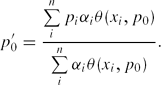 \begin{equation}
p'_0 = \frac{{\sum\limits_i^n {p_i \alpha _i \theta (x_i ,p_0 )} }}{{\sum\limits_i^n {\alpha _i \theta (x_i ,p_0 )} }}.\end{equation}
Here, social learners are indirectly biased: they use the value of a secondary character that characterizes a model – the observed consumption behavior – to determine the attractiveness of that individual as a model for the primary character – the preference concerning a certain consumption level or behavior. Therefore, in determining their own preference level, consumers acquire beliefs from their influential role models about who should be imitated, i.e., about which consumption level one should strive for. In addition, the most influential agents – those characterized by a level of consumption close to the preference level of the individual in question – will prefer higher consumption levels than the population as a whole. We assume an individual's level of consumption to be positively correlated with her preference level. Via cultural transmission, agents adopt from their set of role models a higher preference level than they had before entailing a higher aspired consumption level. Furthermore, two individuals exposed to the same set of cultural models will, on average, adopt different cultural variants of traits affected by the role model bias.
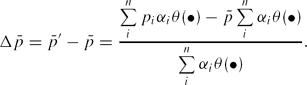
Since we aim at understanding the interdependence between individual preference and consumption levels in a group of interacting agents, we take a population-based perspective on the evolution of these two variables. After having defined the recursions that describe how individuals choose their consumption level and how they attain their preferences for a certain consumption level via cultural transmission, we can capture the evolution of the mean values of xi,  , and pi,
 , in a population consisting of individuals behaving in the described way. To do so, we look at the changes in these mean values given by the following expressions:
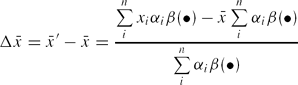 \begin{equation}
\Delta \bar x = \bar x' - \bar x = \frac{{\sum\limits_i^n {x_i \alpha _i \beta ( \bullet ) - \bar x\sum\limits_i^n {\alpha _i \beta ( \bullet )} } }}{{\sum\limits_i^n {\alpha _i \beta ( \bullet )} }}\end{equation}
 \begin{equation}
\Delta \bar p = \bar p' - \bar p = \frac{{\sum\limits_i^n {p_i \alpha _i \theta ( \bullet ) - \bar p\sum\limits_i^n {\alpha _i \theta ( \bullet )} } }}{{\sum\limits_i^n {\alpha _i \theta ( \bullet )} }}.\end{equation}
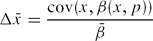
As is shown in Appendix A (see also Price, Reference Price1970), equations (3) and (4) can be reformulated to
 \begin{equation}
\Delta \bar x = \frac{{{\mathop{\rm cov}} (x,\beta (x,p))}}{{\bar \beta }}\end{equation}
 \begin{equation}
\Delta \bar p = \frac{{{\mathop{\rm cov}} (p,\theta (x,p))}}{{\bar \theta }}.\end{equation}
For values of x and p close to and , the bias functions β(•) and θ(•) can be approximated by using a Taylor series approximation (see Appendix B). We then obtain for the changes in the mean values of x and p
 \begin{equation}
\Delta \bar x \approx {\mathop{\rm var}} (x)\left. {\frac{{\partial \ln \beta ( \bullet )}}{{\partial x}}} \right|_{\bar x,\bar p} + {\mathop{\rm cov}} (x,p)\left. {\frac{{\partial \ln \beta ( \bullet )}}{{\partial p}}} \right|_{\bar x,\bar p}\end{equation}
 \begin{equation}
\Delta \bar p \approx {\mathop{\rm cov}} (x,p)\left. {\frac{{\partial \ln \theta ( \bullet )}}{{\partial x}}} \right|_{\bar x,\bar p} + {\mathop{\rm var}} (p)\left. {\frac{{\partial \ln \theta ( \bullet )}}{{\partial p}}} \right|_{\bar x,\bar p} .\end{equation}
In this context, cov(x,p) indicates the covariance between a certain level of consumption, measured by x, and the preference level, p, that determines the consumption level perceived as appropriate by a consumer. This is the assumed positive correlation between an individual's consumption level x and her notions about an ‘adequate’ level of consumption, p. The other term, beginning with var(x) or var(p), gives the change due to the direct effect of variation in that variable; for example, how a change in an individual's consumption level affects her influence as a role model. In order to facilitate an evaluation of this two-dimensional system, we need to define particular functional forms for the direct and indirect bias expressions. Plausible forms of β(•) and θ(•) are Gaussian bias functions
 \begin{equation}
\beta (x,p) = \exp \left\{ { - a(x - p)^2 } \right\}\end{equation}
 \begin{equation}
\theta (x,p) = \exp \left\{ { - b(x - p)^2 } \right\}\end{equation}
 \begin{equation}
\Delta \bar x = G_x \left\{ { - 2a\bar x + 2a\bar p} \right\} - B_{xp} \left\{ { - 2a\bar p + 2a\bar x} \right\}\end{equation}
 \begin{equation}
\Delta \bar p = B_{xp} \left\{ { - 2b\bar x + 2b\bar p} \right\} - G_p \left\{ { - 2b\bar p + 2b\bar x} \right\}.\end{equation}
Next, we solve for  and
 denoting the equilibrium values of the consumption and the preference levels in a population of interacting consumers. It is easy to see that if = , both recursion equations equal zero. Therefore, = is an equilibrium of this two-dimensional dynamic system. Given a graph with on the horizontal axis and on the vertical axis, = is a line through the origin with slope one and any point on this line is an equilibrium. To further analyze the model's dynamic properties, it is helpful to compute its trajectory in such a diagram:
 \begin{equation}
\frac{{\Delta \bar p}}{{\Delta \bar x}} = \frac{{B_{xp} ( - 2b\bar x + 2b\bar p) - G_p ( - 2b\bar p + 2b\bar x)}}{{G_x ( - 2a\bar x + 2a\bar p) - B_{xp} ( - 2a\bar p + 2a\bar x)}} \\
= \frac{{b(B_{xp} + G_p )}}{{a(B_{xp} + G_x )}}. \\
\end{equation}
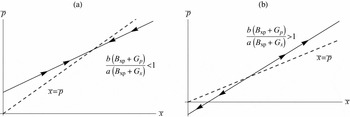
If changes one unit as a result of biased cultural transmission, the preference level, , changes  $\frac{{b(B_{xp} + G_p )}}{{a(B_{xp} + G_x )}}$ units as a consequence of the correlated effects.
Figure 1 shows two-phase plots of the model's evolutionary trajectories that visualize its dynamics. In both cases, the dashed 45-degree lines through the origins with slope one are the lines of equilibrium, where = . Both, and increase above this line of equilibrium and decrease below it. The other lines in Figures 1(a) and (b) give the trajectories of populations of social learners that begin at different initial points and have slope $\frac{{b(B_{xp} + G_p )}}{{a(B_{xp} + G_x )}}$. Given the case depicted in Figure 1 (a), the slope of the trajectory is less than the slope of the line of equilibrium and the system is stable approaching an equilibrium on the 45-degree line, as is indicated by the arrows. On the other hand, in case Figure 1 (b), if the trajectory's slope is greater, the population evolves toward higher and higher preference levels and respective consumption levels when starting from a point above the line of equilibrium.
The phase plots of the model's evolutionary learning trajectories for (a) a > b and (b) a < b (Bxp = 3, Gx = 1, Gp = 1).

Therefore, if a(Bxp+Gx)>b(Bxp+Gp), i.e., if the direct bias, whose strength is measured by the parameter a, is larger than the indirect bias effect, measured by b, then the learning dynamic eventually comes to rest at some point along the line of equilibrium. This situation is depicted in Figure 1(a). On the other hand, if the indirect bias effect of role models is greater, i.e., if b(Bxp+Gp)>a(Bxp+Gx), then the mean of the preference level in the population, , is increasing faster than the mean of the consumption level, measured by , and both traits ‘run away’; the system is unstable (case (b) in Figure 1 for initial values lying above the line of equilibrium). As a consequence, the distance of both mean values from the line of equilibrium is increasing from one learning step to the next ( -
 > - ). Certainly, this process cannot continue forever: some economic or ecological constraints will eventually restrain this dynamic. Some factors not accounted for in the model will eventually limit the evolution of the cultural traits in the population. To conclude, a situation with > (inducing a rise in ) combined with the role model bias function, β(•), that continuously updates the preference levels upward, makes social learners adopt ever more accentuated preferences relative to an ‘appropriate’ level of consumption. This results in a self-augmenting ‘treadmill’ of consumption choices.
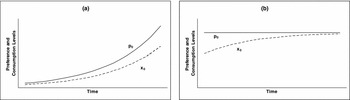
Figure 2 offers another way to visualize the system's dynamic properties. It displays the development of a representative individual's preference level, p 0, and consumption level, x 0, by iterating the two-dimensional system consisting of equations (11) and (12) for many social learning steps. As can be seen in Figure 2(a), the role model bias in social learning gives rise to a widening gap between an individual's preference and consumption levels. This might also be interpreted as a growing discontent of an agent with her material condition. Figure 2(b), in contrast, assumes that no role model bias continuously updates a consumer's preference level. In this case, an individual's level of consumption finally reaches her preference level. The closing of this gap might entail a lasting satisfaction of this consumer's preferences.
(a) The development of an individual's preference and consumption levels when indirect bias is greater than direct bias. (b) The development of an individual's preference and consumption levels when there is no indirect bias.

4. Toward a procedural concept of well-being
This section presents an account of well-being that builds upon the insights on processes of cultural learning and preference formation discussed above. The model of cultural transmission informs us about the conditions under which the dynamic interplay of two learning biases can generate a treadmill of self-augmenting consumption cycles. This allows us to draw a line between those learning paths that are in dynamic equilibrium and those paths that depart from this equilibrium in an accelerating way, leading the agent into an extreme state of permanent dissatisfaction where, ultimately, exogenous (economic or ecological) constraints become binding and the latent learning dynamics cannot unfold anymore.
We suggest to use this model for normative purposes in the following way: processes of preference learning can either ‘work’ or ‘fail to work’ effectively. In the former case, the representative agent's gradual updating of her preference level (recall that this is a cardinal variable) settles down in a dynamic equilibrium that allows her to satisfy her preferences by matching her preference path with a corresponding consumption path (again, note that her consumption level, at any point in time, is represented by some cardinal variable). This is the process depicted in Figure 1(a) and it leads us to the following proposition.
Proposition 1: If the preference level of an individual consumer were unaffected by indirectly biased social learning processes, following from equation (11), would be at equilibrium at = unbiased. Thus, if < unbiased the mean value of a population's consumption level would increase; if it is greater than unbiased, it would decrease.
In the latter case, the agent continuously modifies her preference levels in such a way that she systematically fails to successfully satisfy her preference level (and, hence, fails to increase her well-being). If we interpret preferences as instrumental tools that should ideally enhance the agent's well-being, we may say that the agent, driven by the interplay of our two biases, ends up systematically acquiring dysfunctional tools (as shown in Figure 2(a)). This phenomenon is captured by our second proposition derived from the model:
Proposition 2: If the consumers’ mean consumption level, measured by , reaches their mean preference level, , they temporarily meet their corresponding needs. This state is, however, of a transitory nature only if is continuously modified by processes of biased social learning via cultural role models. The individuals then feel deprived again and strive to adapt their consumption level to this new preference level determining the new level of consumption perceived as appropriate. However, the additional resources spent on reaching the new consumption level still only lead to satisfying one's (modified) consumption preference as it did on lower levels of consumption.
Our model of cultural transmission then allows us to operationalize Elster's intuitive idea that in a world of preference endogeneity we should inquire into the historical genesis of the agents’ preferences (see Section 2, above) in order to be able to distinguish between desirable and undesirable ways of preference learning. In Elster's original paper, he mentions ‘adaptive preference formation’ and the ‘deliberative manipulation of wants by other people’ as cases of undesirable preference change (Reference Elster, Sen and Williams1982: 223, 226–230). In his account, the label ‘undesirable’ refers to the presumed lack of ‘autonomy’ in the acquisition of preferences. In contrast, we focus on an empirically particularly relevant case of social conditioning that involves our specific two biases. The model can be used to track the genesis of an agent's preferences by identifying the way these biases interact in driving the agent's process of preference formation. Based on the empirically observed differential impact of these two biases, it is then possible to suggest a normative distinction between two kinds of preference dynamics.
This distinction can be made normatively relevant by suggesting the following notion of individual well-being: rather than being defined as the satisfaction of ‘given’ and perfectly consistent preferences, in our setting well-being should be understood as the individual ability to engage in the effective learning of new preferences over time, with the ‘effective’ proviso reflecting the absence of systematical frustration on the part of the agent. ‘Frustration’ is to be understood in terms of our model of cultural learning, as the systematic non-satisfaction of preferences, due to the ongoing process of preference updating, fuelled by the influence of social role models, in combination with a consumption level that does not grow at the same pace. Consequently, although the individual's level of consumption rises, her preferences remain unsatisfied, since the agent continues to be frustrated by what she is able to attain. In this perspective, the effective learning of new preferences constitutes well-being in a partly procedural sense. It is partly inherently valuable, i.e., independent of the outcomes in terms of preference satisfaction, and its value is independent of the logical consistency of an agent's vector of preferences at any given point in time. Endogenous preferences turn out to be naturally inconsistent, so in our view it does not make sense to treat inconsistency as an argument for discounting the value of an agent's preferences.Footnote 22
As mentioned above, an alternative way to clarify the contours of our criterion is to frame it in terms of the metapreference approach pioneered by Frankfurt (Reference Frankfurt1971) and elaborated by George (Reference George2004, Reference George2006), among others. We generalize that approach by considering the process that either leads toward an alignment of first- and second-order preferences or away from it. By explicitly modeling the process (or at least one component of it), we are also able to go beyond the assumption that preference change just ‘happens’. Preferences of course often shift in arbitrary and unpredictable ways. But there are also cases where agents develop their preferences further, acquiring valuable knowledge in the process, which tends to make this process irreversible.Footnote 23
In light of our notion of well-being, status-oriented consumption qualifies as a policy problem to the extent that it generates learning dynamics that ultimately (and, perhaps, paradoxically) jeopardize the individuals’ ability to ‘try out’ new preferences in an ongoing, sustainable way. At the level of instrumental policy-making, it follows that policy should at least not restrict, but preferably foster the ability of individuals to engage in the effective learning of new preferences. In order to achieve this, it seems that two general conditions have to be met: first, agents should obviously be left free to acquire new preferences as they see fit. They should, then, be endowed with the maximum set of opportunities that is compatible with everyone else's opportunity set. Note that this first condition is identical to Sugden's criterion of well-being as ‘opportunity’ (see above). In our framework, it is however not sufficient: our model of cultural transmission predicts that preference formation may be dynamically unstable under certain circumstances. These circumstances are targeted by our second condition: policy should design the institutional framework of markets in such a way that the tendency of preference dynamics to ‘collapse’ by inducing self-augmenting cycles will at least not be promoted, but preferably reduced. Prima facie, this may be achieved by a variety of tools that either involve ‘hard’ paternalism (involving taxation of status goods, say) or milder LLSBA interventions that aim directly at influencing consumers’ preferences.
How can our notion of well-being be justified? We propose to follow Sugden (Reference Sugden2008) in adopting a contractarian perspective that frames the issue of evaluating alternative policy rules in terms of a mutual ‘constitutional’ agreement between the individuals that will be affected by the rules. In order to operationalize this approach, assume that all those individuals are put behind a Rawlsian ‘veil of ignorance’ that deprives them of all information about the preferences they themselves will adopt in the future ‘market game’, where they will be subject to processes of cultural transmission.Footnote 24 Assume furthermore that they do know about the characteristics of the model of cultural learning introduced in Section 3, above, i.e., the agents know about the conditions that may undermine the ongoing learning of new preferences and ‘trap’ them in self-defeating cycles of status consumption. Given these assumptions, we claim that those individuals may agree upon assessing alternative policy rules in light of our notion of well-being. This claim would be refuted if individuals would, through a process of public deliberation, reject the idea to guide and structure policy with the help of such a notion.Footnote 25
This claim is backed by the following proposition: Our notion of well-being satisfies all the criteria that have been posited in Section 2, above. First, it is not detached from what real-world individuals are able to care about and effectively do care about. Being an essential contributing factor to an individual's identity and sense of self, preference learning (and the ability to pursue it) can be argued to be even one of the most important things in life people care about.Footnote 26 Hence, we argue that our concept of well-being satisfies the ‘internalism’ Criterion 1.
Second, our notion of well-being allows for individual preferences to be inconsistent and departing from what is in the agent's ‘best interests’. In our context, this means that under certain circumstances the agent may willingly acquire preferences that turn out to be self-defeating from an ex post perspective. The possible dissociation between preference, choice, and well-being is built into our approach to reasoning about well-being. That is why Criterion 2 is satisfied.
Third, our notion of well-being is explicitly tailored to a world where preferences are not ‘given’ once and for all, but change endogenously. Specifically, they are subject to ‘natural’ processes of social conditioning, which in our model come in the shape of two kinds of biases and their dynamic interplay. In this context, the main advantage of our concept of well-being lies in its procedural nature that reflects the procedural account of preferences supported by our positive background model. Hence, Criterion 3 is satisfied.
Fourth, by virtue of requiring to give agents maximum opportunities to engage in preference learning (subject only to freedom-preserving LLSBA interventions to prevent ‘traps’ in the dynamics of preference learning, see above), our notion of well-being includes considerations related to the instrumental value of individual freedom and opportunity. This allows us to conclude that Criterion 4 is satisfied as well.
Let us also consider an objection that may easily be raised: Doesn't the freedom to learn any new kind of preferences as one sees fit imply that people are free to acquire ‘perverse’ or anti-social (racist or sadist) preferences? To this, we would reply that, first, what counts as ‘perverse’ in a given historical or cultural context is far too malleable for policy-makers to care about (consider the example of homosexuality). Second, in order to try out and learn anti-social preferences, agents will typically have to engage in behavior that is positively harmful and will, then, be legitimately banned anyway.
Next, we return to the problem of status-related consumption. At the level of applied policy-making, our procedural notion of well-being (with its positive background model of cultural learning) may be used to assess the desirability of the usually proposed sets of policy tools to shape people's consumption of status goods. Consider ‘hard’ paternalism. Contrary to a widely shared view in the literature on conspicuous consumption and ‘positional externalities’ (Frank, Reference Frank2008), our model shows that the taxation of status goods is ineffective in reducing the consumption of status-signaling goods and the accompanying participation in ‘status races’. Recall the key relationship between and (Figure 1). If < , a tax imposed on the consumption of the good in question would merely increase the difference between and without removing the consumers’ general motivation to meet their preference level by increasing their personal consumption levels and, thus, finally . The role model-based acquisition of modified preference levels via social learning would remain unaffected. In the case of taxation, ‘status races’ would still take place by means now affordable within the boundaries of the new economic restrictions. Hence, this kind of consumption dynamic may occur on the basis of rather different classes of commodities depending on the available income. The hard-wired motivational factors driving status-seeking would remain unaffected.
Hence, interventions that target processes of preference and social norm formation appear to be the best (and probably only) tools available to counter self-defeating preference dynamics. We will briefly consider two kinds of policies that shape preference formation (the proper realm of LLSBA paternalism), two kinds of policies that shape social norm formation by targeting the ‘social meaning’ of activities (Lessig, Reference Lessig1995), and finally the design of institutional frameworks that satisfy the individuals’ need for self-esteem by providing procedural utility (Frey, Benz, and Stutzer, Reference Frey, Benz and Stutzer2004; Schubert, Reference Schubert2012).
As to the first set of policies, we suggest two kinds of interventions: First, policy may influence agents’ preferences by providing information about the characteristics and ‘side-effects’ of consumer goods that will not be provided in the marketplace. This information provision may proceed on more or less neutral terms, i.e., involve the ‘coloring’ of information by using framing effects or other tricks from the behavioral economics toolbox. Our criterion of well-being would endorse the non-neutral provision of information as long as agents are not made subject to manipulation ‘behind their back’, i.e., as long as they can in principle (i.e., if they explicitly wish to do so) realize the degree of non-neutrality, understand both ends and means of public nudging, and act against the policy-maker's goals.Footnote 27
Second, given that, (1), an important precondition of status consumption and the ensuing status races is the individuals’ ability to incur debt and that, (2), widespread overborrowing is a key effect of people's participation in status races, we argue that LLSBA instruments should be used to discourage people from behavior that leads to excessive indebtedness. This may include the operation of ‘counternudges’ to make nudges ineffective that are used by banks to stimulate the incurring of debt. There is also ample empirical evidence that the manipulation of default options can effectively influence people's attitudes toward saving and dissaving (Thaler and Sunstein, Reference Thaler and Sunstein2008).
As to the second set of policies, targeting processes of social norm formation, we again suggest two specific interventions. They aim at influencing the ‘social meaning’ of activities, which Lessig (Reference Lessig1995: 951) defines as the locally uncontested ‘semiotic content attached to various actions, or inactions, or statuses, within a particular context’. They are derived from socially shared understandings or expectations concerning the appropriate course of action in specific situations. To illustrate, consider ‘what it means’ to be black in the American South in the 1960s, to have a whisky in the office in the early 1960s, to have the same whisky in the office in today's business world, or to smoke as a woman in the early 20th century. Within limits, policy may use the conservation or manipulation of social meanings to achieve certain aims, such as the aim to discourage status-oriented consumption. First, it may regulate advertisement by banning the direct appeal to people's role-model bias in the media. Second, it may exploit the very same role model bias by promoting public campaigns that associate prestigious (prominent and glamorous) role models with an attitude that is immune against the lure of status good consumption (by appealing to people's ‘autonomy’ or ‘self-determination’, say). Third, policy may try to redirect the agents’ status consumption toward goods and services that have less harmful side-effects, in particular in terms of the agents’ resources. For example, status-seeking may be redirected toward activities that are also typically intrinsically valued, such as charitable giving.Footnote 28 While this strategy does not remove the basic motivation to engage in status-related consumption, it may at least curb or ‘slow down’ the concomitant preference dynamics by encouraging activities that have been shown to have an independent and lasting impact on the agents’ hedonic well-being (Frey and Stutzer, Reference Frey and Stutzer2002).
Finally, a third set of policies could be implemented to confront directly one of the key motivational drivers of status good consumption, namely people's needs for self-esteem, respect, and a positive self-image (e.g., Johansson-Stenman and Martinsson, Reference Johansson-Stenman and Martinsson2006). Happiness research tells us that the very same set of needs can also be satisfied by organizing human relationships within the political arena or at the workplace in such a way that people gain ‘procedural utility’ (Dolan et al., Reference Dolan, Edlin, Tsuchiya and Wailoo2007; Frey, Benz, and Stutzer, Reference Frey, Benz and Stutzer2004). This may be a supplementary step toward reducing individuals’ desire to satisfy these needs through expensive status good consumption, hence to decrease the demand for status good consumption, the engagement in ‘wasteful’ status races, and the risk of decreasing individuals’ well-being in terms of their ability to self-improve by learning new preferences.
5. Concluding remarks
While behavioral economics provides ample evidence for the fact that in many economically relevant situations real-world individuals may systematically fail to choose what is in their best interests (as perceived by themselves), little progress has been made to derive convincing policy implications from this. We have argued that this is due to the fact that we cannot formulate policy advice without a concept of well-being or welfare, and that the policy-minded literature in the field still lacks a concept of well-being that could be consistently applied in a ‘behavioral’ setting, i.e., in a setting where individual preferences change and tend to be inconsistent.
Our contribution to the literature has been twofold. First, we have tried to facilitate the quest for a ‘behaviorally adequate’ non-standard concept of well-being by introducing a catalog of four conditions that any such concept ought to satisfy. We have used this catalog to gauge the usefulness of those (three) non-standard notions of well-being that have so far been proposed in the literature. In our view, this exercise already sheds light on the contours of a practically applicable concept (for instance, it tells us that such a concept will certainly be of a procedural nature). Second, following the intuition that additional positive insights into the process of individual preference formation may shed further light on this issue, we have introduced a formal model of preference learning. The model predicts that the interplay of two specific biases can generate self-augmenting learning dynamics that lead agents away from sustainable and welfare-enhancing consumption paths. This prediction allowed us to make a distinction between ‘desirable’ and ‘undesirable’ paths of preference learning. This distinction is, thus, not axiomatic, but grounded in empirical evidence, and it can serve as the basis of a procedural notion of well-being. According to this view, well-being is seen as residing in the individual's ability to engage in the ongoing, not systematically frustrated ability to acquire new preferences. Hence, status races call for policy intervention to the extent that they risk decreasing well-being, thus defined.
We hasten to add an important caveat: this policy intervention should not be organized in a top-down way, by some omniscient social planner. Rather, we have suggested to frame the discussion in terms of the contractarian paradigm: our concept of well-being should be used to inform the individuals themselves (as citizens) about possible ways to think about the problem of status races and their impact on well-being. On the basis of this information, the individuals may agree upon a social contract that stipulates a set of rules helping them avoid the welfare losses associated with status races, while essentially maintaining their personal freedom of choice. Think of it as the analog of a set of traffic rules: they do not prescribe any particular activity (they do not tell you where to go), but they channel interdependent – and potentially harmful – individual behavior in such a way that harmful accidents are avoided as far as possible.
Appendix A
Due to the fact that ∑nixiaiβ(•)=E(xβ(•)), E(x) = , and ∑niaiβ(•)=E(β(•)) in combination with cov (x,β(•)) = E(xβ(•)) - E(x)E(β(•)), we obtain expressions (5) and (6) accordingly in the text.
Appendix B
If we assume the two biases are weak, the variances of x and p in the population are small, and use Taylor series approximations of β(•) and θ(•) in two dimensions, we obtain in the case of the direct bias function
 \begin{equation}
\beta (x,p) \approx \beta (\bar x,\bar p) + (x - \bar x)\frac{{\partial \beta ( \bullet )}}{{\partial x}}\left| {_{\bar x,\bar p} + (p - \bar p)\frac{{\partial \beta ( \bullet )}}{{\partial p}}} \right|_{\bar x,\bar p} ,\end{equation}
and p = (for more details – also concerning the quality of this approximation – see McElreath and Boyd (Reference McElreath and Boyd2007: 754/id, 300ff). We can then substitute this term for β(•) to approximate the covariance expression in equation (5),
 \begin{eqnarray*}
{\mathop{\rm cov}} (x,\beta ( \bullet ))E &\approx& \left\{ {(x - \bar x)\left(\beta (\bar x,\bar p) + (x - \bar x)\left. {\frac{{\partial \beta ( \bullet )}}{{\partial x}}} \right|_{\bar x,\bar p} + \left. {(p - \bar p)\frac{{\partial \beta ( \bullet )}}{{\partial p}}} \right|_{\bar x,\bar p} \right)} \right\} \nonumber\\
&\approx& {\mathop{\rm var}} (x)\left. {\frac{{\partial \beta ( \bullet )}}{{\partial x}}} \right|_{\bar x,\bar p} + {\mathop{\rm cov}} (x,p)\left. {\frac{{\partial \beta ( \bullet )}}{{\partial x}}} \right|_{\bar x,\bar p} . \\
\end{eqnarray*}