Introduction
The endemic notothenioids are the most prominent component of the fish fauna in all Antarctic shelf waters, and species composition differs between the seasonal pack ice of West Antarctica and the permanent pack ice of East Antarctica (Andriashev Reference Andriashev1965). Ichthyologists have also noted some unusual aspects of the bathymetric distribution of these fishes (Andriashev Reference Andriashev1965, Reference Andriashev1987, DeWitt Reference Dewitt1971). For example, whereas the depth of maximum species diversity is at 100–200 m in most continental shelf areas of the world, shelf diversity peaks at 400–600 m in East Antarctica (Andriashev Reference Andriashev1965, DeWitt Reference Dewitt1971), a phenomenon attributable to glacial isostasy (Andriashev Reference Andriashev1987). Given the larger ice sheet, the deeper depth of maximum diversity is more pronounced in East than West Antarctica, where diversity is greatest at 200–400 m. There are also changes in the taxonomic composition of the fauna with depth. In both East and West Antarctica, the dominant notothenioid species differ between the inner and outer shelf, and some notothenioids extend onto the slope (Andriashev Reference Andriashev1965, Reference Andriashev1987, DeWitt Reference Dewitt1971) to depths, in the case of a few species, of 2500–3000 m (Gon & Heemstra Reference Gon and Heemstra1990). Bathymetric zonation of benthic species, including fishes, has also been considered to be the result of niche separation by physiological and ecological adaptations (for a review see Brown & Thatje Reference Brown and Thatje2014).
Although notothenioids evolved in situ, the Antarctic fish fauna also contains representatives of cosmopolitan non-notothenioid groups of northern origin, such as zoarcids, liparids and macrourids (Andriashev Reference Andriashev1987, Anderson Reference Anderson1990a). Zoarcids (Anderson Reference Anderson1990b) and liparids (Stein & Andriashev Reference Stein and Andriashev1990, Andriashev Reference Andriashev2003) are found on the shelf and slope, and high-Antarctic macrourids of the genus Macrourus are primarily mid-slope and seamount species (Iwamoto Reference Iwamoto1990, Clark et al. Reference Clark, Dunn, McMillan, Pinkerton, Stewart and Hanchet2010). The abundance and diversity of these three taxa increase at depths greater than 500–600 m, and, at least in the Bellingshausen Sea, zoarcids are the dominant element (Matallanas & Olaso Reference Matallanas and Olaso2007). However, our knowledge of most aspects of the biology of these three groups is far less comprehensive than that for notothenioids.
Recent bottom-trawling and trapping at depths below 1000 m have yielded many new species of non-notothenioids, especially zoarcids (Matallanas Reference Matallanas2010, Reference Matallanas2011, Matallanas et al. Reference Matallanas, Corbella and Møller2012) and liparids (Chernova & Prut’ko Reference Chernova and Prut’ko2011, Stein Reference Stein2012). Nevertheless, depths greater than 1000 m remain under-sampled (Duhamel et al. Reference Duhamel, Hulley, Causse, Koubbi, Vacchi, Pruvost, Vigetta, Irisson, Mormède, Belchier, Dettai, Detrich, Gutt, Jones, Kock, Lopez Abellan and van de Putte2014, p. 331) and there are few quantitative data on taxonomic changes with depth. The 1000–2000 m interval in the Ross Sea is a notable exception because the longline fishery for Antarctic toothfish, Dissostichus mawsoni Norman, operates in this depth range and results in a significant bycatch of notothenioids and non-notothenioids (O’Driscoll et al. Reference O’driscoll, Hanchet and Miller2012, Hanchet et al. Reference Hanchet, Stewart, McMillan, Clark, O’driscoll and Stevenson2013). There is a bias associated with this bycatch in that it captures primarily scavenging fishes that are attracted to an odour plume.
A camera system towed along the outer shelf and slope provided an opportunity to compile higher level taxonomic identification and abundance data for demersal fishes in an area west of Anvers Island in the Palmer Archipelago. We have previously demonstrated the feasibility of identifying fishes in photographs obtained with our towed camera-system in transects in Marguerite Bay and the Amundsen Sea (Eastman et al. Reference Eastman, Amsler, Aronson, Thatje, McClintock, Vos, Kaeli, Singh and La Mesa2013). Our photographic data are not comparable to that obtained with a bottom-trawl because small species (≤15–20 cm total length) are missed or unidentifiable in the photographs; however, our data provide insight into the largest and most conspicuous elements of the fauna and their depth distributions. By analysing photographs from this survey relative to bathymetry, we i) provide data for family level taxonomic composition, absolute abundance and areal abundance, and ii) discuss the potential homogeneity of the fauna on the outer continental shelf and upper slope around Antarctica.
Materials and methods
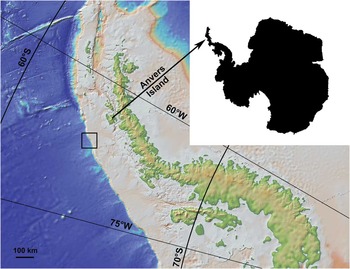
A photographic survey of benthic communities on the continental shelf and slope west of Anvers Island, Antarctica, was conducted aboard the RV Nathaniel B. Palmer in November 2013 (cruise NBP 13-10: 63.53°S, 66.05°W to 64.30°S, 67.43°W). SeaSled, a towed camera vehicle, imaged nine benthic transects, each approximately 8 km long. The 100-by-100 km survey area incorporated both the shelf-break at 450–500 m and the slope, which in this area of the peninsula descended steeply to 2000 m and then flattened between 2500 and 3000 m (Fig. 1). Four depth ranges were chosen for this survey: 400–700 m, 700–1100 m, 1100–1600 m and 1600–2100 m. An additional ‘vertical’ transect cut across depth contours in a depth range of 400–1500 m. Details of SeaSled imaging and environmental sampling specifications are described in Amsler et al. (Reference Amsler, Smith, McClintock, Singh, Thatje, Vos, Brothers, Brown, Ellis, Anderson and Aronson2015).
Location of the 100-by-100 km photographic survey (box) encompassing the outer continental shelf and upper slope off Anvers Island, Antarctica. The upper right silhouette indicates the Antarctic continent and the arrow points from Anvers Island to its location along the western Antarctic Peninsula. Bathymetry constructed in GeoMapApp 3.5.1. based on data from Smith & Sandwell (Reference Smith and Sandwell1997).

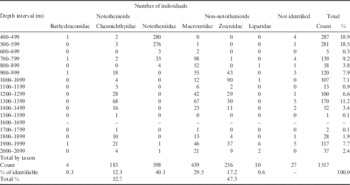
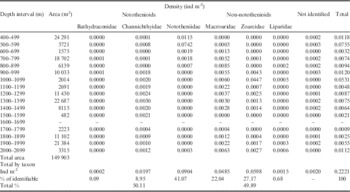
The results of our counts are expressed as absolute abundances (Table I) and areal densities (Table II) by 100 m depth intervals from the cumulative transects and by taxon. The area for each depth zone was determined by combining the area covered by each image within the depth zone. Overlap in images was accounted for using the distance travelled between each image. There was considerable variation in the area photographed for each depth interval; the 1500–1599 m interval was notably under-sampled and there was no photography within the 1600–1699 m interval. Because the 1500–1700 m intervals were under-sampled in our survey, normalized counts are presented as areal densities (Table II).
Absolute abundances of demersal fishes by depth and taxon on the shelf and slope west of Anvers Island, Palmer Archipelago, Southern Ocean (63.53°S, 66.05°W to 64.30°S, 67.43°W).

Areal densities of demersal fishes by depth and taxon (based on data in Table I) on the shelf and slope west of Anvers Island, Palmer Archipelago, Southern Ocean (63.53°S, 66.05°W to 64.30°S, 67.43°W).

The identification of fishes in photographs relied upon on our familiarity with the Antarctic fauna gained from previous trawling and trapping during fieldwork around the continent, and on our prior experience identifying Antarctic fish in photographs (Eastman et al. Reference Eastman, Amsler, Aronson, Thatje, McClintock, Vos, Kaeli, Singh and La Mesa2013). Gon & Heemstra (Reference Gon and Heemstra1990) and more recent taxonomic literature were also consulted. Four species of the macrourid genus Macrourus occupy slope depths in the sub-Antarctic and Antarctic, including the recently described cryptic species, M. caml McMillan, Iwamoto, Stewart & Smith. This species is found in the area of our survey and is geographically and bathymetrically sympatric with M. whitsoni (Regan) in the Antarctic (McMillan et al. Reference McMillan, Iwamoto, Stewart and Smith2012, Pinkerton et al. Reference Pinkerton, McMillan, Forman, Marriott, Horn, Bury and Brown2013). Because these two species are morphologically similar and were indistinguishable in our images, they were collectively identified as Macrourus spp.
Depth was not a factor in our ability to identify fishes in photographs because the camera array was towed at ≤10 m above the substrate regardless of the depth of the water column above, and this provided uniform lighting of the photographic field. Lighting consisted of paired 150 w-sec strobes mounted aft of the cameras to minimize backscatter. Although several images did show a cloud of disturbed substrate suggesting that an animal on the bottom had moved away rapidly, in general alarm reactions or escape responses by fish were not detected in response to the strobe flash.
Results
The nine transects imaged on the outer continental shelf and slope off Anvers Island yielded 35 437 images that were analysed for fishes. All images analysed were ≤10 m off the seafloor and collectively visualized approximately 149 903 m2 of the benthos. A total of 1277 images had single fish in them and 32 had multiple fish. Near-bottom water temperatures increased with depth from 0.46°C at 2000 m to 1.55°C at 700 m, while 1.39°C at 400 m.
Tables I & II provide absolute abundances and areal densities by depth and taxon. Our focus in this paper is on absolute abundance; hence, we simply note that the values for areal density were low (Table II) and will not be considered in additional detail except to mention that notothenioids, especially nototheniids, accounted for 50.1% of the areal density. Non-notothenioids accounted for 49.9%, with zoarcids and macrourids overwhelmingly dominant.
Absolute abundance
Our images contained a total of 1517 fishes. Of these, 1490 were identified at least to the level of the family. The four most abundant families were Nototheniidae, Macrouridae, Zoarcidae and Channichthyidae (Table I). Of the fish identified, 52.7% individuals counted were notothenioids, predominantly species of the families Nototheniidae and Channichthyidae, and 47.3% were non-notothenioids, mostly macrourids and zoarcids. The most abundant species were Lepidonotothen squamifrons (Günther) at 30.5%, Macrourus spp. at 29.5%, and Chionobathyscus dewitti Andriashev and Neelov at 11.7%. Absolute abundance peaked at 400–599 m. Minor peaks in several other depth intervals may simply reflect the larger area imaged at these depths (Table II).
Taxa across depths
Nototheniids were most abundant at 400–599 m. Most individuals were L. squamifrons or species of Trematomus, especially T. loennbergii Regan. Lepidonotothen squamifrons was approximately three-fold more abundant than T. loennbergii. The abundance of nototheniids fell off abruptly at depths >599 m, although two relatively small individuals of D. mawsoni were seen resting on the substrate at depths of 1949 and 2002 m.
A few channichthyids (Chaenocephalus aceratus (Lonnberg) and Chaenodraco wilsoni Regan) were present at the shallow ends of transects between 400–599 m. At greater depths, the channichthyids were almost exclusively C. dewitti. This species appeared at 704 m, was most abundant at 900–1499 m and persisted to 2007 m (Table I).
The transition in dominance from notothenioids to non-notothenioids, specifically Macrourus spp. and zoarcids, occurred between 700 and 999 m. Macrourus spp. began to appear at 704 m and were most abundant at 700–1499 m. Allowing for gaps in sampling, they were continuously present into the deepest intervals of the survey with an observed maximum of 2045 m (Table I).
Benthic and pelagic zoarcids appeared at 740 m, were most abundant at 900–1099 m and persisted to 2099 m (Table I). Approximately two-thirds of the zoarcids were the pelagic Melanostigma gelatinosum Günther, known to be common in the area of our survey. They frequently occurred in groups of 2–3, and up to 10, widely spaced individuals, and exhibited anguilliform locomotion when swimming a few metres above the substrate. We were not able to identify the benthic zoarcids even to the level of genus although, as previously mentioned, they have recently been recognized as an important but underestimated component of fish biomass in high-Antarctic localities.
Liparids, of several different morphotypes including tadpole-like forms, were sparse and encountered mostly at depths of 1900–2099 m.
Discussion
Abundant species
Lepidonotothen squamifrons, Macrourus spp. and C. dewitti were the most abundant species of demersal fishes encountered in our transects. The fishes identified in our photographic transects are the same species that have been collected elsewhere in the Antarctic at outer shelf/upper slope depths or, in the case of L. squamifrons (Clark et al. Reference Clark, Dunn, McMillan, Pinkerton, Stewart and Hanchet2010, Hanchet et al. Reference Hanchet, Stewart, McMillan, Clark, O’driscoll and Stevenson2013), at shallower depths and around seamounts. This previous information was obtained during research trawling, acoustic surveys and as bycatch from longline fishery for the Antarctic toothfish D. mawsoni. For example, there are data with absolute abundance values similar to ours for Macrourus spp. plus C. dewitti and/or L. squamifrons near the Antarctic Peninsula and in the Bellingshausen Sea in the Atlantic Sector (Arana & Vega Reference Arana and Vega1999). There is comparable information for the Indian Ocean Sector off Adélie Land (Koubbi et al. Reference Koubbi, Ozouf-Costaz, Goarant, Moteki, Hulley, Causse, Dettai, Duhamel, Pruvost, Tavenier, Post, Beaman, Rintoul, Hirawake, Hirano, Ishimaru, Riddle and Hoise2010, Causse et al. Reference Causse, Ozouf-Costaz, Koubbi, Lamy, Elaume, Dettaï, Duhamel, Busson, Pruvost, Post, Beaman and Riddle2011) and for the Ross Sea in the Pacific Sector (Clark et al. Reference Clark, Dunn, McMillan, Pinkerton, Stewart and Hanchet2010, O’Driscoll et al. Reference O’driscoll, Hanchet and Miller2012, Hanchet et al. Reference Hanchet, Stewart, McMillan, Clark, O’driscoll and Stevenson2013). It is estimated that Macrourus may constitute over 65% of the total fish biomass on the Ross Sea slope and seamounts to the north (Hanchet et al. Reference Hanchet, Stewart, McMillan, Clark, O’driscoll and Stevenson2013).
Abundant species are trophically linked to Dissostichus mawsoni
Macrourus spp., L. squamifrons and C. dewitti are integral components of the food web of the upper continental slope around Antarctica and, as such, are important prey for D. mawsoni, the largest predatory fish at these depths (Fenaughty et al. Reference Fenaughty, Stevens and Hanchet2003, Stevens et al. Reference Stevens, Dunn, Pinkerton and Forman2014). More specifically, in longline catches at depths of 1157–1798 m in the Lazarev Sea (Atlantic Ocean Sector), C. dewitti and Macrourus spp. were the most important fish in the stomach contents of D. mawsoni, with C. dewitti being two-fold greater by both frequency of occurrence and weight (Petrov & Tatarnikov Reference Petrov and Tatarnikov2011). Lepidonotothen squamifrons is also found in the stomachs of D. mawsoni caught by the longline fishery at depths of 1500–2033 m around Bouvet Island, again in the Atlantic Sector (Petrov Reference Petrov2011). At 786–1552 m in the Weddell Sea, also within the Atlantic Sector, M. whitsoni and C. dewitti were first and fourth most important dietary items by weight at 55% and 8.6%, respectively (Petrov & Gordeev Reference Petrov and Gordeev2015). In catches at slope depths in the Ross Sea, Macrourus spp. were c. 40% of stomach contents by weight compared to 27% for C. dewitti, the most important channichthyid in the diet of D. mawsoni (Pinkerton et al. Reference Pinkerton, Forman, Stevens, Bury and Brown2012, Reference Pinkerton, McMillan, Forman, Marriott, Horn, Bury and Brown2013, Stevens et al. Reference Stevens, Dunn, Pinkerton and Forman2014). Although early juveniles of D. mawsoni are pelagic (Hanchet et al. Reference Hanchet, Rickard, Fenaughty, Dunn and Williams2008), later juveniles and subadults have reduced buoyancy (Eastman & Sidell Reference Eastman and Sidell2002, Near et al. Reference Near, Russo, Jones and DeVries2003) and, as confirmed by our images, live demersally.
Is the fish fauna of the circum-Antarctic slope homogeneous in taxonomic composition?
Kaiser et al. (Reference Kaiser, Griffiths, Barnes, Brandão, Brandt and O’Brien2011) considered whether or not the Antarctic slope harbours a ‘distinct’ invertebrate fauna, and concluded that there was not a ‘homogenous and unique’ fauna that was restricted to the slope. Is this also true in the case of Antarctic slope fishes? In the high-latitude shelf areas of the Antarctic, there are notable differences in the taxonomic composition of notothenioids at the specific and generic levels that are sufficient to recognize East and West Antarctic biogeographic provinces (Andriashev Reference Andriashev1987). Based on the data from our photographic survey and on the trawl and fishery data cited above, the fish fauna at slope depths of 1000–2000 m is more homogeneous and circum-Antarctic in character than that of the shelf and is not assignable to a province. This statement, however, refers to only the largest and most conspicuous elements of the fish fauna, and to fishes living within the range of our camera array at ≤10 m above the substrate.
Although the fish fauna of the slope appears geographically homogeneous, unlike the situation for invertebrates, the fish fauna is not confined to the slope. Both Macrourus spp. and C. dewitti are also present on the outer shelf, but are less abundant there than on the slope. Given the limited spatial coverage, our data may underestimate the number of slope taxa found in the area under investigation. For example, members of the gadiform families Muraenolepididae and Moridae do inhabit the Antarctic slope (Gon & Heemstra Reference Gon and Heemstra1990), but they possess swim bladders and live in the water column above the depth of our camera array. Although documented in a previous survey (Eastman et al. Reference Eastman, Amsler, Aronson, Thatje, McClintock, Vos, Kaeli, Singh and La Mesa2013), species of Rajiidae were not encountered in the Anvers Island transects. The most likely explanation is that they are spotty in occurrence and that most of our photography was conducted at depths greater than their preferred range of <650 m (Gon & Heemstra Reference Gon and Heemstra1990).
At least two factors may contribute to the taxonomic homogeneity of the fish fauna at upper slope depths and make provincialization less likely. First, water temperatures are warm enough at slope depths that fishes do not require antifreeze compounds to protect them from freezing. Bottom water minimum and maximum temperatures along our transects were 0.46 and 1.55°C, well above the freezing point of seawater at -1.9°C. This is especially relevant in the case of macrourids, which are not known to possess antifreeze compounds; they do not live on the high-Antarctic shelf but are not excluded from living in the warmer waters of the slope. Lepidonotothen squamifrons and all channichthyids studied to date do possess antifreeze compounds (Near et al. Reference Near, Dornburg, Kuhn, Eastman, Pennington, Patarnello, Zane, Fernández and Jones2012, table S4), which are vital for survival in shelf waters where temperatures may be also low as -1.9°C. However, these species are not excluded from living in the warmer waters of the slope, if the greater slope depths are within their bathymetric ranges.
A second characteristic contributing to homogeneity of the slope fauna may be the relatively broad depth tolerances of the slope fishes. Eurybathy of c. 900 m to nearly 2800 m is documented for each of the three most abundant species in our survey, a feature facilitating habitation of the outer shelf and slope. For example, M. whitsoni is found from 400–3185 m, a range of 2785 m (Iwamoto Reference Iwamoto1990), M. caml from 350–2080 m, a range of 1730 m (McMillan et al. Reference McMillan, Iwamoto, Stewart and Smith2012), and C. dewitti from 460–2025, a range of 1565 m (Miller Reference Miller1993, Eastman et al. Reference Eastman, Amsler, Aronson, Thatje, McClintock, Vos, Kaeli, Singh and La Mesa2013). Although most of our specimens of L. squamifroms were from 400–599 m, this species is known from 5–900 m, a range of 895 m (Gon & Heemstra Reference Gon and Heemstra1990, Miller Reference Miller1993, Petrov Reference Petrov2011).
Conclusions
The Antarctic notothenioid fishes of the outer shelf/upper slope have not received much attention. The notothenioids L. squamifrons and C. dewitti and the non-notothenioid Macrourus spp. were identified as the most abundant large demersal species in our photographic survey of the outer slope and upper shelf, although L. squamifrons was found at considerably shallower depths than the other two species. Our results are consistent with abundance data obtained from the limited demersal trawling that has taken place at similar depths elsewhere around Antarctica. The photographic transect provides precise data on the depths at which these species are maximally abundant, and on the depth interval at which the abundance shifts from primarily notothenioids to non-notothenioids, which is 700–999 m. Finally, the slope habitat is receiving increased attention as the fishery for D. mawsoni becomes centred at 1000–2000 m. The three abundant species are the most important fish prey in the diet of D. mawsoni during the portion of its life spent on the slope, and they also constitute a major component of the bycatch of the longline fishery. Despite the recognition of this trophic linkage between D. mawsoni and its prey species, much remains to be learned about the biology of Macrourus spp., L. squamifrons and C. dewitti.
Acknowledgements
The authors thank J. Anderson, C.J. Brothers, A. Brown, D. Ellis and S.C. Vos for assistance with the image analysis and E. Barrero-Oro and an anonymous reviewer for valuable comments. We are grateful to the captain and crew of the RV Nathaniel B. Palmer, along with representatives of the US Antarctic Support Contractor, Lockheed Martin, for assistance at sea. Our research was supported by collaborative grants from the National Science Foundation’s Office of Polar Programs to RBA (ANT-0838846 and ANT-1141877) and JBM (ANT-0838844 and ANT-1141896). JTE was supported by a National Science Foundation grant ANT-0436190. This paper is Contribution No. 137 from the Institute for Research on Global Climate Change at the Florida Institute of Technology.
Author contribution
Margaret O. Amsler conducted the majority of the image analysis, fish identification, data analysis and manuscript writing and editing. Joseph T. Eastman provided the conceptual framework for the manuscript, verified fish identification and wrote a major portion of the manuscript. Kathryn E. Smith assisted with field component, image analysis and manuscript editing. James B. McClintock provided the funding for the photographic survey, contributed intellectual input and edited the manuscript. Hanumant Singh assisted with the field component providing the technological expertise necessary to conduct the photographic survey. Sven Thatje contributed to the conceptual framework of the funded proposal. Richard B. Aronson provided the funding for the photographic survey, contributed intellectual input and edited the manuscript.