Introduction
The mucosa of the nasal and paranasal sinuses has a highly efficient system for the physiological functions of olfaction, respiration and protection.Reference Cvetnić, Cvetnić, Sanković, Herceg and Sipus1, Reference Drettner2 The respiratory epithelial cell layer presents a physical barrier that prevents invasion by micro-organisms, while mucociliary action prevents bacterial infection and protects the mucosa from injury and drying.Reference Shin and Heo3 Rhinosinusitis most often occurs when host factors fail to prevent inflammation.Reference Meltzer, Teper and Danzig4 Sinusitis is almost always accompanied by concurrent nasal airway inflammation and, in many cases, is preceded by rhinitis. Recently, otolaryngologists have recognised the inter-relationship between nasal and sinus passages and have started to refer to sinusitis as rhinosinusitis.Reference Meltzer, Hamilos, Hadley, Lanza, Marple and Nicklas5
Acute rhinosinusitis arises most frequently as a consequence of viral rhinitis (common cold), and bacterial infection can subsequently occur.Reference Stammberger and Posawetz6 The administration of systemic antibiotics is not preferred, because it is ineffective against viral infections, has significant side effects and carries a risk of development of resistance.Reference Demoly7 Topical medications are an alternative treatment method aimed at delivering antibiotics directly to the nasal mucosa. The obvious advantage of topical preparations of intravenous (IV) antibiotics is mucosal exposure to high therapeutic concentrations with limited systemic side effects, thereby effectively treating bacterial infections, such as Pseudomonas biofilms.Reference Cankaya, Ozen, Kiroğlu and Yurttaş8 Intranasal corticosteroids may be used to facilitate drainage and reduce mucosal swelling of inflamed tissue.Reference Davidson, Murphy, Mitchell, Smith and Light9, Reference Meltzer, Jalowayski, Orgel and Harris10 Intranasal corticosteroid therapy acts on glucocorticoid receptors to down-regulate the transcription of pro-inflammatory mediators that had been up-regulated because of the inflammatory cascade.Reference Mygind11 These characteristics make intranasal corticosteroids an attractive option in the management of acute rhinosinusitis. As an adjunct to antibiotics in patients with presumed acute bacterial rhinosinusitis, intranasal corticosteroid treatment has demonstrated greater symptom relief than systemic antibiotics alone.Reference Meltzer, Charous, Busse, Zinreich, Lorber and Danzig12–Reference Meltzer, Orgel, Backhaus, Busse, Druce and Metzger17
We aimed to clinically evaluate the effects of a topical antibiotic and steroid combination therapy administered intranasally, versus an oral antibiotic alone when treating acute rhinosinusitis.
Materials and methods
Study design and participants
We conducted this randomised clinical trial in the otolaryngology outpatient clinic of Suez Canal University Hospital and the Microbiology Department of Suez Canal University, Egypt, from January 2009 to March 2012. The local ethics committee approved the study protocol and we obtained written informed consent from each patient.
Patient eligibility and enrolment
Forty adult patients were eligible and were enrolled in the study. They were aged 18–55 years and met the Berg and Carenfelt criteriaReference Williamson, Rumsby, Benge, Moore, Smith and Cross18 for acute bacterial rhinosinusitis,Reference Garbutt, Banister, Spitznagel and Piccirillo19 i.e. they were positive for a minimum of two out of three symptoms and one clinical sign as follows: purulent nasal discharge with unilateral predominance; local pain with unilateral predominance; bilateral purulent nasal discharge; pus on inspection inside the nose;Reference Williamson, Rumsby, Benge, Moore, Smith and Cross18 and rhinosinusitis symptoms for 7 or more days and 28 or fewer days that were not improving or worsening, or rhinosinusitis symptoms lasting for fewer than 7 days that had significantly worsened after initial improvement.
Patients were excluded if they: had significant comorbidities that may impair their immune response; had allergies or adverse reactions to antibiotics; had received antibiotics in the previous three days; had an allergy to penicillin or amoxicillin; had the complications of sinusitis; had cystic fibrosis; or were pregnant.
Eligible patients attending the study sites, where a research assistant was present, were invited to participate by their physician. The research assistant discussed participation requirements and completed the eligibility assessment and the consent process.
Randomisation
We performed this using a blocked randomisation scheme. We used computer-generated random numbers to evaluate how the drugs were allocated to the consecutively numbered study treatment plans.
We divided patients into two groups. Group A (n = 20) received an antibiotic and steroid combination (ofloxacin 0.26 per cent and dexamethasone 0.053 per cent nasal drops) for 10 days, administered nasally (5 drops in each nostril/8 hours). Group B (n = 20), the control group, received an oral antibiotic alone (amoxicillin 90 mg/kg).
Objective and evaluation of outcome measurements
We wanted to clinically evaluate the effects of a topical antibiotic and steroid combination vs an oral antibiotic alone when treating acute rhinosinusitis.
The primary outcome was the effect of treatment on disease-specific quality of life. We asked all patients to complete a questionnaire assessing their nasal symptoms (nasal obstruction, nasal discharge and facial pain) at day 0 and after 8, 24 and 48 hours, and at the end of day 10 following treatment initiation using a visual analogue scale (VAS) to assess subjective symptoms.
We carried out a complete ENT examination with middle meatus aspiration for all patients at day 0 and again at the end of day 10 following treatment initiation in the following order: we connected a fine catheter to a suction unit and carefully introduced it into the nose under the control of a light source or otoscope; we directed the catheter slightly upwards and away from the nasal floor looking for secretions from the region of the middle meatus;Reference Castellanos and Axelrod20 once we observed a discharge in the catheter, we stopped suction, immediately separated the catheter from the suction unit and withdrew it from the nose; finally, we sent the catheter to the laboratory for culture and sensitivity testing of the contents of the discharge.
Data collection, allocation concealment and blinding
At study enrolment (day 0), each patient underwent a brief interview with the physician to complete a questionnaire, and provided demographic (including race and ethnicity) and disease-related information by selecting from options included in the baseline questionnaire. The physician then completed documenting the symptoms and signs and again after 8, 24 and 48 hours and at the end of day 10 following treatment initiation using a VAS to assess subjective symptoms, with 0 indicating no symptoms and 10 indicating severe or constant symptoms.
Outcomes were also assessed by middle meatus aspiration with culture and sensitivity testing at day 0 and at the end of day 10 following treatment initiation.
Another interview was conducted 10 days following treatment initiation. Interviews comprised a structured questionnaire and were conducted blinded to group assignment.
Statistical analysis
Using pilot data, we estimated that a sample of 10 patients per treatment group would provide an 89 per cent power to detect a true difference at day 10 following treatment initiation.
We processed the data collected using SPSS for Windows, version 22 (IBM Corporation, Armonk, New York, USA). Quantitative data were expressed as mean ± standard deviation, while qualitative data were expressed as numbers and percentages. We used the Student's t-test to compare the significance of difference for quantitative variables that followed a normal distribution.
Results
Forty patients (22 women and 18 men) aged between 18 and 55 years (mean age: 29.6 years) diagnosed with acute bacterial rhinosinusitis (diagnosed clinically and with nasal swab for culture) were included in the study. We randomly divided them into two similar groups. Group A (n = 20) received an antibiotic and steroid combination (ofloxacin 0.26 per cent and dexamethasone 0.053 per cent nasal drops) for 10 days, administered intranasally (5 drops in each nostril/8 hours); group B (n = 20), the control group, received an oral antibiotic alone (amoxicillin 90 mg/kg).
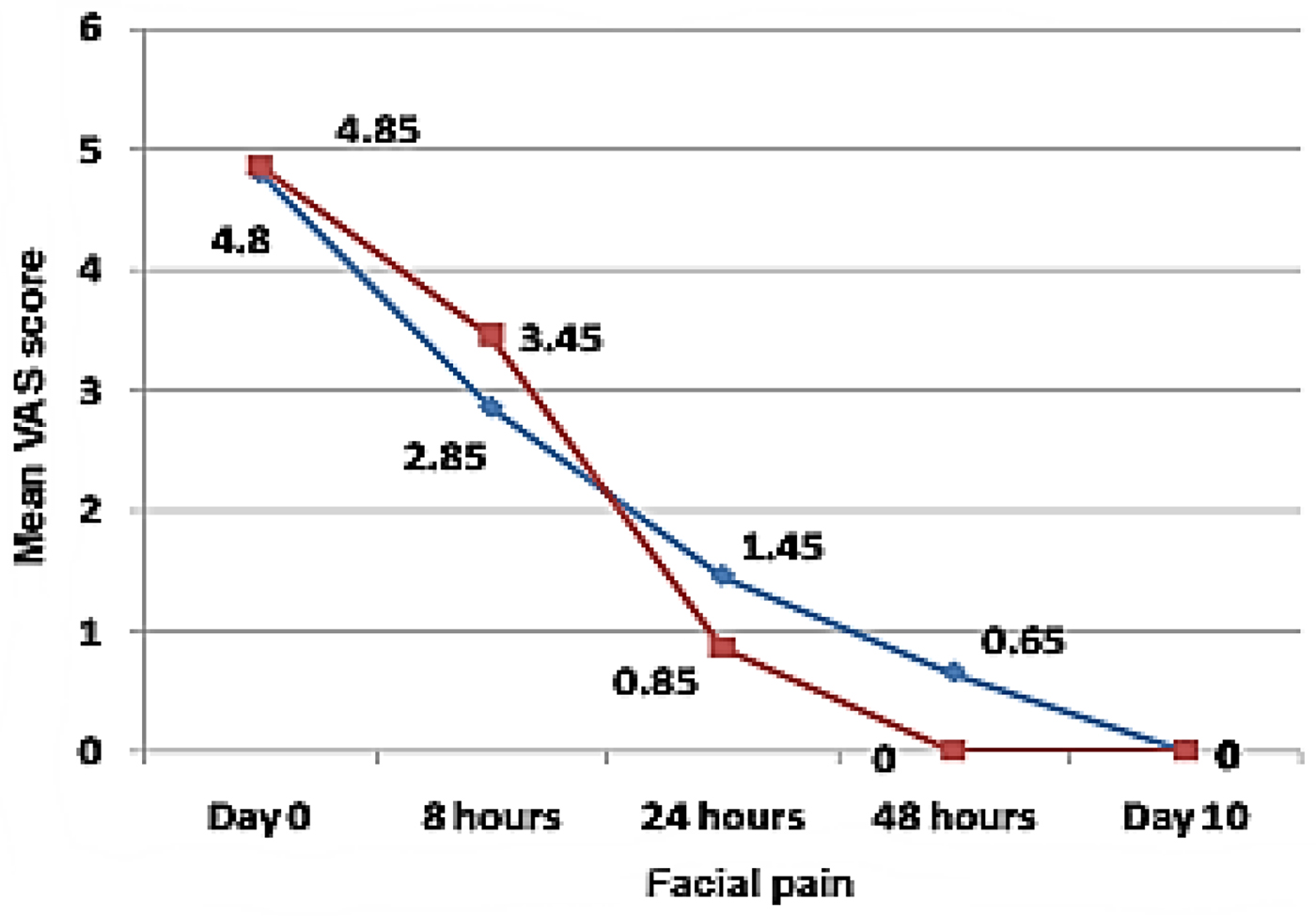
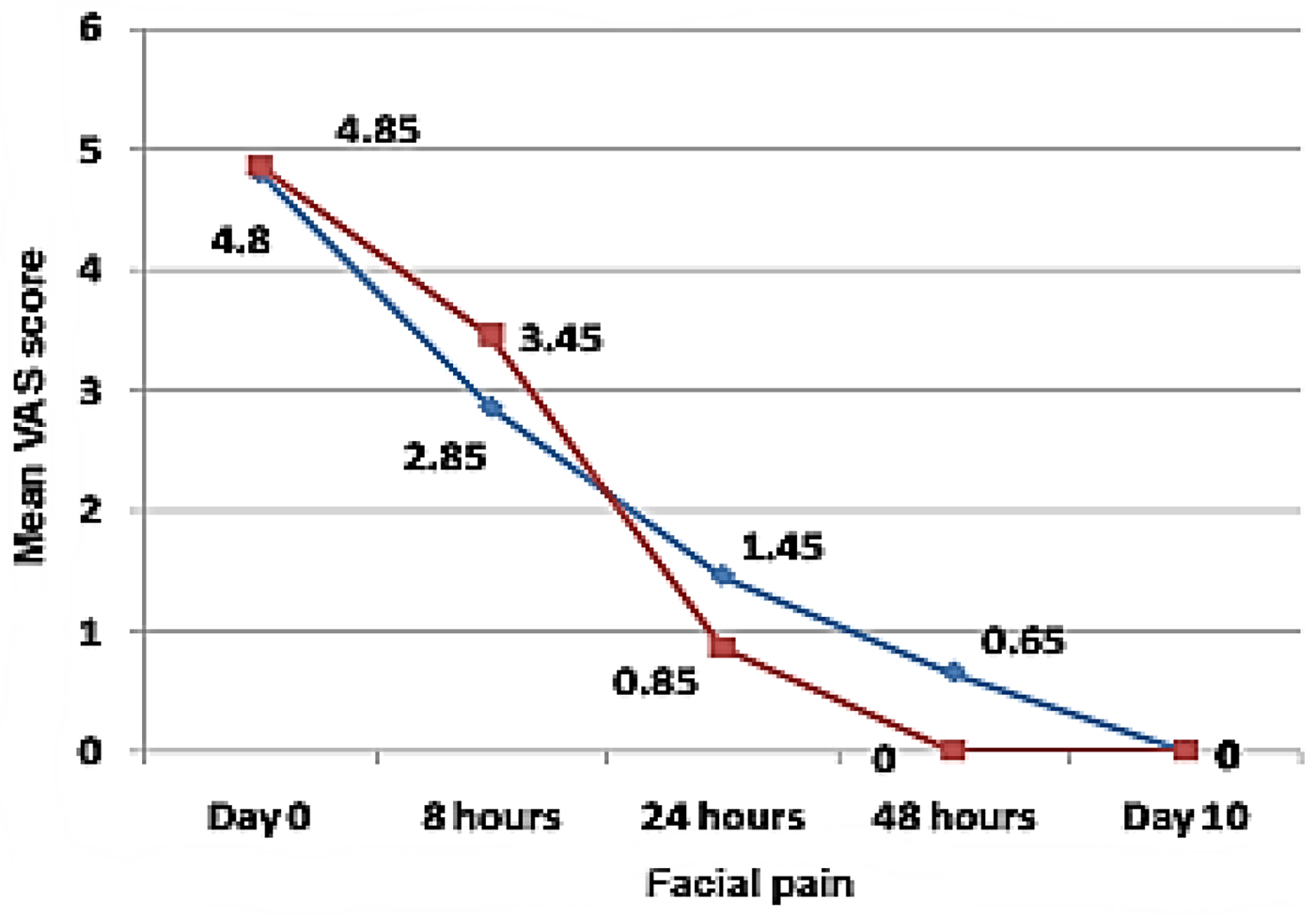
The mean VAS score for facial pain in both groups is shown in Figure 1. At the end of day 10, facial pain was completely absent in both groups. There was no statistically significant difference between patients in the two groups with regard to the mean VAS score for facial pain at day 0, 8 hours and at day 10 after initiation of treatment; however, at 24 and 48 hours after initiation of treatment, the degree of facial pain was significantly lower in group B, as shown in Figure 1.
Mean degree of facial pain in group A (blue line) and group B (red line) before and after treatment. VAS = Visual Analogue Scale
The mean VAS score for nasal obstruction in both groups is shown in Table I. There was no statistically significant difference between patients in the two groups with regard to mean degree of nasal obstruction at 8 hours and 10 days after starting treatment, but at day 0, and at 24 and 48 hours after initiation of treatment, the mean degree of nasal obstruction was significantly lower in group B, as shown in Table I.
Mean degree of nasal obstruction in the two study groups

*p < 0.05. SD = standard deviation
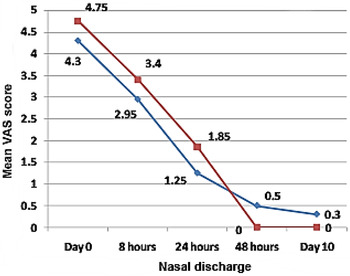
The mean VAS score for nasal discharge in both groups is shown in Figure 2. There was no statistically significant difference between patients in the two groups with regard to the degree of nasal discharge at day 0, at 8, 24 and 48 hours and at day 10 after starting treatment, as shown in Figure 2.
Mean degree of nasal discharge in group A (blue line) and group B (red line) before and after treatment. VAS = Visual Analogue Scale

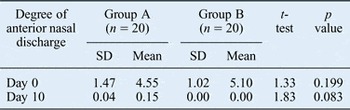
The mean VAS score for anterior nasal discharge in both groups is shown in Table II. There was no statistically significant difference between patients in both groups with regard to the mean degree of anterior nasal discharge at day 0 and 10 days after starting treatment.
Mean degree of anterior nasal discharge in the two study groups

SD = standard deviation
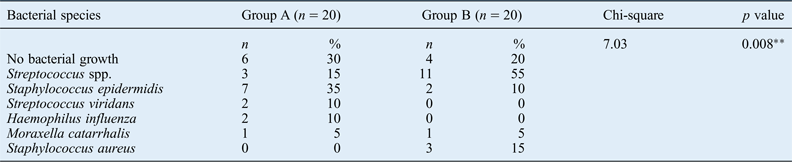
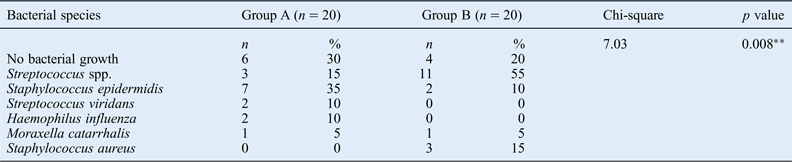
The pre-treatment frequency of bacterial species in the cultures from both groups is detailed in Table III. Streptococcus spp. made up 15 per cent of isolated bacteria in group A and 55 per cent in group B (Table III). Haemophilus influenzae was 10 per cent of isolated bacteria in group A and 0 per cent in group B, and Moraxella catarrhalis was 5 per cent of isolated bacteria in group A and in group B. Staphylococcus aureus was 0 per cent of isolated bacteria in group A and 15 per cent in group B. S viridans was 10 per cent of isolated bacteria in group A and 0 per cent in group B. S epidermidis was 35 per cent of isolated bacteria in group A and 10 per cent in group B, while no growth of bacteria made up 30 per cent of group A and 20 per cent of group B, as shown in Table III.
Pre-treatment frequency of bacterial species in both treatment groups
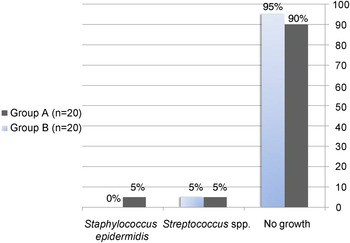
The frequency of bacterial species in the cultures from both groups after treatment is shown in Figure 3. Bacteria were absent (no bacterial growth) in up to 90 per cent of group A and 95 per cent of group B. Streptococcus spp. was 5 per cent of isolated bacteria in group A and group B. S epidermidis was 5 per cent of isolated bacteria in group A, but was absent in group B (Figure 3). There was no statistically significant difference between the two groups with regard to bacterial species present in the cultures from both groups after treatment.
Frequency of bacterial species in the cultures from group A (grey) and group B (lightblue) after treatment.

Discussion
To our knowledge, to date, there are no published data on the effectiveness of a topical antibiotic and steroid combination in treating acute bacterial rhinosinusitis. Ofloxacin topical solution (0.3 per cent) has been approved by the Food and Drug Administration in the USA for the treatment of chronic suppurative otitis media in children older than 12 years.Reference Bluestone21 It is also indicated for the treatment of acute otitis media in children with a tympanostomy tube who are older than 1 year.Reference Gates22
The efficacy of this topical preparation has also been proved against most pathogens isolated in acute and chronic otitis media cases.Reference Klein23 It was also found to be therapeutically equivalent to oral amoxicillin and clavulanate potassium in acute otitis media in patients with a tympanostomy tube.Reference Gates22 Finally, the minimum inhibitory concentration (MIC) of ofloxacin for the typical bacterial pathogens of acute otitis media is still relatively low and potentially achievable via transtympanic membrane delivery, e.g. MIC for penicillin-resistant S pneumonia is about 2 µg/ml.Reference Richter, Brueggemann, Huynh, Rhomberg, Wingert and Flamm24
From all of the previous points and because of the similarity of the main pathogens of acute bacterial rhinosinusitis and acute otitis media, we preferred to use ofloxacin topically in the nasal cavity.
Topical antibiotics have generated considerable interest as an alternative to systemic treatments. Vaughan and CarvalhoReference Vaughan and Carvalho25 reported encouraging results for nasal nebulisation of antibiotics when treating acute exacerbations of chronic rhinosinusitis in a patient group characterised by extensive treatment and drug-resistant flora. The topical route of administration offers the advantages of high local concentrations of drug with minimal systemic absorption, lower costs and decreased morbidity,Reference Wahl and Otsuji26, Reference Scheinberg and Otsuji27 thereby supporting our research.
In 2006, a study by Solares et al.Reference Solares, Batra, Hall and Citardi28 showed that mupirocin nasal irrigations may avoid the need for IV antibiotics, which often provide only temporary benefits and entail greater cost and morbidity. Thus, mupirocin nasal irrigations may provide a relatively simple means for the management of methicillin-resistant S aureus exacerbations of chronic rhinosinusitis,Reference Scheinberg and Otsuji27 again supporting our research.
Although antibiotics have been the mainstay of therapy, recent evidence has suggested that intranasal corticosteroids can provide additional benefit when used as an adjunct.Reference Nayak, Settipane, Pedinoff, Charous, Meltzer and Busse14 The rationale for intranasal corticosteroids in acute rhinosinusitis resides in their anti-inflammatory properties, as inflammation and oedema of the mucous membranes of the nasal turbinates and sinus ostia block the drainage routes and impair mucociliary clearance mechanisms, so reducing inflammation by using intranasal corticosteroids leads to faster drainage, increased aeration and better access for topical antibiotics.Reference Small, Bachert, Lund, Moscatello, Nayak and Berger29
A study by Meltzer et al. involved patients aged 12 years or older with acute bacterial rhinosinusitis confirmed by sinus computed tomography scan. Patients were treated for 21 days with amoxicillin and clavulanate potassium and randomised to receive concurrent mometasone furoate nasal spray or placebo spray. Symptom scores revealed that mometasone furoate nasal spray treatment decreased the total symptom score and individual scores for headache, congestion and facial pain vs placebo (p < 0.05).Reference Meltzer, Charous, Busse, Zinreich, Lorber and Danzig12
There are many studies confirming the safety of intranasal steroids, such as the study by Giger et al.Reference Giger, Pasche, Cheseaux, Cantini, Rossetti and Landis30 In a randomised, double-blind, parallel-group trial involving 112 patients with non-allergic chronic rhinosinusitis, they did not detect any signs of adrenal suppression or significant changes in morning serum cortisol values with once- or twice-daily intranasal beclometasone dipropionate (400 μg/day) administered for 12 weeks.
In our study, post-treatment middle meatal culture showed that there was a non-significant difference between group A (4 cases (20 per cent) still showed bacterial growth) and group B (only 1 case (5 per cent) showed bacterial growth). This could be attributed to subpotent dosage, rapid nasal clearance or the inability of the drops to reach the site of infection in the sinuses. In addition, our microbiological laboratory was unable to determine if S pneumoniae was present at pathogenic levels (more than 104 colony-forming units).
We found that the topical antibiotic and steroid combination was potentially effective in treating acute bacterial rhinosinusitis as there was no significant difference in clinical improvement in group A, which received the topical antibiotic and steroid combination, and group B, which received the oral antibiotic alone.
There was a delay in clinical improvement from the point of view of facial pain and nasal obstruction in the first 24 and 48 hours of starting treatment in group A. This delay in clinical improvement may have been due to the drug combination being unable to achieve a high concentration in the middle meatus, inappropriate position of the patient's head when the drug was administered into the nostrils, or may have been due to mode of application (drops, spray or irrigation).
The delay in clinical improvement may also be due to a decrease in contact time of the topical drug combination with the nasal mucosa as the nasal mucus layer is renewed approximately every 10 minutes, although this occurs in clear, uninfected, non-allergic nasal mucosa. Another explanation could be due to the inability to achieve a high concentration of the drug combination at the sinuses as the movement of mucociliary clearance is towards the sinus ostium and the application device was not pressurised.
• Acute rhinosinusitis arises as a consequence of viral rhinitis, and bacterial infection can subsequently occur
• A topical antibiotic and steroid combination is potentially effective in treating acute bacterial rhinosinusitis
• Direct application of an antibiotic and steroid combination into the nasal cavity is an effective way of treating uncomplicated, acute bacterial rhinosinusitis
• The advantages of a topical antibiotic and steroid combination include easy administration, high local drug concentration and minimal systemic adverse effects
In conclusion, direct application of an antibiotic and steroid combination into the nasal cavity is an effective way of treating non-complicated, acute bacterial rhinosinusitis, with the theoretical advantages of easy administration, high local drug concentration and minimal systemic adverse events.