


Introduction
Concerns about food production are increasing with the growth of the world population. One of the processes that greatly influenced food production was the synthesis of ammonia by the Haber–Bosch process (Erisman et al., Reference Erisman, Sutton, Galloway, Kimont and Winiwarter2008). However, the availability of reactive nitrogen from industrial processes varies in different parts of the world (Galloway et al., Reference Galloway, Townsend, Erisman, Bekunda, Cai, Freney, Martinelli, Seitzinger and Sutton2008).
In marginal agricultural areas, the use of nitrogen fertilizers is limited by the lack of financial resources required for investment, or the lack of investment owing to the high chance of yield losses due to climate risk. Low input systems are more dependent on soil organic matter and plant residues (Gijsman et al., Reference Gijsman, Hoogenboom, Parton and Kerridge2002). However, organic production systems, which range from closed systems (also considered low input) to simpler systems that only meet certification, also depend on the production of organic compost and green manure (Reganold and Wachter, Reference Reganold and Wachter2016).
Organic corn (Zea mays L.) production in the Zona da Mata region of Minas Gerais in Southeastern Brazil is restricted to only one crop per year because of its rainfall regime, and the additional restriction of low availability of mechanizable area for corn farming makes it more difficult for rotation with a leguminous crop. Therefore, alternative means of improving nitrogen management in the crops are needed. One of them is the consortium of corn with legumes, including jack bean (Canavalia ensiformis), which are associated with rhizobia nitrogen-fixers and can keep growing after the corn harvest, to be used as green manure in the successor crop (Corrêa et al., Reference Corrêa, Galvão, Fontanetti, Miranda, Lemos, Rodrigues and Conceição2011). However, it is preferable to grow black oat (Avena strigosa) during the off-season, in order to obtain a higher production of straw with a high C/N ratio for both increased soil cover and weed control (Coelho et al., Reference Coelho, Galvão, Trogello, Campos, Pereira, Barrella, Cecon and Pereira2016).
Another alternative is the inoculation of corn plants with selected strains of diazotrophic bacteria. Since 2019, the strains Ab-v5 and Ab-v6 of the species Azospirillum brasilense have been registered for use in corn. Inoculation with these strains has resulted in a 27% increase (842 kg ha−1) in corn yield (Hungria et al., Reference Hungria, Campo, Souza and Pedrosa2010). Although this bacterium only establishes an associative relationship with the host plant, it can still partially supply the plant's demand for nitrogen. Furthermore, it is recommended for the co-inoculation of several species (Santos et al., Reference Santos, Nogueira and Hungria2019), and allows for reductions between 25 and 50% of nitrogen fertilizer inputs, to obtain the same yield of corn (Hungria et al., Reference Hungria, Campo, Souza and Pedrosa2010; Piccinin et al., Reference Piccinin, Braccini, Dan, Scapim, Ricci and Bazo2013; Fukami et al., Reference Fukami, Nogueira, Araújo and Hungria2016). The use of nitrogen-fixing bacteria represents a promising means of reducing the need for nitrogen fertilizers, making it an alternative technology for the development of more sustainable agriculture (Santos et al., Reference Santos, Nogueira and Hungria2019).
However, it is necessary to understand the behavior of this bacterium in different agricultural systems, especially in organic and other low input systems. Thus, this study aimed to evaluate the effect of A. brasilense inoculation on corn yield and to identify the agricultural production systems that can be most benefited by the use of A. brasilense-based inoculants.
Material and methods
Description of location and soil
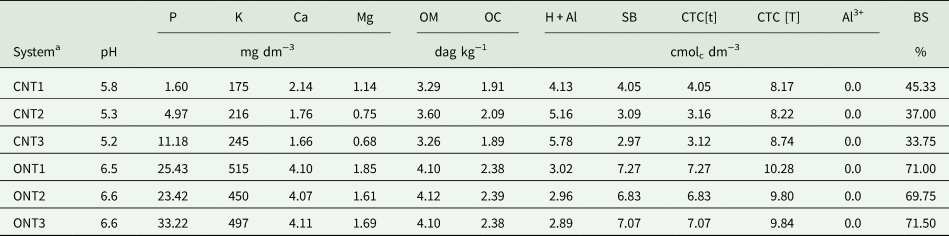
The experiment was carried out in the agricultural years 2015/2016 and 2016/2017, at the Coimbra agricultural experimental station of the Federal University of Viçosa (UFV), located in Coimbra, in the Zona da Mata region, Minas Gerais, Brazil (20°45′S, 45°51′W, altitude 650 m). The soil of that region is classified as Argisolo vermelho-amarelo (Ultisol) (Embrapa, 2013). Due to the use of fertilizers since 1984, this soil exhibited different chemical characteristics between the production systems as shown in Table 1.
Chemical composition of the soil: pH, phosphorus (P), potassium (K), calcium (Ca), magnesium (Mg), organic matter (OM), organic carbon (OC), potential acidity (H + Al), sum of bases (SB), effective CTC [CTC(t)], CTC pH 7 [CTC(T)], exchangeable aluminum (Al3+) and percent base saturation (BS)

a CNT1, conventional no-till without fertilizer; CNT2, conventional no-till with 150 kg ha−1 of mineral fertilizer + 50 kg ha−1 of urea; CNT3, conventional no-till with 300 kg ha−1 of mineral fertilizer + 100 kg ha−1 of urea; ONT1, organic no-till with 40 m3 ha−1 of organic compost; ONT2, organic no-till with 20 m3 ha−1 of organic compost; ONT3, organic no-till with 40 m3 ha−1 of organic compost and intercropped with Canavalia ensiformis. OC was estimated by: OM = 1724 × OC.
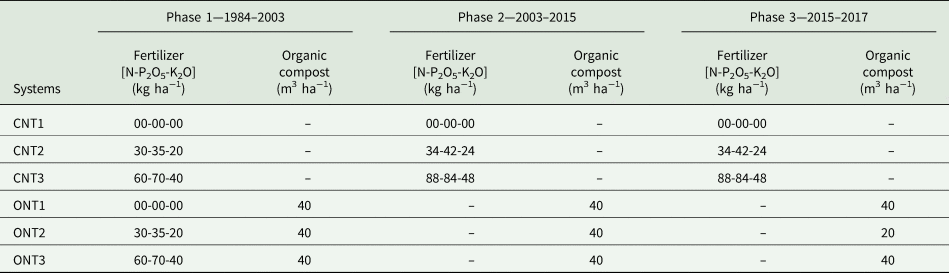
The present study was conducted over a long-term experiment that started in 1984, comprising 12 treatments and four blocks. In the first phase of the long-term experiment, from 1984 to 2003, the soil management was conventional, using mineral and organic fertilizers incorporated into the soil and herbicides for weed control. The treatments consisted of a 3 × 2 × 2 factorial structure, with three levels of mineral fertilization, with and without the application of an organic compost, using corn in monoculture or associated with common beans (Phaseolus vulgaris) (Galvão, Reference Zeffa, Perini, Silva, Sousa, Scapim, Oliveira, Amaral Júnior and Gonçalves1994). The fertilizer rates used in this experiment are shown in Table 2. A few years later, to conduct the 3 × 2 × 2 factorial experiment, the co-cultivation of corn and common beans was replaced by a second corn variety monocropped.
Quantity of nutrients applied with mineral fertilizer (kg ha−1 of N, P2O5, and K2O, respectively) and organic compost applied for each fertilization system depending on the phase of the long-term experiment

From 2003, the experiment was converted to a no-till system. The plots that were receiving the organic compost were converted to an organic system in which mineral fertilizers and herbicides were no longer used. In this system, the organic compost was applied on the soil surface, close to the corn plants, and weed control was carried out using a mechanical brush cutter. The cultivation of cover crops in the off-season, mainly black oat, began and the ONT2 and ONT3 treatments were modified to a consortium of corn with the Fabaceae jack bean (C. ensiformis) at densities of 30,000 and 60,000 plants ha−1, respectively. Two corn cultivars with similar yield levels were used (Corrêa et al., Reference Corrêa, Galvão, Fontanetti, Miranda, Lemos, Rodrigues and Conceição2011).
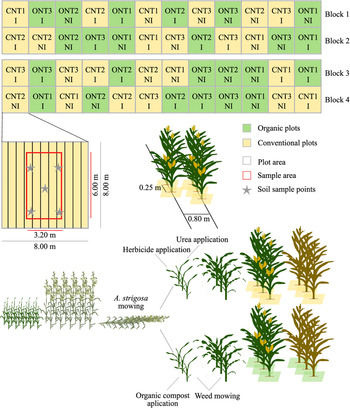
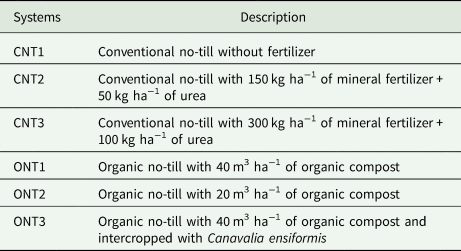
In the third and current phase of the experiment, the treatments were set up in a factorial 6 × 2, with six cultivation systems, with and without seed inoculation with A. brasilense (I = inoculated and NI = not inoculated). The production systems are described in Table 3, and outlined in Figure 1.
Scheme of the field experiment. CNT1, conventional no-till without fertilizer; CNT2, conventional no-till with 150 kg ha−1 of mineral fertilizer + 50 kg ha−1of urea; CNT3, conventional no-till with 300 kg ha−1 of mineral fertilizer + 100 kg ha−1of urea; ONT1, organic no-till with 40 m3 ha−1 of organic compost; ONT2, organic no-till with 20 m3 ha−1 of organic compost; ONT3, organic no-till with 40 m3 ha−1 of organic compost and intercropped with Canavalia ensiformis. Non-inoculated (NI); inoculated (I).

Description of treatments for conventional and organic farming systems

Mineral fertilizer contains 8% N, 28% P2O5, and 16% K2O; urea contains 44% N.
The results of the chemical analysis of the organic compost according to the methodology described by Kiehl (Reference Kiehl1985) were: 10.61% organic carbon; 1.10% total N; 0.38% P; 1.20% K; 0.94% Ca; 0.42% Mg; 0.53% S; 158 mg kg−1 Zn; 37,686 mg kg−1 Fe; 239 mg kg−1 Mn; 68 mg kg−1 Cu; 13.1 mg kg−1 B; 18% Na; and pH 8.83.
Field management
During the off-season, black oat was sown at a seed density of 80 kg ha−1 and was incorporated into the soil by light harrowing. After flowering, the oat crop was cut using a mechanical brush cutter and left on the ground.
After 14 days, the open pollinated corn variety AL Bandeirante was manually sown, and a population density of 50,000 plants ha−1 was maintained after thinning. In the ONT3 treatment, the consortium of corn with the Fabaceae C. ensiformis was established. The Fabaceae was sown on the same planting line and on the same day as the corn, at a population density of 62,500 plants ha−1. In the organic no-tillage systems, the organic compost was applied on the soil surface, close to the sowing line, after the emergence of the corn. In the conventional systems, the fertilizer was introduced into the furrow and the urea fertilizer was applied by broadcast when the corn presented four expanded leaves.
In the plots CNT1, CNT2, and CNT3, weed control was performed using a mixture of the herbicides Atrazine and Nicosulfuron (1.50 and 0.030 kg ha−1, respectively) at 20 days after emergence of the corn. In the ONT plots, weed control was carried out using a mechanical brush cutter between the planting lines, at the stages of two and four expanded leaves.
Seed inoculation
The corn seeds were inoculated with a commercial inoculant, AZOTOTAL®, containing strains Ab-v5 and Ab-v6 of the bacteria A. brasilense at a minimum concentration of 2 × 10⁸ viable cells mL−1, using the recommended dose of 100 mL ha−1 and in accordance with the manufacturer's procedure. The inoculation of the 2015 harvest-year seeds was performed with a liquid inoculant whereas for the 2016 harvest-year seeds, a peat-based inoculant was used. The liquid inoculant was replaced by the peat because the latter ensures a more uniform seed coverage. Seed inoculation was carried out in the morning under shade, using the peat-based inoculant, mixed with a 10% sugar solution. The seeds were then kept in the shade for 30 min to dry.
Colonization of plants by Azospirillum spp
In the 2016/17 harvest, the Azospirillum population in the soil was determined before planting, and later in the rhizospheric soil, roots, and leaves as well. The soil samples, taken before planting, were collected up to a depth of 20 cm using disinfected PVC probes. Five sampling points were selected randomly in each plot.
The rhizospheric soil was collected at the silking (R1) stage from two plants per plot, using a spade (20 × 20 × 20 cm). The excess soil was discarded, leaving only the soil that adhered to the roots to be used for the samples. These roots were also kept for further analysis. The middle third of the leaf below and opposite the ear was also collected from ten corn plants at the R1 stage. The ribs were excluded from these leaf samples.
The soil samples were homogenized and weighed. A mixture of 10 g of soil and 90 mL of saline solution was submitted to agitation at 150 rpm for 1 h. This mixture was then diluted to 10−3 before plating. The soil moisture was measured by expressing the results as the weight of dry soil. This analysis was performed by placing the samples in an oven at 105°C for 24 h.
The root and leaf samples were washed in tap water, sectioned and divided into sample portions each weighing 1 g. The samples were then disinfected by immersion in 70% alcohol for 10 s, and 1% sodium hypochlorite for 30 s, followed by two washes in autoclaved distilled water. They were then immersed in 9 mL of saline solution, crushed using POLITRON® and diluted to 10−2 before plating. The culture medium used was NFb (Döbereiner et al., Reference Döbereiner, Baldani and Baldani1995) and the count was performed using the spiral plater technique (Gilchrist et al., Reference Gilchrist, Campbell, Donnelly, Peeler and Delaney1973). The plates were stored in a climatized chamber at 28°C and after 5 days, were counted using a magnifying glass.
Sampling, plant analysis, and harvest
In the 2015 and 2016 harvests, growth of the corn plants was evaluated at the fourth leaf collar (V4) stage and at R1 by measuring the following parameters: plant height, diameter at the base of the stem and aerial dry matter. The Soil Plant Analysis Development (SPAD) index was also evaluated at these same two phenological stages using SPAD model Minolta 502 DL PLUS. The last completely expanded leaf was evaluated at the V4 stage and the first leaf below and opposite the ear was evaluated at the R1 stage.
The leaf nitrogen content was evaluated in the first leaf opposite and below the first ear at the R1 stage, for this, ten leaves per plot were collected. The samples were washed with tap and distilled water, then dried for 72 h at 70°C. The material was milled using a Willey/Star FT80 knife mill before being submitted to analysis of total nitrogen (N) (dag kg−1) according to the Kjeldahl method.
To evaluate the components of corn productivity, the following variables were quantified: final plant stand (including the number of broken and lodged plants at the time of grain harvest); prolificacy (total number of cobs divided by the number of plants per plot); number of rows of grains per ear; number of grains per row, thousand grain weight, and yield.
The harvest was carried out manually, and the ears threshed in a stationary electric thresher. The grain weight and yield was corrected to 13% moisture.
Statistical analysis
The experiment was performed over two harvest seasons. The average of the two harvests was used for the analysis of variance, except for the data from the Azospirillum count, which was performed only in the 2016 harvest. The means were compared by the Tukey test, at 5% probability. The log (x) transformation was used for counting the data. When there was an interaction between factors, its effect was evaluated; otherwise, only the individual effect was tested. All the analyses were performed using SAEG software (Saeg 2007).
Results
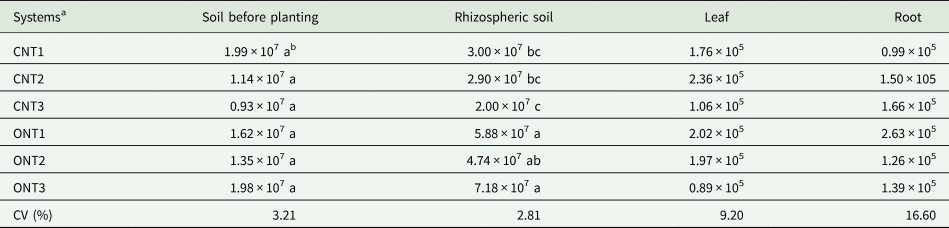
The average population density of Azospirillum spp. in the soil before planting was 1.5 × 10⁷ CFU g−1 and was not influenced by the previous fertilization management system (Table 4). However, it was observed that the fertilization treatment affected the Azospirillum spp. population during the flowering stage. The ONT3 treatment presented a population of 7.18 × 10⁷ CFU g−1 in the rhizospheric soil, which was similar to the other organic treatments, but much higher compared to 2.0 × 10⁷ CFU g−1 presented in the CNT3 treatment. All the other conventional treatments also presented a population similar to that of CNT3. The inoculation of the seeds did not affect the population of Azospirillum spp. in the rhizospheric soil. The population present in roots and leaves was not affected either by inoculation or by the fertilization management system.
Population count of Azospirillum spp. (CFU g−1) present in the soil before planting, in rhizospheric soil, in leaf and root tissue, and according to the fertilization system in the 2016/17 harvest

a CNT1, conventional no-till without fertilizer; CNT2, conventional no-till with 150 kg ha−1 of mineral fertilizer + 50 kg ha−1 of urea; CNT3, conventional no-till with 300 kg ha−1 of mineral fertilizer + 100 kg ha−1 of urea; ONT1, organic no-till with 40 m3 ha−1 of organic compost; ONT2, organic no-till with 20 m3 ha−1 of organic compost; ONT3, organic no-till with 40 m3 ha−1 of organic compost and intercropped with Canavalia ensiformis.
b Means followed by the same lowercase letter in a column do not differ by the Tukey's test, at 5%.
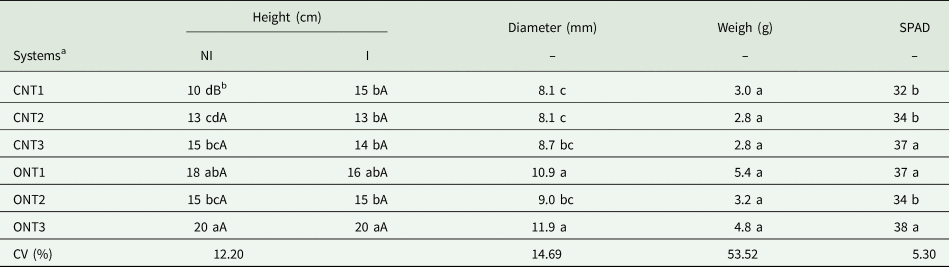
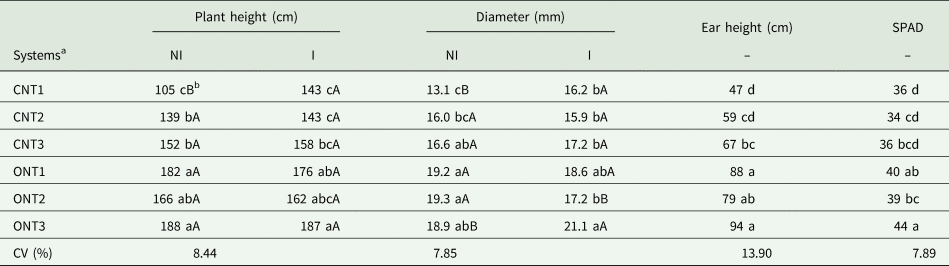
Regarding plant growth, the first variable to present an interaction between the factors was plant height at the V4 stage (Table 5). Plant height in the CNT1-NI treatment was 10 cm, and 15 cm in the CNT1-I treatment. The latter was similar to the other treatments, except ONT3-I that presented the greatest plant height. At R1, plant height and stem diameter of CNT1-NI were 105 cm and 13 mm, respectively. These values were different from those found in the CNT1-I treatment, which were 143 cm and 16 mm, respectively (Table 6). However, at this stage, CNT1-I only presented values similar to other conventional treatments, whereas the organic treatments ONT1 and ONT2 presented similar values to ONT3. This pattern was also observed for the variable, stem diameter.
Average plant height, stem diameter, weight per plant, and SPAD index at the V4 stage of corn, according to the fertilization system and seed inoculation with Azospirillum brasilense, in the 2015/16 and 2016/17 harvests

Non-inoculated (NI); inoculated (I).
a CNT1, conventional no-till without fertilizer; CNT2, conventional no-till with 150 kg ha−1 of mineral fertilizer + 50 kg ha−1 of urea; CNT3, conventional no-till with 300 kg ha−1 of mineral fertilizer + 100 kg ha−1 of urea; ONT1, organic no-till with 40 m3 ha−1 of organic compost; ONT2, organic no-till with 20 m3 ha−1 of organic compost; ONT3, organic no-till with 40 m3 ha−1 of organic compost and intercropped with Canavalia ensiformis.
b Means followed by the same uppercase letters in a line and by the same lowercase in a column do not differ significantly by the Tukey's test, at 5%.
Averages of plant height, stem diameter, ear height and SPAD index at the R1 stage of corn, according to the fertilization system and seed inoculation with Azospirillum brasilense, in the 2015/16 and 2016/17 harvests

Non-inoculated (NI); inoculated (I).
a CNT1, conventional no-till without fertilizer; CNT2, conventional no-till with 150 kg ha−1 of mineral fertilizer + 50 kg ha−1 of urea; CNT3, conventional no-till with 300 kg ha−1 of mineral fertilizer + 100 kg ha−1 of urea; ONT1, organic no-till with 40 m3 ha−1 of organic compost; ONT2, organic no-till with 20 m3 ha−1 of organic compost; ONT3, organic no-till with 40 m3 ha−1 of organic compost and intercropped with Canavalia ensiformis.
b Means followed by the same uppercase letters in a line and by the same lowercase in a column do not differ significantly by the Tukey's test, at 5%.
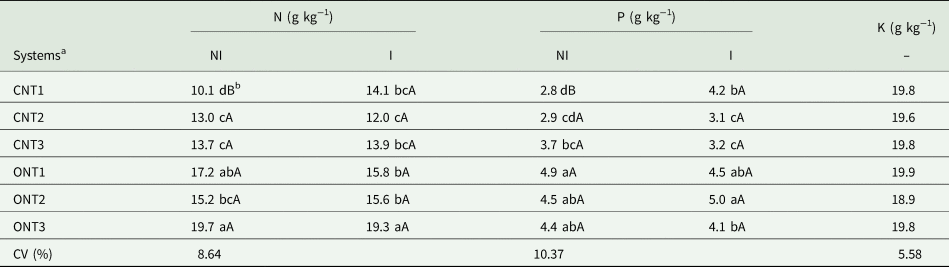
Regarding plant nutrition, seed inoculation increased the concentrations of N and P in CNT1 (Table 7). In CNT1, inoculation increased the concentration of N in the leaves from 10 to 14 g kg−1. The non-inoculated treatment (CNT1-NI) presented the lowest concentration, while the inoculated one (CNT1-I) showed the same level of N concentration as the other treatments, except ONT3, which presented the highest N concentration. The other treatments were not affected by inoculation.
Average concentration of nitrogen (N), phosphorus (P) and potassium (K) in corn leaves during flowering, according to the fertilization system and seed inoculation with Azospirillum brasilense, in the 2015/16 and 2016/17 harvests

Non-inoculated (NI); inoculated (I).
a CNT1, conventional no-till without fertilizer; CNT2, conventional no-till with 150 kg ha−1 of mineral fertilizer + 50 kg ha−1 of urea; CNT3, conventional no-till with 300 kg ha−1 of mineral fertilizer + 100 kg ha−1 of urea; ONT1, organic no-till with 40 m3 ha−1 of organic compost; ONT2, organic no-till with 20 m3 ha−1 of organic compost; ONT3, organic no-till with 40 m3 ha−1 of organic compost and intercropped with Canavalia ensiformis.
b Means followed by the same uppercase letters in a line and by the same lowercase in a column do not differ significantly by the Tukey's test, at 5%.
The concentration of nutrient P in the leaves was similarly affected by inoculation. CNT1 presented an increase in P concentration from 2.8 g kg−1 (CNT1-NI) to 4.2 g kg−1 (CNT1-I). CNT2-NI showed similar P concentration to CNT1-NI. CNT1-I, however, showed higher P concentrations when compared to the conventional treatments CNT2-I and CNT3-I. This was similar to what was observed for N concentration; the inoculation did not affect P concentration in the other treatments. The concentration of K was not influenced by any factor. The SPAD index and aerial dry matter were not affected by inoculation (Table 5). However, in the ONT3 system, the SPAD index was higher in corn leaves during the flowering stage, compared to ONT2 and the conventional systems (Table 6).
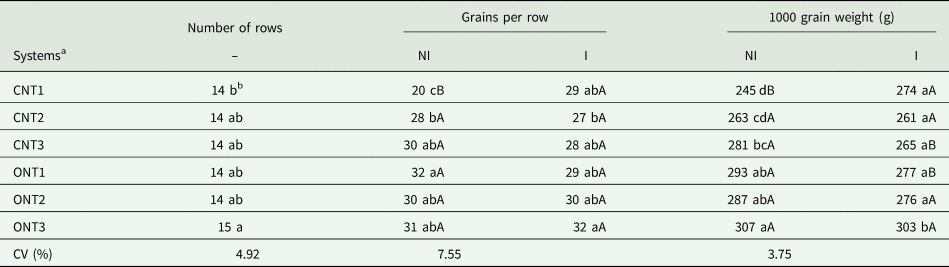
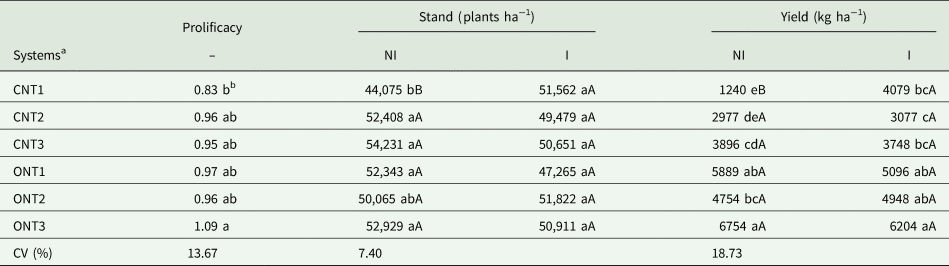
The plant population, grains per row and thousand grain weight were also influenced by inoculation in the CNT1 system. CNT1-NI showed values of 44.075 plants ha−1, 20 grains per row and 245 g of thousand grain weight, compared to 51,532 plants ha−1, 29 grains per row and 274 g of thousand grain weight presented by CNT1-I. The inoculation did not affect these production components in the other systems. The number of ears per plant and number of rows of grains per cob showed less variability among the treatments. Regarding these variables, the CNT1 system differed only from ONT3 (Tables 8 and 9).
Average number of rows of grain per ear, grains per row and thousand grain weight according to the fertilization system and seed inoculation with Azospirillum brasilense, in the 2015/16 and 2016/17 harvests

Non-inoculated (NI); inoculated (I).
a CNT1, conventional no-till without fertilizer; CNT2, conventional no-till with 150 kg ha−1 of mineral fertilizer + 50 kg ha−1 of urea; CNT3, conventional no-till with 300 kg ha−1 of mineral fertilizer + 100 kg ha−1 of urea; ONT1, organic no-till with 40 m3 ha−1 of organic compost; ONT2, organic no-till with 20 m3 ha−1 of organic compost; ONT3, organic no-till with 40 m3 ha−1 of organic compost and intercropped with Canavalia ensiformis.
b Means followed by the same uppercase letters in a line and by the same lowercase in a column do not differ significantly by the Tukey's test, at 5%.
Means of prolificacy (number of ears per plant), stand (plant population), and corn yield according to the fertilization system and seed inoculation with Azospirillum brasilense, in the 2015/16 and 2016/17 harvests

Non-inoculated (NI); inoculated (I).
a CNT1, conventional no-till without fertilizer; CNT2, conventional no-till with 150 kg ha−1 of mineral fertilizer + 50 kg ha−1 of urea; CNT3, conventional no-till with 300 kg ha−1 of mineral fertilizer + 100 kg ha−1 of urea; ONT1, organic no-till with 40 m3 ha−1 of organic compost; ONT2, organic no-till with 20 m3 ha−1 of organic compost; ONT3, organic no-till with 40 m3 ha−1 of organic compost and intercropped with Canavalia ensiformis.
b Means followed by the same uppercase letters in a line and by the same lowercase in a column do not differ significantly by the Tukey's test, at 5%.
Thus, the corn inoculated with A. brasilense presented an increase in yield in the CNT1 system (Table 9). The corn yield in CNT1-I was 4079 kg ha−1 which is an increase of 2839 kg ha−1 or 229% compared to the uninoculated treatment (1240 kg ha−1). The highest productivity in the experiment was achieved with the ONT3 treatment, which did not differ from the other inoculated organic treatments. The CNT1-NI treatment showed the lowest productivity; however, CNT1-I had similar levels to those presented by CNT2-I and CNT3-I.
Discussion
In this study, we found high populations of Azospirillum spp. in the soil before planting, even without inoculation. This could be explained by the wide distribution of this organism in tropical soils (Dobereiner et al., Reference Dobereiner, Marriel and Nery1976). In addition, the characteristics of this experiment, such as the absence of soil disturbance, clay content, organic matter content and the presence of live plants in the off-season, are important factors for the survival of Azospirillum in the soil (Bashan et al., Reference Zeffa, Perini, Silva, Sousa, Scapim, Oliveira, Amaral Júnior and Gonçalves1995).
The higher population of Azospirillum spp. found in the rhizospheric soil of organic systems is related to the higher biomass production of corn plants in these systems, where it is also expected to find a higher production of root exudates, which are considered a source of energy for the bacteria (D'Angioli et al., Reference D'Angioli, Viani, Lambers, Sawaya and Oliveira2017). It was observed that the higher C input in these organic systems positively influenced the population of the class Alphaproteobacteria, to which Azospirillum and rhizobia belong (Semenov et al., Reference Zeffa, Perini, Silva, Sousa, Scapim, Oliveira, Amaral Júnior and Gonçalves2020).
Fukami et al. (Reference Fukami, Nogueira, Araújo and Hungria2016) also found high populations of Azospirillum spp. even in non-inoculated systems. These authors also observed higher populations of Azospirillum spp. in rhizospheric soil and in the internal tissues of inoculated plants. However, in the present study, we did not find such higher populations in the inoculated treatments. This could be one of the reasons why an increase in the plant growth was not observed in the inoculated treatments in five of the six systems performed in this study.
The fact that inoculated plants showed increased growth in early stages is relevant, as plants from the CNT1-I treatment were taller than those from CNT1-NI, since the V4 stage. Thus, the increase in root growth is expected to be at least proportional to or even higher than the increase observed in aerial part, or the root biomass remains unchanged but it turns out more efficient, as reviewed by Bashan and Dubrovsky (Reference Zeffa, Perini, Silva, Sousa, Scapim, Oliveira, Amaral Júnior and Gonçalves1996).
The lack of fertilization for 34 years in the CNT1 system has led to a low availability of nitrogen and phosphorus in easily absorbable forms. However, as reported by Pii et al. (Reference Zeffa, Perini, Silva, Sousa, Scapim, Oliveira, Amaral Júnior and Gonçalves2019), inoculation led to a similar effect as to the availability of nitrate at the beginning of root development, which mainly affected the length of the secondary root branches and the biomass of the root system. This increase in root development may be the cause of the differences between CNT1-I and CNT-NI, leading the inoculated treatment (CNT1-I) recording similar levels of foliar N and P compared to systems CNT2 and CNT3, even with less availability of these nutrients.
Inoculation positively affected the vegetative growth of corn plants in the CNT1 system, resulting in taller plants with a larger stem diameter. Zeffa et al. (Reference Zeffa, Perini, Silva, Sousa, Scapim, Oliveira, Amaral Júnior and Gonçalves2019) studied plant growth and nitrogen absorption efficiency in corn inoculated with A. brasilense. They reported that the growth of corn plants was related to changes in the root system caused by A. brasilense. These bacteria stimulate root elongation (Dobbelaere et al., Reference Dobbelaere, Croonenborghs, Thys, Broek and Vanderleyden1999), as well as the development of secondary roots and root hair (Creus et al., Reference Creus, Graziano, Casanovas, Pereyra, Simontacchi, Puntarulo, Barassi and Lamattina2005; Molina-Favero et al., Reference Molina-Favero, Creus, Simontacchi, Puntarulo and Lamattina2008). These root modifications lead to greater nutrient absorption, resistance to abiotic stressors, and biomass gain in corn plants.
The results showed that the inoculation of corn with A. brasilense increased the absorption of nitrogen and phosphorus, and the growth of plants under nutrient-limiting conditions (CNT1). This is similar to the findings of Cassán and Diaz-Zorita (Reference Cassán and Diaz-Zorita2016), who concluded that the response of plants to inoculation is often observed when nitrogen availability is a limiting factor for productivity. The inoculation efficiency of A. brasilense varies with the plant genotype, bacterial strain and edaphoclimatic conditions (Bashan et al., Reference Bashan, de-Bashan, Prabhu and Hernandez2014). However, nitrogen fertilization management has been shown to have a significant influence on inoculation efficiency (Veresoglou and Menexes, Reference Veresoglou and Menexes2010). Similar results were reported by Zeffa et al. (Reference Zeffa, Perini, Silva, Sousa, Scapim, Oliveira, Amaral Júnior and Gonçalves2019), who observed a positive effect on nitrogen absorption efficiency, plant growth, and biochemical characteristics for inoculated corn grown in nitrogen-limiting conditions.
Although some strains of Azospirillum can solubilize P, this is not a characteristic of the genus, but it might be involved in niche-specific adaptation (Wisniewski-Dyé et al., Reference Zeffa, Perini, Silva, Sousa, Scapim, Oliveira, Amaral Júnior and Gonçalves2012). The increase in the concentration of P is mainly due to the greater absorption of nutrients due to greater root exploration of the soil (Rondina et al., Reference Zeffa, Perini, Silva, Sousa, Scapim, Oliveira, Amaral Júnior and Gonçalves2020).
Microbial inoculants improve the nutritional absorption capacity of cultivated plants and also increase the available form of nutrients close to the rhizosphere (Sammauria et al., Reference Sammauria, Kumavat, Kumavat, Singh and Jatwa2020). The present study demonstrated that the A. brasilense inoculation also favors the absorption of phosphorus, which was observed by Pereira et al. (Reference Pereira, Galindo, Gazola, Dupas, Rosa, Mortinho and Teixeira Filho2020). These authors found that inoculation, associated with P2O5 fertilization increased the phosphorus uptake and the absorption efficiency of this nutrient by 54.6%.
In the CNT1 system, the plant stand was affected by inoculation, leading to a positive effect on the plant population. The greater survival rate of plants and the resulting increased corn canopy has a direct impact on productivity since corn presents low phenotypic plasticity and low ability to compensate for stand failures. Corrêa (Reference Zeffa, Perini, Silva, Sousa, Scapim, Oliveira, Amaral Júnior and Gonçalves2009) experienced difficulties in establishing an adequate stand in the CNT1 system. To avoid that, our experiment was performed using a greater quantity of seed. Even then, the CNT1-NI stand had only 44,000 plants, which was 10% less than the desired number. Therefore, the fact that CNT1-I had the largest stand in this system (CNT1) may also be related to the ability of A. brasilense to relieve abiotic stressors such as low nutrient levels (Ferreira et al., Reference Ferreira, Pires, Rabelo, Oliveira, Luz and Brito2013).
In addition to having the largest stand, CNT1-I showed a greater number of grains per row and higher grain weight compared to ONT1-NI. Kappes et al. (Reference Zeffa, Perini, Silva, Sousa, Scapim, Oliveira, Amaral Júnior and Gonçalves2013) also reported an increase in the values of grain weight, yield, and ear length of inoculated plants.
The increased vegetative growth of corn, and greater accumulation of nutrients in response to inoculation in the CNT1 system, resulted in an increase in yield (Table 9). The CNT1 system showed an average of 4079 kg ha−1, due to inoculation with A. brasilense. This represents 74% of the average Brazilian productivity of corn, which was 5522 kg ha−1 in the 2017 harvest (Conab, 2017). This reinforces the use of microbial inoculants as an ecological, alternative technology to reduce the application rate of fertilizers and to increase the efficiency of nutrient absorption (Ejaz et al., Reference Ejaz, Batool, Anjum, Naz, Qayyum, Naqqash, Shah and Ali2020). Significant increases in corn productivity were also found by Martins et al. (Reference Martins, Jantalaia, Reis, Döwich, Polidoro, Alves, Boddey and Urquiaga2017), who reported an average increase of 1000 kg ha−1 of grains resulting from inoculation with A. brasilense.
The organic systems were not affected by inoculation. This could be related to the high fertility of the soils in these systems. Soils in the organic systems showed the highest average contents of organic matter, a percentage base saturation of approximately 70%, as well as higher levels of phosphorus. Therefore, the results indicate that soil fertility may affect the response to inoculation with A. brasilense.
Organic fertilization of corn using an organic compost at a rate of 40 m3 ha−1 is able to increase soil fertility and to provide satisfactory development of the corn culture (Maia and Cantarutti, Reference Maia and Cantarutti2004). As observed in our organic systems, most notably in the ONT3 system, the consortium of corn with C. ensiformis showed a productivity greater than 6 Mg ha−1, whereas that of the conventional system was approximately 4 Mg ha−1. In the conventional systems, the repeated application of mineral fertilizers is associated with a very low quantity of plant biomass, leading to negative impacts on soil organic matter, which may in the long-term, compromise the productive capacity of agroecosystems (Sammauria et al., Reference Zeffa, Perini, Silva, Sousa, Scapim, Oliveira, Amaral Júnior and Gonçalves2020).
Conclusions
Inoculation with A. brasilense is a promising practice for increasing corn production, especially under stress, and leads to increased production of corn grains in soils with low fertility. Therefore, it is an alternative means of increasing crop productivity in marginal land areas with reduced fertilizer application, and/or a low technological input level. Inoculation does not show a significant effect on corn productivity in stabilized organic systems with highly fertile soils.
Acknowledgements
The authors would like to thank the Coordination for the Improvement of Higher Education Personnel (CAPES) and the National Council for Scientific and Technological Development (CNPq), for their support of this research study, and the Total Biotechnology Company for their donation of the inoculant.