Introduction
Menarche denotes the attainment of puberty maturity and marks the commencement of a woman’s reproductive capacity. There has been a secular decline in age at menarche since the early 19th century (Onland-Moret et al., Reference Onland-Moret, Peeters, Van Gils, Clavel-Chapelon, Key and Tjønneland2005). In developed countries, age at menarche has declined from 15–17 years in the 19th and 20th centuries to around 12–13 years today – a level that has also been achieved in many developing countries (Abma et al., Reference Abma, Chandra, Mosher, Peterson and Piccinino1997; Huen et al., Reference Huen, Leung, Lau, Cheung, Leung and Chiu1997; Bodzsar & Susanne, Reference Bodzsar and Susanne1998; Parent et al., Reference Parent, Teilmann, Juul, Skakkebaekn, Toppari and Bourguignon2003; Anderson & Must, Reference Anderson and Must2005; Bellis et al., Reference Bellis, Downing and Ashton2006; Herman-Giddens, Reference Herman-Giddens2006; Downing & Bellis, Reference Downing and Bellis2009; Gaudineau et al., Reference Gaudineau, Ehlinger, Vayssiere, Jouret, Arnaud and Godeau2010; Talma et al., Reference Talma, Schonbeck, Dommelen, Bakker, Buuren and Hirasing2013). The reasons for this decline are multifaceted and involve a range of genetic, socioeconomic and environmental factors that interact with one another (Heidi, Reference Heidi1986).
Hormonal processes linked to puberty stimulate adolescents’ interest in sexual activity (Udry et al., Reference Udry, Billy, Morris, Groff and Raj1985; Steinberg, Reference Steinberg2005; Halpern, Reference Halpern2006; Negriff et al., Reference Negriff, Susman and Trickett2011). Early-maturing women are likely to have their sexual debut at a younger age (Magnusson et al., Reference Magnusson, Strattin and Allen1985; Simmons & Blythe, Reference Simmons and Blythe1987; Haynie, Reference Haynie2003), as they are also more likely to be influenced by their emotions and peer pressure, and are less likely to be able to refrain from risky behaviour (Steinberg, Reference Steinberg2005; Barbalat et al., Reference Barbalat, Domenech, Vernet and Fourneret2010). Sexual arousal in children who reach puberty early may put them in contact with older and more sexually experienced and romantic partners (Stattin & Magnusson, Reference Stattin and Magnusson1990; Negriff et al., Reference Negriff, Susman and Trickett2011). The trend towards earlier sexual maturation, along with changing mores and increased access to family planning and pornographic materials, have resulted in a 3- to 4-year drop in age at first intercourse for adolescents in Western countries over the last few decades (Wellings & Field, Reference Wellings and Field1996; Goodson et al., Reference Goodson, Evans and Edmundson1997).
Adolescent sexuality gives rise to a lot of problems, including the rise in unwanted pregnancies and unsafe abortions (Crockett et al., Reference Crockett, Bingham, Chopak and Vicary1996; Smith, Reference Smith1997; Deligeoroglou et al., Reference Deligeoroglou, Christopoulos and Creatsas2004; Downing & Bellis, Reference Downing and Bellis2009; Baumgartner et al., Reference Baumgartner, Geary, Tucker and Wedderburn2009; DeGraaf et al., Reference Degraaf, Vanwesenbeeck and Meijer2015; Morris & Rushwan, Reference Morris and Rushwan2015). Many studies have found that teenagers who are sexually active have low contraceptive use (Zink & Shireman, Reference Zink and Shireman2000; Baldwin & Jensen, Reference Baldwin and Jensen2013; Charlton et al., Reference Charlton, Corliss, Missmer, Rosario, Spiegelman and Austin2013; Maslyanskaya et al., Reference Maslyanskaya, Coupey, Chhabra and Khan2016). Problems of adolescent sexuality and fertility are of national concerns in most developing countries. The World Population Policies 2013 (United Nations, 2013) found that 76% of governments in less-developed countries were concerned about the high rate of adolescent fertility.
The study of adolescent sexuality is important because of the health and social problems that may result when young people have unprotected sexual intercourse (O’Donnell et al., Reference O’Donnell, O’Donnell and Stueve2001; Kozal et al., Reference Kozal, Amico, Chiarella, Cornman, Fisher, Fisher and Friedland2006; Baumgartner et al., Reference Baumgartner, Geary, Tucker and Wedderburn2009; MacQuarrie, Reference MacQuarrie2014; National Statistics Office & ICF Macro, 2014). Earlier onset of menarche and increasing age at marriage without a corresponding increase in access to, and utilization of, reproductive health services, means that more and more young women are exposed to the risk of out-of-wedlock pregnancies and sexually transmitted infections (STIs), including HIV (Whatley et al., Reference Whatley, Thin, Reynolds and Blackwell1989; United Nations, 1994; Baumgartner et al., Reference Baumgartner, Geary, Tucker and Wedderburn2009; Downing & Bellis, Reference Downing and Bellis2009; Glynn et al., Reference Glynn, Kayuni, Floyd, Banda, Francis-Chizororo and Tanton2010). Adolescents have disproportionately high rates of STIs (Weinstock et al., Reference Weinstock, Berman and Cates2004; Family Health International, 2010; UNAIDS, 2010), and their risky sexual behaviour remains a priority health problem (Eaton et al., Reference Eaton, Kann, Kinchen, Shanklin, Flint and Hawkins2012). Motherhood at a very young age not only results in a higher risk of maternal death, but also creates an impediment to improving the educational, economic and social status of women (United Nations, 1994; Glynn et al., Reference Glynn, Kayuni, Floyd, Banda, Francis-Chizororo and Tanton2010).
While there have been numerous studies on the association between age at menarche and age at sexual debut in Western countries, there is a dearth of research on this in developing countries. This study focused on the Philippines, a lower middle income (World Bank, 2015) and medium Human Development Index country (United Nations Development Programme, 2014), where teenage marriage has been decreasing but adolescent fertility has remained high. The Philippines is a multi-ethnic country. Tagalog and Cebuano are the two main ethnic groups. Whilst Roman Catholic is the dominant religion in the country, religious freedom is guaranteed by the constitution of the Philippines (National Statistics Office & ICF Macro, 2009). In 1968, the government implemented a family planning programme, but due to opposition from the Church, the government’s commitment to family planning was reversed in 1986 (Herrin, Reference Herrin2007). In the latest development, the Supreme Court did not lift its temporary restraining order on contraceptives (Cabato, Reference Cabato2017).
Many studies have provided empirical evidence of a close link between age at menarche and age at sexual debut (Riley, Reference Riley1994; Moronkola & Oyebami, Reference Moronkola and Oyebami2007; Downing & Bellis, Reference Downing and Bellis2009; Glynn et al., Reference Glynn, Kayuni, Floyd, Banda, Francis-Chizororo and Tanton2010; Negriff et al., Reference Negriff, Susman and Trickett2011). These studies showed that early-maturing girls tend to initiate sexual activity at a younger age. Such empirical evidence presents a case for the introduction of appropriate sexual and reproductive health education in primary schools. Hence, an understanding of the link between age at menarche and sexual debut is relevant from a policy perspective. Moreover, the implementation of the 2030 Agenda for Sustainable Development and the United Nations Global Strategy for Women’s, Children’s and Adolescents’ Health requires indicators to track the targets. Indicators on age at menarche and adolescent sexuality can be used to guide adolescent sexual and reproductive health programming and policymaking at all levels.
The present study sought to examine the trends and differentials in age at menarche and age at sexual debut across the various sub-groups of the Filipino population, as well as the association between these two events. It also aimed to determine the biosocial factors associated with the timing of sexual debut. Age at menarche was used as one of the independent variables (representing biological factors), along with socioeconomic variables in logistic regressions to test if its significant bivariate relationship with age at sexual debut persisted after other variables were held constant.
Methods
Data
Data for this study were taken from five waves of the Philippines National Demographic and Health Survey (NDHS) conducted between 1993 and 2013 (http://dhsprogram.com/Data/). The surveys, funded by USAID, were conducted to collect information on demographic and health issues to guide policy and programme formulation, implementation and evaluation. The surveys applied multi-stage probability sampling to provide nationally representative samples of women of reproductive age (i.e. aged 15–49 years). Since 1984, Demographic and Health Surveys have been conducted in 85 countries based on a set of core questionnaires to allow comparison across countries (Demographic and Health Surveys, 2009; Measure DHS, 2011; National Statistics Office & ICF Macro, 2014). Detailed descriptions of the methodology of the surveys are available in the main survey reports.
Data from all five waves of the survey were used to estimate age at menarche and age at sexual debut across birth cohorts. Data from the 2013 wave were used for a more detailed analysis of age at sexual debut among women aged 21–25 years. The 2013 Philippines NDHS covered a nationally representative sample of 16,155 women aged 15–49 years, of whom 2655 were aged 21–25 years.
Age at menarche and age at sexual debut (the outcomes of interest) were estimated based on the recall method. Studies have shown that the reporting of the dates of events such as the timing of first menstruation and first sex becomes less reliable the further away from the date of interview (Gilger et al., Reference Gilger, Geary and Eisele1991; Koo & Rohan, Reference Koo and Rohan1997; Cooper et al., Reference Cooper, Blell, Hardy, Black, Pollard and Wadsworth2006). To minimize recall errors, the estimation of age at menarche and age at sexual debut was confined to those aged 16–20 and 21–25 years respectively in 1993, 1998, 2003, 2008 and 2013, when the survey was conducted. These two variables were right-censored for those respondents aged 16–25 who were selected for this analysis and who had not menstruated or had sexual intercourse prior to the survey. Hence, the mean age at sexual debut could not be estimated. Instead, dummy variables were constructed for those who had sex by specific ages (for instance, had sex by age 15, Yes=1, No=0; had sex by age 17, Yes=1, No=0; had sex by age 19, Yes=1, No=0).
The age group 16–20 was chosen for the study of age at menarche because about 98% of women had attained menarche by age 16. To investigate age at sexual debut during the teenage years, a cut-off age of 21 was adopted. With more than half of these women having their sexual debut by age 21, their median age at sexual debut could be computed.
Age at menarche was used as one of the biosocial predictors of age at sexual debut. The other predictors or independent variables included marital status, ethnicity, place of residence, women’s educational level and family wealth index. The wealth index is a variable on the household’s quintile classification of wealth index generated through principal component analysis based on household ownership of various assets and on housing characteristics. A more detailed description of the construction of the wealth index is available in the main report of the survey (National Statistics Office & ICF Macro, 2009, 2014).
Statistical analysis
In the bivariate analysis, recent trends of age at menarche and age at sexual debut were tabulated by birth cohorts and selected socioeconomic variables. Age at menarche was also used as an independent variable in explaining age at sexual debut. As many of the variables were inter-correlated and had confounding effects on the dependent variable, binary logistic regression analyses, used in many similar studies (Glynn et al., Reference Glynn, Kayuni, Floyd, Banda, Francis-Chizororo and Tanton2010; Mulugeta & Berhane, Reference Mulugeta and Berhane2014; Mbalinda et al., Reference Mbalinda, Kiwanuka, Eriksson, Wanyenze and Kaye2015; Okigbo et al., Reference Okigbo, Kabiru, Mumah, Mojola and Beguy2015), were used to analyse the odds of women having first sexual intercourse by specific ages. The net effect of age at menarche on age at sexual debut was assessed after taking into account other variables in the logistic regression models. The statistical software SPSS version 20 was used for data analysis.
Results
Recent trends and differentials in age at menarche
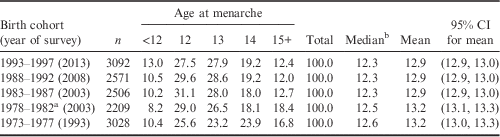
As in other parts of the world, Filipino women are attaining menarche at ever younger ages, with the mean and median ages decreasing from 13.2 years and 12.6 years in the 1973–1977 birth cohort (women aged 16–20 in 1993) to 12.9 years and 12.3 years, respectively, in the 1993-–1997 birth cohort (women aged 16–20 in 2013). During this period, the proportion who had their first menstruation before 12 years of age increased from 10.4% to 13.0%, with a corresponding decrease at age 15 or older from 16.8% to 12.4% (Table 1).
Percentage distribution and median age at menarche by birth cohort among women aged 16–20, Philippines NDHS
a Information on age at menarche was not available from the 1998 NDHS, and hence age at menarche for birth cohort 1978–1982 was estimated for those aged 21–25 from the 2003 NDHS.
b The age at menarche was 11 years at the 10th percentile and 15 years at the 90th percentile across all birth cohorts.
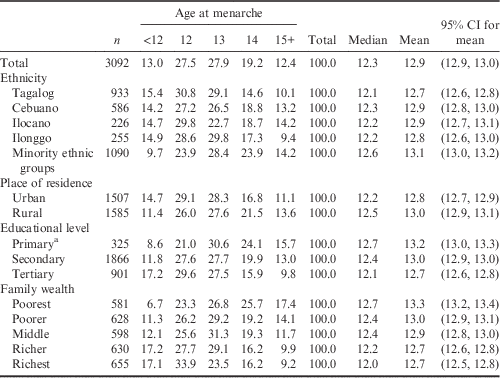
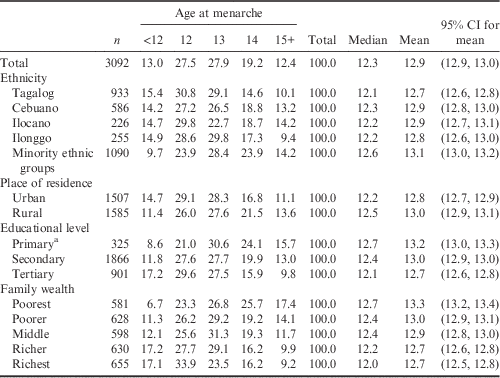
Age at menarche varied across the sub-groups of the population, and was lower among those residing in urban areas compared with rural areas. It was inversely correlated with educational level and family wealth, with a mean difference of half a year between those with primary education and those with higher education, and 0.6 years between those from the poorest and richest families. Across the ethnic groups, the majority ethnic groups (comprising Tagalog, Cebuano, Ilocano and Ilonggo, and making up 64.7% of the total sample) were more likely than the combined minority ethnic groups to have earlier menarche (Table 2).
Distribution of age at menarche by selected variables among women aged 16–20, 2013 Philippines NDHS
a Primary education included 23 cases (0.7% of total) with no schooling.
Recent trends and differentials in age at sexual debut
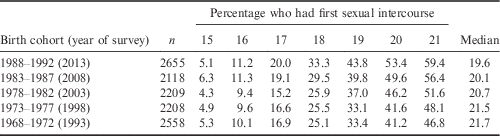
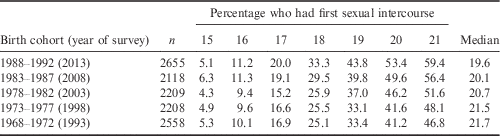
Filipino women are having their first sexual intercourse at ever younger ages across the birth cohorts, with the median age at sexual debut decreasing monotonically from 21.7 years among the 1968–1972 birth cohort (women aged 21–25 in 1993) to 19.6 years among the 1988–1992 birth cohort (women aged 21–25 in 2013). While the proportion who had their sexual debut by age 15 remained at about 5% across the birth cohorts, the proportion who had sexual experience by ages 19 and 20 increased by more than 10 percentage points, from 33.4% and 41.2%, among the 1968–1972 birth cohort to 43.8% and 53.4%, respectively, among the 1988–1992 birth cohort (Table 3).
Cumulative percentage of women aged 21–25 who had had their first sexual intercourse at ages from 15 to 21 years by birth cohort
For a more detailed investigation of the biosocial differentials and determinants of age at sexual debut, the analysis was confined to women aged 21–25 years from the 2013 NDHS. The results are shown in Tables 4 and 5.
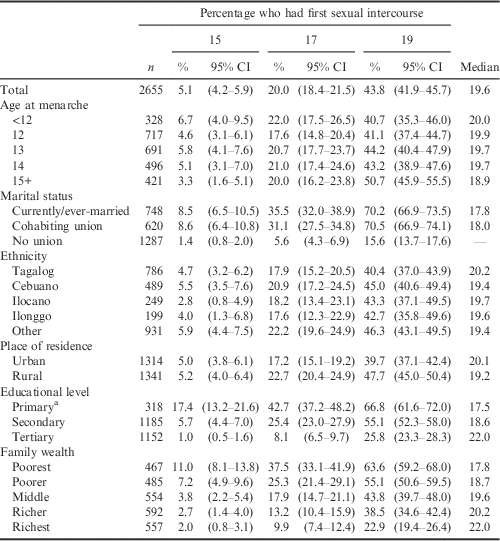
Median age and cumulative incidence of first sexual intercourse by ages 15, 17 and 19 by selected variables among women aged 21–25, 2013 Philippines NDHS
a Primary education included 21 cases (0.8% of total) with no schooling.
Logistic regression of age at sexual debut by ages 15, 17 and 19 by selected variables among women aged 21–25, 2013 Philippines NDHS

a Primary education included 21 cases (0.8% of total) with no schooling.
**p<0.01; *p<0.05.
Table 4 shows that about 5% of Filipino women aged 21–25 had their first sexual experience by age 15, 20% by age 17 and 44% by age 19. Half of the women had their sexual debut at age 19.6 years (median). Early-maturing girls were more likely to initiate sex at a younger age. For instance, among those who had their first menstruation before age 12, almost 7% had their sexual debut by age 15, as compared with only 3.3% among those who had first menstruation after age 14. However, the reverse was true at older ages – only 40.7% of the early-maturing girls had their first sex by age 19, and this was 10 percentage points lower than those who had first menstruation after age 14.
The proportions who had sex by ages 15, 17 and 19 were about the same for those who were currently married/ever-married and those in cohabiting union, but they were 5 to 6 times more likely than those in no union to have their sexual debut during their teenage years. Sexual debut during teenage years did not vary significantly across the ethnic groups. However, while there was a rather small urban–rural differential in the proportion who had their first sex at age 15, rural women were much more likely than urban women to have their first sexual experience by age 17. Women with higher education and from wealthier families tended to delay their sexual debut. Among women with primary education, 17.4% had sexual intercourse by age 15, compared with 5.7% and 1.0% among those with secondary and higher education respectively. Women who had an early sexual debut are probably more likely to drop out from school, especially if they became pregnant. For all educational levels, the proportion of young Filipino women who had their sexual debut increased rapidly as they passed through their teenage years, such that by age 19, slightly over a quarter of the tertiary educated, half of the secondary educated and two-thirds among those with primary education had experienced sexual intercourse. Age at sexual debut was positively correlated with family wealth. By age 15, 11% of women from the poorest families had their sexual debut compared with only 2% among those from the richest families.
Determinants of sexual debut during teenage years
The logistic regression showed that the odds of having sexual debut by age 15 decreased with age at menarche. The odds of having sexual debut by age 15 among women who had their first menstruation before the age of 12 were 4.4 times greater than among those who had their first menstruation after the age of 14. In the bivariate analysis, late-maturing women were more likely than early-maturing women to have first sexual intercourse by age 19; however, there was no significant difference in the odds ratio after adjusting for other variables (Table 5). The odds of having sexual debut during the teenage years were about the same for married women and those in cohabiting unions, but the odds of having sexual debut by age 19 were 10 times greater for married and cohabiting women than for those not in a union.
As in the case of bivariate analysis, ethnicity was not found to be a significant factor in age at sexual debut. While the bivariate analysis above indicated that rural women were more likely than urban women to have their sexual debut by ages 17 and 19, the reverse was true once other factors were held constant. Interestingly, while there was no significant urban–rural differential in early sexual debut at the bivariate level, the logistic regression showed that the odds of having sexual debut by age 15 among urban women were much higher than for rural women (odds ratio=1.8).
Women’s educational attainment had a very strong influence on the timing of sexual debut. The odds of having sexual debut by age 15 among women with primary and secondary education were 12.9 times and 3.8 times greater, respectively, than among those with tertiary education. Although the educational effect on sexual debut at older ages was less pronounced, the odds of having sexual debut by age 19 among women with primary and secondary education were still much greater than for those with tertiary education.
Adjusting for other variables in the model, young women from the poorest families had higher odds than those from the richest families of having had their sexual debut at each age, but the differential was not statistically significant, except for age 19. The small differential in age at sexual debut across wealth quintiles could be attributed to the fact that women from poorer families tend to marry earlier.
Discussion
Filipino women are attaining puberty maturity at ever younger age, and this is consistent with the global trend (Teitler, Reference Teitler2002; Finer, Reference Finer2007; Guo et al., Reference Guo, Wu, Qiu, Chen and Zheng2012). The median age at menarche in this study is lower than that found in a previous study on Filipino girls aged 14–15 years (Adair, Reference Adair2001), which found it to be 13.1 years, with 50% of girls attaining menarche between the ages of 12.4 and 13.9 years.
This study’s estimated median age at menarche for Filipino women, ranging between 12.6 years for the 1973–1977 birth cohort and 12.3 years in the 1993–1997 birth cohort, is rather close to that of other Asian populations: 12.0 years in Malaysia (Hossain et al., Reference Hossain, Wee, Ashaie and Kamarul2013), 12.5 years in Thailand, 12.4 years in Hong Kong, 12.6 years in Japan and 12.1 years in India (Parent et al., Reference Parent, Teilmann, Juul, Skakkebaekn, Toppari and Bourguignon2003). Across the birth cohorts, the mean age at menarche was about 0.6–0.7 years higher than the median, indicating that the data are positively skewed, as few women had their menstruation at ages 16 and above.
The inverse relationship between age at menarche and socioeconomic status is consistent with the findings of a previous study, which showed that earlier menarche is characteristic of girls living in urban areas and higher socioeconomic status households, as indicated by higher maternal education, better housing quality and the possession of household assets (Adair, Reference Adair2001). It also corroborates the findings of Wronka and Pawlinska-Chmara (Reference Wronka and Pawlinska-Chmara2005), and is consistent with ‘energetics theory’, which posits that girls from lower socioeconomic classes are exposed to a chronically poor nutritional environment that impedes their puberty development. Therefore, the later menarche among the minority ethnic groups and those residing in rural areas may be due to their less-favourable socioeconomic conditions.
Apart from its direct effects on the reproductive life of women, earlier onset of menarche has other health implications. Studies in developed countries have found that early puberty is associated with an increased risk of breast and endometrial cancers, menstrual problems, higher body mass index, insulin resistance, cardiovascular risk, as well as elevated blood pressure and glucose intolerance (Remsberg et al., Reference Remsberg, Demerath, Schubert, Chumlea, Sun and Siervogel2005; Feng et al., Reference Feng, Hong, Wilker, Li, Zhang and Jin2008; Mishra et al., Reference Mishra, Cooper, Tom and Kuh2009). On the other hand, late menarche is associated with osteoporosis (Fox et al., Reference Fox, Magaziner, Sherwin, Scott, Plato, Nevitt and Cummings1993; Tuppurainen et al., Reference Tuppurainen, Kroger, Saarikoski, Honkanen and Alhava1995). Because most past research on the health consequences of early menarche has been conducted on populations in developed countries in the West, it will be of interest to carry out similar research on developing countries and Asian populations.
With a more liberal attitude towards pre-marital sex in contemporary modern society, age at sexual debut has been declining as sexual activity among adolescents has become more common. In the Philippines, while the mean age at marriage has remained unchanged at around 22 years since the first wave of the NDHS conducted in 1993, the median age at sexual debut has declined by more than 2 years – from 21.7 years among the 1968–1972 birth cohort to 19.6 years among the 1988–1992 birth cohort – indicating a trend towards an increase in pre-marital sex and out-of-wedlock births. However, due to the lack of complete information on the month of sexual debut and marriage, it was not possible to determine if first sex and first birth had indeed occurred prior to marriage if these events occurred in the same year.
The age at sexual debut in the Philippines is rather similar to that in neighbouring countries but much higher than the level typically found in Western countries. Results from NDHS show that among respondents aged 20–24 years in the Philippines, about 19.3% had sexual debut by age 18, and this is only slightly higher than the corresponding figure of 16.8% in Indonesia and 17.4% in Cambodia. In comparison, about 30% of adolescent girls across nine European countries had sexual debut before the age of 15 (Lenciauskiene & Zaborskis, Reference Lenciauskiene and Zaborskis2008). With globalization and further relaxation of the attitude towards pre-marital sex, age at sexual debut may continue to decline in the Philippines.
Age at sexual debut was found to be closely related to age at menarche and several socioeconomic variables. Consistent with findings from the West, early-maturing women in the Philippines were more likely to have a much early sexual debut than those maturing later. Logistic regression showed that the odds of sexual debut by age 15 among Filipino women who attained menarche before the age of 12 years were 4.4 times greater among those who had first menstruation after the age of 14. However, there was no significant relationship between age at menarche and sexual debut by age 19, although women attaining menarche later were found to be more likely than early-maturing women to have their sexual debut by age 19 at the bivariate level. This clearly demonstrates the role of confounding factors in determining the relationship between the two events.
The various ethnic groups in the Philippines differ significantly in terms of religion and socioeconomic status. While almost 90% of the majority Tagalog are Roman Catholic, more than 40% of the minority ethnic groups belong to other religions. The minority ethnic groups are more likely to live in rural areas, have a lower educational level and lower income. Hence, ethnicity is assumed to subsume socioeconomic and cultural factors, which are not easily measured. Although the other ethnic groups have later menarche compared with the major ethnic groups, there were no significant ethnic differentials in age at sexual debut.
Rural women had earlier sexual debut than their urban counterparts in the bivariate analysis. Interestingly, while there was little urban–rural differential in age at sexual debut by age 15 in the bivariate analysis, the odds of urban women having sexual debut by age 15 were 1.8 times those of rural women, after adjusting for other confounders. The urban–rural differential in pre-marital sex may be assessed by examining the median age at sexual debut and marriage. In the 2013 NDHS, only 47% of urban women were married by age 25 (implying a median age of about 26), while almost 50% of rural women were married by age 20. This indicates a wider gap between age at sexual debut and age at marriage among urban women compared with rural women (with a median age at sexual debut at 20.1 years and 19.2 years respectively).
Besides marital status, women’s education was the most important variable influencing sexual debut. Higher educated women were much less likely than their less-educated counterparts to be engaged in sexual intercourse at each age. This can be explained by the lack of knowledge on reproductive health and sexuality among the less-educated, and those who were sexually active might have dropped out of school, especially if they were married and pregnant. Those aspiring to further their education up to tertiary level were probably better informed about reproductive health and would refrain from sexual activity. Only 9% of the women who had their sexual debut had attained higher education, compared with 57.1% among those who had not had their sexual debut by age 19 (table not shown).
It has been hypothesized that women from higher socioeconomic classes tend to postpone sexual debut due to the higher opportunity cost as they have greater access to higher education and also higher parental expectations for them to build a career before settling down. Besides, women from higher social classes have more access to reproductive health information (Guo et al., Reference Guo, Wu, Qiu, Chen and Zheng2012). At the bivariate level, women from poorer families were much more likely to have had their sexual debut at every age compared with those from richer families. This finding has serious implications as disadvantaged women who have an early sexual debut tend to forego the opportunities to pursue higher education and a future career, and hence are unable to move out of the vicious cycle of poverty.
Besides posing an impediment to improving the status of women due to school drop-out and low employment opportunities, early sexual debut and unprotected sex are also linked to reproductive health problems such as having multiple sex partners, sexually transmitted disease, unwanted pregnancy and abortion. In developing countries, adolescents who have an early sexual debut are less likely to use a condom during intercourse and more likely to have more than one sexual partner (Smith, Reference Smith1997; Langille & Curtis, Reference Langille and Curtis2002) and a higher risk of HIV (Boileau et al., Reference Boileau, Clark, Bignami-Van Assche, Poulin, Reniers and Watkins2009). In this study, among women aged 21–25 who had their sexual debut by age 15, 28.6% reported having had multiple sex partners; in contrast, only 6.3% who had not had sexual intercourse by age 19 reported having multiple sex partners. No information on the use of contraceptive method during sexual debut was available from the NDHS. However, data from the 2013 NDHS show that only 7.2% of those aged 16–20 years were currently using a contraceptive method, and this increased to 29.6% (13.8% using the pill and 1.5% using condoms) among those aged 21–25 years. The low contraceptive prevalence in the Philippines is partly due to religious opposition, which has prevented the implementation of a stronger programme to promote the use of modern contraceptives (Herrin, Reference Herrin2007). Hence, it may be inferred that most Filipino women had unprotected sex during their first sexual intercourse. Unprotected sex poses major reproductive health problems such as sexually transmitted disease, unwanted pregnancy and abortion, besides psychological and emotional stress. Previous studies have found that sexually active teenagers are more likely to use the pill or a condom at first intercourse if they are given contraceptive education (Mauldon & Luker, Reference Mauldon and Luker1996). Sex education curricula can effectively reduce adolescent sexual risk behaviour, early sexual debut (Mueller et al., Reference Mueller, Gavin and Kulkarni2008) and adolescent pregnancy (Kirby, Reference Kirby2002; Hillard, Reference Hillard2005). The Philippines is probably in a similar situation to many countries where developments in social support and education have not kept up with the trend of declining age of sexual maturation (Gluckman & Hanson, Reference Gluckman and Hanson2006). To address adolescent sexual and reproductive health issues in order to substantially reduce adolescent pregnancies, there is a need to equip young people with reproductive health knowledge and promote a responsible and healthy lifestyles.
Many studies have found that girls who started having sex at a younger age are more likely to have deviant behaviour, engage in socially undesirable activities such as smoking, drinking and substance abuse and have poor relationships with family members. All these will have serious negative life-long impacts affecting not just the women, but also their children and family, as well as society.
This analysis found that marital status and educational attainment were the two main determinants of early sexual debut. Efforts must therefore be made to encourage the enrolment of girls in school, and at the same time discourage teenage marriage. There is also a need to introduce and strengthen sexual and reproductive health education in schools and in informal education such as through the media and internet, improve the delivery of family planning services and information, and to engage young people in healthy activities such as sports and community services. More comprehensive and concerted efforts should be made to involve the various stakeholders, including the youths, their parents, teachers, religious leaders, government officials, medical practitioners, non-governmental organizations (NGOs) and the media, to address the issue of youth sexuality.
The study has a number of limitations. The NDHS did not collect information on a number of important variables such as religiosity, family structure, the presence of both parents and their characteristics, exposure to sex and reproductive health education, academic performance, peer pressure and other risky behaviours. The scope of the paper also precludes a more in-depth analysis of the trends and patterns of age at menarche and age at sexual debut by ethnic groups, religion and region. A recent article by Agardh et al. (Reference Agardh, Tumwine and Ostergren2011) found that religion has emerged as an important determinant of sexual behaviour among Ugandan university students. Being a sensitive topic, the reliability of the responses must also be taken at face value. In a US population-based sample, Liang and Chikritzhs (Reference Liang and Chikritzhs2013) found that respondents who had first sex younger or older than the average tended to bias towards the mean. The recall and reporting biases on age at first sex could also affect the accuracy of the estimates.
In conclusion, earlier puberty and sexual debut are public health concerns that have serious implications for individuals, families, society and the nation. A better understanding and awareness of factors associated with early menarche and sexual debut is needed to inform policy and to design programmes that focus on sexuality and contraception, especially for early-maturing girls, to prevent any untoward health problems linked to risky behaviour. There is a need to provide young people with appropriate information and education on reproductive and sexual health. Programmes providing in-school and out-of-school youth with life skills could be strengthened, by enlisting the support of NGOs and the private sector. Innovative educational approaches, including peer counselling for youth and orientation for parents, should be further promoted.
Acknowledgment
The authors would like to thank MEASURE DHS for permission to use the data for this paper.
Ethics Approval. The authors assert that all procedures contributing to this work comply with the ethical standards of the relevant national and institutional committees on human experimentation and with the Helsinki Declaration of 1975, as revised in 2008.
Conflicts of Interest. The authors have no conflicts of interest to declare.
Funding. This research was funded by the Population Studies Unit, University of Malaya.