Introduction
Violent and aggressive behaviour is a clinical reality that continues to affect inpatient psychiatric services and emergency rooms worldwide. In the past decade the UK has seen a raft of national strategies and guidelines that, amongst other things, set out to improve and standardise interventions that may be employed for the management of violent and aggressive behaviour (Health and Safety Executive, 2006; National Institute for Clinical Excellence, 2005; National Institute for Mental Health in England, 2004; Dale et al. Reference Dale, O'Hare and Rae2006). These interventions may include de-escalation, rapid tranquillisation (RT), control and restraint, and seclusion.
Following unsuccessful de-escalation, RT will frequently become the intervention of choice. Its definition varies worldwide, but in the UK has been defined thus: ‘The aim of rapid tranquillisation is to achieve a state of calm sufficient to minimize the risk posed to the service user or to others.’ (National Institute for Clinical Excellence, 2005).
Whilst oral treatment should be offered initially, if this is refused or inappropriate to the situation the parenteral route should then be considered (National Institute for Clinical Excellence, 2005). An important point to note is that any parenteral administration in this context would likely involve forcible administration and consequently restraint. Such situations bring about both drug and non-drug related risks. Most drug related risks are linked to the adverse effect profile of the medicine administered. These may include cardiac effects, extrapyramidal effects (EPSE), respiratory depression, seizures, sedation progressing to loss of consciousness, hypotension and neuroleptic malignant syndrome. Of particular concern are sudden cardiac death, arrhythmias and acute dystonic reactions which can all be associated with antipsychotics (National Institute of Clinical Excellence, 2005). Adverse reactions are likely to be even more significant because of the vulnerable physical state of a struggling patient. Non-drug related risks are numerous, obvious examples including physical injury due to the process of restraint and the difficulty of delivering an IM injection into the correct muscle at the correct depth in a restraint situation. Excited delirium, prolonged struggling and exhaustion have been cited as enhancing the possibility of positional asphyxia occurring during restraint (Police Complaints Authority, 2002; Joint Committee on Human Rights, 2004).
It is therefore unsurprising that physical monitoring following RT is just as important as the administration of medication itself. This was reinforced by the National Institute for Health and Clinical Excellence (NICE) in 2005, recommending that all service providers should have protocols in place to cover all aspects of RT, not withstanding monitoring. This recommendation has clearly been adopted in the UK, with a recent review identifying that 97% of NHS and Health and Social Care Trust RT documents recommended specific physical monitoring parameters following RT (Innes & Iyeke, Reference Innes and Iyeke2011). The details of the recommended monitoring were far from uniform in the trust documents. Concerning variations were identified surrounding when monitoring should be initiated, the parameters being monitored and its suggested duration and frequency. It was evident that as the exact monitoring requirements were not specified in the NICE guidelines this had led to unstandardised processes around physical health monitoring post RT.
However, there were limitations with the above work. Innes & Iyeke (Reference Innes and Iyeke2011) only looked at the practice recommended within the context of RT documents. This national survey provides a logical progression and aims to discover whether monitoring is actually happening in clinical practice and how this had been monitored.
Method
Fifty-eight NHS mental health trusts in England were contacted requesting a report of any audit undertaken within their organisation that related to implementation of their adult RT document. These 58 trusts were all of the mental health trusts listed on the NHS UK website under service directories (www.nhs.uk/ServiceDirectories/Pages/MentalHealthTrustListing.aspx). Requests were made by sending an email to the Freedom of Information Act contact in each trust. Copies of audit reports made between 1st March 2011 and the 14th March 2011 were requested. All replies received by 1st May 2011 were examined. Due to limitations in the number of audit reports a single reviewer could examine, the survey was not extended to private sector organisations.
Examination of trust responses
The replies and documents were examined by a single reviewer and each trust's response was placed into one of the following five categories:
1. No response from trust
2. Confirmed no audit undertaken
3. Audit undertaken but physical monitoring not studied
4. Relevant audit undertaken that studied physical monitoring
5. Trust refused to participate.
Audit report inclusion criteria
Only material relating to adult RT documents was examined in this study. For inclusion in category 3 or 4, a report needed to be considered an audit. Clinical audit can be defined as a measurement of practice against agreed standards and implementing change to ensure that all patients receive care to an acceptable standard (National Institute for Clinical Excellence, 2002). Reports therefore needed to demonstrate evidence of a quality improvement process that sought to systematically review practice against a trust's RT standards. Inclusion within category 4 required an audit to review one or more aspect of physical health monitoring.
Audit report exclusion criteria
Documents received that were not related to the subject of adult RT were excluded from the study. Any material received that did not qualify as audit was excluded from category 3 or 4, and audit not including physical health monitoring was excluded from category 4.
Examination of relevant audits
Audit reports that included assessment of physical health monitoring post RT were studied in more detail and the following elements noted:
• The frequency or duration for which physical observation(s) should be measured.
• A record of whether reasons were stated in notes for not performing physical monitoring (where applicable).
• The number of RT incidents assessed in each audit.
Monitoring of specific physical observations and investigations was then studied more closely: pulse rate, blood pressure, respiratory rate, oxygen saturations, temperature, hydration status, level of consciousness, evidence of dystonia or other movement side effects, ECG, biochemistry and haematology were looked for in each report. In addition to this, the actual results of these audits were studied. From this, the mean percentage of occasions that these particular physical observations or investigations were performed after RT was calculated.
Results
From the 58 mental health trusts in England that were emailed with a request for details of any audits relating to their RT documents, 47 gave some form of response to the request for information.
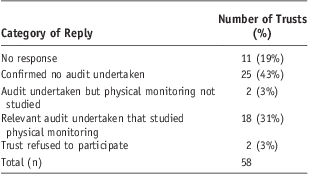
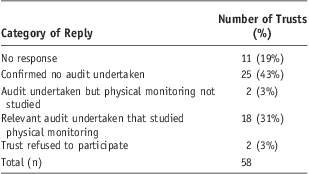
Twenty-five trusts (25/58, 43%) confirmed that no audit had been undertaken. However, 11 of these 25 trusts did send some documents relevant to RT, which did not qualify as audit. This included six trusts that only sent audit tools or data collection forms that could be used to carry out an audit. Two trusts sent their RT documents that included guidelines for physical health monitoring but no accompanying evidence of audit was provided. One trust emailed a short audit report that related to use of zuclopenthixol acetate but this did not constitute an audit that studied RT. One trust sent a statement of how many individuals had received RT without any systematic review of RT standards so this was also not regarded as audit. One other trust replied by giving details of their incident reporting system but no audit report was included. Two trusts (2/58, 3%) sent correspondence stating they did not wish to participate in this project and sent no documents.
Twenty trusts (20/58, 34%) returned one or more audits that related to monitoring of how their RT guidance was implemented. Eighteen (18/58, 31%) of these audits included measurements of whether physical health monitoring was performed around the time of RT. Table 1 summarises these results.
Outcome of requests from 58 mental health trusts for audit documentation on physical monitoring following RT
Of the 18 trusts that sent audit reports of RT practice that included some measurement of physical health monitoring, all 18 (18/18, 100%) studied whether one or more physical observations (e.g. pulse, blood pressure, respiratory rate) were done following administration of RT. The physical health parameters most commonly investigated were blood pressure, pulse and respiratory rate. Ten (10/18, 56%) of the trusts specified in their audits the frequency or duration for which the physical observation(s) should be measured. Four (4/18, 22%) of the audits looked at whether reasons were stated in the notes for not doing physical monitoring where applicable.
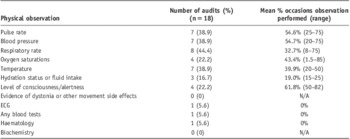
The mean number of RT incidents studied in each audit was 44.5 (range: 4 to 274 incidents). Auditing of specific physical observations or investigations by trusts and the mean results of these audits are shown in Table 2.
Measurements audited by 18 trusts who provided a relevant audit and performance of specific observations when audited

Discussion
Although monitoring of the physical condition of patients subject to RT is advocated and individual NHS Trusts have adopted this within their own policies and guidelines (Innes & Iyeke, Reference Innes and Iyeke2011), less than a third of those contacted could produce evidence of any physical monitoring actually taking place. The practice of monitoring physical health parameters is recommended by NICE but suggested audit criteria (NICE, 2005, appendix D) are vague, only referring to demonstrating that records ‘adequately justify the use of these interventions and the procedures taken during these interventions and any adverse outcomes’ (NICE, 2005). Thus the presence of any auditing and content of actual audit standards has been left to individual organisations. This is reflected in trust individual RT documents (Innes & Iyeke, Reference Innes and Iyeke2011) and the results of this study.
Clinical audit is principally the measurement of practice against agreed standards and implementation of change to ensure that all patients receive care to an acceptable standard (NICE, 2002). It is a cornerstone within clinical governance and a procedure such as RT, with its associated risks, is a prime topic for audit (and possibly a prime topic for review by the Care Quality Commission). However, if standards are variable and ill defined, the practice of audit is unlikely to occur systematically. Clarification of specific baseline requirements for physical monitoring post RT has been requested (Innes & Iyeke, Reference Innes and Iyeke2011) and would be welcomed in. RT and its monitoring is already a specific NHS Litigation Authority risk management standard for all mental health trusts. There are three assessment levels that trusts can choose to work to. All focus on post RT monitoring, although in order to achieve level 3 (top level), trusts need to provide evidence of audit regarding RT monitoring. It is difficult to understand how trusts are able to demonstrate compliance with these standards, as many were unable to respond with evidence of audit following our request.
MacPherson et al. (Reference MacPherson, Dix and Morgan2005) offered a recommendation of what physical support should be offered after parenteral rapid tranquillisation. This included monitoring ‘pulse, temperature, blood pressure and respiratory rate every 5–10 minutes for the first hour, then every 30–60 minutes until the patient is ambulatory’. The same authors also recommend that pulse oximetry is ‘desirable’ if the patient is asleep or unconscious, ‘an electrocardiogram (ECG) if there is any concern about cardiac function’ and ensuring adequate fluid intake (MacPherson et al. Reference MacPherson, Dix and Morgan2005). Alongside those provided by the Maudsley prescribing guidelines (Taylor et al. Reference Taylor, Paton and Kapur2012) these are perhaps the most prescriptive of available standards.
As well as within the Royal College of Psychiatrists consensus statement on antipsychotics (Royal College of Psychiatrists, 2006, p. 26), some guidance, mainly relating to principles of medication usage within RT, has been provided by other authors (e.g. Parker & Khwaja, Reference Parker and Khwaja2011). NICE stated that monitoring of blood pressure, temperature, pulse, respiratory rate and hydration are ‘mandatory’ but do not define a frequency for monitoring (NICE, 2005).
In this study, although most trusts replied to the request for information, there was a wide variety in the type of responses. Less than a third of organisations provided evidence that some physical monitoring post RT was occurring. The paucity of documentation received can only lead to an assumption that relevant auditing of standards was not taking place. However, it is possible that this lack of evidence also reflects poor clinical governance and audit mechanisms. For example, Freedom of Information Act requests could have been forwarded to a person in the trust with no knowledge of audit work in this area or relevant audit reports may not have been collated centrally in the trust.
This lack of relevant audit reports received is despite organisations having RT documents that state that monitoring should happen. In previous work (Innes & Iyeke, Reference Innes and Iyeke2011) it was identified that 7% of documents were classified as protocols, 43% guidelines, 41% policies, 5% standard operating procedures and 2% algorithms. It is only policies and standard operating procedures that set requirements for practice to be followed. The other types of documents often only set out statements about best practice. Therefore, it is inherently difficult for trusts to audit their own RT monitoring when required practices are not strictly set out. RT documents being at a level equivalent to policy would help to address this problem.
The Prescribing Observatory for Mental Health, UK (POMH-UK) sits within the Royal College of Psychiatrists and aims to help specialist mental health trusts and healthcare organisations improve prescribing practice. It identifies specific topics within mental health and develops a range of quality improvement interventions for each topic. Within acute adult inpatient settings it has examined high dose and combined antipsychotic prescribing. Given the high risk, variation in practice and likely positive impact that change would give, examination of RT procedures and associated monitoring may well be is a step that POMH-UK would wish to take.
Of those trusts that provided relevant audits, the most common physical observations measured were: blood pressure, temperature, pulse and respiratory rate. These are four of the five ‘compulsory’ elements favoured by NICE (2005). Hydration status (the fifth measure advocated by NICE, 2005) was analysed by only a few; more examined oxygen saturation. None of the received audits scrutinised evidence of examination for any motor side effects of antipsychotics and only one looked for evidence of attempts for or recording of ECGs. The number of occasions observations were performed or attempted also gave cause for concern; although there was a noticeable variation between trusts, it was clear that a significant percentage of individuals were receiving RT without accompanying physical monitoring. These results are worrying given the potential serious consequences that are associated with this procedure. Whether these are due to poor practice or simply because the prescribed monitoring was either inappropriate or patients refused consent remains to be seen. It is clear that post RT monitoring schedules must be practical to the situation. Whilst some observations may require patient consent and contact (e.g. blood pressure and pulse), others can still be continued remotely even if patient contact is inappropriate or consent is refused (i.e. level of consciousness, respiratory rate). The challenge to trusts is to ensure that at least some level of monitoring continues until such a point that it is considered safe for this to stop or further intervention is required. Hopefully re-audit following changes in practice will produce improvements within these organisations.
Summary and Conclusions
This survey focussed upon measurement of physical health observations following RT and demonstration of the presence of practice dictated within policy or procedural documentation by individual English mental health trusts. It did not look at exact clinical practice (e.g. how long monitoring continued for each individual) but only whether specific items were being audited and the results.
Despite much rhetoric, some guidelines and varying policies, a worryingly low level of demonstration of safe practice was found. This could be because of lack of specific national guidelines related to required monitoring and we urge organisations to provide needed clarification. Specific guidance papers are being revised by various organisations (e.g. NICE guidance relating to management of violence; the Royal College of Psychiatrists consensus statement on the use of high dose antipsychotic medication) and we feel that now is an ideal opportunity to attempt to provide clinicians with a more rigid protocol. Perhaps full consensus will not be gained, but surely those with expertise should try to exert influence.