INTRODUCTION
Recent research and clinical findings indicate that motor and executive control systems may develop in a parallel manner. Both systems display a similar protracted developmental trajectory, with periods of rapid growth in elementary years and continued maturation into young adulthood (Diamond, 2000). In addition, development of each system is dependent on the functional integrity and maturation of related brain regions, suggesting a shared neural circuitry that includes frontostriatal systems and the cerebellum (Diamond, 2000; Pennington & Ozonoff, 1996; Rubia et al., 2001). Moreover, deficits in either system (executive or motor control) frequently present with coexisting deficits in the other; for example, approximately half of children with Attention-Deficit/Hyperactivity Disorder (ADHD) demonstrate problems with motor coordination (Carte et al., 1996; Denckla & Rudel, 1978; Kadesjo & Gillberg, 1998; Pitcher et al., 2003; Steger et al., 2001), and approximately half of children with Developmental Coordination Disorder manifest problems with attention (Kaplan et al., 1998).
A number of neurodevelopmental disorders, including ADHD and high functioning autism (HFA), are associated with executive dysfunction (Diamond, 2000; Pennington & Ozonoff, 1996; Roth & Saykin, 2004; Steger et al., 2001), although the patterns of expression appear to be different. While “cognitive” elements of executive dysfunction are often deficient in individuals with HFA (Kleinhans et al., 2005), there is more often relative sparing of response inhibition (Ozonoff & Jensen, 1999; Ozonoff & Strayer, 1997). Compared with measures of “cognitive” inhibitory control, inhibition of a motor response is the most direct expression of inhibitory control, as it involves all-or-none decisions about action or nonaction (Rubia et al., 2001). Motor inhibition refers to the ability to suppress a prepotent motor act in favor of a competing movement (Barkley, 1997). Children with ADHD have consistently displayed deficits on tasks of response inhibition, regardless of paradigm [i.e., cognitive (Barkley et al., 1992) or behavioral (Quay, 1997; Schachar et al., 1995)] or motor system assessed [i.e., skeletomuscular (Berlin et al., 2004; Mostofsky et al., 2003; Schachar et al., 1995) or oculomotor (Feifel et al., 2004; Mostofsky et al., 2001a, 2001b)]. In contrast, children with HFA have displayed generally intact inhibitory skills under demands for cognitively controlled response inhibition (Griffith et al., 1999; Ozonoff et al., 1994; Ozonoff & Jensen, 1999; Ozonoff & Strayer, 1997), whereas results have been more variable when assessing motor inhibition. Russell and colleagues (Hughes & Russell, 1993; Russell et al., 1991, 2003) found that children with autism have consistently impaired performance when asked to inhibit a prepotent response (i.e., to inhibit reaching for a desired object). Other studies have consistently demonstrated deficits in motor inhibition among children with HFA using behavioral oculomotor inhibition tasks (Goldberg et al., 2002; Minshew et al., 1999). The research literature suggests that some elements of motor inhibition may be deficient in both ADHD and HFA; however, there has been little research directly contrasting the profiles of these groups.
While some theorists have argued that inhibitory control is the core (and developmentally fundamental) component of executive function (Barkley, 1997, 2000), other researchers have proposed that inhibitory control develops in parallel with other more “intentional” skills, including response preparation and working memory (Pennington, 1997). The term “intention” is used in behavioral neurology to refer to four component processes: initiation, sustaining, inhibition, and shifting (Heilman et al., 1993). Whereas attention is considered to precede sensory detection/perception, intention is thought to occur between sensation/perception and action, and involves a state of preparedness to respond (Denckla, 1996). Motor persistence, a relatively direct form of motor control related to the “sustaining” element of intentional control, has received little study in children (Mostofsky et al., 2001c). First described by Fisher (1956), motor persistence refers to the ability to sustain a voluntary action in the absence of reinforcement for a reasonable length of time. In adults, motor impersistence is observed almost exclusively in patients with right frontocentral lesions (Devinsky, 2000; Fisher, 1956; Kertesz et al., 1985). In children, studies have demonstrated an association between reading difficulties and poor oculomotor control (McPhillips & Sheehy, 2004; Shapira et al., 1980), suggesting that oculomotor persistence contributes to reading efficiency. Voeller and Heilman (1988) found that children with ADHD had difficulty sustaining simple motor acts, such as maintaining conjugate gaze, keeping the mouth open, holding out the tongue, or holding the eyes shut. Tantillo et al. (2002) noted that motor persistence improved in boys with ADHD following exercise, suggesting a possible relationship between motor persistence and dopamine availability in striatal regions. Among children with autism, Klin et al. (2002a) found abnormal patterns of visual (oculomotor) fixation in naturalistic social situations. While the methods used by Klin and colleagues assess more complex elements of sustained behavioral control, the implication is that children with autism may have more basic motor persistence deficits that underlie their ability to sustain social eye contact. At present, no studies have directly examined these elements of more basic motor persistence in children with HFA.
The purpose of this study was to contrast the performance of children with ADHD to that of children with HFA on these two components of motor control: motor inhibition and persistence. Because tasks of motor inhibition and persistence involve direct expression of motor control, they may be less susceptible to contamination with other (higher order) executive control demands, such as planning, emotional control, or working memory. These skills were investigated because they comprise the early motor analogs of cognitive response inhibition and perseverance. Given the available literature, it is proposed that children with ADHD will display significant deficits in motor inhibition, while children with HFA have relatively spared basic inhibitory skills. Furthermore, it is hypothesized that both children with ADHD and those with HFA will show deficient performance on motor persistence.
METHODS
Research Participants
A total of 136 children, ages 7–13 years, participated in this study. Three groups were formed: ADHD (n = 52), HFA (n = 24), and typically developing controls (n = 60). Participants were recruited through posted advertisements in the community, outpatient clinics at Kennedy Krieger Institute, local area pediatricians, schools, social/service organizations, chapters of Children and Adults with Attention-Deficit/Hyperactivity Disorder (CHADD), and the Autism Society of America. For all groups, children with a history of seizures, traumatic brain injury, mental retardation, or other neurological illness were excluded from participation. Intellectual level was assessed using the Wechsler Intelligence Scale for Children–III (WISC-III; Wechsler, 1991); only children with Full Scale IQs of 75 or greater were included. Additionally, the Basic Reading subtest from the Wechsler Individual Achievement Test (WIAT; Wechsler, 1992) was administered to rule out a primary deficit in basic reading for the control and ADHD groups, as determined by a statistically significant discrepancy (p < .05) between their Basic Reading score and WISC-III Full Scale IQ score (based on standardization data provided in the WISC-III and WIAT manuals), or a Basic Reading subtest score below 85, regardless of IQ score. We chose to exclude children with word reading difficulties from the ADHD and control groups because of the underlying language dysfunction associated with reading disorders. These data are drawn from larger studies of children with ADHD and autism that also emphasize neuroimaging correlates of the disorders. To ensure more diagnostically pure samples (ADHD and control) for the purposes of neuroimaging, we have attempted to exclude coexisting conditions that can contribute to neuroanatomic differences. Children in the HFA group were not excluded on the basis of reading scores because, by definition, children with autism have language dysfunction, and thus a high rate of language-based learning disorders (e.g., reading disorders) is expected.
Children were included in the ADHD group based on administration of the Diagnostic Interview for Children and Adolescents–IV (DICA-IV; Reich et al., 1997), as well as two sets of behavior rating scales, each of which was completed by parents and teachers: Conners' Parent and Teacher Rating Scale–Revised (CPRS-R, CTRS-R; Conners, 1997) and ADHD Rating Scale–IV, Home and School Versions (ARS; DuPaul et al., 1998). Positive scores on rating scales were defined as a T-score of 65 or greater on scale L (DSM-IV: Inattentive) or M (DSM-IV: Hyperactive-Impulsive) of the CPRS-R and CTRS-R, and ratings of 2 or 3 on at least 6 of the 9 positive items from either the Inattentive or Hyperactivity/Impulsivity scales of the ARS. To be included in the ADHD group, the following criteria were required: (1) referral by a community clinician with identification of a current diagnosis of ADHD, (2) DSM-IV diagnosis of ADHD based on positive scores on at least one parent and one teacher rating scale (CPRS-R, CTRS-R, and/or ARS), and (3) confirmation of the ADHD diagnosis via the DICA-IV psychiatric interview. Children in the ADHD and control groups with conduct, mood, generalized anxiety, separation anxiety, or obsessive-compulsive disorders (based on DICA-IV interview with parent) were excluded. A child neurologist (SHM) confirmed the DSM-IV diagnoses of all children in the ADHD at the time of assessment. Children with ADHD taking psychotropic medications other than stimulants were excluded. Parents were requested to withhold their child's stimulant medication for the day of and the day prior to testing. Based on DICA-IV interviews and rating scales, children with all three subtypes of ADHD were included and combined into one group for analyses (i.e., Combined type, n = 35; Hyperactive-Impulsive type, n = 3; Inattentive type, n = 14).
Children were included in the control group if they had: (1) no parent or teacher report of ADHD as determined by the CPRS-R, CTRS-R, and/or ARS; (2) no evidence of psychiatric disorders as determined by the DICA-IV; (3) no history of neurological disorder determined by parent report on a medical history questionnaire; and (4) no reading disability, as determined by the criteria described earlier. None of the children in the control group were taking psychotropic medications.
Children were included in the HFA group if they met diagnostic criteria on the Autism Diagnostic Interview–Revised (ADI-R; Lord et al., 1994), as well as on the Autism Diagnostic Observation Schedule (ADOS; Lord et al., 1989) or Autism Diagnostic Observation Schedule–Generic (ADOS-G; Lord et al., 2000). Children in the HFA group were not excluded on the basis of medication usage or coexisting anxiety disorders. Of the 24 children with HFA, 3 had comorbid anxiety disorders, 5 had elevated rating scale reports of inattention and/or impulsivity (as described earlier for the ADHD group, although they did not meet DSM-IV criteria for ADHD), and 12 were taking psychoactive medications (9 of whom were taking stimulants). Those in the HFA group taking stimulant medication were asked to withhold the medication the day of and day prior to testing. Other medications were not discontinued.
Procedures
The Institutional Review Board at the Johns Hopkins University School of Medicine approved this study. Parents of participants provided consent for their children to participate in the study and all participants provided assent. All participants were initially screened for inclusion criteria through a brief telephone interview with a parent. Participants completed motor, IQ, and reading tests in one day as part of a larger battery of neuropsychological tests. Parents completed rating scales and a structured diagnostic interview at the time of their child's testing. Study examiners were blind to participant diagnostic group at the time of testing.
Motor Speed Measure
The Timed Motor Examination (Denckla, 1985) was used to assess basic motor speed. All participants were administered a series of 12 timed motor tasks from the Revised Physical and Neurological Examination for Subtle Signs (PANESS; Denckla, 1985). These tasks were selected as measures of basic motor speed and have minimal demands for higher-level motor controls. The tasks included sequences of 20 toe taps, 10 heel-toe taps, 20 hand pats, 20 finger taps, 10 hand pronate-supinate pats, and 5 finger appositions. All tasks were performed bilaterally and scored according to published age- and gender-based norms. Participant scores (z-scores) were averaged across the 12 tasks in order to generate a composite motor speed variable to serve as a control for basic, nonexecutive motor speed.
Motor Control Measures
Four measures of motor control were administered to all participants, including two measures of motor inhibition (Conflicting Motor Response Task and Contralateral Motor Response Task) and two measures of motor persistence (Lateral Gaze Fixation and NEPSY Statue). Examiners were trained on task administration and scoring by a behavioral neurologist (SHM, MBD) or child neuropsychologist (EMM) and achieved a criterion of .90 on interrater reliability on practice examinations with trainers before testing study participants.
Conflicting Motor Response Task
This measure was adapted from the Luria-Christensen Battery (Christensen, 1975). Participants were told, “If I show you my finger, you show me your fist; if I show you my fist, you show me your finger.” The examiner, using the left hand, presented each of the two gestures 24 times (for a total of 48 presentations) in a fixed pseudo-random sequence, at a rate of one per second. The subjects were instructed to respond with their dominant hand as quickly as possible. The task therefore required the subject to inhibit the prepotent tendency to mimic the examiner. The variable of interest relevant to response inhibition was the total number correct out of 48 trials (maximum score = 48). Responses were coded correct if the participant's arm was raised entirely in a correct position within 3 seconds. Responses were coded as errors if participants took more than 3 seconds to respond or if the arm was lifted more than halfway in an incorrect position.
Contralateral Motor Response Task
This measure was initially reported in a study of motor neglect in monkeys (Watson et al., 1978), and has since been used in a study of response inhibition in adults with frontal lobe lesions (Verfaellie & Heilman, 1987). With eyes closed, children were instructed to lift the right hand when touched on the top of the left hand, and lift the left hand when touched on the top of the right hand. A total of 48 trials were administered (24 for each hand) in a fixed pseudorandom sequence at a rate of one per second. Lateral (same side) errors, indicative of failure to inhibit the prepotent response of raising the hand that is touched, were recorded. The dependent variable was the total number correct on the 48 trials (maximum score = 48). Responses were coded correct if the participant's opposite (nontouched) hand was raised within 3 seconds. Responses were coded as errors if participants took more than 3 seconds to respond or the touched hand was lifted off the table at all.
Lateral Gaze Fixation
Adapted from a battery of tasks reported by Kertesz and colleagues (Kertesz et al., 1985), this measure of lateral fixation was used to assess motor persistence. Participants were asked to stand directly opposite the examiner and to sustain a lateral gaze for 20 seconds, timed with a stopwatch. The examiner held a pencil approximately 45° from midline in either the patient's right or left visual field. Trials were terminated at 20 seconds, or earlier if the child's eyes deviated from the indicated fixation point. The procedure was administered 4 times, alternating between the patient's right and left visual fields. The dependent measure was the sum of gaze times (in seconds) for both visual fields (maximum score = 80 seconds).
NEPSY Statue
The Statue test (Korkman et al., 1998) is a measure of motor persistence in which the child is asked to maintain a fixed body position with eyes closed during a 75-second period. Observations were made every 5 seconds to track errors, defined as body movements, eye opening, or talking. During the task, the examiner made a series of distracting noises (e.g., dropping a pencil, coughing). A score of 2 was recorded for each 5-second interval in which there were no errors; a score of 1 was recorded for each interval in which there was only 1 error; and, a score of 0 was recorded for each interval in which there were 2 or more errors. Total raw score was used as the dependent variable for this task (maximum score = 30).
Data Analyses
Group differences in sample characteristics were explored using chi-squares for all categorical data (gender, race, and handedness) and ANOVAs for all other continuous variables (age, IQ, SES). Interrelatedness of the four motor control tasks, IQ, and the motor speed task was analyzed using Pearson correlations. All four dependent measures had skewed distributions; therefore, log transformations of each were used in group comparisons in order not to violate the assumptions of parametric statistics. Group means for the log transformations of the four dependent measures were compared among the HFA, ADHD, and control groups on all motor tasks and were analyzed using univariate analyses of covariance (ANCOVAs). Potential confounding variables (i.e., age, IQ, gender, and motor speed) were used as covariates (see description later). Planned contrasts (ADHD vs. Control; HFA vs. Control; ADHD vs. HFA) were examined using age, IQ, gender, and motor speed as covariates.
RESULTS
Sample Characteristics
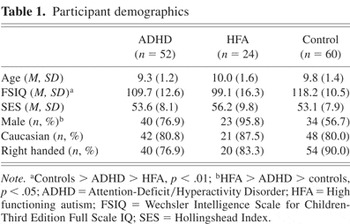
Information regarding age, sex, ethnicity, IQ, socioeconomic status (SES), and handedness by diagnostic group is presented in Table 1. Children ranged in age from 7 to 13 years, with a trend toward age differences between groups [F(2,133) = 2.80, p = .06]. There were no group differences in SES, based on Hollingshead Index [F(2,67) = 0.5, p = .66]. The sample was predominantly male (71.3%), right-handed (83.8%), and Caucasian (81.6% Caucasian, 7.4% African American, 5.1% Asian, 1.5% Hispanic, and 4.4% other ethnic/racial groups or unspecified). There were no significant group differences in racial distribution (χ2 = 7.7, p = .66) or handedness (χ2 = 3.3, p = .20). There were, however, significant differences in gender distribution across the three groups (χ2 =14.2, p = .001), with both HFA and ADHD groups having a greater proportion of males compared to the control group. Full Scale IQ (FSIQ) scores ranged from 77 to 145, with an average of 111.6. There was a significant difference in FSIQ between groups [F(2,132) = 21.1, p < .001], with post hoc tests (Tukey HSD) indicating that the control group had a significantly higher mean IQ than both the ADHD group (p = .001) and HFA group (p < .001); also the ADHD group had a significantly higher mean IQ than the HFA group (p < .01).
Participant demographics

Within-Group Associations of Gender and IQ with Scores on Motor Control Tasks
Within-group analyses of the effects of gender and IQ were conducted to determine if these covariates had similar effects on motor control performance across groups. Within the control group, gender was not associated with scores on Contralateral Motor Response [t(58) = 1.69, p = .10], Conflicting Motor Response [t(58) = 0.10, p = .92], Lateral Gaze Fixation [t(57) = 0.60, p = .55], or Statue [t(56) = −1.84, p = .07]. Analysis also failed to reveal gender effects within the ADHD group for scores on Contralateral Motor Response [t(50) = 1.72, p = .09], Conflicting Motor Response [t(50) = −0.62, p = .54], and Lateral Gaze Fixation [t(50) = −0.75, p = .46]. However, girls with ADHD performed significantly better than boys with ADHD on Statue [t(50) = −2.95, p < .01]. Gender comparisons within HFA participants were not possible because there was only one girl in the HFA group.
Within the control group, IQ level (borderline/low average, average, high average/superior) was not associated with scores on Contralateral Motor Response [F(1,58) = 0.41, p = .52], Conflicting Motor Response [F(1,58) = 0.02, p = .89], Lateral Gaze Fixation [F(1,57) = 0.00, p = .98], or Statue [F(1,56) = 0.91, p = .34]. Analysis also failed to reveal associations of IQ level in the ADHD group with scores on Contralateral Motor Response [F(2,48) = 0.36, p = .70], Conflicting Motor Response [F(2,48) = −0.62, p = .54], Lateral Gaze Fixation [F(2,48) = 0.32, p = .97], and Statue [F(2,48) = 0.80, p = .46]; or IQ level in the HFA group with scores on Contralateral Motor Response [F(2,21) = 2.07, p = .15] and Lateral Gaze Fixation [F(2,17) = 0.61, p = .55]. However, IQ level in the HFA group was associated with scores on Conflicting Motor Response [F(2,21) = 3.84, p = .04] and Statue [F(2,21) = 7.57, p = .003]—in both cases, performance improved with higher IQ level.
Given the potential for age, gender, and IQ to be confounding variables, they were used as covariates in subsequent group comparisons. Because there were different gender effects within groups on Statue, and different IQ effects within groups on Statue and Conflicting Motor Response, group comparisons for Statue were analyzed without covarying for IQ and gender; and group comparisons for Conflicting Motor Response were analyzed without covarying for IQ.
Associations of Motor Control Variables with Each Other and with PANESS
The four motor control measures were significantly correlated with each other (Contralateral Motor Response and Conflicting Motor Response r = .52, p < .001; Contralateral Motor Response and Lateral Gaze Fixation r = .25, p < .005; Contralateral Motor Response and Statue r = .39, p < .001; Conflicting Motor Response and Statue r = .23, p < .01; Lateral Gaze Fixation and Statue r = .48, p < 001). The two measures of motor inhibition were more strongly correlated with each other than with either of the motor persistence tasks and the two measures of motor persistence were more strongly correlated with each other than with either of the motor inhibition tasks. Correlations between each of the four motor control variables and the PANESS motor speed composite variable were small to medium, although statistically significant (Contralateral Motor Response r = .19, p < .05; Conflicting Motor Response r = .19, p < .05; Lateral Gaze Response r = .36, p < .0001; Statue r = .32, p < .0001). Associations of the PANESS with scores on the motor control tasks did not vary with group. FSIQ was significantly correlated with all motor variables: Contralateral Motor Response (r = .21, p = .01), Conflicting Motor Response (r = .17, p = .05), Lateral Gaze Fixation (r = .29, p = .001), Statue (r = .42, p < .001), and the PANESS motor speed composite (r = .19, p = .04).
Group Comparisons on Motor Tasks
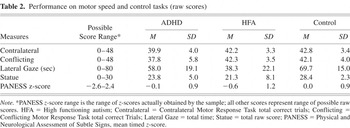
There were no significant differences between diagnostic groups on the measure of basic motor speed from the PANESS [F(2,120) = 2.6, p = .08]; however, given its significant correlation with the motor control tasks, it was used as a covariate for further analyses of the motor control variables. Mean raw and log-transformed scores for the four motor control measures are presented in Tables 2 and 3, respectively. Univariate ANCOVAs (with appropriate covariates) for the log transformation scores revealed significant group (ADHD, HFA, Control) differences on all four measures: Contralateral Motor Response [F(2,115) = 7.9, p = .001, η2 = .12]; Conflicting Motor Response [F(2,117) = 11.8, p < .001, η2 = .17]; Lateral Gaze Fixation [F(2,113) = 13.4, p < .001, η2 = .19]; and Statue [F(2,117) = 16.7, p < .001, η2 = .22]. Planned contrasts (also with appropriate covariates) revealed that children with ADHD performed significantly worse than the control group on the Conflicting Motor Response (p < .001), Contralateral Motor Response (p = .001), and Statue (p < .001), but not Lateral Gaze Fixation (p = .23). In contrast, children with HFA performed significantly worse than controls on both measures of motor persistence (Lateral Gaze Fixation p < .001; Statue p < .001), but neither measure of motor inhibition (Contralateral Motor Response p = .44; Conflicting Motor Response p = .50). Planned contrasts also indicated that the ADHD group performed significantly worse than the HFA group on both motor inhibition tasks (Contralateral Motor Response p = .002; Conflicting Motor Response p < .001); whereas the HFA group performed significantly worse than the ADHD group on Lateral Gaze Fixation (p < .001).
Performance on motor speed and control tasks (raw scores)

Group comparisons on motor control tasks (log transformations)

The ADHD group was examined in isolation for possible effects of ADHD subtype. Across all four tasks, there were no significant differences between children with diagnoses of ADHD-Combined (n = 35), ADHD-Primarily Inattentive (n = 3), or ADHD-Hyperactive/Impulsive (n = 14): Contralateral Motor Response [F(2,58) = 1.2, p = .32]; Conflicting Motor Response [F(2,58) = 0.6, p = .55]; Lateral Gaze Fixation [F(2,58) = 1.2, p = .31]; and Statue [F(2,58) = 1.5, p = .23].
Five of the children within the HFA group were noted to have symptoms of inattention and hyperactivity based on parent or teacher report, although they did not meet DSM-IV criteria for ADHD. To investigate whether the inclusion of these children affected findings, additional analyses were conducted omitting these five subjects. The findings were similar to those reported earlier. Children in the HFA group performed significantly worse than children in the control group only on measures of motor persistence (both p < .001), but not on either of the motor inhibition tasks.
DISCUSSION
The purpose of the present study was to examine motor control among children with ADHD and HFA to better understand the neurobehavioral profiles associated with these disorders. Our findings suggest that ADHD and HFA can be distinguished in terms of their pattern of performance on two types of motor control tasks: motor persistence and motor inhibition. Specifically, significant motor persistence deficits were associated with HFA (and to a lesser extent with ADHD), whereas motor inhibition deficits were associated with ADHD, and not with HFA. These findings do not appear to be related to group differences in basic motor speed, age, gender, or intellectual functioning; indeed, children in the ADHD group performed significantly worse than children in the HFA group on tasks of motor response inhibition, despite having significantly higher IQs. These findings are consistent with those from previous studies highlighting deficits in motor inhibition in individuals with ADHD using a range of tasks, including Conflicting and Contralateral Motor Response Tasks (Mostofsky et al., 2003; Shue & Douglas, 1992), go/no-go tasks (Harris et al., 1995; Trommer et al., 1988), and stop-signal tasks (Rubia et al., 1998; Schachar et al., 2000).
While both the HFA and ADHD groups performed well below controls on the NEPSY Statue task, the HFA group performed significantly worse than the ADHD group on the Lateral Gaze Fixation task. It is notable that this task required sustained visual fixation, as previous studies have identified specific motor deficits in HFA on tasks subserved by oculomotor systems, including visual pursuit tasks (Takarae et al., 2004a), pro- and anti-saccade tasks (Goldberg et al., 2002; Takarae et al., 2004b), and delayed response tasks (Minshew et al., 1999). Furthermore, studies of visual tracking in social situations have found children with autism to display atypical patterns of visual fixation (Klin et al., 2002a, 2002b). These specific deficits occur within the context of preserved performance on similar tasks subserved by other motor systems, including bimanual and gross motor tasks (Griffith et al., 1999; Ozonoff & Strayer, 1997; Russell et al., 1999). While the relative deficits in the HFA group (relative to ADHD and controls) on Lateral Gaze Fixation may have reflected uncontrolled effects of IQ and gender on the scores, this interpretation is doubtful given the lack of association of these factors with performance in the control and ADHD groups. It is also unlikely that the persistence deficit in autism is limited to oculomotor tasks, as we observed relative deficits in this group on the Statue task as well. One possible interpretation of the difference between the ADHD and HFA groups in Lateral Gaze Fixation is that this task provides an especially sensitive assessment of motor persistence. Unlike the procedures involving complex components of fixation described by Klin and colleagues (2002a, 2002b), the Lateral Gaze Fixation Task is a relatively “pure” test of basic oculomotor persistence, which minimizes concurrent social, language, and working memory demands. Additional research contrasting ADHD with HFA in groups matched for age, IQ, gender, and basic motor speed is warranted. Nevertheless, our current findings suggest that the basic motor persistence required for sustained visual fixation may be a particular area of behavioral deficit in autism, potentially dissociable from that observed other neurodevelopmental disorders such as ADHD.
There are several possible explanations for the groups' differential performance on tasks of motor persistence and inhibition. First, the two disorders may involve different levels of anomalous hemispheric lateralization (Bradshaw & Sheppard, 2000). Children with ADHD may have bilateral inefficiencies in systems supporting motor control, whereas children with HFA may have greater relative involvement of the right hemisphere. Motor persistence has been well demonstrated in the adult and lesion literature to be associated with right hemisphere integrity (Kertesz et al., 1985). Thus, groups with bilateral deficits would be expected to display impaired motor performance across both task types, whereas groups with primarily right hemisphere involvement would be expected to display more limited impairments.
Second, the two disorders may involve differential insult to underlying frontal structures. The frontal lobes are heterogeneous, with anatomically and functionally distinct subregions (Castellanos et al., 2006), each associated with different elements of executive function (Fuster, 1997). Though research has demonstrated compromise to frontal regions in both ADHD and HFA, there may be greater relative involvement of subregions of the prefrontal cortex in ADHD. Indeed, fMRI findings reveal that brain activation associated with response inhibition varies depending on the nature of the task (Mostofsky et al., 2003), with greater prefrontal activation observed when inhibiting a response during a more complex go/no-go task in which working memory is necessary to guide response inhibition in contrast to the premotor activation observed during performance on a simplified skeletomotor inhibition (go/no-go) task utilizing a well-ingrained stimulus-response association.
Third, the observed differences in motor profiles of the two disorders may be specific to the nature of the inhibition tasks used in the current study. Given the relative sparing of motor inhibition in our HFA group, there appears to be some differentiation in neural mechanisms supporting manual motor inhibition (as measured by the Conflicting Motor Response and Contralateral Motor Response Tasks) and oculomotor inhibition (as measured by predictive prosaccade and antisaccade tasks), especially as neither of our clinical groups were impaired on basic motor speed. Previous research has identified abnormalities in oculomotor inhibitory control in both ADHD (Mostofsky et al., 2001a, 2001b; Ross et al., 2000), and HFA (Goldberg et al., 2002; Minshew et al., 1999). Thus, the deficient performance on manual motor inhibition tasks in the children with ADHD relative to those with HFA may reflect differences in the nature of extent of prefrontal abnormality associated with these two conditions (Mostofsky et al., 2002). These interpretations are offered as possibilities and further research will be needed to clarify the neural mechanisms responsible for these group differences.
Several issues in the current study require special attention. First, although attempts were made to include comparable numbers of girls in all groups, our two clinical groups had a greater proportion of boys, consistent with base rates of the disorders. The low number of females in some groups limited further exploration of gender by group interactions. In addition, our two clinical groups were not distinct with regard to behaviors associated with ADHD. Several of the children in the HFA group had some symptoms of ADHD per parent and/or teacher report. While the current diagnostic criteria outlined in DSM-IV specifically preclude a diagnosis of ADHD when symptoms occur exclusively in the context of a Pervasive Developmental Disorder, the underlying neural substrate of both conditions may indeed produce overlapping symptom profiles, especially given the current evidence of frontostriatal (Ashtari et al., 2005; Courchesne & Pierce, 2005; McAlonan et al., 2005; Seidman et al., 2005; Vaidya et al., 2005) and cerebellar anomalies (Acosta & Pearl, 2004; Castellanos & Acosta, 2004; Palmen et al., 2005) reported for both disorders in the neuroimaging literature. In our sample, the children in the HFA group had Autism as their primary diagnosis, and their accompanying symptoms of ADHD did not produce the type of inhibitory impairments seen in children with ADHD alone. Secondary analyses omitting the HFA children with attention problems did not alter initial results, suggesting that the main findings are not related to attention problems. We chose not to exclude the five children in the HFA group who presented with symptoms of ADHD; nonetheless, because the range of behaviors in our sample appears entirely consistent with that seen clinically in children with HFA, and exclusion of those children would result in a less representative HFA sample.
Finally, our motor control measures were not “pure” with regard to the demands for motor inhibition and/or motor persistence. For example, on both inhibition measures, there is an element of working memory (i.e., holding the rule in mind while performing the task) required to successfully complete the task. On the NEPSY Statue test, there is an extraneous demand for inhibition introduced during the distractions made by the examiner, as well as a demand for working memory (remembering the rules). Children with ADHD (Wodka et al., in press) and those with autism (Hughes et al., 1994) have increased difficulty on inhibitory control tasks in which some working memory component is required. Additionally, our use of the PANESS permitted limited assessment of other motor functions. By considering only motor speed, we did not assess or control for the full range of children's motor skills.
Strengths of this study include careful diagnosis and assignment to clinical groups, characterization and exclusion of children with comorbid psychiatric and learning disorders, and the discontinuation of stimulant medication during neurobehavioral testing for both clinical groups. These motor inhibition and persistence tasks hold promise for clinical use because they can be administered quickly, require no special equipment, and can be easily used in the office or at the bedside. Further research will be required to fully explore the motor control and executive profiles of various neurobehavioral disorders (e.g., Tourette syndrome, Obsessive Compulsive Disorder), in order to both further elucidate the neurobehavioral phenotypes and clearly identify their underlying neural circuitry. Future research should also be conducted to explore the sensitivity motor control measures with a wider age range, and to directly contrast the neuroimaging correlates of HFA and ADHD groups (with particular emphasis on subparcellation of prefrontal structures) matched on relevant demographic parameters.
In conclusion, the present study highlights the different patterns of motor control observed in children with ADHD and HFA. Children with ADHD are impaired relative to children with HFA and controls on measures of skeletomotor inhibition, whereas children with HFA are impaired relative to those with ADHD and controls on tasks of oculomotor gaze persistence. These findings provide evidence for the unique behavioral phenotypes of these two disorders with respect to motor control, and emphasizes the need for additional research to determine whether these skills represent a double dissociation among ADHD and HFA.
ACKNOWLEDGMENTS
A portion of this article was presented at the 33rd annual meeting of the International Neuropsychological Society in St. Louis, Missouri, February 4, 2005. This research was supported by HD-24061 (Mental Retardation and Developmental Disabilities Research Center), RO1 NS043480 (MBD), K08 NS 02039 (SHM), K02 NS 044850 (SHM), K01 MH 01824 (MCG), M01 RR00052 (Johns Hopkins General Clinical Research Center), and a by the National Alliance for Autism Research (SHM). The authors wish to thank the editors for their helpful suggestions on earlier versions of this manuscript.