How does what happens inside of a business relate to the economy outside of it? In a sense, this question marks the boundary between business and economic history. Business historians generally focus on the ways firms develop new management practices, strategies, and technologies. Their studies are underpinned by the enticing, but rarely explicit, assumption that business practices shape both the success of individual firms and the contours of the larger economy. As Chandler put it, the collective history of business can illuminate the “underlying dynamic in the development of modern industrial capitalism” (Chandler Reference Chandler1977, p. 593). By contrast, for economic historians, the firm often remains a black box. Quantitative studies related to business practices tend to focus on institutional and legal changes, leaving specific business practices, like accounting, as residuals that are not directly measured or discussed. As a result, we know almost nothing about the history of business practices on average or in the aggregate. Such knowledge offers essential context for understanding the nature of managerial practices and the ways they shape economies and societies.
In large part, the lack of quantitative knowledge about historical business practices reflects limitations in available sources. Most knowledge about the early history of management comes from manuscript account books, textbooks, and trade journals. As McGouldrick (Reference McGouldrick1968) wrote half a century ago in an influential study of the New England textile industry, such records are better suited to the “investigation of micro behavior … than [to] the macro results of behavior” (p. 2). Though historians have attempted to remedy this shortcoming by building large samples, biases in surviving records—which are more likely to have belonged to large and long-lived firms—make these samples a poor substitute for knowledge of average practices. Scholars studying the present use surveys and experiments to get around this problem. The results suggest that the adoption of management practices varies widely and also predicts firm performance (Bloom and Van Reenen 2007, 2010). Alas, historians cannot travel back in time to test expertise or to randomly distribute consulting advice.
This paper develops a new way of measuring management practices by using errors and omissions in accounting statements as a proxy for accounting expertise. While many scholars have used account books as a window into management practices, most studies have concentrated on individual firms or groups of firms (Yates Reference Yates1989; Levenstein Reference Levenstein1998; Fear Reference Fear2005; Johnson and Kaplan Reference Johnson and Kaplan1987). This paper adapts methods from research that uses errors in age reporting to estimate levels of numeracy (Mokyr and Ó Gráda 1982; A’Hearn, Baten and Crayen Reference A’Hearn, Baten and Crayen2009). The research has used the over-reporting of “round” ages—5s and 10s—to determine how well given populations know their ages. Tracking errors in corporate reports offers a parallel opportunity to trace the evolution of management practices and how they have changed over time. This paper constructs a unique data set using pre-printed balance sheets distributed by the state of Massachusetts between 1875 and 1895. Analyzing the ways firms filled out these forms offers an opportunity to assess their level of managerial expertise.
The data reveal that in late nineteenth-century Massachusetts, accounting practices were rapidly improving but also remarkably uneven. This is surprising because, as I discuss in more detail later in the paper, practices in Massachusetts—a center for early industrialization—were likely more advanced than average across the United States. And yet, in 1875, approximately 38 percent of Massachusetts corporations failed to return correctly completed balance sheets to the state. However, practices advanced quickly: by 1885, the proportion of errors fell to below 20 percent, and by 1895 more than 96 percent of balance sheets were completed correctly. By the end of the nineteenth century, knowledge of standard double-entry accounting practices had become near universal among corporations. The use of depreciation progressed more slowly. In 1875, 18 percent of firms reported anything in this category, and the proportion had increased to 25 percent by 1895. The late nineteenth century thus appears to have been a period of rapid dissemination for basic accounting but also a time when more advanced techniques remained relatively rare. Both practices are positively correlated with firm survival. Data limitations make it impossible to evaluate causality, but firms that completed forms more correctly and completely tended to remain in the sample. Controlling for size, firms using either or double-entry bookkeeping or depreciation in 1875 survived at higher rates than those using neither, and firms using both practices survived at the highest rates.
The paper proceeds in four stages: I begin by discussing my approach to quantifying numerical practices as well as the unique opportunity presented by the Massachusetts certificates of condition. Second, I discuss the two accounting techniques that are the focus of the paper—double-entry bookkeeping and depreciation. Third, I present data on the prevalence of these techniques between 1875 and 1895; and fourth, I analyze the correlation between accounting practices and firm survival. In the conclusion, I ask what questions the apparent diversity of practices raises for our understanding of late nineteenth-century American capitalism.
QUANTIFYING QUANTITATIVE MANAGEMENT
Opportunities to quantify historical managerial practices are rare: no known surveys inquired about accounting abilities in the nineteenth century, and survival bias among archival manuscripts makes them more appropriate for studies of individual firms than for generalizing about the state of accounting practices. Historians of skills like literacy and numeracy have dealt with similar challenges by focusing not on what was reported but on how it was reported. For example, scholars of numeracy have used “heaping” in age data as a proxy for numeracy and for levels of human capital more generally. This research measures the over-reporting of ages rounded off to the 5s and 10s digits. Mokyr and Ó Gráda (1982) used age heaping to explore the relationship between human capital and immigration patterns during the Irish famine. A’Hearn, Baten, and Crayen (Reference A’Hearn, Baten and Crayen2009) used similar strategies to document the evolution of age heaping in Europe and America over the long run. Such research has confirmed that numeracy measured using heaping correlates with literacy, and also that numeracy rates diverge in patterns that resemble the divergence seen in other kinds of data.
Most historical research analyzing errors in data has focused on ages from censuses or other demographic sources, but scholars studying present-day business practices have used a range of other numbers from a wide variety of documents. For example, data errors have been used to predict the accuracy of modern financial reports, where the over-reporting of some numbers and digits appears to be correlated with eventual revisions to financial statements. Numbers that seem to be rounded off are more likely to be deemed inaccurate and later revised (Lin, Guan, and Fang Reference Lin, Guan and Fang2011). Similarly, Benford’s law, which describes the distribution of first digits in most samples, has been used to uncover fraud in everything from financial reports to clinical trials to election data (Nye and Moul Reference Nye and Moul2007; Rosentrater Reference Rosentrater2017; Miller Reference Miller2015).
This paper identifies errors and omissions in balance sheets and uses them to estimate the prevalence of accounting techniques. Late nineteenth-century Massachusetts offers an excellent setting for exploring business practices at scale. The state was a site of early industrialization, with large factories relying on heavy machinery from the early nineteenth century onward. Indeed, so much has been written about the New England region that one recent study quipped that the “banality of New England industrialization almost makes it unworthy of further study” (Schakenbach Regele 2019, p. 8). The records of the famous textile mills at Lowell and other Massachusetts corporations have been studied by historians for decades, with scholars uncovering both instances of innovation and unevenness in recordkeeping (Dodd 1954; Pollard Reference Pollard1965; Garner Reference Garner1954; Davis and Stettler 1966; McGouldrick Reference McGouldrick1968). The data presented here contextualize the wealth of qualitative studies within the full range of Massachusetts corporations. The data suggest that examples of advanced practices represent but one slice of a broad spectrum of corporate accounts. This diversity also fits with research on the account books of Massachusetts farmers, who have also received disproportionate attention. Among Massachusetts and New England farmers, scholars have found both careful attention to markets (Rothenberg Reference Rothenberg1984, 1992) and unconventional records that prioritize a wide array of concerns (Clark Reference Clark1990; Merrill Reference Merrill1995).
The state of Massachusetts required all incorporated firms to complete blank balance sheets from 1875 onward. These balance sheets were the result of a quarter-century of incorporation legislation that gradually increased reporting requirements. In 1851, the state passed a general incorporation law—one of many passed nationwide during the 1840s and 1850s (Wallis Reference Wallis2005). The Massachusetts law required firms to report basic information to the state, and the secretary of the commonwealth began publishing abstracts of these filings. At first, the published data were minimal: the amount of capital stock, the number of shares, par value of shares, the number of stockholders, and how much capital had been paid in over how many installments.Footnote 1 The reports evolved only slightly until the 1870s, when new legislation dramatically expanded the data collected and published by the state. An 1870 law set out new rules for the incorporation of all kinds of businesses, and these rules came with new reporting requirements: each year firms were required to file an updated report with details on how their capital was invested.Footnote 2 In 1874, an amendment extended the reporting requirements, requiring a filing detailing the “assets and liabilities of said corporation, in such form and with such detail as the commissioner of corporations shall require or approve.”Footnote 3
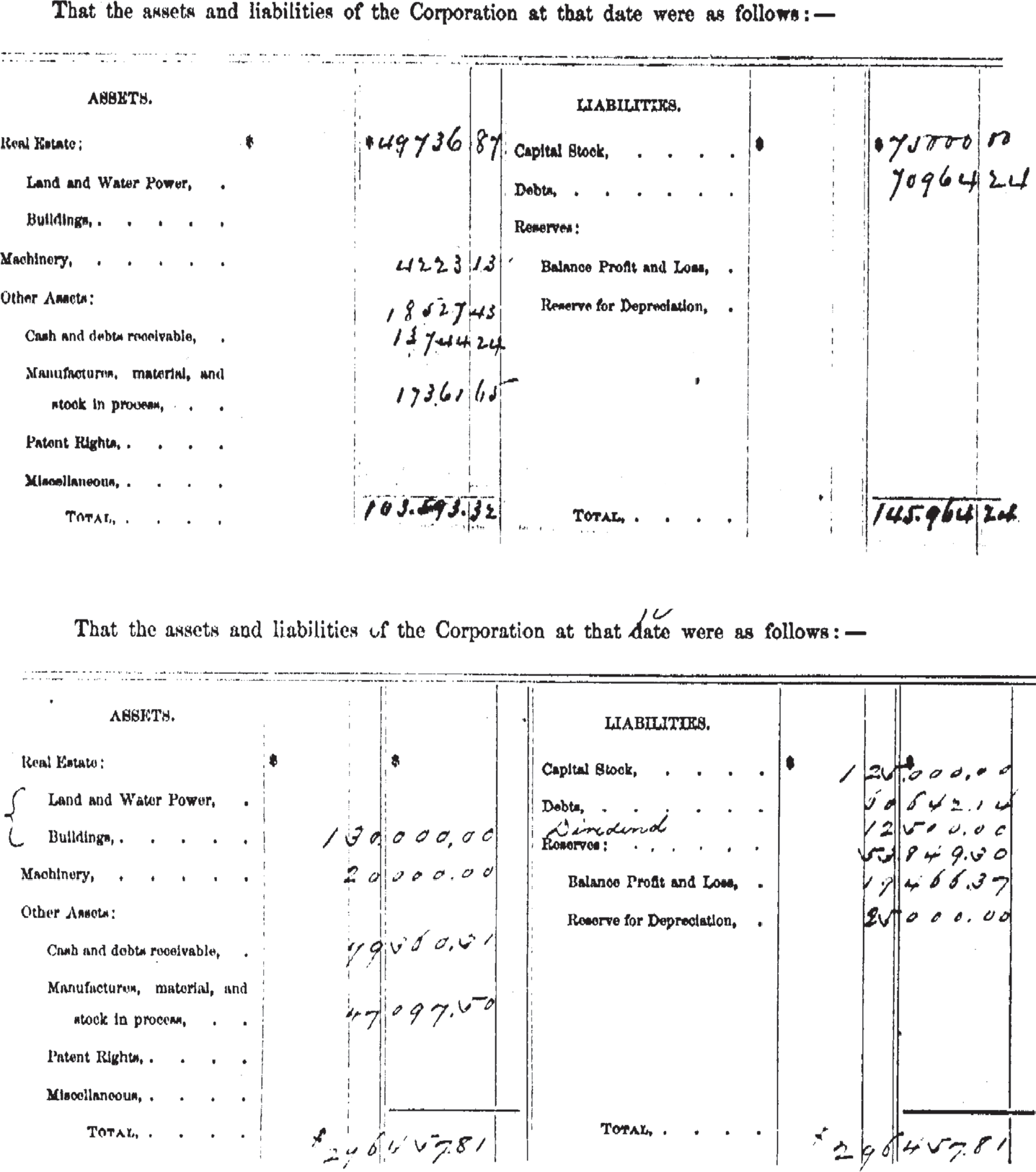
From 1875 onward, the commissioner supplied corporations with blank balance sheets to fill out and return.Footnote 4 Figure 1 shows two sample balance sheets, for Valley Paper Company and Suffolk Glass Company. The first form, for Valley Paper Company, is largely complete and balanced. It includes entries for most categories and the accountant completing it added an extra category to note that a dividend had been paid. The assets and liabilities are summed up and balance. By contrast, the form for the Suffolk Glass Company does not balance, suggesting a lack of familiarity with double-entry bookkeeping. In addition, fewer fields were used, suggesting less precise recordkeeping overall. Still, the firm reported data in several categories, suggesting that at least some records were being kept. Although most of the original forms appear to have been destroyed, the data they contain is preserved in the commissioner’s reports. The reports published the data from each balance sheet in an alphabetical listing of corporations.Footnote 5 Notably, these reporting requirements did not apply to either banks or railroads, both of which faced separate and generally more extensive reporting requirements. The accounting techniques discussed in this paper were likely more common in both banking and railroads, industries where companies tended to be larger and were also more likely to be publicly traded.Footnote 6
SAMPLE BALANCE SHEETS FROM MASSACHUSETTS CERTIFICATES OF CONDITION, 1875

Analyzing errors and omissions in these balance sheets, called “certificates of condition,” offers a unique opportunity to evaluate the state of accounting knowledge in one of the most industrialized pockets of the nineteenth-century American economy. Data from the complete forms were collected for 1875–1881 to gain a fine-grained portrait of reporting during the earliest years of the requirement. Key variables (capital stock, balancing, and depreciation) were extended forward every five years through 1895. Though the balance sheets continued to be published (in expanded form) into the twentieth century, 1895 was selected as a closing date for two reasons. First, by 1895, the proportion submitting unbalanced forms had fallen to a mere 4 percent, suggesting that standardized accounting practices were nearly universal by that time. Second, 1895 offers an opportunity to see whether companies survived the panic of 1893.
DOUBLE-ENTRY BOOKKEEPING AND DEPRECIATION
Both double-entry bookkeeping and depreciation are widely regarded as important areas of change during the nineteenth century, but in different ways. Double entry was a centuries-old practice that was becoming more widespread during the nineteenth century. The revolution in double-entry bookkeeping during this period was primarily one of dissemination and pedagogy, as the practice came to be widely described in textbooks and taught in both common schools and commercial colleges. By contrast, depreciation was a cutting-edge technique that, while used by individual firms, was only rarely described in textbooks or accounting manuals.Footnote 7 Depreciation was little known before this period and remained a technique used only at the most sophisticated firms. This section discusses these techniques in turn.
The codification of double-entry bookkeeping dates to at least the fifteenth century, when Luca Pacioli wrote the Summa de arithmetic, geometria, porportioni et proportionalita (1494). While Pacioli’s text is generally regarded as the earliest known treatise on the subject, examples of its use in practice are even older (Sangster Reference Sangster2015). Proponents of double-entry systems generally recommended the system for two main reasons. First, the symmetry of accounts—every transaction is entered twice, once as a credit and once as a debit—facilitated the detection of errors. Because every entry is included on both sides of the ledger, the sum of credits always equals the sum of debits unless an error has been made or a fraud committed. As Crittenden put it in the Reference Crittenden1883 edition of his bookkeeping manual, if “equilibrium does not exist there is an error which must be sought” (p. 115).Footnote 8 Second, the multiple categories of the ledger offered opportunities to gather information on profitability that could be used for decision making. By classifying credits and debits, bookkeepers could examine and compare sub-parts of their businesses. As Mayhew (1873) wrote in his popular textbook, the goal of “Balancing Accounts” is “to determine whether, on the whole, there has been gain or loss in trade, how much, and how it has arisen” (p. 179). Double-entry bookkeeping was a starting point for more sophisticated forms of analysis, many of which were becoming more common during this period. For example, the shift to accrual-based methods, which assess profits based on when business takes place rather than when cash changes hands, build on systems of double entry.
Though double entry was an old technique, the late nineteenth century was a key period for its dissemination. Formal bookkeeping education was rapidly expanding in the late nineteenth century (Previts and Merino 1997; Khurana Reference Khurana2007; Rosenthal Reference Rosenthal2013). This shift is crystalized in prefaces to accounting textbooks. In 1823, an accountant and teacher of accounting named Alger self-published a slim volume “calculated to give, in a short time, a competent, practical, and scientific knowledge of Book-keeping by Double Entry.” In the preface, he lamented the lack of suitable textbooks to teach accounting. Had there been “within the reach of the author a supply of Books containing the principles of the following system,” he would have “spared himself this labour of Book-making.” A few decades later, he would have had an immense variety of bookkeeping manuals to choose from: a passage on the back of an 1857 bookkeeping manual exclaimed that the time had passed “when we were content to wait for a new book until somebody felt that he had something new to say.”Footnote 9 Competing texts increasingly reworked the same terrain, and by the turn of the twentieth century, the author of a niche text on bookkeeping for co-operatives described the plenty, writing: “There…are text-books on Book-keeping without number. It is no new science” (Wood Reference Wood1907, p. 3).
During this period, accounting became more professionalized and debates over double-entry bookkeeping began to reflect new scientific aspirations. The first professional associations for accountants were founded in the 1880s, including the Institute of Accounts in 1882 and the American Association of Public Accountants in 1886 (Romeo and Kyj 1997; Miranti 1990; Miranti and Loeb 2004). As McMillan wrote in an influential article, this period saw the emergence of a “science of accounts.” Though bookkeepers had been classifying transactions for centuries, discussions of how to sort business activities changed in the late nineteenth century. Previously these debates had been attuned to custom, but in this period they were increasingly aimed at uncovering a single correct process. The “science of accounts” implied that records could reveal not only the history of a business’s activities but underlying truths about the economics of the business. “Accountics,” the name sometimes given to the emerging science, was “the center of the effort to understand the ontological essence of economic reality” (McMillan 1999, p. 22).
Firms had long used orderly and even ornate accounts as a tool for representing themselves to potential customers and creditors. Well-kept books suggested that a company was stable and productive, and that it could be expected to remain in operation. Indeed, the credit agency R.G. Dun sometimes copied accounting details from the Massachusetts certificates of condition directly into their reports. Alongside the mix of fact and rumor that helped people to secure credit, they offered data from the state reports.Footnote 10 Correct accounts signified not just solvency but trustworthiness. As Poovey (Reference Poovey1998) has written about an earlier period, “double-entry bookkeeping also displayed the merchant’s moral rectitude, which was signified by the balance and harmony so prominent in the double-entry ledger” (p. 11). This was true in the nineteenth century as well: accounting textbooks and the clerks who used them described bookkeeping as both a set of skills and also a set of values—even an ideology (Zakim Reference Zakim2006, 2018). Accounting offered both useful information and a litmus test for moral behavior. Waxing eloquent, teachers like Mayhew promised not just skill in bookkeeping but that such skill would encourage “industry, frugality, and integrity” (Reference Mayhew1853, p. v).
In contrast to balancing, depreciation, the second indicator collected from the certificates of condition, was used by a much smaller number of firms and would have been considered cutting-edge during the late nineteenth century. Depreciation describes the practice of adjusting the value of capital investments to reflect wear and tear or declining market value. The practice enables businesses with large fixed costs and small variable costs to think more strategically about their profitability over time. Depreciation can be calculated in a variety of ways, reflecting the variety of approaches to reckoning with complex, long-lived capital assets and the implications of their fluctuating value for conducting business. While sophisticated firms calculated depreciation in the eighteenth century, the practice was not widely discussed until the late nineteenth century.Footnote 11 Even in the late nineteenth century, debates about depreciation (and cost accounting more generally) were confined to experts at a relatively small number of firms in capital-intensive industries, most notably the railroads. Classic texts like civil engineer Fink’s Cost of Railroad Transportation (1875) circulated among experts who compared alternative methods such as replacement cost accounting using a “renewal account.”Footnote 12 However, the avalanche of general accounting textbooks that disseminated knowledge of double entry rarely mentioned depreciation or such alternatives.Footnote 13
The use of depreciation reflected the changing nature of businesses in the late nineteenth century: this was a period of capital deepening, and larger businesses with more invested capital had more to learn by analyzing the changing value of their assets (Atack, Bateman, and Margo Reference Atack, Bateman and Margo2005).The consideration of depreciation tends to be associated with techniques gathered under the label “cost accounting.” These include a variety of tools for analyzing and attributing costs across different products or services in order to set prices and to identify accurately sources of profit and loss. Such tools enable firms to evaluate the impact of large investments and make decisions about these investments—from setting prices to planning for maintenance and replacement. Unlike balancing the books, a lack of consideration of depreciation did not necessarily indicate an accounting error. Some firms may not have calculated depreciation because they did not have large capital assets. Others many not have calculated depreciation because they were members of cartels and colluded to set quantities and prices for production. Collusion would have made cost data less useful than it was for firms that were competing on price and thus needed a detailed understanding of cost structure (Levenstein Reference Levenstein1998).
In sum, balancing the books and estimating depreciation offer windows into two very different sets of techniques—the first, double-entry bookkeeping, was widely recognized by accounting experts of the period as a best practice; the second, cost accounting, was used by only a minority of firms and likely reflected a more strategic and analytic approach to accounting. Turning to the data, we will see that in 1875, the adoption of double entry remained remarkably uneven, but by 1895 it had been almost universally adopted. By contrast, fewer firms considered depreciation, and their numbers increased only slightly over the same period.
ACCOUNTING PRACTICES, 1875–1895
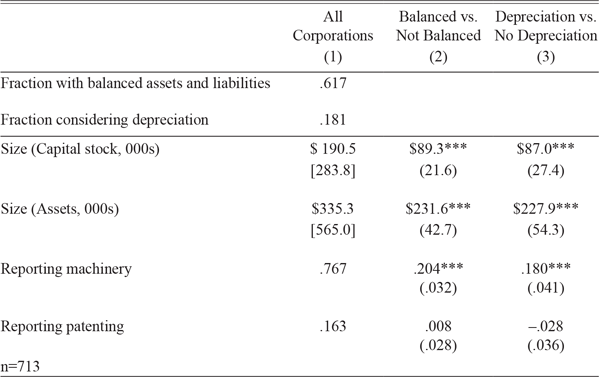
As of 1875, accounting practices remained remarkably diverse (Table 1). Among the 713 corporations for which data are available, only 62 percent submitted entries that balanced—that is, forms including equal entries for total assets and total liabilities. The remainder submitted forms that were either unbalanced, or included blanks or zeros for one or both categories. As expected, the “depreciation” category was used even less often. A mere 18 percent of firms made any entry in the space. Within both categories, there was yet more unevenness in practice. Firms that did not balance submitted forms that were unbalanced in both directions, with assets sometimes higher than liabilities and also the reverse. Similarly, firms entered both positive and negative numbers into the space for depreciation.
ACCOUNTING PRACTICES IN 1875, FIRM CHARACTERISTICS

Notes: Column (1) reports average characteristics for all corporations in 1875. Column (2) reports the difference in characteristics for corporations with balanced assets and liabilities, compared to those without. Balanced includes firms reporting equal amounts in total assets and total liabilities, unbalanced includes different numbers or no data reported in either category. Column (3) reports the difference in characteristics for corporations that consider depreciation in their accounting, compared to those that do not. Considering depreciation includes any entry for depreciation. Capital stock is paid-in as of 1875, some firms (20) report 0. Machinery is a binary category including firms reporting any value for machinery or specifically noting that machinery was included in another category of asset. Patenting includes all firms reporting a value for patents, and firms noting that the value is recorded elsewhere. Firms noting expired or worthless patents are also included as the indicator is intended to capture patenting behavior not value. Standard deviations are reported in [], standard errors are reported in ().*** p < 0.01, ** p < 0.05, * p < 0.1. N = 567.”
Source: Secretary of the Commonwealth of Massachusetts (1871–1895).
Larger corporations were more likely to use both practices, judged both by capital stock and by reported assets (Table 1). On average, firms with balanced books had capital stock of $89,300 more than those that did not, and firms using depreciation reported $86,900 more in capital stock than those that did not. Firms using these practices also reported more assets, $213,600 for balancing and $227,900 for depreciation. Hiring an accountant was expensive in this period, and larger firms likely had access to more resources. Considering rates of accounting practice by firm size confirms this pattern: the larger the firm, the more likely it was to use both practices. At the same time, firms of all sizes utilized both sets of accounting practices. In 1875 the smallest firms (with under $25,000 in capital stock) submitted balanced books 47 percent of the time and used depreciation 10 percent of the time, while the largest firms (with $500,000 to $2,500,000 in capital stock) balanced their books 79 percent of the time and used depreciation 30 percent of the time.Footnote 14
Additional data from the certificates of condition allow for some further generalization about what kinds of firms used sophisticated accounting practices (Table 1). These firms were more likely to report a value for machinery, perhaps a reflection of accounting being particularly important in businesses requiring large capital investments. Interestingly, there appears to be no clear relationship with patenting—a practice that might be expected to correlate with accounting expertise. Firms that did and did not report patenting have similar accounting practices.
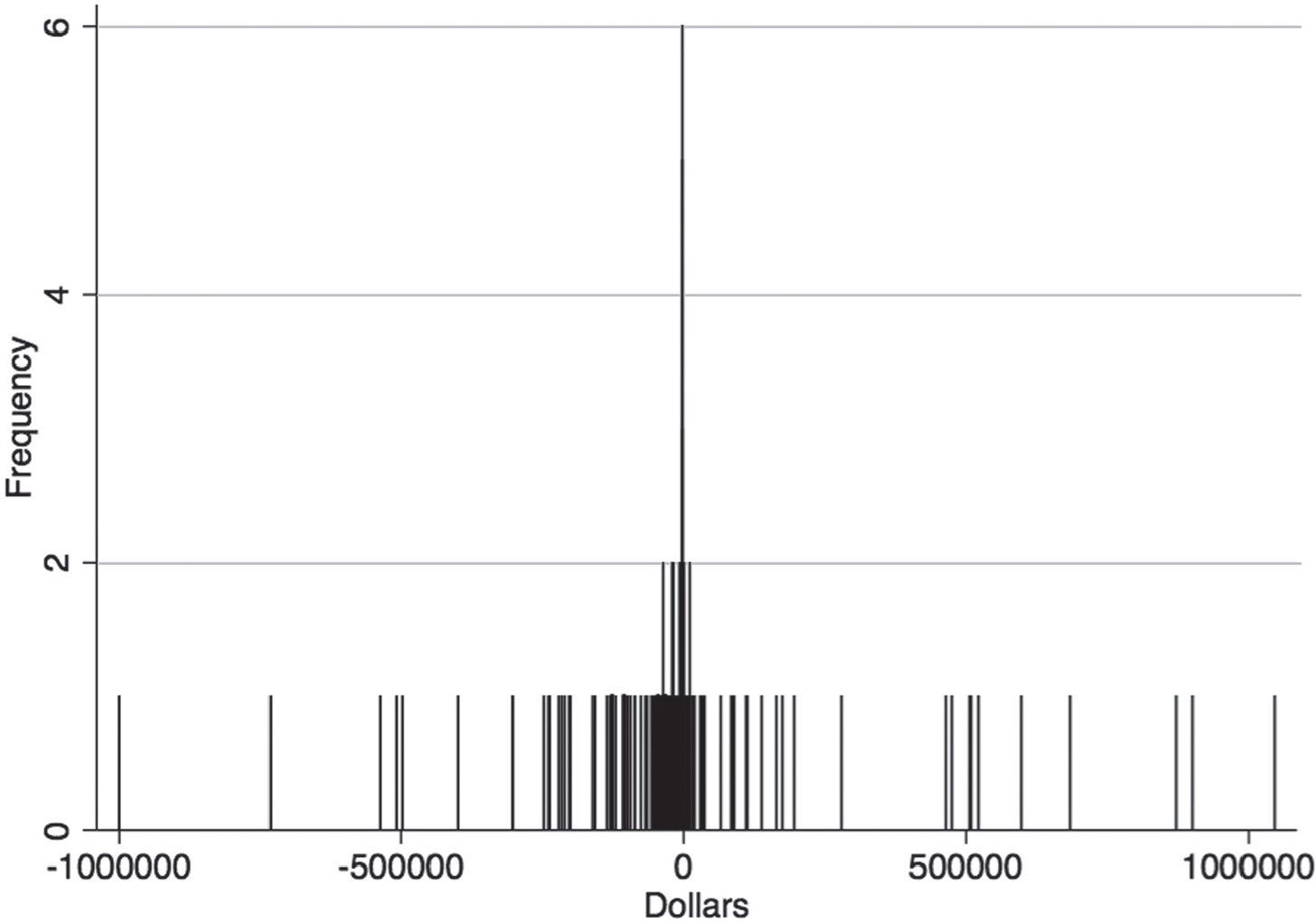
Firms that failed to strike a balance were “off” in many different ways. Figure 2 displays the levels of these imbalances. Among firms with errors, more firms reported a negative balance, with an average imbalance of –$7,899 (liabilities exceeding assets). Some firms were dramatically off, while others recorded similar but not identical figures for total assets and total liabilities. For example, the New England Felt Roofing Company was off by only $1, and 21 firms reported imbalances less than or equal to $1,000. Other firms reported precise numbers but large imbalances, suggesting careful accounting practices, but no understanding of the correct form for the balance sheet. For example, the Lenox Glass Company reported total assets of $41,541 and total liabilities of $1,280,902. Yet another set of firms seems to have been using accounting systems and categories that simply did not translate to the state’s forms. For example, the Franklin Telegraph Company was off by $1,000,000, the amount of their capital stock. Their assets and debts were equal, both $41,163, suggesting some form of double entry may have been used but that they had a different understanding of the “liabilities” category on the balance sheet. A footnote printed by the state notes that the company’s debts were designated as “liabilities” and that they reported “net liabilities” of $1,011,051.41, a number that does not appear anywhere on the balance sheet. A final genre of report included forms that were largely blank. These returns suggest both a lack of careful recordkeeping and a limited understanding of double entry. Firms that considered depreciation also appear to have interpreted the concept diversely—corporations used this space on the form to report both positive and negative values of radically different amounts relative to their invested capital.
LEVEL OF IMBALANCE AT MASSACHUSETTS CORPORATIONS IN 1875

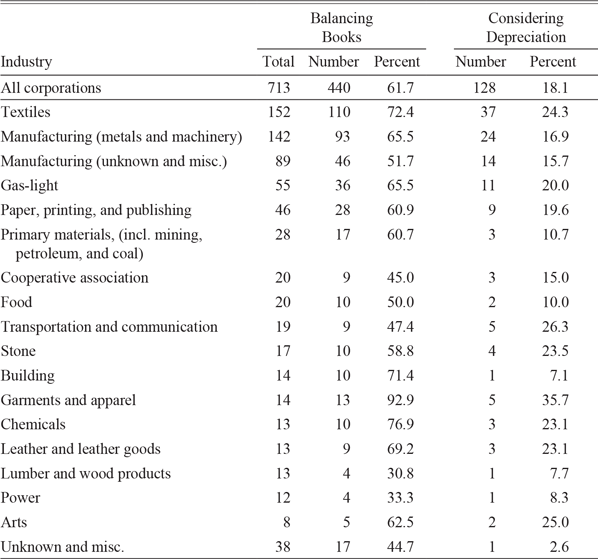
Comparing across industries confirms the overarching picture of recordkeeping diversity: accounting practices varied widely across many types of businesses. The certificates of condition do not include an indication of industry, but using city directories and firm names enabled the classification of a subset of the firms (n=440). As Table 2 shows, every category included both firms that did and did not adopt both practices (the few exceptions are very small categories that were aggregated for the table). “Garments and apparel” had the highest proportion of firms using both practices, while “Lumber and wood products” and “Power” showed relatively low rates for both practices. In a few categories, particularly “Building,” balancing was higher than average while depreciation was lower. But most striking is the broad variety of practice: accounting expertise was scattered across many industries, not concentrated in specific pockets.
PREVALENCE OF ACCOUNTING PRACTICES IN 1875 BY INDUSTRY

Notes: Industry coding utilized firm names and Massachusetts directories offering information on products created. Many industries were aggregated and classifications are approximate. Manufacturing (unknown and misc.) includes cordage, carpet, shipbuilding, fire extinguishers, gas screens, and companies that are called mills or manufacturing but whose names did not specify a product, some of which likely might fit another category. Power includes companies water power, steam mills, boilers, and companies identified by falls with no specified product. Any identified co-operatives were classified as co-operatives even if their industry was also specified. Paper and printing also includes publishing. Unknown and miscellaneous includes both firms with unknown industries and also small categories such as hotels and ice.
Source: Secretary of the Commonwealth of Massachusetts (1871–1895).
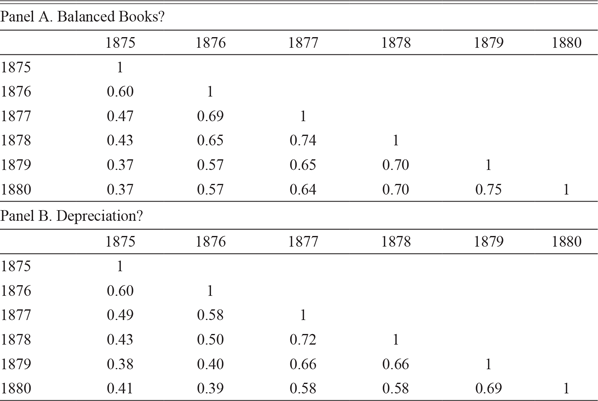
Accounting practices also appear to have varied substantially from year-to-year within individual firms. Table 3 list the pairwise correlation of double entry (Panel A) and depreciation (Panel B) within firms for the first five years of the data set, focusing only on firms surviving for the duration of the period. While correlations are highest between adjacent years, and do appear to be increasing over time, a substantial number of firms submitting balanced forms or considering depreciation in one year did not do so the following year. The correlations between practices from year-to-year are always positive and are largest in adjacent years, as expected. Overall, however, variation at individual corporations suggests remarkable inconsistency in practice. This volatility in practice suggests that expertise in accounting knowledge was thin, perhaps confined to a single individual at many corporations. The arrival or departure of one person might have transformed or undermined accounting practices for the entire firm.
YEAR-TO-YEAR CORRELATION OF ACCOUNTING PRACTICES WITHIN FIRMS, 1875–1880

Notes: Includes firms with accounting data for all years indicated, N=458.
Source: Secretary of the Commonwealth of Massachusetts (1871–1895).
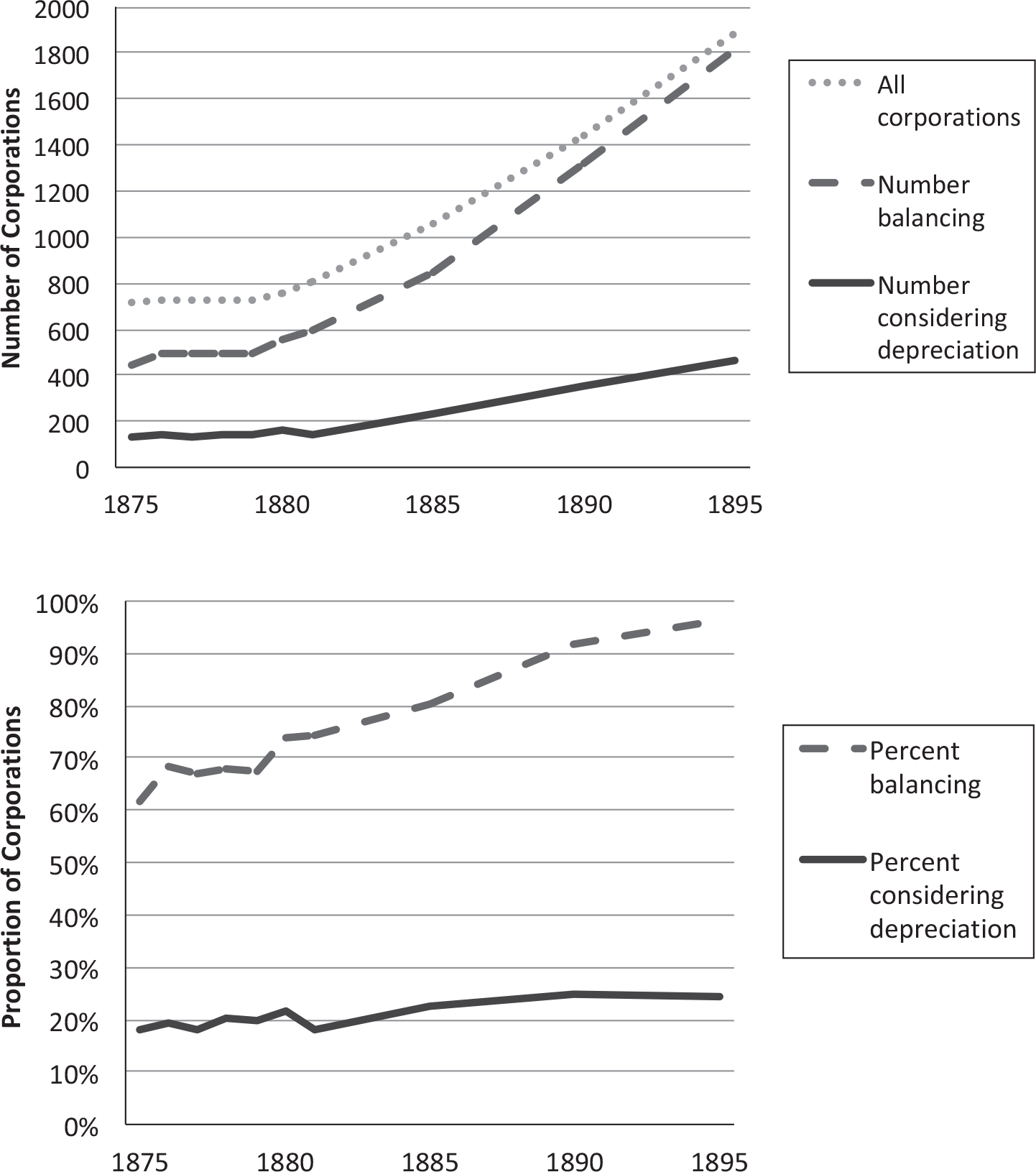
Between 1875 and 1895, the overall picture changed dramatically, with the proportion of firms balancing their books increasing from only 62 percent (440 of 713) to more than 96 percent (1,814 of 1,880). A practice that was common, but not dominant in 1875 became nearly universal by 1895. By contrast, the consideration of depreciation had become only slightly more common, increasing from 18 percent (129 of 713) to 25 percent (462 of 1,880). These shifts are depicted in Figure 3, which show the rise in the total number and proportion of firms adopting each accounting practice. Over the two decades between 1875 and 1895, the knowledge of how to prepare a balance sheet became nearly universal at Massachusetts corporations.
PREVALENCE OF ACCOUNTING PRACTICES AT MASSACHUSETTS CORPORATIONS, 1875–1895

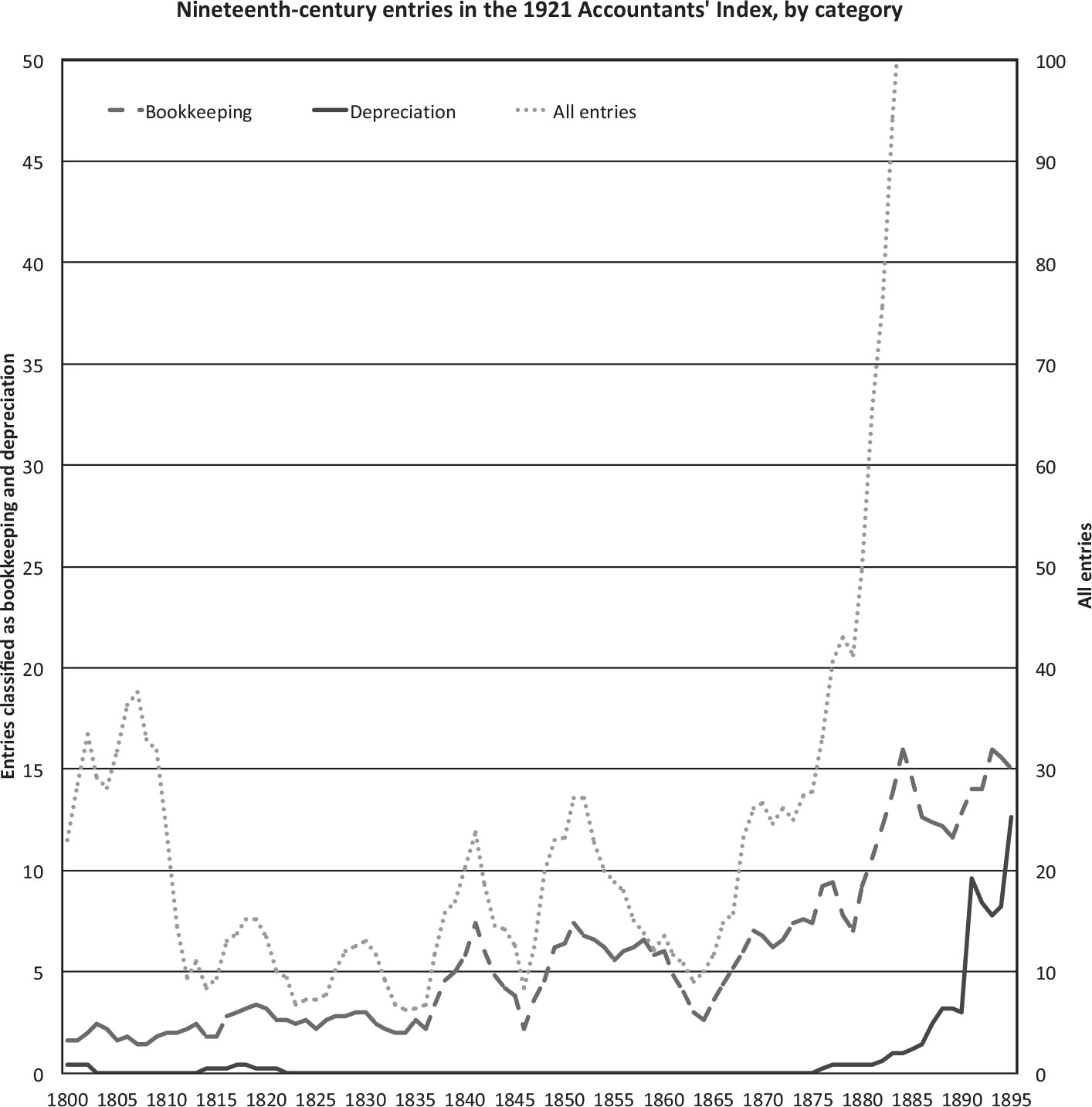
Similar trends can be observed in publications about accounting. The American Association of Public Accountants (1921), now the American Institute of Certified Public Accountants, published a massive bibliography called the “Accountants’ Index.” This bibliography, which continued to be updated in subsequent years, aspired to catalogue all relevant publications relating to accounting. The inaugural 1921 edition included subsections on both bookkeeping and depreciation. Estimating the number of publications in each of these categories offers a general picture of the level of interest in each topic. As Figure 4 shows, publications on bookkeeping increased steadily over the course of the century. By contrast, publications on depreciation were exceptionally rare before the 1880s, becoming common only in the last decade of the century.
TOPICS IN THE ACCOUNTANT‘S INDEX

ACCOUNTING FOR SURVIVAL
Firms that used double entry and depreciation survived longer those that did not. Many firms disappeared from the data, and their failure to submit certificates of condition offers a proxy for continued operation. The measure is imperfect: some firms submitted certificates late or changed their names. However, many firms that disappeared from the data simply failed. Among all corporations existing in 1875, 47 percent were still in business in 1895 (332 of 713). By contrast, among firms submitting balanced reports, the survival rate was 54 percent (239 of 440), and among those considering depreciation it was 70 percent (90 of 129).
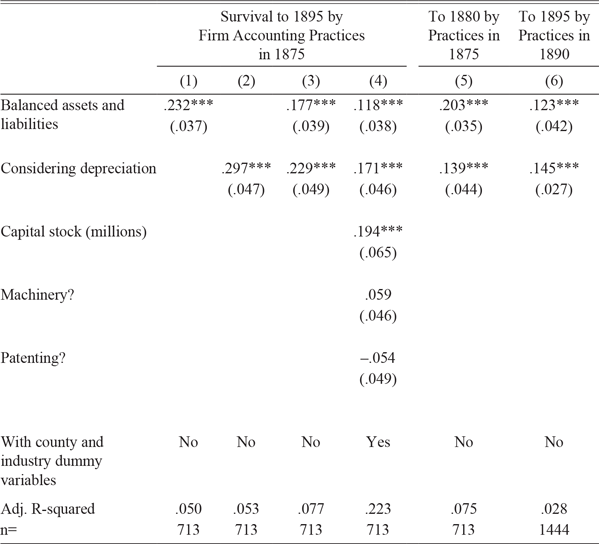
The correlation between accounting and firm survival is large and significant even after controlling for firm characteristics. Table 4 reports ordinary least squares (OLS) regression estimates of survival from 1875–1895 across a variety of specifications (Columns 1–4). In univariate models, balancing the balance sheet and consideration of depreciation are each strongly linked to firm survival: for the full period of 1875–1895, firms that balanced their books were 23 percent more likely to survive than those that did not, and firms considering depreciation were 30 percent more likely to survive than those who did not consider depreciation. These coefficients diminish in size, but remain substantial after including both techniques in the analysis and after adding a range of control variables (including, most importantly, capital stock). After adding additional controls for county and industry, balancing firms survived at an 11 percent higher rate and firms using depreciation survived at a 17 percent higher rate.
The relationship between accounting and survival remained strong over the course of the sample, though it diminished in magnitude at the end of the period as practices became more common. Columns (5)–(6) of Table 4 show OLS results for different periods: Column (5) shows the correlation between practices in 1875 and survival to 1880, and Column (6) shows the correlation between of practices in 1890 and survival to 1895. In both periods, the correlations are large and statistically significant. For balancing, the correlation with survival diminishes in the later period, likely due to the fact that the technique had become very common by the end of the period. In 1875, balancing their books still set some firms apart. However, by 1895, almost all firms were using double-entry bookkeeping, and it was no longer a sign of unusually adept management. The later period also includes the Panic of 1893, which may have made double-entry bookkeeping less protective against failure than in other periods.
SURVIVAL OF FIRMS BY ACCOUNTING PRACTICE (OLS)

Notes: Columns (1)–(3) estimate effect on firm survival of balancing, depreciation, and both practices. Column (4) adds controls for corporation characteristics (described in the notes to Table 1) as well as county and industry dummy variables. Industry and county data were not available for all corporations, and these are coded as unknown. Columns (5) and (6) estimate the correlation of accounting practices with survival for five year periods at the beginning and end of the sample, first of practice in 1875 on survival to 1880 and then on practices in 1890 on survival to 1895. Standard deviations are reported in [], standard errors are reported in ().*** p < 0.01, ** p < 0.05, * p < 0.1.
Source: Secretary of the Commonwealth of Massachusetts (1871–1895).
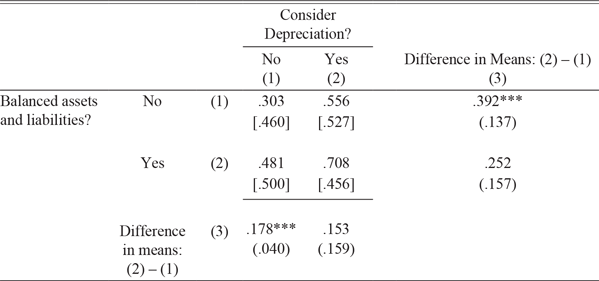
Balancing and depreciation were correlated with each other, but each practice also seems to have been independently correlated with firm survival. Table 5 takes a closer look at the interaction of practices and its relationship to survival rates. Firms that balanced their books and considered depreciation were most likely to survive from 1875 to 1895 (71 percent survived) and firms using neither practice were least likely to still be in business in 1895 (only 30 percent survived). Firms that used one practice but not the other fell in between (with a 48 percent survival rate for firms only balancing and a 56 percent survival rate for firms only using depreciation). Both double-entry bookkeeping and depreciation were probably correlated with management expertise more generally; employees who learned accounting likely had other kinds of training. Similarly, owners who valued accounting may have also valued other kinds of managerial expertise. Still, the independence of these correlations raises the possibility that the techniques may have offered specific and distinct benefits above and beyond general recordkeeping. The two variables may reflect two different kinds of accounting knowledge that were only sometimes available at the same firms.
SURVIVAL OF FIRMS TO 1895 WITH INTERACTION OF PRACTICES FROM 1875

Notes: Columns (1) and (2) report the average survival rates for corporations that do not or do consider depreciation contingent whether they do not or do balance their assets and liabilities (Rows 1 and 2). N=264 for both “no,” n=120 for both “yes,” n=9 for “yes” depreciation but “no” for balancing, and n=320 for “yes” balancing but “no” depr. Column (3) and Row 3 report the difference in means for these survival rates. Standard deviations are reported in [], and standard errors are reported in ().*** p < 0.01, ** p < 0.05, * p < 0.1.
Source: Secretary of the Commonwealth of Massachusetts (1871–1895).
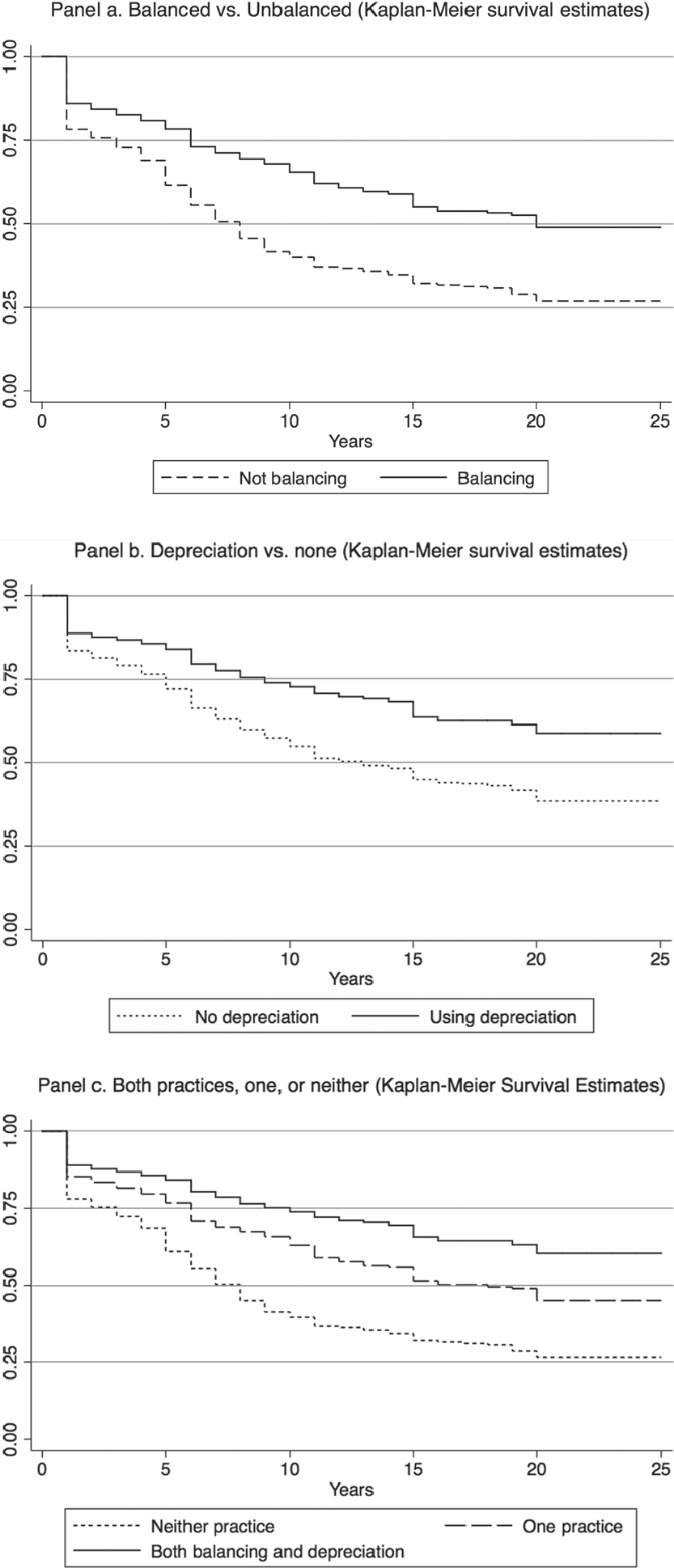
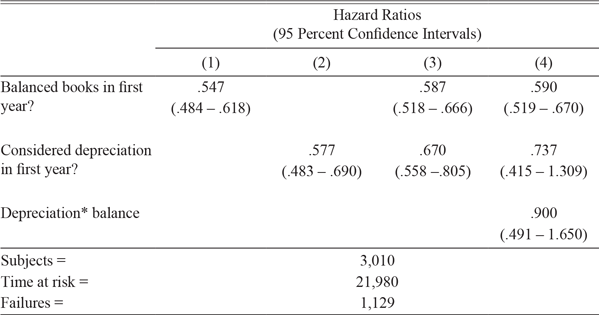
The number of corporations in Massachusetts grew dramatically between 1875 and 1895, and as these new firms incorporated, they too began to send in balance sheet data to the state. Some of these new firms relied on standardized accounting practices from the beginning, but many did not. Shifting from OLS to survival analysis enables us to see whether similar patterns held over a much longer sample. For the survival analysis, firms are classified based on their accounting practices in the first year for which accounting data are available—either 1875 or, for firms founded after 1875, for the first year that they entered the sample. The analysis considers the impact of accounting practices in the first year and does not reclassify firms that later adopted or abandoned accounting techniques. Figure 5 displays the survival rates for all firms based on practices in the first year, divided by those firms that did and did not balance their books (Panel A), firms that did and did not consider depreciation (Panel B), and finally firms that practiced neither, one, or both of these practices (Panel C). As the curves illustrate, all firms were most likely to fail in their early years and failure rates declined over time. At all points, firms using accounting practices fared better than those that did not, and firms using both practices were more likely to survive than those using just one. Using a Cox Proportional Hazards model to estimate the relationship between accounting and survival yields similar results to OLS (Table 6). Table 6 reports the hazard ratios for several specifications, all of which follow patterns similar to OLS. In the model including both accounting practices (Column (3)), the odds of failure in a given year appear to be reduced by more than 40 percent each for balancing, and more than 30 percent for depreciation (hazard ratio=.587 and .670).
SURVIVAL FUNCTION FOR BALANCING OF BOOKS, DEPRECIATION, AND BOTH

SURVIVAL ANALYSIS USING COX PROPORTIONAL HAZARDS MODEL

Notes: Columns (1)–(4) include all firms that have at least one year of accounting data (all firms that exist for at least one year starting in 1875). This first year of accounting data is used to classify the firm throughout the sample, regardless of whether its practices may have shifted over time. Hazard ratios were similar for the subset of firms founded after 1871 to eliminate any issues that might result from left censoring in the data. Breslow method for ties.
Source: Secretary of the Commonwealth of Massachusetts (1871–1895).
The main shortcoming of the data presented here is that the information offered is quite thin, particularly in comparison to case studies based on detailed records or annual reports. It is difficult in most cases to clearly determine what sort of errors companies were making—in some cases, they may have understood basic bookkeeping principles, but a small error in their records prevented them from striking a balance. In other cases, though, they may have had little or no knowledge of standard accounting practices. Previous research on accounting errors has asked whether persistent over- or under-estimation of profits might have shaped firm investments (Brief Reference Brief1965). While Figure 2 does show that on average firms reported higher liabilities than assets, the more striking point emerging from the data is that errors varied widely in both scale and direction. Practices were remarkably diverse.
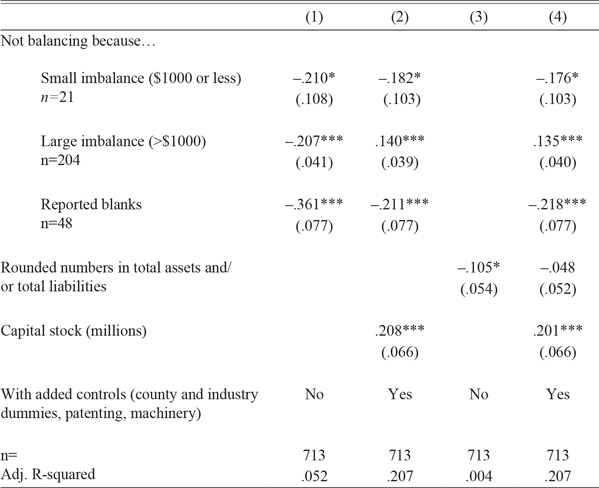
Nonetheless, it is possible to make some comparison by variety of error, and indeed the kinds of errors firms reported appear to be correlated with their survival. Table 7 extends the OLS analysis to consider the different kinds of errors corporations committed when they submitted balance sheets. Several new variables are introduced to gain a finer picture of which firms survived at the highest rates. First, firms with small imbalances are separated from those with large imbalances. Second, I attempt to identify firms with generally sloppy practices using dummy variables for very round numbers and blanks. As might be expected, firms with larger imbalances appear to fail at higher rates than firms with small imbalances. Firms committing small errors may have kept generally correct books that simply contained small errors while firms with large imbalances may not have understood double entry at all. Firms reporting blank balance sheets (“0” or “None” under either or both of total assets and total liabilities) were least likely to survive. The use of round numbers does not appear to be correlated with survival. Although firms reporting zeroes in the tens and ones places for either total assets or total liabilities survive at slightly lower rates in a univariate model, the relationship disappears almost entirely after controls are added.
OLS REGRESSION RESULTS FOR FIRM SURVIVAL TO 1895 TYPE OF BALANCING ERROR IN 1875

Notes: Small imbalances are those of between −$1000 and $1000. Blanks includes firms reporting “0” or “None” for assets and/or liabilities. Reporting round numbers includes firms with 0s in the 1s and 10s digit for assets and/or liabilities. Standard errors are reported in ().*** p < 0.01, ** p < 0.05, * p < 0.1.
Source: Secretary of the Commonwealth of Massachusetts (1871–1895).
Overall, the data suggest that practices were converging over time and that longer-lived firms tended to rely on accepted best practices. Yet there is also a parallel conclusion to be drawn: a substantial number of firms that were not using such practices in 1875 also persisted. Among the 273 firms that did not balance their books in 1875, 155 survived to 1880 and 81 survived to 1895. Their survival despite failing to adopt a centuries-old technique is as striking as the high rates of survival for firms that did use accepted methods.
CONCLUSION: STANDARDIZATION AND DIVERSITY
The late nineteenth century was a key period for the development of managerial practices, especially for the dissemination of basic accounting best practices across firms. During this period, a growing majority of Massachusetts corporations began to balance their books, rising from 62 percent in 1875 to more than 96 percent in 1895. Depreciation was also used by more businesses, although it remained comparatively rare, with usage rates inching up from approximately 18 percent in 1875 to 25 percent in 1895. Both practices were distributed across many industries, and they tended to be more common at larger firms.
Corporations that used these accounting practices survived longer than those that did not. This result holds true both for double entry, a technique that had long been regarded as best practice, and for depreciation, a less common method at the time. Both accounting tools can be seen as information technologies, and their correlation with firm survival underlines the importance of knowledge economies more broadly. During this period, accounting was a general-purpose technology that gave business owners and managers a language for making decisions with data. As with other general-purpose technologies, these techniques were used across many industries and supported other kinds of technological change (David Reference David1990; Rosenberg and Trajtenberg Reference Rosenberg and Trajtenberg2004). Such “macroinventions,” as Mokyr (Reference Mokyr2004) has called them, underlay a range of other technological innovations. Determining precisely why firms survived longer is difficult because accounting practices were likely correlated with other kinds of managerial techniques. Still, the data suggest that paper technologies like accounting warrant close attention as scholars explore the reasons that businesses succeed or fail, as well as the broader relationship between businesses survival and economic change.
There are major limitations to what we can learn from a quantitative analysis such as this one: the errors measured offer a proxy for knowledge of accounting practices, but our understanding of what this knowledge reflects is very thin. We know a firm is making an error or an omission, but not why they have made that error: do they lack knowledge of accounting practices, have they made mistakes as they attempted to apply best practices, or are they knowingly relying on an alternative method of accounting? Similarly, for depreciation, we do not know whether firms submitting blanks did not understand depreciation or if they had no depreciation to report. Given these limitations, the variety of accounting practices may be as revealing as their eventual standardization. A substantial number of firms appear to have done business successfully without fully adopting standard methods of account.
Indeed, the single most remarkable finding from the data may not be the convergence of accounting techniques but the fact that they remained so diverse so late in the nineteenth century. As of 1875, in one of the most industrial states in the country, a substantial minority of corporations did not use double-entry bookkeeping. The data on Massachusetts reveal persistent diversity of methods alongside the expansion of standard practices. This hybrid picture fits with two contrasting images of late nineteenth-century business. On the one hand, the existence of large firms with sophisticated bookkeeping practices seems to reflect the growing influence of a professional managerial class working at the kinds of multidivisional corporations described by Chandler (Reference Chandler1977). On the other hand, the variety of practices suggests the kind of “endless novelty” described by Scranton (Reference Scranton1997). Information technologies like accounting seem to have been part of a story of growing scale, uniformity, and professionalization. But the development of information practices that accompanied this growth was far from linear. The accounting forms analyzed here reflect standardization, but they also reveal reversals, experimentation, and ongoing adaptation. Viewed from a distance, the late nineteenth century appears to be a period of steadily rising managerial prowess. Up close, practices appear diverse and uneven.
In 1953, Joseph Schumpeter reflected on the rise of accounting practices both grandly and ominously. Following cues from Weber (1927) and Sombart (1915), he wrote of double-entry bookkeeping as a “towering monument” of the cost-profit analysis that characterized capitalist practice, arguing that by “crystallizing and defining numerically,” double-entry bookkeeping “powerfully propels” the “logic of enterprise.” Still more dramatically, he wrote that double-entry bookkeeping had embarked on a “conqueror’s career” to rationalize and subjugate “man’s tools and philosophies, his medical practice, his picture of the cosmos, his outlook on life, everything in fact including his concepts of beauty and justice and his spiritual ambitions” (Schumpeter 1950, pp. 123–24). He was surely right to warn of the creep of profit-maximization into ever-broader aspects of human life. But although in hindsight this creep may feel like a conquest, the landscape of accounting practice at Massachusetts corporations suggests otherwise: even late in the nineteenth century—when, by all indications, the hockey stick of economic change had already tipped skyward—businessmen’s account books continued to reflect idiosyncratic and haphazard practices. The persistence of diversity in accounting practices suggests that real standardization awaited the rise of professional associations and the expansion of government regulation.
As we return to case studies of accounting and management, scholars should consider the possibility that the narrowing range of accepted accounting techniques likely had both costs and benefits. Standard practices surely displaced erroneous ones, but they may also have edged out legitimate ways of keeping records and, with them, alternative value systems. Accounting historian McMillan has described the late nineteenth century as a period during which bookkeeping increasingly came to be seen as part of a “science of accounts” (Reference McMillan1998, p. 1). Belief in this science, and adoption of its language, underpinned the professionalization of the discipline. The data collected here support this claim, suggesting that the period saw a convergence of practices. This convergence, which McMillan and others have argued helped the accounting profession to gain legitimacy, can be understood in two ways: as the spread of best practices but also as a narrowing of technologies and, even more importantly, of outlooks. As McMillan argues, the aspiration to be scientific accompanied a belief in an “essential economic ontology, which bookkeeping makes visible.” Accountants came to believe that through systematic classification of transactions bookkeeping could reveal the truth. Professional accountants could uncover the one best way to take account, and thus the correct way to judge the success or failure of businesses (McMillan Reference McMillan1998, p. 1).
Accounting practices have changed over time, and they will continue to evolve. Overlooking managerial diversity can lead us to fundamentally misunderstand the wide range of goals subsumed in even simple terms like “profit.” As O’Sullivan argued in her 2018 presidential address to the Business History Conference, supposing that there is a single “definition of profit…that makes economic sense over long periods of time” leads us to misunderstand both the history of businesses, and the broader history of economic values. If we are not careful, such assumptions can also foreclose future possibilities for how we think about what business can be and do. As Scranton wrote evocatively about the once-neglected history of specialty manufacturing, recognizing diversity can open up “the possibilities of capitalism.” Attending to “examples of variety and versatility… lays an implicit base for conceiving diverse presents and futures” (Scranton Reference Scranton1997, p. 3). More than a century later, accountants continue to debate fundamental questions about measurement and value. This process of methodological evolution will continue, and changing methods of measurement will remain essential for grappling with changing circumstances in an increasingly complex, global economic order.