Introduction
Following the 11 September 2001 attacks on the United States, the George W. Bush administration undertook a series of institutional and organisational changes seeking to assist in the prevention of a repeat. New government structures such as the Department of Homeland Security were established and the Department of Defense reviewed its defensive and operational capabilities. By October 2001, President Bush declared a ‘War on Terror’ and US troops were despatched, alongside allies including Britain, to Afghanistan and later to Iraq in March 2003. In the year between these operations, the Pentagon reviewed and revised its Unified Command Plan (UCP), the global system of military regions first established in 1946.
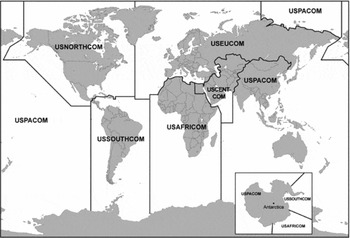
At a press conference held in April 2002, the then Secretary of Defense, Donald Rumsfeld, outlined the rationale for the changes to the UCP. For the first time the continental United States itself would fall within a command (Northern Command, NORTHCOM), and US commanders would be assigned responsibility for contingency response and security cooperation in every part of the world. The geographical areas of responsibility under the new UCP were revealed at the conference. On 6 February 2007, President Bush announced the formation of a new Africa Command (AFRICOM) (White House 2007), through the separation of Africa from the hitherto European Command (EUCOM). AFRICOM would become a sub-unified command in EUCOM by October 2007, and a separate unified command by the end of 2008. Fig. 1 indicates the current areas of responsibility of commanders, including AFRICOM.
The world with commanders' areas of responsibility (This is an abridged version and includes AFRICOM).

The UCP covers the entire Earth because, according to the Secretary of Defense, at a press briefing in the Pentagon:
The plan we announce today is undoubtedly the most significant reform of our nation's military command structure since the first command plan was issued shortly after World War II. Chairman Myers [General Richard Myers, Chairman, Joint Chiefs of Staff] and his staff and the OSD [Office of the Secretary of Defense] staff are certainly to be commended for their work on this plan.
In 1946, the United States faced the challenges and dangers of a new and unexpected era. The first UCP addressed those issues. Today our country faces an era of the unexpected. We're involved in a war unlike any that our country has ever experienced. We must be ready to win today's global war on terror, but at the same time prepare for other surprises and uncertainties that we will most certainly face in the 21st century (Department of Defense 2002).
After detailing the rationale for the new UCP, which had been highlighted by the 2001 Quadrennial Defense Review as necessary, Secretary Rumsfeld and senior defence staff present, including Myers, Lieutenant General George W. Casey, director, Strategic Plans and Policy, Joint Chiefs of Staff and Dr. Stephen A. Cambone, principal deputy under secretary of defense for policy, answered questions from journalists.
The inclusion of Antarctica
Towards the end of the question and answer session, the following exchange occurred:
Q: Can you explain why you've added Antarctica to Pacific Command's responsibilities? And how does this fit in with the treaty that says, you know, no militarization down there at the pole at all?
Casey: It's a fair question. I don't recall it being assigned to SOUTHCOM. Right now the operations that we perform in support of the National Science Foundation we do out of New Zealand with U.S. Transportation Command. We felt that because of that – New Zealand is in Pacific Command's area of responsibility – we felt that's where we needed to put it. And that just allows – again, what that does is, Pacific Command is responsible for coordinating any type of military activities there.
Now, to the militarization treaty, we are very much aware of the treaty. We have no intent to militarize Antarctica. An example of what this might mean for PACOM is, if we had to mount a search and rescue operation, for example, CINCPAC would be the guy that we'd point our finger at and say ‘Go get ‘em.’ Okay? (Department of Defense 2002)
On the face of it the response to the question is encouraging and recognises that there is ‘no intent to militarize Antarctica’ and clearly demonstrates some awareness of the 1959 Antarctic Treaty (even if it is not cited by name).
In fact the revised UCP results in several commands extending into the Antarctic Treaty area. The entire continental area of Antarctica is assigned to Pacific Command (PACOM), but since both the new Africa Command (AFRICOM) and Southern Command (SOUTHCOM) extend to the edge of the continent, these commands also intrude into the Antarctic Treaty area, since this applies to the area south of 60° S, and not just to the continent itself.
This represents an apparent extension of formal US military interest into an area commonly understood as the world's first demilitarised zone. This would appear to be significant given that Klotz concluded in 1990 that ‘Simply put, the Antarctic has never captured the attention of defence planners. . .The United States was able to play a leading role in negotiating, and subsequently implementing, the treaty precisely because of the part the Navy and the other services played in opening the region to Americans’ (Klotz Reference Klotz1990: 193–194).
The earlier UCP saw PACOM covering the entire Pacific and Indian Oceans from the Arctic to the Antarctic. PACOM was significantly involved in military logistical support for US Antarctic activities. Until the formal ending of United States Navy involvement in the late 1990s, the senior in-area military officer, the Commander US Naval Support Force Antarctica, was responsible for operational coordination of Department of Defense participation in the US Antarctic Programme, and for the provision of the military logistic support requested by the National Science Foundation (Department of Defense and National Science Foundation 1985). He had two reporting lines. With regard to policy, he reported through the Pentagon representative on the Antarctic Policy Group (effectively a subcommittee of the National Security Council) (Secretary of the Navy 1983); with regard to administration, he seems to have reported to the Commander in Chief of Pacific Command (CINCPAC). And of course, almost every ship or aircraft that he called upon came from PACOM. US activities in the Antarctic sector that did not fall within PACOM (the South Atlantic and west coast of South America) were almost entirely civilian, supported by either National Science Foundation (NSF) vessels or commercial charters, or ‘grace and favour’ arrangements with other national programmes (including the British Antarctic Survey). The US military support (overwhelmingly then in the PACOM area) was cast as ‘operations and logistic support’ (for a wider review, see Klotz Reference Klotz1990).
Therefore, the rationale was historically ‘operational and logistic support’. Whilst there is still military support for operations and logistics, in the use of LC-130s operated by the New York Air National Guard, and USAF C-17s, the airfield crews at Williams airfield in Antarctica, USN supply/refueling ships, and an element of military icebreaker suppport (under the remit of the Department of Transportation) other logistic support is now provided by civilian contractors. Some US officials were reportedly concerned at New Zealand's deployment of HMNZS Te Kaha to the Ross Sea in February 1999 in response to illegal fishing activities precisely because it was not for ‘operational and logistic support’.
The ‘search and rescue’ rationale
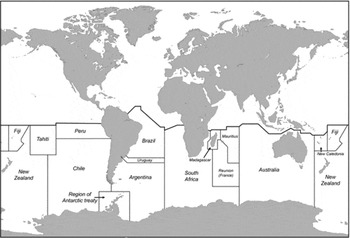
Casey's reference to ‘search and rescue’ (SAR) is intriguing in the sense that while US ships/aircraft could obviously provide a major resource for any such SAR operations, there is already a global network of search and rescue regions developed under International Maritime Organization (IMO) and International Civil Aviation Organization (ICAO) auspices. Fig. 2 shows how a series of geographically proximate states including Argentina, Australia, Chile, New Zealand and South Africa has formal responsibility for search and rescue in the Southern Ocean and Antarctica. The contested Antarctic Peninsula is formally assigned to the Antarctic Treaty Consultative Parties, which include the three rival claimants Argentina, Chile and the United Kingdom. As the figure illustrates, the United States has responsibility for vast areas of the Northern Pacific and Atlantic Oceans but not for the Southern Ocean. The entire circumpolar marine area already, therefore, falls within the IMO Search and Rescue Regions, and these extend to the South Pole.
Southern Ocean and Antarctic search and rescue areas.

Formally (and quite independently of its Antarctic claim) the responsible SAR Centre for the ocean area that includes the Ross Sea (the principal area of US Antarctic activity within PACOM) is New Zealand. When the Japanese whaling support ship Nisshin Maru caught fire and was disabled in March 2007, the Japanese master reported it to Wellington, New Zealand, and not to Honolulu, Hawaii, in the United States (New Zealand 2007). Furthermore, whilst PACOM's bailiwick apparently extends over the entire continent, as we have noted, there appear to be some parts of the Antarctic marine environment within the Antarctic Treaty area that would fall within SOUTHCOM and AFRICOM.
This raises the question of why the United States would feel it necessary to support routine Antarctic operations alongside SAR operations given the existence of these arrangements. The argument does not appear to be very compelling. One suggested answer lies in a now widely entrenched view, especially under the current administration, that the United States should not be limited by international organisations and structures. While this has been seen most dramatically with regard to the International Criminal Court, Casey's comment may also simply be a product of ignorance regarding those established SAR regions. Even if PACOM thought that it had an SAR function to perform in the southern ocean, it begs the question of whether the United States Navy assets under PACOM control have appropriate ice strengthened vessels especially if operating in the far south. On that basis, it would probably be more appropriate to access either Coast Guard vessels (under the jurisdiction of the Department of Transportation in peacetime) or civilian ice-strengthened vessels under charter to the NSF (for example the R/V Laurence M. Gould and the R/V Nathaniel B. Palmer).
Consistency with the 1959 Antarctic Treaty
While PACOM is continuing its Antarctic engagement, it has now been joined by SOUTHCOM and AFRICOM in reaching into the Antarctic. Casey seemed unaware that the geographical area of responsibility for SOUTHCOM (which covers South America in the main) does now, according to the UCP, extend southwards to the Antarctic coastline. What then is the appropriate boundary for defining a military area of responsibility vis-à-vis the Antarctic?
One response would be to argue that none of the commands should intrude upon an area that is subject to demilitarisation under an international agreement, and, indeed, that to do so is quite contrary to the purposes of the Antarctic Treaty and potentially sets an unhelpful precedent. Article I of the treaty specifies that Antarctica should be used for peaceful purposes only and prohibits any measures of a military nature. On that basis, one would have an argument for the southern boundary being the boundary of the area covered by the treaty at 60° S. However, as Article I also specifies, the treaty does not preclude the use of military equipment and personnel for scientific research or other peaceful purposes (logistic support as commonly interpreted). Since PACOM, in addition to its manifest active military responsibility, is also custodian of the capacity to provide support, the US will probably see no legal impediment here. The critical consideration, on this view, is what occurs within the Antarctic Treaty area, not who does it. Hence, the concerns expressed over the decision of the Royal New Zealand Navy to dispatch one of their warships beyond 60° S on a mission that could not be construed as ‘logistical support’.
It is not immediately clear that the extension of a mi- litary command into the Antarctic Treaty area is neces- sary in order for that command to provide logistic support for the US Antarctic Programme. For SOUTHCOM and AFRICOM, neither of which is actually tasked with Antarctic operations, the intrusion into the Antarctic Treaty area seems even more unnecessary. Other states such as Argentina and Chile continue to use their military resources in the treaty area but the levels of involvement have declined in recent years. Chile also reported to the XXX ATCM that it and Argentina were collaborating in the form of a joint naval patrol in the Antarctic Peninsula region. The patrol operates during the summer only and the Chileans have raised concerns about shipping related incidents in the region (for example the recent grounding of M/S Nordkapp at Deception Island (Antarctic Treaty Secretariat 2007; Committee for Environmental Protection 2007)) and capacities for providing SAR assistance. This arrangement, however, is rather different in nature and scope to the US arrangement.
If the rationale for extending the regions south of 60° S is that (particularly) PACOM provides support and or potential SAR capabilities, then it is as likely to be required over the continent as merely approaching the polar coastline. Since the late 1990s, as noted above, the New York Air National Guard (ANG) has undertaken logistical flying support for the National Science Foundation's (NSF) Antarctic programme as well as being empowered to conduct SAR missions in the Antarctic Treaty area. On behalf of the NSF, the ANG and their LC-130 and the USAF and their C-17 aircraft provide vital logistical support by moving cargo from McMurdo station to more remote locations within the continent.
The US has taken a more restrictive view of the reach of some parts of the Antarctic Treaty System (for example, the Antarctic Treaty and Protocol on Environmental Protection) into the marine area compared with the attitude adopted by other Antarctic Treaty Consultative Parties. Military planners and State Department officials may accordingly be reluctant to restrict themselves to 60° S, consistent with the long-standing US commitment to unfettered naval access and right of innocent passage globally. Other states such as Australia and France have used their naval vessels in the southern ocean but, critically, this has occurred north of the Antarctic Treaty area. In both cases, the navies were employed in illegal, unreported and unregulated fishing (IUU) interdiction around islands such as Heard and in the CCAMLR (Convention for the Conservation of Antarctic Marine Living Resources) area. Australia subsequently replaced naval vessel deployment with a civilian (albeit armed) patrol vessel, the Oceanic Viking. New Zealand has not repeated its deployment of Te Kaha, although southern ocean patrol will be among the new duties for a series of more robust naval offshore patrol vessels due to enter service shortly under the Project Protector programme (Royal New Zealand Navy 2007)
Even if the US genuinely attaches high importance to the Antarctic Treaty as a demilitarised zone (whatever interpretation they subsequently place on what constitutes ‘acceptable activity’), it does not approve of other demilitarised/denuclearised zones declared around the world. It has not ratified the 1985 Treaty of Rarotonga, which established a nuclear free zone in the South Pacific. Likewise, as a nuclear weapons state, it has not ratified the Treaty of Pelindaba (1996), which signalled the creation of a nuclear weapons free zone for Africa. Both treaties were signed by US administrations. Were it to concede that one or more of its military commands could not extend into the Antarctic Treaty area because of its demilitarisation provisions, similar arguments about exclusion could and would emerge elsewhere given that the Antarctic Treaty provided the inspiration for those aforementioned nuclear weapons free zones (and others such as the South East Asian).
Accused of being an ‘imperial power’, the US military has consolidated and even expanded its potential to operate anywhere in the world in the aftermath of 11 September 2001 (for two useful essays see Cox Reference Cox2004, Reference Cox2007). The so-called ‘War on Terror’ has provided a powerful backdrop for the justification of substantial increases in military spending, regional alliances and the creation of new military bases in the Middle East, Central Asia and the Horn of Africa (Department of Defense 2006). As one scholar has noted: ‘By early 2006, however, according to statements by senior officials in the Bush administration and in the United States military, the global war on terror has morphed into what they now choose to call the ‘Long War’ (Bacevich Reference Bacevich and Bacevich2007: x).
While nobody really imagines that Islamic radicals will seek to terrorise US positions in the Antarctic, the United States has in recent times been criticised for its decision to construct a so-called ‘road to the South Pole’ (2001–2004), which some observers, including Sir Edmund Hillary, warned would further ‘commercialise’ Antarctica and consolidate America's occupation of parts of the polar continent (BBC News 2004). As the largest polar operator and founder member of the Antarctic Treaty, the United States has been unquestionably one of the most important elements in the preservation of the Antarctic Treaty system especially during the Cold War. Given the long-standing US position with regard to non-recognition of existing claims, any extension of its military areas into the Antarctic takes on an added importance, especially if others think, privately or otherwise, that this part of a longer-term strategy of geopolitical consolidation.
Acknowledgements
For re-drawing Figs. 1 and 2, we thank Jenny Kynaston at the Department of Geography of Royal Holloway, University of London. Professor Simon Dalby of Carleton University kindly alerted the first author to the existence of the map in the first place. We thank the anonymous referees for their helpful comments.