




No CrossRef data available.
CONTEXT OF LEARNING IN THE ACQUISITION OF SPANISH SECOND LANGUAGE PHONOLOGY
Published online by Cambridge University Press: 23 April 2004
Abstract
Studies in SLA have debated the importance of context of learning in the process of developing linguistic skills in a second language (L2). The present paper examines whether study abroad, as it provides opportunities for authentic L2 context, facilitates the acquisition of Spanish phonology. The corpus of this investigation is composed of speech samples from 46 students of Spanish: 26 studying abroad in Spain and 20 in a regular classroom environment in the United States. The students read a paragraph with 60 target words including segments such as word-initial stops (i.e., [p t k]),Throughout the article a phonetic representation of all sounds following the International Phonetic Alphabet (IPA) is presented. Phonetic (instead of phonological) representations avoid making assumptions about underlying L2 representations. intervocalic fricatives (i.e., [ ]), word-final laterals (i.e., [l]), and palatal nasals (i.e.,
 ). The findings reveal the following patterns for both regular classroom and study abroad students across time: (a) similar gain in the case of voiced initial stops and word-final laterals, (b) lack of gain in the case of intervocalic fricatives, and (c) high levels of accuracy in the case of the palatal nasal in the pretest. Concerning the external data, the following factor groups predicted phonological gain among all learners: years of formal language instruction, reported use of Spanish before the semester, reported use of Spanish outside the classroom during the semester (days), reported use of Spanish outside the classroom during the semester (hours), gender, entrance Oral Proficiency Interview, exit Oral Proficiency Interview, and level at which formal instruction began.
Information
- Type
- Research Article
- Information
- Copyright
- © 2004 Cambridge University Press
Studies in second language (L2) learning have begun to examine the role played by context of learning in the acquisition of linguistic skills (Armstrong, 1981; Brecht, 1993a, 1993b; Brecht, Davidson, & Ginsberg, 1995; Freed, 1995; Lafford, 1995; Lapkin, Hart, & Swain, 1995). Freed noted that studies examining L2 learning in study abroad (SA) contexts suggest a positive outcome for experience in the target culture. However, she also underlined the lack of consensus due to contradictory evidence.2
Freed (1995, p. 8) summarized the findings of the previous literature as follows:
What emerges from these studies is a somewhat contradictory picture of the linguistic benefits to be gained from an in-country language learning experience. The role of instruction, its comparison to and/or interaction with naturalistic SLA has been a dominant and much debated issue in SLA studies. Ellis has summarized this literature (1994, pp. 611–663) and concludes that “there is support for the claim that formal instruction helps learners to develop greater L2 proficiency, particularly if it is linked with opportunities for natural exposure (1994, p. 616). At the same time, he suggests caution in interpreting the many conflicting studies.
Gains were sufficient enough that 62 out of 71 respondents to the follow-up study were able to report their placement in advanced levels of college Spanish. The remaining nine had begun at the intermediate level…. Life in the target culture assures meaningful practice and serves to reinforce the learning that takes place in the academic setting. (p. 86)
These findings reinforce the belief that the only way to improve L2 proficiency is to live in a place where the L2 is spoken.
Recent research (Lord, 2000; Simões, 1996) has presented an incomplete picture about the benefits of the SA context on L2 phonology. This investigation fills that gap by examining the acquisition of segmental features (i.e., word-initial stops [p t k]; intervocalic fricatives

; word-final laterals [l], and palatal nasals

) in a more extensive oral corpus to determine the impact of context of learning—L2 learning in a SA program versus studying in regular classrooms in an “at home” institutional setting (AH)—on L2 phonology.
CONSONANTAL PHENOMENA: AN OVERVIEW
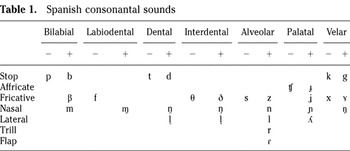
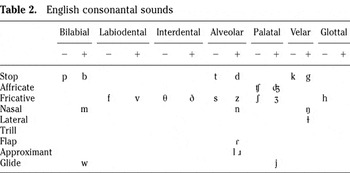
A comparison of the consonantal segments of Spanish and English highlights potential areas of difficulty for native speakers (NSs) of English (cf. Tables 1 and 2). Some of the most common phenomena that are stressed by textbooks for teaching Spanish pronunciation are: the aspiration of voiceless stops, voiced intervocalic fricatives, the velarization of word-final [l], and the palatal nasal (Barrutia & Schwegler, 1994; Barrutia & Terrell, 1982; Dalbor, 1997; Hammond, 2001; Navarro-Tomás, 1967; Quilis & Fernández, 1979; Teschner, 2000).
Spanish consonantal sounds

English consonantal sounds

Spanish voiceless stops ([p t k]) are the first potentially problematic group. English speakers tend to produce word-initial voiceless stops with an increase of airflow or aspiration. In Spanish papá “father,” a native English speaker may pronounce the word-initial [p] as [ph]. According to Harris (1969), voiced fricatives are allophones of voiced stops ([b d g]), which become fricatives by spirantization. Voiced stops occur after a nasal or pause, whereas voiced fricatives

occur in all other contexts, and they are especially frequent in intervocalic position.
3The /d/ is also a voiced stop (i.e., [d]) after a lateral (e.g., falda

“skirt”).

are not present in the English inventory. English NSs have

in their inventory, but they need to learn to produce it in the appropriate context. Furthermore, American English speakers should suppress the production of a flaplike variant in intervocalic position. In English, orthographic “t,” “tt,” “d,” and “dd” tend to be pronounced as a flaplike variant in intervocalic position, and this phonological process is transferred to Spanish. Spanish [l] is a lateral voiced alveolar, undergoing assimilation in syllable-final position followed by a dental (e.g., caldo “soup”), an interdental (as in dulce “candy” in Peninsular Spanish), or a palatal (e.g., colchón “mattress”). English NS learners of Spanish often pronounce word-final [l] by retracting the tongue root toward the velum (i.e., the dark

). Spanish

is a nasal voiced palatal. In syllable-initial position the palatal nasal contrasts with the bilabial nasal (i.e., [m]) and the alveolar nasal (i.e., [n]) as in mama “breast,” mana “flow,” and maña “habit.” In syllable-final position, nasals do not contrast and they assimilate the point of articulation of the following consonant (e.g., ambos [ambos] “both”; pongo

“I put”). English does not have a palatal phone, which causes potential problems in Spanish.
BACKGROUND
Few studies have examined phonological acquisition in an L2 and its relationship to context of learning. After surveying well-known databases in linguistics, SLA, and the humanities, I found only two studies (Lord, 2000; Simões, 1996) in which certain aspects of L2 phonology are analyzed using limited corpora. It nevertheless would be expected that students spending a certain amount of time in a target language country would be more likely to introduce nativelike features in their speech.
The literature analyzing the acquisition of L2 phonology comprises general surveys and anthologies as well as empirical research exploring diverse factors and theoretical issues (Archibald, 1998a, 1998b; Bongaerts, van Summeren, Planken, & Schils, 1997; Flege & Eefting, 1988; González-Bueno, 1997; Leather, 1999; Lord, 2000, 2002; Major, 1998; Moyer, 1999; Piske, MacKay, & Flege, 2001; Simões, 1996). The most important findings within different perspectives are presented to place the subject matter of the present investigation in context.
Generative Approaches to L2 Phonology
Traditional Linear Approaches.
Formal theoretical models help to describe patterns of SLA (see Leather, 1999). The term traditional linear approaches refers to research based on Chomsky and Halle's (1968) model of phonological analysis. In this model, phonological representation consists of a horizontal sequence of segments, with each segment specified as a set of features. According to Leather, Michaels (1974) is a good example of traditional generative approach in L2 learning. Michaels used markedness to explain why NSs of Spanish tend to substitute the velar nasal

for [n] and the palatal fricative

for the palatal affricate

in English. Following the principles of traditional linear and nonlinear generative models, SLA scholars have concentrated on rules that speakers formulate on the basis of L2 input. Such generative rule-based accounts explain connections between underlying and surface representations.
Natural Phonology.
According to Leather (1999), studies focusing on universal constraints in SLA have benefited from theoretical proposals of natural phonology (Stampe, 1979), which considers human speech capacity. Explanations of L2 phonological acquisition concentrate on the simplification of articulatory effort and reattunement of perceptual distinctions. Natural phonology assumes that children possess universal or innate phonological processes conditioned by the input they receive, such as deletion of unstressed syllables, simplification of consonant clusters, and stopping of fricatives. These processes are the product of phonetic and perceptual forces that reflect unmarked (e.g., common, frequent patterns) and universal linguistic patterns. For L2 speakers, phonological processes have been suppressed, limited, or reordered during first language (L1) acquisition. L2 phonological development implies readjustments and the incorporation of new categories. For NSs of English, Spanish fricative sounds (i.e.,

) would be more difficult to acquire because students would have to perceive a new phonetic category as well as to learn new articulatory specifications, some of which do not have phonemic status in English (i.e.,

).
Lexical Phonology.
Lexical phonology explains the differences found in the effect of phonological principles at the lexical and postlexical levels (see Mohanan, 1986). It distinguishes between phonological processes affecting morphology and individual phonemes. Leather (1999) pointed out that lexical phonology has been an important framework in accounting for the transfer of postlexical rules from the L1 to the L2. Yet, lexical rules may not always transfer. Following these generalizations, one can explain why aspiration of /p t k/, flapping of intervocalic /t/ and /d/, and final /l/ velarization are common in the speech of Americans learning Spanish as an L2, given that these processes are postlexical. However, phonological processes based on morphological conditioning would be difficult to find. For instance, Siegel (1974) placed English suffixes in two classes according to their effects on vowel lengthening and stress location (i.e., class I: -ity, -al, -ous; class II: -ness, -hood, -ly). Class I suffixes preserve the stress in the stem and shorten the stressed vowel, whereas class II suffixes are neutral for both the stress and vowel lengthening. This sort of morphophonological phenomenon would be unlikely to be transferred in the process of acquiring an L2.
Feature Geometry.
Archibald (1998a) examined underlying representation in interlanguage phonology by reviewing evidence from Spanish, Polish, Hungarian, Korean, and Arabic. He explained L2 phonological acquisition by adopting a hierarchical representation with different levels such as segments, moras, and syllables. Learners transfer complex L1 structures and principles to the L2. For instance, he claimed that the acquisition of /l/ and /r/ by native Korean learners of English correlates with the acquisition of consonant clusters in onset position and that acquiring /l/ entails learning the contrast between /l/ and /r/. That is, the presence of onset clusters implies that of the contrast between /l/ and /r/ in the English speech of Korean NSs. The independent evidence from different languages as well as the tendencies found in the speech samples of his informants corroborates his claims.
Archibald (1998b) presented a comprehensive perspective emphasizing generative approaches to SLA including feature geometry, lexical phonology, and contrastive proposals such as the connectionist model. According to his viewpoint, generative phonology offers important insights in our understanding of nonnative phonological competence. Archibald maintained that, because phonological inventories vary across languages, learners must perceive and produce new sounds. A key factor for explaining “accented” speech is transfer. For instance, English speakers learning Spanish might pronounce the palatal nasal

as an alveolar [n], the closest L1 match. Transfer is particularly more salient at the beginning stages of acquisition. It is important to mention that besides transfer there are other factors in the development of L2 phonology. Although it is out of the scope of the present paper to offer a detailed account of all factors, it can be pointed out that linguistic universal factors have been investigated (e.g., Archibald; Broselow, Chen, & Wang, 1998; Carlisle, 1998) to determine how L2 speakers develop their phonological system.
Regarding segmental acquisition, Archibald (1998b) maintained that transfer could account for much of SLA. Once learners perceive an L2 phonological distinction, they are likely to produce it. Yet, intrinsic aspects in the structure of the native phonology as well as universal patterns determine the process of learning to perceive and produce the target segments. Thus, the nonnative variants produced by Spanish learners can be explained by considering the English phonological system. For instance, in the cases of intervocalic /g/ as well as of the palatal nasal

, English NSs learning Spanish tend to produce a voiced velar stop (i.e., [g]) and an alveolar voiced nasal (i.e., [n]) where NSs of Spanish produce a fricative voiced velar (i.e.,

) and palatal voiced nasal (i.e.,

). Still, it is expected that other linguistic and extralinguistic factors play a role in the development of new phonological categories (Suter, 1976).
Markedness.
Another influential generative framework is that of markedness, which is defined in terms of simplicity or complexity following criteria that take into account universal frequencies. Crosslinguistically common sounds should be less difficult to acquire than uncommon ones. Specifically, Eckman (1987) examined markedness within the context of the Contrastive Analysis Hypothesis (CAH) by using the notion of the Markedness Differential Hypothesis (MDH). He claimed that the CAH can be completed by incorporating the principles of Universal Grammar to predict the directionality of difficulty in the process of SLA. In other words, linguistic universals would help to predict what segments or combination of segments would be more difficult to master for L2 speakers. Eckman provided as an example the acquisition of voiced and voiceless obstruents for native German learners of English. The contrast between voiced and voiceless obstruents in English occurs word initially, medially, and finally. On the contrary, German only contrasts voiced and voiceless obstruents word initially and medially. In word-final position, only voiceless obstruents are produced. Eckman's model presents an implicational typology according to which languages can be classified taking into account whether the contrast between voiced and voiceless obstruents occurs in word-initial, -medial, or -final position. Following Eckman's proposal, native German speakers learning English would have difficulties acquiring voice contrast in the word-final position. The implicational scale predicts that voice contrasts in the syllable-final position would be more marked for NSs of German given that German only has such contrasts word initially and medially. In summary, Eckman suggested that the MDH is a useful theoretical construct for explaining the potential areas in which an L2 learner will face difficulties, as in the case of native German speakers of English.
Riney and Flege (1998) also used markedness to analyze foreign accent and

production in a group of Japanese learners of English. Riney and Flege assumed that /l/ is less marked than

because /l/ is more frequent in the languages of the world. Following that reasoning, they expected /l/ to be acquired more accurately than

on the basis of markedness. The results of the experiment revealed that even though the scores for /l/ were not statistically significant from those obtained for

, there was a trend according to which the scores for /l/ in singletons and clusters were higher than the ones for

.
Riney and Flege's (1998) study also examined how theories of production and perception account for changes in the English pronunciation of Japanese NSs. Particularly, they examined whether measures of production would mirror those of perception and vice versa. Riney and Flege did not find evidence to support the mirror-image model, according to which improvements in production should reflect improvements in perception. The authors based their proposal on models that posit a direct connection between perception and production (i.e., Best, 1995; Fowler, 1986; Liberman, Cooper, Shankweiler, & Studdert-Kennedy, 1967; Liberman & Mattingly, 1985, 1989). Despite the mixed results obtained for the relationship between perception and production, crucial interconnections were found.
Carlisle (1998) also used the notion of markedness to study the acquisition of initial clusters in English by a group of Spanish NSs. Specifically, Carlisle examined implicational hierarchies in predicting the acquisition of /sp/, /sk/, /spr/, and /skr/. He based his research proposal on the Interlanguage Structural Conformity Hypothesis (ISCH), according to which universal generalizations that apply to primary languages also apply to interlanguages. Carlisle recorded 10 Spanish intermediate students of English using a reading instrument. He collected the data with a period of 10 months between times 1 and 2. Carlisle's results indicate that implicational universals operate in L2 speech, as marked clusters are more likely to be modified than unmarked ones. The meaning of implicational universals in the case of Carlisle's study assumes that short onsets are less marked than long ones. For instance, /sp/ and /sk/ are less marked than /spr/ and /skr/. It was predicted that speakers would be able to be more faithful to less marked onsets than marked ones. Following implicational hierarchies, he also assumed that marked onsets are not produced with a high degree of faithfulness until less marked ones are mastered. He claimed that the ISCH, which takes into account such implicational universals, correctly predicts the pattern in which speakers produce /spr/ and /skr/ with more accuracy when /sp/ and /sk/ are pronounced with a high degree of faithfulness.
An analysis of markedness within Optimality Theory was presented by Broselow et al. (1998). Optimality Theory is the most recent development in formal phonological theory (McCarthy & Prince, 1993, 1995; Prince & Smolensky, 1993). The notion of grammar within Optimality Theory consists of innate and universal constraints, which are ranked in different hierarchies depending on the language. Lower ranked constraints might be violated to satisfy higher ranked constraints. Universal constraints represent common crosslinguistic patterns (e.g., syllables must have onsets). Broselow et al. examined English syllable-coda simplification by NSs of Mandarin Chinese. They claimed that this simplification phenomenon is the result of universal markedness constraints. The inventory of codas in Mandarin Chinese only includes glides and the alveolar and velar nasals. This pattern in syllable codas in Mandarin makes the production of obstruent consonants in such position especially difficult. According to their results, Optimality Theory has more advantages than rule-based accounts given that it encompasses universal constraints that penalize, for instance, marked structures. They presented a theoretical analysis of vowel epenthesis, deletion, and devoicing. They proposed a ranking where WD BIN (i.e., words should consist of two syllables) is a low-ranked markedness constraint that becomes visible when the input violates the high-ranked constraint NO OBS CODA (i.e., syllable codas may not contain obstruents), in which case the faithfulness constraints DEP (V) (i.e., do not insert a vowel) and MAX (C) (i.e., do not delete consonants) are violated to satisfy WD BIN. In other words, Mandarin speakers insert a vowel, delete a coda stop, or devoice a voiced coda stop in English words containing stops in coda position as a strategy to transform an unlicensed syllable structure in their L1 into a licensed one. Broselow et al. maintained that the tendency to produce vowel epenthesis in monosyllabic words and devoicing in disyllabic words are both instances of the emergence of the unmarked, which are reflected in the ranking of phonological constraints. Broselow et al. considered those cases in which low-ranked constraints become visible as the emergence of the unmarked, so that speakers are able to use less complex structures in their speech as in the case where the constraint WD BIN turns out to be visible when faithfulness constraints are violated.
In the case of the sounds analyzed in this paper, the markedness framework can be used to predict some of the patterns found in L2 speech. For instance, following Eckman's (1987) proposal regarding the MDH, we can predict that Spanish voiced fricatives would be more marked than Spanish voiceless stops for NSs of English. The implicational hierarchy would assume that the presence of voiced fricatives in Spanish would also indicate the presence of voiceless stops. Such a hierarchy would also define voiced fricatives as marked. This type of analysis is consistent with L1 acquisition data (Bernhardt & Stemberger, 1998; Jakobson, 1968; Stemberger & Bernhardt, 1999) in which voiceless stops are predicted to be acquired first.
Empirical Studies
This section discusses investigations examining the effect of internal and external factors as well as the role of classroom instruction in the acquisition of L2 phonology. Flege, Frieda, Walley, and Randazza's (1998) study is among those analyzing internal and external factors in L2 speech. They examined the effects of lexical factors such as text frequency, subject familiarity, cognate status, and concreteness4
Concreteness distinguishes mental images (e.g., table) and abstract concepts (e.g., intelligence).
In other empirical studies, production and perception were examined. Flege and Eefting (1988) studied the imitation of voice onset time (VOT) by a group of English NSs and Spanish NSs, including monolingual and bilingual subjects. According to their hypothesis, L2 speakers who accurately produce English stops have established a separate phonetic category for these segments. They created a synthesized stimuli composed by 16-member continuum ranging from /da/ to /ta/. During each trial, the stimuli were presented twice. Subjects were then asked to listen to and imitate each one of them. The findings of the experiment indicated that bilingual speakers were able to imitate the stimuli presented distinguishing three categories from nonaspirated to aspirated variants (i.e., lead, short lag, and long lag). Flege and Eefting maintained that this result indicates that bilingual Spanish speakers who can distinguish between nonaspirated versus aspirated variants of /t/ have acquired a phonetic category [th] that is used when targeting aspirated /t/ in English.
González-Bueno (1997) studied the effect of producing aspirated variants of stop consonants such as /k/ in the perception of foreign accent in the speech of English NSs learning Spanish. She created 28 stimuli including 14 nonaspirated productions and 14 aspirated productions of the word casa “house.” Eighteen monolingual speakers of Spanish from Seville, Spain, listened to and classified the stimuli as foreign or native accented. The results indicated that stimuli perceived as native have VOT ranging from 15 to 35 ms. Because of the variation found in the perception of the NSs when VOT is manipulated, González-Bueno suggested that Spanish pronunciation instruction should consider using training activities to shorten VOT of stops to achieve more nativelike values.
To investigate formal Spanish pronunciation training, Lord (2002) studied the effect of instruction in the attainment of nativelike VOT in the production of Spanish stops by NSs of English enrolled in a Spanish phonetics class. She included 17 NSs of English enrolled in a Spanish phonetics class, 10 NSs of Spanish, and a control group composed of 15 English NSs enrolled in the prerequisite course to the phonetics class. Students attending the phonetics course received a theoretical explanation of the articulation of voiceless stops. Class training also included oral and transcription practice. This traditional training was reinforced by introducing visualization and practice using phonetic computer software. The findings revealed that the experimental group shows a significant improvement at the end of the semester. Lord also found some improvement in the control group. She concluded that explicit instruction and increased input and output in the L2 are beneficial. These results are important because they suggest that students can improve in their pronunciation even in the scenario without explicit instruction.
Moyer (1999) examined the effect of age, motivation, and instruction in the L2 phonology of a group of American graduate students who speak German. Moyer's study revealed that better performance in pronunciation is related to professional motivation. However, although university-level teaching was related to a more accurate speech production, it did not appear to be related to optimal production. Age of immersion as well as age of instruction were also related to pronunciation. Moyer found a significant correlation indicating that individuals exposed to German by instruction or immersion between 11 and 15 years of age were more likely to achieve a more nativelike pronunciation.
Piske, MacKay, and Flege (2001) analyzed factors affecting the degree of foreign accent in the L2. Specifically, they examined the age of L2 learning, length of residence in an L2-speaking country, gender, formal instruction, motivation, language learning aptitude, and amount of L1 use in a group of 90 Italian NSs living in Canada. Their findings indicated that age of L2 learning and frequency of L1 use are significant predictors of degree of foreign accent. Piske et al. found that late bilinguals showed stronger foreign accent than early bilinguals and that speakers using their L1 more frequently also showed a stronger degree of foreign accent.
The age factor and its relationship to English L2 pronunciation were also examined by Bongaerts et al. (1997) among native Dutch speakers of English. They selected a group of late language learners to determine whether they can achieve nativelike performance in their pronunciation. It was found that some of the Dutch speakers were rated as having nativelike pronunciation by the English NS judges, which indicates that a late start in L2 does not necessarily limit ultimate attainment of nativelike pronunciation. They also pointed out that highly successful students5
Bongaerts et al. (1997) defined highly successful in terms of the nativelike abilities of some learners who do not have foreign accent and who show an easy and accelerated process of language acquisition. According to Bongaerts et al. (p. 451):
Subjects may owe their phenomenal language learning success to two factors that distinguish them from the “normal” population of language learners: an exceptional brain organization for language, evidenced by the use of a greater amount of cortex for language processing and by being less left lateralized for language….
Context-of-Learning Studies.
There are two studies in which linguistic gain in the SA context has been observed. Simões (1996) examined fluency in a group of five adult learners of Spanish who participated in a SA program in Costa Rica for a period of 5 weeks. Simões (p. 87) defined fluency as the accurate pronunciation of syllable nuclei in sequences of words. The findings revealed that only two students out of five showed significant changes in their fluency. Specifically, Simões reported less production of centralized vowels (i.e.,

), less vowel lengthening, more use of linking across word boundaries, and fewer hesitations.
Lord (2000) studied the effects of the SA context in the production of voiced stops and their voiced fricative allophones in a group of eight intermediate learners of Spanish who participated in an 8-week SA program in Mexico. Lord divided students in two groups: Four students had not previously taken a Spanish phonetics and pronunciation class (control group), whereas the other four had taken such a course one to two semesters prior to going to Mexico (instruction group). The results showed that students did not have any problem with the production of voiced stops (i.e., [b d g]) in the pretest and posttest. Lord suggested that stop allophones seem to be the default value as a result of transferring the L1 voiced stop values. In the case of fricatives in the pretest, the average accuracy percentage in the control group was 3.3%, whereas the average accuracy percentage in the instruction group was 8.6%. In the posttest, the control group showed 5.8% accuracy, whereas the instruction group presented 28.7%. Although the participant groups were too small to perform a statistical evaluation, Lord concluded that studying abroad facilitates improvement in the production of the voiced fricatives allophones, especially in the case of the instruction group.
In summary, the literature review reveals several tendencies in the analysis of L2 phonology. Formal analysis within the generative framework shows how to explain L2 underlying and surface representations when learners establish new phonetic and phonological categories. Generative approaches also provide explanations regarding the emergence of universal trends in L2 speech favoring unmarked structures. Empirical studies indicate that factors such as age of L2 learning, age of immersion and instruction in the L2, and the frequency of L1 use are important predictors of better performance in L2 phonology. Studies also indicate that late learners can approximate nativelike pronunciation. In these studies, highly successful learners who receive special pronunciation training are more likely to attain nativelike performance. Research examining the effects of SA in fluency and the pronunciation of voiced stops and their fricative counterparts reveals a trend of improvement that requires further investigation. The present study further investigates the role of context of learning (SA vs. AH) as well as factors such as years of formal instruction, time of recording, self-reported use of Spanish outside the classroom, and language proficiency. The aim of this investigation is to observe whether SA has an impact on L2 pronunciation.
The research questions are:
- What is the effect of context of learning (SA vs. AH) in attaining nativelike pronunciation of consonantal segments in Spanish?
- What other variables significantly predict nativelike pronunciation
of consonantal segments in L2 speech?6
The term variable refers to the linguistic phenomena examined (dependent variables) and the possible factors (independent variables) that influence the dependent variable. It is assumed that dependent variable variants of a given phoneme have the same phonological value.
METHOD
Participants
The participants were American university students learning Spanish. Twenty were taking Spanish classes in the regular program at the University of Colorado, and 26 were part of a 10-week SA program in Alicante, Spain. Their ages ranged from 17 to 42, with most in their early 20s.
Instruments
The Language Contact Profile.
All participants completed the Language Contact Profile (LCP; Freed, Segalowitz, Dewey, & Halter, this issue) before and after the program. This instrument gathered personal information such as age, L1, previous language-learning experiences as well as information regarding traveling, languages spoken at home, years of formal language instruction in Spanish and other languages, time spent speaking Spanish with NSs before and during the semester, and time spent reading books and newspapers and watching television in Spanish.
Read-Aloud Text.
To analyze the two groups' speech, a short text was designed with 60 target words containing four types of segments. According to Major (1987):
Many speakers are able to correctly produce sounds and words in isolation, but in running speech they slip back into L1 patterns. This suggests that in formal style the speaker is able to suppress interference processes that will reappear in more casual speech. (p. 107)7
Style is out of the scope of the present paper, and future research should address potential differences between SA and AH students in formal and casual speech.
One would expect, given the results of previous L2 research, that in this formal task speakers are more likely to produce target sounds faithfully (nativelike pronunciation) than in more casual speech where the influence of L1 phonology is expected (Major, 1987; Tarone, 1982, 1983).8
“Faithful” indicates that the learner produced a nativelike Spanish variant.
The target sounds included word-initial stops, intervocalic fricatives, word-final laterals, and palatal nasals. These sounds were chosen on the basis of content material included in Spanish pronunciation textbooks commonly used in American universities. The students read the text before and after the treatment, and the data were digitized.
Procedure for Coding
Statistical Analysis.
Four dependent variables were included in this investigation. They represent segments that could present difficulties for American students of Spanish (Barrutia & Schwegler, 1994; Dalbor, 1997; Navarro-Tomás, 1967; Quilis & Fernández, 1979). The first group consists of word-initial stops (i.e., [p t k] in words such as para “for,” telas “fabric,” and compre “buy”). The second group consists of fricatives in intervocalic position (i.e.,

in such words as todo “all,” pagar “to pay,” vaya “go”). Word-final laterals are included in the third group (e.g., el “the,” papel “paper”), whereas palatal nasals are the fourth (e.g., tamaño “size”). Word-initial stops have two possible variants.
9The variants for all phones were strictly analyzed according to realizations found in the production of the speakers. For example, in the case of the palatal nasal, only two variants were found in the pronunciation of the groups of speakers analyzed (i.e., [n] and

).

has three: (a) the fricative, interdental, voiced segment

, which is the native pronunciation in that context and coincides with the English pronunciation of “th” as in then; (b) the flaplike pronunciation

, which is the result of the influence of the L1 phonology; and (c) the stop, dental, voiced segment [d]. This last variant could be the result of producing the closest English matching segment of intervocalic

. The voiced velar fricative

has two variants according to what was observed in the speech samples: the native fricative variant

, and the voiced velar stop [g].
Word-final laterals can be produced in two ways. The nativelike variant is a lateral, alveolar, voiced segment [l], and the nonnative variant is a velarized lateral, voiced segment

, which is a result of the influence of the L1 phonology. The palatal nasal

also has two variants in the corpus of the present investigation: the native voiced palatal nasal

and the nonnative voiced alveolar nasal [n].
Ten independent variables were included in the analysis of all four dependent variables considered in the present study.
- Time of recording: entrance, exit
- Context of learning: SA, AH
- Years of formal language instruction: 0–3 years, 4–6 years, 6+ years
- Reported use of Spanish before the semester: never, few times, monthly, weekly
- Reported use of Spanish outside the classroom (days per week): 0–3 days, 4–7 days
- Reported use of Spanish outside the classroom (hours per day): 0–3 hours, 4+ hours
- Entrance Oral Proficiency Interview (ACTFL): novice (-low, -mid, and -high), intermediate (-low, -mid, and -high), advanced (-low, -mid, and -high), superior
- Exit Oral Proficiency Interview (ACTFL): novice (-low, -mid, and -high), intermediate (-low, -mid, and -high), advanced (-low, -mid, and -high), superior
- Level at which formal instruction began: elementary school, junior high school, high school, university
- Gender: female, male
Following Berdan (1996) and Young and Bayley (1996), a quantitative analysis of the dependent variables was included in this investigation. Berdan and Young and Bayley maintained that the quantitative model used in sociolinguistic studies is particularly useful for capturing the probabilistic nature of L2 development. All the sounds included in this study are considered as interlanguage variation phenomena, which allows examining such phenomena based on what has been proposed in the sociolinguistic literature (e.g., Cedergren & Sankoff, 1974; Labov, 1966, 1969). Berdan pointed out that quantitative sociolinguistics have developed the variable rule analysis model. Variable rules are studied by means of a logistic regression analysis that can be performed through VARBRUL and GoldVarb.10
Young and Bayley (1996, p. 18) explained:
Modeling interlanguage variation can be carried out by a number of commercial statistical software packages, usually under the name of logistic regression…. However, in linguistics, the programs known as VARBRUL have been used most extensively because they have been deliberately designed to handle the kind of data obtained in studies of variation. They also provide heuristic tools that allow the investigator to modify his or her hypotheses and reanalyze the data easily…. The most widely available versions are GoldVarb for the Macintosh (Rand & Sankoff, 1990) and VARBRUL (Pintzuk, 1988) for DOS computers.
The logistic regression analysis using VARBRUL or GoldVarb provides the probabilistic weight for each one of the factors included within each factor group,11
A factor group consists of the variants in a given linguistic and extralinguistic variable. For example, the context of learning variable consists of two variants—SA and AH students.
The dependent variable must be binary because the logistic regression analysis can only be run by defining two variants for each dependent variable. Thus, all the different variants found for each one of the dependent variables were collapsed into binary categories. For instance, voiceless stops were divided into nonaspirated versus aspirated, and voiced fricatives were categorized in terms of fricatives versus nonfricatives. The application value for each dependent variable was the faithful or native variant (i.e., nonaspirated variants in the case of voiceless stops [p t k], fricative variants in the case of voiced fricatives

, alveolar variants in the case of word-final laterals [l], and palatal variants in the case of the palatal nasal

). The program measures the effect of the independent variables included in relation to the application value, determining which factors have a positive or negative impact on the production of nativelike variants in the particular case of the present paper. In other words, the statistical analysis bases the results by taking as reference the application value, so the effect of each factor group (defined as an independent variable on the application value) is measured. The selection of the faithful variants as the application value enables us to observe the pattern of improvement in the speech of L2 speakers across time as entrance (pretest) and exit (posttest) recordings can be compared.
The first set of analyses examined the speech patterns found in AH and SA students before and after the treatment period. These analyses addressed the first research question. To analyze development across time, an interaction between the factor groups—context of learning and time of recording—was created. The four variants created for this interaction were as follows: SA students' pretest, SA students' posttest, AH students' pretest, and AH student's posttest. For each one of the four dependent variables examined in this study (i.e., word-initial voiceless stops, intervocalic voiced fricatives, word-final /l/, and the palatal nasal), the interactional factor group including context of learning and time of recording was submitted to a logistic regression analysis. As previously mentioned, this statistical test reveals the favoring or disfavoring tendencies of each factor regarding the dependent variables examined.
A second analysis of the data was performed to determine the effect of other factors in the acquisition of L2 phonology—formal language instruction, self-reported use of Spanish outside the classroom, and OPI.12
A certified tester administered the OPI in all cases.
RESULTS
Word-Initial Voiceless Stops
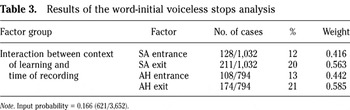
The analysis of the pronunciation of word-initial stops was based on 3,652 tokens (see Table 3). All voiceless stops were collapsed into two variants: nonaspirated and aspirated. The recombination of the six variants into a binary distinction was done to run the logistic regression analysis. The nonaspirated variants represented 17% (621/3,652), whereas aspirated variants represented 83% (3,031/3,652). These findings reveal that aspirated variants [ph th kh] were still predominant in the speech samples of both groups.
Results of the word-initial voiceless stops analysis

There was a trend of improvement in the pronunciation of both groups of students at the end of the period treatment. SA students disfavored nonaspirated variants at the beginning of the semester with a weight of 0.416. However, this tendency changed at the end of the semester when SA students showed a slightly favoring trend toward the pronunciation of nonaspirated variants. Recall that a weight above 0.500 favors the application value of the dependent variable, which in this case is the production of nonaspirated variants. The same pattern of linguistic behavior was found in AH students; at the end of the treatment period, a slightly favoring tendency was reached with a weight of 0.585. These findings suggest that receiving input in the L2 triggers development in both contexts.
Voiced Fricatives in Intervocalic Position


In this section, the results regarding intervocalic

are presented. The quantitative analysis of voiced fricatives was based on 1,378 tokens. The general tendencies reveal that 13% of the cases were realized as fricatives (187/1,378), whereas 87% of the cases were realized as nonfricatives (1,191/1,378). Unfaithful pronunciation of fricative segments was predominant in the speech of these two groups of L2 speakers.
The logistic regression analysis did not select the interaction between context of learning and time of recording as a significant variable, which indicates that this interactional factor group has no effect in predicting the pattern of pronunciation found for voiced fricative segments in the corpus examined. In fact, there was little change over time if one compares the production of fricatives before and after the treatment period in both groups of students. The SA group used intervocalic voiced fricatives 10% of the time on the entrance test and 14% on the exit test; the AH group used intervocalic voiced fricatives 13% of the time on the entrance test and 16% on the exit test. Context of learning did not seem to have a significant effect in attaining a more nativelike pronunciation in the particular case of voiced fricatives in intervocalic position. Following Flege et al. (1998) and Flege and Eefting (1988), one can suggest that the students have not established a different phonetic category for voiced fricative segments separating these from other sound types. Following Eckman's proposal (1987), one might suggest that voiced fricatives are more marked than voiceless stops, which could explain the lack of improvement in their production after the treatment period.
Word-Final [l]
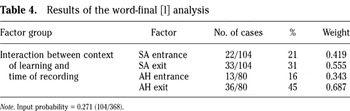
A total of 368 tokens were analyzed in the case of word-final [l] (see Table 4). The general tendencies indicate that participants pronounced 28% of the tokens (104/368) using the native alveolar variant (i.e., [l]), whereas 72% of the tokens (264/368) were realized using the velar variant (i.e.,

). As in previous cases, an initial assessment of the distribution of the variants reveals that the nonnative variant was predominant in the speech of these two groups of L2 speakers.
Results of the word-final [l] analysis

The tendencies reveal improvement in the production of word-final [l] in the speech of both groups of L2 students. Surprisingly, AH students showed a stronger result favoring the production of the faithful variant (i.e., alveolar [l]) than SA students with a weight of 0.687. At the end of the treatment period, SA students reached a borderline weight, slightly favoring the production of the faithful alveolar variant. Once again, these results suggest that in both contexts students were able to show equal linguistic gains.
Palatal Nasal
A total of 92 tokens were examined in the case of the palatal nasal. The distribution of palatal nasal variants is somewhat different from the patterns found for other sound segments. The native palatal was produced faithfully at 84% (77/92), whereas the alveolar productions represented 16% (15/92).
The results of the logistic regression analysis reveal that the interaction between context of learning and time of recording was not statistically significant, as the variable rule analysis did not select it. Phonological gain in the case of the palatal nasal could not be predicted by considering the interaction of both variables. One could interpret this outcome as an indication that neither context of learning nor time of recording has an effect on the production of the nativelike palatal variant. Given that all speakers had already acquired the palatal nasal before the treatment, development across time and context were not relevant for these L2 speakers. The SA group used the palatal nasal 80% of the time on the entrance test and 73% on the exit test; the AH group used the palatal nasal 95% of the time on the entrance test and 90% on the exit test. Flege (1987, p. 63) claimed that statistical analysis of L2 speakers reveals that new phones are more likely to be produced with a higher rate of accuracy in comparison to phones with a similar counterpart in the L1. Following Flege's distinction between new and similar segmental units (p. 63), one might suggest that the palatal nasal is a new segment with a contrastive function in Spanish, which could explain the high rate of accuracy.
FACTORS AFFECTING PHONOLOGICAL ACQUISITION
The four dependent variables examined in the present paper were collapsed in a single variable with the purpose of measuring the effect of the 10 independent variables included in this study. A binary distinction between faithful and unfaithful variants was created to submit all independent variables to a logistic regression analysis. The application value selected was faithful variants. This way of organizing the analysis allowed one to observe what makes a positive impact on L2 speech. This second part of this analysis allowed an examination of not only the role played by context of learning but also other relevant factors that might have influenced L2 phonological acquisition.
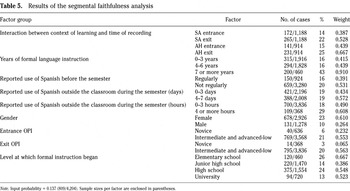
A series of regression analyses were run to evaluate the impact of the 10 factor groups in the pronunciation of the four segmental variables included in this study (see Table 5). The order of selection indicates the degree of impact of a factor group selected on the dependent variable from more to less important. These significant factors were not the only ones incorporated in the logistic regression test. The original analysis also included several (insignificant) factors, such as time of recording and context of learning.
Results of the segmental faithfulness analysis

The factor group selected as the most significant is the interaction between context of learning and time of recording. These tendencies indicate a pattern of improvement in both AH and SA students. Both types of students were able to attain a more faithful pronunciation by the end of the treatment period. A surprising outcome that needs to be pointed out is that the trend of improvement is stronger in the exit recordings of AH students than in the exit recordings of SA students. One possible explanation for these findings is that within the group of AH students there might have been individuals with more years of formal instruction as well as individuals who began studying Spanish at an earlier stage. This is precisely what Díaz-Campos et al. (2002) and Díaz-Campos and Lazar (2003) found in an analysis of the word-initial voiceless stops using the same data. Overall, they found that students with 7 or more years of language instruction show a more nativelike pronunciation of word-initial voiceless fricatives. The second factor group selected was years of formal language instruction. Production of nativelike variants was favored by students with 7 or more years of language instruction with a very strong weight of 0.910, whereas students with 6 or fewer years of formal instruction did not favor the production of faithful variants. These results suggest that formal instruction can have an impact in attaining a nativelike pronunciation after a long period of time. The third factor in the hierarchy was reported use of Spanish before the semester. In this particular case, the results showed a pattern according to which students reporting nonregular use of the L2 before the semester show a borderline effect, whereas students reporting regular use of Spanish before the semester disfavored faithful pronunciation. Before providing a conclusive statement regarding this factor, it would be important to observe by means of other instruments whether this pattern is confirmed.
The fourth most important factor group was reported use of Spanish outside the classroom during the semester (days). The tendencies found in this case were more consistent with the pattern expected. Students who reported using Spanish from 4 to 7 days per week slightly favored the production of more nativelike variants, whereas students who reported using Spanish from 0 to 3 days per week disfavored the production of faithful variants. This result is consistent with what one might anticipate regarding the benefits of using the L2 outside the classroom. In particular, the data suggest a trend of improvement in L2 pronunciation. Consistent with the results for the previous factor group, the next factor in the hierarchy was reported use of Spanish outside the classroom during the semester (hours). In this particular case, the quantitative analysis shows strong tendencies according to which students reporting use of Spanish outside the classroom for 4 hours or more per week highly favored the production of faithful variants, whereas students using Spanish for 0–3 hours per week did not favor nativelike pronunciation. Because of the inconsistency found in the information regarding self-reported use of Spanish before the semester, I suggest that future research should address the problems related to the definition of these types of variables. It is possible that an analysis examining their statistical interaction could provide a solution. However, such an enterprise is out of the scope of the present paper. The sixth factor selected by the logistic regression analysis was gender. The findings indicate that female students favored nativelike pronunciation with a weight of 0.610, whereas male students disfavored it with a weight of 0.264. According to these results, one might speculate that these patterns of linguistic behavior resemble what has been observed in the sociolinguistic literature examining women's speech: Female students are more careful in producing the target segments, which can be interpreted as a conservative tendency (see Labov, 1972; Silva-Corvalán, 1989, 2001; Wodak & Benke, 1998, for further discussion of women's sociolinguistic behavior).
The entrance OPI was the next most important factor. Intermediate and advanced-low proficiency level students slightly favored a more nativelike pronunciation, whereas novice learners disfavored it. These findings suggest that higher OPI ratings are also reflected at the segmental level. The eighth factor group selected was exit OPI. Once again, the results reveal that intermediate and advanced-low students slightly favored the production of more nativelike variants, whereas novice students disfavored them. This is a very important outcome because the OPI ratings reflect the pattern of improvement in the speech of this group of L2 speakers at the end of the treatment period. Level at which formal instruction began was the last factor selected by the logistic regression analysis. The tendencies found reveal that students who began their formal instruction at the elementary level favored the production of faithful variants. Contrary to what one might anticipate, subjects who began their studies at the junior high level did not favor nativelike pronunciation, whereas individuals who began studying Spanish at the high school and university levels presented borderline results slightly favoring the production of faithful variants. Several factors could explain this outcome. However, further research will have to address this issue as focusing on this specific factor is outside the scope of this paper. Regarding the effect of beginning L2 instruction at the elementary school level in attaining a more nativelike pronunciation, the results reflect the tendencies found in previous studies that showed age of L2 learning as an important factor (Moyer, 1999; Piske et al., 2001).
CONCLUSION
What is the effect of context of learning (SA vs. AH) in attaining nativelike pronunciation of consonantal segments in Spanish? The results reveal that the production of word-initial stops and word-final laterals by both groups improves over time. The palatal nasal is produced faithfully in 84% of the cases before and after the treatment period. Still, the pronunciation of voiced fricatives does not show a pattern of development, which suggests that fricatives are difficult to acquire. Following formal generative approaches, fricatives may be more marked and therefore difficult to acquire. The initial motivation to examine these consonantal phenomena came from textbook descriptions that point out possible differences and areas of difficulty for nonnative speakers of Spanish. Even though the phenomena selected was a good point of departure, the results suggest that there might be other aspects in the development of an L2 phonological system that could be included to study the impact of context of learning in attaining nativelike pronunciation.
In summary, the findings reveal three different patterns for both SA and AH students: (a) equal gains in the case of voiceless stops and word-initial laterals, (b) a lack of gain in the case of intervocalic voiced fricatives, and (c) high levels of accuracy in the production of the palatal nasal at the time of the pretest. These results are slightly puzzling in that they do not reveal striking differences between SA and AH students. What aspects of the phonology of an L2 speaker can benefit by participating in a SA program? Future studies will have to explore other segmental aspects, such as vowels and diphthongs, as well as suprasegmental phenomena, such as lexical stress and intonation, to determine what areas of the L2 phonology benefit from participating in a SA program.
The quantitative analysis also reveals that other important independent variables play a role in L2 pronunciation. Specifically, the following eight factor groups were found to be statistically significant: years of formal language instruction, reported use of Spanish before the semester, reported use of Spanish outside the classroom during the semester (days), reported use of Spanish outside the classroom during the semester (hours), gender, entrance OPI, exit OPI, and level at which formal instruction began.
Footnotes
I am very grateful to Joseph Collentine, Barbara F. Freed, and Norman Segalowitz for their comments and suggestions on an earlier version of this article. I also would like to express my thanks to the anonymous SSLA reviewers for their careful reading and useful insights. I would like to thank Nicole Lazar for her comments and help in running a preliminary statistical analysis of the data. Randall Halter of Concordia University in Montreal was instrumental in providing technical support for digitizing the read-aloud materials. I appreciate Randall's work very much. I would also like to thank James Lee, Kimberly Geeslin, and Richard File for reading a previous version of this paper and providing me with comments. Last but not least, I want to thank the Council on International Education Exchange for providing the funds to Freed to coordinate the teamwork regarding language gain in different contexts of learning. All errors are my own.
References
REFERENCES
Archibald, J.
(1998a).
Second language phonology.
Amsterdam:
Benjamins.
Archibald, J.
(1998b).
Second language phonology, phonetics, and typology.
Studies in Second Language Acquisition,
20,
189–211.Google Scholar
Armstrong, G.
(1981).
Effects of an intensive foreign study program on attitudes and
Spanish language skills.
Unpublished doctoral dissertation,
Indiana University,
Bloomington.
Barrutia, R., &
Schwegler, A.
(1994).
Fonética y fonología españolas [Spanish
phonetics and phonology].
New York:
Wiley.
Barrutia, R., &
Terrell, T.
(1982).
Fonética y fonología españolas [Spanish
phonetics and phonology].
New York:
Wiley.
Berdan, R.
(1996).
Disentangling language acquisition from language variation. In
R. Bayley &
D. Preston (Eds.),
Second language acquisition and linguistic variation (pp.
203–244).
Amsterdam:
Benjamins.
Bernhardt, B., &
Stemberger, J.
(1998).
Handbook of phonological development: From the perspective of
constraint-base nonlinear phonology.
San Diego, CA:
Academic Press.
Best, C.
(1995).
A direct-realist view of cross-language speech perception. In
W. Strange (Ed.),
Speech perception and linguistic experience: Issues in
cross-language speech research (pp.
171–206).
Timonium, MD:
York Press.
Bongaerts, T.,
van Summeren, C.,
Planken, B., &
Schils, E.
(1997).
Age and ultimate attainment in the pronunciation of foreign
language.
Studies in Second Language Acquisition,
19,
447–465.Google Scholar
Brecht, R.
(1993a).
Predictors of foreign language gain during study abroad.
Washington, DC:
National Foreign Language Center.
Brecht, R.
(1993b).
Qualitative analysis of second language acquisition in study abroad.
Washington, DC:
National Foreign Language Center.
Brecht, R.,
Davidson, D., &
Ginsberg, R..
(1995).
Predictors of foreign language gain during study abroad. In
B. F. Freed (Ed.),
Second language acquisition in a study abroad context (pp.
37–66).
Amsterdam:
Benjamins.
Broselow, E.,
Chen, S., &
Wang, C.
(1998).
The emergence of the unmarked in second language phonology.
Studies in Second Language Acquisition,
20,
261–280.Google Scholar
Carlisle, R.
(1998).
The acquisition of onsets in a markedness relationship: A
longitudinal study.
Studies in Second Language Acquisition,
20,
245–260.Google Scholar
Cedergren, H., &
Sankoff, D.
(1974).
Variable rules: Performance as a statistical reflection of
competence.
Language,
50,
333–355.Google Scholar
Chomsky, N., &
Halle, M.
(1968).
The sound pattern of English.
New York:
Harper & Row.
Dalbor, J.
(1997).
Spanish pronunciation: Theory and practice.
New York:
Holt, Rinehart, & Winston.
Díaz-Campos, M., &
Lazar, N.
(2003).
Acoustic analysis of voiceless initial stops in the speech of
study abroad and regular class students: Context of learning as a
variable in Spanish second language acquisition. In
P. Kempchinsky &
C.-E. Piñeros (Eds.),
Theory, practice, and acquisition: Papers from the 6th Hispanic
Linguistics Symposium and the 5th Conference on the Acquisition of
Spanish and Portuguese (pp.
352–370).
Somerville, MA:
Cascadilla Press.
Díaz-Campos, M.,
Lazar, N.,
Freed, B. F.,
Segalowitz, N.,
Lafford, B., &
Collentine, J.
(2002, October).
Acoustic analysis of voiceless initial stops in the speech of study
abroad and regular class students.
Paper presented at the 5th Conference on the Acquisition of
Spanish, Iowa City.
Eckman, F.
(1987).
Markedness and the contrastive analysis hypothesis. In
G. Ioup &
S. Weinberger (Eds.),
Interlanguage phonology (pp.
55–69).
Rowley, MA:
Newbury House.
Ellis, R.
(1994).
The study of second language acquisition.
Oxford:
Oxford University Press.
Flege, J.
(1987).
The production of new and similar phones in a foreign language:
Evidence for the effect of equivalence classification.
Journal of Phonetics,
15,
47–65.Google Scholar
Flege, J., &
Eefting, W.
(1988).
Imitation of a VOT continuum by native speakers of English and
Spanish.
Journal of the Acoustical Society of America,
83,
729–740.Google Scholar
Flege, J.,
Frieda, E.,
Walley, A., &
Randazza, L.
(1998).
Lexical factors and segmental accuracy in L2 speech production.
Studies in Second Language Acquisition,
20,
155–187.Google Scholar
Fowler, C.
(1986).
An event approach to the study of speech perception from a
direct-realist perspective.
Journal of Phonetics,
14,
3–28.Google Scholar
Freed, B. F.
(1995).
Language learning and study abroad. In
B. F. Freed (Ed.),
Second language acquisition in a study abroad context (pp.
3–33).
Amsterdam:
Benjamins.
Geeslin, K.
(2002).
The acquisition of Spanish copula choice and its relationship to
language change.
Studies in Second Language Acquisition,
24,
419–450.Google Scholar
González-Bueno, M.
(1997).
Voice onset time in the perception of foreign accent by native
listeners of Spanish.
International Review of Applied Linguistics,
35,
251–267.Google Scholar
Hammond, R.
(2001).
The sounds of Spanish.
Somerville, MA:
Cascadilla Press.
Harris, J.
(1969).
Spanish phonology.
Cambridge, MA:
MIT Press.
Jakobson, R.
(1968).
Child language aphasia and phonological universals.
The Hague:
Mouton.
Labov, W.
(1966).
The social stratification of English in New York City.
Arlington, VA:
Center for Applied Linguistics.
Labov, W.
(1969).
Contraction, deletion, and inherent variability of the English
copula.
Language,
45,
715–762.Google Scholar
Labov, W.
(1972).
Sociolinguistic patterns.
Philadelphia:
University of Pennsylvania Press.
Lafford, B.
(1995).
Getting into, through, and out of a survival situation. In
B. F. Freed (Ed.),
Second language acquisition in a study abroad context (pp.
97–121).
Amsterdam:
Benjamins.
Lapkin, S.,
Hart, D., &
Swain, M.
(1995).
A Canadian interprovincial exchange: Evaluating the linguistic
impact of a three-month stay in Quebec. In
B. F. Freed (Ed.),
Second language acquisition in a study abroad context (pp.
67–94).
Amsterdam:
Benjamins.
Leather, J.
(1999).
Phonological issues in language learning.
Oxford:
Blackwell.
Liberman, A.,
Cooper, F.,
Shankweiler, D., &
Studdert-Kennedy, M.
(1967).
Perception of the speech code.
Psychological Review,
74,
431–461.Google Scholar
Liberman, A., &
Mattingly, I.
(1985).
The motor theory of speech perception revised.
Cognition,
21,
1–36.Google Scholar
Liberman, A., &
Mattingly, I.
(1989).
A specialization for speech perception.
Science,
245,
489–494.Google Scholar
Lord, G.
(2000).
The combined benefits of instruction and immersion on L2
pronunciation. Unpublished manuscript, University of Florida, Gainesville.
Lord, G.
(2002, October).
Can we teach foreign language pronunciation?
Paper presented at the 5th Conference on the Acquisition of
Spanish, Iowa City.
Major, R.
(1987).
A model for interlanguage phonology. In
G. Ioup &
S. Weinberger (Eds.),
Interlanguage phonology: The acquisition of second language sound
system (pp.
101–124).
Rowley, MA:
Newbury House.
Major, R.
(1998).
Interlanguage phonetics and phonology: An introduction.
Studies in Second Language Acquisition,
20,
131–137.Google Scholar
McCarthy, J., &
Prince, A.
(1993).
Prosodic morphology 1: Constraint interaction and satisfaction.
Unpublished manuscript,
University of Massachusetts, Amherst, and Rutgers University.
McCarthy, J., &
Prince, A.
(1995).
Faithfulness and reduplicative identify.
University of Massachusetts Occasional Papers,
18,
249–384.Google Scholar
Michaels, D.
(1974).
Sound replacement and phonological systems.
Linguistics,
176,
69–81.Google Scholar
Mohanan, K. P.
(1986).
The theory of lexical phonology.
Dordrecht:
Reidel.
Moyer, A.
(1999).
Ultimate attainment in L2 phonology.
Studies in Second Language Acquisition,
21,
81–108.Google Scholar
Navarro-Tomás, T.
(1967).
Manual de pronunciación española [Manual of Spanish
pronunciation].
Madrid:
Consejo Superior de Investigaciones Científicas.
Pintzuk, S.
(1988).
VARBRUL programs [software].
Philadelphia:
University of Pennsylvania Department of Linguistics.
Piske, T.,
MacKay, I., &
Flege, J.
(2001).
Factors affecting degree of foreign accent in an L2: A review.
Journal of Phonetics,
29,
191–215.Google Scholar
Prince, A., &
Smolensky, P.
(1993).
Optimality theory: Constraint interaction in generative grammar.
Unpublished manuscript,
Rutgers University and University of Colorado,
Boulder.
Quilis, A., &
Fernández, J.
(1979).
Curso de fonética y fonología españolas para
estudiantes angloamericanos [Course of Spanish phonetics and phonology
for Anglo-American students].
Madrid:
Consejo Superior de Investigaciones Científicas.
Rand, D., &
Sankoff, D.
(1990).
GoldVarb 2.0 [software].
Montreal:
University of Montreal.
Riney, T., &
Flege, J.
(1998).
Changes over time in global foreign accent and liquid
identifiability and accuracy.
Studies in Second Language Acquisition,
20,
213–243.Google Scholar
Sankoff, D.
(1998).
Variable rules. In
U. Ammon,
N. Dittmar, &
K. J. Mattheier (Eds.),
Sociolinguistics: An international handbook of the science of
language and society (pp.
984–997).
Berlin:
Mouton de Gruyter.
Siegel, D.
(1974).
Topics in English morphology.
Unpublished manuscript,
Massachusetts Institute of Technology,
Cambridge.
Silva-Corvalán, C.
(1989).
Sociolingüística: Teoría y análisis
[Sociolinguistics: Theory and analysis].
Madrid:
Alhambra.
Silva-Corvalán, C.
(2001).
Sociolingüística y pragmática del español
[Sociolinguistics and pragmatics of Spanish].
Washington, DC:
Georgetown University Press.
Simões, A.
(1996).
Phonetics in second language acquisition: An acoustic study of
fluency in adult learners of Spanish.
Hispania,
79,
87–95.CrossRefGoogle Scholar
Stampe, D.
(1979).
A dissertation on natural phonology.
New York:
Garland.
Stemberger, J., &
Bernhardt, B.
(1999).
The emergence of faithfulness. In
B. MacWhinney (Ed.),
The emergence of language (pp.
417–446).
Mahwah, NJ:
Erlbaum.
Suter, R.
(1976).
Predictors of pronunciation accuracy in second language learning.
Language Learning,
26,
233–253.CrossRefGoogle Scholar
Tarone, E.
(1982).
Systematicity and attention in interlanguage.
Language Learning,
32,
69–82.CrossRefGoogle Scholar
Tarone, E.
(1983).
On the variability of interlanguage systems.
Applied Linguistics,
4,
142–163.CrossRefGoogle Scholar
Teschner, R.
(2000).
Camino oral [Oral route].
New York:
McGraw-Hill.
Wodak, R., &
Benke, G.
(1998).
Gender as a sociolinguistic variable: New perspectives on
variation studies. In
F. Coulmas (Ed.),
The handbook of sociolinguistics (pp.
127–167).
Oxford:
Blackwell.
Young, R., &
Bayley, R.
(1996).
VARBRUL analysis for second language acquisition research. In
R. Bayley &
D. Preston (Eds.),
Second language acquisition and linguistic variation (pp.
253–306).
Amsterdam:
Benjamins.
Spanish consonantal sounds
English consonantal sounds
Results of the word-initial voiceless stops analysis
Results of the word-final [l] analysis
Results of the segmental faithfulness analysis
 You have
Access
- 165
- Cited by