Introduction
Butia odorata (Barb. Rodr.) Noblick, jelly palm, is a long-lived and useful palm. It is a neglected and subutilized species, and its genetic diversity and associated knowledge are under severe erosion. Its fruit, ‘butiá’, is used for fresh consumption and used to produce jellies, ice creams, chocolates, mousses, juices and liqueurs. The fruit is a good source of iron, manganese, potassium, phenolic compounds, vitamin C and carotenoids (Fonseca, Reference Fonseca2012). The leaves have been used to produce handicrafts, an alternative source of income. The plants are used as ornamental, in rural and urban landscaping. Furthermore, the production of good quality oils from its seeds could be another income generating opportunity regarding this multi-purpose palm (Rossato, Reference Rossato2007).
The Butia genus comprises 18 species in Brazil, Uruguay, Paraguay and Argentina (Lorenzi et al., Reference Lorenzi, Noblick, Kahn and Ferreira2010). B. odorata occurs in the grasslands in southern Brazil and Uruguay. The distribution of B. odorata is estimated to occur over 70,000 ha in Uruguay, but there are no good estimates about the remaining area in southern Brazil.
In Brazil, four genebanks are involved in the conservation of B. odorata germplasm: three are concerned with ex situ conservation, and one with in situ. The latter was established to safeguard a population composed of more than 60,000 adult palms, most of them older than 150 years, covering an area of 750 ha in a private farm.
Improvement of the conservation and sustainable use of B. odorata is very important to characterize the germplasm. Farmers and breeders must have access not only to a wide range of species, but also to the essential information about the traits they possess that facilitate their utilization. Accurate characterization and evaluation data promote utilization, especially if they are available in a user-friendly standard format. For this, it is necessary to develop a list of descriptors composed of characteristics and traits that will allow a proper description to discriminate among plants. Bioversity International (formerly International Board for Plant Genetic Resources and International Plant Genetic Resources Institute) have developed and published list of descriptors for more than 100 crops. The concept of descriptors has evolved over the years (IBPGR, 1977; IBPGR, 1992; IPGRI, 1996; IPGRI et al., 2005; Bioversity, 2008). Initially, in 1977, list of descriptors provided a minimum set of characteristics to describe particular crops. This was revised in 1990 to include all characterization and evaluation descriptors. These lists proved to be very extensive and time consuming and were further revised in 1994, to include a minimum set of highly discriminating descriptors to describe particular crops and allow breeders to use comparable data. Since 1995, additional standardized sections (in vitro conservation, cryopreservation, soil and environment), common across different crops, were incorporated. Ethnobotanical information was included in the list of descriptors in 1999. Recently, to combine a documentation system traditionally used in genebanks and crop improvement institutes with an approach that involves people and their knowledge ‘in the field’, Bioversity and The Christiansen Fund (2010) developed the ‘Descriptors for farmers' knowledge about people and plants’.
Based on this experience, we present a standardized list of descriptors for Butia using scientific documentation methods and farmers' knowledge.
Materials and methods
Based on the variability reported for B. odorata (PROBIDES, 2001; Rivas and Barilani, Reference Rivas and Barilani2004; Rossato, Reference Rossato2007; Lorenzi et al., Reference Lorenzi, Noblick, Kahn and Ferreira2010; Schwart et al., Reference Schwartz, Fachinello, Barbieri and Silva2010) and on the variation observed in the in situ genebank, we propose a list of 11 traits as descriptors for this palm: arrangement of leaves on the plant, stem circumference measured at breast height, colour of leaf, colour of rachillae observed soon after the opening of the spathe, number of bunches per plant, colour of mature fruit, fruit shape, presence of fibre in the pulp, fruit diameter, flowering time and fruiting time. These characteristics were assessed and harmonized with Bioversity International's format and terminology. The validity of the selected traits was then confirmed through consultation with a pool of experts who validated it and added additional ones important for utilization.
The 11 proposed descriptors were used to characterize 303 adult palms, from June 2010 to August 2012. These palms were randomly selected in the in situ genebank, in three areas (A1, A2 and A3) approximately 1 km distant from each other. 101 individual plants were evaluated in each of these areas, whose geographical coordinates are: A1, 51°21′35.23″W/30°31′22.34″S; A2, 51°21′47.61″W/30°31′46.11′S and A3, 51°22′6.35″W/30°32′43.79″S. Evaluation of inflorescence traits was carried out every 15 d. During fruiting period, these evaluations were carried out weekly, to monitor the ripening of fruits. To measure height and diameter of the fruit, 20 ripe fruits were collected from each plant; the measurements were taken using a digital calliper. The mean, standard deviation and coefficient of variation (CV) of the 11 traits were calculated.
In addition, over the last 10 years, we have discussed with many farmers about how they differentiate the Butia plants. These farmers know a lot about this plant and consume the fruits regularly. The discussions have resulted in a list of characteristics adopted in the daily life by the farmers based on the use made of particular parts of the plant. We have compared their characteristics with those we have selected as descriptors.
Results
The 11 characteristics (arrangement of leaves in the plant, stem circumference, colour of leaf, colour of rachillae, number of bunches per plant, colour of mature fruit, fruit shape, presence of fibre in the pulp, fruit diameter, flowering time and fruiting time) were useful to describe the plant and for discriminating the individual plants.
Considering the arrangement of leaves on the plant, most plants have the intermediate arrangement (A1 – 88.11%, A2 – 99.01% and A3 – 96.04%), followed by erect (A1 – 2.97%, A2 – 0.99% and A3 – 3.96%) and pendant (A1 – 8.92%, A2 and A3 – 0%) arrangements. Stem circumference measured at 1.5 m from ground level presented values between 99.8 and 107.5 cm. Most individuals in A1 had grey leaves (90.10%); in A2, there was almost a balance between grey (56.44%) and light green (42.57%), and, in A3, all the plants have shown grey leaves (100%).
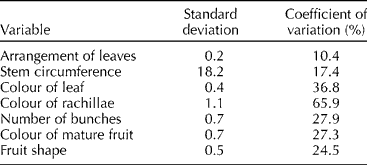
The colour of rachillae was yellow predominantly, followed by pink and purple. This trait showed the highest CV, 65.9%, indicating its great importance as a descriptor to discriminate plants (Table 1).
Standard deviation and coefficient of variation (CV) for traits evaluated in a population of jelly palm (Butia odorata) in southern Brazil

The average production ranged from 1.85 to 3.3 bunches per plant, varying from zero to seven bunches per plant. During the 2010/2011 season, the palms from A1 were more productive than the others (average of 3.3 bunches per plant). In the following season (2011/2012), the production of bunches decreased in the three areas (average of 2.2 bunches per plant), and this may be associated with drought in early 2012 in that region. It is interesting to note that all the plants characterized were older than 150 years.
Colour of mature fruits showed variation: yellow, greenish, orange, reddish-orange, bright red and purple. The predominant colour in all areas was yellow, followed by orange and reddish-orange. Fruit shape was mostly depressed-globose, but ovoid and oblong shapes were also observed. Many fruits showed small amount of fibre in the pulp, and some of them showed much of it, but there were no fruits without it. Variation was also observed on fruit size, with an average of 17.89 mm in length and 26.84 mm in circumference. Larger fruits were found in A3. The smallest fruit was found in A1 and A2, with no significant difference between them.
Flowering and fruiting patterns were similar in the two reproductive cycles evaluated. Flowering begins in late winter, with a peak in late spring and early summer.
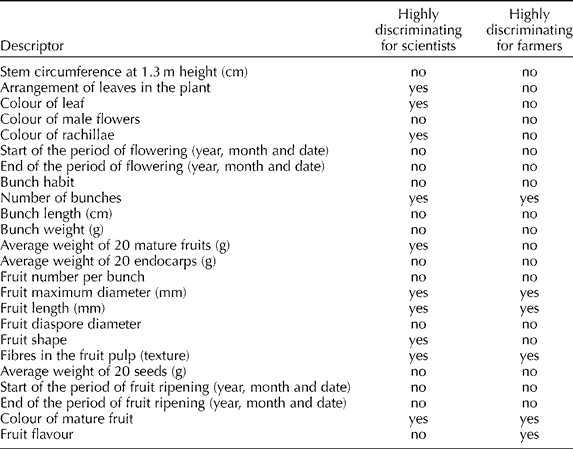
Farmers have selected five characteristics as descriptors, based on their experience of life, which are widely used by them to discriminate different plants: number of bunches, fruit size, texture of the pulp, colour of mature fruit and fruit flavour. General appearance of the plant, yield and resistance to drought and low temperatures are also important for farmers, but they do not refer to these characteristics to discriminate plants.
The descriptors for B. odorata resulting from observations by the authors, literature research, consultation with experts and farmers are given in Table 2.
Descriptors for jelly palm (Butia odorata) resulting from observations in the field, literature research, and consultation with experts and farmers

Discussion
The five characteristics indicated by the farmers were efficient as descriptors to discriminate individual plants: colour of mature fruit, fruit size (which is correlated with fruit diameter and fruit length), number of bunches per plant, texture (which, in this case, is synonymous for the presence of fibres in the pulp) and fruit flavour. For the farmers, the fruit plays a central role in describing the variability in Butia. They have reported three colours of fruit: yellow, orange and red. Almost all of them prefer yellow fruits, because they are attracted by this colour. However, they appreciate sweeter and bigger fruits, and they know that colour of fruit is not directly related to texture, flavour or size of the fruit. They also like fruits with few or no fibres in the pulp (although it is unlikely to find fruits without fibres).
The CV higher than 20% show that number of bunches (CV = 27.9%) and colour of mature fruits (CV = 27.3%) are highly efficient in discriminating different plants (Table 1). It is interesting to note that the highest CV was observed for the descriptor colour of the rachillae (CV = 65.9%), a characteristic that was not indicated as important for the farmers. This can be easily explained because the colour of the rachillae is not considered a useful trait for them as it is not edible.
The farmers' views regarding plant diversity and their ways to detect it most effectively are important to be recorded. It was significantly noted that only five morphological characteristics are used by farmers to distinguish between the different varieties of jelly palm. This is quite amazing if we reflect that 11 traits are instead used by researchers as minimum discriminating traits. This indicates that farmers seem to have simpler and more rapid ways to differentiate diversity than do the scientists for their use-oriented purposes. From the farmers' perspective, descriptors are in fact important tools to manage crop diversity to meet everyday needs. In order to be efficient, these descriptors have to be simple and made available to the community. From an anthropological point of view, it is also interesting to note that since describing crop diversity is embedded deeply in the rural culture and because of the predominant oral transmission of knowledge among farmers across generations, farmers' descriptors can also represent an important instrument to keep alive local cultures under risk of being lost.
A good example is provided by the work carried out by Mr Slimane Bekkay, date palm champion custodian farmer from the oasis of Ghardaia, Algeria. Mr Bekkay, after participating with several scientists and other farmers from North Africa in the development of a standard list of descriptors for date palm (IPGRI et al., 2005), volunteered to develop a separate list of descriptors booklet based on farmers' knowledge to document the precious wisdom on how to describe date palm diversity in his own culture that he has received from his forefathers and wishing to pass on to the next generations. Conscious of the dramatic reduction in the rate of knowledge transmission to younger generations, Mr Bekkay wanted to contribute to keep alive such a knowledge and in so doing help promoting a more efficient use of date palm diversity in his country (Bioversity International, 2009).
Based on these reflections, we should build upon tools such as list of descriptors, which are meant to increase utilization of agricultural biodiversity by primary users, to make them real instruments of local development. Today, we believe list of descriptors are still very much geared to serve the needs of genebank managers for their characterization and evaluation work and data generated from these activities rarely reach out to farmers. Therefore, there is a need to build upon successful experience on ex situ descriptors to combine scientists and farmers' knowledge. The change of paradigm is also necessary if we reflect on the work carried out by community genebanks aimed at promoting greater use of crops by farmers.
In such a discourse aiming at refining tools to describe crop diversity for effective use, it is also important to analyse the intimate relationship that exists between farmers and the surrounding environment they work within. Every farmer is strongly linked to their social and agroecosystems and their preferences result from this relationship that is, by nature, most diverse (Donazzolo, Reference Donazzolo2012). Defining descriptors that would cater for such a diversity of visions is thus a challenge that needs to be properly addressed.
Farmers have their traditional ways to grasp knowledge about plants and their uses, but scientists have perceived these as ‘inferior’. Traditional knowledge systems should not be seen as inferior but just different. For instance, it is very impressive that farmers in the oases of North Africa are able to identify a specific wild male of date palm as source of pollen to be used for pollinating a specific female variety: the result of this process – entirely based on traditional knowledge – will determine fruits of larger size. These are the xenia and metaxenia phenomena, the biological processes of which are still not very clear to scientists (Osman, Reference Osman, Reuther and Erickson1974).
Such a vision of the supremacy of science over traditional knowledge needs to be revisited and the development of list of descriptors through a blended knowledge approach would represent a strategic step towards that direction. A positive signal is the increasing recognition of farmers' wisdom in mobilizing biodiversity in their copying strategies to fight climate change. With regard to Butia, it is worth reporting that farmers have indicated jelly palm as resilient species to drought and low temperatures, elements that warrant follow-up investigations by scientists.
Conclusion and recommendations
In order to characterize B. odorata germplasm and contribute to the development of strategies for conservation and sustainable use of this species, this research has succeeded in developing a list of descriptors that contains the following highly discriminating descriptors: arrangement of leaves on the plant, stem circumference, colour of leaf, colour of rachillae, number of bunches per plant, colour of mature fruit, fruit shape, presence of fibre in the pulp, fruit diameter, flowering time and fruiting time. At the same time, the interactions with farmers led to the identification of only five descriptors, fruit size (taking into account the length and diameter), number of bunches per plant, presence of fibres in the pulp, fruit flavour and colour of mature fruit.
Through this paper, we recommend the further development of this type of list of descriptors that describe plant genetic resources combining both experts' and farmers' knowledge in a ‘common language’. Providing uniform standards for the description and exchange of information on plants is an important tool that permits the international community to find and exchange information in a ‘common’ language, which in turn increases their use (Alercia and Mackay, Reference Alercia and Mackay2013). A change in this direction is necessary if we are aiming to consistently pursue the main objective of list of descriptors, which is to promote the use of crop diversity by users, particularly farmers. The raising awareness of the scientific community towards in situ/on-farm conservation (FAO, 2010; Padulosi et al., Reference Padulosi, Bergamini and Lawrence2012) is opening up new opportunities for the development of innovative information and documentation systems capable to better describe the reality on the farmers' fields based on their needs.
Concrete steps to achieve this goal consist of building participatory mechanisms for the development of documentation tools such as list of descriptors. Examples of such mechanisms are workshops, joint committees, national and international conferences, etc., where scientist and user groups (farmers and other value chain actors) could regularly meet. This is an area of work on which Embrapa and Bioversity are collaborating closely; Butia will represent an important case study for testing the proposed new approach as it plays an important social, economic and cultural role benefiting farmer communities in southern Brazil. Farmers' contribution to conserve biodiversity and traditional knowledge is critical to safeguard and use these resources, which will contribute to enhance their livelihoods and will sustainably ensure availability of resources for future generations.
Acknowledgements
The authors wish to warmly thank the farmers who maintain jelly palms and the associated knowledge, by sharing their valuable information with us during the development of this paper. Special gratitude goes to Probio II (Projeto Nacional de Ações Integradas Público-Privadas para Biodiversidade), Projeto RS Biodiversidade, CNPq (Conselho Nacional de Desenvolvimento Científico e Tecnológico), CAPES (Coordenação de Aperfeiçoamento de Pessoal de Nível Superior – Processo 9440-12-7) and Fapergs (Fundação de Amparo à Pesquisa do Estado do Rio Grande do Sul) for financially supporting this research.