Implications
Use of markers to estimate total tract digestibility of nutrients is less labour intensive than total faeces collection and has been used for many years. In equines, Cr2O3 is widely accepted as a marker to determine nutrient digestibility. However, the use of Cr2O3 as a food additive is prohibited due to its potential carcinogenicity and TiO2 is presented as a promising alternative in many animal species. Hitherto, a comparison between Cr2O3 and TiO2 has not been made in equines. Our results indicate that TiO2 is the preferred marker for digestibility trials in equines.
Introduction
Use of markers to estimate digestibility of nutrients is less labour intensive than total faeces collection (TFC) and has been used for many years. Chromic oxide (Cr) has been widely accepted as a faecal marker in many animal species, including horses, pigs, poultry, dogs, cattle and sheep. However, due to its suspected carcinogenicity, use of Cr2O3 as a food additive is currently prohibited (Sedman et al., Reference Sedman, Beaumont, McDonald, Reynolds, Krowech and Howd2006; FDA, 2016). A promising alternative is TiO2 (Ti) as has been shown in pigs (Jagger et al., Reference Jagger, Wiseman, Cole and Craigon1992), cattle (Titgemeyer et al., Reference Vander Noot, Symons, Lydman and Fonnesbeck2001), sheep (Myers et al., Reference Myers, Ludden, Nayigihugu and Hess2006; Glindemann et al., Reference Glindemann, Tas, Wang, Alvers and Susenbeth2009) and equines (Schaafstra et al., Reference Schaafstra, van Doorn, Schonewille, Wartena, Zoon, Blok and Hendriks2015, Reference Schaafstra, van Doorn, Schonewille, van Riet, Visser, Blok and Hendriks2017 and Reference Sedman, Beaumont, McDonald, Reynolds, Krowech and Howd2018). Titanium dioxide is a colour additive (E171) and permitted for application in foods (FDA, 2016). A direct comparison between TiO2 and Cr2O3 has been made in pigs (Kavanagh et al., Reference Kavanagh, Lynch, O’Mara and Caffrey2001), cattle (Titgemeyer et al., Reference Vander Noot, Symons, Lydman and Fonnesbeck2001) and sheep (Guzman-Cedillo et al., Reference Guzman-Cedillo, Corona, Castrejon-Pineda, Rosiles-Martínez and Gonzalez-Ronquillo2016), and TiO2 was shown to have similar recoveries to Cr2O3. Such comparison between Cr2O3 and TiO2, however, has not been made in hindgut fermenting equines and will be important in order to compare digestibility values between studies.
A continuous excretion of a marker per unit time is a crucial property when the marker technique to measure digestibility of nutrients is used. Within and between-day variation in the excretion of the marker limits its use in, for example, field studies (Haenlein et al., Reference Haenlein, Smith and Yoon1966; Prigge et al., Reference Prigge, Varga, Vicini and Reid1981; Holland et al., Reference Holland, Kronfeld, Sklan and Harris1998). In particular, the time after marker administration seems to be the major determinant for the excretion of the marker (Haenlein et al., Reference Haenlein, Smith and Yoon1966) and a more frequent administration of the marker tends to reduce variation in recovery (Prigge et al., Reference Prigge, Varga, Vicini and Reid1981). In order to accurately determine nutrient digestibility by the use of an orally supplemented marker, a steady-state excretion of the marker is essential. The aim of this study was to compare the recoveries of Cr2O3 and TiO2 when administered as markers and determine the effect of frequency of marker administration (once or twice per day) on the measurement of nutrient digestibility in ponies fed chopped alfalfa hay.
Material and methods
Ethical considerations and animal welfare
The experimental protocol was approved by the Animal Experiments Committee of the Faculty of Veterinary Medicine, Utrecht University, Utrecht, The Netherlands (Ethics Committee approval no. 2013.III.12.093). During the experiment, the ponies were exercised once daily for 1 h in a horse walker at a speed of 4.5 km/h during which time the ponies did not have access to feed or water. In addition, environmental enrichment (jolly balls) was provided in the stables, and the animals were groomed twice daily during sample collection periods. A period of 1 month before the study, all ponies were clinically examined, dewormed (Equest, Fort Dodge Animal Health Benelux B.V., Weesp, The Netherlands) and vaccinated (Equilis Prequenza TE, Intervet International B.V., Boxmeer, The Netherlands) by a licensed veterinarian.
Animals, experimental design and housing
According to a cross-over design, six, 7-year-old, Welsh pony geldings with an initial BW of 254 kg (SEM±3 kg) were assigned to two treatments. Each experimental period consisted of a 14-day preliminary feeding period followed by a 7-day sample collection period (Schaafstra et al., Reference Schaafstra, van Doorn, Schonewille, van Riet, Visser, Blok and Hendriks2017). The ponies were housed individually in 4×4 m boxes on wood shavings during the first 12 days of each experimental period. On day 13, the boxes were thoroughly cleaned, and rubber mats were placed to cover the floor until the end of the collection periods. Throughout the study, ponies had free access to a plastic bin containing fresh water and the BW of each pony was measured and recorded weekly.
Experimental diets
All ponies were fed a mineral and vitamin supplement (Research Diet Services B.V., Wijk bij Duurstede, The Netherlands) and chopped alfalfa hay (Medicago sativa) originating from the same batch, which was provided in different bales during the experiment (Table 1). The ponies were fed iso-energetically (on net energy (NE) basis), and energy intake was calculated to be 25.6 MJ NE/day (CVB, 2004) to meet the energy requirement for maintenance and exercise (250 kg BW, 1 h at 5 km/h). The daily amount of feed DM provided to the animals consisted of 4.65 kg chopped alfalfa hay and 0.09 kg mineral and vitamin supplement, including the Cr2O3 and TiO2 markers. The alfalfa hay was offered in three meals at 0900, 1400 and 1800 h. At 0900 and 1400 h, ponies received a quarter of the alfalfa hay mixed with 2.5 l of water; the other half of the alfalfa hay was mixed with 5 l of water and fed at 1800 h. Water was supplemented to avoid potential obstruction due to the high DM content of the chopped alfalfa hay. The mineral and vitamin supplement was offered by means of a feed bin with intake being monitored by the animal caretaker to ensure complete consumption of the supplement. The supplement was provided either once daily (treatment DF1; 3.3 g Ti and 3.2 g Cr) at 1000 h or twice daily (treatment DF2; 1.65 g Ti and 1.60 g Cr) at 1000 and 1700 h. Actual DM intake was determined as described in Schaafstra et al. (Reference Schaafstra, van Doorn, Schonewille, van Riet, Visser, Blok and Hendriks2017). During each collection period, water intake was calculated as the sum of the amount of water supplemented with the diet and the daily amount of water offered and refused for each pony each morning at 0600 h.
Chemical composition of the components of the experimental diet and the titanium and chromium-containing supplement provided to the ponies

OM=organic matter; BDL=below detection limit of 0.5 g.kg; NE=net energy; DM=dry matter.
Values are expressed as % of DM unless otherwise indicated.
1 The supplement contributed the following (per kg, as fed basis): NaCl, 100 g; CoCO3, 4 mg; Na2SeO3, 9 mg; KI, 20.6 mg; MnO, 2.7 g; CuSO4·5H2O, 1.6 g; ZnSO4·7H2O, 4.45 g; FeSO4·7H2O, 8 g; Cr2O3, 50 g; TiO2, 50 g; thiamine, 0.12 g; riboflavin, 0.1 g; retinol acetate, 20.64 mg; cholecalciferol, 0.33 mg; DL-α-tocoferylacetate, 4 g; molasses 60 g and alfalfa, 718.98 g.
2 Net energy of feedstuffs was calculated according to the formula: NE (MJ/kg DM)=(k m×(ME−31.3×CFAT)+0.80×31.3×CFAT)/1000, where NE is net energy, ME is metabolisable energy (MJ/kg) and CFAT is crude fat (g/kg DM) (CVB, 2004).
Collection of samples
Representative samples of the chopped alfalfa hay and supplement fed during each individual collection period were obtained before each experimental period. During the collection periods, voluntarily voided faeces of each pony were collected quantitatively for 24 h for 7 consecutive days. The faeces collection devices were emptied every hour from 0600 up until 0100 h every 24-h (Schaafstra et al., Reference Schaafstra, van Doorn, Schonewille, van Riet, Visser, Blok and Hendriks2017). All 24-h collected faeces were weighed per pony and thoroughly mixed using a concrete mixer (Altrad Lescha GmbH, Burgau, Germany). Then, two portions of 10% of each mixed 24-h faeces sample were collected. The first 10% proportion was used to determine the daily recovery of the markers and daily DM digestibility (DMD) and organic matter digestibility (OMD). The second 10% proportion was pooled per pony to determine macronutrient digestibility values. Thereafter, a 1.5 kg sample was stored at −20°C in sealed aluminium trays until further processing. At the end of the experiment, the stored daily and pooled faeces samples were dried, ground and stored until chemical analysis (Schaafstra et al., Reference Schaafstra, van Doorn, Schonewille, van Riet, Visser, Blok and Hendriks2017).
Chemical analysis
Alfalfa hay, the supplement and daily faeces samples were analysed for DM and Ti, as described in Schaafstra et al. (Reference Schaafstra, van Doorn, Schonewille, van Riet, Visser, Blok and Hendriks2017). In addition, Cr was determined using the spectrophotometric procedure described by Fenton and Fenton (Reference Fenton and Fenton1979). The combined within and between-run precisions of the determinations for Ti and Cr were ⩽2.5% and 3.5% (CV), respectively.
Alfalfa hay, the supplement as well as pooled faecal samples were analysed for DM, ash, CP, crude fat, crude fibre, starch, sugar and combustion value as described in Schaafstra et al. (Reference Schaafstra, van Doorn, Schonewille, van Riet, Visser, Blok and Hendriks2017). Fibre fractions (NDF, ADF and ADL; expressed without residual ash) were determined according to methods described by Van Soest et al. (Reference Van Soest, Robertson and Lewis1991).
Calculations
Organic matter (OM) was calculated as:
 $${\rm OM}\left( {{\rm g}\,/\,{\rm kg}\,{\rm DM}} \right){\equals}1000-{\rm Ash}\left( {{\rm g}\,/\,{\rm kg}\,{\rm DM}} \right)$$
Apparent total tract DMD and OMD determined by TFC were calculated for each pony using mean daily feed intake (I; DM or OM (kg)) and daily faecal output (FO; DM or OM (kg)) as:
 $${\rm DMD}_{{{\rm TFC}}} {\rm or}\,{\rm OMD}_{{{\rm TFC}}} \left( \,\%\, \right){\equals}\left[ {\left( {I-{\rm FO}} \right)\,/\,I} \right]{\times}100$$
Recovery of each marker in the faeces (Rf) was calculated using mean marker intake and faecal marker excretion over 7 consecutive days as:
 $$\eqalign{{\rm Rf}\left( \,\%\, \right){\equals}\left [{{\rm Faecal}\,{\rm marker}\,{\rm excretion}\left( {{\rm g}\,/\,{\rm day}} \right)}\right\cr\,/\,{\rm Marker}\,{\rm intake}\left( {{\rm g}\,/\,{\rm day}} \right)]{\times}100} } $$
Cumulative faecal recovery (Rfcum) over the 7 consecutive days of faeces collection (days 1 to 7) was calculated as:
 $$\eqalign{{\rm Rf}_{{{\rm cum}}} \left( \,\%\, \right){\equals}\left[\mathop{\sum}\limits_{i{\equals}1}^n {{\rm Faecal}\,{\rm marker}\,{\rm excretion}\left( {{\rm g}\,/\,{\rm day}} \right)\,}\right\cr \Big /\,\mathop{\sum}\limits_{i{\equals}1}^n {{\rm Marker}\,{\rm intake}\,\left( {{\rm g}\,/\,{\rm day}} \right)\Bigg ]{\times}100} } $$
where n is the number of faeces collection days with n⩽7.
The apparent total tract DMD and OMD using the marker method (Ti or Cr) was calculated as:
 $$\eqalign{{\rm DMD}_{{{\rm Ti}\,{\rm or}\,{\rm Cr}}} {\rm or}\,{\rm OMD}_{{{\rm Ti}\,{\rm or}\,{\rm Cr}}} \left( \,\%\, \right)&{\equals} {[1-(A_{{{\rm feed}}} \,/\,B_{{{\rm faeces}}} )} \cr & \quad {\times}({\rm XB}_{{{\rm faeces}}} \,/\,{\rm XA}_{{{\rm feed}}} )]{\times}100}$$
where A and B represent the marker concentration (g/kg DM) and XA and XB the DM or OM concentration (g/kg DM) in the feed and faeces, respectively.
Cumulative apparent DMD (%) or OMD (%) over the seven consecutive days of faeces collection (days 1 to 7) was calculated as:
 $$\eqalign{\left[ {\left( {\mathop{\sum}\limits_{i{\equals}1}^n {{\rm DM}\,{\rm or}\,{\rm OM}\,{\rm intake}_{i} -{\rm Faecal}\,{\rm DM}\,{\rm or}\,{\rm OM}\,{\rm excretion}_{i} } } \right)}\right\cr \,\Big /\,\mathop{\sum}\limits_{i{\equals}1}^n {{\rm DM}\,{\rm or}\,{\rm OM}\,{\rm intake}_{i} } \Bigg ]{{\times}100}}$$
where n is the number of faeces collection days, with n⩽7.
Statistical analysis
All data were subjected to a one-way ANOVA with period and treatment as factors (SPSS Statistics 21.0) following the model:
 $$Y_{{ijk}} {\equals}\mu {\plus}P_{i} {\plus}T_{j} {\plus}e_{{ijk}} $$
where Y ijk is the observed value for the treatment, μ the overall mean, P i the effect of the i th period (i=1 to 2), T j the effect of the j th treatment (j=1 to 2) and e ijk the error term. Within animals, comparisons on BW, DMD and OMD determined with either TFC, Ti, Cr and Rf (DF1 v. DF2) of Cr and Ti were made by paired sample t-tests. The latter test was also used to determine whether Rf of Cr and Ti were different from 100%. Differences were considered statistically significant when P<0.05, and trends were declared at 0.05⩽P<0.1.
Results
All ponies remained healthy throughout the experiment, and no coprophagia was observed during the experiment. Due to a technical error, faecal samples of three ponies at day 4 of faeces collection were missing. As a result, calculation of the mean daily Rf, DMD and OMD on day 4 is based on three ponies and Rfcum, cumulative DMD and OMD were calculated omitting day 4. Feed refusals for the chopped alfalfa hay and the supplement were not observed throughout the study. Mean BW (±SEM) at the end of the experiment (254±4 kg) was not different (P=0.656) to pre-experimental values (254±3 kg). For all treatments combined, mean water intake (including water provided with the feed) was 36.3 l/day (SEM 4.2; n=6).
Faecal recovery of markers
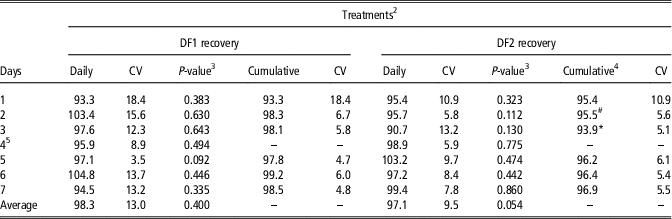
For both treatments and treatments combined, mean daily as well as cumulative faecal recovery (Rf) (percentage of intake) of Cr was greater (P<0.001) compared with Ti. Overall, at day 7 Rfcum of Cr as well as of Ti were not different from 100% for both administration frequencies.
Mean cumulative faecal recovery (Rfcum) of Ti and Cr (Tables 2 and 3) were not different between administration frequencies. The average daily faecal recovery (Rf) of Ti for DF1 (98.3%; CV 13.0) was not different compared with the average daily Rf of Ti for DF2 (97.1%; CV 9.5). For both administration frequencies, daily Rf of Ti was not different to 100%. The greatest daily Rf value (% of intake) was observed for Cr when ponies were administered Cr once per day, that is 113.0% (CV, 11.4%) and no differences were observed when the marker was administered once or twice daily. The average daily faecal recovery (Rf) of Cr was significantly higher than 100% when the marker was dosed once daily.
Mean daily and cumulative faecal recoveries (as % of intake) and corresponding CV obtained using TiO2 as an external marker administered once or twice daily over 7 days to ponies fed chopped alfalfa hay (n=6)Footnote 1

1 Mean cumulative faecal recoveries for days 5–7 are calculated excluding day 4.
2 Treatment: DF1 recovery: once daily administration of marker; DF2 recovery: twice daily administration of marker.
3 Probability that the mean daily faecal recovery is different from 100.
4 Values with a # and * denote a trend (P<0.1) and significant (P<0.05) difference from 100.
5 n=3.
Mean daily and cumulative faecal recoveries (% of intake) and corresponding CV obtained using C2O3 as an external marker administered once or twice daily over 7 days to ponies fed chopped alfalfa hay (n=6)Footnote 1

1 Mean cumulative faecal recoveries for days 5–7 are calculated excluding day 4.
2 Treatment: DF1 recovery: once daily administration of marker; DF2 recovery: twice daily administration of marker.
3 Probability that the mean daily faecal recovery is different from 100.
4 Value with a # denotes a trend (P<0.1) difference from 100.
5 n=3.
For both markers, a 3.3 or 3.5 percentage points decrease in CV was observed for average daily Rf of Cr as well as for Ti, respectively, when the marker was provided twice daily compared with once daily.
Digestibility
For all treatments combined, cumulative apparent total tract DMDTFC and OMDTFC were 61.1% (SEM, 0.25) and 60.1% (SEM, 0.31), respectively. Across treatments, cumulative DMDTi (60.5%, SEM 0.54) and OMDTi (59.6%, SEM 0.48) were not different compared with corresponding values determined with TFC. When cumulative DMD and OMD were estimated using Cr as a marker for all treatments, DMDCr (62.2%, SEM 0.43) tended to be greater than DMDTFC (P=0.097). Cumulative OMDCr (62.0%, SEM 0.42) was greater compared with OMDTFC (P<0.013) (Tables 4 and 5).
Mean daily digestibility of dry matter (DM) and organic matter (OM) over 7 days obtained using total faeces collection (TFC) and external markers (TiO2, Cr2O3) administered once or twice daily to ponies fed chopped alfalfa hay (n=6)

aValues differ significantly (P<0.05) from TFC.
1 DF1 digestibility: once daily administration of marker; DF2 digestibility: twice daily administration of marker.
2 n=3.
Mean cumulative digestibility of dry matter (DM) and organic matter (OM) over 7 days obtained using total faeces collection (TFC) and external markers (TiO2, Cr2O3) administered once or twice daily to ponies fed chopped alfalfa hay (n=6)Footnote 1

aValues differ significantly (P<0.05) from TFC.
1 Mean cumulative digestibility of DM and OM for days 5–7 are calculated excluding day 4.
2 DF1 digestibility: once daily administration of marker; DF2 digestibility: twice daily administration of marker.
Discussion
An indicator method allowing accurate estimation of nutrient digestibility has several advantages over the conventional TFC method; the main one being a simplification of the procedure for a sampling of faeces. In equines, Cr2O3 is widely accepted as an indigestible marker to determine nutrient digestibility. However, the use of Cr2O3 as a food additive is prohibited due to its potential carcinogenicity (Sedman et al., Reference Sedman, Beaumont, McDonald, Reynolds, Krowech and Howd2006; FDA, 2016) and TiO2 is presented as a promising alternative in many animal species (Jagger et al., Reference Jagger, Wiseman, Cole and Craigon1992; Titgemeyer et al., Reference Vander Noot, Symons, Lydman and Fonnesbeck2001; Myers et al., Reference Myers, Ludden, Nayigihugu and Hess2006). Observations in the current study show that the use of TiO2 as a marker in digestibility trials in equines is more accurate over Cr2O3 when total faeces collection is applied.
In the current study, overall cumulative faecal recovery (Rfcum, as % of intake) for Cr was 102.0%, which is greater than recovery rates reported in other studies with horses (98.4%, Haenlein et al., Reference Haenlein, Smith and Yoon1966; 99.6%, vander Noot et al., Reference Vander Noot, Symons, Lydman and Fonnesbeck1967; 94.8%, Parkins et al., Reference Parkins, Snow and Adams1982; 60%; 81%, Patterson et al., Reference Patterson, Cooper, Freeman and Teeter2002; 71.2%, Oliveira et al., Reference Oliveira, de Almeida, de Filho, Vieira, de Almeida, Corassa, Lopes and Macedo2003; 83.7%, Lanzetta et al., Reference Lanzetta, Rezende, Saliba, Lana, Rodriguez and Moss2009; 88%, Siqueira et al., Reference Siqueira, Gomes, Rodrigues, Fukushima, Lorenzo and Gobesso2009). Although the observed recovery rate did not differ from 100%, DMDCr and OMDCr yielded higher values compared with the TFC method on several days. These observations are in contrast to results found by Takagi et al. (Reference Titgemeyer, Armendariz, Bindel, Greenwood and Löest2002), who reported that Cr2O3 was found to provide accurate estimates of the digestibility of rations fed to horses. However, the latter study can be criticised as faeces were collected from the floor (covered with sawdust) not allowing total faeces collection and as such provide a lower RfCr.
When Ti was used as a marker in the current study, observed overall Rfcum was 96.6% for ponies fed chopped alfalfa hay, which corresponds to recovery rates observed in horses (96.2%, Schaafstra et al., Reference Schaafstra, van Doorn, Schonewille, Wartena, Zoon, Blok and Hendriks2015; 97.5%, Schaafstra et al., Reference Schaafstra, van Doorn, Schonewille, van Riet, Visser, Blok and Hendriks2017), maned wolves and dogs (86.7% and 97.0%, Childs-Sandford and Angel, Reference Childs-Sanford and Angel2006), steers (97.2%, Titgemeyer et al., Reference Vander Noot, Symons, Lydman and Fonnesbeck2001), dairy cows (98.8%, Hafez et al., Reference Hafez, Junge and Kalm1988), pigs (97.6%, Jagger et al., Reference Jagger, Wiseman, Cole and Craigon1992), growing pigs (92.3%, Kavanagh et al., Reference Kavanagh, Lynch, O’Mara and Caffrey2001), sheep (102.2%, Glindemann et al., Reference Glindemann, Tas, Wang, Alvers and Susenbeth2009), cattle (102%, Sampaio et al., Reference Sampaio, Detmann, Valente, de Souza, Valaderes Filho and Paulino2011) and chickens (99.3%, Short et al., Reference Short, Gorton, Wiseman and Boorman1996). After adaptation to the marker, recovery of Ti was not different to 100%, and for any of the days, DMDTi and OMDTi were not significantly different to corresponding values obtained with the TFC method. Based on these results, it can be concluded that Ti is a preferred indigestible marker compared with Cr to estimate the digestibility of dietary nutrients in horses.
A variation in the excretion of a marker within and between days in conjunction with the amount of faeces collected and its time of collection is important for the accurate determination of nutrient digestibility. Glindemann et al. (Reference Glindemann, Tas, Wang, Alvers and Susenbeth2009) showed that grab samples obtained at 0900 h had a higher TiO2 concentration than grab samples obtained at 1700 h in sheep fed herbage. A more frequent administration of the marker tends to reduce this variation (Dove and Mayes, Reference Dove and Mayes1991; Peddie et al., Reference Peddie, Dewar, Gilbert and Waddington1982). Digestibility values using Ti and Cr have been reported to be higher with twice, compared with once daily administration of the marker in sheep (Myers et al., Reference Myers, Ludden, Nayigihugu and Hess2006; Glindemann et al., Reference Glindemann, Tas, Wang, Alvers and Susenbeth2009). Although in the present study a decrease in CV was observed when the marker was provided twice daily, this decrease was not significant. Therefore, the accuracy of the estimated digestibility values was not improved when the marker was administered more frequently. This would imply that administration of these markers once daily to horses is justified, provided that a steady-state excretion is attained.
The total error in estimating digestibility values using a marker method is a result of the faecal recovery of the used marker, the latter which is affected by the accuracy of marker administration, absorption, chemical analysis and the total collection of faeces. Mean cumulative DMDCr was different to values determined with the TFC method on day 6 when the marker was administered once daily. For OMDCr, different values from the TFC were observed on days 3, 6 and 7 for DF1 and day 7 for DF2, which is the result of an increased daily faecal recovery of Cr. The time after administration of Cr is considered a major determinant for the recovery of Cr. According to vander Noot et al. (Reference Vander Noot, Symons, Lydman and Fonnesbeck1967), an equilibrium of recovery of the ingested Cr2O3 has been reached after 4 days in horses, with sheep and cattle requiring 5 or 6 days to adapt to the marker administration (Titgemeyer et al., Reference Vander Noot, Symons, Lydman and Fonnesbeck2001; Glindemann et al., Reference Glindemann, Tas, Wang, Alvers and Susenbeth2009). In the current study, Cr was administered for 14 days before the measurement of digestibility, and it can, therefore, be assumed that faecal Cr concentration had reached steady-state conditions during the faeces collection periods and could not explain the increased Rf of Cr. In the current study, the mean daily Rf of Cr as well as of Ti did not differ between faeces collection days. For all treatments combined, Rf of Cr for individual animals over 7 days of faeces collection ranged from 79.6% to 121.9% (data not shown). Large individual differences among animals in the recovery of both Cr2O3 and TiO2 were also observed in horses (vander Noot et al., Reference Vander Noot, Symons, Lydman and Fonnesbeck1967) and steers (Titgemeyer et al., Reference Vander Noot, Symons, Lydman and Fonnesbeck2001) and could influence mean recovery rates and subsequently digestibility values when insufficient animals are used.
In summary, the mean Rfcum of Cr and Ti was not different from 100% and not affected by administration frequency (once or twice daily). However, DMDCr and OMDCr were overestimated, whereas DMDTi and OMDTi gave not significantly different values compared with the TFC method. Based on these results, Ti is the preferred marker in the estimation of DMD and OMD in horses fed chopped alfalfa hay, regardless of administration frequency. To fully exploit the advantage of a digestibility marker, a partial collection of faeces is needed to gain insight in the excretion pattern of Ti with faeces. Further studies need to determine the accuracy of Ti as a digestibility marker when grab samples or incomplete faeces collection are used.
Acknowledgements
The authors acknowledge the staff of the Department of Equine Sciences, Faculty of Veterinary Medicine, Utrecht University for their assistance in animal care and feeding; the laboratory staff of the Animal Nutrition Group, Wageningen University, for their help in chemical analysis. Rowenda Geers, Bart van der Hee, Mariëlle Raaijmakers, Monica Verschuur and Charles Wassenberg are gratefully acknowledged for their help in the execution of the experiment.
Declaration of interest
There are no conflicts of interest.
Ethics statement
The experimental protocol was approved by the Animal Experiments Committee of the Faculty of Veterinary Medicine, Utrecht University, Utrecht, The Netherlands (Ethics Committee approval no. 2013.III.12.093).
Software and data repository resources
Data and models are not deposited in an official repository.