Take-Home Points
1. Agents called ‘‘antidepressants’’ also treat multiple anxiety disorders such as generalized anxiety disorder, posttraumatic stress disorder, panic disorder, and social anxiety disorder; impulsive/compulsive spectrum disorders, such as obsessive compulsive disorder; eating disorders, such as bulimia; and pain conditions, such as neuropathic pain. Agents called ‘‘antipsychotics’’ are also proven to have efficacy in unipolar treatment-resistant depression, in acute bipolar mania, and in bipolar depression.
2. Rather than classifying psychotropic drugs by therapeutic target(s), a paradigm shift is afoot to classify drugs by their known and most potent pharmacologic mode(s) of actions.
3. There are 5 known modes of action of psychotropic drugs:
a. Inhibition of a neurotransmitter transporter
b. Agonist, partial agonist, or antagonist actions at a G-protein linked receptor
c. Antagonist actions at a ligand-gated ion channel
d. Antagonist actions at a voltage-gated ion channel
e. Inhibition of an enzyme
4. Psychotropic drugs can be selective or can have more than one pharmacologic action:
a. Single action agents with a single mode of action are selective.
b. Agents with multiple actions at the same mode (eg, simultaneous actions at multiple G-protein linked receptors) are multifunctional.
c. Agents with actions at more than one mode are multimodal.
Sixty years ago, when psychotropic drugs were introduced, their pharmacologic mechanisms of action were unknown, and they were simply “antipsychotics” or “antidepressants” or “tranquilizers.” Today, we have a much better understanding of the pharmacologic actions of psychotropic drugs, which are now categorized according to 5 modes of actionReference Stahl1 (these are listed above in the Take-Home Points). Some drugs have a single known mode of action (Table 1), but most have multiple pharmacologic actions (Tables 2 and 3). Originally, drugs with more than one pharmacologic action were thought to be “dirty,” with only one mechanism thought to be responsible for therapeutic effects, and the others for side effects. Now, it is increasingly clear that drugs can be selective, but they can also have multiple concomitant therapeutic actions—a sort of “intramolecular polypharmacy” that may create therapeutic synergies where total therapeutic actions are greater than the sum of the pharmacologic parts. Those agents with more than one therapeutic action can have 2 or more actions at a single mode, and are called multifunctional (Table 2). Other agents can have actions at more than one mode, and are called multimodal (Table 3).
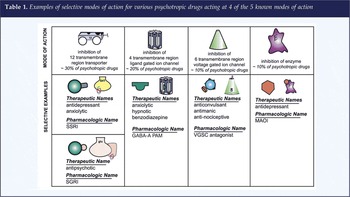
Examples of selective modes of action for various psychotropic drugs acting at 4 of the 5 known modes of action

Two examples of selective inhibition of a neurotransmitter transporter are shown in column 1: the first is for agents targeting the serotonin (5HT) transporter also known as SERT, and these agents are already named for their selective action, called selective serotonin reuptake inhibitors (SSRIs). The second example is a new drug class in clinical development that targets the transporter for the amino acid neurotransmitter glycine, namely the glycine transporter type 1 (GlyT1) transporter on glial cells and glutamate neurons; these agents are called selective glycine reuptake inhibitors (SGRIs). A ligand gated ion channel is selectively targeted in the second column. In this example, a benzodiazepine targets the GABA-A receptor and is a positive allosteric modulator (PAM), which is why the pharmacologic class is GABA-A PAM. In the third column, an agent selectively targets voltage gated sodium channels (VGSCs) and is called a VGSC antagonist. In the fourth column, a drug selectively targets an enzyme, monoamine oxidase (MAO), and is known as an MAOI or MAO inhibitor.
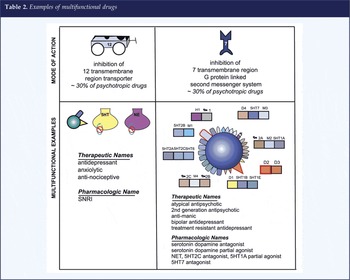
Examples of multifunctional drugs

When a psychotropic drug acts at two or more targets within a single mode of action, it is called multifunctional. On the left, an agent targets two monoamine transporters, namely the serotonin (5HT) transporter (SERT) and the norepinephrine (NE) transporter (NET). These agents are already commonly known as serotonin norepinephrine reuptake inhibitors (SNRIs). The second column shows the drug class that has the most known simultaneous mechanisms of action, all of which target G protein linked receptors. This drug class, commonly called atypical antipsychotics or second generation antipsychotics, is the source of much confusion because these agents are expanding their use to many other therapeutic areas. These agents all are either serotonin dopamine antagonists (SDAs) or serotonin dopamine partial agonists (SDPAs), which is why they are thought to have antipsychotic actions. Antidepressant actions, on the other hand, are linked to different pharmacologic mechanisms, and some agents such as quetiapine and norquetiapine are also norepinephrine transporter (NET) and 5HT2C antagonists plus 5HT1A partial agonists; other agents in this class such as lurasidone are also potent 5HT7 antagonists. Such additional pharmacologic properties create a second class for these complex agents and this second class may explain antidepressant actions.
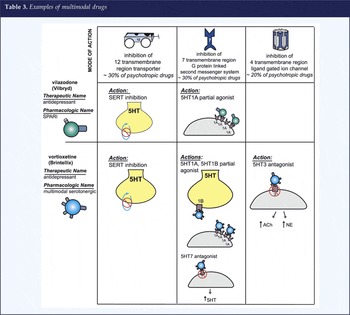
Examples of multimodal drugs
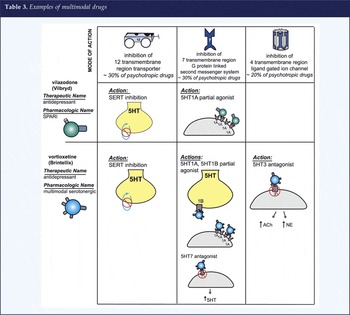
When a psychotropic drugs acts at two more modes, it is called multimodal. Two examples are shown here, the first for an agent that targets both a G-protein linked receptor and a monoamine transporter. Specifically, the agent vilazodone is a partial agonist at 5HT1A receptors and also blocks the serotonin transporter SERT. Thus, its pharmacologic name is a serotonin partial agonist and reuptake inhibitor (SPARI). The second example is an agent that has 5 known mechanisms of action, including targeting 3 different modes, namely a monoamine transporter, 3 different G-protein linked receptors, and a ligand-gated ion channel. Specifically, the late stage compound vortioxetine is a serotonin transporter (SERT) inhibitor, as well as a partial agonist at both 5HT1A and 5HT1B receptors, and an antagonist at 5HT7 receptors, all three of these belonging to the G-protein linked receptor mode of action. Finally, vortioxetine also is an antagonist at 5HT3 receptors, which are ligand gated ion channels.
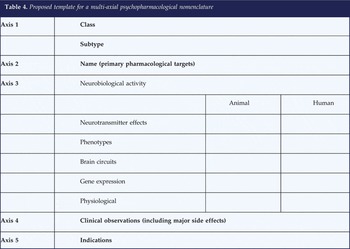
An international consensus committee with representatives from the American College of Neuropsychopharmacology (ACNP), the European College of Neuropsychopharmacology (ECNP), the International College of Neuropsychopharmacology (CINP), and the Asian College of Neuropsychopharmacology (AsCNP) has developed a position statement that psychotropic drugs should be named for their principle pharmacologic action(s).Reference Zohar, Nutt and Kupfer2 Specifically, this group proposes a multiaxial system for nomenclature in neuropsychopharmacology to clarify and expand the known pharmacology, neurobiological activity, and clinical actions of each psychotropic drug (Table 4).Reference Zohar, Nutt and Kupfer2 These concepts are applied to the primary drug classes here in Tables 1–3.
Proposed template for a multi-axial psychopharmacological nomenclature

Axis 1 for psychotropic drug nomenclature lists the broad pharmacological class and subtype of the drug, whereas Axis 2 is for the actual name of the drug, representing the specific main pharmacological target(s) of that drug. Axis 3 concerns the known neurobiological activity of the drug, often a consequence of its Axis 1 and Axis 2 actions, and including its neurotransmitter effects, phenotypes, brain circuits, gene expression, and physiological effects in both animals and humans. Axis 4 details the clinical observations, which include major known side effects of the drug. Axis 5 gives the clinical indications currently approved for the drug (see Zohar etal Reference Zohar, Nutt and Kupfer2).