Introduction
Each year internationally, there are at least 37 million falls that require medical attention (WHO, 2016). In Australia, falls contribute considerably to injury-related deaths and are more frequent than transport crash fatalities (ABS, 2012). The financial impact of falls on Australian primary care settings are limited to estimates, but were in excess of AUD$648 million per annum (Bradley Reference Bradley2012). Falls are more frequent among those aged above 65 years (WHO, 2016) and can be attributed to both intrinsic and extrinsic risk factors (CDCP, 2015). Intrinsic risk factors are specific to the individual and may include muscle weakness or poor vision (Deandrea et al., Reference Deandrea, Lucenteforte, Bravi, Foschi, La Vecchia and Negri2010). Extrinsic factors are specific to the environment in which the individual functions and may include navigating stairs or poor lighting (Deandrea et al., Reference Deandrea, Lucenteforte, Bravi, Foschi, La Vecchia and Negri2010). For aged persons, a diagnosis of severe mental illness (SMI; i.e. schizophrenia, schizoaffective disorder, bipolar disorder, and major depressive disorder) (Heslop et al., Reference Heslop2012) and the use of psychotropic medications (Bunn et al., Reference Bunn2014) are additional fall risk factors. As such, the complex physical and mental health needs of older adults with a diagnosis of SMI exceed that of any other patient cohort (Stubbs, Reference Stubbs2011) and add to the challenge of reducing incidence of falls.
The identification of, or screening for intrinsic and extrinsic fall risk factors can occur at the time of admission to primary care settings. Generally, tools are setting specific such as the Falls Risk Assessment Tool (FRAT) for people in sub-acute hospital or residential care (Stapleton et al., Reference Stapleton, Hough, Bull, Hill, Greenwood and Oldmeadow2009) and the St Thomas's Risk Assessment Tool in Falling Elderly Inpatients (STRATIFY) (Oliver and Healey, Reference Oliver and Healey2009). Although fall risk can be detected, the predictive ability of screening tools remains low (Matarese et al., Reference Matarese, Ivziku, Bartolozzi, Piredda and De Marinis2015). Furthermore, for older people with a diagnosis of SMI, screening predominantly results in identification of high fall risk due in part to the nature and severity of the illness and clinical interventions to address the illness (Bunn et al., Reference Bunn2014; Heslop et al., Reference Heslop, Wynaden and Tohotoa2014; Victor et al., Reference Victor, Dickinson, Narayanan, Simpson, Griffiths and Humphrey2014) compared to those without SMI. Despite the high risk of falling for people with SMI, there is limited falls research in mental health settings (Bunn et al., Reference Bunn2014; Victor et al., Reference Victor, Dickinson, Narayanan, Simpson, Griffiths and Humphrey2014).
The limited research in mental health settings may be due to the contextual factors of such services. Inpatient mental health settings may be characterized by high acuity, rapid turnover, risk of harm to self and/or others, and involuntary admission and treatment (Horsfal et al., Reference Horsfall, Cleary and Hunt2010). Additionally, people with SMI may also exhibit co-occurring behavioral and psychological symptoms of dementia (Ismail et al., Reference Ismail2015) or cognitive impairment. Falls during admission are more likely for those aged over 60 years, and those diagnosed with bipolar disorder or dementia (Tseng et al., Reference Tseng, Su, Huang, Chang and Tai2013). Recurrent falls during admission are associated with length of stay above 33 days (Greene et al., Reference Greene, Cunningham, Eustace, Kidd, Clare and Lawlor2001) and a diagnosis of schizophrenia, bipolar disorder, and dementia (Tseng et al., Reference Tseng, Su, Huang, Chang and Tai2013). Furthermore, falls in aged acute mental health inpatient units are most frequently unwitnessed (Heslop et al., Reference Heslop, Wynaden and Tohotoa2014; Victor et al., Reference Victor, Dickinson, Narayanan, Simpson, Griffiths and Humphrey2014).
Given this, there is limited information to guide clinicians in an attempt to reduce falls in aged inpatient mental health settings (Bunn et al., Reference Bunn2014). However, empirical evidence exists for multimodal falls risk assessment programs (Chang et al., Reference Chang2004). Multimodal fall risk assessment programs are defined as systematic risk factor screening or a focused post-fall review (Chang et al., Reference Chang2004). In addition, incident reporting systems such as the “Australian Incident Management System” (AIMS) and “RiskMan” are used in public healthcare settings and can be used to report contributory intrinsic and/or extrinsic fall risk factors. However, data from these incident reporting systems may be limited in detail to adequately describe fall risk, lacking clarification using longitudinal patient medical records (Heslop et al., Reference Heslop2012). Therefore, the objective of the current study was to conduct a focused post-fall review of fall episodes within aged acute inpatient mental health units at one of Australia's largest publicly funded mental health organizations. The aims of this study were to: (1) describe fall episodes by developing a post-fall reporting tool of intrinsic and extrinsic fall risk factors specific to older persons’ with SMI admitted to aged acute inpatient mental health units and (2) describe the fall risk factors and predictors of risk based on people who fell during inpatient admission across an 18-month period.
Methods
Research design
The research was conducted as an 18-month observational prospective cohort study of fall episodes within three aged acute inpatient mental health units. Observational prospective cohort studies are used to collect a variety of variables that might be relevant to the outcome of interest (Mann, Reference Mann2003). In the current study, the outcome of interest was a fall during inpatient admission. Three units of the Aged Persons’ Mental Health Program (APMHP) within one of Australia's largest publicly funded mental health organization, located in Victoria, were the study settings. This research was approved by the Melbourne Health Office for Research (QA/LNR 2014170).
Settings
NorthWestern Mental Health (NWMH) is located in metropolitan Melbourne, Victoria. The catchment area of NWMH encompasses 1.2 million people in northern and western areas of metropolitan Melbourne. The locales of the three units are characterized with high immigrant and ethnic diversity, and low socio-economic status compared with other areas of metropolitan Melbourne. The organization's three aged persons’ acute inpatient mental health units provide highly specialized and comprehensive services for people aged 65 years and over. People with longstanding mental illness or who develop disorders in later life (e.g. psychiatric or severe behavioral difficulties associated with organic disorders) may be admitted to aged acute inpatient mental health units. There are a total of 54 beds at the three units (20, 19, and 15 beds). The schematic layouts of the units are not identical although all three consist of communal living and dining areas, a central administrative station, and outdoor spaces. Tobacco smoking is not permitted in any areas of the units. The most common diagnoses at admission are schizophrenia, schizoaffective disorder, psychotic disorder, and dementias. Length of admission ranges from 1 day to more than 60 days (mean = 45 days). Admission is most often voluntary (~70%) via community mental health services or a hospital emergency department. Discharge is most often to the consumer's place of residence (> 90%).
Development of the NWMH Post-Fall Reporting Tool
The World Health Organisation defined a fall as; “inadvertently coming to rest on the ground, floor or other lower level, excluding intentional change in position to rest in furniture, wall or other objects” (WHO, 2007, p. 1). Within the APMHP at NWMH, a fall was defined in the organizations policy document (Falls Risk Screening, Assessment and Management Procedure; iPolicy document: NWMH02.12.01) as; “a fall involves a person who for some reason inadvertently drops down to a lower level.” The definition differs from the WHO as in the current setting, intentional change in position to rest in furniture, wall, or other objects are considered a fall. Intentional ‘falls’ are not uncommon in acute inpatient mental health settings (Victor et al., Reference Victor, Dickinson, Narayanan, Simpson, Griffiths and Humphrey2014).
According to the definition of a fall at the organization of the current study, a post-fall reporting tool was developed to consider the relevant intrinsic and extrinsic fall risk factors across the APMHP at NWMH. The tool was developed with multidisciplinary input including service managers, mental health nurses, occupational therapists, a mental health nurse academic, and an exercise scientist academic. The tool was informed by the Victorian Government Department of Human Services “Minimising the Risk of Falls & Fall-related Injuries: Guidelines for Acute, Sub-acute and Residential Care Settings” document (DHS, 2004). The NWMH Post-Fall Reporting Tool was designed to be completed by a mental health clinician during mandatory reporting (i.e. RiskMan) of a fall episode. Mental health clinicians have expressed frustration at the notion of excessive paperwork (Brown and Calnan, Reference Brown and Calnan2016). Therefore, during development of the tool, intent was to maximize compliance by limiting the tool to one double sided A4 page, although the feasibility of the method was unknown. The tool was presented to, refined, and approved by the NWMH Falls Committee consisting of clinician representatives across the multidisciplinary spectrum and a consumer consultant in November 2014. The risk factors involved were: current/recent medication/treatment (e.g. PRN medication and electroconvulsive therapy), observations of blood pressure and sugars, use of walking/mobility aid and observable characteristics of gait (e.g. shuffling, wide base of support, postural sway), activities of daily living (e.g. continence, toileting regime), location of fall and activity at the time of the event (e.g. standing, turning, transfer, resistive, or aggressive behavior). Additional risk factors were specific to communal and private areas (e.g. time of day, bed height, clutter, lighting, surface condition, and use or presence of hand rails).
Data collection and analysis
Basic socio-demographic and clinical descriptors for all consumers admitted to the three inpatient units were drawn from an electronic clinical database. For consumers who fell, the NWMH Post-Fall Reporting Tool was completed by a mental health clinician during mandatory reporting of a fall episode. The clinician had the option to write what they thought was the major reason for the fall (i.e. staff reported fall risk factor). Further, there was the potential for input with the consumer to self-report what may have been the major reason for the fall (i.e. consumer reported fall risk factor).
Content analyses of the consumer and staff reported risk factors were coded and described with count and frequency. Content analysis can allow systematic and objective quantification of written data (Downe-Wamboldt, Reference Downe-Wamboldt1992). The content of the NWMH Post-Fall Reporting Tool and characteristics of fallers and non-fallers during admission were compared using Pearson χ 2 and Fisher exact tests for categorical variables and Student's t-test for continuous variables. To predict falls, a fall episode (i.e. yes or no) was modeled using a multivariable logistic regression. Repeated fall episodes were modeled using a Poisson regression. Each regression accounted for age, sex, SMI diagnosis, and inpatient unit. Model fit was assessed using the Hosmer–Lemeshow goodness of fit test and the variance inflation factor (VIF) was estimated to assess multicollinearity among the socio-demographic and clinical descriptors. Both logistic and Poisson regressions were run with all variables in the models and in a forward stepwise method. Survival analyses were described with sex- and age-adjusted Kaplan–Meier curves with time to fall as the event of interest. A multivariable Cox proportional hazards regression was also conducted. Statistical significance was set at a p ≤ 0.05. Statistical analyses were performed using Stata statistical program (version 14, Stata-Corp.). Data were collected at the start of December 2014 until the end of May 2016.
Results
Sample descriptors
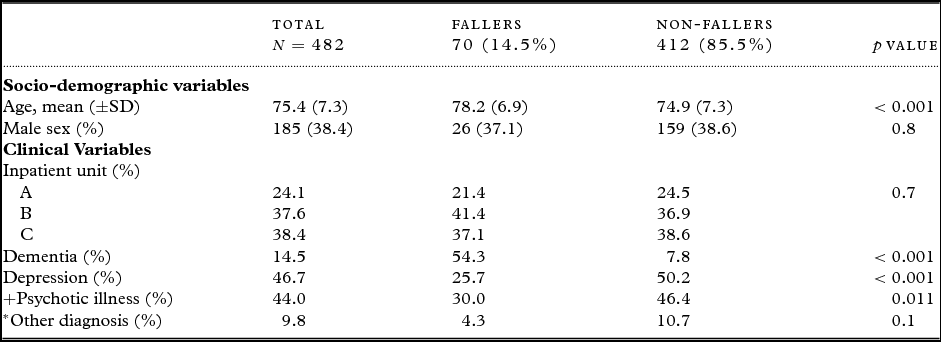
A total of 482 consumers (185 [38.4%] male, mean age of 75.4 [SD 7.3] years, ranging from 57 to 97 years) contributed to 751 acute inpatient admissions (1.6 admissions per person, ranging from 1 to 6 admissions) within the three units during the 18-month period (see Table 1). Of the entire cohort, 70 consumers (14.5%) fell during admission for a combined total of 115 falls. A total of 39 consumers (55.7% of fallers) fell once, 20 consumers (28.6%) fell twice, and 11 consumers (15.7%) fell three or more times. Compared with non-fallers, consumers who fell during admission were older (p < 0.001) and were more likely to have a diagnosis of depression (p < 0.001) (see Table 1). For the total sample, the median length of stay was 32 days (mean 40.8, SD 37.1). Length of stay was longer for those who fell during their admission (median 42, mean 54.5, SD 42.2 days for fallers compared with median 29, mean 37.9, SD 35.3 days for non-fallers, p = 0.002).
Basic socio-demographic and clinical descriptors for all consumers

Diagnosis according to DSM-V. +schizophrenia, schizoaffective disorder, and psychotic disorder, *Any other DSM-V diagnosis.
NWMH Post-Fall Reporting Tool
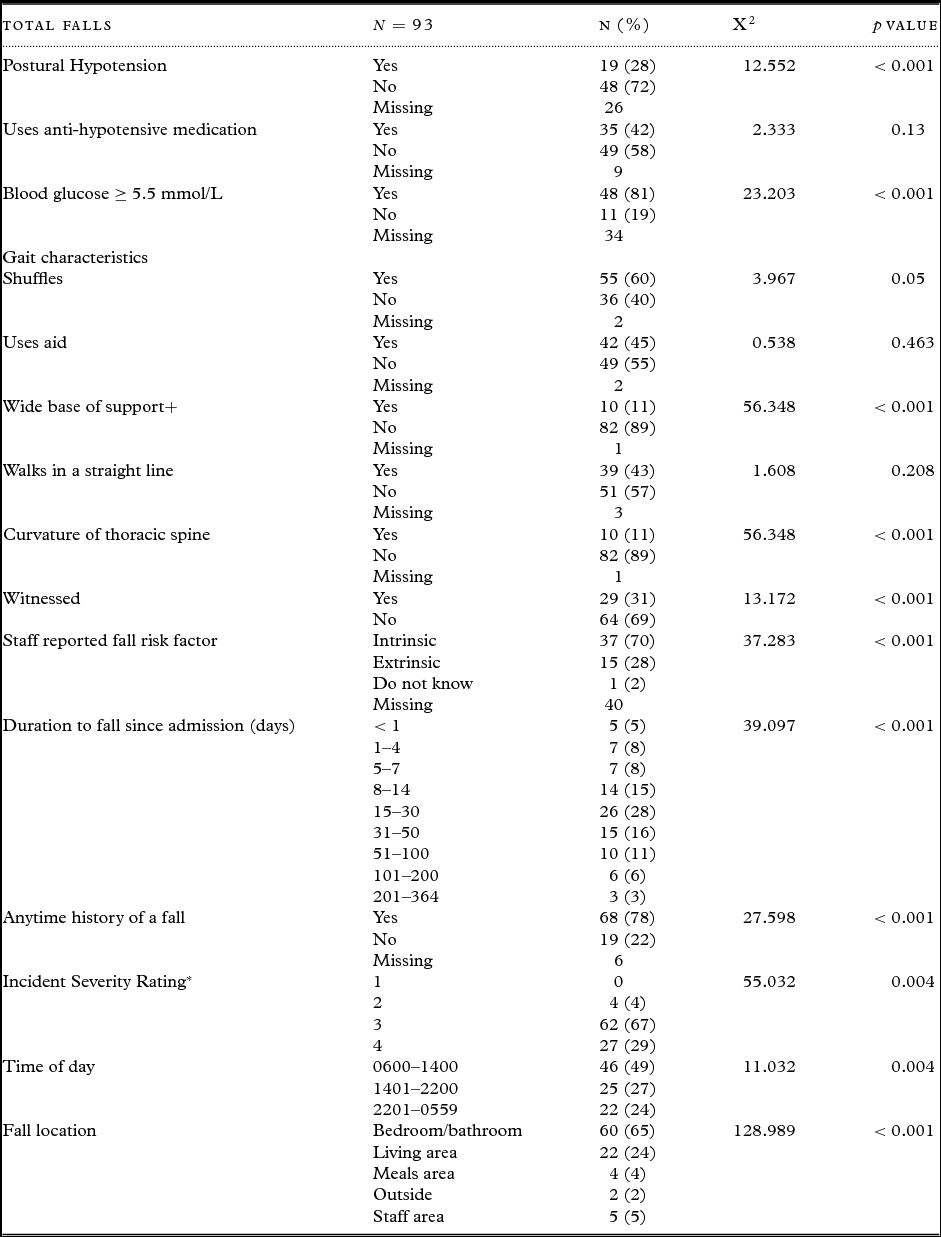
The reporting tool was completed for 93 (80.9%) of the 115 fall episodes within the three inpatient units. Falls were more often unwitnessed (p < 0.001), occurred between 0600 and 1400 hours (p < 0.004), and after 14 days of inpatient admission (p < 0.001) (see Table 2). A total of 86 (93%, p < 0.001) falls occurred in the consumer's bedroom/bathroom or in communal areas (see Table 2).
Descriptors of the NWMH post-fall reporting tool

+The consumer stands and/or walks with the feet displaced from the midline of the body.
*Incident severity rating 1 = Severe/death; 2 = Moderate; 3 = Mild; 4 = No harm/near miss.
Falls in the bedroom/bathroom and living/meals areas (n = 86 [93% of all falls])
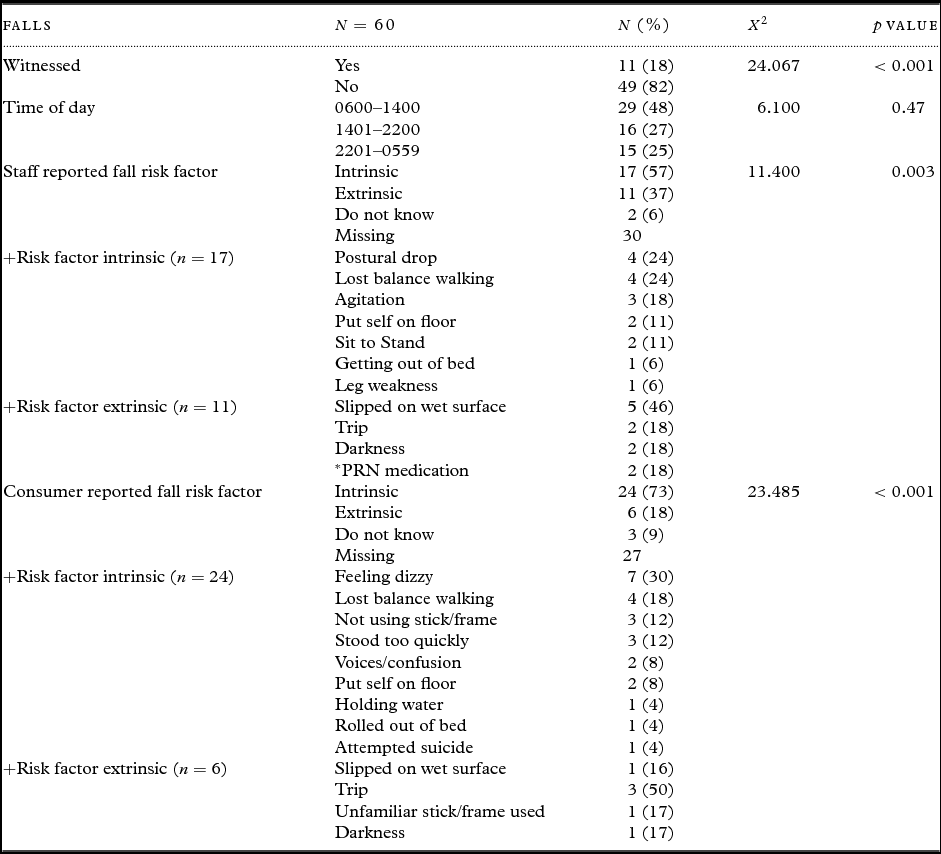
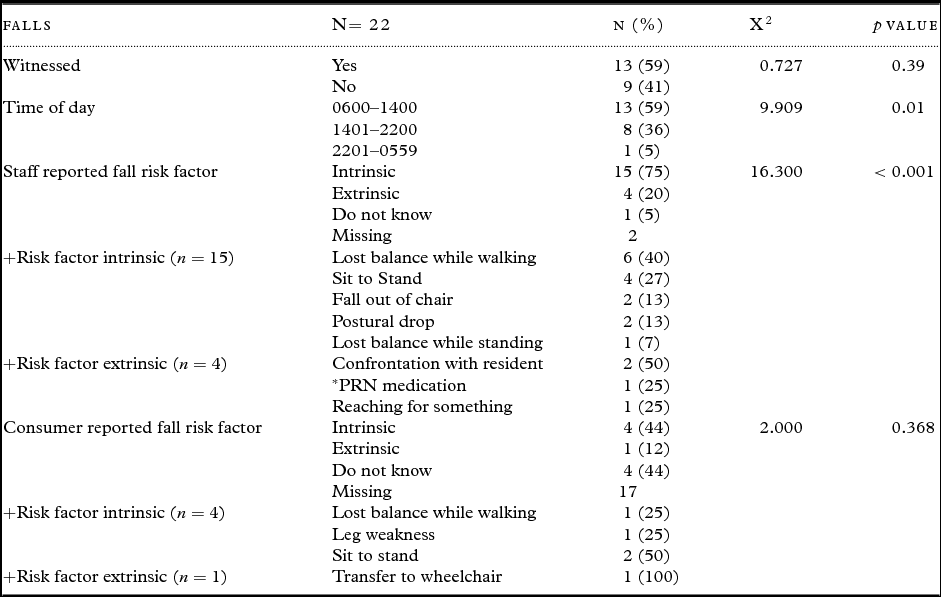
Given the locality of the falls, a more detailed analysis was undertaken of the falls that occurred in the bedroom/bathroom, and those that occurred in the living/meals areas. There were 60 fall episodes in the consumer’s bedroom/bathroom areas during the 18-months of data collection. Falls were more often unwitnessed (p < 0.001), occurred between 0600 and 1400 hours, and were attributed by staff to intrinsic risk factors (p < 0.003) (see Table 3). There were 22 fall episodes in the communal areas of the inpatient units (i.e. living and meals areas). An even proportion of falls were witnessed compared with unwitnessed (p = 0.39). Fall episodes were most common between 0600 and 1400 hours (p < 0.01), and were attributed by staff to intrinsic risk factors (p < 0.001) (see Table 4).
Descriptors of fall episodes in the bedroom/bathroom

*Pro re nata medication. + Content analysis codes.
Descriptors of fall episodes in the living/meals areas

*Pro re nata medication. + Content analysis codes.
Predictive risk factors for a fall during admission
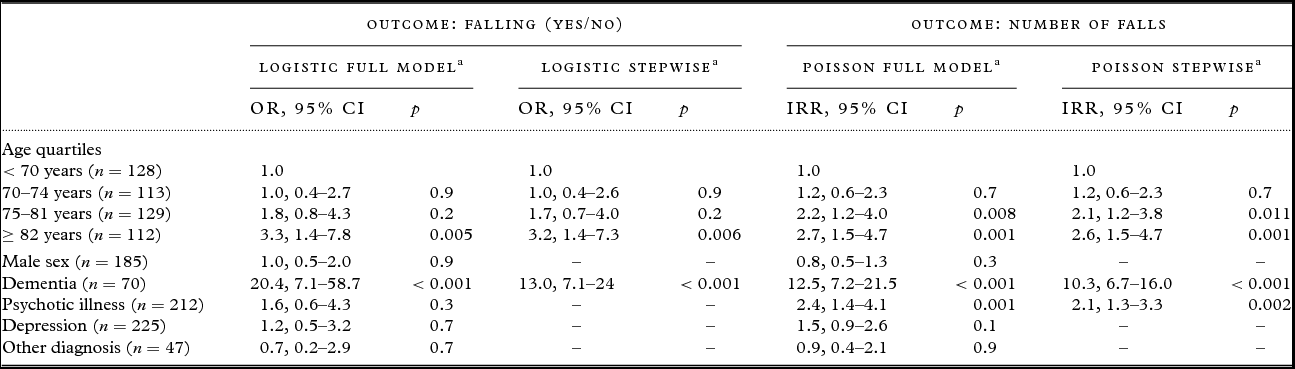
During inpatient admission, falling was associated with people aged 82 years or older (OR 3.2), and with a diagnosis of dementia (OR 13.0) in stepwise analyses of the logistic regression (see Table 5). Risk of a repeated fall during admission was greater in people aged 82 years or older (IRR 2.6), in those with dementia (IRR 10.3), or with psychotic illness (IRR 2.1) (see Table 5). Among individuals with dementia, adjusted for age, the probability of risk of falling among males was more than three times higher than that in females (HR 3.3, 95% CI 1.7–6.4 [Cox model]).
Risk of falling and risk of repeated falls during inpatient admission

a Also adjusted for inpatient unit. Abbreviations: CI (confidence interval), IRR (incidence rate ratio), OR (odds ratio). The Hosmer–Lemeshow goodness of fit tests were acceptable. A moderate multicollinearity was detected between depression and psychotic illness but this was accounted for in the stepwise models.
Survival analysis
Adjusted for age, time-to-event analysis showed that males were at greater fall risk than females (log rank test p < 0.001) and median time to fall was 24 days for males and 18.5 days for females (see figure S1). Adjusted for age and sex, compared with any other diagnoses risk of falling was greater among those with dementia (log rank test p < 0.001) and median time to fall was 21 days (see figure S2). After stratifying the group of consumers with dementia by sex, males with dementia had the highest risk of fall after accounting for age, and median time to fall was 24 days (see figure S3).
Discussion
A major finding of the current study was the high compliance of the new NWMH Post-Fall Reporting Tool which allowed description of intrinsic and extrinsic fall risk factors within three aged acute inpatient mental health units to supplement routinely reported incident data. Specifically, falls were most frequently unwitnessed and occurred in consumer's bedroom or bathroom between 0600 hours and 1400 hours. Other major findings of the current study were the higher risk of fall for those aged ≥ 82 years and those with a diagnosis of dementia. Also, higher risk for repeated falls during admission was for those aged ≥ 74 years, those with a diagnosis of dementia, and those with at diagnosis of a psychotic illness. Adjusted for age, the Kaplan–Meier curves for both females and males with a diagnosis of dementia indicated increased probability of a fall as length of stay increased. Furthermore, the risk of falling for males with dementia was more than three times greater than that of females with dementia.
Clinical staff in the current study most often attributed fall episodes to intrinsic risk factors, in particular postural drop and loss of balance during walking. Those findings are similar to previous work in which staff could partly attribute falls to medication (Heslop et al., Reference Heslop2012; Heslop et al., Reference Heslop, Wynaden and Tohotoa2014) and mobilization/walking (Victor et al., Reference Victor, Dickinson, Narayanan, Simpson, Griffiths and Humphrey2014). Unique to the current study, the consumer commonly self-reported feeling dizzy, or standing too quickly, or losing balance while walking as the cause of their fall. This unique perspective has been lacking in post-fall reporting, yet should be incorporated as clinical interventions for postural drop (i.e. lightheadedness and standing up too quickly) may differ from those to treat dizziness (i.e. vertigo) (Figueroa et al., Reference Figueroa, Basford and Low2010). However, such a process could be hindered by symptoms of SMI and behavioral and psychological symptoms of dementia during inpatient admission. That may be indicated in the current study by consumer self-report for only 18% of falls in the living/meals areas and 40% in the bedroom/bathroom areas. Furthermore, consumers who fell in the current study did not stand/walk with a wide base of support. A narrow base of support is fundamentally less stable than a wide base of support and known to increase musculoskeletal activity of the lower limbs. This could exacerbate fatigue in older adults who experience loss of strength and power of the lower limbs due in part to sarcopenia (Furness and Maschette, Reference Furness and Maschette2009), subsequently increasing the risk of a fall during mobilization/walking. A clearer dialogue among consumers and clinical staff reporting about fall episodes may support future remedial interventions and inform programs to reduce fall risk among aged acute inpatient mental health units.
A clearer dialogue may also assist the challenge of describing unwitnessed falls in aged acute inpatient mental health settings. Unwitnessed falls were common in private areas in the current study which was consistent with previous findings in aged acute inpatient mental health settings (Heslop et al., Reference Heslop, Wynaden and Tohotoa2014; Victor et al., Reference Victor, Dickinson, Narayanan, Simpson, Griffiths and Humphrey2014). Mapping ‘hotspots’ in inpatient settings (Victor et al., Reference Victor, Dickinson, Narayanan, Simpson, Griffiths and Humphrey2014) and including video footage (Robinovitch et al., 2013) could assist in describing unwitnessed fall episodes. Despite the obvious advantage of video footage for post-fall reporting, the transferability of such to private areas within an inpatient setting is likely problematic. As such, there is need for clinicians to engage with consumers to determine internal and external risk factors of unwitnessed falls.
The findings of the current study are similar to the previous literature describing fall episodes in aged acute inpatient mental health settings. Falls occurring more frequently for those with dementia (Tseng et al., Reference Tseng, Su, Huang, Chang and Tai2013) and being unwitnessed (Heslop et al., Reference Heslop, Wynaden and Tohotoa2014; Victor et al., Reference Victor, Dickinson, Narayanan, Simpson, Griffiths and Humphrey2014) are supported in the results of the current study. Findings in other studies relating to age have been more variable and differed to those of the present study. Tseng and colleagues reported falls were more likely for those aged over 60 years (Tseng et al., Reference Tseng, Su, Huang, Chang and Tai2013). However, in the current study a higher risk of falls was found for those above the age of 82 years. Recurrent falls during admission in the current study were increased for those aged over 75 years and with dementia or psychotic illness. These findings support the earlier work of Tseng et al. (Reference Tseng, Su, Huang, Chang and Tai2013). The current study adds to the earlier work of Greene et al. (Reference Greene, Cunningham, Eustace, Kidd, Clare and Lawlor2001), who reported recurrent falls after 33 days of admission, by associating recurrent fall probability with sex and a diagnosis of dementia with increased length of stay.
An et al. (Reference An, Xiang, Lu, Lai and Ungvari2009) reported 52% of falls during the first month of admission and that extended length of stay may have lowered fall episodes. In contrast, Victor et al. (Reference Victor, Dickinson, Narayanan, Simpson, Griffiths and Humphrey2014) reported the majority of fall episodes occurring 35 days after admission and raised the question as to the why such occurs. The results of the current study support the earlier work of An et al. (Reference An, Xiang, Lu, Lai and Ungvari2009) as 59 (64%) falls occurred within the first 30 days of admission. Interestingly, An et al. (Reference An, Xiang, Lu, Lai and Ungvari2009) reported 26% of falls occurring after 90 days admission. Despite the varied findings, the call for investigation beyond post-fall reporting (Victor et al., Reference Victor, Dickinson, Narayanan, Simpson, Griffiths and Humphrey2014) is justified to further understand the effect of length of stay on fall episodes of consumers who fall and consumers who repeatedly fall during inpatient admission.
In other general medical inpatient or rehabilitation settings falls were more frequent within 14 days of admission (Saverino et al., Reference Saverino, Moriarty, Rantell, Waller, Ayres and Playford2015) and length of stay has been less than 11 days (Schwendimann et al., Reference Schwendimann, Bühler, De Geest and Milisen2008). However, in the current study only 37% of falls occurred within 14 days, the median time to fall was at least 18.5 days after admission, and median length of stay was 32 days. Given that patients admitted to acute geriatric services fall at greater proportion than patients admitted to medical and surgical units (Schwendimann et al., Reference Schwendimann, Bühler, De Geest and Milisen2008), the need for further investigation is salient. Interestingly, the proportion of people falling in an acute geriatric inpatient unit was 24% (N = 2,765, Fall n = 663) (Schwendimann et al., Reference Schwendimann, Bühler, De Geest and Milisen2008), compared with between 1% (N = 7,825, Fall n = 96) (An et al., Reference An, Xiang, Lu, Lai and Ungvari2009), 11% (N = 1,659, Fall n = 175) (de Carle and Kohn, Reference de Carle and Kohn2001), and 15% (N = 751, Fall n = 115) in the current study. As such, even though falls were occurring after extended length of stay in aged acute inpatient mental health units compared with acute geriatric units, there are examples where the proportion of falls were less in aged acute inpatient mental health units.
Relevance for clinical practice
Clinicians providing care to consumers admitted to aged acute inpatient mental health units may use the findings of the current study to target specific cohorts within the setting. As fall risk factors were most often intrinsic, clinicians may be able to identify those at risk of fall and recurrent fall, and commence targeted evidence-based interventions. Unfortunately, the evidence base is limited and there is need for clinicians to consider innovative and collaborative approaches and then evaluate such to enhance and translate knowledge. An example could be involving the consumer with known fall risk (i.e. aged over 82 years or with a diagnosis of a psychotic illness) in tailored fall risk education/programme and incorporate the consumer's carer and/or significant others. Such an approach could raise awareness during admission and may assist when the consumer is discharged from the aged acute inpatient mental health unit. Although compliance of the post-fall reporting tool was high (i.e. 80.9%), the methods of the current study did not allow indication that decision to limit the tool to two A4 pages was an assistance or hindrance to post-fall reporting. There may be benefit in trialing this or a similar length tool to further document compliance and potentially reduce frustration that mental health clinicians have expressed due to excessive paperwork (i.e. Brown and Calnan, Reference Brown and Calnan2016).
Limitations
Despite the association of dementia and psychotic illness and falls identified in the current study, interpretation may be limited as the reason for admission to the acute inpatient mental health units was not captured. Hence, only a diagnosis of SMI, rather than severity of symptoms of SMI (Heslop et al., Reference Heslop2012) and/or dementia can be associated with falls in the current study. Furthermore, a thorough review of medications was not undertaken in the current study although earlier recommended by Chang et al. (Reference Chang2004) for fall prevention intervention. While medications were reported in the current study, the aim was to describe fall episodes and risk factors during the 18-month reporting period. Post-fall reporting in the current study by nature is subjective and limited compared with for example, post-fall video footage analysis which can be objective. Further subjectivity was evident in the different interpretations among consumers (i.e. feeling dizzy) and clinicians (i.e. postural drop). Another limitation was that post-fall reporting was conducted for only 18-months within one large mental health service provider. As such, the extrinsic risk factors identified in the current study may not be systemic to other aged acute inpatient mental health units within other metropolitan or rural settings.
Conclusion
The NWMH Post-Fall Reporting Tool was designed and refined with multidisciplinary collaboration. Compliance of the tool was high (80.9%) across the 18-month data collecting period. Falls occurred most often in consumer's bedroom/bathroom and were unwitnessed. Intrinsic risk factors were most often attributed to postural drop and losing balance during walking. Based on the cohort, future falls could be reduced by targeted fall prevention interventions of those aged above 82 years, or with a diagnosis of dementia. Recurrent falls during admission could be reduced by targeted fall prevention interventions of those with psychotic illness and males with a diagnosis of dementia.
Conflict of interest
None.
Description of authors’ roles
All authors contributed to the conceptualization and/or design, and/or preparation of this study and manuscript. SI and RG assisted with data collection. GM and TF analyzed all data. BMcK and KH provided considered and expert contextual and practical application of the outcome measures. All authors approve this version of the manuscript.
Acknowledgment
SI and RG were supported by a NWMH Research Seed Grant (NWMH-014-15) to support the current study.
Supplementary material
To view supplementary material for this article, please visit https://doi.org/10.1017/S1041610217001648