

Introduction
The adoption of a preferential trade agreement (PTA) reflects a political choice on the part of member states. For members, the choice is whether to accept the costs of adjusting to trade liberalization—dislocating workers and shuttering less productive companies—in light of the advantages that benefit exporting firms and consumers. PTAs also affect societies that have no choice in the matter, forcing non-member firms to either come into compliance with PTA requirements or be excluded from the benefits of the agreement.
From an economic standpoint, the preferential structure of these trade agreements threatens a “pandemic of discrimination.”Footnote 1 However, today's markets are highly integrated, reshaping the distributional effects of exclusion. Final goods producers that depend on PTA member markets will lose by way of exclusion. Intermediate goods producers, however, may leverage their position in PTA member production networks to take advantage of expanded market opportunities downstream. For internationally engaged firms, whether exclusion from a PTA helps or hurts depends on their supply chain position.
However, as PTAs often take years to negotiate and implement, firms can potentially adjust their business to counter the negative consequences of exclusion, such as relocating production or seeking additional markets. Firms also vary in the degree that they are able or willing to adjust, with the productive or vulnerable ones more likely to implement these costly adjustments. This creates a dynamic process in which firms that have sunk in the costs of adjustment, regardless of their rationale of doing so, may gradually become invested in the agreement and even welcome its conclusion.
We demonstrate these two effects in a novel survey of firm managers in China prior to the finalization of the Trans-Pacific Partnership (TPP). The TPP threatened to exclude Chinese firms from the largest markets in the world. Our survey was implemented in February 2016, eight years after the initiation of the TPP negotiations, more than sufficient time for firms to anticipate and adjust to exclusion.Footnote 2 This allows us to examine the dynamic effect of PTA exclusion. In addition, we used an embedded survey experiment to probe the distributional effects of the agreement, which requires testing a counterfactual scenario where firms were unable to adjust. This was possible because the timing of the survey marks an ambiguous moment during the negotiation of the TPP, years after negotiations but prior to the finalization of the membership. Leveraging this uncertainty, we experimentally manipulate information about that potential membership, expanding the TPP to either South Korea (a final good producer) or Indonesia (an intermediate and input good producer), each of which were potential members. By priming respondents with an unanticipated event, we can causally evaluate the distributional effect of PTA exclusion, accounting for effects of prior anticipatory adjustments.
Consistent with our expectations, the vast majority of the respondents reported having taken steps to adjust their business for the onset of the agreement, leading to a generally more positive outlook on the TPP. The downstream firms that would be most exposed to the exclusive parts of the agreement and the more productive firms are the most likely to offer positive accounts of the effects of the agreement. However, the views of managers that received information regarding a potentially expanded membership diverge depending on whether or not their firms’ positions in the global supply chain are similar to firms in the prospective TPP member. In particular, managers of final goods producers most likely to compete with South Korean firms are less optimistic about a TPP that includes South Korea. We further validate these results with qualitative evidence from our fieldwork in Guangdong in the summer of 2017.
These findings contribute to our general understanding of the response of firms to preferential trade agreements, and the role of anticipation in shaping the distributional effects of exclusion. Recent work shows that firm and product-level heterogeneity matter substantially for trade politics, particularly when it comes to their responses to PTAs.Footnote 3 We find evidence from the TPP negotiating period that a firm's sensitivity to changes in foreign market access depends on the ability and need to adjust. This, in turn, depends on firm characteristics, namely, their productivity and supply chain position. Moreover, we find that these effects can evolve over the course of an agreement. This suggests that researchers need to be careful about evaluating PTAs at the time of their entry into force, as such adjustments would dampen the apparent effects of the onset of an agreement. preferential agreements are not as effective as they are often claimed to be, and that the global shift away from multilateralism could be counterproductive to national economic goals.
The remainder of this paper is organized as follows. Section 1 describes the effect of PTA exclusion at the level of the firm. We argue that a firm's position in the global supply chain determines the net effect of PTA exclusion, but that firms can make adjustments proactively, pay sunk costs, and eventually become beneficiaries of the agreement. Section 2 situates these effects in the case of China's exclusion from the TPP. Section 3 introduces the survey experiment, our measure of global supply chain position, the main results, and robustness checks. Section 4 supplements the quantitative results with two exemplary cases of Chinese textile firms up and down the global supply chain. Section 5 concludes.
Firm-level analysis of PTA exclusion
Exclusion from a PTA is widely expected to raise costs for excluded parties. These costs comprise individual firm adjustments—reworking their input networks, finding new ways to compete, or ceasing to export, as well as changes that cannot be adjusted, including sunk costs. The degree to which these adjustments are necessary depends on the extent of prior investments and participation in international commerce. Trade participation varies substantially within industries, and even in the most export-oriented sectors, the vast majority of companies serve domestic markets only. Meanwhile, reductions in transportation and transaction costs have enabled a subset of highly productive firms to reorganize production in multinational supply networks.Footnote 4 In the following, we discuss which firms are likely to adjust to the realities of PTA exclusion, and which will be in a position to avoid any adjustment.
The idea that firms vary in their exposure to trade policy change has a long history in political science. Schattschneider observed variation in lobbying activity in regional differences in freight costs, product differentiation, and differences in firms’ relative costs and efficiencies.Footnote 5 More recently scholars have drawn on “New New” Trade Theory, developed by Melitz and Chaney, to micro-found these differences in a general equilibrium model of competing firms.Footnote 6 They demonstrate that much of the effects of trade can be understood as a dynamic reallocation from unproductive to productive firms.Footnote 7 From the macro-perspective, trade expands the market. From the micro-perspective, the effects of trade agreements, and thereby a firm's political interests, depend on whether the firm is sufficiently productive to survive the more competitive environment wrought by expanded market opportunities abroad.
At the root of theoretical work on the dynamics of firm-level adjustment to trade liberalization are forward-looking firms’ decisions concerning entry, exit, export, and innovation.Footnote 8 If agreements are known sufficiently far in advance, firms are able to adjust well in advance of the final ratification. This may be why PTAs exhibit such significant anticipatory effects on trade flows: on average, countries experience a 25 percent increase in trade four years before PTAs enter into force.Footnote 9 As Dür, Baccini, and Elsig argue, these anticipatory effects are largest for “modern” PTAs, with more ambitious agreements having larger anticipatory effects.Footnote 10 In order for trade to increase, firms must make adjustments, investments, and otherwise reallocate resources well ahead of the conclusion of negotiations—sometimes even at the announcement of negotiations.
Applying the same logic to PTA exclusion, we should expect firms to anticipate and respond to the trade diversionary effects of exclusion. This might take the form of changing the organizational structures of the firms, relocating business to PTA member countries, or seeking additional domestic and foreign markets. However, once these adjustments are made, surviving firms are likely to have preferences regarding the PTA at odds with the ex-ante effects of exclusion.
Firms vary in their ability to make costly adjustments, however, which, to a large extent, depends on the firm's productivity, among other things. Highly productive firms can afford to divide production tasks along a spectrum from headquarter services, such as marketing, R&D, and sales, to input and intermediate manufacturing. These production tasks can be divided into “upstream” stages of production, as commodities are transformed into unfinished products and “downstream” stages, when goods are sold to the end-user. Economic research suggests firms that specialize in these stages will tend to vary in terms of their global sourcing strategy. Antràs and Helpman, in particular, theorize that for the most productive firms, they can choose to locate production stages abroad, creating global supply chains.Footnote 11 In other words, we should expect that:
Hypothesis 1:
Productive firms in nonmember countries can make anticipatory adjustments to PTA exclusion.
While very productive firms are able to respond flexibly, a firm's response to any commercial policy also depends on the degree of international exposure, which varies based on a firm's network of suppliers and clients. This is because PTAs include “rules of origin” provisions that classify goods as subject to favorable rates on the basis of their content.Footnote 12 In countries excluded from a PTA, downstream firms may see higher prices for inputs and lower sales of their products, as their competitors in the PTA enjoy lower tariffs on both inputs and outputs.Footnote 13 Among upstream firms, sales may decline if their partners switch to suppliers inside the PTA, while input prices are less affected.
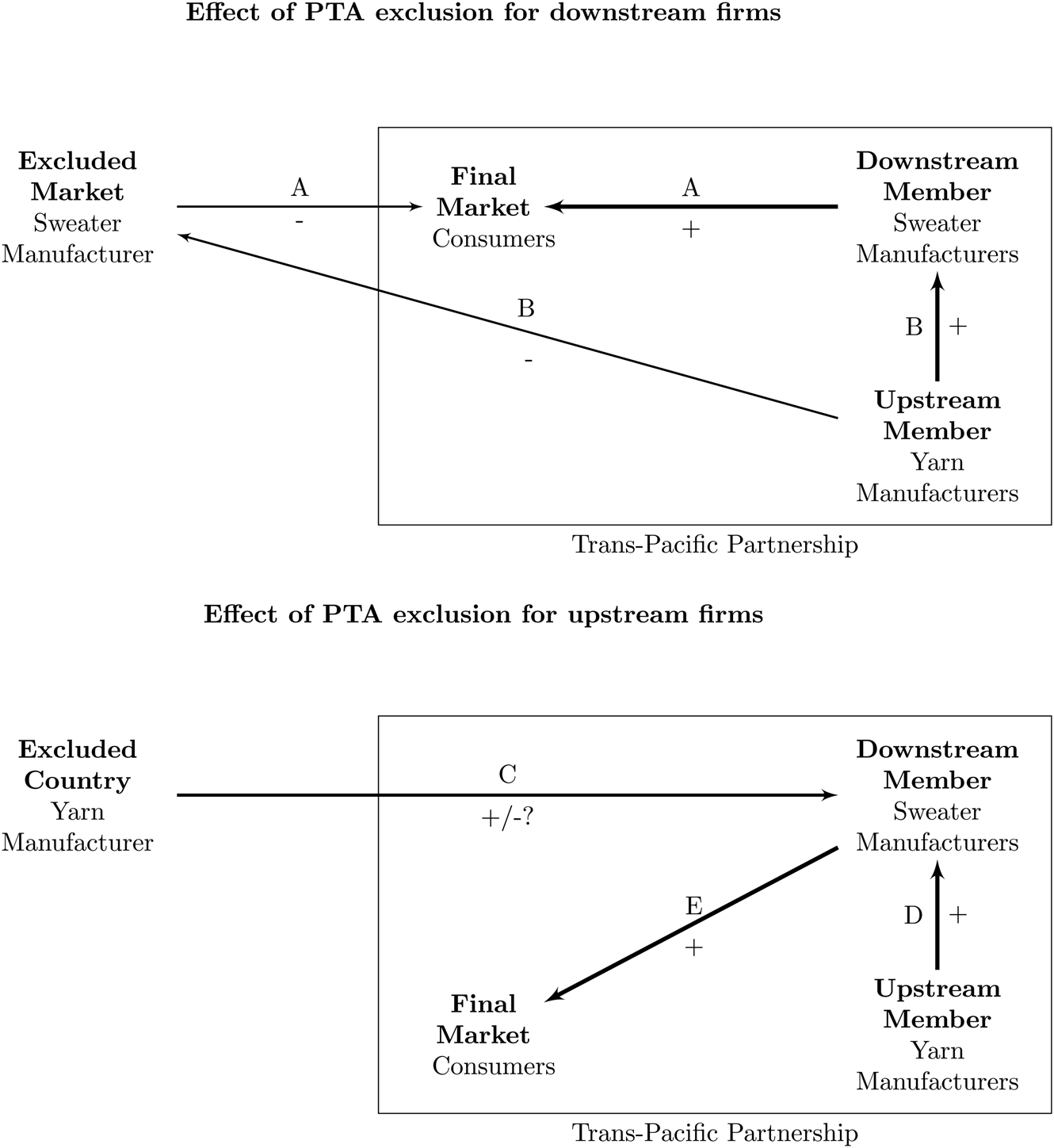
Figure 1 illustrates these dynamics for two hypothetical supply chains that extend into an excluded market and the corresponding changes in trade activity after the introduction of a PTA. The top part of the figure depicts two firms that are part of the PTA: a downstream firm (a sweater manufacturer) and an upstream firm (a yarn manufacturer) both in the textile sector, as well as an excluded downstream firm. In the case of the TPP, the sweater manufacturer may be based in Japan, which competes with China for the Australian sweater market, while the yarn exporter may be based in Vietnam. The arrows indicated with (A) show the effect of the PTA on the sweater manufacturers in both the member and nonmember countries. As indicated by a negative sign, the effect is negative for the excluded firm as the agreement diverts sweater trade from the excluded party toward the downstream member states (positive sign). This is compounded by a second effect: the arrows marked with (B) indicate another negative effect with yarn input trade being diverted from the excluded party to the downstream member. In either case, we see the the typical trade diversion effects, harming excluded downstream manufacturers by shifting market access to their competitors and raising the price of inputs.
Global supply chain position and the effects of PTA exclusion.

The effects of exclusion on upstream firms are more complicated. Whether the PTA demands adjustment depends on whether the excluded upstream firms sell to domestic exporters or exporters in PTA member states. The bottom part of the figure displays the changes that occur for the latter case: a hypothetical yarn manufacturer in an excluded country that sells primarily to downstream manufacturers abroad. In this case, while the agreement may divert yarn export share from the excluded state to a member state (the arrow marked with D), it may also expand the sales of the downstream customers (the arrow marked with E), which would, in turn, increase its demand for the input that may need to be supplied from the excluded manufacturer (the arrows marked with C). The latter effect is particularly important for globalized yarn manufacturers, whose markets are primarily abroad. The net effect of these forward linkages of the upstream firms can therefore offset some or even all of the competitive losses. We summarize these distributional effects in the following hypothesis:
Hypothesis 2:
The effects of PTAs on excluded firms will depend on the position of the firms in the global supply chain. Downstream firms are more likely to be harmed by PTA exclusion than upstream firms, absent any adjustment.
The above discussions also suggest that the more vulnerable, downstream firms should have more reasons to make anticipatory adjustments. In other words,
Hypothesis 3:
Downstream firms are more likely to make anticipatory adjustments to PTA exclusion than upstream firms, all else equal.
We offer evidence in favor of these three hypotheses by drawing on China's exclusion from the TPP. The following section briefly introduces the geopolitical conditions in the Pacific region that led to the adoption of the TPP and how this agreement was expected to affect trade. The subsequent sections describe the research design and analysis.
China's exclusion from the TPP
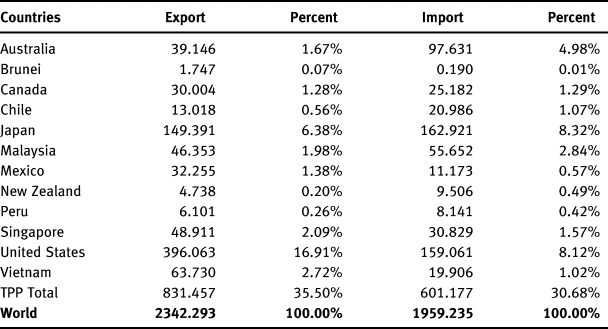
The expanded mandate of the TPP can be understood broadly as a function of geopolitics, namely the United States's goal to establish a counterweight to the growing power and influence of China. In 1978, Deng Xiaoping announced a policy of economic reform.Footnote 14 At that point, China's total imports and exports amounted to $20.6 billion—less than 1 percent of global trade. In 2010, China's total merchandise trade exceeded $3 trillion, 143 times the 1978 level. With an annual export growth of 17.2 percent, China now accounts for 12 percent of world export value and is the world's largest commodity exporter. Less appreciated is the annual growth in Chinese imports—16.4 percent—that makes China the world's second-largest commodity importer. A substantial amount of this trade occurs between China and countries that signed the TPP. In 2014, the twelve TPP prospective members accounted for 35.5 percent and 30.68 percent of China's total exports and imports, respectively (see table 1). The United States and Japan, in particular, have been among China's top three trading partners since 2001.
TPP member participation in China's exports and imports (billion USD)

Note: Data from China Statistical Yearbook, 2015.
The TPP agreement began in 2005 as four countries—New Zealand, Chile, Singapore, and Brunei—signed the Trans-Pacific Strategic Economic Partnership (TPSEP or P-4) to liberalize trade and investment. In part, it was hoped that this initiative would address perceived inefficiencies associated with the growing “noodle bowl” of preferential agreements in the Asian-Pacific region.Footnote 15 However, the TPSEP soon caught the attention of the United States, with President George Bush announcing that the United States would join the P-4 negotiations on financial services and investment in March 2008. Six months later, the United States took the initiative of expanding the pact by inviting Australia, Peru, and Vietnam to join the negotiation on a trans-Pacific agreement. Over the next six years, four additional countries—Malaysia, Mexico, Canada, and Japan—joined the TPP negotiations, which were formally concluded on 5 October 2015. During these negotiations, governments offered two justifications for the agreement, economic and geopolitical, both substantially affected by the prospect of excluding China.
The TPP was a massive undertaking. Although its twelve members have relatively low multilateral tariffs, the TPP promised to join markets that collectively account for about 40 percent of global GDP. According to some estimates, the TPP would provide estimated global income benefits of $223 billion per year, including $77 billion per year to the United States, and would generate an estimated $305 billion in additional world exports per year, including an extra $123.5 billion in U.S. exports by 2025.Footnote 16 The size of the resulting market was expected to offer substantial geopolitical advantages for the United States as part of the Obama Administration's military and diplomatic “pivot,” or “rebalance,” with respect to Asia. Through efforts by the United States, the TPP was transformed from a marginal Asia-Pacific Economic Cooperation initiative into a way for the United States to give the region “options besides China.”Footnote 17
Unfortunately, not only was the TPP not yet finalized in the period under study, but the surprise outcome of the 2016 U.S. presidential election marked the death of the TPP, though it was recently revived as the Comprehensive and Progressive Agreement for Trans-Pacific Partnership (CPTPP) by the remaining members. Nevertheless, there is anecdotal evidence that Chinese firms did indeed anticipate the impact of being excluded, even when the actual content of the agreement was still unclear. In October 2015, the vice president of Lenovo, when asked whether the agreement would affect their market share in TPP countries, commented that Lenovo had already entered those markets by purchasing local firms.Footnote 18 The China Pharmaceutical Enterprise Management Association similarly revealed that many of their members had already opened plants in TPP member countries or were planning to do so.Footnote 19 In addition to relocating their business, some firms implemented changes within themselves. Taiyuan Iron and Steel Group, for example, has prepared for the TPP by upgrading their production line and making their products internationally competitive.Footnote 20
These anticipatory effects highlight the need to reconsider the role that the beliefs and strategies of individual firms can play in trade policy. In the following section, we describe our survey instrument that gauges these expectations of Chinese firms during the formation of the TPP.
Survey design
Our empirical evidence draws on a survey of Chinese firm managers and their evaluations of the effects of the TPP on the business of their firm. Following hypothesis 2, we expect firm level characteristics, particularly supply chain position, to predict variation in manager's evaluations. However, the direct responses from the managers will be subject to what amounts to a survival bias. While firms may initially be pessimistic about being excluded from the TPP, after a decade of adjustment, they could be driven by their sunk investments to endorse the agreement (hypothesis 3). This makes it hard, if not impossible, to test hypothesis 2 with observational evidence. Identifying the ex ante firm-level preferences over exclusion from preferential agreements requires correcting for this adjustment process.
Fortunately, at the time of the survey, the TPP membership was in flux, with South Korea and Indonesia showing new interest in the TPP but yet to join the negotiations formally.Footnote 21 We leveraged this ambiguity by embedding our main survey question with the experimental design, as displayed in the box below. The experimental part of the question involves randomly allocating respondents to the control (C) and two treatment conditions expanding the membership of the TPP to include either South Korea (T1) or Indonesia (T2).
The TPP was signed by Brunei, Chile, New Zealand, Singapore, Australia, Canada, Japan, Malaysia, Mexico, Peru, the United States, and Vietnam. [T1: South Korea is interested in joining soon.| T2: Indonesia is interested in joining soon.| C : Ø] What effect does the Trans-Pacific Partnership have on your business?
Both South Korea and Indonesia, in this case, offer a real-world counterfactual by introducing into the TPP a member with final goods manufacturing and demand for Chinese inputs (South Korea), as well as an intermediate and input good producer (Indonesia).Footnote 22 Although news reports and analyses in China have discussed the prospect and consequences of these two countries becoming TPP members, firms did not have the time to make adjustments to account for the potential members. Priming respondents with an additional TPP member measures respondents’ assessments of the impact of an expanded and, as a consequence, more exclusionary agreement. The differences in attitude between the treatment and the control groups should reflect our theoretical expectations about the impact of exclusion as a function of firm supply chain position in the absence of adjustment.
The survey was administered in January 2016 by an internet marketing-research firm in China.Footnote 23 The respondents were randomly recruited from the firm's subject pool of managers, defined as those holding managerial positions, such as general managers, vice presidents, directors, and CEOs.Footnote 24 In total, 552 firm managers successfully completed the survey.Footnote 25 Our sample includes firms at different stages of the manufacturing process, as well as firms with varying degrees of integration.
In appendix A2, we compare our sample firms with those from the most recent Chinese firm-level industrial survey (CFIS), which contains the universe of more than 300,000 “above-scale” industrial firms in 2013. Though our firms are not from a probability-based sample, the comparison shows that they are fairly representative of the national average in terms of regional location, registration type, industry breakdown, and a number of other firm characteristics.Footnote 26 Many of the respondents work for internationally oriented firms, reporting high levels of engagement in international trade in the prior year.Footnote 27 Overall, 57 percent of respondents say that their companies have engaged in export, 51 percent report having imported goods, and 40 percent report having both imported and exported in the prior year. This high level of international engagement in our sample firms is nevertheless similar to that of the national average.
Firm characteristics
To study the effects of global supply chain position on firm evaluations of the TPP, we asked respondents a series of questions about their trade activities and their customers. Those respondents that reported having engaged in export were asked about the position of those exports in a potential global supply chain. In particular, respondents were asked whether their firm serves foreign consumers, downstream in the global supply chain, or whether their exports are intermediary products, upstream in the global supply chain.Footnote 28 Consistent with the concentrated nature of global supply chains, 61 percent of firms that export directly serve foreign consumers, while the remaining 39 percent primarily sell intermediates. For these two groups of firms, we captured the degree of their global supply chain position by asking: “Approximately what percentage of your products are final products that are sold to foreign consumers (Share Downstream) and what percentage are intermediary inputs sold to foreign producers (Share Upstream)?”Footnote 29
As China becomes richer, Chinese firms are increasingly outsourcing production. To capture this, we asked respondents whether they import goods from abroad (Import Inputs), and if so, what share those imports play in the production of their final product. The median importer reports that 40 percent of the inputs into their final product are imported, and only one firm whose final product involves no imported inputs claims to have engaged in imports.Footnote 30
In addition to overall supply chain position, respondents were asked about the conditions of competition that their firm faces in China. We specifically surveyed managers about the substitutability of their product and their overall productivity. When asked directly how productive the respondents’ firms are relative to their industry peers (Productivity), on a five point scale, only 11 percent reported being somewhat or significantly less productive than other companies in the same industry, but 31 percent reported being “about the same.”Footnote 31 When asked how easy it would it be to substitute their products with similar products produced by other manufacturers in the same industry (Product Differentiation), 40 percent reported “not easy,” 45 percent reported “somewhat easy,” and only 11 percent reported “very easy.”
Firms also vary in the extent that they must compete on an open market, and the success in that competition. Because of their oversized role in the economy, the state-owned enterprises (SOE) in China are highly valued by the state and, thus, continue to have access to benefits and advantages, such as low-interest state bank loans and other policy concessions, which have become a source of many trade disputes between China and its trading partners. Given the privilege enjoyed by SOEs, presumably they are more likely to be protected by the central and local state and to weather the negative impact of PTAs. In our sample, 24.6 percent of the firms were registered as SOEs.
A potential concern is whether or not managers are informed enough about the implications of the TPP for their firms. Our sampled firm managers, however, are generally aware of the TPP—73 percent, or 403 of them, reported having heard of the agreement.Footnote 32 Nevertheless, to mitigate this concern, in all of the following analyses, we restrict our sample to the firms that have heard of the TPP.
Firm preferences regarding the TPP
We begin by presenting the results on overall firm evaluations of the TPP. As discussed earlier, we would expect that firms that are in the sample after eight years of the TPP announcement would generally have made adjustments in advance. Furthermore, hypothesis 1 suggests we would expect these adjustments to have been easiest among productive firms. In sum, preferences toward international treaties depends on the ability and need to make adjustments.
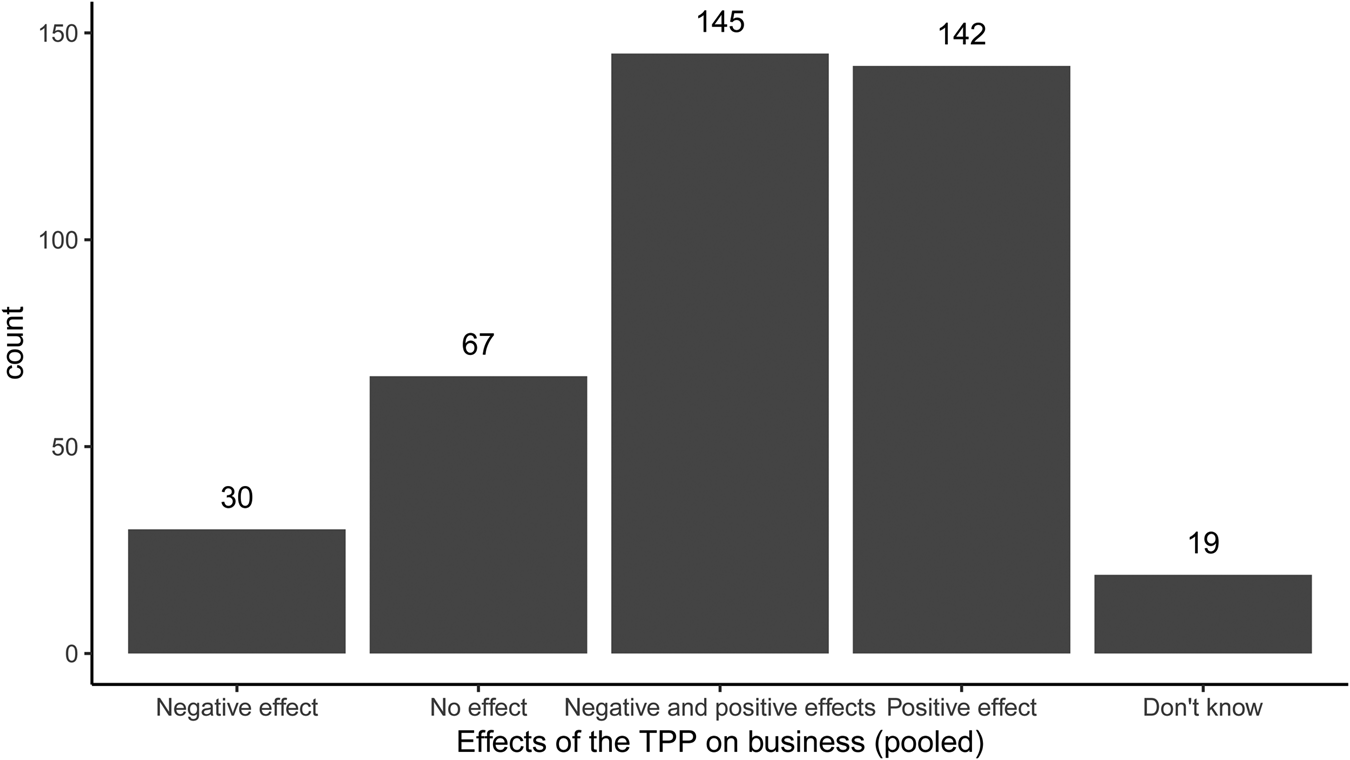
The pooled responses of the main question are displayed in figure 2, indicating that the modal response from the firm managers was to report mixed effects of the agreement, followed closely by an unambiguous statement that the TPP had a positive effect on their business. Only 10 percent of respondents suggested that the TPP had only negative effects on their business. This general positive outlook is consistent with the logic of anticipatory adjustment. Indeed, when asked a follow-up question—“What measures has your company taken to alleviate the negative impact of the TPP?”—only 10.7 percent of them say that their firms have done nothing, and, not surprisingly, these firms are neither integrated in the global supply chain nor productive. The rest of the respondents say that their firms have taken at least one of the following measures: “moving operations to TPP members (12%),” “increasing import/export with non-TPP members (42.7%),” “increasing sales within China (62.7%),” “restructuring the firm (22.7%),” or “asking governments for help (13.3%).” The fact that these firms have implemented the kind of adjustments that allow them to benefit from the TPP explains their positive outlook toward the TPP. Indeed, why shouldn't they if they have already “moved operations to TPP members”?
Effect of TPP on business.

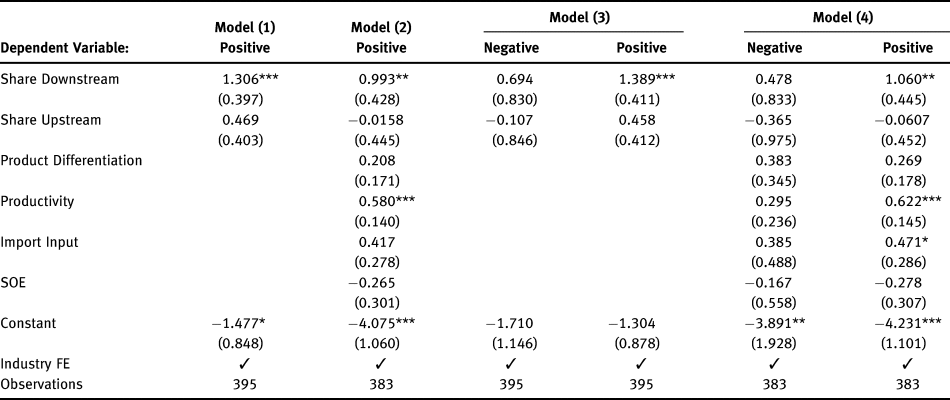
Using the responses in figure 2, we construct the outcome variable in two ways, first by dichotomizing the responses into “positive effects” and everything else, and then by further distinguishing between the “negative effect” and the other responses. Table 2 reports the coefficient estimates of a series of binomial and multinomial logistic regressions that explore the firm's evaluation of the effect of the TPP as a function of respondents’ characterizations of their firms’ competitive condition. Included in all of the models but not reported in the table are industry fixed effects. We treat the “don't know” responses as missing; thus, the sample sizes are slightly smaller than 403.Footnote 33
Position in the Global Supply Chain and Firm Evaluation of the TPP

Note: Robust standard errors in parentheses. Model 1 and 2 are estimated with binomial logistic regressions; Model 3 and 4 are estimated with multinomial logistic regressions, with “mixed / no effect” evaluations of the TPP as the baseline category. Industry fixed effects included but not reported. *** p < 0.01, ** p < 0.05, * p < 0.1
Focusing on the global supply chain position first, we can see that managers of downstream firms with a higher share of final good exports are particularly likely to report positive effects of the TPP. The effects are also substantively significant: a coefficient of 0.993 in model 2 implies that a company whose share of downstream production is 100 percent has a 49 percent probability of viewing the TPP as positive, while a company without downstream production supports the TPP at a rate of 26 percent, holding everything else at their mean. Similarly, using the coefficients in model 4, we can say that for an increase from 0 to 100 percent in downstream production, the relative risk ratio of a company responding “positive effect” over “negative effect” is expected to change by a factor of 2.88, holding everything else constant. On the other hand, the coefficients for the upstream measure are statistically insignificant across all of the models.
The other variable that is statistically significant across all specifications is productivity: firms that are more productive are also more likely to report the positive effects of the TPP. Using estimates from model 2, we can say that, holding everything else constant, a one standard deviation increase in the measures of productivity is associated with 1.74 times higher odds of reporting a positive effect of the TPP. On the other hand, state ownership, product differentiation, and whether or not a firm imports input for its production do not seem to matter for how firms evaluate the effect of the TPP on its business.
These findings are consistent with hypotheses 1 and 3, which take into account the possibility of adjustment for firms that are more capable or vulnerable facing the prospect of exclusion. Mapping the qualitative responses above to the supply chain and productivity measures, we further find that downstream and more productive firms are more likely to opt for “relocating operation to TPP countries,” the costliest adjustment, whereas upstream firms are more likely to “increase exports to non-TPP countries,” “increase domestic sales,” and “[ask] government for help.”
Results from the experiment
The overall positive outlook of the TPP highlights the need for the survey experiment. In the absence of some new situation or information, we are evaluating firm expectations in an environment where the TPP has been part of the calculations of firms for nearly a decade. Any firm that expects to benefit from international trade in this environment will have taken steps to address China's disadvantageous position in the agreement. As we validate through the in-person interviews described in the following section, we find that firms can invest in new capacities and reorient their supply chain to take advantage of the lower barriers to trade. Testing whether different supply chain positions moderate the effects of PTA exclusion in the absence of anticipatory adjustment (i.e., hypothesis 2) requires measurement of the counterfactual world where, in 2016, the TPP was not under negotiation.
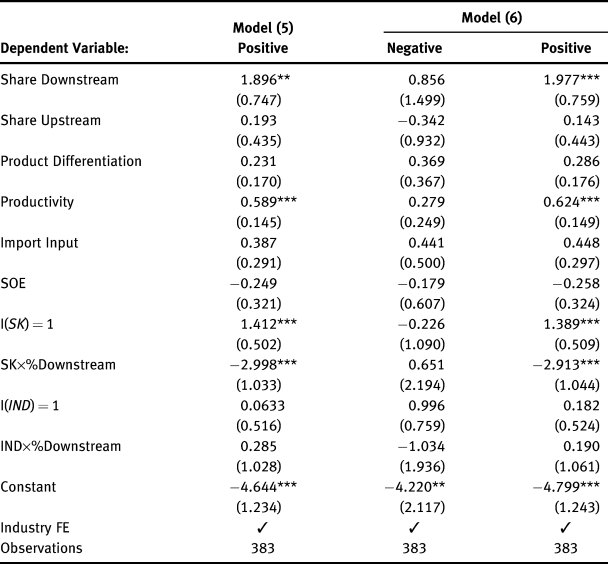
Table 3 reports results from the experiment. We re-estimate the full models in table 2 (model 2 and 4) and add a binary indicator for each of the two treatment conditions, South Korea and Indonesia, as well as their interaction with the share of downstream goods in exports. In model 5 where the outcome variable is modeled with a logistic regression model, we can see that being told that South Korea is joining the agreement (I(SK) = 1) increases the propensity of the firm to report favorable effects of the agreement, compared to the control group that did not receive this information. However, among managers working in firms that predominantly sell final goods to foreign consumers (Downstream), South Korea's membership makes the TPP less attractive, as indicated by the negative and statistically significant coefficient of the interaction term. This is broadly consistent with downstream, final goods producers having to compete with South Korean firms, whereas other firms may benefit from the expanded market for their intermediate inputs, as anticipated by hypothesis 2.
Position in the Global Supply Chain w/ South Korea (SK) and Indonesia (IDN) experiment

Note: Robust standard errors in parentheses. Model 5 is estimated with binomial logistic regressions; Model 6 is estimated with multinomial logistic regressions, with “mixed / no effect” evaluations of the TPP as the baseline category. Industry fixed effects included but not reported. *** p < 0.01, ** p < 0.05, * p < 0.1
The second experimental condition also expands the membership of the TPP, but now with a large intermediate goods producer, Indonesia (IND), which exports a variety of products similar to upstream firms in our survey. The coefficients of both the binary indicator of the Indonesia treatment and its interaction with the downstream measure are statistically insignificant, though the positive sign of the latter suggests that, among managers who work in downstream firms that predominantly sell final goods to foreign consumers, Indonesia joining the agreement may be associated with positive reports of the effects of the TPP. The lack of statistical significance could be due to the fact that only a small proportion of our sample firms trade with Indonesia.
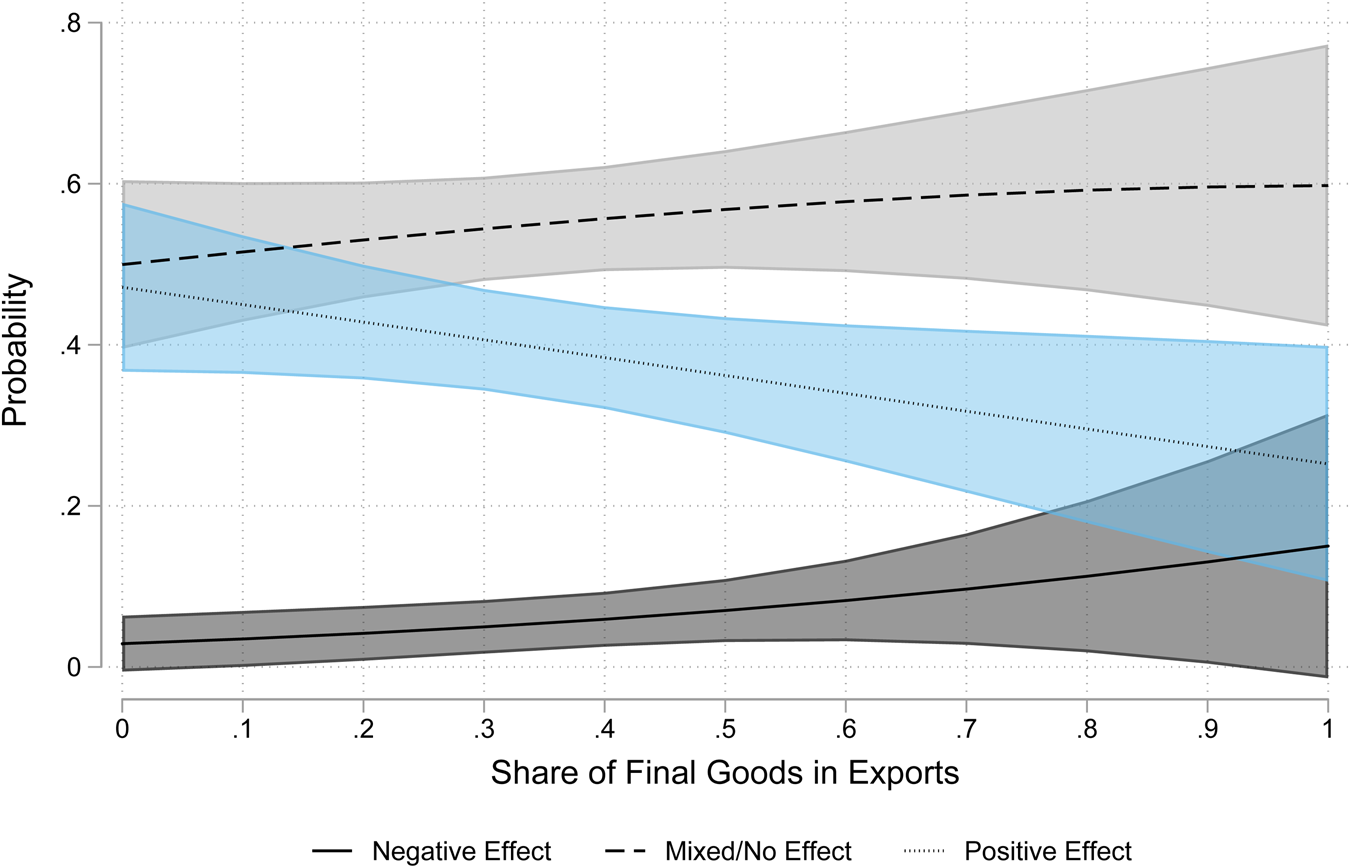
These results remain the same when we use multinomial logistic regressions to model the outcome variable in model 6. To help interpretation of the results with the interaction terms, in figure 3 we plot the predicted probabilities of the three outcomes—“negative effect,” “positive effect,” and “mixed/no effect”—as a function of the share of final goods in the firm's exports for respondents that received the South Korean treatment. The probability that a firm with no downstream production reports a positive effect of the TPP is nearly 50 percent, but this goes down as the proportion of the final goods in the firm's exports increases, with the confidence intervals of the “negative effect” and “positive effect” crossing each other when the proportion is greater than 0.75.
Predicted Probabilities of TPP Evaluations from Firms getting the South Korea Treatment

Robustness checks
In appendix A3 (table A3 and A4), we report an additional set of models to test the robustness of the results above. First, we employed multiple imputation to fill in the missing values in the dataset. The multiple imputation was conducted via a Markov Chain Monte Carlo (MCMC) procedure that assumes that all the variables in the imputation model have a joint multivariate normal distribution, with the ownership and region of the firm, and a question asking about whether or not the firm is doing better than last year as auxiliary variables. We created ten imputed datasets, which we then used to estimate the same models. The results are reported in Models A1, A2, A7, and A8. The coefficient estimates are the averages across ten imputations, and the standard errors are the square roots of the sum of the within and between variance estimates with an adjustment for the number of imputations. The results are similar to those from the models that use list-wise deletion for observations with missing values.
Second, we considered whether firm evaluations of the TPP vary by the factor intensity of their sector as predicted by standard Heckscher-Ohlin theories of trade. To examine this, we coded the industry of each firm into three categories, Labor Intensive, Capital Intensive, and Others.Footnote 34 We then replaced the industry fixed effects with the dummy variables for labor and capital intensive sectors. As shown in models A3, A4, A9, and A10, neither capital-intensive nor labor-intensive industries are associated with higher positive responses to the TPP, while other coefficients in the models remain the same as before.
Finally, we examined whether the results may be driven by a few influential observations in the data. To do so, we first identified the top five observations with the lowest predicted probabilities of observing the outcome value that was actually observed in tables 2 and 3. These “least likely” observations (ten from the binomial logistic regressions and fifteen from the multinomial logistic regressions) represent relatively deviant cases that may be driving the results. We then removed them from the data and re-estimated our models. The results, presented in models A5, A6, A11, and A12, are qualitatively similar to the main findings.
Additional qualitative evidence
The advantage of the survey experiment is that we can evaluate counterfactual firm responses in the absence of adjustment. One disadvantage is that we have to believe that firm managers are both aware of and willing to communicate their firms’ authentic economic and political interests when responding to treatment manipulations in the survey. To supplement the survey findings on the effect of supply chain position, in this section we provide evidence drawn from field research and interviews with managers of textile firms in Guangdong, a province located on the South China Sea coast, in June and August 2017. These interviews provide additional support for the mechanism of adjustment for excluded firms, namely reworking supply chains to regain market access.
Our interviews draw on textile manufacturers in Guangdong. We selected Guangdong because, since 1968, the province has consistently ranked number one among all Chinese provinces in terms of the volume of trade. In 2016, Guangdong's 6.3 trillion yuan in imports and exports accounted for 25.9 percent of the national total.Footnote 35 We focus on the textile sector because of its exposure to competition from TPP member states. The threat of competition was exacerbated by the rules of origin regulations in the agreement, including the “yard forward” rule, which would require firms to use TPP member-produced yarn in textiles in order to qualify for duty-free access. This meant that for Chinese textile firms the most effective adjustment strategy would be to relocate production to a TPP member country. Consistent with hypothesis 1, among the firms we talked to, only the largest and most productive firms were able to do so, which can be illustrated with two firms both having higher-than-average productivity but varying on their supply chain positions.
As an example of a productive, downstream firm, we selected a private firm in the city of Huizhou. This firm is one of the largest knitwear manufacturers in China, with sales of over 2.77 billion yuan in 2016. The firm is heavily dependent on trade with the TPP membership, with its major clients including UNIQLO in Japan and Tommy Hilfiger in the United States. UNIQLO alone accounts for 50 percent of total sales. Located in the downstream segment of the global supply chain, the firm has been experiencing declining profit margins, caused primarily by rising labor costs in China, and has faced concerns about maintaining access to their Japanese clientele. In 2014, the firm decided to relocate some of its production to Vietnam, another prospective TPP member. Japan and Vietnam had already adopted an Economic Partnership Agreement in 2009, but now the TPP was on the horizon.
“The TPP was definitely one of the main reasons why we decided to expand our production in Vietnam,” said the firm's Chief Financial Officer. “There have been concerns that our firm is too dependent on UNIQLO, and the TPP would have allowed us to acquire new customers in member countries such as the United States by exporting through Vietnam.”Footnote 36 In 2016, the firm made an additional investment of 500 million yuan to launch the second phase of a production base located on the outskirts of Ho Chi Minh City. The project was completed in April 2017 and increased the firm's output by one-third. When asked whether the firm is worried now that the TPP is unlikely to happen, he replied that the firm “has accounted for that possibility” in expanding its operations in Vietnam. “We are one of the first firms to relocate to Vietnam and have benefited from the low labor cost, which is nearly half of that in China. Other less productive firms that took a wait-and-see stance are unlikely to move now, which means that our labor cost in Vietnam will be stable for the foreseeable future.”Footnote 37 achieved what Vietnamese politicians had hoped for: investment within the member states.
As an example of an upstream producer, our second firm is a joint venture in the city of Dongguan that manufactures lingerie and sportswear materials, such as elastic fabric, elastic webbing, and lace. This firm is also highly productive, becoming in 2012 the largest lingerie materials manufacturer in the world in terms of sales revenue. As an upstream firm in the global supply chain, it primarily exports to the European and North American markets for brands such as Triumph, Victoria's Secret, Under Armour, and Lululemon. With an annual growth rate of 10 percent in sales and 17 percent in profits since 2011, this firm was among the first to start thinking long-term when Vietnam and Malaysia started TPP negotiations. After conducting research in those markets, however, the firm concluded that none of the local firms in Vietnam or Malaysia could compete with their products and decided instead to expand its production in Dongguan. “Compared to other clothing manufacturers, we are in a much better position as no Vietnamese factories can make the kind of high-end materials we sell to our Western clients,” stated to the firm's vice manager of finance.Footnote 38
In January 2016, a month before the TPP agreement was signed, the firm leased two pieces of land in the Vietnam Singapore Industrial Park in the province of Hai Duong and revealed plans to build a production plant there. In the firm's public statement regarding the land lease, the TPP was highlighted as one of the main drivers behind this move, although for reasons different from those of the UNIQLO supplier. “The tariff reduction would certainly be helpful,” the vice president of the firm explained, “but more importantly, we expected that the TPP would increase demands from member countries, so we wanted to expand our production capacity further while taking advantage of the low labor cost in Vietnam.”Footnote 39
These two cases lend additional support to our findings in the survey. Both firms have made adjustments in anticipation of being excluded from the TPP, enabled by their high productivity (hypothesis 1). However, as a result of their positions in the global supply chain, the degree and direction of these adjustments varied. The upstream firm did not feel the urgency to adjust, and when it did adjust, it did so to take more advantage of expanded markets in TPP countries (hypothesis 2). By contrast, having more to lose, the downstream firm acted much earlier, relocating their production to Vietnam as a necessary hedge against potential competition with firms in TPP member countries (hypothesis 3, as well as others from our fieldwork) said that the Chinese government has adopted any specific policies to help firms adjust to the TPP.
Conclusion
Conventional wisdom holds that exclusion from a PTA entails economic consequences for excluded parties. However, forward-looking and internationally engaged firms in nonmembers are not sitting ducks: they can adjust their business to preempt the adverse effects of exclusion. By structuring our examination on the basis of announcement dates rather than the date of adoption, signature, or ratification, we are able to examine how the effects of PTA exclusion are moderated by firm heterogeneity in productivity and supply chain positions of firms.
Using both quantitative and qualitative evidence, we find that among excluded firms, the productive and downstream producers are motivated and able to make anticipatory adjustments. This, in turn, makes these firms less pessimistic about the prospect of being excluded. In the case of the TPP, many of these firms have even become optimistic, looking to benefit from the market-size effects of regional integration. By contrast, when we probe the counterfactual, destabilizing the membership of the TPP, we see how the absence of adjustment divides firms with different supply positions. In sum, managers appear to be reasoning prospectively, taking into account the competitive conditions both before and after the agreement.
These results contribute to the emerging literature informed by “new new” trade theory as well as the debate on the relationship between preferential and multilateral trade liberalization. Scholars have criticized preferential agreements as undermining the prospects of multilateral negotiations by imposing costs on excluded parties.Footnote 40 At the same time, Baldwin suggests that as global production networks grow, support will grow for the complete removal of the complexities introduced by preferential agreements.Footnote 41 However, the fact that the majority of Chinese firms have already adjusted to trade diversion from exclusion, and even expressed positive views of the TPP, suggests that preferential agreements may inadvertently create constituencies even in excluded parties. Rather than undercut support for PTAs, heterogeneity across firm supply chain positions may create opponents and supporters of the agreement in both member and nonmember countries.
Our findings also highlight the potential empirical pitfalls in estimating the effect of trade agreements. Firms anticipate the prospect of integration and make adjustments before the signature, ratification, and implementation of preferential agreements.Footnote 42 Although we find firms adjusting prior to the conclusion of a PTA negotiation, they likely do not know exactly how the prospective agreement will differ from prior preferential agreements. Examining how firms develop these expectations, and how governments signal the content of these agreements, promises to be a useful and necessary complement to detailed accounts of the effects of specific international institutions.
Lastly, the results from our analysis should have broad policy implications. Now that the CPTPP is moving forward without the United States, Chinese firms that have made the adjustments could once again benefit from expected tariff reductions in their downstream markets, whether in Japan, India and other Pacific and Southeast Asian countries. By contrast, the fact that American firms are now also excluded from the CPTPP not only obviates any adjustments that they've made in anticipation of eventual U.S. entry into the agreement,Footnote 43 but also pits them against their Chinese counterparts, who have had a decade to prepare and adjust for the exclusion. The practical lesson here is that, for today's firms that often need to operate in uncertain policy environments, such as PTA negotiations, perhaps the best strategy is to begin adjusting to expected policy changes, but also to hedge against those adjustments until outcomes are more certain.
Supplementary material
To view supplementary material for this article, please visit https://doi.org/10.1017/bap.2019.8.