Introduction
Corn grain is the main energy grain used in the composition of ruminant diets, being widely used in dairy farms and feedlots. However, due to the variation in prices, supply and quality of this grain during the year, ensiling after milling and rehydration has been increasingly performed, allowing its acquisition in the period of lower price and storage.
Another point worth mentioning is that the grains of corn hybrids cultivated in Brazil are predominantly of hard texture, called ‘flint’, due to the high vitreousness of the endosperm. This characteristic is a consequence of the high content of prolamins, which provides greater resistance to mechanical breakage during harvest and drying. However, this characteristic does not favour the nutrition of ruminants, since the prolamins that surround the starch granules, prevent microbial action during ruminal degradation (Hoffman et al., Reference Hoffman, Esser, Shaver, Coblentz, Scott, Bodnar and Charley2011; Carvalho et al., Reference Carvalho, Ávila, Bernardes, Pereira, Santos and Schwan2017). Therefore, rehydrated corn grain silage, in addition to providing a reduction in production costs, especially in the off-season period, improves grain digestibility, resulting in greater production efficiency of animals, and optimizes labour with grain processing (Hoffman et al., Reference Hoffman, Esser, Shaver, Coblentz, Scott, Bodnar and Charley2011; Gobetti et al., Reference Gobetti, Neumann, Oliboni and Oliveira2013).
However, the making of this silage has some limitations, mainly regarding the homogenization of water to the ground grain, since this is a key point to ensure the quality of the silage, in addition to the fact that water-rehydrated corn grain silages usually present are difficult to ferment, due to the low concentration of water-soluble carbohydrates (WSCs), low counts of lactic acid bacteria (LAB) and consequently low aerobic stability (AS) (Hoffman et al., Reference Hoffman, Esser, Shaver, Coblentz, Scott, Bodnar and Charley2011). Therefore, these silages need a longer storage time in the silo to ensure an adequate fermentative process (Carvalho et al., Reference Carvalho, Ávila, Bernardes, Pereira, Santos and Schwan2017).
Carvalho et al. (Reference Carvalho, Ávila, Bernardes, Pereira, Santos and Schwan2017); Da Silva et al. (Reference Da Silva, Jobim, Neumann and Osmari2018a) and Da Silva et al. (Reference Da Silva, Nascimento, Campos, Alves, Resende, Daniel and Siqueira2019) observed the same problems mentioned above in their research. Thus, it is necessary to seek alternatives that improve not only the fermentative characteristics, but also the AS of these silages. Thus, the cactus pear can be a promising moistening additive of corn grain intended for silage production, since this forage has in its composition up to 90% moisture and 120.0 g/kg of WSCs (Nogueira et al., Reference Nogueira, Araújo, Santos, Gonzaga Neto, Oliveira, Perazzo and Pereira2019), ensuring enough moisture and substrate to guarantee a good fermentation. Moreover, it would dispense the use of water in making this silage in semi-arid regions, where water availability may be restrictive.
Recently, the potential of the cactus pear as a source of substrate in silages has been evaluated to overcome fermentation problems (Macêdo et al., Reference Macêdo, Santos, Araújo, Edvan, Oliveira, Perazzo and Pereira2018; Brito et al., Reference Brito, Santos, de Araújo, de Oliveira, Zanine, Perazzo and Cavalcanti2020; Santos et al., Reference Santos, Santos, Oliveira, Medeiros, Zanine, Araújo and Paulino2020), are improving the fermentative profile of silages (Nogueira et al., Reference Nogueira, Araújo, Santos, Gonzaga Neto, Oliveira, Perazzo and Pereira2019; Sá et al., Reference Sá, Santos, Oliveira, de Araujo, Perazzo, da Silva and Leite2020). The results of these studies pointed out that the use of cactus pear as an additive for silages, besides providing substrate, which ensures good fermentation, also results in heterolactic fermentation, causing these silages to become more stable during the air exposure.
Pereira et al. (Reference Pereira, Santos, Araújo, Oliveira, Pinho, Zanine and Nascimento2020) identified in their research the predominance of lactic bacteria of the genus Weissella in the cactus pear, which are classified as obligatory heterofermentative LAB. The prevalence of heterolactic fermentation has been attributed to the presence of buffering substances in the cactus pear, which promote a less sharp drop in pH, enabling the proliferation of heterofermentative lactic bacteria (Macêdo et al., Reference Macêdo, Santos, Araújo, Edvan, Oliveira, Perazzo and Pereira2018; Pereira et al., Reference Pereira, Santos, Araújo, Oliveira, Pinho, Zanine and Nascimento2020; Sá et al., Reference Sá, Santos, Oliveira, de Araujo, Perazzo, da Silva and Leite2020). Thus, it is expected that the inclusion of cactus pear in corn grain silage will result in silages that are not only well fermented, but also of high AS.
Therefore, the current study aimed to evaluate the effects of cactus pear as a moistening additive on fermentative, microbiological, AS, chemical composition and rumen degradability of corn grain silage at different silo opening times.
Materials and methods
Location and materials used
The research was carried out in the Forage Crops Production Sector at the Agriculture Sciences Center of the Federal University of Paraíba, in the town of Areia, PB, which is located in the micro-region of Brejo Paraibano, located at latitude 6°58′12″ South, longitude 35°42′15″ West and at altitude 619 m. The climate of the region is classified as type ‘As’ hot and humid, according to the Köppen classification. According to data from the Meteorological Station of the Agriculture Sciences Center of the Federal University of Paraíba, the average annual rainfall in Areia is 1400 mm, the average annual temperature is 24.5 °C and the average air relative humidity is 80%. The rainiest 4-month period is from April to July, and represents 62% of the total annual average.
The cactus pear (Nopalea cochenillifera Salm Dyck) used was the variety Miúda, from a cactus plantation already established at the Semiarid National Institute (INSA), with regrowth age of 1 year.
The dry corn grain and cactus pear were processed in a stationary forage chopper (MC1001N Laboremus®, Campina Grande, Brazil). The chopper was equipped with a 5 mm mesh suitable for grinding the dry corn kernel. After milling the corn grain, the 5 mm mesh was removed, and the chopper was cleaned and adjusted to cut cactus pear with a particle size of approximately 1 cm2.
Experimental design adopted
A completely randomized experimental design was adopted, in a 4 × 3 factorial scheme with four levels of dry matter (DM) (50; 60; 70 and 80% of DM) and three silo opening times (30; 60 and 120 days after ensiling), with four replications. The cactus pear was used as a moistening additive in the making of the rehydrated corn grain silage.
Silage making
The silages were made in 48 experimental polyvinyl chloride (PVC) silos, measuring 10 cm in diameter × 30 cm in height. The dry, ground corn grain was mixed manually with the chopped cactus pear until the mixtures reached the intended DM levels (50, 60, 70 and 80% DM). For this purpose, samples of the cactus pear cladodes were previously harvested to determine the DM of the plant, as well as samples of the corn grains according to the AOAC (2005), protocol 934.01. After determining the DM contents of the cactus pear and corn, the proportions of the mixtures were determined to reach the DM levels of each treatment. After mixing, the material was immediately compacted with wooden sticks to reach a specific density of approximately 850 kg/m3 on a fresh matter basis in each experimental silo.
All experimental silos were adapted with a Bunsen valve to eliminate gases resulting from the fermentation. At the bottom of each silo, 1 kg of dry sand was added, whose layer was covered with non-woven fabric (TNT) to capture the effluents. At the end of this process, the silos were closed, weighed and stored at room temperature in a covered, dry and ventilated place until the opening times (30, 60 and 120 days after ensiling).
Microbial population
Microbial populations were quantified before ensiling, as well as at the three silo opening periods (30, 60 and 120 days after ensiling) and after the 120-h AS trial, using selective culture media for each microbial group: MRS agar (Man, Rogosa and Sharpe), containing 1.5 ml/l of acetic acid for LAB and potato dextrose agar, containing 1% of 10% tartaric acid, for moulds and yeasts.
The quantification of the microbial groups was performed on 10 g samples of the replications of each treatment, to which 90 ml of sterilized phosphate buffer solution was added and homogenized for 1 min, obtaining a 10−1 dilution. Then, successive dilutions were carried out, aiming to obtain dilutions ranging from 10−1 to 10−9, and the cultivation was carried out in disposable sterile Petri dishes (González and Rodríguez, Reference González and Rodríguez2003).
The plates were incubated according to the specific incubation temperatures for each microbial group (Ávila et al., Reference Ávila, Carvalho, Pinto, Duarte and Schwan2014; Santos et al., Reference Santos, Pereira, Garcia, Ferreira, Oliveira and Silva2014). For LAB, 37°C for 48 h and for moulds and yeasts, 28°C for 72 h were used. Plates with values between 30 and 300 colony-forming units (CFU/g of silage) were considered eligible for counting.
Silage fermentation profile
At the opening times of 30, 60 and 120 days, pH and ammonia nitrogen (N-NH3) values were determined following the methodology described by Bolsen et al. (Reference Bolsen, Lin, Brent, Feyerherm, Urban and Aimutis1992). In order to determine the WSC content, the concentrated sulphuric acid method described by Dubois et al. (Reference Dubois, Gilles, Hamilton, Rebers and Smith1956) with adaptations by Corsato et al. (Reference Corsato, Scarpare Filho and Sales2008) was used.
Chemical composition of the silages
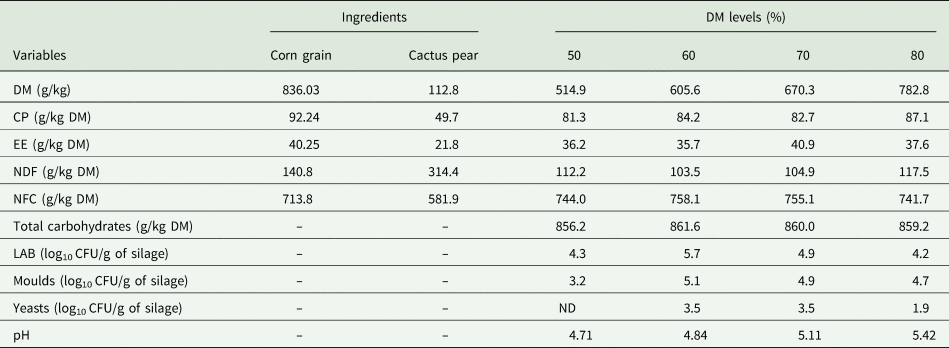
Samples of the corn grain silage rehydrated with cactus pear of approximately 300 g of each replication were collected on the day of ensiling and in each different opening time of the experimental silos (30, 60 and 120 days). The samples were pre-dried in a forced ventilation oven for 72 h at 60 °C. Then, these samples were ground into 1 mm particles in a Wiley knife mill and analysed for DM, organic matter, ether extract (EE) and crude protein (CP) contents according to the AOAC (2005) methods 934.01, 942.05, 920.39 and 968.06, respectively (Table 1).
Chemical composition, pH and microbial count of the mixtures before ensiling

LAB, lactic acid bacteria; DM, dry matter; pH, hydrogenic potential.
The contents of neutral detergent fibre (NDF) and acid detergent fibre of the samples were determined following the methodology described by Mertens (Reference Mertens2002). Non-fibre carbohydrates (NFC) were estimated by the following equation developed by Sniffen et al. (Reference Sniffen, O'connor, Van Soest, Fox and Russell1992):

Silage DM losses and recovery
DM losses in the silages as effluents and gases were quantified by weight difference using the equations described by Zanine et al. (Reference Zanine, Santos, Dórea, Dantas, Silva and Pereira2010):

where EL is the effluent losses (kg/t as fed); EWc is the weight of empty silo + sand at closure (kg); EWo is the weight of empty silo + sand at opening (kg); Ew is the weight of empty silo (kg); FMc is the forage mass at silo closure (kg):

where GL is the gas losses (% of DM); FWc is the weight of silo filled at closure (kg); FWo is the weight of silo filled at opening (kg); FMc is the forage mass at silo closure (kg) and DMc is the forage dry matter concentration at silo closure (%).
The estimate of dry matter recovery (DMR) was obtained by the difference of DM weight before and after ensiling through the equation described by Zanine et al. (Reference Zanine, Santos, Dórea, Dantas, Silva and Pereira2010):

where DMR is the dry matter recovery rate (%); FMo is the forage mass at silo opening (kg); DMo is the forage dry matter concentration at silo opening (%); FMc is the forage mass at silo closure (kg) and DMc is the forage dry matter concentration at silo closure (%).
Aerobic stability
At all opening times (30, 60 and 120 days after ensiling), the AS of the silages (expressed in h) was evaluated by monitoring the internal temperature of the silages exposed to air for a period of 120 h. The silage samples were placed with no compaction in experimental PVC containers without a lid and kept in a closed environment with controlled temperature (25 °C). The onset of deterioration was considered when the internal temperature of the silages reached 2 °C above the room temperature (Kung Jr. et al., Reference Kung, Robinson, Ranjit, Chen, Golt and Pesek2000).
In situ rumen degradability of the silage DM
To assess the in situ rumen degradability of the DM, 1.3 g of dry samples were placed in bags (model R1020; Ankom, New York, USA; pore size = 50 ± 15 μm), as described by Nocek (Reference Nocek1988). Four bags were used per treatment in the pre-ensiled material and in the silages at the opening periods (30, 60 and 120 days after ensiling), totalling 576 samples, which were divided into their respective incubation times (96 samples per incubation period). The samples of each incubation period were allocated into nylon bags containing 25 sample bags each. One pool of sample bags referring to each incubation period was inserted into the rumen of a fistulated bull. The animal used for the degradability test was a Girolando bull, weighing 600 kg. The procedure was approved by the Ethics Committee on the Use of Animals, at the Federal University of Paraíba, in accordance with protocol No. 8681210920.
Incubation times were 6, 12, 24, 48, 72 and 96 h. In order to carry out the degradability trial, the animal was kept confined throughout the evaluation period, receiving chopped elephant grass (Pennisetum purpureum) and 20% concentrate. The bags of time zero or soluble fraction (fraction a) were placed in water bath at 39 °C for 1 h. The bags of the other times were removed from the rumen and placed in cold water to stop fermentation. Afterwards, they were washed by hand, until the water became clear. Then, the bags were placed in an oven at 55 °C for 72 h and weighed. Blanks were incubated for the same period to correct for particulate contamination.
Estimates of the parameters of DM in situ degradability were performed based on the non-linear model proposed by Sampaio (Reference Sampaio and Teixeira1997), from the simplification of the exponential model proposed by Ørskov and McDonald (Reference Ørskov and McDonald1979), expressed as DP = A − Be − ct, where DP is the actual percentage of nutrient degraded after t hours of rumen incubation; A is the maximum material degradation potential; B is the potentially degradable fraction of material that remains after time zero; c is the rate of degradation of the fraction remaining after zero time and t is the incubation time.
The effective degradability (ED) is the percentage of material that is actually degraded in the rumen and it was estimated considering passage rates of 2, 5 and 8%/h (AFRC, 1993), which are rates considered respectively for low-quality forages and straw or crop stubble; composite diets and good-quality roughages; and diets or concentrated ingredients, using the equation proposed by Ørskov and McDonald (Reference Ørskov and McDonald1979), ED = a + [(bc)/(c + k)], where ED is the effective degradation; a is the soluble fraction, rapidly degraded; b is the insoluble fraction, slowly degraded; c is the fractional rate of degradation of b and k is the passage rate.
Statistical analysis
The data obtained were subjected to analysis of variance and regression using the statistical software SAS 9.4 (SAS Institute, Cary, NC, USA). Significant interactions between factors were detailed. The effect of the silage DM levels was verified by regression analysis. The regression equations were chosen based on the coefficient of determination (R 2) and the significance of the regression coefficients using the t test at α = 0.05. The effect of the silages within each opening time was evaluated by the Tukey's test at a significance level of 5%.
The following statistical model was used:

where μ is the population mean; αi is the effect of the DM levels; βj is the effect of the opening times; γij is the effect of the interaction between DM levels × opening times and ɛijk is the residual error.
Results
Microbial count, fermentation profile and chemical composition of the silages
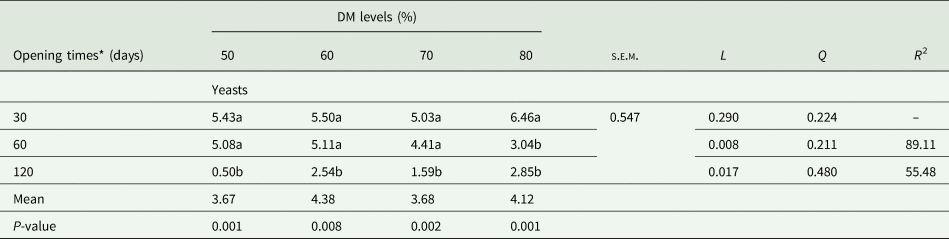
A significant effect was found for the interaction (P = 0.008) between the DM level of the corn grain silage rehydrated with cactus pear and opening times for the silage yeast population. However, there was no effect (P = 0.290; P = 0.224) of the silage DM levels at 30 days after ensiling, with an average of 5.60 log10 CFU/g of silage (Table 2). A linear effect (P = 0.008; P = 0.017) of the DM levels was observed at the opening times 60 and 120 days after ensiling, with averages ranging from 5.08 to 3.04 and 0.50 to 2.85 CFU/g of silage, respectively (Table 2).
Effect of interaction between the DM levels and opening times on silage yeast population

s.e.m., standard error of the mean; L, significance for linear effect; Q, significance for quadratic effect; R 2, coefficient of determination.
* Means followed by the same letters in the column do not differ from each other according to the Tukey's test at the level of 5% probability.
There was a significant difference (P = 0.001; P = 0.008; P = 0.002) between opening times for all silage DM levels. For the 50, 60 and 70% DM levels, the largest populations of yeasts in the silage were observed at 30 and 60 days after ensiling, with no difference between each other. However, in the silage with 80% DM (P = 0.001), the largest population was observed at 30 days and the smallest were at 60 and 120 days after ensiling, with no difference between these times (Table 2).
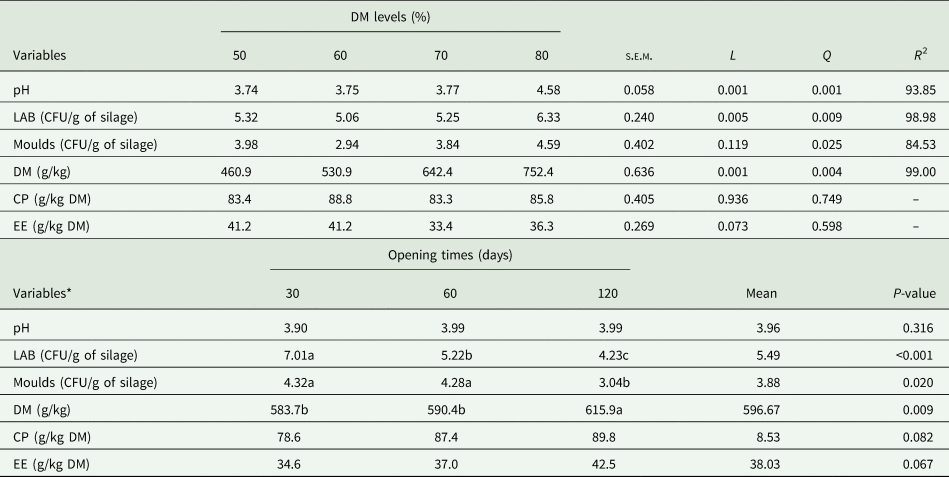
A significant linear effect (P = 0.001) of DM levels was observed on the pH value, with averages increasing from 3.74 to 4.58. However, the pH values did not differ (P = 0.316) between the opening times of the silos, with an overall average of 3.96 (Table 3).
Isolated effects of the DM levels and opening times on corn grain silage rehydrated with cactus pear

LAB, lactic acid bacteria; s.e.m., standard error of the mean; L, significance for linear effect; Q, significance for quadratic effect; R 2, coefficient of determination.
* Means followed by the same letters on the line do not differ from each other according to the Tukey's test at the level of 5% probability.
A linear effect (P = 0.005) for the DM levels was observed on the LAB populations, with means ranging from 5.32 to 6.33 log10 CFU/g of silage (Table 3). A quadratic effect was observed (P = 0.025) on the mould population, with the smallest population found in the 60% DM level. Concomitantly, there was a difference (P = 0.001) between opening times, with the largest population of LAB observed at 30 days and the smallest at 60 and 120 days after ensiling, while the largest populations of moulds (P = 0.020) were observed at 30 and 60 days and the smallest at 120 days (Table 3).
A linear effect (P = 0.001) was found on the DM contents, with means ranging from 460.9 to 752.4 g/kg. However, there was no effect of DM levels on CP (P = 0.936; P = 0.749) and EE (P = 0.073; P = 0.598) contents, showing averages of 85.32 and 38.02 g/kg of DM of silage (Table 3).
A significant effect (P = 0.009) of the opening times of the silos was observed only on the silage DM contents, with the highest average observed at 120 days and the lowest at 30 and 60 days after ensiling, with no difference between these two times. There was no effect (P = 0.082; P = 0.067) of the opening times on the CP and EE contents, with general averages of 85.30 and 38.03 g/kg of DM of silage (Table 3).
Effluent losses, gas losses and DMR
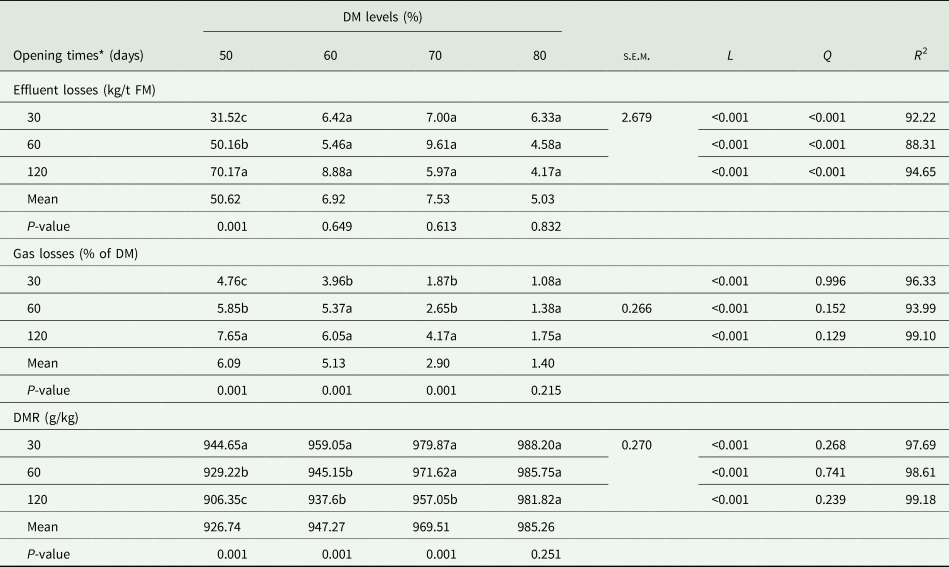
There was a significant effect of interaction (P = 0.001; P = 0.005; P = 0.001) between the DM levels and opening times on EL, GL and DMR of the corn grain silage rehydrated with cactus pear (Table 4). There was a linear effect (P = 0.001; P = 0.001; P = 0.001) of DM levels on EL at the opening times 30, 60 and 120 days, with averages reducing from 31.52 to 6.33, 50.16 to 4.58 and 70.17 to 4.17 kg/t FM, respectively (Table 4).
Effect of interaction between the DM levels and opening times on effluent losses, gas losses and DMR during the ensiling process

s.e.m., standard error of the mean; L, significance for linear effect; Q, significance for quadratic effect; R 2, coefficient of determination.
* Means followed by the same letters on the line do not differ from each other according to the Tukey's test at the level of 5% probability.
Regarding the opening times, there was an effect (P < 0.05) on EL in the 50% DM level (P = 0.001), with the highest EL value found at 120 days and the lowest at 30 days after ensiling (Table 4). However, there was no difference (P = 0.649; P = 0.613; P = 0.832) in EL between opening times in the levels 60, 70 and 80% DM levels with general averages of 6.92; 7.53 and 5.03, respectively (Table 4).
It was observed a linear effect (P = 0.001; P = 0.001; P = 0.001) on GL at the opening times 30, 60 and 120 days, with averages reducing from 4.76 to 1.08, 5.85 to 1.38 and 7.65 to 1.75% of DM, respectively. Regarding the opening times, there was effect (P = 0.001; P = 0.001; P = 0.001) on GL in the 50, 60 and 70% DM levels. The highest GL value in the 50% DM level was observed at 120 days and the lowest at 30 days (Table 4). In the 60% DM level, the highest GL means were found at 60 and 120 days and the lowest at 30 days after ensiling. In the silage with 70% DM, the highest GL value was found at 120 days and the lowest at 30 and 60 days after ensiling, with no difference between each other. However, there was no difference (P = 0.215) in GL between opening times in the 80% DM level (Table 4).
A linear effect (P = 0.001; P = 0.001; P = 0.001) of the silage DM levels on the DMR was found at all opening times, with means ranging from 944.65 to 988.20, 929.22 to 985.75 and 906.35 to 981.82 g/kg, at 30, 60 and 120 days, respectively. It was observed significant differences (P = 0.001; P = 0.001; P = 0.001) between opening times in the 50, 60 and 70% DM levels. The highest DMR in the 50% DM level was observed at 30 days, while the lowest was observed at 120 days after ensiling (Table 4). In the 60% DM level, the highest DMR was observed at 30 days and the lowest at 60 and 120 days after ensiling, with no difference between these two times. Whereas in the 70% DM level, the highest values were observed at 30 and 60 days, with no difference between each other, and the lowest at 120 days after ensiling. However, there was no difference (P = 0.251) between opening times in the 80% DM level, with a general average of 985.26 g/kg (Table 4).
Silage AS and microbial count after the time of exposure to air
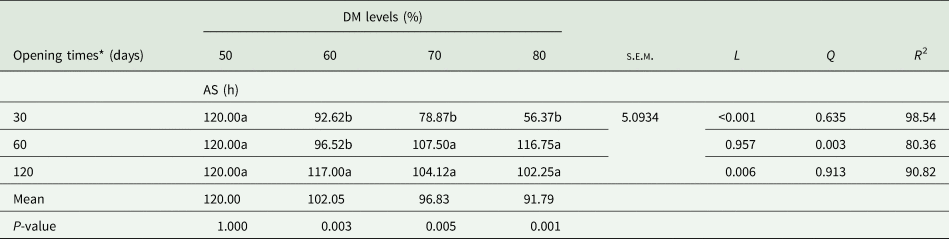
There was an interaction (P = 0.001) between DM levels and opening times on the AS of the silages, which was expressed in hours (Table 5). There was a linear effect of the DM levels (P = 0.001; P = 0.006) on AS at the opening times 30 and 120 days after ensiling, with AS time decreasing from 120.0 to 56.4 and 120.0 to 102.2 h. However, there was a significant quadratic effect (P = 0.003) at the 60 days opening time, with an estimated shortest AS time through the regression model in the 60% DM level (Table 5).
Effect of interaction between the DM levels and opening times on silage AS

s.e.m., standard error of the mean; L, significance for linear effect; Q, significance for quadratic effect; R 2, coefficient of determination.
* Means followed by the same letters on the line do not differ from each other according to the Tukey's test at the level of 5% probability.
Regarding the opening times, there was no difference (P = 1.000) in AS time in the 50% DM level, with a general average of 120 h (Table 5). However, there was a significant difference (P = 0.003; P = 0.005; P = 0.001) between opening times in the 60, 70 and 80% DM levels (Table 5). The longest AS time observed in the 60% DM level was at 120 days and the shortest at 30 and 60 days after ensiling, not differing from each other. In the 70 and 80% DM levels, the longest AS times were found at 60 and 120 days, not differing from each other, and shortest at 30 days after ensiling (Table 5).
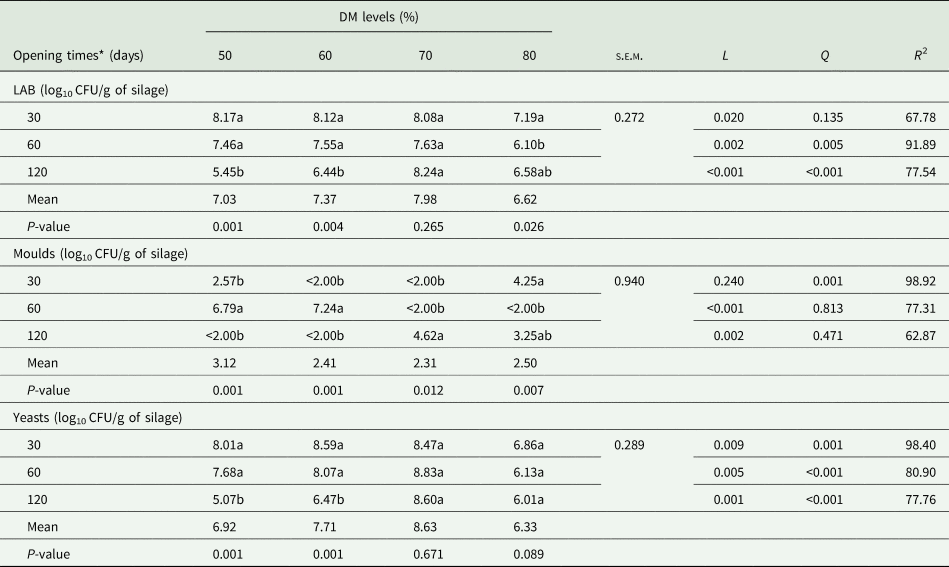
There was an effect of interaction (P = 0.001; P = 0.001; P = 0.001) between the silage DM levels and opening times on the populations of LAB, moulds and yeasts after the silage AS trial (Table 6).
Effect of interaction between the DM levels and opening times on counts of LAB, moulds and yeasts after the silage AS trial

s.e.m., standard error of the mean; L, significance for linear effect; Q, significance for quadratic effect; R 2, coefficient of determination.
* Means followed by the same letters on the line do not differ from each other according to the Tukey's test at the level of 5% probability.
There was a linear effect (P = 0.020) on the LAB population after the AS trial of the opening time of 30 days after ensiling, with the population reducing from 8.17 to 7.19 log10 CFU/g of silage. On the other hand, there was a quadratic effect (P = 0.005) at 60 days, with an estimated population peak in the 60.42% DM level. However, after the AS trial of the opening time of 120 days, a quadratic effect was observed (P = 0.001), with the smallest population being estimated in the 69.25% DM level (Table 6).
There was a significant difference (P = 0.001; P = 0.004; P = 0.026) between the opening times in the levels 50, 60 and 80% DM. The largest population of LAB after the AS trial in the levels 50 and 60% DM were observed at 30 and 60 days after ensiling (Table 6). In the 80% DM level, the largest population of LAB was found at 30 days and the smallest at 60 and 120 days after ensiling. However, there was no difference (P = 0.265) between opening times in the 70% DM level, with a general average of 7.98 log10 CFU/g of silage (Table 6).
A quadratic effect (P = 0.001) was observed in the mould population after the AS trial of the opening time of 30 days after ensiling, with the smallest population being estimated by using the regression model in the 63.75% DM level. There was a linear effect (P = 0.001) on the mould population at 60 days, with means decreasing from 6.79 to <2.00 log10 CFU/g of silage. A linear effect was observed (P = 0.002) on the mould population after the AS trial of the opening time of 120 days after ensiling, with an average varying positively from <2.00 to 3.25 log10 CFU/g of silage (Table 6).
There was a significant difference (P = 0.001; P = 0.001) between opening times in all DM levels. The largest population of moulds after the AS trial in the 50 and 60% DM levels were observed at 60 days and the smallest at 30 and 120 days after ensiling, not differing from each other (Table 6). In the 70% DM level (P = 0.012), the largest mould population was observed at 120 days, however, the presence of moulds in the silages was not detected after the AS trial of the opening times 30 and 60 days after ensiling (Table 6). In the 80% DM level (P = 0.007), the largest mould population was observed at 30 days and the smallest at 60 and 120 days after the AS trial (Table 6).
A quadratic effect (P = 0.001; P = 0.001; P = 0.001) was observed in the yeast population after the AS trial of the opening times 30, 60 and 120 days after ensiling, with the largest populations being estimated by the regression models in the 62.51, 62.57 and 68.07% DM levels, respectively (Table 6). Regarding the opening times, there was a difference (P = 0.001; P = 0.001) in the 50 and 60% DM levels, with the largest yeast population observed after the AS trial at 30 and 60 days and the smallest at 120 days after ensiling. However, there was no difference (P = 0.671; P = 0.089) between opening times in the 70 and 80% DM levels, with general averages of 8.63 and 6.33 log10 CFU/g of silage (Table 6).
In situ rumen degradability of the silage DM
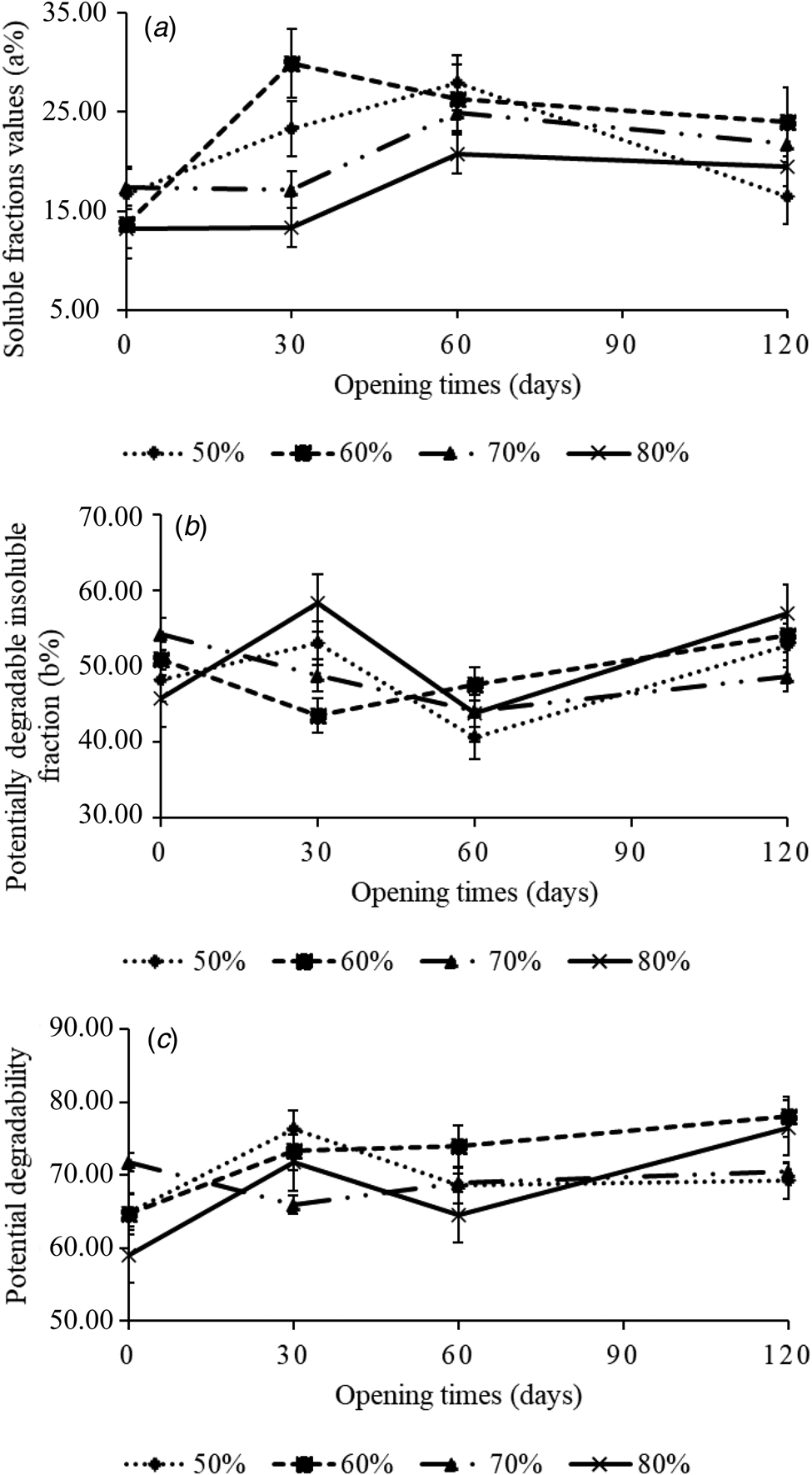
It was observed that the degradability of the soluble fraction of the ensiled mass increased after the ensiling process. Silages with 60% DM reached their peak at 30 days, reducing at 60 days and stabilizing up to the opening time of 120 days. Silages with 50% DM reached their peak at 60 days and reduced up to 120 days after ensiling. The degradability values of the soluble fraction of 70 and 80% DM increased from the opening time of 30 days, reaching a peak at 60 days and stabilizing up to 120 days after ensiling (Fig. 1(a)).
Mean values of DM levels of corn grain silages rehydrated with cactus pear according to the silo opening times for the soluble fraction (a); potentially degradable insoluble fraction (b) and potentially degradable DM (c).

The silages of 50 and 80% DM showed the greatest potentially degradable insoluble fractions at 30 days, decreasing at 60 days and increasing again up to the opening time of 120 days. Silages of 60% DM presented the smallest potentially degradable insoluble fraction when compared to the other silages at 30 days, increasing again until reaching the peak at 120 days after ensiling. The silages with 70% DM presented the lowest value of the potentially degradable insoluble fraction at 60 days, stabilizing up to the opening time of 120 days (Fig. 1(b)).
Silages with 50 and 60% DM had the highest values of potentially degradable DM at 30 days after ensiling. However, the value of potentially degradable DM in silages with 50% DM reduced at 60 days, stabilizing up to the opening time of 120 days, while in silages with 60% DM, it linearly increased up to 120 days after ensiling (Fig. 1(c)). Silages with 70% DM had the lowest value of potentially degradable DM at 30 days, increasing at 60 days, and stabilizing up to the opening time of 120 days. Whereas silages with 80% DM reached the peak of potentially degradable DM at 30 days, reducing at 60 days, and increasing again up to the opening time of 120 days (Fig. 1(c)).
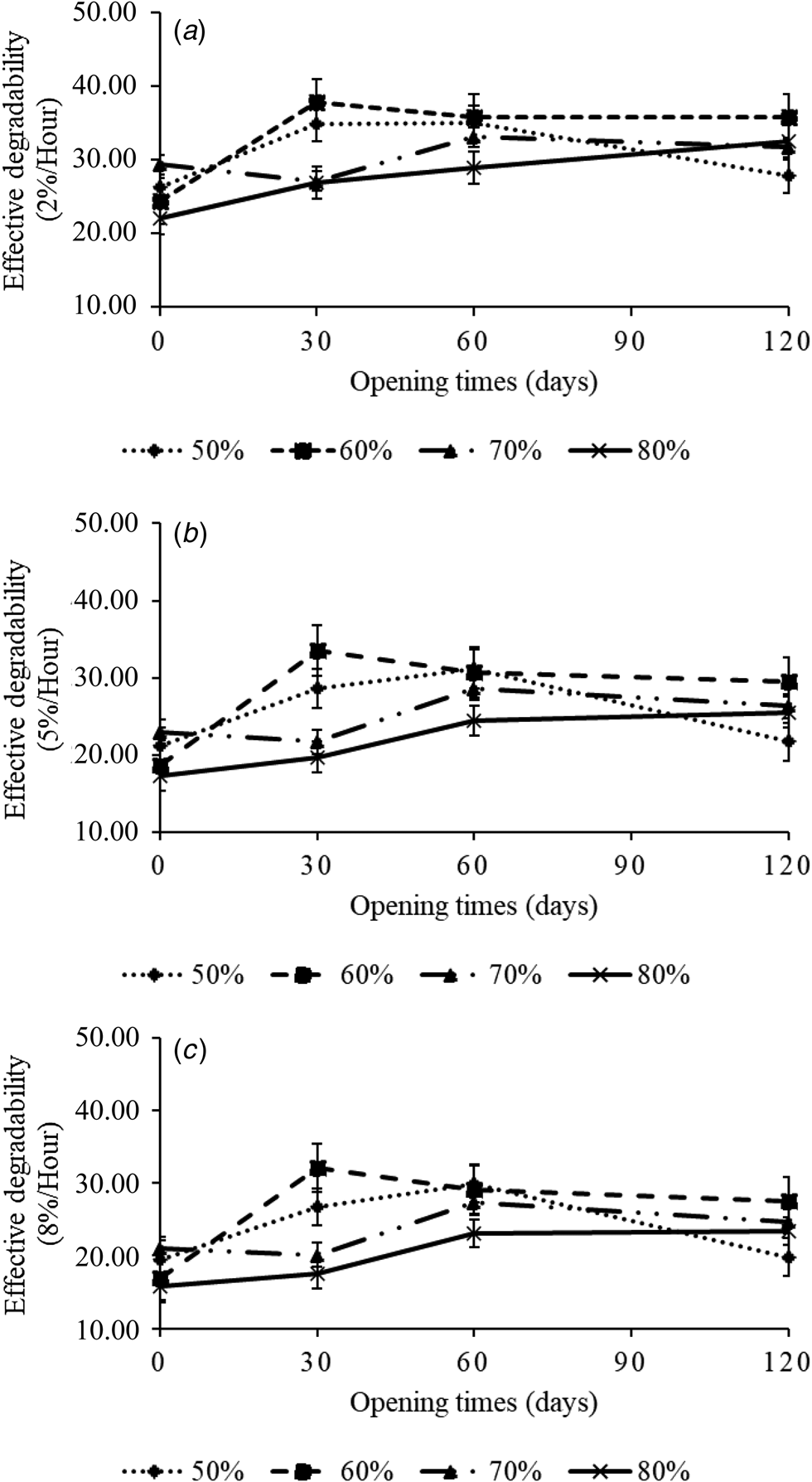
It was observed that the ED of the silages behaved similarly at the different passage rates (2, 5 and 8%/h). Silages with 50 and 60% DM showed the peak of ED of the three passage rates at 30 days after ensiling. However, the silages with 60% DM showed a reduction at 60 days, stabilizing up to the time of 120 days, while the silages with 50% DM stabilized up to 60 days and reduced the ED up to the opening time of 120 days (Figs 2(a)–(c)).
Mean values of DM levels of corn grain silages rehydrated with cactus pear according to the silo opening times for ED (2%/h) (a); ED (5%/h) (b) and ED (8%/h) (c).

Silages with 70% DM showed the lowest values of ED at 30 days, increasing at 60 days, and stabilizing up to the opening time of 120 days. Silages with 80% DM showed an increase in ED until reaching the peak at the opening time of 120 days (Figs 2(a)–(c)).
Discussion
Microbial count, fermentation profile and chemical composition of the silages
The silages evaluated in the current study had pH values ranging from 3.74 to 4.58, with high yeast count (log10 CFU/g of silage) observed between 30 and 60 days after ensiling, even approximating numerically to the LAB count (log10 CFU/g silage). Some yeast strains (e.g. Saccharomyces, Candida, Cryptococcus and Pichia spp.) have the ability to assimilate lactic acid and can develop well in a pH range between 3 and 8 (Tabacco et al., Reference Tabacco, Piano, Cavallarin, Bernardes and Borreani2009).
However, as the preservation time of the ensiled mass advanced, the yeast count linearly declined (Table 2). Carvalho et al. (Reference Carvalho, Ávila, Bernardes, Pereira, Santos and Schwan2017) identified the LAB and yeasts involved in the fermentation of corn grain silage rehydrated with water, and observed a reduction in the yeast population after 30 days of fermentation (5.16 log10 CFU/g of silage), however, the yeast population observed at 280 days of fermentation (3.63 log10 CFU/g of silage) was larger than those observed at the opening time of 120 days of the current study.
The more accentuated reduction in the yeast population observed in the current study when compared to other studies with corn silage rehydrated with water may be due to the higher occurrence of heterolactic fermentation. Sá et al. (Reference Sá, Santos, Oliveira, de Araujo, Perazzo, da Silva and Leite2020) evaluated cactus pear silages added of urea and Lactobacillus buchneri, and observed in the silages of cactus pear without additive values of pH, lactic acid and acetic acid of 3.46, 6.20 and 16.30 g/kg, respectively, which resulted in reduced yeast populations. These results are very important: moistening corn grain silages to achieve a stable silage solves a major problem associated with corn storage. In addition, cactus is a very widespread plant in the semiarid region, where water supply is a major problem.
A similar effect on the population of mould and yeasts was observed with increasing DM levels in the silage. This is possibly related to water activity (WA) in silages with 70 and 80% of DM (Table 2), since yeasts need a WA higher than 0.60 (Beuchat, Reference Beuchat1981). According to Jobim et al. (Reference Jobim, Nussio, Reis and Schmidt2007) the WA, expressed in a scale from 0 to 1, is a determining factor for the development of microorganisms that participate in the silage fermentation processes. Thus, at higher DM levels, despite the lower proportions of cactus pear, there may have been a control of fermentation by yeasts, due to the reduction in WA.
Therefore, when using the cactus pear to rehydrate the dry corn grain, it provides the pre-ensiled material with high soluble carbohydrate content, especially when compared to the material rehydrated with water, which ensure a good fermentation pattern, with lower pH values (3.74–4.58) and a heterolactic fermentation pattern, reducing the yeast population in the silage and limiting its population growth when the silages are exposed to air, making this silage more stable.
DMR and losses through effluent and gases
The 50% DM silage treatment at 120 days after ensiling presented high EL (70.2 kg/t FM) (Table 4), which is due to the increase in the moisture content. Sá et al. (Reference Sá, Santos, Oliveira, de Araujo, Perazzo, da Silva and Leite2020) evaluated the fermentative characteristics and chemical composition of the cactus pear silage, and observed EL values of 12 kg/t FM. The authors associate this result to the high moisture content as a function of the age of the cactus pear plants at the moment of ensiling.
The DM content of the cactus pear cladodes is closely related to the age of the plant, thus the younger the plant, the higher the moisture content, and the lower the amount of mucilage in its cladodes (Gusha et al., Reference Gusha, Katsande, Zvinorova and Ncube2013; Nogueira et al., Reference Nogueira, Araújo, Santos, Gonzaga Neto, Oliveira, Perazzo and Pereira2019). In the study of those authors, the cactus pear had a regrowth age of 2 years, while in the current study it was harvested after one year of regrowth. However, as the objective was to rehydrate the corn grain, it was decided in the current study to evaluate cactus pear plants with higher moisture content, despite resulting in greater loss through effluent, in the levels of greater inclusion of cactus pear.
However, in the silages with 70% DM, there was minimal EL (<10 kg/t FM) (Table 4). Oliveira et al. (Reference Oliveira, Takiya, Del Valle, Rennó, Goes, Leite and Da Silva2019) evaluated the incorporation of an amylolytic enzyme in rehydrated corn grain silage, and found an EL mean value of 57.9 kg/t FM. Therefore, one of the advantages of rehydrating corn with cactus pear is the reduced effluent losses, due to the presence of mucilage. Mucilage is composed of hydrocolloids formed by polysaccharides (rhamnose, arabinose, galactose and xylose) that are highly hydrophilic, which minimize the movement of water and, thus, can reduce effluent losses (Nogueira et al., Reference Nogueira, Araújo, Santos, Gonzaga Neto, Oliveira, Perazzo and Pereira2019). Therefore, the mucilage controlled the loss of effluent in the silages with 70% DM.
The reduction of GL as a function of the silage DM levels, mainly in the 70 and 80% DM levels (Table 4), may be related to the inhibition of proliferation of undesirable microorganisms, such as Enterobacteria and Clostridium, due to the lack of fermentable substrates, slowing down the silage fermentation process, since the cactus pear was used as a moistening additive for the corn grain and a source of substrate. However, there was an increase in GL at the opening time of 120 days, but with values still considered low according to McDonald et al. (Reference McDonald, Henderson and Heron1991).
Although GL increased 120 days after ensiling, the results observed in the current study are similar to those of corn grain silages rehydrated with water, as observed by Ávila et al. (Reference Ávila, Silva, Leite, Barbosa, Florentino and Rezende2019), who found values of 6.3% for GL. However, these authors evaluated only one opening time (90 days after ensiling the material). According to Carvalho et al. (Reference Carvalho, Ávila, Bernardes, Pereira, Santos and Schwan2017) corn silages rehydrated with water present slow fermentation and, consequently, slow reduction in pH, which is related to a low concentration of fermentable substrates by LAB that convert them to lactic acid. In the case of rehydration by cactus pear, the fermentation is possibly faster, resulting in greater control of secondary fermentations.
As with GL, the DMR was influenced by the amount of cactus pear used to rehydrate the corn grain during ensiling, with the silage that contained 50% DM presenting the lowest DMR values. Although silages in general reduced DMR at the opening time of 120 days after ensiling, it can be said that all silages presented high DMR (>900 g/kg), especially above the 60% DM level, at which all silages presented DMR values greater than 930 g/kg.
The results of the current study observed for DMR are higher than those observed by Oliveira et al. (Reference Oliveira, Takiya, Del Valle, Rennó, Goes, Leite and Da Silva2019) when they evaluated corn grain silage rehydrated with water. The authors found a DMR average of 873 g/kg of DM. Thus, it can be said that when using cactus pear as a corn grain moistening additive, the silage fermentation becomes more intense, mainly in levels below 80% DM, accelerating the pH drop of the ensiled mass and inhibiting the development of undesired microorganisms, such as: Bacillus, Listeria, Clostridium and Enterobacteria (Kung Jr. et al., Reference Kung, Shaver, Grant and Schmidt2018), what could result in higher DMR.
Silage AS and microbial count after the time of exposure to air
An important point in the production and use of silages is their aerobic deterioration, and yeasts are the main microorganisms involved in this process, because they initiate the stability break, due to the metabolization of lactic acid, which leads to increase in the silage pH (Tabacco et al., Reference Tabacco, Piano, Cavallarin, Bernardes and Borreani2009, Reference Tabacco, Piano, Revello-Chion and Borreani2011). Although the yeast count observed in Table 2 is considered high for well-fermented silages, it can be said that this yeast population is not related to the silage AS break.
It is worth noting that the cactus pear promotes heterolactic fermentation in the ensiled mass, which possibly results in higher concentration of acetic acid. Pereira et al. (Reference Pereira, Santos, Araújo, Oliveira, Pinho, Zanine and Nascimento2020) evaluated LAB isolated from the cactus pear as potential inoculants, and observed predominance lactic bacteria of the genus Weissella, which are classified as obligatory heterofermentative LAB in cactus pear plants. Obligatory heterolactic species, improve AS due to higher acetic acid production (Muck et al., Reference Muck, Nadeau, McAllister, Contreras-Govea, Santos and Kung2018).
Sá et al. (Reference Sá, Santos, Oliveira, de Araujo, Perazzo, da Silva and Leite2020) evaluated the effect of different additives on the fermentative characteristics of cactus pear silage, and observed no AS break in the silages. This is possibly related to the heterolactic fermentative profile of the cactus pear silage. Therefore, the additive effect of the cactus pear on the fermentative characteristics and AS of the silages in this study was observed 30 days after ensiling at levels below 80% DM, due to the amount of cactus pear used in these treatments, which made the fermentation process more intense. However, from 60 days after ensiling, the additive effect of cactus pear is evident in all silages evaluated. Although silages with 50% DM had greater AS (>120 h) at all opening times when compared to the other DM levels (Table 5), they presented the greatest loss during the ensiling process (Table 4). Thus, the high AS of silages with this DM level cannot be considered alone when deciding which DM level to use.
Da Silva et al. (Reference Da Silva, Jobim, Neumann and Osmari2018a, Reference Da Silva, Nascimento, Nascimento, Resende, Daniel and Siqueira2018b, Reference Da Silva, Nascimento, Campos, Alves, Resende, Daniel and Siqueira2019), Rezende et al. (Reference Rezende, Rabelo, Veiga, Andrade, Härter, Rabelo and Reis2014) and Silva et al. (Reference Silva, Pereira, Leandro, Da Silva, Ribeiro, Mantovani and Santos2016) observed in their water-rehydrated corn silages (without additive) a shorter AS time than those observed in the current study. Therefore, the results of the current study suggest that corn grain silages rehydrated with cactus pear are more stable when exposed to air compared to corn grain silages rehydrated with water, very likely due to heterolactic fermentation, which has been widely reported in the literature for silages containing cactus pear (Pereira et al., Reference Pereira, Santos, Araújo, Oliveira, Pinho, Zanine and Nascimento2020; Sá et al., Reference Sá, Santos, Oliveira, de Araujo, Perazzo, da Silva and Leite2020; Santos et al., Reference Santos, Santos, Oliveira, Medeiros, Zanine, Araújo and Paulino2020).
The increase in the amount of LAB (log10 CFU/g of silage) after the AS trial of 120 h (Table 6), in comparison with the LAB population during the opening of the silos (Table 3) is related to the fact that these microorganisms are facultative anaerobes. When oxygen comes into contact with the ensiled mass, a regrowth of the LAB population has been observed when substrates are present in the ensiled mass, as observed by Sá et al. (Reference Sá, Santos, Oliveira, de Araujo, Perazzo, da Silva and Leite2020) and Santos et al. (Reference Santos, Santos, Oliveira, Ribeiro, Perazzo, Martins and Pereira2018), who found an increase in the LAB population during the silage AS trial.
Although it was observed an increase in the LAB population in the silage after the AS trial, this population was not able to completely inhibit the mould and yeast population (log10 CFU/g of silage) of the corn grain silage rehydrated with cactus pear (Table 6). Even though there was an increase in the yeast population during the AS trial, that did not affect the silage AS (Table 5), which may be related to the targeted inhibition of lactic acid-using yeasts due to the high concentration of acetic acid in the silages (Pereira et al., Reference Pereira, Santos, Araújo, Oliveira, Pinho, Zanine and Nascimento2020; Sá et al., Reference Sá, Santos, Oliveira, de Araujo, Perazzo, da Silva and Leite2020; Santos et al., Reference Santos, Santos, Oliveira, Medeiros, Zanine, Araújo and Paulino2020).
Thus, the use of cactus pear results in a heterolactic fermentative profile, which inhibited the population of yeasts of the genus Saccharomyces, Candida, Cryptococcus and Pichia spp., which are closely related to the aerobic deterioration of the silage, and becomes the silages stable, when compared with corn grain silages rehydrated with water. In fact, the main effect of moistening corn grain with cactus compared with previous results of corn grain silages moistened with water is its more intense fermentation in a heterolactic way, resulting in well fermented and stable silage.
In situ rumen degradability of the silage DM
The additive effect of the cactus pear was observed during the silage DM in situ degradability trial. The WSCs in the cactus pear were rapidly converted to lactic acid, causing the silages with 50 and 60% DM to have a more intense fermentation in comparison with the other levels (70 and 80% DM).
This fermentative characteristic of the corn grain silage rehydrated with cactus pear caused the silages with 60% DM to present the highest degradability rate of the soluble fraction at 30 days after ensiling. Although the silages with 50% DM have more fermentable substrates, the buffering substances present in the cactus pear may have slowed down their fermentative process and consequently the degradability rate of the soluble fraction (Fig. 1(a)).
Silages with 70 and 80% DM reached the maximum degradability value of the soluble fraction at 60 days, stabilizing up to the opening time of 120 days after ensiling. Although these silages showed maximum value at 60 days, their degradability values of the soluble fraction were lower than those observed in the silages with 50 and 60% DM (Fig. 1(a)). This is probably related to a reduction in the amount of cactus pear in the mixture and consequently in the amount of substrate as the silage DM levels increased.
The effect of the lower amount of substrate in the levels of 70 and 80% DM resembles those observed in water-rehydrated corn grain silages. Arcari et al. (Reference Arcari, Martins, Tomazi and dos Santos2016), Carvalho et al. (Reference Carvalho, Ávila, Bernardes, Pereira, Santos and Schwan2017), Da Silva et al. (Reference Da Silva, Nascimento, Campos, Alves, Resende, Daniel and Siqueira2019) and Hoffman et al. (Reference Hoffman, Esser, Shaver, Coblentz, Scott, Bodnar and Charley2011) observed in their studies that the degradability of DM or starch in water-rehydrated corn grain silages is related to the time that the material remained in the silo. Therefore, the longer the time the ensiled mass remains in the silo, the higher its degradability rate.
Regarding the ED as a function of the passage rates (2, 5 and 8% per hour), it was observed that the silage with 60% DM presented the highest value regardless of the passage rate, when compared to the other silages (Figs 2(a)–(c)). According to Hoffman et al. (Reference Hoffman, Esser, Shaver, Coblentz, Scott, Bodnar and Charley2011) during the corn grain ensiling process, proteolysis occurs, which results in the degradation of the protein matrix that surrounds the starch granules, explaining the increase in rumen degradability. Therefore, the use of cactus pear as a corn grain moistening additive, intensifies the grain fermentative process when compared to the results found in the literature for water-rehydrated corn grain silage (Arcari et al., Reference Arcari, Martins, Tomazi and dos Santos2016; Carvalho et al., Reference Carvalho, Ávila, Bernardes, Pereira, Santos and Schwan2017; Da Silva et al., Reference Da Silva, Jobim, Neumann and Osmari2018a, Reference Da Silva, Nascimento, Nascimento, Resende, Daniel and Siqueira2018b, Reference Da Silva, Nascimento, Campos, Alves, Resende, Daniel and Siqueira2019; Ávila et al., Reference Ávila, Silva, Leite, Barbosa, Florentino and Rezende2019). In addition, the corn grain silage rehydrated with cactus pear presents increased degradability in the first 30 days of the fermentative process, which is important because it allows silos to be opened and the silage to be used earlier when compared to water-rehydrated corn silage.
Therefore, the intense fermentation of the silage provided by the WSC of cactus pear improves the digestibility of the corn grain, in addition to reducing the permanence time of these silages in the silo. Compared with corn grains moistened with water, one great advantage of cactus as a moistening additive could be using the silage more early with high digestibility.
Evaluating the results of the present research, the silages with 50% DM presented the longest AS time (>120 h), as well as, the highest losses (EL and GL) and lowest DMR during the fermentative process at all opening times. Although silages with 60 and 70% DM showed good fermentative characteristics and high AS, mainly at 60 days after ensiling, the lowest losses and highest DMR during the ensiling process were observed in the 70% DM level.
However, it was found throughout the research that the fermentative process of the silage with 70% DM was less intense than of that with 60% DM, which directly reflected on the DM degradability of the silage. Thus, it can be said that the need for the use of corn grain silage will determine the level of DM of the silage to be used. Therefore, if the time of permanence of the ensiled mass in the silo is 120 days, the 70% DM level is the most recommended. However, if the time of permanence of the ensiled mass in the silo is less than 120 days, the most recommended level will be 60% DM, considering the values of losses (less than 10 kg/t of DM) and DMR (greater than 930 g/kg of DM), in addition to the fact that this level of DM presented the highest degradability of DM, which reflects positively on the performance of animals fed with this silage.
Conclusion
When using cactus pear as a corn grain moistening additive, a 60% DM level is recommended when the opening time is up 120 days.
Financial support
This research received no specific grant from any funding agency, commercial or not-for-profit sectors.
Conflict of interest
There is no conflict of interest.
Ethical standards
The procedure was approved by the Ethics Committee on the Use of Animals, at the Federal University of Paraíba, in accordance with protocol No. 8681210920.