Systems in which a popularly elected president shares executive power with a prime minister have been enjoying a growing acceptance among Third Wave democracies (Huntington Reference Huntington1991). In the former communist region, about 60 per cent of democracies (18 of 30) have adopted semi-presidential systems after the fall of communism, with only 30 per cent choosing a parliamentarian system and 10 per cent presidential systems. Dual executive systems are not limited to the post-communist countries. Several democracies in Africa, Asia, Latin America and southern Europe have also embraced semi-presidentialism. More interestingly, some presidential or parliamentary democracies have transformed to semi-presidential governance or are considering doing so. Armenia and Georgia, for instance, abandoned their presidential constitutions in favour of a dual-executive system in 1994 and 2004, respectively (Vasilyan Reference Vasilyan1994). More recently, the parliamentary Czech Republic elected its president by popular vote for the first time in February 2013 and Turkey, another parliamentary country, passed a constitutional amendment that paved the way for the first popular and direct presidential election in 2014 (Özbudun and Gençkaya Reference Özbudun and Gençkaya2009). In addition, South Korean politicians have long been debating the possibility of amending their presidential constitution, although the final outcome is yet to be seen. All told, about 40 per cent of new democracies (40 of 103) formed between 1974 and 2009 are classified as semi-presidential systems.Footnote 1
What effects does semi-presidentialism – which was once disregarded as an ‘empty cell’ in the typology – have on democratic performance (Lijphart Reference Lijphart1997)? Would it be a boon for new democracies to share executive power between a president and a prime minister with regard to executive stability, quality of democracy and democratic survival? Or would having two executives be a liability, generating inferior democratic performance? Or could it be the case that the performance of semi-presidentialism varies depending on the areas of democratic performance?
Recently, an increasing amount of comparative research has examined the democratic performance of semi-presidential systems with a particular emphasis on the effects of divided minority governments (where no party or coalition controls a majority), cohabitation (where the two executives come from different parties/coalitions and the president’s party/coalition is not represented in the executive), an imbalance of presidential powers, and a president-parliamentary configuration in executive–legislative relations. Aside from a few exceptions, the findings are largely adverse. Semi-presidential systems facing these conditions are more likely to experience intra-governmental conflicts and government instability (Protsyk Reference Protsyk2005; Roper Reference Roper2002; Sedelius and Ekman Reference Sedelius and Ekman2010), lower levels of democracy (Elgie Reference Elgie2011a; Elgie and McMenamin Reference Elgie and McMenamin2008) and even democratic failure (Elgie Reference Elgie2008, Reference Elgie2010, Reference Elgie2011b; Kirschke Reference Kirschke2007; Moestrup Reference Moestrup2007). Considering the high popularity of semi-presidentialism among new democracies, these pessimistic verdicts clearly cast doubt on their democratic future.
However, the empirical findings are based mostly on a small number of cases or on a specific region (Baylis Reference Baylis1996; Kirschke Reference Kirschke2007; Protsyk Reference Protsyk2003, Reference Protsyk2005; Reilly Reference Reilly2011; Roper Reference Roper2002; Sedelius and Ekman Reference Sedelius and Ekman2010). While they provide important evidence on the system’s performance, we do not know how the performance would look in a broader sample of countries. More recently, several studies set out to derive more generalizable conclusions by expanding the number of countries in the sample (Elgie Reference Elgie2008, Reference Elgie2011c; Elgie and McMenamin Reference Elgie and McMenamin2008). These studies examine new democracies alongside consolidated ones that may show fundamentally different democratic performances when compared with each other. We also lack tests for other types of government instability, such as impeachment attempts. Given that a president often becomes a target for legislative challenges (Kim Reference Kim2014; Pérez-Liñán Reference Pérez-Liñán2007), examining government instability beyond simply looking at changes of prime minister would be informative. Finally, there is an assumption in the literature that factors generating poor executive-level performance have the same harmful effects on system-level performance in terms of quality and survival of democracy (for example, Linz Reference Linz1994). Yet there is good reason to believe that this assumption may not hold. By examining democratic performance at two different levels at the same time, we will be able to assess the assumption.
In this study, I aim to reassess democratic performance in all new semi-presidential systems across Africa, Asia, Europe and Latin America from 1974 to 2009. By democratic performance, I refer to three challenging tasks that new democracies need to deal with at different levels: executive stability, quality of democracy and democratic survival. As for factors that may affect the democratic performance, I focus on divided minority government, cohabitation, unchecked presidential powers and a president-parliamentary subtype that previous studies have identified as the most unfavourable conditions for semi-presidential regimes.
The results from a broader set of new democracies are more encouraging than the pessimistic verdicts most previous studies have reached. First of all, a divided minority government contributes to higher levels of democracy, even though it, along with a strong presidency and president-parliamentarism, threatens executive stability. Second, the perils of cohabitation are not substantiated with regard to executive stability and quality of democracy. Third, none of these caveats against semi-presidentialism makes democratic breakdown more likely. What appears to be a great risk for semi-presidentialism is a failure to check presidential powers; as presidents enjoy more powers, the levels of democracy tend to decrease. This finding has a significant implication for countries that already practise semi-presidential governance or are contemplating a move in that direction: checking presidential powers is one of the key factors that will facilitate democratic consolidation in semi-presidentialism.
In the next section, I review the literature and present conditions that may be associated with contrasting democratic performance of semi-presidential regimes. I then discuss my methodological strategy and findings. The final section presents the conclusions.
Democratic Performance of Semi-Presidential Systems
How do semi-presidential systems fare in new democracies? What influences their democratic performance? Literature on semi-presidentialism has identified several factors that may affect democratic performance, but the direction of their effects is subject to debate.
One body of literature points to divided minority government – a situation in which no party or coalition controls a majority in parliament (Linz Reference Linz1994; Skach Reference Skach2005). Under such circumstances, the ideological polarization is likely to be intensified as the number of parties in the legislature increases (Mainwaring Reference Mainwaring1993). At the same time, the increased number of parties makes bargaining between the president and parliament more complicated. A post hoc coalition may be formed, but its stability remains controversial. For example, a president may form a coalition with an opposition party just as a strategy to divide and rule the opposition camp instead of building a viable ruling bloc out of disparate parties (Linz Reference Linz1994). Thus, semi-presidential systems facing divided minority governments are likely to experience unstable coalitions and frequent government turnovers. This lack of stability in the political process may erode the quality of democracy too. Furthermore, the survival of the regime may be at stake since the president as a symbol of national unity may try to overstep his or her constitutional powers in order to overcome the political crisis (Linz Reference Linz1994).
A related argument ties the poor democratic performance of semi-presidentialism to cohabitation, which is the situation where a president and a prime minister hail from different parties/coalitions and the president’s party/coalition is not represented in the cabinet (Elgie Reference Elgie2011d: 12). Semi-presidentialism by design is characterized with less clear lines of responsibility between the two executives because constitution and/or laws cannot specify every contingency of power-sharing between them (Colton and Skach Reference Colton and Skach2005; Lijphart Reference Lijphart2004; Protsyk Reference Protsyk2005; Pugaèiauskas Reference Pugaèiauskas1999; Valenzuela Reference Valenzuela2004). This inherent characteristic may produce serious problems, as the cohabiting president and prime minister may have different ideological inclinations. Similarly, cohabitation makes it more likely that there will be contradictory policies and delays in decision-making (Linz Reference Linz1994: 55). What is worse, there is often controversy over who has the final say when disagreements and conflicts arise between the two executives. In many cases, a president who is elected from one national constituency relies on a sense of popular but self-righteous legitimacy over a prime minister who lacks a direct popular mandate (Linz Reference Linz1994). The constitutional stability of the presidency may also cultivate an idea that the president is the only one who can speak in the name of the people, as opposed to a prime minister, who is subject to a vote of confidence in the legislature and may fall at any time. Therefore, it is likely that the president in cohabitation ignores the different views suggested by the prime minster, thereby generating chronic intra-executive conflicts and prime ministerial turnovers. The quality and survival of democracy could also be threatened, as a third party such as the military may intervene in such cases.
Another body of research highlights the imbalance of executive powers between president and prime minister. The willingness of political actors to negotiate and compromise is undoubtedly a key to democratic consolidation, but presidents with stronger powers may not have an incentive to do so because they can get things done as they wish without cumbersome negotiations and compromises. Moreover, strong presidents are prone to personalize the political process in new democracies, diminishing the horizontal accountability (Fish Reference Fish2006). Then, semi-presidentialism becomes no different from pure presidentialism (Elgie and McMenamin Reference Elgie and McMenamin2008) and suffers from the very problems of presidentialism that it intends to avoid. Hence, unbalanced executive power in favour of the president can be a backdrop for poor democratic performance (Beliaev Reference Beliaev2006; Colton and Skach Reference Colton and Skach2005; Schleiter Reference Schleiter2003; Shugart and Carey Reference Shugart and Carey1992).
There are theoretical reasons, however, to believe that the same factors discussed thus far can serve more as advantages than liabilities in semi-presidential systems. One is the possibility of enhanced inclusiveness arising from divided minority government and/or cohabitation (Elgie Reference Elgie2011c). Presidentialism has often been criticized for its winner-takes-all logic insomuch as the government’s survival is not dependent on parliamentary support. Coupled with a constitutional fixed term of the presidency, the high level of excludability leads to the marginalization of electoral losers until the next presidential elections, and thus may become a destabilizing factor in new democracies (Linz Reference Linz1994). The truth is that semi-presidentialism is likely to suffer from the same high excludability problem as presidentialism when a president controls a majority in parliament or a prime minister comes from the same party/coalition as the president. Conversely, if no party controls a majority in parliament, then the odds of coalition formation and co-optation would increase because the president needs to garner majority support in parliament (Lijphart Reference Lijphart1992). Cohabitation, too, contributes to broader representation in politics by having two executives coming from different ideological spectrums (Holmes Reference Holmes1993; Pasquino Reference Pasquino1997). It can also be argued that the risk of contradictory policies in cohabitation is overstated. Instead, a need for compromise between president and prime minister in cohabitation may generate more flexible policies, although decisions may take longer (Pasquino Reference Pasquino1997).
Another advantage of divided minority government and cohabitation can be found in increased checks and balances in the executive body. If a prime minister hails from a different party/coalition, then he or she can serve as a restraint on a president’s potential misbehaviour. In those cases a president may be less prone to personalize the presidency or act in an extra-constitutional manner. This is in sharp contrast to a situation where the president enjoys a majority support in parliament or where the prime minister is just a subordinate from the same party/coalition. In this context, divided minority government and cohabitation can be particularly advantageous for young democracies where other state institutions and civil society are relatively weak (Holmes Reference Holmes1993).
It might also be suggested that a strong president plays a positive role by keeping the reform process on the right track (Holmes Reference Holmes1993). That is, only under the leadership of a strong president can critical reforms and policy coordination be undertaken and pushed ahead. Moreover, a president with more powers can guard a country against the uncertainty and instability new democracies often suffer from. Consequently, it may not be appropriate to assume that a strong presidency is a more dangerous institutional configuration for new semi-presidentialism.
Some scholars note that subtypes of semi-presidentialism affect democratic performance as well. Unlike the factors discussed thus far, there seems to be little disagreement over the direction of their effects, however: premier-presidentialism is better suited to good democratic performance than president-parliamentarism (Elgie Reference Elgie2011c; Sedelius and Ekman Reference Sedelius and Ekman2010; Shugart and Carey Reference Shugart and Carey1992). This is mainly due to the fact that the prime minister and cabinet are responsible to both the president and the legislature, and the president has the power to dismiss the legislature in the latter. Accordingly, institutional confusion and ambiguity over the question of who is in control of government become more pronounced in president-parliamentarism (Shugart and Carey Reference Shugart and Carey1992). Also, negotiations between the president and the legislature are discouraged (Elgie Reference Elgie2011e). However, such problems are less likely to occur in premier-presidential systems in which the prime minister and cabinet are solely responsible to the legislature and the president does not have the power to dissolve the legislature. By constitutional design, institutional responsibility and procedures are much clearer in such systems. In addition, the president is more willing to negotiate with the legislature, since in doing so he or she will be able to wield some influence over the government. The legislature, too, would be less confrontational with the president because it can still dominate the government-formation process (Elgie Reference Elgie2011e). All told, institutional confusion and ambiguity, coupled with lack of incentives to negotiate, drive president-parliamentarism to experience more frequent executive conflicts, political instability, lower levels of democracy and democratic breakdown in a worst case (Elgie Reference Elgie2011c; Sedelius and Ekman Reference Sedelius and Ekman2010; Shugart and Carey Reference Shugart and Carey1992).
Recently, growing numbers of case studies and cross-national research have examined the effects of these variables on various indicators of democratic performance. However, most empirical research to date seems to reach a negative conclusion. For instance, Baylis (Reference Baylis1996), Protsyk (Reference Protsyk2003, Reference Protsyk2005) and Sedelius and Ekman (Reference Sedelius and Ekman2010) find that cohabitation, a fragmented party system and president-parliamentarism are responsible for intensive intra-executive conflicts and frequent cabinet turnovers in Eastern Europe. Strong presidential powers also are found to have a deleterious effect on cabinet stability in European semi-presidential systems (Roper Reference Roper2002). When it comes to the levels of democracy, an imbalance of executive powers in favour of the president and president-parliamentarism turn out to have a negative effect in a broader sample of semi-presidential democracies (Elgie Reference Elgie2011c; Elgie and McMenamin Reference Elgie and McMenamin2008). As for democratic survival, Elgie’s descriptive study (2008) finds that partial democracies (a Polity score ranging from +1 to +6) are more prone to break down in divided minority government and cohabitation. Kirschke (Reference Kirschke2007) notes that cohabitation threatens regime stability in sub-Saharan semi-presidential democracies. Overall, few studies have empirically found any positive effects of divided minority government, cohabitation or strong presidential powers on democratic performance, although the adverse conclusion regarding president-parliamentarism should not come as a surprise.Footnote 2
The studies discussed above provide us with valuable insights into what impact these risk factors may have on different areas of democratic performance, but it is not clear if their findings apply across all regions, as many of them are case studies (such as Protsyk Reference Protsyk2003) or focus on a relatively small number of countries in sub-Saharan Africa (Kirschke Reference Kirschke2007) and post-communist countries (Baylis Reference Baylis1996; Protsyk Reference Protsyk2005; Roper Reference Roper2002). A few studies (Cheibub and Chernykh Reference Cheibub and Chernykh2008; Elgie Reference Elgie2008, Reference Elgie2011c; Elgie and McMenamin Reference Elgie and McMenamin2008) are broader in scope by incorporating all semi-presidential countries in the sample but their findings might be biased by pooling young democracies together with consolidated ones such as France and Finland. Theoretically speaking, newer democracies are inherently more prone to experience poor democratic performance due to frequent inter-branch conflicts and institutional crises (Helmke Reference Helmke2010; Jones Reference Jones1995; Linz Reference Linz1990a, Reference Linz1990b, Reference Linz1994; Mainwaring and Pérez-Liñán Reference Mainwaring and Pérez-Liñán2005; Valenzuela Reference Valenzuela2004). Young and established democracies may not be influenced by the aforementioned conditions on an equal basis. This point can in part be justified by the speculation that French democracy is not likely to degenerate or even collapse due to the dynamics of cohabitation or divided minority government. Besides, the disproportionate effect of long country-years in established democracies may bias the results in pooled analyses (Lehoucq Reference Lehoucq2005).Footnote 3 In addition, the popularity of semi-presidentialism has been increasing mostly in new democracies, which adds another reason for omitting consolidated democracies from the sample.
This study tries to expand on previous ones by paying attention to another performance variable. Most studies examining government instability focus on prime minister/cabinet turnovers. Although they tap an important aspect of executive instability, we lack tests on a different type of government instability generated by legislative challenges to the presidency: impeachment attempts (Kim Reference Kim2014; Pérez-Liñán Reference Pérez-Liñán2007). Considering a constitutionally fixed term of a president in office, impeachment attempts clearly signal government instability. It has been quite common for impeachment drives to be mounted against a president. According to Kim, in about 45 per cent of new democracies deputies have attempted to push forward an impeachment agenda, some more than once. Therefore, we would have a more comprehensive understanding of how executive instability plays out in semi-presidential systems if we examine a president’s vulnerability to impeachment attempts.
Finally, as Sedelius and Ekman (Reference Sedelius and Ekman2010) note, the literature on presidential and semi-presidential systems seems to assume that factors generating poor executive-level performance are likely to have the same adverse effects at the system level as well (for example, Linz Reference Linz1994). In other words, the causes of paralysis in policymaking, intra-executive conflicts and cabinet turnovers may be the same as those found in lower democratic quality and even regime instability. However, recent research raises a question about this assumption. For example, Kim (Reference Kim2014) suggests that government instability arising from frequent impeachment attempts reduces the danger of democratic failure by resolving inter-branch conflicts through constitutional means. Similarly, it has been shown that a president’s early departure from office before his or her term expires – another sign of government instability – did not lead to regime instability in many new democracies (Kim and Bahry Reference Kim and Bahry2008; Pérez-Liñán Reference Pérez-Liñán2007). These studies imply that the effects of our risk factors may not be uniform across executive and system-level performance. But most empirical studies to date focus on either executive performance (for example, Protsyk Reference Protsyk2005; Roper Reference Roper2002; Sedelius and Ekman Reference Sedelius and Ekman2010) or system-level performance (for example, Elgie Reference Elgie2008, Reference Elgie2011c; Elgie and McMenamin Reference Elgie and McMenamin2008; Kirschke Reference Kirschke2007; Moestrup Reference Moestrup2007). By examining democratic performance at two different levels at the same time, this study aims to test the assumption.
The proposed analyses of the democratic performance of new semi-presidential regimes shed light on our knowledge regarding institutional design to consolidate democracy. Upon the arrival of a new wave of democracy, many works tried to identify institutional configurations that would facilitate democratic consolidation. However, semi-presidentialism has been somewhat sidelined from the discussion, as we can see from the famous debate about the advantages and disadvantages of presidential and parliamentary systems (for example, Linz Reference Linz1994; Stepan and Skach Reference Stepan and Skach1993). Recent studies are more oriented toward semi-presidentialism, but they suffer from the limitations mentioned above. From the findings in this study, we will be able to suggest what makes semi-presidential democracies permanent. None of these four variables requires major institutional overhaul, such as transforming to a presidential or parliamentary system. What might be necessary is just a small institutional tweak regulating electoral systems, inter-branch relations or presidential powers.
In summary, I set out to reassess democratic performance of semi-presidential countries by addressing the shortcomings of earlier scholarship. Instead of focusing on a region or a small number of countries, I encompass all new democracies in the Third Wave from 1974 through 2009 to aim for more generalizable conclusions. Following Elgie (Reference Elgie2011c) and Elgie and McMenamin (Reference Elgie and McMenamin2008), I concentrate on the impact of divided minority government, cohabitation, presidential powers and president-parliamentarism, but examine a broader scope of democratic performance at different levels such as impeachment attempts, prime ministerial turnovers, the quality of democracy and democratic breakdown.
Research Design
To identify new democracies, I rely on the Polity IV data set (2010a). I include in the analysis countries that experienced either a ‘Major Democratic Transition’ (an increase of 6 points or greater in Polity score over a period of three years or less, including a shift from an autocratic Polity value (−10 to 0) to a partial democratic Polity value (+1 to +6) or full democratic Polity value (+7 to +10)) or a ‘Minor Democratic Transition’ (an increase of 3 to 5 points in Polity score over a period of three years or less, including a shift from autocratic to partial democratic) from 1974 through 2009. In this way, I sift out countries that experienced an insignificant Polity score change (for example, from 0 to +1).
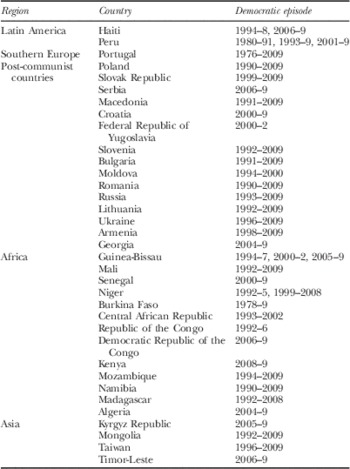
Then, I refer to Elgie’s recent book (2011c: 24–5) and his blog ‘The Semi-Presidential One’ (2013) to identify semi-presidential systems. As in many recent studies (for example, Cheibub and Chernykh Reference Cheibub and Chernykh2008; Cheibub et al. Reference Cheibub, Gandhi and Vreeland2010; Colton and Skach Reference Colton and Skach2005; Kirschke Reference Kirschke2007; Protsyk Reference Protsyk2005; Schleiter and Morgan-Jones Reference Schleiter and Morgan-Jones2009), semi-presidentialism is defined as a system in which a president is popularly elected for a fixed term and a prime minister is responsible to parliament in the analysis (Elgie Reference Elgie1999: 13). Of those new semi-presidential democracies, I exclude countries that had been democratic for less than three years because their democratic performance is often overshadowed by the transitional context (Geddes Reference Geddes2003; Siaroff Reference Siaroff2003). Small countries with a population of less than a million are also excluded, because their social and political environments are significantly different from those of larger countries (Power and Gasiorowski Reference Power and Gasiorowski1997). Table 1 provides a list of Third Wave semi-presidential democracies and years included in the analysis.
Third Wave Semi-Presidential Democracies Included in the Analysis, 1974–2009

Sources: Elgie (Reference Elgie2011e, Reference Elgie2013); Polity IV (2010a).
Dependent Variables
There are four dependent variables, of which two account for executive-level performance and the other two system-level performance. For executive-level performance, I focus on government instability measured by impeachment attempts and prime ministerial turnover. Presidential impeachment attempts are defined as efforts made by deputies in the legislature to effect a constitutional removal of a president, including attempts to declare the president as incapacitated. Impeachment efforts take various forms, ranging from an explicit call by some deputies to impeach the president, deputies attempting to collect the required number of votes/signatures to put the impeachment initiative on the legislative agenda, the legislature holding a vote on whether to impeach in the plenary session, to the legislature passing an impeachment vote. I exclude simple impeachment calls since they might be initiated for a politicking purpose rather than as a serious effort to remove a president.Footnote 4 I search all English news sources from LexisNexis Academic (2011) containing a president’s last name and ‘impeach’/‘incapacity’ during a president’s tenure in office.Footnote 5 This is a dummy variable set to 1=an impeachment attempt, 0=otherwise.Footnote 6
Prime ministerial turnovers are defined as situations in which a prime minister is replaced by a new figure. I do not include changes of a prime minister immediately after parliamentary elections, because they are not outcomes of government instability (Cheibub and Chernykh Reference Cheibub and Chernykh2009; Roper Reference Roper2002). I refer to Rulers (2011), World Political Leaders (2011) and various election data archives to identify new prime ministers. This variable, too, is binary in which 1=the event in question, 0=otherwise. The data show that challenges to a prime minister have been more frequent than challenges to a president. While presidents have been subject to legislative impeachment drives in only 8 per cent of years in the sample, 28 per cent of years have experienced a prime ministerial turnover without parliamentary elections.
For system-level performance, I turn to the quality of democracy and democratic breakdown. Following Elgie and McMenamin (Reference Elgie and McMenamin2008: 330), I measure the quality of democracy by dividing democratic years into two groups: partial democracy (where a Polity2 score ranges from +1 to +5) and full democracy (where a Polity2 score ranges from +6 to +10).Footnote 7 The only difference from their approach is that I do not exclude country-years with a Polity2 score of +10. This is because we cannot be sure that a score of +10 is a sign of democratic consolidation in these new democracies (see note 3). Full democracy is coded 1 and partial democracy, 0. Overall, full democracy is more common (75 per cent of years in the sample) than partial democracy (25 per cent).
Democratic breakdown, the last dependent variable, is a situation in which new democracies cease to function as a result of a coup or civil war. Relying on Polity IV data, countries are considered as non-democracies if their composite democracy score falls below +1, or becomes −77 (‘a collapse of central state authority or a revolutionary transformation in the mode of governance’ – Polity IV Project 2010b). Democratic failure is a rare event. There have been 11 incidents in which a new democracy collapsed: Burkina Faso (1980), Central African Republic (2003), Guinea-Bissau (1998, 2003), Haiti (1999), Madagascar (2009), Niger (1996, 2009), Peru (1992, 2000) and Republic of the Congo (1997). This variable is dichotomous, where 1 is for a year of democratic breakdown, and 0 otherwise.
Independent Variables
This study focuses on the impact of divided minority government, cohabitation, presidential powers and a president-parliamentary configuration, which have been identified in the literature as influential factors in democratic performance of semi-presidential regimes. A divided minority government is defined as a situation in which ‘neither the president nor the prime minister, not any party or coalition, enjoys a substantive majority in the legislature’ (Skach Reference Skach2005: 15). To gauge the distribution of electoral support for political parties/coalitions in the legislature, I rely on election results databases such as Adam Carr’s Election Archive (Reference Carr2011) and Election Results Archive (2011). As a dichotomous variable, 1 is assigned to divided minority government and 0, otherwise. Divided minority government has been quite common in semi-presidential democracies. In about 53 per cent of years in the sample, no party or coalition has controlled a majority.
Cohabitation is a situation in which the president and the prime minister hail from different parties/coalitions and the president’s party/coalition is not represented in the executive (Elgie Reference Elgie2011d: 12). Thus, cases in which they come from the same party or coalition, or where one comes from a party but the other is an independent, or both are independents, are not considered as cohabitation. I rely on ‘The Semi-Presidential One’ (Elgie Reference Elgie2013) to identify cases of cohabitation. This is a dummy variable set to 1 for cohabitation and 0 for no cohabitation. Cohabitation has been less common than divided minority government, having occurred in only about 13 per cent of democratic country-years.
On presidential powers, I rely on Siaroff’s (Reference Siaroff2003) data to construct a presidential power index. He measures presidential powers using nine indicators: popular election, concurrent election of president and legislature, discretionary appointment power, chairing of cabinet meetings, right of veto, long-term emergency and/or decree power, central role in foreign policy, central role in government formation and ability to dissolve the legislature. Each indicator takes a value of either 1 or 0 depending on the presence of the relevant power. I add values of these indicators except for the first two, because all presidents in the sample are popularly elected, and electoral concurrency of the presidency and the parliament is not likely to affect presidential power. The mean for the presidential power index is 4.03, suggesting that presidents in semi-presidential systems enjoy fairly significant constitutional powers.
Finally, I include a dummy variable for subtypes of semi-presidentialism (1=president-parliamentarism, 0=premier-presidentialism). In the former, the prime minister and cabinet are responsible to both the president and the legislature. At the same time, the president has power to dismiss the legislature. In premier-presidentialism, the prime minister and cabinet are solely responsible to the legislature and the president does not have power to dissolve the legislature (Shugart and Carey Reference Shugart and Carey1992). I refer to Elgie (Reference Elgie2011e) to classify subtypes of semi-presidentialism. Overall, premier-presidentialism is slightly more common than president-parliamentarism (60.17 vs. 40.83 per cent).
Control Variables
The analyses include several control variables across all dependent variables. To control for the impact of social instability on democratic performance, I incorporate the number of anti-government demonstrations (Banks Reference Banks2011) and an index of ethnic fractionalization (Fearon and Laitin Reference Fearon and Laitin2003).Footnote 8 The effects of economic performance on democratic performance are controlled for by including an annual percentage growth rate of GDP per capita and logged inflation from World Development Indicators (World Bank 2010).Footnote 9 I also control for years elapsed since democratic transition because there might be differences in the democratic performance between relatively younger and older democracies (Reilly Reference Reilly2011).
Some controls are only applied to certain dependent variables. To the system-level dependent variables (levels of democracy and democratic survival), I add the number of government crises (Banks Reference Banks2011).Footnote 10 For impeachment attempts and changes of a prime minister, I include a dummy variable for a presidential and prime ministerial scandal, respectively.Footnote 11 Lastly for impeachment attempts, I control for the impeachment threshold measured by the percentage of legislative votes required to authorize an impeachment trial.
The data are time-series cross-sectional, with democratic country-years as the unit of analysis. For impeachment attempts, prime ministerial turnovers and quality of democracy, I employ a logit analysis with country-random effects to control for the combined influence of unobserved heterogeneity across countries. In order to control for time dependency of the dependent variables, I include a spell counter variable and estimate models with cubic splines (not shown here) (Beck et al. Reference Beck, Katz and Tucker1998). For democratic breakdown, I use a rare events logit analysis clustered by country because there is a relatively limited number of these events (King and Zeng Reference King and Zeng2001). The Appendix provides a brief definition and summary statistics of the variables used in the analysis.
Assessing Democratic Performance of Semi-Presidential Systems
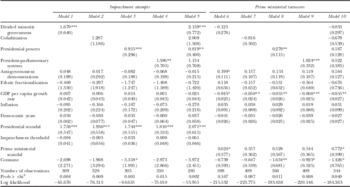
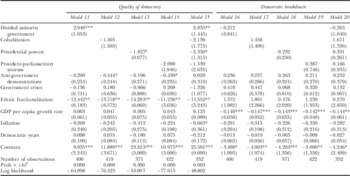
To analyse the democratic performance of semi-presidential systems, I present five models for each dependent variable. The first model examines the impact of divided minority government. In the next three models, I add cohabitation, presidential powers and president-parliamentarism separately in place of divided minority government. Then I examine the effects of all four independent variables in the following model. Table 2 presents the results for impeachment attempts and prime ministerial turnovers. Next, I show how semi-presidential regimes perform in the area of democratic quality and breakdown in Table 3.
Semi-Presidential Systems and Executive Instability in Third Wave Democracies, 1974–2009

Note: Numbers in parentheses are standard errors; significance levels: *** (1%), ** (5%) and * (10%) for a two-tailed test.
Semi-Presidential Systems, Quality of Democracy and Democratic Breakdown in Third Wave Democracies, 1974–2009

Note: Numbers in parentheses are standard errors for quality of democracy and robust standard errors for democratic breakdown; significance levels: *** (1%), ** (5%) and * (10%) for a two-tailed test.
Table 2 confirms in part the pessimistic view of semi-presidentialism with regard to executive instability. When no party or coalition controls a majority in the legislature (that is, a divided minority government), presidents become more vulnerable to legislative impeachment efforts (Models 1 and 5). An imbalance in powers between presidents and parliament produces another source of executive instability; confirming earlier studies on presidential instability (Baumgartner Reference Baumgartner2003; Fish Reference Fish2006; Kim Reference Kim2014), presidents with stronger powers are shown to be more subject to impeachment drives (Models 3 and 5). Additional risk for a president comes from president-parliamentarism (Model 4). In such systems the legislature is more likely to challenge a president, although the effect is overshadowed by divided minority government and presidential powers in Model 5.
As for the second type of executive instability, a prime minister’s tenure in office becomes less stable when presidents enjoy stronger powers and both the president and the legislature can determine the political fate of the prime minister and cabinet (Models 8 and 9). Thus, earlier conclusions based on the experience of post-communist countries (for example, Roper Reference Roper2002; Sedelius and Ekman Reference Sedelius and Ekman2010) appear to hold in a broader set of countries.
One interesting finding from Table 2 is that a divided minority government does not make changes of a prime minister more likely, even though it makes presidents more susceptible to impeachment attempts. This may be due to the practical difficulty of changing prime minister in a divided minority government. Deputies may try to replace a prime minister, but they are unlikely to succeed when the legislature is fragmented. In contrast, challenging a president does not require majority support except for later stages of impeachment efforts (that is, the passage of an impeachment motion). Consequently, impeachment attempts, if not prime ministerial turnovers, are more likely to occur in divided minority governments.
Another notable finding is that cohabitation does not affect executive instability in any form. The direction of the variable is not consistent across two indicators of executive instability (positive for impeachment attempts and negative for prime ministerial turnovers), nor significant. Therefore, the theoretical advantages and disadvantages of cohabitation largely seem exaggerated as far as executive stability concerns.
Since support by coalition may be less stable, I tested in Table 2 an alternative measure of divided minority government by disaggregating a coalition by constituent parties (Linz Reference Linz1994: 54). Focusing solely on each party’s seat distribution in parliament rather than a coalition’s, the results (not reported) remain consistent as reported in Table 2. The new indicator of divided minority government is still significant with a positive sign in Models 1 and 5, but loses significance in Models 6 and 10. Coalition formation thus does not seem to have a discernible effect on executive stability. I also examined the effect of a president’s partisan resource in the legislature (measured by the percentage of seats held by a president’s party) in place of divided minority government because limited legislative support may intensify the problems of dual legitimacy between two popularly elected institutions (Jones Reference Jones1995; Valenzuela Reference Valenzuela2004). In line with previous research on impeachment (Kim Reference Kim2014; Pérez-Liñán Reference Pérez-Liñán2007), presidents enjoying strong legislative support are more likely to resist impeachment efforts. However, a president’s partisan support has no effect on prime ministerial turnovers (results not reported here).
As for controls, the implication of the president in scandal drives the legislature to initiate an impeachment process (Models 1–5). In a similar vein, a prime minister is likely to lose his or her job when a scandal becomes public (Models 6 and 10). However, a higher GDP per capita growth rate makes a prime minister’s office more secure as in general he or she is in charge of managing the national economy (Models 6–10).
When the discussion turns to the quality of democracy, divided minority government seems to be a boon for semi-presidential democracies. Belying most of empirical research thus far, the levels of democracy are higher in divided minority government (Models 11 and 15). In contrast, cohabitation does not appear to have any impact (Models 12 and 15). What matters more for the levels of democracy is how partisan support is distributed in parliament, not partisanship congruence between a president and a prime minister.
It is important to note that this positive effect of divided minority government on the levels of democracy is consistent with Elgie’s (Reference Elgie2011a) most recent findings. In a statistically oriented study incorporating both new and consolidated semi-presidential democracies, he finds that divided minority government leads to higher levels of democracy. Instead of accepting the results, however, he suspects that a skewed distribution of divided minority government towards better-performing (or consolidated) democracies may be responsible for the ‘confounding’ findings (Elgie Reference Elgie2011f). Nevertheless, divided minority governments still turn out to be associated with higher levels of democracy when focused solely on new semi-presidential regimes. Therefore, we may conclude that checks and balances, constitutional flexibility and greater political inclusiveness outweigh any potentially negative consequences of divided minority government for the levels of democracy.
How, then, should we understand the contradictory effects of divided minority government on executive instability (impeachment attempts) and quality of democracy? The answer may lie in the potentially positive role played by executive instability for democratic quality. A president faced with legislative challenges may become most willing to compromise and revise a confrontational approach towards the legislature. In a similar way, the president may have incentives to set aside or even abandon his or her controversial agenda (Kim Reference Kim2014). Although these changes originate from the president’s effort to survive in the crisis, in doing so they are likely to have positive effects on democratic quality.
As in executive instability, what is worrisome for new semi-presidential democracies is to have presidents enjoying unbalanced powers. Mirroring Elgie and McMenamin’s finding (Reference Elgie and McMenamin2008), stronger presidential powers are likely to decrease the levels of democracy (Models 13 and 15). This leads us to conclude that checking presidential powers is crucial for consolidating democracy in semi-presidentialism. Cohabitation and president-parliamentarism, however, do not show any discernible effects on democratic quality.
As for the last dependent variable, none of the widely cited caveats against semi-presidential systems makes democratic breakdown more likely (Models 16–20). Cohabitation, presidential powers and president-parliamentary systems have a positive sign, but they do not attain statistical significance. Nor does divided minority government (with a negative sign).Footnote 12
Without accounting for a coalition’s support, a divided minority government is still conducive to higher levels of democracy and has no effect on democratic breakdown. However, greater partisan support for a president in the legislature dampens the quality of democracy (results not reported here). Although a president may easily fulfil his or her political agenda with the help of a legislative majority, strong partisan support for the president in the legislature appears to threaten checks and balances between the president and the legislature, thereby generating harmful effects on the levels of democracy.
Regarding control variables, ethnically diverse countries tend to experience lower levels of democracy (Models 11–15), and democratic survival is more likely in countries with a higher GDP per capita growth rate (Models 16–20). Therefore, economic performance is a suitable predictor of whether or not a country will fall prey to democratic failure (Przeworski and Limongi Reference Przeworski and Limongi1997).
Finally, this study does not find evidence that all the factors causing executive instability have the same adverse effects on the quality or survival of democracy. Although divided minority governments and president-parliamentarism produce risk factors for executive stability, the effects do not hold at the system level. Rather, the fragmented legislature contributes to the higher democratic quality. Nevertheless, strong presidential powers continuously threaten executive stability and quality of democracy.Footnote 13
Conclusion
Empirical research on semi-presidential systems thus far is replete with pessimistic conclusions with regard to their democratic performance. Considering the increasing popularity of such systems, the adverse findings cast doubt on the future of those new democracies. In this study, I re-examined how new semi-presidential regimes perform in the areas of impeachment attempts, prime ministerial turnovers, quality of democracy and democratic breakdown from 1974 to 2009.
The results show that some of the negative views on semi-presidentialism are exaggerated in the literature. Most importantly, divided minority government is positively associated with higher levels of democracy in these countries. Given that divided minority government occurs quite often in dual-executive systems, this finding seems particularly encouraging for countries that contemplate a switch to semi-presidentialism. The well-known perils of cohabitation are not substantiated with regard to executive instability and quality of democracy. In addition, none of the caveats about semi-presidential systems makes them more vulnerable to democratic breakdown.
At the same time, some pessimistic assessments of semi-presidential systems receive empirical support. Divided minority government and president-parliamentarism are more likely to generate executive instability in the form of impeachment attempts or changes of a prime minister. However, executive instability may not necessarily be an alarming sign, given the fact that impeachment attempts are often employed as a means of resolving inter-branch conflicts. This may explain why a divided minority government has negative effects on government stability, while having positive effects on democratic quality.
What is truly destabilizing for a semi-presidential system is a failure to check presidential powers. Not only are countries more likely to experience executive instability under such circumstances, but the levels of democracy are also lower. This finding leaves us with a clear implication concerning strategies of consolidating new semi-presidential democracies: executive powers need to be balanced between president and prime minister. This does not require a major constitutional overhaul such as transforming to parliamentarism or presidentialism. What is necessary is a relatively minor constitutional amendment regulating the distribution of executive powers. If countries can successfully check presidential powers, then a semi-presidential system may appear to be a more appealing option than it does now for many young democracies.
Acknowledgements
An earlier version of this paper was presented at the 2011 Midwest Political Science Association Annual Meeting. I would like to thank two anonymous referees, Jody Baumgartner, Marion Blackburn and Robert Villanueva for their helpful comments and suggestions on earlier drafts of the paper.
APPENDIX
Brief Definition and Summary Statistics of Variables