The incidence rate of CHDs is within the range of 4–10 in 1000 live births. Transposition of the great arteries is the most frequent CHD in the neonatal period, and it constitutes approximately 5% of all CHDs.Reference Qureshi, Justino, Heinle, Shaddy, Penny, Feltes, Cetta and Mital1–Reference Erek, Suzan and Aydın4 Nearly half of the patients have an isolated (simple) transposition of the great artery; they have no additional cardiac defects apart from patent foramen ovale, patent ductus arteriosus, or a haemodynamically insignificant small ventricular septal defect. The condition is defined as a complex transposition of the great artery if it is combined with other cardiac anomalies, such as a left ventricular outflow tract obstruction, large ventricular septal defect, coarctation of the aorta, and hypoplasia of the arch. The currently accepted surgical treatment method is arterial switch operation, which provides full anatomic correction.Reference Erek, Suzan and Aydın4,Reference van Velzen, Haak and Reijnders5 As for the Taussig–Bing anomaly, it defines patients with a double-outlet right ventricle, whose great arteries are transposed and who have a generally wide ventricular septal defect at a subpulmonic location. Double-outlet right ventricle disease constitutes 1% of all CHDs, while Taussig–Bing anomaly encompasses nearly 20% of double-outlet right ventricle disease patients.Reference Lara, Fixler, Ethen, Canfield, Nembhard and Morris6 In terms of treatment, arterial switch operation and ventricular septal defect closure as well as aortic arch reconstruction, if concurrent, are performed.Reference van Velzen, Haak and Reijnders5,Reference Jaggers, Cameron, Herlong and Ungerleider7
During the intrauterine life, transposition of the great artery and Taussig–Bing anomaly do not negatively affect the baby; however, if an early diagnosis and treatment cannot be provided after birth, it may lead to death in the neonatal period. Therefore, making a diagnosis during the fetal period is very important. With the development of echocardiography (echo) equipment and techniques, the rate at which CHDs can be diagnosed in the prenatal period has increased. Some studies have identified that an early diagnosis reduces pre-operative mortality rates in the neonatal period; however it could not be demonstrated with certainty that a prenatal diagnosis can reduce mortality in transposition of the great artery and Taussig–Bing anomaly patients.Reference Byrne, Glatz, Griffis, Millenson and Gillespie8 Nonetheless, prenatal diagnosis can positively affect prognosis, as the patients can be transferred to a suitable neonatal-cardiovascular surgical centre, if needed, or the delivery can be performed at centres with suitable and adequate capacities. The aim of this study is to investigate the effect of the presence of a prenatal transposition of the great artery or Taussig–Bing anomaly diagnosis on patients who underwent arterial switch operation on pre-operative and post-operative morbidity and mortality.
Patients and methods
In this study, the hospital records of patients diagnosed with transposition of the great artery or Taussig–Bing anomaly who underwent arterial switch operation, at the Acıbadem Mehmet Ali Aydınlar University School of Medicine’s Atakent Hospital (a tertiary cardiac surgery centre) between February, 2014 and December, 2019 were retrospectively evaluated. The pre-operative, peri-operative, and post-operative data of 112 patients were reviewed, providing information from their admission to the hospital until their discharge. The patients were divided into two groups: those who were diagnosed prenatally (Group 1) and those who were not diagnosed (Group 2), and the findings obtained were compared. The patients were classified under simple transposition of the great artery, transposition of the great artery-ventricular septal defect, transposition of the great artery aortic arch hypoplasia, and Taussig–Bing anomaly, in accordance with the echo exam results and recommendations of the International Congenital Cardiac Surgery Nomenclature and Database Conference.Reference Blyth, Howe, Gnanapragasam and Wellesley9 During the echo exam performed by a paediatric cardiologist after birth, the cardiac functions, additional cardiac defects, and the pre-operative need for atrial septostomy were evaluated. Prostaglandin E1 infusion treatment at a rate of 0.01 mcg/kg/minute was initiated immediately after diagnosis. The age and body weight of patients at the time of surgery, their post-operative intensive care, and their clinical service findings were recorded. Patients who died in the first 28 days were assessed as neonatal mortalities.
Patient data were entered into the Statistical Package for the Social Sciences (SPSS) 15.0 data recording system and were statistically assessed. The categorical variables were specified in terms of their frequency and percentage, and permanent variables were specified as the average ± standard deviation or median value. The association between the two nominal variables was evaluated using the Pearson chi-squared test. For analysing the data that did not show a normal distribution between the two groups, the Mann–Whitney U test was used. The value of p < 0.05 was accepted as statistically significant.
The study was approved by the local ethics committee of Acibadem University (No: ATADEK 2018-13/2).
Results
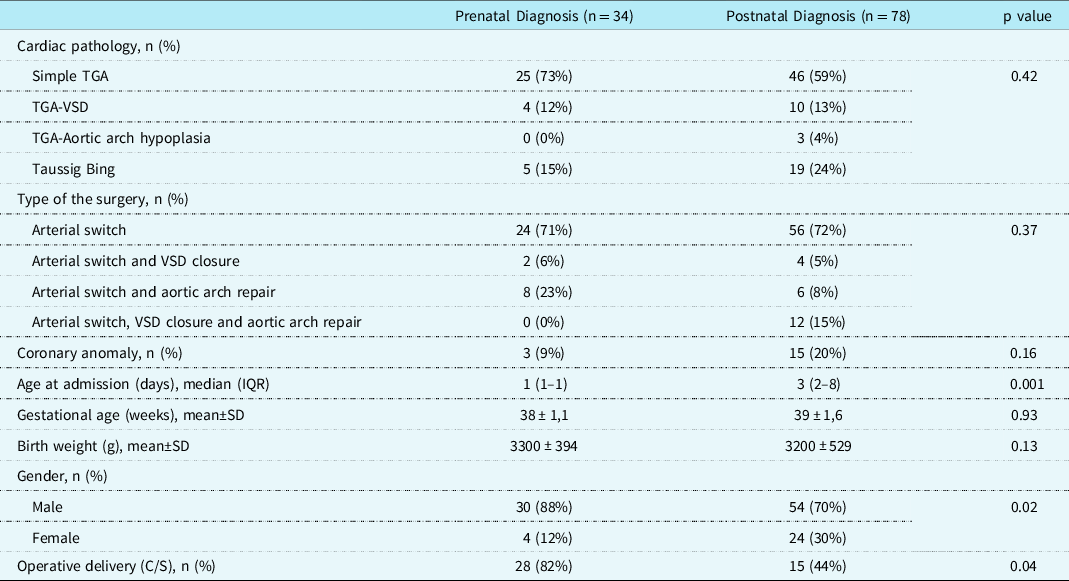
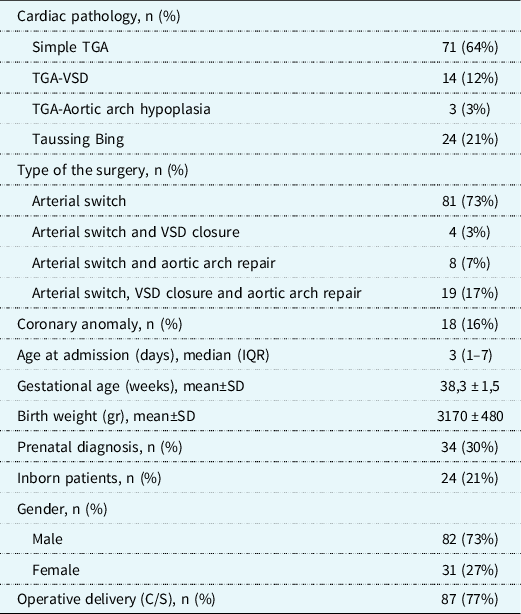
While 34 (30%) of 112 patients who underwent arterial switch operation with a diagnosis of transposition of the great artery or Taussig–Bing anomaly had a prenatal diagnosis (Group 1), 78 patients (70%) did not have a prenatal diagnosis (Group 2). Of the patients included, 82 were male (73%) and 30 were female (27%). The ratio of male infants to female infants was found to be 2.7:1. The average age of patients at diagnosis was 3 (1–7) days, the average body weight was 3.170 ± 480 g, and the average number of gestational weeks was 38.3 ± 1.5 weeks. Eighty-six were born via C-section (77%) and 26 via normal vaginal delivery. It was observed that patients who had a prenatal diagnosis had a higher rate of C-section (82% vs. 44%; p = 0.004). Twenty-nine patients (26%) were born at Atakent Hospital, 39 (35%) at another hospital in Istanbul, and 44 (39%) in cities other than Istanbul (Table 1).
Comparison of hospital data of patients with and without prenatal diagnosis

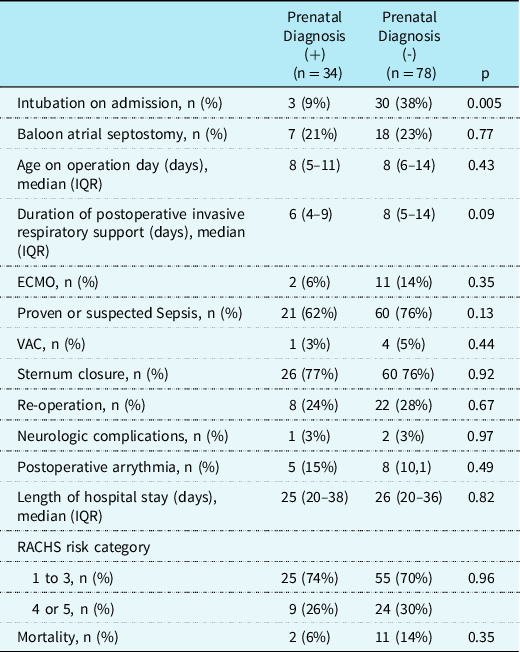
Of these 112 patients, 71 were diagnosed with transposition of the great artery (63%), 14 with transposition of the great artery-ventricular septal defect (13%), 3 with transposition of the great artery aortic arch hypoplasia (3%), and 24 with Taussig–Bing anomaly (21%) (Table 1). The presence of a prenatal diagnosis, sex, age at pregnancy, and birthweight were similar between these groups (p > 0.05). It was identified that 18 of these patients (16%) also had a coronary abnormality. The incidence of coronary abnormality was similar between the groups (9% vs. 20%; p = 0.16) (Table 2). No patients were lost in the pre-operative period. A balloon atrial septostomy procedure was conducted before arterial switch operation on 25 patients (22.3%) that had isolated transposition of the great artery and restrictive patent foramen ovale. The rates of septostomy were found to be similar in both groups (21% vs. 23%; p = 0.77). Patients who had a prenatal diagnosis were more often intubated at the time of admission to the neonatal ICU (38% vs. 9%; p = 0.005).
Basic characteristics of patients undergoing arterial switch operation

TGA = Transposition of great arteries; VSD = Ventricular septal defect.
For the two-stage arterial switch operation, two patients received pulmonary band surgery, and one patient received band and septectomy surgery during the same session. No statistically significant differences were found between the two groups with respect to operation time, cardiopulmonary bypass time, aortic cross-clamp time, the rate at which surgery was ended with an open sternum, post-operative invasive respiratory support duration, or extracorporeal membrane oxygenation support. When the four groups were examined by diagnosis, no statistically significant differences were found with respect to post-operative mechanical ventilation support. There were also no differences found in the intensive care monitoring period of patients who were discharged [25 (20–39) days vs. 26 (20–35) days; p = 0.964] (Table 3).
Comparison of operation and post-operative data of patients with and without prenatal diagnosis

ECMO = Extracorporeal membrane oxygenation; IQ = Interquartile range; SD = Standard deviation; VAC = Vacuum assist closure.
Four patients underwent plication surgery due to diaphragm paralysis, while two patients received revision due to haemorrhaging on the day after surgery and 4 days later. Neurological complications, onset of post-operative arrhythmia, and duration of hospital stay were the same in both groups. Among patients who underwent arterial switch operation, 13 (11.6%) died. The mortality rate was 6% in Group 1 and 14% in Group 2 (p = 0.35) (Table 3). Of the deaths following surgical treatment, 62% occurred in the neonatal period. The average time of death was 22 (15–45) days. Based on diagnosis, the mortality rates were found to be 7% for transposition of the great artery, 15% for transposition of the great artery-ventricular septal defect, 33% for transposition of the great artery aortic arch hypoplasia, and 21% for Taussig–Bing anomaly. It was observed that mortality among those with Taussig–Bing anomaly was higher than other diagnoses (p = 0.04). Among the patients who died, the median age at death of those with a prenatal diagnosis (n = 2) was 15 (8–15) days, and it was 22 days (18–47) for those without a prenatal diagnosis (n = 11). No statistically significant age differences were found between these two groups (p = 0.308). The average age at surgery among patients who survived was 8 days (6–12 days), and the average age at surgery of patients who died was 11 days (7.5–14 days) (p = 0.21). No statistically significant difference in mortality rates was found between patients who received balloon atrial septostomy and those who did not (p = 0.9).
Discussion
The first surgical option in neonates diagnosed with transposition of the great artery or Taussig–Bing anomaly is arterial switch operation, which provides anatomic correction with the left ventricle being a systemic ventricle and the mitral valve being a systemic AV valve. A study in literature described the association of factors such as low birthweight, variations in the coronary anatomy, and the hospital and surgeon’s level of experience with operative mortality.Reference Cloete, Bloomfield and Sadler10 Several studies have been conducted in relation to the patients and the operation; however, the correspondence between a prenatal diagnosis, arterial switch operation results, and the information obtained on this topic is limited. The results regarding the effect of prenatal diagnosis on pre-operative mortality or early post-operative results for patients with transposition of the great artery are not consistent. The diagnosis of simple transposition of the great artery patients was found to be at a low rate of 3–27% in various studies on the prenatal period;Reference Jaggers, Cameron, Herlong and Ungerleider7,Reference Li, Zhou, Fang, Wang, Hua and Mu11 however, the rate of prenatal diagnosis has increased over the years.Reference Holland, Myers and Woods12 Since the transposition of the great artery disease presents a four-chamber image, it is important for a prenatal diagnosis to include the outflow tract and three-vessel images in the fetal echo screening protocols.Reference Jaggers, Cameron, Herlong and Ungerleider7 In our study of simple and complex transposition of the great artery and Taussig–Bing anomaly patients, the rate of prenatal diagnosis was found to be 30% in the study population and no differences were identified among the four groups with respect to the rate of prenatal diagnosis. Patients with a prenatal diagnosis have a higher rate of operative births. This situation may stem from the fact that clinicians would like to deliver the patients under stable conditions to reduce the risk of perinatal mortality and morbidity.
In neonates with transposition of the great artery, postnatal survival also depends on the timely delivery of specific treatments, such as prostaglandin infusion after delivery and, as necessary, the balloon atrial septostomy procedure. Even when diagnosed with transposition of the great artery at an early postnatal period, the infants who were born right outside the surgical centre were still at risk of death. The presence of an accompanying ventricular septal defect significantly increased the rate for prenatal diagnosis. In our patient series, it was identified that the accompanying ventricular septal defect did not change the antenatal diagnosis rates, which differed from the literature. This result was attributed to the fact that our hospital was a tertiary care centre and that only a few echo exams were performed for patients for whom this was deemed necessary by perinatology and paediatric cardiology. The same study identified that some patients with intact ventricular septum and restrictive patent foramen ovale who were not diagnosed in the prenatal period died after birth in spite of early diagnosis; these infants were also born outside of the metropolitan area, without the availability of a surgical centre. Such infants may not respond to prostaglandin treatment, so it is important to perform the balloon atrial septostomy procedure in time for their survival.Reference Holland, Myers and Woods12 Among the patients who were born at Atakent Hospital, there were no infants who had been undiagnosed in the prenatal period. Among the patients admitted from external centres who had not been diagnosed in the prenatal period, none of them were lost in the pre-operative period. This may be because patients suspected to have a CHD were rapidly transported and medical treatment was initiated immediately. For the patients who could not be diagnosed in the prenatal period, due to reasons such as cyanosis after birth, failure to pass the saturation screening test, and worsening of the general condition, paediatric cardiology evaluation was requested by the physician who followed the patient, and the patients were diagnosed with heart disease by performing an echocardiographic examination. After that, the patients were transferred to the hospitals, where they would be operated under appropriate conditions and quickly, by starting prostaglandin infusion, by 112 emergency service airplane ambulances affiliated to the Ministry of Health. Because of these factors, none of the patients died before the operation, and there was no significant difference between the two groups in terms of the frequency of balloon atrial septostomy procedure or complications. We think that rapid diagnosis after birth, initiation of appropriate medical treatment, and prompt referral under appropriate conditions are as important as diagnosis in the prenatal period in babies with congenital heart disease that could not be diagnosed prenatally.
In the literature, a meta-analysis published to assess the effect of prenatal diagnosis determined that a diagnosis made in the prenatal period significantly decreased pre-operative and post-operative mortality rates. It was reported that prenatal diagnosis resulted in an earlier response and more effective perinatal management for all CHD cases; however, it was only associated with reduced peri-operative mortality rates for transposition of the great artery patients.Reference Bekmez, Alyamaç Dizdar, Okur, Büyüktiryaki, Uras and Oğuz13 In another study including infants diagnosed with transposition of the great artery and critical coarctation of the aorta, the mortality rate was found to be 7% among infants diagnosed after birth; this rate was significantly higher than infants diagnosed in the antenatal period. The findings of this study emphasise the importance of timely diagnosis and early response.Reference Holland, Myers and Woods12 Strategies for optimising neonatal pre-operative care are required to reduce the overall mortality rate, especially in cases of simple transposition of the great artery. Another study, conducted between 2002 and 2012 with 144 transposition of the great artery and Taussig–Bing anomaly patients, identified that the rate of prenatal diagnosis was 26%, which is similar to our study. None of the infants diagnosed before birth and born alive died in the first year, but the mortality rate was 11.4% for infants who did not have a prenatal diagnosis. In simple transposition of the great artery cases without prenatal diagnosis, the presurgical mortality rate was 6.5%.Reference Jaggers, Cameron, Herlong and Ungerleider7
In our study, there was no statistically significant difference in mortality rates among patients who could not be diagnosed in the prenatal period. This was most likely caused by the fact that the patients who were referred could be taken into surgery early, using the most suitable medical approach. A meta-analysis of eight other studies compared neonatal patients diagnosed with critical CHD, some of whom were diagnosed in the prenatal period and some who were not, in terms of the mortality risk present before cardiac surgery. Among neonates with similar anatomy, the possibility of a prenatal diagnosis before the scheduled cardiac surgery has been found to be lower than patients diagnosed after birth, due to the factors of standard risk, the parents' wish to treat, and optimal care. For this reason, further studies and efforts are needed to improve the rate of prenatal diagnoses of CHD.Reference Bonnet, Coltri and Butera14
Another study investigated the effect of a prenatal diagnosis at a centre without a surgical clinic on the mortality of infants with CHD before referral. No statistically significant difference in mortality was identified between infants diagnosed in the prenatal period and those diagnosed in the postnatal period.Reference Landis, Levey and Levasseur15 In a separate study, it was demonstrated that a prenatal transposition of the great artery diagnosis was not associated with better neonatal survival results.Reference Byrne, Glatz, Griffis, Millenson and Gillespie8
On the other hand, a study by Bonnet et al. compared the pre-operative and post-operative results among infants diagnosed with transposition of the great artery and concluded that a prenatal diagnosis reduced the risk of mortality and morbidity.Reference Bonnet, Coltri and Butera14 In another study, the rate of intubation among patients diagnosed with a CHD in the prenatal period was lower than that of patients who were not diagnosed in the prenatal period. However, no correlation was found between the prenatal diagnosis and pre-operative or predischarge mortality rates.Reference Gupta, Mowitz, Lopez Colon, Nixon, Vyas and Co-Vu16 In another study that included patients with TGA, the average intubation period was found to be higher among infants with no prenatal diagnosis at 14.3 days versus 10.5 days. This study reported that a prenatal diagnosis is beneficial to reduce intubation in the pre-operative period, but the need for mechanical ventilation was mostly attributed to prostaglandin infusion or the rapid deterioration of the overall condition in this period.Reference Gupta, Mowitz, Lopez Colon, Nixon, Vyas and Co-Vu16 In our study, contrary to the literature, the statistical rate of pre-operative intubation at intensive care admission was significantly higher among patients who could not be diagnosed in the prenatal period, compared to patients diagnosed in the prenatal period. This result could be attributed to the wish to stabilise patients who are scheduled for surgery in the early period under appropriate conditions.
The best, cheaper, and the most secure way to transfer of the patients with critical congenital heart disease is in-utero transfer. Prenatal diagnosis is especially important in countries or cities which doesn't have enough sources for treatment. Long hours during transfer and waste of critical time may be very risky for critical neonates. In this study, we could only analyse the patients who could reach to our centre alive. The others who had no diagnosis before death or died during waiting period could not be calculated. It is a natural limitation of the study. Other limitations of our study are that the results were from a single hospital, the study was retrospective, and it was conducted before pulse oximetry screening was started. Prospective and multi-centre studies will be required for this purpose. Nonetheless, the power of our study is that the number of patients was high and that patients referred from different centres were assessed.
Conclusion
In conclusion, transposition of the great artery and Taussig–Bing anomaly are life-threatening diseases for neonates; however, surgical treatment is available for full anatomic correction. Timely treatment have a positive effect on neonatal mortality and morbidity. That’s why all families with prenatal diagnosis of critical CHD should be recommended to have the delivery in a tertiary care hospital. Although it could not be demonstrated in this study, prenatal diagnosis has a potential to improve surgical results especially in countries or cities, which does not have enough resources for transfer and surgical units. All families whose infant has been diagnosed with complex CHD before birth should be recommended to have the delivery in a tertiary care hospital. Further efforts are needed to improve prenatal screening programmes.
Acknowledgements
The author thank all the team members of this review for corporation.
Financial support
This research received no specific grant from any funding agency, commercial, or not-for-profit sectors.
Conflicts of interest
None.
Ethical standards
The study was approved by the local ethics committee of Acibadem University (No: ATADEK 2018-13/2).