Despite advances in operative techniques and better understanding of the pathophysiology of surgical site infection (SSI) evolution, SSI continues to be the main infectious complication among patients undergoing surgery.Reference Kirkland, Briggs, Trivette, Wilkinson and Sexton 1 Many studies have shown that a surveillance program leads to a reduction in SSI rate,Reference Choi, Adiyani and Sung 2 and the Centers for Disease Control (CDC) have established SSI surveillance programs with feedback to surgeons.
The direct surveillance method requires a healthcare worker to collect data after surgery during hospitalization and after discharge for 30–90 days, depending on the procedure. 3 An indirect surveillance method, which requires fewer resources, includes a combination of several techniques such as survey of microbiology laboratory data and diagnoses from patient records.Reference Klompas and Yokoe 4 The literature suggests that direct observation of surgical sites is the most accurate method, but this method is labor intensive and expensive. Surveillance during hospital stay only is not sufficient because at least half of SSIs occur after discharge.Reference Sands, Vineyard and Platt 5
Routine SSI surveillance is not obligatory in Israel, and it is not performed in most surgical departments. In 2008, we began to develop a semiautomatic surveillance tool that facilitates continuous SSI surveillance with fewer human resources. Here, we present our 5-year experience of surveillance in the orthopedic department using this tool.
MATERIALS AND METHODS
Setting and Participants
The intervention was conducted in the Orthopedic Department at the Mount Scopus campus of Hadassah-Hebrew University Medical Center. The surgeries followed were total hip or knee replacement or revision, hip hemiarthroplasty or fixation, anterior cruciate ligament repair, and spinal surgical procedures. Beginning in August 2008, all patients 18 years old or older who underwent one of these clean surgeries were included. We excluded surgeries during which infections were identified.
Surveillance Methods
Surgical-site infections were defined according to the CDC definitions, 3 but deep incisional and organ space infections were combined into deep SSIs. We developed a computerized system to collect all patient demographic and baseline clinical data. Wound status evaluation during the postoperative hospital stay was done by the department physicians as part of their routine clinical activity. In every morning round, instead of using free text, the wound status was documented in an obligatory structured field of the electronic patient record (ie, normal appearance or signs and type of infection, if any), and these data were transferred automatically to the computerized data collection system. To preserve the validity of the data, the physicians received formal training regarding CDC definitions for SSI 3 by the infection prevention team; they were also provided structured forms for follow-up. Postdischarge follow-up was performed at 2 time points: (1) 6 weeks after surgery at the routine visit at the hospital outpatient clinic or in the absence of a visit, a structured phone interview was carried out by an infection prevention practitioner; (2) during readmission or emergency department visit within 90 days after surgery (all readmissions were recorded automatically in the data collection sheet). Postdischarge wound status data were then inserted manually by an infection prevention practitioner who was responsible for the entire program. All cases of suspected SSI and all inconclusive cases were reviewed by the infectious prevention physician in charge (S.B.).
In addition, we compared our surveillance tool to indirect surveillance based on reviewing discharge and readmission diagnoses only. A report of all patient diagnoses during hospitalization or readmission within 90 days after discharge was prepared by the medical records department and was inspected for SSI infection or suspected infection diagnosis.
Data Analysis
Infection rates were calculated annually per surgery type and were compared to those reported by the CDC/NHSN.Reference Edwards, Peterson and Mu 6 Proportions of infections diagnosed during hospitalization and after discharge were computed. Rates using indirect surveillance were compared to those from direct surveillance (accepted standard), and sensitivity and specificity of indirect surveillance were calculated. The annual infection rates over time were calculated using the Mantel trend test (WinPepi software).Reference Abramson 7 All P values were 2-tailed, and P <.05 defined statistical significance. Infections diagnosed after joint replacement surgeries were also analyzed using statistical process controlReference Benneyan, Lloyd and Plsek 8 and are presented in a g-type control chart. This type of analysis is based on the interval of procedures between infections.
RESULTS
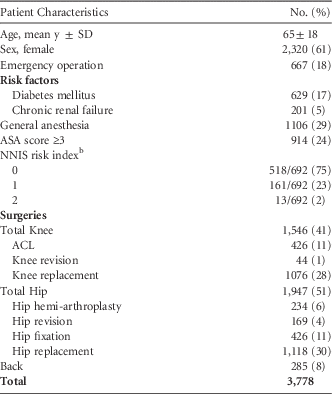
From August 1, 2008, to December 31, 2012, data from 3,778 procedures in 3,608 patients were collected. Demographic, clinical details and surgery types are presented in Table 1. Risk factors for infection were identified in a minority of patients. Prophylactic antibiotic treatment was given at the appropriate time (within 1 hour of incision) in 85% of the procedures.
Patient Demographic and Baseline Clinical Data and Categories of Surgeries (2008–2012Footnote a )

NOTE. ASA score, American Society of Anesthesiologists score; NNIS, National Nosocomial Infection Surveillance System; ACL, anterior cruciate ligament.
a During 2008, the follow-up was conducted for 5 months (Aug–Dec).
b Measured only during 2012 in 692 patients.
Follow-Up for Detection of Surgical Site Infections (SSI)
Surveillance during hospitalization and after discharge was completed in 94% and 95% of procedures, respectively. Referral to the hospital within 180 days post-operatively was detected in 1,190 of 3,778 patients (31.5%), mostly during the first month after operation. Among these, 659 (55%) were seen only in the emergency department and were not hospitalized. Among the 531 who were readmitted, 352 (66%) were hospitalized in the orthopedic department.
Surgical Site Infection (SSI) Rates and Cultures
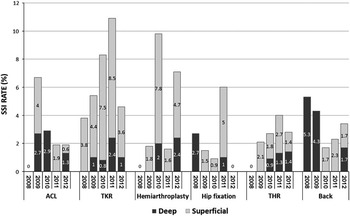
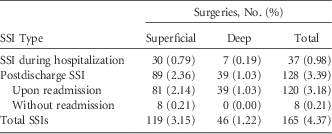
Overall, SSIs were diagnosed in 165 of 3,778 (4.4%) surgical patients (Table 2); a third of these were deep SSIs (46 of 165, 27.9%). The mean time (±SD) for postsurgery SSI diagnosis was 24 (±23) days. Most infections were diagnosed after discharge (128 of 165, 77.5%). Most patients diagnosed with SSI after discharge were referred to the hospital (120 of 128, 94%). All patients with postdischarge SSI who did not seek readmission (8 of 128, 6%) had superficial infections. Yearly crude rates of infection and surgery type are presented in Figure 1. There were no significant annual trends in infection rates over time (ie, P was not significant for total and for surgery specific annual infection rates). Analysis of SSI rate by g-type control chart showed that the number of surgeries between 2 infections increased significantly for total knee replacement surgeries, expressing a decrease in SSI frequency (Supplementary Figure 1). Positive bacterial cultures were obtained in 63 of 165 SSIs (38%): 39 of 46 deep SSIs (85%), and 20 of 119 superficial SSIs (17%). Staphylococcus aureus was the most common pathogen, found in 31 of 63 (49%) positive cultures, and most were being methicillin sensitive (30 of 31, 97%).
Crude yearly rates of surgical site infections in clean orthopedic surgeries between 2008 and 2012. SSI, surgical site infection; ACL, anterior cruciate ligament; TKR, total knee replacement; THR, total hip replacement.

Surgical-Site Infection (SSI) by Timing of Diagnosis and Depth of Infection in Clean Orthopedic Surgeries at Hadassah Medical Center, 2008–2012Footnote a

a Total number of surgeries =3,778.
Analysis of Various Surveillance Methods
Surveillance by diagnoses recorded in patient files had a sensitivity of 34.5% (95% CI, 27.3%–42.3%) and a specificity of 98.3% (95% CI, 97.9%–98.7%) (Supplementary Table 1). In comparison, direct SSI surveillance, which includes in-hospital follow-up together with readmission evaluation, but without outpatient clinic information or phone interview, had a detection rate of 95.5% (95% CI, 90.1%–97.8%), with no false-positive SSI diagnoses.
DISCUSSION
We present an innovative computer-assisted surveillance system that combines direct observation during hospital stay with a thorough follow-up after discharge. A central component of the system is daily inspection of the surgical wound by the attending physician and mandatory reporting in the patient’s electronic medical chart. Follow-up after discharge included outpatient clinic visit data, a structured phone interview, and review of readmission data. We found that reviewing only readmission data was highly sensitive for postdischarge SSI detection and therefore precluded the need for outpatient clinic visit data and phone interview. Using this combined method enabled us to perform highly accurate continuous surveillance with relatively few human resources. This routine and permanent SSI surveillance is unique in Israel and allows us to provide periodic feedback to the surgeons concerning SSI rates.
Most postoperative infections occur after discharge, especially when the initial hospitalization is short.Reference Edwards, Peterson and Mu 6 , Reference Ward, Charlett, Fagan and Crawshaw 9 In our study, 78% of postoperative infections occurred after discharge; therefore, our monitoring system included comprehensive postdischarge surveillance. Postdischarge follow-up at several stages as well as high rates of completion of the follow-up during hospitalization increases the sensitivity of the monitoring and strengthens the confidence in its accuracy and validity. Nearly all infections identified after discharge, 120 of 128 (94%), were detected upon readmission or emergency department visits. We found that the sensitivity of surveillance, which includes follow-up during hospitalization and assessment of readmission data, is 95.5%. This high value allows us to dispense with assessment of the outpatient clinic and phone calls and to use rehospitalization only for postdischarge follow-up. This method, while maintaining high sensitivity of SSI detection, reduces the proportion of patients who need assessment after discharge to 30% (those who returned to the emergency room or were hospitalized within 3 months). In our orthopedic department, patients return to the hospital according to the instructions they receive, even for the slightest suspicion of infection, and this policy enables us to rely on readmission only.
We developed a computerized system that enables us to collect a significant part of the SSI data automatically. Furthermore, physicians are required to report wound status daily during morning visits, and these data are stored in the computerized file. Rehospitalization is recorded automatically in the same file, which eases the identification of patient records that should be further assessed. The system can be further improved by adding a mandatory field for wound status upon readmission. However, a system administrator is needed to operate the system and to analyze the data.Reference Klompas and Yokoe 4 , Reference Lower, Eriksen, Aavitsland and Skjeldestad 10
Regarding our SSI rates, we did not find an overall decline in infections over these 5 study years. Perhaps this is because the underlying deep infection rate was low, as reflected in the comparison of our infection rate with the NHSN data.Reference Edwards, Peterson and Mu 6 It is also possible that sensitivity increased with the development of the monitoring system. Another possible explanation is that the staff received feedback only once a year, which makes potential corrective actions difficult. Providing more frequent feedback may lead to corrective actions, which in turn may yield a reduction in SSI rate. Using statistical process control presented by a g-type control chart,Reference Benneyan, Lloyd and Plsek 8 feedback can be provided more frequently and continuously.
A comparison of the SSI rates detected by our surveillance system with those found through diagnoses codes for infection in the discharge and readmission letters showed very low sensitivity (34.5%) and indicates a low accuracy of diagnoses codes regarding SSI in discharge letters at our institution.
The study has several limitations. First, the reliability of postdischarge SSI detection by readmission only might not be widely applicable. It may be restricted to a system in which patients are instructed to return to the hospital in which the surgery was performed, as actually occurs in our hospital. Second, because the hospital surveillance is performed by the residents and not by an external observer, it is reliable only after thorough instruction of the physicians and assurance that their reporting is accurate. The mandatorily daily recording of wound status by the attending physician during hospitalization lowers the chance of omitting patient data from the medical record.
In summary, we created a semiautomatic surveillance system assisted by the surgeons for in-hospital wound follow-up. The fact that almost every patient who developed SSI after discharge was readmitted allows limiting postdischarge follow-up to patients who were readmitted, thus significantly reducing the workload without reducing surveillance accuracy. The principles of this model can be adopted by other hospitals if physician reports are valid and if the readmission policy is similar to the one described in this study.
ACKNOWLEDGMENTS
Financial support: No financial support was provided relevant to this article.
Potential conflicts of interest: All authors report no conflicts of interest relevant to this article.
SUPPLEMENTARY MATERIAL
To view supplementary material for this article, please visit https://doi.org/10.1017/ice.2016.322