Introduction
Community surveys consistently find that elderly people have much less clinical depression than younger people (Jorm, Reference Jorm2000; Blazer & Hybels, Reference Blazer and Hybels2005). A number of explanations have been proposed for this finding, most focusing on the possibility that depression is underestimated among the elderly. Suggested biases include age-related differentials in recall, mortality, selection out of the household population into nursing homes, willingness to participate in surveys and willingness to admit psychiatric symptoms in interviews (Snowdon, Reference Snowdon1997; Schoevers et al. Reference Schoevers, Geerlings, Deeg, Holwerda, Jonker and Beekman2009). However, evidence for these methodological interpretations is weak (Ernst & Angst, Reference Ernst and Angst1995), leading some commentators to conclude that the low estimated prevalence of depression among the elderly is genuine (Blazer & Hybels, Reference Blazer and Hybels2005).
One issue that complicates analysis of late-life depression is that many physical disorders become increasingly prevalent in old age, making boundaries with depression sometimes unclear and raising the possibility that depression is underestimated because it is confused with the symptoms of physical disorders (Drayer et al. Reference Drayer, Mulsant, Lenze, Rollman, Dew, Kelleher, Karp, Begley, Schulberg and Reynolds2005). This issue is complicated by the fact that some somatic disorders that increase with age can induce depression (Salaycik et al. Reference Salaycik, Kelly-Hayes, Beiser, Nguyen, Brady, Kase and Wolf2007; Bremmer et al. Reference Bremmer, Beekman, Deeg, Penninx, Dik, Hack and Hoogendijk2008) while late-life depression can increase risk of some physical disorders (Bremmer et al. Reference Bremmer, Deeg, Beekman, Penninx, Lips and Hoogendijk2007; Petronijevic et al. Reference Petronijevic, Petronijevic, Ivkovic, Stefanovic, Radonjic, Glisic, Ristic, Damjanovic and Paunovic2008).
In an effort to shed light on the possible age-related underestimation of depression in epidemiological studies due to confounding with physical disorders, we analysed age-related changes in associations of physical disorders with Diagnostic and Statistical Manual of Mental Disorders, Fourth Edition (DSM-IV) major depressive episodes (MDE) in the National Comorbidity Survey Replication (NCS-R) (Kessler & Merikangas, Reference Kessler and Merikangas2004). Parallel analysis was carried out with co-morbidity between MDE and other DSM-IV mental disorders to determine if the patterns for physical disorders are unique or the same as for mental disorders. MDE was defined without either organic exclusions or diagnostic hierarchy rules to facilitate investigation of co-morbidity. Our primary aims were to see if the estimated prevalence of MDE declines with age and to evaluate the extent to which co-morbidity of MDE with other disorders changes with age. In studying co-morbidity, we focused on associations rather than conditional prevalence, as data on age-related changes in prevalence exist (Blazer et al. Reference Blazer, Hughes and George1987; Kennedy et al. Reference Kennedy, Kelman and Thomas1990) but not data on age-related changes in associations. An examination of these associations is of interest because we would expect them to increase with age if the assessment of MDE is confounded by physical disorders.
As a preliminary to the analysis of co-morbidity, we examined basic MDE prevalence by age to show that an inverse age–MDE relationship does, in fact, exist in the NCS-R. We then examined age differences in the ratios of recent (30-day and 12-month) to lifetime prevalence, expecting that recall bias would produce higher ratios among elderly than younger respondents whereas substantive patterns would produce the opposite pattern. We also investigated whether MDE age-of-onset (AOO) distributions differ by age, expecting that recall bias would result in these distributions being skewed more to the right among older than younger respondents. We then compared age-related differences in median numbers of lifetime MDE episodes among respondents with a history of MDE, expecting that recall bias would result in these values not increasing with age in a substantively plausible way. We then examined age differences in the persistence and severity of 12-month MDE, which we assumed would be less influenced by recall bias than data on lifetime MDE. We are unaware of any previous attempt to investigate these specifications in the context of an analysis of co-morbidity between MDE and other disorders.
Method
Sample
The NCS-R was a face-to-face household survey conducted between February 2001 and December 2002 in a nationally representative sample of the US adult (aged ⩾18 years) household population. The response rate was 73.0%. The interview was in two parts. Part I, administered to all 9282 respondents, assessed core DSM-IV mental disorders. Part II, administered to all part I respondents who screened positive for any part I disorder (n=4235) plus a probability subsample of other part I respondents (n=1457), assessed additional disorders and correlates. The part I sample was weighted to adjust for differential probabilities of selection. The part II sample was additionally weighted to adjust for the undersampling of respondents with no part I disorder. A final post-stratification weight was used to match the part II sample with the 2000 Census on a variety of sociodemographic and geographic variables. NCS-R sampling, field and weighting procedures are discussed in more detail elsewhere (Kessler et al. Reference Kessler, Berglund, Chiu, Demler, Heeringa, Hiripi, Jin, Pennell, Walters, Zaslavsky and Zheng2004).
Measures
Mental disorders
DSM-IV mental disorders were assessed with version 3.0 of the World Health Organization (WHO) Composite International Diagnostic Interview (CIDI) (Kessler & Üstün, Reference Kessler and Üstün2004), a fully structured lay-administered interview that generates diagnoses for common mental disorders. The disorders considered in addition to MDE are other mood disorders (dysthymic disorder, bipolar disorder), anxiety disorders (generalized anxiety disorder, panic disorder, agoraphobia without panic disorder, specific phobia, social phobia, post-traumatic stress disorder, adult separation anxiety disorder), intermittent explosive disorder and substance disorders (alcohol and drug abuse with and without dependence). Good concordance was found between CIDI diagnoses and blinded clinical assessments in an NCS-R clinical reappraisal study (Haro et al. Reference Haro, Arbabzadeh-Bouchez, Brugha, de Girolamo, Guyer, Jin, Lepine, Mazzi, Reneses, Vilagut, Sampson and Kessler2006). All disorders were defined without organic exclusions and without diagnostic hierarchy rules for purposes of the current report in order to facilitate analysis of co-morbidity.
We examined information about MDE course by analysing retrospectively reported CIDI data on AOO, number of lifetime episodes, and, among 12-month cases, number of weeks in episode in the past 12 months. Clinical severity was assessed among 12-month cases using the Quick Inventory of Depressive Symptoms Self-Report (QIDS) (Rush et al. Reference Rush, Trivedi, Ibrahim, Carmody, Arnow, Klein, Markowitz, Ninan, Kornstein, Manber, Thase, Kocsis and Keller2003), a validated measure of depression clinical severity. Standard QIDS cut-points were used to define episodes as severe (including original QIDS ratings of very severe), moderate, mild, or not clinically significant. Role impairment among 12-month cases was assessed with the Sheehan Disability Scales (Leon et al. Reference Leon, Olfson, Portera, Farber and Sheehan1997), a validated disorder-specific measure of role impairment. Respondents were asked to rate separately how much these symptoms interfered with home management, work, social life and personal relationships using a 0–10 visual analogue scale of none (0), mild (1–3), moderate (4–6), severe (7–9) and very severe (10). Severe and very severe were combined and we focused on the role domain with the highest impairment. Respondents with 12-month MDE were also asked to estimate the number of days out of 365 in the past year they were totally unable to work or carry out their other usual activities because of their depression.
Co-morbid physical disorders
Physical disorders were assessed with a chronic conditions checklist based on the list in the US National Health Interview Survey (Schoenborn et al. Reference Schoenborn, Adams and Schiller2003). Such checklists are widely used in epidemiological studies and yield more accurate reports than estimates derived from open-ended questions (Knight et al. Reference Knight, Stewart-Brown and Fletcher2001). Methodological studies have documented good concordance between checklist condition reports and medical records (Edwards et al. Reference Edwards, Winn, Kurlantzick, Sheridan, Berk, Retchin and Collins1994; Baker et al. Reference Baker, Stabile and Deri2001; Revicki et al. Reference Revicki, Rentz, Dubois, Kahrilas, Stanghellini, Talley and Tack2004). The prevalence estimates of these conditions in the NCS-R are in accordance with those in other large-scale community surveys (Schoenborn et al. Reference Schoenborn, Adams and Schiller2003). Five broad classes of physical disorders are considered: cardiovascular (heart attack, hypertension, other heart disease, stroke), musculoskeletal (arthritis/rheumatism, chronic back/neck problems), respiratory (seasonal allergies, asthma, other chronic lung disease such as chronic obstructive pulmonary disease and tuberculosis), pain conditions (frequent/severe headaches, other chronic pain conditions) and other disorders (cancer, diabetes, ulcers). Only disorders present in the past 12 months are considered.
Depression treatment
Treatment was assessed by asking respondents about treatment in the past 12 months for any problem with emotions, nerves or substance use by a psychiatrist, other mental health professional (e.g. clinical psychologist, psychiatric social worker), general medical (GM) provider, human services professional (e.g. religious counselor, social worker in a social services agency) and in the complementary alternative medicine (CAM) sector (either a self-help group or treatment by a CAM professional). We examine treatment separately in the specialty (psychiatrist or other mental health professional), GM, healthcare (either specialty or GM), human services and CAM sectors.
Analysis methods
Age differences in prevalence, course, severity and treatment of MDE were examined using cross-tabulations and mean comparisons across age groups. Multiple regression analysis was used to study co-morbidity between MDE and other disorders. Both linear and logistic link functions (Hosmer & Lemeshow, Reference Hosmer and Lemeshow2001) were used in parallel to estimate the regression equations because these approaches sometimes yield different results due to their differing assumptions about functional form of associations (difference in prevalence of co-morbid disorders in linear regression and relative odds of co-morbid disorders in logistic regression). All regression equations were estimated separately in four age groups (18–34 years, 35–49 years, 50–64 years and ⩾65 years) and the total sample controlling for sex, education and marital status. The total-sample equations also included dummy predictor variables for age groups and interactions of the other predictors with these age group dummies. Wald χ2 tests (logistic) and F tests (linear regression) were used to evaluate the significance of interactions. We also evaluated whether the conditional prevalence of co-morbid disorders among people with MDE varies with age, again using Wald χ2 tests and F tests. Logistic regression equations were also used to study sociodemographic correlates of MDE and patterns of treatment for MDE. Because the NCS-R data are weighted and clustered, the Taylor series linearization method (Wolter, Reference Wolter1985) implemented in the sudaan software system (Research Triangle Institute, USA; 2002) was used to estimate statistical significance. Significance was consistently evaluated using 0.05-level two-sided tests.
Results
Prevalence estimates
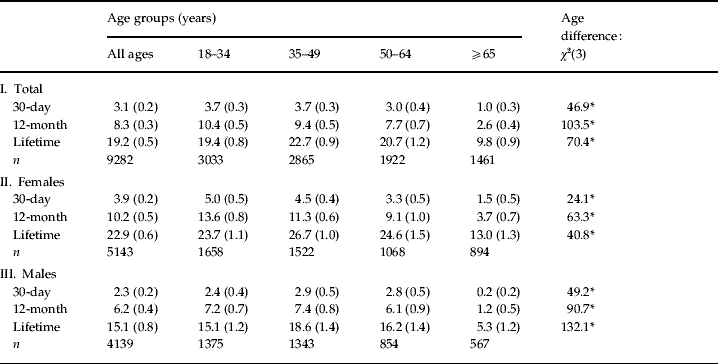
The estimated lifetime prevalence of MDE in the total sample is 19.2% (Table 1). This estimate varies significantly across the four age groups considered here [χ2(3)=70.4, p<0.001] due to a much lower estimated prevalence among respondents in the oldest age group (⩾65 years; 9.8%) than in younger age groups (18–34 years, 35–49 years and 50–64 years; 19.4–22.7%). The same general pattern holds for 12-month and 30-day prevalence estimates (8.3% and 3.1%, respectively) in the total sample, where estimates vary significantly across the age groups [χ2(3)=46.9–103.5, p<0.001] due largely to much lower prevalence estimates among respondents aged ⩾65 years (2.6% and 1.0%, respectively) than in younger age groups (7.7–10.4% and 3.0–3.7%, respectively). Very similar age differences are obtained separately for women and men despite prevalence estimates being consistently higher among women than men.
Thirty-day, 12-month and lifetime prevalence estimates of DSM-IV/CIDI MDE by age and sex

DSM-IV, Diagnostic and Statistical Manual of Mental Disorders, Fourth Edition; CIDI, Composite International Diagnostic Interview; MDE, major depressive episode.
Values are given as percentage prevalence (standard error).
* Significant age difference (p<0.05, two-sided test).
It is noteworthy that the ratio of the prevalence estimates among ⩾65-year-olds compared with the total sample is lower for recent (30-day and 12-month) prevalence (31–32%) than for lifetime prevalence (51%). The same pattern holds separately among women (36–38% v. 57%) and men (9–19% v. 35.1%). This gradient suggests that recall error is not responsible for the lower prevalence estimates among ⩾65-year-olds, as recall failure would produce an opposite pattern, with high estimates in the shortest time-frame and low estimates in lifetime prevalence. A related observation is that the ratio of 12-month prevalence to lifetime prevalence is consistently lower among respondents aged ⩾65 years (22–28%) than younger respondents (37–57%). This is an expectable pattern on substantive grounds, but would be reversed if elderly recall failure drove differences in estimates.
AOO, lifetime course and 12-month severity
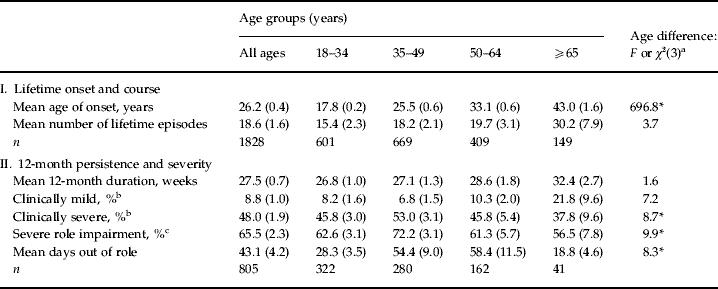
Retrospectively reported AOO of MDE varies significantly across age groups in the total sample [χ2(3)=696.8, p<0.001]. A monotonic increase exists in mean AOO from the youngest to oldest age groups: 17.8 (18–34 years), 25.5 (35–49 years), 33.1 (50–64 years) and 43.0 (⩾65 years) (see Table 2, part I – Lifetime onset and course). The difference between the median age-at-interview in each age group and the mean AOO of MDE in that age group increases with increasing age. For example, in the youngest age group (aged 18–34 years at interview), mean AOO is approximately 8 years earlier than the median age-at-interview (i.e. 17.8 v. 26 years) compared with 16, 24 and >30 years in the successively older age groups. This pattern is what we would expect based on substantive processes and, like the patterns in Table 1, argues against a methodological interpretation of the age differences. As would be expected based on these inter-cohort differences, the mean number of lifetime episodes of MDE reported by respondents with a lifetime history increases monotonically with age-at-interview, from a low of 15.4 among respondents in the 18–34 years age group to 30.2 in the ⩾65 years age group.
Dimensions of DSM-IV/CIDI MDE lifetime onset, course and 12-month persistence and severity by age among NCS-R respondents with MDE

DSM-IV, Diagnostic and Statistical Manual of Mental Disorders, Fourth Edition; CIDI, Composite International Diagnostic Interview; MDE, major depressive episode; NCS-R, National Comorbidity Survey Replication.
Values are given as mean or proportion (standard error).
a Significance was evaluated with an F test for the means (age of onset, mean number of lifetime episodes, mean duration) and a χ2 test for the proportions (the percentage of cases classified clinically mild, clinically severe, and having severe role impairment).
b The percentage of cases whose depression was classified either severe or very severe on the self-report version of the Quick Inventory of Depressive Symptomatology (Rush et al. Reference Rush, Trivedi, Ibrahim, Carmody, Arnow, Klein, Markowitz, Ninan, Kornstein, Manber, Thase, Kocsis and Keller2003).
c The percentage of cases whose depression-related role impairment was classified either severe or very severe on any dimension of the Sheehan Disability Scales (Leon et al. Reference Leon, Olfson, Portera, Farber and Sheehan1997).
* Significant age difference (p<0.05, two-sided test).
The mean self-reported duration of depressive episodes in the 12 months before interview, which was retrospectively reported to be 27.5 weeks, does not vary significantly across age groups [F(3, 692)=1.6, p=0.21] (see Table 2, part II – 12-month persistence and severity). However, symptom severity of these episodes, as assessed by the QIDS, does vary significantly with age, with the proportion of cases classified clinically mild higher in the ⩾65 years age group (21.8%) than in younger age groups (6.8–10.3%) and the percentage classified clinically severe lower in the ⩾65 years age group (37.8%) than in the younger age groups (45.8–53.0%). Consistent with these results, the proportion of 12-month cases rating their depression as causing severe role impairments varies significantly with age [χ2(3)=9.9, p=0.020] and is lowest in the ⩾65 years age group (56.5% v. 61.3–72.2%). The mean number of days out of role in the past year due to depression among 12-month cases also varies significantly with age [F(3, 692)=8.3, p<0.001] and is again lowest in the ⩾65 years age group (18.8 v. 28.3–58.4 days).
Co-morbidity of 12-month MDE with other 12-month DSM-IV disorders
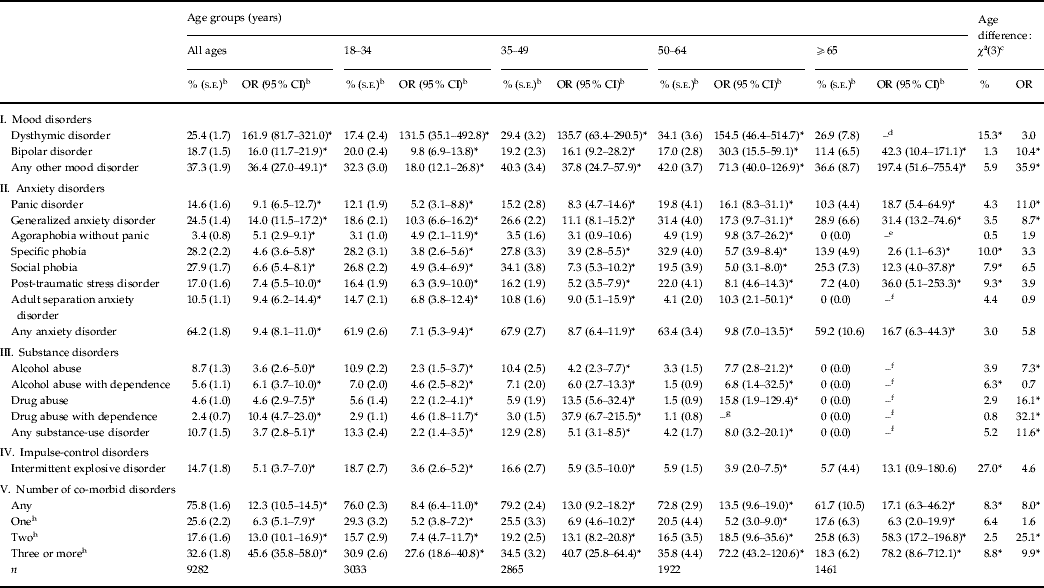
All 14 DSM-IV disorders considered here are significantly and positively associated with MDE in the total sample in both linear (results not shown, but available on request) and logistic regression models (see Table 3). Odds ratios (ORs) are in the range 3.6–161.9. Consistent with previously reported NCS-R results (Kessler et al. Reference Kessler, Chiu, Demler, Merikangas and Walters2005), the conditional 12-month prevalence of co-morbid disorders among respondents with MDE is lowest among those ⩾65 years for 10 of the 14 co-morbid disorders (six significantly so at the 0.05 level). Associations (ORs) of MDE with co-morbid mental disorders vary significantly with age for six of the 14 co-morbid disorders. In three of these six the OR is highest in the ⩾65 years age group (bipolar disorder, panic disorder, generalized anxiety disorder). In the other three, which involve substance disorders, the OR is missing in the ⩾65 years age group because no elderly respondents (with or without MDE) have the co-morbid disorder but the OR is highest in the next oldest age group (50–64 years). The OR is also highest in the ⩾65 years age group for three other disorders (social phobia, post-traumatic stress disorder, intermittent explosive disorder) even though the age difference is not statistically significant.
Twelve-month co-morbidity ORs of DSM-IV/CIDI MDE with other 12-month DSM-IV/CIDI disorders by ageFootnote a

OR, Odds ratio; DSM-IV, Diagnostic and Statistical Manual of Mental Disorders, Fourth Edition; CIDI, Composite International Diagnostic Interview; MDE, major depressive episode; s.e., standard error; CI, confidence interval.
Values are given as OR (95% CI) or proportion (standard error).
a The results in this table are based on a series of multivariate logistic regression equations in which a dichotomous predictor for a single 12-month co-morbid disorder was used to predict a dichotomous measure of 12-month MDE controlling for respondent sex, education and marital status.
b Entries in the % columns represent the conditional prevalence estimate (and s.e. of that estimate) of each co-morbid disorder among respondents with 12-month MDE. Entries in the OR columns represent the OR (and 95% CI of the OR) between MDE and the co-morbid disorder estimated in the logistic regression equation.
c The χ2 tests in the age difference columns test the statistical significance of age differences in conditional prevalence of the co-morbid disorders among respondents with MDE (%) and of the ORs between MDE and the co-morbid disorders (OR). The tests are two degree of freedom tests in the case of the disorders where prevalence in the ⩾65 years subsample was zero (agoraphobia, adult separation anxiety disorder and substance disorders).
d Among respondents in the ⩾65 years age group, 13 cases with MDE had dysthymia, but only one case among those without MDE had dysthymia, resulting in a lack of convergence in the multivariate model. The OR would have been much larger than in the younger age groups, though, if it had converged.
e Among respondents in the ⩾65 years age group, none of those with MDE had agoraphobia compared with five without MDE who had agoraphobia. This means that the OR is effectively 0.0 in this age group.
f Among respondents in the ⩾65 years age group, none of those either with or without MDE had this disorder.
g Among respondents in the 50–64 years age group, only two cases with MDE had drug abuse, while none of those without MDE had drug abuse.
h The ORs associated with number of co-morbid disorders are based on a single equation in each age group to predict 12-month MDE from three dichotomies for one, two and three or more co-morbid disorders in comparison with the contrast category of no such disorders. As with the other equations, controls were included for sex, education and marital status.
* Significant (p<0.05, two-sided test).
As noted above in the section on analysis methods, ORs describe multiplicative relationships, which mean ORs can be large even when the proportions of depressed and non-depressed people who have a particular co-morbid disorder are small. For example, when the conditional prevalence of a co-morbid disorder is 3% among people with depression and 2% among people without depression, the difference is small (1%) but the OR is large (3.1). It is consequently useful to examine patterns of co-morbidity based on linear regression equations. When we did this (detailed results are available on request), we found that age-related variations in prevalence differences for co-morbid disorders are less consistent than age-related variations in ORs. In four cases the prevalence difference is highest among the elderly (dysthymia, post-traumatic stress disorder, alcohol abuse, drug dependence, the latter two involving respondents in the 50–64 years age group because the co-morbid disorder did not occur among those in the ⩾65 years age group) and in five other cases lowest among the young (bipolar disorder, panic disorder, adult separation anxiety, drug abuse, alcohol dependence, with the last three referring to the 50–64 years age group), but only two of these nine are statistically significant (drug abuse and dependence). In two other cases the prevalence difference is lowest among the elderly (agoraphobia, specific phobia), while in the remaining three cases there is no clear age trend in the prevalence differences.
Co-morbidity of 12-month MDE with chronic physical disorders
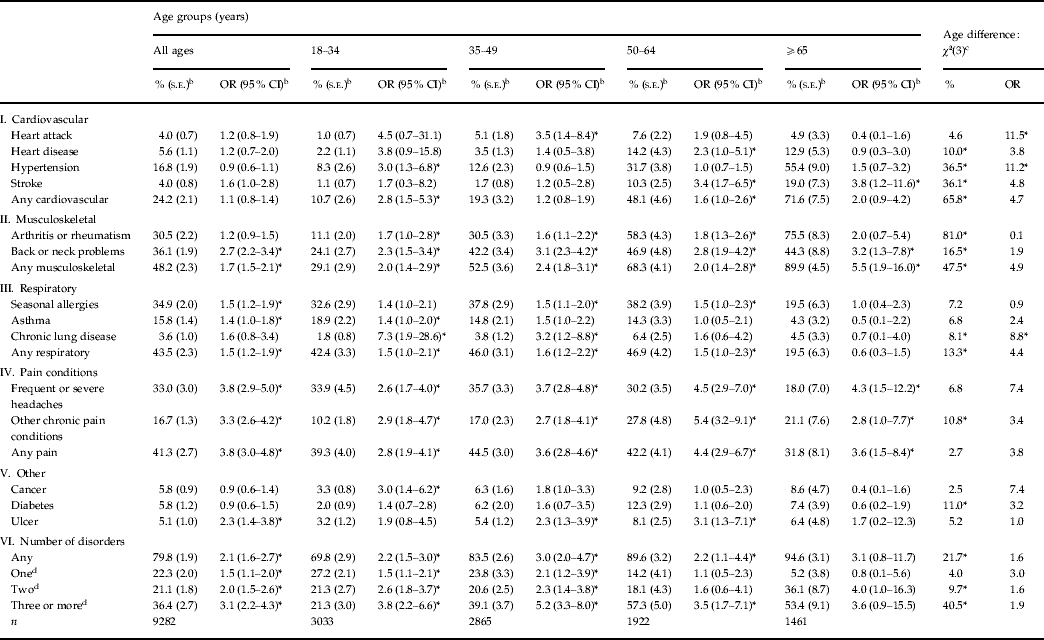
As with the co-morbid mental disorders, all 14 physical disorders are significantly co-morbid with MDE in linear models in the total sample. In 11 of these 14, the co-morbid disorder is more prevalent among people with than without MDE and in the other three less prevalent. (Detailed results are available on request.) Only six of the 14, in comparison, are significantly co-morbid with MDE in logistic regression models (Table 4). All six ORs are positive (1.4–3.8). The association between age and the conditional prevalence of the co-morbid physical disorders is also for the most part positive, with conditional prevalence either increasing monotonically with age (hypertension, stroke, arthritis), being highest in the two oldest age groups (cancer, heart disease, chronic lung disease, chronic pain), or being lowest in the youngest age group (low back pain, ulcers, heart attack, diabetes). However, the age gradient is not consistent, as age is significantly related to prevalence for only eight of the 14 disorders and prevalence is highest in the ⩾65 years age group for only three of these eight (hypertension, stroke, arthritis). Prevalence is highest in the next oldest age group (50–64 years) for the majority of co-morbid disorders. Nonetheless, the proportion of depressed respondents with one or more co-morbid physical disorders is considerably higher in the ⩾65 years age group (94.6%) than in any of the younger age groups (69.8–89.6%).
Twelve-month co-morbidity ORs of DSM-IV/CIDI MDE with chronic physical disorders by ageFootnote a

OR, Odds ratio; DSM-IV, Diagnostic and Statistical Manual of Mental Disorders, Fourth Edition; CIDI, Composite International Diagnostic Interview; MDE, major depressive episode; s.e., standard error; CI, confidence interval.
Values are given as OR (95% CI) or proportion (standard error).
a The results in this table are based on a series of multivariate logistic regression equations in which a dichotomous predictor for a single 12-month co-morbid disorder was used to predict a dichotomous measure of 12-month MDE controlling for respondent sex, education and marital status.
b Entries in the % columns represent the conditional prevalence estimate (and standard error of that estimate) of each co-morbid disorder among respondents with 12-month MDE. Entries in the OR columns represent the OR (and 95% CI of the OR) between MDE and the co-morbid disorder estimated in the logistic regression equation.
c The χ2 tests in the age difference columns test the statistical significance of age differences in conditional prevalence of the co-morbid disorders among respondents with MDE (%) and of the ORs between MDE and the co-morbid disorders (OR).
d The ORs associated with number of co-morbid disorders are based on a single equation in each age group to predict 12-month MDE from three dichotomies for one, two and three or more co-morbid disorders in comparison with the contrast category of no such disorders. As with the other equations, controls were included for sex, education and marital status.
* Significant (p<0.05, two-sided test).
Associations of MDE with co-morbid disorders have a general tendency to decrease with age. In the logistic regression models, the ORs decrease with age for six disorders (heart attack, heart disease, asthma, lung disease, cancer, diabetes), are lowest in the elderly for two others (allergies, ulcers) and are highest in the young for one other (hypertension), although only three of these nine are statistically significant (heart attack, lung disease, hypertension). In the linear regression models, the MDE prevalence difference decreases monotonically with age for seven co-morbid disorders and is lowest among the elderly for five others (low back pain, headaches, chronic pain, diabetes, ulcers). Of these 12 age trends, seven are statistically significant. An age trend is absent for only the two remaining disorders (hypertension, stroke).
Age-related differences in treatment of 12-month MDE
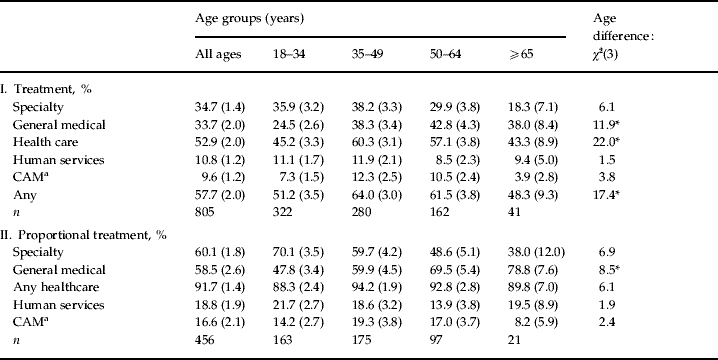
Somewhat more than half (57.7%) of NCS-R respondents with 12-month MDE reported treatment for emotional problems in the year before interview (see Table 5, part I – Treatment). The proportion in treatment is lowest in the ⩾65 years age group (48.3% v. 51.2–64.0%) due to low proportions of the elderly than younger respondents in specialty (18.3% v. 29.9–38.2%) and CAM (3.9% v. 7.3–12.3%) treatment. More detailed analysis shows that these low treatment proportions are not due to the lower severity of MDE, as the proportion in treatment among the severely depressed also varies significantly with age [χ2(3)=9.5, p=0.023] and is lowest among the ⩾65-year-olds (33.6% v. 63.3–69.9%). Proportional treatment in the GM sector also varies significantly with age, as depressed patients in the ⩾65 years age group receive a higher proportion of their treatment in the GM sector (78.8%) than do younger respondents (47.8–69.5%).
Past-year treatment of emotional problems among respondents with 12-month DSM-IV/CIDI MDE by age

DSM-IV, Diagnostic and Statistical Manual of Mental Disorders, Fourth Edition; CIDI, Composite International Diagnostic Interview; MDE, major depressive episode; CAM, complementary alternative medicine.
Values are given as proportion (standard error).
a Herbalists, chiropractors, faith-healers, self-help groups.
* Significant age difference (p<0.05, two-sided test).
Age-related sociodemographic correlates of MDE prevalence and treatment
We examined four sociodemographic correlates of MDE and treatment: sex, family income, employment status (employed/self-employed, student, homemaker, retired, disabled/unemployed), and marital status (married, previously married, never married). All four are significantly related to MDE in the total sample. Elevated risk of MDE is related to being female, poor, disabled/unemployed, and unmarried, with ORs of 1.7–2.8. (Detailed results are available on request.) The strength of these associations (ORs), though, varies significantly with age. The higher odds of MDE among women than men are especially pronounced among respondents aged ⩾65 years (3.2 v. 1.5–20). The elevated odds of MDE associated with being poor (in the lowest quartile of the income-per-family-member distribution) is also especially pronounced among respondents aged ⩾65 years (3.9 v. 1.2–2.7). Employment status, in comparison, is unrelated to MDE among the elderly although it is significant at earlier ages. The elevated odds of MDE among the previously married, finally, is somewhat higher among respondents aged ⩾65 years than those aged 50–64 years (2.3 v. 1.7). Sex and marital status are the only two sociodemographic variables studied that are significantly related to 12-month treatment of emotional problems among respondents with 12-month MDE. Women have higher odds of treatment than men (1.5) and the previously married have higher odds of treatment than the married (1.6). The association of sex with treatment is significantly weaker among depressed people who are aged ⩾65 years (1.0) than younger (1.3–2.2). (Detailed results are available on request.)
Discussion
The above results are limited by several sampling and measurement problems. Regarding sampling, results could be influenced by truncation of the severity spectrum of physical disorders if people with extreme physical disorders are less likely to be interviewed. This bias would lead to underestimation of the association between physical disorders and MDE, possibly more among the elderly. Regarding measurement, physical disorders were assessed with a checklist, while mental disorders were assessed with a diagnostic interview. This difference could have led to artificial overlap between estimated diagnoses of mental and physical disorders, as core symptoms of some physical conditions (e.g. lethargy, insomnia) are also symptoms of mental disorders. If present, this bias presumably led to an artificial increase in the estimated associations of MDE with physical disorders.
Within the context of these limitations, our results are consistent with previous research in finding less MDE among older than younger respondents (Weissman et al. Reference Weissman, Bruce, Leaf, Florio, Holzer, Robins and Regier1991; Blazer & Hybels, Reference Blazer and Hybels2005). The findings of higher mean AOO and longer time lag between AOO and current age among the depressed elderly, while substantively plausible, are inconsistent with the findings of Simon & Von Korff (Reference Simon and Von Korff1992) in the Epidemiologic Catchment Area (ECA) study. Simon & Von Korff (Reference Simon and Von Korff1992) used this substantively implausible pattern to argue that the seemingly higher lifetime prevalence of depression in younger cohorts is due to recall bias among the elderly. The absence of this implausible pattern in the NCS-R is presumably due to the use of an innovative AOO probing technique developed for the baseline NCS that reduces recall bias (Knäuper et al. Reference Knäuper, Cannell, Schwarz, Bruce and Kessler1999). The fact that the age difference in MDE persists despite this methodological innovation argues against recall bias accounting for the age–MDE relationship. It is still possible, though, that sample selection bias is at work, with depressed people more likely than others to die at an early age, to be outside the household population (e.g. in nursing homes), to refuse to be interviewed, or to deny depression when they are interviewed. The results reported here shed no light on these possibilities, which could account for the evidence of cohort effects found in previous epidemiological studies of depression (Kessler et al. Reference Kessler, Berglund, Demler, Jin, Koretz, Merikangas, Rush, Walters and Wang2003).
The finding that retrospectively reported number of lifetime episodes increases with age among respondents with a history of MDE is substantively plausible. We are aware of no previous studies of this association. The finding that age is unrelated to duration of 12-month depressive symptoms among 12-month cases is consistent with previous research (Sargeant et al. Reference Sargeant, Bruce, Florio and Weissman1990; Mitchell & Subramaniam, Reference Mitchell and Subramaniam2005). The findings that symptom severity, severity of role impairment, and mean number of days out of role due to 12-month depression are all significantly lower among elderly than younger depressed people are also consistent with the small number of direct (Koenig et al. Reference Koenig, Meador, Shelp, Goli, Cohen and Blazer1991) and indirect (Ernst & Angst, Reference Ernst and Angst1995) studies of this association in the literature.
As noted in the Introduction, previous studies have consistently found that recent prevalence of most mental disorders decreases with age (Blazer et al. Reference Blazer, Hughes and George1987) and that prevalence of many physical disorders increases with age (Kennedy et al. Reference Kennedy, Kelman and Thomas1990). Our replication of these findings is consequently unremarkable. However, we are aware of virtually no research on age differences in the associations between depression and co-morbid disorders. Although there is considerable research on co-morbidity of late-life depression (Alexopoulos et al. Reference Alexopoulos, Buckwalter, Olin, Martinez, Wainscott and Krishnan2002; Taylor et al. Reference Taylor, McQuoid and Krishnan2004), this research fails to make comparisons with earlier ages. Our finding that the associations of MDE with co-morbid mental disorders generally increase with age while the associations of MDE with co-morbid physical disorders generally decrease with age are consequently unique. We found no studies in the literature that examined age differences in the association between depression and co-morbid mental disorders and only one that examined age differences in the association of depression with co-morbid physical disorders (Fiske et al. Reference Fiske, Gatz and Pedersen2003). The latter study found that the association between a composite measure of physical disorders and scores on a screening scale of depressive symptoms did not change over the life course in a sample of Swedish twins.
It is difficult to offer a clear causal interpretation of the generally increasing ORs of MDE with co-morbid mental disorders with age because both MDE and most co-morbid mental disorders have decreasing prevalence with age. Given that the prevalence differences decrease with age, the most plausible interpretation is that the subset of co-morbid cases has a more persistent course than other cases due to causal effects that might involve MDE influencing the onset or course of co-morbid mental disorders, co-morbid mental disorders influencing the onset or course of co-morbid MDE, common causes influencing the onset or course of both disorders, or some combination of these processes.
The generally decreasing ORs of MDE with co-morbid physical disorders are more interpretable because the age patterns in prevalence are different for MDE (decreasing prevalence with age) and most co-morbid physical disorders (increasing prevalence with age). In a situation of this sort, it is likely that the decreasing ORs are at least partially due to the causal effects of physical disorders on MDE decreasing with age. Whether or not causal effects of MDE on co-morbid physical disorders also decrease with age is difficult to say because the implications of such a decrease on the prevalence of physical disorders would be negligible in light of the low prevalence of MDE. This argues against the suggestion that the low estimated prevalence of MDE among the elderly is due to increased confounding with physical disorders.
Our results shed no light on why it is that physical disorders have decreasing effects on MDE among the elderly. One possibility suggested in the literature is that elderly people are more accepting than younger people of the inevitability of physical illness, resulting in the otherwise adverse effects of physical disorders on depression being buffered (Ernst & Angst, Reference Ernst and Angst1995). Although we are aware of no direct test of this hypothesis, elderly people have been shown to be more likely than younger people to cope with adverse situations by using strategies that accept and adapt rather than try to change these situations (Diehl et al. Reference Diehl, Coyle and Labouvie-Vief1996) and that disengage from stressful situations in ways that reduce adverse emotional effects (Charles & Carstensen, Reference Charles and Carstensen2008). Other research has shown similar age differences in coping with physical illness (Felton & Revenson, Reference Felton and Revenson1987), but has not investigated whether these differences attenuate the impact of physical disorders on depression. The investigation of this buffering effect is an important next research step that, while beyond the scope of the present study, may help delineate positive patterns of response to increasing age and infirmity.
Acknowledgements
The National Comorbidity Survey Replication (NCS-R) is supported by the National Institute of Mental Health (NIMH; U01-MH60220) with supplemental support from the National Institute on Drug Abuse (NIDA), the Substance Abuse and Mental Health Services Administration (SAMHSA), the Robert Wood Johnson Foundation (RWJF; grant 044780) and the John W. Alden Trust. The preparation of this report was additionally supported by an unrestricted educational grant from Sanofi-Aventis. Collaborating NCS-R investigators include R.C.K. (principal investigator, Harvard Medical School), K. Merikangas (co-principal investigator, NIMH), J. Anthony (Michigan State University), W. Eaton (The Johns Hopkins University), M. Glantz (NIDA), D. Koretz (Harvard University), J. McLeod (Indiana University), M. Olfson (New York State Psychiatric Institute, College of Physicians and Surgeons of Columbia University), H. Pincus (University of Pittsburgh), G. Simon (Group Health Cooperative), M. Von Korff (Group Health Cooperative), P. S. Wang (NIMH), K. Wells (University of California, Los Angeles), E. Wethington (Cornell University) and H.-U. Wittchen (Max Planck Institute of Psychiatry; Technical University of Dresden, Germany). The views and opinions expressed in this report are those of the authors and should not be construed to represent the views of any of the sponsoring organizations, agencies or the US Government.
A complete list of NCS publications and the full text of all NCS-R instruments can be found at http://www.hcp.med.harvard.edu/ncs
The NCS-R is carried out in conjunction with the WHO World Mental Health (WMH) Survey Initiative. We thank the staff of the WMH Data Collection and Data Analysis Coordination Centers for assistance with instrumentation, fieldwork, and consultation on data analysis. These activities were supported by the National Institute of Mental Health (R01 MH070884), the John D. and Catherine T. MacArthur Foundation, the Pfizer Foundation, the US Public Health Service (R13-MH066849, R01-MH069864 and R01 DA016558), the Fogarty International Center (FIRCA R03-TW006481), the Pan American Health Organization, Eli Lilly and Company, Ortho-McNeil Pharmaceutical, Inc., GlaxoSmithKline and Bristol–Myers Squibb. A complete list of WMH publications can be found at http://www.hcp.med.harvard.edu/wmh/
The authors thank K. Merikangas, the staff of Sanofi-Aventis and H.-U. Wittchen for comments on an earlier draft of the paper.
Declaration of Interest
R.C.K. has been a consultant for GlaxoSmithKline Inc., Kaiser Permanente, Pfizer Inc., Sanofi-Aventis, Shire Pharmaceuticals and Wyeth–Ayerst, has served on advisory boards for Eli Lilly & Company and Wyeth–Ayerst, and has had research support for his epidemiological studies from Bristol–Myers Squibb, Eli Lilly & Company, GlaxoSmithKline, Johnson & Johnson Pharmaceuticals, Ortho-McNeil Pharmaceuticals Inc., Pfizer Inc. and Sanofi-Aventis. H.B. was supported in this research by funding from Sanofi-aventis research and development (Paris, France).