





1 Introduction
By a classical theorem of Cantor, every countable dense linear ordering with no endpoints is order-isomorphic to the rational numbers. Consequently, every separable, dense linear order with no endpoints in which every nonempty bounded set has a least upper bound is order-isomorphic to the real line. In a problem list published in 1920 [Reference SouslinSou20], Souslin asked whether the characterization remains valid once replacing separability by the property ccc asserting that every pairwise disjoint family of open intervals is countable. In the early 1930s, this problem led Kurepa to the discovery of set-theoretic trees. Most notably, Kurepa proved that Souslin’s proposed characterization of the real line is equivalent to the following purely Ramsey-theoretic assertion: every uncountable set-theoretic tree must admit an uncountable chain or an uncountable antichain. Soon after learning about the latter, Aronszajn was able to construct an uncountable set-theoretic tree all of whose levels are countable, and yet admitting no uncountable chains. Kurepa who possibly did not fully appreciate this partial result, named this object an Aronszajn tree, insisting that the main question is whether a Souslin tree can be constructed. It then took three more decades until it was proven that, unlike Aronszajn trees, the existence of Souslin trees is independent of the usual axioms of set theory
 $\textsf {ZFC}$
and even of
 $\textsf {ZFC}+\textsf {GCH}$
(see the surveys [Reference RudinRud69, Reference AlvarezAlv99, Reference KanamoriKan11]).
Famously, long before Souslin trees were shown to consistently exist, Rudin [Reference RudinRud55] boldly used them to construct a Dowker space [Reference DowkerDow51], i.e., a normal topological space whose product with the unit interval is not normal.Footnote
1
The Dowker space problem has its own rich history, which we will not elaborate on in here (but see [Reference Kojman and ShelahKS98]). For our purpose, it suffices to mention that a few years ago, Rinot and Shalev [Reference Rinot and ShalevRS23] found a new proof of Rudin’s theorem by introducing a combinatorial guessing principle
 $\clubsuit _{\operatorname {\mathrm {AD}}}$
and proving the following two implications:
 $$ \begin{align*}\exists~\text{Souslin tree}\implies\clubsuit_{\operatorname{\mathrm{AD}}}\text{ holds}\implies\exists~\text{Dowker space}.\end{align*} $$
Their proof of the first implication goes through an analysis of the vanishing levels of set-theoretic trees, highlighting its importance and raising a few fundamental questions. In order to formulate them, let us provide a couple of basic definitions.
Definition 1.1 (Set-theoretic trees)
For an infinite cardinal
 $\kappa $
, a partially ordered set
 $\mathbf T=(T,{<_T})$
is a
 $\kappa $
-tree iff the following two requirements hold:
-
(1) For every node
 $x\in T$
, the set
$x_\downarrow :=\{ y\in T\mathrel {|} y<_T x\}$
is well-ordered by
$<_T$
. Hereafter, write
$\operatorname {\mathrm {ht}}(x):=\operatorname {\mathrm {otp}}(x_\downarrow ,<_T)$
for the height of x;
-
(2) For every ordinal
$\alpha <\kappa $
, the
$\alpha ^{\text {th}}$
-level of the tree,
$T_\alpha :=\{ x\in T\mathrel {|} \operatorname {\mathrm {ht}}(x)=\alpha \}$
, is nonempty and has size less than
$\kappa $
. The level
$T_\kappa $
is empty.


 $\mathbf T$
is normal iff each
 $x\in T$
admits an extension to every level
 $\alpha <\kappa $
.
For an ordinal
 $\alpha $
, a subset
 $B\subseteq T$
is an
 $\alpha $
-branch iff
 $(B,<_T)$
is linearly ordered and
 $\{\operatorname {\mathrm {ht}}(x)\mathrel {|} x\in B\}=\alpha $
; it is said to be vanishing iff it has no upper bound in
 $\mathbf T$
. With this terminology, Kőnig’s infinity lemma [Reference KonigKon27] is nothing but the assertion that every
 $\aleph _0$
-tree has an
 $\aleph _0$
-branch, and Kurepa’s theorem [Reference KurepaKur35] is that Souslin’s question admits an affirmative answer iff every
 $\aleph _1$
-tree with no uncountable antichains has an
 $\aleph _1$
-branch. Curiously, his proof of the contrapositive of the forward implication goes through showing that the collection of vanishing branches of a counterexample tree admits a lexicographic-like ordering that makes it into a ccc nonseparable linear order (see the proof of [Reference KunenKun80, Theorem II.5.13]).
As said before, Kurepa named these objects after people, thus, a
 $\kappa $
-Aronszajn tree is a
 $\kappa $
-tree with no
 $\kappa $
-branches, and a
 $\kappa $
-Souslin tree is a
 $\kappa $
-Aronszajn tree with no
 $\kappa $
-sized antichains. Our next key definition reads as follows.
Definition 1.2 (Vanishing levels)
For a
 $\kappa $
-tree
 $\mathbf T=(T,<_T)$
, let
 $ V(\mathbf T)$
denote the set of all nonzero (limit) ordinals
 $\alpha <\kappa $
such that for any node
 $x\in T$
of height less than
 $\alpha $
there exists a vanishing
 $\alpha $
-branch containing x.
The general case of the first implication from [Reference Rinot and ShalevRS23] presented earlier asserts that if
 $\mathbf T$
is a
 $\kappa $
-Souslin tree, then
 $\clubsuit _{\operatorname {\mathrm {AD}}}(S)$
holds over some subset
 $S\subseteq \kappa $
that is equal to the intersection of
 $V(\mathbf T)$
with some closed and unbounded subset of
 $\kappa $
(a club). In particular, if
 $V(\mathbf T)$
is “large” (e.g., stationary), then a nontrivial instance of
 $\clubsuit _{\operatorname {\mathrm {AD}}}$
holds true, which in turn has important applications in set-theoretic topology.
For
 $\mathbf T$
a normal
 $\aleph _1$
-Aronszajn tree,
 $V(\mathbf T)$
is readily large and must in fact cover a club, but complications arise naturally once dealing with higher trees. For instance, a
 $\kappa $
-tree
 $\mathbf T$
is
 $\sigma $
-complete iff any increasing sequence of nodes in
 $\mathbf T$
, and of length less than
 $\sigma $
, has an upper bound in
 $\mathbf T$
. For such a tree,
 $V(\mathbf T)$
cannot contain points of cofinality smaller than
 $\sigma $
. Dually, if a normal splitting
 $\kappa $
-tree
 $\mathbf T$
is regressive,Footnote
2
then
 $V(\mathbf T)$
must contain all points of cofinality
 $\aleph _0$
. But completeness and regressivity are too coarse and what’s missing is a sincere understanding of the spectrum of sets that can be realized as the vanishing levels of normal
 $\kappa $
-trees. After all, what we are facing here is an invariant of trees in the sense that if two normal
 $\kappa $
-trees
 $\mathbf T,\mathbf T'$
are isomorphic on a club, then
 $V(\mathbf T)$
is equal to
 $V(\mathbf T')$
modulo a nonstationary set, and it possesses various algebraic features, such as
 $V(\mathbf T\otimes \mathbf T')=V(\mathbf T)\cup V(\mathbf T')$
and
 $V(\mathbf T+\mathbf T')=V(\mathbf T)\cap V(\mathbf T')$
for any two normal
 $\kappa $
-trees
 $\mathbf T,\mathbf T'$
. Moving forward, Definition 1.2 opens the door to formulating deep questions about higher trees: for instance, Krueger [Reference KruegerKru18] proved it is consistent that every two
 $\aleph _1$
-complete
 $\aleph _2$
-Aronszajn trees are club-isomorphic, and so the next natural step is seeking models in which, for some fixed subset
 $X\subseteq \aleph _2$
, any two
 $\aleph _2$
-trees whose set of vanishing levels coincide with X modulo some nonstationary set are moreover club-isomorphic.Footnote
3
As made clear earlier, in view of applications, the primary problem in this vein is whether
 $V(\mathbf T)$
of a
 $\kappa $
-tree
 $\mathbf T$
must be large. Our first main result shows that this is not the case. This is best demonstrated in Gödel’s constructible universe,
 $\mathsf {L}$
, where we obtain the following characterization.
Theorem A In
 $\mathsf {L}$
, for every regular uncountable cardinal
 $\kappa $
that is not weakly compact, the following are equivalent:
-
• there exists a
$\kappa $
-Souslin tree
$\mathbf T$
such that
$V(\mathbf T)=\emptyset $
; -
• there exists a normal and splitting
$\kappa $
-tree
$\mathbf T$
such that
$V(\mathbf T)=\emptyset $
; -
•
$\kappa $
is not the successor of a cardinal of countable cofinality.


Our second main result deals with the other extreme and continues our discussion on completeness and regressivity: is it possible to have a
 $\kappa $
-Souslin tree whose set of vanishing levels is as large as possible? Here, again, we obtain a complete characterization for Gödel’s universe.
Theorem B In
 $\mathsf {L}$
, for every regular uncountable cardinal
 $\kappa $
that is not weakly compact, the following are equivalent:
-
• there exists a
$\kappa $
-Souslin tree
$\mathbf T$
such that
$V(\mathbf T)=\operatorname {\mathrm {acc}}(\kappa )$
; -
• there exists a
$\kappa $
-tree
$\mathbf T$
such that
$V(\mathbf T)=\operatorname {\mathrm {acc}}(\kappa )$
; -
•
$\kappa $
is not subtle.


An interesting feature of the proof of Theorem B is that it goes through a pump-up theorem generating
 $\kappa $
-Souslin trees from other input trees with weaker properties. Before we turn to describe some of our pump-up theorems, let us introduce another piece of notation. For a
 $\kappa $
-tree
 $\mathbf T$
, we write
 $V^-(\mathbf T)$
for the set of all
 $\alpha $
’s such that there exists a vanishing
 $\alpha $
-branch. If
 $\mathbf T$
is homogeneous, then
 $V^-(\mathbf T)$
coincides with
 $V(\mathbf T)$
, but in contrast with Theorem A, for every normal
 $\kappa $
-Aronszajn tree
 $\mathbf T$
, the set
 $V^-(\mathbf T)$
is necessarily stationary.Footnote
4
Our first pump-up theorem asserts that the existence of a special
 $\kappa $
-Aronszajn tree
 $\mathbf T$
is equivalent to the existence of one with
 $V(\mathbf T)=\operatorname {\mathrm {acc}}(\kappa )$
. Our second pump-up theorem asserts that for every
 $\kappa $
-tree
 $\mathbf K$
there exists a
 $\kappa $
-tree
 $\mathbf T$
such that
 $V^-(\mathbf K)\setminus V(\mathbf T)$
is nonstationary. Our third pump-up theorem asserts that assuming an instance of the proxy principle
 $\operatorname {\mathrm {P}}(\ldots )$
from [Reference Brodsky and RinotBR17a],Footnote
5
the corresponding tree
 $\mathbf T$
may moreover be made to be
 $\kappa $
-Souslin.
Theorem C Suppose that
 $\operatorname {\mathrm {P}}(\kappa ,2,{\sqsubseteq ^*},1)$
holds. Then:
-
(1) For every
$\kappa $
-tree
$\mathbf K$
, there exists a
$\kappa $
-Souslin tree
$\mathbf T$
such that
$V^-(\mathbf K)\setminus V(\mathbf T)$
is nonstationary. In particular: -
(2) There exists a
$\kappa $
-Souslin tree
$\mathbf T$
such that
$V(\mathbf T)$
is stationary.


The preceding addresses the problem of ensuring
 $V(\mathbf T)$
to cover some stationary set S. The next theorem addresses its dual. Along the way, it provides a cheap way to obtain a family of
 $2^\kappa $
-many
 $\kappa $
-Souslin trees that are not pairwise club-isomorphic.Footnote
6
Theorem D If
 $\diamondsuit (S)$
holds for some nonreflecting stationary subset S of a strongly inaccessible cardinal
 $\kappa $
, then there is a family
 $\mathcal S$
of
 $2^\kappa $
-many stationary subsets of S such that:
-
• for every
$S'\in \mathcal S$
, there is a
$\kappa $
-Souslin tree
$\mathbf T$
with
$V(\mathbf T)=S'$
; -
• for all
$S'\neq S"$
in
$\mathcal S$
,
$|S'\cap S"|<\kappa $
.


In the last two sections of this article, we come back to the motivating problem of getting instances of
 $\clubsuit _{\operatorname {\mathrm {AD}}}$
. By [Reference Rinot and ShalevRS23, Theorem 2.30], if
 $\kappa $
is weakly compact, then
 $\clubsuit _{\operatorname {\mathrm {AD}}}(S)$
fails for every S with
 $\operatorname {\mathrm {Reg}}(\kappa )\subseteq S\subseteq \kappa $
. This raises the question as to whether
 $\clubsuit _{\operatorname {\mathrm {AD}}}(S)$
may hold over a large subset S of a cardinal
 $\kappa $
that is close to being weakly compact. We answer this question in the affirmative.
Theorem E Assuming the consistency of a weakly compact cardinal, it is consistent that for some strongly inaccessible cardinal
 $\kappa $
satisfying
 $\chi (\kappa )=\omega $
,Footnote
7
there is a
 $\kappa $
-Souslin tree
 $\mathbf T$
such that
 $V(\mathbf T)=\operatorname {\mathrm {acc}}(\kappa )$
.
Our final theorem sheds a new light on the classical problem of getting Dowker spaces and can be read independently of the rest of the article. In [Reference de CauxdC77], de Caux constructed a Dowker space of size
 $\aleph _1$
assuming the combinatorial principle
 $\clubsuit $
. Addressing higher cardinals, Good [Reference GoodGoo95] constructed a Dowker space of size
 $\lambda ^+$
assuming
 $\clubsuit (S)$
for some nonreflecting stationary subset S of
 $E^{\lambda ^+}_\omega $
.Footnote
8
Thanks to advances in [Reference Rinot and ShalevRS23] and the insights gathered through the study of vanishing levels of trees, we found the way to waive Good’s need for guessing using ladders of order-type
 $\omega $
. Thus, we found a new sufficient condition for the existence of a Dowker space of size
 $\kappa $
.
Theorem F If
 $\clubsuit (S)$
holds over a nonreflecting stationary
 $S\subseteq \kappa $
, then there exists a Dowker space of size
 $\kappa $
.
1.1 Organization of this article
Throughout this article,
 $\kappa $
denotes a regular uncountable cardinal.
In Section 2, we develop the basic theory of vanishing levels of
 $\kappa $
-trees. It is proved that if
 $\kappa $
is not a strong limit, then
 $V^-(\mathbf T)$
is stationary for every normal and splitting
 $\kappa $
-tree
 $\mathbf T$
. It is proved that for every
 $\kappa $
-tree
 $\mathbf K$
, there exists a
 $\kappa $
-tree
 $\mathbf T$
such that
 $V^-(\mathbf K)\setminus V(\mathbf T)$
is nonstationary, and that the existence of a special
 $\kappa $
-Aronszajn tree
 $\mathbf T$
is equivalent to the existence of a homogeneous one with
 $V(\mathbf T)=\operatorname {\mathrm {acc}}(\kappa )$
.
In Section 3, we prove Theorem C and some variations of it. As a corollary, we get Theorem B and infer that if
 $\square _\lambda \mathrel {+}\diamondsuit (\lambda ^+)$
holds for an infinite cardinal
 $\lambda $
, or if
 $\square (\lambda ^+)\mathrel {+}\textsf {GCH}$
holds for a regular uncountable
 $\lambda $
, then there exists a
 $\lambda ^+$
-Souslin tree
 $\mathbf T$
with
 $V(\mathbf T)=\operatorname {\mathrm {acc}}(\lambda ^+)$
.
In Section 4, we address the problem of realizing a given nonreflecting stationary subset of
 $\kappa $
as
 $V(\mathbf T)$
for some
 $\kappa $
-Souslin tree
 $\mathbf T$
. The proof of Theorem D will be found there.
In Section 5, we address the problem of constructing a homogeneous
 $\kappa $
-Souslin tree
 $\mathbf T$
such that
 $V(\mathbf T)=\{ \alpha <\kappa \mathrel {|} \operatorname {\mathrm {cf}}(\alpha )\in x\}$
for a prescribed finite nonempty set
 $x\subseteq \operatorname {\mathrm {Reg}}(\kappa )$
. In particular, this is shown to be feasible in
 $\mathsf L$
whenever
 $\kappa $
is a limit cardinal or the successor of a cardinal of cofinality at least
 $\max (x)$
. The proof of Theorem A will be found there.
In Section 6, we deal with Souslin trees admitting an ascent path. It is proved that for every uncountable cardinal
 $\lambda $
,
 $\square _\lambda +\textsf {GCH}$
entails that for every
 $\mu \in \operatorname {\mathrm {Reg}}(\operatorname {\mathrm {cf}}(\lambda )),$
there exists a
 $\lambda ^+$
-Souslin tree
 $\mathbf T$
with a
 $\mu $
-ascent path such that
 $V(\mathbf T)=\operatorname {\mathrm {acc}}(\lambda ^+)$
. The proof of Theorem E will be found there.
In Section 7, we improve [Reference Rinot and ShalevRS23, Lemma 2.10] from which we obtain the proof of Theorem F. As said, this section can be read independently of the rest of the article.
1.2 Notation and conventions
 $H_\kappa $
denotes the collection of all sets of hereditary cardinality less than
 $\kappa $
.
 $\operatorname {\mathrm {Reg}}(\kappa )$
denotes the set of all infinite regular cardinals
 $<\kappa $
. For
 $\chi \in \operatorname {\mathrm {Reg}}(\kappa )$
,
 $E^\kappa _\chi $
denotes the set
 $\{\alpha < \kappa \mathrel {|} \operatorname {\mathrm {cf}}(\alpha ) = \chi \}$
, and
 $E^\kappa _{\geq \chi }$
,
 $E^\kappa _{>\chi }$
,
 $E^\kappa _{\leq \chi }$
,
 $E^\kappa _{<\chi }$
,
 $E^\kappa _{\neq \chi }$
, are defined analogously.
For a set of ordinals C, we write
 $\operatorname {\mathrm {ssup}}(C) := \sup \{\alpha + 1 \mathrel {|} \alpha \in C\}$
,
 $\operatorname {\mathrm {acc}}^+(C) := \{\alpha < \operatorname {\mathrm {ssup}}(C) \mathrel {|} \sup (C \cap \alpha ) = \alpha> 0\}$
,
 $\operatorname {\mathrm {acc}}(C) := C \cap \operatorname {\mathrm {acc}}^+(C)$
, and
 $\operatorname {\mathrm {nacc}}(C) := C \setminus \operatorname {\mathrm {acc}}(C)$
. For a set S, we write
 $[S]^{\chi }$
for
 $\{A\subseteq S\mathrel {|} |A|=\chi \}$
, and
 $[S]^{<\chi }$
is defined analogously. For a set of ordinals S, we identify
 $[S]^2$
with
 $\{ (\alpha ,\beta )\mathrel {|} \alpha ,\beta \in S, \alpha <\beta \}$
, and we let
 $\operatorname {\mathrm {Tr}}(S):=\{ \beta <\operatorname {\mathrm {ssup}}(S)\mathrel {|} \operatorname {\mathrm {cf}}(\beta )>\omega \ \&\ S \cap \beta \text { is stationary in } \beta \}$
.
We define four binary relations over sets of ordinals, as follows:
-
•
$D\sqsubseteq C$
iff there exists some ordinal
$\beta $
such that
$D = C \cap \beta $
; -
•
$D\sqsubseteq ^* C$
iff
$D \setminus \varepsilon \sqsubseteq C \setminus \varepsilon $
for some
$\varepsilon < \sup (D)$
; -
•
$D\mathrel {{}^{S}{\sqsubseteq }} C$
iff
$D\sqsubseteq C$
and
$\sup (D)\notin S$
; -
•
$D \mathrel {{}_{\chi }{\sqsubseteq }} C$
iff
$D \sqsubseteq C$
or
$\operatorname {\mathrm {cf}}(\sup (D))<\chi $
.


A list over a set of ordinals S is a sequence
 $\vec A=\langle A_\alpha \mathrel {|} \alpha \in S\rangle $
such that, for each
 $\alpha \in S$
,
 $A_\alpha $
is a subset of
 $\alpha $
. It is said to be thin if
 $|\{ A_\alpha \cap \varepsilon \mathrel {|} \alpha \in S\}|<\operatorname {\mathrm {ssup}}(S)$
for every
 $\varepsilon <\operatorname {\mathrm {ssup}}(S)$
. It is said to be
 $\xi $
-bounded if
 $\operatorname {\mathrm {otp}}(A_\alpha )\le \xi $
for all
 $\alpha \in S$
. A ladder system over S is a list
 $\vec A=\langle A_\alpha \mathrel {|} \alpha \in S\rangle $
such that
 $\operatorname {\mathrm {ssup}}(A_\alpha )=\alpha $
for every
 $\alpha \in S$
.Footnote
9
It is said to be almost disjoint if
 $\sup (A_\alpha \cap A_{\alpha '})<\alpha $
for every pair
 $\alpha <\alpha '$
of ordinals in S. A C-sequence over S is a ladder system
 $\vec C=\langle C_\alpha \mathrel {|} \alpha \in S\rangle $
such that each
 $C_\alpha $
is a closed subset of
 $\alpha $
. Finally, a (resp.,
 $\xi $
-bounded)
 $\mathcal C$
-sequence over S is a sequence
 $\vec {\mathcal C}=\langle \mathcal C_\alpha \mathrel {|} \alpha \in S\rangle $
of nonempty sets such that every element of
 $\prod _{\alpha \in S}\mathcal C_\alpha $
is a (resp.,
 $\xi $
-bounded) C-sequence.
2 The basic theory of vanishing levels
Definition 2.1 A
 $\kappa $
-tree
 $\mathbf T=(T,<_T)$
is said to be:
-
• Hausdorff iff for every limit ordinal
$\alpha $
and all
$x,y\in T_\alpha $
, if
$x_\downarrow =y_\downarrow $
, then
$x=y$
; -
• normal iff for all
$\alpha <\beta <\kappa $
and
$x\in T_\alpha $
there exists
$y\in T_\beta $
with
$x<_T y$
; -
•
$\chi $
-complete iff any
$<_T$
-increasing sequence of elements of
$\mathbf T$
, and of length
$<\chi $
, has an upper bound in
$\mathbf T$
; -
•
$\varsigma $
-splitting iff every node of
$\mathbf T$
admits at least
$\varsigma $
-many immediate successors, that is, for every
$x\in T$
,
$|\{ y\in T\mathrel {|} x<_T y, \operatorname {\mathrm {ht}}(y)=\operatorname {\mathrm {ht}}(x)+1\}|\ge \varsigma $
. By splitting, we mean
$2$
-splitting; -
• Aronszajn iff
$\mathbf T$
has no
$\kappa $
-branches; -
• Souslin iff
$\mathbf T$
has no cofinal branches nor antichains of size
$\kappa $
; -
• special iff there exists a map
$\rho :T\rightarrow T$
satisfying the following:-
– for every non-minimal
$x\in T$
,
$\rho (x)<_T x$
; -
– for every
$y\in T$
,
$\rho ^{-1}\{y\}$
is covered by less than
$\kappa $
many antichains.
-


Remark 2.2 All the
 $\kappa $
-Souslin trees constructed in this article will be Hausdorff, normal, and splitting.
Definition 2.3 For a
 $\kappa $
-tree
 $\mathbf T=(T,<_T)$
and an ordinal
 $\alpha $
:
-
(1) a subset
$B\subseteq T$
is an
$\alpha $
-branch iff
$(B,<_T)$
is linearly ordered and
$\{\operatorname {\mathrm {ht}}(x)\mathrel {|} x\in B\}=\alpha $
; it is said to be vanishing iff it has no upper bound in
$\mathbf T$
; -
(2)
$ V^-(\mathbf T)$
denotes the set of all
$\alpha \in \operatorname {\mathrm {acc}}(\kappa )$
such that there exists a vanishing
$\alpha $
-branch; -
(3)
$ V(\mathbf T)$
denotes the set of all
$\alpha \in \operatorname {\mathrm {acc}}(\kappa )$
such that for every
$x\in T$
with
$\operatorname {\mathrm {ht}}(x)<\alpha $
there exists a vanishing
$\alpha $
-branch containing x; -
(4) For
$A\subseteq \kappa $
, we write
$T\mathbin \upharpoonright A:=\{ x\in T\mathrel {|} \operatorname {\mathrm {ht}}(x)\in A\}$
.


Remark 2.4
 $V(\mathbf T)\subseteq V^-(\mathbf T)\subseteq \operatorname {\mathrm {acc}}(\kappa )$
, and if
 $V(\mathbf T)$
is cofinal in
 $\kappa $
, then
 $\mathbf T$
is normal.
Lemma 2.5 Suppose that
 $\mathbf T=(T,<_T)$
is a
 $\kappa $
-tree such that
 $V^-(\mathbf T)$
(resp.,
 $V(\mathbf T)$
) covers a club in
 $\kappa $
. Then, there exists a subset
 $T'\subseteq T$
such that the tree
 $\mathbf T':=(T',<_T)$
satisfies that
 $V^-(\mathbf T')$
(resp.,
 $V(\mathbf T')$
) is equal to
 $\operatorname {\mathrm {acc}}(\kappa )$
.
Proof Let D be a subclub of
 $V^-(\mathbf T)$
(resp.,
 $V(\mathbf T)$
), and consider the tree
 $\mathbf T':=(T\mathbin \upharpoonright D,{<_T})$
. We claim that
 $V^-(\mathbf T')=\operatorname {\mathrm {acc}}(\kappa )$
(resp.,
 $V(\mathbf T')=\operatorname {\mathrm {acc}}(\kappa )$
). To this end, pick
 $\alpha \in \operatorname {\mathrm {acc}}(\kappa )$
. Let
 $\delta <\kappa $
be least ordinal to satisfy
 $\operatorname {\mathrm {otp}}(D\cap \delta )=\alpha $
. Then,
 $\delta \in \operatorname {\mathrm {acc}}(D)\subseteq D$
and hence
 $\delta \in V^-(\mathbf T)$
(resp.,
 $\delta \in V(\mathbf T)$
). As every vanishing
 $\delta $
-branch in
 $\mathbf T$
induces a vanishing
 $\alpha $
-branch in
 $\mathbf T'$
, we infer that
 $\alpha \in V^-(\mathbf T')$
(resp.,
 $\alpha \in V(\mathbf T')$
).
Proposition 2.6 For a
 $\kappa $
-tree
 $\mathbf T=(T,<_T)$
:
-
(1) If
$\mathbf T$
is a normal
$\kappa $
-Aronszajn tree, then
$V^-(\mathbf T)$
is stationary; -
(2) If
$\mathbf T$
is homogeneous,Footnote
10
then
$ V^-(\mathbf T)=V(\mathbf T)$
.


Proof (1) Suppose not, and fix a club
 $D\subseteq \kappa $
disjoint from
 $V^{-}(\mathbf T)$
. We shall construct a
 $<_T$
-increasing sequence
 $\langle t_\alpha \mathrel {|} \alpha \in D\rangle $
in such a way that
 $t_\alpha \in T_\alpha $
for all
 $\alpha \in D$
, contradicting the fact that
 $\mathbf T$
is
 $\kappa $
-Aronszajn. We start by letting
 $t_{\min (D)}$
be an arbitrary element of
 $T_{\min (D)}$
. Next, for every
 $\alpha \in D$
such that
 $t_\alpha $
has already been successfully defined, we set
 $\beta :=\min (D\setminus (\alpha +1))$
, and use the normality of
 $\mathbf T$
to pick
 $t_\beta $
in
 $T_\beta $
extending
 $t_\alpha $
. For every
 $\alpha \in \operatorname {\mathrm {acc}}(D)$
such that
 $\langle t_\epsilon \mathrel {|} \epsilon \in D\cap \alpha \rangle $
has already been defined, the latter clearly induces an
 $\alpha $
-branch, so the fact that
 $\alpha \notin V^-(\mathbf T)$
implies that there exists some
 $t_\alpha \in T_\alpha $
such that
 $t_\epsilon <_T t_\alpha $
for all
 $\epsilon \in D\cap \alpha $
. This completes the description of the recursion.
(2) Suppose that
 $\mathbf T$
is homogeneous. Let
 $\alpha \in V^-(\mathbf T)$
, and fix a vanishing
 $\alpha $
-branch b. Now, given a node x of
 $\mathbf T$
of height less than
 $\alpha $
, let y be the unique element of b to have the same height as x. Since
 $\mathbf T$
is homogeneous, there exists an automorphism
 $\pi $
of
 $\mathbf T$
sending y to x, and it is clearly the case that
 $\pi [b]$
is a vanishing
 $\alpha $
-branch through x.
Proposition 2.7 If
 $\square (\kappa )$
holds, then there exists a
 $\kappa $
-Aronszajn tree
 $\mathbf T$
such that
 $V(\mathbf T)=E^\kappa _\omega $
.
Proof By [Reference KönigKön03, Theorem 3.9],
 $\square (\kappa )$
yields a sequence of functions
 $\langle f_\beta :\beta \rightarrow \beta \mathrel {|} \beta \in \operatorname {\mathrm {acc}}(\kappa )\rangle $
such that:
-
• for every
$(\beta ,\gamma )\in [\operatorname {\mathrm {acc}}(\kappa )]^2$
,
$\{\alpha <\beta \mathrel {|} f_\beta (\alpha )\neq f_\gamma (\alpha )\}$
is finite; -
• there is no cofinal
$B\subseteq \operatorname {\mathrm {acc}}(\kappa )$
such that
$\{ f_\beta \mathrel {|} \beta \in B\}$
is linearly ordered by
$\subseteq $
.


Set
 $T:=\{ f\in {}^\alpha \alpha \mathrel {|} \alpha <\kappa , f\text { disagrees with }f_\alpha \text { on a finite set}\}$
. Then,
 $\mathbf T=(T,{\subsetneq })$
is a uniformly coherent
 $\kappa $
-Aronszajn tree. By [Reference Rinot and ShalevRS23, Remark 2.20], then,
 $V(\mathbf T)=E^\kappa _\omega $
.
Definition 2.8 For a
 $\kappa $
-tree
 $\mathbf T=(T,<_T)$
and a subset
 $S\subseteq \kappa $
, we say that
 $\mathbf T$
is S-regressive iff there exists a map
 $\rho :T\mathbin \upharpoonright S\rightarrow T$
satisfying the following:
-
• for every
$x\in T\mathbin \upharpoonright S$
,
$\rho (x)<_T x$
; -
• for all
$\alpha \in S$
and
$x,y\in T_\alpha $
, if
$\rho (x)<_T y$
and
$\rho (y)<_T x$
, then
$x=y$
.


We say that
 $\mathbf T$
is regressive if it is
 $\operatorname {\mathrm {acc}}(\kappa )$
-regressive.
Remark 2.9 If
 $\rho $
is as above, then every map
 $\varrho :T\mathbin \upharpoonright S\rightarrow T$
satisfying
 $\rho (x)\le _T \varrho (x)<_T x$
for all
 $x\in T\mathbin \upharpoonright S$
is as well a witness to
 $\mathbf T$
being S-regressive.
The next lemma generalizes [Reference Rinot and ShalevRS23, Lemmas 2.19 and 2.21].
Lemma 2.10 Suppose that:
-
•
$\mathbf T$
is a normal,
$\varsigma $
-splitting
$\kappa $
-tree, for some fixed cardinal
$\varsigma <\kappa $
; -
•
$S\subseteq E^\kappa _\chi $
is stationary for some fixed regular cardinal
$\chi <\kappa $
; -
• Any of the following:
-
(1)
$\varsigma ^\chi \ge \kappa $
; -
(2)
$\mathbf T$
is S-regressive and
$\varsigma ^{<\chi }<\varsigma ^\chi $
; -
(3)
$\mathbf T$
is S-regressive,
$\chi =\varsigma $
and there exists a weak
$\chi $
-Kurepa tree.Footnote
11
-


Then, for every
 $\alpha \in S$
, either
 $\alpha \in V(\mathbf T)$
or (
 $\operatorname {\mathrm {cf}}(\alpha )>\omega $
and)
 $V^-(\mathbf T)\cap \alpha $
is stationary in
 $\alpha $
. In particular,
 $V^-(\mathbf T)\cap E^\kappa _{\le \chi }$
is stationary.
Proof Write
 $\mathbf T=(T,{<_T})$
. Toward a contradiction, suppose that
 $\alpha \in S$
is a counterexample. As
 $\alpha \notin V(\mathbf T)$
, we may fix
 $x\in T$
with
 $\operatorname {\mathrm {ht}}(x)<\alpha $
such that every
 $\alpha $
-branch B with
 $x\in B$
has an upper bound in
 $\mathbf T$
. Since either
 $\operatorname {\mathrm {cf}}(\alpha )\le \omega $
or
 $V^-(\mathbf T)\cap \alpha $
is nonstationary in
 $\alpha $
, we may fix a club C in
 $\alpha $
of order-type
 $\chi $
such that
 $\min (C)=\operatorname {\mathrm {ht}}(x)$
and such that
 $\operatorname {\mathrm {acc}}(C)\cap V^-(\mathbf T)=\emptyset $
.
Let
 $\langle \alpha _i\mathrel {|} i<\chi \rangle $
denote the increasing enumeration of C. We shall recursively construct an array of nodes
 $\langle t_s\mathrel {|} s\in {}^{<\chi }\varsigma \rangle $
in such a way that
 $t_s\in T_{\alpha _{\operatorname {\mathrm {dom}}(s)}}$
. Set
 $t_\emptyset :=x$
. For every
 $i<\chi $
and every
 $s:i\rightarrow \varsigma $
such that
 $t_s$
has already been defined, since T is normal and
 $\varsigma $
-splitting, we may find an injective sequence
 $\langle t_{s{}^\smallfrown \langle j\rangle }\mathrel {|} j<\varsigma \rangle $
of nodes of
 $T_{\alpha _{i+1}}$
all extending
 $t_s$
. For every
 $i\in \operatorname {\mathrm {acc}}(\chi )$
such that
 $\langle t_s\mathrel {|} s\in {}^{<i}\varsigma \rangle $
has already been defined, for every
 $s:i\rightarrow \varsigma $
, since
 $\{ t_{s\mathbin \upharpoonright \iota }\mathrel {|} \iota <i\}$
induces an
 $\alpha _i$
-branch, the fact that
 $\alpha _i\notin V^-(\mathbf T)$
implies that we may find
 $t_s\in T_{\alpha _i}$
that is a limit of that
 $\alpha _i$
-branch. This completes the recursive construction of our array.
For every
 $s\in {}^{\chi }\varsigma $
,
 $B_s:=\{ t\in T\mathrel {|} \exists i<\chi \,(t<_T t_{s\mathbin \upharpoonright i})\}$
is an
 $\alpha $
-branch containing x, and hence there must be some
 $b_s\in T_\alpha $
extending all elements of
 $B_s$
. Our construction also ensures that
 $B_s\neq B_{s'}$
whenever
 $s\neq s'$
. We now consider a few options:
-
(1) Suppose that
$\varsigma ^\chi \ge \kappa $
. Then,
$|T_\alpha |\ge |\{ b_s\mathrel {|} s\in {}^\chi \varsigma \}|=\varsigma ^\chi \ge \kappa $
. This is a contradiction. -
(2) Suppose that
$\mathbf T$
is S-regressive, as witnessed by
$\rho :T\mathbin \upharpoonright S\rightarrow T$
. For every
$s\in {}^{\chi }\varsigma $
,
$\rho (b_s)$
belongs to
$B_s$
, but by Remark 2.9, we may assume that
$\rho (b_s)= t_{s\mathbin \upharpoonright i}$
for some
$i<\chi $
.-
▸ If
$\varsigma ^{<\chi }<\varsigma ^\chi $
, then we may now find
$s\neq s'$
in
${}^\chi \varsigma $
such that
$\rho (b_s)=\rho (b_{s'})$
. Then,
$\rho (b_{s'})<_T t_s$
and
$\rho (b_s)<_T t_{s'}$
, contradicting the fact that
$b_s\neq b_{s'}$
. -
▸ If
$\chi =\varsigma $
and there exists a weak
$\chi $
-Kurepa tree, then this may be witnessed by a tree of the form
$(K,{\subsetneq })$
for some
$K\subseteq {}^{<\chi }\varsigma $
. Let
$\langle s_\beta \mathrel {|} \beta <\chi ^+\rangle $
be an injective enumeration of branches through
$(K,{\subsetneq })$
. Since
$|K|\le \chi $
, there must exist
$\beta \neq \beta '$
such that
$\rho (b_{s_\beta })=\rho (b_{s_{\beta '}})$
, which yields a contradiction as in the previous case.
-


Corollary 2.11 If
 $\kappa $
is not a strong limit, then for every normal and splitting
 $\kappa $
-tree
 $\mathbf T$
,
 $V^-(\mathbf T)$
is stationary.
Proof Suppose that
 $\kappa $
is not a strong limit. It is not hard to see that there exists some infinite cardinal
 $\varsigma <\kappa $
for which there exists a regular cardinal
 $\chi <\kappa $
such that
 $\varsigma ^\chi \ge \kappa $
. Now, given a normal and splitting
 $\kappa $
-tree
 $\mathbf T=(T,<_T)$
, as shown in the proof of [Reference Rinot and ShalevRS23, Proposition 2.16], the club
 $D:=\{\alpha <\kappa \mathrel {|} \alpha =\varsigma ^\alpha \}$
satisfies that
 $\mathbf T'=(T\mathbin \upharpoonright D,{<_T})$
is normal and
 $\varsigma $
-splitting. By Lemma 2.10,
 $V^-(\mathbf T')$
is stationary. As D is a club in
 $\kappa $
, this means that
 $V^-(\mathbf T)$
is stationary, as well.
Corollary 2.12 If
 $\kappa =\lambda ^+$
is a successor cardinal and
 $\lambda ^{\aleph _0}\ge \kappa $
, then for every normal and splitting
 $\kappa $
-tree
 $\mathbf T$
,
 $E^\kappa _\omega \setminus V(\mathbf T)$
is nonstationary.
Proof Suppose that
 $\kappa $
and
 $\lambda $
are as above. Now, given a normal and splitting
 $\kappa $
-tree
 $\mathbf T=(T,<_T)$
, the club
 $D:=\{\alpha <\kappa \mathrel {|} \alpha =\lambda ^\alpha \}$
satisfies that
 $\mathbf T'=(T\mathbin \upharpoonright D,{<_T})$
is normal and
 $\lambda $
-splitting. By Lemma 2.10,
 $V(\mathbf T')\supseteq E^\kappa _\omega $
. As D is a club in
 $\kappa $
, this means that
 $E^\kappa _\omega \setminus V(\mathbf T)$
is nonstationary.
Definition 2.13 [Reference Brodsky and RinotBR21]
A streamlined
 $\kappa $
-tree is a subset
 $T\subseteq {}^{<\kappa }H_\kappa $
such that the following two conditions are satisfied:
-
(1) T is downward-closed, i.e., for every
$t\in T$
,
$\{ t\mathbin \upharpoonright \alpha \mathrel {|} \alpha <\kappa \}\subseteq T$
; -
(2) for every
$\alpha <\kappa $
, the set
$T\cap {}^\alpha H_\kappa $
is nonempty and has size
$<\kappa $
.


For every
 $\alpha \le \kappa $
, we denote
 $\mathcal B(T\mathbin \upharpoonright \alpha ):=\{f\in {}^\alpha H_\kappa \mathrel {|} \forall \beta <\alpha \,(f\mathbin \upharpoonright \beta \in T)\}$
.
Remark 2.14 We identify a streamlined
 $\kappa $
-tree T with the poset
 $\mathbf T=(T,{\subsetneq })$
which is a Hausdorff
 $\kappa $
-tree in the sense of Definition 2.1 satisfying that
 $\operatorname {\mathrm {ht}}(x)=\operatorname {\mathrm {dom}}(x)$
for every
 $x\in T$
. In particular,
 $T_\alpha =T\cap {}^\alpha H_\kappa $
for every
 $\alpha <\kappa $
. Furthermore, for
 $\alpha \in \operatorname {\mathrm {acc}}(\kappa )$
, a subset
 $B\subseteq T$
is a vanishing
 $\alpha $
-branch iff there exists an
 $f\in \mathcal B(T\mathbin \upharpoonright \alpha )\setminus T_\alpha $
such that
 $B=\{f\mathbin \upharpoonright \beta \mathrel {|} \beta <\alpha \}$
.
We now extend Lemma 2.5 to streamlined trees.
Lemma 2.15 Suppose that T is a streamlined
 $\kappa $
-tree such that
 $V^-( T)$
(resp.,
 $V( T)$
) covers a club in
 $\kappa $
. Then, there exists a streamlined
 $\kappa $
-tree X that is club-isomorphic to T, and
 $V^-( X)$
(resp.,
 $V( X)$
) is equal to
 $\operatorname {\mathrm {acc}}(\kappa )$
.
Proof Let D be an arbitrary club in
 $\kappa $
. Let
 $\pi :\kappa \leftrightarrow D$
be the unique order-preserving map. For every
 $\gamma <\kappa $
, for every
 $t\in T_{\pi (\gamma )}$
, define a corresponding
 $x_t:\gamma \rightarrow T$
via
 $$ \begin{align*}x_t(\alpha):=t\mathbin\upharpoonright\pi(\alpha).\end{align*} $$
Consider
 $X:=\{ x_t\mathrel {|} t\in T\mathbin \upharpoonright D\},$
which is again a subset of
 ${}^{<\kappa }H_\kappa $
.
Claim 2.15.1 X is downward-closed.
Proof Let
 $\beta <\gamma <\kappa $
and
 $x\in X\cap {}^\gamma H_\kappa $
. Pick
 $t\in T_{\pi (\gamma )}$
such that
 $x=x_t$
. As T is streamlined,
 $t\mathbin \upharpoonright \pi (\beta )$
is in T, so that
 $x_{t\mathbin \upharpoonright \pi (\beta )}$
is in X. In addition, for every
 $\alpha <\beta $
,
 $$ \begin{align*}x_{t\mathbin\upharpoonright\pi(\beta)}(\alpha)=(t\mathbin\upharpoonright\pi(\beta))\mathbin\upharpoonright\pi(\alpha)=t\mathbin\upharpoonright\pi(\alpha)=x_t(\alpha)=x(\alpha),\end{align*} $$
and hence
 $x\mathbin \upharpoonright \beta $
is in X.
It follows that for every
 $\gamma <\kappa $
,
 $X_\gamma =X\cap {}^\gamma H_\kappa =\{ x_t\mathrel {|} t\in T_{\pi (\gamma )}\}$
and in particular,
 $0<|X_\gamma |<\kappa $
. That is, X is a streamlined
 $\kappa $
-tree.
Next, consider the club of fixed-points
 $E:=\{\gamma \in \operatorname {\mathrm {acc}}(\kappa )\mathrel {|} \pi (\gamma )=\gamma \}$
.
Claim 2.15.2
 $t\mapsto x_t$
forms an isomorphism from
 $(T\mathbin \upharpoonright E,\subsetneq )$
to
 $(X\mathbin \upharpoonright E,\subsetneq )$
.
Proof It is clear that for every pair
 $t\subsetneq t'$
of nodes in
 $T\mathbin \upharpoonright D$
,
 $x_t\subsetneq x_{t'}$
. For every
 $\gamma \in E$
, the map
 $t\mapsto x_t$
sends
 $T_\gamma $
onto
 $X_\gamma $
. To verify it is injective, let
 $\gamma \in E$
and
 $t\neq t'$
in
 $T_\gamma $
. Pick
 $\alpha <\gamma $
such that
 $t\mathbin \upharpoonright \alpha \neq t'\mathbin \upharpoonright \alpha $
, in particular,
 $t\mathbin \upharpoonright \pi (\alpha )\neq t'\mathbin \upharpoonright \pi (\alpha )$
, and hence
 $x_t(\alpha )\neq x_{t'}(\alpha )$
, so that
 $x_t\neq x_{t'}$
.
Claim 2.15.3 If
 $D\subseteq V(T)$
, then
 $V(X)=\operatorname {\mathrm {acc}}(\kappa )$
.
Proof Let
 $\gamma \in \operatorname {\mathrm {acc}}(\kappa )$
and
 $x\in X\mathbin \upharpoonright \gamma $
. Fix a
 $t\in T_{\pi (\operatorname {\mathrm {dom}}(x))}$
such that
 $x=x_t$
. If
 $D\subseteq V(T)$
, then
 $\pi (\gamma )\in V(T)$
and
 $t\in T\mathbin \upharpoonright \pi (\gamma )$
, so we may find some vanishing
 $\pi (\gamma )$
-branch B through T containing t. Evidently,
 $\{ x_s\mathrel {|} s\in B\cap (T\mathbin \upharpoonright D)\}$
is a
 $\gamma $
-branch containing x. If it is not vanishing, then
 $\bigcup \{ x_s\mathrel {|} s\in B\cap (T\mathbin \upharpoonright D)\}$
belongs to X, so that it must equal
 $x_{t^*}$
for
 $t^*:=\bigcup (B\cap (T\mathbin \upharpoonright D))$
, and the latter must belong to
 $T\mathbin \upharpoonright D$
. However,
 $\operatorname {\mathrm {otp}}(B\cap (T\mathbin \upharpoonright D),{\subseteq })=\gamma \in \operatorname {\mathrm {acc}}(\kappa )$
and hence
 $t^*=\bigcup B$
, whereas
 $\bigcup B$
is not in T. Thus, the said
 $\gamma $
-branch is indeed vanishing.
A similar proof shows that if
 $D\subseteq V^-(T)$
, then
 $V^-(X)=\operatorname {\mathrm {acc}}(\kappa )$
.
Definition 2.16 For two elements
 $s,t$
of
 $H_\kappa $
, we define
 $s*t$
to be the empty set, unless
 $s,t\in {}^{<\kappa }H_\kappa $
with
 $\operatorname {\mathrm {dom}}(s)\le \operatorname {\mathrm {dom}}(t)$
, in which case
 $s*t:\operatorname {\mathrm {dom}}(t)\rightarrow H_\kappa $
is defined by stipulating:
 $$ \begin{align*}(s*t)(\beta):=\begin{cases}s(\beta),&\text{if }\beta\in\operatorname{\mathrm{dom}}(s);\\ t(\beta),&\text{otherwise.}\end{cases}\end{align*} $$
Remark 2.17 The above operation is associative in the sense that
 $(r*s)*t=r*(s*t)$
whenever
 $\operatorname {\mathrm {dom}}(r)\le \operatorname {\mathrm {dom}}(s)\le \operatorname {\mathrm {dom}}(t)$
.
Definition 2.18 A streamlined
 $\kappa $
-tree T is uniformly homogeneous iff for all
 $\alpha <\beta <\kappa $
,
 $s\in T_\alpha $
and
 $t\in T_\beta $
,
 $s*t$
is in T.
The following fact must be folklore.
Proposition 2.19 Suppose that T is a streamlined
 $\kappa $
-tree that is uniformly homogeneous. Then, T is indeed homogeneous.
Proof Let
 $s\neq s'$
be two nodes in
 $T_\beta $
for some
 $\beta <\kappa $
. For every
 $t\in T$
, consider
 $$ \begin{align*}\begin{aligned} \alpha(t)&:=\min(\{\epsilon<\beta\mathrel{|} s(\epsilon)\neq t(\epsilon)\}\cup\{\beta,\operatorname{\mathrm{dom}}(t)\}),\text{ and}\\ \alpha'(t)&:=\min(\{\epsilon<\beta\mathrel{|} s'(\epsilon)\neq t(\epsilon)\}\cup\{\beta,\operatorname{\mathrm{dom}}(t)\}). \end{aligned}\end{align*} $$
For the next definition, we take the convention that for a function f, whenever we write
 $f(x)$
, then we implicitly express that x is in
 $\operatorname {\mathrm {dom}}(f)$
. Now, define a map
 $\pi :T\rightarrow T$
via:
 $$ \begin{align*}\pi(t):=\begin{cases} (s'\mathbin\upharpoonright \alpha(t))*t,&\text{if }t\subseteq s\text{ or }s\subseteq t;\\ (s'\mathbin\upharpoonright \alpha(t))*t,&\text{if }\alpha'(t)<\alpha(t) \text{ and } t(\alpha(t))\neq s'(\alpha(t));\\ ((s'\mathbin\upharpoonright \alpha(t))*(s\mathbin\upharpoonright (\alpha(t)+1)))*t,&\text{if }\alpha'(t)<\alpha(t)\text{ and } t(\alpha(t))=s'(\alpha(t));\\ (s\mathbin\upharpoonright \alpha'(t))*t,&\text{if }t\subseteq s'\text{ or }s'\subseteq t;\\ (s\mathbin\upharpoonright \alpha'(t))*t,&\text{if }\alpha(t)<\alpha'(t) \text{ and } t(\alpha'(t))\neq s(\alpha'(t))\\ ((s\mathbin\upharpoonright \alpha'(t))*(s'\mathbin\upharpoonright (\alpha'(t)+1))*t,&\text{if }\alpha(t)<\alpha'(t)\text{ and } t(\alpha'(t))=s(\alpha'(t));\\ t,&\text{otherwise}. \end{cases}\end{align*} $$
It is not hard to see that
 $\pi $
is well-defined and satisfies
 $\pi (s)=s'$
.
Claim 2.19.1 Let
 $t\in T$
. Then,
 $\pi (\pi (t))=t$
.
Proof Write
 $\gamma :=\operatorname {\mathrm {dom}}(t)$
. Let
 $\delta <\beta $
be the least such that
 $s(\delta )\neq s'(\delta )$
. Note that if
 $\alpha (t)\neq \alpha '(t)$
, then
 $\min \{\alpha (t),\alpha '(t)\}=\delta $
. Now, by symmetry, it suffices to analyze the first three cases in the definition of
 $\pi $
. See Figure 1 for an illustration.
-
Case 1: If
$t\subseteq s$
, then
$\pi (t)=s'\mathbin \upharpoonright \gamma $
and hence
$\pi (\pi (t))=s\mathbin \upharpoonright \gamma =t$
. Likewise, if
$s\subseteq t$
, then
$\pi (t)=s'*t$
and hence
$\pi (\pi (t))=s*t=t$
. -
Case 2: If
$\delta =\alpha '(t)<\alpha (t)<\min \{\beta ,\gamma \}$
and
$t(\alpha (t))\neq s'(\alpha (t))$
, then
$\pi (t)=(s'\mathbin \upharpoonright \alpha (t))*t$
and hence
$\alpha '(\pi (t))=\alpha (t)$
and
$\alpha (\pi (t))=\delta =\alpha '(t)$
. So
$\alpha (\pi (t))<\alpha '(\pi (t))$
. In addition,
$\pi (t)(\alpha (t))=t(\alpha (t))$
, so that
$\pi (t)(\alpha (t))\neq s(\alpha (t))$
. Altogether,
$$ \begin{align*}\pi(\pi(t))=(s\mathbin\upharpoonright \alpha'(\pi(t)))*\pi(t)=(s\mathbin\upharpoonright\alpha(t))*t=t.\end{align*} $$
-
Case 3: If
$\delta =\alpha '(t)<\alpha (t)<\min \{\beta ,\gamma \}$
and
$t(\alpha (t))= s'(\alpha (t))$
, then
$\pi (t)=((s'\mathbin \upharpoonright \alpha (t))*(s\mathbin \upharpoonright (\alpha (t)+1)))*t$
. So
$\alpha (\pi (t))=\delta =\alpha '(t)$
and
$\alpha '(\pi (t))\ge \alpha (t)$
. If
$\alpha '(\pi (t))>\alpha (t)$
, then
$t(\alpha (t))=s'(\alpha (t))=\pi (t)(\alpha (t))=s(\alpha (t))$
, contradicting the definition of
$\alpha (t)$
. So
$\alpha '(\pi (t))=\alpha (t)$
. Therefore,
$\pi (t)(\alpha '(\pi (t)))=\pi (t)(\alpha (t))=s(\alpha (t))=s(\alpha '(\pi (t)))$
. Altogether,
$$ \begin{align*}\begin{aligned}\pi(\pi(t)) =&\ (s\mathbin\upharpoonright \alpha'(\pi(t)))*(s'\mathbin\upharpoonright (\alpha'(\pi(t))+1))*\pi(t)\\ =&\ (s\mathbin\upharpoonright \alpha(t))*(s'\mathbin\upharpoonright (\alpha(t)+1))*t\\ =&\ (t\mathbin\upharpoonright \alpha(t))*(s'\mathbin\upharpoonright (\alpha(t)+1))*t\\ =&\ (t\mathbin\upharpoonright \alpha(t)){}^\smallfrown\langle t(\alpha(t)+1)\rangle*t=t. \end{aligned}\end{align*} $$


For the reader’s convenience, the above proof is illustrated in Figure 1.
Two main cases from the proof of Claim 2.19.1.

At this point, to prove that
 $\pi $
is an automorphism, it suffices to show that it is order-preserving.
Claim 2.19.2 Let
 $t_0\subseteq t_1$
be a pair of nodes in T. Then,
 $\pi (t_0)\subseteq \pi (t_1)$
.
Proof We may assume that
 $t_0 \subsetneq t_1$
.
 $\blacktriangleright $
If
 $\alpha (t_0)<\alpha (t_1)$
, then
 $t_0\subseteq s$
, so that
 $\pi (t_0)=s'\mathbin \upharpoonright \alpha (t_0)$
.
 $\blacktriangleright \blacktriangleright $
If
 $\alpha '(t_1)<\alpha (t_1)$
, then
 $s'\mathbin \upharpoonright \alpha (t_0)\subseteq s'\mathbin \upharpoonright \alpha (t_1)= \pi (t_1)\mathbin \upharpoonright \alpha (t_1)$
.
 $\blacktriangleright \blacktriangleright $
If
 $\alpha '(t_1)\ge \alpha (t_1)$
, then
 $t_1\mathbin \upharpoonright \alpha (t_0)=s\mathbin \upharpoonright \alpha (t_0)=s'\mathbin \upharpoonright \alpha (t_0)$
and hence
 $s'\mathbin \upharpoonright \alpha (t_0)\subseteq \pi (t_1)$
.
 $\blacktriangleright $
If
 $\alpha '(t_0)<\alpha '(t_1)$
, then
 $t_0\subseteq s'$
, so that
 $\pi (t_0)=s\mathbin \upharpoonright \alpha '(t_0)$
.
 $\blacktriangleright \blacktriangleright $
If
 $\alpha (t_1)<\alpha '(t_1)$
, then
 $s\mathbin \upharpoonright \alpha '(t_0)\subseteq \pi (t_1)\mathbin \upharpoonright \alpha '(t_1)$
.
 $\blacktriangleright \blacktriangleright $
If
 $\alpha (t_1)\ge \alpha '(t_1)$
, then
 $t_1\mathbin \upharpoonright \alpha '(t_0)=s'\mathbin \upharpoonright \alpha '(t_0)=s\mathbin \upharpoonright \alpha '(t_0)$
and hence
 $s\mathbin \upharpoonright \alpha '(t_0)\subseteq \pi (t_1)$
.
 $\blacktriangleright $
If
 $\alpha (t_0)=\alpha (t_1)$
and
 $\alpha '(t_0)=\alpha '(t_1)$
, then surely
 $\pi (t_0)=\pi (t_1)$
.
This completes the proof.
The implication
 $(4)\implies (3)$
of the next lemma is what was dubbed in the article’s Introduction as the second pump-up theorem.
Lemma 2.20 For a stationary
 $S\subseteq \kappa $
, the following are equivalent:
-
(1) There exist a club
$D\subseteq \kappa $
and a thin almost disjoint ladder system over
$S\cap D$
; -
(2) There exist a club
$D\subseteq \kappa $
and a thin ladder system
$\langle A_\alpha \mathrel {|} \alpha \in S\cap D\rangle $
such that, for every
$(\alpha ,\beta )\in [S\cap D]^2$
,
$A_\alpha \neq A_\beta \cap \alpha $
; -
(3) There exist a club
$D\subseteq \kappa $
and a uniformly homogeneous streamlined
$\kappa $
-tree T such that
$V(T)\supseteq S\cap D$
; -
(4) There exist a club
$D\subseteq \kappa $
and a
$\kappa $
-tree
$\mathbf T$
such that
$V^-(\mathbf T)\supseteq S\cap D$
.


Proof
 $(1)\implies (2)$
: This is immediate.
 $(2)\implies (3)$
: Suppose that D and
 $\langle A_\alpha \mathrel {|} \alpha \in S\cap D\rangle $
are as in (2). Let
 $\langle x_i\mathrel {|} i<\kappa \rangle $
be an injective enumeration of
 $\langle A_\alpha \cap \varepsilon \mathrel {|} \varepsilon <\alpha , \alpha \in S\cap D\rangle $
. For each
 $\alpha \in S\cap D$
, let
 $k_\alpha :\alpha \rightarrow \kappa $
be the unique function to satisfy for all
 $\varepsilon <\alpha $
:
 $$ \begin{align*}A_\alpha\cap\varepsilon=x_{k_\alpha(\varepsilon)}.\end{align*} $$
Define first an auxiliary collection K by letting
 $$ \begin{align*}K:=\{ k_\beta\mathbin\upharpoonright\alpha\mathrel{|} \alpha<\beta, \beta\in S\cap D\}.\end{align*} $$
Note that
 $\{ \operatorname {\mathrm {dom}}(y)\mathrel {|} y\in K\}=\kappa $
and that K is closed under taking initial segments. So K is a streamlined
 $\kappa $
-tree because otherwise there must exist some
 $\varepsilon <\kappa $
such that
 $\{ k_\beta \mathbin \upharpoonright \varepsilon \mathrel {|} \beta \in S\cap D\}$
has size
 $\kappa $
, contradicting the fact that
 $\langle A_\beta \mathrel {|} \beta \in S\cap D\rangle $
is thin. We shall use K to construct a uniformly homogeneous streamlined
 $\kappa $
-tree T by defining its levels
 $T_\alpha $
by recursion on
 $\alpha <\kappa $
.
Start by letting
 $T_0:=K_0$
. Clearly,
 $T_0=\{\emptyset \}$
, so that
 $|T_0|<\kappa $
. Next, for every nonzero
 $\alpha <\kappa $
such that
 $T\mathbin \upharpoonright \alpha $
has already been defined and has size less than
 $\kappa $
, let
 $$ \begin{align*}T_{\alpha}:=\{ x*y\mathrel{|} x\in T\mathbin\upharpoonright\alpha,\, y\in K_\alpha\}\end{align*} $$
and note that
 $|T_\alpha |<\kappa $
. Altogether, T is a streamlined
 $\kappa $
-tree.
Claim 2.20.1 T is uniformly homogeneous.
Proof We prove that
 $x*y\in T$
for all
 $x,y\in T$
with
 $\operatorname {\mathrm {dom}}(x)<\operatorname {\mathrm {dom}}(y)$
. The proof is by induction on
 $\operatorname {\mathrm {dom}}(y)$
. So suppose that
 $\alpha <\kappa $
is such that for all
 $x,y\in T$
with
 $\operatorname {\mathrm {dom}}(x)<\operatorname {\mathrm {dom}}(y)<\alpha $
, it is the case that
 $x*y\in T$
, and let
 $x,y\in T$
with
 $\operatorname {\mathrm {dom}}(x)<\operatorname {\mathrm {dom}}(y)=\alpha $
. Recalling the definition of
 $T_\alpha $
, pick
 $x'\in T\mathbin \upharpoonright \alpha $
and
 $y'\in K_\alpha $
such that
 $y=x'*y'$
.
 $\blacktriangleright $
If
 $\operatorname {\mathrm {dom}}(x)<\operatorname {\mathrm {dom}}(x')$
, then
 $x*y=x*(x'*y')=(x*x')*y'$
. As
 $\operatorname {\mathrm {dom}}(x)<\operatorname {\mathrm {dom}}(x')<\alpha $
, the induction hypothesis implies that
 $x*x'\in T\mathbin \upharpoonright \alpha $
, and then the definition of
 $T_\alpha $
implies that
 $(x*x')*y'$
is in T.
 $\blacktriangleright $
If
 $\operatorname {\mathrm {dom}}(x)\ge \operatorname {\mathrm {dom}}(x')$
, then
 $x*y=x*(x'*y')=x*y'$
, and then the definition of
 $T_\alpha $
implies that
 $x*y'$
is in T.
By the preceding claim together with Proposition 2.6, it now suffices to prove that
 $V^{-}(T)\supseteq S\cap D\cap \operatorname {\mathrm {acc}}(\kappa )$
. To this end, let
 $\alpha \in S\cap D\cap \operatorname {\mathrm {acc}}(\kappa )$
. Clearly,
 $b:=\{ k_\alpha \mathbin \upharpoonright \varepsilon \mathrel {|} \varepsilon <\alpha \}$
is an
 $\alpha $
-branch in K and hence in T. If b is not vanishing in T, then we may find
 $x\in T\mathbin \upharpoonright \alpha $
and
 $y\in K_\alpha $
such that
 $x*y=k_\alpha $
. Recalling the definition of
 $K_\alpha $
, we may pick
 $\beta \in S\cap D$
above
 $\alpha $
such that
 $y=k_\beta \mathbin \upharpoonright \alpha $
. As
 $\alpha <\beta $
, it is the case that
 $A_\alpha \neq A_{\beta }\cap \alpha $
, so we may pick
 $\delta \in A_\alpha \Delta (A_{\beta }\cap \alpha )$
. Then,
 $\varepsilon :=\max \{\delta ,\operatorname {\mathrm {dom}}(x)\}+1$
is smaller than
 $\alpha $
and satisfies
 $k_\alpha (\varepsilon )\neq k_{\beta }(\varepsilon )$
, contradicting the fact that
 $k_\alpha (\varepsilon )=(x*y)(\varepsilon )=y(\varepsilon )=k_\beta (\varepsilon )$
.
 $(3)\implies (4)$
: This is immediate.
 $(4)\implies (1)$
Every
 $\kappa $
-tree is order-isomorphic to an ordinal-based tree (see, e.g., [Reference Rinot and ShalevRS23, Proposition 2.16]), so we may assume that we are given a tree
 $\mathbf T$
of the form
 $(\kappa ,<_T)$
and a club
 $D\subseteq \kappa $
such that
 $V^-(\mathbf T)\supseteq S\cap D$
. By possibly shrinking D, we may also assume that
 $D\subseteq \operatorname {\mathrm {acc}}\{\beta <\kappa \mathrel {|} T\mathbin \upharpoonright \beta =\beta \}$
. It follows that for every
 $\alpha \in D$
, every
 $\alpha $
-branch is a cofinal subset of
 $\alpha $
. For every
 $\alpha \in S\cap D$
, let
 $A_\alpha $
be a vanishing
 $\alpha $
-branch. As
 $\mathbf T$
is a
 $\kappa $
-tree, the ladder system
 $\langle A_\alpha \mathrel {|} \alpha \in S\cap D\rangle $
is thin. In addition, for every
 $(\alpha ,\beta )\in [S\cap D]^2$
, if it were the case that
 $\sup (A_\beta \cap A_\alpha )=\alpha $
, then
 $\min (A_\beta \setminus A_\alpha )$
is a node extending all elements of
 $A_\alpha $
, contradicting the fact that
 $A_\alpha $
is vanishing. So,
 $\sup (A_\beta \cap A_\alpha )<\alpha $
.
When
 $S=\kappa $
, the preceding is related to the subtle tree property.
Definition 2.21 (Weiß, [Reference WeißWei10])
 $\kappa $
has the subtle tree property (
 $\kappa $
-
 $\textsf {STP}$
for short) iff for every thin list
 $\langle A_\alpha \mathrel {|} \alpha \in D\rangle $
over a club
 $D \subseteq \kappa $
, there exists a pair
 $(\alpha ,\beta )\in [D]^2$
such that
 $A_\alpha =A_\beta \cap \alpha $
.
Note that for every thin list
 $\langle A_\alpha \mathrel {|} \alpha \in D\rangle $
, if
 $\{\alpha \in D\mathrel {|} \sup (A_\alpha )<\alpha \}$
is stationary, then by Fodor’s lemma, there exists a pair
 $(\alpha ,\beta )\in [D]^2$
such that
 $A_\alpha =A_\beta \cap \alpha $
. Thus,
 $\kappa $
-
 $\textsf {STP}$
is really about thin ladder systems.
Corollary 2.22 All of the following are equivalent:
-
•
$\kappa $
-
$\mathsf {STP}$
fails; -
• there is a
$\kappa $
-tree
$\mathbf T$
with
$V^-(\mathbf T)=\operatorname {\mathrm {acc}}(\kappa )$
; -
• there is a homogeneous streamlined
$\kappa $
-tree T with
$V(T)=\operatorname {\mathrm {acc}}(\kappa )$
; -
• there is a uniformly homogeneous streamlined
$\kappa $
-tree T such that
$V(T)$
covers a club in
$\kappa $
.


Remark 2.23 By [Reference WeißWei10, Theorem 3.2.5],
 $\textsf {PFA}$
implies that
 $\aleph _2$
-
 $\textsf {STP}$
holds. By [Reference Hachtman and SinapovaHS20, Theorem 1.2], if
 $\lambda $
is the singular limit of supercompact cardinals then
 $\lambda ^+$
-
 $\textsf {STP}$
fails.Footnote
12
Corollary 2.24 Assuming the consistency of a subtle cardinal,Footnote 13 it is consistent that the conjunction of the following holds true:
-
• there exists an
$\aleph _2$
-Souslin tree; -
• for every normal and splitting
$\aleph _2$
-tree
$\mathbf T$
,
$E^{\aleph _2}_{\aleph _1}\setminus V(\mathbf T)$
is stationary.


Proof Work in
 $\mathsf L$
, and fix a subtle cardinal
 $\kappa $
that is not weakly compact. Now, pass to a generic extension
 $\mathsf L[G]$
by Mitchell’s forcing of length
 $\kappa $
. By [Reference WeißWei10, Theorem 2.3.1],
 $\aleph _2$
-
 $\textsf {STP}$
holds, and hence
 $V(\mathbf T)$
cannot contain a club for every
 $\aleph _2$
-tree
 $\mathbf T$
. Since
 $\kappa $
is not weakly compact in
 $\mathsf {L}$
,
 $\square (\aleph _2)$
holds. In addition, this is a model in which
 $2^{\aleph _0}=2^{\aleph _1}=\aleph _2$
and hence Corollary 2.12 implies that
 $E^{\aleph _2}_{\aleph _0}\setminus V(\mathbf T)$
is nonstationary for every normal and splitting
 $\aleph _2$
-tree
 $\mathbf T$
. Therefore,
 $E^{\aleph _2}_{\aleph _1}\setminus V(\mathbf T)$
is stationary for every normal and splitting
 $\aleph _2$
-tree
 $\mathbf T$
.
Since the model
 $\mathsf L[G]$
is a forcing extension by a projection of
 $\operatorname {\mathrm {Add}}(\omega , \kappa )\times \mathbb R$
for some countably-closed forcing
 $\mathbb R$
, all of our reals live in
 $\mathsf L^{\operatorname {\mathrm {Add}}(\omega ,\kappa )}$
. Recalling that already
 $\operatorname {\mathrm {Add}}(\omega ,\omega _1)$
adds a Luzin set, we altogether infer that
 $\mathfrak b=\aleph _1$
. Finally, by [Reference RinotRin22, Theorem A], whenever
 $\mathfrak b=\aleph _1$
,
 $2^{\aleph _1}=\aleph _2$
and
 $\square (\aleph _2)$
all hold, there indeed exist an
 $\aleph _2$
-Souslin tree.
Corollary 2.25 Suppose that S is a stationary subset of a strongly inaccessible
 $\kappa $
. Then, there exists a
 $\kappa $
-tree
 $\mathbf T$
such that
 $V(\mathbf T)\cap S$
is stationary.
Proof By Lemma 2.20, it suffices to find a stationary
 $S^-\subseteq S$
that carries a thin almost disjoint C-sequence. We consider two cases:
 $\blacktriangleright $
If
 $S\cap E^\kappa _\omega $
is stationary, then set
 $S^-:=S\cap E^\kappa _\omega $
, and let
 $\langle C_\alpha \mathrel {|} \alpha \in S^-\rangle $
be some
 $\omega $
-bounded C-sequence over
 $S^-$
.
 $\blacktriangleright $
Otherwise, let
 $S^-:=S\setminus (E^\kappa _\omega \cup \operatorname {\mathrm {Tr}}(S))$
. Then,
 $S^-$
is stationary, and for every
 $\alpha \in S^-$
, we may pick a club
 $C_\alpha $
in
 $\alpha $
that is disjoint from S. Evidently,
 $\sup (C_\alpha \cap C_{\alpha '})<\alpha $
for every pair
 $\alpha <\alpha '$
of ordinals in
 $S^-$
.
Lemma 2.26 If
 $\theta \in \operatorname {\mathrm {Reg}}(\kappa )$
is such that
 $\lambda ^{<\theta }<\kappa $
for all
 $\lambda <\kappa $
, then there exists an almost disjoint thin C-sequence over
 $E^\kappa _\theta $
.
Proof Just take a
 $\theta $
-bounded C-sequence over
 $E^\kappa _\theta $
.
Building on the work of Todorčević [Reference TodorcevicTod07] and Krueger [Reference KruegerKru13], we obtain the following pump-up theorem for special
 $\kappa $
-Aronszajn trees.
Theorem 2.27 The following are equivalent:
-
(i) There exists a special
$\kappa $
-Aronszajn tree; -
(ii) There exists a streamlined
$\kappa $
-Aronszajn tree K, a club
$D\subseteq \operatorname {\mathrm {acc}}(\kappa ),$
and a function
$f:K\mathbin \upharpoonright D\rightarrow \kappa $
such that all of the following hold:-
–
$V^-(K)\supseteq D$
; -
–
$f(x)<\operatorname {\mathrm {dom}}(x)$
for all
$x\in K\mathbin \upharpoonright D$
; -
–
$f(x)\neq f(y)$
for every pair
$x\subsetneq y$
of nodes from
$K\mathbin \upharpoonright D$
; -
– for all
$x,y\in K$
and
$\varepsilon \in \operatorname {\mathrm {dom}}(x)\cap \operatorname {\mathrm {dom}}(y)$
, if
$x(\varepsilon )=y(\varepsilon )$
, then
$x\mathbin \upharpoonright \varepsilon =y\mathbin \upharpoonright \varepsilon $
.
[(iv)]
-
-
(iii) There exists a streamlined uniformly homogeneous special
$\kappa $
-Aronszajn tree T for which
$V(T)$
covers a club in
$\kappa $
; -
(iv) There exists a streamlined homogeneous special
$\kappa $
-Aronszajn tree T with
$V(T)=\operatorname {\mathrm {acc}}(\kappa )$
.


Proof
 $(i)\implies (ii)$
Assuming that there exists a special
 $\kappa $
-Aronszajn tree, by [Reference KruegerKru13, Lemma 1.2 and Theorem 2.5], we may fix a C-sequence
 $\vec C=\langle C_\beta \mathrel {|} \beta <\kappa \rangle $
and a club
 $C\subseteq \operatorname {\mathrm {acc}}(\kappa )$
satisfying the following:
-
(1) for every
$\beta \in C$
,
$\min (C_\beta )>\operatorname {\mathrm {otp}}(C_\beta )$
; -
(2) for every
$\beta \in \operatorname {\mathrm {acc}}(\kappa )\setminus C$
,
$\min (C_\beta )>\sup (C\cap \beta )$
; -
(3) for every
$\epsilon <\kappa $
,
$|\{ C_\beta \cap \epsilon \mathrel {|} \beta <\kappa \}|<\kappa $
.


Consider the following additional requirement:
-
(4)
$\min (C_\beta )=\operatorname {\mathrm {otp}}(C_\beta )+1$
for every
$\beta \in C$
.


Claim 2.27.1 We may moreover assume that Clause (4) holds.
Proof For every
 $\beta \in C$
, let
 $C_\beta ^\bullet :=C_\beta \cup \{\operatorname {\mathrm {otp}}(C_\beta )+1\}$
, and for every
 $\beta \in \kappa \setminus C$
, let
 $C_\beta ^\bullet :=C_\beta $
. We just need to verify that
 $|\{ C^\bullet _\beta \cap \epsilon \mathrel {|} \beta <\kappa \}|<\kappa $
for every
 $\epsilon <\kappa $
. Toward a contradiction, suppose that
 $\epsilon $
is a counterexample. From
 $(3)$
, it follows that we may fix
 $B\in [C]^\kappa $
on which the map
 $\beta \mapsto C_\beta ^\bullet \cap \epsilon $
is injective. We may moreover assume that
 $\beta \mapsto C_\beta \cap \epsilon $
is constant over B. By possibly removing one element of B, we may assume that
 $C_\beta ^\bullet \cap \epsilon $
is nonempty for all
 $\beta \in B$
. So, we may moreover assume the existence of
 $\tau <\epsilon $
such that
 $\min (C^\bullet _\beta )=\tau $
for every
 $\beta \in B$
. But then
 $C_\beta ^\bullet \cap \epsilon =(C_\beta \cap \epsilon )\cup \{\tau \}$
for every
 $\beta \in B$
. This is a contradiction.
Now, let
 $\rho _0$
be the characteristic function from [Reference TodorcevicTod07, Section 6] obtained by walking along
 $\vec C$
satisfying (1)–(4), and consider the following streamlined
 $\kappa $
-tree:
 $$ \begin{align*}T(\rho_0):=\{ \rho_{0\beta}\mathbin\upharpoonright\alpha\mathrel{|} \alpha\le\beta<\kappa\}.\end{align*} $$
Using (1)–(3), the proof of [Reference KruegerKru13, Theorem 4.4] provides a club
 $D\subseteq C$
and a function
 $g:T(\rho _0)\mathbin \upharpoonright D\rightarrow \kappa $
satisfying the following two:
-
•
$g(t)<\operatorname {\mathrm {dom}}(t)$
for all
$t\in T(\rho _0)\mathbin \upharpoonright D$
; -
• for every pair
$s\subsetneq t$
of nodes from
$T(\rho _0)\mathbin \upharpoonright D$
,
$g(s)\neq g(t)$
.


Next, consider the following subfamily of
 $T(\rho _0)$
:
 $$ \begin{align*}T:=\{ \rho_{0\beta}\mathbin\upharpoonright\alpha\mathrel{|} \alpha<\beta<\kappa\}.\end{align*} $$
Clearly, T is downward-closed and
 $\{\operatorname {\mathrm {dom}}(y)\mathrel {|} y\in T\}=\kappa $
, so that T is a streamlined
 $\kappa $
-Aronszajn subtree of
 $T(\rho _0)$
.
Claim 2.27.2
 $T\cap \{\rho _{0\alpha }\mathrel {|} \alpha \in C\}=\emptyset $
. In particular,
 $V^-(T)\supseteq C\supseteq D$
.
Proof The “in particular” part will follow from the fact that
 $\{ \rho _{0\alpha }\mathbin \upharpoonright \epsilon \mathrel {|} \epsilon <\alpha \}$
is an
 $\alpha $
-branch of T for every
 $\alpha <\kappa $
. Thus, let
 $\alpha \in C$
and we shall prove that
 $\rho _{0\alpha }\notin T$
. Suppose not, and pick some
 $\beta>\alpha $
such that
 $\rho _{0\alpha }=\rho _{0\beta }\mathbin \upharpoonright \alpha $
. Recall that for every
 $\gamma <\kappa $
,
 $$ \begin{align*}C_\gamma=\{ \xi<\gamma\mathrel{|} \rho_{0\gamma}(\xi)\text{ is a sequence of length }1\}.\end{align*} $$
In particular,
 $\min (C_\alpha )=\min (C_\beta )$
. As
 $\sup (C\cap \beta )\ge \alpha>\min (C_\alpha )$
, it follows from Clause (2) that
 $\beta \in C$
. So, by Clause (4),
 $\operatorname {\mathrm {otp}}(C_\alpha )=\operatorname {\mathrm {otp}}(C_\beta )$
. It follows that may fix some
 $\delta \in C_\alpha \setminus C_\beta $
. But then
 $\rho _{0\alpha }(\delta )$
is a sequence of length
 $1$
, whereas
 $\rho _{0\beta }(\delta )$
is a longer sequence. This is a contradiction.
For every
 $t\in T\mathbin \upharpoonright \operatorname {\mathrm {acc}}(\kappa )$
, define a function
 $k_t:\operatorname {\mathrm {dom}}(t)\rightarrow T$
via
 $$ \begin{align*}k_t(\varepsilon):=t\mathbin\upharpoonright\varepsilon.\end{align*} $$
Let K be the following downward-closed subfamily of
 ${}^{<\kappa }H_\kappa $
:
 $$ \begin{align*}K:=\{ k_t\mathbin\upharpoonright\alpha\mathrel{|} \alpha\le\operatorname{\mathrm{dom}}(t), t\in T\mathbin\upharpoonright\operatorname{\mathrm{acc}}(\kappa)\}.\end{align*} $$
Evidently, for all
 $x,y\in K$
and
 $\varepsilon \in \operatorname {\mathrm {dom}}(x)\cap \operatorname {\mathrm {dom}}(y)$
, if
 $x(\varepsilon )=y(\varepsilon )$
, then
 $x\mathbin \upharpoonright \varepsilon =y\mathbin \upharpoonright \varepsilon $
. In addition,
 $t\mapsto k_t$
constitutes an isomorphism between
 $(T\mathbin \upharpoonright \operatorname {\mathrm {acc}}(\kappa ),{\subsetneq })$
and
 $(K\mathbin \upharpoonright \operatorname {\mathrm {acc}}(\kappa ),{\subsetneq })$
, and hence K is a streamlined
 $\kappa $
-Aronszajn tree with
 $V^-(K)\supseteq D$
. The fact that the above map is an isomorphism also implies that a function
 $f:K\mathbin \upharpoonright D\rightarrow \kappa $
defined via
 $f(k_t):=g(t)$
satisfies that
 $f(x)<\operatorname {\mathrm {dom}}(x)$
for all
 $x\in K\mathbin \upharpoonright D$
, and that
 $f(x)\neq f(y)$
for every pair
 $x\subsetneq y$
of nodes from
 $K\mathbin \upharpoonright D$
.
 $(ii)\implies (iii)$
: Suppose that K and
 $f:K\mathbin \upharpoonright D\rightarrow \kappa $
are as in Clause (ii). By possibly shrinking D, we may assume that for all
 $\beta \in D$
and
 $\alpha <\beta $
, it is the case that
 $\omega \cdot \alpha <\beta $
.
Using Remark 2.17, we may define a family T to be the collection of all elements of the form
 $x_0*\cdots *x_n,$
whereFootnote
14
-
(a)
$n<\omega $
, -
(b)
$x_i\in K$
for all
$i\le n$
, and -
(c)
$\operatorname {\mathrm {dom}}(x_i)<\operatorname {\mathrm {dom}}(x_{i+1})$
for all
$i<n$
.


It is clear that
 $t\mathbin \upharpoonright \alpha \in T$
for all
 $t\in T$
and
 $\alpha <\kappa $
. Thus, recalling the proof of Claim 2.20.1, to establish that T is a uniformly homogeneous streamlined
 $\kappa $
-tree, it suffices to prove the following claim.Footnote
15
Claim 2.27.3
 $T_0=\{\emptyset \}$
and
 $T_\alpha =\{ x*y\mathrel {|} x\in T\mathbin \upharpoonright \alpha , y\in K_\alpha \}$
for every nonzero
 $\alpha <\kappa $
.
Proof Suppose that
 $\alpha $
is a nonzero ordinal such that
 $T_\epsilon =\{ x*y\mathrel {|} x\in T\mathbin \upharpoonright \alpha , y\in K_\epsilon \}$
for every
 $\epsilon <\alpha $
. Let
 $t\in T_\alpha $
. Pick a sequence
 $(x_0,\ldots ,x_n)$
satisfying (a)–(c) for which
 $t=x_0*\cdots *x_n$
.
 $\blacktriangleright $
If
 $n=0$
, then
 $t=\emptyset *x_0$
with
 $\emptyset \in T\mathbin \upharpoonright \alpha $
and
 $x_0\in K_\alpha $
.
 $\blacktriangleright $
If
 $n=m+1$
for some
 $m<\omega $
, then
 $t=x*y$
with
 $x:=x_0*\cdots *x_m$
in
 $T\mathbin \upharpoonright \alpha $
and
 $y:=x_{m+1}$
in
 $K_\alpha $
.
For each node
 $t\in T$
, we define
 $n(t)$
and
 $x(t)$
by first letting
 $n(t)$
denote the least n for which there exists a sequence
 $(x_0,\ldots ,x_n)$
satisfying (a)–(c) for which
 $t=x_0*\cdots *x_n$
, and then letting
 $x(t)$
be such an
 $x_n$
. Note that
 $\operatorname {\mathrm {dom}}(x(t))=\operatorname {\mathrm {dom}}(t)$
, and that
 $K=\{ t\in T\mathrel {|} n(t)=0\}$
.
Define a function
 $g:T\mathbin \upharpoonright D\rightarrow \kappa $
via
 $$ \begin{align*}g(t):=(\omega\cdot f(x(t)))+n(t).\end{align*} $$
Claim 2.27.4
-
(1)
$g(t)<\operatorname {\mathrm {dom}}(t)$
for all
$t\in T\mathbin \upharpoonright D$
; -
(2) Let
$s\subsetneq t$
be a pair of nodes from
$T\mathbin \upharpoonright D$
. Then,
$g(s)\neq g(t)$
.


Proof (1) Since
 $\omega \cdot \alpha <\beta $
for all
 $\beta \in D$
and
 $\alpha <\beta $
.
(2) Suppose not. Let
 $\tau <\kappa $
and
 $n<\omega $
be such that
 $f(x(s))=\tau =f(x(t))$
and
 $n(s)=n=n(t)$
. By the choice of
 $f,$
it follows that
 $x(s)\nsubseteq x(t)$
, so since
 $s\subsetneq t$
, it must be the case that
 $n=m+1$
for some
 $m<\omega $
. Fix a sequence
 $(x_0,\ldots ,x_m,x_{m+1})$
of nodes from K such that
 $s=x_0*\cdots * x_m* x_{m+1}$
and
 $x_{m+1}=x(s)$
. Likewise, fix a sequence
 $(y_0,\ldots ,y_m,y_{m+1})$
of nodes from K such that
 $t=y_0*\cdots * y_m* y_{m+1}$
and
 $y_{m+1}=x(t)$
.
 $\blacktriangleright $
As
 $x_{m+1}\nsubseteq y_{m+1}$
, we may fix
 $\delta \in \operatorname {\mathrm {dom}}(x_{m+1})$
such that
 $x_{m+1}(\delta )\neq y_{m+1}(\delta )$
.
 $\blacktriangleright $
As
 $s\subseteq t= y_0*\cdots * y_m* y_{m+1}$
and
 $n(s)>m$
, it must be the case that
 $\operatorname {\mathrm {dom}}(y_m)<\operatorname {\mathrm {dom}}(s)$
.
Altogether,
 $\varepsilon :=\max \{\delta +1,\operatorname {\mathrm {dom}}(x_m),\operatorname {\mathrm {dom}}(y_m)\}$
is an ordinal less than
 $\operatorname {\mathrm {dom}}(s)$
, satisfying
 $x_{m+1}(\varepsilon )=s(\varepsilon )=t(\varepsilon )=y_{m+1}(\varepsilon )$
, but then
 $x_{m+1}\mathbin \upharpoonright \varepsilon =y_{m+1}\mathbin \upharpoonright \varepsilon $
, contradicting the fact that
 $\delta <\varepsilon $
.
It is easy to see that the two features of g together imply that T admits no
 $\kappa $
-branch. The beginning of the proof of [Reference KruegerKru13, Theorem 4.4] shows furthermore that T must be a special
 $\kappa $
-Aronszajn tree.
Claim 2.27.5
 $V(T)\supseteq D$
.
Proof Let
 $\alpha \in D$
. As
 $D\subseteq V^-(K)$
, we may fix a function
 $t:\alpha \rightarrow H_\kappa $
such that
 $\{ t\mathbin \upharpoonright \epsilon \mathrel {|} \epsilon <\alpha \}\subseteq K$
, but
 $t\notin K$
. As
 $K\subseteq T$
, it thus suffices to prove that
 $t\notin T$
. Toward a contradiction, suppose that
 $t\in T$
. In particular,
 $n(t)>0$
. Fix
 $m<\omega $
and a sequence
 $(x_0,\ldots ,x_m,x_{m+1})$
of nodes from K such that
 $t=x_0*\cdots * x_m*x_{m+1}$
. As
 $x_{m+1}\neq t$
, we may fix some
 $\delta <\alpha $
such that
 $t(\delta )\neq x_{m+1}(\delta )$
. Pick
 $\varepsilon <\alpha $
above
 $\max \{\delta ,\operatorname {\mathrm {dom}}(x_m)\}$
. Then,
 $t(\varepsilon )=x_{m+1}(\varepsilon )$
. But
 $t\mathbin \upharpoonright (\varepsilon +1)$
and
 $x_{m+1}\mathbin \upharpoonright (\varepsilon +1)$
are two nodes in K that agree on
 $\varepsilon $
and hence
 $t\mathbin \upharpoonright (\varepsilon +1)=x_{m+1}\mathbin \upharpoonright (\varepsilon +1)$
, contradicting the fact that
 $\delta <\varepsilon $
.
The implication
 $(iii)\implies (iv)$
follows from Lemma 2.15, and the implication
 $(iv)\implies (i)$
is trivial.
Definition 2.28 (Products)
For a sequence of
 $\kappa $
-trees
 $\langle \mathbf {T}^i \mathrel {|} i<\tau \rangle $
with
 $\mathbf T^i = (T^i, {<_{T^i}})$
for each
 $i<\tau $
, the product
 $\bigotimes _{i<\tau } \mathbf {T}^i$
is defined to be the tree
 $\mathbf T=({T}, {<_{{T}}})$
, where:
-
•
$T=\bigcup \{\prod _{i<\tau }T_\alpha ^i\mathrel {|} \alpha <\kappa \}$
; -
•
$\vec {s} <_{{T}} \vec {t}$
iff
$\vec s(i) <_{T^i} \vec t(i)$
for every
$i<\tau $
.


Remark 2.29 The product of streamlined trees may be realized as a streamlined tree (see Definition 5.4 below).
Proposition 2.30 For a sequence
 $\langle \mathbf {T}^i \mathrel {|} i<\tau \rangle $
of normal
 $\kappa $
-trees, if
 $\lambda ^\tau <\kappa $
for all
 $\lambda <\kappa $
, then:
-
(1)
$\bigotimes _{i<\tau } \mathbf {T}^i$
is a normal
$\kappa $
-tree; -
(2)
$V(\bigotimes _{i<\tau } \mathbf {T}^i)=\bigcup \{V(\mathbf T^i)\mathrel {|} i<\tau \}$
; -
(3)
$V^-(\bigotimes _{i<\tau } \mathbf {T}^i)=\bigcup \{V^-(\mathbf T^i)\mathrel {|} i<\tau \}$
.


Proof Left to the reader.
Definition 2.31 (Sums)
The disjoint sum
 $\sum \mathcal P$
of a family of posets
 $\mathcal P$
is the poset
 $(A,<_A)$
defined as follows:
-
•
$A:=\{ ((P,<_P),x)\mathrel {|} (P,<_P)\in \mathcal P, x\in P\}$
; -
•
$((P,<_P),x)<_A ((Q,<_Q),y)$
iff
$(P,<_P)=(Q,<_Q)$
and
$x<_Py$
.


In the special case of doubleton, we write
 $\mathbf T+\mathbf S$
instead of
 $\sum \{\mathbf T,\mathbf S\}$
.
Proposition 2.32 Suppose that
 $\mathcal T$
is a family of less than
 $\kappa $
many (resp., normal)
 $\kappa $
-trees. Then:
-
(1)
$\sum \mathcal T$
is a (resp., normal)
$\kappa $
-tree; -
(2)
$V(\sum \mathcal T)=\bigcap \{V(\mathbf T)\mathrel {|} \mathbf T\in \mathcal T\}$
; -
(3)
$V^-(\sum \mathcal T)=\bigcup \{V^-(\mathbf T)\mathrel {|} \mathbf T\in \mathcal T\}$
.


Proof Left to the reader.
Remark 2.33 The disjoint sum of two Hausdorff trees need not be Hausdorff for the mere reason it does not have a unique root, but this is inessential. Furthermore, there is a natural operation of disjoint sum for streamlined trees (as in the proof of Claim 6.3.1) whose outcome is a streamlined tree (hence Hausdorff) maintaining the features of Proposition 2.32.
It follows from Propositions 2.30 and 2.32 that the spectrum of sets that arise as the vanishing levels of normal
 $\kappa $
-trees is closed under finite unions and intersections.
Corollary 2.34 Suppose
 $\chi \in \operatorname {\mathrm {Reg}}(\kappa )$
is such that
 $\lambda ^{<\chi }<\kappa $
for all
 $\lambda <\kappa $
. Then, there exists a
 $\kappa $
-tree
 $\mathbf T$
with
 $V^-(\mathbf T)\supseteq \operatorname {\mathrm {acc}}(\kappa )\cap E^\kappa _{\leq \chi }$
.
Proof Denote
 $\Theta :=\operatorname {\mathrm {Reg}}(\chi +1)$
. By Lemmas 2.26 and 2.20, for every
 $\theta \in \Theta $
, we may pick a
 $\kappa $
-tree
 $\mathbf T^\theta $
such that
 $E^\kappa _{\theta }\setminus V^-(\mathbf T^\theta )$
is nonstationary. In fact, the proof of
 $(2)\implies (3)$
of Lemma 2.20 shows that we may secure
 $V^-(\mathbf T^\theta )\supseteq E^\kappa _{\theta }$
. Let
 $\mathbf T:=\sum \{\mathbf T^\theta \mathrel {|} \theta \in \Theta \}$
be the disjoint sum of these trees. By Proposition 2.32,
 $V^-(\mathbf T)=\bigcup _{\theta \in \Theta }V^-(\mathbf T^\theta )\supseteq \bigcup _{\theta \in \Theta }E^\kappa _\theta = \operatorname {\mathrm {acc}}(\kappa )\cap E^\kappa _{\leq \chi }$
.
Remark 2.35 In Section 5, we provide sufficient conditions for getting a homogeneous
 $\kappa $
-Souslin tree
 $\mathbf T$
with
 $V(\mathbf T)=\bigcup _{\chi \in x}E^\kappa _\chi $
for a prescribed finite and nonempty
 $x\subseteq \operatorname {\mathrm {Reg}}(\kappa )$
.
Question 2.36 Is it consistent that for some regular uncountable cardinal
 $\kappa $
, there are
 $\kappa $
-Souslin trees, but
 $V(\mathbf T)$
is nonstationary for every
 $\kappa $
-Souslin tree
 $\mathbf T$
?
By Proposition 2.6, Corollary 2.11, and [Reference Brodsky and RinotBR17b, Lemma 2.4], in such a model there cannot be a homogeneous
 $\kappa $
-Souslin tree. A model with an
 $\aleph _1$
-Souslin tree but no homogeneous one was constructed by Abraham and Shelah in [Reference Abraham and ShelahAS93].
3 Consulting another tree
In this section, we present a method for constructing a
 $\kappa $
-Souslin tree
 $\mathbf T$
while consulting another input tree
 $\mathbf K$
in order to ensure
 $V(\mathbf T)\supseteq V^-(\mathbf K)$
. This is how we will be proving Theorems B and C. The main result of this section is Theorem 3.7 below. A sample corollary of it reads as follows.
Corollary 3.1 Suppose that
 $\kappa =\lambda ^+$
for an infinite cardinal
 $\lambda $
.
-
(1) If
$\square _\lambda \mathrel {+}\diamondsuit (\kappa )$
holds, then there exists a
$\kappa $
-Souslin tree
$\mathbf T$
with
$V(\mathbf T)=\operatorname {\mathrm {acc}}(\kappa )$
; -
(2) If
$\square (\kappa )$
holds and
$\aleph _0<\lambda ^{<\lambda }<\lambda ^+=2^\lambda $
, then there exists a
$\kappa $
-Souslin tree
$\mathbf T$
with
$V(\mathbf T)=\operatorname {\mathrm {acc}}(\kappa )$
; -
(3) If
$\operatorname {\mathrm {P}}_\lambda (\kappa ,\kappa ,{\sqsubseteq },1)$
holds, then there exists a
$\kappa $
-Souslin tree
$\mathbf T$
such that
$V(\mathbf T)\supseteq E^\kappa _{>\omega }$
.


Proof (1) Suppose that
 $\square _\lambda \mathrel {+}\diamondsuit (\kappa )$
holds. By Lemma 2.5, it suffices to find a
 $\kappa $
-Souslin tree
 $\mathbf T$
for which
 $V(\mathbf T)$
covers a club in
 $\kappa $
.
-
▸ For
$\lambda =\aleph _0$
,
$\diamondsuit (\aleph _1)$
implies the existence of a normal and splitting
$\aleph _1$
-Souslin tree
$\mathbf T$
, and by Corollary 2.12,
$V(\mathbf T)$
covers a club in
$\aleph _1$
. -
▸ For
$\lambda \ge \aleph _1$
, by [Reference Brodsky and RinotBR17a, Corollary 3.9],
$\square _\lambda +\operatorname {\mathrm {CH}}_\lambda $
is equivalent to
$\operatorname {\mathrm {P}}_\lambda (\kappa ,2,{\sqsubseteq },1)$
. In addition, by a theorem of Jensen,
$\square _\lambda $
gives rise to a special
$\lambda ^+$
-Aronszajn tree. Thus, we infer from Theorem 2.27 the existence of a streamlined
$\kappa $
-tree K for which
$V(K)$
covers a club in
$\kappa $
. It thus follows from Theorem 3.7(1) below that there exists a
$\kappa $
-Souslin tree
$\mathbf T$
for which
$V(\mathbf T)$
is a club in
$\kappa $
.


(2) By [Reference RinotRin17, Corollary 4.4], the hypothesis implies that
 $\operatorname {\mathrm {P}}^-(\kappa ,2,{\sqsubseteq },1)$
holds. In addition, by a theorem of Specker,
 $\lambda =\lambda ^{<\lambda }$
implies the existence of a special
 $\lambda ^+$
-Aronszajn tree. Now, continue as in the proof of Clause (1).
(3) Similar to the proof of Clause (1), using Theorem 3.7(2), instead.
Remark 3.2 Sufficient conditions for
 $\operatorname {\mathrm {P}}_\lambda (\kappa ,\kappa ,{\sqsubseteq },1)$
to hold are given by Corollaries 3.15 and 3.24 of [Reference Brodsky and RinotBR19c].
Before turning to the proofs of the main results of this section, we provide a few preliminaries.
Definition 3.3 (Proxy principle, [Reference Brodsky and RinotBR17a, Reference Brodsky and RinotBR21])
Suppose that
 $\mu ,\theta \le \kappa $
are cardinals,
 $\xi \le \kappa $
is an ordinal,
 $\mathcal R$
is a binary relation over
 $[\kappa ]^{<\kappa }$
, and
 $\mathcal S$
is a collection of stationary subsets of
 $\kappa $
. The principle
 $\operatorname {\mathrm {P}}_\xi ^-(\kappa ,\mu ,\mathcal {R},\theta ,\mathcal {S})$
asserts the existence of a
 $\xi $
-bounded
 $\mathcal C$
-sequence
 $\langle \mathcal {C}_\alpha \mathrel {|} \alpha <\kappa \rangle $
such that:
-
• for every
$\alpha <\kappa $
,
$|\mathcal C_\alpha |<\mu $
; -
• for all
$\alpha <\kappa $
,
$C\in \mathcal {C}_\alpha $
, and
$\bar {\alpha }\in \operatorname {\mathrm {acc}}(C)$
, there exists some
$D\in \mathcal {C}_{\bar {\alpha }}$
such that
$D\mathrel {\mathcal {R}}C$
; -
• for every sequence
$\langle B_i\mathrel {|} i<\theta \rangle $
of cofinal subsets of
$\kappa $
, and every
$S\in \mathcal {S}$
, there are stationarily many
$\alpha \in S$
such that for all
$C\in \mathcal C_\alpha $
and
$i<\min \{\alpha ,\theta \}$
,
$\sup (\operatorname {\mathrm {nacc}}(C)\cap B_i)=\alpha $
.


Convention 3.4 We write
 $\operatorname {\mathrm {P}}_\xi (\kappa , \mu , \mathcal R, \theta , \mathcal S)$
to assert that
 $\operatorname {\mathrm {P}}^-_\xi (\kappa , \mu , \mathcal R, \theta , \mathcal S)$
and
 $\diamondsuit (\kappa )$
both hold.
Convention 3.5 If we omit
 $\xi $
, then we mean
 $\xi :=\kappa $
. If we omit
 $\mathcal S$
, then we mean
 $\mathcal S:=\{\kappa \}$
. In the case
 $\mu =2$
, we identify
 $\langle \mathcal {C}_\alpha \mathrel {|} \alpha <\kappa \rangle $
with the unique element
 $\langle C_\alpha \mathrel {|} \alpha < \kappa \rangle $
of
 $\prod _{\alpha <\kappa }\mathcal {C}_\alpha $
.
Fact 3.6 [Reference Brodsky and RinotBR17a, Lemma 2.2]
The following are equivalent:
-
(1)
$\diamondsuit (\kappa )$
, i.e., there is a sequence
$\langle f_\beta \mathrel {|} \beta <\kappa \rangle $
such that for every function
$f:\kappa \rightarrow \kappa $
, the set
$\{ \beta <\kappa \mathrel {|} f\mathbin \upharpoonright \beta =f_\beta \}$
is stationary in
$\kappa $
. -
(2)
$\diamondsuit ^-(H_\kappa )$
, i.e., there is a sequence
$\langle \Omega _\beta \mathrel {|} \beta < \kappa \rangle $
such that for all
$p\in H_{\kappa ^{+}}$
and
$\Omega \subseteq H_\kappa $
, there exists an elementary submodel
$\mathcal M\prec H_{\kappa ^{+}}$
such that:-
•
$p\in \mathcal M$
; -
•
$\mathcal M\cap \kappa \in \kappa $
; -
•
$\mathcal M\cap \Omega =\Omega _{\mathcal M\cap \kappa }$
.
-
-
(3)
$\diamondsuit (H_\kappa )$
, i.e., there are a partition
$\langle R_i \mathrel {|} i < \kappa \rangle $
of
$\kappa $
and a sequence
$\langle \Omega _\beta \mathrel {|} \beta < \kappa \rangle $
such that for all
$p\in H_{\kappa ^{+}}$
,
$\Omega \subseteq H_\kappa $
, and
$i<\kappa $
, there exists an elementary submodel
$\mathcal M\prec H_{\kappa ^{+}}$
such that:-
•
$p\in \mathcal M$
; -
•
$\mathcal M\cap \kappa \in R_i$
; -
•
$\mathcal M\cap \Omega =\Omega _{\mathcal M\cap \kappa }$
.
-


Theorem 3.7 Suppose that K is some streamlined
 $\kappa $
-tree.
-
(1) If
$\operatorname {\mathrm {P}}(\kappa ,2,{\sqsubseteq ^*},1)$
holds, then there exists a normal and splitting streamlined
$\kappa $
-Souslin tree T such that
$V(T)\supseteq V^-(K)$
; -
(2) If
$\operatorname {\mathrm {P}}(\kappa ,\kappa ,{\sqsubseteq },1)$
holds, then there exists a normal and splitting streamlined
$\kappa $
-Souslin tree T such that
$V(T)\supseteq V^-(K)\cap E^\kappa _{>\omega }$
.


Proof Fix a well-ordering
 $\vartriangleleft $
of
 $H_\kappa $
, and a sequence
 $\langle \Omega _\beta \mathrel {|} \beta <\kappa \rangle $
witnessing
 $\diamondsuit ^-(H_\kappa )$
. If
 $\operatorname {\mathrm {P}}^-(\kappa ,\kappa ,{\sqsubseteq },1)$
holds, then let
 $\vec {\mathcal C}=\langle \mathcal C_\alpha \mathrel {|} \alpha <\kappa \rangle $
be any
 $\operatorname {\mathrm {P}}^-(\kappa ,\kappa ,{\sqsubseteq },1)$
-sequence. If
 $\operatorname {\mathrm {P}}^-(\kappa ,2,{\sqsubseteq ^*},1)$
holds, then, by [Reference Brodsky and RinotBR21, Theorem 4.39], we may let
 $\vec {\mathcal C}=\langle \mathcal C_\alpha \mathrel {|} \alpha <\kappa \rangle $
be a
 $\operatorname {\mathrm {P}}^-(\kappa ,\kappa ,{\sqsubseteq },1)$
-sequence with the added feature that for every
 $\alpha \in \operatorname {\mathrm {acc}}(\kappa )$
for all
 $C,D\in \mathcal C_\alpha $
,
 $\sup (C\mathbin {\bigtriangleup } D)<\alpha $
.
Following the proof of [Reference Brodsky and RinotBR19b, Proposition 2.2], we shall recursively construct a sequence
 $\langle T_\alpha \mathrel {|} \alpha <\kappa \rangle $
such that
 $T:=\bigcup _{\alpha <\kappa }T_\alpha $
will constitute the tree of interest whose
 $\alpha ^{\text {th}}$
-level is
 $T_\alpha $
. Note, however, that unlike the reference construction, here T will not be a subset of
 ${}^{<\kappa }\kappa $
, but of
 ${}^{<\kappa }H_\kappa $
.
We start by letting
 $T_0:=\{\emptyset \}$
, and once
 $T_\alpha $
has already been defined, we let
 $$ \begin{align*}T_{\alpha+1}:=\{t{}^\smallfrown\langle 0\rangle,t{}^\smallfrown\langle 1\rangle,t{}^\smallfrown\langle \eta\rangle\mathrel{|} t\in T_\alpha, \eta\in K_\alpha\}.\end{align*} $$
Next, suppose that
 $\alpha \in \operatorname {\mathrm {acc}}(\kappa )$
is such that
 $T\mathbin \upharpoonright \alpha $
has already been defined. For all
 $C\in \mathcal C_\alpha $
and
 $x\in T\mathbin \upharpoonright C$
, we shall identify a set of potential nodes
 $\{\mathbf b_x^{C,\eta }\mathrel {|} \eta \in \mathcal B(K\mathbin \upharpoonright \alpha )\}$
and then let
 $$ \begin{align} T_\alpha:=\{\mathbf b_x^{C,\eta}\mathrel{|} C\in\mathcal C_\alpha,\eta\in K_\alpha, x\in T\mathbin\upharpoonright C\}. \end{align} $$
To this end, fix
 $C\in \mathcal C_\alpha $
,
 $x\in T\mathbin \upharpoonright C$
and
 $\eta \in \mathcal B(K\mathbin \upharpoonright \alpha )$
. The node
 $\mathbf b_x^{C,\eta }$
will be obtained as the limit
 $\bigcup \operatorname {\mathrm {Im}}(b_x^{C,\eta })$
of a sequence
 $b_x^{C,\eta }\in \prod _{\beta \in C\setminus \operatorname {\mathrm {dom}}(x)}T_\beta $
, as follows:
-
• Let
$b_x^{C,\eta }(\operatorname {\mathrm {dom}}(x)):=x$
. -
• For every
$\beta \in \operatorname {\mathrm {nacc}}(C)$
above
$\operatorname {\mathrm {dom}}(x)$
such that
$b_x^{C,\eta }(\beta ^-)$
has already been defined for
$\beta ^-:=\sup (C\cap \beta )$
, let
$$ \begin{align*}Q^{C, \eta}_x(\beta) := \{ t\in T_\beta\mathrel{|} \exists s\in \Omega_{\beta}[ (s\cup(b_x^{C,\eta}(\beta^-){}^\smallfrown\langle \eta\mathbin\upharpoonright\beta^-\rangle))\subseteq t]\}.\end{align*} $$
Now, consider the two possibilities:
-
– If
$Q^{C,\eta }_x(\beta ) \neq \emptyset $
, then let
$b^{C,\eta }_x(\beta )$
be its
$\lhd $
-least element; -
– Otherwise, let
$b^{C,\eta }_x(\beta )$
be the
$\lhd $
-least element of
$T_\beta $
that extends
$b_x^{C,\eta }(\beta ^-){}^\smallfrown \langle \eta \mathbin \upharpoonright \beta ^-\rangle $
. Such an element must exist, as the level
$T_\beta $
was constructed so as to preserve normality.
-
-
• For every
$\beta \in \operatorname {\mathrm {acc}}(C\setminus \operatorname {\mathrm {dom}}(x))$
such that
$b_x^{C,\eta }\mathbin \upharpoonright \beta $
has already been defined, let
$b_x^{C,\eta }(\beta ):=\bigcup \operatorname {\mathrm {Im}}(b_x^{C,\eta }\mathbin \upharpoonright \beta )$
.


For the last case, we need to argue that
 $b_x^{C,\eta }(\beta )$
is indeed an element of
 $T_\beta $
. As
 $\vec {\mathcal C}$
is
 $\sqsubseteq $
-coherent, the set
 $\bar C:=C\cap \beta $
is in
 $\mathcal C_\beta $
. Also, K is a tree and hence
 $\bar \eta :=\eta \mathbin \upharpoonright \beta $
is in
 $K_\beta $
. So, since
 $\mathbf b_x^{\bar C,\bar \eta }\in T_\beta $
, to show that
 $b_x^{C,\eta }(\beta )\in T_\beta $
, it suffices to prove the following.
Claim 3.7.1
 $b_x^{C,\eta }(\beta )=\mathbf b_x^{{\bar C},\bar \eta }$
.
Proof Clearly,
 $\operatorname {\mathrm {dom}}(b_x^{C,\eta }(\beta ))=C\cap \beta \setminus \operatorname {\mathrm {dom}}(x)={\bar C}\setminus \operatorname {\mathrm {dom}}(x)=\operatorname {\mathrm {dom}}(b_x^{{\bar C},\bar \eta })$
. So, we are left with showing that
 $b_x^{C,\eta }(\delta )=b_x^{{\bar C},\bar \eta }(\delta )$
for all
 $\delta \in {\bar C}\setminus \operatorname {\mathrm {dom}}(x)$
. The proof is by induction on
 $\delta \in {\bar C}\setminus \operatorname {\mathrm {dom}}(x)$
:
-
• For
$\delta =\operatorname {\mathrm {dom}}(x)$
, we have that
$b_x^{C,\eta }(\delta )=x=b_x^{{\bar C},\bar \eta }(\delta )$
. -
• Given
$\delta \in \operatorname {\mathrm {nacc}}({\bar C})$
above
$\operatorname {\mathrm {dom}}(x)$
such that
$b_x^{C,\eta }(\delta ^-)=b_x^{{\bar C},\bar \eta }(\delta ^-)$
for
$\delta ^-:=\sup ({\bar C}\cap \delta )$
, we argue as follows. Since the definitions of
$$ \begin{align*}b_x^{C,\eta}(\delta^-){}^\smallfrown\langle \eta\mathbin\upharpoonright\delta^-\rangle=b_x^{{\bar C},\bar \eta}(\delta^-){}^\smallfrown\langle \bar\eta\mathbin\upharpoonright\delta^-\rangle,\end{align*} $$
$b_x^{C,\eta }(\delta )$
and
$b_x^{{\bar C},\bar \eta }(\delta )$
coincide.
-
• If
$\delta \in \operatorname {\mathrm {acc}}({\bar C}\setminus \operatorname {\mathrm {dom}}(x))$
, then we take the limit of two identical sequences, and the unique limit is identical.


This completes the definition of
 $b_x^{C,\eta }$
. For all
 $\eta \in \mathcal B(K\mathbin \upharpoonright \alpha )$
, let
 $\mathbf b_x^{C,\eta }:=\bigcup \operatorname {\mathrm {Im}}(b_x^{C,\eta })$
, and then we define
 $T_\alpha $
as promised in (⋆).
Clearly,
 $T:=\bigcup _{\alpha <\kappa }T_\alpha $
is a normal and splitting
 $\kappa $
-tree. The verification of Souslin-ness is standard (see [Reference Brodsky and RinotBR19b, Claims 2.2.2 and 2.2.3]).
Claim 3.7.2 Suppose that
 $\alpha \in V^-(K)$
is such that
 $\sup (C\cap D)=\alpha $
for all
 $C,D\in \mathcal C_\alpha $
. Then,
 $\alpha \in V(T)$
.
Proof As
 $\alpha \in V^-(K)$
, we may fix
 $\eta \in \mathcal B(K\mathbin \upharpoonright \alpha )\setminus K_\alpha $
. Let
 $x\in T\mathbin \upharpoonright \alpha $
, and we shall find a vanishing
 $\alpha $
-branch through x in T. First fix
 $C\in \mathcal C_\alpha $
. Using normality and by possibly extending x, we may assume that
 $x\in T\mathbin \upharpoonright C$
. We have already established that
 $\{ \mathbf b_x^{C,\eta }\mathbin \upharpoonright \epsilon \mathrel {|} \epsilon <\alpha \}$
is an
 $\alpha $
-branch through x. Toward a contradiction, suppose that it is not vanishing, so that
 $\bigcup \operatorname {\mathrm {Im}}(b_x^{C,\eta })$
is in
 $T_\alpha $
. It follows from (⋆) that we may pick
 $D\in \mathcal C_\alpha $
,
 $y\in T\mathbin \upharpoonright D$
and
 $\xi \in K_\alpha $
such that
 $\bigcup \operatorname {\mathrm {Im}}(b_x^{C,\eta })=\mathbf b_y^{D,\xi }$
. Fix
 $\beta \in C\cap D$
large enough such that
 $\beta>\max \{\operatorname {\mathrm {dom}}(x),\operatorname {\mathrm {dom}}(y)\}$
and
 $\eta \mathbin \upharpoonright \beta \neq \xi \mathbin \upharpoonright \beta $
. In particular,
 $\beta \in \operatorname {\mathrm {dom}}(b_x^{C,\eta })\cap \operatorname {\mathrm {dom}}(b_y^{D,\xi })$
. Consider
 $\beta ^C:=\min (C\setminus \beta +1)$
, the successor of
 $\beta $
in C and
 $\beta ^D:=\min (D\setminus \beta +1)$
, the successor of
 $\beta $
in D. Then, the definition of the successor stage of
 $b_x^{C,\eta }$
ensures that
 $b_x^{C,\eta }(\beta ^C)$
extends
 $b_x^{C,\eta }(\beta ){}^\smallfrown \langle \eta \mathbin \upharpoonright \beta \rangle $
, so that
 $b_x^{C,\eta }(\beta ^C)(\beta )=\eta \mathbin \upharpoonright \beta $
. Likewise,
 $b_y^{D,\xi }(\beta ^D)(\beta )=\xi \mathbin \upharpoonright \beta $
. From
 $\mathbf b_x^{C,\eta }=\mathbf b_y^{D,\xi }$
, we infer that
 $b_x^{C,\eta }(\beta ^C)(\beta )=\mathbf b_x^{C,\eta }(\beta )=\mathbf b_y^{D,\xi }(\beta )=b_y^{D,\xi }(\beta ^D)(\beta )$
, contradicting the fact that
 $\eta \mathbin \upharpoonright \beta \neq \xi \mathbin \upharpoonright \beta $
.
This completes the proof.
We now arrive at Theorem C.
Corollary 3.8 Suppose that
 $\operatorname {\mathrm {P}}(\kappa ,2,{\sqsubseteq ^*},1)$
holds. Then:
-
(1) For every
$\chi \in \operatorname {\mathrm {Reg}}(\kappa )$
such that
$\lambda ^{<\chi }<\kappa $
for all
$\lambda <\kappa $
, and every
$\kappa $
-tree
$\mathbf K$
, there exists a
$\kappa $
-Souslin tree
$\mathbf T$
such that
$(E^\kappa _{\le \chi }\cup V^-(\mathbf K))\setminus V(\mathbf T)$
is nonstationary. -
(2) There exists a
$\kappa $
-Souslin tree
$\mathbf T$
such that
$V(\mathbf T)$
is stationary.


Proof (1) Suppose
 $\chi $
and
 $\mathbf K$
are as above. By Corollary 2.34, we may fix a
 $\kappa $
-tree
 $\mathbf H$
with
 $V^-(\mathbf H)\supseteq \operatorname {\mathrm {acc}}(\kappa )\cap E^\kappa _{\leq \chi }$
. By Proposition 2.32,
 $\mathbf K+\mathbf H$
is a
 $\kappa $
-tree with
 $V^-(\mathbf K+\mathbf H)=V^-(\mathbf K)\cup V^-(\mathbf H)$
. By [Reference Brodsky and RinotBR21, Lemma 2.5], we may fix a streamlined
 $\kappa $
-tree that K that is club-isomorphic to
 $\mathbf K+\mathbf H$
. Now, appeal to Theorem 3.7(1) with K.
(2) Appeal to Clause (1) with
 $\chi =\omega $
.
Definition 3.9 (Jensen–Kunen, [Reference Jensen and KunenJK69])
A cardinal
 $\kappa $
is subtle iff for every list
 $\langle A_\alpha \mathrel {|} \alpha \in D\rangle $
over a club
 $D\subseteq \kappa $
, there is a pair
 $(\alpha ,\beta )\in [D]^2$
such that
 $A_\alpha =A_\beta \cap \alpha $
.
We now arrive at Theorem B.
Corollary 3.10 We have
 $(1)\implies (2)\implies (3)$
:
-
(1) there exists a streamlined
$\kappa $
-Souslin tree T such that
$V(T)=\operatorname {\mathrm {acc}}(\kappa )$
; -
(2) there exists a
$\kappa $
-tree
$\mathbf T$
such that
$V^-(\mathbf T)$
covers a club in
$\kappa $
; -
(3)
$\kappa $
is not subtle.


In addition, in
 $\mathsf {L}$
, for
 $\kappa $
not weakly compact,
 $(3)\implies (1)$
.
Proof
 $(1)\implies (2)$
: This is immediate.
 $(2)\implies (3)$
: By Lemma 2.20.
Next, work in
 $\mathsf L$
and suppose that
 $\kappa $
is a regular uncountable cardinal that is not subtle and not weakly compact. If
 $\kappa $
is a successor cardinal, then by Corollary 3.1(1), Clause (1) holds, so assume that
 $\kappa $
is inaccessible. By
 $\textsf {GCH}$
,
 $\kappa $
is moreover strongly inaccessible, and then Lemma 2.20 yields that Clause (3) holds. Since we work in
 $\mathsf {L}$
and
 $\kappa $
is not weakly compact, by [Reference Brodsky and RinotBR17a, Theorem 3.12],
 $\operatorname {\mathrm {P}}(\kappa ,2,{\sqsubseteq },1)$
holds. So by Corollary 3.8(1), the hypothesis of Clause (3) yields a
 $\kappa $
-Souslin tree
 $\mathbf T$
such that
 $V(\mathbf T)$
covers a club in
 $\kappa $
. Now, appeal to Lemma 2.15.
Corollary 3.11 In
 $\mathsf {L}$
, if
 $\kappa $
is not weakly compact, then for every stationary
 $S\subseteq \kappa $
, there exists a
 $\kappa $
-Souslin tree
 $\mathbf T$
for which
 $V(\mathbf T)\cap S$
is stationary.
Proof By Corollary 3.1(1), we may assume that
 $\kappa $
is (strongly) inaccessible. By Corollary 2.25, we may fix a
 $\kappa $
-tree
 $\mathbf K$
such that
 $V^-(\mathbf K)\cap S$
is stationary. By [Reference Brodsky and RinotBR17a, Theorem 3.12],
 $\operatorname {\mathrm {P}}(\kappa ,2,{\sqsubseteq },1)$
holds. Finally, appeal to Corollary 3.8(1).
4 Realizing a nonreflecting stationary set
In this section, we provide conditions concerning a set
 $S\subseteq \kappa $
sufficient to ensure the existence of a
 $\kappa $
-Souslin tree
 $\mathbf T$
with
 $V(\mathbf T)\supseteq S$
and possibly
 $V(\mathbf T)=S$
. As a corollary, we obtain Theorem D.
Corollary 4.1 If
 $\diamondsuit (S)$
holds for some nonreflecting stationary subset S of a strongly inaccessible cardinal
 $\kappa $
, then there is an almost disjoint family
 $\mathcal S$
of
 $2^\kappa $
many stationary subsets of S such that, for every
 $S'\in \mathcal S$
, there is a
 $\kappa $
-Souslin tree
 $\mathbf T$
with
 ${V^-(\mathbf T)=V(\mathbf T)=S'}$
.
Proof By Corollary 4.9 below, it suffices to prove that there exists a family
 $\mathcal S$
of
 $2^\kappa $
many stationary subsets of S such that:
-
• for every
$S'\in \mathcal S$
,
$\diamondsuit (S')$
holds; -
•
$|S'\cap S"|<\kappa $
for all
$S'\neq S"$
from
$\mathcal S$
.


Now, as
 $\diamondsuit (S)$
holds, we may easily fix a sequence
 $\langle (A_\beta ,B_\beta )\mathrel {|} \beta \in S\rangle $
such that, for all
 $A,B\in \mathcal P(\kappa )$
, the following set is stationary:
 $$ \begin{align*}G_A(B):=\{\beta\in S\mathrel{|} A\cap\beta=A_\beta\ \&\ B\cap\beta=B_\beta\}.\end{align*} $$
Set
 $\mathcal S:=\{ S_A\mathrel {|} A\in \mathcal P(\kappa )\}$
, where
 $S_A:=\{\beta \in S\mathrel {|} A\cap \beta =A_\beta \}$
. Then,
 $\mathcal S$
is an almost disjoint family of
 $2^\kappa $
many stationary subsets of S, and for every
 $S'\in \mathcal S$
,
 $\diamondsuit (S')$
holds, as witnessed by
 $\langle B_\beta \mathrel {|} \beta \in S'\rangle $
.
Definition 4.2 [Reference Brodsky and RinotBR17a]
A streamlined
 $\kappa $
-tree
 $T\subseteq {}^{<\kappa }H_\kappa $
is prolific iff for all
 $\alpha <\kappa $
and
 $t\in T_\alpha $
,
 $\{ t{}^\smallfrown \langle i\rangle \mathrel {|} i<\max \{\omega ,\alpha \}\}\subseteq T$
.
A prolific tree is clearly splitting.
Theorem 4.3 Suppose that
 $\operatorname {\mathrm {P}}(\kappa ,\kappa ,\mathrel {{}^{S}{\sqsubseteq }},1)$
holds for a given
 $S\subseteq \operatorname {\mathrm {acc}}(\kappa )$
. Then, there exists a normal, prolific, streamlined
 $\kappa $
-Souslin tree T such that
 $ V(T)\supseteq S$
.
Proof Fix a well-ordering
 $\vartriangleleft $
of
 $H_\kappa $
, a sequence
 $\langle \Omega _\beta \mathrel {|} \beta <\kappa \rangle $
witnessing
 $\diamondsuit ^-(H_\kappa )$
, and a sequence
 $\vec {\mathcal C}=\langle \mathcal C_\alpha \mathrel {|} \alpha <\kappa \rangle $
witnessing
 $\operatorname {\mathrm {P}}^-(\kappa ,\kappa ,{\mathrel {{}^{S}{\sqsubseteq }}},1)$
. By
 $\mathrel {{}^{S}{\sqsubseteq }}$
-coherence, we may assume that for every
 $\alpha \in S$
,
 $\mathcal C_\alpha $
is a singleton.
Following the proof of [Reference Brodsky and RinotBR19b, Proposition 2.2], we shall recursively construct a sequence
 $\langle T_\alpha \mathrel {|} \alpha <\kappa \rangle $
such that
 $T:=\bigcup _{\alpha <\kappa }T_\alpha $
will constitute a normal prolific streamlined
 $\kappa $
-Souslin tree whose
 $\alpha ^{\text {th}}$
-level is
 $T_\alpha $
.
Let
 $T_0:=\{\emptyset \}$
, and for all
 $\alpha <\kappa $
let
 $$ \begin{align*}T_{\alpha+1}:=\{t{}^\smallfrown\langle i\rangle\mathrel{|} t\in T_\alpha, i<\max\{\omega,\alpha\}\}.\end{align*} $$
Next, suppose that
 $\alpha \in \operatorname {\mathrm {acc}}(\kappa )$
is such that
 $T\mathbin \upharpoonright \alpha $
has already been defined. Constructing the level
 $T_\alpha $
involves deciding which
 $\alpha $
-branches through
 $T\mathbin \upharpoonright \alpha $
will have their limits placed into our tree. For all
 $C\in \mathcal C_\alpha $
and
 $x\in T\mathbin \upharpoonright C$
, we first define two elements
 $\mathbf b_x^{C,0}$
and
 $\mathbf b_x^{C,1}$
of
 $\mathcal B(T\mathbin \upharpoonright \alpha )$
, ensuring that
 $\{\mathbf b_x^{C,0}\mathrel {|} x\in T\mathbin \upharpoonright C\}\cap \{\mathbf b_x^{C,1}\mathrel {|} x\in T\mathbin \upharpoonright C\}=\emptyset $
, and then we shall let:
 $$ \begin{align} T_\alpha:=\begin{cases}\{\mathbf{b}_x^{C,0}\phantom{,\mathbf{b}_x^{C,1}}\mathrel{|} C\in\mathcal C_\alpha, x\in T\mathbin\upharpoonright C\},&\text{if }\alpha\in S;\\ \{\mathbf{b}_x^{C,0},\mathbf{b}_x^{C,1}\mathrel{|} C\in\mathcal C_\alpha, x\in T\mathbin\upharpoonright C\},&\text{otherwise}. \end{cases} \end{align} $$
For every
 $\alpha \in S$
, since
 $|\mathcal C_\alpha |=1$
, this ensures that
 $\alpha \in V(T)$
.
Let
 $C\in \mathcal C_\alpha $
,
 $x\in T\mathbin \upharpoonright C$
and
 $i<2$
.
 $\mathbf b_x^{C,i}$
will be the limit
 $\bigcup \operatorname {\mathrm {Im}}(b_x^{C,i})$
of a sequence
 $b_x^{C,i}\in \prod _{\beta \in C\setminus \operatorname {\mathrm {dom}}(x)}T_\beta $
obtained by recursion, as follows. Set
 $b_x^{C,i}(\operatorname {\mathrm {dom}}(x)):=x$
. At successor step, for every
 $\beta \in C\setminus (\operatorname {\mathrm {dom}}(x)+1)$
such that
 $b_x^{C,i}(\beta ^-)$
has already been defined with
 $\beta ^-:=\sup (C\cap \beta )$
, we consult the following set:
 $$ \begin{align*}Q^{C,i}_{x}(\beta) := \{ t\in T_\beta\mathrel{|} \exists s\in \Omega_{\beta}[ (s\cup (b^{C,i}_x(\beta^-){}^\smallfrown\langle i\rangle))\subseteq t]\}.\end{align*} $$
Now, consider the two possibilities:
-
• If
$Q^{C,i}_{x}(\beta ) \neq \emptyset $
, then let
$b^{C,i}_x(\beta )$
be its
$\lhd $
-least element; -
• Otherwise, let
$b^{C,i}_x(\beta )$
be the
$\lhd $
-least element of
$T_\beta $
that extends
$b^{C,i}_x(\beta ^-){}^\smallfrown \langle i\rangle $
. Such an element must exist, as the tree constructed so far is normal.
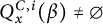


Finally, for every
 $\beta \in \operatorname {\mathrm {acc}}(C\setminus \operatorname {\mathrm {dom}}(x))$
such that
 $b_x^{C,i}\mathbin \upharpoonright \beta $
has already been defined, we let
 $b_x^{C,i}(\beta )=\bigcup \operatorname {\mathrm {Im}}(b_x^C\mathbin \upharpoonright \beta )$
. By (⋆),
 $\mathrel {{}^{S}{\sqsubseteq }}$
-coherence and the exact same proof of [Reference Brodsky and RinotBR19b, Claim 2.2.1],
 $b_x^{C,i}(\beta )$
is indeed in
 $T_\beta $
.
Claim 4.3.1 For every
 $C\in \mathcal C_\alpha $
,
 $\{\mathbf b_x^{C,0}\mathrel {|} x\in T\mathbin \upharpoonright C\}\cap \{\mathbf b_x^{C,1}\mathrel {|} x\in T\mathbin \upharpoonright C\}=\emptyset $
.
Proof Let
 $C\in \mathcal C_\alpha $
and
 $x,y\in T\mathbin \upharpoonright C$
. Fix a large enough
 $\beta \in \operatorname {\mathrm {nacc}}(C)$
for which
 $\beta ^-:=\sup (C\cap \beta )$
is bigger than
 $\max \{\operatorname {\mathrm {dom}}(x),\operatorname {\mathrm {dom}}(y)\}$
. By the definitions of
 $b_x^{C,0}$
and
 $b_y^{C,1}$
,
-
•
$b_x^{C,0}(\beta )(\beta ^-)=0$
, and -
•
$b_y^{C,1}(\beta )(\beta ^-)=1$
.


In particular,
 $\mathbf b_x^{C,0}\neq \mathbf b_y^{C,1}$
.
This finishes the construction of
 $T_\alpha $
. Finally, by [Reference Brodsky and RinotBR19b, Claims 2.2.2 and 2.2.3],
 $T:=\bigcup _{\alpha <\kappa }T_\alpha $
is a
 $\kappa $
-Souslin tree.
Theorem 4.4 Suppose that
 $\chi $
is a cardinal such that
 $\lambda ^{<\chi }<\kappa $
for all
 $\lambda <\kappa $
, and that
 $\operatorname {\mathrm {P}}(\kappa ,\kappa ,\mathrel {{}^{S}{\sqsubseteq }},1,\{S\cup E^\kappa _{\ge \chi }\})$
holds for a given
 $S\subseteq \operatorname {\mathrm {acc}}(\kappa )\cap E^\kappa _{<\chi }$
. Then, there exists a normal, prolific, streamlined
 $\kappa $
-Souslin tree T such that
 $V^-(T)\cap E^\kappa _{<\chi }=V(T)\cap E^\kappa _{<\chi }=S$
.
Proof The proof is almost identical to that of Theorem 4.3, where the only change is in that now, the definition of
 $T_\alpha $
for a limit
 $\alpha $
splits into three:
 $$ \begin{align*}T_\alpha:=\begin{cases}\{\mathbf{b}_x^{C,0}\phantom{,\mathbf{b}_x^{C,1}}\mathrel{|} C\in\mathcal C_\alpha, x\in T\mathbin\upharpoonright C\},&\text{if }\alpha\in S;\\ \{\mathbf{b}_x^{C,0},\mathbf{b}_x^{C,1}\mathrel{|} C\in\mathcal C_\alpha, x\in T\mathbin\upharpoonright C\},&\text{if }\alpha\in E^\kappa_{\ge\chi};\\ \mathcal B(T\mathbin\upharpoonright\alpha),&\text{otherwise}.\\ \end{cases}\end{align*} $$
The details are left to the reader.
Remark 4.5 Sufficient conditions for the existence of
 $S\subseteq \kappa $
for which
 $\operatorname {\mathrm {P}}(\kappa ,\kappa ,\mathrel {{}^{S}{\sqsubseteq }}, 1,\{S\})$
holds are given by [Reference Brodsky and RinotBR21, Corollary 4.22] and [Reference Brodsky and RinotBR21, Theorem 4.28]. In particular, for every (nonreflecting) stationary
 $E\subseteq \kappa $
, if
 $\square (E)$
and
 $\diamondsuit (E)$
both hold, then there exists a stationary
 $S\subseteq E$
such that
 $\operatorname {\mathrm {P}}(\kappa ,\kappa ,\mathrel {{}^{S}{\sqsubseteq }},1,\{S\})$
holds.
Corollary 4.6 Suppose that
 $2^{2^{\aleph _0}}=\aleph _2$
, and that S is a nonreflecting stationary subset of
 $E^{\aleph _2}_{\aleph _0}$
. Then, there exists a normal prolific streamlined
 $\aleph _2$
-Souslin tree T such that
 $ V(T)=S\cup E^{\aleph _2}_{\aleph _1}$
.
Proof By [Reference Brodsky and RinotBR19c, Lemma 3.2], the hypotheses implies that
 $\operatorname {\mathrm {P}}(\aleph _2,\aleph _2,{\mathrel {{}^{S}{\sqsubseteq }}}, 1,\{S\})$
holds. Appealing to Theorem 4.4 with
 $(\kappa ,\chi ):=(\aleph _2,\aleph _1)$
provides us with a normal, prolific, streamlined
 $\aleph _2$
-Souslin tree T such that
 $V^-(T)\cap E^{\aleph _2}_{\aleph _0}=V(T)\cap E^{\aleph _2}_{\aleph _0}=S$
. As
 $V^-(T)\cap E^{\aleph _2}_{\aleph _0}$
is a nonreflecting stationary set, Lemma 2.10(1) (using
 $(\varsigma ,\chi ,\kappa ):=(2,\aleph _1,\aleph _2)$
) implies that
 $V(T)\cap E^{\aleph _2}_{\aleph _1}=E^{\aleph _2}_{\aleph _1}$
.
Corollary 4.7 Suppose
 $\operatorname {\mathrm {CH}}$
and
 both hold.Footnote
16
For every stationary
 $S\subseteq E^{\aleph _2}_{\aleph _0}$
, there exists an
 $\aleph _2$
-Souslin tree
 $\mathbf T$
such that
 $V(\mathbf T)$
is a stationary subset of S.
Proof
 implies
 $\square _{\aleph _1}$
which implies that for every stationary
 $S\subseteq E^{\aleph _2}_{\aleph _0}$
there exists a stationary
 $R\subseteq S$
that is nonreflecting. It thus follows from Corollary 4.6 that for every stationary
 $S\subseteq E^{\aleph _2}_{\aleph _0}$
, there exist a stationary
 $R\subseteq S$
and an
 $\aleph _2$
-Souslin tree
 $\mathbf T$
such that
 $ V(\mathbf T)=R\cup E^{\aleph _2}_{\aleph _1}$
. In addition,
 yields a uniformly coherent
 $\aleph _2$
-Souslin tree
 $\mathbf S$
(see [Reference VeličkovićVel86, Theorem 7] or [Reference Brodsky and RinotBR17a, Proposition 2.5 and Theorem 3.6]). By [Reference Rinot and ShalevRS23, Remark 2.20], then,
 $V(\mathbf S)=E^{\aleph _2}_{\aleph _0}$
. Clearly,
 $\mathbf T+\mathbf S$
is an
 $\aleph _2$
-Souslin tree, and, by Proposition 2.32(2),
 $V(\mathbf T+\mathbf S)=R$
.
Theorem 4.8 Suppose that
 $\kappa $
is a strongly inaccessible cardinal, and that
 $\operatorname {\mathrm {P}}(\kappa ,\kappa ,\mathrel {{}^{S}{\sqsubseteq }}, 1,\{S\})$
holds for a given
 $S\subseteq \operatorname {\mathrm {acc}}(\kappa )$
. Then, there exists a normal, prolific, streamlined
 $\kappa $
-Souslin tree T such that
 $V^-(T)=V(T)=S$
.
Proof The proof is almost identical to that of Theorem 4.3, where the only change is that now, the definition of
 $T_\alpha $
for a limit
 $\alpha $
does not explicitly mention the
 $\mathbf {b}_x^{C,1}$
’s. Instead, it is:
 $$ \begin{align*}T_\alpha:=\begin{cases}\{\mathbf{b}_x^{C,0}\mathrel{|} C\in\mathcal C_\alpha, x\in T\mathbin\upharpoonright C\},&\text{if }\alpha\in S;\\ \mathcal B(T\mathbin\upharpoonright\alpha),&\text{otherwise}.\\ \end{cases}\end{align*} $$
The details are left to the reader.
Corollary 4.9 Suppose that
 $\kappa $
is a strongly inaccessible cardinal, and S is a nonreflecting stationary subset of
 $\operatorname {\mathrm {acc}}(\kappa )$
on which
 $\diamondsuit $
holds. Then, there exists a normal prolific streamlined
 $\kappa $
-Souslin tree T such that
 $V^-(T)=V(T)=S$
.
Proof By Theorem 4.8 together with [Reference Brodsky and RinotBR21, Theorem 4.26].
5 Realizing all points of some fixed cofinality
In this section, we deal with the problem of constructing a
 $\kappa $
-Souslin tree
 $\mathbf T$
for which
 $V(\mathbf T)$
is equal to the finite nonempty union of sets of the form
 $E^\kappa _\chi $
. The proof approach is motivated by Proposition 2.30, hence, we shall be constructing a finite sequence of
 $\kappa $
-Souslin trees whose product is still
 $\kappa $
-Souslin, and each of these trees satisfies that its set of vanishing levels is equal to
 $E^\kappa _\chi $
for one of the cardinals
 $\chi $
of interest. The main result of this section is Theorem 5.10 below. A sample corollary of it reads as follows.
Corollary 5.1 In
 $\mathsf {L}$
, for every regular uncountable cardinal
 $\kappa $
that is not weakly compact, for every finite nonempty
 $x\subseteq \operatorname {\mathrm {Reg}}(\kappa )$
with
 $\max (x)\le \operatorname {\mathrm {cf}}(\sup (\operatorname {\mathrm {Reg}}(\kappa )))$
, there exists a streamlined uniformly homogeneous
 $\kappa $
-Souslin tree T such that
 $V^-(T)=\bigcup _{\chi \in x}E^\kappa _\chi $
.
Proof Work in
 $\mathsf {L}$
. Let
 $\kappa $
be regular uncountable cardinal that is not weakly compact, and let
 $\langle \chi _i\mathrel {|} i\le n\rangle $
be the increasing enumeration of a set x as in the hypothesis. By
 $\textsf {GCH}$
,
 $\lambda ^{<\chi _n}<\kappa $
for every
 $\lambda <\kappa $
. By [Reference Brodsky and RinotBR17a, Theorem 3.6] and [Reference Brodsky and RinotBR19a, Corollary 4.14],
 $\operatorname {\mathrm {P}}(\kappa ,2,{\sqsubseteq },\kappa ,\{E^\kappa _{\ge \chi _n}\})$
holds. So, by Theorem 5.10 below, using
 $(\nu ,\chi ,\chi '):=(\aleph _0,\chi _0,\chi _n)$
and
 $S:={}^{<\kappa }1$
, we may pick a streamlined, normal,
 $2$
-splitting, uniformly homogeneous,
 $\chi _0$
-complete,
 $\chi _0$
-coherent,
 $E^\kappa _{\ge \chi _0}$
-regressive
 $\kappa $
-Souslin tree
 $T^0$
. Furthermore,
 $T^0$
is
 $\operatorname {\mathrm {P}}^-(\kappa ,2,{\sqsubseteq },\kappa ,\{E^\kappa _{\geq \chi _n}\})$
-respecting.
Claim 5.1.1
 $V^-(T^0)=E^\kappa _{\chi _0}$
.
Proof Since
 $T^0$
is
 $\chi _0$
-complete,
 $V^-(T^0)\cap E^\kappa _{<{\chi _0}}=\emptyset $
, so that
 $\operatorname {\mathrm {Tr}}(\kappa \setminus V^-(T^0))$
covers
 $E^\kappa _{\ge {\chi _0}}$
. By
 $\textsf {GCH}$
,
 $2^{<\chi _0}<2^{\chi _0}$
. Together with the fact that
 $T^0$
is
 $E^\kappa _{\chi _0}$
-regressive, it follows from Lemma 2.10(2) that
 $E^\kappa _{\chi _0}\subseteq V^-(T^0)$
. Finally, since
 $T^0$
is
 ${\chi _0}$
-coherent and uniformly homogeneous, we get from Lemma 5.3 below that
 $V^-(T^0)\cap E^\kappa _{>{\chi _0}}=\emptyset $
.
If
 $n=0$
, then our proof is complete. Otherwise, one can continue by recursion, where the successive step is as follows: Suppose that
 $i<n$
is such that
 $\bigotimes _{j\le i}T^j$
is a streamlined uniformly homogeneous normal
 $\kappa $
-Souslin tree that is
 $\operatorname {\mathrm {P}}^-(\kappa ,2,{\sqsubseteq }, \kappa ,\{E^\kappa _{\geq \chi _n}\})$
-respecting, and that
 $V(\bigotimes _{j\le i}T^j)=\bigcup _{j\le i}E^\kappa _{\chi _j}$
. By Theorem 5.10 below, using
 $(\nu ,\chi ,\chi '):=(\aleph _0,\chi _{i+1},\chi _n)$
and
 $S:=\bigotimes _{j\le i}T^j$
, we may pick a streamlined, normal,
 $2$
-splitting, uniformly homogeneous,
 $\chi _{i+1}$
-complete,
 $\chi _{i+1}$
-coherent,
 $E^\kappa _{\ge \chi _{i+1}}$
-regressive
 $\kappa $
-Souslin tree
 $T^{i+1}$
. Furthermore,
 $S\otimes T^{i+1}$
is a normal
 $\operatorname {\mathrm {P}}^-(\kappa ,2,{\sqsubseteq },\kappa , \{E^\kappa _{\geq \chi _n}\})$
-respecting
 $\kappa $
-Souslin tree. By an analysis similar to that of Claim 5.1.1,
 $V^-(T^{i+1})=E^\kappa _{\chi _{i+1}}$
. Altogether,
 $\bigotimes _{j\le i+1}T^j$
is a uniformly homogeneous normal
 $\kappa $
-Souslin tree that is
 $\operatorname {\mathrm {P}}^-(\kappa ,2,{\sqsubseteq }, \kappa ,\{E^\kappa _{\geq \chi _n}\})$
-respecting. In addition, by Proposition 2.30(2),
 $V(\bigotimes _{j\le i+1}T^j)=\bigcup _{j\le i+1}E^\kappa _{\chi _j}$
.
We start by giving a definition.
Definition 5.2 A streamlined
 $\kappa $
-tree T is
 $\chi $
-coherent iff for all
 $s,t\in T$
,
 $\{ \xi \in \operatorname {\mathrm {dom}}(s)\cap \operatorname {\mathrm {dom}}(t)\mathrel {|} s(\xi )\neq t(\xi )\}$
has size
 $<\chi $
.
Lemma 5.3 Suppose that
 $\chi <\kappa $
is a cardinal, and that T is a streamlined,
 $\chi $
-coherent uniformly homogeneous
 $\kappa $
-tree. Then,
 $V^-(T)\subseteq E^\kappa _{\le \chi }$
.
Proof Let
 $\alpha \in E^\kappa _{>\chi }$
. Suppose that
 $B\subseteq T$
is an
 $\alpha $
-branch, and we shall show it is not vanishing.
For every
 $\beta <\alpha $
, let
 $t_\beta $
denote the unique element of
 $T_\beta \cap B$
. Fix a node
 $t\in T_\alpha $
. For every
 $\beta \in E^\alpha _\chi $
, by
 $\chi $
-coherence, the following ordinal is smaller than
 $\beta $
:
 $$ \begin{align*}\epsilon_\beta:=\sup\{ \xi<\beta\mathrel{|} t_\beta(\xi)\neq t(\xi)\}.\end{align*} $$
As
 $\operatorname {\mathrm {cf}}(\alpha )>\chi $
,
 $E^\alpha _\chi $
is a stationary subset of
 $\alpha $
, so we may fix a large enough
 $\epsilon <\alpha $
for which
 $R:=\{\beta \in E^\alpha _\chi \mathrel {|} \epsilon _\beta <\epsilon \}$
is stationary. As T is uniformly homogeneous,
 $t_\epsilon *t$
is in
 $T_\alpha $
. For every
 $\beta \in R$
,
 $t_\beta =(t_\epsilon *t)\mathbin \upharpoonright \beta $
. But since R is cofinal in
 $\alpha $
, it is the case that
 $t_\epsilon *t$
constitutes a limit for B. Therefore, B is not vanishing.
In the context of streamlined
 $\kappa $
-trees, there is a neater way of presenting the operation of product (compare with Definition 2.28).
Definition 5.4 [Reference Brodsky and RinotBR19c, Section 4]
For every function
 $x:\alpha \rightarrow {}^\tau H_\kappa $
and every
 $i<\tau $
, we let
 $(x)_i:\alpha \rightarrow H_\kappa $
be
 $\langle x(\beta )(i)\mathrel {|} \beta <\alpha \rangle $
. Using this notation, for every sequence
 $\langle T^i\mathrel {|} i<\tau \rangle $
of streamlined
 $\kappa $
-trees, one may identify
 $\bigotimes _{i<\tau }T^i$
with the collection
 $T:=\{ x\in {}^{<\kappa }({}^\tau H_\kappa )\mathrel {|} \forall i<\tau \,[(x)_i\in T^i]\},$
which is a streamlined
 $\kappa $
-tree provided that
 $\lambda ^\tau <\kappa $
for all
 $\lambda <\kappa $
.
Remark 5.5 The product of two uniformly homogeneous
 $\kappa $
-trees is uniformly homogeneous.
Before we can state the main result of this section, we need one more definition.
Definition 5.6 [Reference Brodsky and RinotBR17b]
A streamlined
 $\kappa $
-tree X is
 $\operatorname {\mathrm {P}}_\xi ^-(\kappa , \mu ,\mathcal R, \theta , \mathcal S)$
-respecting iff there exists a subset
 $\S \subseteq \kappa $
and a sequence of mappings
 $\langle d ^C:(X\mathbin \upharpoonright C)\rightarrow {}^\alpha H_\kappa \cup \{\emptyset \}\mathrel {|} \alpha <\kappa , C\in \mathcal C_\alpha \rangle $
such that:
-
(1) for all
$\alpha \in \S $
and
$C\in \mathcal C_\alpha $
,
$X_\alpha \subseteq \operatorname {\mathrm {Im}}(d^C)$
; -
(2)
$\vec {\mathcal C}=\langle \mathcal C_\alpha \mathrel {|} \alpha <\kappa \rangle $
witnesses
$\operatorname {\mathrm {P}}_\xi ^-(\kappa , \mu ,\mathcal R, \theta , \{S\cap \S \mathrel {|} S\in \mathcal S\})$
; -
(3) for all sets
$D\sqsubseteq C$
from
$\vec {\mathcal C}$
and
$x\in X\mathbin \upharpoonright D$
,
$d^D(x)=d^C(x)\mathbin \upharpoonright \sup (D)$
.


Remark 5.7
-
(1) If
$\operatorname {\mathrm {P}}_\xi ^-(\kappa , \mu ,\mathcal R, \theta , \mathcal S)$
holds, then the normal streamlined
$\kappa $
-tree
$X:={}^{<\kappa }1$
is
$\operatorname {\mathrm {P}}_\xi ^-(\kappa , \mu ,\mathcal R, \theta , \mathcal S)$
-respecting; -
(2) If
$\kappa =\lambda ^+$
for an infinite regular cardinal
$\lambda $
, and
$\operatorname {\mathrm {P}}_\lambda ^-(\kappa , \mu , \mathrel {{}_{\lambda }{\sqsubseteq }}, \theta , \{E^\kappa _\lambda \})$
holds, then every
$\kappa $
-tree is
$\operatorname {\mathrm {P}}_\lambda ^-(\kappa , \mu , \mathrel {{}_{\lambda }{\sqsubseteq }}, \theta , \{E^\kappa _\lambda \})$
-respecting.


Lemma 5.8 Suppose that:
-
• X is a streamlined
$\kappa $
-tree that is
$\operatorname {\mathrm {P}}_\xi ^-(\kappa , \mu ,\mathcal R, \kappa , \mathcal S)$
-respecting, as witnessed by some
$\vec {\mathcal C}$
and
$\S $
; -
• Y is a streamlined
$\kappa $
-tree that is
$\operatorname {\mathrm {P}}_\xi ^-(\kappa , \mu ,\mathcal R, \kappa , \{S\cap \S \mathrel {|} S\in \mathcal S\})$
-respecting, as witnessed by the same
$\vec {\mathcal C}$
.


Then, the product
 $X\otimes Y$
is
 $\operatorname {\mathrm {P}}_\xi ^-(\kappa , \mu ,\mathcal R, \kappa , \mathcal S)$
-respecting.
Proof In view of Definition 5.4, for every two functions
 $x,y$
from an ordinal
 $\alpha <\kappa $
to
 $H_\kappa $
, we denote by
 the unique function
 $p:\alpha \rightarrow {}^2H_\kappa $
such that
 $(p)_0=x$
and
 $(p)_1=y$
. Note that
 .
Write
 $\vec {\mathcal C}$
as
 $\langle \mathcal C_\alpha \mathrel {|} \alpha <\kappa \rangle $
. Fix a sequence of mappings
 $\langle d^C:(X\mathbin \upharpoonright C)\rightarrow {}^\alpha H_\kappa \cup \{\emptyset \}\mathrel {|} \alpha <\kappa , C\in \mathcal C_\alpha \rangle $
such that:
-
(1) for all
$\alpha \in \S $
and
$C\in \mathcal C_\alpha $
,
$X_\alpha \subseteq \operatorname {\mathrm {Im}}(d^C)$
; -
(2)
$\vec {\mathcal C}=\langle \mathcal C_\alpha \mathrel {|} \alpha <\kappa \rangle $
witnesses
$\operatorname {\mathrm {P}}_\xi ^-(\kappa , \mu ,\mathcal R, \kappa , \{S\cap \S \mathrel {|} S\in \mathcal S\})$
; -
(3) for all sets
$D\sqsubseteq C$
from
$\vec {\mathcal C}$
and
$x\in X\mathbin \upharpoonright D$
,
$d^D(x)=d^C(x)\mathbin \upharpoonright \sup (D)$
.


Fix a stationary
 $\S '\subseteq \S $
and a sequence of mappings
 $\langle e^C:(Y\mathbin \upharpoonright C)\rightarrow {}^\alpha H_\kappa \cup \{\emptyset \}\mathrel {|} \alpha <\kappa , C\in \mathcal C_\alpha \rangle $
such that:
-
(4) for all
$\alpha \in \S '$
and
$C\in \mathcal C_\alpha $
,
$Y_\alpha \subseteq \operatorname {\mathrm {Im}}(e^C)$
; -
(5)
$\vec {\mathcal C}=\langle \mathcal C_\alpha \mathrel {|} \alpha <\kappa \rangle $
witnesses
$\operatorname {\mathrm {P}}_\xi ^-(\kappa , \mu ,\mathcal R, \kappa , \{S\cap \S '\mathrel {|} S\in \mathcal S\})$
; -
(6) for all sets
$D\sqsubseteq C$
from
$\vec {\mathcal C}$
and
$y\in Y\mathbin \upharpoonright D$
,
$e^D(y)=e^C(y)\mathbin \upharpoonright \sup (D)$
.


Let
 $\vec B=\langle B_{x,y}\mathrel {|} (x,y)\in X\times Y\rangle $
be a partition of
 $\kappa $
into cofinal subsets of
 $\kappa $
. Define a sequence of mappings
 $\langle b^C:(X\otimes Y)\mathbin \upharpoonright C\rightarrow {}^\alpha H_\kappa \cup \{\emptyset \}\mathrel {|} \alpha <\kappa , C\in \mathcal C_\alpha \rangle $
, as follows. Let
 $\alpha <\kappa $
and
 $C\in \mathcal C_\alpha $
.
 $\blacktriangleright $
For every
 $\beta \in C$
, if there are
 $x\in X\mathbin \upharpoonright (C\cap \beta )$
and
 $y\in Y\mathbin \upharpoonright (C\cap \beta )$
such that
 $\beta \in B_{x,y}$
, then since
 $\vec B$
is a sequence of pairwise disjoint sets, this pair
 $(x,y)$
is unique, and we let
 for every
 $p\in (X\otimes Y)_\beta $
.
 $\blacktriangleright $
For every
 $\beta \in C$
for which there is no such pair
 $(x,y)$
, we let
 $b^C(p):=\emptyset $
for every
 $p\in (X\otimes Y)_\beta $
.
Claim 5.8.1 Suppose
 $D\sqsubseteq C$
are sets from
 $\vec {\mathcal C}$
. For every
 $p\in (X\otimes Y)\mathbin \upharpoonright D$
,
 $b^D(p)=b^C(p)\mathbin \upharpoonright \sup (D)$
.
Proof Given
 $p\in (X\otimes Y)\mathbin \upharpoonright D$
. Denote
 $\beta :=\operatorname {\mathrm {dom}}(p)$
. Note that
 $D\cap \beta =C\cap \beta $
. Now, there are two options:
 $\blacktriangleright $
There are
 $x\in X\mathbin \upharpoonright (C\cap \beta )$
and
 $y\in Y\mathbin \upharpoonright (C\cap \beta )$
such that
 $\beta \in B_{x,y}$
. Then,
 and
 . Since
 $D\sqsubseteq C$
, we know that
 $d^D(x)=d^C(x)\mathbin \upharpoonright \sup (D)$
and
 $e^D(y)=e^C(y)\mathbin \upharpoonright \sup (D)$
. Therefore,
 $b^D(p)=d^C(p)\mathbin \upharpoonright \sup (D)$
.
 $\blacktriangleright $
There are no such x and y. Then,
 $b^D(p)=\emptyset =d^C(p)$
.
Consider the following set:
 $$ \begin{align*}\S":=\{\alpha\in\S'\mathrel{|} \forall C\in\mathcal C_\alpha\forall x\in(X\mathbin\upharpoonright\alpha)\forall y\in(Y\mathbin\upharpoonright\alpha)\,[\sup(\operatorname{\mathrm{nacc}}(C)\cap B_{x,y})=\alpha]\}.\end{align*} $$
Claim 5.8.2
 $\vec {\mathcal C}=\langle \mathcal C_\alpha \mathrel {|} \alpha <\kappa \rangle $
witnesses
 $\operatorname {\mathrm {P}}_\xi ^-(\kappa , \mu ,\mathcal R, \kappa , \{S\cap \S "\mathrel {|} S\in \mathcal S\})$
.
Proof Let
 $\langle B_i\mathrel {|} i<\kappa \rangle $
be a given sequence of cofinal subsets of
 $\kappa $
. Let
 $\pi :\kappa \leftrightarrow \kappa \uplus (X\times Y)$
be a surjection. As X and Y are
 $\kappa $
-trees, the set
 $D:=\{ \alpha <\kappa \mathrel {|} \pi [\alpha ]=\alpha \uplus ((X\mathbin \upharpoonright \alpha )\times (Y\mathbin \upharpoonright \alpha ))\}$
is a club in
 $\kappa $
. By Clause (5), then, for every
 $S\in \mathcal {S}$
, there are stationarily many
 $\alpha \in S\cap \S '\cap D$
such that for all
 $C\in \mathcal C_\alpha $
and
 $i<\alpha $
,
 $\sup (\operatorname {\mathrm {nacc}}(C)\cap B_{\pi (i)})=\alpha $
. In particular, for every
 $S\in \mathcal {S}$
, there are stationarily many
 $\alpha \in S\cap \S "$
such that for all
 $C\in \mathcal C_\alpha $
and
 $i<\alpha $
,
 $\sup (\operatorname {\mathrm {nacc}}(C)\cap B_i)=\alpha $
.
Claim 5.8.3 Let
 $\alpha \in \S "$
and
 $C\in \mathcal C_\alpha $
. Then,
 $(X\otimes Y)_\alpha \subseteq \operatorname {\mathrm {Im}}(b^C)$
.
Proof Let
 $(s,t)\in X_\alpha \times Y_\alpha $
. As
 $\S "\subseteq \S '\subseteq \S $
, using Clauses (1) and (4), we may fix
 $x\in X\mathbin \upharpoonright C$
and
 $y\in Y\mathbin \upharpoonright C$
such that
 $d^C(x)=s$
and
 $e^C(y)=t.$
As
 $\alpha \in \S "$
, we may pick
 $\beta \in \operatorname {\mathrm {nacc}}(C)\cap B_{x,y}$
above
 $\max \{\operatorname {\mathrm {dom}}(x),\operatorname {\mathrm {dom}}(y)\}$
. Let p be an arbitrary element of
 $(X\otimes Y)_\beta $
. Then,
 .
This completes the proof.
Remark 5.9 The preceding proof highlights a feature of respecting trees of independent interest, namely, for a streamlined
 $\operatorname {\mathrm {P}}_\xi ^-(\kappa , \mu ,\mathcal R,\theta , \mathcal S)$
-respecting
 $\kappa $
-tree X, in case of
 $\theta =\kappa $
, one may assume in Definition 5.6 that
 $d^C(x)$
depends only on
 $\operatorname {\mathrm {dom}}(x)$
(and C), and Clause (1) may be strengthened to assert that for all
 $\alpha \in \S $
,
 $C\in \mathcal C_\alpha ,$
and
 $x\in X_\alpha ,$
there are cofinally many
 $\beta \in \operatorname {\mathrm {nacc}}(C)$
such that
 $d^C(x\mathbin \upharpoonright \beta )=x$
.
Theorem 5.10 Suppose that:
-
•
$\varsigma <\kappa $
is a cardinal; -
•
$\nu \le \chi \le \chi '<\kappa $
are cardinals such that
$\lambda ^{<\chi }<\kappa $
for every
$\lambda <\kappa $
; -
• S is a
$\operatorname {\mathrm {P}}^-(\kappa ,2,{\mathrel {{}_{\nu }{\sqsubseteq }}},\kappa ,\{E^\kappa _{\geq \chi '}\})$
-respecting streamlined normal
$\kappa $
-tree with no
$\kappa $
-sized antichains; -
•
$\diamondsuit (\kappa )$
holds.


Then, there exists a streamlined, normal,
 $\varsigma $
-splitting, prolific, uniformly homogeneous,
 $\chi $
-complete,
 $\chi $
-coherent,
 $E^\kappa _{\ge \chi }$
-regressive
 $\kappa $
-Souslin tree T such that
 $S\otimes T$
is a normal
 $\operatorname {\mathrm {P}}^-(\kappa ,2,{\mathrel {{}_{\nu }{\sqsubseteq }}},\kappa ,\{E^\kappa _{\geq \chi '}\})$
-respecting
 $\kappa $
-Souslin tree.
Proof Fix a stationary
 $\S \subseteq E^\kappa _{\geq \chi '}$
and a sequence
 $\langle d^\alpha :S\mathbin \upharpoonright C_\alpha \rightarrow {}^\alpha H_\kappa \cup \{\emptyset \}\mathrel {|} \alpha <\kappa \rangle $
such that:
-
(1) for every
$\alpha \in \S $
,
$S_\alpha \subseteq \operatorname {\mathrm {Im}}(d^\alpha )$
; -
(2)
$\vec C:=\langle C_\alpha \mathrel {|} \alpha <\kappa \rangle $
witnesses
$\operatorname {\mathrm {P}}^-(\kappa , 2,{\mathrel {{}_{\nu }{\sqsubseteq }}}, \kappa , \{\S \})$
; -
(3) for all
$\alpha <\beta <\kappa $
, if
$C_\alpha \sqsubseteq C_\beta $
, then
$d^\alpha (x)=d^\beta (x)\mathbin \upharpoonright \alpha $
for every
$x\in S\mathbin \upharpoonright C_\alpha $
.


Claim 5.10.1 We may assume that
 $C_{\alpha +1}=\{\alpha \}$
for every
 $\alpha <\kappa $
and that
 $\min (C_\alpha )=0$
for every
 $\alpha \in \operatorname {\mathrm {acc}}(\kappa )$
.
Proof Consider the C-sequence
 $\vec {C^\bullet }=\langle C_\alpha ^\bullet \mathrel {|} \alpha <\kappa \rangle $
defined by letting
 $C_0^\bullet :=\emptyset $
,
 $C_{\alpha +1}^\bullet :=\{\alpha \}$
for every
 $\alpha <\kappa $
, and
 $$ \begin{align*}C_\alpha^\bullet:=\{ 0\} \cup \{n+1\mathrel{|} n\in C_\alpha\cap\omega\} \cup (C_\alpha\setminus\omega),\end{align*} $$
for every
 $\alpha \in \operatorname {\mathrm {acc}}(\kappa )$
,
It is clear that
 $\operatorname {\mathrm {acc}}(C_\alpha ^\bullet )=\operatorname {\mathrm {acc}}(C_\alpha )$
for every
 $\alpha \in \operatorname {\mathrm {acc}}(\kappa )$
, and that for all nonzero
 $\beta <\alpha <\kappa $
,
 $C_\beta ^\bullet \sqsubseteq C_\alpha ^\bullet $
iff (
 $\beta =1$
and
 $\alpha \in \operatorname {\mathrm {acc}}(\kappa )$
) or (
 $\beta ,\alpha \in \operatorname {\mathrm {acc}}(\kappa )$
and
 $C_\beta \sqsubseteq C_\alpha $
). Consequently,
 $\vec {C^\bullet }$
witnesses
 $\operatorname {\mathrm {P}}^-(\kappa , 2,{\mathrel {{}_{\nu }{\sqsubseteq }}}, \kappa , \{\S \})$
. Next, for every
 $\alpha \in \operatorname {\mathrm {nacc}}(\kappa )$
, let
 $b^\alpha :S\mathbin \upharpoonright C_\alpha ^\bullet \rightarrow \{\emptyset \}$
be a constant map. Then, for every
 $\alpha \in \operatorname {\mathrm {acc}}(\kappa )$
, define
 $b^\alpha :S\mathbin \upharpoonright C_\alpha ^\bullet \rightarrow {}^\alpha H_\kappa \cup \{\emptyset \}$
, as follows. Given
 $x\in S\mathbin \upharpoonright C_\alpha ^\bullet $
:
-
• If
$x=\emptyset $
, then let
$b^\alpha (x):=\emptyset $
; -
• If
$\operatorname {\mathrm {dom}}(x)=n+1$
for some
$n<\omega $
, then let
$b^\alpha (x):=d^\alpha (x\mathbin \upharpoonright n)$
; -
• If
$\operatorname {\mathrm {dom}}(x)\ge \omega $
, then let
$b^\alpha (x):=d^\alpha (x)$
.


As S is normal,
 $\operatorname {\mathrm {Im}}(b^\alpha )\supseteq \operatorname {\mathrm {Im}}(d^\alpha )$
for every
 $\alpha \in \operatorname {\mathrm {acc}}(\kappa )$
. Finally, for all
 $\beta <\alpha <\kappa $
, if
 $C_\beta ^\bullet \sqsubseteq C_\alpha ^\bullet $
and there exists
 $x\in S\mathbin \upharpoonright C^\bullet _\beta $
that is nonempty, then
 $C_\beta \sqsubseteq C_\alpha $
and
 $d^\beta (x)=d^\alpha (x)\mathbin \upharpoonright \beta $
for every
 $x\in S\mathbin \upharpoonright C_\beta $
, from which it follows that
 $b^\beta (x)=b^\alpha (x)\mathbin \upharpoonright \beta $
for every
 $x\in S\mathbin \upharpoonright C^\bullet _\beta $
.
The upcoming construction follows the proof of [Reference Brodsky and RinotBR17a, Proposition 2.5]. Let
 $\langle R_i \mathrel {|} i<\kappa \rangle $
and
 $\langle \Omega _\beta \mathrel {|} \beta <\kappa \rangle $
together witness
 $\diamondsuit (H_\kappa )$
. Let
 $\pi :\kappa \rightarrow \kappa $
be such that
 $\alpha \in R_{\pi (\alpha )}$
for all
 $\alpha <\kappa $
. From
 $\diamondsuit (\kappa )$
, we have
 $\left |H_\kappa \right | =\kappa $
, thus let
 $\lhd $
be some well-ordering of
 $H_\kappa $
of order-type
 $\kappa $
, and let
 $\phi :\kappa \leftrightarrow H_\kappa $
witness the isomorphism
 $(\kappa ,\in )\cong (H_\kappa ,\lhd )$
. Put
 $\psi :=\phi \circ \pi $
.
We now recursively construct a sequence
 $\langle T_\alpha \mathrel {|} \alpha <\kappa \rangle $
of levels whose union will ultimately be the desired tree T. Let
 $T_0:=\{\emptyset \}$
, and for all
 $\alpha <\kappa $
, let
 $$ \begin{align*}T_{\alpha+1}:=\{ t{}^\smallfrown\langle i\rangle\mathrel{|} t\in T_\alpha, i<\max\{\varsigma,\omega,\alpha\}\}.\end{align*} $$
Next, suppose that
 $\alpha \in \operatorname {\mathrm {acc}}(\kappa )$
, and that
 $\langle T_\beta \mathrel {|} \beta <\alpha \rangle $
has already been defined. We shall identify some
 $\mathbf b^\alpha \in \mathcal B(T\mathbin \upharpoonright \alpha )$
, and then define the
 $\alpha ^{\text {th}}$
-level, as follows:
 $$ \begin{align} T_\alpha:=\begin{cases} \mathcal B(T\mathbin\upharpoonright\alpha),&\text{if }\alpha\in E^\kappa_{<\chi};\\ \{x*\mathbf b^\alpha\mathrel{|} x\in T\mathbin\upharpoonright\alpha\},&\text{if }\alpha\in E^\kappa_{\ge\chi}. \end{cases} \end{align} $$
We shall obtain
 $\mathbf b^\alpha $
as a limit
 $\bigcup \operatorname {\mathrm {Im}}(b^\alpha )$
of a sequence
 $b^\alpha \in \prod _{\beta \in C_\alpha }T_\beta $
that we define recursively, as follows. Let
 $b^\alpha (0):=\emptyset $
. Next, suppose
 $\beta ^-<\beta $
are two successive points of
 $C_\alpha $
, and that
 $b^\alpha (\beta ^-)$
has already been defined. There are two possible options:
 $\blacktriangleright $
If
 $\psi (\beta )$
happens to be a pair
 $(y,x)$
lying in
 $(S\mathbin \upharpoonright \beta ^-)\times (T\mathbin \upharpoonright \beta ^-)$
, and the following set happens to be nonempty:
 $$ \begin{align*}Q^{\alpha,\beta}:=\{t\in T_\beta\mathrel{|} \exists(\bar s,\bar t)\in \Omega_\beta\,[\bar s\subseteq d^\alpha(y)\mathbin\upharpoonright \beta\ \&\ (\bar t\cup(x*b^\alpha(\beta^-)))\subseteq t] \},\end{align*} $$
then let t denote its
 $\lhd $
-least element, and put
 $b^\alpha (\beta ):=b^\alpha (\beta ^-)* t$
.
 $\blacktriangleright $
Otherwise, let
 $b^\alpha (\beta )$
be the
 $\lhd $
-least element of
 $T_\beta $
that extends
 $b^\alpha (\beta ^-)$
.
As always, for all
 $\beta \in \operatorname {\mathrm {acc}}(C_\alpha )$
such that
 $b^\alpha \mathbin \upharpoonright \beta $
has already been defined, we let
 $b^\alpha (\beta ):=\bigcup \operatorname {\mathrm {Im}}(b^\alpha \mathbin \upharpoonright \beta )$
and infer that it belongs to
 $T_\beta $
. Indeed, either
 $\operatorname {\mathrm {cf}}(\beta )<\chi $
, and then
 $b^\alpha (\beta )\in \mathcal B(T\mathbin \upharpoonright \beta )=T_\beta $
, or
 $\operatorname {\mathrm {cf}}(\beta )\ge \chi \ge \nu $
, and then
 $C_\beta =C_\alpha \cap \beta $
from which it follows that
 $b^\alpha (\beta )=\mathbf b^\beta \in T_\beta $
. This completes the definition of
 $b^\alpha $
, hence also that of
 $\mathbf b^\alpha $
. Finally, let
 $T_\alpha $
be defined as promised in (⋆).
It is clear that
 $T := \bigcup _{\alpha < \kappa } T_\alpha $
is a streamlined, normal,
 $\varsigma $
-splitting, prolific, uniformly homogeneous,
 $\chi $
-complete
 $\kappa $
-tree.
Claim 5.10.2
T is
 $\chi $
-coherent.
Proof Suppose not, and let
 $\alpha $
be the least ordinal to accommodate
 $s,t\in T_\alpha $
such that s differs from t on a set of size
 $\ge \chi $
. Clearly,
 $\alpha \in E^\kappa _{\ge \chi }$
. So
 $s=x*\mathbf b^\alpha $
and
 $t=y*\mathbf b^\alpha $
for nodes
 $x,y\in T\mathbin \upharpoonright \alpha $
, and hence x and y differ on a set of size
 $\ge \chi $
, contradicting the minimality of
 $\alpha $
.
Claim 5.10.3
T is
 $E^\kappa _{\ge \chi }$
-regressive.
Proof To define
 $\rho :T\mathbin \upharpoonright E^\kappa _{\ge \chi }\rightarrow T$
, let
 $\alpha \in E^\kappa _{\ge \chi }$
. By the definition of
 $T_\alpha $
, for every
 $t\in T_\alpha $
, there exists some
 $x\in T\mathbin \upharpoonright \alpha $
such that
 $t=x*\mathbf b^\alpha $
, so we let
 $\rho (t)$
be an element of
 $T\mathbin \upharpoonright \alpha $
such that
 $t=\rho (t)*\mathbf b^\alpha $
. Now, if
 $s,t\in T_\alpha $
are such that
 $\rho (t)\subseteq s$
and
 $\rho (s)\subseteq t$
, then
 $\rho (t)\subseteq \rho (s)*\mathbf b^\alpha $
and
 $\rho (s)\subseteq \rho (t)*\mathbf b^\alpha $
. In particular,
 $\rho (s)$
is compatible with
 $\rho (t)$
. Without loss of generality,
 $\rho (s)\subseteq \rho (t)$
. Then,
 $t=\rho (s)*\mathbf b^\alpha =s$
.
Claim 5.10.4
T is
 $\operatorname {\mathrm {P}}^-(\kappa ,2,{\mathrel {{}_{\nu }{\sqsubseteq }}},\kappa ,\{\S \})$
-respecting, as witnessed by
 $\vec C$
.
Proof Define
 $\langle e^\alpha :T\mathbin \upharpoonright C_\alpha \rightarrow T_\alpha \mathrel {|} \alpha <\kappa \rangle $
via:
 $$ \begin{align*}e^\alpha(x):=\begin{cases}x*\mathbf b^\alpha,&\text{if }x\neq\emptyset\text{ and }\alpha\in\operatorname{\mathrm{acc}}(\kappa);\\ \emptyset,&\text{otherwise}. \end{cases}\end{align*} $$
Let
 $\alpha \in \S $
and we shall show that
 $T_\alpha \subseteq \operatorname {\mathrm {Im}}(e^\alpha )$
. To this end, let
 $y\in T_\alpha $
. As
 $\S \subseteq E^\kappa _{\ge \chi '}\subseteq E^\kappa _{\ge \chi }$
, we get from (⋆) the existence of some
 $x\in T\mathbin \upharpoonright \alpha $
such that
 $y=x*\mathbf b^\alpha $
. By possibly extending x, we may assume that
 $x=y\mathbin \upharpoonright \beta $
for some nonzero
 $\beta \in C_\alpha $
. Consequently,
 $e^\alpha (x)=y$
.
By Claim 5.10.1, for all
 $\beta <\alpha <\kappa $
such that
 $C_\beta \sqsubseteq C_\alpha $
, it is the case that
 $\beta \in \{0,1\}\cup \operatorname {\mathrm {acc}}(\kappa )$
and
 $\alpha \in \operatorname {\mathrm {acc}}(\kappa )$
. If
 $\beta =1$
, then
 $e^\beta (x)=\emptyset =e^\alpha (x)$
for every
 $x\in T\mathbin \upharpoonright C_\beta $
, and we are done. Otherwise,
 $\beta \in \operatorname {\mathrm {acc}}(C_\alpha )$
hence
 $\mathbf b^\beta \subseteq \mathbf b^\alpha $
from which it follows that
 $e^\beta (x)=e^\alpha (x)\mathbin \upharpoonright \beta $
for every
 $x\in T\mathbin \upharpoonright C_\beta $
.
It thus follows from Lemma 5.8 that
 $S\otimes T$
is
 $\operatorname {\mathrm {P}}^-(\kappa ,2,{\mathrel {{}_{\nu }{\sqsubseteq }}},\kappa ,\{E^\kappa _{\geq \chi '}\})$
-respecting. It is clear that
 $S\otimes T$
is normal, thus we are left with verifying that it is Souslin. To this end, let A be a maximal antichain in
 $S\otimes T$
. As both S and T are normal, it follows that for every
 $z\in T$
, the following (upward-closed) set is cofinal in S:
 $$ \begin{align*}D_z:=\{s\in S\mathrel{|} \exists (\bar s,\bar t)\in A \exists t\in T\cap z^\uparrow\,[\operatorname{\mathrm{dom}}(s)=\operatorname{\mathrm{dom}}(t), \bar s\subseteq s, \bar t\subseteq t]\}.\end{align*} $$
As an application of
 $\diamondsuit (H_\kappa )$
, using the parameter
 $p:=\{\phi ,S,T, A, \langle D_z\mathrel {|} z\in T\rangle \}$
, we get that for every
 $i<\kappa $
, the following set is cofinal (in fact, stationary) in
 $\kappa $
:
 $$ \begin{align*}B_i:=\{\beta\in R_i\mathrel{|} \exists \mathcal M\prec H_{\kappa^+}\,(p\in \mathcal M, \mathcal M\cap\kappa=\beta, \Omega_\beta=A\cap \mathcal M)\}.\end{align*} $$
Note that
 $(S\mathbin \upharpoonright \beta )\times (T\mathbin \upharpoonright \beta )\subseteq \phi [\beta ]$
for every
 $\beta \in \bigcup _{i<\kappa }B_i$
. Now, as
 $\vec C$
witnesses
 $\operatorname {\mathrm {P}}^-(\kappa , 2,{\mathrel {{}_{\nu }{\sqsubseteq }}}, \kappa , \{\S \})$
, we may fix some
 $\alpha \in \S $
such that, for all
 $i<\alpha $
,
 $$ \begin{align*}\sup (\operatorname{\mathrm{nacc}}(C_\alpha)\cap B_i)=\alpha.\end{align*} $$
In particular,
 $(S\mathbin \upharpoonright \alpha )\times (T\mathbin \upharpoonright \alpha )\subseteq \phi [\alpha ]$
. As
 $\alpha \in \S $
, we also know that
 $S_\alpha \subseteq \operatorname {\mathrm {Im}}(d^\alpha )$
and that
 $\operatorname {\mathrm {cf}}(\alpha )\ge \chi $
.
Claim 5.10.5
 $A\subseteq (S\otimes T)\mathbin \upharpoonright \alpha $
. In particular,
 $|A|<\kappa $
.
Proof As A is an antichain, it suffices to prove that every element of
 $(S\otimes T)_\alpha $
extends some element of A. To this end, fix
 $(s',t')\in (S\otimes T)_\alpha $
. Since
 $S_\alpha \subseteq \operatorname {\mathrm {Im}}(d^\alpha )$
, we may fix a
 $y\in S\mathbin \upharpoonright C_\alpha $
such that
 $d^\alpha (y)=s'$
. Recalling (⋆), we may also fix some
 $x\in T\mathbin \upharpoonright C_\alpha $
such that
 $t'=x*\mathbf b^\alpha $
.
As the pair
 $(y,x)$
is an element of
 $(S\mathbin \upharpoonright \alpha )\times (T\mathbin \upharpoonright \alpha )$
, we may find an
 $i<\alpha $
such that
 $\phi (i)=(y,x)$
, and then find a
 $\beta \in \operatorname {\mathrm {nacc}}(C_\alpha )\cap B_i$
such that
 $\beta ^-:=\sup (C_\alpha \cap \beta )$
is greater than
 $\max \{\operatorname {\mathrm {dom}}(y),\operatorname {\mathrm {dom}}(x)\}$
. Note that
 $\psi (\beta )=\phi (\pi (\beta ))=\phi (i)=(y,x)$
.
Subclaim 5.10.5.1
 $\Omega _\beta =A\cap ((S\otimes T)\mathbin \upharpoonright \beta )$
, and
 $Q^{\alpha ,\beta }\neq \emptyset $
.
Proof As
 $\beta \in B_i$
, we may fix
 $\mathcal M\prec H_{\kappa ^+}$
such that all of the following hold:
-
•
$\{\phi ,S,T, A, \langle D_z\mathrel {|} z\in T\rangle \}\in \mathcal M$
; -
•
$\mathcal M\cap \kappa =\beta $
; -
•
$\Omega _\beta =A\cap \mathcal M.$


By elementarity,
 $(S\otimes T)\cap \mathcal M=(S\otimes T)\mathbin \upharpoonright \beta $
, and
 $\Omega _\beta =A\cap \mathcal M=A\cap ((S\otimes T)\mathbin \upharpoonright \beta )$
. Then,
 $z:=t'\mathbin \upharpoonright \beta ^-$
is in
 $\mathcal M$
, and hence, so is
 $D_{z}$
. Pick in
 $\mathcal M$
a maximal antichain
 $\bar D$
in
 $D_z$
. Since
 $D_z$
is cofinal in S,
 $\bar D$
is a maximal antichain in S. Since S has no
 $\kappa $
-sized antichains, we may find a large enough
 $\gamma \in \mathcal M\cap \kappa $
such that
 $\bar D\subseteq S\mathbin \upharpoonright \gamma $
. It thus follows that
 $s'\mathbin \upharpoonright \gamma $
extends an element of
 $\bar D$
, but since
 $D_z$
is upward-closed,
 $s:=s'\mathbin \upharpoonright \gamma $
is in
 $D_z$
. It follows that we may fix
 $(\bar s,\bar t)\in A$
and
 $t\in T_\gamma \cap z^\uparrow $
such that
 $\bar s\subseteq s$
and
 $\bar t\subseteq t$
. As
 $\Omega _\beta =A\cap ((S\otimes T)\mathbin \upharpoonright \beta )$
,
 $(d^\alpha (y)\mathbin \upharpoonright \beta )\mathbin \upharpoonright \gamma =s$
and
 $x*b^\alpha (\beta ^-)=z\subseteq t$
, we infer that any element of
 $T_\beta $
extending t is in
 $Q^{\alpha ,\beta }$
.
It follows that
 $b^\alpha (\beta )=b^\alpha (\beta ^-)* t$
for some
 $t\in Q^{\alpha ,\beta }$
. This means that we may pick
 $(\bar s,\bar t)\in \Omega _\beta \subseteq A$
such that
 $\bar s\subseteq s'\mathbin \upharpoonright \beta $
and
 $\bar t\cup (x*b^\alpha (\beta ^-))\subseteq t$
. Therefore,
 $\bar t\subseteq x*b^\alpha (\beta )$
. Altogether,
 $(\bar s,\bar t)\in A$
,
 $\bar s\subseteq s'$
and
 $\bar t\subseteq t'$
.
This completes the proof.
We now arrive at the proof of Theorem A.
Theorem 5.11 We have
 $(1)\implies (2)\implies (3)$
:
-
(1) there exists a streamlined
$\kappa $
-Souslin tree T such that
$V(T)=\emptyset $
; -
(2) there exists a normal and splitting
$\kappa $
-tree
$\mathbf T$
such that
$V(\mathbf T)$
is nonstationary; -
(3)
$\kappa $
is not the successor of a cardinal of countable cofinality.


In addition, in
 $\mathsf {L}$
, for
 $\kappa $
not weakly compact,
 $(3)\implies (1)$
.
Proof
 $(1)\implies (2)$
: If
 $\mathbf T=(T,<_T)$
is a
 $\kappa $
-Souslin tree, then a standard argument (see [Reference Brodsky and RinotBR17b, Lemma 2.4]) shows that for some club
 $D\subseteq \kappa $
,
 $\mathbf T'=(T\mathbin \upharpoonright D,{<_T})$
is normal and splitting. Clearly, if
 $V(\mathbf T)=\emptyset $
, then
 $V(\mathbf T')=\emptyset $
, as well.
 $(2)\implies (3)$
: Suppose that
 $\mathbf T$
is a normal and splitting
 $\kappa $
-tree. If
 $\kappa $
is the successor of a cardinal of countable cofinality then by Corollary 2.12,
 $V(\mathbf T)$
covers the stationary set
 $E^\kappa _\omega $
.
Hereafter, work in
 $\mathsf L$
, and suppose that
 $\kappa $
is a regular uncountable cardinal that is not weakly compact and not the successor of a cardinal of countable cofinality. Then, by Corollary 5.1 together with Proposition 2.6(2), there are streamlined
 $\kappa $
-Souslin trees
 $T^0,T^1$
such that
 $V(T^0)=E^\kappa _\omega $
and
 $V(T^1)=E^\kappa _{\omega _1}$
. The disjoint sum of the two
 $T:=\sum \{T^0,T^1\}$
is clearly
 $\kappa $
-Souslin. In addition, by Proposition 2.32(2),
 $V(T)=V(T^0)\cap V(T^1)=\emptyset $
.
Example 5.12 A
 $\kappa $
-tree
 $\mathbf T=(T,<_T)$
is full iff for every
 $\alpha \in \operatorname {\mathrm {acc}}(\kappa )$
, there is no more than one vanishing
 $\alpha $
-branch in
 $\mathbf T$
. Such a tree
 $\mathbf T$
must satisfy
 $V(\mathbf T)=\emptyset $
, since for
 $\alpha \in V(\mathbf T)$
, it must be the case that
 $\mathbf T$
admits exactly one vanishing
 $\alpha $
-branch and that the said branch contains all elements of
 $T\mathbin \upharpoonright \alpha $
which means that
 $T\mathbin \upharpoonright \alpha $
itself is the said vanishing
 $\alpha $
-branch, so that
 $T_\alpha $
is empty. It thus follows from [Reference Rinot, Yadai and YouRYY24, Theorem C and Proposition 2.6] that there consistently exists a family of
 $2^{\aleph _2}$
-many
 $\aleph _2$
-Souslin trees
 $\mathbf T$
with
 $V(\mathbf T)=\emptyset $
such that no two of them are club-isomorphic.
We conclude this section by pointing out that by using [Reference Brodsky and RinotBR17a, Theorem 3.6] and a proof similar to that of Theorem 5.11, we get more information on the model studied in Corollary 4.7.
Corollary 5.13 Suppose that
 $\operatorname {\mathrm {CH}}$
and
 both hold. Then, there are
 $\aleph _2$
-Souslin trees
 $\mathbf T^0,\mathbf T^1,\mathbf T^2,\mathbf T^3$
such that:
-
•
$V(\mathbf T^0)=\emptyset $
; -
•
$V(\mathbf T^1)=E^{\aleph _2}_{\aleph _0}$
; -
•
$V(\mathbf T^2)=E^{\aleph _2}_{\aleph _1}$
; -
•
$V(\mathbf T^3)=\operatorname {\mathrm {acc}}(\aleph _2)$
.


6 Souslin trees with an ascent path
The subject matter of this section is the following definition.
Definition 6.1 (Laver)
Suppose that
 $\mathbf {T} = (T, <_T)$
is a
 $\kappa $
-tree. A
 $\mu $
-ascent path through
 $\mathbf {T}$
is a sequence
 $\vec f=\langle f_\alpha \mathrel {|} \alpha < \kappa \rangle $
such that:
-
• for every
$\alpha < \kappa $
,
$f_\alpha :\mu \rightarrow T_\alpha $
is a function; -
• for all
$\alpha < \beta < \kappa $
, there is an
$i < \mu $
such that
$f_\alpha (j) <_T f_\beta (j)$
whenever
$i\le j<\mu $
.


We will show that Souslin trees having a large set of vanishing levels are compatible with carrying an ascent path. For this, we shall make use of the following strengthening of
 $\operatorname {\mathrm {P}}_\xi ^-(\kappa ,\mu ^+,{\sqsubseteq },\theta ,\mathcal {S})$
.
Definition 6.2 [Reference Brodsky and RinotBR21, Section 4.6]
The principle
 $\operatorname {\mathrm {P}}_\xi ^-(\kappa , \mu ^{\text {ind}}, {\sqsubseteq },\theta ,\mathcal {S})$
asserts the existence of a
 $\xi $
-bounded
 $\mathcal C$
-sequence
 $\langle \mathcal {C}_\alpha \mathrel {|} \alpha <\kappa \rangle $
together with a sequence
 $\langle i(\alpha )\mathrel {|} \alpha <\kappa \rangle $
of ordinals in
 $\mu $
, such that:
-
• for every
$\alpha <\kappa $
, there exists a canonical enumeration
$\langle C_{\alpha ,i}\mathrel {|} i(\alpha )\le i<\mu \rangle $
of
$\mathcal C_\alpha $
satisfying that the sequence
$\langle \operatorname {\mathrm {acc}}({C}_{\alpha ,i})\mathrel {|} i(\alpha )\le i<\mu \rangle $
is
$\subseteq $
-increasing with
$\bigcup _{i\in [i(\alpha ),\mu )}\operatorname {\mathrm {acc}}(C_{\alpha ,i})=\operatorname {\mathrm {acc}}(\alpha )$
; -
• for all
$\alpha <\kappa $
,
$i\in [i(\alpha ),\mu )$
and
$\bar \alpha \in \operatorname {\mathrm {acc}}({C}_{\alpha ,i})$
, it is the case that
$i\ge i(\bar \alpha )$
and
$C_{\bar \alpha ,i}\sqsubseteq C_{\alpha ,i}$
; -
• for every sequence
$\langle B_\tau \mathrel {|} \tau <\theta \rangle $
of cofinal subsets of
$\kappa $
, and every
$S\in \mathcal {S}$
, there are stationarily many
$\alpha \in S$
such that for all
$C\in \mathcal C_\alpha $
and
$\tau <\min \{\alpha ,\theta \}$
,
$\sup (\operatorname {\mathrm {nacc}}(C)\cap B_\tau )=\alpha $
.





Conventions 3.4 and 3.5 apply to the preceding, as well.
Lemma 6.3 Suppose that:
-
(1)
$\mu <\kappa $
is an infinite cardinal; -
(2) K is a streamlined
$\kappa $
-tree; -
(3)
$\operatorname {\mathrm {P}}^-(\kappa , \mu ^{\text {ind}}, {\sqsubseteq },1)$
holds, and is witnessed by a sequence
$\langle \mathcal {C}_\alpha \mathrel {|} \alpha <\kappa \rangle $
such that
$\bigcap \mathcal C_\alpha $
is cofinal in
$\alpha $
for every
$\alpha \in \operatorname {\mathrm {acc}}(\kappa )$
; -
(4)
$\diamondsuit (\kappa )$
holds.


Then, there exists a normal and splitting streamlined
 $\kappa $
-Souslin tree T with
 $V(T)\supseteq V^-(K)$
such that T admits a
 $\mu $
-ascent path.
Proof As a preparatory step, we shall need the following simple claim.
Claim 6.3.1 We may assume that
 $\mathcal B(K)\neq \emptyset $
.
Proof For every
 $\eta \in K$
, define a function
 $\eta ':\operatorname {\mathrm {dom}}(\eta )\rightarrow H_\kappa $
via
 $\eta '(\alpha ):=(\eta (\alpha ),0)$
. Then,
 $K':=\{ \eta '\mathrel {|} \eta \in K\}\uplus {}^{<\kappa }1$
is a streamlined
 $\kappa $
-tree with
 $V^-(K')=V^-(K)$
and, in addition,
 $\mathcal B(K')\neq \emptyset $
.
Write
 $\vec {\mathcal C}$
for
 $\langle \mathcal {C}_\alpha \mathrel {|} \alpha <\kappa \rangle $
. In particular,
 $\vec {\mathcal C}$
is a
 $\operatorname {\mathrm {P}}^-(\kappa ,\kappa ,{\sqsubseteq },1)$
-sequence satisfying that, for all
 $\alpha \in \operatorname {\mathrm {acc}}(\kappa )$
and
 $C,D\in \mathcal C_\alpha $
,
 $\sup (C\cap D)=\alpha $
. As always, we may also assume that
 $0\in \bigcap _{0<\alpha <\kappa }\bigcap \mathcal C_\alpha $
.
Using
 $\vec {\mathcal C}$
and K, construct the sequence of levels
 $\langle T_\alpha \mathrel {|} \alpha <\kappa \rangle $
exactly as in the proof of Theorem 3.7, so that
 $T:=\bigcup _{\alpha <\kappa }T_\alpha $
is a normal and splitting streamlined
 $\kappa $
-Souslin tree. From Claim 3.7.2, we infer that
 $V(T)\supseteq V^-(K)$
.
In addition, the construction of Theorem 3.7 ensures that for every
 $\alpha \in \operatorname {\mathrm {acc}}(\kappa )$
, it is the case that
 $$ \begin{align*}T_\alpha=\{\mathbf b_x^{C,\eta}\mathrel{|} C\in\mathcal C_\alpha,\eta\in K_\alpha, x\in T\mathbin\upharpoonright C\}.\end{align*} $$
Fix
 $\zeta \in \mathcal B(K)$
. Let
 $\langle i(\alpha )\mathrel {|} \alpha <\kappa \rangle $
witness that
 $\vec {\mathcal C}$
is a
 $\operatorname {\mathrm {P}}^-(\kappa , \mu ^{\text {ind}}, {\sqsubseteq },1)$
-sequence. Similar to the proof of [Reference Brodsky and RinotBR21, Theorem 6.11], for every
 $\alpha \in \operatorname {\mathrm {acc}}(\kappa )$
, using the canonical enumeration
 $\langle C_{\alpha ,i}\mathrel {|} i(\alpha )\le i<\mu \rangle $
of
 $\mathcal C_\alpha $
, we define a function
 $f_\alpha :\mu \rightarrow T_\alpha $
via
 $$ \begin{align*}f_\alpha(j):=\mathbf{b}_\emptyset^{C_{\alpha,\max\{j,i(\alpha)\}},\zeta\mathbin\upharpoonright\alpha}.\end{align*} $$
Claim 6.3.2 Let
 $\beta <\alpha $
be a pair of ordinals in
 $\operatorname {\mathrm {acc}}(\kappa )$
. Then, there exists an
 $i<\mu $
such that
 $f_\beta (j)\subseteq f_\alpha (j)$
whenever
 $i\le j<\mu $
.
Proof Note that by Claim 3.7.1, for all
 $C\in \mathcal C_\alpha $
,
 $\eta \in K_\alpha $
, and
 $x\in T\mathbin \upharpoonright (C\cap \beta )$
, if
 $\beta \in \operatorname {\mathrm {acc}}(C)$
, then
 $\mathbf b_x^{C,\eta }\mathbin \upharpoonright \beta =\mathbf b_x^{C\cap \beta ,\eta \mathbin \upharpoonright \beta }$
.
Now, by Definition 6.2, we may fix a large enough
 $i\in [i(\alpha ),\mu )$
such that
 $\beta \in \operatorname {\mathrm {acc}}(C_{\alpha ,j})$
whenever
 $i\le j<\mu $
. Let j be such an ordinal. Then,
 $j\ge i(\beta )$
and
 $C_{\alpha ,j}\cap \beta =C_{\beta ,j}$
, so that
 $$ \begin{align*}f_\beta(j)=\mathbf{b}_\emptyset^{C_{\beta,j},\zeta\mathbin\upharpoonright\beta}=\mathbf{b}_\emptyset^{C_{\alpha,j},\zeta\mathbin\upharpoonright\alpha}\mathbin\upharpoonright\beta=f_\alpha(j)\mathbin\upharpoonright\beta,\end{align*} $$
as sought.
It now easily follows that T admits a
 $\mu $
-ascent path.
Corollary 6.4 Suppose that:
-
•
$\lambda $
is an uncountable cardinal satisfying
$\square _\lambda $
and
$2^\lambda =\lambda ^+$
; -
•
$\mu <\lambda $
is an infinite regular cardinal satisfying
$\lambda ^\mu =\lambda $
.


Then, there exists a streamlined
 $\lambda ^+$
-Souslin tree T with
 $V(T)=\operatorname {\mathrm {acc}}(\lambda ^+)$
such that T admits a
 $\mu $
-ascent path.
Proof By [Reference Lambie-Hanson and LückeLHL18, Theorem 3.4], in particular,
 $\square ^{\text {ind}}(\lambda ^+,\mu )$
holds. Then, by [Reference Brodsky and RinotBR21, Theorem 4.44],
 $\operatorname {\mathrm {P}}^-(\lambda ^+, \mu ^{\text {ind}}, {\sqsubseteq },1)$
holds. Furthermore, its proof shows that starting with a
 $\square ^{\text {ind}}(\lambda ^+,\mu )$
-sequence
 $\vec {\mathcal C}$
, there exists a triangular
 $\mathfrak x=\langle x_{\gamma ,\beta }\mathrel {|} \gamma <\beta <\kappa \rangle $
such that:
-
(i) for all
$\gamma <\beta <\kappa $
,
$x_{\gamma ,\beta }$
is a finite subset of
$(\gamma ,\beta ]$
with
$\beta \in x_{\beta ,\gamma }$
; -
(ii) the corresponding postprocessing function
$\Phi _{\mathfrak x}$
satisfies that
$\langle \{\Phi _{\mathfrak x}(C)\mathrel {|} C\in \mathcal C_\alpha \}\mathrel {|} \alpha \in \operatorname {\mathrm {acc}}(\kappa )\rangle $
witnesses
$\operatorname {\mathrm {P}}^-(\lambda ^+, \mu ^{\text {ind}}, {\sqsubseteq },1)$
.Footnote
17


Recalling [Reference Brodsky and RinotBR21, Lemma 4.9], Clause (i) implies that
 $C\subseteq \Phi _{\mathfrak x}(C)$
for every
 $C\in \bigcup _{\alpha \in \operatorname {\mathrm {acc}}(\kappa )}\mathcal C_\alpha $
. Consequently, our witness to
 $\operatorname {\mathrm {P}}^-(\lambda ^+, \mu ^{\text {ind}}, {\sqsubseteq },1)$
satisfies Clause (3) of Lemma 6.3.
Meanwhile, by Shelah’s theorem,
 $2^\lambda =\lambda ^+$
implies
 $\diamondsuit (\lambda ^+)$
. In addition, it is a classical theorem of Jensen that
 $\square _\lambda $
gives a special
 $\lambda ^+$
-Aronszajn tree, so by Theorem 2.27, we may find a streamlined
 $\lambda ^+$
-tree K such that
 $V(K)=\operatorname {\mathrm {acc}}(\lambda ^+)$
. It now follows from Lemma 6.3 that there exists a normal and splitting streamlined
 $\lambda ^+$
-Souslin tree T with
 $V(T)=\operatorname {\mathrm {acc}}(\lambda ^+)$
such that T admits a
 $\mu $
-ascent path.
We now turn to combine the preceding construction with the study of large cardinals. The following cardinal characteristic
 $\chi (\kappa )$
provides a measure of how far
 $\kappa $
is from being weakly compact.
Definition 6.5 (The C-sequence number of
$\kappa $
, [Reference Lambie-Hanson and RinotLHR21])

If
 $\kappa $
is weakly compact, then let
 $\chi (\kappa ):=0$
. Otherwise, let
 $\chi (\kappa )$
denote the least cardinal
 $\chi \le \kappa $
such that, for every C-sequence
 $\langle C_\beta \mathrel {|} \beta <\kappa \rangle $
, there exist
 $\Delta \in [\kappa ]^\kappa $
and
 $b:\kappa \rightarrow [\kappa ]^{\chi }$
with
 $\Delta \cap \alpha \subseteq \bigcup _{\beta \in b(\alpha )}C_\beta $
for every
 $\alpha <\kappa $
.
By [Reference Lambie-Hanson and RinotLHR21, Lemma 2.12(1)], if
 $\kappa $
is an inaccessible cardinal satisfying
 $\chi (\kappa )<\kappa $
, then
 $\kappa $
is
 $\omega $
-Mahlo. The following is an expanded form of Theorem E.
Theorem 6.6 Assuming the consistency of a weakly compact cardinal, it is consistent that for some strongly inaccessible cardinal
 $\kappa $
satisfying
 $\chi (\kappa )=\omega $
, the following two hold:
-
• Every
$\kappa $
-Aronszajn tree admits an
$\omega $
-ascent path; -
• There is a streamlined
$\kappa $
-Souslin tree T such that
$V(T)=\operatorname {\mathrm {acc}}(\kappa )$
.


Proof Suppose that
 $\kappa $
is a non-subtle weakly compact cardinal. By possibly using a preparatory forcing, we may assume that the non-subtle weak compactness of
 $\kappa $
is indestructible under forcing with
 $\mathrm {Add}(\kappa ,1)$
. Following the proof of [Reference Lambie-Hanson and RinotLHR21, Theorem 3.4], let
 $\mathbb {P}$
be the standard forcing to add a
 $\square ^{\text {ind}}(\kappa ,\omega )$
-sequence by closed initial segments, let G be
 $\mathbb {P}$
-generic, and let
 $\vec {\mathcal {C}}=\langle C_{\alpha ,i} \mathrel {|} \alpha <\kappa ,~i(\alpha ) \leq i<\omega \rangle $
denote the generically-added
 $\square ^{\text {ind}}(\kappa ,\omega )$
-sequence. Work in
 $V[G]$
. By Clauses (1), (2), and (4) of [Reference Lambie-Hanson and RinotLHR21, Theorem 3.4],
 $\kappa $
is strongly inaccessible,
 $\chi (\kappa )=\omega $
, and every
 $\kappa $
-Aronszajn tree admits an
 $\omega $
-ascent path.
For every
 $\alpha \in \operatorname {\mathrm {acc}}(\kappa )$
, let
 $$ \begin{align*}B_\alpha:=\{ \beta\in C_{\alpha,i(\alpha)}\mathrel{|} \{\min(C_{\alpha,i(\alpha)}\setminus\beta+1)+l\mathrel{|} l<\omega\}\subseteq C_{\alpha,i(\alpha)}\setminus\{\beta+1\}\}.\end{align*} $$
Claim 6.6.1 For every cofinal
 $B\subseteq \kappa $
, there exist
 $\alpha \in E^\kappa _\omega $
and
 $\epsilon <\alpha $
such that
 $(B_\alpha \setminus \epsilon )\subseteq B$
,
 $i(\alpha )=0$
and
 $\sup (\operatorname {\mathrm {nacc}}(C_{\alpha ,i})\cap B_\alpha )=\alpha $
for every
 $i<\omega $
.
Proof We follow the proof of [Reference Lambie-HansonLH17, Lemma 3.9]. Work in V. For every
 $\alpha \in \operatorname {\mathrm {acc}}(\kappa )$
, let
 $\dot {B_\alpha }$
be the canonical
 $\mathbb P$
-name for
 $B_\alpha $
. Next, let
 $\dot {B}$
be a
 $\mathbb P$
-name for a cofinal subset of
 $\kappa $
, and let
 $p_0$
be an arbitrary condition in
 $\mathbb {P}$
. By possibly extending
 $p_0$
, we may assume that
 $i(\gamma ^{p_0})^{p_0}=0$
. We shall recursively define a decreasing sequence of conditions
 $\langle p_n \mathrel {|} n<\omega \rangle $
, and an increasing sequence of ordinals
 $\langle \beta _n \mathrel {|} n<\omega \rangle $
such that for every
 $n<\omega $
, all of the following hold:
-
(1)
$p_{n+1}\leq p_n$
; -
(2)
$i(\gamma ^{p_{n+1}})^{p_{n+1}}=0$
; -
(3)
$p_{n+1} \Vdash "\beta _n \in \dot {B}\text { and }\dot B_{\gamma ^{p_{n+1}}}\setminus (\gamma ^{p_n}+1)=\{\beta _n \}"$
; -
(4) For every
$i\le n$
,
$\beta _n\in \operatorname {\mathrm {nacc}}(C_{\gamma ^{p_{n+1}},i}^{p_{n+1}})$
. -
(5) For every
$i<\omega $
,
$C_{\gamma ^{p_{n+1}},i}^{p_{n+1}} \cap \gamma ^{p_n}=C_{\gamma ^{p_n},i}^{p_{n}}$
.


Suppose
 $n<\omega $
is such that
 $\langle p_m \mathrel {|} m\leq n \rangle $
and
 $\langle \beta _m \mathrel {|} m< n \rangle $
have already been successfully defined. Find a
 $p^*_n \leq p_n$
and a
 $\beta _n>\gamma ^{p_n}$
such that
 $p^*_n \Vdash "\beta _n \in \dot {B}"$
. Without loss of generality,
 $\gamma ^{p^*_n}>\beta _n$
. Now, let
 $\gamma :=\gamma ^{p^*_n}+\omega $
, so that
 $$ \begin{align*}\gamma^{p_n}<\beta_n<\beta_n+1<\gamma^{p_n^*}<\gamma^{p^*_n}+\omega=\gamma.\end{align*} $$
Let
 $m <\omega $
be the least such that
 $m\geq \max \{n, i(\gamma ^{p^*_n})^{p^*_n}\}$
and
 $\gamma ^{p_n} \in \operatorname {\mathrm {acc}}(C_{\gamma ^{p^*_n},m}^{p_n^*})$
. Then, let
 $p_{n+1}$
be the unique extension of
 $p_n^*$
with
 $\gamma ^{p_{n+1}}=\gamma $
and
 $i(\gamma )^{p_{n+1}}=0$
to satisfy the following for every
 $i<\omega $
:
 $$ \begin{align*}C_{\gamma^{p_{n+1}},i}^{p_{n+1}}=\begin{cases} C_{\gamma^{p_n},i}^{p_{n}}\cup \{ \gamma^{p_n},\beta_n \}\cup \{ \gamma^{p_n^*}+l \mathrel{|} l<\omega \},&\text{if }i\leq m;\\ C_{\gamma^{p_n^*},i}^{p^*_{n}}\cup \{ \gamma^{p_n^*}+l \mathrel{|} l<\omega \},&\text{otherwise}. \end{cases}\end{align*} $$
Thus, we have maintained requirements (1)–(5).
Once completing the above recursion, we obtain a decreasing sequence of conditions
 $\langle p_n \mathrel {|} n<\omega \rangle $
. Let
 $\alpha :=\sup \{ \gamma ^{p_n} \mathrel {|} n<\omega \}$
, and let p be the unique lower bound of
 $\langle p_n \mathrel {|} n<\omega \rangle $
to satisfy
 $\gamma ^{p}=\alpha $
,
 $i(\alpha )^{p}=0$
, and
 $C^{p}_{\alpha ,i}=\bigcup _{n<\omega }C^{p_n}_{\gamma ^{p_n},i}$
for every
 $i<\omega $
. Then, p is a legitimate condition satisfying
 $p\Vdash "\dot B_\alpha \setminus (\gamma ^{p_0}+1)=\{\beta _n \mathrel {|} n<\omega \} \subseteq \dot {B}"$
. In addition, for every
 $i<\omega $
,
 $\{ \beta _n \mathrel {|} i \leq n<\omega \} \subseteq \operatorname {\mathrm {nacc}}(C_{\alpha ,i}^{p})$
. So we are done.
For each
 $\alpha <\kappa $
, let
 $\mathcal C_\alpha :=\{ C_{\alpha ,i}\mathrel {|} i(\alpha )\le i<\omega \}$
. We claim that
 $\langle \mathcal C_\alpha \mathrel {|} \alpha <\kappa \rangle $
is a
 $\operatorname {\mathrm {P}}^-(\kappa , \omega ^{\text {ind}}, {\sqsubseteq },1)$
-sequence satisfying that
 $\bigcap \mathcal C_\alpha $
is cofinal in
 $\alpha $
for every
 $\alpha \in \operatorname {\mathrm {acc}}(\kappa )$
. As we already know that
 $\vec {\mathcal {C}}$
is an
 $\square ^{\text {ind}}(\kappa ,\omega )$
-sequence, the first two bullets of Definition 6.2 are satisfied, and
 $\bigcap \mathcal C_\alpha =C_{\alpha ,i(\alpha )}$
for every
 $\alpha \in \operatorname {\mathrm {acc}}(\kappa )$
. Thus, we are left with verifying the last bullet of Definition 6.2 with
 $\theta :=1$
and
 $\mathcal S:=\{\kappa \}$
. By the same argument from the proof of [Reference Brodsky and RinotBR21, Corollary 3.4], this boils down to showing that for every cofinal
 $B\subseteq \kappa $
, there exists at least one
 $\alpha \in \operatorname {\mathrm {acc}}(\kappa )$
such that
 $\sup (\operatorname {\mathrm {nacc}}(C_{\alpha ,i})\cap B)=\alpha $
for every
 $i\in [i(\alpha ),\omega )$
. This is covered by Claim 6.6.1.
Claim 6.6.2
 $\diamondsuit (E^\kappa _\omega )$
holds.
Proof This is a standard consequence of Claim 6.6.1 together with the fact that
 $\kappa ^{<\kappa }=\kappa $
, but we give the details. Let
 $\vec X=\langle X_\beta \mathrel {|} \beta <\kappa \rangle $
be a repetitive enumeration of
 $[\kappa ]^{<\kappa }$
such that each set appears cofinally often. Let us say that an ordinal
 $\alpha \in E^\kappa _\omega $
is informative if
 $\sup (B_\alpha )=\alpha $
and there are
 $\epsilon <\kappa $
and a subset
 $A_\alpha \subseteq \alpha $
such that
 $A_\alpha \cap \gamma =X_\beta \cap \gamma $
for every pair
 $\gamma <\beta $
of ordinals from
 $B_\alpha \setminus \epsilon $
. Note that if
 $\alpha $
is informative, then the set
 $A_\alpha $
is uniquely determined. For a noninformative
 $\alpha \in E^\kappa _\omega $
, we let
 $A_\alpha :=\emptyset $
.
To verify that
 $\langle A_\alpha \mathrel {|} \alpha \in E^\kappa _\omega \rangle $
witnesses
 $\diamondsuit (E^\kappa _\omega )$
, let A be a subset of
 $\kappa $
and let C be a club in
 $\kappa $
, and we shall find an
 $\alpha \in C\cap E^\kappa _\omega $
such that
 $A\cap \alpha =A_\alpha $
.
By the choice of
 $\vec X$
, we may fix a strictly increasing function
 $f:\kappa \rightarrow \kappa $
satisfying that
 $A\cap \xi =X_{f(\xi )}$
for every
 $\xi <\kappa $
. Consider the club
 $D:=\{\delta \in C\mathrel {|} f[\delta ]\subseteq \delta \}$
. Let B be some cofinal subset of
 $\operatorname {\mathrm {Im}}(f)$
sparse enough to satisfy that for every pair
 $\gamma <\beta $
of ordinals from B, there exists a
 $\delta \in D$
with
 $\gamma <\delta <\beta $
. Using Claim 6.6.1, fix
 $\alpha \in E^\kappa _\omega $
and
 $\epsilon <\alpha $
such that
 $(B_\alpha \setminus \epsilon )\subseteq B$
and
 $\sup (B_\alpha )=\alpha $
. Now, let
 $\gamma <\beta $
be a pair of ordinals in
 $B_\alpha \setminus \epsilon $
. As
 $\gamma ,\beta \in B$
, we may pick a
 $\delta \in D$
with
 $\gamma <\delta <\beta $
. As
 $\beta \in B\subseteq \operatorname {\mathrm {Im}}(f)$
, we may also pick a
 $\xi <\kappa $
such that
 $\beta =f(\xi )$
. Since
 $f[\delta ]\subseteq \delta \subseteq \beta $
, it must be the case that
 $\xi \ge \delta>\gamma $
. So
 $A\cap \gamma =(A\cap \xi )\cap \gamma =X_\beta \cap \gamma $
. Thus, we showed that
 $A\cap \gamma =X_\beta \cap \gamma $
for every pair
 $\gamma <\beta $
of ordinals in
 $B_\alpha \setminus \epsilon $
, and hence
 $\alpha $
is informative and
 $A_\alpha =A\cap \alpha $
. In addition, for every pair
 $\gamma <\beta $
of ordinals in
 $B_\alpha \setminus \epsilon $
, there exists
 $\delta \in D$
with
 $\gamma <\delta <\beta $
, and hence
 $\alpha \in \operatorname {\mathrm {acc}}^+(D)\subseteq C$
.
Since
 $\kappa $
is a strongly inaccessible cardinal that is non-subtle, Corollary 2.22 implies that there exists a streamlined
 $\kappa $
-tree K such that
 $V^-(K)$
covers a club in
 $\kappa $
. So by appealing to Lemma 6.3 and then to Lemma 2.15, we infer that there exists a streamlined
 $\kappa $
-Souslin tree T with
 $V(T)=\operatorname {\mathrm {acc}}(\kappa )$
.
By [Reference Rinot and ShalevRS23, Theorem 2.30],
 $\chi (\kappa )=0$
refutes
 $\clubsuit _{\operatorname {\mathrm {AD}}}(\operatorname {\mathrm {Reg}}(\kappa ))$
. An easy variant of that proof yields that
 $\chi (\kappa )=0$
furthermore refutes
 $\clubsuit _{\operatorname {\mathrm {AD}}}(\operatorname {\mathrm {Reg}}(\kappa )\cap D)$
for every club
 $D\subseteq \kappa $
. It follows from the preceding theorem together with the proof of [Reference Rinot and ShalevRS23, Theorem 2.23] that
 $\chi (\kappa )=\omega $
is compatible with
 $\clubsuit _{\operatorname {\mathrm {AD}}}(D)$
holding for some club
 $D\subseteq \kappa $
. Whether this can be improved to
 $\chi (\kappa )=1$
remains an open problem.
7 A new sufficient condition for a Dowker space
In this section, we shall present a new sufficient condition for the existence of a Dowker space of size
 $\kappa $
, proving Theorem F. Our proof will go through the principle
 $\clubsuit _{\operatorname {\mathrm {AD}}}$
to be defined momentarily. As mentioned in the article’s Introduction, the existence of a
 $\kappa $
-Souslin tree
 $\mathbf T$
for which
 $V(\mathbf T)$
is stationary yields an instance of
 $\clubsuit _{\operatorname {\mathrm {AD}}}$
. Here, however, we shall obtain instances of
 $\clubsuit _{\operatorname {\mathrm {AD}}}$
by pumping-up instances of the classical principle
 $\clubsuit $
. For completeness, and upon the suggestion of the referee, we first include a diagram (see Figure 2) illustrating the results from [Reference Rinot and ShalevRS23, Reference Rinot, Shalev and TodorcevicRST24].
Diagram of implications, all at the level of
 $\aleph _1$
.

The general case reads as follows.
Definition 7.1 [Reference Rinot and ShalevRS23]
Let
 $\mathcal S$
be a collection of stationary subsets of a regular uncountable cardinal
 $\kappa $
, and
 $\mu ,\theta $
be nonzero cardinals below
 $\kappa $
. The principle
 $\clubsuit _{\operatorname {\mathrm {AD}}}(\mathcal S,\mu ,\theta )$
asserts the existence of a sequence
 $\langle \mathcal A_\alpha \mathrel {|} \alpha \in \bigcup \mathcal S\rangle $
such that:
-
(1) For every
$\alpha \in \operatorname {\mathrm {acc}}(\kappa )\cap \bigcup \mathcal S$
,
$\mathcal A_\alpha $
is a pairwise disjoint family of
$\mu $
many cofinal subsets of
$\alpha $
. -
(2) For every
$\mathcal B\subseteq [\kappa ]^\kappa $
of size
$\theta $
, for every
$S\in \mathcal S$
, there are stationarily many
$\alpha \in S$
such that
$\sup (A\cap B)=\alpha $
for all
$A\in \mathcal A_\alpha $
and
$B\in \mathcal B$
Footnote
18
. -
(3) For all
$A\neq A'$
from
$\bigcup _{S\in \mathcal S}\bigcup _{\alpha \in S}\mathcal A_\alpha $
,
$\sup (A\cap A')<\sup (A)$
.


Remark 7.2 The variation
 $\clubsuit _{\operatorname {\mathrm {AD}}}(\mathcal S,\mu ,{<}\theta )$
asserts the existence of a sequence simultaneously witnessing
 $\clubsuit _{\operatorname {\mathrm {AD}}}(\mathcal S,\mu ,\vartheta )$
for all
 $\vartheta <\theta $
.
By [Reference Rinot and ShalevRS23, Lemma 2.10], for a pair
 $\chi <\kappa $
of infinite regular cardinals, for a stationary subset S of
 $E^\kappa _\chi $
, Ostaszewski’s principle
 $\clubsuit (S)$
implies
 $\clubsuit _{\operatorname {\mathrm {AD}}}(\mathcal S,\chi ,{<}\omega )$
for some partition
 $\mathcal S$
of S into
 $\kappa $
many stationary sets. The next lemma reduces the hypothesis “
 $S\subseteq E^\kappa _\chi $
” down to “
 $S\cap \operatorname {\mathrm {Tr}}(S)=\emptyset $
”.
Lemma 7.3 Suppose:
-
•
$\mu ,\theta <\kappa =\kappa ^{<\theta }$
are infinite cardinals; -
•
$S\subseteq E^\kappa _{\ge \max \{\mu ,\theta \}}$
is stationary and
$\operatorname {\mathrm {Tr}}(S)\cap S=\emptyset $
; -
•
$\clubsuit (S)$
holds.


Then,
 $\clubsuit _{\operatorname {\mathrm {AD}}}(\mathcal S,\mu ,{<}\theta )$
holds for some partition
 $\mathcal S$
of S into
 $\kappa $
many stationary sets. More generally, for every
 $Z\subseteq \kappa $
such that
 $S\subseteq \operatorname {\mathrm {acc}}^+(Z)$
, there exists a matrix
 $\langle A_{\delta ,i}\mathrel {|} \delta \in S, i<\mu \rangle $
and a partition
 $\mathcal S$
of S into
 $\kappa $
many pairwise disjoint stationary sets such that:
-
(1) For every
$\delta \in S$
,
$\langle A_{\delta ,i}\mathrel {|} i<\mu \rangle $
is a sequence of pairwise disjoint subsets of
$Z\cap \delta $
, and
$\sup (A_{\delta ,i})=\delta $
. -
(2) For every
$(\gamma ,\delta )\in [S]^2$
, for all
$i,j<\mu $
,
$\sup (A_{\gamma ,i}\cap A_{\delta ,j})<\gamma $
. -
(3) For every
$\vartheta <\theta $
, every sequence
$\langle B_\tau \mathrel {|} \tau <\vartheta \rangle $
of cofinal subsets of Z and every
$S'\in \mathcal S$
, there exists
$\delta \in S'$
such that
$\sup (A_{\delta ,i}\cap B_\tau )=\delta $
for all
$i<\mu $
and
$\tau <\vartheta $
.


Proof By [Reference Brodsky and RinotBR21, Theorem 3.7], since
 $\clubsuit (S)$
holds, we may find a partition
 $\langle S_{\vartheta ,\iota }\mathrel {|} \vartheta <\theta , \iota <\kappa \rangle $
of S into stationary sets such that
 $\clubsuit (S_{\vartheta ,\iota })$
holds for all
 $\vartheta <\theta $
and
 $\iota <\kappa $
. For all
 $\vartheta <\theta $
and
 $\iota <\kappa $
, since
 $\clubsuit (S_{\vartheta ,\iota })$
holds and
 $\kappa ^{\vartheta }=\kappa $
, by [Reference Brodsky and RinotBR21, Lemma 3.5], we may fix a matrix
 $\langle X_\delta ^\tau \mathrel {|} \delta \in S_{\vartheta ,\iota }, \tau <\vartheta \rangle $
such that, for every sequence
 $\langle X^\tau \mathrel {|} \tau <\vartheta \rangle $
of cofinal subsets of
 $\kappa $
, there are stationarily many
 $\delta \in S_{\vartheta ,\iota }$
, such that, for all
 $\tau <\vartheta $
,
 $X^\tau _\delta \subseteq X^\tau \cap \delta $
and
 $\sup (X^\tau _\delta )=\delta $
.
Now, let
 $Z\subseteq \kappa $
with
 $S\subseteq \operatorname {\mathrm {acc}}^+(Z)$
be given. For all
 $\vartheta <\theta $
,
 $\iota <\kappa $
,
 $\delta \in S_{\vartheta ,\iota }$
and
 $\tau <\vartheta $
, we do the following:
-
• if
$X^\tau _\delta \cap Z$
is a cofinal subset of
$\delta $
, then let
$Y^\tau _\delta :=X^\tau _\delta \cap Z$
. Otherwise, let
$Y^\tau _\delta $
be an arbitrary cofinal subset of
$Z\cap \delta $
; -
• since
$\delta \in S\subseteq \kappa \setminus \operatorname {\mathrm {Tr}}(S)$
, we may fix a club
$C_\delta \subseteq \delta $
disjoint from S, and then, by [Reference Brodsky and RinotBR21, Lemma 3.3], we may find a cofinal subset
$Z^\tau _\delta $
of
$Y^\tau _\delta $
such that in-between any two points of
$Z^\tau _\delta $
there exists a point of
$C_\delta $
, so that
$\operatorname {\mathrm {acc}}^+(Z^\tau _\delta )\cap S=\emptyset $
.


As
 $\operatorname {\mathrm {cf}}(\delta )\ge \theta>\vartheta $
and by possibly thinning out, we may assume that
 $\langle Z^\tau _\delta \mathrel {|} \tau <\vartheta \rangle $
consists of pairwise disjoint cofinal subsets of
 $Z\cap \delta $
. As
 $\operatorname {\mathrm {cf}}(\delta )\ge \mu $
, for every
 $\tau <\vartheta $
, we may fix a partition
 $\langle Z_\delta ^{\tau ,i}\mathrel {|} i<\mu \rangle $
of
 $Z_\delta ^{\tau }$
into cofinal subsets of
 $\delta $
. For every
 $i<\mu $
, let
 $$ \begin{align*}A_{\delta,i}:=\bigcup_{\tau<\vartheta}Z_\delta^{\tau,i}.\end{align*} $$
For every
 $i<\mu $
, since
 $\operatorname {\mathrm {acc}}^+(Z_\delta ^{\tau ,i})\cap S\subseteq \operatorname {\mathrm {acc}}^+(Z^\tau _\delta )\cap S=\emptyset $
, and since
 $\delta \in S\subseteq E^\kappa _{>\vartheta }$
, we get that
 $\operatorname {\mathrm {acc}}^+(A_{\delta ,i})\cap S=\emptyset $
. So
 $\langle A_{\delta ,i}\mathrel {|} i<\mu \rangle $
is a sequence of pairwise disjoint cofinal subsets of
 $\delta $
, and for every
 $\gamma \in S\cap \delta $
and every cofinal subset
 $A\subseteq \gamma $
,
 $\sup (A\cap A_{\delta ,i})<\gamma $
. Thus, we have already taken care of Clauses (1) and (2).
Next, consider
 $\mathcal S:=\{ \bigcup _{\vartheta <\theta }S_{\vartheta ,\iota }\mathrel {|} \iota <\kappa \}$
which is a partition of S into
 $\kappa $
many stationary sets. Now, given
 $\vartheta <\theta $
, a sequence
 $\langle B_\tau \mathrel {|} \tau <\vartheta \rangle $
of cofinal subsets of Z, and some
 $S'\in \mathcal S$
, we may find
 $\iota <\kappa $
such that
 $S'\supseteq S_{\vartheta ,\iota }$
, and find
 $\delta \in S_{\vartheta ,\iota }$
such that, for all
 $\tau <\vartheta $
,
 $X^\tau _\delta \subseteq B_\tau \cap \delta $
and
 $\sup (X^\tau _\delta )=\delta $
. In particular, for all
 $\tau <\vartheta $
and
 $i<\mu $
,
 $Z_\delta ^{\tau ,i}\subseteq Z^\tau _\delta \subseteq Y^\tau _\delta =X^\tau _\delta \cap Z\subseteq B_\tau $
. Therefore, for all
 $\tau <\vartheta $
and
 $i<\mu $
,
 $\sup (A_{\delta ,i}\cap B_\tau )=\delta $
.
Corollary 7.4 Suppose that
 $\clubsuit (S)$
holds for some nonreflecting stationary subset S of
 $\kappa $
. Then,
 $\clubsuit _{\operatorname {\mathrm {AD}}}(\mathcal S,\omega ,{<}\omega )$
holds for some partition
 $\mathcal S$
of S into
 $\kappa $
many stationary sets.
Using the preceding, we now obtain Theorem F which extends an old result of Good [Reference GoodGoo95].
Corollary 7.5 If
 $\clubsuit (S)$
holds over a nonreflecting stationary
 $S\subseteq \kappa $
, then there are
 $2^\kappa $
many pairwise nonhomeomorphic Dowker spaces of size
 $\kappa $
.
Proof By [Reference Rinot, Shalev and TodorcevicRST24, Theorem A.1], if
 $\clubsuit _{\operatorname {\mathrm {AD}}}(\mathcal S,1,2)$
holds for a partition
 $\mathcal S$
of a nonreflecting stationary subset of
 $\kappa $
into
 $\kappa $
many stationary sets, then there are
 $2^\kappa $
many pairwise nonhomeomorphic Dowker spaces of size
 $\kappa $
.
Our last corollary deals with the problem of getting
 $\clubsuit _{\operatorname {\mathrm {AD}}}$
to hold over a club subset of a successor cardinal.
Corollary 7.6 Suppose that
 $\kappa =\lambda ^+$
for some infinite cardinal
 $\lambda $
, and that
 $\clubsuit (E^\kappa _\theta )$
holds for every
 $\theta \in \operatorname {\mathrm {Reg}}(\kappa )$
. Then, there exists a partition
 $\mathcal S$
of some club
 $D\subseteq \operatorname {\mathrm {acc}}(\kappa )$
into
 $\kappa $
many sets such that
 $\clubsuit _{\operatorname {\mathrm {AD}}}(\mathcal S,\omega ,1)$
holds. Furthermore, there is a matrix
 $\langle A_{\delta ,i}\mathrel {|} \delta \in D, i<\operatorname {\mathrm {cf}}(\delta )\rangle $
such that:
-
(1) For every
$\delta \in D$
,
$\langle A_{\delta ,i}\mathrel {|} i<\operatorname {\mathrm {cf}}(\delta )\rangle $
is sequence of pairwise disjoint cofinal subsets of
$\delta $
. -
(2) For all
$A\neq A'$
from
$\{ A_{\delta ,i}\mathrel {|} \delta \in D, i<\operatorname {\mathrm {cf}}(\delta )\}$
,
$\sup (A\cap A')<\sup (A)$
. -
(3) For every cofinal
$B\subseteq \kappa $
, for every
$S\in \mathcal S$
, there are stationarily many
$\delta \in S$
such that
$\sup (A_{\delta ,i}\cap B)=\delta $
for all
$i<\operatorname {\mathrm {cf}}(\delta )$
.


Proof Let
 $\langle Z_\mu \mathrel {|} \mu \in \operatorname {\mathrm {Reg}}(\kappa )\rangle $
be a partition of
 $\kappa $
into cofinal sets. Let
 $D:=\bigcap _{\mu \in \operatorname {\mathrm {Reg}}(\kappa )}\operatorname {\mathrm {acc}}^+(Z_\mu )$
. For every
 $\mu \in \operatorname {\mathrm {Reg}}(\kappa )$
, by appealing to Lemma 7.3 with the set
 $Z_\mu $
and the stationary set
 $E^\kappa _\mu \cap D$
, we may fix a matrix
 $\langle A_{\delta ,i}\mathrel {|} \delta \in E^\kappa _\mu \cap D, i<\mu \rangle $
and a partition
 $\langle S_{\mu ,\iota }\mathrel {|} \iota <\kappa \rangle $
of
 $E^\kappa _\mu \cap D$
into
 $\kappa $
many pairwise disjoint stationary sets such that:
-
• For every
$\delta \in E^\kappa _\mu \cap D$
,
$\langle A_{\delta ,i}\mathrel {|} i<\mu \rangle $
is a sequence of pairwise disjoint subsets of
$Z_\mu \cap \delta $
, and
$\sup (A_{\delta ,i})=\delta $
. -
• For every
$(\gamma ,\delta )\in [E^\kappa _\mu \cap D]^2$
, for all
$i,j<\mu $
,
$\sup (A_{\gamma ,i}\cap A_{\delta ,j})<\gamma $
. -
• For every cofinal
$B\subseteq Z_\mu $
, for every
$\iota <\kappa $
, there exists
$\delta \in S_{\mu ,\iota }$
such that
$\sup (A_{\delta ,i}\cap B)=\delta $
for every
$i<\mu $
.


Putting these matrices together, we get a matrix
 $\langle A_{\delta ,i}\mathrel {|} \delta \in D, i<\operatorname {\mathrm {cf}}(\delta )\rangle $
satisfying Clause (1). In addition, since
 $Z_\mu \cap Z_{\mu '}=\emptyset $
for
 $\mu \neq \mu '$
, Clause (2) is satisfied. Now,
 $\mathcal S:=\{ \bigcup _{\mu \in \operatorname {\mathrm {Reg}}(\kappa )}S_{\mu ,\iota }\mathrel {|} \iota <\kappa \}$
is a partition of D into
 $\kappa $
many stationary sets. By the pigeonhole principle, for every cofinal
 $B\subseteq \kappa $
, there exists some
 $\mu \in \operatorname {\mathrm {Reg}}(\kappa )$
such that
 $B\cap Z_\mu $
is cofinal in
 $\kappa $
. So, for every
 $S\in \mathcal S$
, there exists an
 $\iota <\kappa $
with
 $S_{\mu ,\iota }\subseteq S$
and then there exists a
 $\delta \in S_{\mu ,\iota }$
such that
 $\sup (A_{\delta ,i}\cap B)=\delta $
for every
 $i<\operatorname {\mathrm {cf}}(\delta )$
.
Acknowledgements
Some of the results of this article were presented by the second author in a poster session at the Young Set Theory Workshop in Novi Sad, August 2022. Additional results were presented by the first author as part of a graduate course on Set Theory, Algebra and Analysis at the Fields Institute for Research in Mathematical Sciences during the spring semester of 2023. The authors thank the corresponding organizers for the opportunity to present this work and the participants for their feedback.
The authors are indebted to the referee for providing two thorough reports with over 90 invaluable suggestions and corrections.


 Open access

