


Obesity has become a global health crisis, with over one billion adults affected worldwide by 2022, more than doubling since 1990 (Phelps et al., Reference Phelps, Singleton, Zhou, Heap, Mishra, Bennett, Paciorek, Lhoste, Carrillo-Larco, Stevens, Rodriguez-Martinez, Bixby, Bentham, Di Cesare, Danaei, Rayner, Barradas-Pires, Cowan, Savin and Ezzati2024). It substantially increases the risk of type 2 diabetes, cardiovascular diseases, hypertension, and also impairs skeletal health (Gkastaris et al., Reference Gkastaris, Goulis, Potoupnis, Anastasilakis and Kapetanos2020; Mikhail et al., Reference Mikhail, Golub and Tuck1999; Park et al., Reference Park, Ryoo, Oh, Choi, Chung and Jung2019; Piché et al., Reference Piché, Tchernof and Després2020; Seravalle & Grassi, Reference Seravalle and Grassi2017; Tallis et al., Reference Tallis, Shelley, Degens and Hill2021). Recently, the concept of ‘preclinical obesity’ has been proposed to describe individuals with severe obesity yet without overt organ dysfunction, highlighting the need for early and accurate obesity assessment to prevent downstream complications and reduce healthcare burdens (Rubino et al., Reference Rubino, Cummings, Eckel, Cohen, Wilding, Brown, Stanford, Batterham, Farooqi, Farpour-Lambert, le Roux, Sattar, Baur, Morrison, Misra, Kadowaki, Tham, Sumithran, Garvey and Mingrone2025).
Among various indicators, body fat percentage (BF%) is a direct and reliable measure of adiposity, providing deeper insights into obesity-related health risks than the commonly used body mass index (BMI). Although BMI is widely applied in clinical and epidemiological settings, it fails to differentiate fat from lean mass, leading to potential misclassification — particularly in muscular individuals and across different ethnicities (Bray, Reference Bray2023; Després, Reference Després2023; Romero-Corral et al., Reference Romero-Corral, Somers, Sierra-Johnson, Thomas, Collazo-Clavell, Korinek, Allison, Batsis, Sert-Kuniyoshi and Lopez-Jimenez2008; Sperrin et al., Reference Sperrin, Marshall, Higgins, Renehan and Buchan2016). In contrast, BF% directly quantifies fat content and shows stronger associations with metabolic conditions such as metabolic syndrome and cardiovascular diseases (Ortega et al., Reference Ortega, Lee, Katzmarzyk, Ruiz, Sui, Church and Blair2013; Park et al., Reference Park, Ryoo, Oh, Choi, Chung and Jung2019). Furthermore, age-related reductions in lean mass may render BMI less reliable among older adults, whereas BF% remains an accurate indicator (Kyle et al., Reference Kyle, Schutz, Dupertuis and Pichard2003; Okorodudu et al., Reference Okorodudu, Jumean, Montori, Romero-Corral, Somers, Erwin and Lopez-Jimenez2010; Romero-Corral et al., Reference Romero-Corral, Somers, Sierra-Johnson, Thomas, Collazo-Clavell, Korinek, Allison, Batsis, Sert-Kuniyoshi and Lopez-Jimenez2008).
Emerging evidence suggests that BF% is influenced by both environmental and genetic factors, with heritability estimates ranging from 50% to 80% (Yang et al., Reference Yang, Kelly and He2007). Studies across diverse populations, including those in Oman, the United States, Denmark, and Nigeria, have consistently demonstrated moderate to high heritability of BF% (ranging from 50% to 80%; Faith et al., Reference Faith, Pietrobelli, Nuñez, Heo, Heymsfield and Allison1999; Hsu et al., Reference Hsu, Lenchik, Nicklas, Lohman, Register, Mychaleckyj, Langefeld, Freedman, Bowden and Carr2005; Luke et al., Reference Luke, Guo, Adeyemo, Wilks, Forrester, Lowe, Comuzzie, Martin, Zhu, Rotimi and Cooper2001; Man et al., Reference Man, Nolte, Jaju, Al-Anqoudi, Muñoz, Hassan, Al-Yahyaee, Bayoumi, Comuzzie, Floras, van Roon, Riese, Albarwani and Snieder2020; Rice et al., Reference Rice, Daw, Gagnon, Bouchard, Leon, Skinner, Wilmore and Rao1997; Schousboe et al., Reference Schousboe, Visscher, Erbas, Kyvik, Hopper, Henriksen, Heitmann and Sørensen2004; Treuth et al., Reference Treuth, Butte, Ellis, Martin and Comuzzie2001).
Despite extensive research from various populations, data on the genetic contribution to BF% in Chinese populations remain limited. Given potential ethnic differences in genetic architecture, it is crucial to obtain population-specific estimates. Twin studies, as a foundational approach in genetic epidemiology, can effectively disentangle genetic from environmental influences, providing robust estimates of heritability. Therefore, this study aimed to estimate the heritability of BF% in a sample of Chinese adult twins using a classical twin design.
Method
Participants
Twins’ samples were derived from the Qingdao Twin Registration System, which has recruited Han Chinese twins born in the Qingdao region. Its objective is to investigate genetic and environmental factors contributing to chronic noncommunicable diseases. Between 2012 and 2013, a total of 384 twin pairs were recruited, including one set of triplets.
Inclusion criteria: age 40 years or older; both twins with complete data from questionnaire surveys, phenotypic measurements, and laboratory tests; voluntary provision of written informed consent; and availability of both twins for follow-up.
Exclusion criteria: individuals without body fat percentage measurements; twin pairs with missing key information or who were unable to participate in the study due to poor health conditions; and any twin pair in which either individual was lost to follow-up. In total, 344 twin pairs were included in this study.
Body Fat Percentage Measurement
Body fat percentage was measured using the Tanita TBF-300A bioelectrical impedance analyzer following standardized procedures. Age, sex, and height were accurately entered into the device prior to measurement. Participants removed shoes and accessories, wore light clothing, and stood barefoot on the conductive platform. The measurements were recorded to a precision of 0.1%.
Zygosity Determination
Zygosity was determined at the Molecular Biology Laboratory of the Qingdao Central Blood Station using a stepwise approach involving sex, ABO blood group, and short tandem repeat (STR) DNA markers (Gao et al., Reference Gao, Li, Cao, Zhan, Lv, Qin, Pang, Wang, Chen, Chen and Hu2006).
Statistical Analysis
The twins’ database was established using Epidata 3.1 software, and all data were entered using a double-entry method. Data preprocessing and statistical description were conducted using SPSS version 26.0. Quantitative variables were summarized using the median (M) and interquartile range (IQR), while categorical variables were described using counts (n) and percentage (%). For variables with non-normal distribution, Blom’s transformation was applied.
Analyses were conducted for BMI (Fox et al., Reference Fox, Liu, White, Feitosa, Smith, Heard-Costa, Lohman, Johnson, Foster, Greenawalt, Griffin, Ding, Newman, Tylavsky, Miljkovic, Kritchevsky, Launer, Garcia, Eiriksdottir and Borecki2012; Liu et al., Reference Liu, Monda, Taylor, Lange, Demerath, Palmas, Wojczynski, Ellis, Vitolins, Liu, Papanicolaou, Irvin, Xue, Griffin, Nalls, Adeyemo, Liu, Li, Ruiz-Narvaez and Fox2013; Rose et al., Reference Rose, Newman, Mayer-Davis and Selby1998; Shungin et al., Reference Shungin, Winkler, Croteau-Chonka, Ferreira, Locke, Mägi, Strawbridge, Pers, Fischer, Justice, Workalemahu, Wu, Buchkovich, Heard-Costa, Roman, Drong, Song, Gustafsson, Day and Mohlke2015) adjusted BF% as the main analysis to investigate genetic influences on fat composition independent of overall adiposity. As a sensitivity analysis, unadjusted BF% was also analyzed. All analyses were adjusted for age and sex.
Structural equation modeling (SEM) was performed using the Mx software (version: Mx-PC 1.70a; Neale, Reference Neale2015). The classical twin model decomposes the total phenotypic variance into additive genetic factors (A), common/shared environmental factors (C), dominant genetic factors (D), and unique environmental factors (E). Based on the magnitude of intraclass correlation coefficients for monozygotic (r MZ) and dizygotic (r DZ) twins, either the ACE or ADE model was selected. Specifically, when r MZ>2r DZ), the ADE model was fitted; otherwise, the ACE model was chosen. The selected full model (ACE or ADE) was compared with its nested submodels (AE, CE, or DE) using likelihood ratio chi-square tests. A p-value > .05 indicated that the simpler model did not significantly differ from the full model. In such cases, model fit was further evaluated using Akaike’s Information Criterion (AIC), with lower AIC values and parsimony guiding model selection. The proportion of variance attributed to the additive genetic component (A) in the best-fitting model was interpreted as heritability (h 2).
In addition, bivariate genetic analysis was conducted to estimate the genetic and environmental correlations between BMI and BF%. This analysis was performed using the Cholesky decomposition model in Mx.
To evaluate the statistical power of the current sample in estimating the heritability of BF%, power analysis was conducted using the umx package in R, with a significance level (α) set at .05.
Furthermore, intrapair correlations were calculated for all five zygosity groups (MZ male, MZ female, DZ male, DZ female, and DZ opposite-sex twins) to allow examination of potential sex differences.
Results
Study Sample and Participant Characteristics
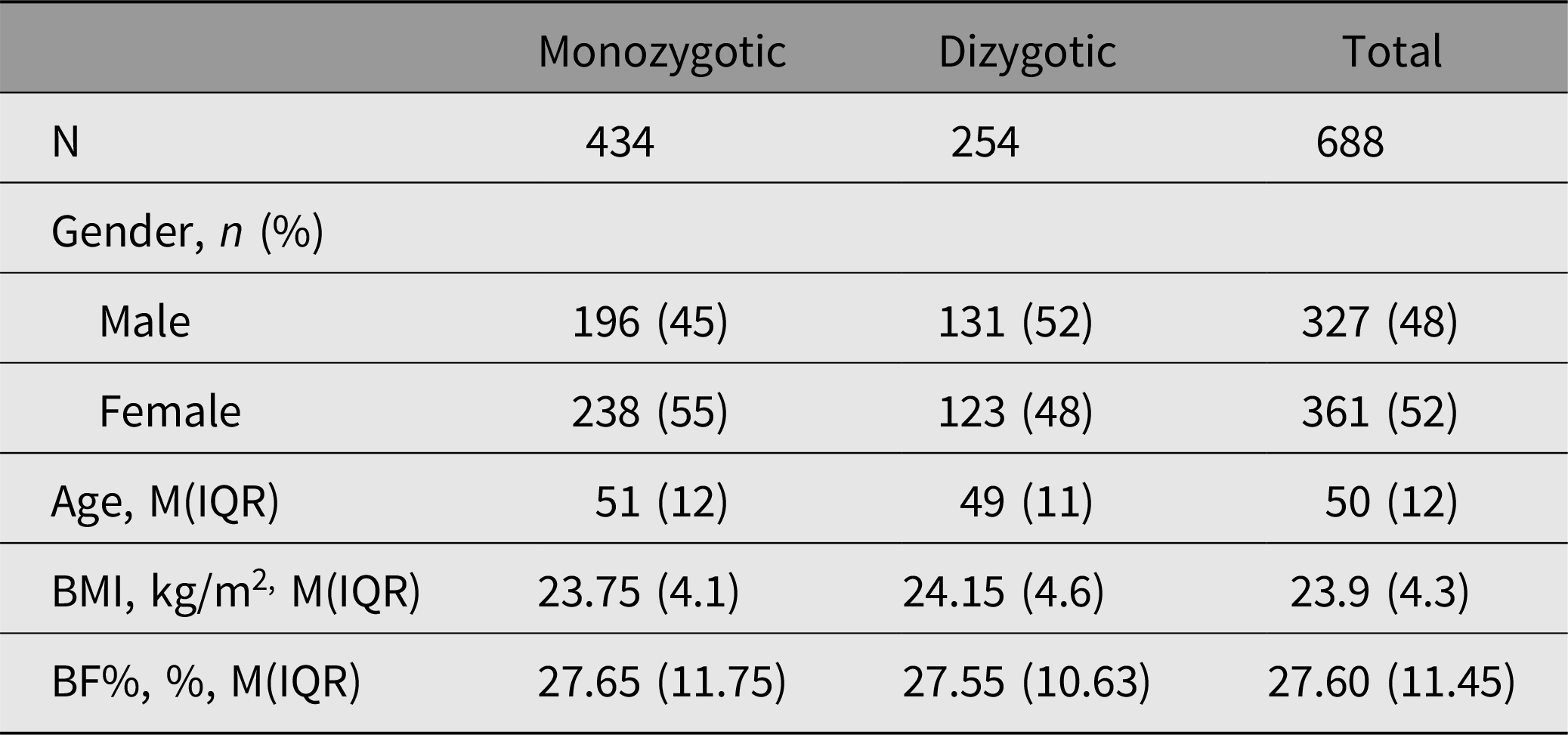
Based on the inclusion and exclusion criteria, a total of 344 twin pairs were included in this study, comprising 127 dizygotic (DZ) and 217 monozygotic (MZ) pairs. Characteristics are presented in Table 1. The study consisted of 327 male and 361 female participants. The median age was 50 years with an IQR of 12 years. The M (IQR) of BMI and BF% were 23.9 (4.3) kg/m² and 27.6 (11.4) %, respectively.
Participants’ characteristics

Note: M, median; IQR, interquartile range; BMI, body mass index; BF%, body fat percentage.
Heritability Estimation
Table 2 presents the intrapair correlation coefficients (ICC) of BF% in MZ and DZ twins. The results showed that the correlation coefficient for MZ twins (r MZ = 0.79) was substantially higher than that for DZ twins (r DZ = 0.27), suggesting a significant genetic contribution to BF%. Since r MZ > 2r DZ, the ADE model was selected for structural equation modeling, along with its nested submodels AE and DE.
The intraclass correlation coefficients in monozygotic and dizygotic twins

Note: BF%, body fat percentage.
As shown in Table 3, the model fitting results indicated no statistically significant differences between the full ADE model and its nested AE and DE submodels (p > .05), suggesting that the more parsimonious models were adequate. Among the three models, the AE model yielded the lowest values for both the AIC (AIC = −411.12) and Bayesian Information Criterion (BIC = −1517.14), indicating the best model fit according to the AIC rule and the principle of parsimony. In the AE model, the proportion of total variance attributed to additive genetic factors (A) — that is, the heritability of BF% — was estimated to be approximately 54%. Power analysis indicated that a sample size of 344 twin pairs provided a statistical power of 92% to detect heritability for BF% at a significance level of α = 0.05. This suggests that our study has sufficient power to reliably detect the genetic contribution to BF% in this sample. The heritability of unadjusted BF% was estimated at 66% (Table S1). Intrapair correlations of BF% are presented for all five twin groups (Table S2).
Fitting results of ADE and nested AE and DE models

Note: Models were adjusted by age, gender, BMI. -2LL, -2 times log-likelihood of data; df, degrees of freedom; AIC, Akaike’s Information Criterion; BIC, Bayesian Information Criterion; A, additive genetic influence; D, dominance genetic effect; E, nonshared environment and measurement error.
Bivariate Genetic Models
Bivariate genetic analysis indicated a genetic correlation (rG) of 0.56 (95% CI [0.47,0.64]) and an environmental correlation (rE) of 0.70 (95% CI [0.63, 0.77]) between BF% and BMI (Table S3).
Discussion
This study investigated the heritability of body fat percentage using data from 344 pairs of twins from the Qingdao Twin Database. Based on the magnitude of ICC for DZ and MZ twins, we selected the ADE model and its nested submodels AE and DE to calculate heritability. The results indicate that the best-fitting model is the AE model, where additive genetic effects account for 54% of the total variance in BF%, indicating a moderate level of heritability.
Current research highlighted the significant role of genetic factors in the genetic variation of BF%. A study involving five families from Oman with a total of 1231 participants reported a heritability of 52.2% for body fat percentage (Man et al., Reference Man, Nolte, Jaju, Al-Anqoudi, Muñoz, Hassan, Al-Yahyaee, Bayoumi, Comuzzie, Floras, van Roon, Riese, Albarwani and Snieder2020). Similarly, a study in Houston, recruiting prepubertal girls aged 8–9 years, found that additive genetic effects accounted for approximately 50% of the total variance (Treuth et al., Reference Treuth, Butte, Ellis, Martin and Comuzzie2001). These findings closely align with the results of our study. In contrast, a study from the United States involving 554 participants from 244 families in the Diabetes Heart Study reported a heritability of approximately 64% for body fat percentage (Hsu et al., Reference Hsu, Lenchik, Nicklas, Lohman, Register, Mychaleckyj, Langefeld, Freedman, Bowden and Carr2005). Another study of 66 pairs of twins aged 3–17 years in the United States estimated that genetic factors explained 75% of the phenotypic variance (Faith et al., Reference Faith, Pietrobelli, Nuñez, Heo, Heymsfield and Allison1999). A twin study in Denmark revealed heritability estimates of .59 in females and .63 in males for body fat percentage, with heritability decreasing with age (Schousboe et al., Reference Schousboe, Visscher, Erbas, Kyvik, Hopper, Henriksen, Heitmann and Sørensen2004).
Most current research originates from populations in Europe and the United States, which may differ from the Chinese population due to ethnic as well as environmental factors such as lifestyle and dietary habits. Additionally, differences in participant age range and methods used to measure BF% may contribute to variability in heritability results. Overall, disparities in ethnicity, age, dietary habits, and measurement methods of body fat percentage may partially explain differences in heritability estimates.
The IPCs of BF% across the five twin groups indicated substantial genetic influence. However, due to the limited sample size, we did not perform sex-limitation modeling; instead, analyses were conducted using combined-sex models.
This study has several strengths. First, the use of a classical twin design enables a robust estimation of genetic and environmental contributions to BF% by leveraging the genetic similarity between MZ and DZ twins. Second, all participants were derived from the same regional twin registry, which helps reduce variability due to regional or cultural heterogeneity. Third, the statistical power for the genetic effects (A path) in the AE model is 0.92 (α = .05), suggesting adequate sample size to detect genetic effects effectively and ensure result accuracy.
However, several limitations should be acknowledged. First, body fat percentage was measured using a single method, and potential measurement error or methodological bias could influence heritability estimates. Second, the generalizability of the findings to broader or more heterogeneous populations may be limited, despite the study being adequately powered to detect moderate heritability.
The findings from this study provide important insights into the genetic architecture of BF% in a Chinese population, emphasizing that genetic effects play a substantial role in BF% variation. Future GWAS and EWAS based on twin cohorts may further elucidate the genetic and epigenetic mechanisms of body fat percentage, enhancing our understanding of obesity etiology.
Supplementary material
To view supplementary material for this article, please visit https://doi.org/10.1017/thg.2025.10039.
Acknowledgments
We thank Dr Gu Zhu for his technical guidance of data analysis. We thank all participants and contributors of Qingdao Twins.
Authors’ contributions
Fusheng Cui, Weijing Wang and Dongfeng Zhang concepted and designed the research, Xiaocao Tian carried out data acquisition, Fusheng Cui and Weijing Wang conducted data analysis, Fusheng Cui edited the manuscript, Weijing Wang and Dongfeng Zhang reviewed the manuscript.
Consent for publication
Not applicable.
Funding
This research did not receive any specific grant from funding agencies in the public, commercial, or not-for-profit sectors.
Competing interests
The authors declare no conflict of interest.
Ethics statement
All participants provided written informed consent for participating in the study which was approved by the local ethics committee at Qingdao CDC, Qingdao, China.