





Introduction
Advances in cancer diagnosis and treatment have increased survival rates worldwide; however, many patients continue to live with advanced disease requiring complex and ongoing care. In advanced cancer, family members frequently assume responsibility for symptom management, treatment-related care, emotional support, decision-making, and end-of-life care (Stilos et al. Reference Stilos, Fitch and Nolen2018; Cui et al. Reference Cui, Shi and Li2023; Sun and Lee Reference Sun and Lee2024). Although caregiving may provide opportunities for personal growth and meaning, it often imposes substantial physical, emotional, social, and financial burdens on family caregivers (Adejoh et al. Reference Adejoh, Boele and Akeju2021; Zhu et al. Reference Zhu, Pei and Chen2023; Ellis et al. Reference Ellis, Furgal and Wayas2024). These challenges may intensify as the disease progresses and patients become increasingly dependent on informal caregivers for daily support (Yang et al. Reference Yang, Liu and Chen2024; Takeuchi et al. Reference Takeuchi, Kurosawa and Yoshida2025).
The growing recognition of caregivers as an essential component of palliative and supportive cancer care has led to increased attention toward their supportive care needs. Family caregivers of patients with advanced cancer frequently report unmet needs related to information, communication with healthcare professionals, emotional support, healthcare services, social functioning, and caregiving responsibilities (Hart et al. Reference Hart, Crawford-Williams and Crichton2022). Unmet supportive care needs have been associated with increased caregiver burden, psychological distress, poorer coping, and reduced well-being (Ahn et al. Reference Ahn, Romo and Campbell2020; Treanor Reference Treanor2020; Hart et al. Reference Hart, Crawford-Williams and Crichton2022). Qualitative evidence further suggests that caregivers experience considerable disruptions in family life, financial stability, social relationships, and emotional functioning throughout the caregiving trajectory (Adejoh et al. Reference Adejoh, Boele and Akeju2021; Zhu et al. Reference Zhu, Pei and Chen2023; Song et al. Reference Song, Wang and Zhu2024).
Quality of life is a key outcome in caregiving research because it reflects caregivers’ physical, psychological, and social well-being. Previous studies have demonstrated that caregivers of patients with advanced cancer often experience poorer quality of life than the general population, particularly when caregiving demands are high and patient symptom burden is severe (Kehoe et al. Reference Kehoe, Xu and Duberstein2019; Gan et al. Reference Gan, Tey and Mat2022; Lin et al. Reference Lin, He and Fan2023; Yang et al. Reference Yang, Liu and Chen2024). Caregiver quality of life may be influenced by multiple factors, including caregiving burden, psychological distress, resilience, family functioning, and social support (Leow et al. Reference Leow, Chan and Chan2015; Ellis et al. Reference Ellis, Furgal and Wayas2024; Cui et al. Reference Cui, Cheng and An2024a, Reference Cui, Yang and Hu2024b).
Social support is considered as one of the most important protective resources available to family caregivers. Greater perceived social support has been associated with lower caregiver burden, reduced psychological distress, enhanced coping capacity, and improved quality of life among caregivers of patients with advanced cancer (Leow et al. Reference Leow, Chan and Chan2015; Ahn et al. Reference Ahn, Romo and Campbell2020; Ulgen and Uğur Reference Ulgen and Uğur2022; Fang et al. Reference Fang, Hu and Xie2024). These relationships can be understood through Pearlin’s Stress Process Model, which proposes that caregiving outcomes are shaped by the interaction between caregiving stressors and available coping resources (Pearlin et al. Reference Pearlin, Mullan and Semple1990). Within this framework, unmet supportive care needs may be conceptualized as caregiving-related stressors, whereas perceived social support represents an important coping resource that may buffer the negative effects of caregiving demands on caregiver well-being. Recent studies have applied the Stress Process Model to explain associations among caregiving burden, social support, psychological outcomes, and quality of life among cancer caregivers (Treanor Reference Treanor2020; Yang et al. Reference Yang, Liu and Chen2024; Zhao et al. Reference Zhao, Na and Xing2024).
Despite growing evidence regarding caregiver burden, supportive care needs, and social support, several important gaps remain. First, much of the existing literature has examined caregivers of patients with cancer as a heterogeneous group, whereas caregivers of patients with advanced cancer may face unique challenges related to progressive disease, symptom burden, uncertainty, and end-of-life concerns (Hart et al. Reference Hart, Crawford-Williams and Crichton2022; Zhu et al. Reference Zhu, Pei and Chen2023; Yang et al. Reference Yang, Liu and Chen2024). Second, relatively little is known about how supportive care needs and perceived social support are jointly associated with caregiver quality of life within different sociocultural contexts. In Türkiye, caregiving is predominantly family-centered and strongly influenced by cultural expectations regarding family responsibility and care for ill relatives. Although previous Turkish studies have examined caregiving burden and perceived social support among caregivers of patients with cancer (Danacı and Koç Reference Danacı and Koç2018; Ulgen and Uğur Reference Ulgen and Uğur2022), evidence specifically focusing on family caregivers of patients with advanced cancer remains limited.
Furthermore, quantitative findings alone provide limited understanding of how caregivers experience and interpret caregiving-related challenges in their everyday lives. Mixed-methods research offers an opportunity to integrate statistical associations with caregivers’ lived experiences, thereby providing a more comprehensive understanding of caregiver well-being and support needs (Creswell and Plano Clark Reference Creswell and Plano Clark2018). Exploring caregivers’ experiences may also help explain the mechanisms through which supportive care needs and social support are associated with quality of life.
The study was guided by Pearlin’s Stress Process Model (Pearlin et al. Reference Pearlin, Mullan and Semple1990), which conceptualizes caregiving outcomes as the result of interactions between caregiving-related stressors and coping resources. Within this framework, supportive care needs were considered caregiving-related stressors, perceived social support was conceptualized as a coping resource, and quality of life represented a caregiver outcome. The findings may contribute to the development of family-centered supportive and palliative care interventions designed to improve caregiver well-being and quality of life.
Methods
Design
This study used a convergent mixed-methods design to examine the relationships among supportive care needs, perceived social support, and quality of life among family caregivers of patients with advanced cancer and to explore caregivers’ experiences of the caregiving process. Quantitative and qualitative data were collected during the same study period and integrated during interpretation to provide a more comprehensive understanding of caregiver well-being. Quantitative methods were used to examine associations among supportive care needs, perceived social support, and quality of life, whereas qualitative interviews were conducted to gain an in-depth understanding of caregivers’ lived experiences.
Setting and participants
The study was conducted between March 2024 and April 2025 at the oncology center of a university hospital in Türkiye. Participants were family caregivers of patients diagnosed with stage III or stage IV cancer. Caregivers were eligible if they were aged 18 years or older, identified as the primary caregiver, able to read and communicate in Turkish, and willing to participate in the study. Caregivers who received financial compensation for caregiving, had cognitive impairment, had a diagnosed psychiatric condition that could interfere with participation, or were unable to communicate effectively were excluded. The required sample size was calculated using G*Power version 3.1.9.2. Based on the correlation coefficient reported by Ulgen and Uğur (Reference Ulgen and Uğur2022), an effect size equivalent to r = 0.18 was assumed, a significance level of 0.05, and a statistical power of 80% were used. The minimum required sample size was calculated as 239 participants. A total of 328 caregivers were included in the quantitative component of the study. For the qualitative component, purposive sampling was used to recruit caregivers who had participated in the quantitative phase and agreed to be interviewed. Data collection continued until thematic saturation was achieved after 22 interviews.
Measures
Caregiver information form
A researcher-developed form was used to collect caregivers’ sociodemographic characteristics, health status, caregiving responsibilities, and caregiving-related experiences.
Patient information form
A structured form was used to obtain patients’ sociodemographic and clinical characteristics.
Multidimensional scale of perceived social support
Perceived social support was assessed using the Multidimensional Scale of Perceived Social Support (MSPSS) developed by Zimet et al. (Reference Zimet, Dahlem and Zimet1988). The Turkish validity and reliability study was conducted by Eker and ve Arkar (Reference Eker and ve Arkar1995) and subsequently revised by Eker et al. (Reference Eker, Arkar and ve Yaldız2001). The scale consists of 12 items and three subscales assessing support from family, friends, and a significant other. Total scores range from 12 to 84, with higher scores indicating greater perceived social support. Eker et al. determined the Cronbach’s alpha reliability coefficient of the MSPSS as 0.89. In the present study, Cronbach’s alpha coefficient for the total scale was 0.98.
Supportive care needs survey–caregivers
Supportive care needs were measured using the Supportive Care Needs Survey–Caregivers (SCNS-C) developed by Girgis et al. (Reference Girgis, Lambert and Lecathelinais2011). The Turkish validity and reliability study was conducted by Ergen and Arikan (Reference Ergen and Arikan2020). The instrument consists of 39 items and four domains: Psychological and Emotional Needs, Health Care and Information Needs, Work and Social Needs, and Communication and Family Needs. Higher scores indicate greater unmet supportive care needs. In the study introducing the scale, it was determined that the Cronbach’s alpha reliability coefficients of the sub-dimensions varied between 0.88 and 0.94 (Girgis et al. Reference Girgis, Lambert and Lecathelinais2011). In the present study, Cronbach’s alpha coefficient for the total scale was 0.985.
SF-12 health survey
Caregiver quality of life was assessed using the SF-12 Health Survey developed by Ware et al. (Reference Ware, Kosinski and Keller1995). The Turkish validity and reliability study was conducted by Soylu and ve Kütük (Reference Soylu and ve Kütük2022). The instrument generates Physical Component Summary (PCS-12) and Mental Component Summary (MCS-12) scores, with higher scores indicating better health-related quality of life. Soylu and Kütük determined the Cronbach’s alpha reliability coefficients of the scale as 0.73 for the PCS-12 sub-dimension and 0.72 for the MCS-12 sub-dimension (Soylu and Ve Kütük Reference Soylu and ve Kütük2022). In the present study, Cronbach’s alpha coefficients were 0.81 for PCS-12 and 0.78 for MCS-12.
Data collection
Quantitative data were collected through face-to-face administration of study questionnaires. Eligible caregivers were informed about the study and invited to participate. Data collection took place in a private room within the oncology clinic to ensure participant comfort and confidentiality. Completion of the questionnaires required approximately 20–25 minutes. Qualitative data were collected using a phenomenological approach. Semi-structured interviews were conducted with 22 caregivers who agreed to participate in the qualitative component. Interviews were conducted in a private room at the oncology center at a time convenient for participants. The interview guide explored caregivers’ experiences of providing care, supportive care needs, sources of social support, challenges encountered during caregiving, and the impact of caregiving on their quality of life. Interviews lasted between 20 and 45 minutes and were audio-recorded with participants’ permission. During the interviews, participants were encouraged to elaborate on their experiences and clarify their responses when necessary. Participants were assigned identification codes (e.g., P1, P2, and P3) to protect confidentiality.
Data analysis
Quantitative data were analyzed using IBM SPSS Statistics version 25. Data distribution was assessed using the Shapiro–Wilk test. Descriptive statistics were calculated as frequencies, percentages, means, standard deviations, medians, and ranges. Because the data were not normally distributed, Spearman correlation analysis was used to examine the relationships among supportive care needs, perceived social support, and quality of life. Internal consistency reliability was evaluated using Cronbach’s alpha coefficients. Statistical significance was set at p < .05.
Qualitative data were analyzed using Colaizzi’s phenomenological method (Colaizzi Reference Colaizzi, Valle and King1978). Audio recordings were transcribed verbatim and read repeatedly to achieve immersion in the data. Significant statements were identified, coded, and independently reviewed by two researchers. Codes were grouped into categories, subthemes, and overarching themes through iterative comparison and discussion until consensus was reached. The trustworthiness of the findings was enhanced through independent coding, participant validation during interviews, maintenance of an audit trail, and detailed description of the study context and procedures. Reporting of the qualitative component followed the Consolidated Criteria for Reporting Qualitative Research (COREQ) guidelines (Tong et al. Reference Tong, Sainsbury and Craig2007).
Results
Participant characteristics
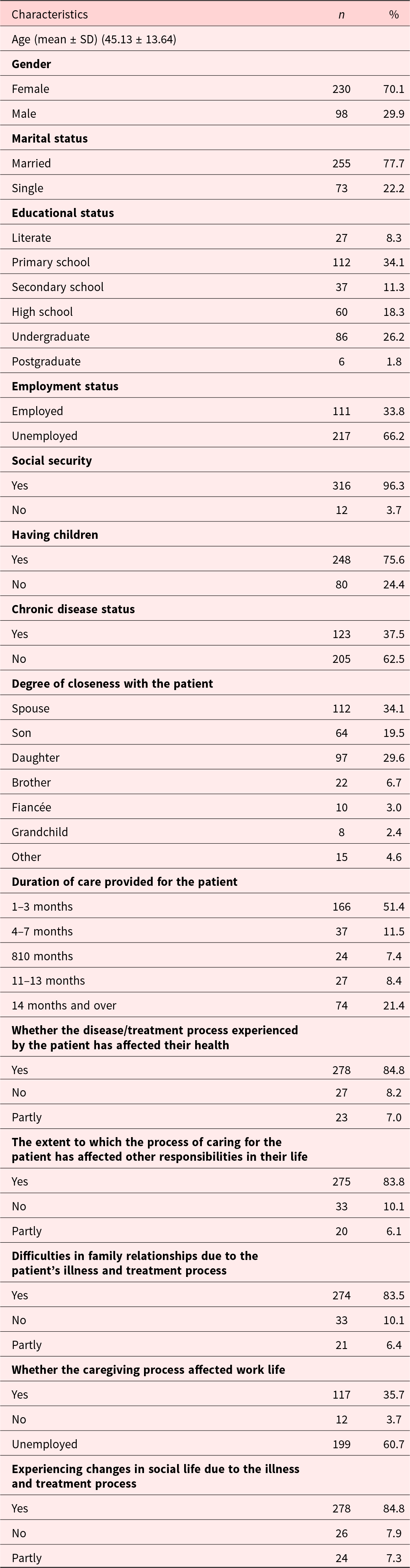
A total of 328 family caregivers of patients with advanced cancer participated in the quantitative component of the study, and 22 caregivers participated in the qualitative interviews. The mean age of caregivers was 45.13 years (SD = 13.64). Most caregivers were female (70.1%), married (77.7%), unemployed (66.2%), and had children (75.6%). Approximately one-third were spouses of the patient (34.1%), and more than half had been providing care for 1–3 months (51.4%). Most caregivers reported that the caregiving process had adversely affected their health (84.8%), family relationships (83.5%), social life (84.8%), and other daily responsibilities (83.8%). Detailed caregiver characteristics are presented in Table 1. Most patients were male (58.5%), married (84.8%), and diagnosed with stage IV cancer (90.5%). The mean age of patients was 60.08 years (SD = 13.26). Lung cancer (23.8%) and gastric cancer (16.2%) were the most common diagnoses.
Sociodemographic characteristics and caregiving-related experiences of family caregivers (N = 328)

Table 1 Long description
Sociodemographic and caregiving experiences are summarized for 328 family caregivers. Average age was about 45 years, and most caregivers were female (70.1 percent) and married (77.7 percent). Education was most often primary school (34.1 percent) or undergraduate (26.2 percent); 66.2 percent were unemployed, and 96.3 percent had social security. Most had children (75.6 percent) and did not report a chronic disease (62.5 percent). Relationship to the patient was most commonly spouse (34.1 percent) or daughter (29.6 percent), followed by son (19.5 percent). Care duration was most often 1 to 3 months (51.4 percent), with 21.4 percent providing care for 14 months or longer. Large majorities said the illness and treatment process affected their health (84.8 percent), other responsibilities (83.8 percent), family relationships (83.5 percent), and social life (84.8 percent). Work life impact was reported by 35.7 percent, while 60.7 percent were unemployed, so work-related effects may not apply to all caregivers.
Descriptive findings
Caregivers reported moderate-to-high supportive care needs and relatively high levels of perceived social support. The mean SCNS-C total score was 3.32 (SD = 1.03), indicating substantial unmet supportive care needs. The mean MSPSS total score was 69.02 (SD = 21.21), suggesting generally high perceived social support. Mean SF-12 scores were 39.91 (SD = 10.15) for the Physical Component Summary (PCS-12) and 32.19 (SD = 9.14) for the MCS-12. Detailed descriptive statistics are presented in Table 2.
Descriptive statistics for quality of life, perceived social support, and supportive care needs

M: mean; SD: standard deviation; Min.: minimum, Max.: maximum; SCNS-P&C: Supportive Care Needs Survey – Partners and Caregivers; MSPSS: Multidimensional Scale of Perceived Social Support.
Relationships among supportive care needs, perceived social support, and quality of life
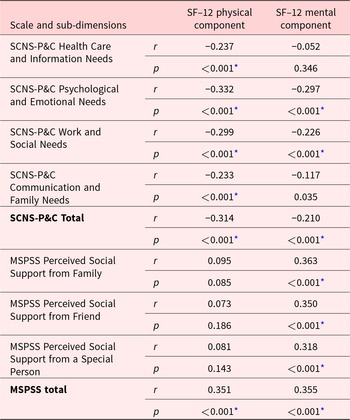
Higher supportive care needs were associated with poorer quality of life. Significant negative correlations were observed between SCNS-C total scores and both PCS-12 (r = –0.314, p < .001) and MCS-12 scores (r = –0.210, p < .001). Among SCNS-C domains, psychological and emotional needs demonstrated the strongest negative associations with both physical and mental quality of life. Detailed correlation coefficients are presented in Table 3. Perceived social support was positively associated with quality of life. MSPSS total scores showed moderate positive correlations with PCS-12 (r = 0.351, p < .001) and MCS-12 scores (r = 0.355, p < .001). Examination of MSPSS subscales revealed an important pattern. Family support, friend support, and support from a significant other were each significantly associated with mental quality of life; however, none of the individual MSPSS subscales demonstrated statistically significant correlations with physical quality of life. In contrast, the overall MSPSS score was significantly associated with both physical and mental quality of life (Table 3).
Correlations among quality of life, perceived social support, and supportive care needs

Table 3 Long description
Correlations link supportive care needs and perceived social support with SF-12 physical and mental quality-of-life components. All supportive care needs domains show negative relationships with physical health, ranging from weak to moderate, with the strongest for psychological and emotional needs and for the total needs score. Mental health is also negatively related to most supportive care needs, strongest for psychological and emotional needs and for work and social needs, while health care and information needs show little relationship with mental health. Perceived social support shows a clear positive relationship with mental health across family, friends, special person, and total support, with moderate strengths. Physical health has little relationship with support from family, friends, or a special person, but total perceived support shows a moderate positive relationship with physical health. Most reported relationships are statistically significant, except several of the smaller physical-health correlations for individual support sources and the mental-health correlation for health care and information needs. Correlations indicate association only and do not establish cause and effect.
* p < .05; SCNS-P&C: Supportive Care Needs Survey – Partners and Caregivers; MSPSS: Multidimensional Scale of Perceived Social Support.
Qualitative findings
Analysis of the interviews generated two overarching themes and nine subthemes describing caregivers’ experiences (Table 4).
Themes, subthemes, and representative quotations illustrating family caregivers’ experiences (N = 22)

Table 4 Long description
Qualitative themes summarize family caregivers’ experiences, organized into two main categories with sub-themes and representative quotations from participants. Effects of the caregiving process include disrupted family bonds and routines, reduced ability to parent or care for others, loss of social life and work roles, and significant financial hardship such as debt and high treatment-related costs. Caregivers also describe coping with intense challenges, including distress while trying to maintain the patient’s morale, learning practical care skills, and using home care services. Support needs are highlighted through reliance on siblings, spouses, children, neighbors, and brief respite when others can step in. Emotional and psychological dimensions include anxiety, uncertainty, feelings of inadequacy, anticipatory grief, burnout, and sadness as the patient declines. Many quotations describe turning to religious beliefs and practices for comfort, alongside fluctuating hope and despair influenced by prognosis and treatment outcomes. Findings are illustrative rather than quantitative, and repeated quotations indicate emphasis but not frequency or prevalence across all caregivers.
Theme 1: Impacts of the caregiving process
Caregivers described substantial disruptions in family relationships, social participation, employment, and financial stability. Many participants reported changes in family roles and responsibilities as caregiving became the central focus of daily life. Social isolation, reduced engagement in leisure activities, and financial strain were frequently reported.
Participants also described the challenges of adapting to the caregiving role and emphasized the importance of support from family members, relatives, neighbors, and community resources. Shared caregiving responsibilities and practical assistance from family members were perceived as valuable sources of support that helped caregivers cope with daily demands.
Theme 2: Emotional and psychological dimensions of caregiving
Caregivers frequently reported feelings of inadequacy, uncertainty, anxiety, sadness, and emotional exhaustion. Many participants described witnessing disease progression and confronting the possibility of death as emotionally distressing experiences.
Religious beliefs and spiritual practices emerged as important coping resources. Participants frequently referred to prayer, faith, and acceptance as mechanisms that helped them manage uncertainty and emotional distress. Simultaneously, caregivers described a continuing tension between hope and despair as they navigated the illness trajectory. Representative quotations for all themes and subthemes are presented in Table 4.
Integration of quantitative and qualitative findings
Integration of the quantitative and qualitative findings revealed substantial convergence. Quantitative analyses demonstrated that greater supportive care needs were associated with poorer quality of life, whereas greater perceived social support was associated with better quality of life. Qualitative findings provided contextual explanations for these relationships. Participants described unmet informational, emotional, social, and practical support needs, as well as disruptions in family, occupational, and social functioning, which corresponded with the observed negative associations between supportive care needs and quality of life.
Similarly, caregivers frequently emphasized the importance of support received from family members and their social networks in helping them cope with caregiving-related challenges. These narratives supported the quantitative finding that greater perceived social support was associated with better quality of life. Together, the findings suggest that supportive care needs and social support are closely linked to caregiver well-being and represent important considerations within palliative and supportive cancer care.
Discussion
This convergent mixed-methods study examined the relationships among supportive care needs, perceived social support, and quality of life among family caregivers of patients with advanced cancer. Quantitative findings demonstrated that greater supportive care needs were associated with poorer physical and mental quality of life, whereas higher levels of perceived social support were associated with better quality of life. Qualitative findings complemented these results by illustrating how caregiving disrupted caregivers’ family relationships, social participation, employment, financial stability, and emotional well-being. Together, the findings provide a comprehensive understanding of caregiver experiences within the context of advanced cancer and palliative care.
The negative association between supportive care needs and quality of life is consistent with previous studies reporting that unmet psychological, informational, and practical needs contribute to caregiver burden, distress, and reduced well-being (Hart et al. Reference Hart, Crawford-Williams and Crichton2022; Akter et al. Reference Akter, Konlan and Nesa2023; Ellis et al. Reference Ellis, Furgal and Wayas2024; Cui et al. Reference Cui, Yang and Hu2024b). Similar findings have been reported among caregivers of patients with advanced cancer receiving supportive and palliative care, where caregiver burden was inversely associated with quality of life (Manivannan et al. Reference Manivannan, Karunanithi and Lakshminarayanan2023). In the present study, psychological and emotional needs demonstrated the strongest associations with both physical and mental quality of life. Qualitative interviews provided further insight into these findings. Caregivers frequently described uncertainty regarding the future, concerns about disease progression, emotional exhaustion, and difficulties coping with the possibility of losing a loved one. These findings are consistent with qualitative syntheses demonstrating that caregivers of patients with advanced cancer experience substantial emotional strain throughout the illness trajectory (Zhu et al. Reference Zhu, Pei and Chen2023; Song et al. Reference Song, Wang and Zhu2024). Similarly, Chen et al. (Reference Chen, Qiao and Arber2023) reported that coping resources and psychological resilience were closely associated with quality of life among adult children caring for parents with advanced cancer, highlighting the importance of adaptive coping strategies in mitigating caregiving-related distress.
Perceived social support was positively associated with both physical and mental quality of life. This finding is consistent with previous studies suggesting that social support functions as an important protective resource for caregivers facing the demands of advanced cancer care (Leow et al. Reference Leow, Chan and Chan2015; Guo et al. Reference Guo, Reblin and Tay2021; Fang et al. Reference Fang, Hu and Xie2024; Zhao et al. Reference Zhao, Na and Xing2024). Guo et al. (Reference Guo, Reblin and Tay2021) further demonstrated that diverse social support networks may help caregivers cope with caregiving stress and emotional burden, supporting the importance of maintaining supportive interpersonal relationships throughout the caregiving trajectory. However, a more nuanced pattern emerged when the MSPSS subscales were examined. Although support from family, friends, and significant others was associated with mental quality of life, none of the individual support sources demonstrated statistically significant associations with physical quality of life. In contrast, the overall MSPSS score was associated with both physical and mental quality of life. This finding suggests that caregivers’ overall perception of being supported may be more important for physical well-being than support derived from any single source. The finding also highlights the multidimensional nature of social support and emphasizes the importance of considering social support as a broader relational resource rather than focusing exclusively on individual support providers.
The present findings can be interpreted through Pearlin’s Stress Process Model, which conceptualizes caregiving as a dynamic process in which stressors and coping resources interact to influence caregiver outcomes (Pearlin et al. Reference Pearlin, Mullan and Semple1990). Within this framework, unmet supportive care needs may be understood as caregiving-related stressors that negatively affect caregiver well-being, whereas social support functions as a coping resource that helps caregivers manage these demands. The qualitative findings strongly supported this interpretation. Participants described numerous caregiving stressors, including emotional strain, financial difficulties, role changes, and disruptions in daily life, while simultaneously emphasizing the importance of support received from family members, relatives, and community networks. The convergence of quantitative and qualitative findings therefore provides empirical support for the relevance of the Stress Process Model in understanding caregiver experiences in advanced cancer. The current findings are also consistent with recent research demonstrating that caregiving burden and psychological distress are closely associated with quality of life among patients with advanced cancer and their caregivers (Cui et al. Reference Cui, Ai and Chen2025).
An important contribution of this study is its integration of supportive care needs, perceived social support, and quality of life within a single mixed-methods framework. Previous studies have often examined caregiver burden, social support, or quality of life separately. In contrast, the present study demonstrated not only that supportive care needs and social support were associated with quality of life, but also how caregivers experienced these relationships in everyday life. Qualitative narratives revealed that unmet informational, emotional, and practical needs were experienced through disruptions in family functioning, social isolation, financial strain, and psychological distress. At the same time, caregivers described family support, shared caregiving responsibilities, and interpersonal relationships as important resources that helped them maintain emotional well-being. These integrated findings contribute new knowledge by illustrating the lived experiences underlying the quantitative associations observed in caregivers of patients with advanced cancer.
The findings also highlight the importance of considering caregiving within its sociocultural context. In Türkiye, caregiving is strongly influenced by collectivist family values, interdependence, and cultural expectations regarding responsibility for ill family members. Many participants described caregiving as a moral obligation and an expected family role rather than a voluntary activity. Similar observations have been reported among caregivers in other family-oriented societies, where caregiving responsibilities are closely linked to cultural norms regarding familial duty and reciprocity (Adejoh et al. Reference Adejoh, Boele and Akeju2021; Zhu et al. Reference Zhu, Pei and Chen2023). These cultural expectations may partly explain the high proportion of caregivers who reported adverse effects on their health, family relationships, and social lives despite continuing to provide care. Consistent with this interpretation, Lim et al. (Reference Lim, Tan and Chua2017) reported that caregiver quality of life is influenced not only by caregiving demands but also by social and cultural contexts that shape caregiving experiences and expectations.
A notable qualitative finding was the prominence of spirituality and religious coping. Caregivers frequently described prayer, acceptance, faith, and trust in God as important resources for managing uncertainty and emotional distress. Contemporary models of palliative care recognize spirituality as a core dimension of holistic care and emphasize its role in promoting meaning, hope, resilience, and psychological adaptation during serious illness (Puchalski et al. Reference Puchalski, Ferrell and Virani2009). Similar findings have been reported among individuals affected by advanced cancer, where spiritual beliefs provide emotional comfort, existential support, and meaning-making in the face of illness-related uncertainty (Balboni et al. Reference Balboni, Vanderwerker and Block2007; Ellis et al. Reference Ellis, Janevic and Kershaw2017; Ferrell et al. Reference Ferrell, Kravitz and Borneman2018). The present findings suggest that spiritual resources may play an important role in caregiver adaptation and should be considered when developing culturally sensitive supportive care interventions.
The findings are also consistent with family-centered models of cancer care, which emphasize the interdependence of patient and caregiver well-being. Northouse et al. (Reference Northouse, Katapodi and Song2010) highlighted that caregiving experiences affect multiple domains of functioning and that interventions addressing caregivers’ informational, emotional, and social needs can improve psychosocial outcomes. The current findings support this perspective and further suggest that caregiver assessment should become a routine component of supportive and palliative cancer care services. Similar recommendations have been proposed by Lapid et al. (Reference Lapid, Atherton and Kung2016), who emphasized the need for targeted interventions to improve caregiver quality of life and address unmet psychosocial needs among family caregivers of individuals with cancer.
The integration of quantitative and qualitative findings represents a major strength of this study. Quantitative analyses identified statistically significant associations among supportive care needs, social support, and quality of life, whereas qualitative findings provided contextual explanations for these relationships. The convergence between the two datasets strengthens confidence in the interpretation of the findings and supports a more comprehensive understanding of caregiver well-being than would have been possible using a single methodological approach.
Limitations
Several limitations should be considered when interpreting the findings. First, the cross-sectional design precludes causal inference, and the observed relationships should therefore be interpreted as associations rather than predictive effects. Second, the study was conducted at a single oncology center, which may limit transferability to other settings. Third, all quantitative data were based on self-report measures and may be subject to reporting bias. Finally, caregivers of patients with different cancer diagnoses were included, potentially introducing heterogeneity in caregiving experiences. Because the study was conducted in a single cultural context, transferability to other cultural settings should be interpreted cautiously. Qualitative findings may not be representative of all caregivers.
Conclusion
Among family caregivers of patients with advanced cancer, greater supportive care needs were associated with poorer physical and mental quality of life, whereas higher perceived social support was associated with better quality of life. Qualitative findings revealed that caregiving affects family functioning, social participation, financial stability, and emotional well-being, while family support and spiritual coping serve as important adaptive resources. These findings support the integration of caregiver assessment, psychosocial support, family-centered care, and spiritual care within palliative and supportive cancer services.
Clinical implications
The findings emphasize the importance of routinely assessing supportive care needs, perceived social support, and quality of life among family caregivers of patients with advanced cancer. Healthcare professionals should recognize family caregivers as integral partners in palliative care. Multidisciplinary supportive care programs that include caregiver education, psychosocial counseling, peer-support opportunities, family-centered interventions, and spiritual care resources may help address unmet needs and enhance caregiver well-being.
Acknowledgments
We thank the family caregivers of patients with advanced cancer who participated in this study.
Funding
The authors declare that no funds, grants, or other support were received during the preparation of this manuscript.
Competing interests
The authors declare that they have no conflict of interest.
Ethical approval
The study was started after obtaining permission from the Ondokuz Mayıs University Board of Ethics (Date: 30.12.2022; Number: 11; Decision No: 2022-1066).
Ethics and consents
Administrative permission was obtained from the university hospital where the study was conducted. Written informed consent was obtained from all participants prior to data collection. Participation was voluntary, confidentiality was maintained throughout the study, and participants were informed of their right to withdraw from the study at any time without consequence.



 Open access

