Introduction
In Antarctic shelf ecosystems, Amphipoda constitutes, despite its relatively low biomass, a significant group in terms of energy flux (Dauby et al. Reference Dauby, Scailteur, Chapelle and de Broyer2001b, Reference Dauby, Nyssen, De Broyer, Huiskes, Gieskes, Rozema, Schorno, van der Vies and Wolff2003). These crustaceans are among the most diversified Antarctic benthic taxa with respect to number of species, lifestyles, habitats and size spectra (Watling & Thurston Reference Watling, Thurston and Crame1989, Momo et al. Reference Momo, Bogazzi and Duttweiler1998, De Broyer & Jażdżewska Reference De Broyer, JaŻdŻewska, De Broyer, Koubbi, Griffiths, Raymond, d'Udekem d'Acoz and van de Putte2014). As the group is highly diverse, one would expect amphipods to occupy an important number of different ecological niches to exploit the full spectrum of resources. Previous work based on gut content examination and trophic markers has accordingly shown that Antarctic amphipods exhibit high trophic diversity and cover a wide range of consumed preys, feeding behaviours and eco-functional roles (Dauby et al. Reference Dauby, Scailteur and de Broyer2001a, Reference Dauby, Scailteur, Chapelle and de Broyer2001b, Graeve et al. Reference Graeve, Dauby and Scailteur2001, Nyssen et al. Reference Nyssen, Brey, Lepoint, Bouquegneau, de Broyer and Dauby2002, Reference Nyssen, Brey, Dauby and Graeve2005). Adaptation to a wide variety of ecological niches should be reflected in the diversity of functional morphological traits. Changes in mouthpart morphology, and particularly in mandible anatomy, have notably been interpreted as adaptations to presumed preferred food sources (Momo et al. Reference Momo, Bogazzi and Duttweiler1998, Watling Reference Watling1993).
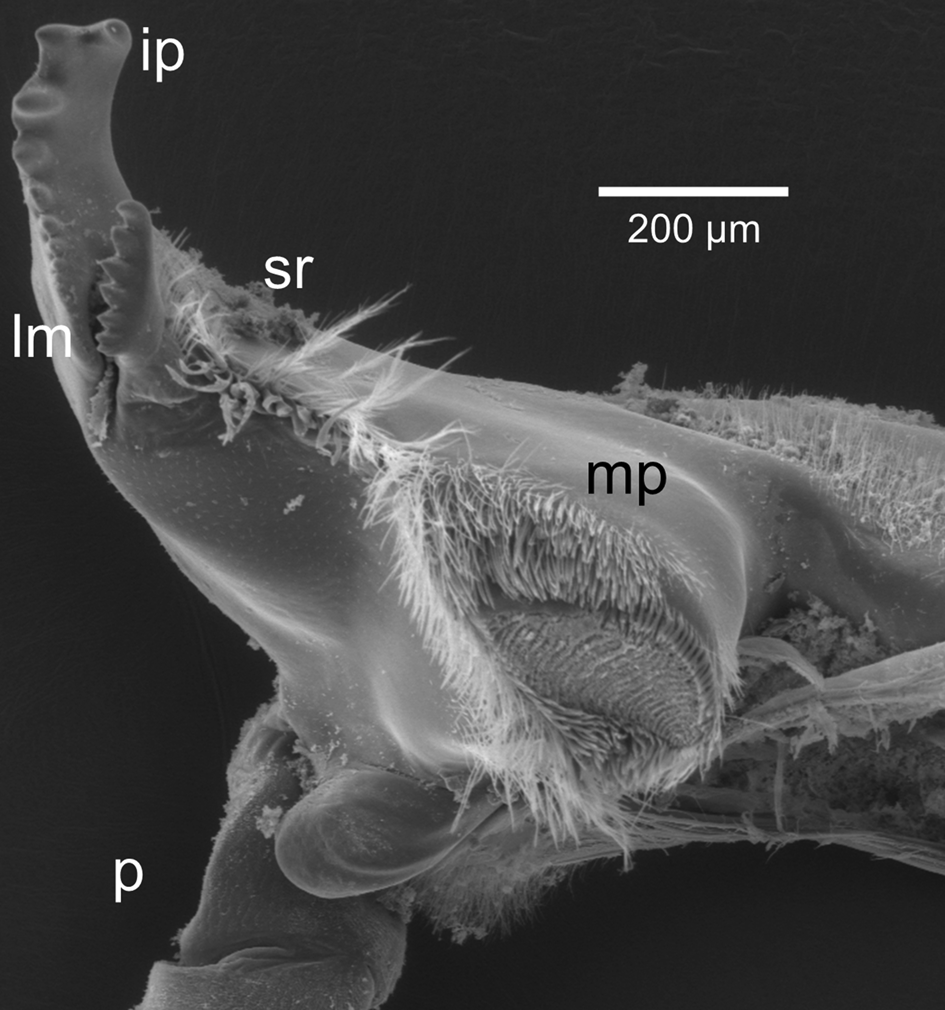
In amphipods, the mandible serves both for cutting and grinding (crushing) food (Manton Reference Manton1977). It consists of four main structures (Fig. 1), starting distally and going to the mouth opening: the incisor process, a projection of the mandibular body that sometimes bear cusps or teeth; the lacinia mobilis, an articulated and sometimes toothed plate inserted close to and generally in line with the incisor; the seta row, filling the space between incisor and molar and presumably preventing food particles from falling away from the molar; and the molar process, a columnar structure projecting from the mandibular body and often provided with multiple triturative surfaces (Fig. 1) (Watling Reference Watling1993). In typical peracarid biting, the left and right mandibles have distinct roles. The right incisor process enters the gap between the left incisor and the left lacinia mobilis, which glides into the gap left between the right incisor and the right lacinia, when the latter is present. The lacinia mobilis contributes to cutting and helps to guide the incisor processes into the right planes and to lock them into their final closing position. In addition, a toothed or spiny lacinia mobilis probably helps to hold food particles in place during the bite (Dahl & Hessler Reference Dahl and Hessler1982, Watling Reference Watling1993). Due to their different roles in feeding, asymmetry between the left and right mandibles is commonly observed in amphipods. The left lacinia mobilis, notably, is often larger, stronger and/or bears more ornamentation than the right one (Watling Reference Watling1993, Mayer et al. Reference Mayer, Haug, Maas and Waloszek2013). Besides this, a large panel of modifications to the abovementioned typical mandible morphology pattern can be observed among amphipods. They include reduction or overgrowth of the incisor process, disappearance of the setae row and reduction or complete loss of the molar process (Watling Reference Watling1993).
Structure of a typical gammaridean amphipod mandible. ip = incisor process, mp = molar process, lm = lacinia mobilis, p = mandibular palp, sr = setae row.

Many studies have suggested associations between specific mouthpart morphologies and feeding strategies (Coleman Reference Coleman1989a, Reference Coleman1989b, Reference Coleman1990, Arndt et al. Reference Arndt, Berge and Brandt2005, Mayer et al. Reference Mayer, Maier, Maas and Waloszek2009, Mekhanikova Reference Mekhanikova2010, Pavesi & Olesen Reference Pavesi and Olesen2017). The ‘basic’ amphipod morphology, observed in most gammaridean families, is typically associated with detritivory and with suspension and/or deposit feeding. The compact mandible body bears a toothed incisor, a well-developed and toothed lacinia mobilis and a columnar molar, designed for crushing (Watling Reference Watling1993). Filter-feeders often combine this basic mandible morphology with increased mouthpart setation (Caine Reference Caine1974, Cole & Watkins Reference Cole and Watkins1977, Mayer et al. Reference Mayer, Maier, Maas and Waloszek2009). Detritus feeders, which primarily feed by processing benthic sediments or biofilms, have proportionally larger and more strongly dentate mandibles and increased molar grinding surfaces, suggesting an adaptation to mastication. Moreover, they have teeth and cuspidate setae on maxillae and maxillipeds for scraping off adherent food from substrates (Caine Reference Caine1974, Coleman Reference Coleman1991, Arndt et al. Reference Arndt, Berge and Brandt2005, Mayer et al. Reference Mayer, Maier, Maas and Waloszek2009). Enlarged, strong, toothless and sharp incisors are generally associated with increasingly predatory feeding habits (Coleman Reference Coleman1990, Haro-Garay Reference Haro-Garay2003, Guerra-García & Tierno de Figueroa Reference Guerra-García and Tierno de Figueroa2009, Hutchins et al. Reference Hutchins, Schwartz and Nowlin2014). Predators feeding on relatively soft prey (e.g. some cnidarians, sponges, holothurians or polychaetes) appear to share an absent or greatly reduced molar (Coleman Reference Coleman1989a, Reference Coleman1989b, Reference Coleman1990, Watling Reference Watling1993, Guerra-García & Tierno de Figueroa Reference Guerra-García and Tierno de Figueroa2009), whereas a broader and triturative molar is presumably used to crush more rigid food items, such as crustacean exoskeletons (Caine Reference Caine1974, Sainte-Marie Reference Sainte-Marie1984, Haro-Garay Reference Haro-Garay2003). Highly adapted scavenger species generally combine wide, sharp and toothless shearing incisors (to bite off large pieces of carrion) with tall, conical, posteriorly projecting, non-triturative molars, which push pieces of food into the stomodeum without chewing (Dahl Reference Dahl1979, Sainte-Marie Reference Sainte-Marie1984, Steele & Steele Reference Steele and Steele1993, Watling Reference Watling1993, Arndt et al. Reference Arndt, Berge and Brandt2005, Seefeldt et al. Reference Seefeldt, Campana, Deregibus, Quartino, Abele, Tollrian and Held2017). Facultative scavengers often show some degree of omnivory and appear to have a somewhat distinct mandible morphology compared to exclusive scavengers, characterized by a slender incisor and a lower triturative molar process (Dahl Reference Dahl1979, Momo et al. Reference Momo, Bogazzi and Duttweiler1998, Arndt et al. Reference Arndt, Berge and Brandt2005, Seefeldt et al. Reference Seefeldt, Campana, Deregibus, Quartino, Abele, Tollrian and Held2017). Finally, herbivorous habits are generally associated with sturdy and sharp incisors combined with wide and highly structured (rasp-like) molars, as this mandible morphology is well-suited for cutting and grinding firm plant material (Watling Reference Watling1993, Mayer et al. Reference Mayer, Maier, Maas and Waloszek2009, Pavesi & Olesen Reference Pavesi and Olesen2017).
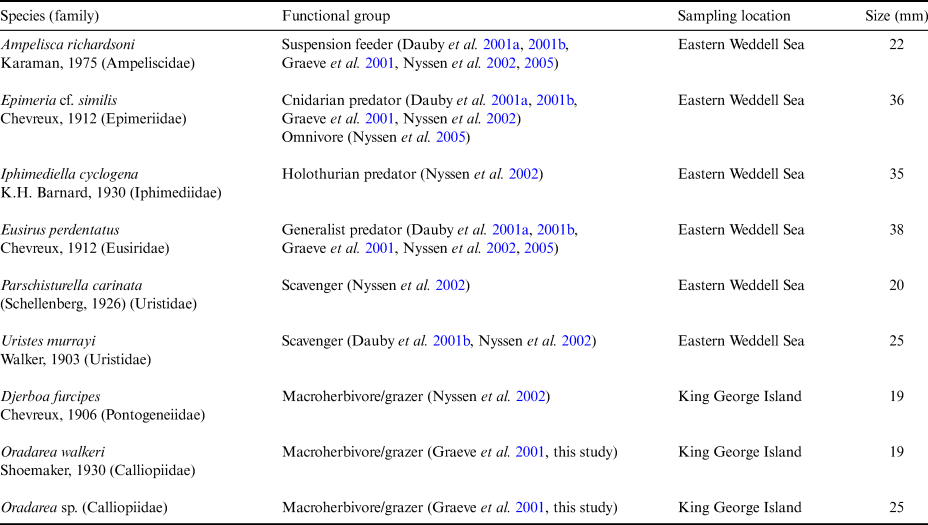
Overall, amphipod mouthpart morphology seems to be correlated with their trophic ecology. However, the functional significance of many morphological traits or modified structures in amphipods is still incompletely understood. Here, we aimed to test whether differences in feeding habits were reflected in the morphology of the mandible in multiple Antarctic amphipod groups. To do this, we examined mandible morphology in nine species spanning seven families and five functional groups (grazers, suspension feeders, generalist predators, specialist predators and scavengers) (Table I) and related our findings to available information on their feeding ecology (generated by gut content analyses, stables isotopes and fatty acid trophic markers). We hypothesized that mandible morphology and feeding habits would be closely related and that the mandible should show strong morphological differences between species belonging to different functional groups or having different feeding habits, while the mouthparts of species showing similar feeding habits would bear more resemblance.
Families, functional groups (according to literature), sampling locations and specimen sizes for the nine studied amphipod species.

Material and methods
Specimens of six species (Table I) were collected with Agassiz, benthopelagic and bottom trawls and dredges in the eastern Weddell Sea during three Antarctic summer cruises of RV Polarstern: EPOS leg 3 (1989), EASIZ I (1996) and EASIZ II (1998). Individuals of Oradarea walkeri and Djerboa furcipes were sampled on King George Island (South Shetland Islands, Antarctic Peninsula) in 1993. They were either hand-collected in the upper part of the infra-littoral of Admiralty Bay during spring tides or dredged in shallow water in the vicinity of the Henryk Arctowski Polish Antarctic station during the summer season. Finally, the Oradarea spp. were also collected on King George Island during the summer of 1993, but at depths of 400 m using traps baited with different macroalgae (Desmarestia menziesii or Iridaea sp.).
For each species, a single adult (see body sizes in Table I) female specimen was selected for mouthpart morphology examination. Animals preserved in 10% formalin were dissected under a binocular microscope (Leica MZ12) using forceps and scissors. After dissection, amphipod mandibles were dehydrated through an alcohol series, critical point-dried and then sputter-coated with carbon then gold to be observed by scanning electron microscopy.
To assess congruence between mouthpart specialization and feeding habits, mandible morphology was compared to trophic ecology as depicted by feeding behaviour observations, gut content analyses and trophic markers (stable isotope ratios, lipid and/or fatty acid analyses). Gut content data for Ampelisca richardsoni, D. furcipes, Epimeria cf. similis, Eusirus perdentatus, Iphimediella cyclogena, Parschisturella carinata and Uristes murrayi were extracted from the literature (Dauby et al. Reference Dauby, Scailteur and de Broyer2001a, Reference Dauby, Scailteur, Chapelle and de Broyer2001b, Graeve et al. Reference Graeve, Dauby and Scailteur2001, Nyssen et al. Reference Nyssen, Brey, Lepoint, Bouquegneau, de Broyer and Dauby2002, Aumack et al. Reference Aumack, Lowe, Amsler, Amsler, McClintock and Baker2017). As, at the time the study was performed, no gut content data were available for O. walkeri, Oradarea sp. or D. furcipes, they were analysed for this study. For 20 specimens of each species, the digestive tract was cut at the oesophagus level and removed together with the midgut glands. It was then separated from the midgut glands, opened, and its contents were spread on a microscope slide. Slides were examined under an optical microscope (Leica DMLB equipped with a reflection contrast system). Feeding behaviour observations were taken from Klages & Gutt (Reference Klages and Gutt1990) and Dauby et al. (Reference Dauby, Scailteur and de Broyer2001a); stable isotope ratios analyses were taken from Nyssen et al. (Reference Nyssen, Brey, Lepoint, Bouquegneau, de Broyer and Dauby2002, Reference Nyssen, Brey, Dauby and Graeve2005) and Aumack et al. (Reference Aumack, Lowe, Amsler, Amsler, McClintock and Baker2017); and lipid and/or fatty acid composition analyses were taken from Graeve et al. (Reference Graeve, Dauby and Scailteur2001) and Nyssen et al. (Reference Nyssen, Brey, Dauby and Graeve2005) and Aumack et al. (Reference Aumack, Lowe, Amsler, Amsler, McClintock and Baker2017). As no trophic marker measurements were, to the best of our knowledge, available for Oradarea sp. or O. walkeri, we compared their mandible morphology with results obtained on their congeners Oradarea edentata (Graeve et al. Reference Graeve, Dauby and Scailteur2001) and Oradarea bidentata (Aumack et al. Reference Aumack, Lowe, Amsler, Amsler, McClintock and Baker2017).
Results
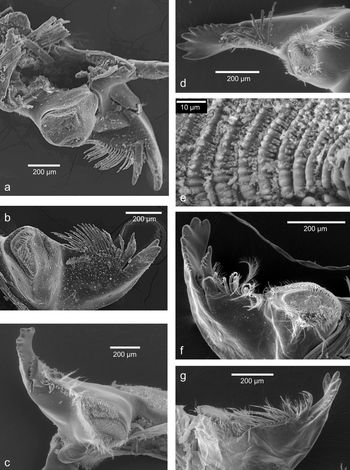
Both mandibles of A. richardsoni (Fig. 2a & b) bore well-developed incisors and molar processes. Both incisors presented five rounded cusps, and the left one (Fig. 2a) was ornamented by a strong five-toothed lacinia mobilis. The right lacinia mobilis was smaller and more spine-like (Fig. 2b). The molars were prominent and some smooth ridges were visible. The most striking feature of those mandibles was the development of the setae rows: on both sides, the row was composed of ~15 serrate setae nearly as long as the lacinia mobilis.
Scanning electron micrographs of the mandibles of the studied amphipods (primary consumers). a. Ampelisca richardsoni, left mandible. b. Ampelisca richardsoni, right mandible. c. Oradarea sp., left mandible. d. Oradarea sp., right mandible. e. Oradarea sp., details of molar process. f. Oradarea walkeri, left mandible. g. Djerboa furcipes, left mandible.

The gut composition of Oradarea sp. depended drastically on the used macroalgal baits. When they were made of pieces of the brown algae Desmarestia menziesii, 95% of the gut volume was filled with fragments of this algae. On the other hand, when baits consisted of pieces of Iridaea sp., the gut content was composed of mineral particles, of frustules of different kind of diatoms, of chitinous structures and, in some specimens, of a small number of pieces of Iridaea sp. Mandibles were asymmetrical regarding the morphology of the lacinia mobilis (Fig. 2c & d). The incisor bore ten rounded cusps. The left lacinia (Fig. 2c) was similar to the incisor, but smaller and with only seven more acute cusps. The right lacinia (Fig. 2d) was slender. The setae row consisted only of stout serrate setae (Fig. 2d) on the right mandible, while an additional parallel row of plumose slender setae was present on the left mandible (Fig. 2c). The molar process was massive and sub-columnar, and the triturative area was closely surrounded by short and thick setae and topped by a dense crown of setae. The grinding surface of the molar process was provided with densely set short spinules and ridges with serrate distal margins (Fig. 2e).
A total of 90% of the gut contents of O. walkeri were composed of pieces of macroalgae. The other 10% consisted of different types of diatoms and of inorganic material. Mandible morphology was nearly identical to that described for the other Oradarea sp. (Fig. 2f). Both incisors were well-developed and bore ten strong teeth. The rather flat mandibular body was bordered ventrally by a double row of stout serrate setae and by slender plumose setae. The large and tall molars were topped by a dense fringe of setae and bore a large triturative area provided with ridges and other rasp-like structures. Both mandibles were flanked by a lacinia mobilis, which was strong and seven-toothed on the left mandible (Fig. 2f) and weaker and spine-like on the right mandible (not shown).
Examination of the gut contents of D. furcipes revealed that they were composed of more than 85% of pieces of macroalgae, 10% of pennate diatoms and a small amount of chitinous parts. All dissected specimens also had mineral particles in their guts. As with both species of the genus Oradarea, D. furcipes displayed basic gammaridean amphipod mandibles (Fig. 2g). They had ten-toothed incisors, a left lacinia mobilis with ten teeth, but only three on the right one (Fig. 2g), large (yet smaller than in the genus Oradarea) cylindrical and triturative molars crowned by a dense fringe of small setae and the setae row, like in O. walkeri, was composed of two different types of setae (plumose and serrate).
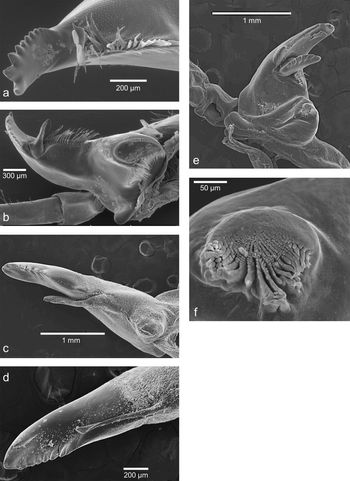
Both mandibles of E. cf. similis (Fig. 3a & b) bore strong ten-toothed incisors and tall sub-columnar molars provided with well-developed and smooth ridges. The molars were surrounded by a row of stubby setae and fringed with bundles of hair-like setae at their dorsal margin. The left lacinia mobilis (Fig. 3a) was armed with seven cusps, whereas the right one was smaller, bifurcated and spine-like (Fig. 3b). The setae row was composed of stout denticulate setae, flanked on the ventral side by slender setae.
Scanning electron micrographs of the mandibles of the studied amphipods (predators). a. Epimeria cf. similis, left mandible. b. Epimeria cf. similis, right mandible. c. Iphimediella cyclogena, left mandible. d. Iphimediella cyclogena, details of right lacinia mobilis. e. Eusirus perdentatus, left mandible. f. Eusirus perdentatus, details of molar process.

The mandibular body of I. cyclogena was elongate, tapering into the incisor that was much narrower than in all other species considered in this work (Fig. 3c). Both incisor processes were toothed (ten cusps) and bore a long lacinia mobilis that was inserted close to the molar process, which was reduced to a small fleshy cone. The left lacinia mobilis (Fig. 3c) was thick and strongly chitinized, but the right one (Fig. 3d) was reduced to a thinner, twig-like structure. A major modification was the change in the orientation of the incisor, cutting in the vertical frontal plane.
The mandibles of E. perdentatus bore strong incisors and molar processes (Fig. 3e). The incisor was wide and smooth, flanked by a single cusp at each end. The left lacinia mobilis was denticulated and seven-toothed (Fig. 3e), whereas the right one was armed with just two teeth. The short setae row was composed of approximately ten setae. The apex of the tall sub-columnar molar bore a small triturative area with rasp-like structures (Fig. 3f).
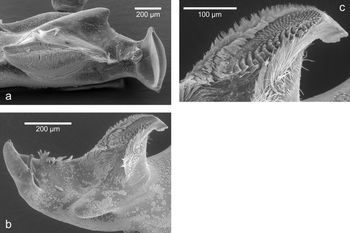
The proximal parts of the incisors of U. murrayi incisors were narrow, and the structures broadened distally (Fig. 4a). The cutting edge was smooth and flanked by a single cusp at each end. The lacinia mobilis was present on both mandibles. The setae row was composed of three setae, followed by a dense string of hairy setae bordering the mandibular body. The molar was oval-shaped and surrounded by a ventral fringe of setae that partly overlapped the relatively smooth triturative area (Fig. 4a).
Scanning electron micrographs of the mandibles of the studied amphipods (scavengers). a. Uristes murrayi, right mandible. b. Parschisturella carinata, left mandible. c. Parschisturella carinata, details of molar process.

The incisor processes of P. carinata were smooth, and their edges were rather sharp and flanked by a single cusp at each end (Fig. 4b). The slightly concave mandibular body was bordered by a row of seven or eight thick setae. The left mandible bore a weak digitiform, apically bidentated lacinia mobilis (Fig. 4b). The molars were tall and ornamented with setae. The oval triturative area bore several series of deeply toothed ridges and rasp-like structures and was more developed than in U. murrayi (Fig. 4c).
Discussion
Macroherbivores/grazers
While our study is, to the best of our knowledge, the first one to investigate the feeding habits of Oradarea sp. and O. walkeri, gut contents and lipid analyses suggested that O. edentata showed a high, year-round reliance on macroalgal tissues (Graeve et al. Reference Graeve, Dauby and Scailteur2001). Joint use of gut contents, stable isotopes and fatty acid trophic markers highlighted that O. bidentata was also a primary consumer, and that it relied not only on macroalgae, but also on their epiphytic diatoms and endo/epiphytic filamentous algae (Aumack et al. Reference Aumack, Lowe, Amsler, Amsler, McClintock and Baker2017). The two Oradarea species studied here, whose guts mostly contained macroalgal fragments and/or diatom frustules, seem to have feeding habits that are comparable with their congeners. Interestingly, Oradarea sp. had specific grazing preferences. They fed avidly on D. menziesii, but did not consume Iridaea sp. This preferential consumption could be linked to the ability of red algae from the genus Iridaea to develop chemical defences against herbivores (Amsler et al. Reference Amsler, McClintock and Baker1998). Oradarea bidentata was also found to have distinct dietary preferences when sampled in association with Desmarestiales or red algae (Aumack et al. Reference Aumack, Lowe, Amsler, Amsler, McClintock and Baker2017).
Aumack et al. (Reference Aumack, Lowe, Amsler, Amsler, McClintock and Baker2017) analysed the gut contents of D. furcipes and found that the species ingested items similar to those we observed here (macroalgae, diatoms and crustacean parts), albeit in different proportions. This might indicate that some dietary plasticity exists in this species. Nevertheless, our gut contents results are consistent with this species mostly consuming living or recently dead macroalgal material (Aumack et al. Reference Aumack, Lowe, Amsler, Amsler, McClintock and Baker2017). Combined use of stable isotopes and fatty acid markers confirmed that D. furcipes held a low trophic position and mostly relied on macroalgae for its nutrition (Nyssen et al. Reference Nyssen, Brey, Dauby and Graeve2005).
For feeding on live macrophytes and/or fresh macrophyte detritus, it is necessary to possess structures for biting off pieces of plant material and for grinding it prior to ingestion. The mandibles of Oradarea sp., O. walkeri and D. furcipes were very similar to one another and to those of other previously described herbivorous species (e.g. Mayer et al. Reference Mayer, Maier, Maas and Waloszek2009, Pavesi & Olesen Reference Pavesi and Olesen2017), and all appear well-suited for this kind of feeding. All of these species have incisors with sharp dentition, which may facilitate cutting pieces from firm plant material (Mayer et al. Reference Mayer, Maier, Maas and Waloszek2009, Pavesi & Olesen Reference Pavesi and Olesen2017). The left mandible of the three species also had a strong, sharply denticulate lacinia mobilis that probably works as an additional cutting edge (Coleman Reference Coleman1989b, Pavesi & Olesen Reference Pavesi and Olesen2017). The setal row was well-developed and consisted of a range of numerous serrate and plumose setae in all three species. The molars of the three grazers, as with other herbivorous species, were structured like ‘rasps’ (i.e. ornamented with a dense concentration of strongly denticulate/spinous ridges; see Fig. 2e for Oradarea sp. molar details). This has been interpreted as a mechanism for triturating hard particles such as tough macroalgal tissues (Watling Reference Watling1993, Momo et al. Reference Momo, Bogazzi and Duttweiler1998, Mayer et al. Reference Mayer, Maier, Maas and Waloszek2009, Pavesi & Olesen Reference Pavesi and Olesen2017).
Suspension feeders
The gut contents of A. richardsoni contained mostly planktonic items, notably diatoms (Dauby et al. Reference Dauby, Scailteur and de Broyer2001a, Reference Dauby, Scailteur, Chapelle and de Broyer2001b). Lipid markers suggested that phytoplanktonic organisms (including but not limited to diatoms) made up most of this species’ diet (Graeve et al. Reference Graeve, Dauby and Scailteur2001, Nyssen et al. Reference Nyssen, Brey, Dauby and Graeve2005). Stable isotopes confirmed that this species occupied a low trophic position (2.1; Nyssen et al. Reference Nyssen, Brey, Lepoint, Bouquegneau, de Broyer and Dauby2002). Overall, A. richardsoni appeared to be a primary consumer relying mostly on the water column for its nutrition.
Generally speaking, denser setation of the mouthparts and other feeding-related appendages (antennae, gnathopods) has been linked to a greater trend towards filter-feeding (Caine Reference Caine1974, Reference Caine1977). Small particles in the water column are indeed collected passively or actively by setiferous antennae, which are cleaned by gnathopods and transferred to the mouthparts (Caine Reference Caine1974, Reference Caine1977). The setae row between the molar and the incisor is used to retain suspended organic matter collected from the surrounding water and is therefore well-developed in filter-feeders (Dixon & Moore Reference Dixon and Moore1997, Poltermann Reference Poltermann2001). In A. richardsoni, the two dense setae rows were composed of long serrate setae that join together when the mandible closes, thereby forming a kind of bridge between the tip of the mouthparts and the mouth itself. This appears particularly well-suited for retaining particles. Well-developed molar processes with blunt lamelliform cusps can be used to masticate hard materials such as diatom shells that may be present in marine snow (Caine Reference Caine1974, Haro-Garay Reference Haro-Garay2003). Ampelisca richardsoni possessed such well-developed and structured molars, although the ridges were fewer and blunter than what is usually observed in herbivorous species. This is consistent with the fact that smaller planktonic items require less processing prior to ingestion than tough algal tissues. On the other hand, the incisors of filter-feeders (A. richardsoni included), although similarly toothed, were less elongated and not as broad as the grazers’ incisors, a trend that may be indicative of a reduced need for cutting.
Generalist predators
Feeding behaviour observations suggested that E. perdentatus acted as a ‘sit-and-wait’ passive predator (Klages & Gutt Reference Klages and Gutt1990, Dauby et al. Reference Dauby, Scailteur and de Broyer2001a). Crustacean hard parts and pieces of polychaetes formed more than half of its gut contents, which also contained unidentifiable organic and inorganic material (Dauby et al. Reference Dauby, Scailteur and de Broyer2001a, Reference Dauby, Scailteur, Chapelle and de Broyer2001b). Stable isotopes confirmed the status of E. perdentatus as a predator, with a trophic position of 3.0 (Nyssen et al. Reference Nyssen, Brey, Dauby and Graeve2005). It showed no particular specialization in terms of lipid or fatty acid compositions, suggesting that the species feeds on a wide range of items (Graeve et al. Reference Graeve, Dauby and Scailteur2001, Nyssen et al. Reference Nyssen, Brey, Dauby and Graeve2005). This was corroborated by the important variability of its carbon isotopic ratios (Nyssen et al. Reference Nyssen, Brey, Lepoint, Bouquegneau, de Broyer and Dauby2002). Overall, E. perdentatus seems to be a generalist predator, able to switch between dietary items (crustaceans, polychaetes), possibly according to food availability.
Wide and sharp, usually toothless (‘axe-like’) incisors with one broadened lacinia mobilis, columnar molars with a generally reduced triturative area and a lower number of small-sized setae have all been interpreted as adaptations to feeding on animal prey (Haro-Garay Reference Haro-Garay2003). The mandibles of E. perdentatus showed these typical characteristics of predators. However, apart from these general trends, there seems to be a great degree of variation involved in the form of exclusively predatory mandibles, probably linked to prey nature and size (Watling Reference Watling1993). Stout molars have also been associated with predatory habits (notably in opportunistic scavengers that also rely on active predation) and could be used to crush masses of soft food, such as decaying tissue, but also to break microzooplankton exoskeletons (Sainte-Marie Reference Sainte-Marie1984, Haro-Garay Reference Haro-Garay2003). Predators' mandible morphology also appears to vary with the size of the animal, which reflects the prey size it can potentially exploit (Arndt et al. Reference Arndt, Berge and Brandt2005). Wider incisors and taller molars with a more reduced triturative surface would occur in larger species/individuals (Haro-Garay Reference Haro-Garay2003). Eusirus perdentatus, as one of the largest Antarctic amphipod species (up to 75 mm), appeared to follow this trend. Some other opportunistic predators also present a toothed incisor, which may indicate that they feed on softer prey, such as gelatinous plankton, or could be indicative of a lower reliance on predation (i.e. an increased tendency to omnivory) (Haro-Garay Reference Haro-Garay2003).
Cnidarian predators/omnivores
The gut content analyses of E. cf. similis specimens suggested that this species was a specialist predator of cnidarians (Dauby et al. Reference Dauby, Scailteur and de Broyer2001a, Reference Dauby, Scailteur, Chapelle and de Broyer2001b, Nyssen et al. Reference Nyssen, Brey, Lepoint, Bouquegneau, de Broyer and Dauby2002, Reference Nyssen, Brey, Dauby and Graeve2005). Their stomach contents were indeed composed of 63% cnidarian remains on average, although other items such as sponge spicules, microalgae and pieces of polychaetes were also identified (Dauby et al. Reference Dauby, Scailteur and de Broyer2001a, Reference Dauby, Scailteur, Chapelle and de Broyer2001b). However, the presence of sediments in the guts of this species also suggested partial reliance on deposit feeding, and the fatty acid composition suggested assimilation of sediment-associated microorganisms (Nyssen et al. Reference Nyssen, Brey, Dauby and Graeve2005). In addition, stable isotope analyses highlighted that this species relies on a broad spectrum of sources of organic matter (Nyssen et al. Reference Nyssen, Brey, Lepoint, Bouquegneau, de Broyer and Dauby2002, Reference Nyssen, Brey, Dauby and Graeve2005).
Overall, insights from multiple methods suggest that E. cf. similis might be an omnivore rather than a strict cnidarian predator. Examination of its mandibles corroborated this view. Their morphology was indeed basic and showed no modifications that could be associated with a specialized regime. This is consistent with an omnivore having a broad prey spectrum. Mandibles were very similar to those of other omnivorous species (Arndt et al. Reference Arndt, Berge and Brandt2005, Mayer et al. Reference Mayer, Maier, Maas and Waloszek2009, Mekhanikova Reference Mekhanikova2010), which feature roughly toothed incisors and lacinia mobilis used to tear apart food items and a strong and ridged or rasp-like molar able to reduce food morsels to small pieces and crack and grind even hard plant material and diatom shells (Arndt et al. Reference Arndt, Berge and Brandt2005). Conversely, mandibles of specialized cnidarian micropredators such as Maxilliphimedia longipes (Coleman Reference Coleman1989b), Andaniexis sp. or Stenothoe brevicornis (Moore et al. Reference Moore, Rainbow and Vader1994) seem adapted to taking large bites of soft tissues and ingesting food as large, whole lumps. As such, the latter species bear an enlarged incisor cutting blade with very small or no teeth for cutting and slicing soft food, and when a molar is present, it is reduced or soft, without any grinding surface (Moore et al. Reference Moore, Rainbow and Vader1994).
Holothurian predators
Stable isotopes suggested that the iphimediid I. cyclogena is a predator (trophic position: 3.7; Nyssen et al. Reference Nyssen, Brey, Lepoint, Bouquegneau, de Broyer and Dauby2002). Food items observed in its guts were mainly holothurian ossicles (70%) and, to a lesser extent, polychaete remains and plankton (Nyssen et al. Reference Nyssen, Brey, Lepoint, Bouquegneau, de Broyer and Dauby2002). This led the authors to conclude that this species is a predator specializing in holothurians (De Broyer et al. Reference De Broyer, Rauschert and Scailteur1999, Dauby et al. Reference Dauby, Scailteur and de Broyer2001a, Nyssen et al. Reference Nyssen, Brey, Lepoint, Bouquegneau, de Broyer and Dauby2002). Holothurians are a quite uncommon food source for invertebrates because their integument is strong and leathery, with embedded ossicles. Few amphipod species are known to feed on holothurians (Dauby et al. Reference Dauby, Scailteur and de Broyer2001a), and a single one was recognized to date as a specialized predator of this unusual prey, the Stilipedidae Alexandrella schellenbergi (previously Bathypanoploea schellenbergi; Coleman Reference Coleman1990).
The mouthparts of A. schellenbergi are highly adapted to cope with the tough tissues of these echinoderms (Coleman Reference Coleman1990). Its mandibles are remarkably stout, with strongly serrate incisors and left lacinia mobilis, providing three strong edges to cut through the firm body wall of holothurians (Coleman Reference Coleman1990). Although gut contents suggested that I. cyclogena mainly relied on the same food source as A. schellenbergi, its mandible morphology presents some notable differences (Fig. 3c & d). Its mandibular body was more elongated, with much narrower incisors and a smooth lacinia mobilis on both sides. These differences could be explained by a change in the orientation of the cutting plane. Unlike A. schellenbergi, which possesses transversely orientated incisors, the incisor of most iphimediids (including I. cyclogena) cuts in the vertical frontal plane (Watling & Thurston Reference Watling, Thurston and Crame1989). The longitudinally orientated toothed cutting edge of the incisor of I. cyclogena (Fig. 3c & d) accordingly suggested that it cuts in a scissor-like manner. Because of this change in orientation to offer a longer cutting edge, the incisor of I. cyclogena does not have to be wide, as in A. schellenbergi, but instead elongated. In both species, the molars were reduced and without any grinding surface, but the incisors presented many teeth. This suggests that the reduction of food to small pieces relies solely on the action of the incisors and lacinia mobilis (Coleman Reference Coleman1990).
Scavengers
The gut contents suggested that the diet of U. murrayi mostly consisted of carrion (Nyssen et al. Reference Nyssen, Brey, Lepoint, Bouquegneau, de Broyer and Dauby2002). Nevertheless, the guts of this species also contained crustacean and polychaete remains, and, when kept in tanks, this species could exhibit active predation behaviour (Dauby et al. Reference Dauby, Scailteur and de Broyer2001a). Similarly, in aquaria, P. carinata readily fed on any dead material provided, without preference, but crustacean remains could also be found in the guts of this species (Dauby et al. Reference Dauby, Scailteur and de Broyer2001a). Stable isotope ratios confirmed that these two species occupied high trophic positions (3.8 and 3.9, respectively), which is consistent with scavenging behaviour (Nyssen et al. Reference Nyssen, Brey, Lepoint, Bouquegneau, de Broyer and Dauby2002). Furthermore, their isotopic ratios were similar in terms of both carbon and nitrogen (Nyssen et al. Reference Nyssen, Brey, Lepoint, Bouquegneau, de Broyer and Dauby2002), suggesting they might rely on similar resources.
Many Lysianassoidea amphipods are highly mobile scavengers and have developed morphological, physiological and behavioural traits in relation to this lifestyle. Scavenging amphipods were previously classified into two distinct functional groups. The first is composed of voracious, rapid feeders, processing food in large bites that they swallow directly into the oesophagus. These usually larger species possess large and flexible guts and can survive long starvation periods (Steele & Steele Reference Steele and Steele1993, Seefeldt et al. Reference Seefeldt, Campana, Deregibus, Quartino, Abele, Tollrian and Held2017). Their mandibles are therefore adapted to take large bites of muscular food items. They have a bowl-shaped and enlarged mandibular body, a wide and sharp shearing incisor edge and a molar that is either non-triturative (similar to a ‘setose tongue’) or only bears a vestigial patch of triturative area (Dahl Reference Dahl1979, Sainte-Marie Reference Sainte-Marie1984). Such species' molars therefore do not have a grinding function, but can serve to push pieces of food into the stomodeum when the mandible is adducted (Steele & Steele Reference Steele and Steele1993). Members of the second functional group have a continuous and less rapid feeding behaviour and probably do not survive long starvation periods (Seefeldt et al. Reference Seefeldt, Campana, Deregibus, Quartino, Abele, Tollrian and Held2017). The mandibles of these usually smaller species bear a slender incisor process and a triturative molar (Sainte-Marie Reference Sainte-Marie1984, Momo et al. Reference Momo, Bogazzi and Duttweiler1998, Arndt et al. Reference Arndt, Berge and Brandt2005, Seefeldt et al. Reference Seefeldt, Campana, Deregibus, Quartino, Abele, Tollrian and Held2017). The development of the molar suggests that these animals rely on a broader dietary regime (Sainte-Marie Reference Sainte-Marie1984). This group would therefore be composed of more facultative scavengers that could also act as predators and/or deposit feeders (Seefeldt et al. Reference Seefeldt, Campana, Deregibus, Quartino, Abele, Tollrian and Held2017).
Here, both U. murrayi and P. carinata appeared to belong to this second functional group, as previous ecological studies suggested that they are also able to prey on live animals (Dauby et al. Reference Dauby, Scailteur and de Broyer2001a). Accordingly, they both displayed the typical mandible morphology of this group: a wide, smooth and sharp incisor combined with a triturative molar (Fig. 4a & b).
Conclusions
For each of the nine Antarctic amphipod species presented here, mandible morphology seemed to be, to some extent, congruent with what is known of their feeding habits. This tends to confirm the links between mandible morphology and feeding strategies that were previously suggested for amphipods from other regions. These trends seem consistent across a wide variety of taxa and/or over large spatial scales, suggesting that mandible morphology can be a good descriptor of some aspects of trophic ecology. For example, differences in mouthpart morphology are usually seen between primary (herbivores and/or suspension feeders) and higher trophic level consumers (predators and/or scavengers). Similarly, mandible morphology can help us to discriminate between more generalist or specialist feeding strategies. The former are exemplified in this study by the case of E. cf. similis, for which the absence of mandible modifications that could be associated with a specialized diet seems consistent with findings from other methods classifying this species as an omnivore with a broad prey spectrum.
On the other hand, the links between mandible morphology and amphipod diet were seldom unambiguous or straightforward. Similar adaptations were found in distinct functional groups. For instance, grazers, suspension feeders and omnivores all showed very similar mandible morphologies that were close to the basic plan. Conversely, a great variability of mandible morphologies can also be found within the same functional group, as observed for generalist predators. Phenotypic plasticity is common in nutrition-related traits, and they may be independently lost or acquired over the course of evolution (Rüber et al. Reference Rüber, Verheyen and Meyer1999). Phylogeny can therefore have an obfuscating effect on form-function relationships (Hutchins et al. Reference Hutchins, Schwartz and Nowlin2014). In the case of I. cyclogena, a change in the orientation of the cutting plane during the evolution of iphimediids led to a very different mandible morphology from another unrelated species using the same food source, which can be misleading if phylogenetic effects are not taken into consideration. Finally, in some cases, dietary specialization can be linked with marked changes in the morphology of other mouthparts and/or accessory feeding appendages (e.g. antennae or gnathopods). For instance, the main characteristic of filter-feeders' mandibles, differentiating them from grazers or omnivores showing a similar basic morphology, is the increased setation, which is more visible on other feeding-related body parts than on the mandible (Cole & Watkins Reference Cole and Watkins1977, Arndt et al. Reference Arndt, Berge and Brandt2005, Mayer et al. Reference Mayer, Maier, Maas and Waloszek2009).
Overall, in many cases, mandible morphology on its own could not precisely predict amphipod feeding strategies. As with all trophic ecology methods, such as behavioural observations, gut content analyses or trophic markers, the mandible morphology examination possesses its own strengths and limitations. Nevertheless, when used in combination with some of the abovementioned methods, morphological observation of mouthparts proved to be able to complement them efficiently by shedding light on specific issues. As such, it could constitute a valuable source of information for integrative studies of amphipod ecological diversity in the Southern Ocean and beyond.
Acknowledgements
The authors would like to thank Prof W. Arntz (AWI, Bremerhaven) for his invitation to participate in the EASIZ cruises, the officers and crews of the RV Polarstern, AWI (Bremerhaven) colleagues who helped with collecting and sorting samples and Dr Claude De Broyer (RBINS, Brussels), who collected amphipod specimens from King George Island. Dr Y. Scailteur (RBINS) is acknowledged for his work on the gut content analyses. Particular thanks are given to Julien Cillis (RBINS) for his help with the scanning electron microscopy. LNM is indebted to Dr Laëtitia Leloup and Dr Jonathan Dedonder for facilitating the final steps of manuscript preparation. The authors also thank Dr Anna Jażdżewska and another anonymous reviewer whose comments helped improve this manuscript. This paper is contribution no. 42 to the vERSO project, contribution no. 18 to the RECTO project and MARE publication no. 397.
Author contributions
FLN and PD conceived the study. FLN performed the observations. FLN and LNM created the figures. FLN, LNM and MV interpreted the data. FLN and LNM prepared the manuscript with input from MV and PD.
Financial support
FLN was a Belgian Fund for Research Training in Industry and Agriculture (FRIA) grantee and a Belgian Funds for Scientific Research (F.R.S.-FNRS) postdoctoral researcher. LNM was an F.R.S.-FNRS research fellow and a Belgian Science Policy Office (BELSPO) postdoctoral researcher. MV is an F.R.S.-FNRS postdoctoral researcher. This research was performed under the auspices of the Scientific Research Programme on Antarctic (Phase IV) from the Belgian Federal Office for Scientific, Technical and Cultural Affairs (OSTC contract no. A4/36/BO2). It was also supported by BELSPO through the vERSO and RECTO projects (contract no. BR/132/A1/vERSO and BR/154/A1/RECTO).