Introduction
Although marked cognitive deficits are present in both chronic and first-episode psychosis (FEP) samples (Heinrichs & Zakzanis, Reference Heinrichs and Zakzanis1998), considerable variability exists with regard to the exact nature and severity of these impairments (Mohamed et al. Reference Mohamed, Paulsen, O'Leary, Arndt and Andreasen1999; Bilder et al. Reference Bilder, Goldman, Robinson, Reiter, Bell, Bates, Pappadopulos, Willson, Alvir, Woerner, Geisler, Kane and Lieberman2000; Riley et al. Reference Riley, McGovern, Mockler, Doku, O'Ceallaigh, Fannon, Tennakoon, Santamaria, Soni, Morris and Sharma2000; Townsend et al. Reference Townsend, Malla and Norman2001; Addington & Addington, Reference Addington and Addington2002; Hill et al. Reference Hill, Schuepbach, Herbener, Keshavan and Sweeney2004). This may, in part, be attributable to the wide heterogeneity inherent in psychotic disorders.
One potential explanation for this heterogeneity is the variable level of functioning prior to the onset of the illness and numerous studies have addressed this aspect of development. The level of pre-morbid functioning in a wide range of domains (i.e. school, work, relationship with peers), especially its progression during childhood and adolescence, probably reflects various underlying processes, chief among them neurodevelopmental. Although poorer pre-morbid adjustment has been linked to male gender, earlier age of onset, negative symptoms, lower remission rates and poorer response to treatment (Addington & Addington, Reference Addington and Addington1993; Gupta et al. Reference Gupta, Rajaprabhakaran, Arndt, Flaum and Andreasen1995; Malla et al. Reference Malla, Norman, Manchanda and Townsend2002; Rund et al. Reference Rund, Melle, Friis, Larsen, Midboe, Opjordsmoen, Simonsen, Vaglum and McGlashan2004), it is also likely to be associated with variation in magnitude and/or pattern of cognitive deficits, suggesting variation in neurodevelopmental mechanisms underlying each pre-morbid adjustment pattern. The few studies that have investigated cognitive deficits within the context of pre-morbid adjustment have revealed inconsistent associations between poor pre-morbid functioning and a wide range of cognitive impairments such as attention and executive functions (Silverstein et al. Reference Silverstein, Mavrolefteros and Close2002), working memory and verbal learning (Larsen et al. Reference Larsen, Friis, Haahr, Johannessen, Melle, Opjordsmoen, Rund, Simonsen, Vaglum and McGlashan2004; Rund et al. Reference Rund, Melle, Friis, Larsen, Midboe, Opjordsmoen, Simonsen, Vaglum and McGlashan2004), verbal reasoning and concept formation (Addington & Addington, Reference Addington and Addington1993), verbal memory and fluency (Addington & Addington, Reference Addington and Addington2005), poor visual memory span (Levitt et al. Reference Levitt, O'Donnell, McCarley, Nestor and Shenton1996) and a generalized cognitive dysfunction (Rabinowitz et al. Reference Rabinowitz, Harvey, Eerdekens and Davidson2006). In addition, these studies have significant limitations such as small sample sizes (Addington & Addington, Reference Addington and Addington1993), inclusion of patients with affective psychoses (Larsen et al. Reference Larsen, Friis, Haahr, Johannessen, Melle, Opjordsmoen, Rund, Simonsen, Vaglum and McGlashan2004), lack of healthy comparison groups (Larsen et al. Reference Larsen, Friis, Haahr, Johannessen, Melle, Opjordsmoen, Rund, Simonsen, Vaglum and McGlashan2004; Rund et al. Reference Rund, Melle, Friis, Larsen, Midboe, Opjordsmoen, Simonsen, Vaglum and McGlashan2004; Addington & Addington, Reference Addington and Addington2005), use of chronic patients (Addington & Addington, Reference Addington and Addington1993; Silverstein et al. Reference Silverstein, Mavrolefteros and Close2002), exclusion of female patients (Levitt et al. Reference Levitt, O'Donnell, McCarley, Nestor and Shenton1996) and the exclusive use of a global neurocognitive measure (Rabinowitz et al. Reference Rabinowitz, Harvey, Eerdekens and Davidson2006).
Furthermore, these studies have not elucidated whether the relative severity of cognitive impairments varies with differences in the course and progression of pre-morbid functioning from childhood to adolescence. The course of pre-morbid functioning is probably reflective of whether the deficits, or lack thereof, were present from childhood and stayed static or whether there was deterioration just prior to onset of psychosis during adolescence. These different patterns may represent different underlying mechanisms, such as early or late neurodevelopmental or neuroprogressive processes.
Thus, our aim was to address these limitations in the previous research on pre-morbid adjustment and neurocognitive functioning. Specifically, our main aim was to investigate the pattern and severity of cognitive impairments across three distinct pre-morbid adjustment course patterns (stable-poor, stable-good and deteriorating course) as suggested by Haas & Sweeney (Reference Haas and Sweeney1992), using a large sample of FEP patients newly admitted to an early-psychosis program. These three patterns refer to subgroups of patients with a distinct course of functioning prior to the onset of psychosis. We also sought to examine the demographic and clinical profiles of these three groups to enable a more thorough understanding of the cognitive deficits present within the groups. We hypothesized that the number of cognitive domains affected and the severity of such deficits would be greatest in patients with a stable-poor pre-morbid course, followed by the deteriorating group, and least in the stable-good group, and that all groups would show cognitive deficits in comparison to matched healthy controls.
Method
Treatment setting
The present report is part of a larger prospective study of patients treated for FEP in a specialized early intervention service, the Prevention and Early Intervention Program for Psychoses (PEPP-Montreal, Quebec). There is no other first-episode program serving this catchment area and no alternative facilities are available privately in the Canadian system of mental health care, thus rendering our sample very close to a treated incidence sample.
Subjects
Subjects for this study were consecutive patients accepted for treatment between 2003 and 2007 having met the following inclusion criteria: 14–30 years old, diagnosis of a schizophrenia spectrum disorder, previous antipsychotic therapy for <1 month, and living within a specified catchment area. The exclusion criteria were: IQ<70, a history of organic mental disorder such as epilepsy, substance-induced psychosis, history of head injury resulting in unconsciousness, and an inability to speak either English or French. Healthy controls, recruited through advertisements in local newspapers and on the university and hospital grounds, were screened for neurological conditions and for past and current psychiatric illnesses with the modified version of the Structured Clinical Interview for the DSM-IV (SCID; First et al. Reference First, Spitzer, Gibbon and Williams1995) for non-psychiatric populations. Patients and controls signed an informed consent for participation after the nature of the evaluation protocol was explained to them. The study was approved by the research ethics board at the Douglas Institute.
Assessments
Diagnosis and symptoms
Diagnoses were determined using the SCID soon after entry to the program and repeated at the 1-year follow-up. Symptoms were assessed using the 30-item Positive and Negative Syndrome Scale (PANSS; Kay et al. Reference Kay, Fiszbein and Opler1987). Symptom ratings were conducted at two time points: (1) at study entry (during the acute phase of the episode); and (2) close to the time of the neuropsychological examination (typically within 2 weeks of the assessment). All assessments were carried out by trained research staff and supervised by at least two senior psychiatrists (A.M. and R.J.).
Medication
Medication dosages were converted into chlorpromazine equivalents (CPZEs) based on widely used norms (Bezchlibnyk-Butler & Jeffries, Reference Bezchlibnyk-Butler and Jeffries2007). The following equivalencies were used for 100 mg of CPZEs: olanzapine 6.25 mg; haloperidol 1.88 mg; quetiapine 125 mg; risperidone 0.75 mg; loxapine 10 mg; and zuclopenthixol 120 mg (injectable every month). For patients who were taking more than one antipsychotic medication at the time of testing (n=7), CPZEs were added to compute total dosages.
Pre-morbid adjustment
The Pre-morbid Adjustment Scale (PAS; Cannon-Spoor et al. Reference Cannon-Spoor, Potkin and Wyatt1982) was used to rate pre-morbid functioning during four distinct age ranges: childhood (⩽11 years), early adolescence (12–15 years), late adolescence (16–18 years) and adulthood (age ⩾19 years). Because the usual onset of schizophrenia spectrum disorders is in early adulthood, we did not include ratings for adulthood in any of our analyses. In addition, pre-morbid was defined as the period 6 months before the onset of the psychotic episode. Within each age range, information collected from the patient and from significant family members was used to make ratings on items regarding sociability and withdrawal, peer relationships, scholastic performance and adaptation to school.
For our analysis, a total score on items across age periods was calculated. Consistent with the usual scoring procedures for the PAS, the scores given within each age period were divided by the maximum possible score, resulting in an index varying between 0 and 1, with higher scores indicating poorer adjustment. Using the method suggested by Haas & Sweeney (Reference Haas and Sweeney1992), we identified three groups, deteriorating, stable-good and stable-poor, on the basis of the course of scores across age periods. A deteriorating course was identified on the basis of a two-point change over relevant pre-morbid periods (i.e. from childhood to early and late adolescence). Patients were identified as having stable-good pre-morbid adjustment if they did not meet the criterion for deterioration and if their overall pre-morbid adjustment score was below the median for the sample, and as having a stable-poor pre-morbid adjustment if their overall score was above the median.
Neuropsychological assessment
All patients accepting treatment at PEPP were approached to undergo a 2.5-h session for administration of a battery of neuropsychological tests. The assessment was conducted by trained research staff with supervision by an accredited neuropsychologist (M.L.). Testing was completed in a single-day session within the first 3 months of entry in the program or between the third and sixth month in a minority of cases (<4.1%) to ensure clinical stabilization of acute psychotic symptoms (mean time from entry in the program to neuropsychological testing=9.73 weeks; range −1.57 to −41 weeks). One patient was tested prior to acceptance into the program to rule out intellectual disability, which resulted in a negative value.
Nine commonly used tasks that are part of the neuropsychological battery performed at PEPP were selected to assess six cognitive domains as suggested by the National Institute of Mental Health (NIMH) Measurement and Treatment Research to Improve Cognition in Schizophrenia (MATRICS) group (MATRICS, 2003; Nuechterlein et al. Reference Nuechterlein, Barch, Gold, Goldberg, Green and Heaton2004). The z scores for each cognitive domain were computed using the mean and standard deviation of the healthy control group. An abbreviated full-scale IQ was based on the short form of the Wechsler Adult Intelligence Scale (WAIS-R; Wechsler, Reference Wechsler1981) and used as an index of general intellectual functioning. In addition, because of recent evidence that a single-cognitive factor model fits the data best, we computed a global neurocognitive measure by using the mean standardized scores for each cognitive domain (Dickinson et al. Reference Dickinson, Ragland, Calkins, Gold and Gur2006). Below is a listing of the six neurocognitive domains and a description of the tasks used to estimate these domains.
(1) Attention
d2 test of attention (Brickenkamp, Reference Brickenkamp1998)
This is a letter cancellation test composed of 14 lines of 47 letters each. Examinees are asked to slash out as many targets as they can among distracters in 4 min 20 s. The final score used to assess performance is the total number of cancellations minus the total number of distracters wrongly slashed out.
(2) Working memory
Digit-Span subtest of the Wechsler Adult Intelligence Scale III-Revised (WAIS-III-R; Wechsler, Reference Wechsler1981)
In this task, series of numbers are read aloud and the examinee is told to repeat the numbers in the same and reverse order for the backward digit-span. The final score refers to the number of correctly repeated sequences until the discontinue criterion (i.e. failure to reproduce two sequences of equal length) is met.
Spatial Span subtest of the Wechsler Memory Scale III (WMS-III; Wechsler, Reference Wechsler1997)
In this test of visual working memory, the examiner taps a series of three-dimensional blocks and the examinee is asked to tap the same blocks in the same and reverse order for the backward spatial span. The final score refers to the number of correctly tapped sequences of blocks until the discontinue criterion (i.e. failure to reproduce two sequences of equal length) is met.
(3) Verbal memory
Logical Memory subtest of the WMS-III (Wechsler, Reference Wechsler1997)
This instrument assesses both immediate and delayed recall of auditory material, specifically two stories. The final score is the correct number of items successfully remembered.
(4) Visual memory
Visual Reproduction subtest of the WMS-III (Wechsler, Reference Wechsler1997)
This instrument assesses both immediate and delayed recall of visual material. The final score is the correct number of items successfully remembered.
(5) Reasoning/problem solving
Trail Making Test, Part B (TMTB; Reitan, Reference Reitan1985)
This task assesses set-shifting abilities where examinees have to correctly connect letters and numbers in an alternative order. Time for completion is used as the primary score.
Block Design subtest of the WAIS-III-R (Wechsler, Reference Wechsler1981)
This task is timed and requires subjects to construct figures using nine identical blocks.
(6) Processing speed
Trail Making Test, Part A (TMTA; Reitan, Reference Reitan1985)
This task requires subjects to connect numbers in the correct chronological order. Time for completion was used as the primary score.
Digit-Symbol Coding Task (DST)
This task is a subtest of the WAIS-III-R (Wechsler, Reference Wechsler1981) and requires subjects to correctly match as quickly as possible a set of symbols to numbers ranging from 1 to 9 during a 120-s time period.
Data analysis
SPSS for Window version 15.0 (SPSS Inc., USA) was used for statistical analysis. To test for demographic and clinical differences between the deteriorating, stable-good and stable-poor pre-morbid adjustment groups, χ2 and ANOVA with Bonferroni corrections were used. All tests were two-tailed. As sample sizes varied, effect sizes for each cognitive domain and IQ across pre-morbid adjustment groups were computed using normal controls' means and standard deviations (Mohamed et al. Reference Mohamed, Paulsen, O'Leary, Arndt and Andreasen1999). To test for group differences on all cognitive domains and abbreviated IQ, ANCOVA models were conducted with group (patient versus control) as the between-group factor and education as the covariate. As males showed poorer performance on the verbal memory domain compared to females (t=–3.741, df=122, p=0.000), gender was also entered as a covariate when testing for group differences on the verbal memory domain.
Results
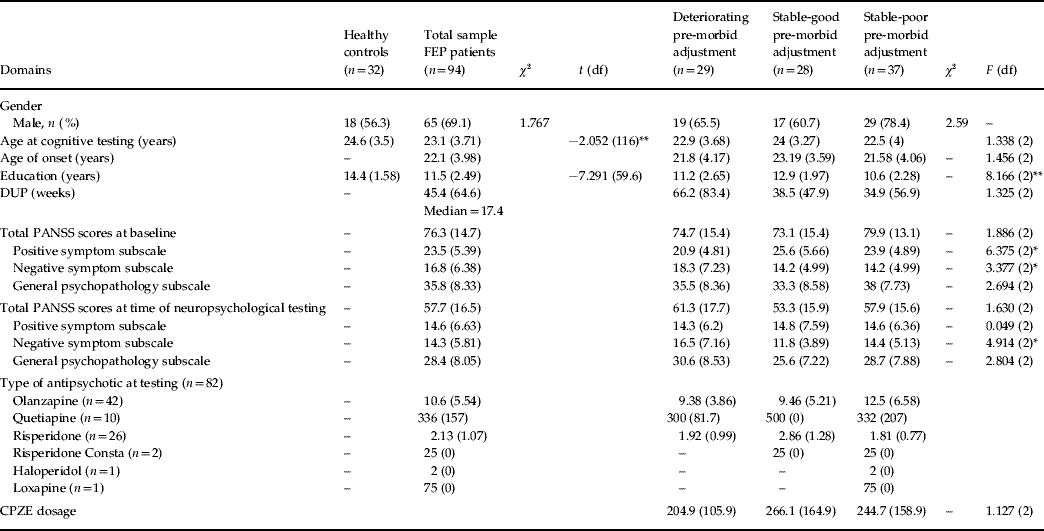
Out of 169 patients with a diagnosis in the schizophrenia spectrum range [i.e. schizophrenia, schizophreniform, schizo-affective, delusional disorder and psychosis not otherwise specified (NOS)] at baseline, 121 completed the full neuropsychological battery (completion rate of 72%). The remaining patients who refused to complete the assessment did not differ from those who participated in the study on gender, age of onset, education, duration of untreated psychosis (DUP) and symptoms at baseline but were different on ethnicity. Caucasians (n=80, 66%) were more likely to have completed the tests than non-Caucasians (n=15, 45.5%) (Fisher's exact test, p=0.03). A total of 94 patients completed the PAS. These patients did not differ significantly from those who did not complete the assessment (n=27) with regard to gender, ethnicity, age of onset, education, DUP and cognition. However, patients who did not complete the PAS had significantly higher baseline PANSS total scores (t=2.919, df=114, p=0.004). The following analyses are based on the 94 patients who completed both the neuropsychological evaluation and the PAS. Clinical and demographic characteristics of the patient (total sample and divided into three pre-morbid adjustment groups) and healthy comparison groups are provided in Table 1.
Demographic and clinical characteristics of first-episode psychosis (FEP) and healthy control subjects

DUP, Duration of untreated psychosis; PANSS, Positive and Negative Syndrome Scale; CPZE, chlorpromazine equivalents; df, degrees of freedom.
Values given as mean (standard deviation) unless stated otherwise.
* p<0.05, ** p<0.005.
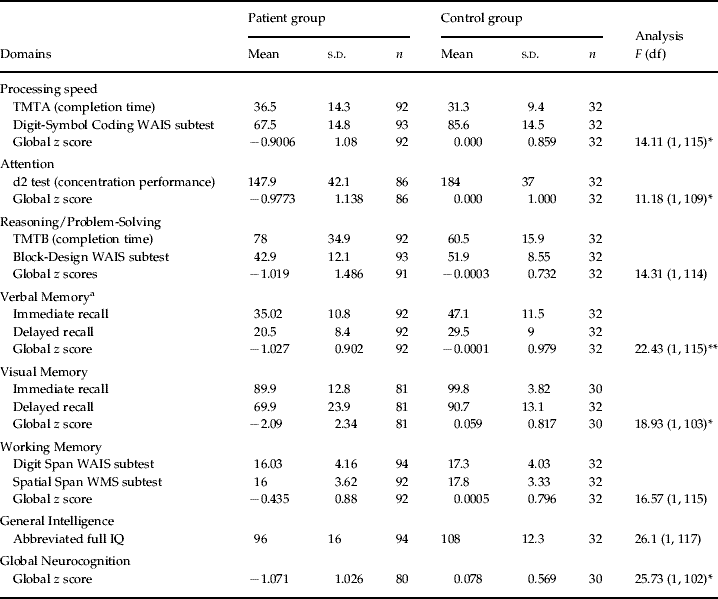
The raw scores for each cognitive test and the mean z scores for patients and healthy controls are presented in Table 2. ANCOVA revealed that patients performed significantly worse than controls on all cognitive domains and the abbreviated full-scale IQ measure. However, the significant difference in working memory, reasoning/problem-solving and the abbreviated IQ measure disappeared after adjusting for education. Pearson correlations revealed that CPZE dosages were not correlated with any of our cognitive domains or full-scale IQ. Because of the variety of antipsychotic medications used, we conducted an additional analysis examining the correlation between CPZE dosages for patients taking olanzapine (n=42) and risperidone (n=26) and our cognitive domains. The results indicated that verbal memory was the only domain negatively correlated with CPZE dosages (person r=–0.297, p=0.016).
Comparison of first-episode subjects and healthy control group at baseline assessment on neurocognitive domains

TMTA, Trail Making Test, Part A; TMTB, Trail Making Test, Part B; WAIS, Wechsler Adult Intelligence Scale; WMS, Wechsler Memory Scale; s.d., standard deviation; df, degrees of freedom.
All ANCOVAs were conducted with education as a covariate.
a ANCOVAs with verbal memory were conducted with gender and education as covariates.
* p<0.05, ** p<0.005.
Demographic variables across pre-morbid adjustment groups (Table 3)
Based on the method of Haas & Sweeney (Reference Haas and Sweeney1992), 39.4% of patients were categorized as having stable-poor functioning, 30.9% as having a deteriorating pre-morbid adjustment and 29.8% as having stable-good functioning. One-way ANOVAs and χ2 were calculated to determine the differences between these three groups in symptoms, education, age of onset, CPZE dosages at the time of neuropsychological testing, and gender. Post-hoc tests with Bonferonni corrections were used to determine the groups between which the differences occurred. The results show that the three pre-morbid adjustment patterns did not differ significantly with regard to age of onset, CPZE dosages and gender. Patients in the stable-good group had significantly more years of education compared to the deteriorating group (F=8.17, p<0.05).
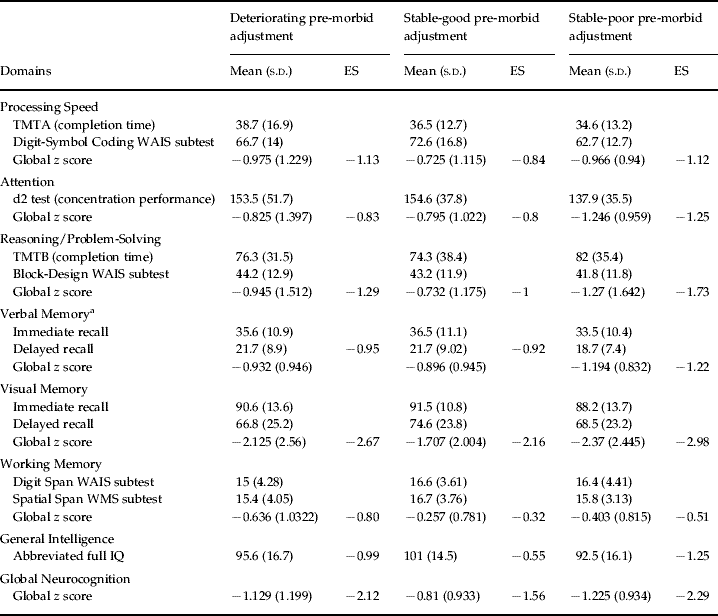
Effect sizes of different cognitive domains across pre-morbid adjustment patterns

TMTA, Trail Making Test, Part A; TMTB, Trail Making Test, Part B; WAIS, Wechsler Adult Intelligence Scale; WMS, Wechsler Memory Scale; s.d., standard deviation; ES, effect size.
a ANCOVAs with verbal memory were conducted with gender and education as covariates.
Clinical variables across pre-morbid adjustment groups (Table 1)
Baseline symptoms during the acute phase
During the acute phase of the illness (baseline assessment), the stable-good group scored significantly higher on the PANSS positive scale at baseline compared to the deteriorating group (F=6.375, p<0.005). In addition, the deteriorating group presented with higher symptoms on the PANSS negative scale compared to the stable-good group (F=3.377, p<0.05). Patients did not differ with regard to the PANSS total and general psychopathology scales at baseline.
Symptoms at time of neuropsychological testing during the stabilized phase
Analyses of symptoms at the time of neuropsychological testing (when patients were stabilized) revealed that the groups differed significantly with regard to only the severity of negative symptoms. The deteriorating group presented with higher scores on the PANSS negative scale compared to the stable-good group (F=4.914, p<0.05).
Cognition across pre-morbid adjustment groups (Table 3)
Effect sizes were computed for each cognitive domain and full-scale IQ separately for the three pre-morbid adjustment groups (Table 3). Figure 1 presents the z scores for each cognitive domain and full-scale IQ across the three pre-morbid adjustment groups. For most domains (except for Working Memory and Processing Speed), the stable-poor group showed larger impairments compared to the deteriorating group, which in turn was more impaired than the stable-good group. For the Working Memory domain, the deteriorating group presented with the largest impairments, followed by the stable-poor and stable-good groups. Severity of impairments on the Processing Speed tasks was similar between the stable-poor and deteriorating pre-morbid adjustment groups. Effect size estimates for each domain ranged from −0.32 to −2.16 in the stable-good group, from −0.8 to −2.67 in the deteriorating group and from −0.51 to −2.98 in the stable-poor group. The most impaired cognitive domains did not vary within each pre-morbid adjustment group. Indeed, all three groups presented with the largest impairments on Visual Memory, Reasoning/Problem-Solving and the Global composite score.
Cognitive impairments across domains for each pre-morbid adjustment course pattern. ––▪––, Stable-poor course; - - -▴- - -, stable-good course; · –◆– ·, deteriorating course. PS, Processing Speed; Att, Attention; Reas/PS, Reasoning/Problem-Solving; VM, Verbal Memory; Vis M, Visual Memory; WM, Working Memory; Full IQ, Abbreviated Full-scale IQ; Global, Composite Neurocognitive Score.

Discussion
This study examined the neuropsychological and clinical profile of a community sample of FEP across three pre-morbid adjustment patterns as defined by Haas & Sweeney (Reference Haas and Sweeney1992). Our findings indicate that these subtypes are useful and may represent patients with varying neurocognitive profiles, suggesting distinct underlying neurodevelopmental processes. Although our results seem to differ slightly from previous studies with regard to percentage of patients in each pre-morbid adjustment subtype, three groups were easily identifiable. The majority of our patients fell within the stable-poor group (39%) and similar proportions of patients were in the deteriorating (31%) and stable-good (30%) groups. Other studies investigating pre-morbid adjustment patterns in both chronic and first-episode samples have found slightly different proportions in the stable-poor and deteriorating groups whereas the proportion of patients who fall in the stable-good group seems to be similar to the one reported here (Haas & Sweeney, Reference Haas and Sweeney1992; Larsen et al. Reference Larsen, McGlashan, Johannessen and Vibe-Hansen1996; Rabinowitz et al. Reference Rabinowitz, Harvey, Eerdekens and Davidson2006). In addition, these groups varied with regard to cognitive and clinical correlates, thus suggesting concurrent validity of these subtypes.
Cognitive impairments across pre-morbid adjustment patterns
Our central findings are similar to other studies with regard to the general association between poorer pre-morbid functioning and cognitive dysfunction. Based on effect size estimates, the stable-poor group was significantly more impaired on five out of seven of our cognitive domains (i.e. Visual and Verbal Memory, Reasoning/Problem-Solving, Attention, abbreviated full IQ and the global neurocognition measure) compared to the deteriorating functioning group and on all measures compared to the stable-good group. Similarly, the deteriorating group was more impaired on all cognitive domains compared to the stable-good group.
Based on a cut-off of 0.8 (Cohen, Reference Cohen1988) for large effect sizes, a closer examination of our findings reveal that the stable-poor group are severely impaired on seven of our cognitive measures, the deteriorating group on eight cognitive measures and the stable-good group on five cognitive measures. Our results clearly illustrate that pre-morbid patterns are reliable, quantifiable factors that explain a portion of the heterogeneity pertaining to cognitive impairments in FEP patients. In addition, our findings support the concept of a continuum of neurocognitive function in schizophrenia and allow the differentiation between subgroups of patients who show milder dysfunction and others presenting more severe impairments. Although our cognitive battery was large, it was not completely comprehensive and as a result it remains difficult to conclude whether a specific cognitive domain enables the differentiation between subgroups of pre-morbid adjustment. Indeed, pre-morbid adjustment seems to have better prognostic validity with regard to severity than the type of cognitive dysfunction during the first-episode of psychosis.
Pre-morbid adjustment patterns: demographic and clinical correlates
No significant difference between pre-morbid adjustment patterns with regard to gender, age of onset and ethnicity was found. Some reports with chronic and first-episode samples have found a gender difference whereby males exhibit poorer pre-morbid functioning than their female counterparts (Childers & Harding, Reference Childers and Harding1990; Addington & Addington, Reference Addington and Addington1993; Larsen et al. Reference Larsen, McGlashan, Johannessen and Vibe-Hansen1996). Other studies have not replicated these findings and it seems reasonable to conclude that gender differences in pre-morbid functioning may not be significant in a representative sample of FEP patients (Fennig et al. Reference Fennig, Putnam, Bromet and Galambos1995; Larsen et al. Reference Larsen, Friis, Haahr, Johannessen, Melle, Opjordsmoen, Rund, Simonsen, Vaglum and McGlashan2004).
Our general findings regarding symptomatology and pre-morbid adjustment groups are in line with several studies showing an association between negative but not positive symptoms and pre-morbid adjustment in both chronic and first-episode samples (Keefe et al. Reference Keefe, Mohs, Losonczy, Davidson, Silverman, Horvath and Davis1989; Buchanan et al. Reference Buchanan, Kirkpatrick, Heinrichs and Carpenter1990; Kelley et al. Reference Kelley, Gilbertson, Mouton and van Kammen1992; Gupta et al. Reference Gupta, Rajaprabhakaran, Arndt, Flaum and Andreasen1995; Bilder et al. Reference Bilder, Goldman, Robinson, Reiter, Bell, Bates, Pappadopulos, Willson, Alvir, Woerner, Geisler, Kane and Lieberman2000). Patients with a deteriorating course had significantly more negative symptoms compared to the stable-good group at the time of baseline assessment when patients were acutely ill and at the time of neuropsychological testing when patients were stabilized. Thus, it seems that the association between pre-morbid functioning and the presence of negative symptoms later in the illness course is stronger for individuals who present deterioration in functioning during adolescence. These findings are in line with other studies (Buchanan et al. Reference Buchanan, Kirkpatrick, Heinrichs and Carpenter1990; Mukherjee Reference Mukherjee1991; Kelley et al. Reference Kelley, Gilbertson, Mouton and van Kammen1992). Indeed, Kelley et al. (Reference Kelley, Gilbertson, Mouton and van Kammen1992) postulated that this deterioration was due to late maturation, altered myelination processes during late adolescence and faulty synaptic pruning during adolescence. Our findings also reveal that patients in the stable-poor group showed a trend towards higher negative symptoms compared to the stable-good group and lower negative symptoms compared to the deteriorating group, although these associations did not reach statistical significance. Importantly, most previous reports have investigated this relationship using correlational analyses, which may mask the specific links between subgroups of patients with distinct pre-morbid functioning and symptomatology. The current study allowed a more thorough examination of the relationship between symptoms and pre-morbid adjustment using meaningful subtypes. Of interest, although the stable-poor pre-morbid adjustment group present with more severe cognitive deficits, the negative symptom profile seems to be somewhat less severe. This may indicate that, although overlapping, negative symptoms and cognitive deficits are not inextricably linked. More research is needed to fully understand the nature of the neurodevelopmental abnormalities that come into play during adolescence and their role in establishing the course of pre-morbid adjustment.
Furthermore, our study is the first to reveal that severity of positive symptoms during the acute phase of the illness, in addition to being unrelated to poorer pre-morbid functioning, is linked to better pre-morbid adjustment, implying an acute onset in the latter group. The severity of positive symptoms after stabilization (at the time of neuropsychological testing) was not associated with subgroups of pre-morbid adjustment. Similarly, Amminger et al. (Reference Amminger, Resch, Mutschlechner, Friedrich and Ernst1997) found that patients with complete remission of positive symptoms after 8 weeks of therapy had experienced better pre-morbid adjustment in early adolescence and childhood. Perhaps patients with a good pre-morbid functioning have positive symptoms whose origin differs from those with a deteriorating and a stable-poor course. Furthermore, these individuals may experience more severe positive symptoms and lower levels of negative symptoms during the acute phase in addition to more rapid stabilization and/or remission of positive symptoms. These findings clearly illustrate the need for more research targeted at investigating patients with a stable-good pre-morbid adjustment. More specifically, it needs to be clarified whether and what kind of cognitive impairments and neurodevelopmental abnormalities are present during the pre-morbid phase of the illness in this subgroup, and whether such abnormalities have a meaningful impact on functioning despite being relatively mild. Future studies should also investigate the progression of these cognitive deficits within each pre-morbid adjustment group. Perhaps patients with a stable-good course merely represent a subgroup with a right-shifted neurodevelopmental trajectory where the disturbances start later and progress for a longer period of time before culminating into noticeable cognitive impairments, or alternately they may have had minimal, if any, neurodevelopmental abnormality accounting for a more favorable course.
In conclusion, our findings related to the association between poor pre-morbid functioning, cognitive deficits and negative symptoms during the acute and stabilization phases of the illness clearly indicate that poor pre-morbid functioning (either with a deteriorating or a stable-poor course) is the result of a more gradual, insidious onset of a deficit type of schizophrenia (Carpenter et al. Reference Carpenter, Heinrichs and Wagman1988). In addition, our study reveals that individuals with a stable-poor and deteriorating course represent distinct groups who differ with regard to their cognitive and symptom profile, although the distinction with regard to cognition is related to severity rather than type of deficit. This may imply the need for a different approach to their treatment and rehabilitation. Our study is the first report to show that patients with good pre-morbid adjustment present with higher positive symptoms during the acute phase of the illness, lower negative symptoms during the acute and stabilization phases and milder cognitive deficits.
Several limitations of this study warrant consideration. The use of summary scores for each cognitive measure may prevent a thorough understanding of the various processes involved in each general cognitive domain. However, the aim of the current study was to examine the general cognitive deficits present within each subgroup of pre-morbid adjustment. In addition, we cannot rule out the possibility that neuroleptic medications had a deleterious effect on neuropsychological functions, even though analyses did not reveal significant correlations.
The use of a retrospective tool to assess pre-morbid functioning also has its inherent limitations. Scores are based on the recollection of patients and their families pertaining to functioning dating back several years, and thus memory biases may occur. Furthermore, the small sample sizes in each subgroup of pre-morbid adjustment functioning may have reduced statistical power, thus potentially increasing the occurrence of type II errors.
Despite these methodological limitations, the current study has provided several improvements on previous research such as the use of a large representative sample of FEP taking low doses of atypical neuroleptic medication; the use of a healthy control group; the inclusion of several neuropsychological tasks assessing various cognitive domains; and also symptom assessments during the acute and stabilized phases of the illness.
Declaration of Interest
None.