The on-going controversy about the Gospel of Jesus' Wife (GJW) is by no means the only one, and probably not the most striking one, in the rich history of manuscripts with a doubtful provenance. What makes it outstanding and interesting to us is the use or rather misuse of the results of material analysis in the attempts to authenticate the text. Here it should be stressed that the results of material analysis on their own cannot lead to the authentication of an object of cultural interest: such a certification always rests on the specialist in the field, whose judgement can be supported by appropriate material analysis. In this paper we present a visual inspection of the fragments and a review of their material analysis.
It is possible to date the papyrus writing support roughly according to the way it has been manufactured. For this purpose the classification of the individual sheets and the art of joining the sheets are especially helpful. One can differentiate between the manufacture joins, scribal joins and document joins, with the first ones being usually homogeneous with respect to the join width and the structure (right sheet on top of the left or vice versa). The interested reader is invited to consult the full description in the publications devoted to the manufacture of papyrus.Footnote 1
The papyrus bearing the so-called Gospel of Jesus' Wife is a fragment of ca. 4 × 8 cm. Its upper edge is cut, and three other edges are broken, with the bottom edge displaying the strongest profile. On visual examination it is indeed antique papyrus material that we can safely attribute to the period after the fourth century ad.
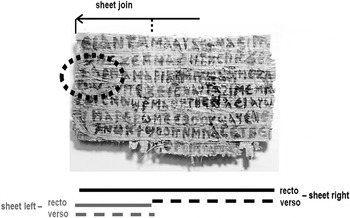
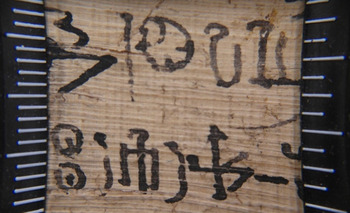
In the top layer the recto fibres run towards the left edge in irregular and untidy fashion ending abruptly a few millimetres away from the edge. Underneath one observes another layer of recto fibres that shows a different structure. Thus, we are dealing with a manufacture join type ii,Footnote 2 with an overlapping section (i.e. join width) of about 3.3 cm. As a general rule the scribe would lay out the papyrus to be inscribed in such a way that the writing direction would follow the structure of the sheet joins to facilitate smooth writing. In the case of GJW, the writing does not follow this rule.Footnote 3
A close examination of the left edge of the right sheet reveals that it belongs to the sheet type ii,Footnote 4 the so-called fringe type (see Fig. 1, cross-section of the sheet). In the left margin, the recto fibres that extend beyond the verso layer show disordered orientation similarly to the fringes in a carpet edge (see Fig. 1, circle). Such a structure commonly results from the manufacture of the papyrus sheet rather than from later damage.
Sheet join in the GJW papyrus, bottom: cross-section representation

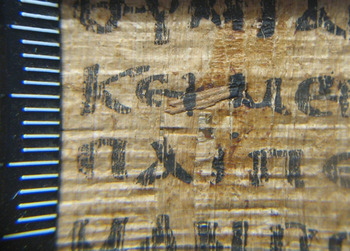
The writing made with carbon inks rests on the surface of the fibres and usually reflects the disorder or defects of the fibres. Note that at the beginning of the third line of GWJ a part of the inscribed text seems to be missing or to disappear under the fibres (see Fig. 1, circle). It seems to us that the forger considered this defect to be post-manufacture damage and therefore let the corresponding part of the writing disappear. In the case of Codex Berolinensis Gnosticus 8502 we find two defects on page 97. The first, which appears in the second line of the detail presented in Fig. 2, corresponds to the manufacture. The second one, in the third line, results from post-manufacture damage – a piece of a fibre is missing. In both cases the inscription reflects the defects – it is present in the first case and missing in the second.
Codex Codex Berolinensis Gnosticus 8502, page 97: poor manufacture (second line) and missing fibre (third line)

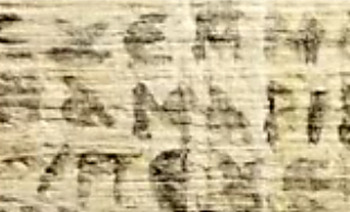
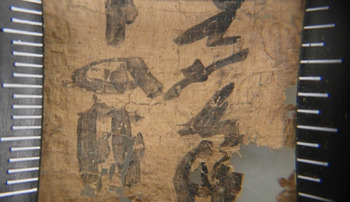
Let us now consider one of the characteristic features of the inscription which might help in the identification of the forgery: the writing implement and the resulting line form. We would expect a document to be written with a calamus in the fourth century and even more so in the eighth century ad. But the text of GJW displays a rounded and irregular line formFootnote 5 that can be associated with a rush pen rather than a calamus (see Fig. 3). In contrast to the inscriptions with a rush pen (Fig. 4), the writing produced with a calamus has a uniform and steady line (see Figs. 2 and 5).
Detail of the writing on the GJW papyrus

Detail with rush pen writing – Berlin P 15724, Abusir, 5th Dynasty, Old Kingdom

Detail with calamus writing – Berlin P 3030, Thebes (?), late period

GJW and a control papyrus containing a fragment of the Gospel of John (JnFragm) were analysed non-destructively by means of Fourier-Transformed Infrared SpectroscopyFootnote 6 and Raman spectroscopy.Footnote 7 The same fragments were also dated by means of radiocarbon analysis.Footnote 8 We will first describe the experiments, then we will take a look at their results, and evaluate the contribution of these results to the debate.
J. M. Azzarelli, J. B. Goods, T. M. Swager, ‘Study of Two Papyrus Fragments with Fourier Transform Infrared Microspectroscopy’, HTR 107 (2014) 165 (supplement report)
In their study, Azzarelli and his co-workers analysed three papyri (GJW, JnFragm and a modern papyrus as reference) by FTIR microscopy in reflection mode. It was found that the material was indeed cellulosic (not a plastic imitation?). Furthermore, GJW and JnFragm are reported to show signs of oxidation in contrast to a modern papyrus; this oxidation may be a result of the age and storage conditions ‘among other factors’. The inked areas did not show any additional features. The nature of the orange stain on the GJW fragment could not be established.
It is difficult to understand from the summary what the aim of this analysis was. It seems that the only reliable result obtained amounts to the identification of the materials as papyrus, a fact that was not disputed from the outset. The second finding, conveyed on the basis of a lengthy and difficult experiment, is that the papyri are oxidised, which fact is compatible with their advanced age. And although in the executive summary the authors do not directly link the oxidation to the old age, the analysis seems to suggest it. It is noteworthy that artificial ageing might produce the same type of spectrum: if indeed age determination was the focus of the study, an artificially aged modern papyrus should have also been investigated as an additional control.
We conclude, therefore, that the output of the FTIR analysis is reduced to establishing the cellulosic nature of the (papyrus) support. This result seems to be of limited, if any, relevance to the current debate.
A note on the analysis of the spectra
The authors remark in passing that the resolution of the spectra is not sufficient to draw conclusions about the carbonyls, leaving the reader with the impression that such a bad resolution is an inherent feature of the FTIR microscopy rather than the specific mode of collecting the spectra. Yet this information would be crucial for the understanding of the experiment. The work was conducted in reflection mode due to the requirement of not-invasiveness. The non-specialist in this technique would appreciate a detailed explanation of its limitations and of the difficulties in interpreting such spectra. Despite these difficulties the authors identify carbonyls in the spectra of GJW and JnFragm but fail to find them in the modern papyrus, leaving the reader with an unidentified feature at ~1,620 cm−1 that is suspiciously similar to that ascribed to the carbonyls in GJW. The position of the peak in GJW in the curves 2a–2d varies between 1,630 and 1,650 cm−1 rather than between 1,680 and 1,750, i.e. the carbonyl region as stated on page 14 line 3. By the end of the same page the carbonyl region moves to 1,650–1750 cm−1, probably to account for a somewhat low frequency of the attributed carbonyl peak in spectrum 2a of GJW. The determination of the oxidation degree seems rather challenging with this set-up due to the presence of the broad water absorption band at just ~1,640 cm−1.Footnote 9
Finally, we would like to attract attention to another conclusion – ‘The fragment is largely homogenous in chemical composition.’ Since nothing but cellulosic material could be seen by that method we could translate this statement into a modest acknowledgement that all the spots tested indicated papyrus only, i.e. no foreign contamination could be detected in fourteen random spots of 100 × 100 µm on the inked and ‘bare’ areas. In our experience with historic material, homogeneity is a rare feature – uneven distribution of salts or other mineral deposits is more than common. Homogeneity is best investigated with µ-X-ray fluorescence (µ-XRF) in the scanning mode. A map of the chemical elements of the fragment would give an indication of the presence of inorganic material and its distribution throughout a fragment. Optical and scanning electron microscopies are other valuable methods commonly used to characterise ancient material.Footnote 10 In other words, such a characteristic as homogeneity cannot be established investigating a dozen micro-spots with a technique capable of detecting the main material only.
J. T. Yardley and A. Hagadorn, ‘Characterization of the Chemical Nature of the Black Ink in the Manuscript of the Gospel of Jesus's Wife through Micro-Raman Spectroscopy’, HTR 107 (2014) 162–4 (supplement report)
Here the inks of the two papyri were first compared qualitatively to the commercial lamp black and vine black inks. Then the inks of GJW and JnFragm were compared quantitatively with each other. The inks were found to be of the lamp black type and distinct from one another. No other possible ink constituents were detected in either case. The key sentence seems to be ‘The observed Raman spectra are very similar to the carbon-based inks studied for a wide variety of manuscripts including many dated from the early centuries of the Christian era.’
This study suggests that the inks based on lamp black can be easily differentiated from each other, though it is not quite clear how the ancient inks are different from the modern ones produced by the same method, i.e. how one identifies the age of the inks with the help of Raman spectroscopy. The authors approached the question somewhat naively, encouraged by an unfortunate choice of reference materials because modern black pigments are not necessarily produced from the burning of pure organic materials.Footnote 11 The sharp peak (G) at ~1,600 cm−1 and the bands (D) in the region between 1,280 and 1,400 cm−1 describe relative contributions of the crystalline and disordered structures in carbonaceous material, respectively. Since the disordered components do indeed largely depend on the precursor and combustion conditions, the spectral parameters were found to be useful in the differentiation of the black pigments.Footnote 12 We agree that statistical treatment of the data is very tempting. However, one should remember that the disordered bands (D) and to a lesser extent the ordered band (G) result from a superposition of different contributions whose number and exact attribution are still debated.Footnote 13
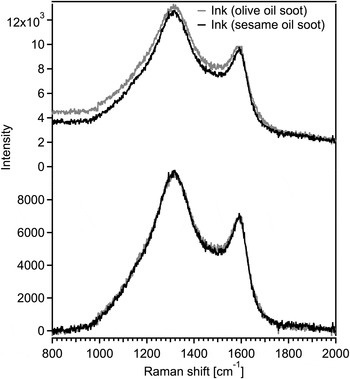
The low reproducibility of the measurements in Yardley et al. (‘Characterization of the Chemical Nature of the Black Ink’), attested by their discarding more than half of the measured spectra, raises the question whether their set up with a micron resolution is well suited for this kind of investigation. The large variability of the data might originate from the inherent heterogeneity of the inks at the micron scale. It is noteworthy that their own statistical analysis does not support the conclusion that the inks of the two sides of GJW are distinct from that of JnFragm offered in the executive summary. In Fig. 8.2 (top) of the report ID/IG, the intensity ratio of the disordered and ordered bands for both fragments clearly falls within the error bars. In the bottom diagram of the peak position we find that the ink of JnFragm is distinct only from the ink of GJW, verso, but fits well into the group corresponding to the ink of GJW, recto. In our own experiments some of the inks based on soot prepared from different oils under the same conditions resulted in identical Raman spectra (cf. Fig. 6).
Comparison of the Raman spectra of inks based on the soot produced from sesame oil (black) and olive oil (grey). The spectra were collected with ×20 objective at the excitation line of 785 nm. Top: original spectra; bottom: after subtraction of the linear baseline

For this experiment we used a specially modified Renishaw in Via Raman spectrometer. Unlike that utilised by Yardley et al., ours had no microscope but an open configuration suited to the study of large objects. To render the device transportable we substituted the sensitive optics with fibre-optic probes and a high-resolution video-camera for the positioning of the laser beam. Depending on the material under examination we used ×20 or ×50 objective and lasers with excitation lines at 785 and 532 nm. This is, to our knowledge, the first transportable Raman spectrometer with a performance comparable to that of bench equipment. We prepared the soot for the inks using commercial oils and individual Pyrex oil lamps to avoid contamination. In the example presented here the measurements were conducted on larger spots. Moreover, modern inks do not possess patina that strongly fluoresces and disturbs Raman measurements. We see no differences between two inks based on sesame and olive oil soot once the baseline is subtracted. Similarly, comparison of ancient lamp black inks with those prepared in-house did not show consistent differences, strongly suggesting that currently Raman spectroscopy can only be used to determine the type, i.e. qualitatively.Footnote 14
We infer, therefore, that the output of the Raman spectral analysis is reduced to establishing the soot nature of the inks. This result, however, is not sufficient to support the authenticity of the document under scrutiny.
The irrelevance of the results of both material analysis investigations in this case raises the question whether they were superfluous from the outset. Had our knowledge of the inks used in the period in question allowed a firm classification according to the age, a precise determination of the ink type could have been useful. Carbon inks, iron-gall inks and a mixture of both would be possible in the period from the fourth to eighth centuries ce. A highly improbable case of aniline or alizarin inks, developed later, does not need Raman spectroscopy for identification. In fact, infrared pictures of the fragments would allow for a quick check of the presence of carbon in the ink.
Similarly, FTIR spectroscopy in general is a powerful tool for detecting contamination and a binder in the carbon ink. Unfortunately, FTIR in reflection is not well suited to an investigation requiring high precision. For the determination of the binders one would prefer to extract a micro-sample and collect the spectra in transmission. The amount needed is so small that the sampling spot would not be visible with a naked eye. But then again, what do we know about the binders used in the inks of this period?
N. Tuross, ‘Accelerated Mass Spectrometry Radiocarbon Determination of Papyrus Samples’, HTR 107 (2014) 170–1 G. Hodgins, ‘Accelerated Mass Spectrometry Radiocarbon Determination of Papyrus Samples’, HTR 107 (2014) 166–9 (supplement report)
Radiocarbon dating first conducted in the Arizona AMS laboratory placed JnFragm in the eighth century ce, but found a very early date (fourth century bce) for GJW. The laboratory report suggested redating the fragment, stating that the early date might have resulted from possible contamination. The second radiometric measurement conducted at the NOSAMS in Massachusetts produced median dates of 718 cal. ce and 741 cal. ce for JnFragm and GJW, respectively. Therefore the material, i.e. papyrus, was produced some time in the eighth century ce.
We do not need to address the quality of the radiometric results here. The reports of the standardised measurements written according to the usual convention contain all the necessary data.
Radiometric dating of the papyrus substrates is the only investigation in this series that contributed fruitfully to the debate. First of all it effectively disputed the initial claim that GJW originated from an early Christian manuscript. The second result of the dating is even more spectacular: JnFragm that hitherto served as a reference of an impeccable reputation turned out to be a modern forgery since it was written in a dialect that no longer existed in the eighth century ce.Footnote 15
At least two lessons can be learned from this instructive story. Firstly, it is not so easy to purchase a piece of an antique papyrus of the right age if one intends to forge a sensational document. Secondly, it has been clearly demonstrated that expert knowledge of codicology,Footnote 16 palaeographyFootnote 17 and ancient languagesFootnote 18 does not necessarily require the support of natural sciences (dating excluded) to identify a text forgery. In fact, the input from the material analysis would become much more relevant when our knowledge of the composition of the writing materials gets closer to that accumulated in other fields of text studies.
In order to further rehabilitate the natural sciences and raise their esteem in the wake of the current debate, let us take a closer look at the work of the specialists in this field.
Forensic science has been established for the last 150 years; it has developed investigation protocols that include a clear statement of the purpose of the analysis and the definition of plausibility criteria for the possible outcome. Therefore, forensic scientists rarely deploy instruments that are not liable to answer the question posed. The younger sister of forensics, archaeometry, has to overcome additional obstacles such as the heterogeneity of historic material coupled with the scarcity of suitable reference material. Over the last two decades the popularity of archaeometric studies has increased enormously, with the industry-driven development of so-called non-destructive technologies (NDT) that do not require sampling. Further technological developments led to the appearance of NDT methods with extremely small interaction windows (µm range). Each of these methods has limitations that have to be carefully considered when planning the studies of heterogeneous and often partially degraded historical material. Starting with the analysis of the known facts and a clearly assigned task, an archaeometrist devises a work programme that allows him or her to achieve the task in the most economical way. Similarly to forensic science, the choice of techniques in this inherently multi-instrumental approach is always dictated by the task. Very often, the insights obtained during the work lead to modification of the programme, while keeping the original main goal in mind. If the task cannot be fulfilled because of the nature of the object, the analyst should provide a full explanation.
If a radiocarbon dating is planned, it is advisable to perform a spatially resolved pre-screening to identify contaminations. If a non-contaminated sample is not available, any radiometric lab would appreciate the composition profile of the sample and suggestions on cleaning procedures.
From the above it is clear that an archaeometric or forensic department unites a number of specialists who work together to define the tasks and the methods required for their successful completion. But which would be the better candidate for investigating a historical object suspected to be a modern forgery? Probably the forensic laboratory, since not the authentication of the object, but the determination of the forgery stands in the focus of the work.
Now, we come to the sensitive issue of authentication of objects of cultural heritage of immense cultural and monetary value if certified to be genuine. Material analysis alone, especially its non-destructive variety, cannot prove that the object is genuine. The best material analysis can do, after all appropriate tests have been conducted, is to announce that nothing has been found that contradicts the assumption of genuineness. Moreover, the results of the material analysis can never be used as the only justification of the authentication in cases of composite objects such as manuscripts or epigraphs. A certification always requires the expertise of the specialist in the field (be it a historian, palaeographer, epigrapher, etc.), whose judgement can be at the most supported by appropriate material analysis.
Unfortunately, the ever-growing gap between the disciplines makes it almost impossible for a non-specialist to select the right technique from the high tech toolbox available on the market. It would be advisable to turn to the institutions certified to issue inspection reports because they are aware of the complexity of the archaeological material.