Introduction
Depression is the leading cause of global disability (World Health Organisation, 2017). It has long-term effects on daily functioning and can increase risk of multiple serious physical health problems (Batelaan, Seldenrijk, Bot, van Balkom, & Penninx, Reference Batelaan, Seldenrijk, Bot, van Balkom and Penninx2016; Machado et al., Reference Machado, Veronese, Sanches, Stubbs, Koyanagi, Thompson and Carvalho2018; Walker, McGee, & Druss, Reference Walker, McGee and Druss2015). The onset of depression tends to first occur during adolescence (Patton et al., Reference Patton, Coffey, Romaniuk, Mackinnon, Carlin, Degenhardt and Moran2014; Thapar, Collishaw, Pine, & Thapar, Reference Thapar, Collishaw, Pine and Thapar2012), with an estimated prevalence during this period of 11–14% (Merikangas et al., Reference Merikangas, He, Burstein, Swanson, Avenevoli, Cui and Swendsen2010; Mojtabai, Olfson, & Han, Reference Mojtabai, Olfson and Han2016). Depressive symptoms during adolescence are associated with an increased risk of depression, other mental health disorders, and behavioural problems in later life (Bertha & Balázs, Reference Bertha and Balázs2013; McLeod, Horwood, & Fergusson, Reference McLeod, Horwood and Fergusson2016). Identifying modifiable risk factors for depressive symptoms during adolescence is an essential step towards reducing the future incidence and burden of depression.
Lower levels of physical activity and higher volumes of sedentary behaviour have consistently been associated with an increased risk of depression in prospective population-based studies of adults (Huang et al., Reference Huang, Li, Gan, Wang, Jiang, Cao and Lu2020; Schuch et al., Reference Schuch, Vancampfort, Firth, Rosenbaum, Ward, Silva and Stubbs2018; Teychenne, Ball, & Salmon, Reference Teychenne, Ball and Salmon2010; Zhai, Zhang, & Zhang, Reference Zhai, Zhang and Zhang2015). Sedentary behaviour is any waking activity in a sitting, lying, or reclining position with low energy expenditure (⩽1.5 metabolic equivalents) (Tremblay et al., Reference Tremblay, Aubert, Barnes, Saunders, Carson, Latimer-Cheung and Chinapaw2017). Time spent in sedentary behaviour is high in young people and increases throughout adolescence (Steene-Johannessen et al., Reference Steene-Johannessen, Hansen, Dalene, Kolle, Northstone, Møller and Ekelund2020; van Ekris et al., Reference van Ekris, Wijndaele, Altenburg, Atkin, Twisk, Andersen and Chinapaw2020). The majority of sedentary behaviour during adolescence is due to screen time, such as television watching (Tremblay et al., Reference Tremblay, LeBlanc, Kho, Saunders, Larouche, Colley and Gorber2011). High sedentary behaviour could influence depressive symptoms through several pathways, such as limiting neuroplasticity in the hippocampal brain region, increasing oxidative stress, or reducing social interactions and support (Kandola, Ashdown-Franks, Hendrikse, Sabiston, & Stubbs, Reference Kandola, Ashdown-Franks, Hendrikse, Sabiston and Stubbs2019). However, there have been few prospective studies of these associations in adolescence, and findings have generally been inconsistent.
Screen-based devices are embedded in modern life and have many important practical and cultural applications, but there may be risks associated with excessive use. A 2016 meta-analysis of 12 cross-sectional and four longitudinal studies suggested that high screen time-based sedentary behaviours are associated with higher odds of depression in adolescents (Liu, Wu, & Yao, Reference Liu, Wu and Yao2016). These findings align with some systematic reviews that suggest high screen time is associated with increased risk of depressive symptoms in adolescents (Hoare, Milton, Foster, & Allender, Reference Hoare, Milton, Foster and Allender2016), but other reviews found no associations (Suchert, Hanewinkel, & Isensee, Reference Suchert, Hanewinkel and Isensee2015). Most of those studies were cross-sectional and unable to adjust for reverse causality. A recent prospective study of device-measured activity found that an additional hour of total sedentary behaviour per day between the ages of 12 and 16 was associated with 8–12% increase in depressive symptoms by age 18 (Kandola, Lewis, Osborn, Stubbs, & Hayes, Reference Kandola, Lewis, Osborn, Stubbs and Hayes2020).
The available evidence suggests that high volumes of sedentary behaviour and screen time could increase the risk of depressive symptoms in adolescents. However, previous studies use total sedentary behaviour or screen time as their exposure or have focused on a particular behaviour, such as television-watching (Hoare et al., Reference Hoare, Milton, Foster and Allender2016; Liu et al., Reference Liu, Wu and Yao2016; Suchert et al., Reference Suchert, Hanewinkel and Isensee2015). The factors contributing to relationships of screen time with mental health in adolescents are complex (Orben & Przybylski, Reference Orben and Przybylski2019; Przybylski & Weinstein, Reference Przybylski and Weinstein2017), and the type of screen time may affect mental health differently.
For example, in video gaming there are social, cooperative, and engaging elements that are absent from other screen time activities, such as general computer use. Screen time modalities with social elements could have mental health benefits that mitigate some of the potential risks of high sedentary behaviour. There is evidence in adults that mentally-passive sedentary behaviours, such as television-watching, are associated with a higher risk of depression than mentally-active sedentary behaviours, such as working at a computer (Hallgren et al., Reference Hallgren, Nguyen, Owen, Stubbs, Vancampfort, Lundin and Lagerros2019, Reference Hallgren, Owen, Stubbs, Zeebari, Vancampfort, Schuch and Trolle Lagerros2018; Hallgren, Dunstan, & Owen, Reference Hallgren, Dunstan and Owen2020; Huang et al., Reference Huang, Li, Gan, Wang, Jiang, Cao and Lu2020). More stimulating forms of screen time could potentially mitigate some of the possible brain and mental health risks of high sedentary behaviours (Hallgren et al., Reference Hallgren, Dunstan and Owen2020). Different types of screen use, and their differential effects on mental health indicators could account for some of the inconsistencies in previous studies with self-report measures of sedentary behaviour in adolescents (Suchert et al., Reference Suchert, Hanewinkel and Isensee2015).
In the 2016 meta-analysis of screen time-based sedentary behaviour, subgroup analyses indicated that increased computer use was modestly but significantly associated with higher depression risk in adolescents (Liu et al., Reference Liu, Wu and Yao2016). A UK-based prospective cohort study found that computer use at age 16 was associated with a small increase in the risk of anxiety symptoms at age 18 (Khouja et al., Reference Khouja, Munafò, Tilling, Wiles, Joinson, Etchells and Cornish2019). However, there were no associations for television watching or texting. Recent trial data from adolescents in Canada showed that social media, computer, and television use at age 12 were all associated prospectively with a higher risk of depressive symptoms (Boers, Afzali, Newton, & Conrod, Reference Boers, Afzali, Newton and Conrod2019). The same study found no association between increased video gaming and depressive symptoms. A recent systematic review of 12 cross-sectional and one longitudinal study found that high social media use was associated with depression and anxiety symptoms (Keles, McCrae, & Grealish, Reference Keles, McCrae and Grealish2020).
Whilst evidence is emerging to suggest that there are varying associations between different types of screen time and depressive symptoms, findings are inconsistent and primarily based on cross-sectional data (Hoare et al., Reference Hoare, Milton, Foster and Allender2016; Liu et al., Reference Liu, Wu and Yao2016; Suchert et al., Reference Suchert, Hanewinkel and Isensee2015). A previous meta-analysis identified gender as an effect modifier of associations between screen time and depressive symptoms, with an association only present in boys (Liu et al., Reference Liu, Wu and Yao2016). Another meta-analysis that included adults also found the association between screen time and depressive symptoms was not present in males (Wang, Li, & Fan, Reference Wang, Li and Fan2019). Depressive symptoms occur at a higher rate in women, a trend that begins in mid-adolescence and may reflect divergent internal and external influences (Bone, Lewis, & Lewis, Reference Bone, Lewis and Lewis2020). Screen time may differentially influence the risk of depressive symptoms depending on gender, but prospective studies of associations between screen time and depressive symptoms rarely examine gender as a moderator (Boers et al., Reference Boers, Afzali, Newton and Conrod2019; Khouja et al., Reference Khouja, Munafò, Tilling, Wiles, Joinson, Etchells and Cornish2019).
Furthermore, structured physical activity can reduce depressive symptoms in adolescents (Bailey, Hetrick, Rosenbaum, Purcell, & Parker, Reference Bailey, Hetrick, Rosenbaum, Purcell and Parker2018) and high physical activity volumes are associated with a lower risk of depression in the general population (Schuch et al., Reference Schuch, Vancampfort, Firth, Rosenbaum, Ward, Silva and Stubbs2018). Regular physical activity could mitigate some of the mental health risks associated with high sedentary behaviour or screen time, as it does with physical health risks (Ekelund et al., Reference Ekelund, Tarp, Fagerland, Johannessen, Hansen, Jefferis and Lee2020).
We conducted a prospective study with data from a large population-based cohort of adolescents to examine associations of particular forms of screen time with depressive symptoms. We aimed to: (1) assess associations of frequency of video game, social media, and internet use at age 11 with depressive symptoms at age 14; (2) determine the extent to which associations between screen time and depressive symptoms may differ by gender; and, (3) examine whether the physical activity may moderate any associations between screen time and depressive symptoms. We expected that more frequent social media use at age 11, but not video game or computer use would be associated with increased depressive symptoms at age 14. This is based on the video game and computer use being mentally-active behaviours (Hallgren et al., Reference Hallgren, Dunstan and Owen2020, Reference Hallgren, Nguyen, Owen, Stubbs, Vancampfort, Lundin and Lagerros2019, Reference Hallgren, Owen, Stubbs, Zeebari, Vancampfort, Schuch and Trolle Lagerros2018; Huang et al., Reference Huang, Li, Gan, Wang, Jiang, Cao and Lu2020) and systematic review evidence of a positive association between social media use and depressive symptoms (Keles et al., Reference Keles, McCrae and Grealish2020). We expect that there may be gender differences in these associations based on prior systematic review evidence (Liu et al., Reference Liu, Wu and Yao2016; Wang et al., Reference Wang, Li and Fan2019), and no association between screen time and depressive symptoms in those with high physical activity given its capacity to reduce depressive symptoms in adolescents (Bailey et al., Reference Bailey, Hetrick, Rosenbaum, Purcell and Parker2018).
Methods
Participants
We used data from the Millennium Cohort Study (MCS), a representative sample of 18,552 families and 18,818 children born in the UK between September 2000 and January 2002, described in full elsewhere (Connelly & Platt, Reference Connelly and Platt2014). Those from socially deprived areas and ethnic minority groups were oversampled to increase representation. The ongoing study currently includes six waves of data collection covering a range of demographic, psychosocial, environmental, and biological factors. Our study focuses on adolescent behaviour and includes data from sweeps 5 (January 2012–February 2013) with 13 469 participants aged 11 (71.5% of the original sample) and sweep 6 (January 2015–March 2016) with 11 872 aged 14 (63.1%). We defined our sample as all with a completed outcome measure (n = 11 341).
The National Health Service Research Ethics Committee provided ethical approval for MCS. We obtained all MCS data from the UK Data Archive.
Exposure(s)
Our exposure was the self-reported frequency of three different types of screen use at age 11: video games, social media, and leisure-time internet use. Participants were asked: How often do you [play games on a computer or games console/use the internet (not for school)/visit a social networking website on the internet]? The possible categorical responses included: most days, at least one a week, at least once a month, less often than once a month, or never. The question does not specify a time period. Due to low numbers, we combined less often than once a month with never to create a 4-point Likert scale.
Outcome
Depressive symptoms were measured using a short Moods and Feelings Questionnaire (sMFQ) at age 14. The sMFQ is a self-report measure of DSM-IV depressive symptoms over the past 2 weeks (Sharp, Goodyer, & Croudace, Reference Sharp, Goodyer and Croudace2006). It includes 13 questions, with responses including not true (0 score), somewhat true (1 score) to true (2 score) with scores ranging from 0 to 26. Higher scores indicate more severe symptoms. It is validated for assessing depressive symptoms in adolescents in population-based research (Sharp et al., Reference Sharp, Goodyer and Croudace2006). We used sMFQ scores as a continuous outcome measure to maximise statistical power.
Confounding and moderating variables
We determined all possible confounding variables a priori. We mapped causal assumptions between screen-time, depressive symptoms, and all confounding variables using the Directed Acyclic Graph (DAG) in Figure 1 of the Supplementary Materials (page 1) and adjusted models accordingly. Possible confounding variables included: gender, socioeconomic position (household income), baseline emotional symptoms [emotional symptoms subscale from the Strengths and Difficulties Questionnaire (SDQ)], self-reported maternal history of a depression or anxiety diagnosis, the self-reported experience of bullying, self-reported physical activity (frequency of playing sports or active games inside or outside on the same 4-point Likert scale as exposure variables), and standardised body mass index (BMI). The direction of causality between BMI and sedentary behaviour is unclear in young people (Biddle, García Bengoechea, & Wiesner, Reference Biddle, García Bengoechea and Wiesner2017). We chose to adjust for BMI as a confounding variable due to the substantial genetic influences on adiposity (Rohde et al., Reference Rohde, Keller, La Cour Poulsen, Blüher, Kovacs and Böttcher2019) that potentially suggests BMI could cause high screen time in young people. We did not adjust for physical activity as a confounding variable due to evidence that sedentary behaviour and physical activity are unlikely to displace one another in young people (Pearson, Braithwaite, Biddle, van Sluijs, & Atkin, Reference Pearson, Braithwaite, Biddle, van Sluijs and Atkin2014).
Analyses
Main analysis
The main analysis examined how the frequency of screen time use for each activity at age 11 was associated with depressive symptoms at age 14 (aim 1). The outcome distribution had a high positive skew (see Figure 2, page 2 of the Supplementary Materials) and was over-dispersed (variance > mean). To account for this, we used negative binomial regression models. These models are commonly used for count data, but as the sMFQ scores are discrete, independent, and have no negative values, models using count distributions are still applicable (Green, Reference Green2020; Kandola et al., Reference Kandola, Lewis, Osborn, Stubbs and Hayes2020). The outcome for these models is interpretable as a percentage change in sMFQ scores.
We entered each categorical exposure variable (video gaming, social media, or internet use) into separate models with the same continuous outcome (depressive symptoms). We ran each model with an interaction term for gender (aim 2) and stratified models accordingly. We present models fully-adjusted for all confounding variables in the main text and crude models in the online Supplementary Materials.
***Secondary and sensitivity analysis
The secondary analysis investigated the extent to which associations between each screen time type and depressive symptoms varied by physical activity (aim 3). We dichotomized the physical activity variable to create a ‘high activity’ group from the most days responses and a ‘low activity’ group from combining all other responses: at least once a week, at least once a month, less often than once a month, or never. We then reran the adjusted models from the main analysis with the physical activity variable as a multiplicative interaction term. Where interaction terms were significant, we presented the models stratified by physical activity.
We also conducted sensitivity analyses that included using psychosocial adjustment (total SDQ score) instead of emotional symptoms as an alternative method of adjusting for baseline mental health. We also reran fully-adjusted models for the video game exposure with a larger reference group (16% of participants) by combining the less often than once a month or never and at least once a month categories. This was due to large differences in the video games reference group (6% of participants) and some of the comparison groups (54%, 30%, and 10%) in the main analysis. We also used multiple imputations by the chained equation to examine how missing data could have affected our main findings through selection bias. We reran the main analysis in a full cohort with imputed missing data.
All analyses were conducted in Stata (version 13) and weighted according to sampling design.
Results
Participants
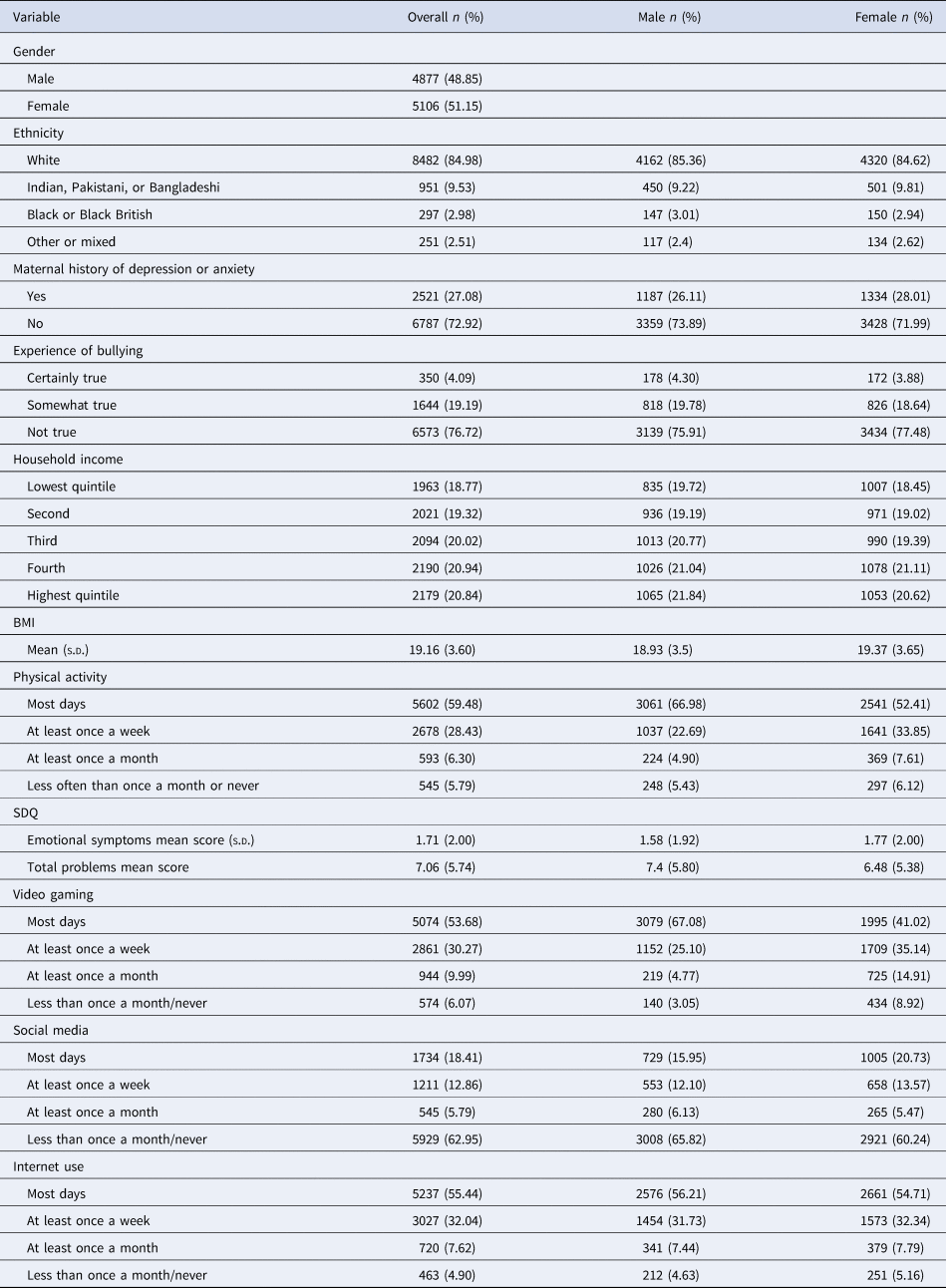
There were 11 341 participants in the total pool of participants and the fully adjusted models included 7701 (68%) participants with complete data. The mean sMFQ score at follow-up was 6.04 (SD = 5.22). Table 1 contains the baseline characteristics of participants included in this study according to gender.
Baseline participant characteristics by gender

BMI, body mass index; SDQ, strengths and difficulties questionnaire.
Main analysis
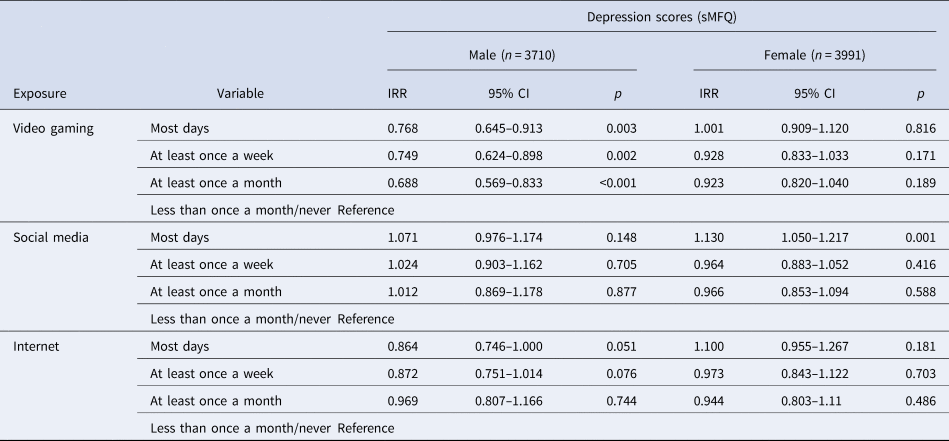
The interaction terms for gender were significant for all exposures (p < 0.05), and stratified, fully-adjusted models are presented in Table 2. We provide crude models in the online Supplementary Materials (Table 1, page 3). Compared with less than once a month/never, playing video games most days, at least once a week, and at least once a month at age 11 were associated with 24.2% (IRR = 0.77, 95% CI 0.65–0.91), 25.1% (IRR = 0.75, 95% CI 0.62–0.89), and 31.2% (IRR = 0.69, 95% CI 0.57–0.83) lower depression scores in boys at age 14, respectively. There were no clear associations between more frequent v. less frequent video gaming and depression scores in girls. Using social media most days at age 11 was associated with 13% (IRR = 1.13, 95% CI 1.05–1.22) higher depression scores at age 14 compared with less than once a month/never in girls. There were no clear associations between other frequency of use categories and depression scores in girls or any associations in boys. There was some indication of associations between internet use most days (IRR = 0.86, 95% CI 0.75–1.00) and at least once a week (IRR = 0.87 95% CI 0.75–1.01) and depression scores compared with less than once a month/never in boys. There were no associations between more frequent v. less frequent internet use and depression scores in girls.
Associations between screen-time activity and depressive symptoms stratified by gender

IRR, incident rate ratios; 95% CI = 95% confidence intervals.
All models are adjusted for BMI, bullying, emotional symptoms at baseline, socioeconomic position, maternal depression or anxiety diagnoses, and physical activity.
Secondary and sensitivity analysis
In the secondary analysis, there was no evidence of an interaction with physical activity for social media or internet use frequency and depressive symptoms (p > 0.05). There was evidence of an interaction with physical activity for video gaming frequency and depressive symptoms in boys only (p = 0.024).
In fully adjusted models for boys with low physical activity (n = 1226), using video games for most days was associated with 32.2% (IRR = 0.68; 95% CI = 0.54–0.86; p < 0.001), at least once a week with 35.2% (IRR = 0.65; 95% CI = 0.50–0.83; p < 0.001), and at least once a month with 38.7% (IRR = 0.61; 95% CI = 0.46–0.82; p < 0.001) lower depression scores than less than once a month/never. In boys with high physical activity (n = 2484), there were some associations between using video games at least once a month and depressive symptoms (IRR = 0.75; 95% CI = 0.58–0.98; p = 0.034) compared with less than once a month/never, but not with more frequent video game use.
These results were consistent in a full cohort with imputed missing data (see Table 2, page 4 of the online Supplementary Materials). The results of the sensitivity analysis were similar when using total SDQ to adjust for baseline mental health (see Table 3 of the Supplementary Materials). The associations between video gaming and depressive symptoms were attenuated when using the larger combined reference group (see Table 4, page 6 of the Supplementary Materials).
Discussion
Main findings
This prospective study examined associations of three types of screen time in girls and boys at age 11 with depressive symptoms at age 14. We found that using video games most days, at least once a week, and at least once a month were associated with 24.2–31.2% lower depressive symptom scores compared to less than once a month/never in boys, but not in girls. There was some evidence that physical activity moderated this association as the associations were consistent in boys with low physical activity, but not in those with high physical activity. Using social media most days was associated with 13% higher depressive symptom scores than less than once a month/never in girls. The relationship between internet use and depressive symptoms was unclear in our results.
Few studies have examined associations between the frequency of video gaming and depressive symptoms in adolescents. A previous meta-analysis of mostly cross-sectional data provided some indications that more frequent video gaming was associated with a lower risk of depression (OR = 0.89, 95% CI 0.74–1.06) (Liu et al., Reference Liu, Wu and Yao2016). A recent longitudinal study found no associations between video gaming and depressive symptoms (Boers et al., Reference Boers, Afzali, Newton and Conrod2019), but this study did not examine gender as a potential effect modifier.
Our results also suggest the novel finding that more frequent video gaming is associated with lower depression symptom scores in boys who are less physically active, but not in those who were physically active. Adolescents who spend less time playing sports and active games may derive more enjoyment and social interaction from playing video games more frequently. We also found some associations between increased social media use and depressive symptoms in girls, which aligns with prior, mostly cross-sectional studies (Boers et al., Reference Boers, Afzali, Newton and Conrod2019; Keles et al., Reference Keles, McCrae and Grealish2020). This finding may again be influenced by social factors. For example, studies in adults suggest that women are more likely than men to report using social media for maintaining social ties and gather social information (Krasnova, Veltri, Eling, & Buxmann, Reference Krasnova, Veltri, Eling and Buxmann2017). Frequent social media use is associated with greater feelings of social isolation than less frequent use (Primack et al., Reference Primack, Shensa, Sidani, Whaite, Lin, Rosen and Miller2017). Adolescent girls with frequent social media use may experience increased social isolation, which can increase the risk of depressive symptoms (Santini et al., Reference Santini, Jose, York Cornwell, Koyanagi, Nielsen, Hinrichsen and Koushede2020). Some studies have indicated that associations between social media use and poorer mental health are stronger in female adolescents than boys (Blomfield Neira & Barber, Reference Blomfield Neira and Barber2014), but other studies have not found this (Keles et al., Reference Keles, McCrae and Grealish2020).
Strengths and limitations
Our findings are based on data from a large, representative cohort of adolescents with a 3-year follow up. The use of an sMFQ is another strength as it allows the assessment of clinical and subclinical symptoms in participants that may not be present to mental health services. The prospective study design and adjustment for baseline symptoms lower the risk of reverse causation. We used DAGs determined a priori to inform each analysis, which improves our capacity to estimate causal effects (Hernan & Robins, Reference Hernan and Robins2020).
A limitation of our study includes the high attrition, which could have introduced selection bias. However, the results remained consistent in a full sample with imputed missing data. This suggests that selection bias within our sample is unlikely to have increased due to the attrition, but selection bias is still possible in the wider Millennium Cohort sample. Another limitation is the lack of data on the duration of screen-time use, which could moderate the association between frequency of use and depressive symptoms. For example, there could be a difference in the risk of depression symptoms between participants who played video games most days for several hours v. those who played for just 1 hour. As no timeframe is specified in the question, participants' reported use could refer to different periods. Screen time use in young adolescents may also have changed since they were measured in 2012 and 2013 in the Millennium Cohort Study.
There were also large differences in the size of some comparison groups, which could cause unstable estimates when comparing groups. One sensitivity analysis indicated that associations between video gaming and depressive symptoms were attenuated in boys when using a larger reference group from combining the two least frequent use groups. However, it is not possible to determine whether this is due to the inclusion of boys who play video games semi-regularly, i.e., more than once a month. A larger sample with more evenly distributed groups will be necessary to determine the extent to which our findings are affected by a random error in the reference groups.
There could also have been a measurement error with the physical activity data. We used self-reported physical activity data that are prone to biases, such as attention and recall bias (Prince et al., Reference Prince, Adamo, Hamel, Hardt, Connor Gorber and Tremblay2008). Another possible source of measurement error includes using the SDQ emotional symptom subscale to assess baseline depressive symptoms. While the outcome measure (sMFQ) directly assesses depressive symptoms, the SDQ subscale captures the broader concept of depression. It may miss specific depressive symptoms and allow for potential confounding from baseline depression. However, as depression is relatively uncommon before puberty, measuring the broader concept of depression could be sufficient.
Implications and future directions
Sedentary behaviour is high in young people and increases during adolescence (Steene-Johannessen et al., Reference Steene-Johannessen, Hansen, Dalene, Kolle, Northstone, Møller and Ekelund2020; van Ekris et al., Reference van Ekris, Wijndaele, Altenburg, Atkin, Twisk, Andersen and Chinapaw2020) with the growing use of screen-based devices (Tremblay et al., Reference Tremblay, LeBlanc, Kho, Saunders, Larouche, Colley and Gorber2011), which may contribute to a higher subsequent risk for depression (Kandola et al., Reference Kandola, Lewis, Osborn, Stubbs and Hayes2020). More-passive compared to more mentally-active sedentary behaviours can have varying relationships with the risk of depression in adults, with mentally active sedentary behaviours in some cases being protective (Hallgren et al., Reference Hallgren, Dunstan and Owen2020, Reference Hallgren, Nguyen, Owen, Stubbs, Vancampfort, Lundin and Lagerros2019, Reference Hallgren, Owen, Stubbs, Zeebari, Vancampfort, Schuch and Trolle Lagerros2018; Huang et al., Reference Huang, Li, Gan, Wang, Jiang, Cao and Lu2020). Our findings suggest that there may be such relationships in adolescents. Approaches that aim to broadly reduce sedentary behaviour or screen-time in young people can overlook these complexities and may not maximise the potential impact on mental health risks.
Our findings suggest that a more targeted approach to screen time may be necessary for the context of risk of depression in adolescents. For example, targeting high social media use could produce a greater effect on reducing depression risk than video gaming, particularly in girls. Our results suggest that interventions may benefit from a gender-specific approach and considering related factors that improve adolescent mental health, such as physical activity (Bailey et al., Reference Bailey, Hetrick, Rosenbaum, Purcell and Parker2018). Adolescents may interact differently with screen-based devices depending on their gender and warrants further research to determine whether different recommendations would be helpful.
The relationships between screen-time and mental health are complex, and their nuances warrant more careful consideration. Inconsistent findings in previous studies could be due to not examining different types of screen-time in relation to depression risk in adolescents (Hoare et al., Reference Hoare, Milton, Foster and Allender2016; Liu et al., Reference Liu, Wu and Yao2016; Suchert et al., Reference Suchert, Hanewinkel and Isensee2015). More evidence is needed on how different types of screen-time may affect the risk of depression in young people. Each type of screen-time provides broadly different experiences that are likely to have a divergent effect on mental health.
For example, video games can involve complex, immersive experiences with detailed and interactive storylines. Many games involve problem-solving, co-operation, and offer a platform for socialization. The use of video games as a social platform could be particularly important for adolescents who participate in fewer sports and active games. Several studies have found that commercial video gaming is associated with improvements in performance on attention, problem-solving, and memory tasks (Choi et al., Reference Choi, Shin, Ryu, Jung, Kim and Park2020) and structural changes in brain plasticity, such as growth in hippocampal and prefrontal areas (Kühn et al., Reference Kühn, Lorenz, Banaschewski, Barker, Büchel, Conrod and Gallinat2014b; Kühn, Gleich, Lorenz, Lindenberger, & Gallinat, Reference Kühn, Gleich, Lorenz, Lindenberger and Gallinat2014a). These elements of video gaming may translate into mental health benefits in some young people with mild to moderate use. Infrequent video game use in this study may also reflect environmental factors that could also contribute to the risk of depression, such as financial difficulties or highly restrictive parenting.
However, excessive video game use may nevertheless be harmful to mental health in young people. Similarly, excessive social media use could be detrimental, particularly if it increases perceptions of social isolation (Primack et al., Reference Primack, Shensa, Sidani, Whaite, Lin, Rosen and Miller2017). Contextual factors of social media use may also be relevant to adolescents' risk of depressive symptoms. For example, using social media for social comparisons could affect self-esteem, leading to depressive symptoms (Robinson et al., Reference Robinson, Bonnette, Howard, Ceballos, Dailey, Lu and Grimes2019).
Conclusions
In this prospective cohort study, we found that more-frequent video gaming at age 11 was associated with a lower risk of depressive symptoms at age 14 for boys but not girls. More frequent social media use at 11 was associated with a higher risk of depressive symptoms in adolescent girls but not boys. Approaches aimed at reducing sedentary behaviour or screen-time should consider the differential associations between activity type and depressive symptoms. More research is necessary to understand how different types of screen-time affect the risk of depression in young people.
Data availability
Details for accessing the data used in this study are available from the UK Data Service.
Supplementary material
The supplementary material for this article can be found at https://doi.org/10.1017/S0033291721000258.
Acknowledgements
We are grateful to all families who took part in the MCS and its staff. The Economic and Social Research Council (ESRC) and a consortium of government departments provide core funding for the MCS. We are also grateful to the Centre for Longitudinal Studies at UCL, who provide access to the MCS data. AK is supported by the ESRC (ES/P000592/1). NO and DD are supported by NHMRC Research Fellowships (#1003960 & #1078360) and by the Victorian Government's Operational Infrastructure Support program.
Author contributions
All authors conceptualized the study. AK performed the analysis and had full access to the data. AK prepared the initial manuscript and all authors contributed toward editing and composition of the final manuscript. The corresponding author attests that all listed authors meet authorship criteria and that no others meeting the criteria have been omitted.
Conflict of interest
No authors have any financial or personal conflicts of interest to declare in relation to the submitted work.
Ethical standards
The authors assert that all procedures contributing to this work comply with the ethical standards of the relevant national and institutional committees on human experimentation and with the Helsinki Declaration of 1975, as revised in 2008.