

Total and permanent disability (TPD) insurance is a significant part of the multibillion-dollar Australian life insurance disability market. Most working Australians have automatic TPD cover through their superannuation retirement funds, which hold the largest proportion (88%) of TPD in group policies (Association of Superannuation Funds of Australia, 2014). Claims for TPD increased significantly in 2013 due to a combination of factors (Lee, Kanhai, & Poon, Reference Lee, Kanhai and Poon2015); a highly competitive marketplace had priced down TPD premiums while at the same time adding generous benefits to secure the superannuation fund business. The most significant benefit was the high level of cover — in some cases over A$1 million — to individuals irrespective of their health status (Fabrizo, Reference Fabrizo2014). The attractiveness of the superannuation TPD product drew more consumer awareness, substantially greater involvement by lawyers, and more claims; more than A$1.7 billion is paid out to claimants annually (Clare, Reference Clare2017).
The purpose of TPD insurance is to provide future financial security if serious illness or injury prevents a person from working (Australian Securities and Investments Commission, 2017). In claims with medical evidence of work capacity, claims professionals may obtain expert information about a claimant’s likelihood of ever engaging in any occupation reasonably suited to his or her education, training, or experience. Information derived from this assessment about a claimant’s employability can be pivotal in deciding a claim. This is a big decision that affects the profitability of the insurance company and each claimant’s financial, physical, and mental wellbeing.
Employability assessment emerged as a new model in the mid-2000s because standard vocational assessment did not suit the TPD policy. Rehabilitation advisors employed by insurance companies developed the model and coined the term employability assessment. Although forensic vocational assessment literature underpins the methodological foundations of employability assessment (Barros-Bailey, Reference Barros-Bailey and Robinson2013; Crystal & Erickson, Reference Crystal, Erickson and Mpofu2010; Robinson, Reference Robinson2014a), several TPD policy characteristics shaped and defined this model. First, a predetermined lump sum amount is paid on an all or nothing basis that established a binary, adversarial framework from the outset (Davis, Reference Davis2000; Leas & Burgess, Reference Leas and Burgess2015). The claimant must prove total and permanent incapacity and the insurer must decide based on evidence provided and obtained (Myatt, Reference Myatt2002). Second, to claim TPD a person must be continuously absent from work due to disability for a defined period, usually six months. Once the mandatory waiting period is met there is no time limit to lodgement of the claim; months or years may pass before a claim is assessed (Berrill, Reference Berrill2014; Fabrizo, Reference Fabrizo2014). Third, vocational rehabilitation services are not provided under TPD. There is no rehabilitative element and usually no contact with the claimant. Suitable alternative occupations involving retraining are disregarded. Although these characteristics remain typical of TPD policies today, some new product innovations herald changes that will affect employability assessment (Riskinfo, 2014; Snyder, Reference Snyder2016). For instance, if work capacity is medically indicated, TPD claimants must undertake vocational rehabilitation, and future rehabilitation options (including certain retraining) can be considered at time of assessment (Leas & Burgess, Reference Leas and Burgess2015).
Employability assessment has been widely adopted and increasingly used as forensic (medicolegal) employment evidence by claims professionals to decide claims, and by lawyers to dispute them. Although the exact proportion of employability assessments requested industry-wide is not known, it is thought to approximate 13% of all claims. This estimate is little more than a guess, based on poor data from a limited sample of insurers (Van Den Akker, Reference Van Den Akker2014). Even so, it is likely that thousands of employability assessments are conducted annually, each one with the potential to be tried in court.
The contribution of employability assessment in assisting claims professionals to reach a fair and timely decision in this crucial financial judgement is an assumption without proof. There is no research to substantiate the key features of an employability assessment or examine its common use. The claims professional specifies the employability assessment protocol, the number of billable hours, and the hourly rate for a given type of assessment based on business assumptions in the absence of facts and substantive models. There has been no inquiry into how or why claims professionals make their requests to external employability assessment providers. The purpose of this study is to document TPD claims professionals’ views on employability assessment and forms part of a broader research project examining the topic from rehabilitation advisor and claimant perspectives. This study sought to answer the following questions:
What is the claims professionals’ concept of employability in the context of TPD?
What components of employability assessment are important to TPD claims professionals?
How do TPD claims professionals generally perceive employability assessment usefulness, quality, cost, and type, and specifically when based on their role, education and experience?
Who is most qualified to conduct an employability assessment?
Methods
Study Design
Survey methodology was used for this descriptive study because of the relatively large population of claims professionals spread across Australia, and the large number of different questions about employability assessment (Bennett et al., Reference Bennett, Khangura, Brehaut, Graham, Moher, Potter and Grimshaw2011; Ponto, Reference Ponto2015).
Data Collection Instrument
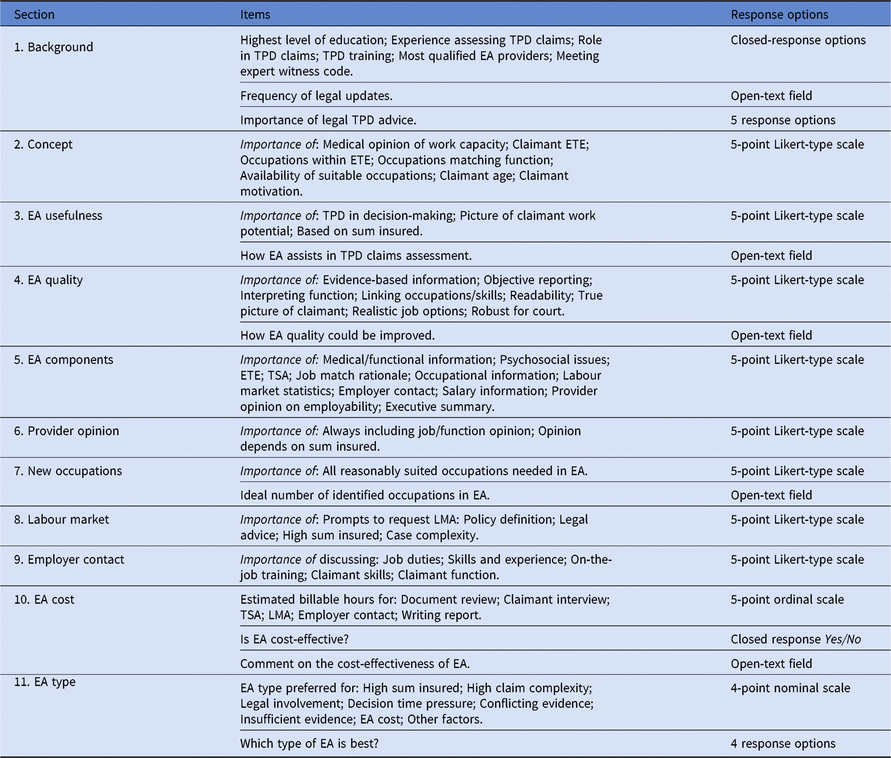
A survey prototype was developed because no existing or modifiable survey was found suitable for purpose. Black, Matthews, and Millington (Reference Black, Matthews and Millington2018) described the Delphi process used to select an expert panel — rehabilitation advisors — and to obtain survey items. Agreed items were formatted for online use in REDCap, an electronic data capture application for research surveys (Harris et al., Reference Harris, Taylor, Thielke, Payne, Gonzalez and Conde2009). The survey instrument comprised 11 sections (see Table 1). Section 1 collected limited demographic information as data on age, gender, or employer were not applicable to the research questions. No geographic or jurisdictional data were sought because the TPD product applies Australia-wide. Section 2 to Section 9 used a 5-point Likert-type scale (0 = not important to 4 = extremely important) to evaluate the importance of variables featured in each section. Items in Section 10 used a 5-point ordinal scale (0 = < 1 hour; 1 = 1 hour; 2 = 2 hours; 3 = 3 hours; 4 = ≥ 4 hours) to quantify the number of billable hours estimated for certain employability assessment tasks. The final section sought participants’ preference among four types of employability assessment using a 4-point nominal scale (1 = internal review, 2 = file-based, 3 = phone interview, 4 = face-to-face interview). Integrating five qualitative open-text fields into the survey provided opportunity for claims professionals’ views to be examined more deeply than a single-dimensional quantitative approach and enabled appraisal of findings from each method (Barbour, Reference Barbour1999).
TPD Survey Instrument Showing Measures Applied to Section Items

Note: TPD = total and permanent disability. EA = employability assessment. ETE = education, training, experience. TSA = transferable skills analysis. LMA = labour market analysis.
The survey embedded the study’s participant information sheet and required electronic consent to commence. A forced-response mechanism necessitated completion of each item before proceeding to the next section. Provision for ‘other’ comments was included where relevant without application of a forced-response mechanism.
Participants
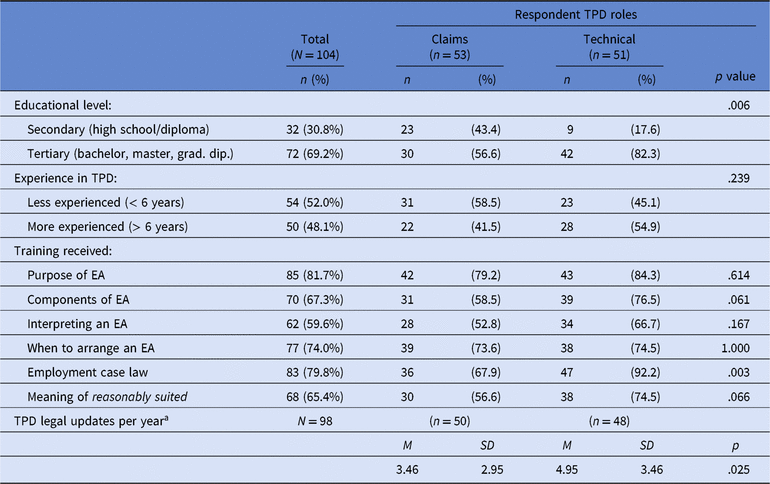
Claims professionals were eligible to participate in the study if they were employed by a life insurance company located in Australia and were familiar with employability assessment as part of their role within TPD claims. Respondents were 104 claims professionals who used employability assessment as part of the TPD claim decision-making process (see Table 2). Almost half (n = 51) were technical advisors who support claims teams with advice on medical, legal, rehabilitation, reinsurance, product, or policy matters. The remainder were from claims teams (n = 53) and responsible for the management, assessment, and formation of a decision about each TPD claim. More participants (69.2%) held a university qualification and 52% were in the first five years of their TPD career. Participants reported receiving legal updates on TPD case law on average four times per year. Significantly more technical advisors had completed university education, received training in employment case law, and attended more legal updates than their claims counterparts.
Characteristics of Participants by Cohort and by Role in TPD Claims

Note: TPD = total and permament disability. EA = employability assessment.
a Case 67 (technical) reported 20 updates, therefore, was considered an outlier and removed from analysis.
The exact number of national claims professionals was unobtainable due to commercial confidentiality, fluidity of staffing, and varied composition of TPD claims teams. Five industry leaders from reinsurance and insurance firms were consulted about TPD staff numbers. Each leader calculated TPD personnel across all companies and an average was agreed. The response rate (n = 104) approximated 52% of the study population based on industry leaders’ estimation of a sampling frame of n = 200.
Procedure
Participants were drawn primarily from the membership of the life insurance peak body, the Australasian Life Underwriting Claims Association (ALUCA). Project details (purpose, summary, eligibility, and survey link) were shared through the ALUCA website, LinkedIn, eNewsletter, and conference posters. An ALUCA email solicited national claims managers to distribute the survey link to their TPD staff. Managers were provided with information about the survey and were well positioned to know who was eligible. Survey champions emerged from the recruitment process to facilitate dissemination outside of the ALUCA membership. The champions were senior claims managers, rehabilitation team managers, and reinsurers who operate within the TPD claims environment. The University of Sydney Human Ethics Committee approved the study. The survey was open from July to December 2016 then responses were downloaded and stored on a secure drive for analyses.
Data Analysis
Quantitative analysis was conducted using the Statistical Package for Social Sciences (SPSS), Version 22 (IBM, 2013). Descriptive data including frequency distribution, percentages, modes, median, means, standard error, and range were conducted for demographic and contextual variables. Nonparametric Mann–Whitney U tests compared the differences between participants’ role, education, and experience against the dependent ordinal variables of usefulness, quality, and billable hours. Fisher-Freeman-Halton (Fisher’s exact test [Fet]) of independence was applied to determine differences in the type of employability assessment preferred between respondent’s role, education, and experience. This test is considered more accurate than chi-square in samples sizes smaller than 1000 (McDonald, Reference McDonald2014). Point-biserial correlations (r pb ) and Cramer’s V were calculated to determine effect size of significant relationships using the following guidelines: small 0.1, medium 0.3, large 0.5 (Cohen & Ronkes, Reference Cohen and Ronkes1998, pp. 79–80).
Five open-text fields were used to capture respondents’ opinions. Responses from two fields (legal update frequency, number of new occupations) were converted for presentation as numeric equivalents. Two fields concerning usefulness and quality were thematically analysed. The five-step process involved (1) data familiarisation, (2) generation of initial codes, (3) collation of codes into tentative themes, (4) revision and mapping themes, then (5) refining and naming themes (Liamputtong, Reference Liamputtong2012). The first author undertook two initial steps and all authors contributed to the next three steps. An audit trail and reflective notes were recorded to maintain data trustworthiness (Carcary, Reference Carcary2009; Cutcliffe & McKenna, Reference Cutcliffe and McKenna2004). Where quoted material is used, the respondent role (claims, technical) is identified in parentheses after the quote. Analysis was not conducted on the fifth open-text field regarding cost-effectiveness due to low response rate (n = 5).
Results
Concepts of Employability Within TPD Claims
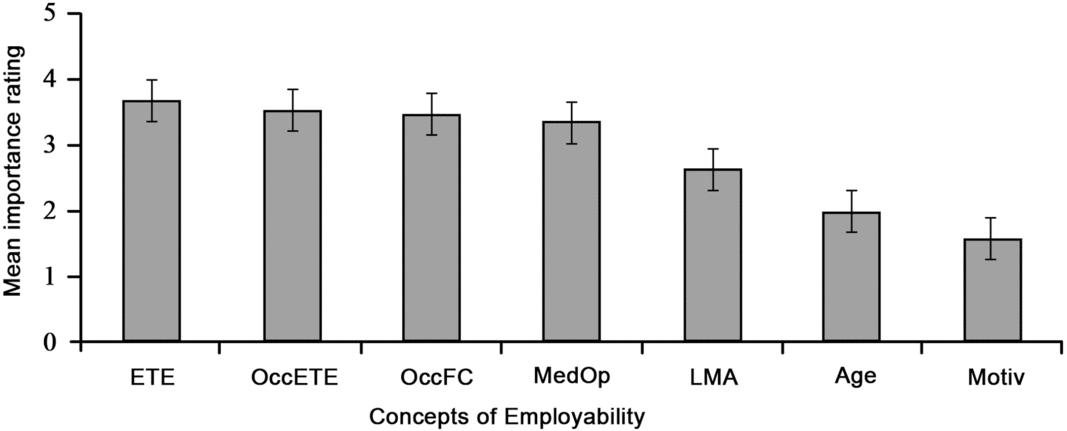
Figure 1 shows participants’ importance ratings for seven employability concepts that have a bearing on a claimant’s employment potential . The three highest-rated concepts of employability — education, training, or experience; identification of occupations within claimant’s work history; and identification of occupations matching claimant’s function — encapsulate the primary purpose of employability assessment. The lowest rated — labour market, claimant’s age, and motivation — pertain to concepts containing psychosocial elements. Among ‘other’ concepts of employability offered by participants (n = 20), most (85%) were within psychosocial classification (e.g., family arrangements, secondary gain, claimant’s attitude toward employment, external barriers to work, multiple claims running, and claimant’s financial situation).
Mean importance rating with standard error of listed concepts of employability.

Importance of Employability Assessment Components in Claim Decision-Making
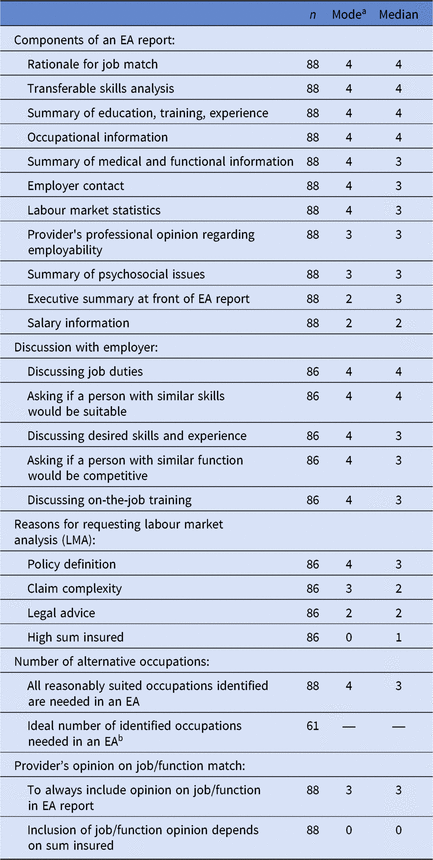
The importance ratings of 23 variables (set within five corresponding aspects of employability assessment) that help to decide TPD claims are reported in Table 3. Highest-rated variables included rationale for job match, transferable skills analysis, and summary of education, training, or experience (Mo = 4). Participants rated all discussion topics with potential employers as extremely important. They were least concerned about the sum insured (the lump sum amount paid to claimant) when deciding whether to request a labour market analysis (Mo = 0). Similarly, in terms of sum insured, participants ranked inclusion of whether a provider’s opinion of job/function depends on sum insured as unimportant (Mo = 0). They recorded mean data between 3 and 4 (range 2–5) as the ideal number of identified occupations needed in an EA.
Importance of Aspects of EA in Assisting Claims Professionals Decide TPD Claims

Note: TPD = total and permanent disability. EA = employability assessment.
a Rating scale: 0 = not important, 1 = somewhat important, 2 = moderately important, 3 = very important, 4 = extremely important.
b This item required numeric response only.
An additional item not directly related to employability assessment asked how important it was to have legal advice on TPD cases. Participants deemed legal advice to be extremely important (Mo = 4).
Usefulness of Employability Assessment
Participants (n = 96) rated using EA to get a clear picture of the claimant’s work potential of equal importance as for decision-making (Mo = 4). Both aspects were more important than using the sum insured to decide whether to request an EA (Mo = 0); however, significant difference was noted between the education groups (secondary, tertiary) for this variable (U = 712, p = .010, r pb = .26). The tertiary group (Mdn = 1.00, n = 64) rated using sum insured to decide whether to request an EA as significantly more important than those with secondary education (Mdn = .00, n = 32). The point-biserial correlation of .26 suggested medium effect size although the low median importance rating by both groups suggests the difference is of low practical significance.
Participants described how employability assessment assisted them to assess and decide TPD claims. Responses (n = 83) were coded into 190 items. Thematic analysis identified three main uses of employability assessment — vocational overview, vocational opinion, and vocational integrity.
Vocational overview. Employability assessment provided valuable rehabilitation summaries of claimants’ education, training, or experience and their functional capacity. Employability assessment was regarded as useful in linking, incorporating, comparing, and matching information to provide a balanced overview, factual snapshot, overall picture of work potential, clear argument on options, and an objective critical analysis.
Vocational opinion. Employability assessment provided expert opinion on key vocational areas such as work history, identification of suitable occupations, the labour market, claimants’ return to work potential, and claimants’ transferable skills. For instance: ‘Identification of employment in consideration of the claimant’s function/education, training, experience/work availability which cannot be reached by simply reviewing the claimant’s history provided in the claim forms’ (claims); ‘Gives a ‘subject matter expert’ opinion on the match between education, training, or experience, function, and real occupations’ (technical).
Vocational integrity. It was imperative that employability assessments reflect and relate to the real world of work: ‘EA provides an expert overview of a claimant’s education, training, or experience, their function, and applies a “real world” test to whether it translates into a suitable vocational option’ (technical); ‘EA hugely assists in assessing TPD claims as it provides tangible examples of real life roles within claimant’s retained skill sets’ (claims).
Quality of Employability Assessment
Participants (n = 92) rated all quality characteristics as extremely important (Mo = 4) except for readability which was multimodal (Mo = 3 and 4). There was significant difference in the role groups (claims, technical) concerning the variable robust for court, (U = 822, p = .039, r pb = .21). Technical advisors rated robust for court as significantly more important (Mdn = 4.00, n = 44) than claims assessors (Mdn = 3.00, n = 48). The point-biserial correlation of .21 suggested a small to medium effect in an area rated as very and extremely important, and therefore of practical significance.
Qualitative free-text responses (n = 66) describing ways in which employability assessment quality could be improved were coded into 90 items for thematic analysis. The following three areas were identified:
Presenting realistic employment options. Participants berated identification of unrealistic or inappropriate roles such as car park attendant, console operator, or ticket collector. Instead, they posited that report quality would be improved by giving a clear rationale for including/excluding various occupational options. The rationale should link new options to functional capacity and residual skills: ‘Expert needs to provide conclusions based on evidence and tie roles to education, training, or experience. We want realistic options. If the claimant is unemployable, say so’ (technical). They also thought that contact with employers was an essential means of verifying occupational and labour market data: ‘Potential employers need to be contacted to confirm actual requirements of the roles, not just using occupational data’ (technical); and ‘It is really helpful to know that employers would consider the claimant for a role based on education, training, or experience and despite symptoms’ (technical).
Improving rigour of employability assessment. Introduction of industry-wide standards, mandatory training for providers, and provider certification was recommended: ‘A minimum standard that outlines how evidence should be presented, sources used, methodology, and rationale’ (claims); ‘Training on delivering a simply presented, readable, logically analysed summation of evidence and associated labour market research’ (technical). Improving the quality of referral, evidence, and instruction by claims to providers was also recommended.
Clear and concise reports. In this final area the advice was unequivocal: ‘Ensure opinions are objective and stick to facts provided’ (claims); ‘Some reports can be up to 30 pages long which can be overwhelming to assessors’ (claims); ‘Simplify the report and focus on the important parts that we rely on’ (claims); and ‘Remove any and all ambiguity’ (technical).
Cost of Employability Assessment
Most participants (n = 84, 91%) affirmed that employability assessments were cost effective. When asked to estimate billable hours for various tasks required to produce a report, Mann-Whitney U testing revealed significant differences by experience in two tasks. First, billable hours estimation for interview with claimant was significantly greater in the more experienced group (Mdn = 3.00, n = 37) when compared to those with less experience (Mdn = 2.00, n = 47; U = 1,207, p = .001, r = .35). The difference was of medium effect size. Second, billable hours estimation for labour market analysis was significantly greater in the less experienced group (Mdn = 3.00, n = 47) than those with more experience (Mdn = 2.00, n = 37; U = 605.5, p = .011, r = .27) with medium effect size. The sum of median hours for each billable task (15 hours) provided an approximation of a billable timeframe for tasks outlined in Table 1, Section 10.
Type of Employability Assessment
Employability assessment may be conducted in four ways — by internal rehabilitation review, by file-based report, with a telephone claimant interview, or with a face-to-face claimant interview. Over half the participants (56%) preferred face-to-face interview as the best means of assessment. When offered seven variables that may influence their choice, high claim complexity, high sum insured, legal involvement, conflicting evidence, insufficient evidence, had the strongest influence (Mo = 4) on type preferred. Two variables, time pressure for a decision and cost of an EA, were rated least influential (Mo = 2).
By role, a significantly larger proportion of the technical group (53.7%) reported preference for using file-based employability assessment compared to the claims group (29.3%) when faced with time pressure for deciding a TPD claim (p = .041, Fet = 8.130, V = .32). Cramer’s V indicates medium effect size. For cost of an EA, a significantly higher proportion of the technical group (65.9%) preferred file-based assessment (vs. claims group, 22.0%), while a significantly higher percentage of the claims group (24.4%) reported a preference for a telephone interview (vs. technical group, 7.3%; p = .001, Fet = 16.480, V = .45). Cramer’s V indicated a medium to strong effect size.
By education, secondary-educated respondents preferred internal review (33.3%) when experiencing time pressure for a TPD decision (vs. tertiary-educated, 14.5%) while the tertiary group preferred file-based assessment (49.1% vs. secondary-educated 25.9%; p = .042, Fet = 8.087, V = .32). Cramer’s V indicates a medium effect size.
By experience, a significantly larger proportion of respondents with less TPD experience (36.9%) reported preference for file-based employability assessments than those with more experience (13.9%) in view of high sum insured (p = .033, Fet = 8.391, V = .32), and a significantly larger proportion of the less experienced group (43.5%) preferred a file-based employability assessment compared to their more experienced counterparts (13.9%) if there was legal involvement in the case. The more experienced group (63.9%) reported significantly greater preference for face-to-face employability assessments than the less experienced group (41.3%) when there was legal involvement (p = .031, Fet = 8.680, V = .32). Both differences had a medium effect size.
Who Is Most Qualified To Conduct an Employability Assessment?
Of the 104 respondents, 58 (56%) indicated that rehabilitation counsellors were most qualified to conduct an employability assessment. Thirty-seven (36%) considered that occupational therapists were most qualified. Medical practitioners were selected by two respondents (2%); and physiotherapists, psychologists, and occupational allied health practitioners were each selected by one respondent (3%). Four (4%) did not know who was qualified to conduct an employability assessment. Most respondents (81%) believed that the provider conducting an employability assessment should meet the courts’ Expert Witness code requirements.
Discussion
This study explored the views of the two main groups of TPD claims professionals — claims assessors and technical advisors — to gain baseline information about employability assessment. Claims professionals’ concept of employability related strongly to claimants’ employment potential and the identification of suitable occupations within claimants’ education, training, and experience, and functional capability. In line with TPD policy, less importance was placed on psychosocial concepts of motivation for work, age, and the labour market in which the claimant operates. Psychosocial influences are widely regarded as integral to consideration of an individual’s future work potential and are common concepts of employability in other forensic vocational settings (Austin et al., Reference Austin, Barzegarian, Ciddio, Cottle, Diaz, Ferra and Winn-Boaitey2009; Pryor & Hawkins, Reference Pryor and Hawkins2009; Robinson, Reference Robinson2013). Paradoxically, psychosocial comments in ‘other concepts’ of employability indicates that when given an opportunity to express their own views, respondents showed a desire to understand a more holistic — real life — picture of the claimant’s situation.
Policy and practice are again at odds in the findings on important components of employability assessment. Contact with employers as part of labour market analysis was highly endorsed in quantitative and qualitative responses, yet policy definition governs respondents’ thinking on when to request a labour market analysis. A common interpretation of the policy regarding labour market analysis is based on case law such as Hannover Life v. Colella (2014) and Long v. United Super (2014) whereby the TPD test is one of capacity to perform alternative work, not the availability of that work. This policy restriction challenges the prevailing ‘real life’ imperative established by the courts (Drummond, Reference Drummond2014; Tsacalos, Reference Tsacalos2005). Participants agreed with the court that employability assessment must reflect the ‘real world of work’ and a claimant’s realistic chance of getting a job. A review of international literature identified that labour market research and employer survey data are fundamental to forensic employability assessment for an integrated assessment of a person in the real world of work (Barros-Bailey, Reference Barros-Bailey and Strauser2014; Barros-Bailey & Robinson, Reference Barros-Bailey and Robinson2012; Robinson, Reference Robinson2013).
Participants found employability assessment extremely useful when deciding a TPD claim as it provides a clear picture about a claimant’s work potential from an expert in the field. They use the provider to synthesise information about the claimant and to provide a professional opinion on suitable employment options, with rationale for their choices. University-qualified claims professionals placed significantly greater importance on the sum insured when requesting an assessment than their peers with secondary education. Insured sums average A$103,000 (Bui, Collier, Gee, & Platon, Reference Bui, Collier, Gee and Platon2017), with lump sum payouts ranging from a few thousand to over a million dollars. Actuarial and business risk implications such as the sum insured is more likely to be within the scope of university-qualified technical advisors.
Identification of realistic alternative occupations using objective, evidence-based information is regarded by participants as the hallmark of a quality report. Technical advisors held a significantly stronger view that employability assessment should be robust to withstand the scrutiny of the court. Their role is to take a higher-level perspective on commercial matters so that each report meets prevailing legal requirements. Improvement of employability assessment quality focused on provider competency. Participants urged introduction of standardised guidelines for provider training and certification. Australia must establish forensic standards to avoid adverse court rulings. United States court judgements created significant upheaval in the 1990s by requiring forensic experts to justify their methodology, evidence, and opinions (Crystal & Erickson, Reference Crystal, Erickson and Mpofu2010; Williams, Dunn, Bast, & Giesen, Reference Williams, Dunn, Bast and Giesen2006).
Participants regarded employability assessment as cost effective. When estimating billable hours for certain tasks, those with more experience allowed significantly more time to conduct an interview with the claimant than their colleagues with less experience. This finding aligns with free-text responses wanting psychosocial information about the claimant, which is generally gleaned by interview. It also fits with forensic literature in which interview-with-claimant is described as a principle source of information (Robinson, Reference Robinson and Robinson2014b). The interview must be comprehensive (Van de Bittner, Wallace, Cottle, & Simon, Reference Van de Bittner, Wallace, Cottle and Simon2012), be conducted with consideration of the claimant’s communication needs (Austin et al., Reference Austin, Barzegarian, Ciddio, Cottle, Diaz, Ferra and Winn-Boaitey2009), and allow time to focus on personal background and issues (Pryor, Reference Pryor, McMahon and Patton2015). The group with less experience estimated more hours for labour market analysis, perhaps yet unaware of data access methods.
Respondents estimated 15 hours for tasks usually undertaken in 8 to 10 hours. Anecdotally, providers frequently comment on the challenge of producing quality assessments within allocated time. Other insurance schemes report estimates of 20 to 40 hours as an average time to complete a comprehensive expert forensic vocational evaluation (Van de Bittner et al., Reference Van de Bittner, Wallace, Cottle and Simon2012). It is timely, therefore, to bring employability assessment timeframes into line with current forensic vocational rehabilitation practice.
Employability assessment with a face-to-face interview with the claimant was deemed the best type by just over half the participants. When time and cost were factors in choosing the assessment, the cheaper and generally quicker file-based assessments were considered appropriate by the technical group whose role requires heightened time/cost/risk awareness. The claims group — the group in telephone contact with claimants during the claim — favoured the next step down in time and cost, a telephone interview with the claimant. Those with more TPD experience opted for a face-to-face claimant interview when there was legal involvement in a claim. An interview with the claimant is a requisite step in the process of identifying realistic occupations in most forensic assessment methodologies (Austin et al., Reference Austin, Barzegarian, Ciddio, Cottle, Diaz, Ferra and Winn-Boaitey2009; Crystal & Erickson, Reference Crystal, Erickson and Mpofu2010; Robinson, Reference Robinson2013; Van de Bittner et al., Reference Van de Bittner, Wallace, Cottle and Simon2012). Reliance on claimant’s self-report is regarded a hazard for forensic providers who mostly work as counsellors (Pryor & Hawkins, Reference Pryor and Hawkins2009); therefore, objective and realistic employability assessments depend on the experience, skills, and integrity of the forensic provider (Sleister, Reference Sleister2000).
Rehabilitation counsellors were regarded as best qualified to conduct employability assessments by 56% of survey respondents. Competencies for vocational assessment are well established within the rehabilitation counselling profession (Australian Society of Rehabilitation Counsellors, 2014; Rehabilitation Counselling Association of Australasia, 2015) and align with recently released guidelines for TPD employability assessment providers (ALUCA, 2017). Improving the rigour of employability assessment through standardised training was a main theme arising from the qualitative aspect of this study. This is a particularly important area for development given there is no independent forensic training and credentialing system extant in Australia. Rapid growth in this sector mirrors past expansion in the United States of forensic vocational assessment and corresponding development of formal forensic training/accreditation (Barros-Bailey, Reference Barros-Bailey and Robinson2013). Standardised training and certification are indicated for all employability assessment providers irrespective of their health professional qualifications.
Future Research
Three areas of future research — quality, cost, and providers — emerge from this study’s findings. Criteria for measuring quality of forensic reports is varied. According to Robinson (Reference Robinson and Robinson2014b), the quality of reporting goes beyond the constituent parts of a vocational assessment such as background information, transferable skills analysis, and vocational options. Five additional factors that influence the perceived quality of a report were: the utility of the report, the specificity of the report, style and readability, jargon and grammar, and the length of the report (Robinson, Reference Robinson and Robinson2014b, p. 5). Objectivity and consistency of methodology also contributed to report quality (Shahnasarian & Lassiter, Reference Shahnasarian and Lassiter2002), as well as a report which is balanced and impartial (Pryor & Hawkins, Reference Pryor and Hawkins2009). Therefore, further inquiry into employability assessment reports would provide more definitive evidence of quality. Specific research is needed to gauge the quality of employability assessment reports against standardised criteria rather than rely on the viewpoints of insurance claims professionals. It is important to include the issue of psychosocial factors into future examination of quality.
Disparity between current costs and respondents’ estimates of billable hours warrants research to identify appropriate billable hours for key tasks associated with employability assessment and ensure that timeframes set for providers correspond with forensic vocational assessment standards. Finally, although rehabilitation counsellors were identified as best qualified to conduct employability assessments, research to further investigate this finding would add credence to future provider guidelines and strengthen the standing of providers in the courts.
Limitations
The findings of this study need to be considered in view of two methodological challenges, sampling and selection bias (Wright, Reference Wright2005). First, not all TPD claims professionals are members of the peak body ALUCA which promoted the study, and second, because there was no way of knowing if all claims managers had cascaded the survey link to their teams as requested, responses may have come predominantly from the teams that did receive the link. The use of in-office survey champions to encourage claims staff to participate may have somewhat offset this issue. Information about respondents’ professional backgrounds and geographical location was not documented. This may have masked potential bias in their choice of most qualified provider to conduct employability assessments.
Given that the survey was generated exclusively by insurer-based rehabilitation advisors — albeit a highly experienced group — it arguably lacked input from medical, legal, provider, and claimant stakeholders. The scope of the study was ambitious with 68 mandatory-response items. Of the study sample, 79% (n = 82) completed every section of the survey. Anecdotal feedback from many claims professionals was highly supportive of the survey but taking time from hectic workloads to address detailed items may have contributed to the attrition rate. A condensed version, refined by further Delphi iterations (Keeney, Hasson, & McKenna, Reference Keeney, Hasson and McKenna2011) and with limited forced-response measures, may be more practicable in future surveys.
Conclusion
This study explored, for the first time, many facets of employability assessment from the perspective of claims professionals — the decision-makers in a winner take all TPD claims process. The data demonstrate that employability assessment is an extremely useful, cost effective means of providing an objective picture of a claimant’s work potential. Summarising education, training, and experience, functional information, transferable skills, and providing rationale for work options are highly rated concepts and components of employability assessment. Participants were certain that labour market analysis with employer contact and face-to-face interviews with claimants are essential to reflect the real world of work. They were less clear about inclusion of psychosocial factors in establishing realistic work options. Standardised training and credentialing of providers who conduct employability assessment is essential to improving quality of reports. In combination, claims professionals’ views contribute to a better understanding of employability assessment within the unique TPD environment in Australia.
Acknowledgement
The authors thank Dr Rob Heard (Faculty of Health Sciences, The University of Sydney) for his helpful statistical advice. The contribution of the participants in this foundational study is gratefully acknowledged.