INTRODUCTION
The ability to perform culturally and linguistically appropriate neuropsychological assessments is becoming increasingly important given the aging and growing diversity of the United States population. By 2050, 18.7% of Americans will be 65 or older, a growth of 51% over the 12.4 million in this age range in 2000 (U.S. Census Bureau, 2004). In the same time period, minorities will increase to over 50% of the total U.S. population, with Hispanic/Latino and Asian/Pacific Islanders being the two fastest growing groups (Pew Research Center, 2008; U.S. Department of Commerce, 1999). For example, Asian-Americans are expected to triple in number from 11.2 million in 2000 to 34.4 million in 2050. While accurate information about the prevalence of dementia is not available for most U.S. minority groups (Yeo, Reference Yeo, Yeo and Gallagher-Thompson2006), a recent report (Ross, Brennan, Nazareno, & Fox, Reference Ross, Brennan, Nazareno and Fox2009) indicates that, between 2008 and 2030, the number of Californians with Alzheimer’s disease (AD) will approximately triple for Hispanics/Latinos (from 92,242 to 276,821) and Asian/Pacific Islanders (from 72,075 to 194,266), and approximately double for African-Americans (from 26,521 to 52,369). While alarming, these projections probably underestimate the actual numbers as multiple studies have shown that dementia is under-recognized in minorities. In general, minority individuals, and Hispanic/Latinos and Asian/Pacific Islanders in particular, are unlikely to seek help and receive a diagnosis of dementia until the disease has progressed into the later stages.
As the ethnic/racial, language, and cultural background of the U.S. population shifts, clinicians must develop the ability to accurately assess the cognitive functioning of individuals from diverse backgrounds. An older individual’s performance on cognitive tests is affected by a variety of interacting factors, including age, gender, education, occupation, ethnicity/race, language, and cultural experiences, as well as the presence of diseases and disorders such as AD, hypertension, and depression. Unfortunately, the effect of demographic variables such as ethnicity/race, language, and acculturation on the performance of older adults on both standard and novel neuropsychological instruments is not well understood. A review of 1440 studies reported in five of the most frequently read neuropsychological journals from 1995 to 2000 showed that, while most of them presented data on participants’ age (97.6%), gender (77.7%), and education (88.0%), relatively few included any information regarding ethnicity/race (21.5%), language (12.0%), or level of acculturation (0.1%) (O’Bryant, O’Jile, & McCaffrey, Reference O’Bryant, O’Jile and McCaffrey2004).
When addressing cross-cultural issues, appropriate tests and normative data are two pressing needs for neuropsychologists serving diverse populations (Ferraro, Reference Ferraro2002; Fletcher-Janzen, Strickland, & Reynolds, Reference Fletcher-Janzen, Strickland and Reynolds2002; Nell, Reference Nell2000). Meeting these needs has been challenging, given the sensitivity and experience needed for designing appropriate tests, as well as the enormous cost—in time, effort, and personnel—involved in successfully recruiting and assessing large numbers of minority participants. Nearly impossible for individual researchers, studies in test development require collaboration among researchers, and support from state, federal, or foundation sources. Recognizing this challenge, the authors of this study committed to jointly developing a new assessment tool for recent memory that would address the cultural and language diversity present in California that is also largely appropriate for the US population in general.
The Common Objects Memory Test (COMT) was developed as part of the larger Cross-Cultural Neuropsychological Battery (CCNB) (Dick, Teng, Kempler, Davis, & Taussig, Reference Dick, Teng, Kempler, Davis, Taussig and Ferraro2002). The COMT was designed to assess age-related memory impairments in individuals who vary extensively in educational and literacy levels as well as in language and cultural backgrounds. After describing the COMT itself, preliminary normative and clinical data will be presented.
GENERAL METHOD
The Common Objects Memory Test (COMT)
Test development
The COMT uses a modification of a word list learning paradigm, which “is among the most sensitive memory test formats because of its relative freedom from associative context…” (Lezak, Howieson, & Loring, Reference Lezak, Howieson and Loring2004, p. 427). Administration of the COMT, as in other word list learning protocols (e.g., Delis, Kramer, Kaplan, & Ober, Reference Delis, Kramer, Kaplan and Ober2000; Fillenbaum et al., Reference Fillenbaum, van Belle, Morris, Mohs, Mirra and Davis2008; Schmidt, Reference Schmidt1996), entails repeated presentations of a list of to-be-remembered items and multiple opportunities for the subject to recall and recognize the original list. Responses during its three learning with immediate free recall trials, and those during the subsequent two delayed recall trials, allow the examiner to assess the rate and extent of learning and forgetting. Scores on its two delayed recognition trials provide additional information about storage versus retrieval deficits and the subject’s ability to benefit from cues.
Unique features of the COMT include the following
1. Color photographs of 10 common objects familiar across cultures were used as the to-be-remembered stimuli instead of either auditorily or visually presented (i.e., written) words as used in other popular memory tests (e.g., Delis et al., Reference Delis, Kramer, Kaplan and Ober2000; Fillenbaum et al., Reference Fillenbaum, van Belle, Morris, Mohs, Mirra and Davis2008; Schmidt, Reference Schmidt1996). Visually presented words are problematic for individuals who are illiterate or have very limited education. Auditorily presented words have the problem of unknown equivalency in the translated words across languages and cultures and the obvious difficulties posed by presenting auditory stimuli to an older population who will have a high incidence of presbycusis (hearing decline associated with aging).
2. Objects and their photographs were selected to be canonical images without distracting detail. The COMT requires the subject to name the color photographs of each object as it is shown, thereby optimizing acquisition in the learning trials by engaging both auditory–verbal and visual channels.
3. Currently available in four languages (English, Spanish, Chinese, and Vietnamese), the COMT test items and instructions were translated and back translated using the procedures outlined by Taussig, Henderson, & Mack (Reference Taussig, Henderson and Mack1992). For all four languages, the authors avoided the use of words that might not have an equivalent in one of the languages and that speakers from particular regions of the world would be less likely to know (e.g., there are no words for “shin” or “instep” in Chinese) (Teng, Reference Teng, Yeo and Gallagher-Thompson1996). Only objects that were easily named and accurately translated in all four languages were included in the final version of the COMT. Words in the Spanish version were checked to ensure agreement on word meaning in dialects spoken in Puerto Rico, Spain, and in North, Central, and South America. Words in the Chinese version are equally appropriate for Mandarin and Cantonese dialects.
4. We used bilingual and bi-cultural examiners rather than interpreters to administer the tests to non-English speaking participants in their native languages. The same bilingual and bi-cultural examiners also conducted interviews as they were able to discuss issues (e.g., medical diagnoses, presence of behavioral problems) with the subjects and their families in a culturally sensitive manner.
5. Data were collected from healthy elders and from patients with mild-to-moderate dementia from five ethnic groups: Caucasian and African-American English speakers, and native Chinese, Spanish, and Vietnamese speakers.
Testing procedure
The subject is shown 3” × 5” color photographs of 10 common objects (button, chair, clock, comb, cup, key, knife, leaf, scissors, and umbrella) across three learning trials at the rate of one photograph every 2 sec. The pictures are spiral-bound and presented in a standard order that differs among the three trials. The subject is asked to name the objects aloud as each is shown and forewarned to remember them. If the subject cannot name an object, the examiner names it for the subject to repeat to ensure registration of the target word. Recall of the 10 objects in any sequence is requested immediately after each learning trial. The examiner records the objects that are correctly recalled, the order of their recall, as well as any intrusions. After the third learning trial, the subject is distracted for 3–5 min with unrelated test activities. Following this approximately 5-min delay, the subject is asked to recall the objects again. The 5-min delayed recall is immediately followed by a recognition test in which the subject is shown a set of 20 photographs that includes the10 original objects and 10 distracters. The subject is asked to indicate with a simple “Yes” or “No” whether an object was seen in the three learning trials. The distracter objects are similar to the original objects in terms of familiarity and visual complexity as judged by the authors during consensus meetings. After another approximately 30-min interval filled with unrelated test activities, another recall and recognition test are administered. For the second recognition test, a different set of 10 distracter objects is used. The main scores of the COMT are the number of objects correctly recalled (out of 10) during each of the three learning trials and each of the two delayed recall tests, and the number of objects correctly identified (out of 20) as old or new during each of the two delayed recognition tests.
Study 1: Normative Data
Participants
The normative sample included 336 healthy older adults from five ethnic groups: African-American, Caucasian, Chinese, Hispanic, and Vietnamese. To ensure broad coverage in ethnic background, age and education, efforts were made to recruit approximately equal numbers of participants in the five ethnic groups from three age (i.e., 60–67, 68–75, and ≥ 76 years) and three education (i.e., 0–8, 9–12, ≥ 13 years) ranges. Participants were recruited in the Los Angeles and Orange counties of Southern California through senior centers, memory clinics (aiming for the family members of patients), chapters of the Alzheimer’s Association, as well as through public service announcements. Informed consent was obtained for all participants, consistent with Institutional Review Board (IRB) policy. Healthy participants read (or had the consent read to them if their literacy level limited their ability to read and understand it) and signed consent forms.
Almost all of the participants spoke only their native language at home, including 98% of the 71 Chinese, 81% of the 80 Hispanic, and 97% of the 61 Vietnamese participants. Median number of years in the United States was 9 for the Chinese, 25 for the Hispanic, and 3 for the Vietnamese participants.
All participants were screened for the presence of major health problems, cognitive impairment, depression, and functional deficits. Potential participants who acknowledged a history of stroke, head injury, traumatic loss of consciousness, or psychiatric, speech, language, or memory problems on a health questionnaire were excluded. In addition, all participants had to be free of any physical disabilities (e.g., movement disorders, uncorrected hearing, or vision problems) that could interfere with neuropsychological testing.
To help rule out cognitive impairment, each participant was asked to have a family member complete (1) the Informant Questionnaire of Cognitive Decline in the Elderly (IQCODE) (Jorm & Jacomb, Reference Jorm and Jacomb1989; Jorm, Scott, Cullen, & Mackinnon, Reference Jorm, Scott, Cullen and Mackinnon1991) and (2) the Activities of Daily Living Scale (ADL) (López & Taussig, Reference López and Taussig1991). Finally, the Center for Epidemiological Studies Depression Scale (CES-D) (Radloff, Reference Radloff1977) was administered to all potential participants to rule out depression. Details about these instruments and their cross-cultural applicability have been reported elsewhere (Dick et al., Reference Dick, Teng, Kempler, Davis, Taussig and Ferraro2002).
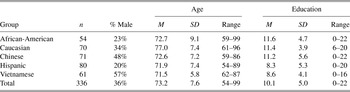
Across the ethnic groups, the healthy participants had a mean age of 73.2 years (SD = 7.6 years) and attended school for an average of 10.2 years (SD = 5.0 years). The ethnic groups differed significantly from one another on Age, F(4,331) = 6.2; p < .001, and Education, F(4,331) = 7.6; p < .001. Tukey-HSD comparisons, evaluated at a Bonferroni adjusted .01 level of significance, showed that the Caucasians were significantly older than participants in the other groups. In an effort to include enough low-education Caucasians, the researchers ended up testing a greater number of older individuals, as they were more likely to have fewer years of schooling. Table 1 shows the basic demographic data for the five ethnic groups.
Demographic background of the healthy participants (N = 336)

Data Collection
A total of 14 examiners administered the COMT as part of the CCNB to the 336 healthy participants. Three Chinese, three Vietnamese, and four Hispanic bilingual and bi-cultural examiners administered the battery in each non-English speaking participant’s primary language and dialect. One African-American and three Caucasian examiners administered the battery to the English-speaking participants. All of the examiners had at least a college degree in psychology or a related discipline and received 12–16 hr of training in the administration and scoring of the COMT and the other measures.
The participants were tested either at home or at a local senior center. The examiners administered the CCNB and obtained demographic and medical information from each participant in a single session. Participants were paid $20 each for their time and effort.
To ensure accuracy of data collection and entry, first the authors reviewed in a timely manner all written responses and scores for possible errors. If any errors were identified, this was brought to the attention of the examiner to correct. Two research assistants independently entered all data into a database, and any discrepancies were identified and corrected. Finally, the authors reviewed the data files to check and verify the validity of any outlying scores.
RESULTS
Mean and standard deviation for the COMT scores for each of the five ethnic groups are shown in Table 2. To examine the influence of age, education, gender, and ethnic background on test performance, the seven COMT component scores (immediate recall from three learning trials, two delayed recall scores, and two delayed recognition scores) were added to create a COMT summary score. Stepwise regression analysis of the COMT summary score on the four demographic variables of interest was conducted for the 336 healthy participants. Age accounted for 17% of the variance (p < .0001); adding education accounted for an additional 2% of the variance (p < .05); gender and ethnic background had no significant influence.
Performance on the COMT by 336 healthy older adults from five ethnic groups

Education generally has its greatest influence on dementia screening tests at the low end of the education range (e.g., Liu et al., Reference Liu, Teng, Lin, Hsu, Guo and Chou1994). To examine whether or not education had a greater influence on the COMT among healthy individuals with lower education levels, a stepwise regression analysis was repeated separately for three education ranges: low (0–4 years; n = 45); middle (5–9 years; n = 108); and high (10–22 years; n = 183). Age accounted for 19% (p < .01), 11% (p < .05), and 23% (p < .0001) of COMT score variance for the low, middle and high education groups, respectively. Additional variances accounted for by education for the three groups were nil (p > .15), 3% (p < .05), and 3% (p < .05). In other words, education did not influence performance of the low education group and only minimally influenced the performance of the other two groups. Gender and ethnic background did not influence the COMT score in any of the three education groups.
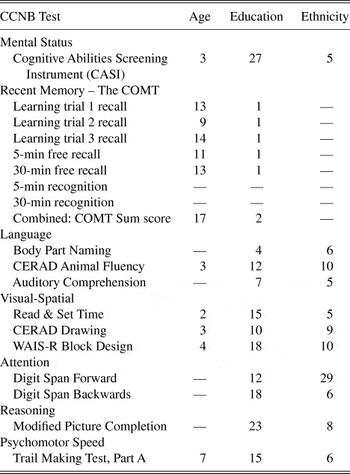
The lack of influence of education and ethnicity on the COMT contrasts with other tests included in the Cross-Cultural Neuropsychological Battery (CCNB). The influences of age, education, and ethnic background on these tests are shown in Table 3. Gender had no influence on any of the tests and is therefore not included in the table. Brief descriptions of these other tests are included here (see Dick et al., Reference Dick, Teng, Kempler, Davis, Taussig and Ferraro2002, for fuller descriptions). Overall mental status was measured with the Cognitive Abilities Screening Instrument (CASI), which includes items to assess attention, concentration, orientation, short-term memory, long-term memory, language, construction, abstraction and problem-solving skills (Teng et al., Reference Teng, Hasegawa, Homma, Imai, Larson and Graves1994). Language was assessed by asking participants to (a) name 10 body parts, (b) name “all the animals you can think of in one minute” and (c) execute 10 verbal commands ranging from simple one-step actions (“open your mouth”) to complex 3-stage actions (“put the watch on the other side of the pencil and turn over the card.”). Visual-spatial skills were assessed by (a) the Wechsler Adult Intelligence Scale (WAIS-R) (Wechsler, Reference Wechsler1981) Block Design subtest, (b) Figure drawing from the Consortium to Establish a Registry for Alzheimer’s Disease (CERAD) Battery (Fillenbaum et al., Reference Fillenbaum, van Belle, Morris, Mohs, Mirra and Davis2008), which involves copying four figures of increasing complexity (i.e., circle, four-sided diamond, pair of intersecting rectangles, and a cube), and (c) reading time on 3 clocks and drawing the hands of a clock for three different times. Attention was assessed by standard administrations of the WAIS-R Digit Span subtests. Reasoning was assessed by a new measure patterned after the WAIS-R Picture Completion subtest, wherein an examinee is shown drawings depicting universal experiences and asked to identify what is missing (e.g., a bearded man looking in a hand-held mirror with the reflected image missing the beard; a couple walking together in the sun, but only one of them casting a shadow). Psychomotor speed was assessed by Part A of the Trail Making Test (Reitan, Reference Reitan1958).
Percentage of variance accounted for by age, education, and ethnic background on each of the tests in the cross-cultural neuropsychological battery (CCNB)

Note
Gender had no significant influence on any of the tests, contributing to < 1% of the variance in test scores.
Study 2: Clinical Data
Participants
The COMT was administered to dementia patients from each of the five ethnic groups to determine how effective the test would be at identifying cognitive impairment. A total of 117 cognitively impaired participants were recruited through the Alzheimer Disease Research Centers (ADRCs) located at the University of California at Irvine (UCI) and the University of Southern California (USC). Informed consent was obtained for all participants, consistent with Institutional Review Board (IRB) policy. Primary caregivers provided written consent for participants with dementia. Twenty-seven of these individuals were severely demented, with scores of 3 or higher on the Clinical Dementia Rating (CDR) scale (Hughes, Berg, Danziger, Coben, & Martin, Reference Hughes, Berg, Danziger, Coben and Martin1982), and were not included in the sample. The final sample of 90 included 4 African-Americans, 20 Caucasians, 18 Chinese, 39 Hispanic, and 9 Vietnamese individuals. Despite the authors’ efforts, we were not able to recruit comparable numbers of patients from the five ethnic groups, as their numbers differed in ADRC patient groups.
Eighty-four of the participants (93%) met the NINCDS-ADRDA diagnostic criteria for either probable or possible AD (McKhann, Drachman, Folstein, Katzman, Price, & Stadlan, Reference McKhann, Drachman, Folstein, Katzman, Price and Stadlan1984). The presence of multi-infarct dementia was ruled out through the patient’s medical history, including neuroimaging data (i.e., computer-assisted tomography and magnetic resonance imaging scans) and a score of 4 or less on the Hachinski Ischemic Scale (Rosen, Gerry, Fudd, Katzman, & Peck, Reference Rosen, Terry, Fuld, Katzman and Peck1980). These 84 participants had mild or moderate dementia as indicated by CDR scores of 1 or 2. The remaining six individuals (7%) showed evidence of cognitive impairment on clinical examination as well as on the IQCODE and ADL measures, and scored 0.5 on the CDR (i.e., questionable or borderline dementia). None of the participants had a history of psychiatric illness, chronic alcoholism, other neurological disorders, or any physical impairment that would interfere with test performance.
Although the 90 cognitively impaired participants were slightly older (M = 75.8; SD = 9.3) than the 336 nonimpaired peers described in Study 1 (M = 73.2; SD = 7.6), t (423) = 2.7; p < 0.01), the two groups were similar in years of formal schooling (M = 10.4; SD = 4.1 for the cognitively impaired patients; M = 10.1; SD = 5.0 for the healthy controls).
RESULTS
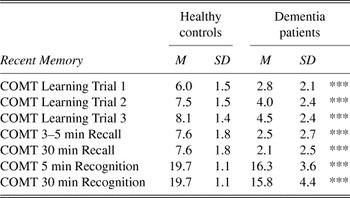
Both analysis of variance (ANOVA) and logistic regression procedures were used to analyze the data. Given the small number of cognitively impaired participants in some of the ethnic groups, it was not possible to compare test sores for healthy and impaired individuals in each of the ethnic groups separately. Rather, the data from the cognitively impaired participants were considered as a whole in analyses. A series of ANOVAs compared the performance of the 336 healthy controls and 90 cognitively impaired participants. Given the significant difference in age between the two groups, age was included as a covariate in all of the analyses. However, age did not turn out to be a significant factor in the analyses. As shown in Table 4, the healthy controls scored higher than the cognitively impaired patients on all of the COMT measures. The differences between the two groups were all significant at the 0.0001 level by the F test. The percentage of patients scoring at or below (mean – 2 SD) was 68% for the sum of the three immediate recall trials, 78% for the 5-min recall, 81% for 30-min recall, 54% for 5-min recognition and 50% for 30-min recognition.
Mean and standard deviation of scores on the COMT for the 336 healthy controls and 90 dementia patients

***: p of F value ≤ 0.0001.
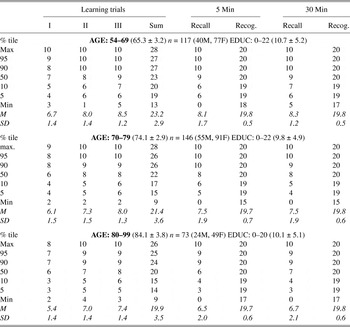
To assist in use of the test with patient populations, we include a table of normative data based on the 336 healthy elderly participants (Table 5). Given the regression analysis reported earlier that showed age accounted for a significant portion of the variance (17%), education accounted for a very small portion of the variance (2%) and neither gender nor ethnicity influenced the scores, the norm table is divided into three age ranges. For each age range the minimum and maximum scores, some key percentile scores, as well as the Mean and SD values are presented for each of the COMT measures.
COMT normative data from three age groups

DISCUSSION
The Common Objects Memory Test (COMT) was developed and administered to 336 healthy older adults, 84 patients with AD and 6 individuals with questionable dementia from five ethnic groups. Data analysis showed that test performance deteriorated somewhat with aging, but was little influenced by the participants’ education level, and un-influenced by their gender or ethnic background. Among the COMT measures, the 30-min delayed recall best distinguished the healthy controls from the cognitively impaired patients, whereas the recognition measures were relatively unsuccessful at separating the two groups.
The finding that age affected performance on the COMT is neither noteworthy nor surprising, as it is well-established that memory declines with advanced age (e.g., Wechsler, Reference Wechsler1997).
More remarkable is the finding that the COMT is hardly influenced by the education level of the participants that ranged from 0 to 22 years. This is contrary to the general findings with most tests of memory or other cognitive functions, where higher education tends to be associated with better test performance (e.g., Ardila, Rosselli, & Rosas, Reference Ardila, Rosselli and Rosas1989; Escobar, Burnam, Karno, Forsythe, Landsverk, & Golding, Reference Escobar, Burnam, Karno, Forsythe, Landsverk and Golding1986; Ganguli, Ratcliff, Belle, Huff, & Kancel, Reference Ganguli, Ratcliff, Belle, Huff and Kancel1991; Kempler, Teng, Dick, Taussig, & Davis, Reference Kempler, Teng, Dick, Taussig and Davis1998; O’Connor, Pollitt, & Treasure, Reference O’Connor, Pollitt and Treasure1989; Ostrofsky-Solís & Lozano, 2006; Rosselli, Ardila, & Rosas, Reference Rosselli, Ardila and Rosas1990; Taussig et al., Reference Taussig, Henderson and Mack1992). Most other memory tests, such as the Rey Auditory-Verbal Learning Test (RAVLT) (Schmidt, Reference Schmidt1996), the California Verbal Learning Test (CVLT) (Delis et al., Reference Delis, Kramer, Kaplan and Ober2000), and the CERAD Word List Memory test (Morris et al., Reference Morris, Heyman, Mohs, Hughes, van Belle and Fillenbaum1989), use words for stimulus presentation, and this would naturally disadvantage individuals with limited education and literacy skills (e.g., Schmidt, Reference Schmidt1996). The COMT uses colored photographs of common objects to bypass education and literacy issues. Asking the participant to name each object as it is shown during the learning trials also ensures both visual and verbal registration. The only other test for recent memory that has also shown little education, language, and cultural effects is the Fuld Object Memory Evaluation (FOME) (Fuld, Reference Fuld1980). In the FOME, real objects are used for stimulus input, and the participant is asked to palpate, view, and name each. While the COMT and the FOME are both sensitive in distinguishing healthy participants from cognitively impaired patients (e.g., Fuld, Masur, Blau, Crystal, & Aronson, Reference Fuld, Masur, Blau, Crystal and Aronson1990; Loewenstein, Duara, Arguelles, & Arguelles, Reference Loewenstein, Duara, Arguelles and Arguelles1995), the FOME involves more complex testing and scoring procedures than the COMT, and therefore more training of its examiners and longer testing time. In addition, the use of spiral-bound photographs of objects in the COMT, in contrast to the bag of objects to be retrieved in random order in the FOME, permits easier duplication of the test material and a standard sequence of stimulus presentation for all test sessions.
Ethnic and cultural background can influence test performance in various ways. Different ethnic groups may have different experiential backgrounds and language structures (Marcopulos, McLain, & Giuliano al., Reference Marcopulos, McLain and Giuliano1997; Teng, Reference Teng, Yeo and Gallagher-Thompson1996). Even the number of syllables in words can influence verbal test performance (Kempler et al., Reference Kempler, Teng, Dick, Taussig and Davis1998). During the design of the COMT, the authors kept these issues in mind and tried to minimize their impact. The finding of little ethnic influence on the COMT, at least for the five ethnic groups tested in this study, is a validation of the authors’ efforts.
Among the tests of the CCNB, the recall scores of the COMT are the most sensitive in distinguishing healthy subjects from dementia patients (Dick et al., Reference Dick, Teng, Kempler, Davis, Taussig and Ferraro2002). In addition, unlike the COMT, the other tests were more or less influenced by the subjects’ education level and ethnic background (Dick et al., Reference Dick, Teng, Kempler, Davis, Taussig and Ferraro2002; Kempler et al., Reference Kempler, Teng, Dick, Taussig and Davis1998). These findings underscore the uniqueness and usefulness of the COMT.
The recognition measures of the COMT are comparatively weaker than the recall measures. Inspection of the COMT recognition score distributions show that the recognition tests were too easy. Chance correct with the “yes” versus “no” testing format is already at the 50% level. On average, normal participants got 99% correct, and cognitively impaired participants got 79–82% correct. In the future, the COMT recognition tests could be made more difficult. For example, instead of showing 10 old and 10 new objects in mixed order, 10 four-choice photo arrays could be used, each including the original object with three foils. Using a four-choice testing format would reduce the chance correct level to 25%. The task could be made harder still by using four objects of the same name, differing only in visual image (e.g., four chairs), so that verbal memory will not aid the performance. Alternately, a four-choice paradigm could use three distracters from the same semantic category as the target (e.g., four pieces of furniture), as it is known that patients with dementia have difficulty with fine semantic distinctions early in the course of dementia (e.g., Almor et al., Reference Almor, Aronoiff, MacDonald, Gonnerman, Kempler and Hintiryan2009; Gonnerman, Andersen, Devlin, Kempler, & Seidenberg, Reference Gonnerman, Andersen, Devlin, Kempler and Seidenberg1997).
Our patient data are preliminary and limited in several ways. First, our patient sample is small and somewhat restricted (e.g., there were only four African Americans). Second, most of our patients had mild to moderate Alzheimer’s disease. The extent to which the present findings can apply to patients with vascular or other types of dementia requires more studies. Third, the extent to which the COMT can distinguish healthy elders from individuals with minimal cognitive impairment or incipient dementia also remains to be determined.
In conclusion, this study introduces a practical test of recent memory that has been used with both healthy and cognitively impaired individuals from several non-Caucasian, non-English speaking groups. The COMT is simple to administer, fairly short, barely influenced by the examinees’ education level, and un-influenced by their gender or ethnic background. Among a battery of cognitive tests, the COMT recall measures performed well in distinguishing healthy individuals from patients with dementia.
ACKNOWLEDGMENTS
This work was supported by funding from the State of California, Department of Health Services, Alzheimer’s Disease Program (Contract No. 93-18635) to Malcolm Dick. Additional support was provided by a grant from the National Institute on Aging to the University of California at Irvine, Alzheimer’s Disease Research Center (P50 AG16573). We thank the following individuals who assisted with subject recruitment and data collection: Laura Bracamonte, Kim Bui, Lydia Cano, Rocco Cheng, Chen-Chen Chen, Marian Chow, Jacqueline Conyers, Fred Dewey, Miriam Hsieh, Patricia Madrigal, Andy Nguyen, Pauline Pham, Maria Sandoval, Libbia Taylor, Nghia Tran, Sylvia Upchurch, and Holly Warriner. Finally, we thank Deborah S. Davis and Scott Lyness for their assistance with data analysis.