Children who are exposed to two languages vary widely in the bilingual proficiency they achieve. Some become fully bilingual; others become far more competent in one language than the other. The varied patterns of bilingual competency that characterize young children in dual language environments are not well understood, and there have been calls recently from several sources for research to investigate sources of variability in bilingual development (Center for Early Care and Education Research, 2010; Hammer, Miccio, & Rodriguez, Reference Hammer, Miccio, Rodriguez and Goldstein2004; McCardle & Hoff, Reference McCardle, Hoff, McCardle and Hoff2006). Because children's early oral language skills have consequences for their later academic achievement (e.g., Miller et al., Reference Miller, Heilmann, Nockerts, Iglesias, Fabiano and Francis2006; Morrison, Connor, & Bachman, Reference Morrison, Connor, Bachman, Dickinson and Neuman2006), and because the number of children entering school from bilingual homes is increasing in many regions of the world (Garcia & Jensen, Reference Garcia and Jensen2009; Scheele, Leseman, & Mayo, Reference Scheele, Leseman and Mayo2010), understanding the factors that create variability in bilingual development is a pressing need.
The variable outcomes of dual language exposure also pose an explanatory challenge for theories of language acquisition. Maturational factors cannot explain the within-child differences in the rate of language development that bilingual children often display. In contrast, theories that accord a substantial role to input in language acquisition are consistent with the robust finding that the relative amount of input children receive in each of their languages predicts the relative rate of development in those languages (David & Wei, Reference David and Wei2008; De Houwer, Reference De Houwer2009; Gathercole, Reference Gathercole2007; Gathercole & Hoff, Reference Gathercole, Hoff, Hoff and Shatz2007; Gathercole & Thomas, Reference Gathercole and Thomas2009; Hoff et al., Reference Hoff, Core, Place, Rumiche, Señor and Parra2011; Parra, Hoff, & Core, Reference Parra, Hoff and Core2011; Pearson, Fernández, Lewedeg, & Oller, Reference Pearson, Fernández, Lewedeg and Oller1997; Place & Hoff, Reference Place and Hoff2011). Although this finding that relative amount of exposure predicts balance in bilingual development points to input as a source of variability, it leaves many questions about input unanswered. Some evidence suggests that different sources and contexts of input may have different effects (Place & Hoff, Reference Place and Hoff2011; Vagh, Pan, & Mancilla-Martinez, Reference Vagh, Pan and Mancilla-Martinez2009), but very little research has addressed this question. Moreover, findings that variable patterns of language exposure create variability in bilingual development move the question of explaining bilingual development to questions about what factors shape dual language exposure. In that regard, some studies have identified parents’ immigration status and number of native heritage language speakers in the household as influences (Hakuta & D'Andrea, Reference Hakuta and D'Andrea1992; Ishizawa, Reference Ishizawa2004; Place & Hoff, Reference Place and Hoff2011), but many questions remain.
The aim of this study was to examine the influence of older siblings on language use in bilingual homes and on the language acquisition of young toddlers in those homes. The role of siblings in bilingual development has been discussed in several case studies of bilingual children (Caldas, Reference Caldas2006; Wang, Reference Wang2008; Yip & Matthews, Reference Yip and Matthews2007). These reports suggest that language use in sibling interaction does not necessarily follow the same pattern as parents’ dual language use, that older siblings have a greater influence on the language used in sibling interaction than does a younger child, and that the language of sibling interaction is typically the dominant language in the larger environment. For example, in describing the French–English bilingual development of his children in the English-dominant environment of the United States, Caldas (Reference Caldas2006) reported that both parents spoke only French at home to their youngest (twin) children, but that their oldest child, who spoke English more than French, addressed his siblings in English.
Anecdotal reports from bilingual parents in the United States concur with this description. An older sibling, they say, brings English into the home and reduces the use of the heritage language. There are several reasons why this might be the case. Children from bilingual homes who use English at school may be more proficient in English than in the heritage language and prefer to use it for that reason (Jia & Aaronson, Reference Jia and Aaronson2003; Kohnert, Reference Kohnert2002). Moreover, at least among Spanish–English bilingual children in the United States, English is clearly the language of peer interaction among school-aged children (Oller & Eilers, Reference Oller and Eilers2002), and children may extend this preference to language use with their siblings at home.
While the influence of older siblings may be to diminish the use and acquisition of the heritage language, older siblings may at the same time have salutary effects on the English language development of young children. In some immigrant families, for instance, the first child to enter school may be the first English speaker in the household and may be more proficient in English than the parents. This potentially makes older siblings a source of input that supports younger children's English language development, but the evidence from the literature on sibling effects is mixed in its implications. Research has documented that older siblings have significant roles in the upbringing of young children and are significant sources of language input in many cultures (Zukow-Goldring, Reference Zukow-Goldring and Bornstein2002). In contrast, the speech older children address to toddlers differs from the mothers’ child-directed speech in ways that suggest it may be a less rich model from which to learn (Hoff-Ginsberg & Krueger, Reference Hoff-Ginsberg and Krueger1991), which is consistent with the evidence that the rate of language development is not as rapid in later-born children as in firstborns (Bates, Reference Bates, Lewis and Rosenblum1975; Hoff, Reference Hoff2006; Hoff-Ginsberg, Reference Hoff-Ginsberg1998; Huttenlocher, Waterfall, Vasilyeva, Vevea, & Hedges, Reference Huttenlocher, Waterfall, Vasilyeva, Vevea and Hedges2010).
Two studies presented here investigated the influence of older siblings on the language environments and language development of bilingually developing toddlers. The first study investigated the influence of an older sibling on 16- to 30-month-old children's exposure to and acquisition of English in a sample of toddlers living in homes in which both English and another language were used. In that study, the second languages varied, and only English use and development were the focus of study. The second study investigated the influence of having a school-aged older sibling in a separate sample of children assessed at 22 and 30 months who lived in Spanish–English bilingual homes, which allowed investigating older sibling influence on bilingual toddlers’ development of both their languages.
STUDY 1
In Study 1, the parents of 60 toddlers living in bilingual homes provided information about language use in the home and about their children's English language development. The hypothesis that older siblings are a significant source of language-advancing English input yielded three predictions: (a) that toddlers with older siblings would hear more English at home, on average, than toddlers without older siblings, (b) that toddlers with older siblings would have higher English vocabulary scores than toddlers without older siblings, and (c) that toddlers’ English skills would be positively related to the relative amount of English their older siblings used in talking to them.
Method
Participants
The parents (58 mothers, 2 fathers) of 60 children (36 boys, 24 girls) participated in this study. For all children, according to parent report, two different languages were used in the home in direct interaction with the child. All the target children were between 16 and 30 months old (M age = 22.54 months, SD = 3.94). According to parent identification, 31 children were Hispanic, 7 European American, 7 African American, 1 Asian, and 14 were described as being of another ethnicity. All participants reported having children who were healthy, full-term, and born in the United States. All families were residing in South Florida. The language other than English was Spanish in 22 homes; other second languages included Portuguese, Creole, Hebrew, French, and others, all in small numbers.
Twenty-six of the toddlers (15 boys, 11 girls) had one or more older siblings; 34 (21 boys, 13 girls) were firstborn or only children. The two groups of toddlers were comparable in terms of their mean age and their parents’ level of education. The mean age of the toddlers with older siblings was 21.89 months (SD = 4.31); the mean age of the toddlers without older siblings was 23.03 months (SD = 3.62). Among the toddlers with older siblings, 50% of mothers and 52% of fathers had at least a college degree; among the toddlers without older siblings 62% of mothers and 55% of fathers had at least a college degree. Among those with an older sibling, 52% had two parents who were native speakers of a language other than English; among those without older siblings, 26% had two parents who were native speakers of a language other than English. Other evidence suggests that parents who are native speakers of another language use English less in talking to their children (Place & Hoff, Reference Place and Hoff2011); this difference between the two groups of children would work against the present hypothesis.
Procedure
Participants were recruited through fliers at local day-care centers and programs for young children and by word of mouth. When contact with a parent was made, a trained research assistant ascertained that inclusion criteria for the study were met (i.e., the child was exposed to two languages, was born in the United States, had no major medical or health problems, had no obvious signs of developmental delay).
An extensive interview about home language use was conducted in English with a parent who was a source of English input for the target child. In the course of the interview, estimates of the percentage of time English was used in the household overall and estimates of the percentage of time English was used in sibling-to-sibling conversation were obtained. The validity of this method of estimating children's language exposure in bilingual households is supported by findings from a separate study that parent estimates provided in interviews are highly correlated with measures of language use obtained from 7-day diary records kept by mothers following the Language Diary procedure developed by De Houwer and Bornstein (Reference De Houwer and Bornstein2003; Place & Hoff, Reference Place and Hoff2011).
The parent also filled out the MacArthur–Bates Communicative Development Inventory: Words and Sentences—Short Form (CDI). The CDI short form is a standardized checklist of 100 common words for children between 16 and 30 months, with established reliability and validity (Fenson et al., Reference Fenson, Pethick, Renda, Cox, Dale and Reznick2000). It yields a raw vocabulary score and percentile scores based on a norming sample of more than 1,000 children. Because the children in the present sample differed in age, percentile scores were used.
Results
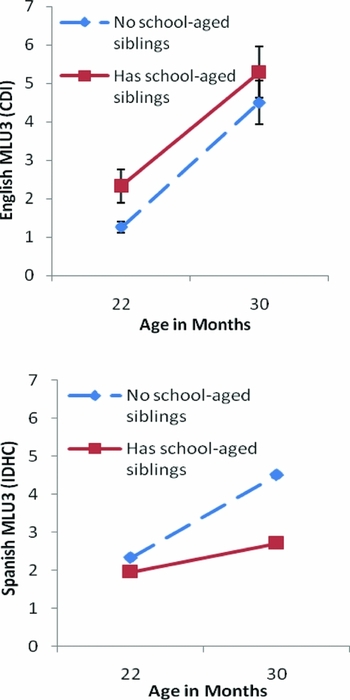
The mean use of English in the home for toddlers with and without older siblings, the mean use of English in sibling interaction for those toddlers who had an older sibling, and the mean CDI vocabulary percentile for both groups of toddlers are presented in Table 1. Two comparisons addressed the hypothesis that older siblings increase toddlers’ exposure to English. Reported overall use of English in the homes of toddlers with and without older siblings was compared and was not significantly different. Reported use of English in sibling interaction was compared to reported use of English overall, with the finding that mean use of English in sibling conversation was significantly greater than mean household use, t (25) = 1.93, p = .03, one tailed, ηp 2 = 0.13. To address the effect of older siblings on toddlers’ English development, mean CDI percentile scores were compared, with the finding that toddlers with older siblings had significantly higher English vocabulary scores than those without older siblings, t (58) = 1.77, p = .04, one tailed, d = 0.45.
Study 1 means (standard deviations) for use of English in the home and English vocabulary percentile scores for toddlers with and without older siblings

a Significantly greater than English portion of overall home language use for these participants.
b Significantly greater than English vocabulary percentile scores for toddlers with no school-aged siblings.
*p < .05 (one tailed).
Two analyses tested the hypothesis that use of English with older siblings predicted toddlers’ English skills. First, toddlers with older siblings were grouped according to whether they used only English in sibling interaction (n = 11) or both English and another language (n = 14), and the English vocabulary percentiles of those groups were compared. (There was one participant who was reported to hear only a language other than English in sibling interaction.) Among these toddlers who all had older siblings, those who were reported to hear only English from their older siblings had a mean vocabulary percentile of 45.45 (SD = 27.88), while those who were reported to hear English and another language from their older siblings had a mean English vocabulary percentile of 22.14 (SD = 20.07). This difference was significant, t (23) = 2.43, p = .01, one tailed, d = 1.16. Second, the correlation between reported percentage of English usage in sibling conversation and toddler English vocabulary was calculated; it was positive and significant, r (n = 26) = .36, p = .04, one tailed.
Discussion
Study 1 findings support the hypothesis that older siblings are an important source of English language exposure for young children in bilingual homes and have a significant influence on their English language development. According to parent report, toddlers’ conversations with their older siblings were more likely to occur in English than were the toddlers’ conversations with others. The toddlers who had older siblings were more advanced for their age in English than toddlers without older siblings. Within the group of toddlers who had an older sibling, those whose siblings used English more were more advanced in English, which also attests to the influence of siblings. These findings are consistent with arguments from the literature on monolingual children that siblings can serve as sources of language-advancing input (Zukow-Goldring, Reference Zukow-Goldring and Bornstein2002).
Although the foregoing findings are internally consistent and support the hypothesis that older children draw bilingual homes toward greater use of English than toddlers do, the study has limitations. The hypothesis of sibling effects really applies to siblings who have school or preschool experiences in English outside the home, but because the data were collected for another purpose, information on the age and activities of the older siblings was not available. A second limitation of this study is that only English vocabulary was examined as an outcome. Study 2 was designed to address these limitations by comparing toddlers with older school-aged siblings to toddlers with no older siblings by assessing vocabulary and grammatical development and by assessing the toddlers’ development in both languages they were learning. Study 2 also made use of longitudinal data to assess the stability of effects of older siblings on toddlers’ language environments and language development.
STUDY 2
Method
Participants
The participants were 27 children who were being raised in Spanish–English bilingual homes and whose mothers were native speakers of Spanish. In all families, the mothers were the primary caregivers. These participants were a subset of children selected from a larger study of early language development in children in Spanish–English bilingual homes. In that study, all children had been exposed to both languages since birth and the less-frequently heard language constituted at least 10% of their language exposure. Only those with native Spanish-speaking mothers were selected in order to have a sample of children for whom a Spanish-dominant language environment was possible; for 13 of the children (7 who had older siblings and 6 who did not), the father was also a native Spanish speaker. Fourteen of the children had one or more siblings at least 6 years old; 13 had no siblings who were 6 or older. Of the 14 with school-aged older siblings, 10 had one older sibling (mean age = 6.67 years), and 4 had two older siblings (mean age = 7.38 years). Of the 13 with no school-aged siblings, 3 had an older sibling who was 3 years old (one of these also had a twin who was not included in these analyses); 5 had younger, infant siblings; 5 were only children. All of the school-aged siblings attended English-only schools. All mothers described themselves as bilingual. Four of the children with school-aged siblings attended English-only childcare, 1 attended Spanish-only childcare, 2 attended bilingual childcare, and 7 did not attend childcare. Three of the children with no school-aged siblings attended English-only childcare, 1 attended bilingual childcare, and 9 did not attend childcare. There was no significant association between sibling status and type of childcare. In the group with school-aged siblings, 10 were boys, and 4 were girls; in the group with no school-aged siblings, 7 were boys, and 6 were girls. All children were full-term and healthy at birth, had normal hearing, and showed no evidence of communicative delay at the time of study entry (22 months) using a standardized screening instrument (Squires, Potter, & Bricker, Reference Squires, Potter and Bricker1999). The parents were highly educated: 26 of the mothers had at least a college degree, and 1 had a 2-year degree; 21 of the fathers had at least a college degree, 2 had 2-year degrees, and 4 had high school degrees.
Procedure
Subjects were recruited through advertisements in local magazines aimed at parents of young children, through electronic announcements, through contact with parents at library programs and preschools, and by word of mouth. In the initial contact, typically by telephone, a fully bilingual researcher explained the study in the language used by the caregiver and determined that the child was full-term or nearly full-term and healthy at birth, had no serious medical problems, and had begun to speak. At 22 months, caregivers completed the Ages and Stages Questionnaire (Squires et al., Reference Squires, Potter and Bricker1999) in their preferred language.
When the children were 22 and 30 months, the caregivers were administered a Home Language Environment Questionnaire, which was an elaborated version of the interview about home language use conducted with parents in Study 1. Caregivers also completed the long forms of the CDI (Fenson et al., Reference Fenson, Dale, Reznick, Thal, Bates and Hartung1993) and El Inventario del Desarrollo de Habilidades Comunicatives (Jackson-Maldonado et al., Reference Jackson-Maldonado, Thal, Marchman, Newton, Fenson and Conboy2003). These inventories are caregiver-report instruments that yield measures of vocabulary and grammatical development. The reliability of both instruments as a means of assessing vocabulary and grammatical development has been established against samples of spontaneous speech in monolingual and bilingual populations (Fenson et al., Reference Fenson, Dale, Reznick, Thal, Bates and Hartung1993; Jackson-Maldonado et al., Reference Jackson-Maldonado, Thal, Marchman, Newton, Fenson and Conboy2003; Marchman & Martínez-Sussmann, Reference Marchman and Martínez-Sussmann2002). The visits were conducted in the participants’ homes or, if the caregiver chose, in a laboratory playroom on campus. Approximately 85% of visits were conducted in the participants’ homes. At approximately 60% of the assessments for the bilingual children, the same caregiver filled out the Spanish and English inventories; 40% of the time a different caregiver completed the two instruments. If a different family member completed one of the instruments, it was left with the primary caregiver and mailed in by the participant or picked up by the examiner at the next visit.
Measures
The language inventories yielded raw vocabulary scores based on words the children had been heard to produce and also yielded two measures of grammatical development: (a) a grammatical complexity score based on 37 items in which a pair of utterances is presented, one grammatically more advanced than the other, and the caregiver indicates which sounds more like her child's speech, and (b) the mean length of the longest three utterances (MLU3) the child has been heard to produce, calculated in morphemes for both languages and excluding utterances that included words from both languages. The English and Spanish versions of these inventories are not direct translations, but rather are independently developed and normed against monolingual English- and Spanish-speaking populations. Estimates of the English proportion of total home language use, including all sources of child-directed speech, and of mothers’ and siblings’ use of English in talking to the toddler were obtained from the mothers’ responses to the Home Language Environment Questionnaire.
Results
Effects of older siblings on toddlers’ dual language exposure
The means for the measures of English language exposure for toddlers with and without school-aged older siblings are presented in Figure 1. The effect of having an older, school-aged sibling on English use in the home was assessed in a 2 (Sibling Status) × 2 (Age) mixed analysis of variance (ANOVA) with percentage of English in the home as the outcome variable. The effect of Sibling Status was significant; in homes with an older sibling who attended school, English was used a greater percentage of the time than in homes without an older child who attended school F (1, 25) = 8.47, p = .007, ηp 2 = 0.25. Because English exposure was measured as a percentage of total exposure, wherever English exposure was greater Spanish exposure was necessarily less. There was no significant effect of Age and no significant Sibling Status × Age interaction. A 2 (Sibling Status) × 2 (Age) mixed ANOVA with percentage of English in mothers’ speech addressed to the toddler as the outcome revealed that mothers who also have older, school-aged children use English in talking to their toddler more than mothers who do not have an older child who attends school. The effect of Sibling Status on mothers’ use of English was significant, F (1, 25) = 5.80, p = .02, ηp 2 = 0.19. Within the group of children who had an older, school-aged sibling, separate t tests compared the use of English by mothers and siblings at 22 and 30 months. Both comparisons revealed significant differences: in talking to toddlers, older siblings spoke proportionately more English than mothers did, t (11) = 1.86, p < .05, one tailed at 22 months and t (12) = 1.79, p < .05 one tailed at 30 months. (The ns differ from each other and from analyses of other measures because of missing data on this variable.)
Study 2 mean levels of overall English use in the home, mean English use in mothers’ child-directed speech, and mean English use in older siblings’ child-directed speech for children in Spanish–English bilingual homes at 22 and 30 months. [A color version of this figure can be viewed online at http://journal.cambridge.org/aps]

Effects of older siblings on toddlers’ bilingual development
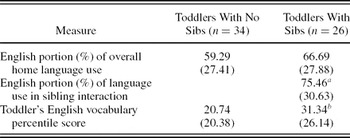
The means for the toddlers’ English and Spanish vocabulary are presented in Figure 2. A 2 (Sibling Status) × 2 (Age) × 2 (Language) mixed ANOVA assessed the effect of having an older, school-attending sibling on the toddlers’ acquisition of English and Spanish vocabulary. There was no main effect of Sibling Status averaged across Language, F (1, 25) < 1; that is, toddlers with and without school-aged siblings did not differ in total language knowledge. There was a significant main effect of Age, F (1, 25) = 72.14, p < .001, ηp 2 = 0.74; children grew in vocabulary knowledge between 22 and 30 months. There was a significant Age × Language interaction, F (1, 25) = 6.81, p = .015, ηp 2 = 0.21; on average, children's English vocabularies grew more than their Spanish vocabularies. Central to the hypothesis of the present study, there was a Sibling Status × Language interaction, F (1, 25) = 7.49, p = .011, ηp 2 = 0.23; the children with older siblings were more advanced in English than Spanish while the children without older siblings were more advanced in Spanish than in English. The three-way Age × Sibling Status × Language interaction was not significant.
Study 2 mean productive vocabulary scores in English and Spanish at 22 and 30 months for toddlers with and without older siblings. [A color version of this figure can be viewed online at http://journal.cambridge.org/aps]

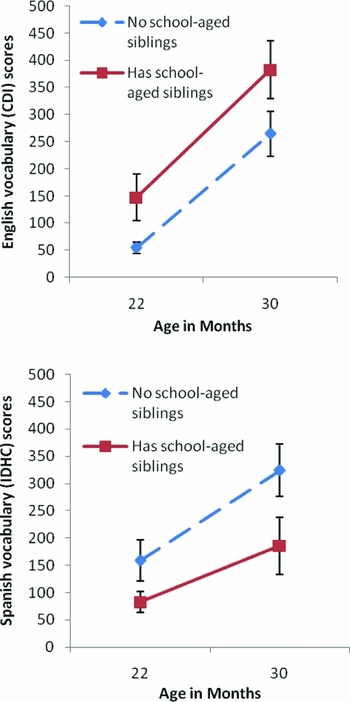
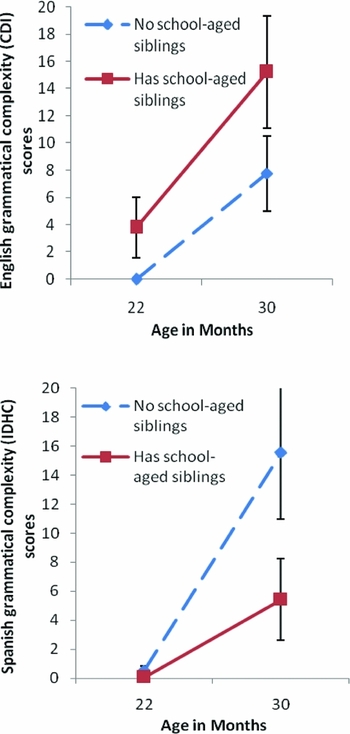
The means for toddlers’ grammatical complexity score and MLU3 are presented in Figure 3 and Figure 4. Because these measures are not comparable across languages, separate analyses were conducted for each measure in English and Spanish. There were significant main effects of Age on both measures in both languages, revealing that the children were progressing in acquiring the grammar of English and Spanish during the period from 22 to 30 months, Fs (1, 25) for grammatical complexity in English, grammatical complexity in Spanish, MLU3 in English and MLU3 in Spanish = 20.30, 15.68, 88.58, and 27.38, respectively, all ps < .001, ηp 2 = 0.49, 0.39, 0.78, and 0.52, respectively. The effects of Sibling Status on grammatical complexity in English and in Spanish were significant as one-tailed tests, F (1, 25) = 2.91, p = .10, ηp 2 = 0.11 for English and F (1, 25) = 3.78, p = .06, ηp 2 = 0.13 for Spanish. The Sibling Status × Age interaction was not significant with English grammatical complexity as the outcome measure but was significant (again, by a one-tailed criterion) with Spanish grammatical complexity as the outcome, F (1, 25) = 3.52, p = .07, ηp 2 = 0.12. The toddlers without school-aged siblings made greater gains in Spanish between 22 and 30 months than did the toddlers who had school-aged siblings. Although the pattern of differences in MLU3 was like the pattern of differences in grammatical complexity, the only significant effect on MLU3 in either language was the effect of age. There was no significant effect of Sibling Status nor Sibling Status × Age interaction on MLU3 in either language.
Study 2 mean productive grammatical complexity scores in English and Spanish at 22 and 30 months for toddlers with and without older siblings. [A color version of this figure can be viewed online at http://journal.cambridge.org/aps]

Study 2 mean length of longest utterances in English and Spanish at 22 and 30 months for toddlers with and without older siblings. [A color version of this figure can be viewed online at http://journal.cambridge.org/aps]

Discussion
The findings of Study 2 revealed effects of having an older sibling who attends school on the language experience and language development of toddlers in bilingual homes. At 22 and 30 months, the toddlers with older, school-aged siblings heard more English than the toddlers without school-aged siblings. Two factors contributed to this effect: the school-aged siblings used English more than the mothers did, but the mothers who had school-aged children also used English more than mothers in households with no school-aged children, even when talking to the toddler.
These differences in language experience had predictable effects on the toddlers’ language development. The toddlers with school-aged siblings were more advanced in English and less advanced in Spanish, compared to the toddlers without school-aged siblings. The toddlers without school-aged siblings were more advanced in Spanish than they were in English, while the toddlers with school-aged siblings were more advanced in English than they were in Spanish. An important point to note: where it was possible to look at language knowledge combined across languages, namely in the domain of vocabulary size, the children with and without older, school-attending siblings did not differ in total language knowledge. They differed only in the distribution of their knowledge between English and Spanish. The effects of having an older sibling on the children's grammatical development were in the same direction as the effects on vocabulary, but they were smaller and in the case of MLU, not significant. The finding of similar trends in effects on vocabulary and grammar is not surprising given other evidence that vocabulary and grammatical development are related, including within-language relations between vocabulary and grammar among bilingual children (Marchman, Martinez-Sussmann, & Dale, Reference Marchman, Martínez-Sussmann and Dale2004). The finding of more robust effects on vocabulary also parallels other findings in the literature that vocabulary growth is more sensitive to input effects than is grammatical development (Hoff, Reference Hoff2006; Zhang, Jin, Shen, Zhang, & Hoff, Reference Zhang, Jin, Shen, Zhang and Hoff2008).
GENERAL DISCUSSION
In a series of two studies, the influence of older siblings on language use in bilingual homes with young toddlers and the influence of older siblings on the language development of those toddlers were assessed. Specifically, we sought to determine the role that language input from older siblings has on the bilingual development of younger children in the household. Study 1 found that in bilingual homes, toddlers’ conversations with their older siblings were more likely to be in English than other conversations in the household and that toddlers who have older siblings show more advanced English vocabulary for their age than toddlers without older siblings. The inference that exposure to English via older siblings was the cause of the these English skills is supported by the findings that the amount of English that older siblings used with younger children was a positive predictor of the younger children's English vocabulary development. The findings of Study 1 left some unanswered questions: despite the difference in English use between siblings and household use in general, the difference in household use between the homes of toddlers with and without older siblings was not significant, raising questions about the overall impact of older siblings on households. Moreover, Study 1 looked only at toddlers’ English development, leaving open the possibility that the effect of siblings was not a specific effect of English use on English development, but possibly a more general effect of the stimulation of an older sibling on development or language development.
Study 2 addressed these open questions. When households with older siblings who attended school taught in English were compared to households with no school-aged children, the difference in English usage was significant. The more detailed data available in Study 2 revealed not only that older, school-aged siblings use English more than mothers, but also that mothers who had an older child in addition to the target toddler used English more in talking to their toddler than did mothers with only a toddler. The findings of Study 2 replicated the effect observed in Study 1 of older siblings on toddlers’ English and revealed that the effect was not on language development in general but on the acquisition of English. Toddlers without older siblings who heard less English at home were more advanced in Spanish than toddlers with older siblings. The findings of Study 2 also demonstrated that language development differences between toddlers with and without older siblings were not confined to vocabulary but appeared in at least some measures of grammatical development as well. Last, the findings of Study 2 demonstrate that the effects of older siblings on toddlers’ English exposure and English development were stable across the period of development from 22 to 30 months.
The present findings are consistent with previous work on the influence of siblings that has argued that older siblings can serve as a significant source of language exposure to young bilingually developing children (e.g., Zukow-Goldring, Reference Zukow-Goldring and Bornstein2002). The present findings suggest that older siblings may be a valuable source of English exposure to young children in some immigrant households. Although other findings have suggested that older siblings are not equivalent to adults as sources of language-advancing input (Hoff-Ginsberg & Krueger, Reference Hoff-Ginsberg and Krueger1991), there was no evidence of that in the present data. The effect of older siblings was on the balance of English and Spanish in the children's development, but not on the overall rate of development. In that regard, however, it is important to point out that the present findings are limited to a very early period in language development. The continued role of siblings in the English language use and English development of children in bilingual homes requires further study. The present findings also confirm the informal observation that heritage language use in the home is less likely to be maintained as children enter school and bring their English experience home. Thus, the entry of children into school, at least into schools that use English as the medium of instruction, as was the case for all the older siblings in Study 2, appears to contribute to heritage language loss as it also contributes to English language development in their younger siblings.
The present studies provide only a limited window on the influence of older children in bilingual households on their younger siblings’ language environments. We have measured children's exposure using caregiver estimates of the balance of English and heritage language use in the home. Although these and other data suggest that these measures are valid and relevant to children's language development, it is clear from other research that children's total amount of language experience varies from home to home and that the total amount of children's language experience matters for language development (e.g., Hoff, Reference Hoff2006). It is also clear from research on monolingual and bilingual children that some types of input are more supportive of language development than others, such that not only quantity but also the quality of input matters (Hoff, Reference Hoff2006; Place & Hoff, Reference Place and Hoff2011). Moreover, we have measured the children's language development using only caregiver report instruments and the summary measures of vocabulary and grammatical development they yield. Again, although these measures are valid measures of language development, they may not fully capture the differences in language development that older sibling influences produce. Last, the findings of these studies may be specific to bilingual environments in which one language is clearly the culturally dominant language and the other is a heritage and minority language. For all the school-aged siblings in these studies, English was the language of instruction in school, and the findings of other research suggest that English would have been the almost exclusive language of peer interaction for these older children (Oller & Eilers, Reference Oller and Eilers2002). In a different type of bilingual environment, in which the two languages used at home were both used in instruction and among peers, the influence of an older sibling might be different.
These limitations notwithstanding, the present findings shed new light on the contextual variables that shape young children's dual language experience and the processes that account for variability in early bilingual development. When the language that adults speak in the home differs from the culturally dominant language, the children in households who leave the home each day to attend school are a bridge between the home and larger environment. These children bring the language they use in school home with them and influence the balance of language use in bilingual homes. The result is that young toddlers in bilingual homes hear the culturally dominant language more and acquire it more rapidly when they have a school-aged sibling. This exposure to and acquisition of the culturally dominant language appears to come at the expense of the heritage language. An important finding of the present work is that school-aged siblings add to the use of the culturally dominant language not only by speaking it themselves but also by increasing their mothers’ use of that language. This finding is an example of how the nested influences of different levels of children's environments exert their effects (Bronfenbrenner & Morris, Reference Bronfenbrenner, Morris, Damon and Lerner1998). In this case a societal level variable, the language used in schooling, influences the home environments that children experience.
ACKNOWLEDGMENTS
This research was supported by Grant HD054427 (to E.H.) from the Eunice Kennedy Shriver National Institute of Child Health and Human Development. Portions of this work were submitted by the first author in partial fulfillment of the requirements for the degree of Master of Arts at Florida Atlantic University.