INTRODUCTION
A general principle of sociolinguistic theory is that speakers style shift (i.e. vary the way in which they talk from moment to moment). In the variationist paradigm, this has become known as the principle of style shifting (Labov Reference Labov1971:112). However, research in language obsolescence has long presented evidence that appears to contradict this principle.Footnote 1 Since the 1970s at least, scholars have shown that, where a minority threatened variety is progressively lost in ‘gradual language death’ (Campbell & Muntzel Reference Campbell and Muntzel1989:182), restructuring phenomena can be observed in the linguistic system, one such phenomenon being the functional contraction of speakers’ language style repertoires, termed stylistic shrinkage (e.g. Dressler Reference Dressler1972:454; Dressler & Wodak-Leodolter Reference Dressler and Wodak-Leodolter1977:36–37; Romaine Reference Romaine1989:372; Grinevald Craig Reference Grinevald Craig and Coulmas1997:261; Holloway Reference Holloway1997:149; Dal Negro Reference Dal Negro2004:50). Speakers of dying languages are thus said to be monostylistic (Dressler & Wodak-Leodolter Reference Dressler and Wodak-Leodolter1977:37; Dressler Reference Dressler and Cooper1982:326, Reference Dressler and Newmeyer1988:188–89). Such observations raise questions for contemporary accounts of language variation and change, in which the centrality of style variation is unquestioned. For instance, if variation is necessary for linguistic change (e.g. Bailey Reference Bailey1973), and theories of style shift are predicated on some broad consensus in a community around a set of standard norms and values to which speakers orient (Labov Reference Labov1972:120–21), then how do innovations diffuse (if at all) through communities speaking threatened languages that are characterized as (a) monostylistic, and (b) lacking normative infrastructure? It is therefore still pertinent to ask if variability in language obsolescence differs from that found in ordinary language change. While some forty years ago Hill & Hill argued that Labovian innovations in field methods would ‘provide new opportunities for scholars working on dying languages’ (Reference Hill and Hill1977:55), very little attention continues to be paid to the intersection of variationist sociolinguistics and the study of language obsolescence (Wolfram Reference Wolfram, Chambers, Trudgill and Schilling-Estes2002:777–78; Hildebrandt, Jany, & Silva Reference Hildebrandt, Jany; and Silva2017:1), in spite of the continued and unprecedented rate of loss in global linguistic diversity (Amano, Sandel, Eager, Bulteau, Svenning, Dalsaard, Rahbek, Davies, & Sutherland Reference Amano, Sandel, Eager, Bulteau, Svenning, Dalsaard, Rahbek, Davies and Sutherland2014; Loh & Harmon Reference Loh and Harmon2014).
The goals of this article are (a) to present results from a variationist analysis of style shifting observed among speakers of obsolescent Francoprovençal in France and Switzerland, and (b) to argue more broadly for bridging research on severe language endangerment with variationist sociolinguistic theory. Not only would this approach contribute more diverse sources of data, as has been called for (Stanford Reference Stanford2016:525), but, as shown below, such an approach can reveal insights into the nature of language change by offering observations about how variation can emerge and acquire social meaning over time. This article also aims to shed light on variation in severe language endangerment, where it is argued that stylistic shrinkage is not a foregone conclusion. The data discussed here come from a corpus collected for a larger project on language variation and change in Francoprovençal (Kasstan Reference Kasstan2015a). Francoprovençal is an ideal test case for the proposed approach: it is a highly fragmented and severely endangered regional language spoken across three nation-states, with no existing prestige variety or standard norm. While speakers have long been shifting to the dominant languages with which Francoprovençal is in contact, the language is nevertheless also experiencing a renaissance on the ground. A pan-regional Arpitan revitalization movement has emerged in which ‘new speakers’ (O'Rourke, Pujolar, & Ramallo Reference O'Rourke, Pujolar and Ramallo2015) and new sociolinguistic practices are now being nurtured. A comparison of these disparate practices forms the basis for the wider discussion on language variation and change in severe language endangerment.
The article is organized as follows: to orient the reader, some initial commentary is given on the language under investigation. Then, the traditional work on language obsolescence as it relates to style is reviewed in the second section, and this literature is then connected with more current research on new speakers of endangered languages. The research design is introduced for fieldwork undertaken in two Francoprovençal-speaking communities, followed by sections on data and analysis. Some conclusions and future research trajectories are proposed in the final section.
LANGUAGE CONTEXT: ON FRANCOPROVENÇAL
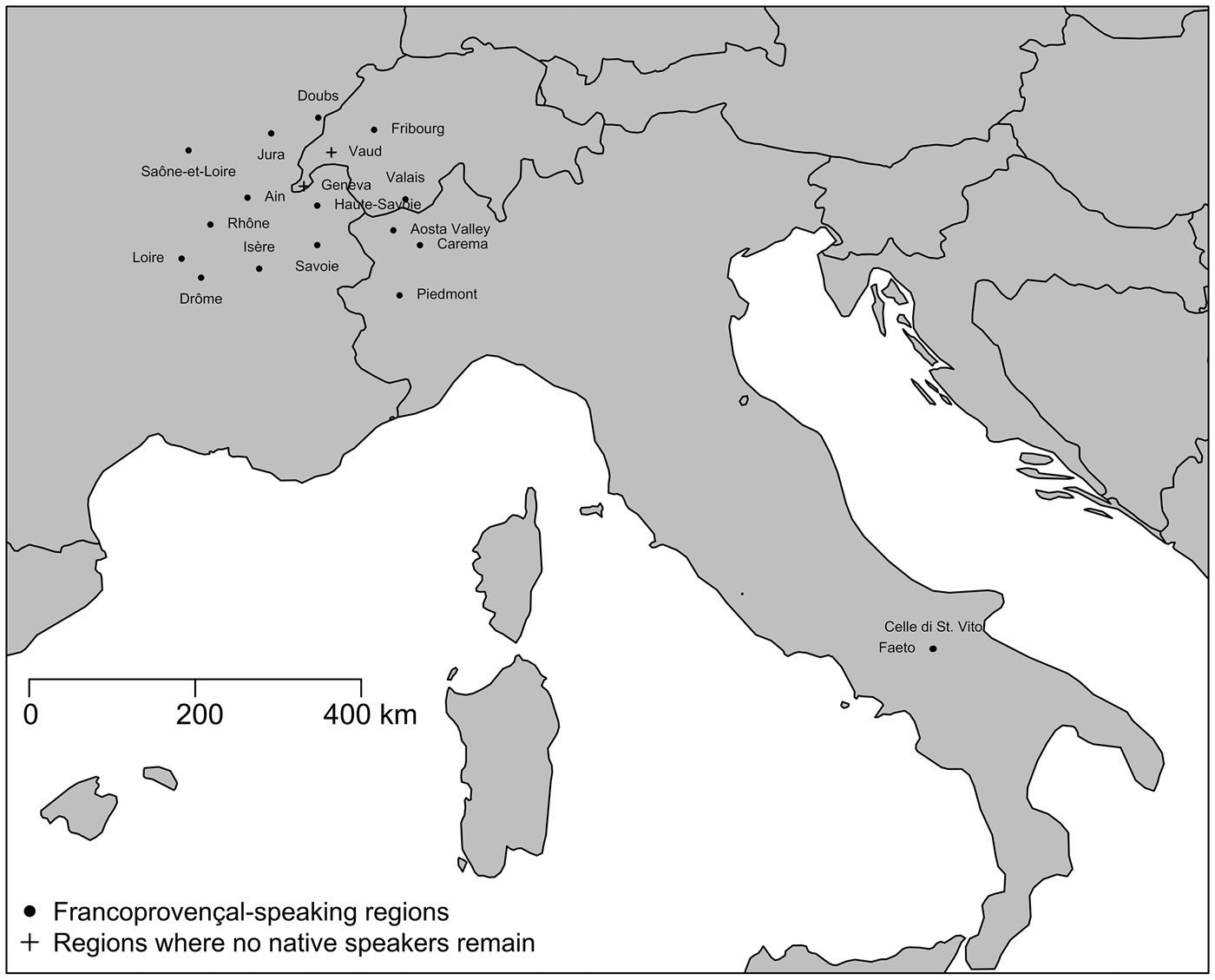
Francoprovençal is the label given by linguists to a fragmented Romance language spoken transnationally across French, Italian, and Swiss borders. While the language was spoken in the region long before the formation of modern nation-state boundaries, there has traditionally been significant disagreement over such fundamental issues as the linguistic criteria that have been adopted in demarcating the Francoprovençal-speaking region, the limits of these borders, and the glottonym that has been adopted to refer to the language (for an overview, see Kasstan & Nagy Reference Kasstan, Müller and Nagy2018).
Although a Francoprovençal literary heritage emerged in the thirteenth century, the folk-linguistic perception among speakers has always been one of fragmented oral vernacular tradition. Accordingly, there is no pan-regional linguistic identity comparable to, for example, Breton and bretonnant identity in Brittany: speakers have never embraced membership in a common linguistic system (Matthey & Meune Reference Matthey and Meune2012:108), and will instead refer to their language affectionately as ‘patois’ rather than ‘Francoprovençal’. The status accorded to the language varies widely: Francoprovençal in the Aosta Valley (northern Italy) is afforded provision in schools under Law 482, having long been recognized as a regional language. Conversely, in France, Francoprovençal was not officially recognized until 1999 (Cerquiglini Reference Cerquiglini1999:6); it is accorded no official status or suitable provision, and speakers have been encouraged (explicitly and implicitly) to abandon Francoprovençal over generations. The concomitant effects of Francoprovençal's history and variable status have contributed to its current state as a severely endangered language. Measures of ethnolinguistic vitality vary significantly across national borders (Zulato, Kasstan, & Nagy Reference Zulato, Kasstan and Nagy2018:13), and speakers have long been dwindling as language shift progresses. Francoprovençal is no longer transmitted inter-generationally in France, where French has long been entrenched in the critical domain (the home), and the decline is well advanced in Switzerland, too, in spite of local efforts to maintain traditional practices.
For the most part, then, Francoprovençal has retreated almost exclusively to the private sphere: it is mostly used by the eldest speakers inside the family (if at all), and exclusively in informal contexts. The overall picture is thus one of gradual language death (Campbell & Muntzel Reference Campbell and Muntzel1989:182): a context of long-term language contact, typically characterized by unstable diglossia, where there is a contraction in the domains of usage available to the threatened variety, leading to (a) periods of bilingualism, (b) a decrease in linguistic competence, and therefore (c) an identifiable continuum of speakers with variable proficiency. In Dorian's seminal work, this continuum ranges from fluent speakers to ‘semi-speakers’ (Reference Dorian1981:114). Semi-speakers have been referred to as ‘harbingers of language death’ (Jaffe Reference Jaffe2015:23) as they represent both a downward trajectory in language vitality at the level of the speech community, and a general pattern of so-called linguistic ‘decay’ at the level of the individual. This general pattern is so commonly reported that Dorian (Reference Dorian1977:29) has proposed a number of semi-speaker universals, chief among them their apparent reduction of stylistic options.
STYLE VARIATION IN LANGUAGE OBSOLESCENCE
As Mougeon & Beniak (Reference Mougeon, Beniak and Dorian1989) note, most sociolinguistic research investigating the linguistic effects of language obsolescence has focused on simplification in the grammar and style reduction.
If simplification is the result of disuse of a minority language, style reduction is the consequence of its functional restriction and usually involves the decline of stylistic options which are tied to those societal domains where use of the minority language is excluded. (Reference Mougeon, Beniak and Dorian1989:299, emphasis in original)
Prototypically, the model predicts that, as the threatened variety progressively loses ground to the superordinate contact variety, there is a subsequent loss of more or less formal language styles associated with those domains, leaving speakers to control only casual styles in the most intimate domains.Footnote 2 This pattern of stylistic shrinkage has been demonstrated cross-linguistically and at most levels of linguistic description. For instance, Dressler & Wodak-Leodolter (Reference Dressler and Wodak-Leodolter1977) report stylistic shrinkage in Breton lexicon. Breton has long been subordinated to French in most formal domains, and so style differentiation does not, they argue, ‘seem to be important anymore… of all Breton styles, only casual speech remains’ (Reference Dressler and Wodak-Leodolter1977:37). Holloway (Reference Holloway1997) adopts the label stylistic shrinkage to describe the contraction in morphosyntactic variation among speakers of Brule Spanish (Louisiana). In his sample, some speakers do not distinguish between variable pro-forms usted and tú to mark formal and informal distinctions: he cites examples of speakers employing informal second-person singular inflectional morphology regardless of speech style. Holloway argues that ‘the formal registers are so impoverished that Brule speakers for the most part have little underlying awareness of the distinctions which speakers of many other Spanish dialects use to distinguish formal and informal speech’ (Reference Holloway1997:149). Similarly, Gal (Reference Gal and Schiffrin1984) illustrates stylistic shrinkage in the phonological systems of her Oberwart Hungarian-German bilinguals. While older speakers in her sample consistently style-shift in traditional sociolinguistic interviews for three Hungarian variables, her younger speakers acquire the variants for these linguistic variables, but not the associated interactional constraints, and so use the variants interchangeably irrespective of speech style (Gal Reference Gal and Schiffrin1984:297). Gal reasons that the younger speakers maintain different social-network structures to the older speakers in that they are predominantly German speaking, and so there are far fewer occasions to employ Hungarian. The absence of normative pressure is also highlighted.
[F]or these speakers there is no social network of Hungarian-speaking peers which could maintain separate stylistic norms within Hungarian [nor is there a] social institution which would demand that they actively use a distinction between the social significance of standard and local forms. (Gal Reference Gal and Schiffrin1984:298)
For the purposes of the present article, the absence of overt normative infrastructure and its implications for style shifting in language obsolescence is noteworthy. Stanford & Preston (Reference Stanford, Preston, Stanford and Preston2009:8) have also highlighted that traditional variationist approaches to lesser-studied languages face the challenge posed by a lack of established normative pressures. In the same volume, Clarke's (Reference Clarke, Stanford and Preston2009:120) data, taken from research on Sheshatshiu-Innu-aimun (Canada), are characterized by a void of stylistic variation for fourteen of the eighteen variables studied, which she suggests may result from ‘the absence of… a prestige standard [or] orthographical norm’. However, the absence of a standard does not entail the absence of style variation, as work on variation in underdocumented languages has tended to assume (Skilton Reference Skilton2017:108). That Clarke identifies four variables operating like sociolinguistic markers (per Labov Reference Labov1972:238) is not inconsiderable, but no explanation is offered to account for this variation: ‘why some features… should be more subject to style shifting is not fully clear’ (2009:120). Similarly, Rau, Chang, & Dong (Reference Rau, Chang, Dong, Stanford and Preston2009:274) identify style shifting between wordlist and narrative styles for word-final (ay) and (aw) among four speakers of Yami (Orchid Island, Taiwan), another unstandardized endangered language. Their data show that three speakers produce the conservative (unraised) variant in wordlists to categorical levels, and variable raising in the more informal narrative style (cf. Lai & Gooden Reference Lai and Gooden2018:134). While the sample is small, in this case it appears that speakers orient to the most conservative variant when most attention is paid to speech. Skilton's (Reference Skilton2017) qualitative work on obsolescent Máíhɨ̃ki (Peru) also demonstrates that style shifting is still present in the absence of a standard norm, and Dorian has already proposed that the absence of such norms may encourage rather than inhibit ‘the persistence of conspicuous interspeaker and intraspeaker variation’ (Reference Dorian1994a:694). Nevertheless, these examples notwithstanding, it is clear that, in the vast majority of gradual-death case studies, stylistic shrinkage has been commonly documented. The contraction of style repertoires has been linked to external factors such as domain loss and to the absence of normative pressures.
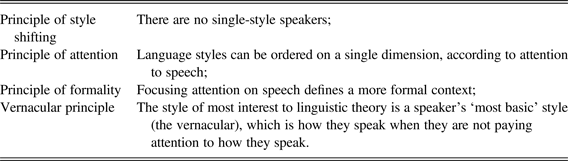
As Dorian (Reference Dorian, Biber and Finegan1994c:331) suggests, such characterizations of monostylistic behavior challenge the principle that ‘there are no single-style speakers’ (Labov Reference Labov1971:112).Footnote 3 Labov's principles of linguistic methodology are predicated on this postulation, from which he derives three further principles (Table 1) that now constitute standard assumptions in variationist fieldwork, be it in sites closer to or far from New York City.Footnote 4
Principles of linguistic methodology (Labov Reference Labov1971).

Under his attention-to-speech model of style shifting, increased focus on speech is taken to indicate a more formal context where speakers shift away from the vernacular (or ‘casual’ style). However, Labov's model is not without its critics, many of whom have instead prioritized the role of stances, activities, and interactions in style shifting, seeing the process as much more agentive and less unidimensional than his model implies (Meyerhoff Reference Meyerhoff2016). Among the early agentive approaches, Bell (Reference Bell1984) was careful to note the implications of the loss of style repertoires. Under audience design, Bell posits the style axiom, which holds that intraspeaker (stylistic) variation ‘derives from and echoes’ interspeaker (social) variation (Reference Bell1984:151), and, therefore, ‘If a variable has no interspeaker variation, it will have no intraspeaker variation (Reference Bell1984:158). In gradual language death, Bell (Reference Bell1984:158) adds that loss of style variation (what has been termed stylistic shrinkage) is a response to and result of the contracted range of social variation resulting from domain loss. His interpretation of domain loss thus also implies a reduction in occasions, contexts, and types of speakers with which to interact. The below discussion departs from this view that loss of domains entails monostylism.
It is also noteworthy that the cline of language obsolescence is not necessarily terminal. In language-revitalization contexts, there can be a ‘reshift’ (Fitzgerald Reference Fitzgerald2017:e288) in that communities commit to reclaiming and reacquiring the indigenous variety. Very often, revitalization groups acknowledge the pitfalls of absent standardized or normative practices for their own broader goals associated with, for example, more favorable language policies, or reversing the decline in speaker numbers. Therefore, revitalization strategies might, in the process of reversing language shift (a macro-level change), also reverse processes such as stylistic shrinkage (a micro-level change), as they promote the use of the threatened variety in a greater number of domains. While the expansion of the sociostylistic range through language revitalization remains understudied, recent work on new speakers has considered the implications for broader questions related to language variation and identity construction in severe language endangerment.
LANGUAGE REVITALIZATION AND NEW SPEAKERS
The ‘new speaker’ label is used in work on language endangerment and revitalization to characterize the lived experiences and sociolinguistic realities of individuals who acquire a minority language not through traditional transmission contexts (e.g. home, family), but as adults through revitalization initiatives (O'Rourke et al. Reference O'Rourke, Pujolar and Ramallo2015). The adoption of this label breaks with a tradition in sociolinguistics that prioritizes the study of ‘native’ speakers—seen as the most traditional or authentic (and thus legitimate) representatives of a speech community—at the expense of more recent arrivals, whose language production has been viewed in terms of deficit (these speakers are typically labelled ‘L2’ or ‘learner’, etc.). Such essentialist perspectives on language and identity follow from an ideology of language (and fluency) as inherited by birth (Rampton Reference Rampton1990). Essentialist beliefs are particularly common in endangered-language contexts, which are very often characterized by (a) dwindling numbers of older more fluent speakers, and (b) a preponderance of younger speakers with more limited proficiency.
New speakers have become the focus of a number of (predominantly qualitative) sociolinguistic studies in language endangerment. Kasstan (Reference Kasstan2017) highlights some general characteristics of new speakers based on the available evidence from threatened languages such as Breton. Broadly, they can be characterized as well-educated middle-class urbanites, who are highly politicized in the sense that they are often engaged in language revitalization initiatives. They are therefore in most cases far removed from more ‘traditional’ endangered-language speakers, who tend to be described as older, nonmobile, rural dwelling, and working class (e.g. in France, Pooley Reference Pooley2000:141–43). While the bulk of this work has focused on interaction-level analyses of speaker legitimacy and power relations in the community, far less attention has been paid to linguistic variation. This is surprising, given that new speakers are potentially important and influential arbiters in communities where no standard or prestige norm is established, or where ‘personal pattern variation’ (Dorian Reference Dorian1994a:634) abounds.
In language-revitalization initiatives, new speakers have significant input on and influence over emergent or fluctuating normative practices. For example, although Breton has been described as a clear-cut case of gradual death for some time, new speakers have been cultivated in Breton-medium (Diwan) schools in Britany now for several decades. This has given rise to a generation of néo-bretonnants who are said to employ a standardized variety of Breton far removed from the traditional norms associated with older speakers (Jones Reference Jones1998:323). Much of the qualitative sociolinguistic work on Breton has emphasized the social and linguistic disparity between ‘traditional’ and ‘new’ speakers. Adkins (Reference Adkins2013:66), for instance, describes how the former can view néo-breton as inferior or inauthentic, and Jones (Reference Jones1998:321) has suggested that néo-breton speakers will typically simplify complex Breton structures. However, this has been questioned in recent production studies that evidence little difference in quantitative terms distinguishing néo-bretonnants from older speakers in structured elicitation tasks (e.g. Kennard & Lahiri Reference Kennard and Lahiri2017). Nonetheless, the Breton case does illustrate that there are perceptible production differences between traditional speakers of endangered languages and emergent new speakers, and this linguistic differentiation has led to more recent quantitative work that has sought to investigate new-speaker variation in more naturalistic settings.
Nance, McLeod, O'Rourke, & Dunmore (Reference Nance, Wilson and Dunmore2016) present a quantitative analysis of word-final rhotic variation among Scottish Gaelic new speakers in Glasgow and Edinburgh. While the older ‘traditional’ Gaelic speakers approximated to palatalized rhotics in the study, some new speakers displayed substantial variation in their production of rhotics, in some cases preferring weakly rhotic or nonrhotic variants in spite of high fluency rates. These observations were supported by sociolinguistic interviews that illustrated that these speakers ‘preferred an ideal self that was more oriented towards a new-speaker model and considered a native-speaker target as inauthentic’ (Nance et al. Reference Nance, Wilson and Dunmore2016:185). Nance and colleagues show then that new speakers can produce linguistic variants that (a) differ from traditional norms, and (b) are socially constructive as markers of newspeakerness rather than traditional practice. Nance has further argued that Scottish Gaelic new-speaker variation in Glasgow is becoming enregistered, with speakers recognizing an emergent and discrete new-speaker variety, described as ‘distinctive and innovative within Gaelic-speaking circles’ (Reference Nance, Smith-Christmas, Murchadha, Hornsby and Moriarty2018:223). The Scottish Gaelic study shows that adult learners not only acquire sociolinguistic variation, but that they can also innovate features that can come to convey social functions without precedence in their respective speech communities. However, as little if any attention has so far been paid to style shifting among new speakers, it is not clear to what extent they are able to control for variation across language styles that are constrained by external factors, and how such variants (and associated constraints) are diffused. More evidence is therefore needed to establish the extent to which variation observed in language obsolescence is analogous to the systematic variability described in variationist studies on dominant languages. As language styles play a pivotal role in socially informed (Labovian) theories of linguistic variation and change, it is suggested here that style variation will provide a window on these processes in severe language endangerment, too.
VARIABLE PALATALIZATION OF LATERAL APPROXIMANTS
An investigation into style variation in language obsolescence formed part of the research design for a project on variation and change in Francoprovençal (Kasstan Reference Kasstan2015a). This article considers one dependent variable: the palatalization of /l/ in obstruent + lateral onset clusters /kl, ɡl, pl, bl, fl/.
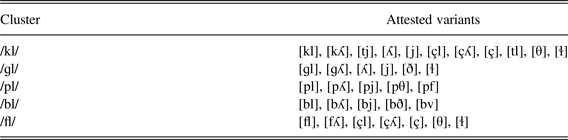
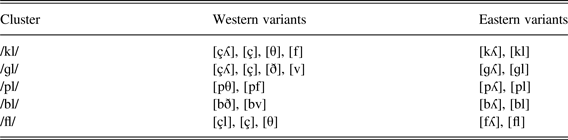
Palatalization of laterals is an old and well-attested feature in Romance (e.g. Jänicke Reference Jänicke1997), and, in Francoprovençal, there is substantial variation both in terms of the clusters that palatalize and the surface variants that emerge (see Table 2).Footnote 5
Attested variants in C + /l/ onset clusters (adapted from Stich Reference Stich1998:47–50).

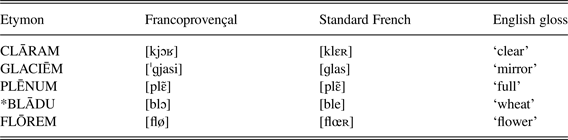
In Les monts du Lyonnais (France), early twentieth-century atlases (Gilliéron & Edmont Reference Gilliéron and Edmont1902–1910; Gardette Reference Gardette1950–1956) illustrate /l/ as palatalizing only in the velar + lateral clusters, where the median approximant [j] is attested, while [l] is produced in the labial + lateral clusters (see Table 3). This pattern holds across communes.
Palatalization in les monts du Lyonnais (adapted from Gardette Reference Gardette1950–1956).

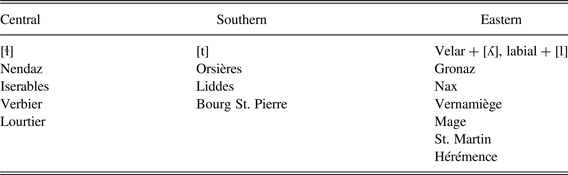
In the Canton of Valais (Switzerland), the picture is comparatively more complex. Gilliéron's (Reference Gilliéron1880) atlas indicates that palatalization in all five obstruent + lateral clusters varies from commune to commune. Gilliéron grouped his data into two sets: variants in the /kl, ɡl, fl/ set (map 24),Footnote 6 and those in the /pl, bl/ set (map 25). Table 4 summarizes Gilliéron's observations from map 24, where four variants are identified.
(l) variants for /kl, ɡl, fl/ clusters in Valais (adapted from Gilliéron Reference Gilliéron1880).

This article concerns itself primarily with those sites identified as ‘eastern’ in Table 4, where two forms are attested: [ʎ] in velar clusters, and [l] in labial clusters. Conversely Jeanjacquet (Reference Jeanjacquet1931:39–40) describes the feature as variable (see Table 5).
Regional variation in Valais (after Jeanjacquet Reference Jeanjacquet1931:40).

Table 5 shows that, in eastern Valaisan communes, palatalization varies between [ʎ] ~ [l] in all clusters, contra Gilliéron, who reports palatalization in the velar clusters only. This indicates a possible change in progress in the 1930s, some fifty years after Gilliéron (Reference Gilliéron1880), whereby a categorical rule (palatalization before velar obstruents only) has become variable; optionality emerging out of formerly categorical rules is commonly attested in language obsolescence (e.g. Campbell & Muntzel Reference Campbell and Muntzel1989). Moreover, at the time of writing, Jeanjacquet concedes that palatalization was ‘tending to disappear’ (i.e. likely recessive) in the eastern varieties (Reference Jeanjacquet1931:40). The discussion below focuses on one eastern variety spoken in the commune of Savièse, which is motivated by two concerns. First, if Jeanjacquet's assessment concerning the progressive loss of palatalization in the East is accurate, then this may have implications for the broader discussion on stylistic shrinkage under investigation here. Second, evidence from local orthographic standardization in Savièse suggests that, since at least the 1960s, it has become convention to transcribe the lateral in obstruent + lateral clusters as <l>, for example, <cl, gl> etc. (Favre & Balet Reference Favre and Balet1960). This is significant, as the orthographic norm in Savièse is a phonetic-based spelling system, and so the use of <l> would indicate that palatalization is no longer present in the speech community, particularly when compared with other regions, such as Évolène, where, for example, <kly, gly> is found to mark /l/-palatalization (Barmaz & Pannatier Reference Barmaz and Pannatier2013:40).Footnote 7 In the intervening years, then, a change that was described as incipient in the 1930s may have gone to completion in Savièse by the 1960s, which would account for local spelling conventions. Some recent empirical evidence, however, does call this into question. Data collected from two speakers between 1994–2001 for the Atlas linguistique audiovisuel du francoprovençal valaisan (ALAVAL) (Diémoz & Kristol Reference Diémoz and Kristol2018) show that, while the male participant (born 1935) produces a small number of palatalized tokens (in variation with [l]), the female participant (~1937) produces no palatalized tokens at all. This may indicate then that any shift to [l] is akin to a change-from-above (Labov Reference Labov2001:274).
To summarize, in Savièse, historical evidence indicates that a categorical rule of palatalization may have become variable, whereby [ʎ] has come to co-vary with [l] across the obstruent + lateral clusters. However, none of the authors circumscribe this variation in any way, nor do they provide details of the conditions under which this variation is constrained, which is typical of the dialectological tradition. There is no comparable evidence for Les monts du Lyonnais, where very little sociolinguistic spadework has hitherto taken place, and where atlas data only illustrate the presence of palatalization to [j] before velars.
Two further considerations concerning palatalization need to be highlighted. First, the palatalization of laterals in both regions has long been subject to metalinguistic commentary, where it is evaluated as a typical Francoprovençal feature (e.g. Duraffour Reference Duraffour1932:238). Moreover, during fieldwork, speakers offered commentary on lateral palatalization, describing it as the ‘famous L’ or ‘impossible to explain to nonspeakers’. In a few cases, speakers evoked a ‘performative style’ (Schilling-Estes Reference Schilling-Estes1998:56) in which the feature was offered in a rote phrase as a shibboleth. Lateral palatalization can therefore be said to carry icon status among speakers as a ‘Francoprovençal-like’ target. Secondly, this has been recognized by language revitalizers. Recent pan-regional standardization efforts in the region have given rise to a unified multidialectal orthography termed Orthographe de référence B (ORB; Stich, Gouvert, Favre, & Walter Reference Stich, Favre and Walter2003). ORB has been heavily criticized by speakers and linguists alike, but it has been adopted by the Arpitan revitalization movement, and remains popular among new speakers in particular (Matthey & Meune Reference Matthey and Meune2012:108). Under ORB, /l/-palatalization is transcribed with the characteristic diagraph <ll>, that is, <cll, gll, pll, bll, fll>, indicating that palatalization occurs in all obstruent + lateral sets. In an earlier iteration of the orthography, the ‘recommended’ pronunciation [ʎ] is offered for <ll>, which is described (inaccurately) as the ‘majority’ form for the Francoprovençal-speaking region, and the form that speakers seeking a ‘standard’ accent should emulate (Stich Reference Stich1998:78).
A review of the literature shows that /l/-palatalization is both variable and subject to metalinguistic evaluation. The feature is therefore suitable for variationist analysis, and is referred to as (l) in the Labovian tradition. In the following sections, data are presented from the empirical investigation. The first dataset comes from participants in Les monts du Lyonnais (France).Footnote 8 These data are then compared with a second dataset collected in Savièse (Switzerland). First, the research design is outlined.
METHODOLOGY IN TWO FRANCOPROVENÇAL-SPEAKING COMMUNITIES
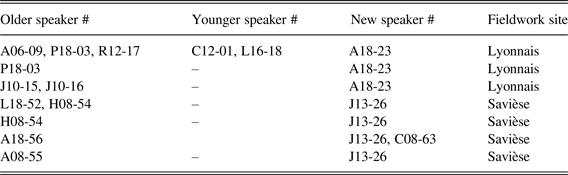
Fieldwork was conducted in France and Switzerland in 2012. In both sites, Francoprovençal has long been subordinated to French. The data come from a judgement sample of participants, via the friend-of-a-friend technique, who fall into three categories: ‘older’, ‘younger’, and ‘new’ speakers (participant demographics are provided in Appendix 1).Footnote 9 ‘Older’ speakers are defined here as an inter-war generation who acquired Francoprovençal as a mother-tongue: they are disproportionately retired rural dwellers. The ‘younger’ speakers are a postwar generation who acquired Francoprovençal in late adolescence. While French was prioritized in the home by immediate caregivers, they were nonetheless exposed to Francoprovençal through its presence in the wider sociocultural environment (e.g. grandparents, older siblings, the community). Like their reference group (the older speakers), they are also typically rural dwelling. Younger speakers exhibit significant variation in their production, often evidencing changes and simplifications in the grammar. In this respect they are analogous to the ‘semi-speakers’ described above. The new speakers, by contrast, are much younger tertiary-sector workers who began acquiring Francoprovençal as adults in an educational context, through evening classes provided by local language associations, or through the use of available pedagogy on the language. These speakers are much more likely to write and read than speak Francoprovençal, and there can be substantial variation in proficiency levels. For the purposes of this study, it is the extent to which they are able to acquire internal and external constraints on variation that is of most interest, and whether they can style shift. The distribution of the final sample is presented in Table 6.Footnote 10
Study final sample.

In order to compare the linguistic practices of these three groups, the research design borrows from Schmidt (Reference Schmidt1985), who adopted an index of language use to account for production differences between younger and older speakers of Dyirbal, another context of gradual language death. Schmidt's motivation for this approach lay not in quantifying language and social networks in the traditional sense (Milroy Reference Milroy1980), but in uncovering the boundaries of a focused peer-group variety that she describes as different to the traditional Dyirbal of older speakers (Schmidt Reference Schmidt1985:147–48). There are therefore clear and fruitful parallels with the context of the present study (i.e. older speakers of Francoprovençal and new speakers of Arpitan). Schmidt's index is based on scores assigned to speakers, which she then employs as a proxy for group structure. For the present study, an Arpitan Engagement Index (AEI) was devised to establish the extent to which traditional production patterns are oriented to by all three groups of participants. In other words, if speakers do not approximate community norms, can this behaviour be accounted for in general terms using the AEI. To arrive at the AEI, a score was given on the basis of responses to questions in interviews. For each participant in the final sample, an index ranging from 0–6 was calculated posthoc according to the following indicators (participant scores are presented in Appendix 1), given in (1) below.
(1)
a. labels their variety ‘Francoprovençal’ or ‘Arpitan’ rather than ‘patois’
b. has made use of some pedagogy to advance proficiency
c. reads Francoprovençal literature from other regions
d. uses Francoprovençal on the internet
e. engages in language activism
f. participates in the Arpitan revitalization movement
On the basis of these scores, participants were then categorized by the totals given in (2).
(2)
a. an index score of 0–2 (low), reflecting very traditional practice
b. a score of 3–4 (mid-way), reflecting some traditional practice
c. a score of 5–6, constituting an independent category (high), defined here as a self-conscious category of speakers, whose sociolinguistic practices are predicated on most (if not all) components of the indexFootnote 11
Data collection involved two recorded sessions. In the first meeting, a wordlist translation task was administered to participants in order to elicit a more monitored speech style. Such tasks have been fruitful as a substitution for reading passages among largely illiterate endangered-language speakers as a means of maintaining the formality of Labov's reading style (Klingler & LaFleur Reference Klingler, LaFleur, Detey and Nouveau2007:336). Owing to high illiteracy rates in Francoprovençal, it was necessary to prompt participants in French.Footnote 12 The items included in the wordlist (Appendix 2) contain instances of the dependent variable, and fillers were also interspersed to conceal the features of interest. Participants were then invited to attend sociolinguistic interviews in groups. Group interviews were conducted in the target language between older, younger, and new speakers so as to elicit a more casual, less monitored speech style.
While conversational modules (Labov Reference Labov, Baugh and Sherzer1984) were adopted, the aim of the group discussions was to elicit the most vernacular style (Table 1), and so rather than the author coordinating the group discussions (as a nonnative speaker and a noncommunity member), they were directed by community volunteers. This enabled the author to fade into the background so as to allow the participants to guide the discussion themselves. This approach has been demonstrably successful in endangered-language research (Haddican Reference Haddican2007:689). As far as possible, both styles are analyzed below. It was not possible, however, to elicit tokens across styles for every participant in the study, owing to the old age, frailty, and isolation of many of the speakers (and thus the fact that not all participants could attend group interviews), and so the data are fragmentary. This is, however, to be expected of research undertaken on severely endangered languages, as compared with the bulk of variationist research on dominant languages in urban settings (Blainey Reference Blainey2017; Chirkova, Stanford, & Wang Reference Chirkova, Stanford and Wang2018). The author acknowledges here the constraints that the nature of the data places on the discussion and interpretation of findings.
As the dependent variable is binary in both fieldwork sites, with sufficient auditory salience to distinguish competing variants, coding was undertaken impressionistically. Where doubt arose between two possible forms, however, coding was backed up by spectrogram readings in Praat (version 5.3.17, Boersma & Weenink Reference Boersma and Weenink2012). Spectrogram settings were kept to a frequency view range of 6000 Hz, with a dynamic range of 50.0 dB, suitable for measuring formant values at F1, F2, and F3. Owing to the fragmentary nature of the dataset, there are limitations on what inferences can be drawn in the analysis. The primary statistical measure adopted below is Fisher's exact test of significance (two tailed), which has been demonstrated to perform well on small datasets of the type described above (e.g. Nance et al. Reference Nance, Wilson and Dunmore2016:177). Where inferences cannot be drawn, generalizations are provided based on descriptive statistics.
RESULTS: (1) AND STYLE VARIATION
A total of 833 tokens were extracted from both interview conditions across fieldwork sites. The only significant internal constraint that emerged in the dataset was the type of syllable initial obstruent preceding the lateral. No other segmental environment effects were found to be palatalizing triggers (see Kasstan Reference Kasstan2015a).
Palatalization in Les monts du Lyonnais
Among the older speakers, 99% of palatal tokens were observed in velar + lateral sets (n = 332); one token was recorded in the /pl/ cluster (see Table 8).
Group-interview structures.

Distribution of variants for Lyonnais older speakers.

Observations from fieldwork undertaken six decades after Gardette (Reference Gardette1950–1956) confirm then that internal-linguistic constraints operating on (l) have been maintained: palatalization remains confined to the velar sets, and this pattern was replicated in the ‘younger’ speaker category, where no palatalization occurred in the labial sets (n = 16 tokens were recorded in the velar sets; see Table 9).
Distribution of variants for Lyonnais younger speakers.

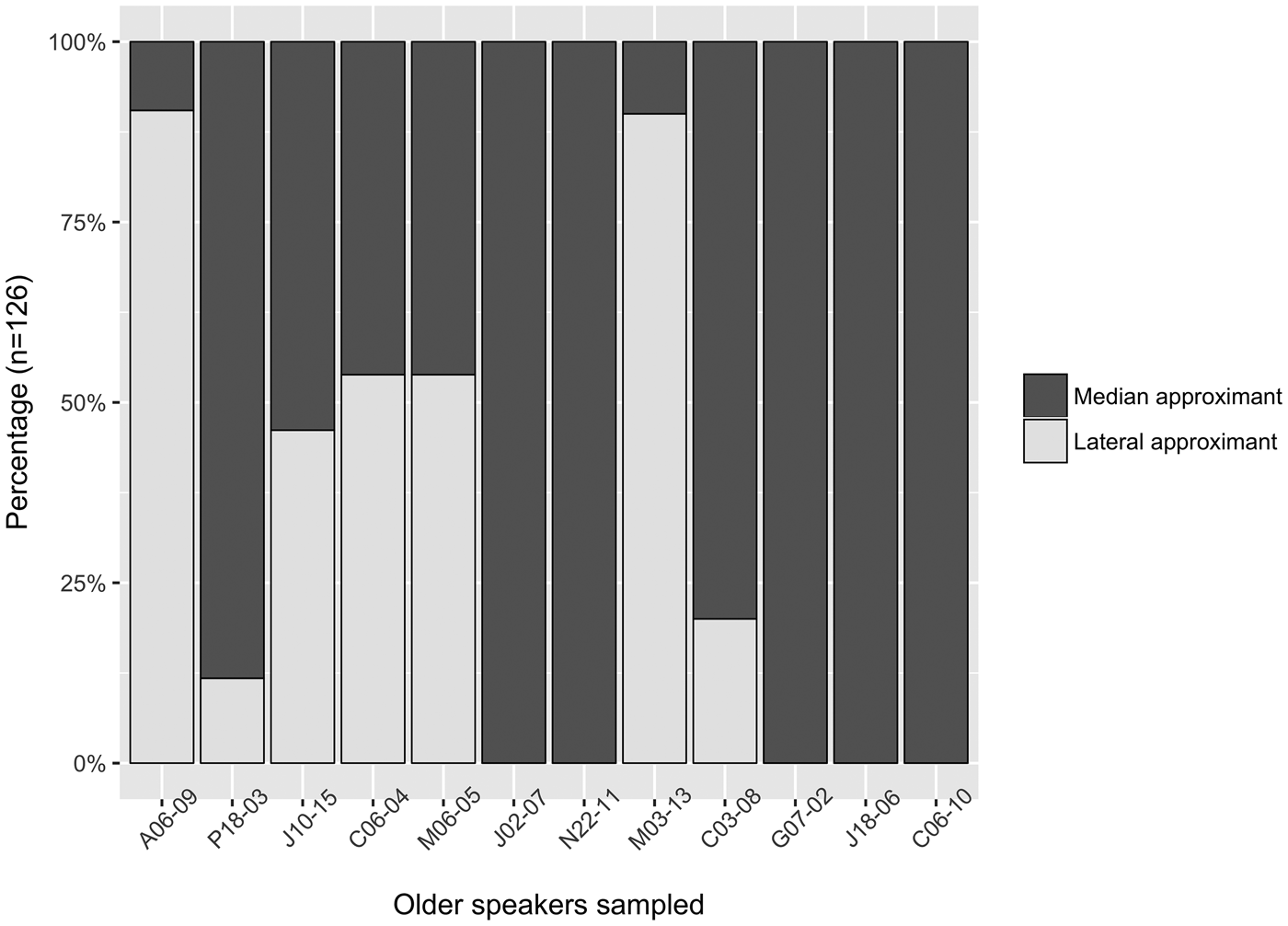
However, both older and younger speakers show variable palatalization in the velar sets, confirming that this rule is no longer categorical in Les monts du Lyonnais. Individual older-speaker variation is illustrated in Figure 2 (given that so few younger speaker tokens are present in the dataset, only the older speaker data are discussed further, below).
Francoprovençal-speaking region in Europe (after Kasstan & Nagy Reference Kasstan, Müller and Nagy2018:2).

Distribution of variants by Lyonnais older speaker (careful speech style).

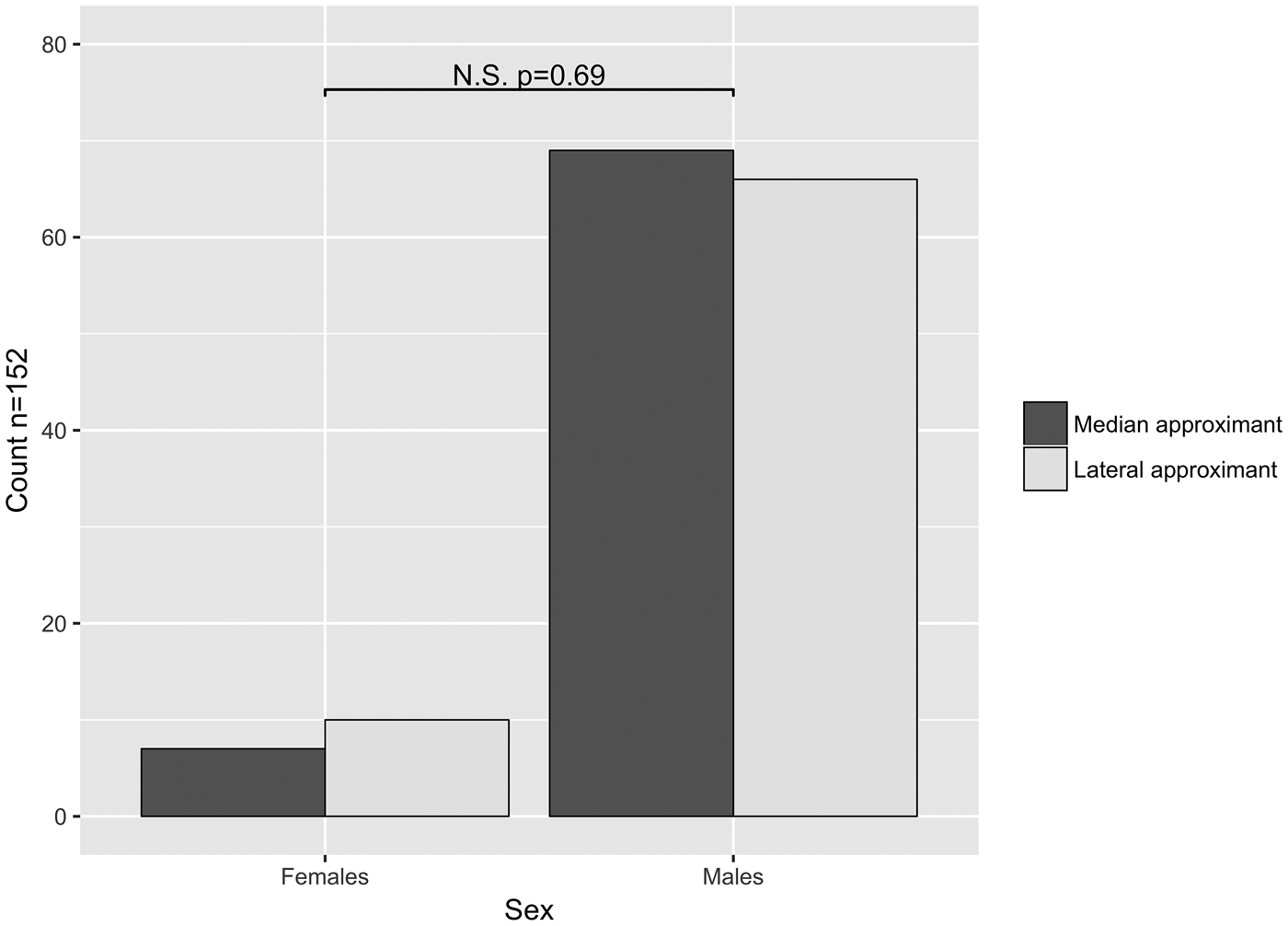
The granular evidence shows that there is substantial variation within the most careful speech style (cf. Figure 4). While some speakers are categorical, others show variable (and in some cases very low) rates of palatalization. The distribution is presented for sex in Figure 3, which is not statistically significant (Fisher's exact test, two tailed p = .69). However, it is noteworthy that the females sampled do show a slight preference for the lateral variant over males in the aggregate, in spite of low token counts.
Distribution of variants for Lyonnais older speakers and sex.

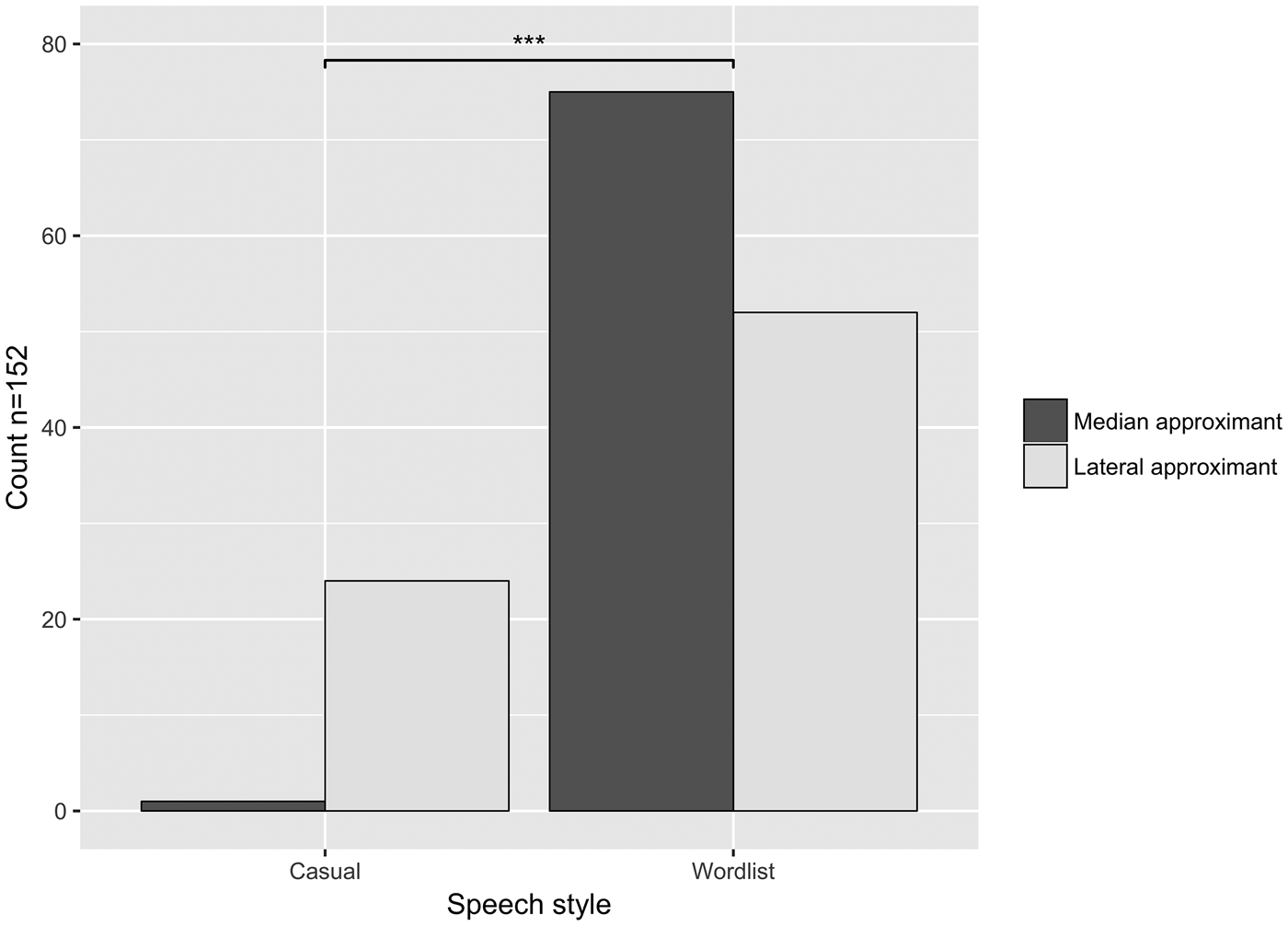
Distribution of variants for Lyonnais older speakers and speech style.

A comparison of Figures 3 and 4 shows that, of the available conventional external-linguistic factors under analysis in the older speaker category, only speech style emerged as a statistically significant factor in the Lyonnais dataset (Fisher's exact test, two tailed p < .001).Footnote 13 As Figure 4 illustrates, among a relatively homogeneous sample of sixteen older speakers, there is a significant difference observed for the distribution of [j] (evaluated as the typical Francoprovençal variant) in the most formal style (wordlist), and [l] in the most casual style (group interviews). Therefore, much like the findings reported by Clarke (Reference Clarke, Stanford and Preston2009) and Rau et al. (Reference Rau, Chang, Dong, Stanford and Preston2009), here the variable appears to behave in an analogous way to a sociolinguistic marker as described by Labov (Reference Labov1972:238): there is clearly sensitivity to speech style. The nature of the style shift, however, requires further discussion (below), as speakers are not orienting to a standard variant.
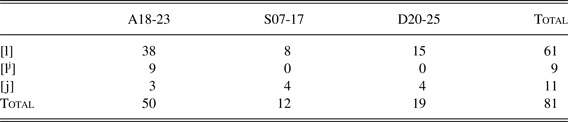
Among the three new speakers sampled in Les monts du Lyonnais, broadly the same pattern is observed in that palatalization takes place most often in the velar sets.
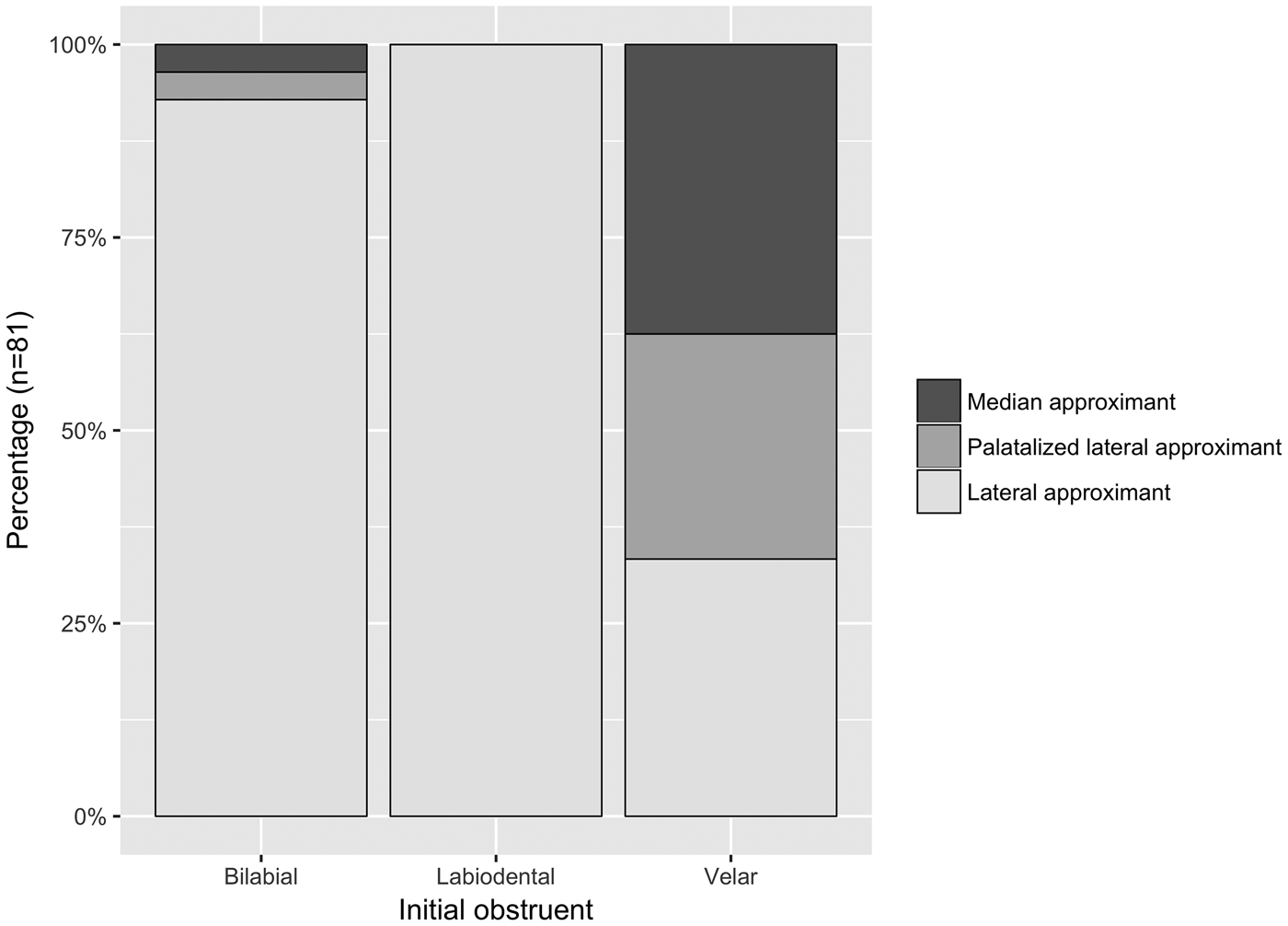
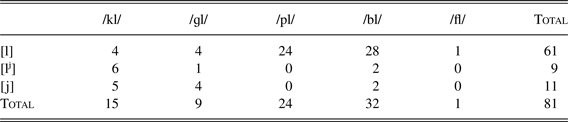
As Table 10 and Figure 5 illustrate, the new speakers have to some extent acquired the internal constraints for (l), and the distributions are comparable to the older and younger speaker groups (although it is only possible to compare in very general terms, as just four (l) tokens were observed in spontaneous speech for this group, all of which were [l]). Thus, new speakers are also predominantly palatalizing in the velar sets (Fisher's exact test, two tailed p < .001). However, innovative palatalizing tendencies are also observed in the Lyonnais new-speaker dataset. As Figure 5 illustrates, tokens are observed for palatalization in the labial sets, and a third possible [lʲ] variant is also present, in addition to [j] and [l], which is unattested in the literature for this part of the Francoprovençal-speaking region (Kasstan Reference Kasstan2015b:351).
Distribution of variants for Lyonnais new speakers.

Distribution of variants for Lyonnais new speakers.

Table 11 presents a more nuanced view of the distribution, where one new speaker (A18-23) is responsible for the production of palatalized lateral [lʲ] variant in the velar sets, which occurs in greater frequency than the traditional median approximant. Moreover, a small number of palatalized tokens are produced by participants A18-23 and S07-24 in the labial sets, too. These observations are discussed in detail below.
Distribution of variants by individual Lyonnais new speaker.

Palatalization in Savièse
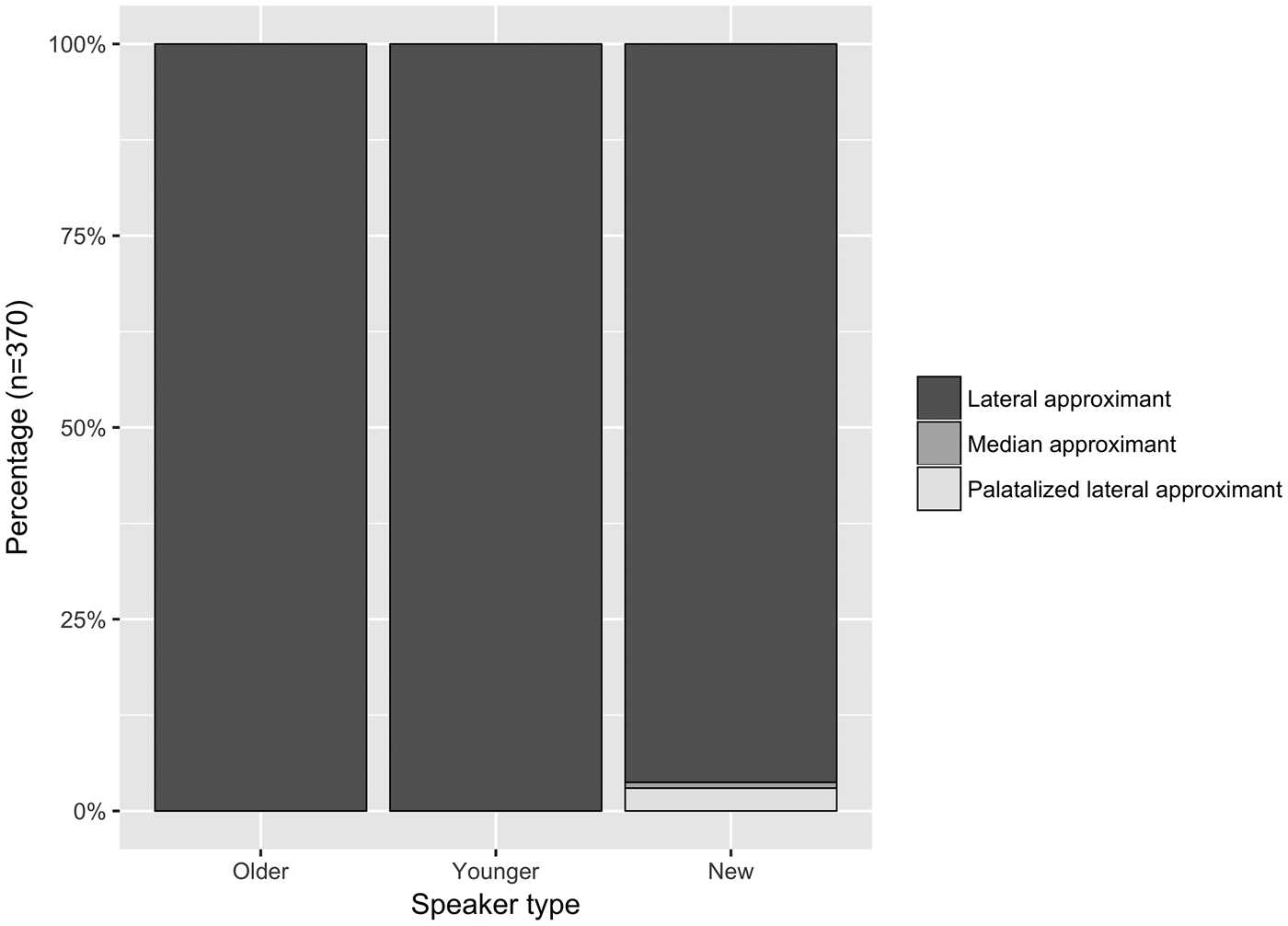
Figure 6 shows that speakers sampled in the study who had acquired Francoprovenççal through traditional transmission produced zero palatalized variants.
Distribution of variants across Savièse sample.

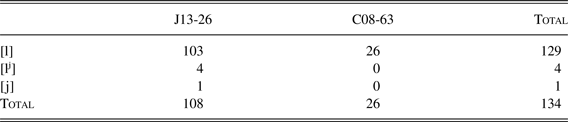
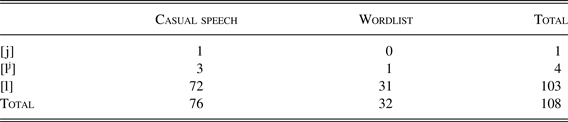
This observation lends empirical support to Jeanjacquet's (Reference Jeanjacquet1931) claim concerning recessive palatalization, and supports the above argument regarding local orthographic practice, too. Conversely, five palatalized tokens were recorded among the new speakers in the sample. While this is a very small number (~4% as a proportion of the total token count for these speakers), the principle of accountability (Labov Reference Labov1972:22) mandates that an explanation be sought for the greatest possible range of the variation. Further, Trudgill (Reference Trudgill1999:322) has warned of the dangers inherent in ignoring small token counts in sociolinguistic research, as this may mask patterns reflecting incipient change. Therefore, it is necessary to consider why new speakers might produce palatalized variants of (l), when they are not only more likely to be influenced by contact with French (a nonpalatalizing variety) than any other group, but when they are also exposed to local norms in a community that has been shifting from [ʎ] to [l] for nearly a century. Before discussing the data further, the distribution is further broken down by individual speaker and speech style (Tables 12, 13).
Distribution of variants among Savièse new speakers.

Distribution of variants for J13-26 by style (Savièse).

As both tables show, one speaker (J13-26) is responsible for the production of palatalized variants in the Savièse dataset: four tokens of [lʲ] in the /k/ + /l/ cluster, and just one instance of [j] in an /f/ + /l/ cluster, none of which are attested variants for Savièse (Diémoz & Kristol Reference Diémoz and Kristol2018). Conversely, C08-63 produces [l] in all contexts. These observations are further interrogated below.
Palatalization and index scores
The results presented above illustrate that all three groups in the Lyonnais sample are (to a greater or lesser extent) toeing traditionally attested community norms, in that, where [j] is anticipated, speakers are palatalizing (albeit at variable rates). Conversely, in the Savièse sample, it has been demonstrated that palatalization no longer takes place. However, some new speakers across fieldwork sites have been shown to be more innovative in their production of palatal forms, whereas others are following attested patterns more closely. To augment the analysis of this variation, the distribution of (l) tokens is compared against the AEI scores outlined in the research design (see Appendix 1 for speaker scores).
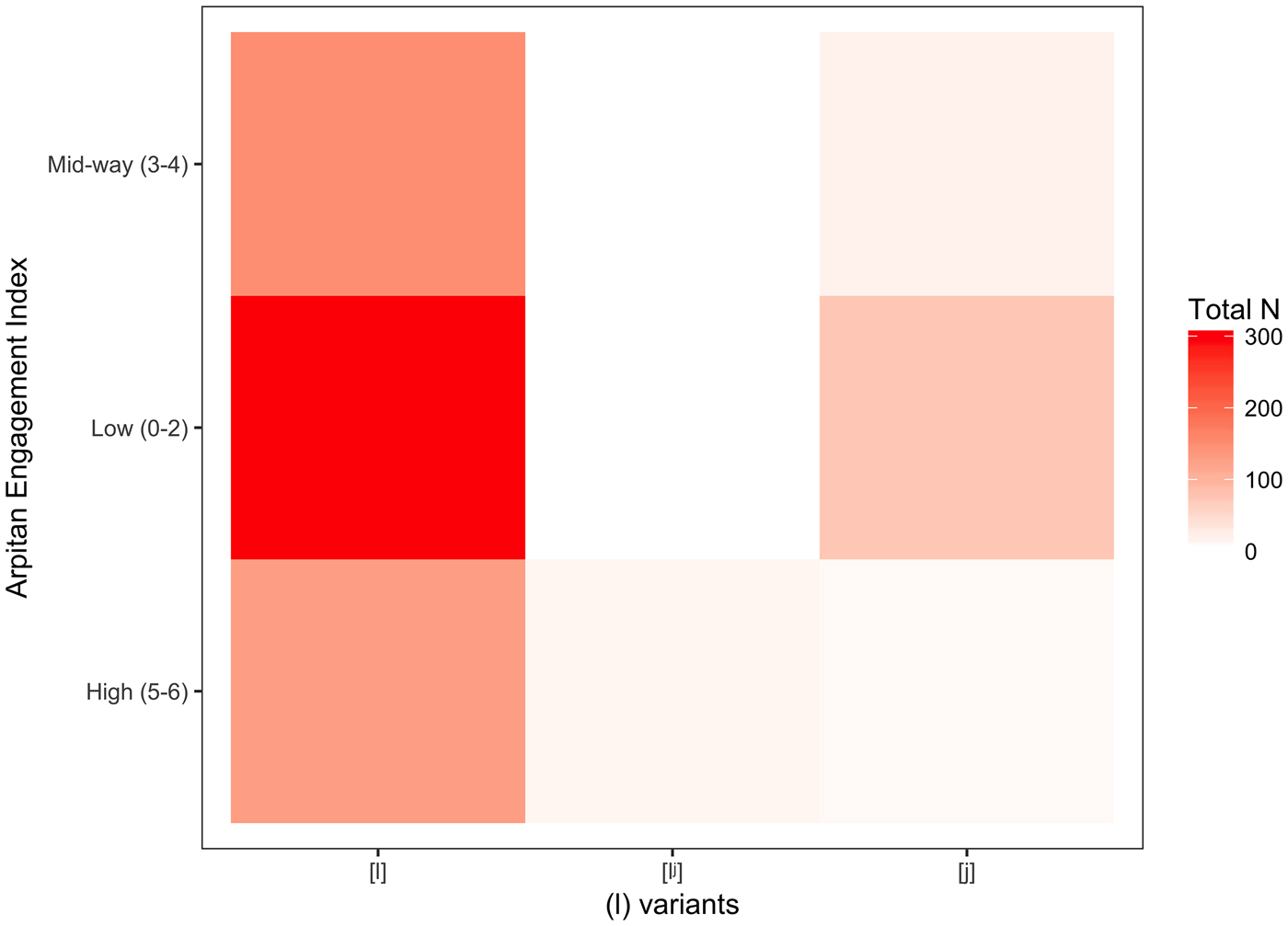
Figure 7 illustrates a cross-tabulation of AEI scores for all three categories of speakers (labelled ‘low’, ‘mid-way’, and ‘high’), and the total count for (l) observed in the corpus across Lyonnais and Savièse samples. As the figure shows, tokens of [l] and [j] are observed for speakers irrespective of their AEI score (which reflects the data presented above). Only those participants who accrued a ‘high’ score, however, were found to produce the innovative palatal variant [lʲ]. In a very general sense then, there is a relationship between speakers’ orientation to the Arpitan movement and speech production. However, it is again pertinent to highlight that token counts remain very low. Therefore, this limited quantitative evidence is supplemented with interactional data in the discussion.
AEI categories and total count for (l).

DISCUSSION
This article began by asking to what extent variability in language obsolescence differs from patterns observed in typical dominant-language contexts, and it was suggested that a Labovian approach to style shifting in contexts typical of ‘stylistic shrinkage’ would be a fruitful point of departure. The (l) variable was identified as suitable for variationist analysis, given that there are internal and external-linguistic constraints operating on palatalization, with at least some metalinguistic evaluation attached to the feature.
In spite of the fragmentary nature of the data, and the fact that (l) is a low-frequency variable, the evidence from the older and younger speakers in the Lyonnais sample points to an attested pattern of palatalization, with a clear maintenance of internal constraints (velar vs. labial clusters). There is evidence then to support the argument that linguistic variability in language obsolescence is no differently constrained than other types of variability in dominant-language contexts. It is within the stylistic range that novel observations can be made. First, among the older and younger speakers, the evidence revealed that participants were more likely to produce the most ‘Francoprovençal-like’ variant [j] in the most attended-to speech style (wordlist), with near-categorical production of laterals in casual speech, a distribution that was found to be statistically significant (Fisher's exact test, two tailed p < .001). This observation is important because these speakers are not immersed in a standard-language community, and so there is no overt normative infrastructure demanding a rigid maintenance of the variants across styles, the hallmark of the sociolinguistic marker variable. Instead, a rule that was once categorical has since become variable, and this underspecification has rendered the palatal variant [j] free for strategic use. The structured elicitation task has pushed speakers to perform their ‘best’ Francoprovençal, analogous to Schilling-Estes's (Reference Schilling-Estes1998:56) ‘performative style’. However, in group discussions designed to elicit the most unmonitored style (the ‘vernacular’), very few palatalized tokens were observed in the Lyonnais dataset. Therefore, while attention-to-speech has implied cognitive primacy of the vernacular in variationist studies, in contexts of language obsolescence it may in fact betray signs of ‘stylistic shrinkage’ in the first-learned variety. Evidence from Francoprovençal confirms then (as Wolfram Reference Wolfram, Chambers, Trudgill and Schilling-Estes2002:777 has proposed) that style shifting in moribund languages is indeed more varied and complex than the simple unidimensional casual-to-formal axis has traditionally assumed. However, the nature and extent of this complexity is not well understood as the phenomenon is so heavily understudied. The Lyonnais older-speaker data, then, (a) provide an insight into how raw material emerges and takes on social meaning, and (b) do not demonstrate monostylism in spite of acute domain loss. Moreover, an attention-to-speech model of style shifting in language obsolescence can provide a diagnostic for identifying linguistic variables that are progressing along a cline of stylistic shrinkage: here, the traditional Francoprovençal palatalized variant is being lost to [l] across speech styles, remaining more robust in formal elicitation tasks, and near absent in casual speech.Footnote 14 This was most evident in the Lyonnais older speakers, who demonstrated significant variation in palatalization in formal speech, and very little variation in casual speech, indicating a progressive loss of external-linguistic constraints, but a rigid maintenance of internal-linguistic constraints. The end result of this process is demonstrated to a certain extent by the Savièse data, where palatalization has been levelled out altogether, suggesting that a change, identified by Jeanjacquet (Reference Jeanjacquet1931) as incipient, has gone to completion. The small dataset collected from formal interviews in 1994–2001 for the ALAVAL therefore represent an intermediate stage: only the male participant demonstrated variable palatalization in Savièse; the female participant produced zero palatalized tokens, and it was suggested that such an observation might be analogous to a change-from-above. While there is no direct evidence for this from the Swiss sample here, it is noteworthy that the female participants in the Lyonnais sample demonstrated a similar tendency overall (though this was not statistically significant: Fisher's exact, two tailed p = .69). This observation may further indicate that phonological change in obsolescence can follow principles posited for dominant languages in urban contexts, as has been argued recently for Ganluo Ersu (China) by Chirkova et al. (Reference Chirkova, Stanford and Wang2018:138) (cf. Nagy Reference Nagy2011:371). The findings should however be interpreted with caution, given the fragmentary nature of the dataset, which remains an artefact of studying severely endangered-language communities. A variationist analysis of a wider sample, a larger number of tokens, and a battery of additional linguistic variables would confirm the robustness of this diagnostic.
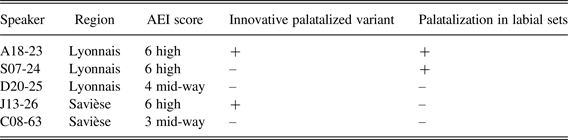
Turning to the Lyonnais new speakers, although a very limited number of tokens were elicited from just three participants, the data show that they have acquired the variants associated with (l), but they show more variability in control of the constraints by comparison with the older and younger speakers: palatalization is in some cases extended to the labial sets, and no palatalization was observed in casual speech. In a short analysis of the Lyonnais data, Kasstan & Müller (Reference Kasstan and Müller2018:112) argue that (a) the production of the palatalized lateral approximant [lʲ], in addition to [j], and (b) extension of palatalization outside of the velar clusters is an effect of orthographic form operating on speech production. As described above, new speakers are much more likely to write in Francoprovençal (or ‘Arpitan’) than they are to speak the language. The emergence of a pan-lectal orthography (ORB) was discussed above as the norm of choice among new speakers. As the diagraph elaborated in ORB that represents the palatalizing feature in Francoprovençal is <ll> (<cll, gll, pll, bll, fll>, with an accompanying ‘recommended’ pronunciation), and given that /l/-palatalization in Francoprovençal has been the subject of metalinguistic commentary for some time, the authors argued that the use of palatalized variants is indexical of a pan-regional Arpitan linguistic identity (rather than a linguistic identity that is locally circumscribed, per Matthey & Meune Reference Matthey and Meune2012), and engagement in the revitalization movement that brings these speakers together on occasions to militate for and promote language rights. Therefore, while the older and younger speakers were making strategic use of variants that had become available to them through underspecification of a once-obligatory rule of palatalization, the new speakers instead innovate palatalizing variants. The small subsample from the Swiss dataset supports this narrative. While all older and younger speakers in the sample were found to be producing [l] to categorical levels, among the new speakers, J13-26 produced five palatalized tokens, whereas C08-63 produced no palatalized tokens at all. To enhance the analysis, the total n (l) tokens were cross-tabulated with the AEI outlined in the research design, and it became apparent that only those new speakers with the strongest links to the Arpitan movement were found to be producing innovative palatal variants. The AEI scores reproduced in Table 14 are for the new speakers in the Lyonnais and Savièse samples.Footnote 15
Innovative palatalization and index scores for all new speakers.

Thus, those new speakers most clearly connected to the Arpitan movement, across fieldwork sites, are also those responsible for the ‘Arpitan-like’ features described above. The index also indicates that new speakers sampled in the same communes who do not produce these Arpitan variants had lower scores, reflecting more traditional practices. In order to further triangulate the data, these observations are supported by interactional evidence taken from participant interviews.
In the Lyonnais sample, A18-23 leads in the production of the innovative [lʲ] variant, and he also has a ‘high’ AEI score. A18-23 began learning Francoprovençal after arriving at university, initially in the context of a local language association organized by a community leader. By the time the interviews were conducted, A18-23 no longer pursued these classes, but he had become actively involved in the Arpitan movement. His language practices were the subject of commentary in the interview (see extract (3)).Footnote 16
(3)


In extract (3), A18-23 indicates with whom he uses Francoprovençal most often, naming in particular J18-23 (Savièse) in line 7, and stating that his associates all tend to belong to the ‘Association Culturelle Arpitanna’. It is also noteworthy that he recounts in lines 12–14 occasions where he would deliberately employ Francoprovençal on the metro in Lyon, even though the language has not been spoken inside the city for nearly a century (Gardette Reference Gardette1974). A18-23 consistently refers to Francoprovençal as ‘Arpitan’, and it is clear that, while his opportunities to practice speaking are rare, he sees the language as unconfined in terms of usage domains, and he is quite happy to subvert community norms. This can be contrasted with all older and younger speakers sampled, who would see usage outside of the community as inappropriate. Conversely, in the Savièse sample, C08-63 (AEI 3, ‘mid-way’) is in lockstep with the older and younger speakers for (l), whereas J13-26 (AEI 6, ‘high’) is not. These differences became the subject of discussion under interview (see extract (4), adapted from Kasstan Reference Kasstan2018:389).
(4)

As the author asks C08-63 about the label ‘Arpitan’ and what it represents, she makes it clear that, for her, Francoprovençal (‘patois’, line 11) is locally circumscribed in terms of identity, culture, and practice, and that learning the language within the scope of a broader revitalization movement would be futile without these contextual anchors. C08-63 therefore adopts a stance that foregrounds essentialist notions of sociolinguistic authenticity: to be an authentic speaker requires local identification, ‘to be from somewhere’ (Woolard Reference Woolard, Süselbeck, Mühlschlegel and Masson2008:304). C08-63's profile as a speaker differs from J13-26 in that she began learning Francoprovençal intensively within the context of a language association in Savièse. Conversely, J13-26 self-identifies as a member of the Arpitan movement, and he is known locally for his language activism. For instance, he performs in a regular Arpitan radio broadcast, and he has been actively involved in producing online materials for would-be learners that are transcribed exclusively in ORB, rather than the local orthography. On occasion in group interviews, J13-26 would foreground the utility of ORB in representing localized phonological variation (extract (5)).
(5) J13-26 is attending a group interview with three speakers from the commune Bagne (‘Central’ in Table 4): J (male, 20–45) is a new speaker; JF (male, 70–80+) and GF (female, 70–80+) are older speakers native to the commune.

Extract (5) begins with a discussion of pronunciation differences between Bagne and Savièse, and in line 4 the discussion turns to how the lateral fricative is reflected orthographically by JF. When GF explains that the language is ‘not easy to write’ (line 8), J13-26 in lines 9–11 invokes an example using (l) to illustrate the practicalities of a unified orthography. J13-26 is therefore demonstrating through his metalinguistic awareness of regional variation the salience associated with (l), even within the context of a speech community with a markedly different variety of Francoprovençal. Later in the same recording, J13-26 introduces the innovative [lʲ] variant while querying a translation (see extract (6) below).
(6)

In lines 1–4, J13-26 pursues the local variant for ‘clearer’, and, as it becomes increasingly likely that his questioning will not elicit a response, J13-26 scaffolds with [lʲ] as a variant of (l) in line 7, shortly thereafter ratifying with [klʲɑː] in lines 7–8, to the surprise of GF (who in line 9 is rendered confused by his chosen form). In extracts (5) and (6), then, J13-26 demonstrates an awareness of the Bagnard [ɬ] variant of (l), which he references as an example using ORB. However, when JF is faced with a lexical gap, J13-26 presents himself as a language authority: through this epistemic stance and preference for [lʲ], J13-26 in extract (6) illustrates how norms might come to be negotiated where they are in flux. This evidence supports claims made in the literature, where it has been suggested that new speakers can adopt influential roles as norm arbiters in severe language endangerment (cf. Nance et al. Reference Nance, Wilson and Dunmore2016; Kasstan Reference Kasstan2017).
To summarize, the interactional data support the argument that there is meaningful co-variation between sociolinguistic stance and the sorts of linguistic features produced by new speakers. While palatalization of laterals was once a feature of Francoprovençal spoken in Savièse, it is clearly a change that has reached completion in the case of the sample analyzed here: while this norm has remained the target for one new speaker in the corpus (C08-63), J13-26 more readily adopts features with broader sociolinguistic capital: those that clearly align with a younger emergent community of endangered-language speakers. When the Lyonnais and Savièse data are considered together, it becomes clear how a new-speaker variant has become a ‘pointer to (index of) the social identities and the typical activities of speakers’ (Irvine & Gal Reference Irvine, Gal and Kroskrity2000:37).
Again, the variation analyzed here is no differently constrained than other types of inherent variability: even within the confines of a small revitalization movement, the (l) variable carries sociostylistic significance for new speakers. Analogous observations can also be found in the literature: the overview presented above shows that new speakers of Scottish Gaelic are also found to produce innovative variants, and more recent work has argued for an emergent new speaker variety in the aggregate (Nance Reference Nance, Smith-Christmas, Murchadha, Hornsby and Moriarty2018). The evidence presented here, while much more embryonic, does illustrate how innovative variants may take hold in a small social group dedicated to language revitalization, and how style variation operates in the context of a dying language. Stylistic shrinkage is not a forgone conclusion.
CONCLUSION
Research on dying languages stands out as exceptional from the perspective of style variation as it is conceived in sociolinguistics. Since the 1970s, recurrent observations suggest that stylistic shrinkage is a linguistic correlate of a threatened variety restricted to critical language domains. Speakers of such varieties have been labelled monostylistic (e.g. Dressler Reference Dressler and Newmeyer1988:188–89). The evidence reported here not only calls this into question, but, more importantly, illustrates how sociolinguistic variation can emerge from new raw material. Data gathered from among older and younger speakers of Francoprovençal in France and Switzerland show that previously obligatory rules that have broken down as obsolescence progresses can render features available for stylistic usage in novel ways. Under careful elicitation conditions, the Lyonnais speakers adopted palatalization as part of a performative style that was argued to represent their ‘best’ Francoprovençal (a surrogate for standard). Conversely, in spontaneous speech, few if any tokens were recorded. Style can therefore be operationalized as a heuristic tool for identifying variables undergoing a process of stylistic shrinkage. This appears to have run to completion in the Savièse dataset among the most fluent speakers. The new-speaker data, however, demonstrate that, even among learners with very limited proficiency, (l) has been adopted for strategic use: sociometric and interactional evidence points to an emergent new-speaker norm that indexes a very different kind of Francoprovençal speaker, with new prestige targets and sociolinguistic practices. Therefore, while linguistic variation has been shown to play an important role in the aggregate for new speakers as a distinct group of endangered-language learners (Nance et al. Reference Nance, Wilson and Dunmore2016; Nance Reference Nance, Smith-Christmas, Murchadha, Hornsby and Moriarty2018), the evidence presented here illustrates that style shifting is central to new-speaker practices. These findings are significant: they challenge the characterization of dying languages as inherently monostylistic (contra Dressler), and, to paraphrase Dorian, they establish that natural languages can still be spoken in ways appropriate to speaker’ various stylistic needs, in spite of very limited access to occasions and contexts with which to practice (Reference Dorian, Biber and Finegan1994c:326). While this study adds to our understanding of sociolinguistic variation in general, and style shifting among speakers of threatened languages in particular, it is important to highlight the limitations of the data that have been interpreted above. This work therefore calls for more research at the intersection of variationist sociolinguistics and the study of language obsolescence, so that interactions between linguistic decay, emergent variation and social meaning can be more clearly integrated into contemporary models of language variation and change.
APPENDIX 1. PARTICIPANT DEMOGRAPHICS

APPENDIX 2. WORDLIST TRANSLATION TASK

APPENDIX 3. TRANSCRIPTION CONVENTIONS