1. Introduction
Institutional economists always have paid close attention to the relationship between institutions and cognition. The founder of institutionalism, Thorstein Veblen, who defined institutions as ‘prevalent habits of thought’ (Veblen, Reference Veblen1899), brought their cognitive function to the fore. Wesley Mitchell (Reference Mitchell1910) transformed the Veblenian approach to include the idea of social concepts that underlie social institutions and make up their ‘core’. In turn, John Commons (Reference Commons1934) emphasized that the main feature of the human actor is an institutionalized mind: all cognitive processes are embedded in a heterogeneous environment of working rules, habits, customs, etc. Subsequently, many distinguished institutional scholars have analyzed the cognitive functions of institutions and their impact on economic decision-making (see, for example, Aoki, Reference Aoki2011; Dequech, Reference Dequech2013; Herrmann-Pillath, Reference Herrmann-Pillath2012; Hodgson, Reference Hodgson1988, Reference Hodgson2013; Knight and North, Reference Knight and North1997; Ostrom, Reference Ostrom2005). Institutionalist views on cognition have been consistently antagonistic to the radical internalism of the neoclassical mainstream, according to which cognition is a set of analytical inside-the-head processes that institutions only constrain.
But the real breakthrough in the cognitive-institutional field was Arthur Denzau and Douglass North's (Reference Denzau and North1994) famous paper about shared mental models. This article and North's (Reference North2005) follow-up book have been cited thousands of times. The ‘shared mental models’ concept has become one of the foundations of the World Bank's recommendations for cognition-oriented public policy (World Bank, 2015). Inspired by North's ideas, the cognitive strand of institutional economics rose to the forefront of cognitive science. To a large extent, this was the result of the intellectual collaboration between North and the prominent philosopher of the mind, Andy Clark (see for details Petracca and Gallagher, Reference Petracca and Gallagher2020).
Clark drew on the ideas of North and Denzau when developing the concept of external scaffolding (Clark, Reference Clark1997) – a broad set of material and non-material artifacts (including institutions) that enable cognitive processes – which he integrated into an ‘extended mind thesis’ (Clark and Chalmers, Reference Clark and Chalmers1998). This thesis gave rise to the first wave of studies on the extended mind, and many institutional economists following North align with this approach.Footnote 1 However, after North's (Reference North2005) book, which developed first-wave ideas about cognition's scaffoldings and shared beliefs, two more waves emerged and went unnoticed by institutional economists.Footnote 2 These waves are associated with a deepening of the externalist understanding of cognition and, accordingly, with an increasingly pronounced push towards rejecting somewhat simplified first-wave explanations in favor of much more complex and dynamic approaches.
The question of where to move beyond the Northian (shared mental models) paradigm is timely. So far, there have been two responses to it.
Greif and Mokyr (Reference Greif and Mokyr2017) advocate the first approach (I call it the ‘evolutionary’ approach) and implicitly align with the second wave of extended mind theory, namely the ‘cognitive norms’ concept by Richard Menary (Reference Menary2007). More precisely, they do not align with all the ideas of the second wave (Greif and Mokyr do not use extended cognition theoretical views at all), but they most notably align with the understanding of institutions' role espoused in the second wave. They put forward an idea about the fundamental importance of the shared cognitive rules on which all socioeconomic institutions are based: ‘We think that cognitive rules such as what is moral, what is expected of people to do in certain situations, and how causes lead to outcomes are underlying the regularities in behavior generated by institutions’ (Greif and Mokyr, Reference Greif and Mokyr2017: 27). Without cognitive rules, people cannot think, make decisions, and solve problems in their daily lives; these rules are the socially constructed immanent foundations of individual cognition.
The second approach (I call it ‘revolutionary’) is based on Shaun Gallagher's (Reference Gallagher2013) concept of a socially extended mind and invites institutional economists to adopt the third-wave extended mind theory. Enrico Petracca and Gallagher (Reference Petracca and Gallagher2020) consider ‘economic cognitive institutions’ as the core concept of post-Northian institutional economics. These scholars maintain a strong externalist stance and take shared mental models entirely out of the methodological framework, thereby breaking from the Northian legacy. The shared mental models approach was succeeded by shared mental processes, which are considered as cognitive institutions. These institutions constitute cognitive processes that are impossible outside of specific institutional structures, such as the market or the legal system.
This paper discusses a research agenda for post-Northian institutional economics. I propose a third path between the evolutionary (Greif–Mokyr) and revolutionary (Petracca–Gallagher) approaches, using an alternative definition of cognitive institutions that combines rule-based and process-based views. Section 2 describes the differences between the three waves in extended mind theory and the accompanying shifts in understanding the influence of institutions on cognition. Section 3 introduces a two-fold definition of cognitive institutions that highlights the interrelated duality of their content (cognitive norms and rules) and form (co-producing interactional processes). Section 4 places the enactivist notion of ecological rationality mediated by cognitive institutions at the center of the post-Northian research program. Section 5 draws attention to active agency and the co-production of cognitive institutions in cognitive-cultural niches.
2. Waves of extended mind studies: the path to the ‘cognitive institutions’ concept
The extended mind theory was put forward in opposition to the dominant internalist approach in cognitive science and the philosophy of mind. Internalism claims that ‘mental states are entirely in the head’ and ‘all mental reality is in the minds of individuals’ (Searle, Reference Searle2005: 21), so for something to be considered cognitive, it must be inside our heads, in the brain. The extended mind theory proposes an alternative, externalist paradigm: cognition is constantly extending beyond the brain and involves external components (e.g., bodily actions, material artifacts, and social constructs). Hence, the real-world environment, represented by various external cognitive structures and artifacts, plays a crucial role in cognitive processes. In a reasonably short time, extended mind studies passed through three stages (‘waves’) that have significant theoretical differences.
The first-wave extended mind theory postulated that the internal (mental) and external (environmental) elements of extended cognitive processes are functionally equivalent; this is the so-called ‘parity principle.’ This equal status is because internal and external elements perform a similar functional (or causal) role in cognition. Thus, in functionalist terms, notebooks, to-do lists, flip charts, smartphones, social media, other people, and institutions are analogs of various patterns of neural activity. They help us perform a variety of cognitive processes – e.g., memorize and recall, categorize experiences, make judgments and evaluations, predict and generate expectations, interpret facts and create understandings, compare alternatives, make calculations and decisions, deceive, persuade, navigate, innovate, and so forth. Therefore, the first-wave extended mind theory takes an explicitly externalist view of cognition; it conceptualizes cognitive agents ‘as spread into the world’ (Clark and Chalmers, Reference Clark and Chalmers1998: 18) and embedded in complex networks of external information-bearing artifacts and structures that are resources for cognitive processes. The first wave generated a broad discussion on the critical role of external artifacts and structures in cognition and a debate on blurring the line between the mental and environmental. According to first-wave theorists, institutions enable cognitive processes and provide external scaffolding for them, acting as a background condition of cognition. The ‘shared mental models’ (Denzau and North, Reference Denzau and North1994) and ‘shared beliefs’ (North, Reference North2005) concepts are aligned with the first-wave understanding of institutions' role in cognition.
The second-wave extended mind theory shifts the focus from the functional equivalence of internal and external elements of cognition to their dissimilarities, which pave the way for their functional complementarity (Sutton, Reference Sutton and Menary2010) and cognitive integration (Menary, Reference Menary2007). Language, markets, smartphones, and the brain are arranged and act fundamentally differently. But it is precisely the qualitatively different functional features that make possible the joint participation of internal and external elements in extended cognitive processes: in the case of ‘right’ (effective) coupling, all these elements work as an integrated cognitive system. Therefore, second-wave theories focus on extended cognitive systems (or coupled agent–environment systems), consisting of variously heterogeneous internal and external elements. The main conclusion of second-wave studies is that cognitive processes are based on interactive couplings and have no stable and fixed properties. Second-wave scholars have moved from a somewhat abstract understanding of institutions as external scaffolding to focusing on specific cognitive norms that govern concrete types of cognitive processes (Menary, Reference Menary2007, Reference Menary and Menary2010) and on norms-related cognitive practices that play orchestrating role in extended cognition (Menary, Reference Menary, Metzinger and Windt2015). At the same time, institutions are still considered as enabling conditions and not constituent parts of human cognition (see details in Slors, Reference Slors2020). Greif and Mokyr's (Reference Greif and Mokyr2017) approach is quite similar to that of the second wave: they place at the center of their analysis shared cognitive rules, i.e., the socially accepted understandings and beliefs that underlie individual decision-making.
Third-wave extended mind theory builds on enactivist ideas and offers a dynamic and interactionist view of cognition (Gallagher, Reference Gallagher2018). The third wave focuses on continuous two-way interactions between individuals and environments that form dynamic trajectories of brain–body–world cognitive activities (Kirchhoff and Kiverstein, Reference Kirchhoff and Kiverstein2019: 15–23). In these dynamic cognitive processes, neither do internal cognitive functions have fixed proprietary characteristics nor do external cognitive resources have their own fixed properties. The consensus of third-wave theorists is that cognitive processes are dynamic configurations of neural processes, bodily actions, external tools, artifacts, and structures that reciprocally influence each other while continuously changing. Primary attention is paid not to individuals (whose cognition is extended with the help of external minds, tools, and institutions, as was held in the first and second waves) but to socially and culturally distributed cognitive systems (see also Cash, Reference Cash2013; Gallagher, Reference Gallagher2013) – multidimensional, continuously reformatting configurations of cognitive processes with multiple causal flows and feedback loops without sharp boundaries.
The third-wave extended mind theory is based on the fundamental difference between artifact-extended cognition and socially extended cognition (Slors, Reference Slors2020). Artifact-extended cognition is the use of cognitive artifacts (such as a notebook or smartphone) ‘in addition’ to the cognitive resources of the brain; thus, in this way, the cognitive processes' implementation base can be extended. Socially extended cognition involves complex cognitive systems consisting of many interacting people, material artifacts, social norms, and cultural practices. These systems include the legal system, the market, or science. They comprehensively expand our cognitive abilities; in turn, by following the rules of these systems, we strengthen them and make their functioning possible. Socially extended cognition cannot be understood without recognizing normativity's crucial role: it is vital for coordinating multiple participants in complex cognitive systems. Therefore, cognitive institutions (and instituted practices) are the central objects of attention of the third wave. From the point of view of third-wave theorists, cognitive institutions are not only enabling conditions but also constitute cognitive processes (Petracca and Gallagher, Reference Petracca and Gallagher2020). In other words, cognitive processes without corresponding cognitive institutions are carried out with much less efficiency or most often cannot exist at all.
3. What are cognitive institutions?
Shared mental models (SMMs, hereinafter) are a key focus of Northian cognitive-institutional analysis. From this (first-wave-like) point of view, the brain is mainly a reality-representational organ, while personal mental models are internal representations for interpreting and understanding the environment. The intersubjective distribution of these models leads to them becoming SMMs; institutions are a separate class of SMMs (Denzau and North, Reference Denzau and North1994). In North's (Reference North2005) book, the shared beliefs that underpin all SMMs and institutions were given a central role: ‘Shared mental models reflecting a common belief system will translate into a set of institutions’ (North, Reference North2005: 104). But despite the groundbreaking nature of the SMMs concept for its time, it has built-in limitations. The SMMs concept highlights individual learning (through the internalization of SMMs) rather than social interactions (see Greif and Mokyr, Reference Greif and Mokyr2017: 26). This individualistic orientation is the legacy of the first-wave theory that considers the individual the center of extended cognitive processes. In addition, the sharing of mental models is a rather passive process for the vast majority of people in the Northian paradigm, except for ‘ideological entrepreneurs’. Finally, shining the spotlight on mental models leads to serious internalist–externalist tension (Petracca and Gallagher, Reference Petracca and Gallagher2020: 751). Therefore, to develop a cognitive-institutional analysis beyond North, we will have to rethink all three parts of the SMMs concept: the ‘shared’, the ‘mental’, and the ‘models’.
First, the transition from ‘passively shared’ to ‘actively co-produced’ SMMs seems essential. An enactivist perspective, in a general sense, is a ‘view of the co-production of cognizer and environment through dynamic interaction’ (Ward et al., Reference Ward, Silverman and Villalobos2017: 368). For institutional economics, the co-production of SMMs by different actors (individuals, organizations, social groups, governments, etc.) with various interests, resources, strategies, values, and worldviews is particularly important. SMMs do not emerge on their own in a frictionless environment. They are always the result of active polycentric interactions in a heterogeneous environment full of constraints and affordances that require ongoing effort and investment.
Second, we need a transition from a ‘mental’ view of SMMs to an ‘interactional’ view. From the perspective of enactivism and third-wave extended mind theory, cognitive processes are brain–body–world interactions. Cognition is deeply connected with all elements and actions of the physical body, not just the brain. Cognition is carried out through continuous interactions with the environment using external cognitive structures and artifacts as cognitive resources. Finally, cognition constantly and actively constructs the surrounding world, not just representations of it. Therefore, mental models are not internal (mental) states and attitudes located inside the head. These interactive models are in constant reassembly through the dynamic reconfiguration of internal and external cognitive resources: thereby, the very separation of internal and external elements of cognition loses all meaning.
Third, there is a need to shift the understanding of SMMs from (relatively stable) ‘models’ to (pronounced dynamic) ‘processes’. Enactivist third-wave theorists emphasize continuous mind–environment interactions (processes) over the construction of detailed and complete internal representations of the environment (models). This step completes the break with Northian SMMs and logically brings us to the new central concept of ‘cognitive institutions’.
Petracca and Gallagher (Reference Petracca and Gallagher2020) draw a strong contrast between model-based and process-based views on cognitive institutions. They make an unequivocal choice in favor of a process-based approach: cognitive institutions should not be understood as SMMs, but, more accurately, as ‘shared mental processes’ (Petracca and Gallagher, Reference Petracca and Gallagher2020: 753): the ‘mental’ is understood here not as internal (inside-the-head) but as an interactional (mind–environment) property. This definition is entirely consistent with the third wave, which distances itself from using the ‘mental representations’ concept to explain cognition. Of course, SMMs is a representationalist concept; in turn, ‘shared mental processes’ is a purely enactivist (or dynamic and interactive) concept. Shared mental processes and individuals' cognitive processes are engaged in reciprocal co-constitution (Slors, Reference Slors2020): cognitive institutions are themselves shared mental processes or ‘extended cognitive processes’ (Petracca and Gallagher, Reference Petracca and Gallagher2020: 759), and, at the same time, cognitive institutions constitute these cognitive processes, making them possible and more effective.
In the spirit of radical enactivism, Petracca and Gallagher (Reference Petracca and Gallagher2020) completely abandon the representationalist view and exclude both shared and personal mental models from their explanation. But I think it is better for institutional economists to change their understanding of mental models than (for now) to abandon them entirely. The critical point is that personal mental models are not discrete and purely internal mental states (representations) but properties of the entire system of ongoing brain–body–world interactions. These mental models are neither comprehensive nor stable but inevitably incomplete and changing at different rates (see a similar view: Rosenbaum, Reference Rosenbaum2021). Even such seemingly internal (mental) attitudes as personal narratives, specific mentalities and identities, or individual beliefs are, in reality, not isolated and encapsulated in the brain but continuously and interactively connected with the surrounding world. Thus, I propose to talk about mental models not in representationalist terms, but in interactionist terms, focusing on the fact that these models are properties of dynamical agent–environment couplings and not internal representations of reality. In other words, ‘even when agents are dealing with the absent, the possible and the abstract they are still coordinating to the rich landscape of affordances available in their ecological niche’ (Kiverstein and Rietveld, Reference Kiverstein and Rietveld2018: 159–160). This view is one of minimal representationalism, which, in my opinion, is compatible with (non-radical) enactivism and the third-wave extended mind research program.
I would like to avoid the models vs. processes dichotomy. In my view, models and processes are two sides of the same coin – namely, cognitive institutions. For example, co-created cognitive norms (e.g., shared narratives, identities, and beliefs) are inseparable from co-creating processes (e.g., narrative-making, identity-forming, and belief formation) that multiple actors carry out in different ways. The cognitive norm is both a collective mental model and a set of co-producing interactional processes. It seems to me that (especially radical) enactivists often present mental models as fixed and stable entities and extended cognitive processes as highly dynamic ones. This often ignores the varying speeds of different processes and the varying speeds of change of different models. Many collective mental models are very fluid (e.g., fashions) and many extended cognitive processes are very slow (e.g., change in religious canons). The choice of whether to describe a cognitive institution as a ‘model’ or a ‘process’ depends on the scholar's subjective viewpoint; even a stone can be considered as an extremely slow process of formation and deterioration. Third-wave scholars eminently highlight the dynamic nature of cognitive institutions, making an unambiguous choice in favor of a process-based view (Petracca and Gallagher, Reference Petracca and Gallagher2020). In my opinion, we can supplement this approach with a model-based view and still remain convinced enactivists. The model-based view is valuable in that it allows us to see not only the amorphous and dynamic side of socially extended cognitive processes, but it also enables us to take into account that these processes give rise to more or less distinct and stable collective mental models.
I propose a two-fold definition of cognitive institutions based on the form–content distinction (according to dialectical methodology). The distinction reflects the interrelated duality (but not dualism or dichotomy) between the contentful and formal dimensions of cognitive institutions. Content refers to what is co-produced in shared mental processes; form is how it is co-produced. In a general sense, cognitive institutions are interactively and polycentrically co-produced cognitive norms (or rules).Footnote 3
Actively co-produced, interactional processes (AIPs, hereinafter) are forms of cognitive institutions.Footnote 4 On the other hand, shared cognitive norms (or rules) are the co-produced normative content of cognitive institutions. The first part of this definition comes from Petracca and Gallagher's (Reference Petracca and Gallagher2020) fruitful approach. The second part is close to Menary's (Reference Menary2007) cognitive norms concept and to Greif–Mokyr's (2017) interpretation; it also refers to Dequech's (Reference Dequech2013) broad definition of institutions as shared rules of thought and behavior. At the same time, unlike Menary's and Greif–Mokyr's approaches, I consider cognitive norms (rules) not as the enabling context of cognition but as its constituent parts. The idea of co-producing cognitive institutions is an Elinor Ostrom–inspired methodological step that highlights polycentric and active agency in socially extended cognitive processes. This focus on polycentricity implies that individual-centered explanations of socially extended cognition are inadequate: we need a more sophisticated interactionist picture. The two-fold definition allows us to combine the advantages of Petracca–Gallagher's and Greif–Mokyr's approaches: it adds co-production and more normativity to the process-based definition; it also integrates dynamism and polycentricity into the rule-based definition. The two-fold definition emphasizes that the form and content of cognitive institutions are dialectically interconnected. AIPs are essentially processes of cognitive norms' co-production; in turn, cognitive norms exist in the form of various polycentric and interactive cognitive processes.
One of the main constituents in extended cognitive processes is cognitive or cultural practices (Gallagher, Reference Gallagher2013, Reference Gallagher2020), which come to the fore in third-wave theory. Cognitive institutions (rules or norms) result in a wide range of practices (Menary, Reference Menary, Metzinger and Windt2015), but practices themselves are not rules or norms. Practices are specific patterns of norm-following behaviors; a cognitive norm can drive many behaviors and manifest in various practices. For example, sustainable thinking includes numerous cognitive norms (i.e., alternative ways of sustainability-oriented cognition) and a highly heterogeneous set of cognitive and cultural practices. Individuals' cognitive practices are integral parts of AIPs, and under favorable conditions, they (through AIPs) can become cognitive norms. Unlike practices, institutions are always characterized by strongly pronounced normativity; this main feature has often been the focus of attention of institutional economists: ‘Norms and rules both contain prescriptions – the musts, must nots, and mays of deontic logic’ (Ostrom and Basurto, Reference Ostrom and Basurto2011: 321). It is normativity that makes socially extended cognition possible (Slors, Reference Slors2020). Cognitive institutions define right and wrong, acceptable and unacceptable, and conventional and non-conventional ways of thinking. Further, individuals engaged in extended cognitive processes are not simply embedded in networks of instituted practices (Kirchhoff and Kiverstein, Reference Kirchhoff and Kiverstein2019: 23); instead, I emphasize that individual agents are active co-producers of cognitive institutions.
When we think about something, we connect to various cognitive institutions, ‘activating’ (enacting) them and using them in our cognitive processes. Cognitive institutions, in this case, ‘are activated in ways that extend our cognitive processes and help us to solve problems of a particular type’ (Gallagher, Reference Gallagher2018: 434). We also ‘upload’ into existing AIPs new elements – comments, facts, arguments, narratives, criticisms, forecasts, emotions, questions, explanations, documents, models, graphics, photos, etc. Modern cognitive institutions immersed in the digital media environment are interactively co-created and ‘co-edited’ by multiple actors: they are constantly changing, and by connecting to them, people ‘update’ their personal mental models to new versions of cognitive institutions.
As in the case of shared files hosted on the cloud and edited collaboratively by many users, there is little point in internalizing (‘downloading’) cognitive institutions, since these institutions (like shared files) are different at each moment. We can internalize simple and stable cognitive institutions, for example, by learning grammar rules or traffic rules. But in the case of a relatively complex and ever-changing cognitive institution, people, as a rule, cannot even perceive them in their entirety and heterogeneity: this applies, for example, to scientific theories, economic doctrines, or legal concepts. People always internalize partial, incomplete, and inaccurate ‘copies’ of cognitive institutions. Moreover, the internalization itself is nothing more than a metaphor; it is not a representational mapping of static institutions and not a one-way, outside–in process but an ongoing stream of minds–institutions interactions. People do not ‘store’ updated versions of cognitive institutions in a ‘mind store’ (or in a ‘mind palace’ like Sherlock Holmes) as static mental representations; on the contrary, these mental models are a dynamic part of dynamic interactions with the environment. We do not exist separately from cognitive institutions and do not internalize them as fixed external artifacts. We are co-participants and co-creators of numerous AIPs. Therefore, it is more appropriate to speak not about the internalization but the ‘interactivization’ of cognitive institutions. This third-wave approach strongly contrasts with the Northian paradigm, where the internalization of SMMs is the only and distinctly passive mode of the cognitive agent's interactions with the environment.Footnote 5
4. Toward a cognitive–institutional view of ecological rationality
Institutional economists have always criticized the internalist and decontextualized understanding of rationality that dominates the neoclassical mainstream. The theoretical alternatives they proposed were, of course, externalist and, on the whole, corresponded to the spirit of the first wave (more precisely, to the institutions-as-scaffoldings view). The externalist position was first expressed with certainty by Mitchell, who argued that economists should situate the model of the human actor in a broad socio-cultural context: ‘His very rationality gets its character from the institutions under which he is reared’ (1910: 210). Denzau and North (Reference Denzau and North1994) also emphasized that the institutional features of market economies drive ‘maximizing-style’ economic decisions. Many institutional economists followed this line by looking at individual decision-making in terms of the embeddedness of this process in the institutional environment.
However, for the most part, the new institutionalists took Herbert Simon's bounded rationality model as a baseline. At the same time, the boundedness of the decision-maker was most often understood as one-sided, in an internalist spirit, as an individual's lack of cognitive resources that reduces the effectiveness of adaptations to the environment. Simon's original approach focused on the ‘twice-bounded’ rationality, which, according to his famous claim, ‘is shaped by a scissors whose two blades are the structure of task environments and the computational capabilities of the actor’ (Reference Simon1990: 7). But the environmental part of bounded rationality gradually disappeared during the development of this theory (Gigerenzer and Selten, Reference Gigerenzer and Selten2002), and Simon's mind–environment ‘scissors’ turned into Simon's cognitive-limitations ‘knife’. The misinterpreted and narrower Simon's ‘knife-like’ approach is the most influential approach in modern research on cognition and rationality in economics (see also Petracca, Reference Petracca2017).
The shift in attention to the wider ‘scissors-like’ approach proposed by Simon has caused an implicit ‘externalist turn’ in economics and led to increased research on so-called ‘ecological rationality.’ Two traditions have been developed for understanding ecological rationality (for details, see Dekker and Remic, Reference Dekker and Remic2019).
The first (individualistic) view of ecological rationality (ER1) is associated with individual decision-making in a complex environment by adapting to it through environment-specific heuristics – easy-to-use cognitive rules or rules of thumb. The ER1 approach is used in the behavioral economics' fast-and-frugal-heuristics (FFH) program in the tradition of Gerd Gigerenzer. The FFH program is contrasted with the heuristics-and-biases (H&B) research program in the tradition of Daniel Kahneman and Amos Tversky. The H&B program considers heuristics as mental shortcuts that generate cognitive biases or systematic irrational errors and cause negative deviations from the ideal of instrumental rationality (Kahneman, Reference Kahneman2011). In contrast, the FFH program traces back to Simon's ‘scissors’ but focuses on cognitive achievements rather than cognitive errors (like H&B scholars). The FFH program offers an optimistic theory of cognition, in which heuristics are tools people use to adapt to chaotic and complex real-world environments (Gigerenzer, Reference Gigerenzer2000, Reference Gigerenzer2021). Adaptive heuristics are suitable for specific tasks in a particular environment and may not work for other tasks and/or in other environments. Therefore, cognitive biases result from using non-adaptive heuristics for specific tasks and/or environments. Adaptive heuristics allow for reasonably intelligent decisions in a complex and changing environment: such decisions are ecologically rational. The ER1 approach assigns the role of background conditions to institutions (Gigerenzer, Reference Gigerenzer, Engel and Gigerenzer2006); this view implicitly aligns with the first wave.
The second (systemic) view of ecological rationality (ER2) focuses on institutional settings guiding individual decision-making. The ER2 approach was developed in experimental economics. It is essentially the institutions-driven ecological rationality, or, in the words of Vernon Smith, the ‘intelligence embodied in the rules, norms and institutions’ (Reference Smith2003: 470), which individuals discover during trial-and-error learning. This approach focuses on the permanent interactions of individuals with the institutional environment, which generates various cognitive properties, including environmentally sustainable choices and decisions. Thus, Smith's ecological rationality ‘is a property of the institutional setting, the system, rather than of individual choices’ (Dekker and Remic, Reference Dekker and Remic2019: 294). ER2 builds on a systems-centered view: institutional systems set the environmentally embedded interpretive structures that people rely on when thinking about situations that involve choice and decision-making. The ER2 approach partially aligns with second-wave ideas, but it is designed for a specific type of scientific problem – laboratory behavioral experiments with simulated institutional settings.
Developing Gigerenzer's idea, Smith formulated that ‘[t]he behavior of an individual, a market, an institution, or other social system involving collectives of individuals is ecologically rational to the degree that it is adapted to the structure of its environment’ (Reference Smith2008: 36). This prevailing understanding of ecological rationality emphasizes context-dependent or environment-driven cognition. From the enactivist third-wave viewpoint, even Simon's original approach (and the ER1 and ER2 views based on it), with its mind–environment ‘scissors’, remains mechanistic and dualistic, drawing an unnecessarily clear line between the internal and external elements of cognition. The third wave of extended mind theory moves from attempting to clearly differentiate mental and environmental processes to understanding their fundamental fuzziness and fluidity, which economists have not yet sufficiently understood. There are no purely internal and external or cognitive and non-cognitive phenomena: in the case of Simon's ‘scissors’, we are talking about continuous feedback loops and ongoing dynamic interactions, so that mind–world boundaries (‘scissor blades’) are more metaphorical.
Rationality is not an assumption about individual cognitive capacities or behaviors but also not just a product of a particular institutional setting. From the third-wave viewpoint, rationality is essentially ecological in nature, and it is a property of dynamic mind–environment interactions.Footnote 6 In an enactivist interpretation, the human actor ‘acts rationally insofar as it maintains a proficient engagement with its environment’ (Rolla, Reference Rolla2021: 577). We can understand rationality broadly as ‘a motive force with an iterative and dynamic relationship to social institutions’ (D'Amico and Martin, Reference D'Amico and Martin2022: 2) – more precisely, cognitive institutions. What is rational strongly depends on the shared cognitive norms we follow. Rationality includes a wide range of diverse forms that are based on specific cognitive norms, i.e., on normative benchmarks or standards for rational decision-making. But economists and other social scientists are most likely to proceed from the idea of single-norm rationality, attempting to explain numerous varieties of cognitive strategies and practices in terms of some universal ‘one-size-fits-all’ cognitive norm. In the real world, domain-general cognitive norms (for example, rules of logic and probability calculus) matter much less than context-specific cognitive norms. The third-wave enactivist view of ecological rationality suggests that different environments correspond to relevant shared cognitive norms that dynamically change as a result of polycentric cognitive processes. Therefore, instead of focusing on a single cognitive norm of rationality, institutional economists could pay attention to the dynamic switching between different cognitive norms and their combinations in multiple environments with domain-specific sets of success criteria for cognitive actions and strategies.
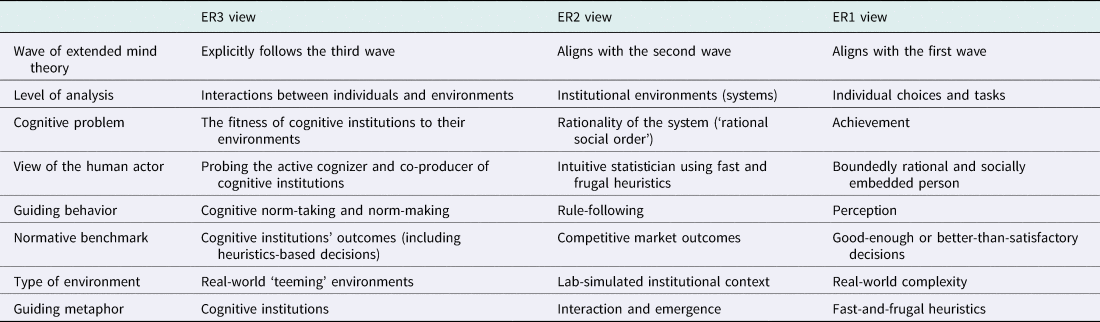
The third-wave view of ecological rationality (ER3) focuses on cognitive institutions adapted to the environment and acting as mediators of mind–environment interactions (see Table 1).
The varieties of the ecological rationality concept

Note: The descriptions of ER1 and ER2 views are partially taken from Dekker and Remic (Reference Dekker and Remic2019: 301).
Unlike what has been argued in second-wave theories, extended cognitive processes are not simply realized in the context of cognitive norms and cultural practices. Cognitive institutions provide the ‘social-normative coupling’ (Slors, Reference Slors2020) that underlies socially extended cognition: they facilitate individuals' navigation of a complex and ambiguous environment through derived orientations, scaffoldings, and affordances. Individuals' perceptions and understandings of the world are mediated by cognitive institutions, which ‘are enacted through the dynamic coupling between individuals and various external resources’ (Petracca and Gallagher, Reference Petracca and Gallagher2020: 755). Heuristics play a similar (mediating) role – ‘[i]t is the interaction between a heuristic and its social, institutional, or physical environment that explains behavior’ (Todd and Gigerenzer, Reference Todd and Gigerenzer2007: 167) – but primarily explains the underlying cognitive processes.
Heuristics are rules of thumb, but first of all, they are shared cognitive rules: more precisely, they are simple, intuitive, and task-specific cognitive institutions. The institutional dimension of heuristics is manifested in their normativity, since heuristics inform rule-following thinking and prescribe the right way of responding to environmental signals. In addition, heuristics are collectively co-produced and shared by various actors. So, they should become the focus of analysis in post-Northian institutional economics along with more complex cognitive institutions.Footnote 7 Simple heuristics may not work in all environments (which FFH scholars often forget); different domains may require cognitive institutions of different degrees of complexity. The cognitive norms associated with blockchain, robotics, big data, and nanotechnology are examples of highly sophisticated cognitive institutions that are widely used in these specific cognitive domains. Reducing the focus of the whole concept of ecological rationality to simple cognitive rules seems one-sided.Footnote 8 We could extend the ecological rationality concept from the FFH program to all cognitive institutions.
Creativity, inventions, and innovations cannot rely solely on simplifying rules; economy is important, but it is not the main feature of the human brain. Creative decisions often require substantial cognitive resources. Thus, the market as a cognitive institution helps reduce individuals' cognitive efforts (Gallagher et al., Reference Gallagher, Mastrogiorgio and Petracca2019), but it no less often stimulates actors to develop complex decision-making strategies and practices. This applies, in particular, to R&D, finance, marketing, and strategic planning. In turn, the legal system and science provide much more affordances for joint sophisticated cognitive processes rather than for simplistic ones. Therefore, the ER3 research program emphasizes the full range of cognitive institutions. In addition, we could move from the analysis of universal heuristics (such as the investment heuristic 1/N, recognition heuristic, or take-the-best heuristic), which is widespread in the FFH program, to studying more narrow-acting and domain-specific cognitive institutions.
Individual decisions are ecologically rational if they are good enough or better than alternatives through the use of cognitive institutions adapted to a given environment. But cognitive institutions are not pre-formed and fixed, not inherently obvious, and not ready for use. On the contrary, cognitive institutions in real-world environments are constantly changing in the course of polycentric co-producing processes; they generate innumerable, indefinite, ambiguous, possible, or hidden signals for actors, as a result of which individuals most often deal with ‘teeming’ environments. Our cognitive activities are aimed not so much at passive adaptation to an environment with predetermined and fixed signals but rather at active exploration, redefinition, rethinking, probing, and testing the environment in search of cues and clues provided by cognitive institutions of varying degrees of complexity. In short, human beings are probing organisms (see for details Felin and Koenderink, Reference Felin and Koenderink2022). The ER3 view focuses on the active role of individuals in solving cognitive tasks and decision-making. From the third-wave enactivist viewpoint, deciding what to do next (which is the most fundamental cognitive challenge for human beings) ‘is best understood not as choosing the right response to a given stimulus, but rather as choosing the right stimulus – the right experience to seek’ (Anderson, Reference Anderson2016: 7). We can say more broadly that deciding what to do next is, first of all, deciding to follow the right cognitive institution: this not only gives individuals access to a variety of cognitive strategies and practices (which allows them to proficiently engage with the environment) but also makes them participants of co-production processes.
5. Co-production of cognitive institutions
In institutional economics, passive cognitive agency is a feature of the Northian (SMMs-based) paradigm that is still deployed. From this perspective, individuals usually take the cognitive rules as given, and they normally cannot set or change them (Greif and Mokyr, Reference Greif and Mokyr2017). Enactivism categorically favors the notion of dynamic interactions between individuals and the environment: in this case, active agency (both individual and collective) is crucial. The environment is not a pre-given domain of the realm: actors not only receive signals from the environment and use environmental cognitive resources but also change the environment through interactions with the world, more precisely, through enactment of the world.
However, active agency takes place not in the environment (or the world) as a whole but in various niches. Although it emerged during the second wave, the cognitive/cultural niche is a key concept for the third-wave extended mind theory. Sterelny (Reference Sterelny2010) emphasizes that the niche-construction approach provides a more helpful methodological framework for understanding human cognitive agency than the first-wave extended mind approach. The terms ‘cognitive niche’ and ‘cultural niche’ are used similarly in third-wave studies (see Constant et al., Reference Constant, Clark, Kirchhoff and Friston2022; Kirchhoff and Kiverstein, Reference Kirchhoff and Kiverstein2019). Therefore, I talk about cognitive-cultural niches. In this hybrid term, ‘cognitive’ refers to the interactive cognitive processes in niches, while ‘cultural’ emphasizes the cumulative cultural specificity of polycentric niche communities.
The idea of niche multiplicity is helpful here; any individual simultaneously enters a multitude of cognitive-cultural or, more correctly, cognitive-subcultural niches. We now live in a world of multiple identities based on multiple community memberships. A cognitive-cultural niche is a separated and relatively autonomous space of interrelated cognitive norms, co-developed by a community of actors united by some shared characteristics. The Internet has created almost limitless opportunities for emerging communities (and cognitive-cultural niches) centered around ideas or identities. Such niches can be of different scales, from local to global; they can be relational, virtual, or, most often, hybrid; and they can be created by communities of place, practice, or interest. Any cognitive-cultural niche gives rise to a relatively isolated media system in which the exchange of information takes place, resulting in the co-production of shared cognitive norms. These niche-related cognitive institutions constrain, enable, and constitute community actors' cognitive processes.
Humans are niche-seeking and niche-constructing beings with community-bounded cognition. People are not affected by society as a whole but by society represented by those communities (and related cognitive-cultural niches) in which they belong. It is natural for humans to enter a community: they do this because of tribal instincts that developed during the many millennia of gene–culture coevolution. Cognitive-cultural niches set agendas, topics for discussions, shared views, values, stereotypes, narratives, expectations, etc. Niche-specific cognition is immeasurably more common than niche-general cognition. In this sense, the mass market for ideas (Greif and Mokyr, Reference Greif and Mokyr2017) is often an observer's illusion. In reality, most ideational and cognitive-institutional processes occur in relatively closed communities that generate socially led and technology-driven echo chambers. If we use the metaphor of ‘market for ideas’ (although I agree that there is little reason for this; see Hodgson, Reference Hodgson2020), we should not be discussing a homogeneous mass market but a highly segmented (multi-niche) market.
The most crucial property of cognitive-cultural niches is that they are collectively constructible. Cognitive rules do not just ‘summarize and aggregate society's beliefs and attitudes’ (Greif and Mokyr, Reference Greif and Mokyr2017: 27); they are not entities independent of individuals and communities. A niche-construction perspective allows us to emphasize that cognitive institutions are not just involved in individual cognitive processes from the outside but are actively co-produced within polycentric cognitive processes. Cognitive institutions are not a given; they are not ready-made and packaged ‘goods’ on the ‘market for ideas.’ People not only use cognitive institutions but also make numerous incremental changes in them, thereby carrying out user-driven institutional innovations; in turn, well-resourced actors can jointly bring about broader, radical changes in cognitive institutions. A niche-construction view is not just an old-fashioned, first-wave approach, according to which the key is ‘the embeddedness of the thought process in the larger social and institutional context’ (North, Reference North2005: 24); instead, we should speak of the actors themselves co-producing that context in different cognitive-cultural niches.
The basis of cognitive-cultural niche construction is the co-production of cognitive institutions; it is a polycentric process in which various community actors and external actors participate. All actors play active roles in the co-production of cognitive norms, although they have different capabilities, resources, strategies, and worldviews. More correctly, actors cannot make direct changes to cognitive norms. Still, they can alter elements of polycentric interactive co-producing processes (views, understandings, anticipations, expectations, practices, habits, beliefs, etc.), triggering cognitive-institutional changes. In the same niche, niche construction (i.e., co-production of niche-related cognitive institutions) usually co-occurs in different ways. The term ‘niche construction’ can be misleading because it implicitly presents the niche as unified and homogeneous. But any community is heterogeneous and includes individuals with differing interests, values, and worldviews. In any niche, various competing and complementary cognitive institutions are co-produced in parallel. For example, during the COVID-19 pandemic, all communities (local or social identity–based communities) co-produced a heterogeneous continuum of cognitive institutions supporting or rejecting antiviral preventative measures to varying degrees. In intensively developing niches (such as artificial intelligence, cryptocurrencies, smart cities, or a sharing economy), various cognitive institutions coevolve and compete; that is why all these concepts are criticized for their amorphousness and blurring.
The market and the legal system not only constitute specific types of cognitive processes, they also enable actively co-produced, interactional processes (AIPs), as a result of which markets and legal systems are constantly being reassembled by both internal and external actors. Internal actors directly participate in AIPs and follow the relevant cognitive norms. External actors are indirectly connected with certain cognitive institutions, but they can still participate in their co-production: they can act as commentators, critics, haters, supporters, promoters, and so on. Let's take a look at the robots market. Writers, screenwriters, film directors, and other actors in cultural industries actively shape the market's AIPs. As a result, roboticists implicitly think about robots in terms of existing cognitive norms, including shared stereotypes found in science fiction books and films. These cognitive norms are then embodied in the functional features and design of the robots that are brought to market. Another example is how co-producing interactive processes in the legal system involve numerous outsiders. Resonant lawsuits cover a wide range of actors, including politicians, experts, journalists, bloggers, activists, and internet users who co-produce the cognitive norms (socially accepted beliefs, moral judgments, argumentations, objections, etc.) underlying court rulings. In particular, cancel culture involves mass and rapid co-production of legal system–related cognitive institutions. ‘Courts of public opinion’ deliver judgements and engage in digital public shaming before decisions are made by the judiciary (moreover, they often seek a review of the official courts' verdicts). Cancel culture extends the legal system (a complex cognitive-institutional system) outside courtrooms and into the multi-actor domain of collective condemnation.
From a third-wave perspective, the market is the economizer of individuals' cognitive efforts (Gallagher et al., Reference Gallagher, Mastrogiorgio and Petracca2019) and an ‘extended problem-solving entity’ (see also Dekker, Reference Dekker, D'Amico and Martin2022; Petracca and Gallagher, Reference Petracca and Gallagher2020: 759). However, the market is not limited to ‘purely market’ collective cognitive processes, such as price formation or mutual discovery and learning. It is also a cognitive-cultural niche, that is, a space for co-producing cognitive norms concerning market-related activities and products. Consider the drone market, which is a complex distributed network of dynamically related co-producing processes. These AIPs are constantly updated with new reports, papers, books, videos, posts, inside information, rumors, forecasts, expert opinions, user reviews, infographics, rankings, updated databases, and robot prototypes and concepts. All of these elements are combined in the drone market's AIPs, resulting in ever-changing cognitive norms in this multi-niche market. For example, the market for military drones is based on competing drone-related cognitive norms, the range of which is quite wide, from ‘the most humane weapon’ to ‘weapon of cowards’ and ‘killer robots’ (Chamayou, Reference Chamayou2015), from a transformative technology and ‘silver bullet’ to an overvalued technology that will have a rather narrow application (Horowitz et al., Reference Horowitz, Kreps and Fuhrmann2016). It is on these cognitive norms that the drone market's parameters (e.g., prices, supply, demand, growth trends, market segments, etc.) are based. Popular culture, internet memes, advertising, and storytelling by journalists and activists play a special role in the drone market's AIPs (Howley, Reference Howley2018), which allows the re-imagining and co-construction of the future trajectories of this market.
In any case, it would be desirable for us to avoid the idealized ‘harmonious’ (free market–like) notion of cognitive institutions' co-production. Whether it be cognitive institutions concerned with understanding the present, past, or imagined futures, various social groups are always at work, vying for ideational power. Cognitive institutions employ a mixture of top–down and bottom–up ideologies and, therefore, are objects of competition, lobbying, and conflict. The co-production of cognitive norms involves manipulation, deception, coercion, and other unfair cognitive practices. Further, as nodes of ideational power relations, cognitive institutions inevitably generate inequality and power hierarchies.Footnote 9
Of course, there are other ways of co-producing cognitive institutions. These engineering-like paths involve rational, goal-oriented design with specially selected resources and tools and are observable in the development of scientific theories, legal frameworks, or technological standards. In contrast, the vast majority of real-life cognitive institutions are created differently – through bricolage. Bricolage is usually opposed to engineering (Lévi-Strauss, Reference Lévi-Strauss1966), and institutional bricolage, called ‘crafting of institutions’ by Ostrom (Reference Ostrom1992), is the ‘artisanal’ co-production of institutions by heterogeneous resourceful actors from any available resources. These resources can be ideas, norms, practices, signs, images, narratives, representations, symbolic constructs, cultural artifacts, etc. (Campbell, Reference Campbell2004; Cleaver, Reference Cleaver2012), which come from the institutional past (Greif and Kingston, Reference Greif, Kingston, Schofield and Caballero2011), everyday practice, or adjacent fields. Many cognitive institutions that look engineering-based are, in fact, products of bricolage. For example, strangely enough, methodological bricolage is an essential part of creating scientific theories (Pratt et al., Reference Pratt, Sonenshein and Feldman2022) and even highly formalized systems of legal cognitive rules include a large proportion of bricolage processes and elements (see Turner and Wiber, Reference Turner and Wiber2022). Cognitive-institutional bricolage is an organic feature of complex institutional systems which is much more common than the purposeful design of cognitive institutions by professional actors, such as policy-makers, scientists, lawyers, and experts. Bricolage is small institutional entrepreneurship: the creative ‘artisanal’ process of Schumpeterian recombination of existing cognitive institutions for use in new choice situations. The bricolage approach emphasizes the continuous reconstruction and reassembling of emerging cognitive norms rather than equilibria. Bricolage is carried out without explicit performance criteria, from any available resources, and under conditions of permanent time pressure.Footnote 10 Therefore, bricolage paves the way for heterogeneous, fragmented, messy, and far-from-optimal assemblages of cognitive-institutional elements. Bricolage involves improvisation, experimentation, reframing, resignification, reimagining, the subversion of widespread cognitive norms, and the reuse of past cognitive institutions.
A community constructs a niche through joint cognitive-institutional activities, but individuals practice, discuss, and criticize cognitive institutions in their niches. Cognitive-institutional bricolage is an active (even enactive) process during which individual actors constantly question, reinterpret, and reassemble cognitive institutions. Cognitive institutions are cognitively constructed because cognitive actions are performative (for details, see Herrmann-Pillath and Boldyrev, Reference Herrmann-Pillath and Boldyrev2014). Cognitive actions (such as descriptions, explanations, definitions, categorizations, storytelling, sensemaking, meaning-making, or moral judgments) do not simply reflect or describe external reality. These actions also shape, change, and even transform cognitive institutions. Actors use shared cognitive norms not only in an accepted way but also in innovative, disruptive, and sometimes provocative ways. In the era of universal internet access and social media, cognitive institutions are far less established, stable, and monolithic phenomena than is commonly believed. All institutions in the modern world are mediatized; they exist in a media-saturated environment, where all people are social media actors and content generators. Cognitive institutions in the digital media environment are open to change: flexible, loosely defined, and endlessly discussed, contested, and recombined, they are interactively updated and full of misunderstandings and disagreements. Following cognitive norms is not a passive process but a daily interactive and performative action immersed in communication fields. Individuals not only legitimize the already existing cognitive institutions but also co-produce them by adding ideational building blocks – commenting, criticizing, applauding, hating, telling stories, referring to data, posting pictures and photos, using hashtags, ‘liking’ on social media, and sharing with friends and acquaintances. We are all now bricoleurs, continuously engaged in digital cognitive-institutional bricolage in our various niches. In this sense, the bricoleur can become an alternative view on cognitive agency in post-Northian institutional economics.
6. Conclusion
The cognitive dimension of institutions remains underexplored in institutional economics. Institutional economists have not gone beyond first-wave extended mind theory based on North's ideas of shared mental models, shared beliefs, and scaffolded cognition. For first-wave institutional economists, it was most important to understand ‘how heterogeneous minds interact with institutions’ (Felin, Reference Felin2015: 528), interpreted as background conditions of cognition. Now we have many other more complex ‘how’ questions. These include: how do cognitive institutions matter to institutional and economic change? How does cognitive-institutional diversity evolve? How do actors interact with cognitive institutions to produce ecologically rational outcomes? How do heterogeneous minds co-produce ecologically rational cognitive institutions? How can cognitive institutions be used to improve public policy? It is impossible to answer these questions without involving inspiring ideas from third-wave extended mind theory.
I invite the broad institutionalist community to join the discussion on a post-Northian institutional economics research agenda (the debate is already ongoing, see Dekker, Reference Dekker, D'Amico and Martin2022; Frolov, Reference Frolov2022; Greif and Mokyr, Reference Greif and Mokyr2017; Petracca and Gallagher, Reference Petracca and Gallagher2020; Slors, Reference Slors2020). We need a new path, following which we can continue North's search for ‘a better, if imperfect, grasp of the complex interaction between cognitive processes, belief formation, and institutions’ (Reference North2005: 25). This new path can challenge the weak-externalist view of cognition, the individualistic notion of rationality, and the passive (scaffolding-like) understanding of institutions' role in cognition; these approaches have dominated modern institutional economics for far too long. Along the way, we may encounter an unknown and wired world of polycentric interactive cognitive processes in which cognition is fundamentally inseparable from institutions.
Acknowledgements
The research is supported by the grant of the Russian Science Foundation no. 21-18-00271. I wish to thank editors and anonymous reviewers for useful comments.