Implications
This study reports significant variation in growth, nutrient utilization, organ weight and the small intestine structure between an obese Iberian (IB) and a lean-type Landrace × Large White (LD) pig subjected to identical nutritional management. The LD pigs exhibited higher growth performance, N retention (NR) and efficiency of NR than pigs of the IB breed. Although the observed structural aspects of the small intestine may contribute to explaining the dissimilarities in nutrient absorption, they cannot account for the wide differences previously reported in overall efficiency of protein and energy use between both genotypes. Additional research is required to better understand the mechanisms responsible for such differences in growth potential.
Introduction
The effects of pig genotype on total-tract apparent digestibility (TTAD) of nutrients and energy have been widely reported in the literature. Nevertheless, there is controversial information on the digestive capacity of indigenous pig breeds compared with lean-type pigs. Some authors have reported higher TTAD coefficients in obese-type pigs compared with lean pigs (Février et al., Reference Février, Bourdon and Aumaitre1992; Freire et al., Reference Freire, Dias, Cunha and Aumaitre2003). In contrast, Morales et al. (Reference Morales, Pérez, Baucells, Mourot and Gasa2002) and Rivera-Ferre et al. (Reference Rivera-Ferre, Aguilera and Nieto2006) found lower TTAD coefficients for Iberian pigs (IB) when compared with Landrace pigs at the same stage of growth (fattening (90 to 110 kg BW) and post-weaning (25 to 35 kg BW) pigs, respectively), which may contribute to explaining the poorer nutrient utilization of the IB genotype. In other studies, higher TTAD coefficients of indigenous pigs has been related to differences in total weight of the gastrointestinal tract (GIT), in enzymatic and microbial activity of the gut and in digesta passage rate (Freire et al., Reference Freire, Dias, Cunha and Aumaitre2003). Nevertheless, little information is available in the literature relating TTAD coefficients to micro-anatomical structure of the intestine, which is often referred to in studies on weaning piglets, in which the structural aspects of the intestine have not necessarily reached ‘mature’ morphology (Salgado et al., Reference Salgado, Freire, Mourato, Cabral, Toullec and Lallès2002; Liu et al., Reference Liu, Piao, Kim, Wang, Shen, Lee and Li2008). Regardless of animal-related factors (i.e. genotype, BW, sex, etc.), nutrient and energy digestibility depend on chemical (and physical) characteristics of the feed and on the interactions among all these factors (Noblet and van Milgen, Reference Noblet and van Milgen2004).
Despite digestive differences, the efficiency of utilization of dietary protein for body protein deposition is strongly related to pig genotype (Campbell and Taverner, Reference Campbell and Taverner1988; Rivera-Ferre et al., Reference Rivera-Ferre, Aguilera and Nieto2005). Matching the crude protein (CP) supply according to pig requirement has not only nutritional and environmental implications (i.e. increased feed efficiency and reduced N excretion; Dourmad et al., Reference Dourmad, Sève, Latimier, Boisen, Fernández, van der Peet-Schwering and Jongbloed1999), but also may improve pig health by limiting the incidence and severity of enteric pathologies (Ball and Aherne, Reference Ball and Aherne1987). Some studies have also reported the effects of dietary CP supply on intestinal development and morphology of the growing pig (Guay et al., Reference Guay, Donovan and Trottier2006; Yue and Qiao, Reference Yue and Qiao2008), although the overall impact on the absorption and utilization of dietary nutrients is still under discussion.
On these bases, the main objective of this study was to investigate differences in TTAD and nutrient utilization of two pig genotypes (i.e. IB and lean-type) at two stages of growth (growing and fattening) and their possible relationship with differences in visceral proportional weight and intestinal micro-anatomical aspects. At the same time, the possible differential effects of dietary CP supply on the above-mentioned variables have also been investigated.
Material and methods
Experimental design and diets
Experimental procedures and animal care were carried out according to current Spanish legislation, and the authorization to experiment on living animals was approved by the Bioethical Committee of the Spanish National Research Council (CSIC, Spain).
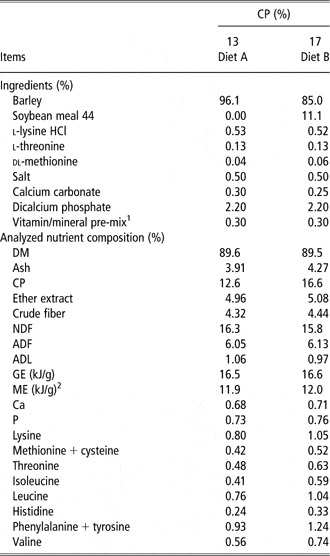
A total of 38 purebred IB and Landrace × Large White (LD) castrated male pigs (n = 19 per genotype) were used in this experiment. Post-weaned piglets of IB (e.g. of Silvela strain) and LD breeds were supplied by Sánchez Romero Carvajal Jabugo SA (Seville, Spain) and Jodral Gutiérrez SA (Cordoba, Spain), respectively. Three pigs of each genotype were slaughtered before the beginning of the trial (e.g. at approximately 15 kg BW). The remaining pigs were housed in individual pens (2 m2) located in an environmentally controlled room. The temperature in the room was decreased progressively from 26°C during the first days to 20°C during the last period of the trial to be at thermoneutrality. The pigs were fed one of two adequate amino acid composition diets (e.g. formulated according to the ideal protein concept; British Society of Animal Science (BSAS), 2003) differing in CP content: 13% (diet A) or 17% (diet B) as fed (Table 1). Dietary CP supply was fixed to meet or exceed the current recommendations for growing (approximately 15 to 50 kg BW) IB (13% CP, Nieto et al., Reference Nieto, Miranda, García and Aguilera2002; Barea et al., Reference Barea, Nieto and Aguilera2007) and lean-type pigs (17% CP, BSAS, 2003). Thus, each CP supply was tested in each genotype under its otherwise optimal CP level in the growing period. For simplicity, these CP contents were maintained throughout the experiment. Thus, during the finishing period (50 to 115 kg BW), diet A was supposed to be optimal for LD, but in excess for IB pigs (approximately +20% of current recommendations; Barea et al., Reference Barea, Nieto and Aguilera2007). Nutrients other than CP and energy content were formulated in order to be equivalent or to exceed the current requirements for growing lean-type pigs (BSAS, 2003). The experimental diets were supplied by Institut de Recerca i Tecnologia Agroalimentàries (IRTA, Tarragona, Spain). A pair-fed procedure (eight pigs per treatment and breed) was used and the feeding level was restricted at 0.8 × ad libitum of the IB breed, which has a higher intake capacity than LD pigs (Nieto et al., Reference Nieto, Lara, García, Gómez, Zalvide, Cruz, Pariente, Moreno and Aguilera2001; Morales et al., Reference Morales, Pérez, Baucells, Mourot and Gasa2002). During the experiment, the pigs were weighed weekly after an overnight fast and the daily feed allowance for each animal was adjusted for the following week according to the equation described by Nieto et al. (Reference Nieto, Lara, García, Gómez, Zalvide, Cruz, Pariente, Moreno and Aguilera2001). Water was freely available during the experiment. Refusals, if any, were dried and weighed in order to calculate actual average daily feed intake (ADFI). Four pigs per treatment and genotype were slaughtered at 50 kg BW (e.g. growing period), whereas the remaining pigs were kept on the trial until slaughter at 115 kg BW (e.g. growing–fattening period). The pigs were also weighed after an overnight fast at the beginning and at the end of the experimental period in order to determine the average daily gain (ADG) for each stage of growth.
Ingredients and chemical composition of the diets on an as-fed basis

DM = dry matter; GE = gross energy; ME = metabolizable energy.
1Provided the following nutrients (per kg diet as fed): vitamin A, 5000 IU; vitamin D3, 1000 IU; vitamin E, 15 mg; vitamin K3, 2 mg; thiamin, 1.3 mg; riboflavin, 3.5 mg; niacin, 15 mg; calcium pantothenate, 10 mg; pyridoxine, 1.5 mg; biotin, 0.1 mg; folic acid, 0.6 mg; vitamin B12, 0.025 mg; Fe, 80 mg; Cu, 6 mg; Zn, 60 mg; Mn, 30 mg; I, 0.75 mg; Se, 0.1 mg; Co, 0.75 mg; and ethoxiquin, 150 mg.
2ME calculated according to Sauvant et al. (Reference Sauvant, Perez and Tran2004).
Digestibility measurements
Nutrient digestibility and N balance trials were performed at approximately 30 and 80 kg BW to determine the apparent TTAD of nutrients and N retention (NR). The pigs were moved to individual metabolic cages placed in an environmentally controlled room (19°C ± 1.5 °C), 3 days before starting the excreta collection. Total collection of feces and urine (collected in 100 ml of 4 mol/l H2SO4) was performed daily during 5 days. The collected feces and urine were weighed and stored at −20°C. At the end of the digestibility measurements, composite samples of feces and urine were obtained separately for the whole period for each pig. Fecal samples were freeze-dried and finely ground for further chemical analysis. Apparent digestible energy (DE) and metabolizable energy (ME) contents were determined from the gross energy (GE) content of the feed consumed minus the GE content of feces or feces plus urine, respectively. No correction for energy loss as CH4 was made. Apparent energy digestibility and metabolizability were calculated as DE : GE and ME : GE ratios, respectively. N balance was determined as the difference between N intake (NI) and N losses in feces and urine.
Organ weight and tissue samples
Nineteen pigs per genotype were slaughtered after an overnight fast at approximately 15 (n = 3), 50 (n = 8) and 115 (n = 8) kg BW, involving four pigs per dietary CP treatment within each stage of growth. The pigs were killed by exsanguination after electrical stunning. Immediately after slaughter, the GIT and bladder were carefully emptied. The empty intestine (small and large), liver and the remaining internal organs (i.e. kidneys, stomach, trachea and lungs, diaphragm, heart, genital tract, bladder, spleen and mesenteric fat) were weighed. The total length of the small intestine was also measured after emptying. Immediately after slaughter, emptying and weighing, samples of the small intestine were collected for micro-anatomical analyses at 10 cm caudal to the pylorus (duodenum), mid-jejunum and 10 cm cranial to the ileocecal valve (ileum).
Histology and histometry of the small intestine
A total of 96 gut samples (32 pigs × 3 intestine segments) were fixed immediately after collection for 24 h at 4°C in 4% paraformaldehyde in 0.01 M phosphate-buffered saline at pH 7.4. Subsequently, the samples were dehydrated (e.g. in an increasing concentrations of ethanol), cleared with xylene and embedded in paraffin. Microtome sections of 3 to 5 μm of thickness were made and then stained with a sequential hematoxylin/eosin (HE) stain to evaluate the structural aspects of the organs and for histometric analysis: the thickness of the Tunica mucosa, Tunica submucosa and Tunica muscularis were measured at five sites of each section at ×200. Moreover, the depth of crypts (C), length of villi at ×200 and the ratio of villi and the measurements of the crypts (V : C ratio; 10 per section) were determined on the HE-stained sections.
All the observations were made by a single investigator, blind to the pig genotype and dietary treatment, using an Olympus BX51 microscope (Olympus Italia Srl, Milan, Italy) equipped with a digital camera and DP software for computer-assisted image acquirement and management.
Chemical analyses
The dry matter and ash content were determined in samples of feed and feces according to the methods of the Association of Official Analytical Chemists (AOAC, 1990). The N contents in feed, feces and urine were determined according to the Dumas procedure using a LECO Truspec CN determinator (LECO Corporation, St. Joseph, MI, USA). Samples were also analyzed for GE using an isoperibolic bomb calorimeter (PARR 1356, Biometa, IL, USA). The crude fat content of feed was determined by ether extraction (AOAC, 1990). The NDF, ADF and ADL contents of diets were analyzed by the method of Goering and van Soest (Reference Goering and Van Soest1970). The amino acid contents of feed samples were analyzed by HPLC (Alliance 2695 separation module; Waters Cromatrografía SA, Madrid, Spain) after protein hydrolysis with 6 N HCl at 110°C for 24 h. Methionine and cysteine dietary contents were determined after performic oxidation before hydrolysis.
Statistical analyses
Within each stage of growth, the results of performance, digestibility measurements and organ weight were subjected to ANOVA using the GLM procedure (SAS Institute Inc., Cary, NC, USA) for a factorial arrangement of treatments, which included genotype, dietary CP content and their interaction. Organ weight was also analyzed for a factorial arrangement including genotype, BW at slaughter (e.g. 15, 50 and 115 kg BW) and their interaction. In case of significant interaction between factors, data were then subjected to a one-way ANOVA. The least squares means option of SAS was used to evaluate statistical differences between variables according to the Student’s t-test. Data from histometrical analyses of the small intestine were subjected to an ANOVA using the MIXED procedure of SAS. The model included the fixed effects of genotype and dietary CP content and the random effect of the pig. An individual pig was used as the experimental unit and differences were considered significant at P < 0.05 for all data.
Results
In general, pigs appeared to be in good health throughout the experiment. Occasional cases of diarrhea occurred during the first 2 weeks of the trial and the pigs were then treated with amoxicillin (Penimox L.A., Bayer Health Care SA, Barcelona, Spain).
Growth performance
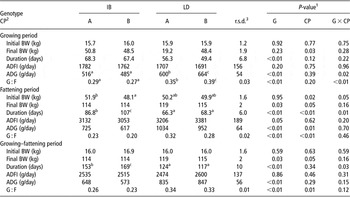
Table 2 shows the performance data for the growing period (approximately between 15 and 50 kg BW, ), the fattening period (approximately 50 to 115 kg BW) and the whole trial (growing–fattening period). There was an interaction between pig genotype and CP content for ADG and gain-to-feed ratio (G : F) in the growing period (P = 0.02 and P < 0.01, respectively), associated with higher ADG and G : F observed in LD pigs fed diet B than either LD pigs fed diet A or IB pigs fed both the treatments. No significant differences in ADFI were observed for either pig genotype or dietary CP content at growing and growing–fattening periods. However, in the fattening period the ADFI tended to be higher in LD than in IB pigs (P = 0.0549). During the fattening and growing–fattening periods, performance was affected by the breed with higher ADG and G : F ratio in LD pigs (approximately >30% on average; P < 0.01).
Effects of genotype and dietary CP content on growth performance of pigs during growing (15 to 50 kg BW), fattening (50 to 115 kg BW) and growing–fattening (15 to 115 kg BW) periods (least squares means)

IB = Iberian pigs; LD = crossbred Landrace × Large White pigs; ADFI = average daily feed intake; ADG = average daily gain; G : F = gain-to-feed ratio.
1Effects of genotype (G), dietary CP content (CP) and their interaction (G × CP). Within a row, means without a common superscript differ (P < 0.05).
2CP = crude protein intake – diet A: 13% and diet B: 17%, as fed basis.
3n = 16 per genotype in the growing and growing–fattening period; n = 8 per genotype in the fattening period.
The CP supply altered pig performance mainly during the fattening period. The pigs receiving diet A presented higher ADG and G : F (P < 0.05) than those fed diet B. During the whole experimental period (e.g. growing–fattening stage) pigs fed diet A presented higher G : F than those supplied with diet B (P = 0.01), although the magnitude of the change is greater for IB pigs.
Total-tract digestibility
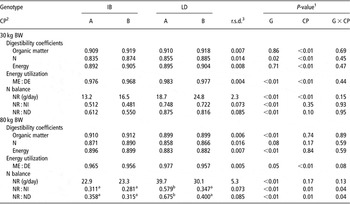
Data concerning the effect of pig genotype and dietary CP supply on nutrient and energy TTAD and N balance are given in Table 3. Digestibility coefficients of organic matter or energy were not affected by pig genotype at 30 kg BW. However, lower N TTAD was observed in IB compared with LD pigs at both CP levels (0.835 v. 0.855, and 0.874 v. 0.885, for IB v. LD pigs, fed diets A and B, respectively, P = 0.02). In contrast, at 80 kg BW, TTAD coefficients of nutrients or energy were widely affected by genotype; IB pigs presented higher TTAD coefficients of organic matter and energy than the LD pigs (averaging 1.5% higher; P < 0.01) and the N TTAD tended to be higher in IB than in LD pigs (on average 0.881 v. 0.862, respectively; P = 0.08). The ME : DE ratio was higher in LD pigs, irrespective of the BW at which the digestibility trial was performed (P < 0.01 and P = 0.05 at 30 and 80 kg BW, respectively). In agreement with performance data, the N balance showed reduced (P < 0.01) NR (g/day) in IB than in LD pigs in both balance trials performed at 30 and 80 kg BW (see Table 3). In addition, the efficiency with which dietary protein was deposited in tissues (e.g. expressed either as NR : NI or NR : N digested (ND)) was lower in IB compared with LD pigs at 30 kg BW (32% lower for both variables; P < 0.01). There were genotype × CP content interactions for NR : NI and NR : ND at 80 kg BW (P = 0.04) because of the higher efficiency of NR observed in LD fed diet A.
Effects of genotype and dietary CP content on digestive utilization of energy and nutrients and N balance of pigs at 30 and 80 kg BW (least squares means)

N = nitrogen; IB = Iberian pigs; LD = crossbred Landrace × Large White pigs; ME = metabolizable energy; DE = digestible energy; NR = N retention; NI = N intake; ND = digestible N.
1Effects of genotype (G), dietary CP content (CP) and their interaction (G × CP). Within a row, means without a common superscript differ (P < 0.05).
2CP = crude protein intake – diet A: 13% and diet B: 17%, as fed basis.
3n = 24 and n = 12 at 30 and 80 kg BW, respectively.
The TTAD coefficients of nutrients or energy were significantly affected by the CP supply only at 30 kg BW (P < 0.01). In fact, pigs receiving diet B presented higher TTAD coefficients of organic matter (1%), N (4.1%) and energy (1.2%) than those fed diet A. In contrast, the ME : DE ratio was higher in pigs of both genotypes receiving diet A compared with those fed diet B at 30 and 80 kg BW (P < 0.01). Finally, at 30 kg BW, NR was higher in pigs fed diet B than those fed diet A (13.2 v. 16.5 and 18.7 v. 24.8 g/day, for IB and LD pigs, respectively; P < 0.01).
Organ weight
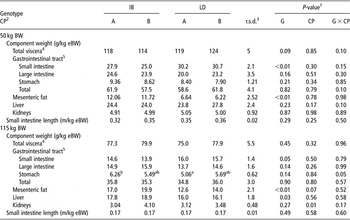
The effects of pig genotype and dietary CP on the weight of organs and body components of pigs slaughtered at 50 and 115 kg BW (as g/kg empty BW (eBW)) are shown in Table 4. The weight of the small intestine was higher in LD than in IB pigs (13% and 10% greater at 50 (P < 0.01) and 115 kg BW (P < 0.05), respectively). The IB presented increased mesenteric fat than LD pigs, both at 50 (11.89 v. 6.43 g/kg eBW on average, respectively) and 115 kg BW (18.4 v. 13.3 g/kg eBW as mean values, respectively). The liver weight was higher in IB at 115 kg BW compared with LD (averaging 18.3 v. 16.0 g/kg eBW, respectively; P = 0.03). The relative weight of the rest of the organs did not show a significant difference between the two pig types. Pig breed and dietary CP did not affect significantly the length of the small intestine (as m/kg eBW) neither at 50 nor 115 kg BW.
Effects of genotype and dietary CP content on carcass characteristics and organ weight of pigs at 50 and 115 kg BW (least squares means)

IB = Iberian pigs; LD = crossbred Landrace × Large White pigs; eBW = empty BW.
1Effects of genotype (G), dietary CP content (CP) and their interaction (G × CP). Within a row, means without a common superscript differ (P < 0.05).
2CP = crude protein intake – diet A: 13% of dry matter, diet B: 17%, as fed basis.
3n = 16 at 50 and 115 kg BW, respectively.
4Liver, lungs and trachea, heart, kidneys, spleen, digestive tract, diaphragm, bladder and genital tract.
5Components of the digestive tract were weighted empty.
Increasing the CP supply produced little response in the weight of body components and organs. Only at 115 kg BW, pigs fed diet B presented 20% higher kidney weight than those fed diet A (3.79 v. 3.08 g/kg eBW on average, respectively; P = 0.01). Mesenteric fat tended to be higher in pigs receiving diet B than those fed diet A at 115 kg BW (P = 0.07).
Micro-anatomical analyses of the small intestine
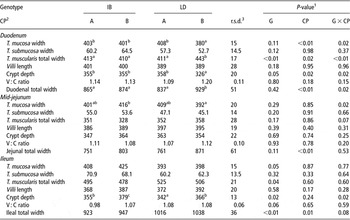
The structure of the different intestinal tracts was judged to be fully normal in both genotypes at different BW studied. The histometrical measurements determined at different tracts of the small intestine at 50 and 115 kg BW are shown in Tables 5 and 6, respectively. Significant interactions (genotype × CP content) were observed for several histological parameters (P < 0.05) because of a higher effect of increased CP supply on structural aspects in all segments of the small intestine in LD compared with IB pigs, particularly at 50 kg BW. At 50 kg BW (Table 5), LD pigs presented higher muscle layer thickness than IB breed in the ileum (averaging 516 v. 486 μm, respectively, P = 0.04). Even if the total width of the ileum was 10% higher in LD (P < 0.01), the IB pigs showed a higher Tunica mucosa width in the ileum (417 v. 396 μm on average, respectively; P = 0.05).
Effects of genotype and dietary CP content on measured histological parameters (μm) of the small intestine of pigs at 50 kg BW (least squares means)

T. mucosa = Tunica mucosa; T. submucosa = Tunica submucosa; T. muscularis = Tunica muscularis; IB = Iberian pigs; LD = crossbred Landrace × Large White pigs; V : C = villi-to-crypt ratio.
1Effects of genotype (G), dietary CP content (CP) and their interaction (G × CP). Within a row, means without a common superscript differ (P < 0.05).
2CP = crude protein intake – diet A: 13% and diet B: 17%, as fed basis.
3n = 80 for T. mucosa, T. submucosa and T. muscularis; n = 160 for villi and crypts.
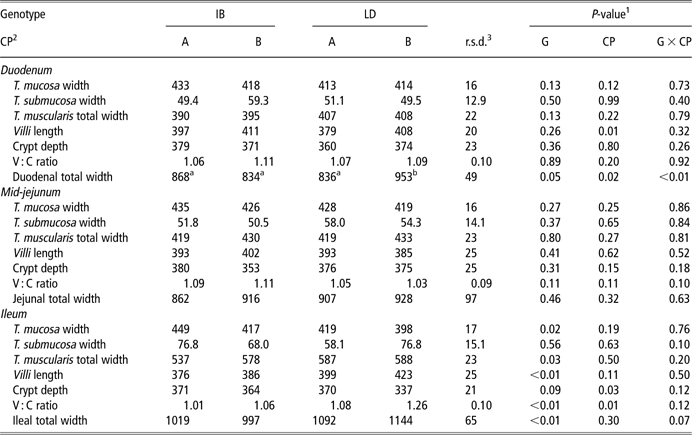
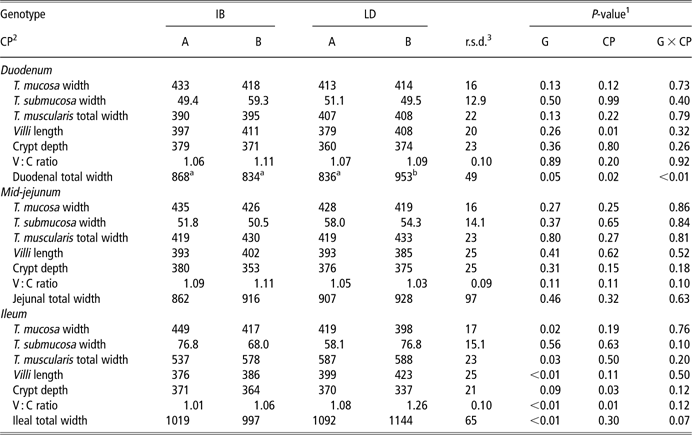
Effects of genotype and dietary CP content on measured histological parameters (μm) of the small intestine of pigs at 115 kg BW (least squares means)
T. mucosa = Tunica mucosa; T. submucosa = Tunica submucosa; T. muscularis = Tunica muscularis; IB = Iberian pigs; LD = crossbred Landrace × Large White pigs; V : C = villi-crypt ratio.
1Effects of genotype (G), dietary CP content (CP) and their interaction (G × CP). Within a row, means without a common superscript differ (P < 0.05).
2CP = crude protein intake– diet A: 13% and diet B: 17%, as fed basis.
3n = 80 for T. mucosa, T. submucosa and T. muscularis; n = 160 for villi and crypts.
Pigs fed diet B presented higher jejunal and total ileal widths than those receiving diet A at 50 kg BW (P < 0.05). The significant interactions observed at 50 kg BW showed that LD pigs fed diet B presented lower T. mucosa width and crypt depth (and higher T. muscularis and total widths) in duodenum than those receiving diet A.
Similarly to 50 kg BW pigs, at 115 kg BW the T. muscularis total width was higher in LD than in IB pigs in ileum (averaging 587 v. 558 μm, respectively; P = 0.03 (Table 6)). In addition, the total ileal width was lower in the IB breed compared with LD pigs (1008 v. 1118 μm as mean values, respectively; P < 0.01) and IB pigs presented 6% higher T. mucosa width in the ileum than LD (433 v. 409 μm on average, respectively; P = 0.02). Moreover, significant effects of pig genotype (P < 0.01) were observed at 115 kg BW in ileal villi length (381 v. 411 μm for IB and LD pigs on average, respectively) and V : C ratio (P < 0.01).
Increasing the CP supply decreased crypt depth (5%; P = 0.03) and increased V : C ratio (10%; P = 0.01) in ileum. The villi length of the duodenum was also higher in pigs fed diet B at 115 kg BW compared with pigs fed diet A (5%; P = 0.01). Similarly to what has been described for 50 kg BW, at 115 kg BW, LD pigs receiving diet B also presented a higher total duodenal width than those fed diet A.
Discussion
Traditional extensive systems of heavy pig production (e.g. pigs are slaughtered at 140 to 180 kg BW and 18 to 25 months of age) are typically located in some areas of the Mediterranean basin. They rely on indigenous genotypes (i.e. IB, Alentejano, Nero Siciliano, Corsican) that are slow growing, obese porcine breeds with low productivity. One of the causes of the decreased efficiency of nutrients of IB pigs may stem from the digestive level. In fact, in a previous work of the Institute of Animal Nutrition (Granada, Spain), lower apparent total-tract digestibility of protein and energy was detected for young IB gilts when compared with Landrace gilts (Rivera-Ferre et al., Reference Rivera-Ferre, Aguilera and Nieto2006).
Studies of growing IB pigs carried out in the Institute of Animal Nutrition showed that the nutritional requirements of the IB pig differ widely from those of lean-type pigs. The optimal protein-to-energy ratio of the diet for IB pigs is considerably lower, both for growing (15 to 50 kg BW; Nieto et al., Reference Nieto, Miranda, García and Aguilera2002) and fattening pigs (50 to 100 kg BW; Barea et al., Reference Barea, Nieto and Aguilera2007) compared with pigs with higher genetic potential for protein deposition. For these reasons, two CP levels (13% and 17% as fed) were chosen to carry out the experiment. In this way, each genotype would receive a CP content diet adequate for the growing period (e.g. between 15 and 50 kg BW) and, also, the optimum CP content for the other pig type. For simplicity, these CP contents were maintained constant throughout the experiment.
The data from performance and N balance trials in this experiment confirm that selection for lean tissue in pigs improves ADG, G : F, NR and efficiency of NR, irrespective of the period of growth studied. This is not surprising as it has been previously reported for IB (Nieto et al., Reference Nieto, Miranda, García and Aguilera2002; Barea et al., Reference Barea, Nieto and Aguilera2007; García-Valverde et al., Reference García-Valverde, Barea, Lara, Nieto and Aguilera2008) and other genotypes (Campbell and Taverner, Reference Campbell and Taverner1988; Quiniou et al., Reference Quiniou, Dourmad and Noblet1996; Noblet et al., Reference Noblet, Karage, Dubois and van Milgen1999, etc.). On the other hand, the higher G : F observed in pigs fed diet A for fattening and the overall experimental period may be related to the variation in the dietary CP requirements of the two genotypes. The genotype × CP interactions observed in the growing period was related to higher ADG and G : F for LD pigs fed diet B. These results suggest that diet A supplied an optimal CP level for IB and for LD pigs at 50 to 115 kg BW, respectively. Furthermore, the lower NR observed in pigs fed diet A at 30 kg BW and the higher efficiency of NR in LD pigs fed the same diet at 80 kg BW (as suggested the genotype × CP interactions) confirmed that this CP level was initially deficient (and subsequently optimal) for growth of LD pigs at 30 and 80 kg BW, respectively.
As cited above, the reported data concerning variation in the TTAD coefficients and/or digestive capacity between indigenous pig breeds and lean-type pigs are controversial. Some authors support that indigenous pigs are able to digest dietary nutrients and energy better than lean-type pigs due to an increased activity of microflora and digestive enzymes in the GIT or to a higher retention time of digesta in the hindgut in experiments carried out under similar feed intake for both pigs types (Kemp et al., Reference Kemp, den Hartog, Klok and Zandstra1991; Freire et al., Reference Freire, Dias, Cunha and Aumaitre2003) or at higher ADFI for obese pigs (Len et al., Reference Len, Ngoc, Ogle and Lindberg2009). In contrast, there are some reports, in which selection for higher protein deposition in lean-type breeds is associated to greater nutrient and energy digestibility and lower rate of digesta passage (Varel et al., Reference Varel, Jung and Pond1988; Ly et al., Reference Ly, Diéguez, Martinez and García1998). The information available comparing the digestive capacity of IB and lean-type pigs is scarce in the literature. Morales et al. (Reference Morales, Pérez, Baucells, Mourot and Gasa2002) observed that IB pigs fed diets varying in cereal sources presented lower organic matter, N and monosaccharide TTAD coefficients (and higher ADFI) than Landrace pigs at the finishing period of growth (approximately between 90 and 110 kg BW, ) under ad libitum feeding. Under different conditions, our results clearly show that IB pigs digested better than LD pigs organic matter and energy (and tended to better digest the N) at 80 kg BW. The fact that, in this experiment, digestibility measurements have been obtained at similar intake/kg BW for both pig breeds might explain, at least in part, the differences with respect to Morales et al. (Reference Morales, Pérez, Baucells, Mourot and Gasa2002). Rivera-Ferre et al. (Reference Rivera-Ferre, Aguilera and Nieto2006) found that under similar feed intake (both restricted to 0.9 × ad libitum of IB pigs), higher N TTAD coefficients in Landrace compared with IB gilts of 25 to 35 kg BW, approximately, which is in close agreement with our observations in N TTAD at 30 kg BW. The IB pigs might have adapted their digestive physiology to the traditionally poor and unstable availability of nutrient supply of the Mediterranean forest (e.g. mainly acorn and pasture), which could result in a better utilization of some dietary compounds mainly at higher BW. In relation to this, it has been reported that the microflora capacity to degrade fibrous components of the diet is lower in piglets than in heavier (and older) pigs because of lower fermentation processes in the large intestine of the former ones (Thorbek et al., Reference Thorbek, Chwalibog and Henckel1984; Noblet and Shi, Reference Noblet and Shi1993). In addition, as LD pigs grew faster and they were comparatively younger than IB, in this experiment we cannot exclude an age effect on the higher nutrient TTAD of IB pigs at 80 kg BW.
Differences in the morphology of the GIT can explain variation in the digestive transit time and in the gastrointestinal microbial activity and, consequently, in nutrient digestibility and in overall efficiency of energy use (Freire et al., Reference Freire, Dias, Cunha and Aumaitre2003). The proportional weight of viscera seems to be affected by genotype, decreasing in lean-type pigs compared with indigenous genotypes (Noblet et al., Reference Noblet, Karage, Dubois and van Milgen1999). In this experiment, genotype differences appear to be maximal for young pigs, with increased proportional weight of the large intestine, stomach and liver, and lower weight of the small intestine in IB pigs (e.g. when piglets slaughtered at 15 kg BW were considered in the comparison, data not shown). Accordingly, Rivera-Ferre et al. (Reference Rivera-Ferre, Aguilera and Nieto2005) observed higher weight (as a proportion of BW) for stomach, large intestine, total GIT and liver in IB than in Landrace gilts of approximately 25 kg BW. For heavier pigs, the proportions of the small intestine remains lower (and the liver heavier) in IB pigs. Freire et al. (Reference Freire, Dias, Cunha and Aumaitre2003) did not observe differences in the empty small intestine weight between Duroc × Landrace and Alentejano piglets. In contrast, empty large intestine weight was 15% higher in the Alentejano breed. In this trial, feeding level was chosen to provide the same energy and nutrient supply per kg BW to both genotypes, as the main target, but also with the aim of reducing feed refusal for practical purposes. It is known that feed intake have a positive effect upon visceral growth (Koong et al., Reference Koong, Nienaber and Mersmann1983; Rao and McCracken, Reference Rao and McCracken1992), therefore, it is possible that if ad libitum feeding had been applied, differences on the relative weight of the viscera between the breeds could have been somewhat higher. The results of this study also indicate that the genetic obesity of IB probably induces large increments in visceral fat depots (e.g. measured as mesenteric fat content), irrespective of the BW studied. This result supports the findings of Kouba et al. (Reference Kouba, Bonneau and Noblet1999) who showed increased kidney fat (e.g. visceral fat) in Meishan barrows compared with leaner pig breeds between 12 and 110 kg BW.
Comparative studies involving the morphology of the GIT and TTAD coefficients have been often referred to the weaning period, which is a critical stage for the health and survival of the piglet (Salgado et al., Reference Salgado, Freire, Mourato, Cabral, Toullec and Lallès2002; Liu et al., Reference Liu, Piao, Kim, Wang, Shen, Lee and Li2008). However, to our knowledge, no information is available in the literature relating the intestinal morphology and structure of the GIT and possible digestive variation between pig genotypes at higher stages of growth. Our results showed higher muscular layers (and lower T. mucosa) in either the duodenum or the ileumin LD pigs, irrespective of the BW. These data also confirmed that pig genotype produces variation not only in muscular but also in mucosal layers of different segments of the small intestine. Increasing the muscle layers in the small intestine of pigs has been related to a higher resistance to digesta passage (Redlich et al., Reference Redlich, Souffrant, Laplace, Hennig, Berg and Mouwen1997). Laplace et al. (Reference Laplace, Souffrant, Hennig, Chabeauti and Fevrier1994) also suggested that a slower passage of time of the digesta may increase the prececal transit time and, thus, the time in which the digesta remains in the small intestine, improving nutrient digestion and absorption. However, when considering the coefficients of TTAD obtained in the present experiment, only minor differences between porcine genotypes are found. Thus, other factors related to nutrient (and energy) utilization in specific tissues should be implicated in the comparatively lower metabolic efficiency of IB pigs observed in previous studies (Nieto et al., Reference Nieto, Miranda, García and Aguilera2002; Rivera-Ferre et al., Reference Rivera-Ferre, Aguilera and Nieto2006; Barea et al., Reference Barea, Nieto and Aguilera2007). On the other hand, the higher TTAD coefficients observed in IB pigs at higher BW may be mainly related to a more important contribution of the large intestine to the overall digestion of dietary compounds (Fernández et al., Reference Fernández, Jørgensen and Just1986; Noblet and Shi, Reference Noblet and Shi1993).
It is assumed that on increasing the V : C ratio, nutrient digestion and absorption capacity of the small intestine are enhanced (Pluske et al., Reference Pluske, Thompson, Atwood, Bird, Williams and Hartmenn1996). Zitnan et al. (Reference Zitnan, Voigt, Kuhla, Wegner, Chudy, Schönhusen, Brna, Zupcanova and Hagemeister2008) suggested that the higher growth potential and protein deposition observed in Charolais cattle compared with German Holstein may be due to increased villi lengths in the duodenum and the proximal jejunum, which seems to be an adaptive mechanism to cope with the higher nutrient requirements of lean-type breeds of cattle. In this study, we did not observe important variations of villi length or crypt depth in the upper parts of the small intestine (i.e. duodenum and mid-jejunum) associated with pig genotype. It is well known that the main dietary compounds are absorbed in the proximal part of the small intestine. Hamard et al. (Reference Hamard, Sève and Le Floc’h2007) suggested that protein synthesis in the upper segments of the small intestine relies largely on dietary amino acids, whereas at the ileum level, this process depends mainly on systemic amino acid supply, suggesting that the ileal nutrient supply is less dependent on dietary sources. Taking these observations into account we do not exclude the fact that the lack of effect of pig breed on mucosal structure (i.e. higher villi lengths or V : C ratios in upper parts of the small intestine in LD than IB pigs) could be associated with the dietary treatments used in this study. In fact, morphological changes in the gut have been related to dietary CP supply in pigs (Guay et al., Reference Guay, Donovan and Trottier2006; Yue and Qiao, Reference Yue and Qiao2008). In the present experiment, histological data from LD pigs fed diet A at 50 kg BW were similar to those of IB pigs fed diet A or B (as shown by the statistical interactions for genotype × CP supply). It has been proposed that an appropriate non-essential amino acid concentration (mainly arginine and glutamine) is indispensable in growing pigs in order to maximize the growth of the gut (Yue and Qiao, Reference Yue and Qiao2008). Thus, LD growing pigs fed diet A might have had insufficient amounts of amino acids for the optimal development of the proximal segments of the small intestine during a considerable period of time. However, it remains unclear whether these histological changes might result in an increased absorption capacity at the distal small intestine in LD, which needs to be further elucidated.
In conclusion, our results show that LD pigs presented higher growth performance, NR and efficiency of NR associated with some structural variations of the small intestine, which may have some minor consequences in nutrient absorption. Consequently, the increased growth rate and improved G : F may stem from a better efficiency of the utilization of N absorbed and digested energy-yielding nutrients. Complementary research is required to better understand the physiological and biochemical mechanisms responsible for these variations and to unravel differences in growth potential between these pig types.
Acknowledgements
The authors thank Ms Ana Navarro, Mr Francisco Funes and Mr Miguel Liñán for their skillful technical assistance and Sánchez Romero Carvajal Jabugo SA (Seville, Spain), Jodral Gutiérrez SA (Cordoba, Spain) and Institut de Recerca i Tecnologia Agroalimentàries (IRTA, Tarragona, Spain) for helpful collaboration. R. Barea was supported by a contract from the JAE Postdoctoral Program (CSIC, Spain). This work was supported by the Spanish Ministry of Science and Innovation (MICINN) Grant no. GL2008-00255 and by grant of the University of Milan, Italy (PUR 2008) to C. Domeneghini.