1 Introduction
Finding our way in an unfamiliar building, city or landscape is a cognitively demanding task. It involves the processing of environmental and self-generated spatial cues, higher-order spatial computations and executive control mechanisms, as well as internal representations of directions, distances, more complex spatial structures, and the visual appearance of places encountered along the way (review e.g. in Wolbers and Hegarty, Reference Wolbers and Hegarty2010). These cognitive components are deployed flexibly, depending on the complexity of the wayfinding task, prior knowledge and individual preferences (Hölscher et al., Reference Hölscher, Buchner, Meilinger and Strube2009; Wiener et al., Reference Wiener, Büchner and Hölscher2009; Ekstrom et al., Reference Ekstrom, Spiers, Bohbot and Rosenbaum2018)
Principally, we can find our way through the environment both in an egocentric and in an allocentric reference frame. The egocentric frame codes directions and distances with respect to our own body, e.g., ‘from where I am, the city hall is 200 m to the left’. In contrast, the allocentric frame codes directions and distances with respect to places in the environment, irrespective of our own body, e.g., ‘the city hall is 200 m east of the cathedral’ (see reviews, e.g., in Nadel and Hardt, Reference Nadel and Hardt2004; Burgess et al., Reference Burgess, Alderman, Forbes, Costello, Laure, Dawson, Anderson, Gilbert and Dumontheil2006). The fundamental difference between these two reference frames is supported by functional MRI studies, which suggest that egocentric and allocentric referenced frames are processed in distinct brain regions: allocentric frames mainly in the hippocampus and in the medial temporal lobe, and egocentric frames mainly in the caudate nucleus, retrosplenial cortex and parietal cortex (see review in Colombo et al., Reference Colombo, Serino, Tuena, Pedroli, Dakanalis, Cipresso and Riva2017).
Five distinct cognitive strategies for finding our way through a complex environment have been proposed. Three of those strategies use the egocentric reference frame. With the sequential strategy, we memorise a sequence of directions to take (Tlauka and Wilson, Reference Tlauka and Wilson1994; Iglói et al., Reference Iglói, Zaoui, Berthoz and Rondi-Reig2009), e.g., ‘turn left at the first intersection, continue straight on at the second, and turn right at the third’. With the associative cue strategy, we take advantage of local landmarks, i.e., of distinctive architectural or natural objects that are visible while we are nearby, and use those local landmarks as cues for the directions we should take next (Tlauka and Wilson, Reference Tlauka and Wilson1994; Waller and Lippa, Reference Waller and Lippa2007), e.g., ‘turn left at the gas station, then turn right at the city hall’. With the beacon strategy, we take advantage of global landmarks, i.e., of distinctive objects that are visible from many places within the environment; we gradually reduce our distance to such a landmark (Waller and Lippa, Reference Waller and Lippa2007), e.g. ‘walk towards the church steeple, and you will find the tourist information just next to it’. The remaining two postulated strategies use the allocentric reference frame. With the relative location strategy, we gradually reduce our distance to a location that is defined by multiple global landmarks (Morris, Reference Morris1984; Jacobs et al., Reference Jacobs, Laurance and Thomas1997), e.g., ‘walk towards the center of a triangle formed by the church steeple, the circular high-rising building and the TV tower’. With the cognitive map strategy, we use an internal representation of the spatial layout of our environment (Tolman, Reference Tolman1948; O'Keefe and Nadel, Reference O'Keefe and Nadel1978), e.g., ‘given the layout of this city, the shortest way from the cathedral to the train station is to walk down A-street, and then turn northwest at its intersection with B-street’. It is quite conceivable that other wayfinding strategies exist, besides the five strategies proposed in the literature. Furthermore, it has been shown that travellers may use more than one strategy on a given walk: we can switch between strategies on repeated walks along the same route (Iaria et al., Reference Iaria, Petrides, Dagher, Pike and Bohbot2003), and even on different sections of the same walk (Wolbers and Hegarty, Reference Wolbers and Hegarty2010; Hamburger, Reference Hamburger2020). In fact, it has been suggested that the best wayfinders are those who can easily switch between strategies (Harris et al., Reference Harris, Wiener and Wolbers2012; Colombo et al., Reference Colombo, Serino, Tuena, Pedroli, Dakanalis, Cipresso and Riva2017).
A large number of studies have documented that spatial cognition develops gradually from early infancy on (for a review, see, e.g., Vasilyeva and Lourenco, Reference Vasilyeva and Lourenco2012). At primary school age, this development has proceeded far enough to support successful wayfinding: about 10% to 30% of western-world children aged from seven to 11 years regularly walk outdoors without adult supervision, e.g., from home to school (for a review, see, e.g., Rissotto and Tonucci, Reference Rissotto and Tonucci2002). When schoolchildren were asked to find their way in an unknown, real or virtual environment, most of them succeeded; however, seven-to-eight year olds learned the route more slowly and committed more errors than older children, and they depended more on the availability of landmarks (Cohen and Schuepfer, Reference Cohen and Schuepfer1980; Allen et al., Reference Allen, Kirasic and Beard1989; Jansen-Osmann and Wiedenbauer, Reference Jansen-Osmann and Wiedenbauer2004; Lingwood et al., Reference Lingwood, Blades, Farran, Courbois and Matthews2015). This suggests that proficiency in wayfinding continues to improve during school age.
In the above work, participants were free to plan their way in an egocentric or in an allocentric reference frame. As an example, Jansen-Osmann and Wiedenbauer (Reference Jansen-Osmann and Wiedenbauer2004) asked participants to follow a prescribed route through a virtual maze; the route passed across nine intersections and local landmarks were provided near all the intersections. This wayfinding task can be mastered with the sequential strategy or with the associative cue strategy, both of which rely on an egocentric reference frame, but it can also be mastered with the cognitive map strategy, which relies on an allocentric reference frame as it requires an internal spatial representation of the maze. The above work, therefore, left open whether schoolchildren are able to find their way both in an egocentric and in an allocentric reference frame, and if so, whether they can use both frames with comparable proficiency.
In other studies, schoolchildren accomplished a wayfinding task and were then given post-tests that were thought to require an allocentric reference frame. They were asked to walk the route back to the start (Allen et al., Reference Allen, Kirasic and Beard1989; Cornell et al., Reference Cornell, Heth and Broda1989), to estimate directions and distances between objects in the environment, and to find new routes through that environment (Cousins et al., Reference Cousins, Siegel and Maxwell1983; Jansen-Osmann and Fuchs, Reference Jansen-Osmann and Fuchs2006). Most schoolchildren completed those post-tests successfully, which indicates that they acquired allocentric spatial knowledge about their environment. However, this does not necessarily imply that they used an allocentric reference frame for wayfinding; rather, it is also conceivable that participants found their way in an egocentric reference frame, but nevertheless acquired allocentric spatial knowledge as a by-product. Indeed, incidental acquisition of spatial knowledge has been reported before (Magliano et al., Reference Magliano, Cohen, Allen and Rodrigue1995; Münzer et al., Reference Münzer, Zimmer, Schwalm, Baus and Aslan2006; van Asselen et al., Reference van Asselen, Fritschy and Postma2006).
In yet other studies, schoolchildren accomplished a wayfinding task and were then given post-tests that could be completed both in an egocentric and in an allocentric reference frame. The majority of schoolchildren preferred to use an allocentric frame: 84⋅4% of eight year olds did so in one study (Bohbot et al., Reference Bohbot, McKenzie, Konishi, Fouquet, Kurdi, Schachar, Boivin and Robaey2012), 52⋅6% of seven year olds and 57⋅1% of 10 year olds did so in another study (Bullens et al., Reference Bullens, Iglói, Berthoz, Postma and Rondi-Reig2010). This outcome confirms once more that schoolchildren can acquire allocentric spatial knowledge, and it further documents that they used allocentric in preference to egocentric spatial knowledge on the particular post-tests administered in the two studies. However, it again remained open whether participants used an allocentric or an egocentric reference frame for the actual wayfinding task.
Thus summing up, the available literature shows that schoolchildren can find their way in an initially unknown environment, that they can acquire allocentric spatial knowledge in that environment, and that they prefer allocentric over egocentric spatial knowledge when completing certain post-tests. However, it remains unknown whether schoolchildren can use both an allocentric and an egocentric reference frame for wayfinding, and if they can, whether they are as proficient in allocentric wayfinding as in egocentric wayfinding. To close this gap in our knowledge, it would be desirable to compare schoolchildren's performance on two matching wayfinding tasks: one that can only be mastered in an allocentric reference frame, and one that can only be mastered in an egocentric reference frame. According to the authors’ knowledge, this approach has not yet been taken in the literature, since most available studies with schoolchildren, young adults and/or older adults administered only one wayfinding task – mostly a task that was not specific for a particular reference frame. The only exception of which the authors are aware is a study that administered two matching wayfinding tasks (Fricke and Bock, Reference Fricke and Bock2018). One of those two tasks could only be mastered with the relative location strategy or with the cognitive map strategy; it, therefore, required an allocentric reference frame. The other task could only be mastered with the associative cue strategy; it, therefore, required an egocentric reference frame. This study documented that older adults performed nearly as well as young ones on the egocentric wayfinding task, but exhibited substantial deficits on the matching allocentric wayfinding task.
The purpose of the present work was to close the above gap in our knowledge by administering the two tasks of Fricke and Bock (Reference Fricke and Bock2018) to a group of schoolchildren. Earlier work with schoolchildren documented that spatial knowledge in an allocentric reference frame develops at a later age than spatial knowledge in an egocentric reference frame (Cousins et al., Reference Cousins, Siegel and Maxwell1983) and therefore it was reasoned that schoolchildren will perform nearly as well as young adults on the egocentric wayfinding task, but will exhibit deficits on the matching allocentric wayfinding task. In other words, it was hypothesised that data from schoolchildren will mimic those of older adults. The outcome is of practical significance since the ability to find our way is critical for our everyday mobility and independence, and hence also for our quality of life.
2 Methods
2.1 Participants
Schoolchildren were recruited by contacting schools and youth sports groups. Twenty-six persons aged 7–16 years volunteered to participate (mean ± SD: 12⋅04 ± 2⋅76 years; 11 = 42⋅3% female). Parents confirmed that those children had no visual, oculomotor, postural or memory deficits. Furthermore, no sensorimotor or cognitive deficits were observed during the course of testing; in particular, all participants apparently understood what tasks they were supposed to perform, and they exhibited no overt signs of fatigue or distraction throughout testing.
The data collected in the present study were combined for analysis with data collected earlier in young and older adults (Fricke and Bock, Reference Fricke and Bock2018). Those were 32 young adults aged 18–35 years (46⋅9% female), and 19 older adults aged 63–81 years (44⋅8% female). Thus, data from a total of 77 persons were analysed; the percentage of female participants was similar in all three age groups, but the age range was narrower for children than for the other two groups.
2.2 Wayfinding tasks
The same virtual wayfinding tasks were administered as in Fricke and Bock (Reference Fricke and Bock2018). The virtual environment was designed with Unreal Engine ® 4.16.2 (Epic Games) and featured a landscape with soft hills, landmarks and a network of meandering paths. Seated participants viewed the environment in the first-person perspective, moved through it forwards or backwards by depressing arrow keys on a keyboard, and turned left or right by moving a standard computer mouse. Their task was to travel from a fixed starting point across five four-way intersections to a goal location that was marked by a golden dragon. Participants had to exit each intersection along one specific path. If they took the correct path, they could proceed towards the next intersection. If they took a wrong path, they eventually hit an invisible wall and had to turn around, walk back to the last intersection, and try again. Thus, all participants were sanctioned by a loss of time for any error they committed along the way. Once participants reached the goal, they were teleported back to the starting point to begin the next trial. The outcome measure was the number of errors committed on each trial, i.e., the number of times that a person took a wrong path.
All participants completed six trials of an egocentric wayfinding task and six trials of an allocentric wayfinding task. The egocentric task displayed a group of local landmarks at each intersection. These landmarks were clearly discernible buildings, trees and other objects that could only be seen while participants were at that particular intersection. Each intersection was populated with different landmarks, and those landmarks specified the correct exit path. As an example, Figure 1 depicts intersection 5 from a first-person perspective. To exit this intersection, participants had to take the path between the brick building and the wooden-frame buildings; if they took another path, they hit an invisible wall and had to try again. Notably, intersections 2, 3 and 5 were entered from different directions on different trials. Thus, intersection 5 was entered on trial 1, 3, 4 and 6 along the path shown at the bottom of Figure 1, and to proceed between the brick building and the wooden-frame buildings, participants therefore had to walk straight ahead. On trial 2 and 5, however, intersection 5 was entered from the path shown on the right side of Figure 1, and to proceed between the brick building and the wooden-frame buildings, participants therefore had to make a right turn. The entry path of intersection 2 was also shifted to the right on trial 2 and 5 compared with the other trials, while the entry path of intersection 3 was shifted to the left on trial 2 and 5 compared with the other trials. This rotation regime was implemented to ensure that participants did not use the sequential strategy, as the correct sequence of directions varied between trials. The rotations also ensured that participants could not use the cognitive map strategy, as the topography of paths connecting one intersection to the next varied between trials. Furthermore, participants could not use the beacon strategy or the relative location strategy since global landmarks were not available. The only appropriate strategy for reaching the goal, therefore, was the associative cue strategy, which relies on an egocentric reference frame (see Introduction).
Participants’ view of an intersection in the egocentric task. Fences, buildings and trees served as local landmarks; participants could see them while they were near this intersection, but not from elsewhere in the virtual landscape. Counters of elapsed time and walked distance were displayed, but participants received no instructions about them

The allocentric task displayed global landmarks around the perimeter of the landscape. These were mountain ranges, castles and towers, which were visible from almost anywhere within the landscape (cf. Figure 2). The goal was located mid-way between a snow-capped mountain range and a characteristic medieval tower, and participants had to exit each intersection along the path that brought them closer to the goal. Notably, participants were rotated counterclockwise when entering intersections 2 and 4 on trials 2 and 5. Because of this rotation regime, participants could not use the sequential strategy to reach the goal. Furthermore, they could not use the associative cue strategy since local landmarks were not available, and they could not use the beacon strategy since the goal was not adjacent to a global landmark. The only appropriate strategies for reaching the goal, therefore, were the relative location strategy and the cognitive map strategies, both of which rely on an allocentric reference frame.
Participants’ view of an intersection in the allocentric task. Mountains and castles served as global landmarks; they were located around the perimeter of the landscape, and participants could see them from many locations in the virtual landscape

2.3 Procedures
After signing the informed consent statement, participants practised moving through a virtual landscape by means of arrow keys and a computer mouse. This was done in a separate landscape which was not used in the subsequent wayfinding tasks and contained no landmarks. After about 3 min of practice, the egocentric and the allocentric wayfinding task were administered in balanced order, which took about 20 to 30 min per task.
2.4 Data analysis
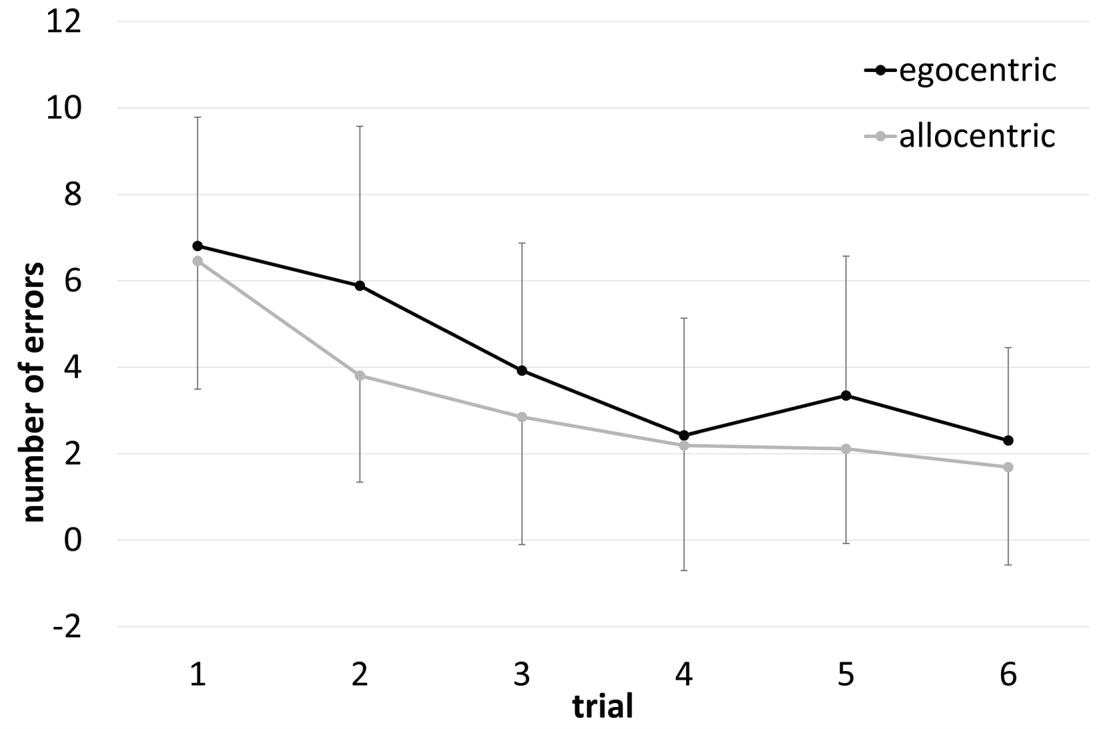
A first look at the schoolchildren's data revealed a floor effect in the second half of each task. The number of errors gradually decreased from trial 1 to trial 3, and then remained at a low and relatively stable level (cf. Figure 3). On trial 4 to trial 6, therefore, 25⋅9% of all error scores on the egocentric task and 34⋅6% of all error scores on the allocentric task were zero; the corresponding values for the combined data from the present study and from Fricke and Bock (Reference Fricke and Bock2018) were 25⋅6% and 36⋅3%. Such a high incidence of zeroes precludes the use of parametric tests on data from trials 4 to 6, and therefore it was decided to focus the analysis on trials 1 to 3.
Wayfinding errors of schoolchildren in the egocentric task and in the allocentric task, plotted separately for each trial. The data points represent across-participant means and error bar the pertinent standard deviations

The error scores of the schoolchildren, young adults and older adults were combined for statistical analysis. A general linear model was calculated with the dependent variable ‘error score’, with the categorical independent variables Task (repeated measures; levels: allocentric, egocentric), Trial (repeated measures; levels: 1, 2, 3) and Gender (between-participant; levels: female, male), and with the continuous independent variable Age (participant's calendar age).
The required sample size for the analysis was estimated with G*power (Faul et al., Reference Faul, Erdfelder, Lang and Buchner2007). This estimation focused on the main effect of interest, Task × Age, and assumed Age to be a categorical variable with three levels (child, young adult, older adult). Using the parameters f = 0⋅25, number of groups = 3, number of measurements = 2, α = 0⋅95 and 1–ß = 0⋅9, G*power yielded a required sample size of n = 54. Since Age was a continuous rather than a categorical variable in the statistical model, it was reasoned that Age may explain more variance than was assumed by the above estimation, and that the required sample size might actually be less than 54. In any case, the statistical analysis was conducted with a sample size of n = 77.
3 Results
Figure 3 illustrates the data collected in the present study. The wayfinding errors of the schoolchildren gradually decreased over the first three trials of the egocentric and the allocentric tasks, and then remained at a low, relatively stable plateau.
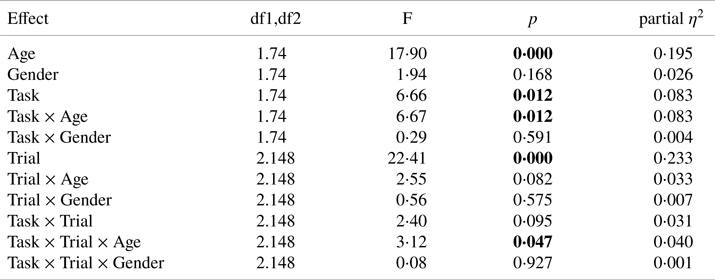
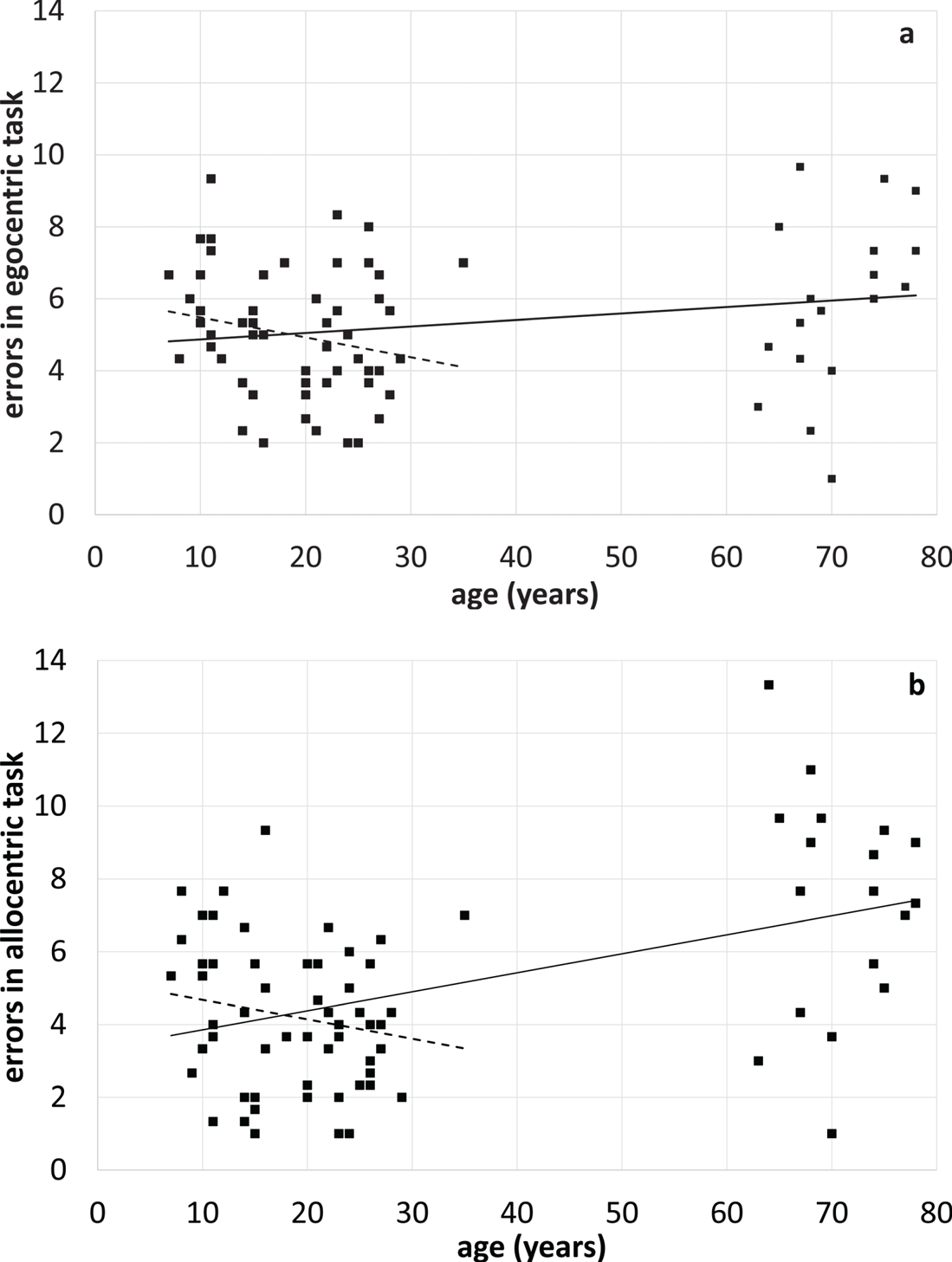
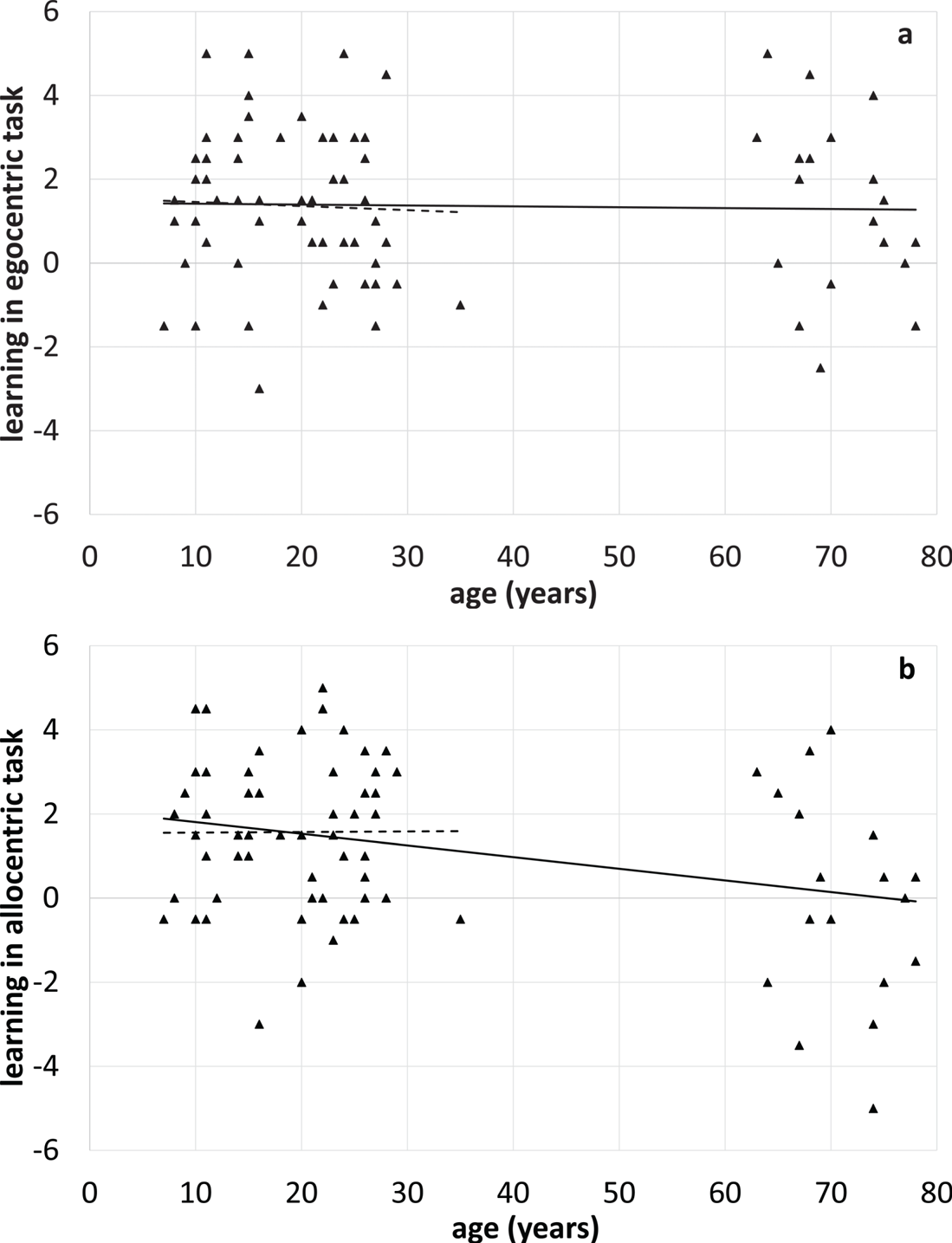
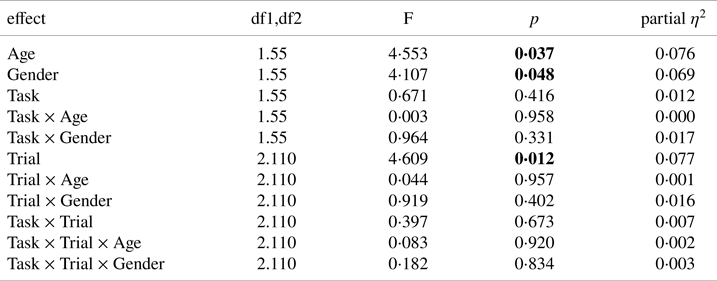
Table 1 summarises the statistical analysis of wayfinding errors in schoolchildren, young adults and older adults. According to Table 1, the effects of Age, Task and Task × Age were significant. This is illustrated by Figure 4, where the mean error on trials 1 to 3 is plotted as a function of age, along with the pertinent regression line (solid line). The graphics show that the errors increased with age, more so in the allocentric task (Figure 4b) than in the egocentric task (Figure 4a). Further, as shown in Table 1, the effect of Trial and of Task × Trial × Age was significant. To illustrate the triple interaction in a compact fashion, the learning rate, i.e., the rate at which the number of errors decreased from trial 1 to trial 3 was calculated; that rate was sign-inversed, such that higher values represent faster learning. Figure 5 shows that the learning rate was largely age-invariant in the egocentric task (Figure 5a) but decreased with age in the allocentric task (Figure 5b). In fact, the learning rate of older adults on the allocentric task varied about a mean that was close to zero, i.e., errors decreased from trial 1 to trial 3 in about one half of older persons and increased from trial 1 to trial 3 in the other half. This is in accordance with an earlier analysis of the same data, according to which the mean number of older adults’ errors on the allocentric task changed little from trial 1 to trial 3, and decreased only thereafter (Fricke and Bock, Reference Fricke and Bock2018).
Outcome of statistical analysis for all three age groups

Note: Significant values are shown in bold.
Wayfinding errors in (a) the egocentric task and (b) the allocentric task, as a function of participant's age. Each data point represents the mean error on trials 1 to 3 for one person. The regression line for all participants is drawn in solid style, and that for the sub-sample aged 7 to 35 is dashed

Learning rate in (a) the egocentric task and (b) the allocentric task, as a function of participant's age. Each data point represents the rate of learning from trials 1 to trial 3. Lines as in Figure 4

Table 2 summarises a second statistical analysis, which was limited to the sub-sample of schoolchildren and young adults, i.e., to the ages of seven to 35. Note that the size of this sub-sample is n = 58, which still is more than the required sample size of n = 54 (see Methods). Table 2 shows that the effect of age remained significant, but the effects of Task and Task × Age lost their significance. Accordingly, the dashed regression lines in Figure 4 indicate that the error decreased with increasing age in this sub-sample and that the increase was quite similar in both tasks. Further, as shown in Table 2, the effect of Trial remained significant, but the triple interaction lost its significance. Accordingly, the dashed regression lines in Figure 5 indicate that the learning rate was largely age-invariant in this sub-sample and that it was quite similar in both tasks. Table 2 also includes a significant effect of Gender, which was absent in Table 1: among schoolchildren and young adults, females made 4⋅99 ± 1⋅64 errors, while males made 4⋅28 ± 2⋅06 errors (mean ± standard deviation in trial 1 to 3 of both tasks).
Outcome of statistical analysis for schoolchildren and young adults

Note: Significant values are shown in bold.
Based on the regression lines in Figures 4 and 5, the age-dependence in the two tasks can be estimated as follows. The mean error in the egocentric task decreased from 5⋅65 at the age of seven to 4⋅17 at the age of 35 and increased to 6⋅15 at the age of 81. In the allocentric task, it decreased from 4⋅84 at the age of seven to 3⋅34 at the age of 35 and increased to 7⋅56 at the age of 81. The learning rate in the egocentric task decreased slightly from 1⋅49 errors per trial at the age of seven to 1⋅21 errors per trial at the age of 35 and was 1⋅27 errors per trial at the age of 81. In the allocentric task, it was 1⋅55 errors per trial at the age of seven and 1⋅59 errors per trial at the age of 35 and decreased towards close-to-zero (−0⋅16 errors per trial) at the age of 81.
Mean errors on the egocentric and on the allocentric task were significantly associated when all three age groups were considered together (r = 0⋅298; F(1,75) = 7⋅330; p = 0⋅008), but not when older adults were excluded (r = 0⋅092; F(1,56) = 0⋅485; p = 0⋅489). The inverse pattern was yielded for learning rates: egocentric and allocentric learning rates were not significantly associated when all three age groups were considered together (r = 0⋅171; F(1,75) = 2⋅249; p = 0⋅138), but significance emerged when older adults were excluded (r = 0⋅275; F(1,56) = 4⋅593; p = 0⋅036). Taken together, these findings are consistent with a modest association between tasks.
4 Discussion
This study compared the wayfinding proficiency of schoolchildren with that of young and older adults. It was hypothesised that the data from schoolchildren would mimic those of older adults, i.e., that their performance on an egocentric wayfinding task will be nearly as good as that of young adults, but their performance on an allocentric wayfinding task will be substantially poorer than that of young adults. To find out, newly collected data from schoolchildren were compared with available data from young and older adults (Fricke and Bock, Reference Fricke and Bock2018). The same wayfinding tasks, the same instructions and the same lead investigator (OB) were involved in all three age groups.
Schoolchildren were able to learn both the egocentric and the allocentric wayfinding task, since their errors on both tasks decreased from trial 1 to 3, and then reached a relatively stable, low plateau. The precursor study (Fricke and Bock, Reference Fricke and Bock2018) observed a similar time course of errors on both tasks in young adults and on the egocentric task in older adults, but not on the allocentric task in older adults, where errors only started to decrease after trial 3 (Fricke and Bock, Reference Fricke and Bock2018). While the present study used five decision points (i.e., intersections), other work used 18 or 19 decision points and also found wayfinding errors to reach a plateau after just three trials (Waller and Lippa, Reference Waller and Lippa2007; Wiener et al., Reference Wiener, de Condappa and Hölscher2011). In yet other studies, however, wayfinding errors decreased over much more than three trials. It therefore appears that the quick attainment of a plateau was not closely related to the number of decision points but rather to other factors, such as the layout of the environment, the number and discriminability of landmarks, participants’ experience with wayfinding tasks, and individual preferences (Hölscher et al., Reference Hölscher, Buchner, Meilinger and Strube2009; Wiener et al., Reference Wiener, Büchner and Hölscher2009; Ekstrom et al., Reference Ekstrom, Spiers, Bohbot and Rosenbaum2018).
To scrutinise the research hypothesis, performances on the egocentric and the allocentric task across age groups were compared. The statistical analysis summarised in Table 2 involved only schoolchildren and young adults. According to this analysis, the mean number of errors decreased with age, and this decrease was not significantly different on the egocentric and on the allocentric task (i.e., Task × Age term was not significant in Table 2). Furthermore, the learning rate changed little with age on both tasks (i.e., Task × Trial × Age term was not significant in Table 2). The statistical analysis summarised in Table 1 involved all three age groups. According to that analysis, the mean number of errors increased towards senescence, more so on the allocentric than on the egocentric task (i.e., Task × Age term was significant in Table 1). Furthermore, the learning rate decreased towards senescence, again more so on the allocentric than on the egocentric task (i.e., Task × Trial × Age term was significant in Table 1). Thus summing up, wayfinding performance improved somewhat from school age to young adulthood, and this improvement proceeded more or less in parallel for the egocentric and for this allocentric task; wayfinding performance decayed from young to older adulthood, but this decay was more dramatic for the allocentric than for the egocentric task. This pattern of findings does not support the hypothesis that the wayfinding performance of schoolchildren mimics that of older adults.
The observed improvement of wayfinding performance from school age to young adulthood is in accordance with the literature (Cohen and Schuepfer, Reference Cohen and Schuepfer1980; Cousins et al., Reference Cousins, Siegel and Maxwell1983; Allen et al., Reference Allen, Kirasic and Beard1989; Cornell et al., Reference Cornell, Heth and Broda1989; Jansen-Osmann and Wiedenbauer, Reference Jansen-Osmann and Wiedenbauer2004; Jansen-Osmann and Fuchs, Reference Jansen-Osmann and Fuchs2006; Lingwood et al., Reference Lingwood, Blades, Farran, Courbois and Matthews2015). The parallel improvement on both tasks indicates that young schoolchildren can already code spatial information in an allocentric reference frame; it has indeed been shown before that seven to nine year olds can memorise the spatial relationships between objects (Acredolo et al., Reference Acredolo, Pick and Olsen1975; Herman and Siegel, Reference Herman and Siegel1977), and that they can use – and in fact prefer to use – an allocentric reference frame at least on one given wayfinding task (Bohbot et al., Reference Bohbot, McKenzie, Konishi, Fouquet, Kurdi, Schachar, Boivin and Robaey2012).
The observed decay of wayfinding performance in older age is also in accordance with the literature (see reviews in Moffat, Reference Moffat2009; Wolbers and Hegarty, Reference Wolbers and Hegarty2010). The stronger decay for the allocentric task than for the egocentric task is in agreement with earlier work which found that older adults were less likely than young ones to prefer an allocentric over an egocentric reference frame for wayfinding (Wiener et al., Reference Wiener, Büchner and Hölscher2009; Rodgers et al., Reference Rodgers, Sindone and Moffat2012) and were less proficient in using an allocentric compared with an egocentric reference frame for spatial coding (Wiener et al., Reference Wiener, Kmecova and de Condappa2012; Montefinese et al., Reference Montefinese, Sulpizio, Galati and Committeri2015; Merriman et al., Reference Merriman, Ondřej, Roudaia, O'Sullivan and Newell2016).
One limitation of the present study is a possible setting effect. Data from young and older participants were collected in the laboratory (Fricke and Bock, Reference Fricke and Bock2018). However, it was found to be difficult to bring schoolchildren into the laboratory, and the authors therefore decided to test them at the site of recruitment, e.g., at a sports club. Although quiet testing areas were selected at those sites, the presence of distracting sounds and sights cannot be fully excluded. It therefore is conceivable that the wayfinding performance of the schoolchildren in this study was negatively affected by distractions, and/or was positively affected by site familiarity.
Finally, the authors would like to add a note that might be helpful when designing future wayfinding studies for children. In pilot tests it was observed that even six year olds were able to move through the virtual environments by using arrow keys and mouse and to do so in accordance with our instructions. However, some of the six year olds exhibited signs of poor concentration, such as restlessness, and did not complete all trials. It was, therefore, decided to limit the final sample to schoolchildren aged seven or older. The authors surmise that, in future research, even children below the age of seven could successfully complete wayfinding tasks if the environment were real rather than displayed on a computer screen, if participants walk through it physically rather than virtually, and if they receive a real rather than virtual reward at the goal, e.g., a glass of fruit juice.
5 Conclusion
It was observed that wayfinding performance improves from school age to young adulthood in a similar fashion for the allocentric and for the egocentric task, but decays in older age more dramatically for the allocentric than for the egocentric task. The performance of schoolchildren, therefore, does not mimic that of older adults.
Competing interests
None.
Acknowledgments
Thanks are due to Caroline Tisson for her help with experimental setup and data collection.
Funding statement
This research did not receive any specific grant from funding agencies in the public, commercial, or non-profit sectors.
Data availability statement
Original data will be made available by the authors upon reasonable request.
Ethical standards
The authors assert that all procedures contributing to this work comply with the ethical standards of the relevant national and institutional committees on human experimentation and with the Helsinki Declaration of 1975, as revised in 2008. Informed consent was obtained from all participants and their parents.