Introduction
Over the last decades, in the wake of the initial theoretical insights, the field of empirical research in deliberative democracy has been kicking and striving, with a strong emphasis on analysing the design features of small citizens’ forums (for overviews see Ryfe, Reference Ryfe2005; Thompson, Reference Thompson2008; Bächtiger et al., Reference Bächtiger, Niemeyer, Neblo, Steenbergen and Steiner2010). More recently, in the quest of understanding the implications for the democratic public sphere, empirical works have started to delve into the question of the support among the mass public (Hibbing and Theiss-Morse, Reference Hibbing and Theiss-Morse2002; Mutz, Reference Mutz2006; Neblo et al., Reference Neblo, Esterling, Kennedy, Lazer and Sokhey2010; Webb, Reference Webb2013). In the intersection between the study of small democratic innovations and the study of support for deliberative democracy, one major question still needs to be tackled: who wants to pay for deliberative democracy?
While a large number of deliberative mini-publics have been funded by public authorities or by a limited number of private sponsors, an increasing number of deliberative events are funded bottom-up. Thanks to crowdfunding (Lehner, Reference Lehner2013; Mollick, Reference Mollick2014), these projects are initiated by drawing on relatively small contributions from a relatively large number of individuals after an open call for money. This technique of fundraising offers a well-suited means to tackle two major challenges of mini-publics: autonomy and mass support. First, the large number of funders reduces the risk of potential manipulation by a unique sponsor. According to O’Flynn and Sood (Reference O’Flynn and Sood2014: 53), part of the failure to devolve control of the agenda to participants is simply a consequence of funding realities. The funder may be tempting to frame the design of the mini-public to produce a particular output in line with her concerns. Crowdfunding can help to avoid this tendency and give a guarantee of autonomy to participants. Second and more positively, one of the major critics of mini-publics is their lack of connection with the maxi-public (Chambers, Reference Chambers2009; Felicetti et al., Reference Felicetti, Niemeyer and Curato2016). In order to foster the legitimacy of such a deliberative process, crowdfunding can be used to establish this bridge. The bottom-up feature shows that the work of a mini-public receives the support of a larger part of the population.
The guarantee of autonomy and the search for external support are two important arguments to fund mini-publics by the ‘crowd’. But to what extent are citizens willing to financially support mini-publics? It is, of course, one thing to claim one is in favour of this type of democratic initiative, but it is much more demanding to go into one’s wallet to contribute to its organization. There is therefore a need to understand who the people are who want to pay for deliberative democracy and why they are willing to do so.
In order to appreciate these questions, the G1000 Citizens’ summit organized in Belgium in 2011 offers a meaningful case study as this large-scale deliberative mini-public was funded by crowdfunding. At a time when Belgium was in the midst of her longest government-formation crisis (Reuchamps, Reference Reuchamps2013), a group of citizens sought to initiate a bottom-up deliberative mini-public that would bring together 1000 randomly selected inhabitants to deliberate over major issues regarding the future of the country. This project came as an outlier in the deliberative democracy universe in that its organizers explicitly chose to stay independent from public authorities and thus rejected public resources (G1000, 2012). Instead, they used the crowdfunding technique. ‘Our strategy, the organizers contend, was very simple: to generate maximum media attention and hope for sufficient support’ (G1000, 2012: 31). In the end, they achieved in securing their €300,000 budget in less than 6 months from over 3000 crowdfunders. The profile and motivations of these money-givers form the central object of this research.
The first section of this article lays the foundations for the study of financial support for deliberative democracy, which comes at the intersection of research on public support for deliberative democracy, political participation, and philanthropy. The original G1000 crowdfunding data set is presented and the method of analysis is explained on this basis. In the following section, the crowdfunders’ profiles and their attitudes towards current and alternative forms of democracy are discussed. Finally, the conclusion brings them back in light to the overarching question of the support for deliberative democracy.
The uncertain demand for deliberative democracy
The impetus for deliberative democracy first came from philosophical circles, where the notion of deliberation (re)emerged in the 1980s as an appropriate solution to several structural stakes faced by modern societies (Fishkin, Reference Fishkin1995; Dryzek, Reference Dryzek2000; Gutmann and Thompson, Reference Gutmann and Thompson2004). This deliberative turn brought out the idea to anchor democracy on a new legitimacy; not on the aggregation of interest through voting anymore, but rather on deliberation towards the public good (Manin, Reference Manin1987; Cohen, Reference Cohen1989; Habermas, Reference Habermas1996). della Porta (Reference della Porta2005: 340) has nicely summed up the aim of this proposition: it is to construct a democracy in which, under conditions of equality, inclusiveness, and transparency, communicative processes based upon reason are able to transform individual preferences to reach decisions oriented towards the common good.
This theoretical development has – more or less directly – inspired several democratic innovations around the world (Smith, Reference Smith2009; Geissel and Newton, Reference Geissel and Newton2012). Among these, mini-publics have become the most prominent instrument of deliberative democracy in practice. They are forums where citizens representing different viewpoints are gathered to deliberate on a particular issue in small-N groups (Grönlund et al., Reference Grönlund, Bächtiger and Setälä2014: 1). In a seminal article, Goodin and Dryzek (Reference Goodin and Dryzek2006: 220) have caught their peculiar nature: ‘mini-publics are designed to be groups small enough to be genuinely deliberative, and representative enough to be genuinely democratic, even though rarely will they meet standards of statistical representativeness’. Much emphasis has been put on the study of their design (Ryfe, Reference Ryfe2005; Fung, Reference Fung2007) but there is an on-going debate about the place of mini-publics in the maxi-public (Reuchamps and Suiter, Reference Reuchamps and Suiter2016). Whereas some argue that the multiplication of mini-publics is key to improving the future evolution of democracy because they achieve equal participation and reasoned decision (Fishkin, Reference Fishkin2009; Niemeyer, Reference Niemeyer2011), others are more critical of their effective deliberative or even democratic potential (Chambers, Reference Chambers2009; Pourtois, Reference Pourtois2013).
The question that follows is whether there is a willingness among the general public to support the development of such deliberative mechanisms. In their book about Americans’ beliefs on democracy, Hibbing and Theiss-Morse (Reference Hibbing and Theiss-Morse2002) are quite sceptical about the existence of deliberative democrats and argue that citizens are rather stealth democrats. That is to say, they expect democracy to be barely visible in their daily life and thus not demanding any citizens’ participation. From a social psychology perspective, Mutz (Reference Mutz2006) argues that most citizens may be tempted not to participate in deliberation in order to avoid political conflicts. However, this fairly pessimistic approach was not left unchallenged. Recent empirical research has delved deeper into the support for different models of democracy. In the American context, Neblo et al. (Reference Neblo, Esterling, Kennedy, Lazer and Sokhey2010) have shown that there is more support for deliberation than expected. According to them, people who feel more disconnected from the political system have more incentives to defend deliberative innovations (Neblo et al., Reference Neblo, Esterling, Kennedy, Lazer and Sokhey2010). In the United Kingdom, Webb (Reference Webb2013) has identified two distinctive profiles: on the one hand, dissatisfied democrats who are politically interested, efficacious, and in favour of participation in deliberation forums and, on the other, stealth democrats who generally show opposite characteristics but who are in favour of direct democracy, because of the populist nature of this participation mode. More generally, a recent series of studies has identified the multidimensionality of support for different kinds of political decision-making processes (Bengtsson and Christensen, Reference Bengtsson and Mattila2014; Coffé and Michels, Reference Coffé and Michels2014; Font et al., Reference Font, Wojcieszak and Navarro2015). They all show that three major orientations – participatory, expert-based, and representative – structure citizens’ democratic preferences. This emerging literature has thus demonstrated that different groups are potentially attracted by different models of democracy.
Deliberative activists: the case of the G1000’s crowdfunders
The aim of this article is to go beyond the analysis of diffuse support for different models of democracy. Previous research endeavours have captured the potential attitudes towards a more deliberative or participatory democracy, but they remain at a hypothetical level. In other words, we do not hitherto know who in concreto supports deliberative democracy by, for instance, organizing or paying for these new forms of governance. It is indeed one thing to agree with a potential change; it is quite another one to commit oneself to make it happen. The potential normative orientation towards a political issue is not necessarily translated into real political action (McHugh, Reference McHugh2006). We must therefore analyse separately the population’s hypothetical views on deliberative democracy and the views of those who act as deliberative activists. Back in the early 2000s, in a fictive dialogue, Young (Reference Young2001) portrayed the encounter between two kinds of political participants: a deliberative democrat and a political activist. The former enjoys the dialogue with other people to deliberate and find the common good in a spirit of cooperation. The latter is a more traditional militant who defends a specific vision of society in a more agonistic atmosphere. If we consider the recent development of deliberative democratic innovations, this raises a third figure: the activist for deliberative democracy. Indeed, some people act to support this new political form such as deliberative mini-publics. Who are these activists and why do they support deliberative mini-publics?
To answer this twofold research question, the fundraising of the G1000 deliberative mini-public held in Belgium in November 2011 provides a meaningful case study. The G1000 is a large-scale deliberative project that takes a particular place in the world of deliberative experiments (Caluwaerts and Reuchamps, Reference Caluwaerts and Reuchamps2016). Unlike most deliberative mini-publics which are organized for research purposes, or funded by government institutions, the G1000 was a completely grassroots organization. The initial idea came from a Dutch-speaking writer and a French-speaking editorialist, joined soon by a group of artists, businessmen, leaders of non-profit organization, and academic specialists of democratic matters. At the time, Belgian representative democracy was under pressure because parties were unable to find an agreement and the country was without a full-fledged federal government for several months. In this context, the organizers wanted to create a large citizens’ assembly to show that citizens are more than sporadic voters and are able to deliberate together despite the linguistic differences (Caluwaerts and Reuchamps, Reference Caluwaerts and Reuchamps2014a). Their aim was to design a grassroots deliberative mini-public. On 11 November 2011, seated at 81 tables, 704 participants randomly selected among inhabitants of the country deliberated about three issues – social security, welfare in times of economic crisis, and immigration – that were chosen in a first online phase. They were invited to discuss these topics, to listen to short speeches from experts and to propose some options of public policies as well as vote on them. At the end of the day, a report was given to the presidents of the parliaments of the country, who had been invited to observe this deliberation (for an analysis of the impact of the G1000, see Jacquet et al., Reference Jacquet, Moskovic, Caluwaerts and Reuchamps2016).
To run this great deliberation, the organizers relied on several hundred volunteers for different tasks from simultaneous translation to cooking (Caluwaerts and Reuchamps, Reference Caluwaerts and Reuchamps2012). Moreover, the event was not financed by public money; it relied on crowdfunding. But it was not sponsorship either since the donors’ name and their donations were not made public. They also set a limit of a maximum of €35,000 for each donation in order to prevent one donor from buying off the initiative. On 11 June 2011, the organizers launched alongside the publication of their manifesto a public call for crowdfunding. After 5 months, on 11 November 2011, the day of the G1000 Citizens’ Summit, they had successfully gathered their €300,000 budget from 3059 donors: ‘with no less than 3018 gifts of 1 to 500 euro and 41 gifts of more than 500 euro’ (G1000, 2012: 32).
The reason why the organizers did not apply for public money is because they sought to keep, using all means, the autonomy of the process. The G1000 aimed at gathering ordinary citizens in a setting, which would be conducive to open and uncoercive deliberation on contentious political issues that the citizens themselves found important (G1000, 2012). They accordingly opted for participatory fundraising to create a bottom-up mini-public. This form of fundraising was innovative in the Belgian context. The country had already experienced deliberative mini-publics at local, regional, and federal level but they were all funded by public authorities (Claisse et al., Reference Claisse, Laviolette, Reuchamps and Ruyters2013). Organizers had been inspired by the development of crowdfunded start-ups and socio-cultural projects in both Belgium and the rest of the world. More broadly, they could count on the long tradition of individual philanthropy in the country for non-profit organizations (Fondation Roi Baudouin and Itinera Institute, 2014).
Analysing who contributes and why
To explore the financial support for deliberative mini-publics, the research is structured around three questions. The first question seeks to grasp who these deliberative activists are; in other words, what are their socio-demographic profiles? Depending on the form of activities, political scientists have indeed shown that participation is unequally distributed among the population (Barnes and Kaase, 1979; Verba et al., Reference Verba, Schlozman and Brady1995). The more an action demands time, energy, civic skills, and money, the more it is mobilized by the socially advantaged groups in the society (Marien et al., Reference Marien, Hooghe and Quintelier2010; Stolle and Hooghe, 2005). Men also tend to participate more in traditional forms of participation and activism differs along life cycles and generations (Burns et al., Reference Burns, Schlozman and Verba2001; Norris, Reference Norris2002). But which patterns does the giving of money to mini-publics follow? The current literature points out two opposite hypotheses.
On the one hand, some researchers consider that deliberative democracy offers an alternative way of conceiving politics. One of the major goals of democratic innovation is to develop a more inclusive decision-making process (Barber, Reference Barber1984; Ryfe, Reference Ryfe2002; Landemore, Reference Landemore2015). Neblo et al. (Reference Neblo, Esterling, Kennedy, Lazer and Sokhey2010) argue that people who are less likely to participate in traditional partisan politics are more likely to support deliberative democracy because they consider this form of action as an alternative to politics as usual, which they dislike. We can then hypothesize that deliberative events attract citizens opposed to those who are already active in traditional politics and that younger, less educated, and those unengaged in political and social participation, are more likely to support deliberative mini-publics.
One the other hand, supporters of deliberative democracy, and, in particular, those who pay for it, can be similar to traditional political activists. Several recent studies have confirmed the social inequality in both conventional and unconventional modes of political engagement (Bovens and Wille, Reference Bovens and Wille2010; Marien et al., Reference Marien, Hooghe and Quintelier2010; Armingeon and Schädel, Reference Armingeon and Schädel2014). The form of action considered in this article is giving money. Studies on contribution to political campaigns (Verba et al., Reference Verba, Schlozman and Brady1995) and more broadly the literature on every form of philanthropy demonstrate the same patterns of inequality (Smith, Reference Smith1994; Schervish and Havens, Reference Schervish and Havens1997; Reed and Selbee, Reference Reed and Selbee2001; Brooks, Reference Brooks2005; Uslaner and Brown, Reference Uslaner and Brown2005; Brown and Ferris, Reference Brown and Ferris2007). According to this, we can expect citizens who are older, better educated, and engaged in political and social participation to be more likely to support deliberative democracy. The first empirical part of the article investigates the profile of G1000 crowdfunders to determine which strand of the literature is appropriate in this case.
But to fully grasp the meaning of the financial support to the deliberative mini-publics, we need to go beyond this socio-demographic descriptive approach and to analyse their attitudes towards the current and alternative models of democracy. Democratic innovations are presented as opportunities to cure the malaise of Western representative democracies and the erosion of political trust (Geissel and Newton, Reference Geissel and Newton2012). The development of mini-publics is part of a larger democratic renewal intended to create a more participatory and deliberative style of democratic legitimacy and practices (Barber, Reference Barber1984; Cohen and Fung, Reference Cohen and Fung2004). In Belgium, the G1000 was born in the midst of a crisis of representative government (Van Reybrouck, Reference Van Reybrouck2011; Caluwaerts and Reuchamps, Reference Caluwaerts and Reuchamps2014b). The organizers argued that ‘it is clear that our society would benefit from the use of more forms of citizens’ participation. A healthy democracy has to be earned anew every day; this responsibility is shared between citizens and their political representatives’ (G1000, 2012: 8). But the question that remains open is whether the – financial – supporters of the G1000 were also reasoning along these lines. ‘Do crowdfunders mistrust the current representative democracy?’ is therefore the second question that we want to tackle in this research.
Here too, the literature provides contradictory expectations. A first hypothesis comes from the literature on changing political values (Inglehart and Catterberg, Reference Inglehart and Catterberg2002; Dalton and Welzel, Reference Dalton and Welzel2014; Norris, 1999). This thesis claims that social modernization, through the rise of education levels and the development of postmodern ideals, has led citizens to become more distrustful towards traditional authorities, and to support more direct and less hierarchical forms of political engagement (Inglehart, 1997). According to this line of reasoning, deliberative activists are the ones who mistrust the traditional political institutions and who are critical of the current system’s responsiveness.
Nonetheless, the support of deliberative democracy could find its roots not so much in mistrust towards the current democratic system, but rather in the will to deepen it. The representative government, as Manin argues (Reference Manin1997), has been able to transform itself to accommodate new political dynamics. Deliberative events can be seen as a way to improve the representative and electoral process by allowing citizens to give feedback to elected officials (Gastil, Reference Gastil2000; Brown, Reference Brown2006; Warren, Reference Warren2008). Supporters of deliberative democracy are accordingly not necessarily to be found among more distrustful democrats (Webb, Reference Webb2013), but among satisfied democrats who believe deliberative mini-publics would help reinvigorate the current electoral democracy. In the second empirical part of the article, we will therefore look at crowdfunders’ political trust and external political efficacy to see whether one or two of the hypotheses come true. They are indeed not necessarily contradictory. Mini-publics are complex institutions and one might expect they attract support from both critical and more confident citizens.
On the basis of the answers to the first two questions, crowdfunders’ democratic preferences should also be investigated to fully understand the meaning of their support to deliberative democracy. In the current and on-going debate about the future of democracy, a large variety of evolutions is proposed to cure the democratic malaise (Held, Reference Held2006). In this debate, two alternative ways of governance are often put forward. On the one side, participatory democrats argue that citizens should have a greater direct role in the decision-making process (Cohen and Fung, Reference Cohen and Fung2004; Pateman, Reference Pateman2012). On the opposite normative side, more technocratic democrats consider that experts are the best decision-makers to face contemporary political challenges (Pastorella, Reference Pastorella2015).
What are the preferences of crowdfunders towards these two orientations? One can reasonably expect that deliberative mini-publics’ crowdfunders would agree to develop the participation of lay citizens in the decision-making process. But recent empirical research on democratic preferences in the maxi-public, that is the whole population, has shown that some categories of individuals support, at the same time, expert-based and more participatory forms of governance (Bengtsson and Christensen, Reference Bengtsson and Mattila2014; Font et al., Reference Font, Wojcieszak and Navarro2015; Jacquet et al., 2015). In the last empirical part of this article, we will thus analyse if this is also the case for crowdfunders of deliberative mini-publics. In other words, is the engagement for deliberative democracy incompatible with a technocratic orientation? If this is the case, we will need to explain what drives this support. More precisely, we have to investigate the relationship between political trust and preferences for alternative modes of democracy. According to some recent studies in the British and Spanish populations, the support for technocratic and participatory style of governance can be explained by a general dissatisfaction with the current representative system (Webb, Reference Webb2013; Font et al., Reference Font, Wojcieszak and Navarro2015). In one more exploratory perspective, this research will therefore explore whether this hypothesis is true for some of the deliberative activists.
The socio-demographic profile of the G1000 crowdfunders
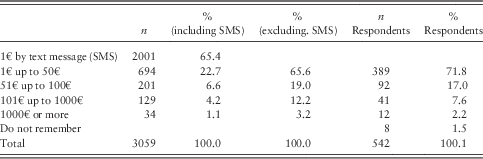
Among the 3000 crowdfunders of the G1000, about 2000 contributed with a text message worth €1 (Table 1). For privacy reasons, we did not receive any data about them, but we know the address of the 1058 remaining crowdfunders who sent their contribution by bank transfer. Each of them was individually sent a questionnaire by mail in the months that followed the G1000. Their anonymity was guaranteed and this explains why any re-call was impossible. In order to maximize the response rate – the only gap in a survey in which the whole population is contacted (Groves et al., Reference Groves, Fowler, Couper, Lepkowski, Singer and Tourangeau2009) – a pre-paid envelope was included. In total, 542 completed questionnaires were sent back, which is a quite an impressive response rate of 51% in a single wave. Table 1 shows that respondents are quite representative of the targeted population in terms of the amount of the donations. While remaining cautious, we can assume that the sample is representative of the contributors who gave more than one euro by bank transfer. In this article, we then consider only this category of donors.
Summary of donations

The data on the G1000’s crowdfunders were collected by the authors.
The questionnaire was made up of five parts: opinions about the G1000 and the reason for their donation, political attitudes, support for democracy, participation practices, and socio-demographics. In order to appreciate who is willing to pay for deliberative democracy, we can compare the crowdfunders’ socio-demographic and political profile with the Belgian population, as measured in the run-up to the 2009 elections by the Belgian inter-university consortium PartiRep that provides a representative sample of Flemish and Walloon voters. Besides gender, age, education, and political interest, both questionnaires surveyed the political participation in exactly the same way. On the one hand, respondents were invited to indicate how often they had, over the past 12 months, ‘been active in a political party’, ‘taken part in demonstrations’, ‘boycotted products’, and ‘signed a petition’ with possible answers going from ‘never’ (1) to ‘often’ (4). On the other hand, they were invited to indicate if they were a ‘current member’, ‘member in the past’, or ‘never been member’ of 15 different kinds of organizations.Footnote 1
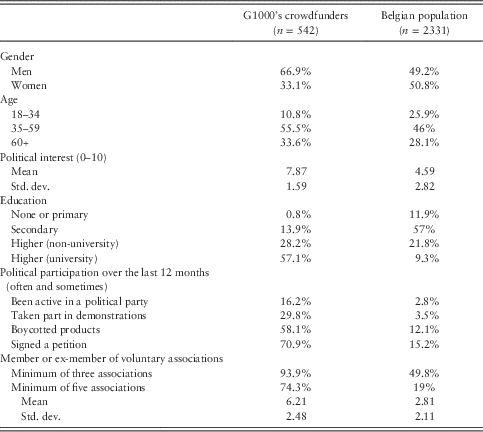
The first question concerns the socio-demographic profile of the G1000’s crowdfunders, and how they differ from the wider Belgian population. Table 2 shows quite clearly that the G1000’s crowdfunders are far from being representative of the whole population. First of all, there are more men, which might be somewhat surprising. Non-institutionalized forms of participation are often seen to be more egalitarian concerning this dimension (Stolle et al., Reference Stolle, Hooghe and Micheletti2005; Marien et al., Reference Marien, Hooghe and Quintelier2010). But in this case, it appears that paying for deliberative democracy is more appealing to men, as in more traditional forms of political participation. Research on philanthropy shows mixed results about this issue and, in fact, it largely depends on the goal of the donation (Bekkers and Wiepking, Reference Bekkers and Wiepking2007). In this case, the financial support for the G1000 seems to echo traditional political participation. There are also less young people and more middle-aged people. This can be explained by the specific nature of this form of participation: money giving. Active people are more likely to have financial means to spend (Bekkers and Wiepking, Reference Bekkers and Wiepking2007). But the most impressive difference is the overrepresentation of the higher educated among the G1000’s crowdfunders. Education is the variable that seems to set the contributors most strongly apart from the general population. More than 50% of the donors hold a university degree, compared with 9% in the population. Supporters of deliberative mini-publics tend thus to be drawn disproportionately from more advantaged, well-educated groups.
Socio-demographic and political profile of the G1000’s crowdfunders

The data on the G1000’s crowdfunders were collected by the authors; the data for Belgium come from the PartiRep voter survey 2009 (www.partirep.eu).
Most of the G1000’s crowdfunders are involved in several voluntary associations, which is a typical indicator of high social capital (Castiglione et al., Reference Castiglione, Van Deth and Wolleb2008). Moreover, the crowdfunders’ level of political participation is high. For each of the four forms of political participation indicated in Table 2, the G1000’s contributors participate significantly more than the Belgian population in general, and in this case, in non-institutionalized forms of participation like demonstrating, political consumerism, or signing petitions (Marien et al., Reference Marien, Hooghe and Quintelier2010). But more surprising, there is also an overrepresentation of people who have been active in political parties (16 vs. 3% in the Belgian population). In this case, deliberative activists come from better-educated groups, interested in politics and very active in the current political system in both conventional and unconventional forms.
Nonetheless, the very nature of crowdfunding might explain this elitist support for deliberative democracy as giving money is easier – albeit not necessarily (Bekkers and Wiepking, Reference Bekkers and Wiepking2007) – when one is rich than when one is poor, to put it bluntly. No comparative data sets are available to test this pattern in the whole population. Nevertheless, in our data set, we first saw that most of the donations (65.6%) amounted to less than €50 and we could test the amount of the donations, looking for correlations between socio-demographic and political attitudes and the sum of money that was given to the G1000. We did not, however, find any significant correlations for any variables of interest. The amount of the donation does not discriminate between – financial – supporters of deliberative democracy. What matters therefore is to understand why they do support deliberative democracy in order to make sense of their financial contribution to such democratic innovations.
Between critical and trustee crowdfunders
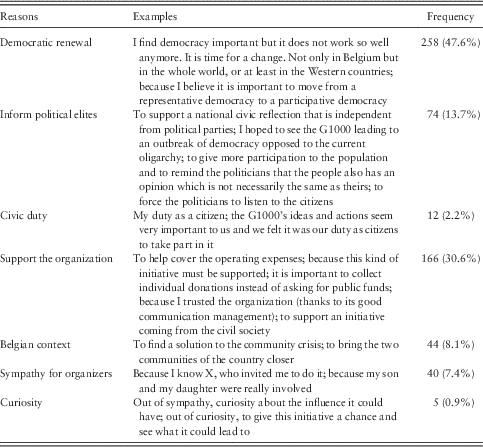
A preliminary way to explore the meaning of the G1000’s support is to look at the answers to the open question: ‘in a few words, could you explain why you made a donation to the G1000?’ We have inductively coded the different reasons and created the following typology (Table 3). The G1000’s crowdfunders justify their donation from different and non-exclusive perspectives. In line with the organizers’ discourse, a very large majority explains that it is important to renew the democratic process to give more voice to lay citizens. Some relate their narrative with a criticism of the current political actors. But responses to this open question also reveal more other motives of action, like civic duty, curiosity, or sympathy for organizers. Finally, a group of contributors explains that the G1000 being organized at the whole country level is a good means to maintain unity in a divided Belgium. It shows that some crowdfunders make sense of mini-publics through the national context while others mobilize a more abstract motive.
Expressed reasons for donation of the G1000’s crowdfunders

The data on the G1000’s crowdfunders and coded reasons were collected by the authors.
Nevertheless, these answers only give the arguments provided by actors to justify their action but they tell us nothing about the more profound attitudes towards the political process that can motive them to support deliberative mini-publics. We need a more systematic measure to explore the crowdfunders’ reasons in order to answer the question: do crowdfunders mistrust the current actors of representative democracy?
First, confidence towards political actors in Belgium is mixed. On an 11-point Likert scale, the mean is 3.91 (std. dev.=2.01) for political parties and 4.21 (std. dev.=2.10) for politicians. This low level of trust gives weight to the critical citizens’ thesis. But a significant group of crowdfunders also seem to trust more – with a score of 5 or more – political parties (24.5%) and politicians (29.5%). It is therefore difficult to consider that all contributors clearly trust, or do not, political elites.
Second, we can look at the external political efficacy (Pollock, Reference Pollock1983), that is their evaluation of the responsiveness of the electoral system. It was measured by two items: ‘there is no point in voting; parties do what they want anyway’ and ‘before the elections parties make a lot of promises, but eventually little ever comes of them’, on an ordinal scale ranging from (1) ‘strongly disagree’ to (5) ‘strongly agree’. Whereas 73.7% of the crowdfunders – strongly – disagree with the first proposition and are not willing to abandon elections, their position on the second item is much more diversified, with a fifty-fifty distribution on the scale. This result shows that there is much more diversity among the G1000 supporters than one could have expected. Some crowdfunders do not trust political elites and seem suspicious of the ability of the electoral process and political parties to express the will of the people. But others seem less critical. Supporters of mini-publics are therefore mixed regarding their attitudes towards the current political process.
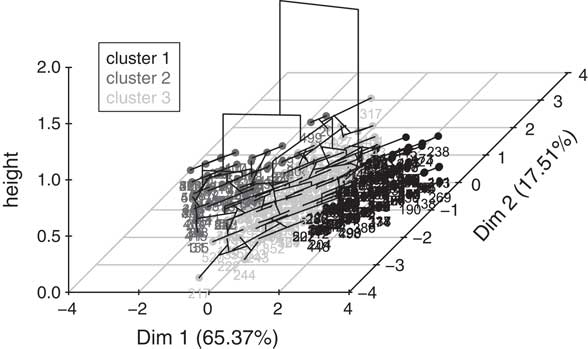
To analyse this diversity, it appears relevant to create a typology of contributors. Accordingly we conducted a clustering analysis (Husson et al., Reference Husson, Josse and Pagès2010). This technique of analysis is particularly helpful to discover groups among individuals that are described by one set of variables. The aim of this analysis is to gather the 542 contributors into smaller groups of similar patterns. To do so, we first conducted a principal component analysis (PCA) with the four aforementioned items (trust in political parties and in politicians and external political efficacy) and then performed a hierarchical clustering with the individuals’ score on the first three dimensions from the PCA, since their cumulative percentage of variance reach 95.4. The following step is to find the optimal level for division suggested by the hierarchical tree (Husson et al., Reference Husson, Josse and Pagès2010). In this case,Footnote 2 the optimal level for division gives a partition in three clusters. The factor map (Figure 1) shows that the three groups distinguish themselves on the first dimension. This dimension highly structures the data (Eigenvalue 2.62, with 65.7% explained variance) and positively correlates with trust in political parties and politicians, as well as external political efficacy (Cronbach’s α of four items=0.8). The higher a crowdfunder scores on this dimension, the more she is confident about the actual functioning of the current electoral and partisan democracy.
Factor map of the crowdfunders according to their political trust and their external political efficacy.

The factor map from the clustering analysis clearly reveals three groups of crowdfunders. The largest group is composed of citizens who are very critical about the current political system (cluster 1, on the right, n=231). The smallest group (cluster 2, on the left, n=95) is composed of citizens who trust politicians and political parties more but who have a poor evaluation of the responsiveness of the electoral system. A last group (cluster 3, in the middle, n=216) is more moderate on these two sets of items. This typology shows that the financial support of the G1000 is the product of citizens who hold quite different views on the current political system. For the first group, the support for the G1000 can be interpreted as a means to find a radical alternative to the current political system and its actors whom they do not trust. But, by contrast, for more moderate and especially confident crowdfunders, the support for deliberative mini-publics is a way to improve the current political system rather than to radically change it.
Multiple democratic preferences
This final empirical section aims to investigate the G1000 contributors’ preferences on two possible evolutions of the current representative model of democracy: participatory or technocratic. The participatory orientation is measured by the extent of agreement with the statement: ‘citizens should participate in the decision-making process themselves instead of letting politicians do the job’. The statement related to technocracy is ‘having experts not government, make decisions according to what they think is best for the country, is a good way of governing this country’. These two indicators are rather straightforward sentences but they give the opportunity to measure the support for two alternative models of governance that are often presented as challenger of representative democracy.
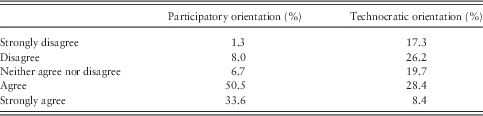
As shown in Table 4, a very large majority of crowdfunders – strongly – agrees that citizens should be able to participate in public decisions rather than to let politicians make decisions. This tends to underlie the participatory nature of the support for the G1000. But the second column of Table 4 nuances this view. Only a minority of the crowdfunders – strongly – disagrees that, instead of having a government, it would be better if experts governed according to what they think is best for the country. From a theoretical point of view, the participation of lay citizens in deliberation is based on an inclusive model of democracy, whereas the citizens’ active engagement is valued against the government of a few and technocracy (Held, Reference Held2006). But our data show that people who support mini-publics by giving money are not necessarily opposed to a more expert-based style of governance. Moreover, the spearman correlation among the two items is significantly positive (0.141). The orientation towards a more participatory model is accordingly not opposed to a more technocratic orientation among some G1000 crowdfunders.
Support for models of democracy

n=542.
There are no data available in Belgium to compare these findings with the whole Belgian population and different international teams analysing democratic preferences have used different questions and scales to measure these orientations. Nevertheless, the cautious comparison of our findings with the Spanish (Font et al., Reference Font, Wojcieszak and Navarro2015), English (Webb, Reference Webb2013), Finnish (Bengtsson and Christensen, Reference Bengtsson and Mattila2014), and United States of America (Hibbing and Theiss-Morse, Reference Hibbing and Theiss-Morse2002; Neblo et al., Reference Neblo, Esterling, Kennedy, Lazer and Sokhey2010) surveys shows that the support for these two orientations within the group of G1000 crowdfunders is quite similar with the level of support in some of these countries. Moreover, the preferences for expert-based conceptions of democracy are higher among G1000 crowdfunders (36.8%) than in some countries’ general population. For instance, 19.5% of British respondents agree that government would run better if left up to independent non-elected experts (Webb, Reference Webb2013: 753).
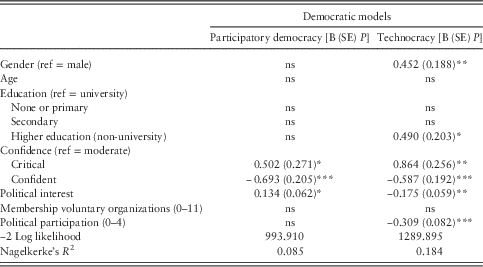
To go beyond this descriptive analysis, a multivariate analysis needs to be performed. We have to test whether the support for these alternative models of democracy is connected to the level of political trust. Previous research has indeed shown that more discontented citizens tend to support any alternative – participatory and technocratic – that differ from the current electoral and partisan system (Webb, Reference Webb2013). In order to test this hypothesis, we conducted two separate ordinal logistic regressions (Table 5). The dependent variables are the ordered categories from (1) ‘strongly disagree’ to (5) ‘strongly agree’ for each of the two models of democracy. The independent variable is the three clusters of citizens (critical, moderate, and confident). Age, gender, level of education, political interest (0–10), the sum of voluntary associations (0–15), and the sum of forms of political participation (0–4) are included as control variables.
Ordinal logistic regression models of democratic preferences

***P⩽0.001, **P⩽0.01, *P⩽0.05.
The aim of these two ordinal regressions is to capture the influence of the typology of crowdfunders on the support for their participatory and/or technocratic preferences. It is, however, not the objective to offer a full explanatory model of attitudes towards different democratic models. The most impressive finding is the fact that the typology of crowdfunders significantly explains the support for each of the two models in the same direction. Compared with the moderate group, critical citizens favour more participatory democracy but also technocracy. It is the opposite for the confident crowdfunders. In other words, the more the crowdfunders dislike politicians and parties and the more they believe there is no point in voting, the more they tend to support any alternative mechanism to the current model. In this sense, technocracy and more participatory tools are part of the same group of alternatives. Contrariwise, people who are more confident in the current system tend to be more moderate in their support for the two alternatives. It means that the stronger participatory and technocratic orientations are driven by the same distrust in the current political system.
Conclusion
Crowdfunding is sometimes presented as the most suitable means to finance bottom-up democratic participatory innovations because it shares the same logic of bottom-up participation. But who are these crowdfunders, and why do they want to pay for deliberative democracy? This article offers two major answers to this question.
First, the financial support for deliberative mini-publics mainly comes from the more socially advantaged groups. Crowdfunders have a higher level of education, more are men, more are active in associations and participate more in unconventional and conventional forms of political actions. The more marginalized public that the G1000 – and more broadly other democratic innovations – wished to reintegrate in the political process was absent from its financing. It does not, however, imply that the inclusive aim of such a deliberative process cannot be reached. Mix of random selection and targeted recruitment can be used to attract more marginalized groups inside mini-publics (Fung, Reference Fung2003; Neblo et al., Reference Neblo, Esterling, Kennedy, Lazer and Sokhey2010), and this was indeed done in the G1000 (Caluwaerts and Reuchamps, Reference Caluwaerts and Reuchamps2015). It could also be argued that this unequal support is a form of redistribution. Instead of expressing their political opinion directly, the more advantaged group gives the opportunity to a more diversified citizens’ panel to have their voice heard. In doing so, such crowdfunding redistributes the unequal political opportunities and resources of participation, as long as the crowdfunders do not frame the deliberative design according to their own concerns.
Second, the political meaning of giving money to the G1000 is more nuanced. Our research brings an interesting perspective for understanding the ambiguity of democratic innovation projects. The analysis of the G1000’s crowdfunders shows that the support for deliberative democracy is more complex and heterogeneous than the justification of their organizers. From the clustering analysis three groups of contributors emerged. One group is more critical with citizens who think that there is no point in voting. On the opposite, some other crowdfunders are more confident about the current representative democracy. A quite large number of crowdfunders are even members of political parties. This underlines that deliberative mini-publics, such as the G1000, are able to federate citizens with different attitudes vis-à-vis democracy. Moreover, our findings reveal that these different groups of crowdfunders have different democratic preferences. The more critical contributors tend to support any alternative that differs from the usual politics. They support a participatory design, but they also favour a more expert-based model of governance. On the contrary, more confident crowdfunders are less attracted by these alternative models and give their support to new forms of democracy, such as the G1000, as a way to deepen and improve the representative system by giving feedback to elected officials, but without rejecting the electoral process.
Other studies have already observed in national populations that support for more citizen participation can go hand in hand with support for more technocratic models (Bengtsson and Mattila, Reference Bengtsson and Christensen2009; Font et al., Reference Font, Wojcieszak and Navarro2015). According to Webb (Reference Webb2013), this contradictory support is a sign of frustration with the current functioning of politics and does not mean a real desire to effectively be involved in public decision-making. Our research shows, nevertheless, that some have actively supported one deliberative democracy project by giving money to organize a large-scale mini-public. Citizens disillusioned with representative democracy can act to develop deliberative democracy but their support is not exclusive from other forms of governance.
This article demonstrates the multiplicity of the support for deliberative democracy. Depending on the nature and design of democratic innovations, different goals can be reached such as inclusivity, effectiveness of public action, considered and informed choices, justice, and popular control (Fung, Reference Fung2006; Smith, Reference Smith2012). But the objectives of the organizers may differ from those who support them. Based on an original data set, we have sought to address the key question of ‘Who wants to pay for deliberative democracy?’ The G1000 has attracted the support of citizens for different reasons and federated people with diverging democratic preferences. This sheds light on the complex intertwining between views on the ideal democratic system and the attitudes towards the current situation, and above all, on the links between a mini-public and the maxi-public.
Acknowledgements
Lots of people have contributed to this research: not the least, of course, the crowdfunders of the G1000. Without their support, neither the G1000 nor this article would have been possible. While the financial support was crowdfunded, so was the logistic support of the survey. Special thanks go to Didier Caluwaerts, Alix Defays, Benoît Derenne, and the team of the Fondation pour les Générations Futures, Jérémy Dodeigne, Sophie Jacquet, Véronique Jacquet, Benoît Lecloux, and Manoelle Wertz for their help at different stages of the data collection. The journey towards publication was, as often, quite erratic and the authors would like to thank Annick Back, Didier Caluwaerts, Julie Reginster, and three anonymous referees for their helpful comments on earlier drafts. This research was made possible with the financial support of the Fonds de la recherche scientifique – FNRS, notably via the FRESH, the PartiRep inter-university attraction pole, the Political Science Department at the Vrije Universiteit Brussel, and the Fonds spéciaux pour la recherche of the Université catholique de Louvain, Belgium.