Despite many efforts to prevent it, Clostridioides difficile (C. difficile) continues to pose a major challenge to the healthcare system.Reference Lessa, Mu and Bamberg1 Clostridioides difficile is a major healthcare-associated pathogen and the most common infectious cause of hospital-acquired diarrhea, resulting in high morbidity and mortality, increased healthcare utilization and costs, and prolonged hospital stays.Reference Lucado, Gould and Elixhauser2 Prevention of C. difficile infection (CDI) is challenging; therefore, innovative integration of numerous control methods has been developed, albeit with limited success.Reference Weiss, Boisvert and Chagnon3, Reference Evans, Kralovic, Simbartl, Jain and Roselle4 Consequently, many professional organizations such as the Infectious Diseases Society of America (IDSA) and the Society for Healthcare Epidemiology of America (SHEA) recommend an infection control “bundle” strategy for CDI control and prevention.Reference McDonald, Gerding and Johnson5
A CDI bundle is comprised of individual intervention components as part of a larger process; we refer to these components as “subprocesses.” They include diagnostic testing, empiric isolation, contact isolation, hand hygiene, and environmental disinfection. Successful implementation of these subprocesses is dependent upon multiple stakeholders: physicians, nurses, nursing assistants, environmental services personnel, families/caregivers, and others who interact with patients.Reference Ngam, Hundt, Haun, Carayon, Stevens and Safdar6, Reference Hundt, Ngam, Carayon, Haun and Safdar7 Understanding how these different stakeholders are affected by and ensuring that they comply with subprocesses is important for successful implementation of the entire CDI bundle.
In our previous work, using a human factors approach and focusing on nurses’ perspectives, we demonstrated that work system barriers and facilitators were associated with all bundle subprocesses.Reference Ngam, Hundt, Haun, Carayon, Stevens and Safdar6 Here, we extend the scope of our previous work by examining perspectives of 3 stakeholder groups at the forefront of CDI prevention: environmental services personnel, physicians, and nurses. Yanke et alReference Yanke, Moriarty, Carayon and Safdar8 conducted similar work, but unlike an academic teaching hospital where we conducted our study, their setting was a Veteran Affairs hospital, and some of the bundle subprocesses were different than the ones we assess here. This approach of incorporating multiple perspectives in the context of system design has been successfully applied elsewhere.Reference Xie, Carayon and Cartmill9–Reference Detienne11
In this study, we use a human factors and systems engineering approach; we incorporated the Systems Engineering Initiative for Patient Safety (SEIPS) model as our conceptual framework.Reference Smith and Carayon-Sainfort12–Reference Carayon, Hundt and Karsh14 This model has been used widely in infection prevention.Reference Yanke, Carayon and Safdar15, Reference Patel and Kallen16 The SEIPS model focuses on 5 elements of the work system: person, tasks, tools, and technologies, physical environment, and organizational conditions.Reference Shekelle, Pronovost and Wachter17 These elements interact and may create barriers or facilitators to completion of subprocesses of the CDI bundle.
In this study, we aimed to answer this question: What must be considered when designing subprocesses as part of the overall C. difficile bundle when multiple stakeholders are involved? This investigation included consideration of common, unique (to a stakeholder group) and conflicting work-system barriers and facilitators (ie, situations in which a facilitator for one stakeholder group is a barrier for another).
Methods
Setting
This study was performed at a large academic teaching hospital in the midwestern United States. It is part of a larger study with a goal of conducting a work system analysis to better understand factors that facilitate or hinder implementation of a “bundle” of CDI prevention practices, which we refer to here as “subprocesses” (ie, diagnostic testing, empiric isolation, contact isolation, hand hygiene, disinfection). Table 1 lists components of the C. difficile bundle in place at our institution during the study period. This study was approved by our institutional review board.
Components of the C. difficile Prevention Bundle at the Study Institution

Data collection
We conducted 3 focus groups with the following stakeholder groups: (1) environmental services (EVS) workers (ie, housekeepers), (2) physicians, and (3) nurses (Table 2). A human factors engineer facilitated each focus group. An infectious disease physician served as the content expert, and a logistician assisted the group process. The discussions were audio recorded and transcribed. We used a phenomenological method, a qualitative research method used to describe how participants experience a certain phenomenon—in this case the C. difficile bundle and its subprocesses. The phenomenological approach allows the researcher to assess the perceptions, perspectives, and understandings of individuals who have actually experienced the phenomenon or situation of interest.Reference Giorgi18 Further details regarding the methods used in the focus groups are reported elsewhere.Reference Hundt, Ngam, Carayon, Haun and Safdar7
Focus Group Participants

Data analysis
Two researchers independently reviewed the transcripts and identified work system barriersReference Brown and Mitchell19 and facilitators.Reference Carayon, Gurses, Hundt, Ayoub, Alvarado, Korunka and Hoffmann20 Each identified barrier and facilitator was coded according to (1) the work system element, (2) the associated CDI subprocess, (3) whether it was a barrier or facilitator, and (4) the role (ie, EVS, physician, nurse) (Supplement 1 online) The 2 researchers met and compared coding for each transcript with discussion of any discrepancies. Agreed upon coding was then recorded in Dedoose content analysis software and was later downloaded for in-depth analysis of each subprocess.
Using the constant comparison method, in which data are repeatedly analyzed and compared,Reference Robson21 we conducted subprocess analyses by first sorting the coded data by subprocess, then by work system element, then by barrier or facilitator, and finally by role. This method facilitated comparisons of common, unique, and conflicting work system barriers and facilitators for each subprocess by role.
Results
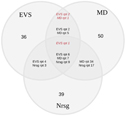
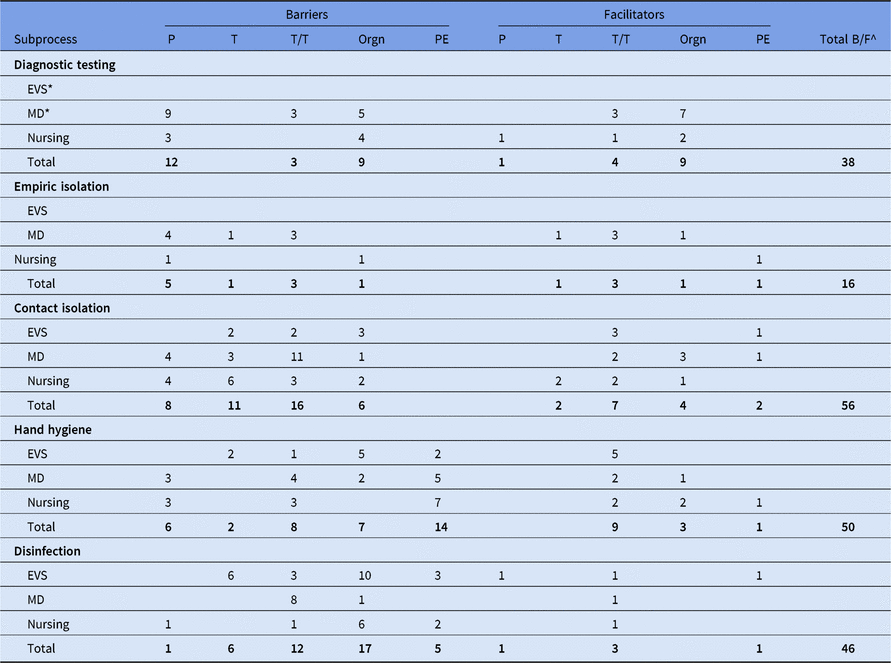
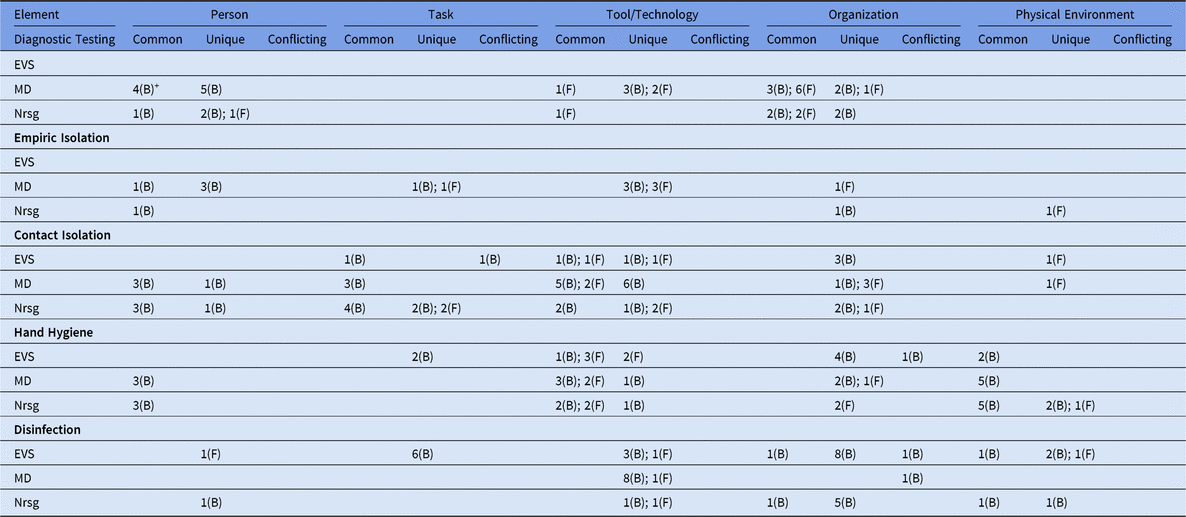
The study included 24 participants in 3 focus groups (each lasting 1.5 hours): 6 EVS workers, 8 physicians, and 10 nurses. In the following text, we present results for each of the 5 subprocesses of the CDI prevention bundle. Verbatim quotations (Q#) are presented in Supplement 2 online. A summary of work system barriers and facilitators by subprocess by role is provided in Table 3. Common, unique, and conflicting work system data are displayed in Table 4 and Fig. 1.
Italicized text refers to conflicting barriers and facilitators, that is, when a barrier for one group is a facilitator for another. Note. EVS, environmental services; MD, physician; Nrsg, nursing; rpt, report.

Subprocess Work System Barriers and Facilitators by Focus Group

Note. EVS, environmental services; MD, physicians; B, barrier; F, facilitator; P, person; T, task; T/T, tool/technology; Orgn, organization; PE, physical environment. Blank space means 0.
Number of Common, Unique and Conflicting Work System Barriers and Facilitators by Subprocess for 3 Focus Groups

Note. EVS, environmental services; MD, physicians; Nrsg, nursing; (B), barrier; (F), facilitator. Blank space means 0.
Diagnostic testing
Only in the physician and nurse focus groups was the diagnostic testing subprocess discussed. Physicians described person-related barriers to identifying CDI that included synthesizing information from patients presenting with multiple complicated conditions (Q1). For trainee physicians, recognizing when to suspect CDI versus antibiotic-associated diarrhea alone was a challenge. Trainee physicians also reported that peer influence sometimes results in either over-ordering tests to avoid embarrassment for missing the diagnosis, or under-ordering tests to avoid unnecessary precautions if CDI is not confirmed (Q2). Nurses identified challenges in recognizing the need to order a diagnostic test because they perceived that patients do not want to be “embarrassed” or “bother” the nurse to discuss their diarrhea (Q3). Physicians and nurses concurred regarding barriers associated with obtaining an accurate history or appropriately identifying signs of CDI. Only nurses described facilitators associated with the person element; it related to their clinical experience and ability to recognize CDI based on odor and appearance of the stool sample (Q4).
Physicians reported barriers associated with the electronic health record (EHR; ie, a technology) including inconsistent location and documentation of symptoms and signs. Another barrier was that EHR alerts or flags that inform clinicians of a patient’s recent CDI diagnosis are automatically removed 90 days after CDI diagnosis. Physicians also described overuse of e-mail to clinicians, which is less efficient than the EHR in conveying CDI-related (and other) policies and procedures. They also identified design aspects of the EHR that facilitate information finding, and both the physicians and nurses reported that EHR design made it easy to place orders (Q5).
Physicians described organization barriers such as inadequate information when patients are transferred from other healthcare facilities. Nurses reported that inconsistent practices for CDI patients across units is a barrier in caring for these patients (Q6). Other organization barriers identified by both nurses and physicians were related to poor communication between different roles caring for CDI patients and at the handoff between shifts. Physicians reported that nurses’ ability to place orders for diagnostic tests when they suspect CDI facilitated patient care by expediting the diagnostic process. Both focus groups described an organization facilitator: a heightened awareness by clinical staff of CDI (Q7) and the responsiveness of other services (eg, the laboratory) to test or for information requests regarding CDI.
Empiric isolation
Person-related barriers unique to physicians included the belief that CDI is not foremost on a physician’s mind when taking a patient’s history and conducting a physical examination. In addition, physicians reported variation among physicians regarding ordering practices for C. difficile testing because these physicians may be uncertain of CDI- versus antibiotic-associated diarrhea (Q8). Physicians and nurses noted that patients with suspected CDI sometimes become overwhelmed by and may not understand why healthcare workers must take isolation precautions (Q9). Physicians confirmed that taking precautions (eg, donning gowns and gloves) slows down rounds (ie, a task barrier), although the ability to give verbal orders expedites (ie, facilitates) their work (10).
Physicians listed barriers related to technology use including difficulty getting access to a computer, resulting in delays in writing orders. Physicians reported that an isolation order is automatically generated when placing a diagnostic test order and that this feature facilitates the process of empiric isolation.
Nurses reported that receiving incomplete patient information upon transfer from the emergency department was an organization barrier. Physicians identified nurses’ ability to place a diagnostic test order independent of the physician as an organization facilitator (Q11). In the facility where this study was conducted, nurses could place laboratory orders to test for CDI within the first 72 hours of patient admission if there was high suspicion of CDI based on clinical findings such as diarrhea or patient history such as recent antibiotic therapy. In addition, nurses reported that all patient rooms (physical environment) are isolation-eligible. This was another facilitator to executing empiric isolation.
Contact isolation
Both physicians and nurses discussed negative consequences (ie, barriers) associated with a lack of knowledge or awareness regarding CDI. For example, physicians reported hearing conflicting evidence concerning contact isolation procedures (Q12), and nurses discussed instances when care team members, despite entering a patient’s room, did not follow contact isolation procedures because they did not have direct physical contact with the patient or items in the patient’s room (Q13). Both groups discussed negative consequences of delays in posting isolation signs. In addition, both groups talked about patients’ negative reaction to everyone entering their room wearing gowns and gloves (Q9).
All 3 groups (physicians, nurses, and EVS staff) described the increased workload (task barriers) associated with contact isolation. Physicians described slower rounds, EVS staff described additional handwashing procedures, and nurses identified both issues. Nurses and physicians described delays in stocking necessary supplies for CDI patients, thus delaying or extending rounds. EVS staff described increased workload and lost time when, to facilitate access to a patient by the healthcare team, they must leave a patient room (and return later) so the team can efficiently complete rounds (Q14). In this case, expedited access to the patient by the healthcare team (a facilitator) conflicts with effective room cleaning by EVS staff. Task-related facilitators identified by nurses included using slow periods to ensure adequate stocking of contact isolation supplies.
EVS staff reported that, occasionally, non-EVS staff prematurely remove signs prior to cleaning a discharged CDI patient’s room, which presents a barrier to contact isolation compliance. Physicians reported that taking other tools and technologies (eg, computers, food trays, pagers) into a patient room poses potential for colonization of this equipment by C. difficile. Nurses reported that it was challenging to put on gloves immediately after washing their hands. EVS staff and physicians explained how “excessive” sign use sometimes caused them to overlook contact isolation precaution signs (Q15). Nurses and physicians reported that they sometimes run out of supplies (eg, gowns) needed to comply with contact precautions. All 3 focus groups discussed a common barrier of feeling overly warm when wearing gowns. Tool-related facilitators discussed by EVS and physician focus groups included benefits of “appropriate” sign use to ensure precaution compliance. Nurses and EVS staff identified strategies that facilitate their work, including the use of pagers by supervisors to ensure staff awareness of CDI patient rooms. Nurses described using larger carts to meet the additional supply demands of CDI patients.
Each focus group identified different organizational barriers. EVS staff discussed the negative consequences of significant staff turnover and consequent training needs (Q16). Physicians talked about pressure from peers to not over-order diagnostic tests, and nurses described confusion due to constantly changing CDI policies (Q17). Physicians noted that clinical team member assistance, such as a recommendation by an experienced nurse, facilitates CDI procedure compliance. Nurses spoke positively about the organization’s policy that considers CDI patient volume when assigning nurse-to-patient ratios.
From a physical environment perspective, EVS staff noted that seeing a bag of gowns outside a patient room is a visual cue to follow contact isolation precautions (ie, a facilitator), and physicians stated that supply cabinets provide a common location for storing gowns.
Hand hygiene
Nurses and physicians reported a lack of common awareness regarding when hand hygiene and glove use should be practiced when caring for a patient with suspected or confirmed CDI (Q18). They also reported breakdowns in compliance with contact precautions that result when other staff fail to post isolation precautions signs (Q19). All of these are person-related barriers. EVS staff reported that having to perform hand hygiene multiple times for a single room (a task barrier) increases workload.
Participants from all 3 focus groups reported difficulty putting on gloves immediately after applying hand hygiene gel (Q20). Physicians and nurses talked about inconsistency of door sign content, and nurses pointed out the drying effect of excessive hand hygiene. All of these are tool-related barriers. EVS staff commented positively on signs noting CDI rooms. Physicians and EVS staff stated that soap is always available. Facilitators also included strategies by nurses and EVS staff to use larger size gloves after applying hand hygiene gel. All 3 groups reported that signs placed on gel dispensers provide clear hand hygiene instructions.
EVS staff and physicians identified several organizational barriers to hand hygiene. EVS staff reported the impact of high staff turnover on hand hygiene awareness and time pressure associated with having to leave a patient’s room at a physician’s request without performing proper hand hygiene (Q21). Physicians reported inconsistent understanding of where to perform hand hygiene (Q22) and problems resulting when all team members are not present in a CDI patient’s room during rounds. An organizational facilitator noted by the physicians was the support interns receive from nurses. Nurses talked about peer support for monitoring CDI patients.
Nurses also described physical environment barriers associated with patients trying to access the soap dispenser and the lack of foot pedals on sinks in patient rooms. Foot pedals on hallway sinks facilitated hand washing without contamination of the sink by hands. Common barriers associated with sink use were identified by all 3 focus groups, including challenges accessing the sinks due to their location, the number of sinks on a unit, and clutter interfering with access to sinks.
Disinfection
Nurses reported that keeping the supply cabinets organized and clean was a challenge due to the large number of people who access it (Q23). EVS staff stated that patients preferred the smell of the current room cleaner (Oxycide) compared to bleach used previously.
All task barriers were identified during the EVS focus group and related to the timing and special requirements associated with disinfection of CDI patient rooms. Workflow is negatively affected when EVS staff receive “stat” or urgent requests to clean a room immediately (Q24). Workflow is also affected when clinicians wish to enter a patient room during disinfection. EVS staff perceive that the convenience afforded to clinicians supersedes EVS staff work. Finally, needing to change curtains in a patient room adversely affects workflow (Q25), as does patients being on multiple external devices and lines. EVS personnel generally do not handle such equipment, yet they have to clean around it.
EVS staff identified barriers to tool and technology availability for rooms of discharged patients, including delayed access to disinfection machines and premature removal of isolation signs posted on patient doors (Q26). Physicians noted that it is challenging to determine whether disinfection is necessary for tools and instruments such as pens, computers, pagers, and stethoscopes. Nurses talked about medications taken into a patient room that, if not used, must be disposed of outside the room because they cannot be disinfected. Each focus group identified a single tool or technology that facilitated room disinfection (Q27).
EVS staff talked extensively about organizational barriers associated with high staff turnover, training, scheduling, and work expectations by supervisors and clinicians. Nurses discussed having an inadequate understanding of disinfection techniques and organizational decisions, resulting in an insufficient number of medication scanners, which frequently compromises appropriate use. EVS staff and nurses also discussed a lack of clarity regarding their respective responsibilities in disinfection. Physicians reported that they place pressure on EVS staff to expeditiously clean a discharged CDI patient’s room to facilitate a new admission despite the potentially negative consequence of rushed room disinfection (Q28). Although rushed cleaning may compromise disinfection, physicians commonly request “stat” cleaning, which introduces conflicting goals between physicians and EVS staff.
Elements of the physical environment pose barriers to EVS staff trying to adequately disinfect CDI patients’ rooms, such as when clean curtains are not available or when patient’s personal supplies clutter the room. Nurses were unsure of which aspects of the physical environment need to be disinfected (eg, white boards). They also viewed excessive equipment and furniture in the room as interfering with the disinfection process. EVS staff discussed the positive presence of bags of gowns, which helps them anticipate a CDI patient’s room.
Discussion
We identified unique, common, and conflicting work system barriers and facilitators across subprocesses of the CDI bundle as perceived by different stakeholders who provide care to patients infected with C. difficile.
Common barriers and facilitators
Issues of information gathering from patients and inconsistencies between peers in their knowledge and practice of CDI procedures point to the challenges of working with others to ensure complete and consistent information acquisition and sharing. Variation in understanding and enforcement of the institutional CDI prevention guidelines was associated with inconsistency in CDI practices. Thus, adequate feedback to stakeholders involved in infection prevention processes is necessary to confirm knowledge, heighten awareness, and promote interprofessional collaboration.Reference Yanke, Moriarty, Carayon and Safdar8
Increased workload was associated with contact precautions compliance. Infection prevention practices such as donning and doffing gowns and gloves, add to the workload. Although the recommendation for contact precautions is included in many clinical practice guidelines for prevention of healthcare-associated infections, including those by the IDSA and SHEA,Reference McDonald, Gerding and Johnson5 negative consequences such as less healthcare worker contact with patients have been reported.Reference Morgan, Pineles and Shardell22 In addition, participants in this study were generally skeptical about the impact of contact precautions in preventing transmission of infections. This may be the reason for nonadherence to contact precautions reported by some participants. This skepticism may stem from literature showing that discontinuation of contact precautions was not associated with an increase in methicillin-resistant Staphylococcus aureus or vancomycin-resistant enterococci.Reference Tschudin-Sutter, Lucet, Mutters, Tacconelli, Zahar and Harbarth23, Reference Martin, Bryant and Grogan24
The design of tools and technology, such as the challenge of putting on and taking off gloves coupled with handwashing requirements prior to putting gloves on and a feeling of excessive warmth while wearing gowns, needs to be addressed. These findings demonstrate the need to give particular attention to the design and function of tools and technologies necessary for the success of work system interventions (ie, the CDI bundle).
The poor design and/or location of elements of the physical environment (eg, sinks) and means of providing storage for patient belongings as well as tools and technologies required for patient care can interfere with effective, efficient infection prevention practices.Reference Bartley, Olmsted and Haas25
Another common barrier was that policies and procedures were frequently written with a given stakeholder group in mind because they are closely related to tasks the group must perform. Although this practice is useful, we recommend that policies and procedures should be created with consideration of all HCW needs because of the potential overlap in the tasks they perform.
The main common facilitator was the organization-wide mindfulness of CDI and associated responsiveness by support services when making the diagnosis. This facilitated management of CDI patients.
Unique barriers and facilitators
Physicians
Varying abilities to synthesize relevant information from patient histories and to apply algorithmic approaches to effectively and accurately identify CDI patientsReference Wilcox, Planche, Fang and Gilligan26 were reported as both barriers and facilitators. Such differences among physicians can facilitate or complicate management of CDI patients. Physicians faced barriers related to the EHR involving inconsistency in CDI documentation and lack of clarity concerning whether to disinfect devices team members bring into patient rooms (eg, pages, pens). Stakeholders must understand when to disinfect tools and instruments they use.
Nurses
Nurses reported occasional challenges in successfully engaging patients to collect stool samples. Patients must be educated about their care, including why stool samples need to be collected. Patient education has been shown to increase their acceptance of certain infection prevention practices.Reference Musuuza, Roberts, Carayon and Safdar27
Environmental services
EVS staff reported that access to cleaning and disinfection equipment was a problem. Organizations need to store this equipment in areas accessible to EVS staff. The requirement of complying with room disinfection standards within the limited time to clean a room was another challenge. The EVS staff need to be provided with adequate time to properly clean patient rooms.
Conflicting barriers and facilitators
Conflicting barriers and facilitators related to opposing objectives of HCWs. Clinicians want ready access to a patient, even if their room is being disinfected. A newly admitted patient needs to be settled in a room promptly, but EVS staff must efficiently and effectively clean and disinfect patient rooms that have often been recently vacated by a previous patient. The interruption and/or pressure to expeditiously disinfect a room may compromise the quality of the room disinfection. This problem can be solved by proper coordination and communication between the clinical team and EVS leadership and staff.
Whereas all work-system barriers identified here must be addressed through system improvement or (re)design, those identified by >1 group require careful attention. Assurance that resolving the barrier for one group does not exacerbate the barrier for another requires a careful interdisciplinary systems approach. Likewise, when a barrier for one group is a facilitator for another, the subprocess design should either resolve or minimize the conflict through interdisciplinary efforts.
This study has several limitations. It was conducted in a single organization and only captured work systems barriers and facilitators incurred by 3 groups of HCWs. These 3 groups represent those who must comply with all or most of the CDI subprocesses discussed here; they are the stakeholders who most commonly interact with these patients. Ancillary staff, such as pharmacists, who are affected by a lessor number of subprocesses generally have encounter only contact isolation and hand hygiene elements. Most physicians interviewed were residents in training; whether their perspective is similar to that of more experienced physicians is unknown. However, this study presents a unique opportunity for intervention such as more training in infection control. Moreover, in teaching hospitals, these frontline physicians write most of the initial patient orders including orders related to managing CDI. The perspectives gathered were only hospital-based whereas gaining an understanding from others outside the hospital, especially addressing challenges of information gathering and sharing, would be useful. In addition, the patient and caregiver perspective is missing. Comments made by others that attempted to represent the patient may be incomplete or even inaccurate.
In conclusion, subprocesses of a “system” (CDI prevention) must be addressed by identifying and exploring common, unique, and conflicting work-system barriers and facilitators across those individuals and groups affected by the intervention. Such factors must be addressed in the continuous implementation of clinical interventions.Reference Carayon28 Considerations for workers other than those providing clinical care, whose work also affects or is affected by the intervention, must also be addressed. These different stakeholders will gain from a greater understanding of how their work affects the role and responsibilities of others that must function in the same work system.
Supplementary material
To view supplementary material for this article, please visit https://doi.org/10.1017/ice.2019.150
Financial support
The Agency for Healthcare Research and Quality supported this work (grant no. R03HSO023791). Support for this publication was provided partly by the Clinical and Translational Science Award (CTSA) program through the NIH National Center for Advancing Translational Sciences (NCATS grant no. UL1TR002373). The content is solely the responsibility of the authors and does not necessarily represent the official views of the funding agencies.
Conflicts of interest
All authors report no conflicts of interest relevant to this article.