Socioeconomic transformations in China in the last three decades have changed the work preferences of Chinese youth, who are now encouraged to take the initiative and make autonomous choices, aim for career advancement, and find jobs that interest them.Footnote 1 Work preferences have become increasingly important as they shape the employment decisions of young Chinese adults who are faced with a growing number of job choices and opportunities with the privatization of state enterprises since the 1980s.Footnote 2 Studies, mostly in Western countries but also in China, point to differences in work preferences by gender and by class.Footnote 3 In China, differences in work preferences are shaped by the unequal opportunity structures in the job market and reflect income and gender inequality, which have been growing since the economic reforms in the 1980sFootnote 4 with the rapid transition from a state to a market economy.Footnote 5 Furthermore, income plays a bigger role than it did before the economic reforms that began in the 1980s in shaping the lives of Chinese urban households,Footnote 6 accentuating the widening income gap between rich and poor families. In light of the increasing importance of work preferences and family income, and the growing inequalities by gender and household in China, this article looks at the relationship between income and gender inequality by examining whether and how work preference differences between husbands and wives vary by family socioeconomic status, specifically family income.
Discourses in the new market economy in contemporary China have encouraged young Chinese adults to view work as an opportunity for self-development and personal fulfilment, not just an activity necessary for generating income.Footnote 7 Work preferences reflect the qualities that people desire in their work as well as their needs and life goals.Footnote 8 Parents also express such preferences through their expectations for their children's future.Footnote 9 Work preferences held by parents of infants, as is the case in this study, are likely to echo parents’ own preferences as projected on to their child because toddlers are too young to show stable personality traits and skills that could be interpreted as future job choices.
Among married couples, the different roles husbands and wives play within marriage are an important reason for gender differences in work preferences. Despite contest and change in Chinese gender ideologies,Footnote 10 the predominant cultural model of the “ideal woman” is still that of the “virtuous wife and good mother” (xianqi liangmu 贤妻良母).Footnote 11 After marriage, Chinese women are found to identify more closely with their family roles,Footnote 12 while men identify more closely with their work roles: “Men are judged in the workplace and women are judged in the home.”Footnote 13 A study conducted in Shanghai in the 1990s found that wives often valued jobs close to home that offered time flexibility and benefits, while husbands valued jobs that allowed them to utilize their skills and creativity, or provided them with meaningful work.Footnote 14 For women, being a “good mother” was seen as more important than being a “virtuous wife,” and the bulk of child care and education was seen as the main responsibility of the mother.Footnote 15 This suggests that wives are more likely to value child care and education benefits than their husbands.
In the late 1990s, the literature on gender differences in work preferences also consistently found that Chinese women were more likely to value job security than men.Footnote 16 This implies that women prefer state jobs, which provide better benefits and security than private firms and allow some career advancement, although they do not offer the opportunities found in the private sector in terms of achieving rapid advancement.Footnote 17 Such preferences can be understood in light of the common household strategy of “one-family two-systems” based on the specific opportunities available to an individual husband or wife as well as on longstanding cultural models of gender.Footnote 18 Under this system, married couples co-ordinate their income-earning activities to balance one spouse's risky employment with the other's more stable job.Footnote 19 Although women's income and employment were improved under the Chinese state economy from 1949 to the late 1970s,Footnote 20 neither the market nor the state was successful in eliminating gender disparities in wages.Footnote 21 Marketization actually widened the wage gap between men and women, and women were treated as “second-class workers.”Footnote 22 As the private sector gained in prestige in the 1990s, it became male-dominatedFootnote 23 and gender inequality increased more rapidly in the private sector than in other sectors.Footnote 24 This pushed wives to favour state jobs more than their husbands according to the “one-family two-system” strategy, especially if the family needed a stable source of income. However, in spite of such gender differences in terms of preference for secure jobs, no differences were found between young urban Chinese college-educated men and women in terms of preferences for career advancement opportunities, learning opportunities and interesting work.Footnote 25 This suggests that women aspire to career advancement and desire to be in jobs that interest them as much as men, although the opportunities actually available to them mean that they also have a strong preference for more secure jobs.
Another work preference potentially associated with gender roles within marriage but rarely explored in the study of gender in China is the desire for less stress at work. Psychologists define job stress as neither specific to the environment nor specific to the individual, but rather as experienced by the individual when interactions with the environment are experienced as a threat to well-being.Footnote 26 Stress could arise from a mismatch between the demands of the job and the employee's coping resources, such as skills, abilities, needs or preferences, or the employee's lack of control over the job.Footnote 27 One source of job-related stress for married couples in the United States is work–family conflict, resulting in strain and psychological distress from the difficulty of handling family and working roles simultaneously.Footnote 28 The same is true in the Chinese context.Footnote 29 Furthermore, Chinese women were found to perceive higher levels of family demands than men, although in a recent study there were no differences between men and women in terms of their perceptions of work demands.Footnote 30 However, because Chinese husbands are pressured to be the main financial providers for their families,Footnote 31 they are more likely to experience job stress related to financial pressure. This is true especially if they are working in jobs that are very demanding and do not do not fit their interests, yet do not meet their financial needs.
Gender differences in work preferences within and outside marriage contexts are thus suggested by the literature, but there are no studies to date on the effects of income on work preference differences within couples. However, we can hypothesize that such differences may be different for high-income and low-income families. We distinguish income from education because these two factors often operate independently in China, where factors such as skill and luck in the rapidly growing private sector and strong social and kinship networks can help some individuals with less education attain more income than their better-educated peers, even as unemployment and underemployment have increased among college graduates because the rapid expansion of higher education has not always been matched by an equally rapid expansion in the job market.Footnote 32 Although there is a higher probability that a high-income family will have couples with higher levels of education, this is not always the case. We focus on income rather than education because there is greater diversity in income levels than in education levels among our sample.
Increasingly, higher income has become associated with taking risks, and stability is seen as an obstacle to success and achievement.Footnote 33 The removal of the “iron rice bowl” of lifetime employment and benefits provided by the stateFootnote 34 has made state jobs less attractive to ambitious employees than private firms. As a result, individuals with better education and opportunities are more likely to engage in riskier yet more rewarding sectors,Footnote 35 especially with the increased income returns for human capital and entrepreneurship in rural and urban settings.Footnote 36 As a result, wives in higher-income couples, who are to a greater degree financially backed by their high-earning husbands,Footnote 37 may have better opportunities to take advantage of the diversification of the economy and be less likely to value security than wives in low-income couples.Footnote 38
In high-income couples, wives may be more likely to value career advancement. For instance, a study in the United Kingdom found that women of higher socioeconomic class in professional or managerial positions were more likely than women of lower socioeconomic class to consider paid employment as central to their identity and to prioritize interesting and enjoyable work.Footnote 39 This suggests that husband–wife work preferences in China might be more similar in high-income families compared to low-income families, with a less distinct gendered division of roles in high-income families.
Studies of the relationship between family income and the gendered division of roles within marriage need to address husband–wife work preference differences between high-income and low-income couples to explain the relationships between income inequality and gender inequality better. Though much research has been done in China and elsewhere about income inequality and about gender inequality, little work has been done about the relationship between income inequality and gender inequality, and none examining both within-couple and across-couple differences.Footnote 40 This article addresses this gap in the literature, and examines potential differences between how high-income and low-income families negotiate gender roles within marriage that shape spouses’ decisions about their work in and outside the home. Couple-level studies such as this, which compare wives with their husbands rather than comparing men and women in general,Footnote 41 are important for understanding factors underlying gender differences and inequalities. This is true especially in China, where marriage is still near-universalFootnote 42 and 95 per cent of Chinese urban households were nuclear households with a married couple and a child by the late 1990s.Footnote 43 Furthermore, the few studies that have examined marriage and family life in China by addressing the questions of employment or gender roles within marriage are either exclusively quantitative or qualitative studies. This study, however, draws on the strengths of both the quantitative and qualitative approaches by looking at quantitative associations between income and couple-level gender differences in work preferences, while also examining qualitative interview data from a random subsample of the larger sample to shed light on what these associations mean for individuals and families.
Research Methods and Setting
This article draws on data from an ongoing, multi-method longitudinal studyFootnote 44 that began in 2006 in Nanjing city, Jiangsu province. Nanjing, a medium-sized city close to Shanghai with a registered population of 6.24 million, is the capital of Jiangsu, one of China's most developed coastal provinces. When our study began, Nanjing was ranked tenth among the 35 Chinese provincial capitals and cities in terms of gross regional product, higher than western cities such as Xi'an but lower than fast-growing coastal cities designated as Special Economic Zones such as Shanghai or Shenzhen.Footnote 45 Nanjing's economic growth has intensified since China's entry into the World Trade Organization in 2002, and the city has attracted a large amount of foreign direct investment, which quadrupled between 2002 and 2006. In this economy, young adults had increasing work opportunities to choose between state, private and shareholding firms or self-employment. For those entering the private sector, mean annual wages increased dramatically from 8,000 to 32,000 yuan from 1996 to 2006.Footnote 46 However, there were fewer non-wage benefits when compared to the state sector, which still provided benefits and security, although less than in the past. While our sample may not represent couple-level differences in work preferences across China, the patterns observed in Nanjing are likely to be similar to those present in many other Chinese cities.Footnote 47
A sample of 414 six-month infantsFootnote 48 and their parents was drawn from birth lists at a large city hospital in Nanjing and stratified by income level.Footnote 49 Surveys were administered in person at six, 14 and 24 months with mothers and fathers. Semi-structured interviews were also conducted with a random subsample of 80 mothers and fathers when their infants were 12 months old.Footnote 50 The interviews, lasting an average of two hours, covered various aspects of parents’ lives relating to childrearing and work. The current study uses data from the six-month and 14-month surveys (measures of work status, work preferences and demographic characteristics) and the semi-structured interviews. Each of the parents is married to the other parent of his or her infant, so we use “mother/father” and “wife/husband” interchangeably in this article.
Complete data on our principal measures of earnings and work preferences were available from 381 couples. In this dyadic sample, wives were on average younger and slightly less educated than husbands. According to the survey conducted in 2007–08, when the couple's first child was six months old, the mean age in this sample was 28.9 years for wives and 31.7 for husbands, ranging from 20 to 40 for wives and 21 to 51 for husbands. Most couples were college-educated: 79.7 per cent of wives and 81.9 per cent of husbands had completed a bachelor's degree; and there was a larger proportion of husbands than wives who had completed a post-college degree (graduate/professional school or a doctorate): 8.4 per cent of wives completed graduate or professional school and 1 per cent had a doctorate, while 13.4 per cent of husbands had completed graduate or professional school and 2.9 per cent had completed a doctorate. Most of the wives (83.4 per cent) were working at the time the survey was collected, and earned 3,472.8 yuan on average per month, lower than the husbands’ average monthly income of 5,543.7 yuan. Most of the parents in our sample started working in the late 1990s, after the private sector was well established and after the state had stopped assigning jobs to most college graduates.Footnote 51 Among the wives, 35.5 per cent were employed by the state, 34.3 per cent employed by privately owned organizations, 12.6 per cent employed by companies owned by shareholders and 6 per cent self-employed. The average total monthly family income, including money from paid jobs, other work for pay and any contributions from others, was 8,662.4 yuan. Monthly family incomes ranged from 1,500 to 100,000 yuan in our total sample, and from 3,000 to 20,000 yuan for those who were interviewed. It is important to note that in this sample, the education levels of husbands and wives were not associated with their respective incomes or total monthly family income. As a result, couples with post-secondary education may be on either the high or the low end of the spectrum in terms of family income.
We define “low-income” couples as those with a monthly family income of less than 4,000 yuanFootnote 52 (the bottom 14.2 per cent in our total sample), and “high-income” couples as those with a family income of more than 10,000 yuan per month (the top 12.1 per cent). Husbands in high-income families were in white-collar high-status jobs such as lawyers, managers in foreign trade or information technology companies, bankers, architects, real estate managers, high-level hospital administrators, professors, and entrepreneurs running their own businesses. Wives in high-income families were higher-paid teachers, nurses, civil servants, reporters, and staff in banks and information technology companies. Husbands in low-income families were in low-level professional, administrative and service jobs, and blue-collar manufacturing jobs. For instance, some were car and computer salesmen, property managers, managers at internet cafés, factory workers and drivers. Wives in low-income families were also in low-level administrative, professional and service jobs, such as lower-paid teachers, civil servants, nurses, saleswomen and staff in hotels and restaurants.
The parents of six-month-old infants were asked to rate the importance of those aspects of an ideal job (lixiang de gongzuo 理想的工作) that were identified in the literature as work preferences potentially differing by gender and/or income. The responses were rated on a scale from one to four, ranging from “not at all important” to “very important.” There were two items measuring job security: security of the job (gongzuo de wendingxing 工作的稳定性) and working in a state-owned firm (guoying qiye 国营企业).Footnote 53 Four items measured career advancement: opportunities for advancement and promotion (you jiaxin huo shengzhi de jihui 有加薪或升职的机会), opportunities to learn new skills that will help in the future (you jihui xuedao duijianglai fazhan youyong de jineng 有机会学到对将来发展有用的技能), opportunities to run one's own business (you jihui jingying ziji de shenyi, 有机会经营自己的生意) and pay (baochou 报酬).Footnote 54 Job interest (neng manzu wode xingqu de gongzuo 能满足我的兴趣的工作) and low stress in the job (gongzuo yali buda 工作压力不大), were also included in this list. Preliminary analysis showed that preference for a job which provides help with child care (haizide tuo'er buzhu 孩子的托儿补助) and child education benefits (haizi jiaoyu buzhu 孩子教育补助) were correlated at r = .65, p < .001, so we created a composite variable measuring preference for child benefits. These work preferences reflect career versus family orientation as well as differences in levels of family income, and are also associated with parents’ employment choices.Footnote 55
Differences in Gendered Work Preferences within Married Couples by Family Income
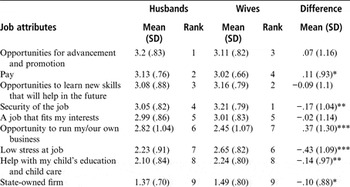
We first describe correlations between family income and work preferences as well as mean differences in work preferences found between all men and women in our total sample. The higher the family income the less wives valued child care and education benefits from their workplaceFootnote 56 and the less husbands valued job security.Footnote 57 The mean differences in the work preferences between husbands and wives in our sample in Table 1 also suggest that wives valued security and benefits more than husbands whereas husbands valued pay and running their own business more than wives. However, there were no differences between husbands’ and wives’ preferences for career advancement and interesting work.
Means, Standard Deviations, and Rank Order of the Importance Ratings of Work Preferences by Gender

Notes:
* p < .05; **p < .01; *** p < .001.
Source:
Authors’ survey.
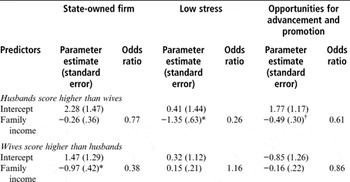
In order to test the effects of family income on couple-level differences in work preferences, we performed a set of multinomial logistic regressions in which the dependent variable of work preference differences between spouses was divided into three categories: husbands scoring more than .5 standard deviation higher than their spouses, wives scoring more than .5 standard deviation higher than their spouses, and both members of the couple scoring within half a standard deviation of each other (Table 2).Footnote 58 Since there were more than two outcome categories, we set as our reference category the third category: couples with similar scores on the work preferences. Regressions were run for the nine work preferences in Table 1, but only those that were significant (p < .05, two-tailed) or of trend level of significance (p < .10) were reported here. Monthly family income was our main predictor variable. Average level of education of the couple,Footnote 59 as well as age and educational differences between husbands and wives and interactions among these demographic characteristics were included in our models as covariates.Footnote 60
Likelihood of Husbands Scoring Higher or Lower than their Wives on the Work Preferences of State-owned firm, Low stress, and Opportunities for Advancement and Promotion

Notes:
†p < .10; *p < .05; **p < .01; ***p < .001. The reference category is husbands having the same scores as wives. Coefficients for covariates not included; available upon request from first author.
Source:
Authors’ survey.
Table 2 shows that with every 10,000 yuan increase in monthly income, the odds of wives valuing a state job more than husbands were .38 times the odds of wives and husbands agreeing on valuing a state job (p < .05). This means that in low-income couples, wives were more likely to value state jobs than their husbands compared with high-income couples, in which wives and husbands were more similar in terms of favouring state jobs. With every 10,000 yuan increase in monthly income, the odds of husbands valuing a low-stress job more than wives were .26 times the odds of wives and husbands agreeing on valuing a low-stress job (p < .05). This means that in low-income couples, husbands were more likely than wives to value low-stress jobs compared with high-income couples, in which wives and husbands were more similar in terms of valuing low-stress jobs. Table 2 also points to a trend whereby with every 10,000 yuan increase in monthly income, the odds of husbands scoring higher than their wives on valuing opportunities for career advancement and promotion were .61 times the odds of wives and husbands agreeing on this work preference. This means that in low-income couples, husbands were more likely to value career advancement than their wives than in high-income couples, in which husbands and wives were more similar in terms of valuing career advancement.
The couple-level patterns just described suggest that high-income couples were more likely than low-income couples to have similar work preferences with regard to state jobs, low stress and career advancement. These patterns speak to the variations in couple-level employment decisions and roles in the household by family income, and we draw on our qualitative findings to explain them. In our interviews, couples suggested that they were socialized into gendered jobs by their own parents and in turn held gendered beliefs about work for their children. Many viewed the state sector as especially suitable for girls, and this view was most strongly and commonly espoused by low-income couples, which may partly explain why wives were more likely to value state jobs than their husbands in low-income couples than in high-income couples. Working in the state sector was seen as an ideal occupational choice for wives because state jobs were associated with stability. A low-income wife working as a civil servant in a government office stated: “I like [working in] state-owned firms. It is stable. This is important for women.” This does not mean that high-income couples and men tended to dislike the state sector per se; rather, it means that, because they had more job choices and opportunities, they preferred high-earning jobs which happened to be more likely in the private sector than in the state sector.
In our sample, in low-income families, the majority of the husbands (74 per cent) had earnings similar to their wives while only a minority of husbands (22 per cent) earned more than their wives. In high-income families, it was the reverse: the majority of the couples (57 per cent) had husbands earning more than their wives while only a minority (29 per cent) had similar earnings to their wives. Furthermore, high-earning husbands were in extremely high-paying jobs, and the higher the family income the larger the spousal income gap.Footnote 61 These distributions of earnings between wives and husbands explain some of the work preference patterns observed.
First, wives in low-income couples in our sample were more likely than wives in high-income couples to serve as an important source of family income, following the model of the “one-family two-systems.” As a result, in low-income couples wives were more likely to value state jobs than their husbands because state jobs provided benefits and security, which were major issues of concern for these women. In comparison, wives in high-income families were financially backed by their husbands and had more scope to choose jobs based on their own interests.Footnote 62 For instance, the husband in one high-income couple whose wife was a reporter while he worked as a manager in private business, explained: “My wife majored in literary arts (wenyi 文艺) and I am interested in business, so she can choose and do some kind of intellectual work (naoli laodong 脑力劳动). I am sure that I can provide her with such opportunity as she won't be worrying about earning a living.” Although this wife was in a white-collar job with a relatively high salary, she was portrayed as pursuing her own interests rather than generating income that was important for the family's survival.
Husbands in low-income families, whose earnings tended to be low, faced more pressure than their wives to increase their salaries and advance in their careers to conform to the social expectations of husbands as breadwinners and achievers. This meant that they were more likely than husbands in high-income couples to show a greater preference for career advancement than their wives did. Even when husbands were not earning more than their wives, which was actually the case for 43 per cent of the couples in our total sample, husbands and wives still held on to a cultural model of gender in which husbands were responsible for providing the main source of income in the family while their wives were responsible for taking care of housework and their child. A wife from a low-income couple running her own clothing store said: “Being a father, he has to work hard and earn a living while a mother doesn't have to … Although the father's share of housework is less, he has the main burden of earning a living.” Husbands were not only expected to be the main financial providers but also faced social pressure to excel and be competitive at work. A low-income teacher, the mother of a son, said:
Social pressure (shehui yali 社会压力) is relatively high; boys must be excellent and outstanding (youxiu he tuchu 优秀和突出) at school and at work, or they might be despised by society (bei shehui taoyan 被社会淘汰). The expectation for girls isn't that high. She can study as hard as she can, and if she doesn't do well, she can find a stable job – it doesn't need to be so good either.
Such gendered perceptions that parents often expressed in our sample suggest that, despite the decline of gender inequalities that has been observed in previous studies,Footnote 63 assumptions about differences between men's and women's work roles persist.
Low-income husbands in our sample were more likely than their wives to value low stress at the job because husbands faced pressure to earn more, which increased stress. The level of stress which had to be shouldered by all husbands at work because of the financial burden imposed by the birth of the child regardless of income levels was articulated by a high-income couple.Footnote 64 The wife, who was a business manager, said: “Having the child makes one thing different for my husband: increased stress at the workplace (yali biandale 压力变大了). He has to earn more money to be able to raise the child.” Her husband, who was an architect, echoed her statement in a separate interview: “After having the baby, I became more stressed than before (juede yali biandale 觉得压力变大了). I need to spend less and save more because of our child.” Low-income husbands were additionally more heavily involved in childrearing than high-income husbands, who tended to be busier and often went on business trips, which reduced their time at home.Footnote 65
Case Studies of a High-income Couple and a Low-income Couple
To illustrate the relationships between income and differences in work preferences of couples within marriage as described above, this section discusses the cases of a high-income and a low-income couple, with monthly family incomes of 20,000 and 3,800 yuan respectively, representative of the high and low ends of the spectrum found in our qualitative sample. Pseudonyms were used for all research participants. We chose these couples as case studies because they were particularly articulate in their interviews and because they illustrate the diversity of strategies and tensions at play in how husbands and wives of a variety of income levels negotiate their respective work and childrearing roles.
Liu Wei and Lin Li, a high-income couple
Liu Wei (34 years old) and Lin Li (31 years old), were a college-educated couple both working in high-status white-collar jobs with a monthly family income of 20,000 yuan. Liu Wei was a high-level manager in a state-owned firm (guoqi 国企), while his wife was a sales manager in a share-holding company with a dozen employees. Liu Wei, originally from a more rural province, moved to Nanjing to attend college and was assigned (fenpei 分配) his current job where he has worked for over ten years. Lin Li, also from the same province, moved to Nanjing with her husband, leaving her previous job in her hometown where she had been working in a hospital pharmacy. Although Liu Wei is working in the state sector, his job as a high-level manager is at least as high paying and prestigious as the best private sector jobs held by others in our sample, and thus unlike most other lower-level state sector jobs held or discussed by our research participants.
Although Liu Wei's job had been assigned to him, he was extremely satisfied with it, and stated: “Now I have a house, I have a car, I have everything … this is much more than everything I had hoped for at the time!” His job was extremely well-paid, and the ample material compensation not only alleviated his financial pressure to provide for the family but also increased his overall satisfaction with his job, which met his demands and was a good match for him. It is thus less likely that he would experience unhealthy levels of job stress, although he did say that his job was sometimes challenging in terms of making decisions in the face of difficult problems. Because he was working in the state sector, he also indicated that he faced more freedom and less stress than his counterparts working in the private sector. “This is much better than some private-run firms, because some firms are extremely stressful for their employees,” he said. Liu Wei's job thus provided him with most of the benefits also mentioned by low-income women; however, the occupational mobility and earnings were unusual for a state job.
His wife Lin Li, on the other hand, was slightly more likely to experience job stress because she was working in a share-holding company. Lin Li faced many demands and challenges at work. “I want to have a job that is purely management-related. Right now, I am doing both management and marketing. This is really tiring for me,” she said. Such multi-tasking was required in many higher-income jobs, adding to job stress. However, she was no less satisfied than her husband with her job, which she had chosen based on her interests. Because both members of high-income couples tended to be in equally challenging jobs and had high earnings, husbands and wives tended to score similarly on work preference for low job stress.
Lin Li, who was working in a high-income high-status job like her husband, expressed a strong preference for career advancement. Unlike her husband, Lin Li had changed jobs many times. She left her first job to accompany her husband who already had a job in Nanjing. Her work history was common among wives who were career-minded but still prioritized their families. Her next job in Nanjing was as a manager at several pharmacies. However, because she felt bored, Lin Li changed jobs again with the help of a friend and got her current job, which involved both managing and marketing duties. Lin Li clearly enjoyed interacting with clients, as she said, “The last job was unchallenging, I was doing the same thing every day and I quickly got bored. My current job, selling products, requires good communication skills. My previous jobs isolated me from connecting to society. This job allows me to communicate with different people and helps me develop my communication skills.” Her current job also gave her a lot of space for autonomy, and she explained, “I have a lot of autonomy. I can make decisions on a lot of affairs except the kinds of new medicine we are importing, or the investment in projects.” Lin Li's search for challenge and growth was reflected in the way she spent her spare time during her second job. She said: “I had plenty of personal time so I chose to use the spare time to educate myself.” Thus, Lin Li's changing work trajectory reflected her constant desire to pursue her interests and promote her learning. This was characteristic of many high-income wives who had more choices because of the financial backing of their high-earning husbands. Indeed, Liu Wei said of his wife, “My job was relatively stable and fixed, but she didn't care so much [about her job]!” This was an inaccurate description of Lin Li's choices, but reflected how Liu Wei provided financial support for his wife to choose a job of interest to her instead of relying on her to provide a significant proportion of the income the family needed.
Lin Li was not only career-oriented but also very confident of her abilities, and emphasized her self-sufficiency, saying:
He [her business partner, who is the bigger shareholder] needs my help a lot; I don't ask him for help. I don't need his emotional support, because I am independent and emotionally strong. I don't follow his command when I think he is wrong … I have very good relationships with my co-workers, I am pretty sure they feel the same way … I don't usually ask people for help. They [her co-workers] ask me for help sometimes and they feel very grateful.
Her statement clearly suggested her confidence in her professional skills, and she later described herself as competitive (haoqiang 好强). Predictably, when Lin Li was asked by the interviewer to choose between a job where she could make five times more than her current income a month, with some risk of being laid off some time, and another job where she could only make 1,000 yuan a month, but with a much lower risk of being laid off, she chose the higher-risk higher-income job, and justified her choice by stating: “I can find another job if I am laid off. Also, doing one job forever is boring.” Such response was common among high-income wives who were working in riskier jobs in the private sector, and were confident that even if they lost their jobs they would be able to find another equally good job because of their youth and superior abilities. Most wives who were career-oriented like Lin Li were reluctant to stay too long in one job. As another high-income wife working on the administrative staff of a school pointed out, “too much stability can wear you down.”Footnote 66 This made high-income wives less likely to value state jobs, which provided stability. Lin Li, when asked about her ideal job, indicated her preference for joint-venture firms, which she believed to be better regulated, and not state firms.
The experiences of this couple illustrate some of the reasons why high-income wives were not more likely than their husbands to value state jobs, not only because, confident of their abilities, they did not value stability, but also because they were not concerned about benefits. Liu Wei's job provided the couple with the full range of benefits including housing, medical care, child education and child care. As a result, they did not worry about welfare, as pointed out by Lin Li, who said, “I don't care about the welfare because I have high income … My husband and I got all our benefits from our current jobs.” However, Lin Li still held on to traditional cultural models of gender roles within marriage, and prioritized her family over her career when it came to making decisions in spite of her desire to have a fulfilling career that was both interesting and challenging.
Yang Zhendong and Dong Shufen, a low-income couple
Yang Zhendong (28 years old) and Dong Shufen (26 years old) were a young college-educated couple with a low monthly family income of 3,800 yuan, both originally from Nanjing. Yang Zhendong was a low-status administrative staff member working as an assistant in a private business, while his wife worked as an assistant cleaning rooms and bathrooms in a small private-run hotel (jiudian 酒店). Dong Shufen had sold goods in a state-run department store for three years before this, at a job that had been assigned to her by her school, but she quit because of the low salary (daiyu buzenme taigao 待遇不怎么太高).
Dong Shufen complained on many occasions about the stressful nature of her current job, especially compared to her previous job at the state-run department store.Footnote 67 She worked long hours (45 hours a week), sometimes not having enough time to eat, had a heavy workload as the hotel was understaffed with only five employees, and was involved in physical labour activities such as cleaning the hotel rooms and serving guests. Her current job was physically exhausting, especially now that she had a child and housework to tend to, and she complained: “Right after getting married or before, I only needed to look after myself, I didn't need to take care of anything else … but now, after I come back home, I have to take care of the child, of housework, I feel this is very tiring.”
This was common in low-income blue-collar jobs, especially in the private sector. State jobs actually offered fewer working hours and better working conditions than low-paying jobs in the private sector, as Dong Shufen pointed out based on her own experience. Although on average, in our sample, state jobs offered lower pay than self-employment, there was more variability in income levels for wives who were self-employed.Footnote 68 Wives who worked in the state sector worked an average of 39 hours per week, while those who were self-employed worked an average of 47 hours per week, close to Dong Shufen's working hours. An especially desirable feature of the state sector was the state protection which provided some form of job security, which was not available in the private sector.Footnote 69 In light of such trends, Dong Shufen's preference for state jobs was predictable. When prompted, she indicated her preference for working in a state-run company which she believed to be well-regulated, and explained how she became risk averse after giving birth to her son.
Dong Shufen's preference for state jobs was reinforced by the importance of her income to her family, which followed the model of “one-family two-systems.” In contrast to the wives in the previous couples, Dong Shufen was working to pay the bills. She clearly disliked her job. “It [my ideal job] would certainly not be a hotel-related profession (jiudian hangye 酒店行业),” she said. She aspired to move into a better-paying and higher-status job in the future: “I am presently taking financial accounting classes, and plan to look again for another job in accounting once I have acquired an accounting diploma (kuaijizheng 会计证).” Although Dong Shufen aspired to career mobility, career advancement was less of an issue for her, compared with her husband who was in a contract job: “No, he [her husband] wouldn't change jobs unless he doesn't want to do it anymore, he is in that type of state-run, long-term contract job (changqi hetong 长期合同),” she said. This was the type of job she also aspired to be in. Thus, Dong Shufen was more likely to value a state job than her husband, because her private sector job was unpleasant and labour-intensive, as well as unstable.
Dong Shufen's work was indeed stressful in terms of physical demands, but her husband faced additional sources of stress, making him value low stress at work even more than his wife did. Like most low-income husbands, Yang Zhendong faced social pressure to earn more than he was currently earning. Yang Zhendong indicated his preference for the high-income but riskier job when asked to pick between a job where he could make five times more than his current income a month, with some risk of being laid off some time, and another job where he could only make 1,000 yuan a month, with a much lower risk of being laid off. “After we had a child, life became a little harder, because we often spent a lot of money to provide our child with the best things,” he said. He viewed the financial burden which increased with the birth of the child as his main responsibility.
Because Yang Zhendong was not earning enough to support the family, Dong Shufen's salary was an important source of income for the couple. Yang Zhendong acknowledged this fact, and noted that his wife's income was vital to support the costs of childrearing. In order to help alleviate his wife's burden at home, as she often came home physically exhausted from work, he was involved in various aspects of child-related duties, such as making powdered milk or changing the child's nappies at night. His wife appreciated his contributions and praised him: “He really takes care of the family and the child.” Yang Zhendong and Dong Shufen thus complemented each other by taking relatively egalitarian roles in childrearing and working to make money. The experience of this couple also illustrates some of the reasons husbands in low-income families were more likely to prefer low-stress jobs because of the pressure they faced at home to support their wives and then at work because they were pressured to earn more.
Conclusion
Our study found distinct patterns of work preference differences between husbands and wives, and variation in these patterns by family income. We found that with increasing family income, differences in work preferences between husbands and wives were reduced, especially with regard to preference for state jobs, low stress and career advancement. However, in spite of work preference similarities between husbands and wives in high-income families, the two case studies we presented illustrate some of the ways dominant cultural models of gender roles within marriage still persisted within families at all income levels. In low-income families, despite the relatively egalitarian division of childcare duties, husbands were still more career-oriented than their wives. In high-income families wives were career-oriented, but still tended to sacrifice their career interests to family duties when needed.
In spite of the differences we found between high-income and low-income couples, their narratives also show how unstable the structures of inequality and hierarchy currently are in China, in a world where boundaries are increasingly flexible.Footnote 70 Though most couples recognized boundaries and hierarchies set by gender and income, these boundaries were constantly renegotiated and shifting. Couples could move up the income ladder by competing in the market economy in riskier yet more rewarding sectors, while husbands and wives could also move in and out of each others’ boundaries, with husbands’ increasing participation in housework in low-income families and wives’ increasing participation in upwardly mobile careers in high-income families.
Nevertheless, in families of all income levels, the cultural models of the husband as breadwinner and the wife as the “virtuous wife and good mother” who had main responsibility for domestic work and childrearing were still highly salient. Discrepancies between employment opportunities and dominant cultural models of gendered family roles created work–family role conflicts that caused stress, especially for husbands in low-income families. Low-income husbands were often in low-paid jobs, faced pressure to provide for their family, and experienced more stress at jobs that were more likely not to suit their demands and needs. The large number of parents who had similar earnings in low-income families in our sample suggests that women in these families make indispensable contributions to their family incomes. This was recognized by low-income husbands, who helped with housework and childrearing more than their high-income counterparts. However, traditional beliefs about gendered roles of wives and husbands persisted even among these couples.
As couples co-ordinated their income-earning activities, low-income wives were no less concerned about financial issues than their husbands, and often focused on generating a stable source of income, following the “one-family two-system” strategy. Low-income wives were extremely limited in their employment choices by their lack of professional abilities, their family duties and their low-earning husbands. As a result, they were more likely than their husbands to prefer state jobs. As in the case of female migrant workers (dagongmei 打工妹), caught between the state socialist system and the capitalist world economy,Footnote 71 wives from low-income families were excluded from fully participating in the market economy even though they still aspired to work in career-oriented competitive jobs that promoted advancement. Their preference for the state sector, which was feminized for its passivity while achievement and competition in the private sector were associated with masculinity,Footnote 72 was actually a reflection of the lack of choices they faced in the market economy. This contrasted sharply with the situation of wives in high-income families, whose career choices were enhanced by their professional abilities and by the financial backing of their husbands. As a result, wives in high-income families were career-driven and valued interest and learning opportunities, which were associated with career advancement. Our findings show how household employment decisions were governed largely by gendered attitudes towards childrearing and work. Family income created boundaries within which couples could adjust their choices, shaping work preference differences between husbands and wives.