Introduction
Cognitive deficits are a core feature of schizophrenia (SZ) that can begin in early stages and become more severe in the chronic stage of illness (Seidman et al. Reference Seidman, Buka, Goldstein and Tsuang2006; Wu et al. Reference Wu, Chen da, Tan, Xiu, Yang and Soares2016). However, the extent to which antipsychotic (AP) drugs cause improvement or worsening of cognitive performance in first episode of psychosis (FEP) remains a matter of debate.
Over the last two decades, chronic SZ and FEP studies have suggested that second-generation AP medications (SGA) appear to enhance (Harvey & Keefe, Reference Harvey and Keefe2001; Karson et al. Reference Karson, Duffy, Eramo, Nylander and Offord2016) or show a small benefit (Cuesta et al. Reference Cuesta, Peralta and Zarzuela2001; Keefe et al. Reference Keefe, Seidman, Christensen, Hamer, Sharma and Sitskoorn2004, Reference Keefe, Seidman, Christensen, Hamer, Sharma and Sitskoorn2006; Harvey et al. Reference Harvey, Rabinowitz, Eerdekens and Davidson2005) in terms of cognition when compared with first-generation AP medications (FGA). However, recent contributions from large naturalistic studies have not replicated this finding in FEP (Davidson et al. Reference Davidson, Galderisi, Weiser, Werbeloff, Fleischhacker and Keefe2009) and chronic samples (Keefe et al. Reference Keefe, Bilder, Davis, Harvey, Palmer and Gold2007a). Differences in AP dose could explain these contradictory findings as Harvey et al. (Reference Harvey, Rabinowitz, Eerdekens and Davidson2005) used relatively high doses for FGA, whereas EUFEST used lower doses of haloperidol (1–4 mg/day) compared with SGA (quetiapine, e.g.: 200–750 mg/day). An alternative hypothesis is that initial cognitive improvement is due to positive symptom amelioration (such as for instance auditory verbal hallucinations) due to AP effects (Faber et al. Reference Faber, Smid, Van Gool, Wiersma and Van Den Bosch2012). Moreover, it has been suggested that auditory verbal hallucinations can be traced back to abnormally elevated resting state activity in the auditory cortex (Northoff, Reference Northoff2014) leading to deficits in working memory (Nejad et al. Reference Nejad, Ebdrup, Siebner, Rasmussen, Aggernæs and Glenthøj2011) or sustained attention (He et al. Reference He, Deng, Li, Chen, Jiang and Wang2013).
The effects of AP on cognition seem to be more complex than previously acknowledged as they may depend on the stage of illness. In support of this, there is evidence of cognitive worsening related to AP drugs when the patient is clinically in an advanced phase of remission. In this regards, van den Bosch et al. performed a randomized controlled trial of maintenance v. guided discontinuation with SGA, finding better performance in processing speed tasks in the latter. It suggests that dose reduction or discontinuation after achieving stable remission might improve neurocognitive function (Faber et al. Reference Faber, Smid, Van Gool, Wiersma and Van Den Bosch2012). However, it also has been found a cognitive worsening during the drug-free stage probably explained by the withdrawal effects of the AP drugs (Potkin et al. Reference Potkin, Fleming, Jin and Gulasekaram2001; Weickert et al. Reference Weickert, Goldberg, Marenco, Bigelow, Egan and Weinberger2003).
Sparse literature can be found about the AP anticholinergic load in cognition in FEP (Baitz et al. Reference Baitz, Thornton, Procyshyn, Smith, MacEwan and Kopala2012) or chronic SZ patients (Minzenberg et al. Reference Minzenberg, Poole, Benton and Vinogradov2004). Methodologically, both studies calculated the anticholinergic load by using acetylcholine-binding receptor human and animal studies and clinician ratings. A third study used benztropine mesylate as an equivalent dose unit in a chronic SZ sample (Rehse et al. Reference Rehse, Bartolovic, Baum, Richter, Weisbrod and Roesch-Ely2016). The Anticholinergic Risk Scale (ARS) is commonly used to obtain an estimate of anticholinergic burden in the geriatric population in clinical settings and some studies have included the chronic SZ population (Landi et al. Reference Landi, Dell'Aquila, Collamati, Martone, Zuliani and Gasperini2014). However, to date there has been no FEP study directly measuring the anticholinergic compounds of AP drugs using this instrument.
The aim of this study was thus to investigate whether anticholinergic loadings and dose of AP drugs in FEP advanced remission patients are associated with cognitive impairment. We also tested the influence of AP dose and anticholinergic loadings regarding the influence of premorbid IQ on cognitive performance in our FEP sample.
Subjects and methods
Subjects
This study forms part of a project called ‘Phenotype-genotype and environmental interaction, an application of a predictive model in first psychotic episodes’ (also called the PEPs project) (Bernardo et al. Reference Bernardo, Bioque, Parellada, Saiz Ruiz, Cuesta and Llerena2013, Reference Bernardo, Bioque, Cabrera, Lobo, González-Pinto and Pina2017). Our study is cross-sectional, multicentre and naturalistic with 266 patients with FEP recruited from inpatient units and outpatient clinics of 16 psychiatry centres nationwide in Spain.
Our inclusion criteria were essentially having positive/negative symptoms for <1 year and for at least 1 week of duration and an age span of 7–35 years. Exclusion criteria included major medical and neurological illnesses, history of head injury with cognitive sequelae and mental retardation according to the Diagnostic and Statistical Manual of mental disorders, 4th edition (DSM-IV) criteria (American Psychiatric Association, 1994). Patients with suicide ideation or a substance use disorder, who are frequently excluded from FEPs studies, were allowed to participate (Bernardo et al. Reference Bernardo, Bioque, Parellada, Saiz Ruiz, Cuesta and Llerena2013).
The patients of this study were assessed on two occasions: at recruitment (baseline) for pharmacologic variables, and then at 2 months for all variables. Hence, the patients’ cognitive assessments were performed at the 2-month visit to ensure their clinical stability. The current report is based on premorbid, clinical and cognitive data gathered at 2 months.
For the purposes of the present study, we only included adult patients who completed seven or more of the 10 neuropsychological tests of the study, which represented more than 95% of the sample. The final sample comprised 266 patients.
Methods
Clinical assessments
Scales included in the PEPs project protocol were administered by expert clinicians (see Bernardo et al. Reference Bernardo, Bioque, Parellada, Saiz Ruiz, Cuesta and Llerena2013 for detailed information). All subjects gave written informed consent in accordance with local Institutional Review Board guidelines. Informed consent for the study was signed by the patient.
Demographic and premorbid data were collected for all participants, including age, gender, years of education, current occupation and living arrangements. Psychopathological assessment was carried out using the Positive and Negative Symptom Scale (PANSS) (Kay et al. Reference Kay, Fiszbein and Opler1987; Peralta & Cuesta, Reference Peralta and Cuesta1994). Diagnoses were determined using the SCID-I and II according to the DSM-IV criteria.
Measurement of AP dosage in our study during the 2-month assessment was calculated using an estimation based on an average of equivalents of chlorpromazine (Eq-CPZ) at two different points (basal line and 2 months of treatment). We used the equivalences used by Gardner et al. as their findings provide broad, international, expert consensus-based recommendations for most clinically employed AP drugs (Gardner et al. Reference Gardner, Murphy, O'Donnell, Centorrino and Baldessarini2010). There was not prior long-term exposure to AP. It did not exceed 12 months at study entry.
The ARS was developed to measure anticholinergic load following a review of 500 drugs within the Veterans Affairs Boston Healthcare System. Each drug is ranked on a scale of 0 (limited or none), 1 (moderate), 2 (strong) and 3 (very strong) based on the dissociation constant for the muscarinic receptor, rates of anticholinergic effects v. placebo in experimental studies, and a literature review on anticholinergic adverse effects (Rudolph et al. Reference Rudolph, Salow, Angelini and McGlinchey2008). We also controlled the anticholinergic load due to all psychiatric medications analysed using a similar formula [(baseline ARS score + 2 months ARS score)/2]. None of the 266 participants received non-psychiatric medication with anticholinergic load. The individual scores are calculated by summing the score for each drug to determine the patient ARS score for the whole treatment plan. Thus, the ARS score was used to calculate the anticholinergic load as it is associated with important negative outcomes, such as functional decline (Landi et al. Reference Landi, Dell'Aquila, Collamati, Martone, Zuliani and Gasperini2014).
Cognitive assessments
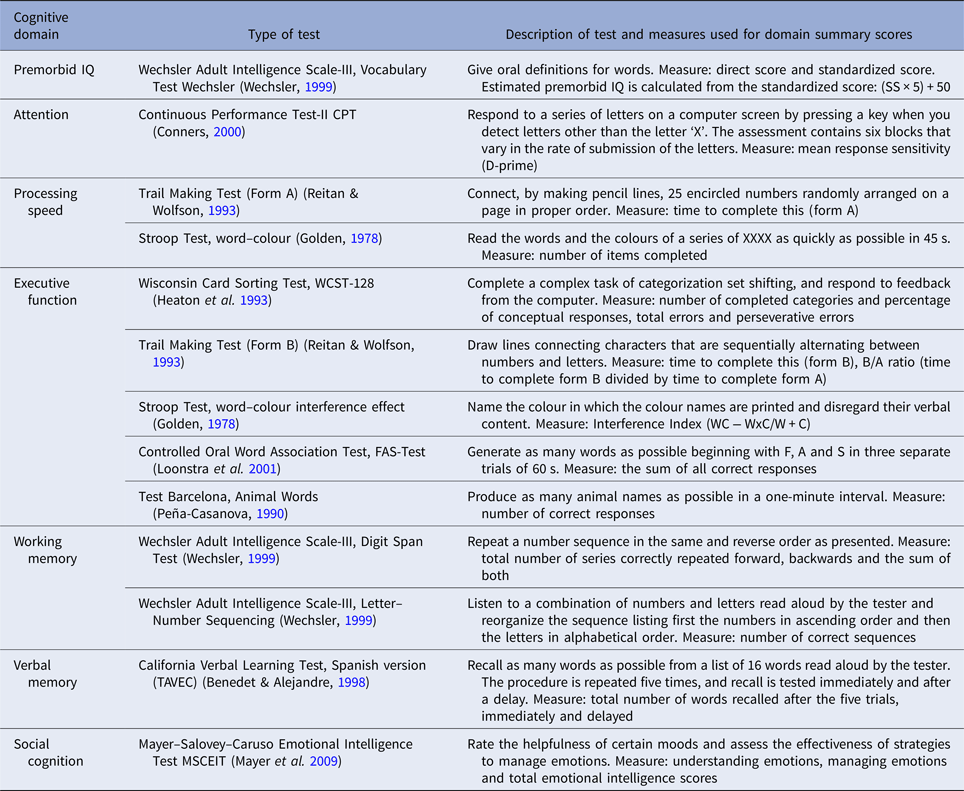
Cognitive functioning was assessed using a comprehensive battery of 10 standardized neuropsychological tests, validated in the Spanish population. This battery of tests was designed to encompass global cognition score and six (attention, processing speed, working memory, verbal memory, social cognition and executive function) of the seven cognitive dimensions proposed in the MATRICS battery (Green & Nuechterlein, Reference Green and Nuechterlein2004; Green et al. Reference Green, Nuechterlein, Gold, Barch, Cohen and Essock2004). Premorbid IQ and handedness were also assessed at the same time of the cognitive functioning assessment in all participants. Table 1 shows the neuropsychological tests that were administered and the measures selected to compute each domain score.
Neuropsychological tests used in the PEPsCog add-on study

The tests were administered by experienced psychologists in two sessions of 1–1.5 h, and were conducted sequentially in the same order from the lowest to the highest level of difficulty in order to reduce as much as possible the effect of fatigue and to facilitate cooperation. Good to excellent inter-rater reliability among psychologists was indicated by intraclass correlation coefficients >0.80 in two of the tests in the battery: the Wechsler Adult Intelligence Scale (WAIS) Vocabulary subtest and Wisconsin Card Sorting Test (WCST), in which the final score may partially depend on the judgement of the psychologist administering and correcting the test.
Statistics
All neuropsychological variables were then transformed into standard equivalents (z-scores). The scores for cognitive domains were calculated by averaging the z-scores of the relevant measures, as listed in the previous subsection. Reliability was assessed by calculating Cronbach's α for all subscale scores composed of more than one score. All cognitive scores were calculated such that higher values indicated better performance.
Pearson product-moment correlation coefficients were computed to assess the relationship between the cognitive functioning in different domains and the daily dose of AP measured in Eq-CPZ and the ARS of all the medications. All comparisons were two-tailed. We conducted this test in the whole sample and also for subgroup analyses dividing it into four quartiles, taking into account the daily AP Eq-CPZ.
To avoid error I type, we performed Bonferroni correction for bivariate analyses. We divided the critical p value (α) by the number of comparisons being made. Thus, p values under 0.007 were considered statistically significant after Bonferroni correction.
A series of hierarchical regression models (using the enter method) of the score of each cognitive domain were then used to examine the association of cognitive impairment with (1) premorbid IQ, (2) demographic characteristics (age, gender and years of education), (3) clinical dimensions (PANSS scores: positive, negative, general and total scores) and (4) pharmacological block of variables (Eq-CPZ and ARS score), entered in that order. For the regression analyses, we only entered variables that were correlated with the cognitive domain scores with p ⩽ 0.05 in the bivariate analyses. The outcome of primary interest was the incremental proportion of variance explained by each model in the hierarchical series. Preliminary analyses were conducted to ensure no violation of the assumptions of normality, linearity, multicollinearity and homoscedasticity. We conducted the test using the whole sample and also in two groups that were separated from the sample by the 50th percentile of premorbid IQ (named high and low premorbid IQ subgroups, respectively). Statistical procedures were carried out using IBM SPSS 21.0 version.
Results
Descriptive data of the sample
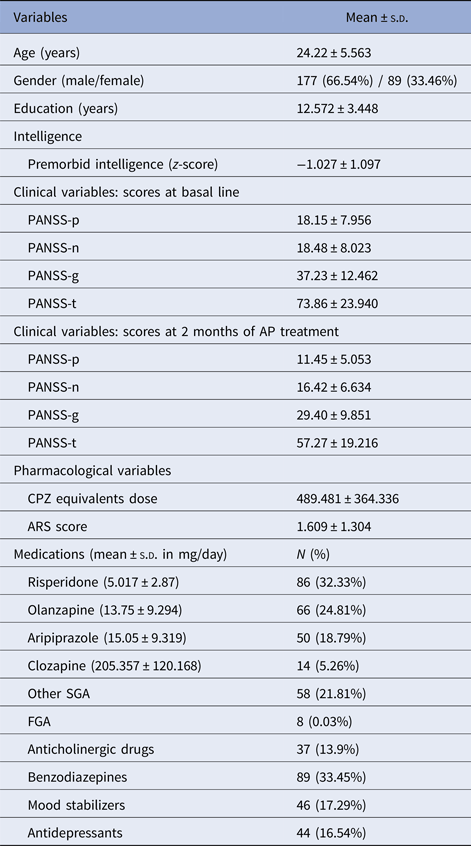
Two hundred and sixty-six adult FEP patients gave informed consent to participate in this study. Clinical severity across different psychopathological dimensions, IQ and other descriptive variables are depicted in Table 2.
Background characteristics of sample

Socio-demographic, premorbid cognitive, clinical and pharmacological variables.
Bivariate analysis: Eq-CPZ/ARS effect on cognitive performance in FEP patients
There was a negative correlation between the global cognition score and four additional cognitive domains (processing speed, working memory, verbal memory and executive function) with Eq-CPZ. On the other hand, ARS score only showed a significant negative correlation for verbal memory and global cognition. All significant results showed low to moderate strength according to Cohen criteria (Pallant, Reference Pallant2013) in all cases (r values ranged from −0.19 to −0.37 for Eq-CPZ and −0.22 to −0.31 for ARS score). See online Supplementary Table S1 for more details.
As shown in previous publications by our group using the same sample and data, we present the same Cronbach's α coefficients for the composite scores of the neuropsychological tests for our FEP sample (Cuesta et al. Reference Cuesta, Sánchez-Torres, Cabrera, Bioque, Merchán-Naranjo and Corripio2015). They were as follows: 0.697 for the processing speed score, 0.730 for the verbal memory score, 0.846 for the working memory score, 0.757 for the executive function score and 0.933 for the social cognition score. All scores indicated moderate to high reliability.
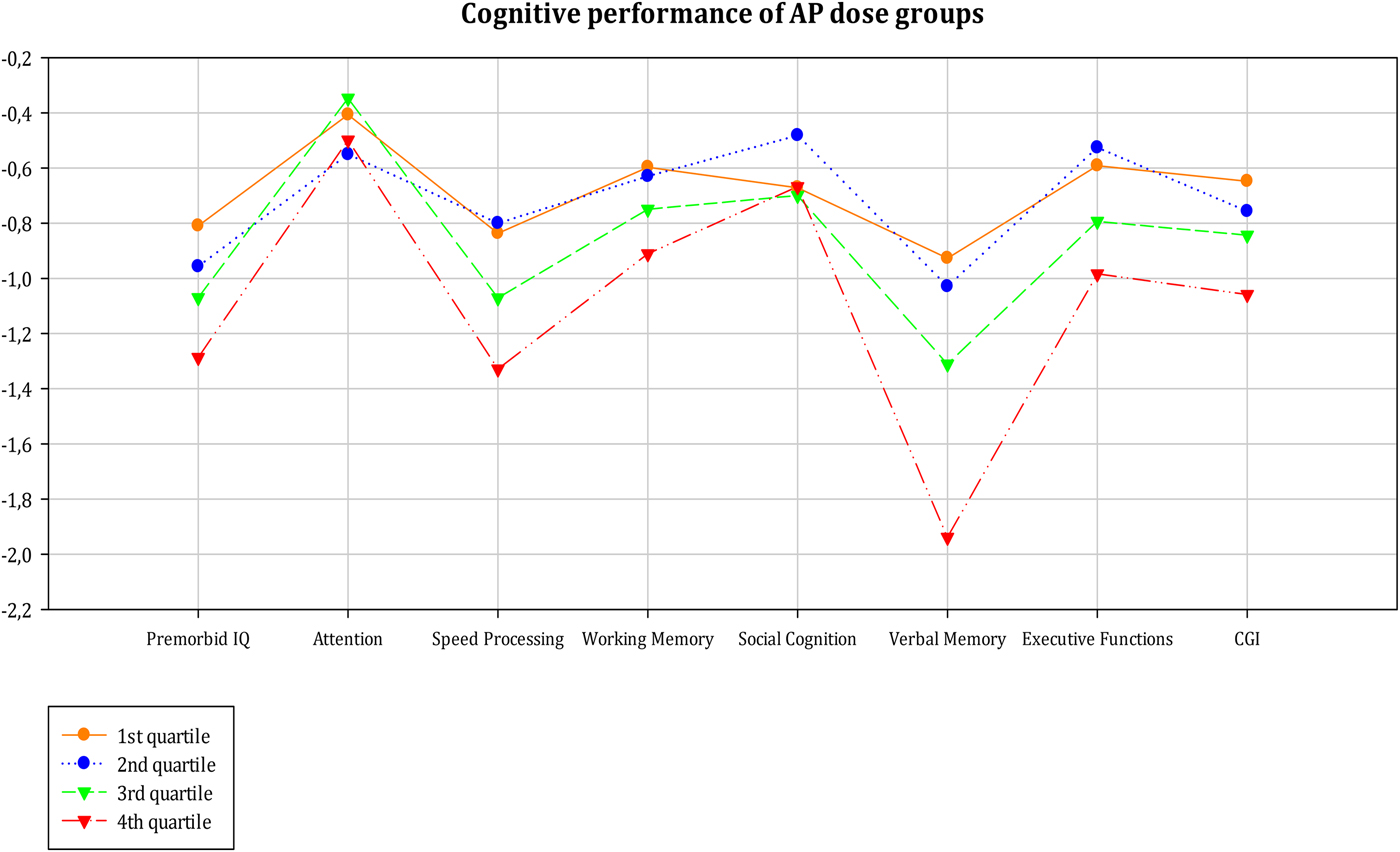
Figure 1 highlights the different cognitive patterns when dividing the whole sample into four quartiles, taking into account the daily AP Eq-CPZ.
Patterns of cognitive impairment for each group of quartile antipsychotic dose of our FEP sample.

Multivariate analysis: controlling clinical symptoms and premorbid IQ
Hierarchical regression in the whole sample
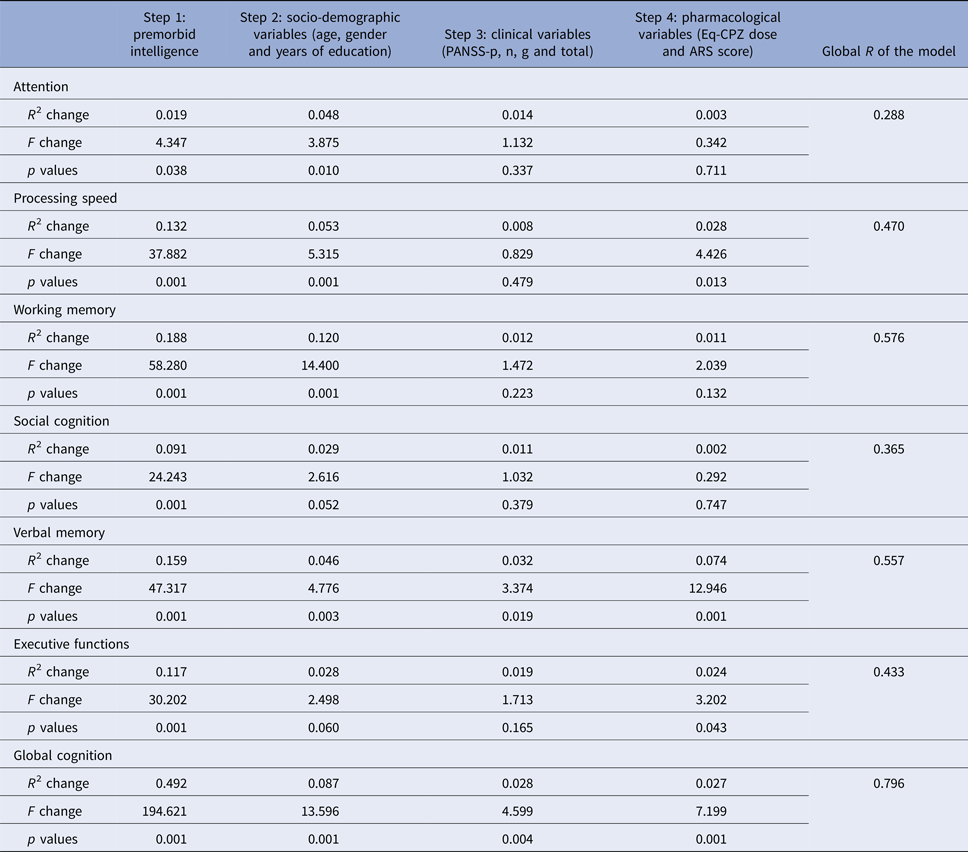
Premorbid IQ was entered at block 1, explaining 49.2% of the variance in global cognition of the whole sample. After entry of socio-demographic, clinical and pharmacological blocks of variables (blocks 2–4), the total variance explained by the model as a whole was 63.4%, F (9, 193) = 37.126, p < 0.001. The two control measures explained only an additional 2.7% of the variance in global cognition, after controlling blocks 1–3, R 2 change = 0.027, F change (2, 193) = 7.199, p = 0.001. In the final model, the Eq-CPZ of the two control measures was statistically significant, recording the following β value: β = −0.134, p = 0.012.
With regards to the remaining cognitive domains, again, premorbid IQ explained a higher percentage of the variance in all of the six cognitive domains compared to the pharmacological block. Hierarchical multiple regression (HMR) revealed results showing pharmacological block as a significant control cluster of variables for processing speed, verbal memory and executive functioning (see Table 3). With regards to clinical variables, there was a negative and statistically significant association with verbal memory and global cognition. When studying coefficients for each clinical variable independently, only global cognition and negative symptomatology reached statistical significance (β = 0.18 and p = 0.004).
Model summary of HMR analyses of cognition at 2-month follow-up, after controlling for clinical symptoms and IQ

Coefficient analyses of significant results of pharmacological variables
Coefficient analyses of variables related to significant results for pharmacological block revealed that three out of the four cognitive variables (processing speed, verbal memory and global cognition) remained significant when assessing Eq-CPZ individually (β values ranging from −0.181 to −0.134) whereas in ARS score analyses only verbal memory showed significant results (β = −0.149, p = 0.019). See online supplementary Table S2 in the supplementary data for additional details.
‘Low premorbid IQ’ v. ‘high premorbid IQ’ group analyses
We also conducted HMR on high and low premorbid IQ groups as depicted in online Supplementary Table S3.
In the ‘low premorbid IQ group’, four out of seven variables (working memory, verbal memory, executive functioning and global cognition) were significantly associated with the fourth block entered into the regression. However, in the ‘high premorbid IQ group’, only two variables (processing speed and verbal memory) showed significant results (see online Supplementary Table S3 for more details).
It is worth pointing out that, with regards to processing speed, in the LPIG the two control pharmacological measures showed no significant results, after controlling for the other blocks: R 2 change = 0.022, F change (2, 111) = 1.530, p = 0.221. On the other hand, in the HPIG, pharmacological block explained 8.7% of the variance in this cognitive variable: R 2 change = 0.087, F change (2, 120) = 7.178, p = 0.001.
Discussion
Summary of results
Our results demonstrated lower cognitive performance in those FEP with higher daily Eq-CPZ, specifically processing speed, verbal memory and global cognition. We also found a deleterious effect on verbal memory caused by all psychiatric treatment plan, with anticholinergic properties measured using the ARS score. Our results also showed that premorbid IQ is inversely associated with cognitive impairment and, accordingly, this cognitive deficit was more marked in the low IQ subgroup (in four cognitive domains v. only two domains in the high IQ subgroup). These findings are not explained by other socio-demographic and clinical variables.
Our results also found a negative and statistically significant association of PANSS variables with verbal memory and global cognition, and coefficient analyses suggested that they would be mainly related with negative symptomatology. This association endured after controlling for other extrinsic variables (such as Eq-CPZ and ARS score).
Meaning of the results
Cognition, AP dose and anticholinergic load
Our findings are in full agreement with previous evidence in FEP. Faber et al. found processing speed negatively correlated with AP dose (Faber et al. Reference Faber, Smid, Van Gool, Wiersma and Van Den Bosch2012). This study was longitudinal but, on the other hand, it has certain limitations compared to our study like its small sample size. Nevertheless, it complements our results as it aimed a cognitive functioning assessment following a treatment discontinuation plan, whereas our study was naturalistic. Interestingly, as extensively explained below, study with potency load indexes also found a higher D(2) load associated with poorer motor functioning, whereas higher anticholinergic load was again associated with poorer delayed verbal memory (Baitz et al. Reference Baitz, Thornton, Procyshyn, Smith, MacEwan and Kopala2012).
With regards to the chronic SZ samples, previously published data are in partial agreement with our results. One of these studies showed that an impairment in declarative memory was associated with AP dose (Minzenberg et al. Reference Minzenberg, Poole, Benton and Vinogradov2004; Elie et al. Reference Elie, Poirier, Chianetta, Durand, Grégoire and Grignon2010). This finding was replicated in a second study but processing speed was also found to be inversely correlated with AP dose (Rehse et al. Reference Rehse, Bartolovic, Baum, Richter, Weisbrod and Roesch-Ely2016). However, as concerns the anticholinergic burden, no cognitive worsening was found in those patients taking higher doses of anticholinergic compounds in either study, whereas recently a naturalistic study found that verbal memory was the cognitive domain most robustly influenced by anticholinergic burden (Eum et al. Reference Eum, Hill, Rubin, Carnahan, Reilly and Ivleva2017). In other words, regarding AP dose our findings resemble the evidence found in FEP, whereas those reported for anticholinergic load in chronic SZ are mixed.
Neither previous FEP studies nor our study found any inverse correlation between attention, working memory and any of these pharmacological variables. We speculate that this is because cognitive control of attention and selective attention have strong conceptual relationships with working memory (Cohen et al. Reference Cohen, Barch, Carter and Servan-Schreiber1999) and, as established endophenotypes, they are state independent and are relatively unaffected by AP medications (Gur et al. Reference Gur, Calkins, Gur, Horan, Nuechterlein and Seidman2007).
Some authors have studied the effects of AP drugs on cognition in healthy subjects in an attempt to avoid the numerous confounding factors that may affect the results. However, they report contradictory findings and cannot be compared to our results for two reasons. First, Allain et al.’s study was financed by industry and practice effects may have altered the results, and second, the remaining literature followed single AP dose models (Allain et al. Reference Allain, Tessier, Bentué-Ferrer, Tarral, Le Breton and Gandon2003; Artaloytia et al. Reference Artaloytia, Arango, Lahti, Sanz, Pascual and Cubero2006; Chung et al. Reference Chung, Park, Yang, Huang, Zhao and Oh2012). In contrast to this, our study allowed us to observe the cumulative effect of AP medications while controlling for different confounding variables by multivariate analyses and consequently to test the hypothesis directly on the desired target population.
These results and previous literature underline the importance of treating FEP patients with the lowest effective dose of AP (Faber et al. Reference Faber, Smid, Van Gool, Wiersma and Van Den Bosch2012). Regarding the anticholinergic load, Minzenberg et al. designed a model measuring the corresponding load estimate in chronic SZ patients. It comprised an index of the anticholinergic potencies of AP calculated from a compilation of literature reporting in vitro brain muscarinic receptor antagonism, and a clinical index, based on ratings of the anticholinergic side effects of medications (Minzenberg et al. Reference Minzenberg, Poole, Benton and Vinogradov2004). This index was also used by Baitz et al. in FEP patients (Baitz et al. Reference Baitz, Thornton, Procyshyn, Smith, MacEwan and Kopala2012), but an alternative design with clinical applicability is needed to develop a useful tool to lessen the cognitive burden of AP due to its anticholinergic compounds. The ARS score has been widely used in the geriatric population to measure the anticholinergic load of AP medication (Rudolph et al. Reference Rudolph, Salow, Angelini and McGlinchey2008; Landi et al. Reference Landi, Dell'Aquila, Collamati, Martone, Zuliani and Gasperini2014; Mangoni et al. Reference Mangoni, Kim, Hakendorf, Mayner and Woodman2016), and this is the first study that provides evidence of the clinical utility of the ARS score in a FEP sample.
AP cognitive impairment pattern by premorbid IQ
In line with our results, it has been reported that higher premorbid functioning may diminish the severity of deterioration in FEP, although this decline persists at least in the processing speed domain (González-Blanch et al. Reference González-Blanch, Rodríguez-Sánchez, Pérez-Iglesias, Pardo-García, Martínez-García and Vázquez-Barquero2010). Premorbid IQ is associated with a poorer neuropsychological performance and functional outcome (de la Serna et al. Reference de la Serna, Andrés-Perpiñá, Puig, Baeza, Bombin and Bartrés-Faz2013; Amoretti et al. Reference Amoretti, Bernardo, Bonnin, Bioque, Cabrera and Mezquida2016), and its level is an important predictor of neuropsychological (Barnett et al. Reference Barnett, Salmond, Jones and Sahakian2006), symptomatic (Andreou et al. Reference Andreou, Roesch-Ely, Veckenstedt, Bohn, Aghotor and Köther2013) and structural changes such as cortical thinning (Gutiérrez-Galve et al. Reference Gutiérrez-Galve, Chu, Leeson, Price, Barnes and Joyce2015) in FEP.
By clinical symptoms
The abovementioned association between negative dimension and two cognitive variables, although commonly reported, is relatively independent, as discussed in previous work by our group (Cuesta et al. Reference Cuesta, Sánchez-Torres, Cabrera, Bioque, Merchán-Naranjo and Corripio2015). As we will discuss below, there is evidence of an improvement of positive symptoms due to AP with better performance on neuropsychological tests (Faber et al. Reference Faber, Smid, Van Gool, Wiersma and Van Den Bosch2012). A reduction in metabolism in frontal association areas like the medial frontal cortex would underpin this phenomenon (Lane et al. Reference Lane, Ngan, Yatham, Ruth and Liddle2004). However, other authors hypothesized that neurobiological substrates not associated with positive symptomatology may be linked with cognitive impairment in SZ, such as the N-methyl-D-aspartic acid-type glutamate receptors hypofunction and the GABAergic origin hypothesis (Nakazawa et al. Reference Nakazawa, Zsiros, Jiang, Nakao, Kolata and Zhang2012).
Limitations
Our study has four limitations that must be taken into consideration:
First, our study was cross-sectional which implies to be cautious in terms of interpreting the results and also conditioned the moment of cognitive evaluation. Thus, recent findings suggest that cognitive improvement due to AP medication during the first 4–6 weeks of treatment is related to clinical symptom improvement (Cuesta et al. Reference Cuesta, García de Jalon, Campos and Peralta2009; Trampush et al. Reference Trampush, Lencz, DeRosse, John, Gallego and Petrides2015) but also longitudinal studies showed improvement of cognition throughout the first 6 months of AP treatment (Keefe et al. Reference Keefe, Sweeney, Gu, Hamer, Perkins and McEvoy2007b; Olivier et al. Reference Olivier, Killian, Chiliza, Asmal, Schoeman and Oosthuizen2015).We considered testing our sample after 2 months as cognitive improvement with AP use mostly occurs during the first weeks or months of treatment (Faber et al. Reference Faber, Smid, Van Gool, Wiersma and Van Den Bosch2012). Taking everything into account, this cross-sectional design provides associative (but not causative) findings, but they are relevant considering its sample size and the fact that they are assessed on an advanced stage of clinical remission (see PANSS scores at basal line and 2 months of AP treatment in Table 2 for further details).
Second, it is important to highlight that the percentages of the explained variance of all significant comparisons for Eq-CPZ and ARS in our study were weaker than those compared to premorbid IQ. However, we find them clinically relevant as anticholinergic loadings and AP dose are potentially modified in the individual treatment of patients.
Third, we used clinical AP equivalents instead of biological methods of measurement of AP dose. The literature gives the equivalence of Eq-CPZ of FGA with much more clarity than the SGA, probably because the receptor profile of the SGA group not only predominantly focus on D2 receptors but also on serotonergic, histaminergic, cholinergic and adrenergic receptors (Danivas & Venkatasubramanian, Reference Danivas and Venkatasubramanian2013). We consider it a limitation as the impact of other mechanisms of action like histaminergic blockade may cause cognitive dysfunction in areas like working memory (Roegge et al. Reference Roegge, Perraut, Hao and Levin2007), and it has not been evaluated. However, the Defined Daily Dose approach is not exempt from limitations since it has ‘never been developed as measures of dose equivalence, and that there is a reluctance to change them once they have been established’ (Leucht et al. Reference Leucht, Samara, Heres and Davis2016). In contrast, we used the interesting approach of measuring anticholinergic load due to its clear clinical applicability. We chose a scale with established use in pluripathological and polymedicated old age patients to predict cognitive impairment due to the anticholinergic compound of psychoactive medications (Mangoni et al. Reference Mangoni, Kim, Hakendorf, Mayner and Woodman2016). This is the first study to use this scale for this purpose in FEP patients.
Regarding the pharmacological variables, there is a fourth limitation, which is that in both cases we used a formula that only estimates the respective loads. A day-to-day record of both variables should be performed over a 2-month period in further studies to confirm or rule out our findings.
Final remarks and future directions
Here we present results suggesting that, after a period of treatment of FEP leading to remission, the clinician should consider the cognitive impact of the AP dose on proper clinical rehabilitation. Longitudinal studies are required to confirm a causal inference ruling out possible confounding factors such as clinical severity or previous exposition to AP drugs. In this regard, non-naturalistic studies found that a dose reduction strategy has been associated to significant improvements in frontal lobe functions measured in ‘set-shifting’ tests (Kawai et al. Reference Kawai, Yamakawa, Baba, Nemoto, Tachikawa and Hori2006) and also overall cognitive functions (Takeuchi et al. Reference Takeuchi, Suzuki, Remington, Bies, Abe and Graff-Guerrero2013). Nevertheless, a study of naïve samples of FEP patients non-previously exposed to drugs might lead to a better understanding of the relationship between AP and anticholinergic loads and changes in cognitive performance.
Recent literature has questioned the benefits of continuing prophylactic AP after clinical recovery as up to 40% of those whose psychosis remits after a FEP should be able to achieve a good outcome in the long term, either neuroleptic free or with a very low dose (Murray et al. Reference Murray, Quattrone, Natesan, van Os, Nordentoft and Howes2016). As well as effects on cognition, diminished neural modulation of this resting state network (Abbott et al. Reference Abbott, Juárez, White, Gollub, Pearlson and Bustillo2011), cortical thickness (Vita et al. Reference Vita, De Peri, Deste, Barlati and Sacchetti2015) and neuroleptic super-sensitivity (Konig et al. Reference Konig, Benzer and Fritzche1991; Silvestri et al. Reference Silvestri, Seeman, Negrete, Houle, Shammi and Remington2000; Mizrahi et al. Reference Mizrahi, Agid, Borlido, Suridjan, Rusjan and Houle2011) may be associated with AP dose, raising additional concerns over cumulative effects once an FEP patient is stabilized. In line with this, the classic recommendation of 1 year of AP treatment following remission is currently under debate as earlier AP discontinuation may be possible in some FEP subgroups if bolstered by effective psychosocial interventions (Alvarez-Jimenez et al. Reference Alvarez-Jimenez, O'Donoghue, Thompson, Gleeson, Bendall and Gonzalez-Blanch2016). However, a 3-year naturalistic follow-up study found a higher risk of symptom recurrence in those patients who discontinued AP after a minimum of 18 months of treatment (Mayoral-van Son et al. Reference Mayoral-van Son, de la Foz, Martinez-Garcia, Moreno, Parrilla-Escobar and Valdizan2016) supporting the idea of reducing (but not discontinuing) AP in those patients with higher risk of relapse.
New clinical strategies focused on therapeutic targets like the cholinergic pathway may be effective in terms of functional outcome mediated by attention and memory amelioration (McGaughy et al. Reference McGaughy, Dalley, Morrison, Everitt and Robbins2002; Risbrough et al. Reference Risbrough, Bontempi and Menzaghi2002; Sarter et al. Reference Sarter, Hasselmo, Bruno and Givens2005). Thus, some authors have suggested the possibility of using anticholinesterase inhibitors as adjunctive therapy to ameliorate some specific cognitive deficits (Ribeiz et al. Reference Ribeiz, Bassitt, Arrais, Avila, Steffens and Bottino2010; Choi et al. Reference Choi, Wykes and Kurtz2013). However, managing an adequate dose longitudinally in time and selecting drugs with low anticholinergic load are the main options the clinician can take into consideration to counteract the intrinsic/extrinsic factors of cognitive impairment in SZ, especially as it also impairs cognitive rehabilitation (Vinogradov et al. Reference Vinogradov, Fisher, Warm, Holland, Kirshner and Pollock2009).
Tailoring the pharmacological intervention according to the premorbid IQ would be an additional step that the clinician may take. Low premorbid IQ in FEP prior to illness outbreak predicts higher clinical severity (Leeson et al. Reference Leeson, Sharma, Harrison, Ron, Barnes and Joyce2011) and comorbidity (Koenen et al. Reference Koenen, Moffitt, Roberts, Martin, Kubzansky and Harrington2009). This is the first study with data suggesting higher cognitive impairment associated to AP dose in those patients with lower premorbid IQ in areas such as working memory, verbal memory, executive functioning and global cognition.
We conclude that the clinician should implement a stepped and individualized treatment plan during the first stages of the illness. This will require balancing the effectiveness of the AP treatment in terms of risk of relapse against other factors such as cognitive impact of medication as occurs in other major psychiatric disorders (Dias et al. Reference Dias, Balanzá-Martinez, Soeiro-de-Souza, Moreno, Figueira and Machado-Vieira2012); and the prevention of cognitive impairment should begin in the initial stages of the illness by personalized treatment programmes combining reduction of potential cognitive impairment associated to AP drugs and appropriate rehabilitation programmes (Killackey et al. Reference Killackey, Jackson and McGorry2008).
Supplementary material
The supplementary material for this article can be found at https://doi.org/10.1017/S0033291717003774
Acknowledgements
The authors particularly thank all the participants and their families who took part, the clinicians and others who kindly approached them on our behalf, and Dr Igor Bombín for training and guidance regarding the IQ and clinical assessments. This study is part of a coordinated-multicentre project, funded by the Ministerio de Economía y Competitividad (PI08/0208; 08/1026; 11/02831; PI08/1161; PI14/1621), Instituto de Salud Carlos III- Fondo Europeo de Desarrollo Regional and European Union. Una manera de hacer Europa. The Health Department of the Government of Navarra (87/2014). CERCA Programme/Generalitat de Catalunya; Secretaria d'Universitats i Recerca del Departament d'Economia i Coneixement (2014|SGR1636, 2014SGR441) and Fundación Alicia Koplowitz.
Declaration of Interest
Dr Cuesta has received research funding from the Spanish Ministry of Science and Innovation (Carlos III Health Institute), the Government of Navarre and the ‘Plan Nacional sobre Drogas’ from the Spanish Ministry of Health. Miquel Bernardo has been a consultant for, received grant/research support and honoraria from, and been on the speakers/advisory board of ABBiotics, Adamed, Almirall, AMGEN, Boehringer, Eli Lilly, Ferrer, Forum Pharmaceuticals, Gedeon, Hersill, Janssen-Cilag, Lundbeck, Otsuka, Pfizer, Roche and Servier, and has obtained research funding from the Spanish Ministry of Health, the Spanish Ministry of Science and Education, the Spanish Ministry of Economy and Competiveness, Centro de Investigación Biomédica en Red de Salud Mental (CIBERSAM), Government of Catalonia, Secretaria d'Universitats i Recerca del Departament d'Economia i Coneixement, Institut d'Investigacions Biomèdiques August Pi i Sunyer (IDIBAPS) and the Seventh Framework Program of the European Union. Miquel Bioque has been a consultant for, received honoraria from and/or been on speakers/advisory boards of Adamed, Ferrer, Janssen-Cilag, Lundbeck, Otsuka and Pfizer. Roberto Rodriguez-Jimenez has been a consultant for, spoken in activities of, or received grants from: Instituto de Salud Carlos III, Fondo de Investigación Sanitaria (FIS), Centro de Investigación Biomédica en Red de Salud Mental (CIBERSAM), Madrid Regional Government (S2010/ BMD-2422 AGES), Janssen Cilag, Lundbeck, Otsuka, Pfizer, Ferrer, Juste, MECTA. Angela Ibáñez has served as speaker or advisor for: Adamed, Bristol-Myers Squibb, Ferrer, Janssen-Cilag, Lundbeck, Pfizer, Servier and Otsuka. Dr Gonzalez-Pinto has received grants and served as consultant, advisor or CME speaker for the following entities: Almirall, AstraZeneca, Bristol-Myers Squibb, Cephalon, Eli Lilly, Glaxo-Smith-Kline, Janssen-Cilag, Jazz, Johnson & Johnson, Lundbeck, Merck, Otsuka, Pfizer, Sanofi-Aventis, Servier, Shering-Plough, Solvay, the Spanish Ministry of Science and Innovation (CIBERSAM), the Ministry of Science (Carlos III Institute), the Basque Government, the Stanley Medical Research Institute and Wyeth. Dr Vieta has received grants and served as consultant, advisor or CME speaker for the following entities: AB-Biotics, Actavis, Allergan, AstraZeneca, Bristol-Myers Squibb, Ferrer, Forest Research Institute, Gedeon Richter, Glaxo-Smith-Kline, Janssen, Lundbeck, Otsuka, Pfizer, Roche, Sanofi-Aventis, Servier, Shire, Sunovion, Takeda, Telefónica, the Brain and Behaviour Foundation, the Spanish Ministry of Science and Innovation (CIBERSAM), the Seventh European Framework Programme (ENBREC) and the Stanley Medical Research Institute. The rest of authors have no conflicts of interest to declare.