Mites have been known to infest plum curculio (PC) Conotrachelus nenuphar (Herbst) (Coleoptera: Curculionidae) larvae and adults (Smith Reference Smith1957; Broersma and Hays Reference Broersma and Hays1966; Amis and Snow Reference Amis and Snow1985), and impair movement of this and other species of insects (Amis and Snow Reference Amis and Snow1985; Smith Reference Smith1988). We conducted olfactometric bioassays to determine if mite-infested PC adults behave differently than noninfested PC regarding response to volatiles.
Apples containing PC larvae were collected from the field in 2009 in Saint-Bruno-de-Montarville, Québec, Canada (45.55028°N, 73.31917°W) during June drop and placed in emergence cages. Emerging nonsexually mature adults were collected daily and immediately separated by sex (Thompson Reference Thompson1932) and transferred to overwintering cages (Le Blanc Reference Le Blanc1992) and placed outdoors under natural conditions throughout the winter. Overwintered adults were removed from their cages the following spring as soon as the soil thawed but while temperatures were still cool. This ensured that all emerging adults were of a similar age (since they emerged from pupation and adults were placed in overwintering cages at similar times). Several adults from each container were sampled to verify sex and sexual immaturity. Adults were then placed in 2 L containers with small apples (McIntosh cultivar, 2–3 cm in diameter) and water and kept at 27 °C, 70% relative humidity, 16L:8D (light:dark hours). A laboratory colony was established using some of these wild individuals as per Hoffmann et al. (Reference Hoffmann, Vanderjagt and Whalon2007). Both wild and laboratory-reared insects were used in experiments. In order to bring laboratory-reared PC to maturity we treated them with pyriproxyfen as described in Hoffmann et al. (Reference Hoffmann, Vanderjagt and Whalon2007). Previous observations over several generations (Hoffmann et al. Reference Hoffmann, Vanderjagt and Whalon2007) reported no issues regarding PC treated with pyriproxyfen, nor were any observed differences between wild and laboratory-reared strains noted in our laboratory. In addition, an experiment conducted in our laboratory with pyriproxyfen-treated and untreated (wild) females regarding response to the odour of two mature males showed no difference in response to test versus control odours.
All PC used in experiments were sexually mature and all PC tested were female. Although the number of days elapsed since insect hatching may have differed between field-collected and laboratory-reared insects, insect age relative to sexual maturity was essentially the same. This is because wild individuals are still immature upon emergence from diapause requiring an average 13 days (Smith Reference Smith1957; Smith and Salkeld Reference Smith and Salkeld1964) to mature and lay eggs at 27 °C. Laboratory univoltine PCs emerging from diapause require treatment with pyriproxyfen to mature, and are able to lay eggs ∼10 days after treatment (Hoffmann et al. Reference Hoffmann, Vanderjagt and Whalon2007).
In our environmental chambers, wild and laboratory-reared individuals were found with mites and were quickly segregated to avoid infection of other wild and laboratory-reared PC colonies (uninfested PC). The source of infestation was most likely the apples used for maintaining wild and laboratory groups, as fruit flies were seen frequenting the apples and have previously been shown to carry phoretic mites with them (Amis and Snow Reference Amis and Snow1985). In containers with infestations, all PC in the container were examined and found to have at least one or more mites present. Random samples of PC revealed an average mite infestation of ≈10–20 mites per PC. In laboratory-reared PC allowed to mate, the resulting offspring kept in the same environmental chambers and reared to adulthood were also found to be infested with mites. Infested PC used in our experiments carried about 10–20 mites each.
Plum essence (PE; Milne Fruit Products Inc., Prosser, Washington, United States of America) and the odour of two live males were previously shown to attract female PC in our laboratory and were used as test odours. PE is a synthetic mixture of plant essence, it is essentially a blend of concentrated plum juice that attracts PC (Coombs Reference Coombs2001, Whalon et al. Reference Whalon, Nortman, Wise, Gut and Epstein2006). Males have been previously shown to produce an aggregation pheromone termed grandisoic acid (Eller and Bartelt Reference Eller and Bartelt1996), and two males have been shown to attract the greatest number of females in our laboratory. Either a 1.5 mL microcentrifuge tube (Sigma-Aldrich Canada Ltd., Oakville, Ontario, Canada) of PE containing a cotton wick for odour dispersion (Experiments 1 and 3), or two virgin males (Experiments 2 and 4), were put inside a 500 mL Mason jar (Bernardin Ltd., Richmond Hill, Ontario, Canada) and secured to the olfactometer with Parafilm®M (Sigma-Aldrich Canada Ltd.).
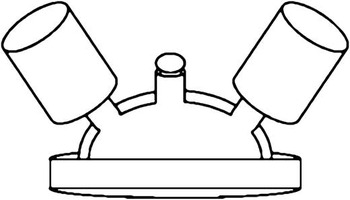
The olfactometer (Fig. 1) consisted of a large (105 mm inner diameter, 50 mm in height) Pyrex® glass container (Corning Inc., Corning, New York, United States of America). Three main openings (24 mm inner diameter, 60 mm height) on top of the olfactometer served as a point of introduction for insects (central opening) into the arena and as connectors (left and right) to the odour jars, which were placed on top and secured to the olfactometer with Parafilm®. Each jar contained either the test odour or the control “odour” (air only). Standard mosquito mesh covered the openings to prevent females from escaping or entering the jars. A Pyrex® glass Petri dish (150 mm diameter, 20 mm height) served as the base.
Diagram of the olfactometer used in experiments consisting of a Pyrex® glass container with a Petri dish bottom and three main apical openings (left, right, centre). Lateral openings served as connectors to Mason jars containing either test or control odours (triangle in Mason jar represents PE odour); central opening served as the point of introduction for insect.

Tests were conducted at 25 °C, 70% relative humidity during scotophase (Racette et al. Reference Racette, Chouinard, Hill and Vincent1991; Chouinard et al. Reference Chouinard, Hill and Vincent1993). A filter (LEE Filter, red primary no. 106®, Son-Art Production, Saint-Hyacinthe, Québec, Canada) covered the lights during experiments because PCs are not perturbed by red light (Prokopy et al. Reference Prokopy, Sylvia, Cooley and Phelan1995). A single female PC was placed in the olfactometer for 30 minutes, after which its position was noted and the PC removed. PC inside or within 1 cm of tubes leading to test or control jars were considered “responders” (i.e., PC having made an odour choice, either test or control); females in all other locations were considered “nonresponders” (no choice having been made). In addition to comparing PC odour choice (test versus control) among responders, the proportion of nonresponders was also compared with responders to gauge the effects of mites on PC ability to respond to odours. Odour zones were randomised after each replicate and the olfactometer was dismantled daily prior to each new experimental treatment, washed with Sparkleen™ (Fisherbrand, Pittsburgh, Pennsylvania, United States of America), and rinsed with acetone and hexane (Sigma-Aldrich Canada Ltd.).
SPSS statistical software (SPSS Inc. 2006, Chicago, Illinois, United States of America) was used for analysis. Comparisons between the number of “responder” PC choosing test versus control as well as the number of responding and nonresponding PC were done using a two-tailed χ 2-test. χ 2 statistics were used to test responders versus nonresponders and test versus control individually for noninfested and infested PC. This was to demonstrate the characteristics of a normal PC response to each odour (noninfested) in order to allow comparison against the response of infested PC (i.e., if mites have no effect on PC, then the behaviour of infested PC should mimic that of noninfested PC regarding their response to each individual odour). Responses between experiments (PC with mites versus PC without mites for each of the two test odours) were compared using a Mann–Whitney U-test.
Infested PCs were sent to the Diagnostic Laboratory of the Ministère de l'Agriculture, des Pêcheries et de l'Alimentation du Québec (MAPAQ: Direction de la Phytoprotection, Québec, Québec, Canada) and identified as Histiostoma sp. (Acari: Histiostomatidae). The mites identified were phoretic deutonymphs that have an attachment organ with 10 sucker-like structures on the posterior venter of the body, and were 0.15 mm in size with four pairs of frontwardly projecting legs ending in a single claw. The front-most pair of legs was longer than the other three pairs.
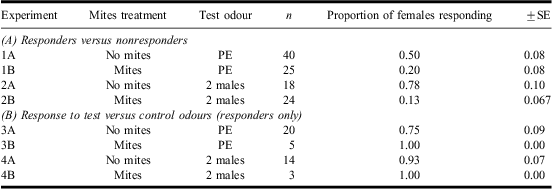
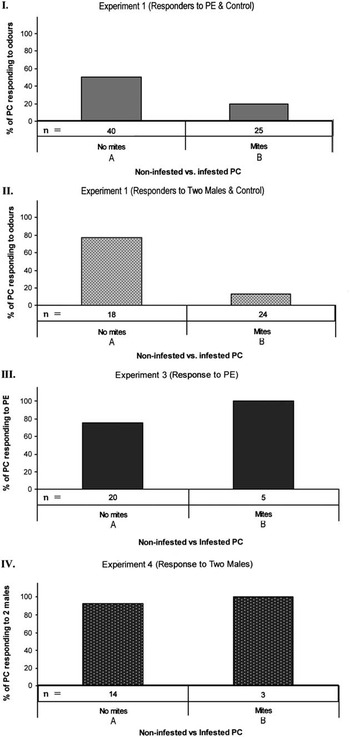
Response to odours (Table 1): no mites. There was no significant difference between proportion of responders versus nonresponders to odours in Experiment 1A (PE/control; χ 2 = 1.000, df = 1, P = 1.000) but there was a significantly higher proportion of responders than nonresponders to odours in Experiment 2A (two males/control; χ 2 = 5.556, df = 1, P = 0.018). Regarding odour preference, beetles responded significantly more to both PE (χ 2 = 5.000, df = 1, P = 0.025) in Experiment 3A, and two males (χ 2 = 10.286, df = 1, P = 0.001) versus the control in Experiment 4A. Mites. There were significantly more nonresponders than responders for both Experiment 1B (PE/control; χ 2 = 9.000, df = 1, P = 0.003) and Experiment 2B (two males/control; χ 2 = 13.500, df = 1, P < 0.0001) odours. All infested females chose PE (Experiment 3B) or two males versus the control (Experiment 4B). No mites versus mites. Noninfested females responded significantly more than infested females in both experiments (Experiment 1A/B [PE/control]: Z = −2.400, P = 0.016 [Fig. 2I]; Experiment 2A/B [two males/control]: Z = −4.214, P < 0.0001 [Fig. 2II]). There was no significant difference in odour choice between responding PC with or without mites regarding choice of test odours (Experiment 3A/B, PE: Z = −1.225, P = 0.221; Experiment 4A/B, two males: Z = −0.463, P = 0.643; Fig. 2III and IV, respectively).
Attraction of female PC to odour sources. (A) Proportion of responders (versus nonresponders) for noninfested and infested PC to PE and control odours. (B) PC responding to test odours (responders only).
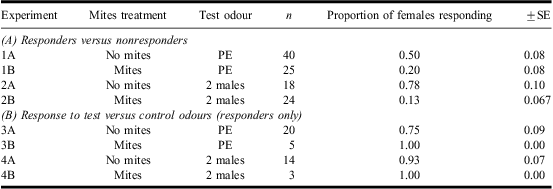
SE = standard error.
n = number of single female choice tests run for 30 min during scotophase at 25 °C, 70% relative humidity.
(I and II) Total percentage of responders – females having made an odour choice (test and control), versus nonresponders – PC that did not make an odour choice (neither test nor control odours). (I) Using PE for testing noninfested and infested PC (Experiment 1A/B); (II) Using two males for testing noninfested and infested PC (Experiment 2A/B). (III and IV) Percent of PC choosing the test odour (based only on total number of PC having made an odour choice, excludes unresponsive PC – those that did not make a choice). (III) Using PE odour for noninfested and infested PC (Experiment 3); (IV) Using odour of two males for noninfested and infested PC (Experiment 4). Bars with an * denote significant differences between infested and noninfested PC. PC = plum curculio, test odour = odour tested other than control (i.e., PE, two males), PE = plum essence, control odour = air, n = number of single female choice tests run for 30 min during scotophase at 25 °C, 70% relative humidity.

The mites herein were phoretic deutonymphs of Histiostoma sp., and not the same mites previously identified as a phytoseiid species, Garmania bulbicola (Oudemans) (Acari: Phytoseiidae), that were reported to infest the PC laboratory colonies of Smith (Reference Smith1957). The species referred to by Smith (Reference Smith1957) as G. bulbicola is in fact Proctolaelaps pygmaeus (Müller) (Acari: Melicharidae) (Ehara Reference Ehara1964). To our knowledge, this is the first report of Histiostoma sp. present on PC. Histiostomatidae are associated with decomposition of organic material, with the deutonymph stage specialising in using arthropods for transport and dispersion (Scheucher Reference Scheucher1957). The mites herein decreased PC ability to physically respond to odours, not their actual odour preference. Both PE and male PC odours were attractive to uninfested females, and all infested PC able to respond also chose the test odours (Fig. 2I and II). Thus, mites affect the ability of PC to actively respond and move towards odours but not PC odour preference itself. We noted that infested PC had problems climbing surfaces; the observed presence of mites on tarsi likely impaired PC movement as was noted by Amis and Snow (Reference Amis and Snow1985), where severe mite infestations hindered PC movement and metamorphosis. Mites can also inhibit insect flight and host-seeking behaviour (Elzinga and Broce Reference Elzinga and Broce1988; Smith Reference Smith1988). In our colonies heavy infestations (30+ mites) immobilised PC. Damage to host health is counter productive regarding mite dispersion but large quantities of mites may cause unavoidable damage. Generally, phoretic mites are thought to be commensals that disperse with no adverse effects to their hosts (Holte et al. Reference Holte, Houck and Collie2001). Our study, like the observations made by Elzinga and Broce (Reference Elzinga and Broce1988), shows how the frontiers between phoretic (commensalistic) and parasitic (trophic negative) interactions is narrow and that the intensity of the phoretic load may determine the neutral or negative impact on host fitness.
Acknowledgements
The authors would like to thank Sylvie Bellerose, Franz Vanoosthyuse, Anne-Lyse Laroche, Marie-Pier Richard, Martin Duquette, and Robert Maheux for their assistance in the laboratory and field. They would also like to thank Tracey Leskey and Starker Wright of the United States Department of Agriculture for supplying the Plum Essence, and Mario Fréchette, Jean-Philippe Légaré, and Michèle Roy of the Laboratoire de Diagnostic en Phytoprotection for their help in identifying the mites. These studies were supported by a grant from the Programme de soutien à l'innovation en agroalimentaire de Ministère de l'Agriculture, des Pêcheries et de l'Alimentation du Québec (MAPAQ) (Québec, Canada).