Introduction
Eighty-five percent of the Louisiana sugarcane crop is harvested green using a chopper harvester (Gravois et al. Reference Gravois, LeBlanc, Sheffield and Nix2017). The chopper harvester cuts stalks into short segments (billets), which are loaded into wagons, transported to the mill, and crushed to extract juice. Attached to the chopper harvester are primary and secondary extractor fans that separate extraneous leaves and growth points from the billet segments and return the residue to the field. The postharvest residue (PHR) blanket following green-harvested sugarcane ranges from 3.8 to 24.2 Mg ha−1 (Judice et al. Reference Judice, Griffin, Etheredge and Jones2007; Richard Reference Richard1999; Viator et al. Reference Viator, Johnson, Grimm and Richard2006). The leachates from PHR have been shown to negatively affect weed seed germination and plant development (Viator et al. Reference Viator, Johnson, Grimm and Richard2006). Weed seeds sensitive to 100 g L−1 of postharvest sugarcane residue leachates included red morningglory (Ipomoea coccinea L.), tall morningglory [Ipomoea purpurea (L.) Roth], redroot pigweed (Amaranthus retroflexus L.), and spiny amaranth (Amaranthus spinosus L.) (Viator et al. Reference Viator, Johnson, Grimm and Richard2006; Webber et al. Reference Webber, White, Landrum, Spaunhorst, Wayment and Dorvil2017, Reference Webber, White, Spaunhorst, Wayment and Landrum2018). Although studies have shown the benefits of PHR reducing weed emergence, other research indicates that the mulching activity of the residue can reduce subsequent sugarcane yields (Judice et al. Reference Judice, Griffin, Etheredge and Jones2007; Viator et al. Reference Viator, Johnson and Richard2005; Viator and Wang Reference Viator and Wang2011). Viator et al. (Reference Viator, Dalley and Richard2011) reported first-ratoon sucrose yield was reduced 13% when PHR was not removed from the row top.
Current methods for PHR residue removal near residential and public areas require a tractor-mounted modified sweeper implement. Steel rake wheels or large rotary brushes sweep residue away from the elevated bed toward the wheel furrow, and the residue is mixed with soil during spring cultivation (Viator et al. Reference Viator, Johnson and Richard2009). The most common method for PHR removal in Louisiana is burning. Failure to remove PHR by March reduced commercial cultivar LCP 85-384 shoot counts and sucrose yield by 16% and 13%, respectively, in Louisiana (Judice et al. Reference Judice, Griffin, Etheredge and Jones2007). Burning PHR may provide some control of surface-deposited itchgrass and divine nightshade seed. Judice et al. (Reference Judice, Griffin, Etheredge and Jones2007) reported December burning of postharvest sugarcane residue reduced spiny sowthistle [Sonchus asper (L.) Hill], annual bluegrass (Poa annua L.), and Italian ryegrass [Lolium perenne L. ssp. multiflorum (Lam.) Husnot] ground cover by 8%, when compared with areas where residue was removed mechanically.
Itchgrass is a problematic, rapidly growing, large-seeded annual grass in commercial sugarcane fields (Holm et al. Reference Holm, Plucknett, Pancho and Herberger1977). During the grand growth phase of sugarcane development, a period from June through August when water consumption is highest, itchgrass competition reduced sucrose yield by 7% and 17% after 30 and 60 d of competition, respectively (Gascho Reference Gascho1985; Millhollon Reference Millhollon1992). Season-long itchgrass competition reduced sucrose yield by 43% (Lencse and Griffin Reference Lencse and Griffin1991). A combination of PRE and POST herbicides is necessary to prevent sugarcane yield loss from itchgrass competition (Griffin and Lencse Reference Griffin and Lencse1992; Millhollon Reference Millhollon1993). Divine nightshade is a small-seeded perennial broadleaf plant that was introduced into the United States, and in 2010 it became a significant weed pest in sugarcane, reducing stalk population and sucrose yield by 18% and 33%, respectively (Orgeron et al. Reference Orgeron, Schilling, Urbatsch, Ma and Spaunhorst2018).
Successful control of problematic weed seeds using heat has been reported (Bolfrey-Arku et al. Reference Bolfrey-Arku, Chauhan and Johnson2011; Lyon et al. Reference Lyon, Huggins and Spring2016; Spaunhorst and Orgeron Reference Spaunhorst and Orgeron2019; Walsh et al. Reference Walsh, Aves and Powles2017; White and Boyd Reference White and Boyd2016). Bolfrey-Arku et al. (Reference Bolfrey-Arku, Chauhan and Johnson2011) reported itchgrass seed collected from the Philippines failed to emerge when exposed to 180 C for 5 min. In a similar study, itchgrass seed exposed to 150 C dry heat for 40 s did not emerge, but 1% of divine nightshade exposed to 200 C dry heat for 160 s emerged (Spaunhorst and Orgeron Reference Spaunhorst and Orgeron2019). Although few studies have investigated the effect of temperature on itchgrass seed mortality (Bolfrey-Arku et al. Reference Bolfrey-Arku, Chauhan and Johnson2011), and there is one study on divine nightshade to our knowledge (Spaunhorst and Orgeron Reference Spaunhorst and Orgeron2019), there are limited reports on the effect of burning postharvest sugarcane residue and residue moisture content on weed emergence. Management of postharvest sugarcane residue continues to be a challenge, in part due to increased residential development in rural areas and the need to remove residue in an economical manner. Therefore, the objectives of this study were to determine (1) the effect of burning PHR on itchgrass and divine nightshade emergence and (2) whether sugarcane residue exposed to simulated rainfall compromises burning efficiency and increases weed emergence.
Materials and Methods
Experimental Design and Residue and Seed Preparation
To evaluate the effects of burning postharvest sugarcane residue on divine nightshade and itchgrass seed emergence, two divine nightshade fruits with approximately 100 to 200 seeds and 20 itchgrass seeds were exposed to four densities of postharvest sugarcane residue (6.1, 12.1, 18.2, and 24.2 Mg ha−1) and two levels of residue moisture (dry and moistened by simulated rainfall) at the USDA-ARS Sugarcane Research Unit Ardoyne Farm in Schriever, LA (29.6372°N, 90.8395°W). Richard (Reference Richard1999) reported the average PHR from first- and second-ratoon green-cane harvested CP 70-321 was 6.4 Mg ha−1; however, Viator et al. (Reference Viator, Johnson, Grimm and Richard2006) reported LCP 85-384 PHR yielded up to 24.2 Mg ha−1. A single nontreated check, weed seed not exposed to PHR burning, was included for comparison. Treatments were arranged in a factorial design, replicated four times, and the experiment was repeated over time.
Postharvest sugarcane residue, consisting of leaves and immature growing points, was collected from machine-harvested first-ratoon HoCP 96-540 using rakes and air-dried in a climate-controlled building for 1 wk. Individual burlap sacks were filled with dried residue, weighed, and labeled for identification purposes. Four days before experiment initiation, the preweighed burlap sacks labeled “moistened by simulated rainfall” were opened, and 11.3 L of water was added by hand using a perforated garden pail to simulate a rainfall event. Burlap sacks exposed to simulated rainfall were tied shut using twine and remained outdoors to allow water to diffuse throughout the residue sample. The residue samples labeled “moistened by simulated rainfall” were exposed to natural climatic conditions (temperature, humidity, etc.) and placed under an overhead shelter when inclement weather threatened. Dry PHR treatments remained in the climate-controlled shop until experimentation.
Divine nightshade and itchgrass seed were collected from physiologically mature, naturally growing plants in commercial sugarcane production fields near the Ardoyne Farm and stored in a refrigerator at 4 C for 3 mo before experimentation. For divine nightshade, physiological maturity was determined when fruits were completely black in color and easily detached from the main cluster when handled. Each fruit typically contained 50 to 100 tan-colored oval seeds (Orgeron et al. Reference Orgeron, Schilling, Urbatsch, Ma and Spaunhorst2018). To simulate natural seed rain, divine nightshade seed remained within the fruit capsule. Mature itchgrass seed were collected by placing a large tray below the plant’s inflorescence and gently shaking the stem. Itchgrass seed were visually inspected for insect damage. Damaged and immature seed were discarded, and seed that passed visual inspection were stored in airtight plastic containers at 4 C.
Burn Day
Square plastic pots (10 cm by 10 cm by 9 cm) were filled with potting medium (Sunshine® Redi-Earth Plug Mix, Sun-Gro Horticulture, Agawam, MA), lightly compacted, and moistened using tap water. Divine nightshade fruits and itchgrass seed were placed on the potting medium surface. The pots were transported to the field and buried so that the top of the pot was flush with the soil surface. To prevent seed loss, wire mesh was placed 2.5 cm above the plastic pots and anchored to the soil with double-headed nails to avoid wire mesh contacting the seeds. Type K thermocouple wires (Grainger, Lake Forest, IL) were buried 1.3 cm below the potting medium inside the plastic plots and 0.5 cm above the soil surface to measure temperature changes. Temperature data were stored on a data logger (Extech SD200 three-channel temperature data logger, Extech Instruments, Nashua, NH). PHR was evenly spread by hand in a 228-cm by 96-cm area in the field over the top of the buried pots and thermocouple wires. The plot perimeter was ignited with a drip torch that dispensed a 10:90 ratio of gasoline to diesel fuel. The burn treatment was terminated when the temperature at 0.5 cm above the soil surface returned to 38 C. The thermocouple wires and plastic pots were removed, and the process was repeated for all treatments. Mean wind speed, gusts, relative humidity, dew point, and air temperature for each experiment were recorded and are presented in Table 1.
Mean wind speed, gust, relative humidity, dew point, and temperature at Schriever, LA.a

a Weather parameters were collected at 5-min intervals that began once the first burn treatment was ignited (8:00 AM) and ceased when the last treatment burned out (12:00 PM).
b Experiment 1 and Experiment 2 were conducted on January 16, 2018, and January 19, 2018, respectively.
Weed Seed Planting and Greenhouse Conditions
The plastic pots were transported to the greenhouse for emergence evaluation on the same day they were extracted from the soil. Divine nightshade and itchgrass seed were planted in the same plastic pot used in the burning experiment to prevent accidental seed loss. Itchgrass seed were planted 1 cm below the soil surface using tweezers to ensure consistent planting depth. Divine nightshade fruits were lanced with a scalpel, and all seed were excised and spread on the potting medium surface. Additional potting medium was placed over the top of pots for final seed burial depths of 1 and 2 cm for divine nightshade and itchgrass, respectively. The scalpel was rinsed with water and dried to ensure seed were not unintentionally transferred. Seed were exposed to natural lighting (10- to 12-h photoperiod) in the greenhouse and watered daily. Minimum and maximum greenhouse temperatures were 24 and 35 C, respectively.
Data Collection and Statistical Analysis
A 40-g fresh-weight sample of PHR was collected from each treatment before burning and stored in a forced-air dryer at 40 C for 2 wk. After being dried, percent PHR moisture was determined using Equation 1, where W W is the fresh weight and W D is the dry weight.
 $$y = \left[ \left( {{W_{\rm{W}}} - {W_{\rm{D}}}} \right)/{W_{\rm{W}}} \right]100$$
Emerged divine nightshade and itchgrass seedlings were counted and removed from plastic pots once per week for 7 consecutive weeks. Emergence was determined when the hypocotyl extended 0.5 cm above the soil surface for divine nightshade and when the coleoptile was visible for itchgrass. Data loggers recorded the temperature at 5-s intervals at 1.3 cm below and 0.5 cm above the soil surface when the plot perimeter was ignited and ceased when the temperature probe at 0.5 cm above the soil surface measured 38 C. The duration of seed exposed to 100, 150, and 200 C or greater was generated from the same data loggers that recorded the temperature during the burn. Previous research conducted in the laboratory showed these temperatures at various levels of exposure time influenced divine nightshade and itchgrass emergence (Spaunhorst and Orgeron Reference Spaunhorst and Orgeron2019).
All data were checked for normality and constant variance using PROC UNIVARIATE (v. 9.3; SAS Institute, Cary, NC) in SAS. Percent moisture data were arcsine square-root transformed. Cumulative weed emergence data for the 7-wk period were converted to a percentage of the nontreated check. Maximum temperature, burn duration, and duration of seed exposed to 100, 150, and 200 C data were not transformed. All data were subjected to the MIXED procedure in SAS and tested for appropriate interactions. In the model for percent moisture, maximum temperature, burn duration, and duration of seed exposed to 100, 150, and 200 C data, the fixed effects were sugarcane residue, residue moisture, and experiment, with replication as a random effect. Species was included as a fixed effect in the model for emergence data. Means were separated using an adjusted Tukey’s test, with α ≤ 0.05. Air temperature recorded at 0.5 cm above the soil surface for the duration of the burn was modeled using Equation 2, where a is the asymptotic maximum temperature value, b is the coefficient controlling the width of the bell, x 0 is the position of the center of the peak, y 0 is the y-value offset, and x is exposure time.
 $$y = {y_0} + a(ex{p^{\{ - 0.5[{{x - {x_0}} \over {b{]^2}}}\} }})$$
Root mean-square error (RMSE) (Equation 3) was calculated to test goodness of fit for the Gaussian function, where P i is the predicted value, O i is the observed value, and n is the total number of observations (Archontoulis and Miguez Reference Archontoulis and Miguez2015).
 $${\rm{RMSE}} = {\left[ {{1 \over n}\sum\nolimits_{i = 1}^n {({P_i}} - {O_i}{)^2}} \right]^{1/2}}$$
The RMSE value describes how well the data fit the model, an RMSE value of zero suggests observed and predicted values are a perfect fit to the model.
Results and Discussion
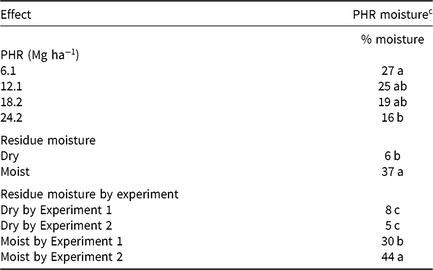
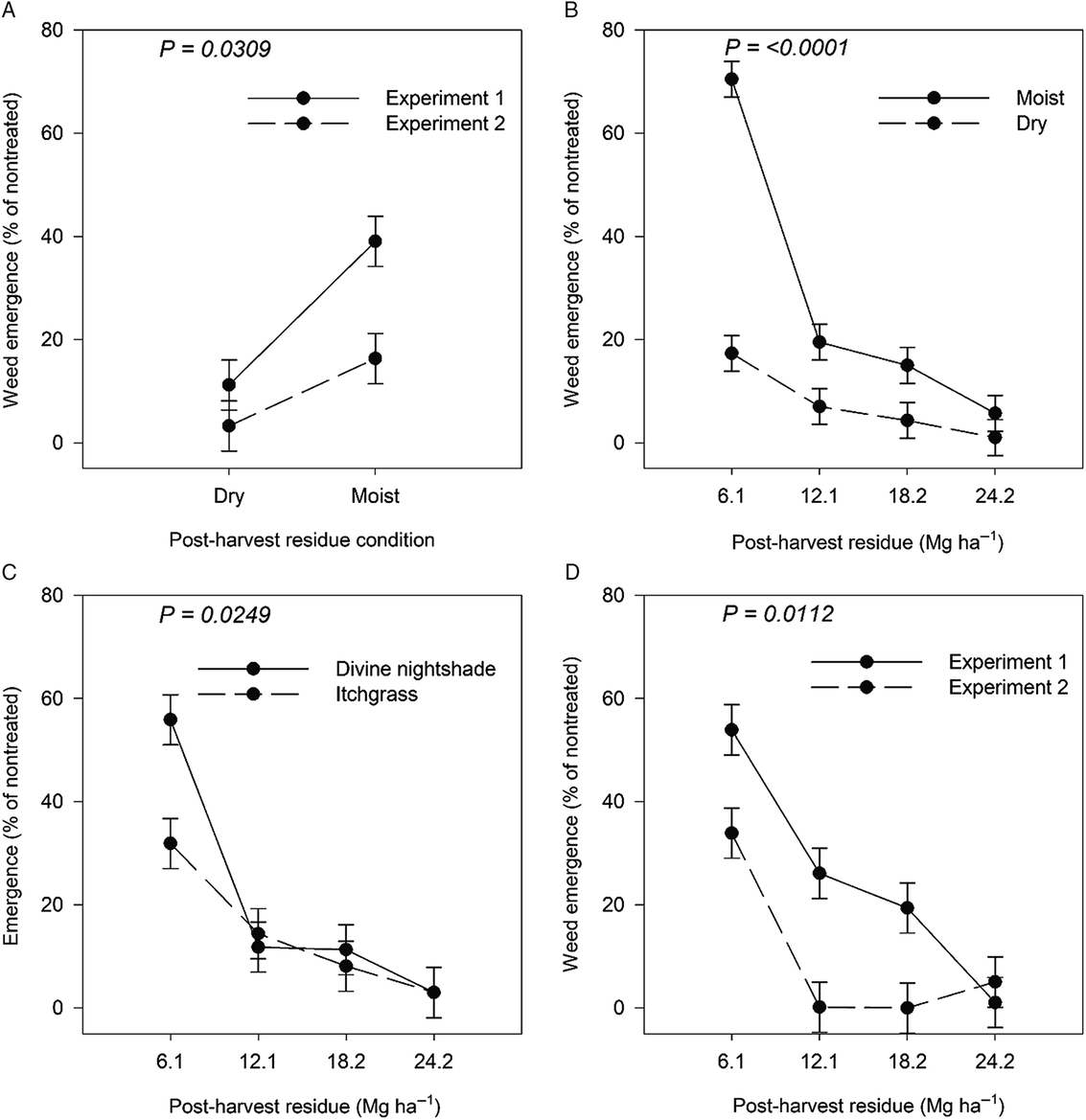
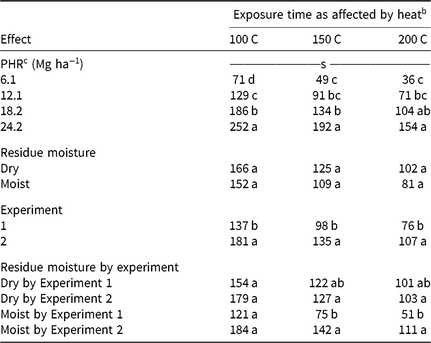
At time of burning, PHR moisture ranged from 5% to 8% and 30% to 44% for dry and moist treatments, respectively (Table 2). Solar irradiance from day 1 to day 4 after postharvest treatments were exposed to simulated rainfall was similar for both experiments (data not shown). However, maximum and minimum mean air temperatures during the 4-d period were 4.5 C greater for Experiment 1 when compared with Experiment 2. Ice crystals from cold nighttime temperatures formed within the moistened burlap sacks for Experiment 2 and delayed moisture evaporation before treatments were burned. The moisture content of residue exposed to simulated rainfall was 14% more in Experiment 2 than in Experiment 1; however, burning PHR with 44% moisture when wind speeds were lower (8.3 kph, Experiment 2) allowed the fire to continue and created a smoldering effect that reduced weed emergence by 23% when compared with burning PHR with 30% moisture during breezy (21.1 kph, Experiment 1) conditions (Tables 1 and 2; Figure 1A). The additional moisture in moist PHR treatments burned in Experiment 2 when compared with Experiment 1 did not influence weed seed exposure time to 100 C; however, at 150 and 200 C, the residue moisture by experiment interaction influenced exposure time. Reduced weed emergence occurred in Experiment 2 due to weather conditions. PHR with 44% moisture burned under calm wind conditions (Experiment 2) sustained 150 and 200 C temperatures 89 and 118% longer than PHR with 30% moisture burned under windy conditions (Experiment 1) (Tables 1–3).

a PHR, postharvest residue. A subsample of PHR from each treatment was collected and weighed before treatments were burned.
b The mean maximum and minimum daily air temperature from day 1 to day 4 after 11.3 L of water was applied to the moist treatment was 12.8 and −1.1 C and 8.3 and −5.6 C for Experiment 1 and Experiment 2, respectively.
c Means within a column that are followed by the same letter are not statistically different according to an adjusted Tukey’s test at α ≤ 0.05. Data were arcsine square-root transformed, and means were back-transformed for presentation.
Interaction of experiment by postharvest residue (PHR) condition (A), PHR condition by PHR density (B), weed species by PHR density (C), and experiment by PHR density (D) on cumulative divine nightshade and itchgrass emergence (% of nontreated) at 7 WAT (wks after treatment) following burning of 6.1, 12.1, 18.2, and 24.2 Mg ha−1 of dry and moistened postharvest sugarcane residue. Bars represent the SE values for four replicates.

Influence of burning 6.1, 12.1, 18.2, and 24.2 Mg ha−1 of postharvest sugarcane residue, residue moisture, and experimental run on mean exposure time (s) to 100, 150, and 200 C.a

a Temperature data were recorded from 0.5 cm above the soil surface.
b Means within a column that are followed by the same letter are not statistically different according to an adjusted Tukey’s test at α ≤ 0.05.
c PHR, postharvest residue.
The residue moisture by PHR interaction influenced weed emergence (Figure 1B). Seventy-one percent of divine nightshade and itchgrass seed survived when 6.1 Mg ha−1 of PHR was moistened and subsequently burned (Figure 1B). The moist 6.1 Mg ha−1 PHR treatment resulted in 53% more weed emergence when compared with 6.1 Mg ha−1 of dry PHR after burning (Figure 1B). Greater emergence can be attributed to more divine nightshade seed surviving the burn than itchgrass. Small densities of PHR (6.1 Mg ha−1) contributed to 54% to 68% seed mortality for divine nightshade and itchgrass, respectively, when seed was exposed to 200 C for 36 s (Table 3; Figure 1C). Under laboratory conditions, Spaunhorst and Orgeron (Reference Spaunhorst and Orgeron2019) reported 90% divine nightshade and itchgrass emergence reduction when seed were exposed to 200 C dry heat for 63 and 33 s, respectively. The discrepancy in seed mortality between this study and the laboratory study by Spaunhorst and Orgeron (Reference Spaunhorst and Orgeron2019) could be explained by cool soil-surface temperatures, which insulated divine nightshade fruits and itchgrass seed from lethal temperatures in the live-fire study. In a preharvest sugarcane burning experiment, Sandhu et al. (Reference Sandhu, Gilbert, Kingston, Subiros, Morgan, Rice, Baucum, Shine and Davis2013) reported soil temperatures at a 2-cm depth were 2.5 and 7.5 C warmer than non-burned sugarcane for muck and coarse-textured soils, respectively.
The experiment by PHR interaction showed divine nightshade and itchgrass emergence was reduced as PHR increased from 6.1 to 24.2 Mg ha−1 for Experiment 1, but no weeds emerged in the second experiment when PHR increased from 6.1 to 12.1 Mg ha−1 (Figure 1D). Similar variation in weed seed mortality between experimental run and straw residue level was reported by White and Boyd (Reference White and Boyd2016) in a live-fire experiment. The authors attributed the variation in weed seed mortality to insufficient quantities (<980 kg ha−1) of the straw needed to maintain the live-fire. Judice et al. (Reference Judice, Griffin, Etheredge and Jones2007) reported that burning postharvest sugarcane residue reduced winter annual weed ground cover 8% more than mechanical residue removal. In a different study, burning 100 g m−2 of crested wheatgrass [Agropyron cristatum (L.) Gaertn.] residue resulted in 85% or more Japanese brome (Bromus japonicus Houtt.), spotted knapweed (Centaurea stoebe L.), Russian knapweed [Rhaponticum repens (L.) Hidalgo], and leafy spurge (Euphorbia esula L.) seed mortality (Vermeire and Rinella Reference Vermeire and Rinella2009).
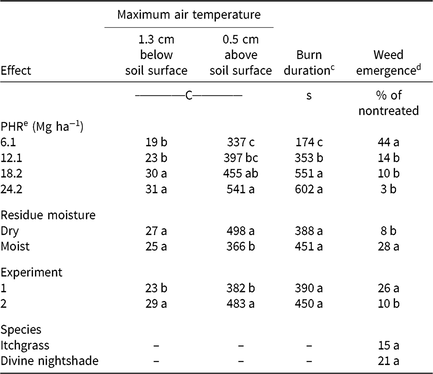
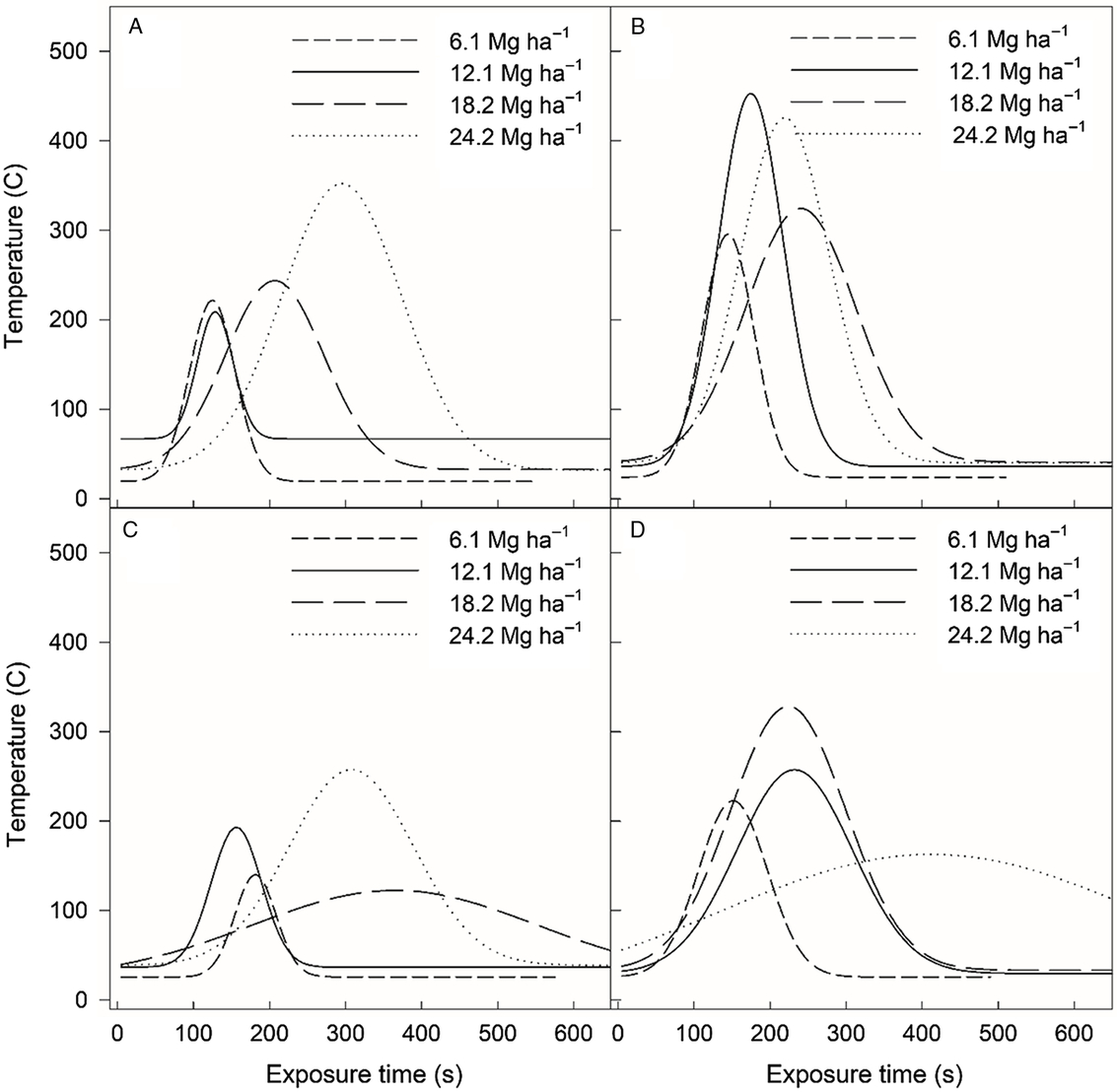
Average wind speeds in excess of 8.3 kph were not detected during Experiment 2, but occasionally 9.8 kph wind gusts were reported; however, the mean wind speed and highest recorded gust in Experiment 1 measured 21.1 and 24.2 kph, respectively (Table 1). The lower mean wind speed observed in Experiment 2, when compared with Experiment 1, likely resulted in the greater thermal temperatures recorded in Experiment 2, because fire conditions for combustion were more favorable. The 99 C cooler maximum temperature reported at 0.5 cm above the soil surface in Experiment 1 coincided with 16% more divine nightshade and itchgrass plants emerging when compared with Experiment 2 (Table 4). Walsh and Newman (Reference Walsh and Newman2007) reported air temperatures of 300 and 600 C at the soil surface when postharvest lupine (Lupinus angustifolius) residue was burned during 3 and 24 kph wind speeds, respectively; however, the authors did not report on the moisture content of burned lupine residue. In the same study, higher wind speed reduced the burn duration. Although conditions were windier in Experiment 1, greater wind speed did not result in a shorter burn duration (Table 4). The effect of burning dry and moistened postharvest sugarcane residue (6.1, 12.1, 18.2, and 24.2 Mg ha−1) on air temperature at 0.5 cm above the soil surface was modeled using the Gaussian function (Figure 2A–D). Parameter b in the model, which described the bell curve width, was 2-fold greater for 18.2 and 24.2 Mg ha−1 treatments, when compared with lower residue densities. The PHR moisture content failed to influence the burn duration; however, the density of PHR was a significant predictor. The burn duration increased 103% and 56% as the amount of PHR increased from 6.1 to 12.1 Mg ha−1 and 12.1 to 18.2 Mg ha−1, respectively (Table 4). RMSE values generally increased as greater amounts of PHR (6.1 to 24.2 Mg ha−1)were burned, indicating the model was slightly better at predicting the air temperature throughout the burn cycle with lower amounts of PHR (Figure 2A–D). Experimental observations indicated low wind speed or pieces of excessively moistened residue in heavy PHR treatments (≥18.2 Mg ha−1) caused fires to smolder, and upon ignition of dryer residue the flame was revived.
Effect of postharvest sugarcane residue density, residue moisture, experiment, and species on maximum temperature at 1.3 cm below and 0.5 cm above the soil surface, burn duration, and weed emergence.a, b

a The interaction plots for cumulative weed emergence data (% of nontreated) at 7 WAT (wks after treatment) can be found in Figure 1.
b Means within a column that are followed by the same letter are not statistically different according to an adjusted Tukey’s test at α ≤ 0.05.
c The burn was determined complete when the surface soil temperature measured 38 C.
d Weed emergence data for divine nightshade and itchgrass were calculated by converting the data to a percentage of the nontreated.
e PHR, postharvest residue.
Effect of burning dry (A, Experiment 1; B, Experiment 2) and moistened (C, Experiment 1; D, Experiment 2) postharvest sugarcane residue (6.1, 12.1, 18.2, and 24.2 Mg ha−1) on air temperature at 0.5 cm above the soil surface, modeled with the use of the Gaussian function  $y = {y_0} + a*ex{p^{\{ - 0.5[{{x - {x_0}} \over {b{]^2}}}\} }}$, where a is the asymptotic maximum temperature value, b is the coefficient controlling the width of the bell, x 0 is the position of the center of the peak, y 0 is the y-value offset, and x is exposure time. The root mean square error (RMSE) was calculated to assess the goodness of fit for the Gaussian function. Smaller RMSE values indicate predicted values are closer to observed values.
A. Experiment 1: dry PHR treatment
 $6.1\,{\rm{Mg\, ha}^{ - 1}};\,y = 19.4 + 202.4\,{\rm{*\, exp}}^{(-0.5(({x - 124.7)/{{30.1})^2)}}}$; RMSE = 59
- $12.1\,{\rm{Mg\, ha}^{ - 1}};\,y = 66.8 + 142.2\,{\rm{*\, exp}}^{(-0.5(({x - 128.4)/{{23.6})^2)}}}$; RMSE = 89
- $18.2\,{\rm{Mg\, ha}^{ - 1}};\,y = 32.8 + 211.0\,{\rm{*\, exp}}^{(-0.5(({x - 206.6)/{{64.6})^2)}}}$; RMSE = 85
- $24.2\,{\rm{Mg\, ha}^{ - 1}};\,y = 32.2 + 320.1\,{\rm{*\, exp}}^{(-0.5(({x - 294.8)/{{78.9})^2)}}}$; RMSE = 110
B. Experiment 2: dry PHR treatment
- $6.1\,{\rm{Mg\, ha}^{ - 1}};\,y = 24.0 + 271.7\,{\rm{*\, exp}}^{(-0.5(({x - 145.1)/{{33.9})^2)}}}$; RMSE = 73
- $12.1\,{\rm{Mg\, ha}^{ - 1}};\,y = 36.1 + 416.8\,{\rm{*\, exp}}^{(-0.5(({x - 174.8)/{{42.5})^2)}}}$; RMSE = 82
- $12.1\,{\rm{Mg\, ha}^{ - 1}};\,y = 36.1 + 416.8\,{\rm{*\, exp}}^{(-0.5(({x - 174.8)/{{42.5})^2)}}}$; RMSE = 91
- $24.2\,{\rm{Mg\, ha}^{ - 1}};\,y = 40.1 + 385.8\,{\rm{*\, exp}}^{(-0.5(({x - 219.6)/{{58.0})^2)}}}$; RMSE = 97
C. Experiment 1: moist PHR treatment
- $6.1\,{\rm{Mg\, ha}^{ - 1}};\,y = 25.8 + 114.3\,{\rm{*\, exp}}^{(-0.5(({x - 181.4)/{{27.1})^2)}}}$; RMSE = 30
- $12.1\,{\rm{Mg\, ha}^{ - 1}};\,y = 36.8 + 156.5\,{\rm{*\, exp}}^{(-0.5(({x - 156.4)/{{33.0})^2)}}}$; RMSE = 31
- $18.2\,{\rm{Mg\, ha}^{ - 1}};\,y = 24.5 + 98.0\,{\rm{*\, exp}}^{(-0.5(({x - 364.3)/{{186.6})^2)}}}$; RMSE = 88
- $24.2\,{\rm{Mg\, ha}^{ - 1}};\,y = 38.8 + 218.7\,{\rm{*\, exp}}^{(-0.5(({x - 307.5)/{{81.9})^2)}}}$; RMSE = 77
D. Experiment 2: moist PHR treatment
- $6.1\,{\rm{Mg\, ha}^{ - 1}};\,y = 25.8 + 196.9\,{\rm{*\, exp}}^{(-0.5(({x - 151.5)/{{45.3})^2)}}}$; RMSE = 80
- $12.1\,{\rm{Mg\, ha}^{ - 1}};\,y = 29.6 + 227.7\,{\rm{*\, exp}}^{(-0.5(({x - 232.4)/{{76.0})^2)}}}$; RMSE = 95
- $18.2\,{\rm{Mg\, ha}^{ - 1}};\,y = 33.3 + 294.9\,{\rm{*\, exp}}^{(-0.5(({x - 224.1)/{{75.8})^2)}}}$; RMSE = 100
- $24.2\,{\rm{Mg\, ha}^{ - 1}};\,y = 0.002 + 162.8\,{\rm{*\, exp}}^{(-0.5(({x - 411.9)/{{278.3})^2)}}}$; RMSE = 100


The PHR by species interaction influenced divine nightshade and itchgrass emergence. Burned plots with 6.1 Mg ha−1 of PHR resulted in 56% divine nightshade emergence, but only 32% of itchgrass emerged (Figure 1C). Divine nightshade emergence in fields with less than 12.1 Mg ha−1 of PHR suggested the fluid-filled berry insulated seeds long enough to survive exposure to lethal temperatures during the prescribed burn. The maximum temperature at 0.5 cm above the soil surface for 6.1 Mg ha−1 of PHR was 337 C, and the burn duration lasted 174 s (Table 4). However, seed exposed to 100, 150, and 200 C continuously failed to exceed 71, 49, and 36 s, respectively, of exposure time when 6.1 Mg ha−1 of PHR was burned (Table 3). Young et al. (Reference Young, Ogg and Dotray1990) reported temperatures ranged from 85 to 200 C near the soil surface when 14.5 Mg ha−1 of mixed wheat (Triticum aestivum L.) straw and jointed goatgrass (Aegilops cylindrica Host) residue was burned. Lower thermal temperatures near the soil surface reported by Young et al. (Reference Young, Ogg and Dotray1990), when compared with the present study, were likely due to 35- to 40-cm-tall wheat and jointed goatgrass stubble at the time of burn, which directed heat away from the soil surface.
Practical Implications
The current research illustrates 56% to 97% of divine nightshade and itchgrass seed is controlled with prescribed burning alone, considering PHR estimations following green-cane harvesting (Judice et al. Reference Judice, Griffin, Etheredge and Jones2007; Richard Reference Richard1999; Viator et al. Reference Viator, Johnson, Grimm and Richard2006). The fluid-filled and fleshy content that comprises divine nightshade fruit protected seed from short durations of high temperatures, but may not insulate seeds for long durations when exposed to a smoldering fire. The combination of high wind speeds plus moist PHR did not enhance the maximum burn temperature near the soil surface. Burning postharvest sugarcane residue from fields with poor stands, especially when PHR is abundantly wet or when water ponds in wheel furrows, will not produce temperatures lethal to divine nightshade and itchgrass seeds. During a live-burn, flames forced to move into the wind that encounter moistened PHR may extinguish, leaving unburned patches of PHR. PHR retention has been shown to negatively affect sugarcane yield the following season (Judice et al. Reference Judice, Griffin, Etheredge and Jones2007; Viator and Wang Reference Viator and Wang2011; Viator et al. Reference Viator, Johnson and Richard2005). Direct flaming has resulted in more consistent control of surface-deposited weed seed than burning PHR (White and Boyd Reference White and Boyd2016). Flaming can be used to manage weeds when soil is extremely moist and conditions are unsuitable for cultivation (Bond and Grundy Reference Bond and Grundy2001). To successfully implement direct flaming in a Louisiana sugarcane cropping system, PHR would need to be removed via burning or sweeping, ideally before sugarcane shoots reemerge following harvest. Failure to direct flame before sugarcane shoots reemerge introduces additional stress before the crop enters dormancy.
Prescribed burning, in addition to cultivation and PRE and POST herbicides, are integrated weed management tools that can be implemented to decrease the likelihood of weeds evolving resistance to herbicides. Sugarcane fields infested with paraquat-resistant goosegrass [Eleusine indica (L.) Gaertn.], black nightshade (Solanum nigrum L.), and wandering cudweed [Gamochaeta pensylvanica (Willd.) Cabrera] were documented in Australia, but no cases of weeds evolving resistance to herbicides have been reported in sugarcane cultivated in Louisiana to date (Heap Reference Heap2019). However, in many cropping systems, herbicide-resistant weeds have become widespread and require integrated approaches to achieve adequate control (DeVore et al. Reference DeVore, Norsworthy and Brye2012; Loux et al. Reference Loux, Dobbels, Bradley, Johnson, Young, Spaunhorst, Norsworthy, Palhano and Steckel2017; Owen Reference Owen2016; Wiggins et al. Reference Wiggins, McClure, Hayes and Steckel2015). Cultivating between sugarcane rows controls established weeds and incorporates fertilizer; however, the approximate 22-cm space to each side of the ratoon stool is relatively undisturbed from planting until crop destruction, with the exception of harvest, and is more susceptible to persistent weed infestations. Pendimethalin and trifluralin herbicides have been used extensively for PRE annual grass control, most notably itchgrass, in sugarcane cultivation (Millhollon Reference Millhollon1993). Metribuzin has resulted in suppression of bermudagrass [Cynodon dactylon (L.) Pers.] and seedling johnsongrass [Sorghum halepense (L.) Pers.], but failed to control solanaceous weeds (Perez and Masiunas Reference Perez and Masiunas1990; Richard Reference Richard1993, Reference Richard1998). The lack of divine nightshade control with the previously mentioned PRE herbicides is concerning, because metribuzin, pendimethalin, and trifluralin are applied one to three times each year for three to four continuous cropping seasons until yield decline justifies replanting. Moreover, the synthetic auxin herbicides 2,4-D and dicamba marginally injure 30- to 45-cm-tall divine nightshade plants, which can produce copious amounts of seed if not managed (Orgeron et al. Reference Orgeron, Schilling, Urbatsch, Ma and Spaunhorst2018; Spaunhorst and Orgeron Reference Spaunhorst and Orgeron2018).
In Louisiana, sugarcane must be harvested within the 100-d grinding season (October to January). Contacting the soil surface with harvesting equipment introduces the possibility for burial of surface-deposited weed seed below the soil surface. In the event PHR is burned, the thermal temperature 1.3 cm below the soil surface will not produce temperatures lethal to divine nightshade or itchgrass seed. A small percentage of ratoon sugarcane, if any, is treated with fall residual herbicides following PHR burning. Additional research is needed to determine whether burning and fall herbicide programs are complementary for reducing divine nightshade emergence in ratoon sugarcane fields.
Acknowledgments
The authors thank Eric Petrie, Norris Matherne, and Blake Landry for their technical assistance in conducting this research. This research was partially funded through the American Sugar Cane League of the USA, Inc., and a by a grant entitled “Biology and Management of Divine Nightshade in Louisiana Sugarcane Production” from the U.S. Department of Agriculture, Animal and Plant Health Inspection Service (USDA-APHIS-60-6052-8-001). USDA is an equal opportunity provider and employer. No conflicts of interest have been declared.