Introduction
National strategies aimed at reducing suicide rates have been developed in several European countries, including England (Department of Health, 2002) and Scotland (Scottish Executive, 2002). Self-harm is a strong predictor of suicide (Owens et al. Reference Owens, Horrocks and House2002; Hawton et al. Reference Hawton, Zahl and Weatherall2003) and was found to occur in 0.6% of self-harm patients within 6 months of an Emergency Department (ED) presentation (Cooper et al. Reference Cooper, Kapur, Webb, Lawlor, Guthrie, Mackway-Jones and Appleby2005). People who repeat self-harm have a twofold increase in the risk of suicide compared to those with a single episode (Zahl & Hawton, Reference Zahl and Hawton2004). It has been estimated that annually there are approximately 220 000 hospital presentations of self-harm to EDs in England (Hawton et al. Reference Hawton, Bergen, Casey, Simkin, Palmer, Cooper, Kapur, Horrocks, House, Lilley, Noble and Owens2007). Such high incidence places considerable pressure on mental health and other health-care services, but also provides an opportunity for suicide prevention (Kapur, Reference Kapur2009). Current guidance in the UK on the management of self-harm recommends that psychosocial assessment is carried out for each self-harm presentation (NICE, 2011). A key element of this involves assessment of the risks of further self-harm and suicide.
Predicting suicide is difficult because of the rarity of the event and risk factors that are associated with completed suicide co-occur commonly in people who self-harm (Kapur, Reference Kapur2006). Established clinical tools have been developed using data collected around 20 years ago and were not designed specifically for use in the ED (Patterson et al. Reference Patterson, Bird and Patterson1983; Kreitman & Foster, Reference Kreitman and Foster1991). The characteristics of people who repeat self-harm vary over time (Kreitman & Foster, Reference Kreitman and Foster1991; Cochrane-Brink et al. Reference Cochrane-Brink, Lofchy and Sakinofsky2000), highlighting the importance of updating clinical tools. It has been recognized that some of the more detailed scoring systems are not suitable for use in a busy ED setting (Hockberger & Rothstein, Reference Hockberger and Rothstein1988). McMillan et al. (Reference McMillan, Gilbody, Bereford and Neilly2007) assessed the ability of the Beck Hopelessness Scale (BHS) to predict self-harm and suicide. Application of the BHS resulted in more false positives than would be feasible for guiding decisions about where treatment aimed at reducing repetition should be directed. They did acknowledge, however, that a tool with a higher sensitivity could be used as a preliminary guide to help identify those who need a more intensive psychosocial assessment. Previously published clinical tools, used both in non-psychiatric medical specialties (Camp & Slattery, Reference Camp and Slattery2002; Wadsworth et al. Reference Wadsworth, Somers, Cazares, Malik, Adam, Stack, Wright and Semmes2004; Scheet et al. Reference Scheet, Zhang and Kolassa2009) and in psychiatry (Monahan et al. Reference Monahan, Steadman, Applebaum, Robbins, Mulvey, Silver, Roth and Grisso2000; Walters et al. Reference Walters, Bisson and Sheperd2007), have applied classification tree techniques to identify high-risk subgroups, helping to inform appropriate clinical management. These techniques are particularly well suited to clinical scenarios that require a high level of sensitivity, and to ED settings, where it is often the priority to rule out potentially life-threatening outcomes (Stiell & Wells, Reference Stiell and Wells1999). We derived a previous rule, the Manchester Self-Harm Rule (Cooper et al. Reference Cooper, Kapur, Dunning, Guthrie and Appleby2006), on information from presentations receiving psychosocial assessment, estimated to be just over two-thirds of all self-harm presentations (Hawton et al. Reference Hawton, Bergen, Casey, Simkin, Palmer, Cooper, Kapur, Horrocks, House, Lilley, Noble and Owens2007). The characteristics of presentations resulting in an assessment are known to differ from non-assessed episodes (Kapur et al. Reference Kapur, Murphy, Cooper, Bergen, Hawton, Simkin, Casey, Horrocks, Lilley, Noble and Owens2008; Lilley et al. Reference Lilley, Owens, Horrocks, House, Noble, Bergen, Hawton, Casey, Simkin, Murphy, Cooper and Kapur2008).
The aim of this study was to develop a clinical screening tool using self-harm data from three cities in England. We sought to develop a simple three- to five-element tool with high sensitivity (at least 95%) for predicting repetition of self-harm within 6 months, while identifying the maximum number of subsequent suicides. With data available for both assessed and non-assessed ED presentations from three centres, there was an opportunity to develop a new, multicentre clinical screening tool.
Method
Study design and setting
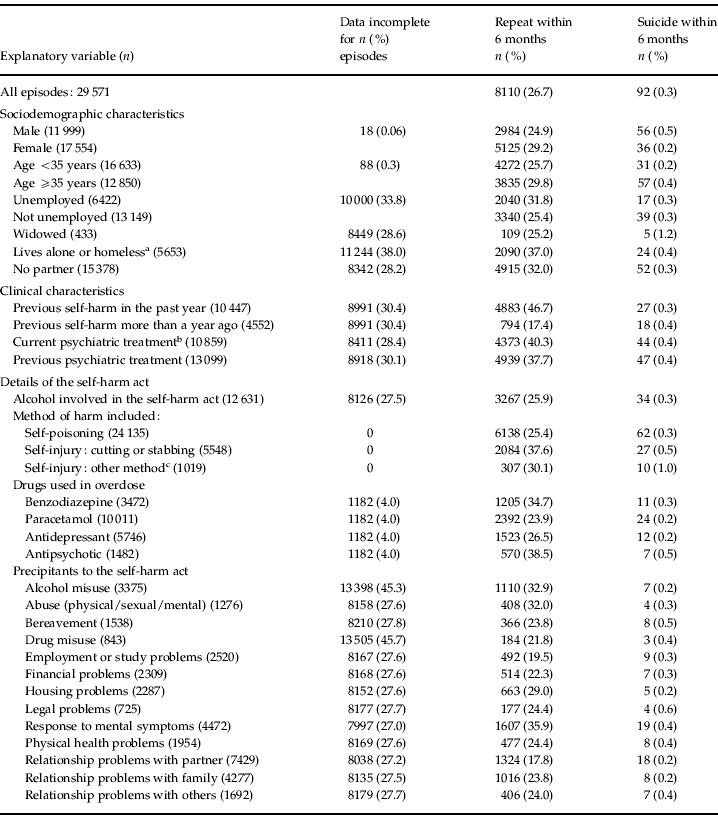
The study data were collected prospectively through the Multicentre Study of Self-Harm in England (Bergen et al. Reference Bergen, Hawton, Waters, Cooper and Kapur2010), a collaboration between three centres in Manchester, Oxford and Derby. Data were available for self-harm presentations to five EDs in total: three in Manchester and one each in Oxford and Derby. Each centre has an established monitoring system to collect data on episodes of self-harm presenting to EDs. Information was collected from psychosocial assessments carried out by psychiatric and/or ED staff. Data included sociodemographics, current and previous psychiatric treatment, precipitating problems preceding the self-harm act and details of the self-harm episode, such as method of harm (Table 1). Limited data were available from hospital records for non-assessed episodes. Although the method of data collection differed somewhat across the three centres, standardized definitions of self-harm are used (Hawton et al. Reference Hawton, Bergen, Casey, Simkin, Palmer, Cooper, Kapur, Horrocks, House, Lilley, Noble and Owens2007) and previous research using these multicentre data has indicated that they are effective at uncovering trends across the centres (Bergen et al. Reference Bergen, Hawton, Waters, Cooper and Kapur2010).
Descriptive analyses of the potential predictors examined

a ‘Homeless’ refers to instances where the individual was street homeless or staying in temporary hostel accommodation at the time of the self-harm episode.
b ‘Current psychiatric treatment’ includes general practitioner (GP), out-patient and in-patient treatment.
c ‘Other self-injury’ includes predominantly violent methods such as jumping from a height, hanging, traffic-related acts and drowning.
Data on analgesics other than paracetamol (and compounds) used in self-poisoning were not available because of differences in data recording between the three centres.
The City of Manchester is located in the north west of England and has a population of 464 000 (ONS, 2009a ). The city has a large student population (HESA, 2007) and a large proportion of adult residents are aged under 30 years compared to England overall (ONS, 2009a ). Manchester has high levels of unemployment (ONS, 2009b ) and is ranked fourth most deprived out of 354 local authority areas in England according to the Index of Multiple Deprivation (IMD; Department for Communities and Local Government, 2008). The proportion of residents from an ethnic group other than white is around double that for England as a whole (ONS, 2009e ). The City of Oxford, located in the south of England, has a population of 153 000 (ONS, 2009a ). A high proportion of working-age residents of Oxford are full-time students (HESA, 2007), with the proportion aged 15–24 years around twice that of the national level (ONS, 2009a ). Oxford has a slightly higher proportion of non-white residents than England overall (ONS, 2009f ). The unemployment rate is relatively low (ONS, 2009c ) and Oxford was ranked 155th in the IMD. Derby is a city in the East Midlands region of England, with a population of 239 000 (ONS, 2009a ). The proportion of non-white residents in Derby is comparable to the population nationally (ONS, 2009g ). Derby was ranked 69th in the IMD and has an unemployment rate slightly higher than the national rate (ONS, 2009d ).
Participants
Data included patient episodes presenting to the participating EDs between January 2003 and June 2007. Multiple episodes by the same individuals were included because, in an ED setting, each attendance is likely to be considered as an isolated case. Outcomes were monitored until the end of 2007 to allow all episodes a follow-up period of at least 6 months. Both assessed and non-assessed presentations, including those where the patient left hospital before assessment or refused treatment, were included. Episodes were excluded for patients aged <16 years at the time of harm because service configuration for this group differs from adult services.
Definitions of variables
Repetition was defined as any episode of self-harm that was followed by a repeat episode, or suicide, within 6 months. ‘Self-harm’ episodes included all acts of ‘intentional self-poisoning or self-injury, irrespective of motivation’ (Hawton et al. Reference Hawton, Bergen, Casey, Simkin, Palmer, Cooper, Kapur, Horrocks, House, Lilley, Noble and Owens2007). Repeat episodes of self-harm were identified from subsequent presentations to the study hospitals, with multiple episodes matched to individuals by the centrally allocated National Health Service (NHS) number (where available), or name and date of birth. Loss to follow-up may have occurred if an individual repeated self-harm but presented to an ED outside of the study area. However, recent audits have estimated the incidence of this to be minimal. Individuals who had self-harmed during the study period were matched to records held by the Medical Research Information Service (MRIS; NHS Information Centre, 2010). These records provided current information on the status of each patient, including information on mortality and coroners' verdicts, allowing the identification of deaths by suicide.
The International Classification of Diseases, tenth revision (ICD-10), was used to identify deaths by suicide (codes X60–X84) and undetermined cause (Y10–Y34, excluding Y33.9). These were combined as ‘suicides’ in this study, as has become customary practice in the UK (Adelstein & Mardon, Reference Adelstein and Mardon1975). This information was continuously updated until September 2010, allowing all episodes of self-harm a minimum follow-up period of 38 months. Episodes with no repeat self-harm presentations to any of the participating hospitals, or suicide, within 6 months were defined as ‘non-repeaters’.
Data analysis
Developing the clinical screening tool
The clinical screening tool was derived from a classification tree, grown using CART (Classification and Regression Trees) version 6.0 (Salford Systems, 2007), designed to identify high-risk subgroups and to explore how risk factors interact (Stiell & Wells, Reference Stiell and Wells1999). Factors relating to the self-harm episode or to the individual were examined as potential predictors of repetition of self-harm within the next 6 months. The classification tree was developed using binary recursive partitioning (Breiman et al. Reference Breiman, Friedman, Olshen and Stone1984) to split the data; it is recursive because once the optimal split is identified, a subgroup is partitioned off and the process repeats with the new set of data. Splits in the classification trees were generated using a technique known as the Gini splitting rule (Breiman et al. Reference Breiman, Friedman, Olshen and Stone1984). At each stage of the tree, mutually exclusive groups were classified as either low risk (non-repeaters) or high to moderate (hereafter referred to as ‘higher’) risk (repeaters). The results for this stage of the analysis are presented as a diagram showing the split in the data at each level.
A 3-to-1 weight was applied so that splits that correctly classified repeaters as higher risk were prioritized, enabling the tree to be grown with a high sensitivity and minimizing the misclassification of repeaters. Incomplete data were handled by ‘surrogate’ splitters (Twala, Reference Twala2009; Steinberg, Reference Steinberg2011); in some instances, cases within one of the binary risk categories determined by the primary splitter can be predicted by another variable. Where data are missing for the primary splitter, a variable that places a sufficiently high number of cases into the correct risk category can be used as a surrogate. Furthermore, because it can be easier to partition the data when there are a smaller number of records, variables are penalized according to the proportion of data that are missing, ensuring all predictor variables have an equal chance of being selected as splitters. Predictors with higher proportions of missing data are deferred further down the tree, until the proportion of complete data has increased.
The rule was derived using data from Manchester and Derby combined, and tested using data from Oxford. To begin with, the entire set of variables was entered into the model (Table 1). Factors that performed poorly were excluded and the analysis was repeated with the remaining set of predictors. ‘Poor’ performance meant that the predictor either (i) initially classified a large proportion of episodes as high risk, including many non-repeaters (reducing specificity), or (ii) performed weakly for correctly predicting suicide outcomes. This process was continued until the rule correctly predicted the greatest number of repetitions and misclassified as few suicides as possible, while also balancing the need for the correct classification of non-repeaters. The predictive ability of the rule was assessed using the following measures: sensitivity (the proportion of repetitions by persons that were initially identified as higher risk), specificity (the proportion of non-repetitions that were correctly classified as low risk), positive predictive value (the proportion classified as higher risk that went on to repeat), negative predictive value (the proportion classified as lower risk that did not repeat) and the total proportion classified as higher risk. Confidence intervals (CIs) for these proportions were calculated using the Wilson method (Altman et al. Reference Altman, Mackin, Byrant and Gardner2000). We also present values for the positive likelihood ratio (LR) (how many times less likely it is that non-repeats will be identified as low risk than those that repeat) and the negative LR (how many times more likely it is that repeat episodes will be identified as higher risk than those that do not repeat) (Deeks & Altman, Reference Deeks and Altman2004). A sensitivity analysis was performed to explore the effect of repeat presentations on the tool, first by selecting each individual's first presentation during the study period and second by curtailing the data at a maximum of 10 presentations for each individual.
Assessing independence using multivariate modelling
Univariate log binomial regression models were fitted using the statistical software package Stata version 10 (Stata Corporation, USA) to examine the effect of the predictor variables on 6-month repetition as a risk ratio (RR). Multivariate modelling was then carried out, using the predictors of the new rule. The purpose of this supplementary analysis was to enable exploration of the independence of each of the predictors and to provide an additional measure of the strength of the risk factors (Lemon et al. Reference Lemon, Roy, Clark, Friedmann and Rakowski2003).
Results
Descriptive statistics
In total there were 29 571 episodes of self-harm by 18 680 individuals aged ⩾16 years (range 16–97 years, median 32 years). Of these, 8110 episodes (27.4%) were followed by a repeat episode within 6 months, including 92 suicides. The proportion of suicides within 6 months of a hospital presentation of self-harm did not differ significantly between the three centres (p=0.6). However, the 6-month repetition was lower in Manchester, where 24.1% of patient episodes were repeated compared to 29.8% in Oxford and 31.2% in Derby (p<0.001).
The overall assessment rate (completed assessments/total number of episodes) for the period of study was 68.3%. The likelihood of receiving an assessment did not vary greatly by age or gender. Self-harm episodes involving cutting were significantly less likely (p<0.001) to receive an assessment (59.7% assessed versus 71.1% of self-poisonings and 69.2% of those involving other methods of self-injury). Individuals whose episodes did not receive an assessment were more likely to repeat (30.5% v. 26.0% that were assessed p<0.001) but there were no differences in the proportions completing suicide within 6 months (0.3% for both non-assessed and assessed).
Developing the clinical screening tool
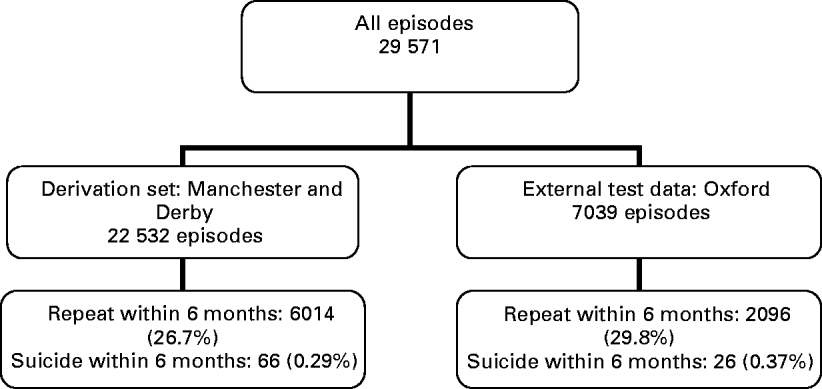
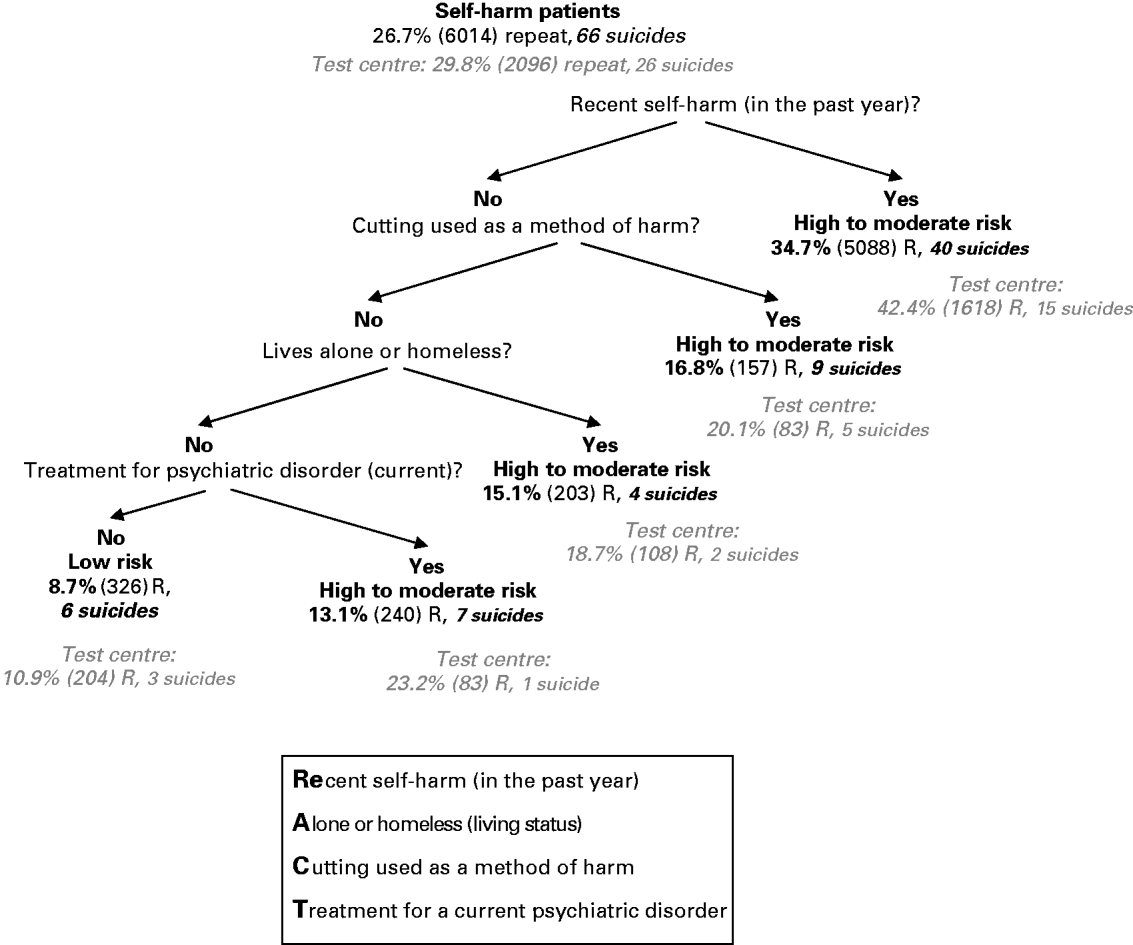
For the development of the clinical prediction tool, the data were split into two groups. A total of 22 532 episodes from the study hospitals in Manchester and Derby were used to derive the rule, and 7039 episodes from Oxford were used separately to test it (Fig. 1). Certain variables were removed during the analysis because their specificity was too low (age, gender, previous psychiatric treatment and any history of self-harm) or because they did not adequately predict suicide (unemployment). The optimal classification tree for the derivation data identified four predictors for repetition within 6 months: recent self-harm (in the past year, self-reported), living alone or homelessness (including street homeless and hostel accommodation), cutting as a method of harm (including stabbing/piercing), and treatment for a current psychiatric disorder [including general practitioner (GP) treatment]. This was summarized as the ReACT Self-Harm Rule (Fig. 2). The presence of one or more of these factors in the presenting episode classifies the patient as being at higher risk of further self-harm within 6 months.
Recruitment flowchart.

The ReACT Self-Harm Rule: repetition within 6 months – derivation dataset. There were 22 532 episodes of self-harm, 6014 repeaters (R) and 16 518 non-repeaters.

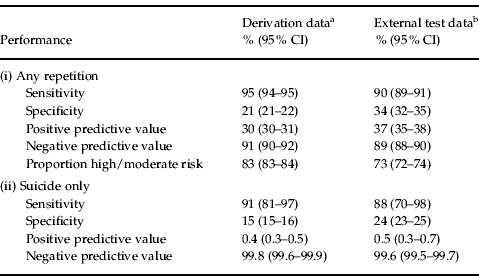
The new rule successfully predicted 95% (95% CI 94–95) of repeat episodes in the derivation sample (Table 2) and correctly classified 21% (95% CI 21–22) of the non-repeat episodes as low risk. When tested on the Oxford data, the rule performed with a lower sensitivity (p<0.001) of 90% (95% CI 89–91) and a specificity of 34% (95% CI 32–35). Within the derivation set, the rule performed with a positive LR of 1.20 (95% CI 1.18–1.21) and a negative LR of 0.26 (95% CI 0.23–0.29), with respective values of 1.36 (95% CI 1.33–1.40) and 0.29 (95% CI 0.25–0.33) in the test centre. In the derivation data there were 66 suicides within 6 months of the self-harm episode; 60 (91%) were predicted by the rule. In the test data, 23 out of the 26 (88%) suicides were predicted. The rule performed similarly in both genders (sensitivity 96% females versus 94% males). It also had similar levels of sensitivity for those aged <35 and ⩾35 years (96% for both), but more accurately discriminated those aged <35 years who were low risk (specificity 24% v. 17% ⩾35, p<0.001). Post-hoc analysis was carried out to see if the level of sensitivity in the test centre could be improved by allowing the tree to continue to split the data. A fifth predictor, self-harm in response to alcohol misuse, increased sensitivity (p<0.001) in the Oxford data to 94% (95% CI 93–95) and lowered the specificity to 25% (95% CI 24–26). Selecting the first presentation for each individual produced three of the predictors found in the ReACT Self-Harm Rule, the exception being self-cutting. When using a maximum of 10 episodes for each individual, the same four predictors as the ReACT Self-Harm Rule emerged.
Prediction performance of the ReACT Self-Harm Rule: (i) any repetition within 6 months; (ii) suicide within 6 months

CI, Confidence interval.
a Manchester and Derby.
b Oxford.
The ReACT Self-Harm Rule correctly identified as higher risk 83/92 suicides occurring within 6 months.
There were a total of nine self-harm episodes that were followed by suicide within 6 months and were not correctly identified by the rule. In all these cases self-poisoning was the only method of harm, with five involving paracetamol. The age of the patients ranged from 19 to 77 years, with five aged <35 years and five being male. Only one patient had ever received psychiatric treatment. There were six episodes resulting in a psychosocial assessment; of these, two received a psychiatric out-patient referral and the only clinical management outcome in the remaining four was a letter sent to the patient's GP.
Univariate and multivariate log-binomial modelling to estimate relative risk
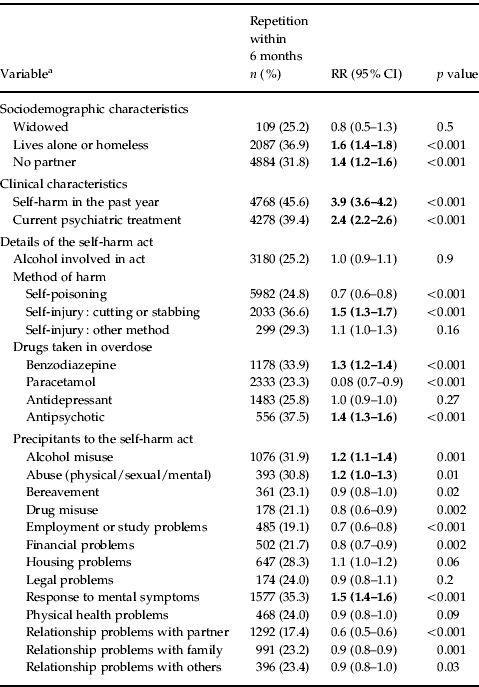
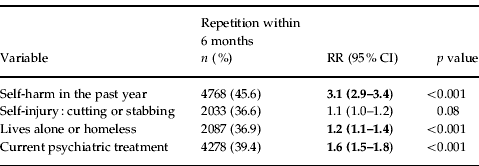
Univariate RRs for 6-month repetition of self-harm were initially estimated for each variable identified for inclusion in the new rule (Table 3). The four elements of the new rule were each found to be significant predictors of repetition: recent self-harm (in the past year) (RR 3.9, 95% CI 3.6–4.2, p<0.001), treatment for a current psychiatric disorder (RR 2.4, 95% CI 2.2–2.6, p<0.001), living alone or homelessness (RR 1.6, 95% CI 1.4–1.8, p<0.001) and cutting as a method of harm (RR 1.5, 95% CI 1.3–1.7, p<0.001). Several other factors were also found to be significant univariate predictors of repetition, including not having a partner, benzodiazepine taken in self-poisoning, antipsychotic taken in self-poisoning and self-harm in response to both abuse and mental symptoms. These results are also shown in Table 3. Multivariate models were then fitted to examine the relative risks of the four predictors emerging from the new rule (Table 4). Recent self-harm (in the past year), living alone or homelessness and treatment for a current psychiatric disorder were found to independently predict self-harm, with highly significant relative RRs. Cutting as a method of self-harm was not a significant predictor in the multivariable model (RR 1.1, 95% CI 1.0–1.2, p=0.08). Self-cutting was tested for association with the three remaining predictors and was found to be most associated with recent self-harm (in the past year).
Univariate log binomial regression: repetition within 6 months

RR, Risk ratio; CI, confidence interval.
Bold text denotes statistically significant RRs.
a Only variables selected for inclusion in the classification tree analysis were examined.
Multivariate log binomial regression: repetition within 6 months

RR, Risk ratio; CI, Confidence interval.
Bold text denotes statistically significant RRs.
Comparison with the Manchester Self-Harm Rule
A previous clinical prediction tool for self-harm, the Manchester Self-Harm Rule (Cooper et al. Reference Cooper, Kapur, Dunning, Guthrie and Appleby2006), was originally derived from assessed presentations only. The Manchester Self-Harm Rule consisted of four predictors: any history of self-harm, previous psychiatric treatment, benzodiazepine used in self-poisoning and current psychiatric treatment. We applied the Manchester Rule to the multicentre data, regardless of assessment status, to consider its performance. There were sufficient data for the rule to be applied for 24 779 out of 29 571 (84%) episodes, including 7606 (30.7%) followed by a repetition within 6 months. Where data on the presence or absence of the four questions were missing, a risk category could not be assigned. The Manchester Self-Harm Rule was 98% (95% CI 98–99) sensitive and 17% (95% CI 16–17) specific in the derivation centres, with a sensitivity of 97% (95% CI 96–98) and a specificity of 20% (95% CI 18–21) in the test centre. Sensitivity was high across all centres individually and specificity was significantly lower in Derby (11%, 95% CI 11–12). In total, application of the Manchester Rule resulted in 87% (95% CI 87–88) of episodes classified as higher risk. Where suicide occurred within 6 months, 65/76 were identified as higher risk by the Manchester Self-Harm Rule.
Discussion
Using contemporary prospective data from five EDs within three centres in England, we have developed a clinical screening tool based on information from all self-harm presentations to the study EDs. Thus we have identified four predictors of repetition or suicide within 6 months in this patient group: recent self-harm (in the past year), living alone or homelessness, cutting as a method of self-harm and treatment for a current psychiatric disorder. This was summarized as the ReACT Self-Harm Rule. The presence of one or more of these risk factors places the patient episode into the higher risk category, and in so doing correctly predicts at least nine out of 10 episodes where repeat self-harm, or suicide, will occur within 6 months.
Our previous clinical tool, the Manchester Self-Harm Rule (Cooper et al. Reference Cooper, Kapur, Dunning, Guthrie and Appleby2006), included ED self-harm attendances to a single centre, and was derived from presentations receiving psychosocial assessment. When we compared its performance to that of the ReACT Rule, we found that although the Manchester Rule performed with high sensitivity in the multicentre data, the ReACT Rule was better at identifying low risk. The inclusion of non-assessed episodes in the ReACT Self-Harm Rule has resulted in a rule that best reflects ED attendance and is therefore more likely to be applicable to actual practice (Gaddis, Reference Gaddis2006). Incomplete data resulting from the inclusion of non-assessed presentations may have resulted in bias in favour of assessed episodes. To minimize this, surrogate variables (Twala, Reference Twala2009; Steinberg, Reference Steinberg2011) were used to predict values where data were missing. The ReACT Self-Harm Rule performed with a lower sensitivity in the test centre, Oxford. The inclusion of alcohol problems precipitating self-harm as a risk factor was found to increase the sensitivity of the rule in the Oxford data. This indicates that certain predictors may reflect the characteristics of individual centres, suggesting that there is likely to be geographical variation in the performance of the rule. However, by testing the rule using the centre with the most dissimilar sociodemographic characteristics, we indicated that it was more likely to be generalizable to other areas (Muller & Möckel, Reference Muller and Möckel2008). Multiple repeat episodes for all individuals were included in the analysis as this reflected real-life clinical scenarios and helped to take account of the fluctuation of risk over time in individuals. This could potentially result in high volume repeaters being over-represented in the rule. A rule derived using each individual's first presentation produced three of the same predictors found in the ReACT Self-Harm Rule, the exception being self-cutting, whereas using a maximum of 10 episodes for each individual resulted in the same four predictors. Although this may reflect the higher repetition rate among those who self-cut, it indicates that this predictor is not over-represented by the relatively small number of high volume repeaters.
Living alone or homelessness (Cooper et al. Reference Cooper, Kapur, Webb, Lawlor, Guthrie, Mackway-Jones and Appleby2005; Haw et al. Reference Haw, Hawton and Casey2006) and cutting as a method of harm have previously been identified as risk factors for repetition of self-harm and suicide. The presence of self-cutting as a predictor in the ReACT Self-Harm Rule corroborates previous findings (Kapur et al. Reference Kapur, Cooper, King-Hele, Webb, Lawlor, Rodway and Appleby2006; Lilley et al. Reference Lilley, Owens, Horrocks, House, Noble, Bergen, Hawton, Casey, Simkin, Murphy, Cooper and Kapur2008) and may be an indication that this is an emerging risk factor. Multivariate analysis showed an independent association between self-cutting and previous self-harm in the past year. However, the classification tree predicted 14/92 suicides within 6 months among those who presented with self-cutting but had no history of self-harm in the previous year, suggesting that this method of harm may be an important predictor of suicide despite it not reaching significance as an independent predictor of repeat self-harm in the multivariable regression. The association between self-cutting and subsequent suicide has been demonstrated in previous research (Cooper et al. Reference Cooper, Kapur, Webb, Lawlor, Guthrie, Mackway-Jones and Appleby2005). We did not differentiate between types or medical severity of self-cutting, which is a potential limitation in our study. A recent Swedish study (Bilén et al. Reference Bilén, Ottosson, Castrén, Ponzer, Ursing, Ranta, Ekdahl and Pettersson2010) aimed to stratify ED self-harm patients according to risk of repetition. Two of the risk factors, current psychiatric treatment and self-cutting, correspond to those identified in the ReACT Self-Harm Rule, in addition to the broader ‘any previous self-harm’ variable, which was the subject of one of the four questions in our previous self-harm prediction tool, the Manchester Self-Harm Rule (Cooper et al. Reference Cooper, Kapur, Dunning, Guthrie and Appleby2006). Previous research reliably demonstrates a link between a history of self-harm and repetition (Kapur et al. Reference Kapur, Cooper, King-Hele, Webb, Lawlor, Rodway and Appleby2006; Beghi & Rosenbaum, Reference Beghi and Rosenbaum2010), with suicide rate at its highest in the 6-month period following the self-harm episode (Cooper et al. Reference Cooper, Kapur, Webb, Lawlor, Guthrie, Mackway-Jones and Appleby2005). The ReACT Rule highlights the importance of focusing on a relatively recent history of self-harm by including previous self-harm in the past year only, a more narrowly defined predictor than in the earlier rule. The presence of treatment for a current psychiatric disorder also appeared in both the Manchester Self-Harm Rule and the ReACT Rule, indicating that, although certain predictors persist, some risk factors may reflect changing patterns of behaviour over time. The use of benzodiazepines in the self-poisoning act formed part of the Manchester Self-Harm Rule but not the ReACT Rule. The RR for self-poisoning using benzodiazepines showed a significant association with repetition in this study, although the proportion using benzodiazepines had decreased compared to our earlier study. There is evidence that the prescribing of benzodiazepines is declining in the UK (NICE, 2004).
The ReACT Self-Harm Rule is intended to facilitate clinicians' decision making on the urgency and type of aftercare offered. We acknowledge that the ReACT Self-Harm Rule sacrifices a degree of specificity for improved sensitivity. We suggest that this may be suited to the ED setting, where the priority is to identify potentially life-threatening outcomes. It has been recognized (McMillan et al. Reference McMillan, Gilbody, Bereford and Neilly2007) that tools with high sensitivity but moderate/low specificity may be useful for the initial screening stage of the assessment process. It has also been suggested that tools for assessing self-harm risk should be integrated into the ED system rather than used in isolation (Randall et al. Reference Randall, Colman and Rowe2011). The decision on whether to carry out a psychosocial assessment should not be based on the results of the ReACT Self-Harm Rule. All self-harm patients presenting to EDs in England and Wales should receive a psychosocial assessment (NICE, 2011) and it is widely agreed that this is central to their clinical management (Royal College of Psychiatrists, 2004). The latest guidance on the use of clinical tools in the management of self-harm (NICE, 2011), suggests that tools may be used as a guide or adjunct to the wider assessment of risk and needs. They should not replace the assessment itself. The guidance recognizes that no risk assessment measure can be accurate enough to assume a patient assessed as low risk will not repeat self-harm or complete suicide. It may be appropriate, however, for some patients classed by the rule as low risk to be followed up for an assessment at a more convenient time and place, perhaps in the community, depending on available service provision. The care offered, however, should not be decided solely on the assessed risk of repetition, but on consideration of the whole psychosocial assessment, which is an essential means of identifying the needs of self-harm patients and is not limited to the assessment of risk (Kapur, Reference Kapur2006).
Considering the high prevalence of self-harm presentations to EDs, a tool that helps to rule out even a modest proportion of attendees as higher risk of repetition could identify a significant number of such patients. The ReACT Self-Harm Rule accurately identifies one in six self-harm episodes as being at low risk for repetition, a higher proportion than when the Manchester Self-Harm Rule was applied, so improving its practicability. It may be particularly useful to clinicians treating self-harm patients at an early stage of the hospital presentation, such as during triage, where most presentations will initially be assessed for their level of urgency (NICE, 2011). For example, the rule could assist in the streamlining of referrals and help to inform a graded response to subsequent management. Screening tools are not intended to identify appropriate specific treatments (McMillan et al. Reference McMillan, Gilbody, Bereford and Neilly2007) but could be used early on in the care pathway to help identify those with a more urgent need for a detailed assessment, which could then inform appropriate management. If those most likely to repeat can be identified by the ReACT Self-Harm Rule, these patients may then be prioritized for urgent psychosocial assessment. Furthermore, the four risk factors included in the ReACT Self-Harm Rule could be used as an adjunct to the more in-depth risk assessment to help inform management and guide risk formulation. A comparison between our previous rule, the Manchester Self-Harm Rule, and clinicians' assessment of risk (Cooper et al. Reference Cooper, Kapur and Mackway-Jones2007) suggested that use of the rule, when incorporated into assessments, could help to improve the accuracy of predicting 6-month repetition. An evaluation of previously published clinical rating scales for suicide risk concluded that such tools may be most suited to clinicians without psychiatric expertise, and most useful for aiding identification of high-risk patients in the ED (Cochrane-Brink et al. Reference Cochrane-Brink, Lofchy and Sakinofsky2000).
There were nine suicides that were not classed as higher risk by the rule, demonstrating the difficulty in predicting this outcome and possibly reflecting the impulsive nature of some of these deaths. Although it is important to appreciate the limitations of screening tools, they can provide an evidence base for the importance of certain risk factors. The ease with which the tool can be interpreted and applied by clinicians should be considered (Cochrane-Brink et al. Reference Cochrane-Brink, Lofchy and Sakinofsky2000). Reliable interpretation of the ReACT Self-Harm Rule depends to some extent on the information disclosed by the patient. However, the four elements of the rule are simple questions with dichotomous answers, some of which may be available from hospital records, and are appropriate for a triage consultation. The rule performed with high sensitivity in both genders and in older and younger age groups, although it more accurately identified low risk in those aged <35 years. The next challenge involves demonstrating further its external validity in other areas of the UK and in other countries, and evaluating the effect of implementing the tool in clinical practice (Stiell & Wells, Reference Stiell and Wells1999). Further research could also focus on the development of prediction tools for particular age and sex groups.
Acknowledgements
We thank the staff at each centre for data collection. The Department of Health funded the multicentre study on self-harm. N.K. is also supported by the Manchester Mental Health and Social Care NHS Trust. The views and opinions expressed in this paper do not necessarily reflect those of the Department of Health or the NHS. The Department of Health had no role in the design, collection, analysis, interpretation of data and the writing of this paper. N.K. is Chair of the National Institute for Health and Clinical Excellence (NICE) Guidelines Development Group for the new self-harm guidelines.
Declaration of Interest
None.