The second language (L2) acquisition of the contrast between the subjunctive and indicative moods has received quite a bit of attention relative to other structures in the Spanish language (e.g., Borgonovo, Bruhn de Garavito, & Prévost, 2005; Borgonovo & Prévost, Reference Borgonovo, Prévost, Beachley, Brown and Conlin2003, Reference Borgonovo and Prévost2005; Bruhn de Garavito, 1997; Iverson, Kempchinsky, & Rothman, Reference Iverson, Kempchinsky and Rothman2008; Lee, Reference Lee1987; Lee & Rodríguez, Reference Lee, Rodríguez, Glass and Pérez-Leroux1997; Quer, Reference Quer2001). Some of this research has emphasized production (Collentine, Reference Collentine1995; Lubbers Quesada, Reference Lubbers Quesada1998) or learners’ preferences for the subjunctive across specific linguistic contexts (Geeslin & Gudmestad, Reference Geeslin, Gudmestad, Bruhn de Garavito and Valenzuela2008; Gudmestad, Reference Gudmestad, Klee and Face2006), rather than learners’ interpretation of subjunctive or indicative forms. Likewise, most studies have tended to include the full range of contexts in which the subjunctive mood can occur, or a relatively broad subset of these contexts, rather than focusing on a single structure. Nevertheless, critical reviews of research on mood suggest that one must distinguish among contexts to fully understand the subjunctive (e.g., Collentine, Reference Collentine, Lafford and Salaberry2003), and recent research suggests that even the lexical trigger (i.e., the lexical item in the main clause that prompts subjunctive use in the dependent clause) is an important constraint on the use of the subjunctive mood (Gudmestad, Reference Gudmestad, Geeslin and Díaz-Campos2012). Thus, one of the primary goals of the current article is to incorporate these insights by focusing exclusively on subjunctive and indicative forms in a single type of structure: following an adverbial conjunction.
One characteristic of mood contrast following adverbial conjunctions is that verbs may be used in indicative or subjunctive forms, and the choice between the two is said to indicate whether or not an event has occurred yet. According to the popular college textbook ¿Qué te parece? (Lee, Young, Bransdorfer, & Wolf, Reference Lee, Young, Bransdorfer and Wolf2005), “The subjunctive is used following an adverbial conjunction when the event or situation referred to . . . has not yet taken place,” whereas “the indicative mood is used following expressions of time . . . if the event or situation referred to . . . already exists” (pp. 205–206). Despite the prescriptive rules presented in textbooks, however, in reality there is more variability in these contexts on the part of native speakers (NSs) of Spanish in a range of tasks. Specifically, NSs do not always use the subjunctive form, even when an event has not yet occurred.Footnote 1 For example, Blas Arroyo and Porcar Miralles (Reference Blas Arroyo and Porcar Miralles1997) reported that 7% of their participants completed the sentence Cuando tu (venir) . . . hablaremos seriamente del tema “When you (to arrive) . . . we will talk seriously about the topic” with the indicative rather than with the subjunctive. In fact, research on native Spanish has demonstrated variability with the subjunctive for a variety of contexts, in different speech communities, and across different adverbial triggers (Blas Arroyo & Porcar Miralles, Reference Blas Arroyo and Porcar Miralles1997; De la Puente-Schubeck, Reference De la Puente-Schubeck1992; Isabelli, Reference Isabelli2006; Murillo Medrano, Reference Murillo Medrano1999). Moreover, recent sociolinguistic research suggests that one factor related to variation across lexical items is linked to the frequency of use of that structure or the frequency of collocations of that structure with a given form (Bybee & Hopper, Reference Bybee and Hopper2001). In other words, NS variation on a variety of forms is linked to lexical frequency. By including our own NS baseline in the current study, we stand to contribute to this area of inquiry as well as to extend this line of research to L2 studies.
The type of sociolinguistic variation found in the use of subjunctive forms by NSs, known as Type II or horizontal variation (i.e., variation between two nativelike forms; Adamson & Regan, Reference Adamson and Regan1991; Rehner, Reference Rehner2002),Footnote 2 has been the object of study in a variety of L2s and for a range of grammatical structures (Bayley & Langman, Reference Bayley and Langman2004; Bayley & Preston, Reference Bayley and Preston1996; Geeslin, Reference Geeslin2003, Reference Geeslin2005, Reference Geeslin, Klee and Face2006; Geeslin & Gudmestad, Reference Geeslin, Gudmestad, Bruhn de Garavito and Valenzuela2008; Geeslin & Guijarro-Fuentes, Reference Geeslin and Guijarro-Fuentes2006; Gudmestad, Reference Gudmestad, Klee and Face2006, Reference Gudmestad2008; Mougeon & Dewaele, Reference Mougeon and Dewaele2004; Preston, Reference Preston, Swicrzbin, Morris, Anderson, Klee and Tarone2000; Regan, Reference Regan2004; Rehner, Mougeon, & Nadasdi, Reference Rehner, Mougeon and Nadasdi2003; Tarone, Reference Tarone2007). As a result of this research, it is known that learner language varies according to characteristics of the speaker, the interlocutor, the grammatical structure, and the context in which the interaction takes place, just as native speech would. This line of inquiry is important because it addresses the L2 acquisition of sociolinguistic competence (Bachman, Reference Bachman1990; Canale & Swain, Reference Canale and Swain1980) and recognizes that the acquisition of a L2 includes more than the accumulation of categorical grammatical rules. Research on L2 variation demonstrates that the ability to vary one’s speech according to the features of the discourse context is, in fact, an essential part of language use. Moreover, this line of research is consistent with several models of language use and development—such as prototype theory (e.g., Adamson, Reference Adamson2009; Goldberg, Reference Goldberg2006; Lakoff, Reference Lakoff1987; Taylor, Reference Taylor1989), connectionism (e.g., Bates & MacWhinney, Reference Bates, MacWhinney and MacWhinney1987, Reference Bates, MacWhinney, MacWhinney and Bates1989; MacWhinney, Reference MacWhinney, Robinson and Ellis2008), and complexity theory (e.g., Ellis & Larsen-Freeman, Reference Ellis and Larsen-Freeman2009; Larsen-Freeman, Reference Larsen-Freeman and Atkinson2011)—that seek to model how variation in the input is stored in developing mental grammars and used in language production. The current study joins a research strand on the acquisition of the subjunctive in variable contexts in L2 Spanish that has shown stages of acquisition for the use of the subjunctive as well as provided in-depth analyses of the effects of several different linguistic and individual factors on the use and selection of mood forms (e.g., Gudmestad, Reference Gudmestad2008, Reference Gudmestad, Geeslin and Díaz-Campos2012) but has not provided stages of development related to learner interpretation of mood contrast. Thus, the unique contribution of this article to L2 variationist research lies in the exclusive focus on mood contrast after adverbial conjunctions and the use of an interpretation task, rather than a production or preference task; the combination of these two characteristics allows us to propose stages of development for a previously unstudied area of L2 variation.
THE RESEARCH CONTEXT
As mentioned in the introduction, the current study connects several different areas of research. First, it is tied to our understanding of how the forms of the subjunctive contrast with indicative forms in a range of contexts, both those that are categorical and those that allow variation across speech contexts. Most recently, these accounts of variability include lexical frequency in the list of variables found to constrain native use of a given form. Second, our focus on the subjunctive in L2 Spanish adds to the extensive body of research on this structure, including the most recent work that accounts for variability in the NS target. These areas of research will be reviewed here prior to presenting the details of the current project, with particular focus paid to mood contrasts following adverbial conjunctions.
The Subjunctive in Native Spanish
As previously stated, it is generally accepted that, following adverbial conjunctions, the subjunctive is used to denote states and events that have not yet occurred, whereas forms in the indicative mood denote actions that are habitual or have already occurred (Blake, Reference Blake1985; Lee et al., Reference Lee, Young, Bransdorfer and Wolf2005; Montrul & Perpiñán, Reference Montrul and Perpiñán2011). This contrast is shown in examples (1) and (2).
(1) Cuando viene Marta, cenamos en el centro.
“When Marta comes, we eat dinner downtown.”
(2) Cuando venga Marta, cenaremos en el centro.
“When Marta comes, we will eat dinner downtown.”
In example (1), Marta’s visiting is depicted as a habitual occurrence, and, thus, the verb form (indicative) implies that she has visited previously and, likely, numerous times. In contrast, in (2), the subjunctive verb form that follows the adverbial conjunction leads to the interpretation that the event has not yet occurred—namely, that Marta has not yet arrived. Although there is often additional information (such as the use of periphrastic or morphological future forms in the main clause) in the context to corroborate the interpretation of these verb forms, NSs are said to be able to accurately interpret such forms without additional cues and, thus, L2 learners of Spanish must also acquire the ability to interpret such forms appropriately (e.g., Blake, Reference Blake1985; Lee et al., Reference Lee, Young, Bransdorfer and Wolf2005).
Despite the general agreement in college textbooks and formal grammars of the Spanish language, the L2 learner faces an additional challenge in that NS use and interpretation of these forms exhibit some variation. In other words, use and interpretation are not categorical but rather exhibit some sociolinguistic variation, and under some circumstances, some NSs might interpret example (1) as denoting an event that has not yet occurred. Whereas a full review of all that has been reported regarding mood use in native Spanish is beyond the scope of the current article, the review that follows provides a sense of what is known about how NSs of Spanish use the subjunctive forms across contexts and speech communities. We begin with four important studies conducted with NSs from Mexico, all of which indicate a certain degree of variability regarding mood. García and Terrell (Reference García, Terrell and Hagiwara1977) collected data in Mexico City via an instrument that contained 25 sentences with comment triggers (e.g., Es triste que “It’s sad that”) that prescriptively require the subjunctive. Overall, the authors found that use of the subjunctive was generally accepted, but participants changed the mood to indicative in 10 cases. Additionally, respondents demonstrated a preference for the indicative in the past (i.e., they preferred preterit forms in past-time contexts). This study served as one of the initial indicators that NSs demonstrate variable mood use and that the indicative is being extended to previously subjunctive contexts. In similar work, Blake (Reference Blake, Lantolf and Stone1981) elicited data from participants from Mexico City using a sentence-completion task. He noted the occurrence of variation in contexts of uncertainty and that, for example, the indicative was at times used following no creer “to not believe,” a prescriptively subjunctive context. Likewise, the participants of Bayerová’s study (Reference Bayerová1994) in Mexico City demonstrated variable mood use in spoken production in that adverbs of uncertainty (such as posiblemente “possibly”) co-occurred with 38 verbs in the indicative and 25 in the subjunctive (the prescriptive expectation). Also, similar to García and Terrell (Reference García, Terrell and Hagiwara1977), there was greater use of the indicative in past-time contexts. Finally, González Salinas (Reference González Salinas2003) examined subjunctive use in Monterrey, Mexico, in nominal, adjectival, and adverbial clauses in language elicited through a sociolinguistic interview and reported greater rates of use of subjunctive forms by females with professional degrees, in accordance with more prescriptive linguistic behavior. Taken together, these studies demonstrate that the use of subjunctive forms varies according to a range of linguistic and social factors.
Turning our attention specifically to studies that focused on mood use in adverbial clauses, four additional investigations merit attention. De la Puente-Schubeck (Reference De la Puente-Schubeck1992) analyzed 30 Spanish NSs in Albuquerque using an informal sociolinguistic interview and a sentence-completion task. According to the GoldVarb analysis, the category adverbial clause trigger was significant, as speakers favored the subjunctive in clauses with antes de que “before,” whereas hasta que “until,” después de que “after,” and cuando “when” disfavored the subjunctive.Footnote 3 Additionally, the informal interview disfavored the subjunctive mood, whereas the semiformal sentence-completion task favored it, indicating that use of the subjunctive correlates with higher formality. In fact, this decreased use of the subjunctive in adverbial clauses in New Mexican Spanish is consistent with later work found in Castellón, Spain (Blas Arroyo & Porcar Miralles, Reference Blas Arroyo and Porcar Miralles1997), and Costa Rica (Murillo Medrano, Reference Murillo Medrano1999). Blas Arroyo and Porcar Miralles (Reference Blas Arroyo and Porcar Miralles1997) analyzed adverbial clauses in Castellón via a sentence-completion task, noting that participants preferred the subjunctive with future contexts and that the future indicative was acceptable for participants in the acceptability task in such clauses. This reporting of the acceptability of the indicative in adverbial clauses for events that had not yet occurred is an important precursor to the present study.
Murillo Medrano (Reference Murillo Medrano1999) analyzed the speech of 46 Costa Rican speakers via dyadic conversations, formal interviews, and formal oral discourse. The investigator focused on mood use in adverbial clauses, noting greater rates of use of the subjunctive in clauses with nonspecific time reference, as opposed to clauses with specific time reference. More recently, Isabelli (Reference Isabelli2006) studied mood use in adverbial clauses in Reno, Nevada, finding a rate of about 90% subjunctive use in so-called obligatory contexts for first-, second-, and third-generation Mexican Americans. Once again, the fact that adverbial clauses denoting information that had not yet occurred did not categorically co-occur with the subjunctive is consistent with the previous studies reported across tasks and Spanish-speaking communities. In sum, these studies confirm the general finding reported earlier that subjunctive use is variable and, furthermore, that this variability does occur within adverbial clauses. What has not been investigated extensively is the degree to which individual factors, such as geographic origin, social class, age, gender, and the like, impact variation with the subjunctive. For example, there is a lack of comparative data across geographic regions, and this makes it impossible at present to know whether certain regions are more likely to allow greater variability after adverbial conjunctions than others.
The Acquisition of the Subjunctive in L2 Spanish
We turn now to research on the L2 acquisition of the subjunctive, noting that, just as our knowledge of the variability of subjunctive use among NSs has grown, so too has the degree to which such variability has been incorporated into L2 research. One of the most prolific researchers on the L2 acquisition of the subjunctive in Spanish is Collentine, whose 1995 study was the first to analyze nonnative acquisition of the Spanish subjunctive in terms of both semantic and morphological features. He concluded that intermediate learners were able to generate a high number of nouns-over-verbs in each clause but also demonstrated use of simplified or insufficiently complex clauses. These findings were consistent with earlier work, such as that of Terrell, Baycroft, and Perrone (Reference Terrell, Baycroft, Perrone, VanPatten, Dvorak and Lee1987), who found that learners were not capable of producing the complex structures necessary for subjunctive use. Building on his earlier study, Collentine (Reference Collentine1997) focused on whether the use and interpretation of the subjunctive mood was affected by the regularity of the verb form itself. He found that learners paid greater attention to irregular forms, which in turn interfered with correctly interpreting sentence meaning. Although discussion of more recent studies will demonstrate some methodological improvements that have been made since Collentine’s early studies, the findings that morphological regularity and verb semantics are important factors in subjunctive use and acquisition continue to prove accurate.
Lubbers Quesada (Reference Lubbers Quesada1998) described the Spanish subjunctive in terms of the prototype schema used by NSs and nonnative speakers (NNSs). Her participants were 16 intermediate university learners studying abroad in Querétaro, Mexico. Two sets of oral interviews were conducted—one soon after the students’ arrival and the other 6 weeks later. She noted that, in the first NNS interview, subjunctive marking was quite low (7.5%) and only occurred following cuando “when” and querer que “to want that.” In the second interview, subjunctive use increased to 43% and to a larger range of contexts. Overall, learners (unlike those of Collentine, Reference Collentine1995) were indeed capable of producing complex syntax, and the prototype schema for subjunctive use for these learners was described as [+future], [+desire], and [+irregular]. This schema illustrates a reliance on syntactic, morphological, and semantic features, unlike the NS schema, which does not include verb regularity and instead includes a pragmatic basis, built on whether a speaker chooses to assert information. Lubbers Quesada’s study was an important first step in attempting to see what motivates learners’ selection of the subjunctive, and her consultation of NSs in determining whether or not certain situations enabled subjunctive use was a positive innovation; however, the view of mood selection as correct or incorrect and the limited number of NS participants with which to compare the learners are methodological limitations.
Most recently, a series of studies has examined the acquisition of the subjunctive mood in L2 Spanish while, at the same time, integrating the variability inherent in NS use into the research design. The first of these studies was that of Gudmestad (Reference Gudmestad, Klee and Face2006), whose results showed that, in a preference task, advanced learners selected the subjunctive significantly more frequently than their intermediate counterparts. In the analysis of the linguistic factors that predicted selection of the subjunctive, it was revealed that, at the intermediate level, only the regularity of the verb form was statistically significant, whereas all linguistic features were significant for the advanced group. Despite the many methodological improvements over previous studies, Gudmestad (Reference Gudmestad, Klee and Face2006) does not show whether these results generalize to production tasks.
Geeslin and Gudmestad (Reference Geeslin, Gudmestad, Bruhn de Garavito and Valenzuela2008) analyzed mood contrasts in native and L2 Spanish using two different elicitation tasks (a written contextualized task [WCT] and a sociolinguistic interview). Their participants were 10 NSs from various Spanish-speaking countries and 10 highly advanced NNSs. This is the first study of mood contrast in variable contexts that included NSs among its participants, and, thus, the authors were able to compare NNS subjunctive use directly with that of NSs. There was a significant difference in the frequency of subjunctive selection and use between the two groups on both tasks, as the NSs used or selected the subjunctive more than the NNSs. Likewise, there was a significant difference across tasks for both groups in that all participants chose the subjunctive significantly more frequently on the WCT than they produced it in the interview. The predictive models showed that, for the WCT, semantic category and futurity were significant predictors of subjunctive selection for both groups; additionally, age, gender, proficiency, and study abroad location were significant for the NNSs. On the interview task, semantic category and verb morphology were significant for both groups; futurity, age, proficiency, and country of origin were significant for the NSs, whereas proficiency and study abroad location were significant for the NNSs. On the basis of these findings, the authors concluded that task was a greater source of variability than speaker group.
In a recent, large-scale developmental study conducted using a variationist framework, Gudmestad (Reference Gudmestad, Geeslin and Díaz-Campos2012) analyzed data from 20 NSs and 130 L2 learners of Spanish at five proficiency levels collected through three oral elicitation tasks. Her results demonstrated a nearly linear increase in rates of use of the subjunctive, beginning at 4.1% for the lowest level and rising to 53.8% at the highest level (which was not significantly different from the 52.7% of the NS group). The predictors of use of the subjunctive included only task type at the lowest level and then included semantic category at Level 2, time reference and hypotheticality for Level 3, and, finally, form regularity for Levels 4 and 5 (which matches the NS model). Gudmestad (Reference Gudmestad, Geeslin and Díaz-Campos2012) showed development in three ways: the gradual increase in frequency of use of the subjunctive, the gradual integration of additional nativelike constraints on use into the model, and the increase in the predictive power of these models, which demonstrated a decrease in individual variation as proficiency increased. This research is quite relevant for the current study because it showed the early importance of the semantic category for use of the subjunctive. Moreover, it provides a model of how developmental stages may be identified using response frequencies and linguistic and extralinguistic constraints on these responses, rather than accuracy rates.
Although research on the L2 acquisition of subjunctive mood in contexts in which NS use is variable remains somewhat limited, this body of work is important to the development of several theories of how NS grammars allow such variation. For example, prototype theory (see Adamson, Reference Adamson2009, for a detailed description in the L2 context), states that acquisition involves the development of prototypes that reflect patterns of frequency of use and contain details of the contexts in which a given form is most likely to occur. These contexts can be described in terms of the linguistic constraints described in the research on the L2 subjunctive previously cited. Likewise, connectionism (Bates & MacWhinney, Reference Bates, MacWhinney and MacWhinney1987; Ellis, Reference Ellis, Doughty and Long2003; MacWhinney, Reference MacWhinney, Robinson and Ellis2008) and, more recently, complexity theory (Ellis & Larsen-Freeman, Reference Ellis and Larsen-Freeman2009; Larsen-Freeman, Reference Larsen-Freeman and Atkinson2011) provide detailed accounts of how information in the input—including social information, information regarding frequency of collocations, and linguistic features of contexts of use—can influence developing grammars. Furthermore, these accounts advocate for a model that views grammars as continually evolving according to patterns in the input, even for adult NSs. Following any of these models, our knowledge of acquisition rests on our ability to identify and understand all of the features in the input (e.g., linguistic, discursive, social) that influence language use. The purpose of the current article is not to advocate on behalf of one particular model but rather to provide evidence of the NS variability that exists as well as of how learner grammars change in variable contexts as proficiency increases. In so doing, we demonstrate the need for a model that can account for these patterns and, in this way, contribute directly to theory building for native and L2 grammars.Footnote 4
L2 Spanish Interpretation Studies
Relative to the quantity of research available on production of the subjunctive in L2 Spanish, there are few studies that consider the interpretation of subjunctive forms. Even the studies previously cited that include written preference instruments seek to understand the form that a speaker might choose at the moment of production, rather than to explore the impact of a given form on the interpretation of an utterance, most especially when that interpretation is variable among NSs. This emphasis on production studies at the expense of interpretation studies has been identified as a general weakness in SLA literature (Bardovi-Harlig, Reference Bardovi-Harlig1999) and, thus, is not an isolated issue for mood distinction. The studies that do address interpretation are reviewed here briefly prior to summarizing the goals for the current study. Working in a generative framework, Bruhn de Garavito (Reference Bruhn de Garavito1993) tested whether advanced learners of Spanish observed restrictions of coreferentiality—namely, that the subject of the main clause cannot also be the subject of the subordinate clause in sentences such as Juan quiere que prepare la cena “Juan wants him to prepare dinner.” She found that some participants accepted coreference, with Juan as the subject of the subordinate clause, indicating that they did not have the morphological knowledge necessary to determine a verb’s mood. In contrast, some learners did reject coreference for such sentences, indicating that advanced learners can eventually process complex syntax in a nativelike way.
Subsequent investigations of mood distinction have also considered the syntax-semantics interface in L2 acquisition and, more specifically, have demonstrated that advanced learners can indeed acquire target representations, even when such interpretations were not present in the input (e.g., Borgonovo et al., Reference Borgonovo, Bruhn de Garavito, Prévost, Burgos, Clark-Cotton and Ha2005). These have included different syntactic contexts, such as following negation and in relative clause contexts (e.g., Borgonovo et al., Reference Borgonovo, Bruhn de Garavito, Prévost, Burgos, Clark-Cotton and Ha2005; Borgonovo & Prévost, Reference Borgonovo, Prévost, Beachley, Brown and Conlin2003, Reference Borgonovo and Prévost2005; Bruhn de Garavito, Reference Bruhn de Garavito, Pérez-Leroux and Glass1997). For example, Iverson et al. (Reference Iverson, Kempchinsky and Rothman2008) demonstrated that English-speaking learners of Spanish were able to interpret the subjunctive in relative clauses similarly to NSs in volitional and negated epistemic clauses (e.g., No creo que “I don’t think” + subordinate clause). They found that interface vulnerability was easiest to overcome when specific lexical items (e.g., volitional verbs) triggered the subjunctive. Although these studies do not seek to address contexts in which NSs may demonstrate variability, the findings regarding the effect of particular lexical items are germane to the goals of the present investigation.
Another strand of research has focused on the comprehension and input processing of subjunctive forms in L2 Spanish (Lee, Reference Lee1987; Lee & Rodríguez, Reference Lee, Rodríguez, Glass and Pérez-Leroux1997). Lee (Reference Lee1987) provided empirical evidence of the subjunctive’s low communicative value by demonstrating that learners who had not previously encountered the form showed no significant differences in their comprehension of a passage that contained the subjunctive as compared to learners who had received instruction on the target form. Similarly, Lee and Rodríguez (Reference Lee, Rodríguez, Glass and Pérez-Leroux1997) found that passages containing subjunctive forms were no more difficult to comprehend than those that did not. However, they did argue that subjunctive forms became intake less frequently than indicative forms, meaning that the inclusion of the subjunctive did not interfere with the global meaning of the passage, but it often did not enter into the learners’ intake either. Thus, studies of this type have shown that learners can comprehend utterances that contain subjunctive forms even at lower proficiency levels. Nevertheless, the examples in these studies were not created to test learner interpretation in contexts in which the subjunctive form itself contributed to overall meaning. Thus, they were more likely to contain nominal, rather than adverbial, clauses in their test items.
Finally, Quer (2001) argued that the subjunctive serves as a cue that the interlocutor must adapt his interpretation of an embedded event or state to some alternative model (rather than the default model), inferable from discourse context. He focused on adverbial clauses and reasoned that, despite the subjunctive’s low communicative value, the form played a key role in connoting interlocutors’ cognitive models of the propositional content presented to them—namely, that it indicates whether or not an action has already occurred.
Taking these studies together, we find evidence that the subjunctive forms are less perceptually salient than those associated with other tenses and aspects (e.g., the preterit), that the presence of a subjunctive form at lower proficiency levels has little effect on overall comprehension of a reading passage, and that those contexts that involve semantic and pragmatic (or so-called interface) features are more difficult to acquire. Thus, research on interpretation of subjunctive forms, in both categorical and variable contexts, will benefit from these insights. The current study seeks to expand this body of research by examining in greater depth the role that subjunctive and indicative forms play in variable adverbial contexts.
Summary and Goals for the Present Study
The preceding review has demonstrated a contrast in the L2 variationist literature between the growing interest in the L2 acquisition of the subjunctive in Spanish and the lack of research on the interpretation of this form in variable contexts. Thus, the primary goal of the current study is to begin to address this gap by exploring a context in which the verb form (i.e., subjunctive vs. indicative mood) is thought to contribute in important ways to the interpretation of the utterance. More specifically, although prescriptive accounts may attribute a categorical interpretation for each form in the postadverbial contexts under investigation, in which the subjunctive always means an event has not yet occurred and the indicative forms always mean the event is habitual, sociolinguistic research suggests that this is not the case. Thus, our project also contributes more generally to the growing body of research on the acquisition of L2 variation and demonstrates how an analysis of rates and predictors of use can enhance our understanding of how L2s develop. As stated previously, this line of investigation stands to contribute to several existing and developing theories about how individual speakers—both native and nonnative—acquire, store, and produce language that varies across speech contexts. Furthermore, because we seek to identify the stages of acquisition for interpretation of the subjunctive forms in these contexts, our research provides important knowledge about the path along which learner grammars develop. A final goal of this article is to begin the exploration of a single syntactic-semantic context, given that the literature on the L2 acquisition of the subjunctive to date suggests that semantic category and perhaps even individual lexical items are important predictors of use of the subjunctive forms and, thus, are likely to play a role in the interpretation of these forms as well. In the remainder of this article, we describe in detail the empirical study designed to meet these goals, followed by the results of our analysis and a discussion of the implications of these findings.
THE CURRENT STUDY
As mentioned in the preceding review, the current study was designed to investigate the interpretation of mood in contexts that contained the adverbs cuando “when,” después de que “after,” and hasta que “until.” These adverbs were selected because they have been shown to allow variation in research on NS mood expression and because, prescriptively, they allow mood contrast to indicate event interpretation. The study was guided by the following research questions:
1. Do NNSs interpret clauses in the indicative as habitual and clauses in the subjunctive as having not yet occurred? How do their interpretations change across levels of proficiency? How do their interpretations compare with those of NSs?
2. What linguistic and extralinguistic factors predict NNS mood interpretation? Do the factors change across proficiency levels? Do the same factors predict NS mood interpretation?
Participants
The participants (N = 97) in the current study included NNSs enrolled in three different levels of instruction in Spanish at a large Midwestern university and a group of NSs of Spanish from a variety of countries of origin. The first NNS group consisted of 29 English-speaking learners of Spanish enrolled in a fifth-semester language course. The average age of this group was 19.0 years. The fifth semester was chosen because, in the university’s curriculum, the relationship between adverbs and mood selection is not presented until the fourth semester; thus the students at this level had been exposed to this relationship and were enrolled in the subsequent grammar course. All 29 of the NNSs at this level reported on the language background questionnaire (described in the next subsection) that they had completed the fourth-semester course at the university. The second participant group included 35 English-speaking learners of Spanish enrolled in a 400-level linguistics course. The average age of these participants was 20.4 years. The third and final NNS group was made up of 17 NSs of English who were graduate students in the department of Spanish and Portuguese at the same university and who, in addition to teaching Spanish courses, had also lived or studied abroad for long periods of time. The participants in this group averaged 25.8 years in age and distinguished themselves from the lower two groups in the extent of their experience abroad. Participants from this group had spent time in Spain, Argentina, Mexico, Puerto Rico, Nicaragua, Chile, Guatemala, and Paraguay. Their time abroad ranged from 6 weeks to 3 years (M = 13.6 months). They had studied Spanish formally for a period ranging from 6 to 14 years (M = 11.5 years). The rationale for including such an advanced group in the current study is to be able to determine whether the most advanced learners, those with many years of study and extensive experience abroad, are able to overcome the challenges associated with the interpretation of the subjunctive mentioned in the preceding review.
The final participant group included 16 NSs of Spanish, whose average age was 32.6 years. Seven of the speakers were between the ages of 22 and 29, whereas the other 9 were at least 30 years of age. These speakers came from a variety of countries of origin and had all lived in the United States for at least 1 year. The nations of origin of these participants include Mexico (n = 4), Puerto Rico (n = 4), Venezuela (n = 2), Spain (n = 2), Argentina (n = 2), and Colombia (n = 2). The reason for selecting speakers from various dialectical backgrounds is that the highest proficiency group had also lived in a variety of Spanish-speaking regions, and all three NNS groups had received formal instruction from a diverse group of native and nonnative instructors. Additionally, all but one of the NS participants taught Spanish at the university (the one who did not teach Spanish was a graduate student at the university and had a similar formal educational background to the other NSs). Because the grammatical structure examined in the current study is variable, the NS responses serve as a basis for comparison without requiring the evaluation of accuracy that would be employed if no such variation were demonstrated in NS interpretation of the subjunctive mood. Furthermore, it has been argued extensively that bilingualism, rather than monolingualism, is a reasonable target for L2 learners (Cook, Reference Cook and Han2008; Ortega, Reference Ortega2010) and also that, for language learners with multiple points of contact (e.g., study in several geographic locations, friends and instructors from multiple points of origin), the arbitrary selection of monolinguals from a single geographic point of origin does not produce a meaningful comparison group (Cook, Reference Cook and Han2008; Geeslin, Reference Geeslin2003).
Data Collection
In the current study, each participant completed three activities. Participants spent approximately 5 min on the language background questionnaire, 15 min on the proficiency exam, and 20–25 min on the mood interpretation task. Each of these tasks is described here in greater detail.
Language Background Questionnaire
Participants first completed a language background questionnaire that included questions about the language(s) spoken at home, language instruction experience, time spent abroad, and other facts about their personal and language-learning histories. The instrument completed by the NNSs was written in English. The questionnaire completed by the NSs was adapted to target the same personal data but to request information about participants’ L2 knowledge (in this case English) rather than study of Spanish. This instrument also differed in that it was written in Spanish.
Language Proficiency Exam
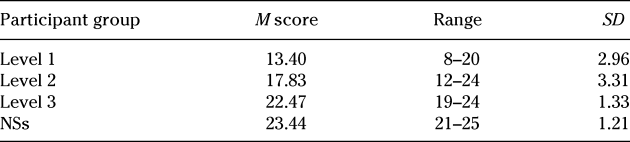
The language proficiency exam was an independent measure to gauge nonnative proficiency and to confirm the groupings based on the level of enrollment described previously. The exam contained 25 multiple-choice grammatical items in a contextualized story. These discrete-point items correspond to many of the formal properties of Spanish typically included in the language classroom. This instrument was relatively difficult for the lowest proficiency group, and it was also able to distinguish between the other two more advanced NNS groups. Moreover, despite the focus on formal properties of the grammar, some variation among the NSs was also exhibited on this instrument. The results for each participant group are included here to demonstrate that the participant groups were indeed qualitatively different from one another in terms of their level of knowledge of the Spanish language (Table 1). One further notes that the range of scores is lower for the higher proficiency group and that the standard deviation is smaller.
Summary of the results for all participant groups on the proficiency test

A one-way between-subjects ANOVA was run to determine whether there were significant differences among the participant groups according to their proficiency scores. There was a statistically significant difference between groups, F(3, 93) = 79.7, p < .001. A Tukey’s post hoc test revealed that all learner groups were significantly different from one another. The Level 1 group (M = 13.40, SD = 2.96) scored significantly lower on the proficiency test than the Level 2 group (M = 17.83, SD = 3.31, p < .001), the Level 3 group (M = 22.47, SD = 1.33, p < .001), and the NS group (M = 23.44, SD = 1.21, p < .001). The Level 2 group also scored significantly lower than the Level 3 group, p < .001, and the NS group, p < .001. The only comparison that was not significant was that between the Level 3 group and the NS group, p = .717).
Mood Interpretation Task
The purpose of the 24-item mood interpretation task employed in the current study was to examine participants’ interpretation of verb forms (in either the indicative or the subjunctive) in contexts in which these forms followed an adverbial conjunction. The items in the task contained relevant content about which the participants are knowledgeable, as the items were related to university life and included vocabulary familiar to the participants (i.e., featured in previous coursework). The use of such content ensures that learner mood interpretation will be on the basis of the linguistic and extralinguistic variables manipulated in the task and not a lack of knowledge of vocabulary or subject content. For each item, participants were asked to indicate if the event mentioned took place habitually, if it had not yet occurred, or if both interpretations were possible. Of the 24 test items included, 12 contained a verb in the subjunctive within an adverbial clause, and 12 included an indicative verb within an adverbial clause (see the Appendix for sample items from the interpretation task).
The test items contained one of three adverbs: cuando “when,” después de que “after,” and hasta que “until,” and each adverb occurred in eight situations (four in the indicative and four in the subjunctive). These three adverbs occur with both subjunctive and indicative forms, and, prescriptively, the use of the indicative results in a habitual reading, whereas use of the subjunctive leads to the interpretation that the event has not yet occurred. From previous research (e.g., Silva-Corvalán, Reference Silva-Corvalán1994) and the results of our own NSs, however, we know that variation exists, and, thus, we do not anticipate categorical patterns in our own analysis.
In addition to alternating the mood of the verb form for each item and balancing the use of all three adverbial conjunctions across the instrument, two other linguistic variables were manipulated. First, all adverbial conjunctions appeared in items with both subjunctive and indicative forms and in sentences with both preposed and postposed main clauses. Second, the regularity of the verbal morphology was also manipulated. The operationalization of this variable is described in greater detail in the next section. The instrument was designed in such a way that all of the possible combinations of each of the categories of these variables occurred one time on the instrument, making isolation of the effects of a single variable possible. To further enhance the power of this instrument, several of the linguistic features were controlled throughout. For example, the verbs in the main clause (the clause that does not contain one of the three adverbials) were all in the present tense, so as to require the participants to consult the mood of the verb in the adverbial clause to determine whether or not the event had occurred yet. Although many sentences with these adverbs may contain the morphological (or periphrastic) futures in the main clause in actual usage, they were not used in these items, to force the participants to base their interpretations on the mood of the verb in the adverbial clause. Despite avoiding what may be the most frequently used form (i.e., the morphological future), each item in the instrument was piloted with eight NSs to ensure acceptability. Piloting suggested the removal of stative verbs from the main clause contexts (as such verbs do not lend themselves as readily to present-for-future value). The final version of the task included only items that were accepted by all eight NSs. The use of this written instrument results in data that are easily compared, as all participants read and interpreted the same linguistic information.Footnote 5
Data Coding and Variables
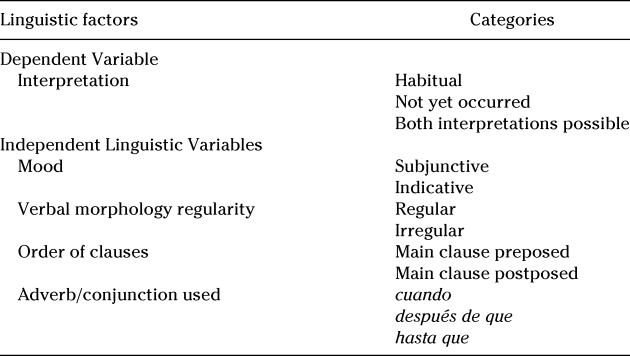
Each completed item on the mood interpretation task constituted a single token, and each was coded for a series of linguistic and extralinguistic variables. The dependent variable in the study was the response for that item (i.e., habitual, not yet occurred, or both possible). The independent linguistic variables (see Table 2) included the mood of the verb form, the regularity of the verbal morphology, the order of the main and dependent clauses, and the adverbial conjunction used. The first independent linguistic variable, mood of the verb form, contains two categories: indicative and subjunctive. As previously mentioned, prescriptively, subjunctive verbs in the adverbial clause indicate that the event has not yet occurred, whereas those in the indicative refer to an event that has already occurred or occurs habitually. The independent variable, regularity of the verbal morphology, also includes two categories: regular and irregular. Regular verbs were defined as any forms for which the indicative and subjunctive stems are the same. An example of a verb with regular morphology can be seen in (3), where the verb visitar has indicative and subjunctive forms that share the same stem (visita “he/she visits [indicative]” / visite “he/she visit [subjunctive]”). Irregular verbs were classified as any verb form whose subjunctive stem differs from its indicative counterpart (e.g., viene “he/she comes [indicative]” / venga “he/she come [subjunctive]”), as in example (4). This follows the work of Gudmestad (Reference Gudmestad, Klee and Face2006) and Geeslin and Gudmestad (Reference Geeslin, Gudmestad, Bruhn de Garavito and Valenzuela2008), who updated Collentine’s (Reference Collentine1995) and Lubbers Quesada’s (1998) original definition of (ir)regularity, to account for the fact that verbs whose stems change in both the indicative and subjunctive are not inherently different for speakers who first encounter the subjunctive. In contrast with Geeslin and Gudmestad (Reference Geeslin, Gudmestad, Bruhn de Garavito and Valenzuela2008), only present tense forms were used in the current study, and, thus, additional categories of this variable were unnecessary.
(3) Hablamos del fútbol americano cuando nos visita Marcos.
“We talk about football when Marcos visits us.”
(4) Salimos del campus cuando venga María.
“We are going to leave campus when Maria comes.”
Summary of the coding scheme
The third independent linguistic variable, order of the main and dependent clauses, allows for the codification of the distinction between preposed and postposed main clauses, as illustrated in examples (5) and (6), which prepose and postpose the main clause, respectively. Both examples contain forms in the indicative, but subjunctive forms are also possible in these sentence-level contexts for events that have not yet occurred.
(5) Bebemos cerveza cuando llega Juan.
“We drink beer when Juan arrives.”
(6) Cuando salen los estudiantes, los profesores hablan del fin de semana.
“When the students leave, the professors talk about the weekend.”
Finally, the variable adverbial conjunction classifies the first word or phrase of the subordinate clause. The categories of this variable are cuando “when,” hasta que “until,” and después de que “after.” The linguistic variables and the categories that they each subsume are summarized in Table 2.
Because of the manner in which the task was designed (i.e., creating contexts in which all combinations of the categories of all of the linguistic variables in the study occurred), the coding of each token for these linguistic variables was consistent across participants, with each participant completing one item for each condition. Additionally, the extralinguistic variables of participant age, gender, nation of origin (for the NSs), and nation of study abroad or prior residence (for those NNSs to whom this applied) were also included in the analysis. It will be recalled that our first two levels of learners were essentially all the same age, whereas our Level 3 learners were all at least 22 years of age. Our NSs were later divided as under 30 years of age or 30 years of age or older. A summary of the nations of origin or study abroad and the time spent abroad by the learners was presented previously in the description of the participants, as was a summary of the ages of the participants in each group. Additionally, the individual participant was also coded as an extralinguistic variable to enable us to see whether individual variability within a participant group was selected as a significant predictor of interpretation.
Data Analysis
Following data collection and coding, the distribution of the responses for each participant group was tabulated. Next, individual chi-square tests were run (using SPSS) to determine which of the independent variables were statistically related to the response choice for a given participant group (p < .05). Third, a binomial, step-up/step-down regression was run using SPSS to determine which of the linguistic and extralinguistic independent variables contributed to the prediction of response choice (i.e., interpretation of an event as habitual or having not yet occurred) when all factors were considered simultaneously in a single statistical model. In the regression analysis, the response “both interpretations are possible” has been included with the “not yet occurred” response because the indicative is encroaching on terrain previously occupied by the subjunctive, and, thus, language change is believed to be moving in the direction of allowing an association previously associated only with the subjunctive (Geeslin, Reference Geeslin2003; Silva-Corvalán, Reference Silva-Corvalán1994). In other words, a subjunctive form was believed to be required (categorically) for an interpretation that an event had not yet occurred, and, thus, any indicative context that allows this interpretation is evidence of language change or variability.Footnote 6 The final portion of the analysis is an in-depth examination of the distribution of responses across the categories of each of the independent linguistic variables to determine the magnitude and directions of the influence of these variables. This part of the analysis is based on crosstabulations as well as chi-square tests for each variable for each participant group.
RESULTS
Distribution of Responses
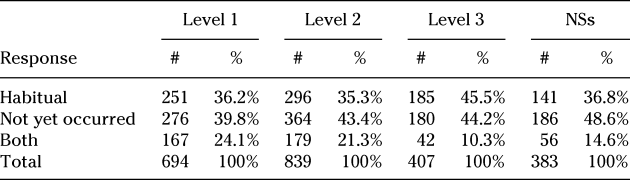
We begin the presentation of the results of the current study with the distribution of the responses for all participant groups on the mood interpretation instrument. It will be recalled that participants were asked to determine whether the event described in the test item was habitual, whether it had not yet occurred, or whether both interpretations were possible. Table 3 summarizes the distribution of these responses across all four participant groups, including the count and percentage of the total tokens that this count represents.
Distribution of response type by participant group
Note. Between-group comparisons for response type (habitual vs. not yet occurred): Level 1 vs. Level 2, χ2 = .911, df = 1, p = .340; Level 1 vs. Level 3, χ2 = .806, df = 1, p = .369; Level 1 vs. NS, χ2 = 1.65, df = 1, p = .199; Level 2 vs. Level 3, χ2 = 3.21, df = 1, p = .073; Level 2 vs. NS, χ2 = .265, df = 1, p = .607; Level 3 vs. NS, χ2 = 3.96, df = 1, p = .047.
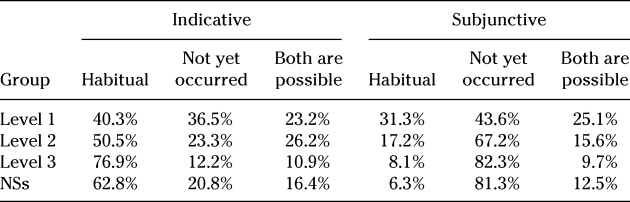
As stated previously, because the subjunctive was used in 12 of the 24 situations, prescriptive norms would lead us to predict that 50% of the responses for each group would be that the event had not yet happened and 50% of responses would indicate that the event was habitual. The results in Table 3 demonstrate that, in general, the four groups had quite similar percentages of selection. There is an apparent trend that higher proficiency NNSs select the prescriptively subjunctive interpretation more than lower proficiency groups (i.e., Level 1 NNSs selected the “not yet occurred” interpretation 39.8% of the time, Level 2 NNSs selected it in 43.4% of cases, Level 3 in 44.2% of the contexts, and the NSs 46.3% of the time). Likewise, Level 1 NNSs selected the habitual interpretation 36.2% of the time, whereas Level 2 NNSs selected it in 35.3% of cases, Level 3 in 45.5% of cases, and the NSs 36.8% of the time. It is interesting to note that the Level 3 participants overshot the NS target for this context, which resulted in their overall interpretations being significantly different (p < .05) in a chi-square test that compared the selection of the habitual response as opposed to the “not yet occurred” response for the two groups, with the Level 3 learners selecting the habitual interpretation significantly more than the NSs. Selections that both answers were possible were also relatively similar for the four groups, although the two less proficient groups preferred this answer more than the two higher groups. Thus, despite these apparent differences, the only significantly different groups were Level 3 and the NSs (p < .05), and, thus, only the observation about overshooting the norm for the habitual interpretation is statistically supported, as the other intergroup comparisons did not yield significant differences. Differences among other participant groups will stem from the additional analyses reported in the next section.
Results of the Predictive Models
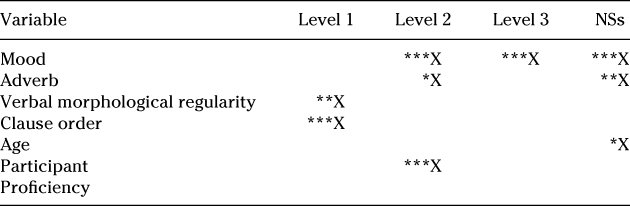
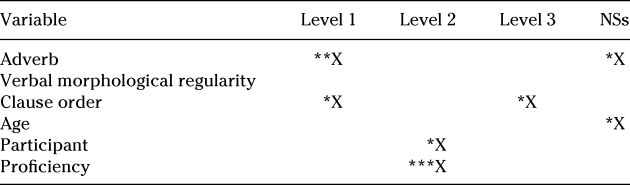
To provide further information regarding the factors that influence the response distribution described in the previous section, a regression analysis was performed for each of the participant groups. Conducting a separate regression model for each proficiency group provides us with an in-depth analysis of the linguistic and social factors that constrain each individual group. In the regression, we combined the “both” response with the “not yet occurred” response, because we were interested in seeing what factors would permit an interpretation that has been traditionally associated exclusively with the subjunctive, and we hypothesize that, because the subjunctive is used less frequently as language change progresses, the meanings associated with this form may spread to other forms (i.e., the indicative). The statistical analyses included all of the linguistic and extralinguistic variables mentioned in the Data Coding and Variables section. The results of these statistical tests are summarized in Table 4. Each independent variable that was found to be a significant predictor of response choice in at least one model is listed in a separate row of the table, and the results are provided in separate columns for each participant group. It will be recalled that such factors may be interpreted as part of the prototype for a given group as the factors that condition use or interpretation or as the contextual details that are stored with these forms under other models of variation. An “X” indicates that the factor was included in the model for that participant group, and the asterisks indicate the degree of significance of that factor in the model (see the Table 4 note for details).
Summary of the results for the predictive models by participant group
*p < .05.
**p < .01.
***p < .001.
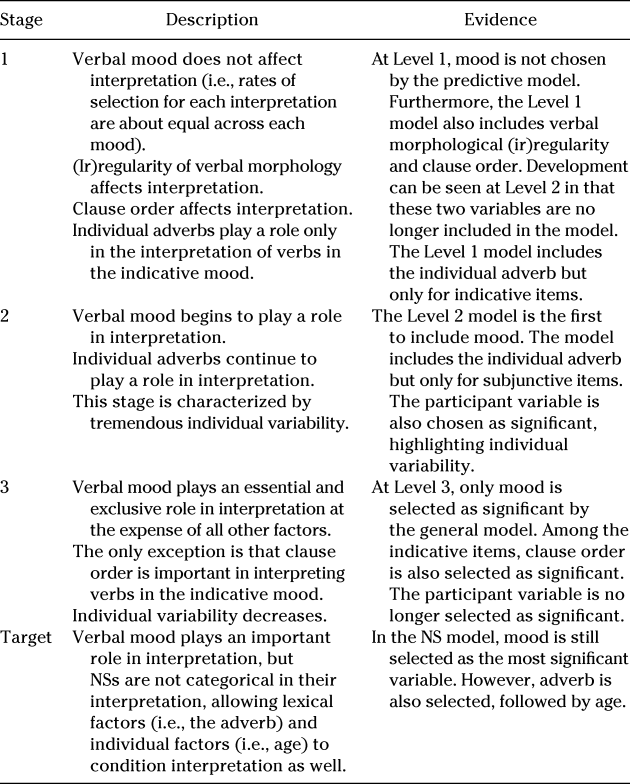
For the NS group, as expected, mood was highly significant in determining interpretation of whether the action in question was habitual or had not yet occurred. It will be recalled that, if prescriptive predictions were accurate, this variable would predict 100% of the responses. The adverb used in the sentence was the second variable selected by the NS predictive model, followed by the age of the participant. As stated previously, the participants in the learner groups were relatively close in age, and no effect is anticipated for the age variable in the predictive models for the NNSs. Thus, the findings for age are discussed only in relationship to the patterns of selection of the NSs. For the Level 3 NNS group, as with the NSs, mood was once again highly significant and was the first (and only) variable selected in the predictive model. The Level 2 NNS predictive model, like that of the two more advanced groups, first selected mood and then selected participant and adverb used. For the Level 1 NNSs, clause order was the first variable selected, followed by verbal morphological regularity. Mood was not selected by the Level 1 NNS model, unlike those of the other three groups.
Distribution across Categories of Linguistic Variables
To better understand the direction and strength of the effects of the independent variables that were found to be significant in the predictive models included with the previously reported results, we provide a closer look at the distribution of the responses across each of the categories of these linguistic variables for each participant group. We begin with the responses given by each group according to the mood of the verb form in that item. Prescriptively, it is predicted that, for the NS group, all indicative forms would be interpreted as habitual actions and all subjunctive forms would be interpreted as events that have not yet occurred. For the learners, one may expect that, as proficiency increases, so too does the degree of categorical responses in the direction of the NS results. The actual results are summarized in Table 5, which provides the percentage of responses of each type given for the indicative and subjunctive verb forms for each participant group.
Distribution of responses across verbal mood forms (indicative and subjunctive)
Note. In indicative contexts: Level 1 vs. Level 2, χ2 = 16.7, df = 1, p < .001; Level 2 vs. Level 3, χ2 = 21.1, df = 1, p < .001; Level 3 vs. NS, χ2 = 7.47, df = 1, p = .006. In subjunctive contexts: Level 1 vs. Level 2, χ2 = 30.5, df = 1, p < .001; Level 2 vs. Level 3, χ2 = 10.5, df = 1, p = .001; Level 3 vs. NS, χ2 = .345, df = 1, p = .557.
It becomes immediately clear that we can no longer examine all of the items on the instrument in a single analysis, because the high amount of variability demonstrated by each group necessitates the isolation of both the indicative and subjunctive item types to understand the ways in which each group differs from prescriptive predictions. Thus, crosstabulations were also performed to compare each participant group to the other groups within each mood. As shown in the Table 5 note, in sentences that included verbs in the subjunctive, NSs and Level 3 NNSs did not differ significantly, although, in indicative contexts, Level 3 NNSs selected the habitual interpretation significantly more than the NSs did, p = .006. Furthermore, the Level 1 NNS group differed significantly (p < .001 in all six comparisons) from the three other groups, not only in indicative contexts but also in subjunctive ones, as the Level 1 group selected the “not yet occurred” interpretation significantly less than the other three groups in subjunctive contexts and selected the habitual interpretation significantly less than the other three groups in indicative contexts. The Level 2 NNS group also differed significantly (p < .001 in both comparisons) from the Level 3 group in both the subjunctive and indicative contexts, and the Level 2 group differed significantly from the NS group in subjunctive contexts (p < .001) but not in indicative ones.
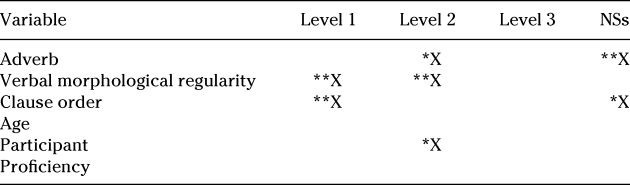
The results presented in Table 5 show that examining the data according to the verb form in each item allows us to see important differences between groups and also to look more closely at the individual predictions one might make for the two separate contexts. For example, in indicative contexts, language change predicts an increase in the possibility to interpret actions as having not yet occurred, despite the lack of a subjunctive form, and, for subjunctive contexts, one might not predict as much variability given that, when this form occurs, it is still likely to be associated with the interpretation that an event has not yet occurred unless the meaning of this form is changing along with the decrease in its frequency of use. Following this line of reasoning, we present a reanalysis of our data, first running a regression for all items that contained indicative forms (Table 6) and then doing so for all items that contained subjunctive forms (Table 7). Note that, because the predictions are different for each form, the “both” option is collapsed differently for each regression. For the indicative items, the “both” option is combined with the “not yet occurred” response, so as to examine the predictors of any context in which an indicative form allows an interpretation that is traditionally thought to require a subjunctive form. In contrast, the regression for the subjunctive items collapsed the “both” option with the habitual response to examine the predictors of responses for which the interpretation generally not found with subjunctive forms was allowed. We begin with a discussion of the indicative contexts and continue with the subjunctive contexts subsequently.
Predictive models for contexts with indicative verbs only
*p < .05.
**p < .01.
***p < .001.
Predictive models for contexts with subjunctive verbs only
*p < .05.
**p < .01.
As indicated in the four regression models summarized in Table 6, when the NS group interpreted indicative forms, the adverb used and the age of the speaker were selected by the model as significant predictors of responses. With respect to adverbs, the NSs selected the “not yet occurred” response for hasta que more than for the other adverbs. Additionally, the younger NSs behaved more prescriptively, selecting the habitual interpretation more often for these indicative sentences than the older group did. Looking at the learner data, the Level 1 participants’ interpretation of indicative forms was influenced significantly by the adverb used and the clause order. These learners selected the habitual interpretation most often when cuando was the adverb and the interpretation that the event had not yet occurred most often when hasta que was the adverb, with después de que behaving rather similarly to hasta que. This group was more likely to select that the event had not yet occurred with postposed adverbials, meaning that they likely interpreted clausal order as chronological order.
For the Level 2 group, the regression demonstrated that only extralinguistic factors were significant predictors of the interpretation of indicative forms, as proficiency level and participant were chosen. The most proficient subgroup selected the habitual interpretation in these indicative contexts (as would be expected prescriptively), whereas the least proficient selected it the least. The fact that participant was selected as a factor indicates the high degree of individual variability within this group. Finally, the regression model for Level 3 shows that only clause order predicted responses on the indicative items. Like the NSs, this group interpreted events with preposed adverbials as slightly more likely to have not yet occurred. As previously noted for this group, more than 75% of the responses were predicted by prescriptive norms alone, and when all items were considered together, mood was the exclusive predictor selected in the regression model for this group. This means that there is less variability on these items to be predicted than for any of the other participant groups, including the NSs.
As with the indicative items, a separate regression model for each participant group was run for only the items that contained a subjunctive form. Despite language change in the direction of less frequent use of subjunctive forms, it is not clear whether it is appropriate to predict changes also in the interpretation of the subjunctive forms because no study has examined this issue previously. To better identify those contexts in which subjunctive forms allowed an interpretation that an event was habitual, the “both” response was collapsed with the habitual response for this set of regressions, and the results are summarized in Table 7.
Table 7 indicates that when the NS group was presented with adverbial clauses containing subjunctive forms, the adverb in the context continued to be a significant predictor of the interpretation selected; clause order was also significant. Concerning adverbs, the NSs selected “not yet occurred” nearly categorically when cuando co-occurred with the subjunctive form, and they selected the habitual interpretation most frequently when después de que was the adverb, with hasta que falling in the middle. For clause order, preposed adverbial clauses were interpreted as having not yet occurred more than postposed adverbial clauses were. In looking at the learner data, Level 1 interpretations were best predicted by clause order and the regularity of the verbal morphology. Participants in this group were more likely to select the interpretation that the event had not yet taken place with postposed adverbials. With respect to morphological regularity, more habitual interpretations were made for regular verbs, and there were more interpretations that the event had not yet occurred for irregular verbs. The fact that this factor was only significant in the predictive model for items in the subjunctive is consistent with previous research that claims that verbal morphology is important because of the higher saliency of irregular subjunctive forms (e.g., Collentine, Reference Collentine1997; Lubbers Quesada, Reference Lubbers Quesada1998). The regression model for the Level 2 group included the factors participant, morphological regularity, and adverb as significant predictors of the interpretation selected. As with the Level 1 learners, interpretations that the event had not yet occurred were selected more frequently for irregular verb forms. Additionally, the interpretation that the event had not yet occurred was selected most frequently for cuando and least frequently for después de que, with hasta que falling in the middle. Finally, the Level 3 learners showed that mood was such a strong predictor of interpretation that no factors were selected for inclusion in the predictive model for subjunctive forms. Again, this confirms the assertion that this group showed the most prescriptive (and least variable) interpretation of these forms.
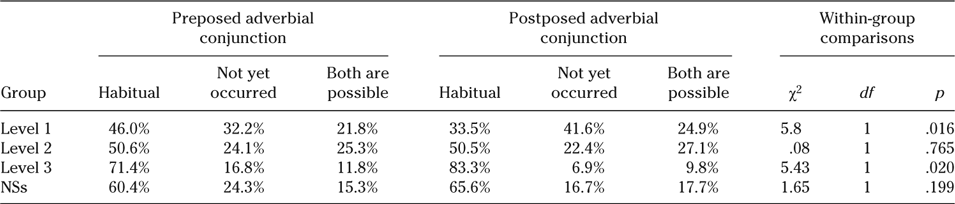
The final steps of the analyses we conducted include an in-depth examination of the effect of those variables that are significant predictors of interpretations for at least one participant group. Given the additional insights gleaned from separating the items with subjunctive forms from those with indicative forms, we continue to maintain this distinction. Additionally, we also present the “both” option separately from the other two interpretation responses to afford detail additional to that provided by the preceding regression tests and the description of the directions of their effects. We begin with a presentation of the results for the three linguistic variables and continue with the presentation of results for the social variables. Tables 8 and 9 present the results for clause order for indicative and subjunctive contexts, respectively. Recall that, in indicative contexts, clause order was a significant predictor of interpretation at Levels 1 and 3 and that, for subjunctive contexts, it was included in the predictive models for Level 1 and the NSs.
Distribution of responses across clause order types for indicative sentences
Note. Within-group comparisons are for preposed vs. postposed contexts.
Distribution of responses across clause order types for subjunctive sentences
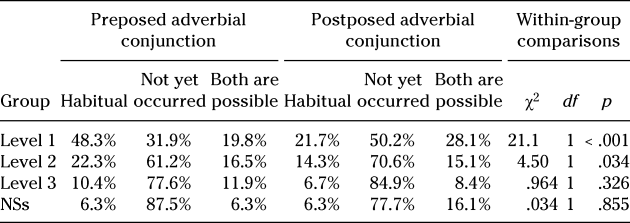
Note. Within-group comparisons are for preposed vs. postposed contexts.
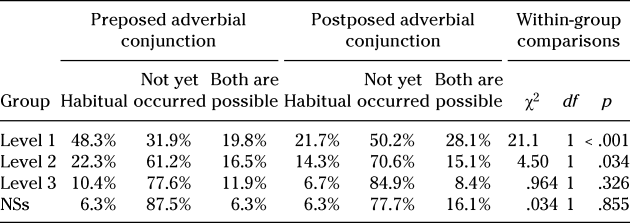
The within-group comparison results in Table 8 show that, for sentences in the indicative, the Level 1 group was significantly more likely (p = .016) to select that the event had not yet occurred with postposed adverbials, meaning that the group members likely interpreted clausal order as chronological order. They were also more likely to select that both interpretations were possible when the adverbial clause was postposed than when it was preposed. The Level 3 group interpreted events in the indicative with preposed adverbials as slightly more likely to have not yet occurred than those with postposed adverbials, and this difference reached significance, p = .020.
For subjunctive sentences, clause order was significant for Level 1 (once again) and for the NSs (Table 9), as indicated in the predictive models. The Level 1 group was significantly more likely (p < .001) to select the interpretation that the event in the subjunctive had not yet taken place when it co-occurred with postposed adverbials, which was also the case in the indicative. For the NS group, subjunctive sentences with preposed adverbial clauses were interpreted as having not yet occurred more often than postposed adverbial clauses were. For indicative sentences, NSs selected that both interpretations were possible about the same percentage of the time, regardless of which clause appeared first, whereas in the subjunctive they selected the “both” interpretation nearly three times more frequently when the adverbial clause was postposed, which likely contributed to this factor being included in the group’s predictive model. Clause order was not selected for the Level 2 NNSs in the regression model for either mood.
The second linguistic variable explored here, the adverb in the context, was a significant predictor of interpretations in items with indicative forms for Level 1 and for the NSs and in items with subjunctive forms for Level 2 and the NSs. The distribution of interpretation responses across the categories of this variable is summarized in Tables 10 and 11; Table 10 provides results for contexts with indicative forms, and Table 11 provides results for the items with subjunctive forms.
Distribution of responses across adverbial conjunctions for indicative sentences
Note. Within-group comparisons for cuando vs. después de que: Level 1, χ2 = 8.40, df = 1, p = .004; Level 2, χ2 = .434, df = 1, p = .510; Level 3, χ2 = 2.56, df = 1, p = .110; NS, χ2 = 3.80, df = 1, p = .051. Within-group comparisons for cuando vs. hasta que: Level 1, χ2 = 15.7, df = 1, p < .001; Level 2, χ2 = 1.72, df = 1, p = .190; Level 3, χ2 = .133, df = 1, p = .715; NS, χ2 = 2.75, df = 1, p = .097.
Distribution of responses across adverbial conjunctions for subjunctive sentences
Note. Within-group comparisons for cuando vs. después de que: Level 1, χ2 = 1.42, df = 1, p = .234; Level 2, χ2 = 6.98, df = 1, p = .008; Level 3, χ2 = .324, df = 1, p = .569; NS, χ2 = 6.95, df = 1, p = .008. Within-group comparisons for cuando vs. hasta que: Level 1, χ2 = .062, df = 1, p = .803; Level 2, χ2 = .870, df = 1, p = .351; Level 3, χ2 = .108, df = 1, p = .742; NS, χ2 = 3.49, df = 1, p = .062.
In the indicative contexts, Level 1 NNSs selected the habitual interpretation most often when cuando was the adverb and least often with hasta que, with después de que behaving rather similarly to hasta que. In fact, they selected the habitual interpretation significantly more often for cuando than for either of the other two adverbials: in comparison with después de que, p = .004, and in comparison with hasta que, p < .001. They also selected that both interpretations were possible most frequently when cuando was the adverb. The NSs selected the “not yet occurred” response for hasta que more than for the other adverbs, and they also selected the “both” response more for hasta que than for the other adverbs, although we note that these differences are not significant. In subjunctive contexts, the Level 2 NNSs selected the interpretation that the event had not yet occurred significantly more for cuando than for después de que, p = .008, with hasta que falling in the middle. The NSs selected “not yet occurred” nearly categorically when cuando co-occurred with the subjunctive verb (which may be expected prescriptively), whereas they selected the habitual interpretation most frequently when después de que was the adverb (also selecting the “both” interpretation more frequently with después de que than with the other adverbials), with hasta que falling in the middle, as it did with the Level 2 NNSs. Native speaker differences between cuando and después de que were significant, p = .008. The adverb used was not significant for Level 3 for either mood.
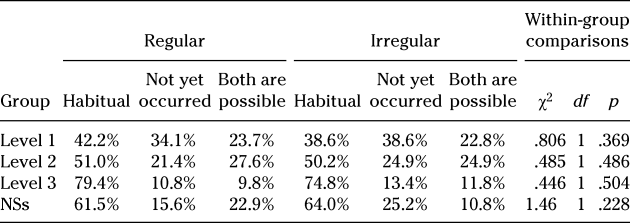
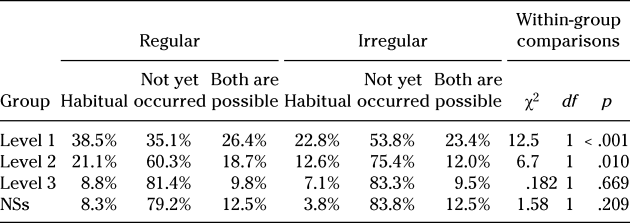
The third and final linguistic variable examined was the regularity of the verb morphology. Recall from Tables 6 and 7 that morphological regularity was not a significant predictor of interpretation for any of the groups when the verb occurred in the indicative, but it was a significant predictor for the two lowest proficiency NNS groups when the verb was in the subjunctive. The distribution of these responses across categories of this variable is summarized in Table 12 for indicative contexts and in Table 13 for subjunctive contexts.
Distribution of responses across regularity of verbal morphology for indicative sentences
Note. Within-group comparisons are for regular vs. irregular verbs.
Distribution of responses across regularity of verbal morphology for subjunctive sentences
Note. Within-group comparisons are for regular vs. irregular verbs.
For sentences in the subjunctive, the Level 1 NNS group made significantly more habitual interpretations for regular verbs and more interpretations that the event had not yet occurred for irregular verbs, p < .001. For the Level 2 NNS group, the same pattern held, as interpretations that the event had not yet occurred were significantly more frequently selected for irregular forms, p = .01. The finding that this category was only significant for verbs in the subjunctive is consistent with previous research that points to the greater saliency of irregular subjunctive forms as an explanation for their role in fostering use of the subjunctive (e.g., Collentine, Reference Collentine1997; Lubbers Quesada, Reference Lubbers Quesada1998). Additionally, both of these levels selected the “both” interpretation slightly more for regular verbs than for irregular verbs. The implications of these findings are analyzed in greater detail in the Discussion section, following the presentation of the details of the analysis of the extralinguistic factors.
Extralinguistic Factors
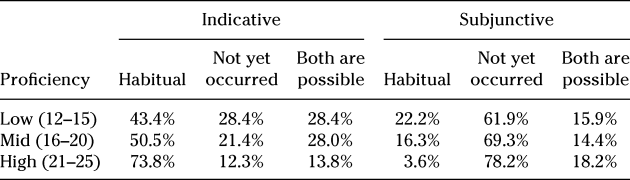
Of the extralinguistic factors, only proficiency level and age were selected by at least one of the predictive models. Beginning with proficiency level for the Level 2 NNS group, there were notable differences within the group with regard to mood interpretation, which are summarized in Table 14, showing the distribution of responses across categories of the proficiency score variable. The categories of this variable divide learners into three different ranges of scores on the 25-item proficiency test and are referred to as high, middle, and low for the purposes of the discussion in the next section.
Distribution of responses across verbal mood forms by proficiency score for Level 2 participants
Note. Indicative: low vs. mid, χ2 = 2.96, df = 1, p = .085; low vs. high, χ2 = 11.9, df = 1, p < .001; *mid vs. high, χ2 = 5.00, df = 1, p = .025. Subjunctive: low vs. mid, χ2 = 2.08, df = 1, p = .150; *low vs. high, χ2 = 9.90, df = 1, p = .002; *mid vs. high, χ2 = 5.53, df = 1, p = .019.
Table 14 indicates that, for the Level 2 NNSs, notable differences in interpretation occurred according to proficiency, such that the high-proficiency group responded more frequently that actions in the indicative were habitual (43.3% for the low group, 50.5% for middle, and 73.8% for high) and that those in the subjunctive had not yet occurred (61.9% for low, 69.3% for middle, and 78.2% for high). In fact, the highest proficiency group responded that actions in the indicative were habitual significantly more often than both the middle (p = .025) and low (p < .001) groups. Similarly, the high group responded that actions in the subjunctive had not yet occurred significantly more frequently than both the middle (p = .019) and low (p = .002) groups.
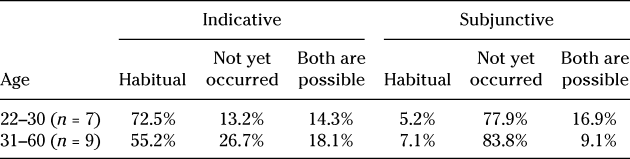
The other significant predictive factor in the regression models was age. The age range for the three NNS levels was relatively small, and no learner predictive model selected this factor. Thus, the variable was only important in predicting NS interpretations, and the distribution of responses across the two participant age groups is summarized in Table 15.Footnote 7
Distribution of responses across age categories for NSs by mood
Note. Interpretation for ages 22–30 vs. 31–60: indicative, χ2 = 6.82, df = 1, p = .009; subjunctive, χ2 = .132, df = 1, p = .717.
As Table 15 indicates, when interpreting indicative forms, the older participant group (ages 31–60) was significantly less likely (p = .009) to interpret the action as habitual and more likely to indicate that the event had not yet occurred or that both interpretations were possible than participants in the younger group (ages 22–30). This finding is interesting because, as stated previously, it was not clear what effect language change would have on the interpretation of indicative forms. At the outset of this analysis, we hypothesized that the gradual loss of subjunctive forms in favor of indicative ones would have no effect at all on interpretation of the indicative forms or that it might mean that the interpretation traditionally associated with the subjunctive had spread to other forms. It is surprising that neither of these hypotheses appears to be true, as we would expect equal rates if the no-effect hypothesis were true and less innovation with the middle-aged speakers than with the younger ones if the spreading hypothesis were true. This is addressed in the discussion that follows.
DISCUSSION
The current study was designed to investigate the interpretation of mood in contexts that contained the adverbs cuando, después de que, and hasta que and, ultimately, to use this information to propose stages of development for the interpretation of subjunctive and indicative forms in these contexts. Again, these adverbs were selected for study precisely because work on NS mood expression showed that they allow variation and that they allow a mood contrast that is linked to interpretation. To that end, our first research question sought to examine how NNSs interpret indicative and subjunctive forms, how this changes across levels of proficiency, and how our learners differed from our NS comparison group. The results for selection of responses in contexts in which the verb form is in the subjunctive show that our Level 3 learners do indeed interpret these forms most often (82.3% of the time) as events that have not occurred and that development in these contexts can be described as a significant increase in the frequency of the “not yet occurred” response as proficiency increases. In comparison to NSs, the Level 3 learners show nativelike response rates (i.e., they are not significantly different). Looking at contexts in which the verb form appears in the indicative and in which predictions based on findings of language change were less clear, we found that development in interpretation of the indicative forms could be characterized as a significant increase across levels in rates of habitual interpretations. One difference between the results for indicative forms and those for subjunctive, however, is that the Level 3 learners were significantly different from the NS group, with Level 3 learners showing a higher rate of selection of the habitual interpretation. In other words, our highly advanced learner group actually behaved more prescriptively than the NS group and was less likely to demonstrate variation in their interpretations. This may be connected to the fact that our participants were also teachers, but it may also be the case that this is a natural progression away from variability that is clearly developmental and toward the integration of nativelike variation, which may only occur at very high levels of proficiency (Regan, Howard, & Lemée, Reference Regan, Howard and Lemée2009). Moreover, these more prescriptive patterns are consistent with learner language precisely because most L2 learners living outside of the L2 context lack access to informal speech contexts (Tarone, Reference Tarone2007). Looking at both indicative and subjunctive items at the same time, we can describe language acquisition as the gradual shift from selection of interpretations that are not based on mood (e.g., the Level 1 learners selected responses with nearly equal frequency) toward greater differentiation as proficiency increases, whereby highly advanced learners show a preference for a single interpretation in 75% or more of the cases for each of the two moods. Nevertheless, the lack of categorical responses on the part of NSs confirms that these structures are indeed variable, and actual interpretation does not match prescriptive predictions, at least for sentences such as those in the current study that avoid use of periphrastic or morphological future forms in the main clause. The implication for learners is that the target for these interpretations is not 100% but rather a preference that also allows variation.
Our second research question sought to explore the linguistic and social factors that predict interpretation of subjunctive and indicative verb forms in adverbial clauses as well as how those factors change across levels and differ between NSs and NNSs. In the general model (i.e., the model that included all test items together), the mood of the verb form was a significant predictor of interpretations for all but the lowest level learner group. This means that, for the lowest level group, the presence of a subjunctive form did not influence the interpretation of the utterance, but as proficiency increased, the verb form came to play a more important role. This is consistent with the findings of Lee (Reference Lee1987) and Lee and Rodríguez (Reference Lee, Rodríguez, Glass and Pérez-Leroux1997) that showed little effect of these forms on overall comprehension. Nevertheless, prescriptive accounts for NSs would anticipate that the mood of the verb form would predict 100% of the cases, and this would mean that it would be the only factor included in the predictive model. In fact, this was only the case for the Level 3 learners. For all other groups, additional factors were included in the predictive models.
Of these factors, several lend evidence to existing accounts of the acquisition and use of the subjunctive. For example, the Level 1 learners’ interpretations were predicted by the regularity of the verb morphology as well as the clause order. Previous accounts of the acquisition of the subjunctive in Spanish have consistently demonstrated that irregular verb forms are acquired first (Collentine, Reference Collentine1995; Gudmestad, Reference Gudmestad, Klee and Face2006; Lubbers Quesada, Reference Lubbers Quesada1998), and, thus, the finding that verbal morphology plays a role in interpretation as well is not surprising. This may be linked to perceptual salience of the form, but we also predict that the frequency of occurrence of these forms plays a role in their acquisition. Current work by Gudmestad (Reference Gudmestad, Geeslin and Díaz-Campos2012) has begun to explore the interaction between frequency and form regularity, and such findings will be important for models that seek to incorporate frequency and variation into explanations of acquisition and use (e.g., complexity theory). Likewise, the importance of clause order is consistent with an account that affords a role to word order in the interpretation of utterances in which processing demands are too high for learners at a given level of proficiency and, thus, universal strategies are employed (e.g., accounts of the first noun principle, such as VanPatten, Reference VanPatten1984). Again, this so-called processing bias is likely linked to frequency in the input as well. For the time being, we would like to suggest that processing plays a role (as does frequency), but neither is exclusively responsible for the acquisition process.
Moving to the Level 2 model, the mood of the verb form becomes important, but so too do the adverb used and the individual participant. The importance of the adverb is likely connected to the early lexical strategies evident in accounts of the acquisition of the subjunctive in first languages and L2s whereby learners first associate the use of the subjunctive with particular lexical triggers rather than with the semantic meaning associated with the form as a whole (see Collentine, Reference Collentine, Lafford and Salaberry2003). This finding is also consistent with models such as prototype theory, in which the best or most likely candidates are said to constitute a prototype on which use and interpretation are modeled, and with accounts that afford a role for frequency such that those lexical items that appear most often with the subjunctive are identified as triggers for the subjunctive. The importance of the participant in the predictive model indicates the high degree of individual variability found at this level. Several studies of variable structures have shown this type of variability at intermediate stages of development, and this has been taken as evidence of individual patterns of restructuring (e.g., Gudmestad, Reference Gudmestad, Geeslin and Díaz-Campos2012). Extending this to some of the prevalent linguistic theories accounting for linguistic variation (e.g., connectionism, complexity theory, or prototype theory), one may further surmise that learners at this level do not all form the same connections at the same time. As a group, they are between Level 1, in which no effect for mood is seen, and Level 3, in which a consistent effect for mood is found, but it also seems to be the case that some members of this intermediate group have begun to make associations with constraints related to mood distinction, whereas others have not. An added source of variation can be seen in previous studies (e.g., Gudmestad, Reference Gudmestad, Klee and Face2006) that have found that different semantic meanings (e.g., volition) associated with the subjunctive are acquired at different rates. On the basis of such a finding, we could also posit that within a certain context (e.g., the adverbial clause context), targetlike mood interpretation with certain lexical items may precede that of others, and this, in turn, may contribute to individual differences at intermediate proficiency levels.
Finally, for the NSs, the predictive model contains mood, adverb, and age. The finding that the adverb itself is important can be explained by accounts of language change that focus on individual lexical items and their properties, such as those that claim that the frequency of a lexical item or the frequency of co-occurrence of that item with a given form are important predictors of the rate at which language change occurs (e.g., Bybee, Reference Bybee2006). Again, if prescriptive accounts were accurate, the interpretations should have been categorical regardless of the lexical items employed. As was noted earlier, the results for age are counter to predictions and are addressed later in this section.
As a result of the importance of mood in the general model, we also explored the role of each linguistic and extralinguistic factor when items in the indicative and subjunctive were considered separately. This allows us to make distinct predictions for the interpretation of each form and also to determine if the factors that predict interpretation of each are the same or different. In the model that only included sentences with verbs in the indicative mood, significant predictors for the NS group included the adverb in the context and the age of the speaker. The NSs selected the “not yet occurred” interpretation for hasta que more than for the other adverbs. Additionally, the younger NSs demonstrated more prescriptive behavior, selecting the habitual interpretation more often for these indicative sentences than the older group did. With respect to the learner models, the Level 1 group’s significant factors included the adverb and clause order. These learners selected the habitual interpretation most often when cuando was the adverb and selected that the event had not yet occurred most often with hasta que. This group was more likely to select that the event had not yet occurred with postposed adverbials, meaning that they likely interpreted clausal order as chronological order. For the Level 2 group, only extralinguistic factors (proficiency level and participant) were significant predictors of the interpretation of indicative form. The most proficient subgroup selected the habitual interpretation more often in these indicative contexts (as would be expected prescriptively), whereas the least proficient subgroup selected that interpretation less frequently. The high degree of individual variability within this group is apparent in the selection of individual participant as a significant factor. Finally, the regression model for Level 3 shows that only clause order was significant for the indicative items. Like the NSs, this group interpreted events with preposed adverbials as having not yet occurred slightly more frequently than sentences with postposed adverbials. This group was the most faithful to prescription and demonstrated less variability on these items than any other participant group, including the NSs.
In the predictive model that included only items with adverbial clauses with verbs in the subjunctive, the adverb continued to be a significant predictor for the NS group, as did clause order. The NSs selected “not yet occurred” nearly categorically when cuando co-occurred with the subjunctive form, whereas they selected this interpretation least frequently when después de que was the adverb. They interpreted preposed adverbial clauses as having not yet occurred more often than postposed clauses. In considering the learner data, the Level 1 model included clause order and the regularity of the verbal morphology. Participants in this group were more likely to select the interpretation that the event had not yet taken place with postposed adverbials. Fewer “not yet occurred” interpretations were made for regular verbs, whereas more such interpretations were made for irregular verbs. Once again, the fact that this variable was only significant for items in the subjunctive is consistent with previous research (e.g., Collentine, Reference Collentine1997; Lubbers Quesada, Reference Lubbers Quesada1998). The Level 2 group’s model included the factors participant, morphological regularity, and adverb as significant predictors of the interpretation selected. As was the case with the Level 1 learners, interpretations that the event had not yet occurred were more frequent for irregular verb forms. Furthermore, the interpretation that the event had not yet occurred was selected most frequently for cuando and least frequently for después de que. Finally, for the Level 3 learners, mood was such a strong predictor of interpretation that no factors were selected for inclusion in the predictive model for subjunctive forms. Again, this confirms the assertion that this group showed the most prescriptive (and categorical) interpretation of these forms.
Having summarized the results of the analyses conducted, there are several issues that merit further attention. One of the primary objectives of the current study was to expand current knowledge about the L2 acquisition of the subjunctive mood in Spanish by adding research on how these forms are interpreted and how such interpretation develops. Thus, it is useful to characterize the acquisition of the interpretation of the subjunctive (and indicative) forms in adverbial clauses. The results of the current study show us that several factors are useful in arriving at this description of development. First, the variable mood (i.e., the form of the verb) plays a significant role in interpretation beginning at Level 2 and continuing through the third level and for the NSs. In fact, this variable is so important in the Level 3 model that this factor alone explains more than three quarters of the responses. Contrasting these results with the Level 1 interpretations, which show that verb form has little or no bearing on the interpretation selected, the increasing degree of importance of this factor over time is a good indicator of acquisition, despite the characteristics of these forms (e.g., low communicative value, low perceptual salience) that make them difficult to acquire. A second important factor is the order of the clauses in the test items. Results show that both Level 1 and Level 2 NNSs were significantly more likely to respond that the event had not yet happened when the main clause was placed before the adverbial clause. In contrast, the Level 3 NNSs and the NSs (in the general model) did not respond significantly differently on the basis of clausal ordering, instead focusing more on verbal mood to determine whether or not the event had occurred. Thus, a second important descriptor of the acquisition process is the loss of reliance on clause order as development progresses. This is likely related to the fact that increased proficiency affords the learner the processing capacity to interpret verbal morphology, whereas, at lower levels, interpretation is more likely focused on lexical semantics and word order strategies. The third factor that aids in describing acquisition is that of the regularity of verbal morphology. As with clause order, this factor is important at the two earlier learner levels but not for the Level 3 and the NS models. Again, the process of acquisition can be described as a reduced reliance on this factor over time. This result is important in connecting research on production with the current study on interpretation because perhaps the most pervasive result to date in studies of production of the subjunctive is that subjunctive forms occur more often with irregular verb forms than with regular ones. The final factor that describes acquisition of these forms is the adverb itself. Our results show that the adverb is significant in predicting learner responses only at the lowest level. This is consistent with earlier research that shows that learners begin with a lexical strategy, linking particular lexical items to the use of a given verb form, and only after time are able to connect the meaning behind those lexical items with the verb form.
To summarize, our study shows that the interpretation of subjunctive and indicative forms in adverbial clauses is dependent on verbal morphology, clause order, and the adverbial present in the context at the earliest levels of proficiency; at intermediate levels, the reliance on the adverbial is reduced, and the importance of the mood of the verb form increases; and by the highest level in the current study (i.e., highly advanced L2 speakers), there is nearly complete reliance on the mood of the verb form in interpreting these utterances. We further note that the significant results for participant and for proficiency for the Level 2 learner group demonstrate that middle stages of this process are also characterized by a high degree of individual variability. These developmental changes over time are summarized in Table 16.
Summary of developmental stages for mood interpretation
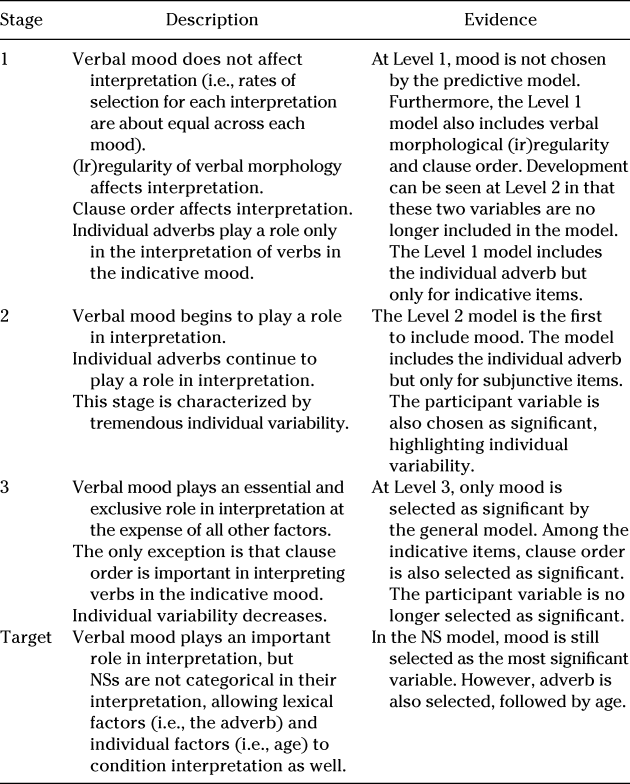
The summary provided in Table 16 describes the path along which learners move en route to nativelike interpretations of indicative and subjunctive forms that follow adverbials that allow a contrast between the two. As stated at the outset of this article, not only does this provide a snapshot of learner progress, but it also contributes directly to theory building because it demonstrates that learner language is variable and constrained by multiple factors, and, thus, a theory of L2 learning and use must incorporate these facts. We also stated that we do not intend to offer an argument in favor of one of the many approaches that seek to incorporate variation in this way. We take this stance in large part because several of these theories show promise for accounting for these facts. For example, using a prototype model, one can take these findings and better understand how prototypes change over time and become further specified with additional experience with a L2. Likewise, working under a model such as connectionism, it is apparent that the connections learners make are not instantaneous and that not all connections are made at the same time. Instead, over time, learners make additional connections to social, lexical, and linguistic factors that better reflect the actual nature of the input received (i.e., nativelike use). Thus, we argue that the facts presented in Table 16 have the potential to contribute to the development of several theories of L2 learning, each of which incorporates and models language variation in slightly different ways.
In addition to characterizing the path of L2 acquisition of this structure, our study also contributes to knowledge of how NSs interpret verb forms in adverbial clauses. Perhaps the most striking result is that the mood of the verb form only explains 62.8% of the indicative cases and 81.3% of the subjunctive cases. In other words, NS interpretations are clearly variable, despite the textbook rules L2 classroom learners face. For indicative forms, age plays a role in the interpretation. Surprising about this result is that the younger NSs are less likely to allow a “not yet occurred” interpretation for indicative forms than the older speakers are. Given the limitations of the participant group in the current study (i.e., lack of a full range of age groups, lack of socioeconomic stratification to corroborate results, small sample size) it would be premature to make strong conclusions on the basis of this result. Thus, the claim that is made here is that it would be unwise to state that the noncategorical interpretation of verb forms in adverbial clauses is a clear-cut case of language change until further evidence for or against this claim is available. It is worth noting, however, that our two eldest speakers (one of whom was over the age of 40 and the other over the age of 50) never selected the “both” interpretation, which could point to evidence that older speakers permit less variation than their younger counterparts, although a subsequent study with a larger number of NSs from multiple age groups would enable firmer conclusions. For the interpretation of subjunctive forms, clause order is also important for NS interpretation, perhaps indicating that, for some speakers, syntax conveys some of the meaning that was thought to be conveyed by verbal morphology. Finally, for both indicative and subjunctive forms, the individual lexical item (i.e., the adverbial) plays a role in interpretation. Thus, NS interpretations are variable and are conditioned by factors such as clause order and the individual lexical item in the utterance as well as perhaps by sociolinguistic factors such as age, although further research is needed to confirm this.
In comparing the NS model to the learners’ models, there are two findings that merit discussion. First, our Level 3 group is very similar to the NS group but also shows some subtle differences. When looking at rates of response selection, the Level 3 group is not significantly different from the NSs in indicative contexts, whereas there is a significant difference in subjunctive contexts in that Level 3 participants selected the “not yet occurred” interpretation more than the NSs did. This same result (i.e., more categorical interpretations by the NNSs) is shown in the fact that mood was the only factor selected in the predictive model for the Level 3 group, whereas the NS model also included the adverb in the context. Our results point to the fact that even at highly advanced levels of proficiency, the acquisition of variation in a L2 is not complete.
The second interesting result is the role of the individual adverb in predicting interpretations. We demonstrated that, for lower levels, this variable was important but lost significance as proficiency increased, despite the fact that this variable is included in the NS model. In our previous discussion, we hypothesized that the importance of the individual lexical items for the lower level learners had to do with the use of lexical strategies rather than semantic ones. Given the importance of clause order, we may wish to revise this to state that, at lower levels, learners employ lexical and syntactic strategies, whereas, for the NSs, we hypothesized that this had to do with properties of the lexical items, such as frequency, that played a role in the degree of variability permitted by each item. To show that it is indeed the case that this variable plays a differing role for NNSs and NSs, it is necessary to look more closely at the results. The factor adverb was a significant predictor of interpretation of indicative forms for Level 1 learners and for subjunctive forms for Level 2 learners. In the case of the former, the habitual interpretation was most frequently selected for the adverb cuando, then for hasta que, and finally for después de que. For the Level 2 learners, the “not yet occurred” interpretation of subjunctive forms was selected most often for cuando, then for hasta que, and finally for después de que. In other words, the adverb cuando was most frequently interpreted according to prescriptive norms, whereas después de que was least frequently interpreted according to prescriptive norms, regardless of the verb form. This finding points to the conclusion that the learners are simply more accurate (prescriptively) with cuando than with the other two adverbs. In the case of después de que, the low rates of distinction between forms may result from the fact that learners are likely also exposed to frequent use of después (without de que) in the input when describing actions in sequence and have not acquired the distinct functions of the two related forms.
The NS results show that, for indicative forms, the habitual interpretation was selected most often with después de que, then with cuando, and then with hasta que, whereas for subjunctive forms the “not yet occurred” interpretation was selected most often with cuando, then with hasta que, and finally with después de que. Although these results do not show a perfect mirror image, it is clear that the adverbial form después de que is most often associated with habitual interpretations, whereas cuando is most often associated with events that have not yet occurred. It is interesting that cuando was most associated with the traditional subjunctive interpretation and that después de que was most commonly paired with the prescriptive indicative interpretation because this is consistent with frequencies found in NS corpus data, such as that of El habla de la ciudad de México, as reported by Blake (Reference Blake1985), who noted that the co-occurrence of cuando with the subjunctive made up 12% of total subjunctive uses, whereas that of hasta que formed only 1% of the total subjunctive uses, and there were zero cases of después de que co-occurring with the subjunctive in the corpus. Although we are cautious about taking Blake’s findings as representative of Spanish use across varieties, our results do show that individual lexical items have properties that play a role in their interpretation when all other conditions are held equal. Moreover, the role of individual lexical items points to an interpretation that affords a different explanation for the importance of this factor for low-level learners as compared to NSs, and it further identifies a factor that is absent from the Level 3 model but also necessary for nativelike variation.
CONCLUSIONS, LIMITATIONS, AND FUTURE DIRECTIONS
The current investigation has shown that analysis of the interpretations of utterances with adverbial clauses containing verb forms in the indicative and subjunctive mood and the examination of the frequency and predictors of these interpretations contribute new findings to the study of the L2 acquisition of Spanish by English-speaking learners as well as that of NS interpretations. Specifically, at the lowest of the three learner levels included in the study, learners do not yet rely on the mood of the verb form in interpreting utterances and instead focus on the regularity of the verbal morphology and the order of the main and subordinate clauses. As proficiency increases, there is an increase in the importance of mood as well as quite a bit of individual variability, as indicated by the importance of proficiency scores and the individual participant in the predictive models. Finally, at the highest level of proficiency in the current study, our participants performed largely as would be predicted by prescriptive norms, with the mood of the verb form playing the most important role in predicting interpretations. The early importance of verbal morphology provides further confirmation of reliance on irregularity at early stages of the acquisition of the subjunctive mood (Collentine, Reference Collentine1997; Gudmestad, Reference Gudmestad, Klee and Face2006; Lubbers Quesada, Reference Lubbers Quesada1998). The results from our NS group demonstrate the importance of the mood of the verb form but also allow a role for the properties of the individual lexical items in determining interpretation (e.g., Bybee, Reference Bybee2006). When comparing this group with our highest level learners, the learners are actually more categorical in their responses than the NSs, and this is demonstrated in a significant difference in the frequency of interpretation of indicative forms as habitual (76.9% vs. 62.8%) as well as through the inclusion of additional factors in the predictive model for the NSs. Nevertheless, in regard to interpreting subjunctive forms, the rates of interpreting these events as having not yet occurred are not significantly different for the Level 3 participants and the NSs (82.3% vs. 81.3%). In sum, we found subtle differences among groups but also striking similarities between native and nonnative interpretations.
Despite the contributions of this project to the fields of SLA and sociolinguistics, there are several limitations that should be addressed in future research on this topic. First, the effects of the age of our NS participants suggest that there is interesting work to be done regarding the degree to which the variability found in interpretations of adverbial clauses might be a language change in progress. To properly explore such questions, a larger NS participant pool with equal stratification among (especially) age, sex, and socioeconomic level must be included. Additionally, the comparison of NSs from a particular region with those of another region would enable further analysis of variable interpretation of individual adverbials. A second direction of future research should involve the exploration of the relationship of the verb form in the main clause to interpretation of the adverbial clause. In the current study, periphrastic and morphological future forms were avoided in the main clauses of the test items, so as to require the participants to focus on the mood of the verb in the adverbial clause in their interpretations. Nevertheless, we acknowledge that although present indicative is commonly used to express futurity (e.g., Gudmestad & Geeslin, Reference Gudmestad, Geeslin, Carvalho and Beaudrie2013), the use of the present indicative in the main clause may generally be a less frequent option for NSs in the types of utterances included in the current study. Thus, although our efforts to control the contexts for the current investigation represent a reasonable first step, questions remain about how other verb forms in the main clause may influence interpretations. Finally, in the current study, interpretation was limited to the sentential level. It would be interesting to see how interpretation may change given more background information beyond the sentence level, especially because, for other structures (e.g., object pronouns, Lee, Reference Lee, Leow and Sanz2000; Malovrh, Reference Malovrh, Sagarra and Toribio2006), both background information and preceding contextualizing information play a role in the interpretation of the utterance. In sum, our study represents an important step forward in connecting the interpretation of verb forms in adverbial clauses to what is already known about production of these forms, but much work remains in this area.
APPENDIX SAMPLE ITEMS FROM THE INTERPRETATION TASK
For each item, read the sentence and select the letter that corresponds to your interpretation. If you feel that both of the first two interpretations are possible, you may select “c.”
1. Salimos del campus cuando venga María.
a. María regularly arrives.
b. María has not yet arrived.
c. Both interpretations are possible.
2. Marcos va al museo después de que salga su primo.
a. His cousin hasn’t yet left.
b. His cousin usually leaves.
c. Both interpretations are possible.
3. Cuando Marta tiene tiempo libre, Julio la visita.
a. Marta regularly has free time.
b. Marta has not yet had free time.
c. Both interpretations are possible.
4. Hasta que la chica nos diga su opinión sobre la fiesta, no caminamos para su casa.
a. The girl usually tells us her opinion.
b. The girl has not yet told us her opinion.
c. Both interpretations are possible.
5. Bailamos cuando llegue Juana.
a. Juana frequently arrives.
b. Juana has not yet arrived.
c. Both interpretations are possible.