Introduction
The onset of global climate change is anticipated to have a broad impact on many biological systems and will have both direct and indirect effects on many aspects of crop production. In many studies, it has been reported that changes in temperature, precipitation pattern and amount, and atmospheric gases such as carbon dioxide (CO2), are likely to change crop productivity by altering the interactions between crops and weeds (Bale and Hayward Reference Bale and Hayward2010; Kingsolver et al. Reference Kingsolver, Arthur Woods, Buckley, Potter, Maclean and Higgins2011; Walther et al. Reference Walther, Post, Convey, Menzel, Parmesan, Beebee, Fromentin, Hoegh-Guldberg and Bairlein2002). The key concern here is that such changes in plant communities, which are integral parts of the ecosystem, may have a great influence on agricultural productivity.
It is known that current ambient CO2 concentration is a limiting factor for the growth of C3 plants (Murray Reference Murray1995), but climatologists have indicated that the atmospheric CO2 concentration is rising at a considerable rate, apparently due to excessive use of fossil fuels (Wuebbles and Jain Reference Wuebbles and Jain2001). In contrast to C3 plants, C4 plants with unique mechanisms of increased utilization of CO2 and inhibited photorespiration theoretically may derive less benefit from elevated CO2 levels (Leegood Reference Leegood2002). It is predicted that the CO2 concentration will increase from the current level of 400 ppm to 1,000 ppm by 2100 (IPCC 2013), which is a considerable change in plant growth conditions that cannot be ignored. A survey of the recent literature has indicated that an increased atmospheric CO2 concentration stimulates photosynthesis, which may result in significant changes in plant communities (Makino and Mae Reference Makino and Mae1999; Poorter et al. Reference Poorter, Pot and Lambers1988). For example, Bajwa et al. (Reference Bajwa, Wang, Chauhan and Adkins2019) reported that ragweed parthenium (Parthenium hysterophorus L.) grew 41% taller and produced 31% more biomass in elevated CO2 (700 ppm) compared with ambient CO2 concentrations (400 ppm). Specific information on the changes in growth and seed production of weeds may contribute to predicting weed communities in future crop production systems.
It is known that water deficit is a major constraint in many cropping systems, and changes in precipitation patterns are one of the other anticipated future climate change effects (Milly et al. Reference Milly, Wetherald, Dunne and Delworth2002; Wehner Reference Wehner2004). Moisture deficiency or overabundance directly affects plant growth and development (Pugnaire et al. Reference Pugnaire, Serrano and Pardos1999; Skirycz and Inzé Reference Skirycz and Inzé2010). However, specific information on the future effects of change in water availability on the growth and seed production of weeds is relatively scarce.
Of specific interest to this investigation, it is known that annual sowthistle (Sonchus oleraceus L.; Family: Asteraceae) is a troublesome weed in many commercially important winter and summer crops such as mung bean [Vigna radiata (L.) R. Wilczek], soybean [Glycine max (L.) Merr.], cotton (Gossypium hirsutum L.), and wheat (Triticum aestivum L.). Sonchus oleraceus has been claimed to be responsible for >16 million kg grain yield losses every year in Australia (Llewellyn et al. Reference Llewellyn, Ronning, Clarke, Mayfield, Walker and Ouzman2016). This weed is highly adaptable to a wide range of environmental conditions and has infested more than 590,000 ha of Australian farmland (Chauhan et al. Reference Chauhan, Gill and Preston2006; Llewellyn et al. Reference Llewellyn, Ronning, Clarke, Mayfield, Walker and Ouzman2016; Manalil et al. Reference Manalil, Ali and Chauhan2018), showing that its control is a challenging issue in many cropping regions in Australia. The traditional reliance on chemical control of this weed has now become a high-risk concern, because overuse of herbicides has increased resistance to many compounds such as glyphosate, acetolactate synthase inhibitors, and triazines in S. oleraceus (Adkins et al. Reference Adkins, Wills, Boersma, Walker, Robinson, McLeod and Einam1997; Boutsalis and Powles Reference Boutsalis and Powles1995; Heap Reference Heap2020; John-Sweeting et al. Reference John-Sweeting, Preston, Baker, Walker and Widderick2008). In addition, the comparative effects of climate change on the growth and seed production of herbicide-resistant and herbicide-susceptible biotypes of this weed are unknown. The differential responses of herbicide-resistant and herbicide-susceptible biotypes of a weed species to climatic changes may influence plant fitness and population dynamics (Tang et al. Reference Tang, Xu, Shen and Chen2015; Thompson et al. Reference Thompson, Thill and Shafii1994; Weller et al. Reference Weller, Florentine, Mutti, Jha and Chauhan2019), factors that can cause a significant concern regarding the potential spread of herbicide-resistant weed biotypes and their adverse effects on sustainable crop production.
Changes in water availability can have a significant impact on efficacy of herbicides such as glyphosate (Silva et al. Reference Silva, Goncalves, Scarano, Pereira and Martins2018; Tanpipat et al. 1977), and may bring new challenges for controlling weeds in the future. A previous study suggested these biotypes could not be adequately managed unless diverse means of weed management strategies such as PRE and POST herbicides are integrated with crop competition (Mobli et al. Reference Mobli, Matloob and Chauhan2019). Despite many studies on the efficacy of this herbicide, little information is available on the differential efficacy of glyphosate on glyphosate-resistant (GR) and glyphosate-susceptible (GS) biotypes of S. oleraceus under different water-stressed conditions. Hence, this current study may provide useful information to facilitate more advanced weed management strategies in the future. A previous study reported that elevated CO2 concentration mitigated the effect of water stress on tall fescue [Schedonorus arundinaceus (Schreb.) Dumort.] through the effect on the leaf water content, while metabolic function was maintained (Chen et al. Reference Chen, Yu and Huang2015).
The specific aim of the study was to evaluate the growth and seed production of GR and GS biotypes of S. oleraceus under different CO2 concentrations and different water levels. In addition, the herbicide efficacy of glyphosate on this weed at different water levels was also investigated.
Materials and Methods
Seed Collection and Plant Preparation
In 2017, seeds of a GS biotype of S. oleraceus were collected from Gatton (27.44°S, 152.23°E) in Queensland, and seeds of a GR biotype of S. oleraceus were collected from Gunnedah (30.99°S, 150.23°E), NSW, Australia. Plants from both biotypes were grown in the same environment at Gatton, and their seeds were collected. An application of glyphosate at 720 g ae ha−1 confirmed the resistance status of both biotypes. Seeds were stored in paper bags at room temperature before the experiments. For this investigation, seeds of GR and GS biotypes were sown separately in plastic trays in a shade house. After emergence, one 2-leaf seedling was transplanted into a pot in the center of a plastic container (12-cm diameter and 15-cm height) filled with a commercial potting mix (Platinum Potting Mix, Centenary Landscaping, NSW, Australia). The potting mix contained biological organic-based products and had a pH of 5.6 and electrical conductivity of 1.6 dS m−1. Two-week-old established plants (4- to 5-leaf growth stage) were used in both studies.
Study 1. Glyphosate Efficacy in Well-Watered and Water-Stressed Conditions
A pot study was conducted in a shade house (naturally ventilated, protected from rain and extensive sunlight with a transparent ceiling) in 2018, at the Queensland Alliance for Agriculture and Food Innovation (QAAFI), located at the University of Queensland, Gatton, QLD, Australia. Both GR and GS biotypes of S. oleraceus were sprayed using a Research Track Sprayer (water volume 108 L ha−1) with a range of glyphosate doses (0 [control], 180, 360, 720 [recommended dose] and 1,440 g ae ha−1) in well-watered (daily sprinkler irrigation, 100% field capacity) and water-stressed (no irrigation for 10 d before herbicide spray, 50% field capacity) conditions (Mollaee et al. Reference Mollaee, Mobli and Chauhan2020; Weller et al. Reference Weller, Florentine, Mutti, Jha and Chauhan2019). The amount of water to achieve 50% and 100% field capacity was calculated as follows (Chauhan and Johnson Reference Chauhan and Johnson2010):
 $${\rm{Field}}\,{\rm{capacity}}(100\% ) = ({W_{\rm{W}}} - {W_{\rm{d}}}) \times {{100} \over {{W_{\rm{d}}}}}$$
where W w is wet weight of soil, and W d is dry weight of soil.
Untreated water from household tap water was used for the glyphosate application. Plants from both water treatments were subirrigated daily (100% field capacity) 24 h after the herbicide application. A plant with at least one healthy leaf was considered “survived.” To evaluate the effects of the different doses of glyphosate at different water levels, the aboveground biomass was taken from surviving plants at 14 d after the herbicide application. The aboveground biomass was determined by cutting the plant at the soil surface and placing it in an oven at 70 C for 72 h before weighing.
Study 2. Response of Biotypes of Sonchus oleraceus to Different CO2 Concentrations and Water Treatments
A pot study was conducted to examine the effect of different CO2 concentrations and water levels on the growth and seed production of GR and GS biotypes of S. oleraceus in the weed science laboratory of QAAFI during 2018. To simulate the high atmospheric CO2 concentration (24 h, ±10–15 ppm), a growth chamber (Climatron-1100-DL-H Growth Cabinets, Thermoline Scientific, Gold Coast, QLD, Australia) was set at 750 ppm of CO2 and, at the same time, a chamber set at 450 ppm (ambient CO2 concentration) was used. Both growth chambers were set at 30 C (±2 C), 12-h day/night photoperiod (light intensity ~800 μmol m−2 s−1), and 60 ± 5% relative humidity. Subirrigated pots were used to ensure a well-watered treatment (100% field capacity), and a weekly irrigation protocol (50% field capacity) was used for the water-stressed treatment. Plant height and number of leaves on each plant were measured at 10-d intervals, starting 20 d after sowing (DAS). The study was terminated 60 DAS. At harvest, the number of buds and seeds on each plant were counted, and the biomass was determined as described for the previous study.
Statistical Analyses
Study 1 (factorial arrangement of glyphosate doses by water treatments) was conducted in a randomized complete block design with eight replications per treatment. Study 2 (factorial arrangement of CO2 concentrations by water treatments) was conducted in a completely randomized design with six replications per treatment. Each study was repeated once. For both studies, data for both runs were pooled, as no significant differences were observed between runs (P > 0.05). Before the ANOVA, data were subjected to homogeneity and normality test (Shapiro-Wilk test), and it was found that no data transformation was needed. SAS (v. 9, SAS Institute, Cary, NC, USA) and SigmaPlot (v. 16, Systat Software, San Jose, CA, USA) software were used for data analyses and nonlinear regression, respectively. Differences between treatments were compared using the standard error of means. In the first study, a three-parameter log-logistic model was fit to the biomass data as follows:
 $$F = {{{X_{\max }}} \over {1 + {\displaystyle{\bigg({{{\rm{Log}}D} \over {{\rm{LogE}}{{\rm{D}}_{50}}}}\bigg)}^b}}}$$
where F is biomass at given glyphosate dose D, X max is the maximum biomass, ED50 is the glyphosate dose needed to reduce the maximum biomass by 50%, and b is the slope. In the second study, a two-parameter exponential growth model was fit to the data for plant height and number of leaves on each plant as follows:
 $$F = a{{\rm{e}}^{bx}}$$
where F represents plant height or number of leaves per plant at time (days after sowing) x, a is the y intercept, and b is the rate constant.
Results and Discussion
Study 1. Glyphosate Efficacy in Well-Watered and Water-Stressed Conditions
Survival
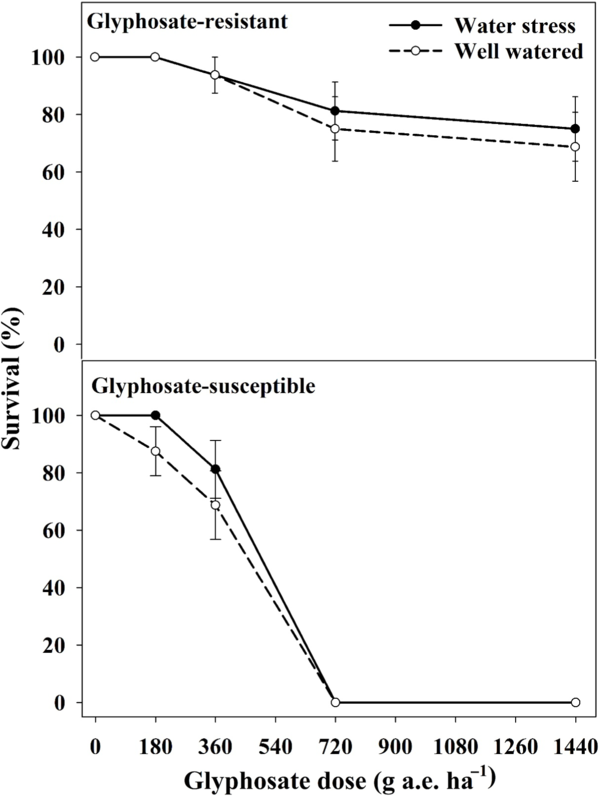
Although there was a significant difference (P < 0.001) between the survival outcomes for different doses of glyphosate and biotypes, it appeared that water treatments did not affect the survival of S. oleraceus (Figure 1). Results showed that an application of 360 g ae ha−1 of glyphosate reduced the survival of the GS biotype of S. oleraceus by more than 19%, and this biotype did not survive at 720 g ae ha−1 under both water levels. The 180 and 360 g ae ha−1 of glyphosate did not affect the survival of the GR biotype, and more than 68% of plants survived at 1,440 g ae ha−1.
Effect of different water levels (well watered: daily irrigation, 100% field capacity; water stressed: irrigation stopped 10 d before glyphosate application, 50% field capacity) and dose on the survival percentage of glyphosate-resistant and glyphosate-susceptible biotypes of Sonchus oleraceus. The vertical bars represent standard error of mean (Study 1).

Biomass
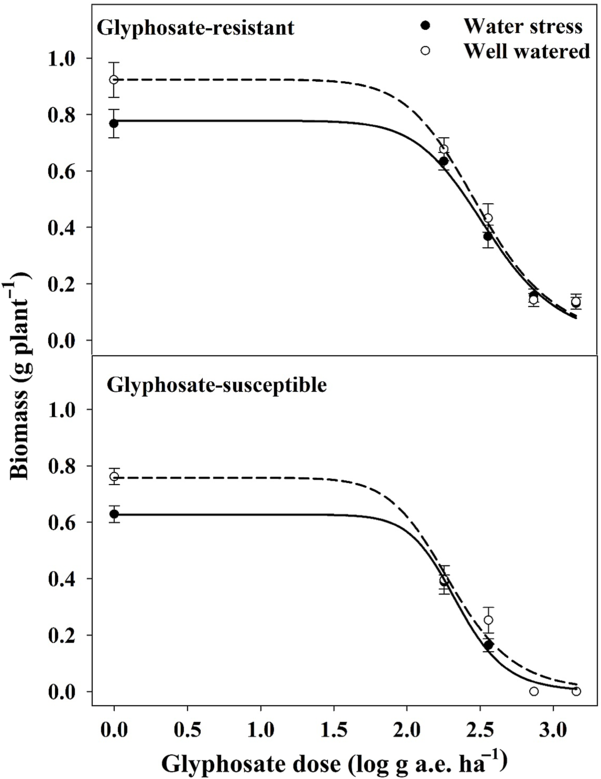
Effects of glyphosate dose, water treatments, biotypes, and the interaction of water treatment and glyphosate dose were significant (P < 0.001) for the biomass of S. oleraceus (Figure 2). The GR biotype produced more biomass than the GS biotype in all treatments, and the highest biomass (0.92 g plant−1) was observed in the well-watered (100% field capacity), nontreated treatment (control). The biomass of the GS biotype was reduced by 50% (ED50 parameter) at 219 and 200 g ae ha−1 glyphosate dose under water-stressed and well-watered conditions, respectively (Table 1). Similarly, the biomass of the GR biotype was reduced by 50% at 363 and 316 g ae ha−1 glyphosate dose under water-stressed and well-watered conditions, respectively.
Effect of different water levels (well watered: daily irrigation, 100% field capacity; water stressed: irrigation stopped 10 d before glyphosate application, 50% field capacity) and dose on the biomass of glyphosate-resistant and glyphosate-susceptible biotypes of Sonchus oleraceus as described by a three-parameter log-logistic model. The vertical bars represent standard error of mean. Parameter estimates of the model are presented in Table 1 (Study 1).

Estimated parameters for a three-parameter logistic model fit to the data of biomass per plant of the glyphosate-resistant (GR) and glyphosate-susceptible (GS) biotypes of Sonchus oleraceus (Study 1).

a The well-watered and water-stressed treatments were daily irrigation (100% field capacity) and irrigation stopped 10 d before glyphosate application (50% field capacity), respectively.
b F = X max/[1+ (logD/logED50) b ]; F is biomass at given glyphosate dose D, X max is the maximum biomass; ED50 is the glyphosate dose needed to reduce the maximum biomass by 50%, and b is the slope.
Study 2. Response of Biotypes of Sonchus oleraceus to Different CO2 Concentrations and Water Treatments
Plant Height and Number of Leaves per Plant
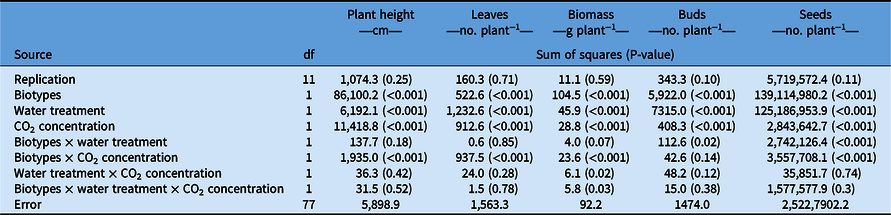
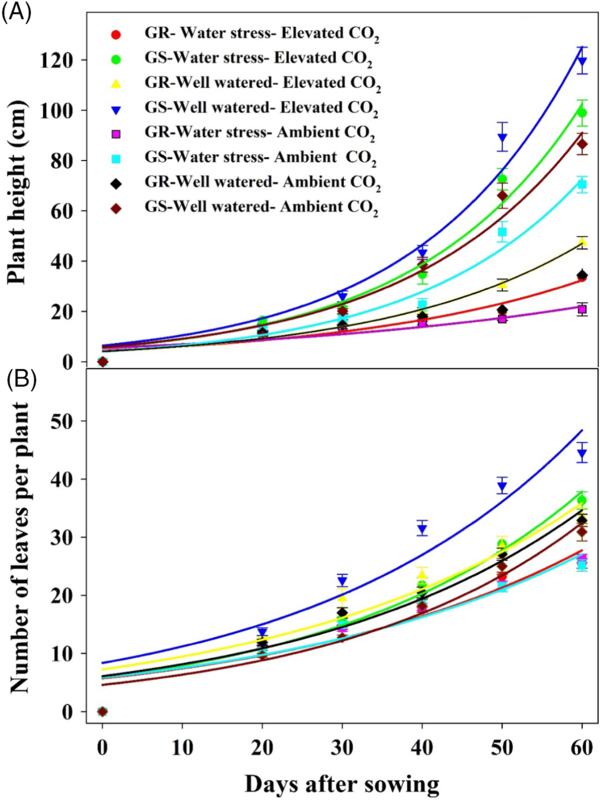
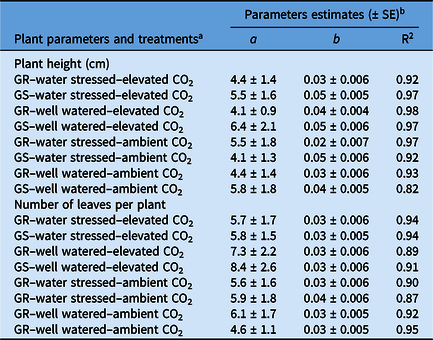
Effects of different CO2 concentrations, water treatments, biotypes, and the interaction of water treatment and biotype were all significant (P < 0.001) in determining the height of S. oleraceus plants (Table 2). The effect of water treatment was more evident in the GS biotype, as evident by the increasing slope (b parameter) of plant height, which was greater for the GS biotype in comparison with the GR biotype (Figure 3A; Table 3). For both biotypes, plants grew taller in well-watered (100% field capacity) conditions and at the higher concentration of CO2, with the GS biotype growing taller than the GR biotype. The GS biotype in the well-watered conditions and the elevated concentration of CO2 (750 ppm) grew 70% taller than plants of the same biotype in the water-stressed (50% field capacity) treatment and the ambient concentration of CO2 (450 ppm) at 60 DAS. The height of the GR biotype in the well-watered treatment increased by 38% with an increased concentration of CO2 measured at 60 DAS.
ANOVAs for various parameters of glyphosate-resistant and glyphosate-susceptible biotypes of Sonchus oleraceus (Study 2).

Effect of different water levels (well watered: continuous subirrigation, 100% field capacity; water stressed: weekly irrigation, 50% field capacity) and CO2 concentrations (elevated: 750 ppm; ambient: 450 ppm) on plant height (A) and number of leaves plant−1 (B) of glyphosate-resistant (GR) and glyphosate-susceptible (GS) biotypes of Sonchus oleraceus. The vertical bars represent standard error of mean. The predicted values are presented in Table 3 (Study 2).

Estimated parameters for the two-parameter exponential growth model fit to the data of plant height and number of leaves per plant of the glyphosate-resistant (GR) and glyphosate-susceptible (GS) biotypes of Sonchus oleraceus (Study 2).

a The well-watered and water-stressed treatments were continuous subirrigation and weekly irrigation, respectively. 750 ppm of CO2 was an elevated level of CO2 concentration (elevated CO2) and 450 ppm was an ambient level of CO2 (ambient CO2).
b F = ae bx , where a is constant, and b represents the slope.
Effects of different CO2 concentrations, water treatments, biotypes, and the interaction of CO2 concentration by biotype were also significant (P < 0.001) for the number of leaves of S. oleraceus (Table 2). Although increases in the CO2 concentration for the GS biotype resulted in a 44% increase in the number of leaves in both water treatments at 60 DAS, increasing the CO2 concentration did not affect the number of leaves of the GR biotype (Figure 3B). Increasing the water level in both CO2 concentrations resulted in more than 23% and 29% increases in the number of leaves in GS and GR biotypes, respectively. The increase in the slope (b parameter) was greater for the GR biotype under both the water-stressed treatment and the ambient CO2 concentration, in comparison with the other treatments (Table 3).
Biomass
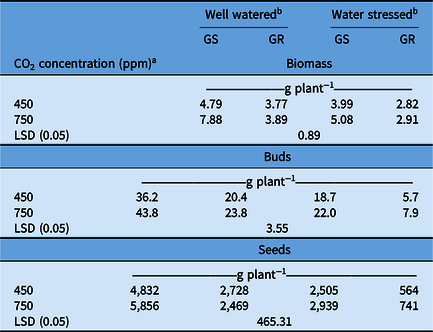
The effects of water treatment, CO2 concentration, biotype, and their interactions were significant (P < 0.001) for S. oleraceus biomass (Table 2). Plants at an elevated CO2 concentration and under well-watered treatment produced 38% and 97% increases in the biomass of the GR and GS biotype, respectively, in comparison with ambient CO2 concentration and the water-stressed treatment (Table 4). For the GS biotype, increases in the CO2 concentration resulted in an increase of biomass by 65% and 27% in the well-watered and water-stressed treatments, respectively. In the GS biotype, the effect of the increased water level on biomass was higher at the elevated CO2 concentration (55%) than at the ambient CO2 concentration (20%). However, the effects of the increase in the water level on biomass of the GR biotype did not differ between the CO2 treatments (averaged 34%).
Effect of different water levels and CO2 concentrations on biomass, number of buds, and seed production of glyphosate-resistant (GR) and glyphosate-susceptible (GS) biotypes of Sonchus oleraceus (Study 2).

a Elevated = 750 ppm; ambient = 450 ppm.
b The continuous subirrigation and weekly irrigation were used for well-watered (continuous subirrigation, 100% field capacity) and water-stressed (weekly irrigation, 50% field capacity) treatments, respectively.
Buds and Number of Seeds per Plant
Effects of CO2 concentration, water treatment, biotype, and the interaction of water level by biotype were significant (P < 0.001) for the number of buds per plant of S. oleraceus (Table 2). The GS biotype produced a greater number of buds and seeds per plant than the GR biotype, and the highest numbers of buds (44 plant−1) and seeds (5,856 plant−1) were observed in the well-watered and elevated CO2 concentration treatments (Table 4). In the GS biotype, increases in the CO2 concentration resulted in an increase in the number of buds per plant by 21% and 18% in the well-watered and water-stressed conditions, respectively. Increases in the CO2 concentration did not affect the number of buds per plant for the GR biotype in either of the two water treatments. For the GS biotype, the increased water level led to an increase of 94% and 99% in the number of buds per plant at ambient (450 ppm) and high (750 ppm) CO2 concentrations, respectively. Similarly, the number of buds in the GR biotype increased by 212% and 258% at the high and ambient CO2 concentrations, respectively.
Effects of water treatment, CO2 concentration, biotype, and their interactions were significant (P < 0.001) for the number of seeds per plant for S. oleraceus (Table 2). The interaction effect of CO2 concentration and water level resulted in 338% and 134% increases in the number of seeds of the GR and GS biotypes, respectively, in comparison with ambient CO2 concentration and the water-stressed treatment (Table 4). The increased level of CO2 concentration only affected the number of seeds of the GS biotype in the well-watered treatment by 21%. In the GS biotype, an increase in the water level resulted in 93% and 99% increases in seed production at the ambient and elevated concentrations of CO2, respectively. The number of seeds per plant increased with the increase in the water level in the GR biotype by 384% and 233% at the ambient and elevated CO2 concentrations, respectively.
It has been well established that environmental factors can influence the uptake and translocation of a herbicide, which can directly influence the herbicide’s efficacy for weed control (Adkins et al. Reference Adkins, Tanpipat, Swarbrick and Boersma1998; Sharma and Singh Reference Sharma and Singh2001; Varanasi et al. Reference Varanasi, Prasad and Jugulam2016). A decline in herbicide efficacy may contribute to weed control failures and selection of rare resistance alleles in natural weed populations. The results from this study indicate that only a little difference (<10%) in the reduction of weed biomass from glyphosate occurred under water-stressed or well-watered conditions, implying that glyphosate efficacy on S. oleraceus biomass is only slightly affected by water levels. In the present study, the biomass of the GS biotype was reduced by more than 67% at 360 g ae ha−1 of glyphosate in comparison with the control treatment, and no plants survived at 720 g ae ha−1 of glyphosate. Although the GR biotype survived by more than 75% at 720 g ae ha−1 in comparison with the control treatment, biomass was reduced by more than 79%. It is important to note that the resistance mechanism of S. oleraceus to glyphosate is not completely understood, so implications drawn from this work would be tentative.
Poorter (Reference Poorter1993) reviewed more than 150 case studies, and reported that the vegetative growth of a range of species (156 plant species), on average, increased by 37% as a result of CO2 enrichment. It has also been observed that the effects of CO2 concentration enrichment on C3 plant growth are more evident through the stimulation of photosynthesis and lower respiration (Amthor Reference Amthor2001; Clements and Ditommaso Reference Clements and Ditommaso2011; Drake et al. Reference Drake, Gonzàlez-Meler and Long1997). Similarly, in our study, the GS biotype of S. oleraceus grew taller with more leaves, buds, biomass, and seeds per plant under the elevated CO2 concentration (750 ppm) in comparison with the ambient CO2 concentration, and no compensatory effect of elevated CO2 in water-stressed conditions was observed. It appears that the response of specific plants species to environmental changes critically depends on the photosynthetic pathway, the balance between sink and source of assimilation, the maternal condition, and the phenotypic and genetic diversity (Bajwa et al. Reference Bajwa, Chauhan and Adkins2018; Hunt et al. Reference Hunt, Hand, Hannah and Neal1991; Pritchard et al. Reference Pritchard, Rogers, Prior and Peterson1999). In the current study, the GR biotype of S. oleraceus grew taller when exposed to elevated CO2 compared with the ambient CO2 concentration, but the number of leaves, buds, and seeds and biomass were not affected. In comparison to the GS biotype, a limited response to the elevated CO2 concentration in the GR biotype could be attributed to genetic and phenotypic differences between biotypes. In this study, significant growth and phenotypic differences were observed even in the well-watered and ambient CO2 concentration. Although the interactions between sink and source were not studied, it seems that the balance of sink and source has been disturbed due to resistance to glyphosate (Fuchs et al. Reference Fuchs, Geiger, Reynolds and Bourque2002).
Water deficit is a major constraint in many cropping regions. Because water has a direct impact on photosynthesis, this deficit may significantly influence plant growth and development (Broughton et al. Reference Broughton, Smith, Duursma, Tan, Payton, Bange and Tissue2017; Qaderi et al. Reference Qaderi, Kurepin and Reid2006; Reddy et al. Reference Reddy, Chaitanya and Vivekanandan2004). In the present study, under the well-watered condition, both biotypes grew taller and produced more leaves, buds, and seeds per plant in comparison with the water-stressed condition. The effect of increasing the water level was seen to be higher in the GR biotype, with a significant increase in biomass and seeds per plant. The observed differences between the GR and GS biotypes could be reasonably attributed to the genotype by environment interaction. This difference in response to climate change in the future may favor survival and fitness of a specific biotype, ultimately impacting the weed seedbank dynamics and invasion (Tang et al. Reference Tang, Xu, Shen and Chen2015; Thompson et al. Reference Thompson, Thill and Shafii1994; Weller et al. Reference Weller, Florentine, Mutti, Jha and Chauhan2019). Furthermore, it was observed that the effect of elevated CO2 on plant growth of both biotypes was reduced under water-stressed conditions. It could be concluded that the limited availability of water in the future could reduce the positive impact of increased CO2 on S. oleraceus.
The results of the study indicated that the effects of climate change (in terms of CO2 concentration and water level) may have a significant impact on the growth and seed production of S. oleraceus. Although other interactions between this weed species and the environment in climate change conditions are unknown, it seems that farmers should be more concerned about seed production and distribution of this plant and thus choose appropriate management techniques to avoid future infestations. It is clear that there are still many knowledge gaps to be explored in this area. These may include studies on the effects of other environmental factors, such as temperature and other atmospheric gases, and biotic and abiotic stresses on this weed’s growth and development, which would ultimately aid in designing resilient and effective long-term weed management strategies.
Acknowledgments
No conflicts of interest have been declared. This research received no specific grant from any funding agency or the commercial or not-for-profit sectors.