Introduction
Otitis media is a leading cause (probably alongside diarrhoea1) of childhood morbidity. It can have a crippling effect on a child's development. Furthermore, it is associated with significant economic and social burdens on the child's family and the healthcare system. For instance, in the USA, between three and five billion US dollars were reportedly spent on otitis media in the 1990s.Reference Marcy, Takata, Chan, Shekelle, Mason and Wachsman2, Reference Rovers, Schilder, Zeilhuis and Rosenfeld3
Otitis media also constitutes one of the clinical infections for which antibiotics are frequently prescribed in developing countries.Reference Morris and Leach4 In a previous study conducted in Nigeria, unorthodox aural toilet practices, which include the use of plant fibres and other non-sterile objects, were identified as significant contributors to the development of otitis media.Reference Nwokoye, Egwari, Coker, Olubi, Ugoji and Nwachukwu5
Age delineation has shown that the highest incidence of acute otitis media occurs in children aged between 6 and 12 months, and infection is less likely to resolve spontaneously (as it does with older children) in this age group.Reference Rovers, Glasziou, Appelman, Burke, McCormick and Damoiseaux6 This underlines the prescription of antibiotics for this age group by many physicians. Nevertheless, otitis media with effusion can affect children of all ages.
Otitis media is asymptomatic and in a small percentage of children it is associated with hearing loss.Reference Rovers, Schilder, Zeilhuis and Rosenfeld3 In contrast, chronic suppurative otitis media (CSOM) occurs as a complication of otitis media with effusion. The prevalence of CSOM in children with hearing loss greater than 40 dB has been reported as being up to 20 per cent in developing countries.Reference Acuin7
The categorisation of otitis media as acute, effusive, chronic and suppurative is based on diagnostic features. Chronic suppurative otitis media is usually painless, with tympanic perforation and discharge. Affected patients report bouts of recurring ear discharge, sore throat, cold and cough.Reference Acuin8–Reference Afolabi, Kodiya, Bakari and Ahmad10 Acute otitis media patients, however, present with pain, with or without otorrhoea. The pain in acute otitis media is mastoidal. In contrast, in acute otitis externa the pain is tragal, and the discharge is foul-smelling, non-mucoid and less profuse.Reference Brobby11 More frequently, infection characterises CSOM; the microbes come from the upper respiratory tract or may be introduced exogenously.Reference Nwokoye, Egwari, Coker, Olubi, Ugoji and Nwachukwu5, Reference Akinpelu and Amusa12
There is controversy regarding whether to prescribe antibiotics for otitis media. It is suggested that antibiotics can prevent progression of acute otitis media to the chronic stage.Reference Berman13–Reference Halter, Kelsberg, Nashelsky and Krist16 However, the unregulated use of antibiotics to treat acute otitis media, in addition to the possibility of predisposing patients to antibiotic resistance, may add to the cost of treatment, especially given that acute otitis media may resolve spontaneously in older children.Reference Rosenfeld and Kay17, Reference Eskin18 A more general consensus is to recommend antibiotics to children younger than six months, as they are more prone to develop complications if the middle ear is infected and the infection becomes chronic.
Whether or not antibiotics are given will depend on accurate diagnosis of the middle-ear infection and assessment of the individual's clinical and bacteriological features. In this paper, we report the occurrence of otitis media syndromes in children and assess the efficacy of different management strategies.
Materials and methods
A total of 212 children aged 6 months to 10 years were examined and treated for otitis media at the Lagos State University Teaching Hospital, Ikeja, Nigeria, in a 13-month study. The six-month-old babies included those aged over five months. Permission to enrol patients into the study was granted by the hospital's research and ethics committee. Admission into the study was dependent on the provision of informed written consent by parents or guardians. Exclusion criteria were cholesteatoma and a history of antibiotic therapy two months prior to presentation at clinic.
Clinical examinations included a review of: patients' past medical history (e.g. history of upper respiratory tract infection, previous diagnosis of otitis media and medication details), routine biodata, the duration of the disease and number of episodes, clinical features, and otoscopic examination findings.
Features used to diagnose acute otitis media were: acute onset with pain and irritation, middle-ear effusion, opacification, and reduced or absent mobility of the eardrum. Acute otitis media was diagnosed as persistent if there was no resolution during antibiotic treatment and cultures were positive for bacteria, or if symptoms recurred within one month of treatment completion (relapse) and cultures were positive for bacteria. A diagnosis of CSOM was dependent on persistent symptoms for at least three months, with a scarred, dull and/or retracted tympanic membrane on otoscopic evaluation. Current and previous painless otorrhoea, possibly accompanied by cold, sore throat and cough, aided the diagnosis of CSOM.Reference Ramakrishnan, Sparks and Berryhill19
In all cases, aural toilet was initiated at the clinic with warm saline solution. The child's care giver was advised to continue the treatment four times daily using dry cotton wool wisps. Initial management of acute otitis media was with paracetamol only (15 mg/kg every 6 hours, for 48 hours). Antibiotics were indicated in patients in whom symptoms persisted; amoxicillin 80 mg/kg/day was given orally in two divided doses for 7–10 days. When infection persisted, treatment options were based on the culture results. In most instances, amoxicillin-clavulanic acid was used.
The CSOM patients were assigned into three treatment groups: an amoxicillin group (n = 27), an amoxicillin-clavulanic acid combination group (n = 27) (empirical groups), and a treatment group based on culture and antibiotic susceptibility test results (n = 28). Clinical responses and bacteriological findings were recorded.
In the culture and antibiotic susceptibility test group, the specimens for culture analysis were collected before antibiotics were given. In the other cases, the specimens were collected on completion of treatment and when infection persisted or relapse occurred. Sterile disposable pipettes (VWR®) were used to aspirate middle-ear fluid that drained into the external auditory canal. Specimens were collected in duplicate for aerobic and anaerobic bacteria culture analyses.Reference Nwokoye, Egwari, Coker, Olubi, Ugoji and Nwachukwu5 Pathogens were identified by conventional microbiological methods.
Results
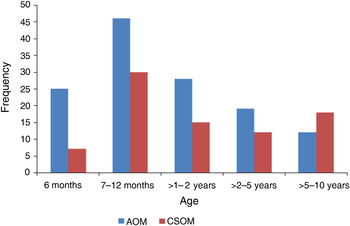
Of the 212 children in the study, 130 (61.3 per cent) presented with symptoms of acute otitis media and 82 (38.7 per cent) were diagnosed with CSOM. The age distribution of the children with otitis media is shown in Figure 1. Twenty-five (19.2 per cent) of the acute otitis media patients were aged 6 months, 46 (35.4 per cent) were 7–12 months, 28 (21.5 per cent) were >1–2 years, 19 (14.6 per cent) were >2–5 years and 12 (9.2 per cent) were >5–10 years. The incidence of acute otitis media in the first year of life was 54.6 per cent. Seven (8.5 per cent) of the CSOM patients were aged 6 months, 30 (36.6 per cent) were 7–12 months, 15 (18.3 per cent) were >1–2 years, 12 (14.6 per cent) were >2–5 years and 18 (22 per cent) were >5–10 years. The incidence of CSOM in the first year of life was 45.1 per cent.
Age distribution of children with otitis media. AOM = acute otitis media; CSOM = chronic suppurative otitis media

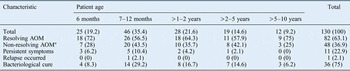
There were 48 (36.9 per cent) cases of non-resolving acute otitis media following paracetamol, while 82 (63.1 per cent) cases of acute otitis media resolved without antibiotic therapy. Non-resolving acute otitis media was more common in infants aged 7–12 months (43.5 per cent) and in children aged >2–5 years (42.1 per cent) than in other age groups. Non-resolving cases were treated empirically with amoxicillin. If the infection persisted, patients were given amoxicillin-clavulanic acid combination treatment (amoxicillin 90 mg/kg/day and clavulanate 6.4 mg/kg/day for 7–10 days depending on the age of the patient) if the culture results indicated sensitivity. Based on responses to paracetamol and antibiotic therapy, 22.9 per cent of the acute otitis media cases were classified as persistent and 2.1 per cent as relapse cases (Table I).
Characterisation and incidence of acute otitis media in children

Data represent numbers (and percentages) of patients. *Defined as symptom persistence or relapse in patients with non-resolving infection during or after antibiotic treatment respectively. AOM = acute otitis media
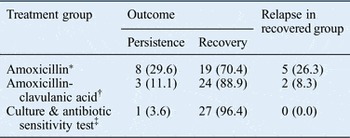
All patients with chronic infections had otorrhoea. Recovery occurred in 19 patients (70.4 per cent) in the amoxicillin group, in 24 patients (88.9 per cent) in the amoxicillin-clavulanic acid group and in 27 patients (96.4 per cent) in the culture and antibiotic susceptibility test group. Relapses were observed only in the amoxicillin group (five cases) and amoxicillin-clavulanic acid group (two cases). Infection persisted in eight, three and one of the patients in the amoxicillin, amoxicillin-clavulanic acid and culture and antibiotic susceptibility test groups, respectively (Table II).
Clinical response to chronic suppurative otitis media treatments

Data represent numbers (and percentages) of patients. *n = 27; †n = 27; ‡n = 28
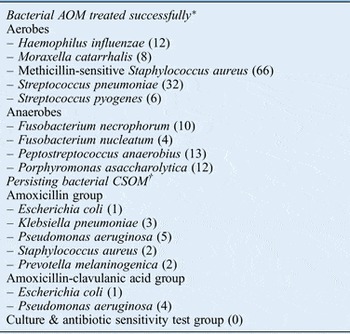
Aerobic and anaerobic bacteria isolated from infectious cases of acute otitis media (for which antibiotics were effective), and the persisting flora in CSOM cases following antibiotic therapy, are given in Table III. Pseudomonas aeruginosa was the most common of the pathogens in those who experienced relapses or in refractory cases.
Summary of data on bacterial aetiology of otitis media

Values in parentheses represent numbers of patients from whom pathogens were isolated. *With amoxicillin or amoxicillin-clavulanic acid. †Relapses or refractory cases. AOM = acute otitis media; CSOM = chronic suppurative otitis media
Discussion
In this study, 54.6 per cent of the acute otitis media cases occurred in the first year of life, thus highlighting a critical group for therapeutic consideration. This becomes more significant when one considers that the trend was maintained in CSOM cases. These findings justify in part why antibiotics should be given to children aged one year or younger who are clinically diagnosed with acute otitis media.Reference Berman13, Reference Alho, Jokinen, Laitakari and Palokangas14
The magnitude of the problem is evident from the study findings of Morris et al.Reference Morris, Leach, Silberberg, Mellon, Wilson and Hamilton20 In their study of Aboriginal children aged 6–30 months, 1 in every 2 children examined had otoscopic signs consistent with suppurative ear disease, and 1 in 4 children had a perforated tympanic membrane. Turner et al. are of the opinion that empirical antibiotic treatment should be given to infants aged less than two months of age, as antibiotic resistance was already present at this age.Reference Turner, Leibovitz, Aran, Piglansky, Raiz and Leiberman21 This is not unrelated to the increase in the production of β-lactamases associated with Moraxella catarrhalis and Haemophilus influenzae, which are amongst the leading pathogens in acute otitis media.Reference Bluestone, Stephenson and Martin22
In our study, the incidence of otitis media was highest in children aged 7–12 months. These findings are consistent with a report published in the late 1980s in which the incidence of otitis media peaked in the second six months of life.Reference Teele, Klein and Rosner23 In that study, 62 per cent of children had one or more episodes of acute otitis media and 17 per cent had three or more episodes in the first year of life. Moreover, 83 per cent of patients aged three years had experienced one or more episodes of acute otitis media and 46 per cent had experienced three or more episodes. It is important to consider that a delay in intervention may result in the associated complications of language difficulty and hearing loss.Reference Acuin7, Reference Roberts, Rosenfeld and Zeisel24
Despite the need to halt the progression of otitis media, available evidence cautions against the unregulated use of antibiotics, as this has contributed to widespread antibiotic resistance amongst clinically pathogenic bacteria.Reference Turner, Leibovitz, Aran, Piglansky, Raiz and Leiberman21, Reference Bluestone, Stephenson and Martin22 This was well illustrated by Nyquist et al., who evaluated the prescription pattern of antibiotics by physicians in the USA for upper respiratory tract infections, cold and bronchitis.Reference Nyquist, Gonzales, Steiner and Sande25 These authors reported that antibiotics were prescribed to 44 per cent of patients with common cold, 46 per cent with upper respiratory tract infections and 75 per cent with bronchitis. It is most significant that children aged zero to four years received 53 per cent of all antibiotic prescriptions, and otitis media accounted for only 30 per cent; this highlights a very disturbing scenario.
• Most otitis media cases are treated empirically with antibiotics
• A high percentage of acute otitis media cases resolve in children aged over one year
• It is recommended that antibiotics are given to children aged less than one year because of associated hearing and speech complications in recurring cases
• In this study, the incidences of acute otitis media and chronic suppurative otitis media were highest in children aged less than one year
• B-lactam antibiotics remain the effective drug of choice
In the present study, otitis media management was restricted to aural toilet, an analgesic and oral antibiotics where necessary. The analgesic used was paracetamol, employed to relieve excruciating pain in patients presenting with acute otitis media. The high rate of resolving acute otitis media in this study supports the concept of ‘watchful waiting’.Reference Morris and Leach4, Reference Rovers, Glasziou, Appelman, Burke, McCormick and Damoiseaux6, Reference Spurling, Del Mar, Dooley and Foxlee26 In other settings, these patients may have received antibiotics for their otitis media, which would not have been beneficial. In the present study, amoxicillin was given as first-line drug. This resulted in bacteriological cure and resolution of symptoms in 75 per cent of cases. Amoxicillin-clavulanic acid was the second-line therapeutic option, with a success rate of 77.1 per cent. This indicates the need for prompt microbiological assessment with antibiotics sensitivity evaluation. This becomes even more imperative when a Gram-negative bacillus such as P aeruginosa is isolated.
Conclusion
The high rate of recurrence in acute otitis media cases, and the success rate of antibiotic therapy for treating both acute otitis media and CSOM, suggest that antibiotics should be considered, especially when culture and sensitivity patterns are established.