




No CrossRef data available.
Article contents
Interpreting patient/informant discrepancies of reported cognitive symptoms in MS
Published online by Cambridge University Press: 26 August 2005
Abstract
Although numerous studies have shown that brain-damaged patients tend to underestimate neuropsychological (NP) impairment when self-ratings are compared to informant ratings, the meaning of such discrepancies is not well studied in multiple sclerosis (MS). We compared patient self- and informant-report questionnaire ratings of NP functioning in 122 MS patients and 37 age- and education-matched normal controls. In addition to completing the Multiple Sclerosis Neuropsychological Questionnaire (MSNQ), participants underwent NP testing and assessment of depression, personality, and neuropsychiatric symptoms. Based on the normal distribution of discrepancy scores, patients were classified according to whether they overestimated or underestimated their cognitive ability, relative to informant ratings. ANOVAs comparing test scores derived from overestimators, underestimators, and accurate estimators were significant for multiple measures of cognitive function, depression, personality, and neuropsychiatric symptoms. Overestimators were characterized by less depression and conscientiousness, and greater degrees of cognitive impairment, euphoric behavioral disinhibition, and unemployment as compared to underestimators. We conclude that patient/informant discrepancy scores on the MSNQ are associated with the aforementioned neuropsychiatric features, and that the MSNQ has potential utility for predicting euphoria and disinhibition syndromes in MS. (JINS, 2005, 11, 574–583.)All authors are from the State University of New York (SUNY) at Buffalo School of Medicine, Department of Neurology, Division of Departmental and Behavioral Neurosciences, and the Jacobs Neurological Institute, Buffalo General Hospital, Buffalo, NY.
Information
- Type
- Research Article
- Information
- Journal of the International Neuropsychological Society , Volume 11 , Issue 5 , September 2005 , pp. 574 - 583
- Copyright
- © 2005 The International Neuropsychological Society
INTRODUCTION
Numerous studies (Anderson & Tranel, 1989; Bogod et al., 2003; Clare, 2004; Fischer et al., 2004; Koss et al., 1993; Kotler-Cope & Camp, 1995; Vogel et al., 2004; Wagner & Cushman, 1994) have shown that brain damaged patients tend to underestimate their degree of cognitive impairment compared with the judgments of family members, and/or with performance on neuropsychological (NP) tests. Patient/informant discrepancy scores have long been interpreted as an objective measure of impaired self-awareness (DeBettignies et al., 1990; Tabert et al., 2002; Van Wielingen et al., 2004). Others have noted that self-reports of cognitive functioning are affected by subjective mood states such as depression (Bruce and Arnett, 2004; Tierney et al., 1996). Patient/informant discrepancy scores have potential clinical utility by identifying awareness deficits or neuropsychiatric syndromes (Benedict et al., 2001a; Fishman et al., 2004; Welleford et al., 1995) in patients with neurological disorders (e.g., Alzheimer's disease, traumatic brain injury, cerebrovascular disease). The goal of the present study was to determine the meaning of patient/informant discrepancy scores on observer measures of cognitive function in multiple sclerosis (MS), as they have rarely been studied in this population.
The famous French neurologist Jean-Martin Charcot (1877) noted that some MS patients have a cheerful or “stupid indifference in reference to all things.” These and other early observations led to the conceptualization of euphoria sclerotica, a syndrome characterized by euphoric mood states, social disinhibition, impulsivity, and emotional lability (Brown & Davis, 1922; Cottrell & Wilson, 1926; Surridge, 1969). More recently, we (Fishman et al., 2004) and others (Diaz-Olavarrieta et al., 1999) employed the Neuropsychiatric Inventory (NPI; Cummings et al., 1994) to evaluate this syndrome in MS. Occurring in roughly 9% of MS patients, it is associated with anger outbursts, disinhibition, and poor social empathy. We have also shown that informant-based decrements in agreeableness and conscientiousness among MS patients are correlated with cognitive impairment (Benedict et al., 2001a), which is present in approximately 50% of cases (Rao et al., 1991). Given the prevalence of cognitive dysfunction/neuropsychiatric syndromes in MS and correlations with informant ratings and patient/informant discrepancy measures may have clinical relevance in the MS population.
In research with other populations, investigators have commonly compared patient self-ratings of NP status to the judgments of informants (Prigatano et al., 1990; Prigatano & Klonoff, 1989; Klonoff et al., 1990; McGlone et al., 1990; Sherer et al., 1998). One of the most frequently used patient/informant discrepancy rating scales in the traumatic brain-injury literature is the Patient Competency Rating Scale (Prigatano & Altman, 1990). Research with this measure has shown that patients with brain injuries tend to overestimate both their cognitive abilities and levels of emotional control compared with informant reports (Gasquoine, 1992; Prigatano & Altman, 1990).
Several methods for assessing poor awareness of NP impairment have emerged in the MS literature. Beatty and Monson (1991) studied the concept of metamemory (knowledge of one's memory abilities) in MS by dividing patients into groups based on NP performance and analyzing metamemory ratings. They found that many MS patients tend to overestimate their memory abilities and concluded that self-reports about memory abilities are likely to be unreliable. Randolph et al. (2001) also studied metamemory in MS by correlating self and informant-report ratings with NP performance. These authors found that MS patients were as accurate, if not more accurate, in their ratings of cognitive performance (r = −.37–.38) than significant others (r = .27). Most recently, Bruce and Arnett (2004) studied metamemory in MS by asking MS patients to estimate cognitive abilities and then subtracting the mean z scores of attention/concentration and verbal memory composites from the mean z score of memory ratings. Cognitive abilities were overestimated by non-depressed patients, underestimated by mildly depressed patients, and accurately estimated by moderately depressed patients. This study raises the possibility that self and informant reports of cognitive capacity in MS are differentially influenced by patient depression.
We know of only one published study examining the validity of patient/informant questionnaire discrepancy scores in MS. Taylor (1990) asked 29 MS patient/informant dyads to complete a questionnaire concerning problems with everyday memory functioning (Sunderland et al., 1983). Patients also completed an extensive battery of NP tests. As expected, the total NP composite score was more strongly correlated with informant than with patient-reported impairments. Furthermore, the degree of patient/informant discrepancy was related to performance on tests thought to reflect frontal lobe functioning. However, this study was limited in several respects: the sample was small, there was no assessment of personality variables or depression, and the questionnaire had not been validated in MS. In addition, the authors did not evaluate normal controls, making it impossible to know if the degree of patient/informant discrepancy in MS patients was abnormal.
Our previous work with the MS Neuropsychological Questionnaire (MSNQ) provides an opportunity for investigation in this area. The MSNQ is a 15-item, disease-specific questionnaire that quantifies perceptions of NP impairment. There are two forms: patient self-report and informant-report. The test has excellent internal consistency and test-retest reliability (Benedict et al., 2003, 2004c). We found that NP impairment is correlated with elevated informant reported deficiencies in everyday activities (r = −.45–−.59), and modestly with patient ratings (r = −.37–−.46). The validity of patient/informant discrepancies on the MSNQ has yet to be investigated. Because there is little research on self-awareness in MS, it remains to be seen if failures to appreciate NP impairment are associated with disinhibition, euphoria, and cognitive impairment, as suggested by the earlier literature.
In this study, we have attempted to replicate and expand upon the work of Taylor (1990), by studying a large sample of MS patients and assessing the meaning of patient/informant MSNQ discrepancy scores. Unlike the aforementioned work, our study included age- and education-matched normal controls, and an extensive test battery that included measures of depression, personality, and neuropsychiatric status, as well as cognitive tests. We also endeavored to determine whether MSNQ discrepancies have ecological validity by comparing scores in employed vs disabled patients. We hypothesized that patients overestimating cognitive ability would have greater degrees of NP impairment, euphoria, psychiatric disturbance, and vocational disability.
METHODS
Research Participants
We studied 122 patients with clinically definite MS (McDonald et al., 2001; Poser et al., 1983) referred for clinical evaluation or participating in studies investigating cognitive correlates of euphoria (Fishman et al., 2004) or the psychometric properties of the MSNQ (Benedict et al., 2003, 2004c). Exclusion criteria were as follows: (1) current or past neurological disorder other than MS, (2) history of psychotic disorder, (3) current psychiatric disorder other than depression or personality change following MS diagnosis, (4) history of developmental disorder (e.g., ADHD, learning disability), (5) history of substance dependence or current abuse, (6) motor or sensory defect that might substantially interfere with cognitive test performance, (7) relapse within 4 weeks of assessment. Mean MS age was 44 (SD = 8.8) years. Mean education was 14.5 (SD = 2.1) years. There were 88 (72%) women and 112 (92%) Caucasians. Mean disease duration was 12.0 (SD = 8) years. Disease course was as follows: 88 relapsing-remitting, 30 secondary progressive, 2 primary progressive, and 2 relapsing progressive, according to established definitions (Lublin & Reingold, 1996). All but 6 patients had undergone quantified neurological examination within six months of the study and Expanded Disability Status Scale (EDSS; Kurtzke, 1983) scores ranged from zero to 8 (MDN = 2.5).
Thirty-seven healthy volunteers served as normal controls. These participants were group-matched to the MS patients on age and education as demonstrated by non-significant parametric statistics (see Table 1). Normal controls were used in this study as a comparison group and as a means to determine the normal range of MSNQ discrepancy scores.
Demographics and test results by diagnostic group

All participants were seen with an informant who provided collateral information. Among patients, 82 (67%) of informants were spouses or domestic partners and 40 (33%) were other family or friends. For the controls, there were 23 (62%) spouses or domestic partners and 14 (38%) other family/friends. The proportion of informants in each category did not differ across group by chi-square test (χ2 = .362, p = .55). During the interview, patients were also categorized in two groups: (1) employed and not disabled, (2) unemployed and disabled. The former required full time employment with no reduction in work hours or productivity. The latter designation necessitated report of being unemployed and objective evidence of vocational disability (e.g., reduction in duties or rank, receipt of disability benefits, prolonged medical leave). There were a number of patients (n = 43) who could not be classified because of either ambiguous reports of disability or unemployment for other reasons (e.g., homemaker, early retirement).
Measures
The MSNQ is a 15-item questionnaire designed to screen for NP impairment in MS clinic attendees (Benedict et al., 2003). Each item inquires about the presence of NP impairment (e.g., “Are you distracted easily?” “Do you laugh or cry with little cause?”). The same items are rated by patients and informants on a 5-point scale, ranging from zero (never, does not occur) to 4 (very often, very disruptive); total scores range from zero to 60. In this study, the total informant score was subtracted from that of the patient to yield a discrepancy score ranging from −60 to +60. Thus, a positive discrepancy score indicated that the patient observed more symptoms than his/her informant, and negative discrepancy scores indicated that the patient observed fewer symptoms.
Patients and controls completed the same NP battery recommended for MS patients (Benedict et al., 2002b). Language was assessed with the Controlled Oral Word Association Test (COWAT; Benton & Hamsher, 1989) during which participants generated as many words as possible beginning with the letters C, F, and L. Sixty seconds were allowed for each trial. The dependent measure was the number of total words generated after three trials. Visual perception and spatial processing were measured with the Judgment of Line Orientation Test (JLO; Benton et al., 1994) during which participants matched the angles of two lines to a model depicting 11 lines. The dependent measure was the number correct of 30 stimuli. New learning and memory were assessed with the second edition of the California Verbal Learning Test (CVLT–II; Delis et al., 2000) and the Brief Visuospatial Memory Test-Revised (BVMT–R; Benedict, 1997). The stimuli for the CVLT–II were 16 words and for the BVMT–R a matrix of six designs presented for 10 s. Material was presented successively during repeated learning trials. After a 20-to-25-min delay, participants were asked to recall the information and then recognize it in a yes/no format. The variables of interest were recall summed across all learning trials (total learning) and words recalled after the 20-to-25-min delay interval (delayed recall). Processing speed and working memory were assessed using adaptations by Rao and colleagues (1991; S.M. Rao & J. Bobholz, personal communication, 2001) of the Paced Auditory Serial Addition Test (PASAT; Gronwall, 1977) and Symbol Digit Modalities Test (SDMT; Smith, 1982). The PASAT (3-s and 2-s presentation rates) required participants to monitor audiotaped digits while adding each consecutive digit to the preceding one. On the SDMT, participants were presented with symbol-number pairings at the top of a 22 × 28 cm page and asked to voice the digit for each unpaired symbol as quickly as possible. The number of correct responses was tabulated for each test. Finally, all patients completed the Wisconsin Card Sorting Test (Heaton, 1997). We used the total number of perseverative responses as the dependent measure.
Depression was quantified using the Beck Depression Inventory (BDI; Beck, 1993). Personality was evaluated with the Agreeableness and Conscientiousness scales derived from the NEO Personality Inventory–Revised (NEO–PI–R). These particular subscales were selected because of their association with executive dysfunction in previous MS research (Benedict et al., 2001a). In accordance with the five-factor model, Agreeableness represented the desire for socialization, honesty, and altruism in relationships. Conscientiousness was the proclivity to be well organized, achievement oriented, and deliberate. Total raw scores derived from these scales were converted to T scores (M = 50, SD = 10), with higher scores indicating a stronger endorsement of each personality trait. As in the case of the MSNQ (see below), a patient-minus-informant discrepancy score was also calculated.
Neuropsychiatric symptoms were measured with the Neuropsychiatric Inventory (NPI; Cummings et al., 1994) a structured interview of informants with ratings of the frequency (range from 1 = not frequent to 4 = very frequent) and severity (1 = mild to 3 = severe) of various symptoms. The frequency and severity scores were multiplied to yield a Total Index score for each symptom. Two NPI factor scores were assessed, based on a recent factor analysis in MS patients (Fishman et al., 2004). Factor 1, called Euphoria Sclerotica, encompassed agitation, euphoria, disinhibition, and irritability. Factor 2, Depression, accounted for dysphoria, anxiety, and apathy. The distress caused by these symptoms according to the caregiver (zero = no distress to 5 = extremely distressing) was also rated, yielding a Total Caregiver Distress score. We also analyzed differences on the NPI Euphoria and Disinhibition scales because these variables were predicted—based on the earlier literature—to be related to impaired awareness.
Procedures
Neuropsychological evaluations were prescribed for consecutive clinical patients or were offered as part of a research protocol. All participants underwent psychiatric screening via clinical interview emphasizing DSM–IV (American Psychiatric Association, 1994) criteria for psychiatric disorders. Research participants provided written informed consents, approved by a university IRB. The MSNQ was administered prior to NP testing. NP tests were administered by trained graduate student assistants or technicians, under the supervision of a board certified neuropsychologist specializing in MS care. Two MS patients did not complete the NEO–PI–R due to time constraints, and 9 normal controls did not complete the NEO–PI–R or NPI because informants were unavailable.
Analysis and Statistical Methods
MSNQ discrepancy scores were calculated for each participant, after which MS patients were categorized into three groups (overestimator, accurate, underestimator) based on the direction and degree of discrepancy between patient and informant reports. Patients at the lower end of the distribution reported fewer deficits than did their informant counterparts, and were classified as overestimators. These overestimators (n = 18) had discrepancy scores less than or equal to 1.5 standard deviations of the normal mean discrepancy score. Those patients underestimating cognitive ability (n = 21) had discrepancy scores greater than or equal to 1.5 standard deviations above the normal mean. A third group, accurate estimators (n = 59), was distinguished from the others by having discrepancies between −1 and +1 standard deviations.
Pearson correlation coefficients were calculated to assess for linear relationships between the MSNQ and NP tests. Group effects (MS vs. control; estimation subgroups) effects were tested with analysis of variance (ANOVA) followed by Student Newman-Keuls post-hoc tests. We then calculated discriminant function models (Wilks's lambda, entrance criterion p < .05, exit criterion p > .10) to determine which specific predictors (all cognitive and neuropsychiatric/personality variables) accounted for most variance in the MSNQ discrepancy designations.
Seventy-nine MS patients were categorized as employed (n = 37) or disabled (n = 42), and the remaining 43 patients had ambiguous vocational status. The frequency of employment versus disability was compared across discrepancy subgroup via chi-square analysis.
Because one of our objectives was to measure deficient awareness of NP impairment, we reasoned that the above analysis should be repeated in a subsample of patients with at least mild cognitive impairment. Z scores based on normal controls were, therefore, calculated for all cognitive variables. Mild impairment was defined as z < −1.5 and severe impairment as z < −2.0. Patients were classified as cognitively impaired if they had at least one severe and one mild impairment, or at least three mild impairments, on NP testing. Of the 122 MS patients, 63 (52%) met this criterion.
Because the study was exploratory, we accepted tests with p < .05 as statistically significant.
RESULTS
For MS patients, the MSNQ informant rating total was significantly correlated (p < .001) with all NP tests (range = −.31 on COWAT to −.47 on SDMT, p < .001 for all variables), whereas the MSNQ self-report total was only significantly correlated with CVLT–Delayed Recall (r = −21, p = .03).
Comparisons of MS Patients and Controls
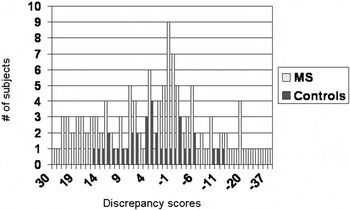
For the MS group, the average MSNQ discrepancy score was 2.1 (SD = 13.2, range −37 to 30). The mean discrepancy score in normal controls was 3.2 (SD = 7.4, range −11 to 16). Skewness of the distribution scores were −.46 for MS patients and .20 for normal controls. Kurtosis was .25 for patients and −.69 for controls. Both distributions (Figure 1) were normal by one sample Kolmogorov-Smirnov test (MS: z = 0.92, p = .370; NC: z = 0.50, p = .961). Mean discrepancy scores did not differ significantly [F(1,157) = 0.2, p = .620].

Frequency distributions of Multiple Sclerosis Neuropsychological Screening Questionnaire (MSNQ) discrepancy scores. For the MS group, the range is −37 to 30. For normal controls, the range is −11 to 16. Both distributions are normal by Kolmogorov-Smirnov test and the mean discrepancy scores did not differ significantly. The graph is oriented so that overestimators (range −37 to −11) of cognitive ability are found in the right tail of the x-axis, and underestimators (range 16 to 30) are in the lower tail of the distribution.
As can be seen in Table 1, normal controls performed significantly better on nearly all NP tests. MS patients were significantly more depressed on the BDI, and on the NPI, MS informants produced higher scores on Factors 1 and 2, and had significantly higher NPI Total and Caregiver Distress Indices. There were no group differences on the NEO–PI.
Comparisons of MSNQ Discrepancy Groups: All MS Patients
Discrepancy scores ranged from 16 to 30 (M = 21.1, SD = 3.6) in the underestimator group, −4 to 11 (M = 2.4, SD = 4.2) in the accurate group, and −37 to −11 (M = −20.6, SD = 7.4) in the overestimator group. Of course, discrepancy scores were significantly different across these subgroups [F(2,95) = 348.4, p < .001]. The subgroups were also well matched on age [F(2,95) = 0.5, p = .621], education [F(2,95) = 1.4, p = .260], and disease duration [F(2,95) = 0.6, p = .565]. While the overestimator group had an equal number of men and women (M/F = 9/9), there were more women in the accurate (20/39) and underestimator (2/19) groups.
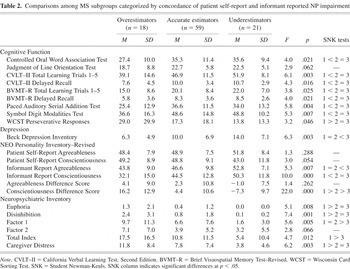
As can be seen in Table 2, one-way ANOVAs revealed significant group differences on eight of nine cognitive tests, BDI, NEO–PI–R and NPI. Post-hoc tests showed that overestimators performed worse than underestimators and accurate estimators on all cognitive tests except JLO and WCST. By contrast, there were no differences between underestimators and accurate estimators on any cognitive test.
Comparisons among MS subgroups categorized by concordance of patient self-report and informant reported NP impairment

The one-way ANOVA for BDI scores was significant, and post-hoc tests revealed significant differences among under- and overestimators, with greater depression found in the former group.
Regarding personality, informants rated underestimators as significantly more agreeable than patients in the other groups. On the NEO–PI–R Conscientiousness scale, a significant effect emerged for the difference score. We found that overestimators rated themselves as more conscientious while informants rated them as low in this domain. Thus, the NEO–PI–R Conscientiousness discrepancy score was marked among overestimating patients.
On the NPI, there were significant differences between overestimators and the other groups on all components except Factor 2. Post-hoc tests revealed that overestimators showed significantly more pathology involving euphoria and disinhibition. Informants for these patients also generated significantly higher Caregiver Distress Index scores.
The discriminant function model predicting accuracy group with all cognitive and neuropsychiatric/personality variables classified 65.3% of patients and retained the following predictors: NEO–PI–R Conscientiousness discrepancy (Lambda = .698, p < .001), BDI (Lambda = .638, p < .001), and NPI Euphoria (Lambda = .585, p < .001).
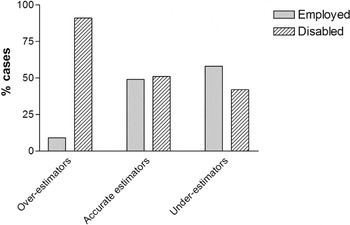
Of the 11 overestimating patients that could be classified as employed or disabled, only 1 was in the former group (Figure 2). In contrast, employed/disabled status was roughly 50% among accurate and underestimating patients. The chi-square analysis was significant (Likelihood Ratio = 7.9, p < .05).

Employment and vocational disability data for 64 MS patients that could be categorized as (1) employed full time, or (2) unemployed and supported by disability benefits. Not included are patients that could not be classified due to ambiguous reports of disability, retirement, homemaker, etc. Graph depicts the percentage of patients within each MSNQ discrepancy subgroup. The proportions differ by chi-square test.
Comparisons of MSNQ Discrepancy Groups: Cognitively Impaired Patients
Among the 63 cognitively impaired MS patients, discrepancy scores ranged from 16 to 30 (M = 20.6, SD = 4.3) among underestimators, −3 to 10 (M = 2.5, SD = 4.0) for accurate estimators, and −37 to −11 (M = −20.4, SD = 7.5) among overestimators. As before, these subgroups were well matched on age [F(2,50) = 1.7, p = .191], education [F(2,50) = 0.8, p = .437], and disease duration [F(2,50) = 1.7, p = .199]. Once again, discrepancy scores were significantly different across these subgroups [F(2,50) = 190.9, p < .001].
Despite limited variability within this cognitively impaired sub-sample, ANOVA revealed a significant group difference on CVLT–II Total Learning [F(2,50) = 4.7, p < .05] and trends toward significance for PASAT [F(2,50) = 3.0, p = .061] and SDMT [F(2,50) = 2.4, p = .098]. Post-hoc tests for CVLT–II Total Learning showed statistical significance between over- and underestimators, with greater cognitive impairment in the former group. Because of power limitations brought about by using only cognitively impaired patients, we explored post-hoc tests for the aforementioned trends and again found greater impairment in the overestimator group (p < .05).
On the BDI, we again found a relationship between higher BDI and under-estimation [F(2,48) = 3.7, p < .05]. Again, there were no significant effects for NEO–PI–R Agreeableness. For Conscientiousness, the patient-report effect was not significant, but overestimating patients had lower informant-report scores [F(2,50) = 5.0, p = .01]. A significant effect for Conscientiousness discrepancy [F(2,50) = 9.4, p < .001] was again characterized by significant post-hoc test differences showing larger discrepancies in the overestimation group.
The effect for NPI Disinhibition [F(2,50) = 3.3, p < .05] was significant and there was a significant trend for Euphoria [F(2,50) = 2.7, p = .074]. Again, overestimators were reported to have had greater degrees of these symptoms than underestimators. The Total and Factor score effects were not statistically significant. There was a significant effect for Caregiver Distress [F(2,50) = 3.6 p < .05].
The discriminant function model classified 43.3% of patients and retained only the NEO–PI–R Conscientiousness discrepancy score (Lambda = .743, p = .010).
All of the 10 cognitively-impaired, overestimating patients were classified as disabled, whereas 4 of 5 underestimators were employed. The chi-square analysis was again significant (Likelihood Ratio = 19.6, p < .001).
DISCUSSION
In order to understand the meaning of patient/informant discrepancy scores in MS, we improved upon the one prior study in this area (Taylor, 1990) by using data obtained from a reliable and valid NP screening questionnaire for MS patients. We found that patients overestimating their cognitive ability were characterized by less depression and conscientiousness, and greater degrees of cognitive impairment, euphoria, disinhibition, and caregiver distress. These psychological and clinical features bear much resemblance to the euphoria sclerotica syndrome described in the classical literature (Charcot, 1877; Cottrell & Wilson, 1926; Finger, 1998), and the correlations are consistent with our prior work showing associations between personality changes and cognitive impairment in MS (Benedict et al., 2001a).
The MSNQ discrepancy score potentially measures two different constructs, depending on the clinical condition of the patient. If the patient is cognitively impaired, normal self-report MSNQs signify impaired awareness of NP impairment. However, if the patient is not impaired, then patient/informant discrepancies reflect poor appraisal of cognitive ability, due perhaps to the patient's mood state or attributional style (Bruce & Arnett, 2004). Therefore, our study assessed the validity of MSNQ discrepancy scores in all MS patients first, and then in a subsample of cognitively-impaired patients. Of course, in the latter subgroup, general linear models assessing the relationship between MSNQ discrepancies and cognitive function were hindered by restriction of range in the dependent variables. Nevertheless, we found that discrepancy scores reflecting overestimation of ability were associated with poor NP test performance in both analyses.
It is noteworthy that patients overestimating cognitive abilities were significantly less depressed than accurate or underestimating patients. This is consistent with previous investigation in other neurological diseases (McGlone et al., 1990; Prigatano & Fordyce, 1986; Tierney et al., 1996). In our work with the MSNQ (Benedict et al., 2003, 2004c), we have consistently found correlations between the self-report MSNQ and various measures of depression, and it is long established that memory complaints are strongly correlated with depressed mood in healthy persons (Kahn, 1975; Riege, 1982). The cause of this relationship is unknown. It may be that as one becomes more aware of deficiency, (s)he develops reactive dysphoria. Conversely, the phenomenon may merely represent the well-established negative report bias that often accompanies depressive disorder (Beck et al., 1987; Corwin et al., 1990).
In future work, we may be inclined to investigate correlations between MSNQ discrepancy scores and brain MRI pathology. Overestimators were more impaired on NP testing, and some of the same tests employed in this study have previously shown correlations with MRI measures of lesion burden and atrophy (Bermel et al., 2002; Christodoulou et al., 2003; Benedict et al., 2004a, 2004b; Rao et al., 1989). Thus, overestimators may be a unique subgroup of MS patients who are prone to cognitive and neuropsychiatric disorders that reflect greater brain pathology. While MRI/NP correlative studies are only beginning to tackle the problem of regional specificity, there are a few noteworthy studies. Arnett et al. (1994) reported that patients with focal white matter lesions primarily localized in the frontal lobes were more apt to fail the WCST than patients with more posterior lesions. Similar findings were reported by our group using a rater-dependent scale of atrophic change (Benedict et al., 2002a). We found that measures of new learning and executive function were more strongly correlated with superior frontal atrophy than atrophy in other brain regions. While we have shown that euphoria and disinhibition are correlated with general MRI measures (Benedict et al., 2004b), to our knowledge, there has been no study of correlations between indices of regional brain pathology and either symptom-report discrepancies or neuropsychiatric disorder in MS. With further developments of reliable, automated, quantified techniques such as voxel based morphometry or parcellation, such investigation will become more tenable. Our tentative hypothesis is that overestimation of ability, or lack of insight in MS, are caused by progressive diffuse brain pathology with disproportionate atrophy of the prefrontal cortex.
Turning to the psychosocial realm, MSNQ discrepancies may identify patients who are vulnerable from the standpoint of quality of life and employability. In this study, caregivers of overestimators reported much greater psychological distress, and the patients themselves were more likely to be vocationally disabled. In our experience with euphoria sclerotica patients (Benedict et al., 2001b), we have found that many lack social empathy and consequently behave in ways that hinder the management of instrumental activities of daily living. Such behavior would naturally become frustrating for caretakers, leading potentially to feelings of helplessness and/or distress as the problem increases in frequency and severity (Knight et al., 1997). Moreover, unemployment leads to financial distress and more time at home with caregivers.
Although a potential criticism of our study is its reliance on informant reports of cognitive function as a surrogate measure of behavior, one must keep in mind that the purpose of the present study was to determine the meaning of patient–informant discrepancy scores. Using the MSNQ, such discrepancy measures are readily obtainable in the clinic setting. While the validity of such informant report questionnaire responses is demonstrated in MS (Benedict et al., 2003), and other conditions (Koss et al., 1993; McGlone et al., 1990; Sunderland et al., 1983), it falls short of actual observation and could be subject to report bias on the part of informants. That being said, the informants in this study had known their respective patients for approximately 27 years, had five to six contacts per week, and none of the groups differed significantly on these variables. We also would have preferred to have had a larger sample of patients from whom to derive subgroups of cognitively impaired patients. A strength of this work is the use of the MSNQ, which has been shown to be reliable and valid in prior studies (Benedict et al., 2003, 2004c). Utilization of previously derived NPI factor scores (Fishman et al., 2004) as dependent variables rather than all 10 domain scores helped avoid additional risk of type 1 error.
An additional caveat is that the underestimator group had a higher proportion of women than the overestimator group. As this group also had significantly higher BDI scores, it is possible that gender, depression, or an interaction of the two mediated underestimation of NP functioning. It is well known that the prevalence of major depressive disorder is higher in women, in both the general population (Coryell et al., 1992; Kessler et al., 1992) and MS (Patten et al., 2000, 2003a, 2003b; Sadovnick et al., 1996). It should be noted however, that the cited MS studies include higher numbers of female MS patients, as women are more likely to develop this disease (Duquette et al., 1992). In our study, small and unequal cell sizes prohibited a factorial design that would have permitted statistical analysis of the effects of gender, depression and their interaction. Future prospective studies will be needed to further investigate the role of gender in the under- and overestimation of NP functioning in MS.
In sum, we find that discrepancies between self- and informant-reported cognitive ability can identify MS patients who are prone to greater degrees of neuropsychiatric disorder. Our data are based on the MSNQ, which can be administered quickly during routine clinical appointments. Identification of these patients is important clinically, as impaired awareness (or anosognosia) interferes with psychosocial function and may hinder treatment. Future research will investigate if MSNQ discrepancy scores can reliably predict imaging abnormalities or occupational therapy and vocational rehabilitation outcomes in MS.
ACKNOWLEDGMENTS
We acknowledge Drs. David Shucard, Janet Shucard, and David Schretlen for their review of this manuscript prior to submission. This research was supported, in part, by an unrestricted educational grant from Biogen Idec.
References
REFERENCES
American Psychiatric Association.
(1999).
Diagnostic and Statistic Manual of Mental Disorders, 4th edition.
(1994).
Washington, DC:
American Psychiatric Association.
Anderson, S.W. &
Tranel, D.
(1989).
Awareness of disease states following cerebral infarction, dementia,
and head trauma: Standardized assessment.
Clinical Neuropsychologist,
3,
327–339.Google Scholar
Arnett, P.A.,
Rao, S.M.,
Bernardin, L.,
Grafman, J.,
Yetkin, F.Z., &
Lobeck, L.
(1994).
Relationship between frontal lobe lesions and Wisconsin Card Sorting
Test performance in patients with multiple sclerosis.
Neurology,
44,
420–425.Google Scholar
Beatty, W.W. &
Monson, N.
(1991).
Metamemory in multiple sclerosis.
Journal of Clinical and Experimental Neuropsychology,
13,
309–327.Google Scholar
Beck, A.T.
(1993).
Beck Depression Inventory.
San Antonio, TX:
Psychological Corporation.
Beck, A.T.,
Rush, A.J.,
Shaw, B.F., &
Emery, G.
(1987).
Cognitive Therapy of Depression.
New York:
Guilford Publications, Inc.
Benedict, R.H.B.
(1997).
Brief Visuospatial Memory Test–Revised: Professional
manual.
Odessa, FL:
Psychological Assessment Resources, Inc.
Benedict, R.H.B.,
Bakshi, R.,
Simon, J.H.,
Priore, R.,
Miller, C., &
Munschauer, F.
(2002a).
Frontal cortex atrophy predicts cognitive impairment in multiple
sclerosis.
Journal of Neuropsychiatry & Clinical Neurosciences,
14,
44–51.Google Scholar
Benedict, R.H.B.,
Carone, D., &
Bakshi, R.
(2004b).
Correlating brain atrophy with cognitive dysfunction, mood
disturbances, and personality disorder in multiple sclerosis.
Journal of Neuroimaging,
10,
675–678.Google Scholar
Benedict, R.H.B.,
Cox, D.,
Thompson, L.L.,
Foley, F.W.,
Weinstock-Guttman, B., &
Munschauer, F.
(2004c).
Reliable screening for neuropsychological impairment in MS.
Multiple Sclerosis.
10
675–678Google Scholar
Benedict, R.H.B.,
Fischer, J.S.,
Archibald, C.J.,
Arnett, P.A.,
Beatty, W.W.,
Bobholz, J.,
Chelune, G.J.,
Fisk, J.D.,
Langdon, D.W.,
Caruso, L.,
Foley, F.,
LaRocca, N.,
Vowels, L.,
Weinstein, A.,
DeLuca, J.,
Rao, S.M., &
Munschauer, F.
(2002b).
Minimal neuropsychological assessment of MS patients: A consensus
approach.
Clinical Neuropsychologist,
16,
381–397.Google Scholar
Benedict, R.H.B.,
Munschauer, F.E.,
Linn, R.,
Miller, C.,
Foley, F.W., &
Jacobs, L.D.
(2003).
Screening for multiple sclerosis cognitive impairment using a
self-administered 15-item questionnaire.
Multiple Sclerosis,
9,
95–101.Google Scholar
Benedict, R.H.B.,
Priore, R.L.,
Miller, C.,
Munschauer, F., &
Jacobs, L.
(2001a).
Personality disorder in multiple sclerosis correlates with cognitive
impairment.
Journal of Neuropsychiatry & Clinical Neurosciences,
13,
70–76.Google Scholar
Benedict, R.H.B.,
Shapiro, A.,
Priore, R.L.,
Miller, C.,
Munschauer, F.E., &
Jacobs, L.D.
(2001b).
Neuropsychological counseling improves social behavior in
cognitively-impaired multiple sclerosis patients.
Multiple Sclerosis,
6,
391–396.Google Scholar
Benedict, R.H.,
Weinstock-Guttman, B.,
Fishman, I.,
Sharma, J.,
Tjoa, C.W., &
Bakshi, R.
(2004a).
Prediction of neuropsychological impairment in multiple sclerosis:
Comparison of conventional magnetic resonance imaging measures of atrophy
and lesion burden.
Archives of Neurology,
61,
226–230.Google Scholar
Benton, A.L. &
Hamsher, K.
(1989).
Multilingual Aphasia Examination.
Iowa City, IA:
AJA Associates.
Benton, A.L.,
Sivan, A.B., &
Hamsher, K.
(1994).
Contributions to Neuropsychological Assessment
(2nd ed.).
New York:
Oxford University Press.
Bermel, R.A.,
Bakshi, R.,
Tjoa, C.,
Puli, S.R., &
Jacobs, L.
(2002).
Bicaudate ratio as a magnetic resonance imaging marker of brain
atrophy in multiple sclerosis.
Archives of Neurology,
59,
275–280.Google Scholar
Bogod, N.M.,
Mateer, C.A., &
MacDonald, S.W.
(2003).
Self-awareness after traumatic brain injury: A comparison of
measures and their relationship to executive functions.
Journal of the International Neuropsychological Society,
9,
450–458.Google Scholar
Brown, S. &
Davis, T.K.
(1922).
The mental symptoms of multiple sclerosis.
Archives of Neurology and Psychiatry,
7,
629–634.Google Scholar
Bruce, J.M. &
Arnett, P.A.
(2004).
Self-reported everyday memory and depression in patients with
multiple sclerosis.
Journal of Clinical and Experimental Neuropsychology,
26,
200–214.Google Scholar
Charcot, J.M.
(1877).
Lectures on the Diseases of the Nervous System.
London:
New Sydenham Society.
Christodoulou, C.,
Krupp, L.B.,
Liang, Z.,
Huang, W.,
Melville, P.,
Roque, C.,
Scherl, W.F.,
Morgan, T.,
MacAllister, W.S.,
Li, L.,
Tudorica, L.A.,
Li, X.,
Roche, P., &
Peyster, R.
(2003).
Cognitive performance and MR markers of cerebral injury in
cognitively impaired MS patients.
Neurology,
60,
1793–1798.Google Scholar
Clare, L.
(2004).
Awareness in early-stage Alzheimer's disease: A review of
methods and evidence.
British Journal of Clinical Psychology,
43,
177–196.Google Scholar
Corwin, J.,
Peselow, E.,
Feenan, K.,
Rotrosen, J., &
Fieve, R.
(1990).
Disorders of decision bias in affective disease: An effect of
beta-adrenergic dysfunction?
Biological Psychiatry,
27,
813–833.Google Scholar
Coryell, W.,
Endicott, J., &
Keller, M.
(1992).
Major depression in a nonclinical sample. Demographic and clinical
risk factors for first onset.
Archives of General Psychiatry,
49,
117–125.Google Scholar
Cottrell, S.S. &
Wilson, S.A.K.
(1926).
The affective symptomatology of disseminated sclerosis.
Journal of Neurology and Psychopathology,
1–30.Google Scholar
Cummings, J.L.,
Mega, M.,
Gray, K.,
Rosenberg-Thompson, S.,
Carusi, D.A., &
Gornbein, J.
(1994).
The Neuropsychiatric Inventory: Comprehensive assessment of
psychopathology in dementia.
Neurology,
44,
2308–2314.Google Scholar
DeBettignies, B.H.,
Mahurin, R.K., &
Pirozzolo, F.J.
(1990).
Insight for impairment in independent living skills in
Alzheimer's disease and multi-infarct dementia.
Journal of Clinical and Experimental Neuropsychology,
12,
355–363.Google Scholar
Delis, D.C.,
Kramer, J.H.,
Kaplan, E., &
Ober, B.A.
(2000).
California Verbal Learning Test manual: Second Edition, Adult
Version.
San Antonio, TX:
Psychological Corporation.
Diaz-Olavarrieta, C.,
Cummings, J.L.,
Velazquez, J., &
Cadena, C.G.
(1999).
Neuropsychiatric manifestations of multiple sclerosis.
Journal of Neuropsychiatry and Clinical Neurosciences,
11,
51–57.Google Scholar
Duquette, P.,
Pleines, J.,
Girard, M.,
Charest, L.,
Senecal-Quevillon, M., &
Masse, C.
(1992).
The increased susceptibility of women to multiple sclerosis.
Canadian Journal of Neurological Sciences,
19,
466–471.Google Scholar
Fischer, S.,
Trexler, L.E., &
Gauggel, S.
(2004).
Awareness of activity limitations and prediction of performance in
patients with brain injuries and orthopedic disorders.
Journal of the International Neuropsychological Society,
10,
190–199.Google Scholar
Fishman, I.,
Benedict, R.H.B.,
Bakshi, R.,
Priore, R., &
Weinstock-Guttman, B.
(2004).
Construct validity and frequency of euphoria sclerotica in multiple
sclerosis.
Journal of Neuropsychiatry & Clinical Neurosciences,
16,
350–356.Google Scholar
Gasquoine, P.G.
(1992).
Affective state and awareness of sensory and cognitive effects after
closed head injury.
Neuropsychology,
6,
187–196.Google Scholar
Gronwall, D.M.A.
(1977).
Paced auditory serial addition task: A measure of recovery from
concussion.
Perceptual and Motor Skills,
44,
367–373.Google Scholar
Heaton, R.
(1997).
A manual for the Wisconsin Card Sorting Test.
Odessa:
FL: Psychological Assessment Resources.
Kahn, R.L.
(1975).
Memory complaint and impairment in the aged: The effect of
depression and altered brain function.
Archives of General Psychiatry,
32,
1569–1573.Google Scholar
Kessler, H.R.,
Cohen, R.A.,
Lauer, K., &
Kausch, D.F.
(1992).
The relationship between disability and memory dysfunction in
multiple sclerosis.
International Journal of Neuroscience,
62,
17–34.Google Scholar
Klonoff, P.S.,
O'Brien, K.P.,
Prigatano, G.P., &
Chiapello, D.A.
(1990).
Cognitive retraining after traumatic brain injury and its role in
facilitating awareness.
Journal of Head Trauma Rehabilitation,
4,
37–45.Google Scholar
Knight, R.G.,
Devereux, R.C., &
Godfrey, H.P.D.
(1997).
Psychosocial consequences of caring for a spouse with multiple
sclerosis.
Journal of Clinical and Experimental Neuropsychology,
19,
7–19.CrossRefGoogle Scholar
Koss, E.,
Patterson, M.B.,
Ownby, R.,
Stuckey, J.C., &
Whitehouse, P.J.
(1993).
Memory evaluation in Alzheimer's disease. Caregivers'
appraisals and objective testing.
Archives of Neurology,
50,
92–97.Google Scholar
Kotler-Cope, S. &
Camp, C.J.
(1995).
Anosognosia in Alzheimer disease.
Alzheimer Disease & Associated Disorders,
9,
52–56.Google Scholar
Kurtzke, J.F.
(1983).
Rating neurologic impairment in multiple sclerosis: An expanded
disability status scale (EDSS).
Annals of Neurology,
13,
227–231.Google Scholar
Lublin, F.D. &
Reingold, S.C.
(1996).
Defining the clinical course of multiple sclerosis: Results of an
international survey. National Multiple Sclerosis Society (USA) Advisory
Committee on Clinical Trials of New Agents in Multiple Sclerosis.
Neurology,
46,
907–911.Google Scholar
McDonald, W.I.,
Compston, A.,
Edan, G.,
Goodkin, D.E.,
Hartung, H.,
Lublin, F.,
McFarland, H.F.,
Paty, D.W.,
Polman, L.H.,
Reingold, S.C.,
Sandberg-Wolheim, M.,
Sibley, W.,
Thompson, A.,
van der Noort, S., &
Weinshenker, B.Y.
(2001).
Recommended diagnostic criteria for multiple sclerosis: Guidelines
from the international panel on the diagnosis of multiple
sclerosis.
Annals of Neurology,
50,
121–127.Google Scholar
McGlone, J.,
Gupta, S.,
Humphrey, D.,
Oppenheimer, S.,
Mirsen, T., &
Evans, D.R.
(1990).
Screening for early dementia using memory complaints from patients
and relatives.
Archives of Neurology,
47,
1189–1193.Google Scholar
Patten, S.B.,
Beck, C.A.,
Williams, J.V.,
Barbui, C., &
Metz, L.M.
(2003a).
Major depression in multiple sclerosis: A population-based
perspective.
Neurology,
61,
1524–1527.Google Scholar
Patten, S.B.,
Fridhandler, S.,
Beck, C.A., &
Metz, L.M.
(2003b).
Depressive symptoms in a treated multiple sclerosis cohort.
Multiple Sclerosis,
9,
616–620.Google Scholar
Patten, S.B.,
Metz, L.M., &
Reimer, M.A.
(2000).
Biopsychosocial correlates of lifetime major depression in a
multiple sclerosis population.
Multiple Sclerosis,
6,
115–120.Google Scholar
Poser, C.M.,
Paty, D.W.,
Scheinberg, L.,
McDonald, W.I.,
Davis, F.A.,
Ebers, G.C.,
Johnson, K.P.,
Sibley, W.A.,
Silberberg, D.H., &
Tourtellotte, W.W.
(1983).
New diagnostic criteria for multiple sclerosis: Guidelines for
research protocols.
Annals of Neurology,
13,
655–661.Google Scholar
Prigatano, G.P. &
Altman, I.M.
(1990).
Impaired awareness of behavioral limitations after traumatic brain
injury.
Archives of Physical Medicine & Rehabilitation,
71,
1058–1064.Google Scholar
Prigatano, G.P.,
Altman, I.M., &
O'Brien, K.P.
(1990).
Behavioral limitations that traumatic-brain-injured patients tend to
underestimate.
Clinical Neuropsychologist,
4,
163–176.Google Scholar
Prigatano, G.P. &
Fordyce, D.J.
(1986).
The neuropsychological rehabilitation program at Presbyterian
Hospital. In
G.P. Prigatano (Ed.),
Neuropsychological rehabilitation after brain injury (pp.
96–118).
Baltimore:
John Hopkins University Press.
Prigatano, G.P. &
Klonoff, P.S.
(1989).
Psychotherapy and neuropsychological assessment after brain
injury.
Journal of Head Trauma Rehabilitation,
3
45–56.Google Scholar
Randolph, J.J.,
Arnett, P.A., &
Higginson, C.I.
(2001).
Metamemory and tested cognitive functioning in multiple
sclerosis.
Clinical Neuropsychologist,
15,
357–368.Google Scholar
Rao, S.M.
(1991).
A Manual for the Brief, Repeatable Battery of Neuropsychological
Tests in Multiple Sclerosis.
Rao, S.M.,
Leo, G.J.,
Bernardin, L., &
Unverzagt, F.
(1991).
Cognitive dysfunction in multiple sclerosis. I. Frequency, patterns,
and prediction.
Neurology,
41,
685–691.Google Scholar
Rao, S.M.,
Leo, G.J.,
Haughton, V.M.,
Aubin-Faubert, P.S., &
Bernardin, L.
(1989).
Correlation of magnetic resonance imaging with neuropsychological
testing in multiple sclerosis.
Neurology,
39,
161–166.Google Scholar
Riege, W.H.
(1982).
Self-report and tests of memory aging.
Clinical Gerontologist,
1,
23–36.Google Scholar
Sadovnick, A.D.,
Remick, R.A.,
Allen, J.,
Swartz, E.,
Yee, I.M.L.,
Eisen, K.,
Farquhar, R.,
Hashimoto, S.A.,
Horge, J.,
Kastruckoff, L.F.,
Morrison, W.,
Nelson, J.,
Oger, J., &
Paty, D.W.
(1996).
Depression and multiple sclerosis.
Neurology,
46,
628–632.Google Scholar
Sherer, M.,
Boake, C.,
Levin, E.,
Silver, B.V.,
Ringholz, G., &
High_Jr., W.M.
(1998).
Characteristics of impaired awareness after traumatic brain
injury.
Journal of the International Neuropsychological Society,
4,
380–387.Google Scholar
Smith, A.
(1982).
Symbol Digit Modalities Test: Manual.
Los Angeles, CA:
Western Psychological Services.
Sunderland, A.,
Harris, J.E., &
Baddeley, A.D.
(1983).
Do laboratory tests predict everyday memory? A neuropsychological
study.
Journal of Verbal Learning and Verbal Behavior,
22,
341–357.Google Scholar
Surridge, D.
(1969).
An investigation into some psychiatric aspects of multiple
sclerosis.
British Journal of Psychiatry,
115,
749–764.Google Scholar
Tabert, M.H.,
Albert, S.M.,
Borukhova-Milov, L.,
Camacho, Y.,
Pelton, G.,
Liu, X.,
Stern, Y., &
Devanana, D.P.
(2002).
Functional deficits in patients with mild cognitive impairment:
Prediction of AD.
Neurology,
58,
758–764.Google Scholar
Taylor, R.
(1990).
Relationships between cognitive test performance and everyday
cognitive difficulties in multiple sclerosis.
British Journal of Clinical Psychology,
29,
251–253.Google Scholar
Tierney, M.C.,
Szalai, J.P.,
Snow, W.G., &
Fisher, R.H.
(1996).
The prediction of Alzheimer disease. The role of patient and
informant perceptions of cognitive deficits.
Archives of Neurology,
53,
423–427.Google Scholar
Van Wielingen, L.E.,
Tuokko, H.A.,
Cramer, K.,
Mateer, C.A., &
Hultsch, D.F.
(2004).
Awareness of financial skills in dementia.
Aging and Mental Health,
8,
374–380.Google Scholar
Vogel, A.,
Stokholm, J.,
Gade, A.,
Andersen, B.B.,
Hejl, A.M., &
Waldemar, G.
(2004).
Awareness of deficits in mild cognitive impairment and
Alzheimer's disease: Do MCI patients have impaired insight?
Dementia & Geriatric Cognitive Disorders,
17,
181–187.Google Scholar
Wagner, M.T. &
Cushman, L.A.
(1994).
Neuroanatomic and neuropsychological predictors of unawareness of
cognitive deficit in the vascular population.
Archives of Clinical Neuropsychology,
9
57–69.Google Scholar
Welleford, E.A.,
Harkins, S.W., &
Taylor, J.R.
(1995).
Personality change in dementia of the Alzheimer's type:
Relations to caregiver personality and burden.
Experimental Aging Research,
21,
295–314.Google Scholar

Demographics and test results by diagnostic group
Frequency distributions of Multiple Sclerosis Neuropsychological Screening Questionnaire (MSNQ) discrepancy scores. For the MS group, the range is −37 to 30. For normal controls, the range is −11 to 16. Both distributions are normal by Kolmogorov-Smirnov test and the mean discrepancy scores did not differ significantly. The graph is oriented so that overestimators (range −37 to −11) of cognitive ability are found in the right tail of the x-axis, and underestimators (range 16 to 30) are in the lower tail of the distribution.
Comparisons among MS subgroups categorized by concordance of patient self-report and informant reported NP impairment
Employment and vocational disability data for 64 MS patients that could be categorized as (1) employed full time, or (2) unemployed and supported by disability benefits. Not included are patients that could not be classified due to ambiguous reports of disability, retirement, homemaker, etc. Graph depicts the percentage of patients within each MSNQ discrepancy subgroup. The proportions differ by chi-square test.
 You have
Access
- 91
- Cited by