Gabriel Byng has been studying the rebuilding of English churches from the late fourteenth to the early sixteenth centuries. His approach is that of an economic historian and his sources are surviving building contracts and accounts. He conveys a great deal of hard-won and useful information.
He does also make a claim, even if it is sometimes a little fuzzy at the edges. At its heart lies, as Byng says, ‘a simple but important contention that the financing of parish church architecture was closely tied to the social fabric of medieval parishes, and was run and financed by comparatively wealthy groups of peasants or townsfolk’ who adopted various ways of managing projects.Footnote 1 Importantly, Byng is also at pains to diminish the number of gentry who single-handedly financed major building projects, questioning the assumption that tombs, armorial bearings, inscriptions and wills show that they did. ‘The parish gentry could be active in managing projects but their contributions were generally limited by their incomes, which probably made building work less affordable to them than it did to the upper peasantry acting collectively.’Footnote 2 ‘Only the wealthiest gentry families were able to finance major building projects on their own.’Footnote 3 ‘Church building was a relative luxury, beyond the resources of all but a small minority of the gentry.’Footnote 4 Standing back from his detailed findings, he concludes that ‘models where activities … were divided between a central lordly patron and a larger group of parishioners including wealthy individuals as well as communal officers and sources were probably not uncommon.’Footnote 5 He goes on to question the typicality of patrons such as the Sussex knight Sir William de Etchingham: Byng wants emphatically to play down the role of individual founders and funders.Footnote 6
In support, Byng offers two key examples. Both are treated in his recent book Church Building and Society in the Later Middle Ages (2017), itself a recasting of his PhD thesis, and each was earlier the subject of a scholarly paper: John Bolney (1485–1557) at Bolney, Sussex, published in Sussex Archaeological Collections,Footnote 7 and Sir William Butler at Biddenham, Buckinghamshire, published in The Antiquaries Journal.Footnote 8 What Byng wishes to question in both cases is the primary role of the lord, Bolney at Bolney, Butler at Biddenham. Instead he claims that the evidence from Biddenham and Bolney points to collaboration between lord and the wealthier parishioners. That claim is not convincingly articulated.
This critique deliberately focuses on the churches at Biddenham and Bolney simply because that is what Byng has done. I deliberately draw out what the sources, documentary and material, reveal about those two churches, but I take care to assess them in their own terms, without imposing upon them frameworks of interpretation drawn from elsewhere. Contextualisation is vital, but if attempted too soon it can too readily turn into an exercise in confirming what we think we already know. I hope in time to prepare a comprehensive national study exploring, as far as the surviving sources allow, the relative parts played by gentry and parishioners in the rebuilding and enhancement of churches. But here this paper sets itself the more modest immediate aim of showing what did, and what did not, happen at Biddenham and Bolney. As Byng has drawn grand conclusions from these two case studies, and sought to apply them more widely, it is important that such claims are now subjected to scrutiny.
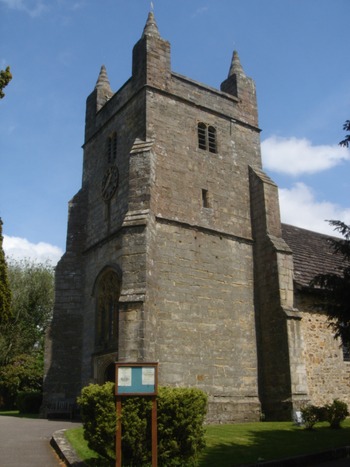
Byng’s first key study is that of the rebuilding of the west tower at Bolney, Sussex (fig 1).Footnote 9 Here the great difficulty is that Byng’s source does not support his overall claim. And the puzzle is that in places Byng even seems to recognise that – though not to the point of modifying his claim. That crucial source is a set of accounts relating to the construction of the tower in 1536–7, now to be found in West Sussex Record Office, Par 252/9/1.Footnote 10 They are not conventional churchwardens’ accounts. They include records of payments by its compiler to the churchwardens, as well as receipts from the churchwardens. The compiler refers to himself in the first person but to the churchwardens in the third person. There is also a fragment of what clearly are churchwardens’ accounts, very different in format, possibly fair copies for the annual audit.
The west tower of St Mary Magdalene’s Church, Bolney. Photograph: The Voice of Hassocks, CC image.

The compiler’s accounts lack headings and are written in a deteriorating and poorly legible hand. The words ‘I, John Bolney’ show beyond doubt that the compiler of these accounts was John Bolney, lord of the manor. They were evidently private accounts relating to the building of the tower. That in itself shows that Bolney’s interest was considerable, detailed and continuing: he kept the accounts up-dated weekly.
Bolney’s involvement is further supported by the evidence of his arms carved on the left spandrel of the west door of the tower. And the words ‘my grant of the said steeple’ in the accounts do rather point to the project being essentially Bolney’s. It is revealing that it was Bolney who contracted with the master mason to build the tower.Footnote 11
So overwhelming is the evidence for Bolney’s leading role that at one point, a little surprisingly given the general thrust of his writings, Byng appears to recognise it. At that point Byng also ascribes motivation: the tower’s construction, he says, was ‘part of a concerted attempt by John Bolney to secure and promote his family’s status in the village’; ‘the building may have been part of a concerted effort by John to act in a manner behoving a manorial lord’.Footnote 12 That is a rather odd remark for Byng to make as generally he seems to doubt that manorial lords – minor gentry – could afford to build churches.
But he does not give this seeming admission the prominence that it deserves, and despite making it, he goes on trying to avoid the obvious conclusion that Bolney was the key patron. Instead he claims that ‘without these unique accounts, the tower would appear to be an act of single-handed patronage’.Footnote 13 That is not quite right. Without these accounts we would know nothing about the detailed organisation of the building work, and we would not know the details of particular donations; but these accounts support, rather than undermine, the deduction that Bolney was the key patron. The accounts are by no means complete and any calculations based on them must be rough and ready. But for what they are worth, we learn that the master mason had contracted to build the tower for £59, and that expenditures totalled £34 and receipts totalled £13. Clearly there was a substantial shortfall – and it was most likely that shortfall that John Bolney met from his own resources, though that must remain supposition.
What Byng does not bring out is that the accounts record payments by Bolney. John Gaston was paid 2s 1d for five days’ work ‘dyggyn of ston for the stepyll’. John Smyth was paid 2s 6d for six days’ digging. Nicholas Tulle was twice paid 20d for four days’ digging. Thomas Wekes was paid 2s 1d for five days’ labour in the quarry. John Harper, carpenter, was paid 18d for three days’ labour for making a pulley and hurdles. Edward Smeth was paid 2s 1d for five days’ labour for ‘makyn of the way to care stone and making of watyl’, 7d for his cart for half a day and for his labour the whole day. Rougway was paid 9s for the iron that went to the ‘trokyll’ [pulley], Luk Tulle 2d for ‘yexyn of the trokyll’. John Gatwyk was paid 20d for carrying ten loads of stone. John Gaston was paid for two and a half days but gave half day so received but 10d. Mentell was paid 4d for leather. Two of Pokyll’s servants – Thomas Puckle was the master mason – were paid 18s for altering the church wall to the steeple.
Most important of all, Bolney paid Pokyll and Gilles 20s for bargaining to make the steeple of Bolney by the foot for 28s the foot, in the twenty-eighth year of Henry viii’s reign (1536–7). That was the crucial contract for the building of the tower. It was made by John Bolney, who also paid what seems like the initial instalment. Bolney paid out a total of £2 12s 8d. If he was making these payments then he was directly involved not just as the instigator of the project, but also as its detailed manager.Footnote 14
Yet, Byng ducks away from these implications. ‘Bolney may have been chief donor and project manager’, he writes, ‘but he shared both responsibilities with other parishioners.’Footnote 15 That is awkwardly put; being ‘chief donor’ was not exactly a ‘responsibility’. And what Bolney’s accounts show is not that those being paid shared responsibility for the project, but rather that they were involved in a multitude of particular aspects of the building of the tower, for example contracting with a carpenter, Roger Frogbrook, for timberwork. Byng is keen to play down Bolney’s role and to insist on that of the parishioners, but the source on which he draws points rather to Bolney. Byng appears to confuse the initiation and the funding of the project on the one hand and the purchase of materials and the management of the labour required to realise it on the other. And given that the costs of building are rarely predictable in advance and often amount to more than is at first supposed, it is not surprising that a project such as this should have attracted a variety of contributions from parishioners, though none of them individually, nor all of them collectively, amounting to anything like enough to build the tower. As Byng speculates, the work of building the tower may have been carried out by some thirty local men under the supervision of Thomas Puckle, master mason, but that does not justify doubting Bolney’s role as patron. Nor does the absence of any gifts from Bolney in these accounts entitle us to doubt it: there would have been no reason for Bolney to have recorded them there.
In his PhD thesis Byng asserted that parish gentry like John Bolney were willing but rarely able to afford church construction without collaborating.Footnote 16 In his published paper he insisted that ‘John must have provided a significant proportion of the total funding, because his arms are carved in the west doorway of the tower’.Footnote 17 Yet, Byng seems since to have rejected that reasoning, as we have seen. Byng’s thinking as presented in his recent book seems at times to have moved on from his earlier articles. That is very understandable, though it would have been helpful if Byng had offered some account and explanation of his evolving views.
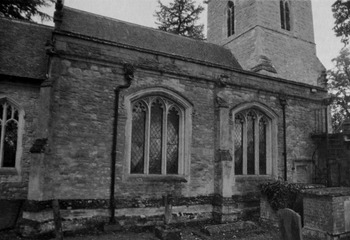
Byng’s second key example is what was going on at Biddenham, Bedfordshire. That a London merchant, Sir William Butler, should have built a two-bay north aisle, no doubt to accommodate a chantry chapel, in the parish church in the Bedfordshire village where his family owned a messuage, was on the face of it entirely conventional (fig 2). But Butler, Byng claims, did not pay for the building of a new two-bay aisle himself: ‘the parish’, Byng says, paid for materials and transport. And that, for Byng, shows that the building of churches more generally was a collaborative effort.
North aisle of St James’s Church, exterior. Photograph: Gabriel Byng.

His case rests on a draft contract that he discovered, The National Archives, Public Record Office, E41/318, Exchequer, Treasury, Ancient Deeds. It is manifestly a draft. It provides for Butler to pay £26 to John Laverock, mason of St Albans, in two instalments. What is unusual is that in the body of the draft contract there are also statements of expenditures to be borne by the parishioners. Stone was to be transported from the quarries to where Laverock wanted it and then subjected to appropriate ‘workmanship’ ‘at the cost charge and expenc of the parochians and other the inhabyt tis of the said parroche’. The old wall, which would be replaced by the new chapel, was ‘to be taken downe at the costs and charges and expence of the said parochians’. The parishioners ‘shall fynde or cause to be found and redy to be layde and caryed at theyre owne cost and charg and expenc asmoche rough stone lyme and sand as tymber for skaffoldes and tymber to vndersett’, as well as other things necessary. A marginal annotation provided that ‘the roof … shall be vnder sett well and substacyallye so that said Laueroke well and surelye worke so at the cost and charges of the said parocianis’. The building of an aisle was to be done at Laverock’s costs, ‘provided alleway that the saide parrocians shalle at all tymes be reddy at their costs and charg & expenc whan they shall therto by the said Iohn Lauerock reasonably… requered aswell to carry the aid xL Lodys of stone as to take downe the forsaid wall’. Scaffolding was also to be at the expense of parishioners. Moreover the parishioners were given a say in the height of the new chapel.
On the face of it, the role given to the parishioners is remarkable. Byng makes a great deal of this. The contract, he says, appears to describe ‘a collaborative activity between the lord and parish’. The parishioners were clearly going to be bearing ‘some of the major responsibilities for financing and organising the project’. ‘The organisational and financial commitments seem to have been scarcely less onerous than Butler’s,’ Byng speculates further. ‘It is possible that the parish was represented by parishioners who were present at the drafting and entitled to make agreements on the parish’s behalf’: perhaps Butler held meetings with parishioners. And the parishioners were involved in deciding how tall the aisle should be. All this, Byng claims, calls into question any notions of the ‘mutual antagonism of lords and tenantry’.Footnote 18 Moreover it shows that Eamon Duffy was right that, when a gentleman built or extended an aisle to house a chantry chapel in the parish church, it was seen as ‘a communal good that benefited the whole parish’ and to which parishioners would readily contribute. ‘Such arrangements were probably not uncommon’, ‘it may be that other buildings contracted by an individual also received funding from a broader range of the parish’.Footnote 19
But is Byng rather hasty in drawing such conclusions? Although what was expected from parishioners was clearly spelled out, nowhere in this draft contract do any named parishioners actually agree to make any such grants. If they had made such an agreement, this document would be exactly where one would expect to see the details precisely spelled out. Here, although references to the costs and charges and expenses to be borne by the parishioners abound, of any agreement there is not a word. Moreover, there is nothing to show that parishioners had ever been consulted. The costs to which this draft contract appeared to commit them would have been substantial and open-ended. And all this was being done to build a two-bay aisle in which no doubt a chantry chapel for Sir William Butler and his family would then be erected. Eamon Duffy, as Byng says, is right to insist that such family chantries could offer parishes valuable spin-offs.Footnote 20 Chantry priests could sing or teach; and when chantry priests sang masses for their patrons they also asked for intercession for all souls, not just those of their patrons.
But it strains plausibility that parishioners would agree to such a one-sided contract as this. Far from suggesting collaboration between patron and parishioners, this contract is much more an example of uncompromising assertion of gentry authority. A more compelling reading is that Butler assumed that parishioners would be perfectly willing to contribute and that he simply attempted to impose his wishes upon them. It is far from clear that they were being given any choice at all in the matter.
Maybe, however, Butler was being presumptuous. Maybe he just took it for granted that parishioners would contribute at his bidding. Perhaps he was treating them in the same way that, as a London merchant, he had treated those he employed there. Perhaps when this draft contract or something like it was presented to them, the parishioners rejected it. Perhaps they took Sir William to court – which may explain the unusual provenance of this draft contract. Given the lack of evidence we cannot be sure that there was a dispute. But it might be prudent to treat what is stated in the draft document as an aspiration rather than a done deal. On the face of it the parishioners of Biddenham would have been taking on remarkably heavy financial responsibilities for very limited benefit to themselves. Sir William Butler was evidently expecting the parishioners to contribute substantially at his command, but we should not unquestioningly use this document as evidence that they did, much less take it as evidence that lord and the wealthier parishioners collaborated in the task of building the north aisle.
All in all, then, it is hard not to conclude that the key examples on which Byng bases his principal claim – namely that the north aisle at Biddenham and the west tower at Bolney show that church-rebuilding was not the work of a single local lord but the fruit of a collaborative partnership – do not offer compelling support. At Bolney, what are surely John Bolney’s accounts show that a range of parishioners were paid to carry out specified work at Bolney’s request. At Biddenham, Butler’s draft contract reads like a demand that parishioners undertook certain tasks and paid for the materials and labour involved. Neither example offers much support for Byng’s claims that relations between lord and wealthier parishioners were characterised by willing and positive collaboration and that church-rebuilding – Bolney’s west tower and Butler’s two-bay north aisle – ‘was run and financed by comparatively wealthy groups of peasants or townsfolk’. The decisive role at both Bolney and Biddenham was played by the lords, John Bolney and Sir William Butler.
ACKNOWLEDGEMENTS
I should wish to thank Simon Payling and an anonymous referee for helpful comments, and Susan Ayres, churchwarden, Margaret Burgess and Martin Burgess for facilitating access to the tower at Bolney and inviting me to climb the sixty-six steps to the top.