

Introduction: global vaccine scarcity and unequal access
Severe supply constraints marked the global rollout of COVID-19 vaccines. High-income countries (HICs) secured early access through advance purchase agreements backed by substantial financial and legal commitments, while low-and middle-income countries (LMICs) experienced significant delays, deepening existing global inequalities (Bollyky and Bown Reference Bollyky and Bown2020; Forman et al. Reference Forman, Shah, Jeurissen, Jit and Mossialos2021). Limited access pushed many LMICs to diversify procurement by turning to suppliers in China, India, and Russia (Hembre et al. Reference Hembre, Chokshi, Hoffman, Suleman, Andresen, Sandberg and Røttingen2025; Wouters et al. Reference Wouters, Shadlen, Salcher-Konrad, Pollard, Larson, Teerawattananon and Jit2021). In parallel, multinational pharmaceutical firms used technology-transfer agreements with manufacturers in middle-income countries to stabilize supply chains and expand production capacity (Hotez et al. Reference Hotez, Gilbert, Saville, Privor-Dumm, Abdool-Karim, Thompson, Excler and Kim2023; Peacocke et al. Reference Peacocke, Heupink, Frønsdal, Dahl and Chola2021).
These dynamics unfolded within a broader history of asymmetries in global pharmaceutical markets. Previous crises – most notably the 2009 H1N1 influenza pandemic – had already revealed how vaccine distribution disadvantaged Latin America, Africa, and Asia, where supplies arrived later, in smaller volumes, or only after HICs had secured their domestic needs (Riaz et al. Reference Riaz, Ahmad, Mohan, dos Santos Costa, Khan, Babar, Hasan, Essar and Zil-E-Ali2021; Vanderslott et al. Reference Vanderslott, Emary, te Water Naude, English, Thomas, Patrick-Smith, Henry, Douglas, Moore, Stuart, Hodgson and Pollard2021). COVID-19 magnified these structural vulnerabilities: with HICs capturing much of the initial vaccine output, many LMICs remained dependent on external suppliers and exposed to delayed or insufficient deliveries (Nhamo et al. Reference Nhamo, Chikodzi, Kunene and Mashula2021).
This experience of constrained access shaped vaccine-production strategies across Latin America, but national responses varied according to institutional legacies, industrial capacities, and the public or private actors available in each country. Brazil’s response centered on long-standing public biomedical institutions: Instituto Butantan, a public biomedical research and production center linked to the state of São Paulo, partnered with Sinovac to produce CoronaVac, while Bio-Manguinhos, the vaccine-production unit of the Oswaldo Cruz Foundation, collaborated with AstraZeneca and the University of Oxford (Fonseca et al. Reference Fonseca, Shadlen and de Moraes Achcar2023, Reference Fonseca, Nachlis, Thomson and Jarman2025).
Similar pressures also shaped responses beyond Latin America, although they operated on different industrial foundations. In India, the response drew on firms already positioned in vaccine development and manufacturing, including Bharat Biotech, the manufacturer of Covaxin (Kumar et al. Reference Kumar, Pandi-Perumal, Trakht and Thyagarajan2021). In South Africa, Aspen Pharmacare’s role was more limited, but still built on existing biomanufacturing capacity as the firm partnered with Johnson & Johnson to formulate, fill, and package its COVID-19 vaccine, becoming a regional “fill-and-finish” hub for Africa (Mulumba et al. Reference Mulumba, Oga, Koomson, Kara, Cynthia and Forman2025). These cases show that domestic production became a broader strategy among middle-income countries facing constrained vaccine access, while revealing important variation in the industrial bases through which that strategy was pursued. Some countries could rely on public biomedical institutes or firms already active in vaccine and biomanufacturing fields; others had to pursue domestic production through firms whose vaccine-specific experience was more partial, adjacent, or unproven.
Argentina offers a revealing case for examining this second pattern: domestic production through firms with partial or adjacent vaccine-production capabilities. Its vaccine strategy centered on national pharmaceutical firms such as mAbxience and Laboratorios Richmond, which became central through the AstraZeneca and Sputnik V partnerships (Shadlen Reference Shadlen, Sun and Sunder2024). What makes these cases analytically significant is that both firms entered these roles with uneven vaccine-specific capabilities.
mAbxience illustrates the partial and adjacent character of these capabilities. As part of the Insud Group, it was connected to vaccine-related assets: Sinergium Biotech produced influenza, pneumococcal, and HPV vaccines; and mAbxience itself had experience supplying components for influenza vaccines, including H1N1. Yet mAbxience had not managed an end-to-end vaccine supply chain or scaled a novel platform under emergency conditions. In the AstraZeneca partnership, mAbxience’s role was limited to producing the active pharmaceutical ingredient, with the fill-and-finish stage assigned to the Mexican laboratory Liomont, a firm with prior links to mAbxience (Infobae 2020). Laboratorios Richmond represented a sharper case of incomplete sector-specific capacity: before the COVID-19 pandemic, it had no experience in vaccine manufacturing, and was known mainly for its portfolio of generic pharmaceuticals, especially oncology, cardiovascular, and HIV/AIDS treatments rather than biologicals (Clarín 2021b).
This leads to our research question: How do governments select vaccine-production partners when sector-specific capacity is incomplete?
The argument: projected capacity and crisis decision-making
Theories of business power provide a useful starting point for understanding how firms influence public policy. Classical accounts emphasize structural power: firms’ ability to shape state preferences through their control over investment, production, and employment (Lindblom Reference Lindblom1977; Strange Reference Strange1998). This influence often operates less through direct lobbying than through policy makers’ anticipation of how firms might respond to regulation, including by exiting or reducing investment (Braun Reference Braun2022; Przeworski and Wallerstein Reference Przeworski and Wallerstein1988).
Structural power is also shaped by institutional settings. By structuring access to policy makers and defining the channels through which business influence operates, institutions condition which firms gain visibility, access, and influence in the policy-making process (Baumgartner and Leech Reference Baumgartner and Leech1998; Fairfield Reference Fairfield2015). Kelly (Reference Kelly2023), for example, shows that managed-care organizations in the United States acquired structural power as public programs, such as Medicare and Medicaid, increasingly relied on them to administer health coverage for large numbers of beneficiaries. As this reliance expanded, the possibility that these firms might withdraw from the programs became politically consequential because it threatened to disrupt coverage, making the state dependent on their continued participation.
Relational approaches complement structural accounts by showing that business power depends not only on firms’ material position, but also on how state actors interpret that position. Firms’ resources do not automatically translate into influence; they matter politically when policy makers recognize firms as credible, reliable, or difficult to replace (Bell and Hindmoor Reference Bell and Hindmoor2015; Woll Reference Woll2007).
This emphasis on interpretation also connects to critiques of structural power as neither constant nor politically given. Vogel (Reference Vogel1987), for example, argues that business influence varies with political and economic conditions. Culpepper and Reinke (Reference Culpepper and Reinke2014) similarly show, through the case of bank bailouts in the United States and the United Kingdom, that structural power is activated under specific conditions: when firms’ systemic importance and international revenue streams limit the state’s ability to discipline them. Taken together, these accounts suggest that business power depends not only on what firms control, but also on when and how state actors perceive that control as consequential.
This point is particularly important in pharmaceuticals, a highly regulated market where firms’ political relevance depends on productive capacity and on how state actors evaluate their credibility under uncertainty. In such markets, the state has considerable power to reward or constrain firms: without regulatory approval, firms cannot sell their products. Prior familiarity with regulators may therefore give some firms an advantage, since recognition reduces uncertainty about their perceived ability to produce safe, compliant products. Repeated interactions can also condition future assessments by giving regulators information about firms’ capabilities, reliability, and compliance behavior (Carpenter Reference Carpenter2004).
High-salience crises intensify this reliance on existing routines and familiar actors because governments face strong pressures to act pre-emptively, project control, and avoid visible failure (Maor Reference Maor2021). When the costs of inaction are immediate, visible, and easily politicized, decisive action becomes more attractive than procedural caution (Hinterleitner Reference Hinterleitner2018; McCaffery and Baron Reference McCaffery and Baron2006). During COVID-19, many states responded by adapting inherited regulatory procedures rather than designing decision-making frameworks from scratch. Emergency Use Authorization pathways structured how vaccines and therapeutics were evaluated under compressed time horizons, allowing governments to act quickly while relying on pre-existing institutional routines. While these inherited procedures enabled rapid action, they could also produce suboptimal policy effects by encouraging decisions based on incomplete information (Nachlis and Thomson Reference Nachlis and Thomson2024). These perspectives help explain why established firms may appear more credible to regulators and policy makers under uncertainty: prior recognition, repeated interaction, and institutionalized decision-making routines shape which firms become visible and trusted. Yet they say less about how credibility and resources accumulated in one domain become a basis for selecting firms in another before sector-specific capacity can be verified – and how such selection can, over time, help transform expectations into durable structural power.
To fill this gap, this article introduces the concept of ‘projected capacity’. The concept captures a mechanism through which states, under conditions of scarcity, treat firms’ established resources, industrial familiarity, structural position, and alignment with health-sovereignty goals as proxies for their potential to develop capacity in another strategic domain.
The mechanism unfolds in three steps. First, vaccine scarcity activates the need for firms’ anticipatory selection. When existing supply channels are unavailable and decision time is compressed, governments cannot wait for vaccine-production capacity to be fully demonstrated. They must act on expectations about which firms could plausibly acquire, assemble, or scale capabilities they do not yet fully possess. Scarcity, therefore, creates the need for selection before verification.
Second, policy makers identify plausible partners through capacity proxies. They rely on industrial legacies, firm–state familiarity, and alignment with a health-sovereignty frame to infer which firms are likely to deliver under pressure.
Third, partner selection converts projected capacity into a state-backed opportunity. Once selected as strategic vaccine-production partners, firms gain access to state support, international alliances, regulatory prioritization, and organizational footholds. These resources can enable firms to develop the very capacities that were initially attributed to them in a new sector.
The article’s theoretical contribution to debates on structural business power and public policy is therefore to specify how resources, credibility, and institutional relationships accumulated in one sector can be projected into another before sector-specific capacity is fully verified. Under conditions of scarcity, state selection can convert these projections into opportunities for capability formation by giving firms access to support, alliances, legitimacy, and organizational footholds. In this sense, the article shows how structural power in a strategic sector can emerge not only from firms’ already-established positions, but also from state-mediated processes that help selected firms acquire sector-specific capacity over time.
Materials and methods
This study employs a qualitative case-study design to analyze the evolution of vaccine politics in Argentina during the COVID-19 pandemic (January 2020–December 2022). It relies on theory-building process tracing because the article seeks to specify a causal mechanism rather than test a fully developed theory across cases. This approach is appropriate when a connection between initial conditions and outcomes appears plausible, but the process linking them remains insufficiently understood. Theory-building process tracing draws on within-case evidence to reconstruct the sequence of events through which such a mechanism can be identified and specified (Beach and Pedersen 2019).
The analysis traces projected capacity across three phases of Argentina’s vaccine strategy: initial selection under scarcity and health-sovereignty concerns, weakening amid production delays and supply constraints, and later consolidation through state support, alliances, and new investments. This phase-based structure allows the analysis to examine how initial expectations were formed, how they were challenged by implementation problems, and how they later became attached to more concrete material advantages.
The article draws on three types of sources to reconstruct the sequence of decisions, expectations, and state–firm interactions that shaped Argentina’s vaccine strategy. First, it uses official records, including 55 presidential press conferences and 72 meetings of the Federal Health Council (COFESA), to identify government priorities, political framing, and patterns of intergovernmental coordination.
Second, it analyzes 2,003 articles from major Argentine outlets – Clarín, Infobae, and La Nación – retrieved from the Factiva database using Spanish-language search terms such as “vacuna” (“vaccine”), “ANMAT,” and the names of the pharmaceutical firms involved: Elea Phoenix and mAbxience, both part of the Insud Group, and Laboratorios Richmond. These articles were used to trace public statements by key actors, reported negotiations, production delays, and shifting interpretations of firm capacity.
Finally, the analysis draws on official statements and vaccine-procurement records from Argentine government websites, including the Boletín Oficial, as well as documents from Argentina’s health regulator, the National Administration of Drugs, Foods and Medical Devices (ANMAT), to trace how state decisions were justified and institutionalized during the crisis.
Interviews were not conducted because the article focuses on publicly observable decision-making, policy justification, and state–firm positioning during the pandemic. The source base – official records, media coverage, official statements, and vaccine-procurement records – was sufficient to reconstruct the sequence through which projected capacity emerged, weakened, and later became attached to more concrete material and institutional advantages. Spanish-language sources were translated into English, and all translations were manually checked against the original texts to ensure accuracy, meaning, and contextual precision.
Initial conditions and the three phases of the projected capacity mechanism
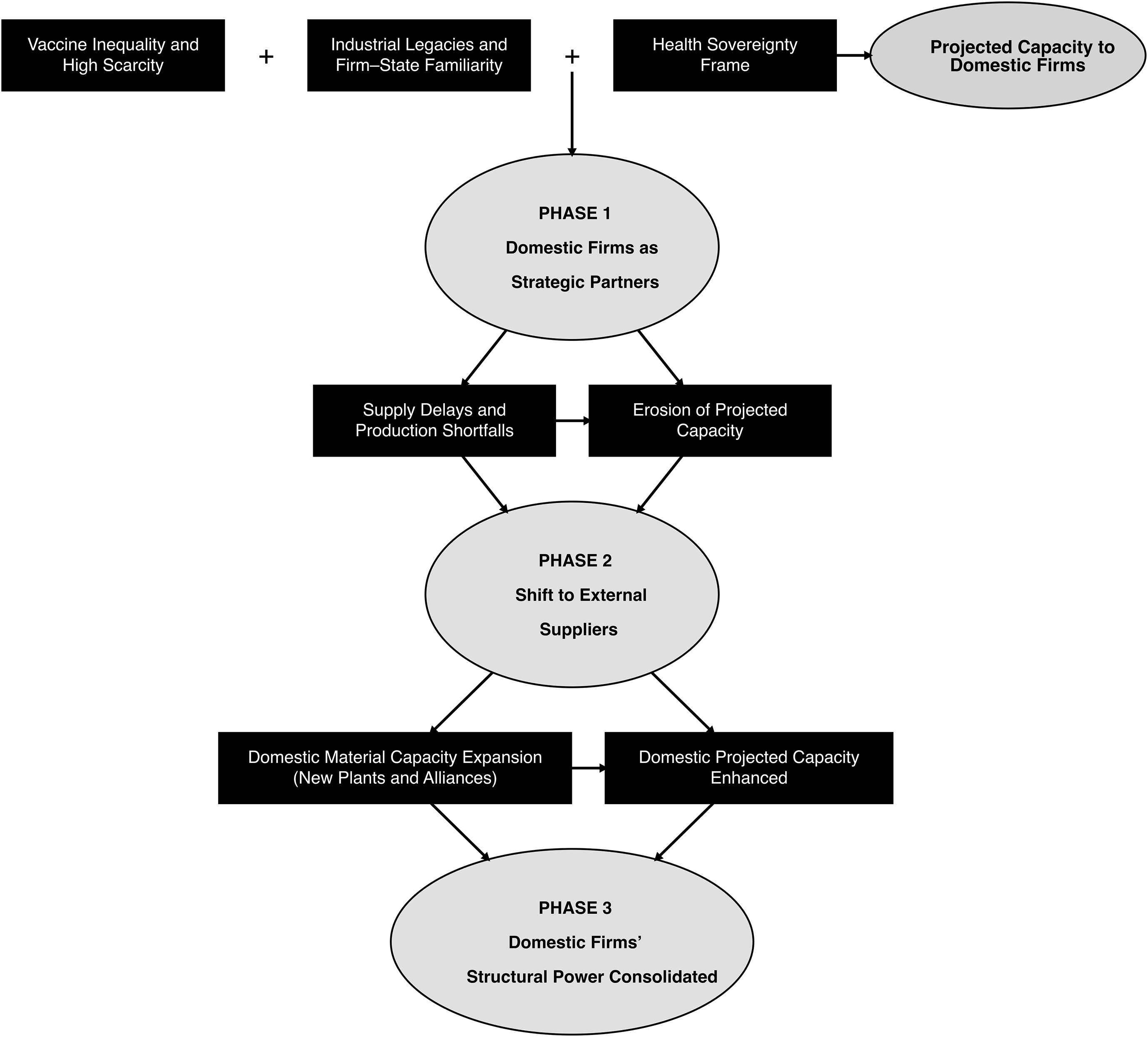
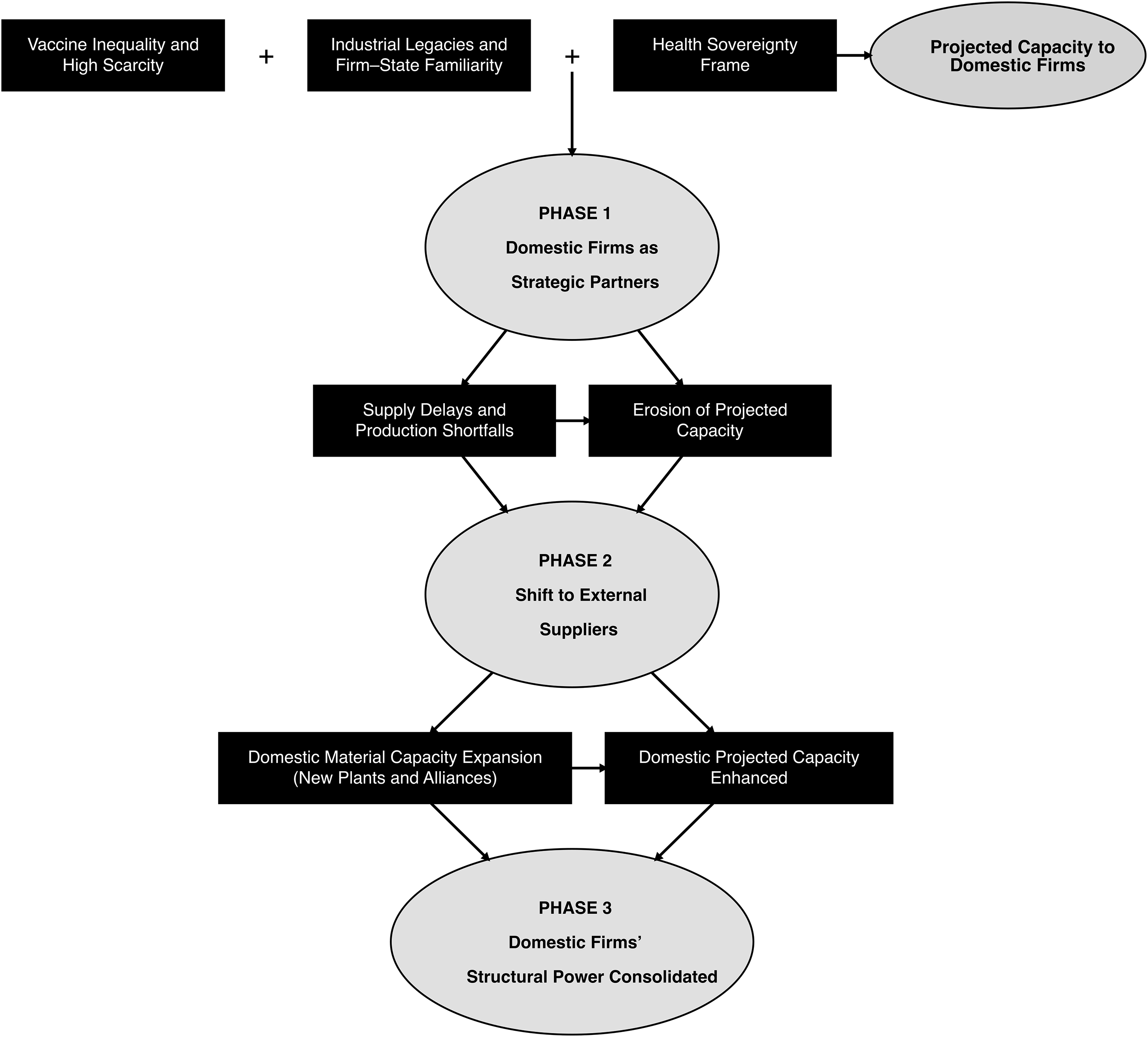
This article traces how Argentina’s vaccine strategy evolved through three sequential phases. At the outset, three initial conditions – vaccine inequality and high scarcity, industrial legacies and firm–state familiarity, and the health sovereignty frame – generated what this article calls projected capacity: the anticipatory attribution of technical competence to domestic firms before their performance can be verified.
Figure 1 summarizes the mechanism linking these initial crisis conditions to the changing configuration of state–industry relations during the pandemic. In Phase 1, projected capacity elevated domestic firms as prospective vaccine producers and strategic partners. In Phase 2, production delays and supply constraints weakened those expectations, prompting a shift toward external suppliers and a recalibration of the domestic-first approach. Crucially, this erosion did not remove domestic firms from the policy field; it changed the basis on which their relevance was assessed. In Phase 3, projected capacity was reoriented toward longer-term technology transfer, industrial upgrading, and health-sovereignty goals, allowing earlier anticipatory judgments to be converted into more durable material and institutional advantages.
The projected capacity mechanism across three phases of Argentina’s COVID-19 vaccine strategy.
Results
Phase 1: the early selection of domestic partners
In Phase 1, the convergence of vaccine scarcity, industrial legacies, and the health sovereignty frame channeled early expectations of capacity toward domestic firms. This configuration shaped the government’s initial decision to position domestic firms as strategic partners in the pandemic response (see Figure 1).
By mid-2020, COVID-19 vaccines were still under development, global manufacturing capacity remained limited, and HICs were already securing future doses through advance purchase agreements. Scarcity was therefore both material and temporal: governments had to act quickly, with incomplete scientific evidence and uncertain timelines for vaccine availability. In Argentina, these pressures encouraged an early turn toward actors that could plausibly support faster access and future domestic production – especially firms with long-standing institutional visibility and prior ties to the state.
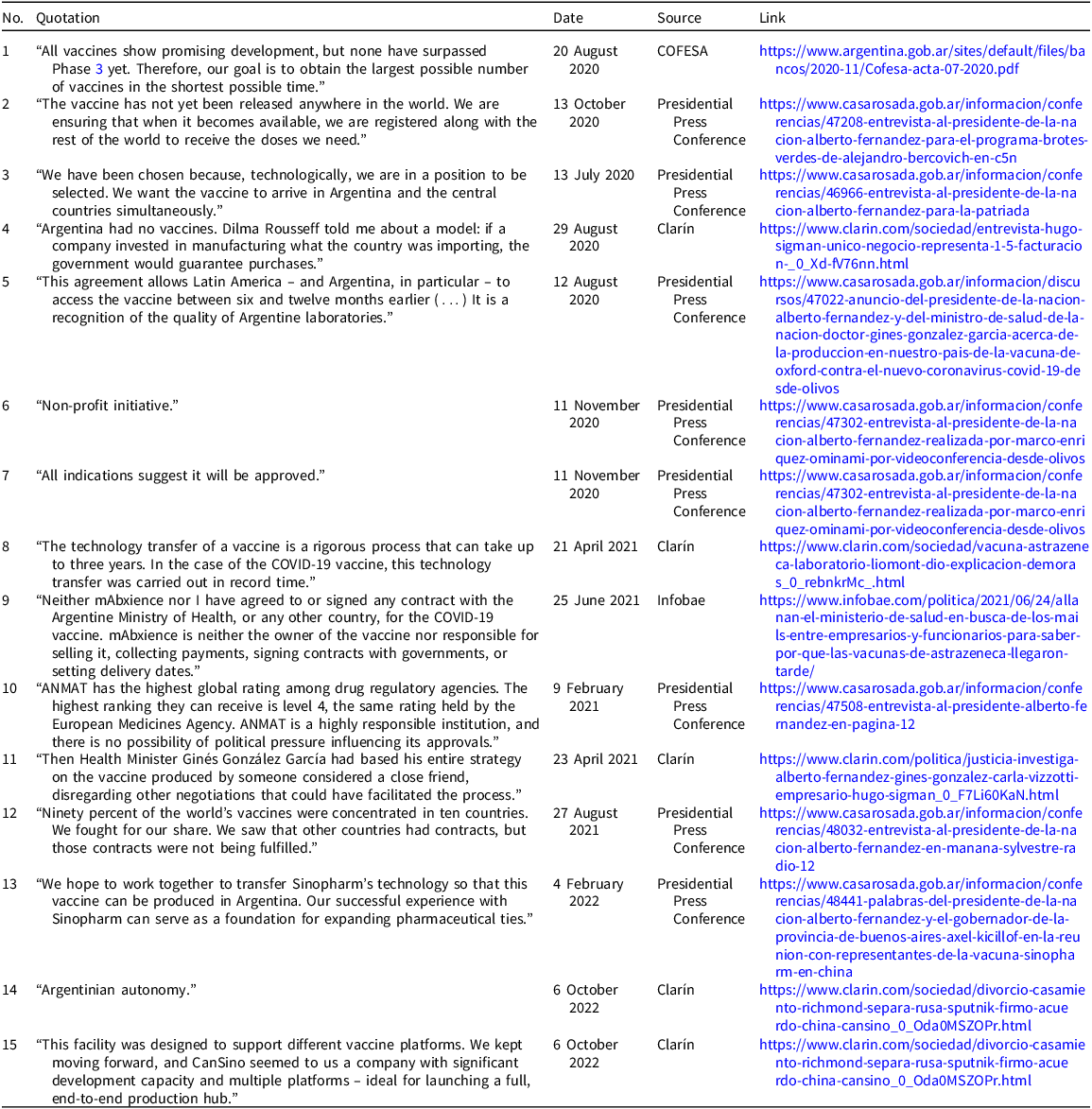
National authorities explicitly framed the situation in these terms. During the COFESA meeting on August 20, 2020, Health Minister Ginés González García stated that all available vaccines were showing promising development but that none had yet completed Phase III trials. He added that the government’s objective was therefore to secure the largest possible number of doses in the shortest possible time (see Table 1, quotation 1).
Key quotations on Argentina’s vaccine strategy
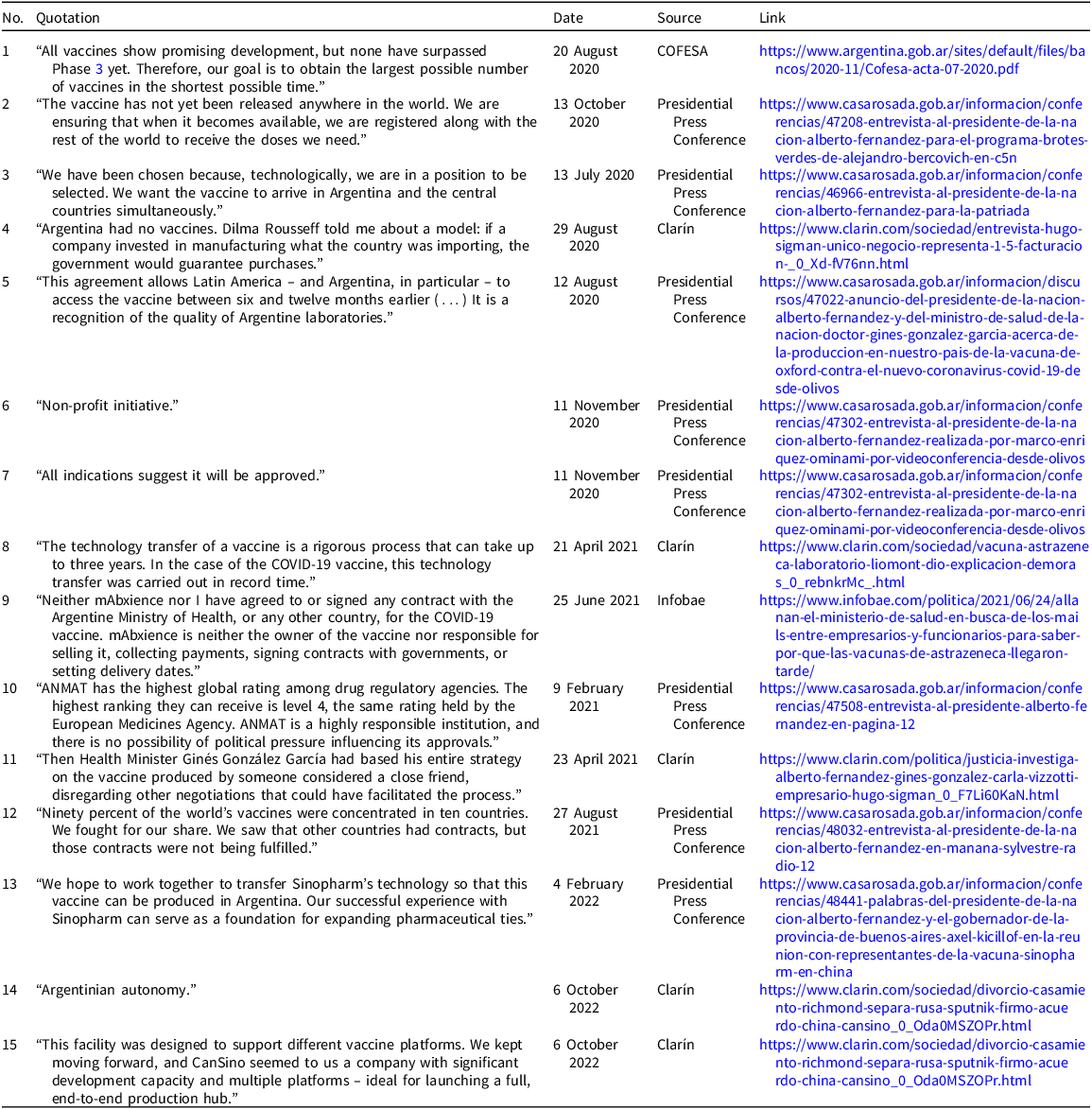
Table 1. Long description
The table has 15 rows and 4 columns. The columns are labeled No., Quotation, Date, Source, and Link. Each row provides a unique quotation related to Argentina‘s vaccine strategy, along with the date, source, and a link for further information. The quotations span from August 20, 2020, to October 6, 2022, and are sourced from various entities including COFESA, Presidential Press Conferences, Clarin, Infobae, and others. The table captures the evolving statements and strategies regarding vaccine development, procurement, and distribution in Argentina.
President Alberto Fernández reinforced this sense of urgency weeks later, emphasizing that Argentina needed to secure a place in the global queue before production began. During a presidential press conference on October 13, 2020, he noted that the vaccine had not yet been released anywhere in the world, and that the government was ensuring that, once it became available, Argentina would register alongside other countries to receive the necessary doses (see Table 1, quotation 2).
In this environment, domestic production became a policy option and a narrative through which the government sought to mitigate perceived vulnerability. When Argentina was selected to host Pfizer’s Phase III trials, President Fernández framed the decision as evidence of the country’s technological competence and international credibility. In July 2020, he presented the selection as validating Argentina’s scientific and industrial capacity, positioning the country as capable of participating alongside HICs in the global vaccine race (see Table 1, quotation 3).
This framing shaped both the preference for domestic production and the selection of firms that could plausibly be treated as strategic vaccine partners. If vaccine access was understood as both an immediate procurement challenge and a longer-term test of health sovereignty, then the government required firms able to connect Argentina’s existing industrial base with future domestic production goals. In this context, selection did not simply reflect which firms were already present in the pharmaceutical market. Rather, scarcity, compressed decision-making, and the state’s longer-term health-sovereignty project reconfigured which firms appeared strategically relevant.
The scarcity context therefore narrowed the universe of plausible partners. Projected capacity was attributed to a small group of firms that seemed capable of operating across two levels at once: domestically, by articulating with state institutions, regulatory processes, and local production goals; and internationally, by connecting Argentina’s vaccine strategy to foreign developers, technology-transfer arrangements, and regional or global supply chains. This helps explain why not all domestic pharmaceutical firms were positioned as vaccine-production partners. Other firms may have had manufacturing experience or commercial presence in Argentina, but they did not combine the same industrial base, prior state relationships, and alignment with the government’s longer-term health-sovereignty agenda.
This selection was facilitated by the expanded coordinating role of the state during the pandemic, which linked procurement, regulatory adaptation, interministerial coordination, and engagement with productive actors (Sanmartín and Bortz Reference Sanmartín, Bortz and Isamu2026). The following section shows why specific firms were able to occupy this position: their industrial legacies, prior state relationships, and biotechnology-related investments made them credible recipients of projected capacity under emergency conditions.
Industrial legacies and the attribution of projected capacity
A key feature of the Argentine case was the existence of historical industrial legacies linking the state to a domestic pharmaceutical sector composed largely of nationally owned firms (Costa and Corrêa Reference Costa and Corrêa2025). Within this sector, Insud Pharma – founded by Argentine businessman Hugo Sigman, who also serves as its chief executive, and operating through subsidiaries such as Biogénesis Bagó, Elea Phoenix, mAbxience, and Sinergium Biotech – had developed sustained interactions with the state over more than a decade (Sigal Reference Sigal2020a).
The 2009 H1N1 influenza pandemic marked a pivotal turning point: global vaccine shortages exposed Argentina’s dependence on imported vaccines, and triggered the creation of Sinergium Biotech, a public–private partnership within the Insud Group established to produce flu, pneumococcal, and HPV vaccines domestically. Public accounts at the time underscored that the initiative responded directly to the government’s goal of reducing vulnerability to external supply disruptions and strengthening local manufacturing capacity. In later interviews, Sigman explained that this model emerged from the idea that, if a national firm invested in producing goods that the country traditionally imported, the state would guarantee demand to sustain that investment (see Table 1, quotation 4).
These prior interactions became especially consequential during the COVID-19 pandemic, when mAbxience, also part of the Insud Group, was designated under the AstraZeneca–Oxford vaccine agreement to produce the active pharmaceutical ingredient for the Latin American market. When the Argentine government announced the agreement in August 2020, it presented the partnership as a diplomatic and technological achievement that would help secure earlier access to doses for Argentina (see Table 1, quotation 5). This framing was reinforced by AstraZeneca’s explanation that mAbxience had been selected on technical grounds, particularly its compliance with Good Manufacturing Practices (GMP), a global standard for production quality and traceability (Sigal 2020b).
Elea Phoenix’s role in the Sinopharm trials further reinforced this pattern. As another firm in the Insud Group, Elea Phoenix became central through its coordination of Phase III trials alongside Fundación Huésped. Negotiations between Sinopharm and the Ministry of Health had begun as early as June 2020, and the announcement of the trial in late August positioned the firm as a key intermediary with Chinese actors. Although Elea Phoenix had no record of producing vaccines, its participation strengthened the broader perception that Insud-linked firms could connect domestic scientific and regulatory institutions with foreign vaccine suppliers under emergency conditions (Costa Reference Costa2020).
A similar pattern of projected capacity also operated beyond the Insud network. In February 2021, Laboratorios Richmond signed a Memorandum of Understanding with the Russian Direct Investment Fund (RDIF) and the Gamaleya Institute to begin domestic production of Sputnik V, in partnership with Hetero Labs, an Indian firm with which Richmond had collaborated for more than 25 years (Clarín 2021b). Richmond’s selection drew on more than the immediate Sputnik V agreement. Since 2009, the firm had received financing from the Banco de Inversión y Comercio Exterior (BICE) to expand its infrastructure, investments that ultimately supported the facilities mobilized for Sputnik V production (Naishtat 2021). Richmond’s president, Marcelo Figueiras, emphasized that the company’s biotechnology expansion – particularly the new Pilar facility – was oriented toward health sovereignty, framing the initiative as part of a broader strategy to reduce dependence on foreign suppliers, and build the national capability needed to produce fully what the country might require in the future (Clarín 2021b).
Taken together, these elements show how historical partnerships, prior state support, biotechnology investments, and health sovereignty narratives converged to produce projected capacity. The state attributed future manufacturing capability to mAbxience and Laboratorios Richmond not because they had verified vaccine-production performance, but because they appeared to combine accumulated collaborations, visible industrial upgrading, and alignment with the government’s sovereignty-oriented expectations.
Projected capacity and the institutionalization of firm partner status
These anticipatory judgments did not remain symbolic; they were institutionalized through procurement contracts, regulatory decisions, and political endorsements that moved ahead of full verification. In August 2020, the government signed an agreement for 22.4 million doses of the Oxford–AstraZeneca vaccine, four months before ANMAT issued formal authorization on December 30 (López 2020). Authorities nevertheless treated the arrangement as a strategic guarantee, framing it as evidence of autonomy and alignment with a regional production model (Clarín 2021a).
Presidential discourse reinforced this interpretation by presenting the AstraZeneca partnership as technically credible and politically advantageous. In November 2020, Fernández described AstraZeneca’s plan as the only global non-profit initiative, emphasized its lower cost relative to other vaccines, and presented the partnership as equitable and strategically beneficial (see Table 1, quotation 6). He also stressed that production had already begun in Argentina despite the absence of regulatory approval, arguing that available indications suggested eventual authorization, and using domestic manufacturing as a justification to advance agreements ahead of formal verification (see Table 1, quotation 7).
The approval of Sputnik V followed a similar anticipatory logic. Authorized on December 23, 2020 before Phase III data were publicly released and before validation by major international regulators, the decision relied on confidential technical information. Although ANMAT formally issued the recommendation, the authorization occurred within a broader political agreement already underway between the government and the RDIF. Subsequent approvals of the Sinopharm and Convidecia vaccines followed a comparable sequence: regulatory decisions advanced in line with government procurement priorities before publicly available evidence had fully consolidated. Together, these moves reflected confidence that strategic vaccine partners – mAbxience, Elea Phoenix, and Laboratorios Richmond – would ultimately help secure vaccine access, despite the absence of fully verifiable performance at the time decisions were made.
Yet the same anticipatory logic that enabled rapid agreements also created vulnerabilities. Once projected capacity had to materialize as timely vaccine supply, the gap between expected and actual production became increasingly visible. This gap marks the transition to Phase 2, when delays and shortfalls began to erode confidence in the domestic-first strategy.
Phase 2: the erosion of projected capacity, and the turn to external suppliers
In Phase 2, production delays and unmet delivery expectations eroded projected capacity, and forced a recalibration of the domestic-first strategy. As the limits of domestically anchored arrangements became visible, the government increasingly turned toward external suppliers and vaccines with broader international recognition (see Figure 1). This phase unfolded as the expectations placed on domestic partners in Phase 1 collided with technological bottlenecks, supply-chain dependencies, and delays in translating projected capacity into timely vaccine access (La Nación 2021).
The first half of 2021 showed that the anticipatory judgments that had elevated domestic firms early in the pandemic were becoming increasingly difficult to sustain. International supply bottlenecks, unmet delivery schedules, and growing public scrutiny exposed the limits of the domestic-first strategy, and pushed the state to broaden its supplier base. These vulnerabilities were most visible in Argentina’s flagship initiative: the regional production chain for the Oxford–AstraZeneca vaccine. Its Mexican partner, Liomont, faced major regulatory and operational delays, obtaining its production license only in March 2021, months after Argentina had expected early access to doses. As a Liomont representative noted in April, technology transfer for vaccine production typically takes up to three years, but had been compressed into an unusually accelerated timeline (see Table 1, quotation 8). In this context, Insud Pharma’s founder, Hugo Sigman, publicly clarified in April 2021 that neither he nor mAbxience had contractual responsibility for vaccine delivery. According to Sigman, the company was not the owner of the vaccine and had no role in sales, payments, contracts, or distribution schedules (see Table 1, quotation 9).
The erosion of projected capacity was also visible in the Sputnik V case, which revealed further limits to the domestic-manufacturing strategy. Laboratorios Richmond’s February 2021 memorandum of understanding with the RDIF and the Gamaleya Institute had been celebrated as a milestone for Argentine biotechnology and as evidence of growing national capacity. Yet the production and delivery of Sputnik V soon encountered major bottlenecks. Shipments from Russia slowed because of manufacturing constraints and later geopolitical disruptions, while domestic production remained insufficient to meet national demand (Czubaj Reference Czubaj2021).
These setbacks redirected scrutiny toward the regulatory process. As doubts grew about the feasibility of a domestically anchored rollout, ANMAT’s earlier authorization of Sputnik V became part of a broader reassessment of the institutional architecture that had supported early vaccine decisions. The vaccine had been approved on December 23, 2020, before Phase III data were publicly released, and based on documentation that was not made public. Major media outlets, including Clarín, requested access to ANMAT’s technical evaluation, but were redirected to the Ministry of Health (Clarín 2021c). President Fernández responded by emphasizing ANMAT’s Level 4 classification – equivalent to that of the European Medicines Agency – as evidence of its institutional reputation (see Table 1, quotation 10).
This episode revealed the limits of reputational authority under crisis conditions. Although ANMAT remained formally central to vaccine authorization, its decisions were embedded in a fragmented advisory configuration that combined technical evaluation, expert consultation, and political decision-making across multiple sites (Costa et al. Reference Costa, Bortz and Seijo2026). As production delays accumulated, the erosion of projected capacity affected firms’ perceived manufacturing competence and the credibility of the institutional arrangements that had enabled early anticipatory decisions.
This reassessment soon extended to the political relationships underlying the domestic-first strategy. By April 2021, legal complaints had been filed against President Alberto Fernández, former Health Minister Ginés González García, and Minister Carla Vizzotti, alleging favoritism toward AstraZeneca because of Hugo Sigman’s proximity to the government. Media reports suggested that González García had centered the vaccination strategy around a product linked to a close ally, potentially at the expense of alternatives that might have expanded procurement options (see Table 1, quotation 11).
As domestic supply faltered, early confidence in familiar partners became increasingly difficult to sustain. Production timelines slipped, promised volumes failed to materialize, and the government faced growing pressure to diversify vaccine sources. By mid-2021, this pressure pushed authorities to reopen negotiations with Pfizer, after talks had collapsed in late 2020 over liability requirements and legal protections that Argentina’s Vaccine Law did not permit (Infobae 2021d).
The turning point came on July 2, 2021, when the government announced a bill to amend Law 27,573, the legal framework governing vaccine contracts. By removing the contentious reference to “negligence” and creating a COVID-19 Compensation Fund, the proposal addressed the liability concerns that had obstructed an agreement with Pfizer (Infobae 2021d). With these changes, the main legal barriers to a Pfizer contract were removed.
By late July 2021, Argentina had significantly broadened its vaccine strategy. On July 27, the government announced two agreements with Pfizer – one for 20 million adult doses and another for 6 million pediatric doses – marking the first major contract with a US manufacturer after the legislative reform (Infobae 2021b). Around the same time, ANMAT granted emergency authorization to the COVID-19 vaccines developed by Moderna and Janssen (Infobae 2021a, 2021c).
This shift marked more than a procurement adjustment; it signaled a change in the logic guiding Argentina’s vaccine strategy. After months of relying on domestic ties and familiar partners, the government began to give greater weight to vaccines with demonstrated international performance and wider regulatory recognition (see Figure 1). The new agreements broadened Argentina’s options, even though they did not immediately resolve shortages: deliveries remained slow, global demand continued to exceed supply, and gaps in the vaccination schedule persisted.
Yet this outward turn did not remove domestic firms from the policy field. Rather, it changed the basis of their relevance. As projected capacity failed to meet the urgency of immediate supply, domestic firms were increasingly repositioned within a more cautious and diversified strategy oriented toward longer-term capacity-building. This shift set the stage for Phase 3, in which projected capacity was redefined around technology transfer, industrial upgrading, and future health-sovereignty goals.
Phase 3: global–local alliances, and the materialization of firm structural power
Phase 3 shows that projected capacity, although weakened during the emergency rollout, was not abandoned. Instead, it was temporally reoriented toward the future of health sovereignty. Argentina’s turn to external suppliers diversified the vaccine portfolio, but did not eliminate the vulnerabilities it was exposed to in Phase 2. Persistent scarcity, delayed deliveries, and unequal global distribution kept domestic production politically relevant, shifting the policy problem from immediate procurement toward longer-term preparedness, technology transfer, and health-industrial upgrading. In this new context, domestic firms retained strategic relevance not because they had fulfilled expectations of rapid delivery, but because they could be repositioned as platforms for future sovereign capacity-building (see Figure 1).
President Alberto Fernández captured this unresolved vulnerability during an August 2021 press conference, noting that global vaccine supply remained concentrated in a handful of countries, and that many international contracts were not being fulfilled as promised (see Table 1, quotation 12). This diagnosis reinforced the lesson of Phase 2: external diversification was necessary, but insufficient. It opened space for a renewed emphasis on technology transfer, domestic manufacturing, and the future of health sovereignty.
Elea Phoenix became central to this reorientation through its relationship with Sinopharm, building on its earlier role in the vaccine’s Phase III trial and its position in the Insud Pharma network. As Sinopharm became one of the most widely administered vaccines in Argentina, Elea Phoenix’s link to the company acquired greater strategic significance in the government’s broader vaccine strategy. This prominence also generated regulatory tensions. In October 2021, when ANMAT recommended extending Sinopharm’s use to children aged 3–17, parts of the medical community – most notably the Argentine Pediatric Society (SAP) – questioned the evidentiary basis for the recommendation, since the supporting data were not publicly available (Infobae 2021e).
Government officials responded by emphasizing ANMAT’s formal authority and access to confidential evidence. At the October 4 COFESA meeting, Health Minister Carla Vizzotti explained that ANMAT had relied on technical information provided by China and the United Arab Emirates, which could not be disclosed because of international confidentiality agreements (COFESA 2021). She stressed that access to this restricted material had allowed the agency to complete its assessment, even though the evidence could not be released publicly. The Ministry later clarified that scientific societies, such as SAP, would be briefed on ANMAT’s legal mandate and review procedures, underscoring that the authority to evaluate clinical data – including confidential documentation – rested with the national regulator.
Yet the controversy did not weaken the government’s broader commitment to the Sinopharm relationship. Rather, it unfolded alongside a renewed political effort to deepen cooperation around technology transfer and domestic production. This alignment was reaffirmed in February 2022, when President Alberto Fernández and Buenos Aires Governor Axel Kicillof met with Sinopharm representatives in China. During the visit, Fernández emphasized Argentina’s strategic interest in securing technology transfer to enable domestic production and in expanding bilateral pharmaceutical cooperation (see Table 1, quotation 13).
A similar reorientation was visible in Laboratorios Richmond’s trajectory. After the prolonged delays and eventual breakdown of the Sputnik V supply chain – a disruption intensified by geopolitical tensions and the vaccine’s stalled path toward WHO approval – Richmond sought to redefine its position through a new technology-transfer partnership. In October 2022, the company announced an agreement with CanSino Biologics to produce the Convidecia vaccine domestically (Hartmann 2022). Unlike the emergency-driven agreements of 2020–2021, this initiative was framed less as a response to immediate shortages than as part of a longer-term strategy to turn Richmond into a biomanufacturing platform. Marcelo Figueiras emphasized that the new facility was designed to support multiple vaccine platforms and to produce the CanSino vaccine “from scratch” in Argentina. He presented the partnership as a step toward health autonomy, and as evidence that the plant could support full-cycle production in the future (see Table 1, quotations 14–15).
The translation of these ambitions into concrete capacity, however, was slow. Richmond’s February 2021 memorandum had anticipated that the new Pilar facility would begin operating in 2022, yet the plant opened only in May 2024, after the acute phase of global vaccine scarcity had passed. This delay is analytically significant: it shows that Richmond’s prominence during the pandemic rested less on verified production performance than on projected capacity – on the expectation that the firm would eventually build the infrastructure needed for sovereign vaccine production. Once operational, the facility gave Richmond end-to-end manufacturing capabilities, including adenovirus-vector platforms, recombinant-protein processes, and mRNA technologies (La Nación Reference Nación2025). In this sense, Richmond’s trajectory captures the temporal reorientation at the center of Phase 3: projected capacity moved from a promise of immediate emergency supply to a claim about future health sovereignty and durable industrial upgrading.
Phase 3 outcome: from projected capacity to structural power in the vaccine sector
Phase 3 shows how the capacity initially projected onto domestic firms gradually acquired a material and institutional basis. What began as anticipatory judgments under conditions of vaccine scarcity did not immediately produce verified domestic-manufacturing capacity. Rather, those judgments kept selected firms inside the state’s vaccine strategy long enough for them to attract partnerships, justify investment, and expand productive infrastructure. Over time, the capabilities projected onto these firms – technology transfer, platform flexibility, supply-chain coordination, and eventual full-cycle production – began to materialize as concrete industrial assets.
This transition was visible across different firm trajectories. mAbxience maintained its role in regional vaccine production through the AstraZeneca supply chain, demonstrating how Argentine facilities could be incorporated into global production networks even when domestic control over the full chain remained incomplete. Richmond used the visibility gained during the Sputnik V agreement to consolidate a different position: it expanded its Pilar biomanufacturing facility, pursued a technology-transfer agreement with CanSino Biologics, and presented itself as a platform capable of supporting multiple vaccine technologies and future full-cycle production. Elea Phoenix followed a complementary path through its expanded cooperation with Sinopharm. Building on its earlier role in the Sinopharm trials and its position within the Insud Pharma network, the firm moved from clinical and regulatory intermediation toward a longer-term agenda of local production and pharmaceutical cooperation.
In this sense, projected capacity evolved into vaccine-sector-specific structural power. Domestic firms’ influence no longer rested primarily on expectations of immediate delivery, but on their growing ability to shape future health-industrial policy: technology-transfer agendas, production platforms, and preparedness planning. This shift was not independent of the state. Public action helped convert earlier projections into material and institutional advantages by giving selected firms access to strategic partnerships, political visibility, investment opportunities, and policy processes linking procurement, regulation, and industrial planning.
By the end of Phase 3, the firms selected under emergency conditions were no longer merely prospective vaccine producers; they had become embedded in longer-term industrial and public-health agendas. The emergency-based selection of domestic firms thus evolved into a more durable form of sector-specific structural power within Argentina’s health-industrial landscape.
Discussion
The COVID-19 pandemic exposed a central dilemma for middle-income states with incomplete vaccine-production capacity. As HICs secured much of the available vaccine supply, governments facing delayed access had to decide whether and how to mobilize domestic production despite limited control over technologies and supply chains. This article examines how governments select vaccine-production partners under conditions of scarcity and partial domestic capability.
Existing approaches to structural and relational business power explain why established firms may appear credible to policy makers: they emphasize pre-existing structural position, accumulated resources, institutional access, and trust (Carpenter Reference Carpenter2004; Culpepper and Reinke Reference Culpepper and Reinke2014; Kelly Reference Kelly2023). Yet the literature has not fully developed how this cross-sectoral movement occurs: how capabilities, credibility, and structural advantages accumulated in one sector become actionable as expected capacity in another. This gap is especially important for middle-income countries, where states may face severe external scarcity while lacking firms with fully verified, sector-specific capacity.
The Argentine case addresses this gap through the concept of projected capacity, showing how three initial conditions – vaccine scarcity, industrial legacies and prior state relationships, and alignment with health-sovereignty goals – operated as proxies through which the state inferred future vaccine-production capability before the firms’ ability to deliver could be fully verified. Firms such as mAbxience, Elea Phoenix, and Laboratorios Richmond became credible vaccine-production partners not because they had already demonstrated full-cycle vaccine-production capacity, but because these conditions made them appear capable of acquiring, coordinating, or eventually developing such capacity under crisis conditions.
The article contributes to debates in political economy and public policy on business power in three ways. First, it identifies a mechanism of partner selection under scarcity, showing how states convert capabilities, credibility, and structural advantages accumulated in one sector into expectations of future capability in another.
Second, it specifies the temporal logic of partner selection under scarcity. Projected capacity shows that, in crisis conditions, state selection can precede verification: firms are empowered before their sector-specific competence is fully demonstrated, with the expectation that capacity will emerge through implementation. This temporal structure is especially important in middle-income countries, where governments must act before domestic production capabilities are complete.
Third, it shows how this anticipatory selection can generate sector-specific structural power. Once selected, firms gain visibility, access to procurement arenas, state support, technology-transfer opportunities, international partnerships, and political legitimacy. These advantages can transform an initial expectation of capacity into more concrete footholds in a strategic sector. In this sense, the article shifts attention from structural power as a pre-existing firm attribute to a form of power partly produced through crisis-driven state action.
This argument opens a comparative agenda on the formation of business power in strategic sectors. Future research could examine how the mechanism operates across different configurations of industrial capacity. Argentina illustrates a case in which capacity was projected onto firms with adjacent but incomplete vaccine-production capabilities. India and South Africa suggest possible variants in settings where relevant capabilities were already more developed. In such cases, projected capacity may operate less by identifying firms that could acquire missing capabilities than by enabling already capable firms to scale production, move into more complex stages of the value chain, consolidate regional supply roles, or strengthen their position in global production networks. In India, state action appears to have scaled or elevated existing vaccine-production capacity, including around firms such as Bharat Biotech. In South Africa, Aspen Pharmacare’s regional role points to the expansion of already relevant biomanufacturing capabilities. In both cases, as in Argentina, production expansion was framed through health-sovereignty claims, suggesting that similar political narratives may support different forms of state selection depending on the underlying industrial base. These comparisons would help clarify how different forms of state selection reshape industrial positioning and the distribution of business power in strategic sectors over time.
Finally, although the evidence comes from a single case and further comparative testing is needed, the mechanism could also be examined across other policy fields where states must select strategic partners before capacity can be fully verified. This would be especially useful for tracing variation in how projected capacity operates across sectors with different degrees of regulation and state dependence. More broadly, the case suggests that, in middle-income countries, structural power in strategic sectors may emerge not only from what firms already are, but also from what states expect them to become – and from the ways state action helps consolidate such expectations into durable forms of business power.
Data availability statement
This study does not employ statistical methods and no replication materials are available.
Acknowledgments
We thank the editors and anonymous reviewers of the Journal of Public Policy for their constructive comments and guidance. Earlier versions of this article were presented at the 2025 Annual Conference of the Midwest Political Science Association, the 11th Annual Conference of the Red para el Estudio de la Economía Política de América Latina in São Paulo 2025, and the 7th International Conference on Public Policy in Chiang Mai 2025. We are grateful to the participants at these conferences for their valuable feedback, and especially to Ken Shadlen, Elize Massard da Fonseca, Juan Diego Prieto, and Alexander Handfas for their insightful comments and suggestions, which contributed substantially to refining the argument and improving the manuscript.
Funding statement
María Alejandra Costa and Luana Forlini received funding from the São Paulo Research Foundation (FAPESP) under grant numbers 2024/00811-3 and 2024/08025-7, respectively.
Competing interests
The authors report no competing financial or non-financial interests.
Use of artificial intelligence (AI) tools
The authors used OpenAI’s ChatGPT (GPT-5) to assist with language refinement and with the English translation of quotations from newspaper sources cited in the manuscript. All AI-assisted text and translations were reviewed and verified by the authors, who take full responsibility for the accuracy and final content of the manuscript.

 Open access

