Introduction
The spatial structure of the marine benthic communities dominated by sessile organisms reflects variation in propagule supply as well as differential settlement and post-settlement processes, each influenced by multiple biotic and abiotic factors (Connell, Reference Connell1985; Hunt and Scheibling, Reference Hunt and Scheibling1997; Underwood and Keough, Reference Underwood, Keough, Bertness, Gaines and Hay2001). Facilitation cascades (Altieri et al., Reference Altieri, Silliman and Bertness2007) are sequences of interspecific interactions that arise when a strong facilitator (a primary foundation species) benefits another strong facilitator (a secondary foundation species), which in turn positively affects a suite of dependent taxa. Known multi-level facilitation cascades may include up to five or six hierarchical levels of foundation species (Thomsen et al., Reference Thomsen, Hildebrand, South, Foster, Siciliano, Oldach and Schiel2016; Yakovis and Artemieva, Reference Yakovis and Artemieva2017). The determinants of the space utilization pattern exhibited by a sessile foundation species in a facilitation cascade potentially have a broad community-wide impact because of the hierarchical indirect effects on multiple dependent taxa (Gribben et al., Reference Gribben, Angelini, Altieri, Bishop, Thomsen and Bulleri2019).
Planktonic larvae of various sessile benthic invertebrates actively select particular natural substrates for settlement (Ryland, Reference Ryland1962; Knight-Jones et al., Reference Knight-Jones, Bailey, Isaac and Crisp1971; Buschbaum, Reference Buschbaum2001). In many systems, resulting settlement patterns often shape the spatial distribution of adults more strongly than differential post-settlement mortality (Grosberg, Reference Grosberg1981; Hurlbut, Reference Hurlbut1991; McKinney and McKinney, Reference McKinney and McKinney1993).
Barnacles and ascidians act as foundation species in benthic communities where they dominate (Dean, Reference Dean1981; Bros, Reference Bros1987; Fielding et al., Reference Fielding, Weerts and Forbes1994; Monteiro et al., Reference Monteiro, Chapman and Underwood2002; Yakovis et al., Reference Yakovis, Artemieva, Shunatova and Varfolomeeva2008; Yakovis and Artemieva, Reference Yakovis and Artemieva2017). Barnacles frequently monopolize primary hard substrates, so that the rest of sessile organisms, including co-dominant solitary ascidians, attach primarily to barnacles and conspecifics (Dean and Hurd, Reference Dean and Hurd1980; Dean, Reference Dean1981; Hatcher, Reference Hatcher1998; Yakovis et al., Reference Yakovis, Artemieva, Fokin, Grishankov and Shunatova2005, Reference Yakovis, Artemieva, Shunatova and Varfolomeeva2008; Yakovis and Artemieva, Reference Yakovis and Artemieva2017). In the shallow subtidal of Onega Bay (the White Sea), epibenthic patches on mixed sediments are typically based on empty shells of the Greenland cockle Serripes groenlandicus (Mohr, 1786; hereafter Serripes). Barnacles Balanus crenatus Bruguière, 1789 (hereafter Balanus) exclusively dominate Serripes shells, whereas co-dominant solitary ascidians (mainly Styela rustica Linnaeus, 1767; hereafter Styela) attach to barnacles, their empty tests, and to each other (Supplementary Figure S1). At other sites in the White Sea (e.g. Kandalaksha Bay), however, in the absence of barnacles, Styela can form clumps directly on primary hard substrates such as shells or gravel (Yakovis et al., Reference Yakovis, Artemieva, Shunatova and Varfolomeeva2008).
In Onega Bay, Serripes, Balanus, and Styela compose a multi-level facilitation cascade in which the presence of Balanus promotes Styela recruitment, and clean Serripes shells (without barnacles) exposed in the field for a year lack ascidian recruits (Yakovis and Artemieva, Reference Yakovis and Artemieva2017). Given the diverse assemblages of dependent species associated with barnacles and ascidians (Yakovis et al., Reference Yakovis, Artemieva, Shunatova and Varfolomeeva2008), the mechanism underlying barnacle facilitation of ascidians represents a key driver of the community structure and dynamics. Two alternative processes could explain the observed pattern: (i) larval substrate preferences of Styela larvae or (ii) substrate-specific post-settlement mortality of recruits. Here, we experimentally tested the first hypothesis. If larval preferences determine adult distribution, we predicted higher settlement density of Styela larvae on barnacles than on Serripes shells. Conversely, equal or higher settlement on Serripes shells would prompt post-settlement mortality as the principal mechanism.
Methods
In the summer of 2005, we collected 14 empty Serripes shells (hereafter S) and 14 empty Serripes shells with the convex side partially covered by adult Balanus (hereafter B) near the Solovetsky Islands in Onega Bay of the White Sea (65°01.180′ N, 35°39.721′ E, at 12 m depth, see Site 1 in Yakovis and Artemieva (Reference Yakovis and Artemieva2017)). Shells were cleaned of all macrobenthic organisms (except barnacles in B) and stored in aerated seawater tanks at +5°С. These empty Serripes shells, like most found in the field, had naturally eroded periostraca and were 5–8 cm long. Mean shell length did not differ between S and B (Student’s t-test, p = 0.136, n = 14). There was a single substrate type in S (shell surface) and three substrate types in B (shell surface, hereafter B-S, live barnacles, hereafter B-B, and few empty barnacle tests, hereafter B-E). We only examined the convex sides of Serripes shells, as concave sides are typically buried in soft sediment in the field. Substrate surface areas were measured by wrapping substrates in thin aluminium foil and weighing the foil (Marsh, Reference Marsh1970).
In mid-September, during the annual breeding period of Styela in the White Sea, we randomly distributed the shells among seven replicate 20 L tanks with aerated seawater at +10°С. Two S and two B were placed on the bottom of each tank in alternating order, convex side upward (matching their typical orientation in the field). Mean (± S.E.) substrate areas per tank were 69 ± 4 cm2 for S, 145 ± 14 cm2 for B-B, 24 ± 5 cm2 for B-S, and 21 ± 7 cm2 for B-E.
Natural epibenthic patches on Serripes shells in the field are covered by fine sediment, except for the distal portions of live barnacles and their large flexible epibionts like ascidians and red algae (authors’ personal observations). To reproduce this pattern, we added 100 ml of liquid silt (particle size ≤ 0.25 mm) to each tank 1 week after substrate placement, producing an unconsolidated sediment layer approximately 2 mm thick that covered all substrates, except the opercular plates and distal parts of B-B. After 24 hours, we added approximately 2500 fertilized Styela eggs to each tank during daylight hours (see Khalaman et al. (Reference Khalaman, Belyaeva and Flyachinskaya2008) for the details on the technique). Tanks were illuminated from above and maintained for 10 days under a 12:12 h light:dark cycle.
After 10 days, we removed the substrates, stained them with 0.1% methylene blue solution and counted all settled ascidians on each substrate type (S, B-B, B-S, and B-E; 1519 individuals in total; Supplementary Data S1). Previous laboratory experiments indicate that most Styela larvae settle within 2–3 days after fertilization (Khalaman et al., Reference Khalaman, Belyaeva and Flyachinskaya2008).
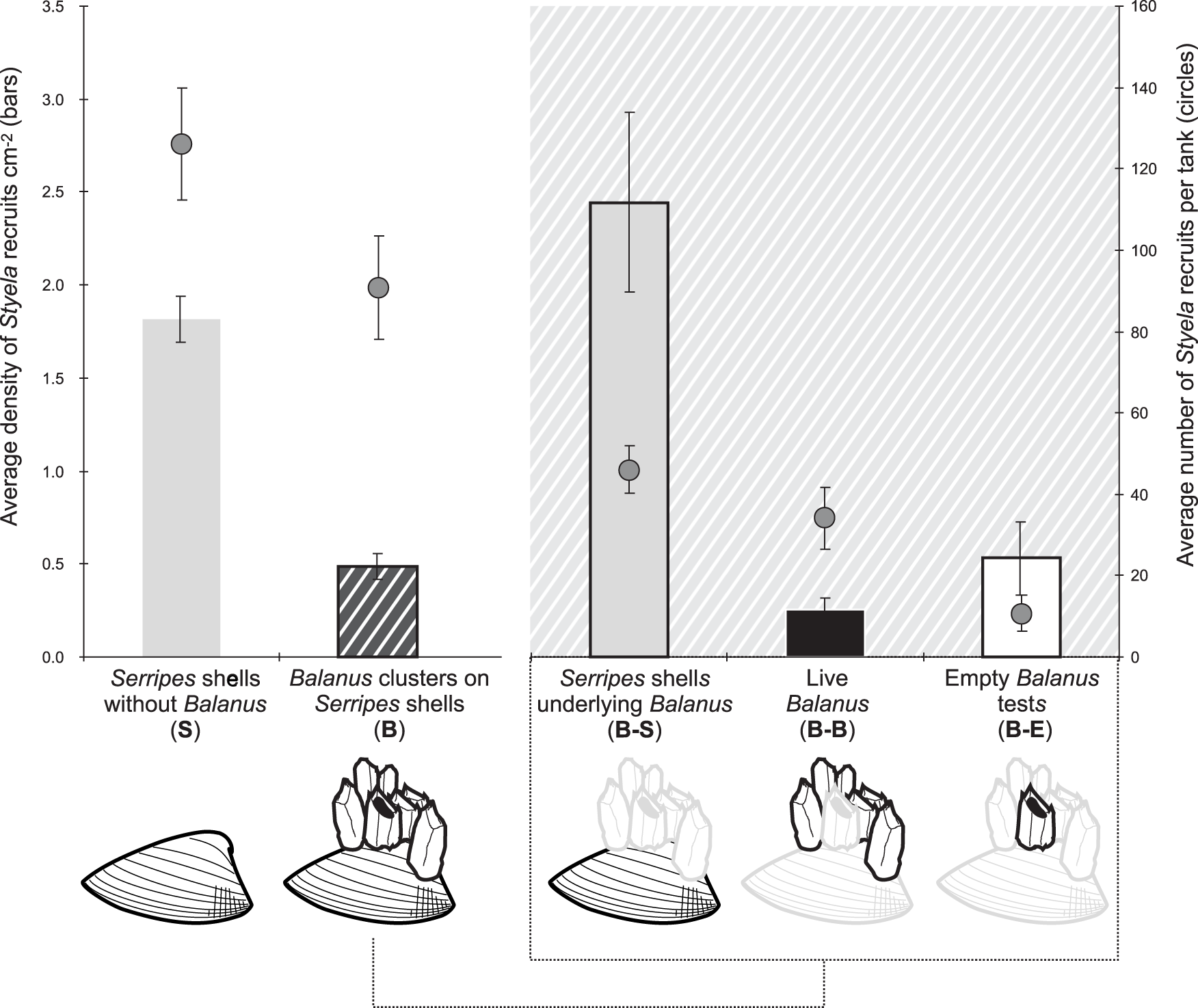
We compared settlement density (individuals per cm2) between S and B-B using GLM ANCOVA (type III), with Substrate (S vs B-B) as a fixed factor, Tank as a random factor, and Substrate Area as a covariate. After pooling data by tank, we also compared settlement density within B shells between B-S and B-B using GLM ANCOVA (type III) with Substrate (B-S vs B-B) as a within-subject fixed factor and B-B/B-S substrate area ratio as a covariate. Empty barnacle tests (B-E) were excluded from statistical analyses because their surface area was too small for meaningful comparison; mean densities on B-E are reported descriptively in Figure 1. Variances were homogeneous (Cochran’s C-test).
Average density (bars, left axis, ±S.E.) and average number of individuals per tank (circles, right axis, ±S.E.) of settled Styela rustica juveniles by substrate type. S – empty Serripes groenlandicus shells, B – Serripes groenlandicus shells with barnacles Balanus crenatus (substrates pooled). B-S – zones on Serripes groenlandicus shells in B not occupied by barnacles, B-B – live barnacles, B-E – empty barnacle tests. Settlement densities on S, B-S, and B-B were used in the analyses (see text for details).

Calculations were performed in StatSoft STATISTICA software package version 8.0 (StatSoft, Inc., 2008). Means are reported ± S.E.
Results and discussion
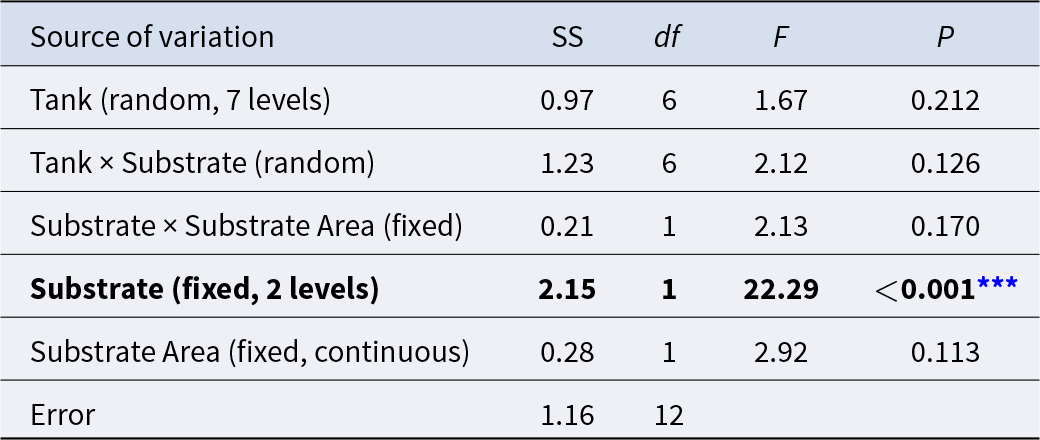
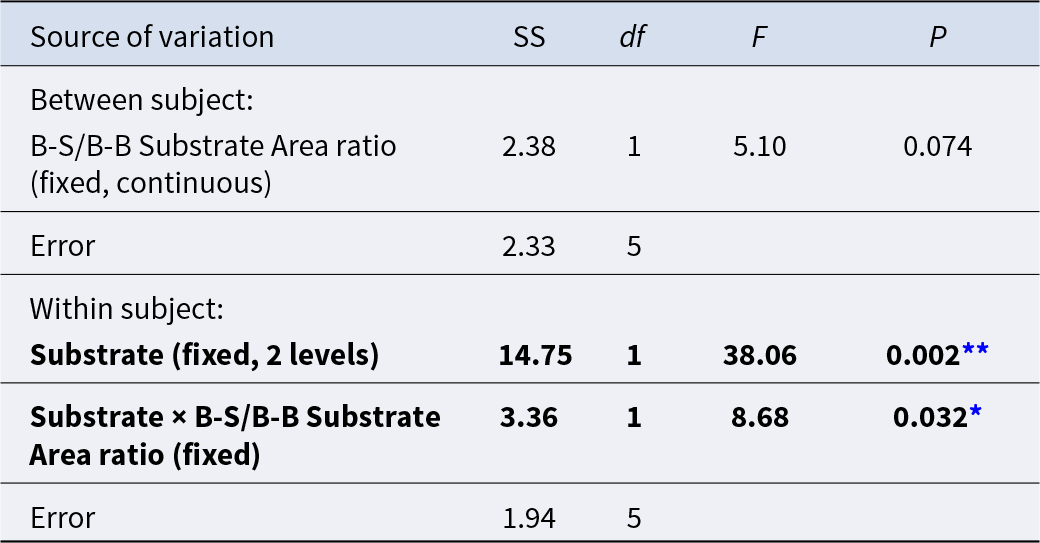
Substrate type significantly influenced the settlement density of Styela recruits (Tables 1–2, Figure 1). Inconsistent with the natural distribution of juveniles and adults observed in the field (Yakovis et al., Reference Yakovis, Artemieva, Shunatova and Varfolomeeva2008; Yakovis and Artemieva, Reference Yakovis and Artemieva2017), Styela larvae clearly favoured cockle shells over barnacles. Settlement density was higher on S than on B-B (Table 1), and within B, higher on B-S than on B-B (Table 2). Mean settlement density was 1.8 ± 0.1 cm−2 on S and 2.4 ± 0.5 cm−2 on B-S, compared to only 0.3 ± 0.1 cm−2 on B-B. As in the field (Yakovis and Artemieva, Reference Yakovis and Artemieva2017), Serripes shells provided less surface area than barnacles. Nevertheless, despite having less than half the available area, Serripes shells accumulated substantially more ascidian recruits (126 ± 14 individuals per tank) than live Balanus (34 ± 8 individuals per tank; Figure 1). These results clearly indicate that the scarcity of juvenile and adult Styela on Serripes shells in the field cannot be explained by larval substrate preferences.
Effect of substrate type (Serripes groenlandicus empty shells [S] vs live Balanus crenatus [B-B]) on the settlement rate of Styela rustica

GLM ANCOVA (type III). Significant effects highlighted in bold.
*** P < 0.001
Effect of substrate type (Serripes groenlandicus empty shells [B-S] vs live Balanus crenatus [B-B]) on the settlement rate of Styela rustica within the Serripes shells with Balanus (B)

GLM ANCOVA (type III). Individual substrates pooled by tank. Significant effects highlighted in bold.
* P < 0.05, ** P < 0.01
Solitary ascidians often occur on barnacles rather than on adjacent relatively smooth primary substrates, both shortly after settlement and after longer exposure periods (Dean and Hurd, Reference Dean and Hurd1980; Young and Gotelli, Reference Young and Gotelli1988; Yakovis et al., Reference Yakovis, Artemieva, Fokin, Grishankov and Shunatova2005). Young and Gotelli (Reference Young and Gotelli1988) reported higher number Styela plicata recruits on barnacle tests than ceramic tiles after 2 weeks of field exposure; however, the design of that experiment did not allow separation of larval settlement from early post-settlement mortality, including potential predator effects.
While calcareous bivalve shells and barnacle tests seem chemically similar, differences in surface texture and wettability may help explain the observed ascidian settlement pattern. The surface of Balanus tests is markedly more complex, with numerous pits and crevices, whereas Serripes shells are comparatively smooth (Supplementary Figure S1). Ascidian larvae can respond to substrate roughness (Chase et al., Reference Chase, Dijkstra and Harris2016) and avoid nano-folds compared to flat surfaces (Sakai et al., Reference Sakai, Sensui and Hirose2024), yet there is no evidence that they actively discriminate among microtopographic features at the scale of 1 mm–1 cm. Also, larvae of many other sessile invertebrates that do exhibit such selectivity (e.g. sponges, corals, barnacles, bryozoans) preferentially settle in surfaces depressions rather than smooth surfaces (Walters and Wethey, Reference Walters and Wethey1996; Whalan et al., Reference Whalan, Abdul Wahab, Sprungala, Poole and de Nys2015). Thus, although microtopographic complexity cannot be excluded as a contributing factor, the available evidence is limited and not entirely consistent.
Possible difference in substrate wettability may provide a more plausible explanation. Larvae of several ascidian species prefer less wettable (more hydrophobic) surfaces for settlement (Sensui and Hirose, Reference Sensui and Hirose2025). Even eroded Serripes shells retain patches of periostracum on their convex surfaces, rich in conchiolin proteins (Supplementary Figure S1), which are likely more hydrophobic than calcified barnacle tests lacking a proteinaceous covering. A preference for less wettable surfaces could therefore promote Styela settlement on Serripes shells. In contrast, the barnacle Balanus amphitrite avoids intact periostracum when settling on bivalve shells (Scardino et al., Reference Scardino, de Nys, Ison, O’Connor and Steinberg2003), consistent with its preference for more wettable surfaces (Rittschof and Costlow, Reference Rittschof and Costlow1989).
In our experiment, Styela larvae successfully settled on substrates covered with a 2 mm layer of unconsolidated silt, indicating a capacity to burrow into the sediment similar to that previously observed (though to a lesser extent) in coral larvae (Ricardo et al., Reference Ricardo, Jones, Nordborg and Negri2017). High sedimentation is often reported to reduce larval settlement (Hodgson, Reference Hodgson1990; Te, Reference Te1992), but this effect may be masked in field studies by post-settlement mortality during prolonged exposure (Babcock and Davies, Reference Babcock and Davies1991). Sediment can cause abrasion, direct burial, and feeding inhibition (Moore, Reference Moore1977) and represents an important source of juvenile mortality in ascidians (Young and Chia, Reference Young and Chia1984), although some species tolerate substantial siltation (Naranjo et al., Reference Naranjo, Carballo and Garcia-Gomez1996). Consequently, sedimentation still can contribute to post-settlement mortality of Styela on Serripes shells. Yet, similar density of Styela juveniles on live barnacles and their empty tests in field experiments (Yakovis and Artemieva, Reference Yakovis and Artemieva2017), together with our results, suggest that barnacle self-cleaning from sediment is not critical for Styela recruitment. Predation of Styela larvae by barnacles seems also unlikely, given that tropical barnacles consume the larvae of colonial ascidians but not the larvae of a solitary Styela plicata (Young and Gotelli, Reference Young and Gotelli1988).
The site selected for settlement by a benthic organism often maximizes subsequent growth and survival (Young and Chia, Reference Young and Chia1984; Buschbaum, Reference Buschbaum2001 and references therein). However, post-settlement mortality can decouple larval preferences from recruit distributions (Mizrahi et al., Reference Mizrahi, Navarrete and Flores2014). Styela is common in the absence of co-dominant barnacles outside Onega Bay of the White Sea (Dybern, Reference Dybern1969; Khalaman, Reference Khalaman2001; Yakovis et al., Reference Yakovis, Artemieva, Shunatova and Varfolomeeva2008), and its larval preferences might have evolved primarily apart from the focal facilitation cascade. Yet, to match the recruitment patterns observed in the field, the higher settlement on Serripes shells must later be offset by substantially higher post-settlement mortality on shells (and thus higher survival on barnacles). Hierarchical facilitation may therefore buffer mismatches between larval behaviour and local selective pressures.
We suggest differential predation is a probable source of the expected contrast in ascidian survival between substrates, given the known strong consumer control of mobile fauna associated with the Serripes–Balanus–Styela system in the White Sea by shrimp and crabs (Yakovis and Artemieva, Reference Yakovis and Artemieva2019, Reference Yakovis and Artemieva2021). Particularly, predation on Styela in the White Sea is poorly studied, except that this species forms a subordinate component of a wolffish diet (Yershov and Khaitov, Reference Yershov and Khaitov2024). Juvenile solitary ascidians in general, however, commonly face strong predation pressure from gastropods, shrimp, crabs, sea urchins, and sea stars (Whitlatch and Osman, Reference Whitlatch and Osman2009; Dumont et al., Reference Dumont, Gaymer and Thiel2011; Giachetti et al., Reference Giachetti, Battini, Castro and Schwindt2022). The plicate surface of Balanus tests may provide an effective refuge against predators (like shrimp or gastropod grazers) compared with the smoother surfaces of cockle shells or stones (Young and Chia, Reference Young and Chia1984; Svane and Young, Reference Svane and Young1989; Walters and Wethey, Reference Walters and Wethey1991). Field caging experiments will be required to identify the precise mechanisms enhancing ascidian survival on barnacles and hence shaping the structure and dynamics of this multi-level facilitation cascade.
Supplementary material
The supplementary material for this article can be found at https://doi.org/10.1017/S0025315426101222.
Acknowledgements
We thank the White Sea Biological Station of Zoological Institute RAS at Cape Kartesh for the laboratory facilities. We are grateful to Dmitry Tomanovskiy, Mikhail Fokin, Ivan Levakin, Sergey Bagrov, Petr Lezin, and Darya Martynova for their assistance in the field.
Author contributions
All authors contributed to the study conception and design. Equipment and methodology were provided by Vladislav Khalaman. Experiments and data collection were performed by Marina Varfolomeeva and Natalia Shunatova. Data were analysed by Marina Varfolomeeva and Eugeniy Yakovis. The first draft of the manuscript was written by Marina Varfolomeeva and Eugeniy Yakovis, and all authors commented on previous versions of the manuscript. All authors read and approved the final manuscript.
Funding
This research was funded by RFBR (grants nos. 05-04-48927А, 03-04-49701А, 05-04-63041К) and the Program ‘Structure, biodiversity and ecosystem functioning of the Arctic Basin seas under a changing climate’ grant No. 125012800889-2.
Competing interests
The authors have no relevant financial or non-financial interests to disclose.
Data
The data supporting the findings of this study are available as supplementary material with this paper (Supplementary Data S1).
Ethical standards
The experiment was performed in accordance with local legislation concerning animal welfare. No approval from research ethics committees was required because the study involved an unregulated invertebrate species.