



1 Introduction
1.1 K-stability and its criteria
To find an explicit and useful criterion for K-stability of polarized varieties is meaningful for both of differential geometry and algebraic geometry. Originally, K-stability, which is a purely algebro-geometric condition, was introduced by Tian [Reference Tian82] for Fano manifolds and reformulated by Donaldson [Reference Donaldson26] for all polarized varietiers by using the Donaldson–Futaki invariants of test configurations. At the same time, the Yau–Tian–Donaldson (YTD) conjecture was introduced. This conjecture predicts that the existence of constant scalar curvature Kähler (for short, cscK) metrics is equivalent to K-polystability. In the Fano case, the conjecture was solved by Chen–Donaldson–Sun [Reference Chen, Donaldson and Sun16] and Tian [Reference Tian83] independently. Recently, K. Zhang [Reference Zhang85] shows the YTD conjecture for other kinds of general polarized manifolds. In this respect, the problem to detect K-stability for a concrete polarized variety is meaningful for differential geometry.
In algebraic geometry, K-stability is closely related to birational geometry and moduli theory. Odaka [Reference Odaka70] finds that K-stability is closely related not only to the geometric invariant theory (GIT cf. [Reference Mumford, Fogarty and Kirwan66]) but also to (semi)log canonical singularities. Odaka [Reference Odaka68] also finds that all semilog canonical models and log Calabi–Yau Kamanata log terminal (klt) varieties are K-stable. He predicts the K-moduli conjecture, which states that there exists a quasi-projective moduli scheme parametrizing all K-polystable varieties with fixed some numerical data (for example, the dimension of varieties) in [Reference Odaka67]. For log Fano pairs, to detect K-stability is more complicated than the classes treated in [Reference Odaka68] but the valuative criterion is established by Fujita [Reference Fujita37] and Li [Reference Li59]. Later, Fujita and Odaka [Reference Fujita and Odaka39] introduced the
 $\delta $
-invariant and Blum and Jonsson [Reference Blum and Jonsson10] prove that this invariant completely detects K-semistability of log Fano pairs. The
 $\delta $
-invariant is one of the key ingredients to the remarkable progress in K-stability of log Fano pairs in this decade. For example, the K-moduli space (cf. [Reference Alper, Blum, Halpern-Leistner and Xu2], [Reference Liu, Xu and Zhuang62]), which parametrizes all K-polystable log Fano pairs is constructed as a projective scheme. It is natural to expect that if there was a more explicit and useful criterion for K-stability for other kinds of polarized varieties, we could construct moduli spaces of K-polystable polarized varieties. However, there are few such useful criteria found for K-stability of other polarized varieties.
1.2 K-stability and the cscK problem on fibrations
In Kähler geometry, the existence problem of cscK metrics on fibrations in the adiabatic sense is studied by [Reference Fine27], [Reference Fine28], [Reference Jian, Shi and Song49], [Reference Dervan and Sektnan23] and [Reference Ortu74]. That is, they consider whether there is a cscK metric under the following circumstance.
Question. Let
 $f\colon (X,H)\to (C,L)$
be a morphism of smooth polarized manifolds with connected fibers. Then, is there any cscK metric in
 $\mathrm {c}_1(\epsilon H+f^{*}L)$
for any sufficiently small
 $\epsilon>0$
?
First, Fine [Reference Fine27], [Reference Fine28] mainly deals with the case when f is a smooth morphism and each fiber admits a cscK metric under some assumptions. Dervan–Sektnan [Reference Dervan and Sektnan23] later introduce a special Kähler metric so-called ‘optimal symplectic connection’, which is a special fiberwise cscK metric and generalize the result of Fine. More precisely, they show that if every fiber of f admits a cscK metric, X admits an optimal symplectic connection and the base
 $(C,L)$
has a twisted cscK metric with respect to the Weil–Petersson metric, then a cscK metric in
 $\mathrm {c}_1(\epsilon H+f^{*}L)$
for any sufficiently small
 $\epsilon>0$
. Ortu [Reference Ortu74] generalizes the definition of optimal symplectic connection and deals with the case when all fibers are analytically K-semistable, that is, they admit some degenerations to polarized manifolds with cscK metrics. Although they only deal with fiber spaces with only K-semistable smooth fibers, they construct a way to detect K-stability of fiber spaces by using information of the base space and fibers. On the other hand, Jian–Shi–Song [Reference Jian, Shi and Song49] show the existence of a cscK metric in
 $\mathrm {c}_1(\epsilon H+f^{*}L_0)$
on a klt–trivial fibration
 $f:X\to B$
for any sufficiently small
 $\epsilon>0$
when H is an ample line bundle on X,
 $K_X\sim _{\mathbb {Q}}f^{*}L_0$
,
 $L_0$
is ample. Here, we call an algebraic fiber space
 $f\colon X\to B$
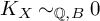
a klt-trivial (resp. lc-trivial) fibration if
 $K_X\sim _{\mathbb {Q},B}0$
and X is klt (resp. lc). We note that f might have a K-unstable singular fiber (for example, we can take X to be an elliptic surface with a cuspidal fiber and of Kodaira dimension one). Later, Sjöström Dyrefelt [Reference Sjöström Dyrefelt76] and Song [Reference Song77] show that smooth minimal models also have cscK metrics for certain polarizations. We note that to klt-trivial fibrations with a singular fiber and
 $K_X$
not nef, we cannot directly apply these results on the existence of cscK metrics on fiber spaces. For example, rational elliptic surfaces have at least one singular fiber and
 $K_X$
is not nef.
Adiabatic K-stability is the following notion, which is first introduced in [Reference Hattori48] to consider the algebro-geometric counterpart of the above results.
Definition 1.1. Let
 $f\colon (X,\Delta ,H)\to (C,L)$
be a polarized algebraic fiber space pair. If
 $(X,\Delta ,\epsilon H+f^{*}L)$
is K-stable for any sufficiently small
 $\epsilon>0$
, we say that
 $(X,\Delta ,H)$
is adiabatically K-stable over
 $(C,L)$
. See Definition 2.18 for details.
We note that algebraic fiber spaces treated in [Reference Fine27], [Reference Fine28], [Reference Jian, Shi and Song49], [Reference Dervan and Sektnan23] and [Reference Ortu74] are adiabatically K-(poly)stable (see [Reference Berman, Darvas and Lu7]). One might think such choices of polarizations are not so canonical, but adiabatic K-stability is important in the point that such K-stability of a fibration is related to K-stability of its fibers and the base. For example, Dervan–Sektnan observe the following phenomenon in [Reference Dervan and Sektnan24, Lemma 2.33]. Consider a test configuration
 $(\mathcal {X},\mathcal {H})$
for
 $(X,H)$
, where H is ample, and let
 $f\colon (X,H)\to (C,L)$
be a morphism of polarized varieties. If there exists a morphism
 $\pi \colon \mathcal {X} \to C$
, then they show that the leading term of
 $\mathrm {DF}(\mathcal {X},\epsilon \mathcal {H}+j\pi ^{*}L)$
with respect to
 $\epsilon $
coincides with
 $\mathrm {DF}(\mathcal {X}_b,\mathcal {H}_b)$
for any general
 $b\in C$
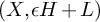
. This means that for some test configuration for
 $(X,\epsilon H+L)$
for sufficiently small
 $\epsilon $
, their Donaldson–Futaki invariant has information about the Donaldson–Futaki invariants for some test configurations for general fibers of f. On the other hand, Dervan–Ross ([Reference Dervan and Ross22, Corollary 4.4]) show for any polarized algebraic fiber space that adiabatic K-semistability of the total space implies twisted K-semistability of the base in the sense of [Reference Dervan21]. Considering these phenomena, there would be some relationships between adiabatic K-stability of a fiber space and K-stability of its fibers and base.
On the other hand, we expect that we could find an explicit and useful criterion for adiabatic K-stability by K-stability of (general) fibers and the base in some cases. Indeed, [Reference Jian, Shi and Song49] and [Reference Ortu74] deal with the case when the base and general fibers are ‘K-semistable’. We note that the base is ‘twisted’ general type and hence twisted K-stable in the case treated by [Reference Jian, Shi and Song49].
1.3 Main results
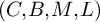
The main purposes of the paper are to reveal relationships between adiabatic K-stability of fiber spaces and ‘K-stability’ of the bases and confirm our expectation in the last paragraph for klt–trivial fibrations over curves. To be precise, we introduce the notion of uniform adiabatic K-stability (cf. Definition 2.18) and log-twisted K-stability (see Definition 2.20) of a log-twisted pair. The latter is the logarithmic version of the twisted K-stability introduced by Dervan [Reference Dervan21]. We note that for any klt-trivial fibration, there are natural two divisors that are called the moduli and discriminant divisors on the base (cf. [Reference Ambro3], §2.4). Then the following is our main result.
Theorem 1.1. Let
 $f:(X,\Delta ,H)\to (C,L)$
be a polarized klt-trivial fibration such that C is a smooth curve. Let M be the moduli divisor and B the discriminant divisor on C.
Then,
 $(X,\Delta ,H)$
is uniformly adiabatically K-stable over
 $(C,L)$
if and only if
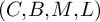 $(C,B,M,L)$
is log-twisted K-stable. Moreover, if
 $\Delta =0$
, X is smooth and
 $(C,B,M,L)$
is log-twisted K-stable, then
 $(X,\epsilon H+L)$
has a cscK metric for any sufficiently small
 $\epsilon \in \mathbb {Q}_{>0}$
.
See Definition 2.26 for the discriminant and moduli divisors. Theorem 1.1 is useful to detect uniform adiabatic K-stability and the existence of cscK metrics since it is easy to check the log-twisted K-stability of curves (see Corollary A.17). We note that Theorem 1.1 is also a key ingredient to construct the moduli space in [Reference Hashizume and Hattori44].
To show Theorem 1.1, there are three key ingredients, Theorems 1.3, 1.2 and 1.4. Theorem 1.2, which is the first key ingredient, states that adiabatic K-semistability of a lc-trivial fibration puts more restrictions on the base space than [Reference Dervan and Ross22, Corollary 4.4]. We emphasize that we do not assume C to be a curve in the following theorem.
Theorem 1.2 (Theorems 4.1, 4.7).
Let
 $f:(X,\Delta ,H)\to (C,L)$
be a polarized lc-trivial fibration. If
 $B_C$
is the discriminant divisor, the moduli divisor
 $M_C$
is
 $\mathbb {Q}$
-Cartier and
 $(X,\Delta ,H)$
is adiabatically K-semistable, then
 $(C,B_C,M_C,L)$
is log-twisted K-semistable.
Furthermore, if
 $(C,B_C,M_C,L)$
is a log-twisted Fano pair and C is an Ambro model (cf. Definition 2.27), and
 $(X,\Delta ,H)$
is uniformly adiabatically K-stable, then
 $(C,B_C,M_C,L)$
is also K-stable.
We note that if C is a smooth curve, then C is an Ambro model. Thus, we obtain one implication of Theorem 1.1 by Theorem 1.2. On the other hand, we deduce the opposite implication from Theorems 1.3 and 1.4.
For the second ingredient, we need the notion of J-stability. J-stability is a variant of K-stability, which is irrelevant to singularities. G. Chen [Reference Chen15] found a useful criterion for J-stability without using test configurations (see also [Reference Datar and Pingali19], [Reference Song77] and [Reference Hattori45]). We extend this criterion to the singular case (see Theorem 3.2). For polarized klt pairs, we also show Theorem A.6 stating that
 $$\begin{align*}H^{\mathrm{NA}}_{\Delta}(\mathcal{X},\mathcal{L})\ge\delta_{(X,\Delta)}(L)(I^{\mathrm{NA}}(\mathcal{X},\mathcal{L})-J^{\mathrm{NA}}(\mathcal{X},\mathcal{L}))=(\mathcal{J}^{\delta_{(X,\Delta)}(L)L})^{\mathrm{NA}}(\mathcal{X},\mathcal{L}). \end{align*}$$
We note that Theorem A.6 had been solved for the smooth case in [Reference Boucksom and Jonsson14] (see also [Reference Zhang85] for the analytic case). Combining Theorem A.6 with the criterion for J-stability (Theorem 3.2), we deduce the following sufficient condition for uniform K-stability.
Theorem 1.3. Let
 $(X,\Delta ,L)$
be a polarized klt pair, and set
 $H=\delta _{(X,\Delta )}(L)L+K_X+\Delta $
. If H is ample and there exists
 $\epsilon>0$
such that
 $$ \begin{align*} \left(n\frac{H\cdot L^{n-1}}{L^n}L-pH\right)\cdot L^{p-1}\cdot V\ge \epsilon(n-p)L^p\cdot V \end{align*} $$
for any subvariety
 $V\subset X$
of dimension
 $1\le p\le n-1$
, then
 $(X,\Delta ,L)$
is uniformly K-stable.
Now, we want to analyze the
 $\delta $
-invariant
 $\delta _{(X,\Delta )}(\epsilon H+L)$
for sufficiently small
 $\epsilon>0$
and apply Theorem 1.3. Theorem 1.4, which is the third key ingredient, states that
 $\delta _{(X,\Delta )}(\epsilon H+L)$
converges to the
 $\delta $
-invariant of the base of a polarized algebraic fiber space over a curve.
Theorem 1.4 (Theorems 4.11, 4.12).
Let
 $f:(X,\Delta ,H)\to (C,L)$
be a polarized algebraic fiber space pair. Suppose that
 $(X,\Delta )$
is a klt pair and C is a smooth curve. Let B be a
 $\mathbb {Q}$
-divisor defined by
 $\sum _{p\in C}(1-\mathrm {lct}_{(X,\Delta )}(f^{-1}(p)))p$
on C. Then
 $$ \begin{align*} \lim_{\epsilon\to 0}\alpha_{(X,\Delta)}(\epsilon H+f^{*}L)&=\alpha_{(C,B)}(L),\quad\text{and}\\ \lim_{\epsilon\to 0}\delta_{(X,\Delta)}(\epsilon H+f^{*}L)&=\delta_{(C,B)}(L). \end{align*} $$
We briefly explain the idea to show the K-stability of the base implies uniform adiabatic K-stability when
 $-(K_X+\Delta )\not \equiv 0$
is nef. We note that the base is a log-twisted K-stable Fano pair in this case and then the
 $\delta $
-invariant of the base is larger than one. Theorem 1.4 shows that the
 $\delta $
-invariant of the total space is also larger than one. Then we can make use of Theorem 1.3 to deduce uniform adiabatic K-stability. Furthermore, we can show that K-energy is coercive in the same way and deduce the existence of cscK metrics from [Reference Chen and Cheng17].
1.4 An application to rational elliptic surfaces
Miranda constructs two moduli spaces of rational elliptic surfaces by applying the geometric invariant theory (GIT) in [Reference Miranda63] and [Reference Miranda64]. In the two results, Miranda realizes that GIT-stability of a rational elliptic surface X depends on what fiber X has, and he further conjectured in [Reference Miranda65] that asymptotic Chow-stability of rational Weierstrass fibrations would be decided by their fibers similarly to the results of [Reference Miranda63] and [Reference Miranda64]. (For the precise definition of asymptotic Chow stability, refer to [Reference Ross and Thomas75]. The point is that asymptotic Chow stability and K-stability are somehow related as noted around [Reference Ross and Thomas75, Theorem 3.9].)
Conjecture 1.2 (Miranda, [Reference Miranda65, Conjecture 2.3]).
Let W be a rational Weierstrass fibration (Definition 2.31), X be its minimal resolution and H be an arbitrary ample line bundle on W. Then,
 $(W,H)$
is
-
(a) asymptotically Chow-stable if X has only reduced fibers,
-
(b) asymptotically Chow-semistable if X has only reduced and
 $I_N^{*}$
-type fibers for
$N\ge 0$
,
-
(c) asymptotically Chow-unstable if X has at least one
$II^{*}$
,
$III^{*}$
or
$IV^{*}$
-type fiber.


Indeed, Miranda shows that (c) holds for some ample line bundles.
As an application of Theorem 1.1 to rational elliptic surfaces, we obtain the following criterion for uniform adiabatic K-stability.
Corollary 1.5 (Corollary 4.18).
Let X be a smooth rational elliptic surface and H be an ample line bundle on X. Set
 $m\ge 1$
as the index of X (cf. Definition 2.33). Then the following hold.
-
(1) If
$m=1$
and X has at most reduced fibers, then
$(X,H)$
is uniformly adiabatically K-stable and has cscK metrics. -
(2) If
$m=2$
and X has no
$II^{*}$
or
$III^{*}$
-type fiber, then
$(X,H)$
is uniformly adiabatically K-stable and has cscK metrics. -
(3) If
$m=3$
and X has no
$II^{*}$
-type fiber, then
$(X,H)$
is uniformly adiabatically K-stable and has cscK metrics. -
(4) If
$m\ge 4$
, then
$(X,H)$
is uniformly adiabatically K-stable and has cscK metrics.


On the other hand,
-
(i) If
$m=1$
and X admits one of
$II^{*}$
,
$III^{*}$
or
$IV^{*}$
-type fibers, then
$(X,H)$
is adiabatically K-unstable over
$\mathbb {P}^1$
. -
(ii) If
$m=2$
and X admits a
$II^{*}$
-type fiber, then
$(X,H)$
is adiabatically K-unstable over
$\mathbb {P}^1$
.


For this, uniform adiabatic K-stability of rational elliptic surfaces depends only on their indices and singular fibers. We also deal with the case when X has canonical singularities in Corollary 4.18. By Corollary 1.5, we see that even if X has a cuspidal curve as a fiber, there is a possibility that
 $(X,H)$
would be uniformly adiabatically K-stable as the result of [Reference Jian, Shi and Song49]. It is well known that a cuspidal curve would never be K-semistable (cf. [Reference Odaka70]). This shows that although we could conjecture there would be some relationships between adiabatic K-stability of fiber spaces and K-stability of fibers by considering [Reference Dervan and Sektnan24, Lemma 2.33], a K-unstable fiber could not affect adiabatic K-stability of the fiber space.
On the other hand, we note that the base of a rational elliptic surface is necessarily twisted K-stable as we show in Remark 4.19 but there are adiabatically K-unstable rational elliptic surfaces as Corollary 1.5. Hence, [Reference Dervan and Ross22, Corollary 4.4] is not sufficient to show adiabatic K-unstability of such rational elliptic surfaces. Furthermore, by using [Reference Donaldson25, Corollary 4] and Corollary 1.5, we can conclude that for any rational Weierstrass fibration
 $f\colon W\to \mathbb {P}^1$
with only irreducible and reduced fibers and ample line bundle H,
 $(W,\epsilon H+f^{*}\mathcal {O}_{\mathbb {P}^1}(1))$
is asymptotically Chow stable for any sufficiently small
 $\epsilon>0$
(see Corollary 4.20). In other words, we partially settle Conjecture 1.2 (a) for special cases.
Remark 1.3. We showed in the first version of this paper [Reference Hattori46] that Conjecture 1.2 (c) holds when the Picard number of W is two. Furthermore, we show that if X has at least one
 $I_{N}^{*}$
-type fiber for some
 $N\ge 1$
, then
 $(W,H)$
is K-unstable for any ample line bundle H. Therefore, Conjecture 1.2 (b) does not hold in general. We would write these results in a forthcoming paper.
Structure of this paper and overview of proof
In Section 2, we will give many terminologies and basic results on K-stability and birational geometry. In this section, we also introduce uniform adiabatic K-stability and log-twisted K-stability.
In Section 3, we partially extend [Reference Chen15, Theorem 1.1] and show Theorem 1.3, which is one of the key ingredients to deduce our main theorems. We also deal with K-stability of polarized klt minimal models. To show uniform K-stability of polarized klt minimal models for fixed certain polarizations, we make use of the result on J-stability for singular varieties as [Reference Sjöström Dyrefelt76] and [Reference Song77] did.
In Section 4, we consider the relationship between the adiabatic K-stability of Calabi–Yau fibrations and the log-twisted K-stability of the base and discuss the proof of Theorem 1.1. In Subsection 4.1, we prove Theorem 1.2. We explain how to show Theorem 1.2 briefly here. We compare the log-twisted Donaldson–Futaki invariant of a test configuration
 $(\mathscr {C},\mathcal {L})$
for the base variety with the Donaldson–Futaki invariant of the test configuration
 $(\mathcal {X},H_{\mathbb {P}^1}+m\mathcal {L})$
induced by the base change by
 $X\to C$
as the proof of [Reference Dervan and Ross22, Corollary 4.4], where H is an ample line bundle on X. We note that the
 $\mathrm {DF}(\mathcal {X},H_{\mathbb {P}^1}+m\mathcal {L})$
is a polynomial of m with leading coefficient the twisted Donaldson–Futaki invariant of
 $(\mathscr {C},\mathcal {L})$
(see the proof of [Reference Dervan and Ross22, Corollary 4.4]) and bigger than the log-twisted Donaldson–Futaki invariant. Then, we run a minimal model program of
 $\mathcal {X}$
over
 $\mathscr {C}$
and compare the canonical divisor of the model of
 $\mathcal {X}$
with the canonical divisor of
 $\mathscr {C}$
by the canonical bundle formula introduced by [Reference Ambro3] and [Reference Fujino and Gongyo34]. Conversely, we show Theorem 1.4 in Subsection 4.2 and obtain that log-twisted K-stability of the base Fano curve implies adiabatic K-stability of the total space of a klt-trivial fibration, which shows Theorem 1.1. To show Theorem 1.4 for the
 $\alpha $
-invariant, we estimate the multiplicities of the horizontal part at any point and of the vertical part along irreducible components of fibers of any
 $\mathbb {Q}$
-divisor
 $\mathbb {Q}$
-linearly equivalent to
 $\epsilon H+L$
when
 $\epsilon $
is so small. For the
 $\delta $
-invariant, we deduce Theorem 1.4 from the assertion for the
 $\alpha $
-invariant.
In Appendix A, we discuss the fundamental results on log-twisted K-stability. In Subsection A.1, we show Theorem A.6, which is the key ingredient to show Theorem 1.1. We consider log-twisted Ding stability to deduce this theorem. We remark that we cannot apply the main result of [Reference Li and Xu61] directly in the proof of Theorem 1.1 since we have to treat when the twist term T is not nef. On the other hand, in Subsection A.2, we deal with the case when
 $(X,B,T,L)$
is log-twisted Fano and T is semiample and discuss its K-stability. This is one of the main ingredients to show Theorem 1.2.
2 Preliminaries
In this paper, we work over the complex number field
 $\mathbb {C}$
. We call a pair
 $(X,L)$
a polarized variety if X is a proper normal variety over
 $\mathbb {C}$
and L is an ample
 $\mathbb {Q}$
-line bundle on X. Let D be a
 $\mathbb {Q}$
-Weil divisor, that is,
 $D=\sum _{i=1}^ka_iD_i $
for some
 $a_i\in \mathbb {Q}_{\ne 0}$
and distinct prime divisors
 $D_i$
. We set
 $D_{>0}:=\sum _{i\colon a_i>0}a_iD_i$
,
 $D_{<0}:=D_{>0}-D$
,
 $\lfloor D\rfloor :=\sum \lfloor a_i\rfloor D_i$
,
 $\lceil D\rceil :=\sum \lceil a_i\rceil D_i$
and
 $D_{=1}:=\sum _{i\colon a_i=1}a_iD_i$
. On the other hand, set
 $$ \begin{align*}\mathrm{red}\,D:=\sum_{i}D_i,\end{align*} $$
and call this the reduced structure of D. Let
 $f\colon X\to Y$
be a proper surjective morphism of normal varieties and D be a
 $\mathbb {Q}$
-divisor on X. Let
 $D=\sum _{i=1}^k a_i D_i$
be the irreducible decomposition. Suppose that there exists
 $1\le l\le k$
such that
 $D_i$
for any
 $i\le l$
is dominant to Y but
 $D_i$
is not so for any
 $i>l$
. Then we set
 $D_{\mathrm {hor}}=\sum _{i\le l}a_iD_i$
(resp.
 $D_{\mathrm {vert}}=\sum _{i> l}a_iD_i$
), and call this the horizontal (resp. vertical) part of D. Let
 $U\subset Y$
be an open subset. If
 $f|_{f^{-1}(U)}$
is smooth and any stratum of
 $D|_{f^{-1}(U)}$
is smooth over U, then we say that
 $(X,D)$
is (relatively) log-smooth over U. In the case when
 $Y=U=\mathrm {Spec}\,\mathbb {C}$
, we say that
 $(X,D)$
is log-smooth. In this case, we call D a simple normal crossing (for short, snc) divisor.
2.1 Birational geometry and the minimal model program (MMP)
First, we recall the fundamental concepts of birational geometry.
Definition 2.1 (Log pair).
Let X and S be quasi projective normal varieties such that there exists a projective surjective morphism
 $f\colon X\to S$
. Let
 $\Delta $
be a
 $\mathbb {Q}$
-Weil divisor on X such that
 $ K_X+\Delta $
is
 $\mathbb {Q}$
-Cartier. Then we call
 $(X,\Delta )$
a log subpair over S. If
 $\Delta $
is further effective, then we call
 $(X,\Delta )$
a log pair. For any subpair
 $(X,\Delta )$
, we take a log resolution
 $\sigma \colon Y\to X$
such that
 $\sigma $
is a projective birational morphism from a smooth variety Y such that
 $\mathrm {Ex}(\sigma )+\sigma ^{-1}_{*}\Delta $
is snc, where
 $\mathrm {Ex}(\sigma )$
is the exceptional locus. If an algebraic group G acts on X, then there exists a log resolution
 $\sigma $
such that
 $\sigma $
is G-equivariant (cf. [Reference Kollár53, 3.9.1]) and we call such
 $\sigma $
a G-equivariant log resolution. We call F a prime divisor over X if there exists a log resolution
 $\sigma :Y\to X$
of
 $(X,\Delta )$
such that F is a prime divisor on Y. A valuation v is called divisorial if there exist a prime divisor F over X and
 $c\in \mathbb {Q}_{>0}$
such that
 $v=c\,\mathrm {ord}_F$
. Then we set the log discrepancy of
 $(X,\Delta )$
with respect to F as
 $$\begin{align*}A_{(X,\Delta)}(v)=v(K_Y+F-\sigma^{*}(K_X+\Delta)). \end{align*}$$
In particular, if
 $v=\mathrm {ord}_F$
, then we denote
 $A_{(X,\Delta )}(F)$
. A log subpair
 $(X,\Delta )$
is called subklt (resp. sublc;
 $\delta $
-sublc, where
 $\delta>0$
) if
 $A_{(X,\Delta )}(v)>0$
(resp.
 $\ge 0$
;
 $\ge \delta $
) for any divisorial valuation v. If
 $(X,\Delta )$
is further a pair, we call this klt (resp. lc). If a (sub)lc pair
 $(X,\Delta )$
has a log resolution
 $\pi \colon Y\to X$
such that
 $A_{(X,\Delta )}(E)>0$
for any
 $\pi $
-exceptional divisor E, we say that
 $(X,\Delta )$
is (sub)dlt. Furthermore, if
 $(X,\Delta )$
is lc and
 $A_{(X,\Delta )}(E)>0$
for any prime divisor E over X whose center is not a prime divisor, then we say that
 $(X,\Delta )$
is a plt pair. A subvariety
 $Z\subset X$
is called a lc center of an lc pair
 $(X,\Delta )$
if there exists a prime divisor E over X such that
 $A_{(X,\Delta )}(E)=0$
and the center of E is the generic point of Z. It is well known that if
 $(X,\Delta )$
is a dlt pair, then a lc center of
 $(X,\Delta )$
is a stratum of
 $\lfloor \Delta \rfloor $
(cf. [Reference Kollár54, Theorem 4.16]). On the other hand, if for any Weil divisor D on X, there exists
 $m\in \mathbb {Z}_{>0}$
such that
 $mD$
is Cartier, then we say that X is
 $\mathbb {Q}$
-factorial.
Example 2.2. Let
 $P\in X$
be a closed point and suppose that X is smooth at P. Let
 $\mu \colon \tilde {X}\to X$
be the blow up of X at P and E be the
 $\mu $
-exceptional divisor. Then we set
 $\mathrm {ord}_P:=\mathrm {ord}_E$
, and this is an example of a divisorial valuation.
Definition 2.3 (Models).
Let
 $(X,\Delta )$
be a log pair over S. Let
 $\phi :X\dashrightarrow Y$
be a birational map such that Y is a normal variety projective over S. Let
 $\mathrm {Ex}(\phi )$
be the sum of all
 $\phi $
-exceptional prime divisors.
 $\phi :X\dashrightarrow Y$
is called a birational contraction if there exists no
 $\phi ^{-1}$
-exceptional divisor. Here, suppose that
 $\phi $
is a birational contraction preserving the structure morphisms to S. Take a resolution
 $\Gamma $
of indeterminacy of
 $\phi $
, and let
 $p:\Gamma \to X$
and
 $q:\Gamma \to Y$
be the canonical projections. Suppose that
 $K_Y+\phi _{*}\Delta $
is
 $\mathbb {Q}$
-Cartier, and let E be the q-exceptional
 $\mathbb {Q}$
-divisor on
 $\Gamma $
defined by
 $$\begin{align*}E=p^{*}(K_X+\Delta)-q^{*}(K_Y+\phi_{*}\Delta). \end{align*}$$
We say that
 $\phi $
is
 $K_X+\Delta $
-nonpositive (resp.
 $K_X+\Delta $
-negative) if E is effective (resp. and further
 $\mathrm {Supp}\,E$
contains all
 $\phi $
-exceptional prime divisors). We call
 $(Y,\phi _{*}\Delta )$
(or simply call Y)
-
• a good minimal model of
$(X,\Delta )$
if
$K_Y+\phi _{*}\Delta $
is relatively semiample over S and
$\phi $
is
$K_X+\Delta $
-negative, -
• the log canonical (lc) model of
$(X,\Delta )$
if
$K_Y+\phi _{*}\Delta $
is relatively ample over S and
$\phi $
is
$K_X+\Delta $
-nonpositive.


For details, see [Reference Kollár and Mori55, §2,3] and [Reference Birkar, Cascini, Hacon and McKernan9].
Let D be a
 $\mathbb {Q}$
-divisor on X. We say that a
 $\mathbb {Q}$
-divisor
 $D'$
is relatively linearly equivalent to D over S if there exists a Cartier divisor M on S such that
 $D\sim D'+f^{*}M$
, where
 $f\colon X\to S$
is the canonical morphism, and denote
 $D\sim _{S}D'$
. If there exists a nonzero integer
 $m\in \mathbb {Z}$
such that
 $mD\sim _SmD'$
, then we say that
 $D'$
is relatively
 $\mathbb {Q}$
-linearly equivalent to D over S and denote
 $D'\sim _{S,\mathbb {Q}}D$
. We denote by
 $\mathbf {B}(D/S)$
a Zariski closed subset that is the intersection of the supports of all effective
 $\mathbb {Q}$
-divisors relatively
 $\mathbb {Q}$
-linearly equivalent to D. Furthermore, we set
 $\mathbf {B}_{+}(D/S):=\mathbf {B}((D-\epsilon A)/S)$
for an f-ample divisor A and a sufficiently small rational number
 $\epsilon>0$
.
 $\mathbf {B}_{+}(D/S)$
is independent of the choices of A and
 $\epsilon $
(cf. [Reference Lazarsfeld56, §10.3]). On the other hand, if
 $S=\mathrm {Spec}\,\mathbb {C}$
and
 $\mathbb {Q}$
-divisors
 $D_1$
and
 $D_2$
satisfy that
 $C\cdot (D_2-D_1)=0$
for any curve
 $C\subset X$
, where
 $D_2-D_1$
is
 $\mathbb {Q}$
-Cartier, we say that
 $D_1$
and
 $D_2$
are numerically equivalent and denote
 $D_1\equiv D_2$
.
Now, we are ready to explain briefly a minimal model program with scaling (see [Reference Birkar, Cascini, Hacon and McKernan9] or [Reference Fujino33] for details). Suppose that
 $(X,\Delta )$
is a
 $\mathbb {Q}$
-factorial dlt pair, and let C be an effective and big
 $\mathbb {Q}$
-Cartier
 $\mathbb {Q}$
-divisor with
 $\mathbf {B}_+(C/S)$
contains no lc center of
 $(X,\Delta )$
. Suppose that
 $(X,\Delta +C)$
is lc and
 $K_X+\Delta +C$
is nef. If
 $K_X+\Delta $
is pseudoeffective but not nef, then there exists a rational number
 $0<\lambda _1\le 1$
such that
 $K_X+\Delta +\lambda _1C$
is nef and there exists a negative extremal ray
 $R_1$
such that
 $R_1\cdot (K_X+\Delta +\lambda _1C)=0$
. Otherwise, let
 $\lambda _1=0$
. Let
 $(X_1,\Delta _1)$
be the base of the divisorial contraction or the flip induced by
 $R_1$
with respect to
 $K_X+\Delta $
and
 $C_1$
be the strict transform of C (cf. [Reference Kollár and Mori55]). Then we see that
 $(X_1,\Delta _1)$
is dlt,
 $(X_1,\Delta _1+\lambda _1C_1)$
is lc, and
 $\mathbf {B}_+(C_1/S)$
contains no lc center of
 $(X_1,\Delta _1)$
. Thus, we see by the above argument that if
 $K_{X_1}+\Delta _1$
is not nef, then there exists
 $0<\lambda _2\le \lambda _1$
such that
 $K_{X_1}+\Delta _1+\lambda _2C_1$
is nef and there exists a negative extremal ray
 $R_2$
for
 $K_{X_1}+\Delta _1$
such that
 $(K_{X_1}+\Delta _1+\lambda _2C_1)\cdot R_2=0$
. Then we obtain
 $(X_2,\Delta _2)$
as the divisorial contraction or the flip induced by
 $R_2$
. By repeating this process, we obtain a nonincreasing sequence
 $\{\lambda _i\}_{i\ge 1}$
of rational numbers and a sequence of divisorial contractions or flips
 $$\begin{align*}(X,\Delta)\dashrightarrow(X_1,\Delta_1)\dashrightarrow\cdots\dashrightarrow(X_i,\Delta_i)\dashrightarrow\cdots. \end{align*}$$
If there exists
 $i\in \mathbb {Z}_{>0}$
such that
 $\lambda _i=0$
, then we call the above procedure a minimal model program of
 $(X,\Delta )$
over S with scaling of C. For details, see [Reference Fujino33, 4.4.11]. We say that we run a minimal model program over S with ample scaling, if we take a general ample
 $\mathbb {Q}$
-divisor C and run a minimal model program over S with scaling of C and this program terminates.
Definition 2.4 (G-equivariant models).
Let G be a connected algebraic group and suppose that G acts on S. If
 $(X,\Delta )$
is a log pair over S, there exists
 $f\colon X\to S$
and G acts on X in the way that f is G-equivariant and
 $\Delta $
is G-stable, then we say that
 $(X,\Delta )$
admits a G-action. Suppose that G acts on
 $(X,\Delta )$
and let
 $\phi \colon X\dashrightarrow Y$
be a birational map. If Y admits a G-action and the graph
 $\Gamma $
of
 $\phi $
is a G-invariant subvariety of
 $X\times Y$
, then we say that
 $\phi $
is G-equivariant. If
 $(Y,\phi _{*}\Delta )$
is a good minimal model of
 $(X,\Delta )$
and
 $\phi $
is G-equivariant, we call Y a G-equivariant good minimal model. By the argument of the proof of [Reference Li and Xu61, Theorem 7] (see also [Reference Andreatta5, 1.5]), if Y is a good minimal model obtained by a certain minimal model program of
 $(X,\Delta )$
with scaling, then Y is a G-equivariant good minimal model. Note also that if Y is the lc model of
 $(X,\Delta )$
, then Y has the natural G-action and the canonical birational map
 $\phi \colon X\dashrightarrow Y$
is G-equivariant since
 $Y=\mathbf {Proj}_{S}(\oplus _{l\ge 0}f_{*}\mathcal {O}_{X}(lr_0(K_{X}+\Delta )))$
, where
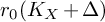 $r_0(K_{X}+\Delta )$
is Cartier.
2.2 K-stability
 $(X,\Delta ,L)$
is called a polarized log (sub)pair if
 $(X,\Delta )$
is a (sub)pair over
 $\mathrm {Spec}\,\mathbb {C}$
and L is an ample
 $\mathbb {Q}$
-line bundle. In this subsection, we recall the definition of log K-stability of polarized log pairs. See [Reference Boucksom, Hisamoto and Jonsson13] for details. If there is no fear of confusion and
 $\Delta =0$
, we simply denote
 $(X,0,L)$
by
 $(X,L)$
.
Definition 2.5 (Test configuration).
Let
 $\pi :\mathcal {X}\to \mathbb {P}^1$
be a projective and flat morphism such that
 $\pi $
is
 $\mathbb {G}_m$
-equivariant, where
 $\mathbb {P}^1$
admits the canonical
 $\mathbb {G}_m$
-action by multiplication. If there exists a
 $\mathbb {G}_m$
-equivariant isomorphism
 $\pi ^{-1}(\mathbb {P}^1\setminus \{0\})\cong X\times (\mathbb {P}^1\setminus \{0\})$
over
 $\mathbb {P}^1\setminus \{0\}$
, where
 $\mathbb {G}_m$
trivially acts on the first component of
 $X\times (\mathbb {P}^1\setminus \{0\})$
,
 $\mathcal {X}$
is called a test configuration for X. Assume further that
 $\mathcal {X}$
admits a relatively (semi)ample
 $\mathbb {G}_m$
-linearized
 $\mathbb {Q}$
-line bundle
 $\mathcal {L}$
over
 $\mathbb {P}^1$
such that
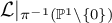 $\mathcal {L}|_{\pi ^{-1}(\mathbb {P}^1\setminus \{0\})}$
coincides with
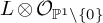 $L\otimes \mathcal {O}_{\mathbb {P}^1\setminus \{0\}}$
with the trivial
 $\mathbb {G}_m$
-action on
 $\mathcal {L}|_{\pi ^{-1}(\infty )}$
. Here, we say that a
 $\mathbb {Q}$
-line bundle
 $\mathcal {L}$
is
 $\mathbb {G}_m$
-linearized if there exists a positive integer m such that
 $m\mathcal {L}$
is a
 $\mathbb {G}_m$
-linearlized line bundle in the sense of [Reference Mumford, Fogarty and Kirwan66, Definition 1.6]. Then,
 $(\mathcal {X},\mathcal {L})$
is called a (semi)ample test configuration for
 $(X,L)$
.
If
 $\mathcal {X}$
is
 $\mathbb {G}_m$
-equivariantly isomorphic to
 $X\times \mathbb {P}^1$
with the trivial action, then we call
 $\mathcal {X}$
trivial. We denote
 $(X\times \mathbb {P}^1,L\otimes \mathcal {O}_{\mathbb {P}^1})$
with the trivial action by
 $(X_{\mathbb {P}^1},L_{\mathbb {P}^1})$
. Similarly, we denote
 $\Delta \times \mathbb {P}^1\subset X_{\mathbb {P}^1}$
by
 $\Delta _{\mathbb {P}^1}$
for any
 $\mathbb {Q}$
-divisor
 $\Delta $
on X.
Let Y be another projective variety and
 $f\colon X\to Y$
be a morphism. If
 $\mathcal {X}$
(resp.
 $\mathcal {Y}$
) is a test configuration for X (resp. Y), we note that there exists a unique
 $\mathbb {G}_m$
-equivariant rational map
 $F\colon \mathcal {X}\dashrightarrow \mathcal {Y}$
induced by
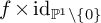 $f\times \mathrm {id}_{\mathbb {P}^1\setminus \{0\}}$
. We call such F the canonical rational map. If F is further a morphism, then we say that there exists a canonical morphism
 $F\colon \mathcal {X}\to \mathcal {Y}$
.
Remark 2.6. Usually, we call
 $\pi ^{-1}(\mathbb {P}^1\setminus \{\infty \})$
a test configuration (see [Reference Boucksom, Hisamoto and Jonsson13] for example) in the situation of Definition 2.5 rather than our
 $\mathcal {X}$
. In Definition 2.5, what we defined to be test configurations are called the canonical compactifications of test configurations in [Reference Boucksom, Hisamoto and Jonsson13]. In this paper, we only make use of the canonical compactifications of test configurations. This is why we define the notion of test configuration as in Definition 2.5.
We note that if a test configuration
 $\mathcal {X}$
for X is normal, then there exists the following relationship between irreducible components of
 $\mathcal {X}_0$
and divisorial valuations of X (cf. [Reference Boucksom, Hisamoto and Jonsson13, §4]). Let E be an irreducible component of
 $\mathcal {X}_0$
, and set
 $b_E:=\mathrm {ord}_E(\mathcal {X}_0)$
. If E is not the strict transform of the central fiber of
 $X_{\mathbb {P}^1}$
, we know that
 $\frac {1}{b_E}\mathrm {ord}_E|_{X}$
is a nontrivial divisorial valuation and we denote this by
 $v_E$
(see [Reference Boucksom, Hisamoto and Jonsson13, Lemma 4.1]).
Notation 2.7. For simplicity, we will denote line bundles and divisors interchangeably. For instance,
 $$ \begin{align*}L^m\cdot (kH+D):=L^{\cdot m}\cdot (H^{\otimes k}\otimes \mathcal{O}_X(D)).\end{align*} $$
We define the following functionals and the Donaldson–Futaki invariant as in [Reference Boucksom, Hisamoto and Jonsson13].
Definition 2.8 [Reference Boucksom, Hisamoto and Jonsson13, §6, §7].
Let
 $(X,\Delta ,L)$
be a polarized log subpair of dimension n. Take an arbitrary normal semiample test configuration
 $(\mathcal {X},\mathcal {L})$
for
 $(X,L)$
. Let
 $\rho \colon \mathcal {X}\dashrightarrow X_{\mathbb {P}^1}$
be the canonical birational map. It is well known that there exist a normal test configuration
 $\mathcal {Y}$
and a canonical morphism
 $\sigma \colon \mathcal {Y}\to \mathcal {X}$
such that the canonical birational map
 $\rho _{\mathcal {Y}}=\rho \circ \sigma $
is a morphism. Furthermore, let
 $\mathcal {Y}_{0,\mathrm {red}}$
be the reduced structure of
 $\mathcal {Y}_0$
,
 $\Delta _{\mathcal {Y}}$
be the closure of
 $\Delta \times (\mathbb {P}^1\setminus \{0\})$
in
 $\mathcal {Y}$
and
 $K^{\mathrm {log}}_{(\mathcal {Y},\Delta _{\mathcal {Y}})/\mathbb {P}^1}:=K_{(\mathcal {Y},\Delta _{\mathcal {Y}})/\mathbb {P}^1}+(\mathcal {Y}_{0,\mathrm {red}}-\mathcal {Y}_0)$
, where
 $\pi \colon \mathcal {Y}\to \mathbb {P}^1$
is the canonical morphism and
 $K_{(\mathcal {Y},\Delta _{\mathcal {Y}})/\mathbb {P}^1}:=K_{\mathcal {Y}}+\Delta _{\mathcal {Y}}-\pi ^{*}K_{\mathbb {P}^1}$
. Then we define
-
•
$I^{\mathrm {NA}}(\mathcal {X},\mathcal {L})=(L^n)^{-1}(\sigma ^{*}\mathcal {L}\cdot \rho _{\mathcal {Y}}^{*}L_{\mathbb {P}^1}^n)-(L^n)^{-1}(\sigma ^{*}\mathcal {L}- \rho _{\mathcal {Y}}^{*}L_{\mathbb {P}^1})\cdot (\sigma ^{*}\mathcal {L})^n,$
-
•
$E^{\mathrm {NA}}(\mathcal {X},\mathcal {L})=\frac {\mathcal {L}^{n+1}}{(n+1)(L^n)},$
-
•
$J^{\mathrm {NA}}(\mathcal {X},\mathcal {L})=(L^n)^{-1}(\sigma ^{*}\mathcal {L}\cdot \rho _{\mathcal {Y}}^{*}L_{\mathbb {P}^1}^n)- E^{\mathrm {NA}}(\mathcal {X},\mathcal {L}),$
-
• the non-Archimedean J
$^H$
-energy is defined to be where H is a
$$\begin{align*}(\mathcal{J}^H)^{\mathrm{NA}}(\mathcal{X},\mathcal{L})=(L^n)^{-1}(\rho_{\mathcal{Y}}^{*}H_{\mathbb{P}^1}\cdot (\sigma^{*}\mathcal{L})^{n})- (L^n)^{-1}(nH\cdot L^{n-1})E^{\mathrm{NA}}(\mathcal{X},\mathcal{L}), \end{align*}$$
$\mathbb {Q}$
-line bundle on X,
-
• the non-Archimedean entropy is defined to be
where E runs over all irreducible components of
$$ \begin{align*} H_\Delta^{\mathrm{NA}}(\mathcal{X},\mathcal{L})&=(L^n)^{-1}\sum_Eb_EA_{(X,B)}(v_E)(E\cdot(\sigma^{*}\mathcal{L})^n)\\ &=(L^n)^{-1}(K^{\mathrm{log}}_{(\mathcal{Y},\Delta_{\mathcal{Y}})/\mathbb{P}^1}-\rho_{\mathcal{Y}}^{*}K_{(X_{\mathbb{P}^1},\Delta_{\mathbb{P}^1})/\mathbb{P}^1})\cdot(\sigma^{*}\mathcal{L})^n, \end{align*} $$
$\mathcal {Y}_0$
that is not the strict transform of
$X\times \{0\}$
,
-
• the log Donaldson–Futaki invariant is defined to be
$$ \begin{align*}\mathrm{DF}_{\Delta}(\mathcal{X},\mathcal{L})=(L^n)^{-1}(K_{(\mathcal{Y},\Delta_{\mathcal{Y}})/\mathbb{P}^1}-\rho_{\mathcal{Y}}^{*}K_{(X_{\mathbb{P}^1},\Delta_{\mathbb{P}^1})/\mathbb{P}^1})\cdot\mathcal{L}^n+(\mathcal{J}^{K_{X}+\Delta})^{\mathrm{NA}}(\mathcal{X},\mathcal{L}),\end{align*} $$
-
• the non-Archimedean Mabuchi energy
$$ \begin{align*}M_\Delta^{\mathrm{NA}}(\mathcal{X},\mathcal{L})=H_\Delta^{\mathrm{NA}}(\mathcal{X},\mathcal{L})+(\mathcal{J}^{K_{X}+\Delta})^{\mathrm{NA}}(\mathcal{X},\mathcal{L}).\end{align*} $$


It is well known that these invariants are independent of the choice of
 $\sigma \colon \mathcal {Y}\to \mathcal {X}$
. We say that a semiample test configuration
 $(\tilde {\mathcal {X}},\tilde {\mathcal {L}})$
dominates
 $(\mathcal {X},\mathcal {L})$
via
 $\mu $
if there exists a canonical morphism
 $\mu :\tilde {\mathcal {X}}\to \mathcal {X}$
such that
 $\tilde {\mathcal {L}}=\mu ^{*}\mathcal {L}$
. It is proved in [Reference Boucksom, Hisamoto and Jonsson13, §§7.5] that those functionals are pullback invariant as defined in [Reference Boucksom, Hisamoto and Jonsson13], that is, if
 $(\tilde {\mathcal {X}},\tilde {\mathcal {L}})$
dominates
 $(\mathcal {X},\mathcal {L})$
, then
 $J^{\mathrm {NA}}(\tilde {\mathcal {X}},\tilde {\mathcal {L}})=J^{\mathrm {NA}}(\mathcal {X},\mathcal {L})$
cf. [Reference Boucksom, Hisamoto and Jonsson13, §6, §7] for example.
Note that
 $I^{\mathrm {NA}}$
,
 $J^{\mathrm {NA}}$
and
 $I^{\mathrm {NA}}-J^{\mathrm {NA}}$
are nonnegative and equivalent norms to each other in the sense of [Reference Boucksom, Hisamoto and Jonsson13, Proposition 7.8].
 $I^{\mathrm {NA}}-J^{\mathrm {NA}}$
is also introduced by [Reference Dervan20] and called the minimum norm. More precisely, the following holds.
Lemma 2.9 (cf. [Reference Boucksom, Hisamoto and Jonsson13, Proposition 7.8]).
Let
 $(X,\Delta ,L)$
be a polarized log subpair of dimension n and
 $(\mathcal {X},\mathcal {L})$
be a normal ample test configuration for
 $(X,L)$
. Then
 $$ \begin{align*} 0\le\frac{1}{n}J^{\mathrm{NA}}(\mathcal{X},\mathcal{L})\le I^{\mathrm{NA}}(\mathcal{X},\mathcal{L})-J^{\mathrm{NA}}(\mathcal{X},\mathcal{L})=(\mathcal{J}^L)^{\mathrm{NA}}(\mathcal{X},\mathcal{L})\le nJ(\mathcal{J}^L)^{\mathrm{NA}}(\mathcal{X},\mathcal{L}). \end{align*} $$
Furthermore,
 $J^{\mathrm {NA}}(\mathcal {X},\mathcal {L})=0$
if and only if
 $\mathcal {X}$
is trivial.
Definition 2.10 (K-stability and J-stability).
Let
 $(X,\Delta ,L)$
be a polarized log pair.
 $(X,\Delta ,L)$
is called K-stable if
 $$\begin{align*}\mathrm{DF}_{\Delta}(\mathcal{X},\mathcal{L})>0 \end{align*}$$
for any nontrivial normal ample test configuration. On the other hand,
 $(X,\Delta ,L)$
is called uniformly K-stable (resp, K-semistable) if there exists a constant
 $c>0$
(resp.,
 $c\ge 0$
) such that
 $$\begin{align*}\mathrm{DF}_{\Delta}(\mathcal{X},\mathcal{L})\ge c J^{\mathrm{NA}}(\mathcal{X},\mathcal{L}) \end{align*}$$
for any semiample test configuration
 $(\mathcal {X},\mathcal {L})$
for
 $(X,L)$
. The above condition is known by [Reference Boucksom, Hisamoto and Jonsson13, §8] to be equivalent to that for any semiample normal test configuration
 $(\mathcal {X},\mathcal {L})$
 $$\begin{align*}M^{\mathrm{NA}}_{\Delta}(\mathcal{X},\mathcal{L})\ge c J^{\mathrm{NA}}(\mathcal{X},\mathcal{L}). \end{align*}$$
The definition of J
 $^H$
-stability is of similar form (cf. [Reference Hattori45]). That is, we say that
 $(X,L)$
is uniformly J
 $^H$
-stable (resp. J
 $^H$
-semistable) if there exists
 $c>0$
(resp.
 $c\ge 0$
) such that
 $$\begin{align*}(\mathcal{J}^H)^{\mathrm{NA}}(\mathcal{X},\mathcal{L})\ge c J^{\mathrm{NA}}(\mathcal{X},\mathcal{L}). \end{align*}$$
Let us recall the scaling action to a non-Archimedean metric [Reference Boucksom, Hisamoto and Jonsson13, §6.2].
Notation 2.11. Let
 $(\mathcal {X},\mathcal {L})$
be a normal semiample test configuration and
 $d\in \mathbb {Z}_{>0}$
. Then let
 $\mathcal {X}^{(d)}$
be the normalization of the base change of
 $(\mathcal {X},\mathcal {L})$
by the d-th power map
 $\mathbb {P}^1\ni t\mapsto t^d\in \mathbb {P}^1$
and
 $\mathcal {L}^{(d)}$
be the pullback of
 $\mathcal {L}$
. We call
 $(\mathcal {X}^{(d)},\mathcal {L}^{(d)})$
the normalized base change of
 $(\mathcal {X},\mathcal {L})$
by the d-th power map
 $\mathbb {P}^1\ni t\mapsto t^d\in \mathbb {P}^1$
. It is well known that
 $d\,M^{\mathrm {NA}}_{\Delta }(\mathcal {X},\mathcal {L})=M^{\mathrm {NA}}_{\Delta }(\mathcal {X}^{(d)},\mathcal {L}^{(d)})$
and
 $d\,\mathrm {DF}_{\Delta }(\mathcal {X},\mathcal {L})\ge \mathrm {DF}_{\Delta }(\mathcal {X}^{(d)},\mathcal {L}^{(d)})$
for any
 $d\in \mathbb {Z}_{>0}$
by [Reference Boucksom, Hisamoto and Jonsson13, Proposition 7.16]. If
 $\mathcal {B}$
is the strict transform of
 $B_{\mathbb {P}^1}$
on
 $\mathcal {X}$
, we denote the strict transform of
 $B_{\mathbb {P}^1}$
on
 $\mathcal {X}^{(d)}$
by
 $\mathcal {B}^{(d)}$
, where B is a
 $\mathbb {Q}$
-divisor on X.
Recall the definitions of the log canonical threshold, the
 $\alpha $
-invariant and
 $\delta $
-invariant.
Definition 2.12. Let
 $(X,B)$
be a subpair and D be an effective
 $\mathbb {Q}$
-Cartier
 $\mathbb {Q}$
-divisor. Suppose that there exists
 $l\in \mathbb {Q}$
such that
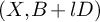 $(X,B+lD)$
is sublc. Then we set the log canonical threshold of
 $(X,B)$
with respect to D as
 $$\begin{align*}\mathrm{lct}_{(X,B)}(D)=\inf\{r\in\mathbb{Q}|(X,B+rD) \ \mathrm{is}\ \mathrm{sublc}\}=\min_v\frac{A_{(X,B)}(v)}{v(D)}, \end{align*}$$
where v runs over all divisorial valuations such that
 $v(D)\ne 0$
.
The
 $\alpha $
-invariant was originally introduced by Tian [Reference Tian80] for Fano manifolds to detect the existence of Kähler–Einstein metrics, but this is very useful to detect K-stability for other kinds of polarized varieties.
Definition 2.13. Let
 $(X,B,L)$
be a polarized klt pair. Then the alpha invariant of
 $(X,B)$
with respect to L is
 $$\begin{align*}\alpha_{(X,B)}(L)=\inf_D \mathrm{lct}_{(X,B)}(D), \end{align*}$$
where D runs over all elements of
 $|L|_{\mathbb {Q}}$
, which is the set of effective
 $\mathbb {Q}$
-Cartier
 $\mathbb {Q}$
-divisors D such that
 $D\sim _{\mathbb {Q}}L$
. If we set
 $T_L(v)=\sup _{D\in |L|_{\mathbb {Q}}}v(D)$
, then we have
 $$\begin{align*}\alpha_{(X,B)}(L)=\inf_v\frac{A_{(X,B)}(v)}{T_L(v)}, \end{align*}$$
where v runs over all divisorial valuations.
Definition 2.14 ([Reference Fujita and Odaka39], [Reference Blum and Jonsson10]).
Let
 $(X,B,L)$
be a polarized klt pair. Take
 $r\in \mathbb {Z}_{>0}$
such that
 $rL$
is a line bundle. For any
 $m\in \mathbb {Z}_{>0}$
,
 $D\in |L|_{\mathbb {Q}}$
is called a divisor of
 $mr$
-basis type if there exists a basis
 $\{f_j\}_{j=1}^{h^0(X,mrL)}\subset H^0(X,mrL)$
such that
 $$\begin{align*}D=(mrh^0(X,mrL))^{-1}\sum_{j=1}^{h^0(X,mrL)}\mathrm{div}_{mrL}(f_j). \end{align*}$$
Here,
 $\mathrm {div}_{mrL}(f_j)$
is an effective Cartier divisor defined by
 $f_j$
as a section of
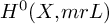 $H^0(X,mrL)$
. We denote by
 $|L|_{mr\text {-basis}}$
the set of all
 $mr$
-basis type divisors D with respect to L. We set
 $S^{mr}_{L}(v):=\sup _{D\in |L|_{mr\text {-basis}}}v(D)$
for any divisorial valuation v of X. Then, we set
 $$\begin{align*}\delta^{mr}_{(X,B)}(L):=\inf_{D\in|L|_{mr\text{-basis}}}\mathrm{lct}_{(X,B)}(D)=\inf_v\frac{A_{(X,B)}(v)}{S^{mr}_{L}(v)}, \end{align*}$$
where v runs over all divisorial valuations on X. By [Reference Blum and Jonsson10, Theorem A],
 $\{\delta ^{mr}_{(X,B)}(L)\}_{m=1}^{\infty }$
converges and set the delta invariant of
 $(X,B)$
with respect to L as
 $$\begin{align*}\delta_{(X,B)}(L):=\lim_{m\to\infty}\delta^{mr}_{(X,B)}(L). \end{align*}$$
Moreover, thanks to [Reference Blum and Jonsson10, §2], we have that
 $\lim _{m\to \infty }S^{mr}_{L}(v)=S_L(v)$
for any divisorial valuation v on X and
 $$\begin{align*}\delta_{(X,B)}(L)=\inf_v\frac{A_{(X,B)}(v)}{S_{L}(v)}, \end{align*}$$
where v runs over all divisorial valuations on X and
 $S_{L}(v):=\mathrm {vol}(L)^{-1}\int _0^{\infty }\mathrm {vol}(L-xv)dx$
. Here,
 $\mathrm {vol}(L-xv)$
means
 $\mathrm {vol}(\pi ^{*}L-xcE)$
, where
 $c\in \mathbb {Q}_{>0}$
, E is a prime divisor over X and
 $\pi \colon Y\to X$
is a log resolution such that
 $v=c\,\mathrm {ord}_E$
and E is a prime divisor on Y. See [Reference Blum and Jonsson10] for details.
We note the following well-known facts to compute
 $\delta _{(X,B)}(L)$
. Let
 $(X,B,L)$
be a polarized klt pair. For any
 $m\in \mathbb {Z}_{>0}$
such that
 $mL$
is a Cartier divisor,
 $\lambda \in \mathbb {Z}_{\ge 0}$
and prime divisor E over X, we set
 $$\begin{align*}\mathcal{F}_E^\lambda H^0(X,mL):=H^0(Y,m\sigma^{*}L-\lambda E), \end{align*}$$
where
 $\sigma \colon Y\to X$
is a resolution of singularities such that E is a prime divisor on Y. Let
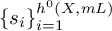
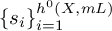 $\{s_i\}_{i=1}^{h^0(X,mL)}$
be a basis of
 $H^0(X,mL)$
. If we can take a basis of
 $\mathcal {F}_E^\lambda H^0(X,mL)$
as a subset of
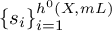 $\{s_i\}_{i=1}^{h^0(X,mL)}$
for any
 $\lambda $
, we say that
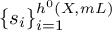 $\{s_i\}_{i=1}^{h^0(X,mL)}$
is compatible with E. In this situation, we have the following.
Lemma 2.15.
-
(1) For any
$m\in \mathbb {Z}_{>0}$
such that
$mL$
is a Cartier divisor and prime divisor E over X, take a basis
$\{s_i\}_{i=1}^{h^0(X,mL)}$
of
$H^0(X,mL)$
compatible with E. If D is the m-basis type divisor defined by
$\{s_i\}$
, then
$$\begin{align*}S^{m}_L(\mathrm{ord}_{E})=\mathrm{ord}_{E}(D)=\frac{\sum_{\lambda\ge1}\mathrm{dim}\,\mathcal{F}^{\lambda}_EH^0(X,mL)}{mh^0(X,mL)}. \end{align*}$$
-
(2) Let E and
$E'$
be prime divisors over X. Then there exists a basis of
$H^0(X,mL)$
compatible with both of E and
$E'$
for any
$m\in \mathbb {Z}_{>0}$
such that
$mL$
is a Cartier divisor.




Proof. (1) follows from the proof of [Reference Fujita and Odaka39, Lemma 2.2]. (2) is nothing but [Reference Abban and Zhuang1, Lemma 3.1].
If
 $v=\mathrm {ord}_F$
for some prime divisor F over X, we will simply denote
 $T_L(F):=T_L(\mathrm {ord}_F)$
.
We remark that for any
 $r\in \mathbb {Q}_{>0}$
, we have that
 $r\delta _{(X,B)}(rL)=\delta _{(X,B)}(L)$
and
 $r\alpha _{(X,B)}(rL)=\alpha _{(X,B)}(L)$
. These invariants are important in the following sense.
Theorem 2.16 [Reference Boucksom, Hisamoto and Jonsson13, Proposition 9.16], [Reference Blum and Jonsson10].
Let
 $(X,B,L)$
be a klt polarized pair. Then the following hold.
-
(1)
$\alpha _{(X,B)}(L)>0$
and for any semiample normal test configuration for
$$\begin{align*}H^{\mathrm{NA}}_{B}(\mathcal{X},\mathcal{L})\ge\alpha_{(X,B)}(L)I^{\mathrm{NA}}(\mathcal{X},\mathcal{L}) \end{align*}$$
$(X,L)$
.
-
(2) Suppose that
$K_X+B=-L$
. Then,
$(X,B,L)$
is uniformly K-stable (resp., K-semistable) if and only if
$\delta _{(X,B)}(L)>1$
(resp.,
$\ge 1$
).







Example 2.17. If X is a curve, then
 $2\alpha _{(X,B)}(L)=\delta _{(X,B)}(L)$
. Indeed, for any closed point
 $P\in X$
, we have that
 $$ \begin{align*}\frac{1}{\mathrm{deg}(L)}\int^{\mathrm{deg}(L)}_0\mathrm{deg}(L-xP)dx=\frac{\mathrm{deg}(L)}{2}.\end{align*} $$
This means that
 $2S_L(\mathrm {ord}_P)=T_L(\mathrm {ord}_P)$
.
From now, we introduce K-stability of algebraic fiber spaces.
Definition 2.18 [Reference Hattori48].
 $f\colon (X,\Delta ,H)\to (C,L)$
is called a polarized algebraic fiber space (sub)pair if
 $(X,\Delta , H)$
is a polarized (sub)pair,
 $(C,L)$
is a polarized normal variety and
 $f\colon X\to C$
is a contraction, that is, f is projective and
 $f_{*}\mathcal {O}_X\cong \mathcal {O}_C$
. Let
 $f:(X,\Delta ,H)\to (C,L)$
be a polarized algebraic fiber space pair. Then
 $(X,\Delta ,H)$
is called adiabatically K-(semi)stable over
 $(C,L)$
if
 $(X,\Delta ,\epsilon H+f^{*}L)$
is K-(semi)stable for sufficiently small
 $\epsilon \in \mathbb {Q}_{>0}$
. Furthermore,
 $(X,\Delta ,H)$
is called
-
• uniformly adiabatically K-stable over
$(C,L)$
if there exist positive constants
$\delta>0$
and
$\epsilon _0>0$
such that
$\mathrm {DF}_{\Delta }(\mathcal {X},\mathcal {M})\ge \delta J^{\mathrm {NA}}(\mathcal {X},\mathcal {M})$
for any
$\epsilon \in (0,\epsilon _0)\cap \mathbb {Q}$
and semiample test configuration
$(\mathcal {X},\mathcal {M})$
for
$(X,\epsilon H+f^{*}L)$
, -
• adiabatically K-unstable over
$(C,L)$
if for any sufficiently small rational number
$\epsilon>0$
, there exists a semiample test configuration
$(\mathcal {X},\mathcal {M})$
for
$(X,\epsilon H+f^{*}L)$
such that
$\mathrm {DF}_{\Delta }(\mathcal {X},\mathcal {M})<0$
.









We say that
 $(X,H)$
has cscK metrics adiabatically if X is smooth,
 $\Delta =0$
and there exists
 $\delta _0>0$
such that
 $(X,\delta H+f^{*}L)$
has a cscK metric for any
 $0<\delta <\delta _0$
. Here, we will simply denote
 $H+f^{*}L$
by
 $H+L$
.
2.3 Log-twisted K-stability
Next, we introduce log-twisted K-stability as follows.
Definition 2.19. A quadruple
 $(X,B,T,L)$
is called a polarized log-twisted pair if
 $(X,B,L)$
is a polarized log pair and T is a
 $\mathbb {Q}$
-line bundle on X.
We call
 $(X,B,T,L)$
a log-twisted Fano pair if
 $L\sim _{\mathbb {Q}}-(K_X+B+T)$
and
 $(X,B)$
is klt.
We remark that if
 $B=0$
, then log-twisted K-stability is nothing but twisted K-stability introduced in [Reference Dervan20].
Definition 2.20. Let
 $(X,B,T,L)$
be a polarized log-twisted pair and
 $(\mathcal {X},\mathcal {L})$
be a semiample test configuration for
 $(X,L)$
. Then the log-twisted Donaldson–Futaki invariant is
 $$\begin{align*}\mathrm{DF}_{(B,T)}(\mathcal{X},\mathcal{L})=\mathrm{DF}_{B}(\mathcal{X},\mathcal{L})+(\mathcal{J}^T)^{\mathrm{NA}}(\mathcal{X},\mathcal{L}). \end{align*}$$
We can also define the log-twisted non-Archimedean Mabuchi functional as
 $$\begin{align*}M^{\mathrm{NA}}_{(B,T)}(\mathcal{X},\mathcal{L})=M^{\mathrm{NA}}_{B}(\mathcal{X},\mathcal{L})+(\mathcal{J}^T)^{\mathrm{NA}}(\mathcal{X},\mathcal{L}). \end{align*}$$
Then,
 $(X,B,T,L)$
is called (log-twisted)
-
• K-semistable if
for any normal semiample test configuration,
$$\begin{align*}M^{\mathrm{NA}}_{(B,T)}(\mathcal{X},\mathcal{L})\ge0 \end{align*}$$
-
• K-stable if
for any nontrivial normal ample test configuration,
$$\begin{align*}M^{\mathrm{NA}}_{(B,T)}(\mathcal{X},\mathcal{L})>0 \end{align*}$$
-
• uniformly K-stable if there exists a positive constant
$\epsilon>0$
such that for any normal semiample test configuration.
$$\begin{align*}M^{\mathrm{NA}}_{(B,T)}(\mathcal{X},\mathcal{L})\ge \epsilon J^{\mathrm{NA}}(\mathcal{X},\mathcal{L}) \end{align*}$$


Definition 2.21. Let T be a
 $\mathbb {Q}$
-line bundle on X. If T is semiample, we say that
 $A\sim _{\mathbb {Q}}T$
is a general effective
 $\mathbb {Q}$
-divisor if there exists
 $m\in \mathbb {Z}_{>0}$
such that
 $mT$
is globally generated and
 $mA\in |mT|$
. When T is not semiample,
 $A\sim _{\mathbb {Q}}T$
is called general if there exist two general semiample
 $\mathbb {Q}$
-divisors
 $A_1$
and
 $A_2$
such that
 $T\sim _{\mathbb {Q}}A_1-A_2$
.
We regard log-twisted K-stability as the log K-stability when we choose a general
 $\mathbb {Q}$
-divisor
 $T_1\sim _{\mathbb {Q}}T$
as follows.
Lemma 2.22. Let
 $(X,B,T,L)$
be a polarized log-twisted pair and
 $(\mathcal {X},\mathcal {L})$
be a normal semiample test configuration for
 $(X,L)$
. Fix a
 $\mathbb {Q}$
-Cartier
 $\mathbb {Q}$
-divisor
 $D\sim _{\mathbb {Q}}T$
. If the support of D does not contain the center of a divisorial valuation
 $v_E$
for any irreducible component
 $E\subset \mathcal {X}_0$
of
 $\mathcal {X}$
, then
 $$ \begin{align*} \mathrm{DF}_{(B,T)}(\mathcal{X},\mathcal{L})&=\mathrm{DF}_{B+D}(\mathcal{X},\mathcal{L})\\ M^{\mathrm{NA}}_{(B,T)}(\mathcal{X},\mathcal{L})&=M^{\mathrm{NA}}_{B+D}(\mathcal{X},\mathcal{L}). \end{align*} $$
Proof. Let
 $\pi :\tilde {\mathcal {X}}\to \mathcal {X}$
and
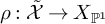 $\rho :\tilde {\mathcal {X}}\to X_{\mathbb {P}^1}$
be the canonical morphisms. Then
 $$ \begin{align*} \mathrm{DF}_{B+D}(\mathcal{X},\mathcal{L})&=\frac{1}{L^n}\left((K_{\tilde{\mathcal{X}}/\mathbb{P}^1}+\mathcal{B}+\mathcal{D})\cdot \pi^{*}\mathcal{L}^n-\frac{n(K_X+B+T)\cdot L^{n-1}}{(n+1)L^n}\pi^{*}\mathcal{L}^{n+1}\right),\quad\text{and}\\ \mathrm{DF}_{(B,T)}(\mathcal{X},\mathcal{L})&=\frac{1}{L^n}\left((K_{\tilde{\mathcal{X}}/\mathbb{P}^1}+\mathcal{B}+\rho^{*}D_{\mathbb{P}^1})\cdot \pi^{*}\mathcal{L}^n-\frac{n(K_X+B+T)\cdot L^{n-1}}{(n+1)L^n}\pi^{*}\mathcal{L}^{n+1}\right), \end{align*} $$
where
 $\mathrm {dim}\,X=n$
and
 $\mathcal {B}$
and
 $\mathcal {D}$
are the strict transforms of
 $B_{\mathbb {P}^1}$
and
 $D_{\mathbb {P}^1}$
on
 $\tilde {\mathcal {X}}$
respectively. Thus,
 $$\begin{align*}\mathrm{DF}_{(B,T)}(\mathcal{X},\mathcal{L})-\mathrm{DF}_{B+D}(\mathcal{X},\mathcal{L})=\frac{1}{L^n}(\rho^{*}D_{\mathbb{P}^1}-\mathcal{D})\cdot \pi^{*}\mathcal{L}^n. \end{align*}$$
By assumption,
 $\rho ^{*}D_{\mathbb {P}^1}-\mathcal {D}$
is
 $\pi $
-exceptional and hence
 $(\rho ^{*}D_{\mathbb {P}^1}-\mathcal {D})\cdot \pi ^{*}\mathcal {L}^n=0$
. Similarly, we can show the assertion for the non-Archimedean Mabuchi functionals.
By Lemma 2.22, we can deduce the similar properties to the log K-stability and twisted K-stability in [Reference Odaka and Sun72], [Reference Boucksom, Hisamoto and Jonsson13] and [Reference Dervan21].
Theorem 2.23. If a polarized log-twisted pair
 $(X,B,T,L)$
is K-semistable, then
 $(X,B)$
is lc. Furthermore, if
 $L=-(K_X+B+T)$
, then
 $(X,B)$
is klt.
Proof. We follow the notations in [Reference Hattori48]. We only prove the first assertion. If
 $\lceil B\rceil $
is reduced, due to [Reference Odaka and Xu73, Theorem 1.1], there exists a closed subscheme whose Rees valuations v satisfy that
 $A_{(X,B)}(v)<0$
. Then,
 $A_{(X,B+T_1)}(v)=A_{(X,B)}(v)<0$
for any general divisor
 $T_1\sim _{\mathbb {Q}}T$
. Therefore, the theorem follows from the proof of [Reference Hattori48, Theorem 5.1]. The rest also follows from the same argument of [Reference Hattori48, Theorem 5.1] and is left to the reader.
Thanks to [Reference Boucksom, Hisamoto and Jonsson13, Proposition 9.16], the following holds as in the logarithmic case.
Proposition 2.24 (cf., [Reference Boucksom, Hisamoto and Jonsson13, Corollaries 9.3 and 9.4], [Reference Dervan21, Theorems 3.21, 3.23]).
Let
 $(X,B,T,L)$
be a polarized log-twisted pair. Then the following hold.
-
(1) If
$K_X+B+T\equiv 0$
and
$(X,B)$
is klt (resp., lc), then
$(X,B,T,L)$
is uniformly K-stable (resp., K-semistable). -
(2) If
$K_X+B+T\equiv L$
and
$(X,B)$
is lc, then
$(X,B,T,L)$
is uniformly K-stable.





The proofs are left to the readers.
We can consider a special log-twisted test configuration as follows.
Definition 2.25. Let
 $(X,B,T,L=-K_X-B-T)$
be a log-twisted Fano pair, T is semiample and
 $(\mathcal {X}^{\mathrm {s}},\mathcal {L}^{\mathrm {s}})$
be a normal ample test configuration. Let
 $\rho ^{\mathrm {s}}\colon \mathcal {X}^{\mathrm {s}}\dashrightarrow X_{\mathbb {P}^1}$
be the canonical birational morphism and
 $\mathcal {B}^{\mathrm {s}}:=(\rho ^{\mathrm {s}})^{-1}_{*}B_{\mathbb {P}^1}$
. Then
 $(\mathcal {X}^{\mathrm {s}},\mathcal {L}^{\mathrm {s}})$
is a log-twisted special test configuration for
 $(X,B,T,L)$
if
 $(\mathcal {X}^{\mathrm {s}},\mathcal {B}^{\mathrm {s}}+(\rho ^{\mathrm {s}})^{-1}_{*}T_{1,\mathbb {P}^1}+\mathcal {X}_0)$
is plt (cf., [Reference Kollár and Mori55, 2.34]) and
 $\mathcal {L}^{\mathrm {s}}\sim _{\mathbb {Q},\mathbb {P}^1}-(K_{\mathcal {X}^{\mathrm {s}}}+\mathcal {B}^{\mathrm {s}}+(\rho ^{\mathrm {s}})^{-1}_{*}T_{1,\mathbb {P}^1})$
for any general effective
 $\mathbb {Q}$
-divisor
 $T_1\sim _{\mathbb {Q}} T$
.
For fundamental properties of log-twisted pairs, see Appendix A.
2.4 Lc-trivial fibrations
We shall recall the canonical bundle formula (cf, [Reference Fujino and Mori35], [Reference Ambro3] and [Reference Fujino and Gongyo34]).
Definition 2.26 (Klt-trivial fibrations).
Let S be a quasi-projective normal variety. Let
 $f:X\to C$
be a proper surjective morphism of normal varieties projective over S such that
 $f_{*}\mathcal {O}_X\cong \mathcal {O}_C$
.
 $K(X)$
denotes the sheaf of quotient fields of X. For any
 $\mathbb {Q}$
-divisor
 $\Delta $
on X,
 $f\colon (X,\Delta )\to C$
is called a sublc-trivial fibration (resp. subklt-trivial fibration) if
 $(X,\Delta )$
is a sublc (resp. subklt) pair satisfying the following properties:
-
•
$ K_{X}+\Delta \sim _{C,\mathbb {Q}}0$
, -
• rank
$f_{*}\mathcal {O}_X(\lceil \mathbf {A}^{*}(X,\Delta )\rceil )=1$
, -
•
$(X,\Delta )$
is sublc (resp. subklt) over the generic point of C,



where we define
 $\mathcal {O}_X(\lceil \mathbf {A}^{*}(X,\Delta )\rceil )$
as follows (cf. [Reference Fujino32, Lemma 3.22]). Let
 $\pi :Y\to X$
be a log resolution of
 $(X,\Delta )$
, and suppose that
 $K_Y=\pi ^{*}(K_X+\Delta )+\sum _ia_iE_i$
and
 $\pi _{*}(\sum _ia_iE_i)=-\Delta $
. Then we set
 $$\begin{align*}\mathcal{O}_X(\lceil \mathbf{A}^{*}(X,\Delta)\rceil)=\pi_{*}\mathcal{O}_Y(\sum_{a_i\ne-1}\lceil a_i\rceil E_i). \end{align*}$$
The definition of
 $\mathcal {O}_X(\lceil \mathbf {A}^{*}(X,\Delta )\rceil )$
is independent of the choice of
 $\pi $
and hence
 $\mathcal {O}_X(\lceil \mathbf {A}^{*}(X,\Delta )\rceil )$
is coherent. We say that f is a lc (resp., klt)-trivial fibration if
 $(X,\Delta )$
is a lc (resp., klt) pair and
 $K_{X}+\Delta \sim _{C,\mathbb {Q}}0$
. It is easy to see that if f is a lc (resp., klt)-trivial fibration, then f is a sublc (resp., subklt)-trivial fibration. We remark that sublc-trivial fibrations are usually called lc-trivial fibrations (e.g., in [Reference Fujino and Gongyo34]). Furthermore, if
 $f\colon (X,\Delta ,H)\to (C,L)$
is a polarized algebraic fiber space pair, then we say that
 $f\colon (X,\Delta ,H)\to (C,L)$
is a polarized lc (resp. klt)-trivial fibration.
If f is a sublc-trivial fibration, then we set the canonical bundle formula as follows (cf. [Reference Ambro3], [Reference Fujino and Gongyo34, 3.4]). There exist a positive integer
 $b\in \mathbb {Z}_{>0}$
and a nonzero rational function
 $\varphi \in K(X)$
such that
 $$ \begin{align} K_{X}+\Delta+\frac{1}{b}(\varphi)= f^{*}(K_C+M_{C}+B_{C}), \end{align} $$
where
 $(\varphi )$
is the principal divisor and
 $M_{C}$
and
 $B_{C}$
are
 $\mathbb {Q}$
-divisors uniquely determined as follows.
 $B_C$
is called the discriminant divisor of f defined by the equation
 $$\begin{align*}B_C=\sum_D(1-\mathrm{lct}_{(X_D,\Delta|_{X_D})}(f^{*}D))D, \end{align*}$$
where
 $X_D\subset X$
is a sufficiently small neighborhood of the fiber of the generic point of D and D runs over all prime divisors on C.
 $M_C$
is defined in the way that (1) holds and called the moduli divisor. We will simply denote the formula (1) by
 $$ \begin{align*}K_{X}+\Delta\sim_{\mathbb{Q}} f^{*}(K_C+M_{C}+B_{C})\end{align*} $$
by omitting
 $\frac {1}{b}(\varphi )$
. For any birational morphism
 $h:C'\to C$
of normal varieties projective over S, we can take a sublc-trivial fibration
 $f':(X',\Delta ')\to C'$
such that there exists a birational morphism
 $\tilde {h}\colon X'\to X$
making the following diagram commute

and satisfying that
 $K_{X'}+\Delta '=\tilde {h}^{*}(K_X+\Delta )$
and
 $\tilde {h}_{*}\Delta '=\Delta $
. Then, we take
 $M_{C'}$
as the following holds
 $$\begin{align*}K_{X'}+\Delta'+\frac{1}{b}(\varphi)= f'^{*}(K_{C'}+M_{C'}+B_{C'}) \end{align*}$$
and hence
 $M_C=h_{*}M_{C'}$
,
 $B_C=h_{*}B_{C'}$
and
 $K_{C'}+M_{C'}+B_{C'}=h^{*}(K_C+M_C+B_C)$
. In this case, we call
 $M_{C'}$
(resp.
 $B_{C'}$
) the moduli (resp. discriminant) divisor defined by
 $M_C$
(resp.
 $B_{C}$
) and f on
 $C'$
and one can see that
 $M_{C'}$
and
 $B_{C'}$
do not depend on the choice of
 $f'$
. For any birational map
 $h":C"\dashrightarrow C$
, we say that a
 $\mathbb {Q}$
-divisor
 $\mathcal {M}$
on
 $C"$
is the moduli divisor defined by
 $M_C$
and f if the following holds. Suppose that there exist proper birational morphisms
 $p\colon C'\to C"$
and
 $h\colon C'\to C$
. Let
 $M_{C'}$
be the moduli divisor defined by
 $M_C$
and f. Then,
 $\mathcal {M}=p_{*}M_{C'}$
. In this situation, we define the following.
Definition 2.27 (Ambro model).
We say that
 $M_C$
is stable under birational base change if
 $M_C$
is
 $\mathbb {Q}$
-Cartier and
 $$\begin{align*}M_{C'}=h^{*}M_C \end{align*}$$
for any birational morphism
 $h:C'\to C$
, where
 $M_{C'}$
is the moduli divisor defined by
 $M_C$
and f. Then, we call C an Ambro model for f. If moreover,
 $M_C$
is semiample, we call C a good Ambro model in this paper. Thanks to [Reference Fujino and Gongyo34, Theorem 3.6], there exists an Ambro model
 $C'$
dominating C for any sublc-trivial fibration and then the moduli divisor is nef. For subklt-trivial fibrations, this fact was originally proved in [Reference Ambro4].
It immediately follows from the same argument of [Reference Ambro3, §5] that if
 $f:(X,\Delta )\to C$
is a sublc-trivial fibration over a curve C, then C is an Ambro model.
Let
 $f\colon (X,\Delta )\to C$
be an lc (resp. klt)-trivial fibration with ample
 $\mathbb {Q}$
-divisors H and L on X and C respectively. Then we call
 $f\colon (X,\Delta ,H)\to (C,L)$
a polarized lc (resp. klt)-trivial fibration.
Remark 2.28. A sublc-trivial fibration
 $f:(X,\Delta )\to C$
is usually called an Ambro model if f is an Ambro model in the sense of this paper and
 $(C,B_C)$
is a log smooth subpair (cf. [Reference Floris, Lazić, Colombo, Fantechi, Frediani, Iacono and Pardini29]). In this paper, we do not assume that the discriminant divisor
 $B_C$
is snc or C is smooth.
It is well known to experts that
 $\mathbf {A}^{*}(X,\Delta )$
,
 $\{M_C\}_C$
and
 $\{B_C\}_C$
are naturally considered to be b-divisors.
The following conjecture is still open in general setting.
Conjecture 2.29 (B-semiampleness conjecture, cf. [Reference Floris, Lazić, Colombo, Fantechi, Frediani, Iacono and Pardini29, §3]).
For any sublc-trivial fibration, there exists a good Ambro model.
When the base C is a smooth curve, we know that C is a good Ambro model (cf. [Reference Ambro3, Theorem 0.1]). We are particularly interested in Ambro models such that the bases are log-twisted Fano and we can show the following in such cases.
Lemma 2.30. Let
 $f:(X,\Delta )\to C$
be a klt-trivial fibration and M and B be the moduli divisor and the discriminant divisor on C respectively. If C is an Ambro model and
 $-(K_C+B+M)$
is big and nef, then C is also a good Ambro model.
Proof. Thanks to [Reference Ambro4], M is nef. Therefore, if
 $-(K_C+B+M)$
is big and nef, then so is
 $-(K_C+B)$
. On the other hand,
 $(C,B)$
is klt due to [Reference Ambro3, Theorem 3.1]. Thus, M is semiample by [Reference Kollár and Mori55, Theorem 3.3].
Next, we recall the notion of elliptic surfaces.
Definition 2.31. Let
 $f\colon X\to C$
be a contraction such that
 $K_X\sim _{\mathbb {Q},C}0$
. Suppose that C is a proper smooth curve and X is a normal surface with only canonical singularities and let
 $\pi \colon \tilde {X}\to X$
be the minimal resolution of singularities. Then we call
 $f\colon X\to C$
(or X) an elliptic surface. If
 $X=\tilde {X}$
, we call X a smooth elliptic surface. On the other hand, if
 $\tilde {X}$
is rational, then we call X a rational elliptic surface.
If X is a rational elliptic surface and has a section S over C such that S is f-ample, then the pair
 $(X,S)$
or
 $f\colon X\to C$
is called a rational Weierstrass fibration over C.
Let
 $f:X\to C$
be an elliptic surface and
 $\pi \colon \tilde {X}\to X$
the minimal resolution. Since
 $K_{\tilde {X}}=\pi ^{*}K_X$
, we know that
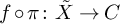 $f\circ \pi \colon \tilde {X}\to C$
is a smooth elliptic surface. Thanks to Kodaira’s canonical bundle formula (cf., [Reference Fujino and Mori35, (2)]) for smooth elliptic surfaces, we have
 $$\begin{align*}K_{\tilde{X}}\sim_{\mathbb{Q}}(f\circ\pi)^{*}\left(K_C+\frac{1}{12}J^{*}\mathcal{O}_{\mathbb{P}^1}(1)+\sum_{Q\in C} (1-\mathrm{lct}_{\tilde{X}}((f\circ\pi)^{*}(Q)))(Q)\right), \end{align*}$$
where
 $J:C\to \mathbb {P}^1$
is the functional invariant (cf. [Reference Barth, Hulek, Peters and Van de Ven6, V.8]). That is,
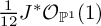 $\frac {1}{12}J^{*}\mathcal {O}_{\mathbb {P}^1}(1)$
is the moduli divisor of f. Kodaira classified singular fibers of elliptic surfaces, and we follow the notations of [Reference Barth, Hulek, Peters and Van de Ven6, V. §7]. Here, we note the following fundamental fact holds.
Lemma 2.32. Let
 $f:X\to C$
be an elliptic surface as Definition 2.31 and
 $\pi \colon \tilde {X}\to X$
the minimal resolution. Let F be a fiber of f over a closed point
 $Q\in C$
and
 $\tilde {F}:=\pi ^{*}F$
. Then the following hold.
-
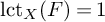
• if
$\tilde {F}$
is a smooth or
$I_N$
-type fiber for some
$N\ge 0$
, then
$\mathrm {lct}_X(F)=1$
. -
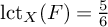
• if
$\tilde {F}$
is a
$II$
-type fiber, then
$\mathrm {lct}_X(F)=\frac {5}{6}$
. -
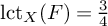
• if
$\tilde {F}$
is a
$III$
-type fiber, then
$\mathrm {lct}_X(F)=\frac {3}{4}$
. -
• if
$\tilde {F}$
is a
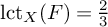
$IV$
-type fiber, then
$\mathrm {lct}_X(F)=\frac {2}{3}$
. -
• if
$\tilde {F}$
is an
$I_N^{*}$
-type fiber for some
$N\ge 0$
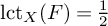
, then
$\mathrm {lct}_X(F)=\frac {1}{2}$
. -
• if
$\tilde {F}$
is a
$II^{*}$
-type fiber, then
$\mathrm {lct}_X(F)=\frac {1}{6}$
. -
• if
$\tilde {F}$
is a
$III^{*}$
-type fiber, then
$\mathrm {lct}_X(F)=\frac {1}{4}$
. -
• if
$\tilde {F}$
is a
$IV^{*}$
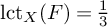
-type fiber, then
$\mathrm {lct}_X(F)=\frac {1}{3}$
. -
• if
$\tilde {F}$
is a multiple fiber with multiplicity m, that is,
$_mI_N$
-type for some
$N\ge 0$
, then
$\mathrm {lct}_X(F)=\frac {1}{m}$
.














Proof. If
 $X=\tilde {X}$
, this lemma is well known and follows from an easy calculation. For the reader’s convenience, we write the idea to show this briefly here. If F is simple normal crossing, then the assertion follows from [Reference Kollár and Mori55, Corollary 2.31]. Even if F is not simple normal crossing, by taking a log resolution of a pair
 $(X,F)$
and [Reference Kollár and Mori55, Corollary 2.31], we can also easily conclude the assertion holds.
If X has a canonical singularity, we know that
 $K_{\tilde {X}}=\pi ^{*}K_X$
. Since
 $\tilde {F}:=\pi ^{*}F$
, we conclude that
 $\mathrm {lct}_X(F)=\mathrm {lct}_{\tilde {X}}(\tilde {F})$
. Thus, the lemma holds.
Let
 $f:X\to C$
be a smooth rational elliptic surface. It is well known that then
 $C=\mathbb {P}^1$
and X is isomorphic to a blow up of
 $\mathbb {P}^2$
at nine points (cf. [Reference Cossec and Dolgachev18, Theorem 5.6.1]). Moreover, X has at most one multiple fiber (cf. [Reference Friedman and Morgan30, Proposition 3.23]).
Definition 2.33. Let
 $f\colon X\to \mathbb {P}^1$
be a rational elliptic surface. We set the multiplicity
 $m(X)$
of X as follows. Let
 $\tilde {X}$
be the minimal resolution of X. If
 $\tilde {X}$
has a
 $_mI_N$
-type fiber for some
 $m\ge 2$
, we set
 $m(X)=m$
. Otherwise, we set
 $m(X)=1$
.
By [Reference Friedman and Morgan30, Proposition 3.23], we see that
 $C=\mathbb {P}^1$
and
 $\mathrm {deg}\,(M+B)=\frac {2m(X)-1}{m(X)}$
if M (resp. B) is the moduli (resp. discriminant) divisor on
 $\mathbb {P}^1$
. Furthermore,
 $(\mathbb {P}^1,B,M,-(K_{\mathbb {P}^1}+M+B))$
is a log-twisted Fano pair.
As klt-trivial fibrations, if H is an f-ample divisor on a rational elliptic surface (resp. rational Weierstrass fibration)
 $f\colon X\to \mathbb {P}^1$
, we say that
 $f\colon (X,H)\to \mathbb {P}^1$
is a polarized rational elliptic surface (resp. polarized rational Weierstrass fibration). We always regard
 $f\colon (X,H)\to \mathbb {P}^1$
as a polarized klt-trivial fibration
 $f\colon (X,0,H)\to (\mathbb {P}^1,\mathcal {O}_{\mathbb {P}^1}(1))$
.
3 Criterion for J-stability without test configurations
In this section, we prove Theorem 1.3 and Theorem 1.1 for the case when
 $K_X+\Delta $
is nef. For this, we partially extend the result of [Reference Chen15] on J-stability to the singular case. We note that there is a quite useful criterion [Reference Chen15, Theorem 1.1] for J
 $^H$
-stability without using test configurations for projective manifolds when H is ample. First, we recall the following notions (cf. [Reference Song77, Definition 1.1]).
Definition 3.1. Let
 $(X,L)$
be a polarized variety of dimension n and H an
 $\mathbb {R}$
-line bundle on X. We say that
 $(X,L)$
is J
 $^H$
-nef if for any p-dimensional subvariety
 $V\subset X$
, where
 $1\le p\le n$
,
 $$ \begin{align} \left(n\frac{H\cdot L^{n-1}}{L^n}L-pH\right)\cdot L^{p-1}\cdot V\ge 0. \end{align} $$
If there exists
 $\epsilon>0$
such that
 $(X,L)$
is J
 $^{H-\epsilon L}$
-nef, then we say that
 $(X,L)$
is uniformly J
 $^H$
-positive. We note that the J
 $^{H-\epsilon L}$
-nefness is equivalent to that
 $$ \begin{align*} \left(n\frac{H\cdot L^{n-1}}{L^n}L-pH\right)\cdot L^{p-1}\cdot V\ge \epsilon(n-p)L^p\cdot V \end{align*} $$
for any subvariety
 $V\subset X$
of dimension
 $1\le p\le n-1$
since it holds that
 $$ \begin{align} \left(n\frac{H_s\cdot L^{n-1}}{L^n}L-pH_s\right)\cdot L^{p-1}\cdot V=\left(n\frac{H\cdot L^{n-1}}{L^n}L-pH+s(n-p)L\right)\cdot L^{p-1}\cdot V, \end{align} $$
where we set
 $H_s:=H+sL$
for
 $s\in \mathbb {R}$
.
The following is a partial generalization of [Reference Chen15, Theorem 1.1] for the singular case.
Theorem 3.2 (cf. [Reference Chen15, Theorem 1.1]).
Let
 $(X,L)$
be an n-dimensional polarized normal variety with an ample (resp. nef)
 $\mathbb {Q}$
-line bundle H. Then
 $(X,L)$
is uniformly
 $\mathrm {J}^H$
-stable (resp.
 $\mathrm {J}^H$
-semistable) if and only if
 $(X,L)$
is uniformly
 $\mathrm {J}^H$
-positive (resp.
 $\mathrm {J}^H$
-nef).
This theorem was first shown by [Reference Chen15] for Kähler manifolds, and [Reference Datar and Pingali19] and [Reference Song77] showed that uniform
 $\mathrm {J}^H$
-positivity is equivalent to that
 $$\begin{align*}\left(n\frac{H\cdot L^{n-1}}{L^n}L-pH\right)\cdot L^{p-1}\cdot V>0 \end{align*}$$
for any subvariety
 $V\subset X$
. To show Theorem 3.2, we prepare the following lemma.
Lemma 3.3. Let
 $(X,L)$
be a polarized normal variety of dimension n, and let H be a
 $\mathbb {Q}$
-line bundle. If
 $(X,L)$
is
 $\mathrm {J}^H$
-semistable, then
 $(X,L)$
is
 $\mathrm {J}^H$
-nef.
Proof. It suffices to show that if
 $(X,L)$
is not
 $\mathrm {J}^H$
-nef, then
 $(X,L)$
is
 $\mathrm {J}^H$
-unstable. Suppose that V is a p-dimensional subvariety such that
 $$\begin{align*}\left(n\frac{H\cdot L^{n-1}}{L^n}L-pH\right)\cdot L^{p-1}\cdot V< 0. \end{align*}$$
Let
 $\sigma \colon \mathcal {X}\to X_{\mathbb {P}^1}$
be the normalization of the blow up along
 $V\times \{0\}$
, and let E be the inverse image of
 $V\times \{0\}$
. Let
 $\hat {X}$
be the strict transform of
 $X\times \{0\}$
, and note that
 $E+\hat {X}=\mathcal {X}_0$
as Cartier divisors. We see that the natural morphism
 $\pi \colon \hat {X}\to X$
is the blow up along V and
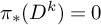 $\pi _{*}(D^{k})=0$
as a cycle for
 $k<n-p$
, where
 $D=E|_{\hat {X}}$
. Note also that
 $\sigma ^{*}L_{\mathbb {P}^1}^{n+1}=\sigma ^{*}L_{\mathbb {P}^1}^{n}\cdot \sigma ^{*}H_{\mathbb {P}^1}=0$
. Thus, we see as [Reference Boucksom, Hisamoto and Jonsson13, Lemma 7.4] that
 $$\begin{align*}(\sigma^{*}L_{\mathbb{P}^1}-\delta E)^{n+1} & =-\delta\sum_{j=0}^nE\cdot(\sigma^{*}L_{\mathbb{P}^1}-\delta E)^{j}\cdot \sigma^{*}L_{\mathbb{P}^1}^{n-j} \\ &=\delta\sum_{j=0}^n((\pi^{*}L-\delta D)^{j}\cdot \pi^{*}L^{n-j})-(L^n)) \end{align*}$$
for any sufficiently small rational
 $\delta>0$
. Similarly, we have that
 $$\begin{align*}\sigma^{*}H_{\mathbb{P}^1}\cdot(\sigma^{*}L_{\mathbb{P}^1}-\delta E)^{n}=\delta\sum_{j=0}^{n-1}(\pi^{*}H\cdot(\pi^{*}L-\delta D)^{j}\cdot \pi^{*}L^{n-1-j}-(H\cdot L^{n-1})). \end{align*}$$
Then, we have that
 $$ \begin{align*} &(L^n)(\mathcal{J}^H)^{\mathrm{NA}}(\mathcal{X},\sigma^{*}L_{\mathbb{P}^1}-\delta E)\\ &\quad = \delta \pi^{*}H\cdot \left(\sum_{i=0}^{n-1} (\pi^{*}L-\delta D)^i\cdot \pi^{*}L^{n-i-1}\right) -\delta \frac{nH\cdot L^{n-1}}{(n+1)L^n}\sum_{i=0}^{n} (\pi^{*}L-\delta D)^i \cdot \pi^{*}L^{n-i} \\ &\quad = \frac{n!\delta^{n-p+1}}{(n-p+1)!p!}(-1)^{n-p-1} D^{n-p}\cdot \left(n\frac{H\cdot L^{n-1}}{L^n}\pi^{*}L^p-p\pi^{*}H\cdot \pi^{*}L^{p-1}\right)+O(\delta^{n-p+2}). \end{align*} $$
By [Reference Fulton40, §4.3], there exists a positive constant
 $e>0$
such that
 $eV=(-1)^{n-p-1}\pi _{*}(D^{n-p})$
as cycles. Thus,
 $$\begin{align*} & (-1)^{n-p-1}D^{n-p}\cdot\left(n\frac{H\cdot L^{n-1}}{L^n}\pi^{*}L^p-p\pi^{*}H\cdot \pi^{*}L^{p-1}\right) \\ &\quad =e\left(n\frac{H\cdot L^{n-1}}{L^n}L^p-pH\cdot L^{p-1}\right)\cdot V<0. \end{align*}$$
Therefore,
 $(\mathcal {J}^H)^{\mathrm {NA}}(\mathcal {X},\sigma ^{*}L_{\mathbb {P}^1}-\delta E)<0$
for any sufficiently small
 $\delta>0$
, and this means that
 $(X,L)$
is J
 $^H$
-unstable.
Proof of Theorem 3.2.
We make use of [Reference Chen15, Theorem 1.1]. First, we note that for any normal semiample test configuration
 $(\mathcal {X},\mathcal {L})$
for
 $(X,L)$
,
 $(\mathcal {J}^{H})^{\mathrm {NA}}(\mathcal {X},\mathcal {L})$
is linear with respect to H. Thus, it is easy to see that uniform J
 $^{H}$
-stability is equivalent to J
 $^{H{-\epsilon }L}$
-semistability for any sufficiently small
 $\epsilon>0$
. To show Theorem 3.2, we assert that it suffices to show that J
 $^H$
-nefness implies that J
 $^H$
-semistability when H is nef. Indeed, we see that J
 $^H$
-semistability implies that J
 $^H$
-nefness by Lemma 3.3. Thus, uniform J
 $^H$
-stability implies that uniform J
 $^H$
-positivity. On the other hand, if H is ample,
 $(X,L)$
is uniformly J
 $^H$
-positive and the first assertion holds for
 $(X,L)$
, we see that there exists
 $\epsilon>0$
such that
 $H-\epsilon L$
is nef and
 $(X,L)$
is
 $\mathrm {J}^{H-\epsilon L}$
-nef. Then, we see that
 $(X,L)$
is
 $\mathrm {J}^{H-\epsilon L}$
-semistable and hence uniformly
 $\mathrm {J}^{H}$
-stable.
When X is smooth, it follows from [Reference Chen15, Theorem 1.1] that
 $(X,L)$
is uniformly
 $\mathrm {J}^H$
-stable if and only if
 $(X,L)$
is uniformly
 $\mathrm {J}^H$
-positive (cf. Definition 3.1). In this situation, we assert that if
 $(X,L)$
is
 $\mathrm {J}^H$
-nef and H is nef, then
 $(X,L)$
is
 $\mathrm {J}^H$
-semistable. Then we see that
 $(X,L)$
is uniformly
 $\mathrm {J}^{H+\epsilon L}$
-positive for any
 $\epsilon>0$
and hence uniformly
 $\mathrm {J}^{H+\epsilon L}$
-stable. Thus,
 $(X,L)$
is
 $\mathrm {J}^H$
-semistable.
Next, we deal with the case when X is not smooth. By what we stated in the first paragraph, it suffices to show that J
 $^H$
-nefness implies J
 $^H$
-semistability of
 $(X,L)$
. Let
 $\pi \colon Y\to X$
be a resolution of singularities and take an ample divisor A on Y. Let
 $(\mathcal {X},\mathcal {L})$
be a semiample test configuration for
 $(X,L)$
with a canonical morphism
 $\rho \colon \mathcal {X}\to X_{\mathbb {P}^1}$
and
 $\mathcal {Y}\subset \mathcal {X}\times _{X}Y$
be the normalization of the irreducible component dominant to
 $\mathcal {X}$
. Let
 $\sigma \colon \mathcal {Y}\to \mathcal {X}$
and
 $\rho _{\mathcal {Y}}\colon \mathcal {Y}\to Y_{\mathbb {P}^1}$
be the canonical morphisms. Then it is easy to see that
 $(\mathcal {Y},\sigma ^{*}\mathcal {L}+\epsilon \rho _{\mathcal {Y}}^{*}A_{\mathbb {P}^1})$
is also a semiample test configuration for
 $(Y,\pi ^{*}L+\epsilon A)$
for any rational number
 $\epsilon>0$
. Set
 $H_{\delta ,\epsilon }:=\pi ^{*}H+\delta (\pi ^{*}L+\epsilon A)$
and
 $L_{\epsilon }:=\pi ^{*}L+\epsilon A$
for
 $\delta>0$
. We know that there exists a positive constant C such that
 $$ \begin{align} \left|n\frac{\pi^{*}H\cdot L_{\epsilon}^{n-1}}{L_{\epsilon}^n}-n\frac{H\cdot L^{n-1}}{L^n}\right|\le C\epsilon. \end{align} $$
Since
 $$ \begin{align} \lim_{\epsilon\to0}(\mathcal{J}^{\pi^{*}H+C\epsilon(\pi^{*}L+\epsilon A)})^{\mathrm{NA}}(\mathcal{Y},\sigma^{*}\mathcal{L}+\epsilon\rho_{\mathcal{Y}}^{*}A_{\mathbb{P}^1})=(\mathcal{J}^{H})^{\mathrm{NA}}(\mathcal{X},\mathcal{L}), \end{align} $$
it suffices to show that
 $$ \begin{align} \left(n\frac{H_{C\epsilon,\epsilon}\cdot L_{\epsilon}^{n-1}}{L_{\epsilon}^n}L_{\epsilon}-pH_{C\epsilon,\epsilon}\right)\cdot L_{\epsilon}^{p-1}\cdot W\ge 0 \end{align} $$
for any small
 $\epsilon>0$
and subvariety
 $W\subset Y$
of dimension
 $1\le p\le n-1$
. For this, we note by equations (3) and (4) that
 $$ \begin{align*} &\left(n\frac{H_{C\epsilon,\epsilon}\cdot L_{\epsilon}^{n-1}}{L_{\epsilon}^n}L_{\epsilon}-pH_{C\epsilon,\epsilon}\right)\cdot L_{\epsilon}^{p-1}\cdot W\\ &=\left(n\frac{\pi^{*}H\cdot L_{\epsilon}^{n-1}}{L_{\epsilon}^n}L_{\epsilon}-p\pi^{*}H\right)\cdot L_{\epsilon}^{p-1}\cdot W+C\epsilon(n-p)L_{\epsilon}^{p}\cdot W\\ &=\left(n\frac{H\cdot L^{n-1}}{L^n}L_{\epsilon}-p\pi^{*}H\right)\cdot L_{\epsilon}^{p-1}\cdot W+\left(C\epsilon(n-p)+n\frac{\pi^{*}H\cdot L_{\epsilon}^{n-1}}{L_{\epsilon}^n}-n\frac{H\cdot L^{n-1}}{L^n}\right)L_{\epsilon}^{p}\cdot W\\ &\ge\left(n\frac{H\cdot L^{n-1}}{L^n}L_{\epsilon}-p\pi^{*}H\right)\cdot L_{\epsilon}^{p-1}\cdot W. \end{align*} $$
Furthermore,
 $$ \begin{align*} &\left(n\frac{\pi^{*}H\cdot \pi^{*}L^{n-1}}{\pi^{*}L^n}L_{\epsilon}-p\pi^{*}H\right)\cdot L_{\epsilon}^{p-1}\cdot W\\ &=\sum_{r}\epsilon^r\left(n\frac{H\cdot L^{n-1}}{L^n}\binom{p}{r}\pi^{*}L^{p-r}-p\binom{p-1}{r}\pi^{*}H\cdot \pi^{*}L^{p-r-1}\right)\cdot A^{r}\cdot W\\ &=\sum_{r}\epsilon^r\binom{p}{r}\left(n\frac{H\cdot L^{n-1}}{L^n}L-(p-r)H\right)\cdot L^{p-r-1}\cdot \pi_{*}(A^{r}\cdot W). \end{align*} $$
We can regard
 $\pi _{*}(A^{r}\cdot W)$
as an effective algebraic cycle of dimension
 $p-r$
in X, and then we have
 $$\begin{align*}\left(n\frac{\pi^{*}H\cdot \pi^{*}L^{n-1}}{\pi^{*}L^n}L_{\epsilon}-p\pi^{*}H\right)\cdot L_{\epsilon}^{p-1}\cdot W\ge0 \end{align*}$$
for any
 $\epsilon>0$
by the assumption that equation (2) holds. Then equation (6) holds and
 $(Y,L_{\epsilon })$
is J
 $^{H_{C\epsilon ,\epsilon }}$
-semistable. Hence, we see that
 $(\mathcal {J}^{\pi ^{*}H+C\epsilon (\pi ^{*}L+\epsilon A)})^{\mathrm {NA}}(\mathcal {Y},\sigma ^{*}\mathcal {L}+\epsilon \rho _{\mathcal {Y}}^{*}A_{\mathbb {P}^1})\ge 0$
and conclude that Theorem 3.2 holds by equation (5).
We will make use of the following fact.
Remark 3.4. Let
 $(X,L)$
be an n-dimensional polarized variety. It is easy to see that if H and
 $$\begin{align*}n\frac{H\cdot L^{n-1}}{L^n}L-(n-1)H \end{align*}$$
are nef, then
 $(X,L)$
is J
 $^H$
-semistable by Theorem 3.2.
Combining Theorems 3.2 and A.6, we obtain Theorem 1.3, which is one of the key ingredients to show Theorem 1.1.
Proof of Theorem 1.3.
By Theorem A.6, we have that for any normal semiample test configuration
 $(\mathcal {X},\mathcal {L})$
for
 $(X,L)$
,
 $$\begin{align*}H^{\mathrm{NA}}_\Delta(\mathcal{X},\mathcal{L})\ge \delta_{(X,\Delta)}(L)(\mathcal{J}^{L})^{\mathrm{NA}}(\mathcal{X},\mathcal{L}). \end{align*}$$
This means that
 $$\begin{align*}M^{\mathrm{NA}}_\Delta(\mathcal{X},\mathcal{L})\ge (\mathcal{J}^{H})^{\mathrm{NA}}(\mathcal{X},\mathcal{L}). \end{align*}$$
We have that
 $(X,L)$
is uniformly J
 $^H$
-stable by Theorem 3.2. Thus, we obtain the assertion.
Finally, we show Corollary 3.5 by Theorem 3.2. This implies Theorem 1.1 for the case when
 $K_X+\Delta $
is nef.
Corollary 3.5. Let
 $(X,\Delta ,H)$
be a polarized klt pair such that
 $K_X+\Delta $
is nef. Then for any sufficiently small rational number
 $\epsilon>0$
,
 $(X,\Delta ,\epsilon H+K_X+\Delta )$
is uniformly K-stable.
Furthermore, there exists
 $\beta>0$
and
 $\epsilon _0>0$
such that
 $$\begin{align*}M^{\mathrm{NA}}_\Delta(\mathcal{X},\mathcal{L})\ge \beta(\mathcal{J}^{\epsilon H+K_X+\Delta})^{\mathrm{NA}}(\mathcal{X},\mathcal{L}) \end{align*}$$
for any
 $\epsilon \in \mathbb {Q}\cap (0,\epsilon _0)$
and normal semiample test configuration
 $(\mathcal {X},\mathcal {L})$
for
 $(X,L)$
.
Proof. Put n as the dimension of X. First, we show the following claim.
Claim. There exists a positive constant
 $C>0$
depending only on the intersection numbers
 $(K_X+\Delta )^i\cdot H^{n-i}$
for
 $0\le i\le n$
such that
 $(X,\epsilon H+K_X+\Delta )$
is
 $\mathrm {J}^{K_X+\Delta +C\epsilon (\epsilon H+K_X+\Delta )}$
-semistable for any sufficiently small rational number
 $\epsilon>0$
.
Proof of claim.
For any p-dimensional subvariety
 $V\subset X$
, consider the following intersection number
 $$\begin{align*}\left(n\frac{(K_X+\Delta)\cdot (\epsilon H+K_X+\Delta)^{n-1}}{(\epsilon H+K_X+\Delta)^n}(\epsilon H+K_X+\Delta)-p(K_X+\Delta)\right)\cdot(\epsilon H+K_X+\Delta)^{p-1}\cdot V. \end{align*}$$
Set
 $$ \begin{align*}m:=\max\{l\,|\, (K_X+\Delta)^l\cdot H^{n-l}\ne0\}.\end{align*} $$
Then for any sufficiently small
 $\epsilon>0$
, we have that
 $$\begin{align*}n\frac{(K_X+\Delta)\cdot (\epsilon H+K_X+\Delta)^{n-1}}{(\epsilon H+K_X+\Delta)^n}=m+O(\epsilon), \end{align*}$$
where the error term depends only on the intersection numbers
 $(K_X+\Delta )^i\cdot H^{n-i}$
for all
 $0\le i\le n$
. Thus, there exists a positive constant C depending only on the intersection numbers
 $(K_X+\Delta )^i\cdot H^{n-i}$
such that
 $$ \begin{align*} &\left(n\frac{(K_X+\Delta)\cdot (\epsilon H+K_X+\Delta)^{n-1}}{(\epsilon H+K_X+\Delta)^n}(\epsilon H+K_X+\Delta)-p(K_X+\Delta)\right)\cdot(\epsilon H+K_X+\Delta)^{p-1}\cdot V\\ &\ge((m-p)(K_X+\Delta)+m\epsilon H-C\epsilon(n-p)(\epsilon H+K_X+\Delta))\cdot(\epsilon H+K_X+\Delta)^{p-1}\cdot V. \end{align*} $$
By this inequality, we see that if it holds that
 $$ \begin{align} ((m-p)(K_X+\Delta)+m\epsilon H )\cdot(\epsilon H+K_X+\Delta)^{p-1}\cdot V\ge0, \end{align} $$
then
 $(X,\epsilon H+K_X+\Delta )$
is
 $\mathrm {J}^{K_X+\Delta +C\epsilon (\epsilon H+K_X+\Delta )}$
-semistable by Theorem 3.2 and equation (3). Therefore, we only have to show equation (7) for any sufficiently small
 $\epsilon>0$
. Set
 $$\begin{align*}\nu:=\max\{l\,|\,(K_X+\Delta)^l\cdot H^{p-l}\cdot V\ne0\}. \end{align*}$$
It is not hard to see that
 $\nu \le \min \{m,p\}$
. Then, we have that
 $$ \begin{align*} &((m-p)(K_X+\Delta)+m\epsilon H )\cdot(\epsilon H+K_X+\Delta)^{p-1}\cdot V\\ &\ge m\epsilon^pH\cdot V+\sum_{i=1}^\nu\epsilon^{p-i}\left((m-p)\binom{p-1}{p-i}+m\binom{p-1}{p-i-1}\right)(K_X+\Delta)^i\cdot H^{p-i}\cdot V\\ &=\sum_{i=0}^\nu\epsilon^{p-i}(m-i)\binom{p}{i}(K_X+\Delta)^i\cdot H^{p-i}\cdot V\ge0. \end{align*} $$
Thus, we obtain equation (7) and complete the proof of claim.
Next, we show that claim implies Corollary 3.5. Let
 $\alpha :=\alpha _{(X,\Delta )}(H+K_X+\Delta )>0$
. We know by [Reference Fujita38, Proposition 2.1] that
 $$ \begin{align*} \frac{n}{n+1}\delta_{(X,\Delta)}(\epsilon H+K_X+\Delta)\ge \alpha_{(X,\Delta)}(\epsilon H+K_X+\Delta)\ge\alpha. \end{align*} $$
Thus, we see that for any
 $\epsilon \in \mathbb {Q}\cap (0,\frac {(n+1)\alpha }{nC})$
,
 $(X,\Delta ,\epsilon H+K_X+\Delta )$
is uniformly K-stable by claim and Theorem 1.3. Furthermore, we have
 $$\begin{align*}M^{\mathrm{NA}}_\Delta(\mathcal{X},\mathcal{L})\ge \frac{(n+1)\alpha}{2nC}(\mathcal{J}^{\epsilon H+K_X+\Delta})^{\mathrm{NA}}(\mathcal{X},\mathcal{L}) \end{align*}$$
for any
 $\epsilon \in \mathbb {Q}\cap (0,\frac {(n+1)\alpha }{2nC})$
and normal semiample test configuration
 $(\mathcal {X},\mathcal {L})$
for
 $(X,L)$
.
4 Adiabatic K-stability versus log-twisted K-stability
4.1 Adiabatic K-stability implies log-twisted K-stability
In this subsection, we see that log-twisted K-stability of the base of a klt (lc)-trivial fibration (cf. Definition 2.26) is a necessary condition for adiabatic K-stability under some conditions (cf. Theorems 4.1 and 4.7).
First, we show the following stronger theorem than Theorem 1.2.
Theorem 4.1. Let
 $f:(X,\Delta ,H)\to (C,L)$
be a polarized lc-trivial fibration. Let M (resp. B) be the moduli (resp. discriminant) divisor.
If M is
 $\mathbb {Q}$
-Cartier and
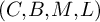 $(C,B,M,L)$
is not log-twisted K-semistable, then
 $(X,\Delta ,H)$
is adiabatically K-unstable over
 $(C,L)$
.
To show Theorem 4.1, we first prepare the following proposition on MMP.
Proposition 4.2. Let
 $f:(X,\Delta ,H)\to (C,L)$
be a polarized lc-trivial fibration,
 $\pi :Y\to X$
be a log resolution of
 $(X,\Delta )$
and
 $\Theta :=\pi ^{-1}_{*}\Delta +\mathrm {Ex}(\pi )$
be an snc
 $\mathbb {Q}$
-divisor on Y. Let
 $\mathcal {Y}$
be a smooth test configuration for Y dominating
 $Y_{\mathbb {P}^1}$
such that
 $(\rho _{\mathcal {Y}})^{-1}_{*}\Theta _{\mathbb {P}^1}+\mathcal {Y}_{0}$
is an snc divisor, where the canonical birational map
 $\rho _{\mathcal {Y}}\colon \mathcal {Y}\to Y_{\mathbb {P}^1}$
is a morphism. Let
 $\mathscr {C}$
be a normal test configuration for C such that there exists a canonical birational morphism
 $\rho _{\mathscr {C}}\colon \mathscr {C}\to C_{\mathbb {P}^1}$
. Suppose that the canonical rational map
 $\Pi \colon \mathcal {Y}\to \mathscr {C}$
is a morphism.
Then, there exist
 $\epsilon _0>0$
and two
 $\mathbb {G}_m$
-equivariant birational contractions
 $h\colon \mathcal {Y}\dashrightarrow \mathcal {W}$
and
 $\xi :\mathcal {W}\dashrightarrow \mathcal {X}$
, where
 $\mathcal {W}$
and
 $\mathcal {X}$
are normal varieties projective over
 $\mathscr {C}$
, satisfying the following.
-
•
$(\mathcal {W},\Delta _{\mathcal {W}})$
is a
$\mathbb {Q}$
-factorial
$\mathbb {G}_m$
-equivariant good minimal model of
$(\mathcal {Y},(\rho _{\mathcal {Y}})^{-1}_{*}\Theta _{\mathbb {P}^1})$
over
$\mathscr {C}$
, where
$\Delta _{\mathcal {W}}:=h_{*}(\rho _{\mathcal {Y}})^{-1}_{*}\Theta _{\mathbb {P}^1}$
, -
• if
$\eta =\xi \circ h$
, then
$(\mathcal {X},\Delta _{\mathcal {X},\epsilon })$
is the
$\mathbb {G}_m$
-equivariant relative lc model of over
$$ \begin{align*}\left(\mathcal{Y},(\rho_{\mathcal{Y}})^{-1}_{*}\Theta_{\mathbb{P}^1}+\epsilon(\pi\times\mathrm{id}_{\mathbb{P}^1}\circ\rho_{\mathcal{Y}})^{*}H_{\mathbb{P}^1}\right)\end{align*} $$
$\mathscr {C}$
for any rational number
$\epsilon \in (0,\epsilon _0)$
.





Furthermore, fix
 $\epsilon \in \mathbb {Q}\cap (0,\epsilon _0)$
. Then, there exist
 $r\in \mathbb {Q}_{>0}$
and an ample
 $\mathbb {Q}$
-line bundle
 $\mathscr {M}$
on
 $\mathscr {C}$
such that
 $$ \begin{align*}\left(\mathcal{X},\epsilon^{-1}(K_{\mathcal{X}}+\Delta_{\mathcal{X},\epsilon})+\Pi_{\mathcal{X}}^{*}\mathscr{M}\right)\end{align*} $$
is an ample test configuration for
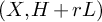 $(X,H+rL)$
, where
 $\Pi _{\mathcal {X}}\colon \mathcal {X}\to \mathscr {C}$
is the canonical morphism.
Proof. Since H is ample, we consider H to be a general effective
 $\mathbb {Q}$
-divisor throughout this proof. First, we note that
 $(Y,\Theta )$
has a good minimal model over C. Indeed, by the proof of the existence of a
 $\mathbb {Q}$
-factorial dlt modification
 $(Z,\Delta _Z)$
over X (cf. [Reference Fujino31, 4.1]), the
 $(K_Y+\Theta )$
-MMP with ample scaling yields a good minimal model
 $(Z,\Delta _Z)$
of
 $(Y,\Theta )$
over X. Let
 $g:Z\to X$
be the structure morphism. Since
 $K_Z+\Delta _Z=g^{*}(K_X+\Delta )$
and
 $K_X+\Delta \sim _{\mathbb {Q},C}0$
,
 $(Z,\Delta _Z)$
is also a good minimal model of
 $(Y,\Theta )$
over C. Hence,
 $(Z,\Delta _Z+\epsilon g^{*}H)$
is a good minimal model for any sufficiently small
 $\epsilon \in \mathbb {Q}_{>0}$
. This means that
 $$ \begin{align*}(\mathcal{Y}\setminus\mathcal{Y}_0,(\rho_{\mathcal{Y}})^{-1}_{*}\Theta_{\mathbb{P}^1}|_{\mathcal{Y}\setminus\mathcal{Y}_0})\cong \left(Y\times(\mathbb{P}^1\setminus\{0\}),\Theta\times(\mathbb{P}^1\setminus\{0\})\right)\end{align*} $$
also has a good minimal model over
 $\mathscr {C}\setminus \mathscr {C}_0\cong C\times (\mathbb {P}^1\setminus \{0\})$
. Since
 $(\mathcal {Y},(\rho _{\mathcal {Y}})^{-1}_{*}\Theta _{\mathbb {P}^1}+\mathcal {Y}_{0,\mathrm {red}})$
is log smooth and dlt, every lc center of the log pair
 $(\mathcal {Y},(\rho _{\mathcal {Y}})^{-1}_{*}\Theta _{\mathbb {P}^1})$
meets
 $\mathcal {Y}\setminus \mathcal {Y}_0$
. Therefore, we can apply [Reference Hacon and Xu42, Theorem 1.1] and there exists a good minimal model
 $(\mathcal {W},\Delta _{\mathcal {W}})$
of
 $(\mathcal {Y},(\rho _{\mathcal {Y}})^{-1}_{*}\Theta _{\mathbb {P}^1})$
over
 $\mathscr {C}$
. We may assume that the contraction
 $h\colon \mathcal {Y}\dashrightarrow \mathcal {W}$
is the output of a minimal model program with ample scaling by [Reference Hacon and Xu42, Corollary 2.9]. In particular, we may assume that
 $\mathcal {W}$
is a
 $\mathbb {Q}$
-factorial (cf. [Reference Fujino33, 4.3.5]) and h is
 $\mathbb {G}_m$
-equivariant by the argument of [Reference Andreatta5, 1.5] and [Reference Li and Xu61, Proof of Theorem 7] (cf. Definition 2.4). We obtain the first assertion for
 $\mathcal {W}$
.
We see that there exists
 $\epsilon ^{\prime }_1>0$
such that every step of the
 $K_{\mathcal {Y}}+(\rho _{\mathcal {Y}})^{-1}_{*}\Theta _{\mathbb {P}^1}$
-MMP yielding
 $\mathcal {W}$
is also a divisorial contraction or a flip with respect to
 $K_{\mathcal {Y}}+(\rho _{\mathcal {Y}})^{-1}_{*}\Theta _{\mathbb {P}^1}+\epsilon (\pi \times \mathrm {id}_{\mathbb {P}^1}\circ \rho _{\mathcal {Y}})^{*}H_{\mathbb {P}^1}$
for any rational number
 $\epsilon \in (0,\epsilon ^{\prime }_1)$
. Thus,
 $(\mathcal {W},\Delta _{\mathcal {W}}+\epsilon h_{*}(\pi \times \mathrm {id}_{\mathbb {P}^1}\circ \rho _{\mathcal {Y}})^{*}H_{\mathbb {P}^1})$
is also dlt and has no lc center contained in
 $\mathcal {W}_0$
for any
 $\epsilon \in (0,\epsilon ^{\prime }_1)\cap \mathbb {Q}$
by [Reference Kollár and Mori55, Corollary 3.44]. In this setting, we show the following claim.
Claim. There exists
 $\epsilon _1\in \mathbb {Q}\cap (0,\epsilon ^{\prime }_1)$
such that
 $(\mathcal {W},\Delta _{\mathcal {W}}+\epsilon h_{*}(\pi \times \mathrm {id}_{\mathbb {P}^1}\circ \rho _{\mathcal {Y}})^{*}H_{\mathbb {P}^1})$
has a good minimal model over
 $\mathscr {C}$
for any
 $\epsilon \in \mathbb {Q}\cap (0,\epsilon _1)$
.
Proof of claim.
We note that every lc center of
 $(\mathcal {W},\Delta _{\mathcal {W}}+\epsilon h_{*}(\pi \times \mathrm {id}_{\mathbb {P}^1}\circ \rho _{\mathcal {Y}})^{*}H_{\mathbb {P}^1})$
meets
 $\mathcal {W}\setminus \mathcal {W}_0$
. By [Reference Hacon and Xu42, Theorem 1.1], it suffices to show that
 $$ \begin{align*}\Bigl(\mathcal{W}\setminus\mathcal{W}_0,\bigl(\Delta_{\mathcal{W}}+\epsilon h_{*}(\pi\times\mathrm{id}_{\mathbb{P}^1}\circ\rho_{\mathcal{Y}})^{*}H_{\mathbb{P}^1}\bigr)|_{\mathcal{W}\setminus\mathcal{W}_0}\Bigr)\end{align*} $$
has a good minimal model over
 $\mathscr {C}\setminus \mathscr {C}_0$
for any
 $\epsilon \in \mathbb {Q}\cap (0,\epsilon ^{\prime }_1)$
. We first note that
 $(Z,\Delta _Z+\epsilon g^{*}H)$
is also a good minimal model of
 $(Y,\Theta +\epsilon \pi ^{*}H)$
over C for any sufficiently small
 $\epsilon \in \mathbb {Q}_{>0}$
. Indeed, if
 $\psi :Y\dashrightarrow Z$
is the birational contraction,
 $A_{(Y,\Theta )}(F)<A_{(Z,\Delta _Z)}(F)$
for any
 $\psi $
-exceptional divisor F. Thus, there exists
 $0<\epsilon _1<\epsilon _1^{\prime }$
such that
 $$ \begin{align*}A_{(Y,\Theta+\epsilon\pi^{*}H)}(F)<A_{(Z,\Delta_Z+\epsilon g^{*}H)}(F)\end{align*} $$
also holds for any
 $\epsilon \in (0,\epsilon _1)\cap \mathbb {Q}$
and
 $\psi $
-exceptional prime divisor F. Furthermore,
 $K_Z+\Delta _Z+\epsilon g^{*}H$
is semiample over C. This means that
 $$ \begin{align*}\left(Z\times(\mathbb{P}^1\setminus\{0\}),(\Delta_Z+\epsilon g^{*}H)\times(\mathbb{P}^1\setminus\{0\})\right)\end{align*} $$
is a good minimal model of
 $$ \begin{align*}\left(\mathcal{Y}\setminus\mathcal{Y}_0,((\rho_{\mathcal{Y}})^{-1}_{*}\Theta_{\mathbb{P}^1}+\epsilon(\pi\times\mathrm{id}_{\mathbb{P}^1}\circ\rho_{\mathcal{Y}})^{*}H_{\mathbb{P}^1})|_{\mathcal{Y}\setminus\mathcal{Y}_0}\right)\end{align*} $$
for any
 $\epsilon \in (0,\epsilon _1)\cap \mathbb {Q}$
. We assert that
 $(Z\times (\mathbb {P}^1\setminus \{0\}),(\Delta _Z+\epsilon g^{*}H)\times (\mathbb {P}^1\setminus \{0\}))$
is also a good minimal model of
 $\left (\mathcal {W}\setminus \mathcal {W}_0,(\Delta _{\mathcal {W}}+\epsilon h_{*}(\pi \times \mathrm {id}_{\mathbb {P}^1}\circ \rho _{\mathcal {Y}})^{*}H_{\mathbb {P}^1})|_{\mathcal {W}\setminus \mathcal {W}_0}\right )$
. Indeed, we note that
 $\mathcal {W}\setminus \mathcal {W}_0\dashrightarrow Z\times (\mathbb {P}^1\setminus \{0\})$
is isomorphic in codimension one points since they are good minimal models of
 $\left (\mathcal {Y}\setminus \mathcal {Y}_0,(\rho _{\mathcal {Y}})^{-1}_{*}\Theta _{\mathbb {P}^1}|_{\mathcal {Y}\setminus \mathcal {Y}_0}\right )$
over
 $\mathscr {C}\setminus \mathscr {C}_0$
(cf. [Reference Kollár and Mori55, Theorem 3.52 (2)]). Therefore, for any prime divisor E over
 $\mathcal {Y}\setminus \mathcal {Y}_0$
, we have
 $$\begin{align*}A_{(\mathcal{W}\setminus\mathcal{W}_0,(\Delta_{\mathcal{W}}+\epsilon h_{*}(\pi\times\mathrm{id}_{\mathbb{P}^1}\circ\rho_{\mathcal{Y}})^{*}H_{\mathbb{P}^1})|_{\mathcal{W}\setminus\mathcal{W}_0})}(E)\le A_{(Z\times(\mathbb{P}^1\setminus\{0\}),(\Delta_Z+\epsilon g^{*}H)\times(\mathbb{P}^1\setminus\{0\}))}(E) \end{align*}$$
by [Reference Kollár and Mori55, Proposition 3.51]. This shows that
 $(Z\times (\mathbb {P}^1\setminus \{0\}),(\Delta _Z+\epsilon g^{*}H)\times (\mathbb {P}^1\setminus \{0\}))$
is also a good minimal model of
 $(\mathcal {W}\setminus \mathcal {W}_0,(\Delta _{\mathcal {W}}+\epsilon h_{*}(\pi \times \mathrm {id}_{\mathbb {P}^1}\circ \rho _{\mathcal {Y}})^{*}H_{\mathbb {P}^1})|_{\mathcal {W}\setminus \mathcal {W}_0})$
for any
 $\epsilon \in \mathbb {Q}\cap (0,\epsilon _1)$
.
In this paragraph, we show the following: There exists a
 $\mathbb {G}_m$
-equivariant birational contraction
 $\xi :\mathcal {W}\dashrightarrow \mathcal {X}$
such that
 $\mathcal {X}$
is a lc model of
 $(\mathcal {W},\Delta _{\mathcal {W}}+\epsilon h_{*}(\pi \times \mathrm {id}_{\mathbb {P}^1}\circ \rho _{\mathcal {Y}})^{*}H_{\mathbb {P}^1})$
over
 $\mathscr {C}$
for any
 $\epsilon \in (0,\epsilon _0)\cap \mathbb {Q}$
. We know that
 $(\mathcal {W},\Delta _{\mathcal {W}})$
is a good minimal model over
 $\mathscr {C}$
and set
 $$ \begin{align*}\mathcal{Z}:=\mathbf{Proj}_{\mathscr{C}}(\oplus_{l\ge0}\alpha_{*}\mathcal{O}_{\mathcal{W}}(lr_0(K_{\mathcal{W}}+\Delta_{\mathcal{W}}))),\end{align*} $$
where
 $\alpha \colon \mathcal {W}\to \mathscr {C}$
is the canonical morphism and
 $r_0\in \mathbb {Z}_{>0}$
satisfies that
 $r_0(K_{\mathcal {W}}+\Delta _{\mathcal {W}})$
is Cartier. We note that
 $\mathcal {Z}$
has the canonical
 $\mathbb {G}_m$
-action induced by the
 $\mathbb {G}_m$
-action on
 $\oplus _{l\ge 0}\alpha _{*}\mathcal {O}_{\mathcal {W}}(lr_0(K_{\mathcal {W}}+\Delta _{\mathcal {W}}))$
and that
 $\mathcal {Z}\setminus \mathcal {Z}_0\cong C\times (\mathbb {P}^1\setminus \{0\})$
. Then, it follows from claim that there exists a good minimal model of
 $(\mathcal {W}\setminus \mathcal {W}_0,(\Delta _{\mathcal {W}}+\epsilon h_{*}(\pi \times \mathrm {id}_{\mathbb {P}^1}\circ \rho _{\mathcal {Y}})^{*}H_{\mathbb {P}^1})|_{\mathcal {W}\setminus \mathcal {W}_0})$
over
 $C\times (\mathbb {P}^1\setminus \{0\})$
for any
 $\epsilon \in (0,\epsilon _1)\cap \mathbb {Q}$
. By [Reference Hacon and Xu42, Theorem 1.1], if we fix a rational number
 $\epsilon '\in (0,\epsilon _0)$
, then there exists a good minimal model of
 $(\mathcal {W},\Delta _{\mathcal {W}}+\epsilon ' h_{*}(\pi \times \mathrm {id}_{\mathbb {P}^1}\circ \rho _{\mathcal {Y}})^{*}H_{\mathbb {P}^1})$
over
 $\mathcal {Z}$
. Thus, there exists a birational contraction
 $\xi \colon \mathcal {W}\dashrightarrow \mathcal {X}$
such that
 $\mathcal {X}$
is a lc model of
 $(\mathcal {W},\Delta _{\mathcal {W}}+\epsilon ' h_{*}(\pi \times \mathrm {id}_{\mathbb {P}^1}\circ \rho _{\mathcal {Y}})^{*}H_{\mathbb {P}^1})$
over
 $\mathcal {Z}$
. Hence,
 $\xi $
is
 $\mathbb {G}_m$
-equivariant. Set
 $\Delta _{\mathcal {X},\epsilon }$
as the strict transform of
 $\Delta _{\mathcal {W}}+\epsilon h_{*}(\pi \times \mathrm {id}_{\mathbb {P}^1}\circ \rho _{\mathcal {Y}})^{*}H_{\mathbb {P}^1}$
on
 $\mathcal {X}$
for any
 $0\le \epsilon \le \epsilon '$
. Let
 $q_{\mathcal {X}}\colon \mathcal {X}\to \mathcal {Z}$
and
 $q_{\mathcal {W}}\colon \mathcal {W}\to \mathcal {Z}$
be the canonical morphisms and G be a relatively ample
 $\mathbb {Q}$
-divisor on
 $\mathcal {Z}$
over
 $\mathscr {C}$
such that
 $q_{\mathcal {W}}^{*}G\sim _{\mathbb {Q},\mathscr {C}}K_{\mathcal {W}}+\Delta _{\mathcal {W}}$
. Then, we see that
 $$ \begin{align*}q_{\mathcal{X}}^{*}G\sim_{\mathbb{Q},\mathscr{C}}K_{\mathcal{X}}+\xi_{*}\Delta_{\mathcal{W}}.\end{align*} $$
For any rational number
 $0<t<1$
, we have
 $$\begin{align*}K_{\mathcal{X}}+\Delta_{\mathcal{X},t\epsilon'}\sim_{\mathbb{Q},\mathscr{C}}(1-t)q_{\mathcal{X}}^{*}\mathcal{G}+t(K_{\mathcal{X}}+\Delta_{\mathcal{X},\epsilon'}). \end{align*}$$
Since
 $K_{\mathcal {X}}+\Delta _{\mathcal {X},\epsilon '}$
is
 $q_{\mathcal {X}}$
-ample and G is relatively ample over
 $\mathscr {C}$
, there exists
 $0<t'<1$
such that
 $K_{\mathcal {X}}+\Delta _{\mathcal {X},t\epsilon '}$
is relatively ample over
 $\mathscr {C}$
for any
 $t\in (0,t')\cap \mathbb {Q}$
. Thus,
 $\mathcal {X}$
is the lc model of
 $(\mathcal {W},\Delta _{\mathcal {W}}+t\epsilon ' h_{*}(\pi \times \mathrm {id}_{\mathbb {P}^1}\circ \rho _{\mathcal {Y}})^{*}H_{\mathbb {P}^1})$
over
 $\mathcal {Z}$
for any
 $t\in (0,t')\cap \mathbb {Q}$
since
 $\xi $
is
 $K_{\mathcal {W}}+\Delta _{\mathcal {W}}+\epsilon ' h_{*}(\pi \times \mathrm {id}_{\mathbb {P}^1}\circ \rho _{\mathcal {Y}})^{*}H_{\mathbb {P}^1}$
-nonpositive and
 $K_{\mathcal {W}}+\Delta _{\mathcal {W}}$
-non-positive. By letting
 $\epsilon _0:=t'\epsilon '$
, we obtain
 $\xi \colon \mathcal {W}\dashrightarrow \mathcal {X}$
and
 $\epsilon _0$
as we asserted in the first sentence in this paragraph.
By what we have shown in the previous paragraph, we see that
 $\mathcal {X}$
and
 $\epsilon _0$
as above satisfy the second assertion of Proposition 4.2. Indeed, since h is
 $K_{\mathcal {Y}}+(\rho _{\mathcal {Y}})^{-1}_{*}\Theta _{\mathbb {P}^1}+\epsilon (\pi \times \mathrm {id}_{\mathbb {P}^1}\circ \rho _{\mathcal {Y}})^{*}H_{\mathbb {P}^1}$
-negative,
 $\eta \colon \mathcal {Y}\dashrightarrow \mathcal {X}$
defines the lc model of
 $(\mathcal {Y},(\rho _{\mathcal {Y}})^{-1}_{*}\Theta _{\mathbb {P}^1}+\epsilon (\pi \times \mathrm {id}_{\mathbb {P}^1}\circ \rho _{\mathcal {Y}})^{*}H_{\mathbb {P}^1})$
for any rational number
 $\epsilon \in (0,\epsilon _0)$
. Thus, we obtain the second assertion of Proposition 4.2.
Finally, we deal with the last assertion of Proposition 4.2. Note that
 $(X,\Delta +\epsilon H)$
is the lc model of
 $(Y,\Theta +\epsilon \pi ^{*}H)$
over C for any sufficiently small rational number
 $\epsilon>0$
. Fix such an
 $\epsilon $
. By the fact that
 $(\mathcal {X},\Delta _{\mathcal {X},\epsilon })$
is the lc model of
 $(\mathcal {Y},(\rho _{\mathcal {Y}})^{-1}_{*}\Theta _{\mathbb {P}^1}+\epsilon (\pi \times \mathrm {id}_{\mathbb {P}^1}\circ \rho _{\mathcal {Y}})^{*}H_{\mathbb {P}^1})$
over
 $\mathscr {C}$
for any sufficiently small
 $\epsilon>0$
,
 $\mathcal {X}$
is a test configuration for X. Since
 $\mathscr {C}$
is normal and projective over
 $\mathbb {P}^1$
, there exists an ample
 $\mathbb {G}_m$
-linearized
 $\mathbb {Q}$
-line bundle
 $\mathscr {M}'$
on
 $\mathscr {C}$
([Reference Mumford, Fogarty and Kirwan66, Corollary 1.6]). By adding
 $\rho ^{*}_{\mathscr {C}}L^{\prime }_{\mathbb {P}^1}$
to
 $\mathscr {M}'$
for some
 $\mathbb {Q}$
-Cartier
 $\mathbb {Q}$
-divisor
 $L'$
on C, we may assume that there exists
 $r'\in \mathbb {Q}_{>0}$
such that
 $(\mathscr {C},\epsilon ^{-1}\rho ^{*}_{\mathscr {C}}D_{\mathbb {P}^1}+\mathscr {M})$
is an ample test configuration for
 $(C,r'L)$
, where D is a
 $\mathbb {Q}$
-Cartier
 $\mathbb {Q}$
-divisor on C such that
 $f^{*}D\sim _{\mathbb {Q}}K_X+\Delta $
. Similarly, we obtain an ample
 $\mathbb {Q}$
-line bundle
 $\mathscr {M}"$
on
 $\mathscr {C}$
and
 $r"\in \mathbb {Q}_{>0}$
such that
 $(\mathscr {C},\mathscr {M}")$
is an ample test configuration for
 $(C,r"L)$
. Thus,
 $$ \begin{align*}\bigl(\mathcal{X},\epsilon^{-1}(K_{\mathcal{X}}+\Delta_{\mathcal{X},\epsilon})+\Pi_{\mathcal{X}}^{*}(\mathscr{M}'+l\mathscr{M}")\bigr)\end{align*} $$
is an ample test configuration for
 $(X,H+(r'+r"l)L)$
, where
 $\Pi _{\mathcal {X}}\colon \mathcal {X}\to \mathscr {C}$
is the canonical morphism, for any sufficiently large
 $l\in \mathbb {Q}_{>0}$
. We complete the proof by letting
 $r:=r'+lr"$
and
 $\mathscr {M}:=\mathscr {M}'+l\mathscr {M}"$
for some sufficiently large l.
Next, we explain how to construct a test configuration for X whose DF invariant is very close to the log-twisted DF invariant of the test configuration for the base by applying Proposition 4.2.
Proposition 4.3. Let
 $f:(X,\Delta ,H)\to (C,L)$
be a polarized lc-trivial fibration such that H is ample on X. Let B be the discriminant divisor and M be the moduli divisor on C respectively. Let
 $(\mathscr {C},\mathcal {L})$
be a semiample test configuration for
 $(C,L)$
. Then, there exist
 $d\in \mathbb {Z}_{>0}$
and a semiample test configuration
 $(\mathscr {C}',\mathcal {L}')$
such that there exists a canonical morphism
 $r_{\mathscr {C}'}\colon \mathscr {C}'\to \mathscr {C}^{(d)}$
with
 $\mathcal {L}'\sim _{\mathbb {Q}}r_{\mathscr {C}'}^{*}\mathcal {L}^{(d)}$
satisfying the following (cf. Notation 2.11).
-
(i) There exists a canonical morphism
$\rho _{\mathscr {C}'}:\mathscr {C}'\to C_{\mathbb {P}^1}$
. -
(ii)
$\mathscr {C}^{\prime }_0$
is reduced. -
(iii) There exist a positive integer
$r>0$
and an ample test configuration
$(\mathcal {X},\mathcal {H})$
for
$(X,H+rL)$
with a canonical morphism
$\Pi :\mathcal {X}\to \mathscr {C}'$
. -
(iv) There exists an open subset
$U\subset \mathscr {C}'$
such that
$\mathrm {codim}_{\mathscr {C}'}(\mathscr {C}'\setminus U)\ge 2$
and where
$$\begin{align*}(K_{\mathcal{X}}+(\rho_{\mathcal{X}})_{*}^{-1}\Delta_{\mathbb{P}^1})|_{\Pi^{-1}(U)}\sim_{\mathbb{Q}}\Pi|_{\Pi^{-1}(U)}^{*}((K_{\mathscr{C}'}+\mathcal{M}+ (\rho_{\mathscr{C}'})_{*}^{-1}B_{\mathbb{P}^1})|_U), \end{align*}$$
$\rho _{\mathcal {X}}:\mathcal {X}\dashrightarrow X_{\mathbb {P}^1}$
is the canonical birational map and
$\mathcal {M}$
is the moduli divisor on
$\mathscr {C}'$
defined by
$f\times \mathrm {id}_{\mathbb {P}^1}$
and
$M_{\mathbb {P}^1}$
(see the paragraph before Definition 2.27).


Proof. We first note that to show Proposition 4.3, we may freely replace
 $(\mathscr {C},\mathcal {L})$
with some blow up or the normalized base change by the d-th power morphism of
 $\mathbb {P}^1$
for some
 $d\in \mathbb {Z}_{>0}$
. Take a normal test configuration
 $\mathscr {C}'$
for C with canonical morphisms
 $r_{\mathscr {C}'}\colon \mathscr {C}'\to \mathscr {C}$
and
 $\rho _{\mathscr {C}'}\colon \mathscr {C}\to C_{\mathbb {P}^1}$
. Let
 $\mathcal {L}':=r_{\mathscr {C}'}^{*}\mathcal {L}$
. Let
 $\pi :Y\to X$
be the log resolution, and set
 $\Theta :=\pi ^{-1}_{*}\Delta +\mathrm {Ex}(\pi )$
as a snc divisor on Y. Then
 $(Y,\Theta )$
is subdlt and log smooth. Let
 $\mathcal {Y}$
be a
 $\mathbb {G}_m$
-equivariant blow up of
 $Y_{\mathbb {P}^1}$
that is a smooth and projective test configuration for Y such that the canonical birational map
 $\Pi _{\mathcal {Y}}\colon \mathcal {Y}\dashrightarrow \mathscr {C}'$
is a morphism (cf. [Reference Kollár53, 3.9.1]). Let
 $g\colon \mathcal {Y} \to X_{\mathbb {P}^1}$
and
 $\rho _{\mathcal {Y}}\colon \mathcal {Y}\to Y_{\mathbb {P}^1}$
be the canonical birational morphisms. Then we can take a
 $\mathbb {G}_m$
-equivariant semistable reduction
 $\mathcal {Y}'$
of
 $\mathcal {Y}$
(cf. [Reference Kempf, Knudsen, Mumford and Saint-Donat50], [Reference Kollár and Mori55, Theorem 7.17], [Reference Li and Xu61, Lemma 5]) such that
 $\mathcal {Y}'\to \mathcal {Y}^{(d)}$
is birational for some
 $d\in \mathbb {Z}_{>0}$
and
 $\mathcal {Y}^{\prime }_0+\rho _{\mathcal {Y}'}^{*}\Theta _{\mathbb {P}^1}$
is a reduced snc divisor, where
 $\rho _{\mathcal {Y}'}\colon \mathcal {Y}'\to Y_{\mathbb {P}^1}$
is the canonical birational morphism. We may also assume that
 $\mathscr {C}^{\prime (d)}_0$
is also reduced. Thus, we may replace
 $\mathcal {Y}$
by
 $\mathcal {Y}'$
and
 $\mathscr {C}'$
by
 $\mathscr {C}^{\prime (d)}$
, and hence we may assume that
 $\mathcal {Y}_0+\rho _{\mathcal {Y}}^{*}\Theta _{\mathbb {P}^1}$
is a reduced snc divisor on
 $\mathcal {Y}$
. By [Reference Hartshorne43, III Corollary 10.7],
 $(\mathcal {Y},\mathcal {Y}_0+\rho _{\mathcal {Y}}^{*}\Theta _{\mathbb {P}^1})$
is relatively log smooth over some neighborhoods of the generic points of all irreducible components of
 $\mathscr {C}^{\prime }_0$
. Then,
 $\mathscr {C}'$
satisfies the conditions (i) and (ii) now.
Next, we deal with the rest conditions. We note that
 $$ \begin{align*}\Pi_{\mathcal{Y}}:\left(\mathcal{Y},g^{-1}_{*}\Delta_{\mathbb{P}^1}+\sum_i\Bigl(1-A_{(X_{\mathbb{P}^1},\Delta_{\mathbb{P}^1})}(E_i)\Bigr)E_i\right)\to \mathscr{C}'\end{align*} $$
is a sublc-trivial fibration, where
 $E_i$
runs over all g-exceptional prime divisors. Let
 $\Xi :=g^{-1}_{*}\Delta _{\mathbb {P}^1}+\sum _i(1-A_{(X_{\mathbb {P}^1},\Delta _{\mathbb {P}^1})}(E_i))E_i$
. Then we have the canonical bundle formula for
 $\Pi _{\mathcal {Y}}$
 $$ \begin{align} K_{\mathcal{Y}}+\Xi\sim_{\mathbb{Q}}\Pi_{\mathcal{Y}}^{*}(K_{\mathscr{C}}+\mathcal{B}+\mathcal{M}), \end{align} $$
where
 $\mathcal {B}$
(resp.
 $\mathcal {M}$
) is the discriminant (resp. moduli) divisor. We note that
 $$ \begin{align*} K_{\mathcal{Y}}+\Xi&\sim_{\mathbb{Q}}g^{*}(K_{X_{\mathbb{P}^1}}+\Delta_{\mathbb{P}^1})=\Pi_{\mathcal{Y}}^{*}\rho_{\mathscr{C}'}^{*}(K_{C_{\mathbb{P}^1}}+M_{\mathbb{P}^1}+ B_{\mathbb{P}^1}),\quad\text{and hence}\\ K_{\mathscr{C}}+\mathcal{M}+ \mathcal{B}&=\rho_{\mathscr{C}'}^{*}(K_{C_{\mathbb{P}^1}}+M_{\mathbb{P}^1}+ B_{\mathbb{P}^1}). \end{align*} $$
This means that
 $\mathcal {M}$
is the moduli divisor defined by
 $f\times \mathrm {id}_{\mathbb {P}^1}$
and
 $M_{\mathbb {P}^1}$
. On the other hand, we obtain by equation (8) that
 $$\begin{align*}K_{\mathcal{Y}}+(\rho_{\mathcal{Y}})^{-1}_{*}\Theta_{\mathbb{P}^1} & \sim_{\mathbb{Q}}\Pi_{\mathcal{Y}}^{*}(K_{\mathscr{C}}+\mathcal{M}+ \mathcal{B})-\sum_i(1-A_{(X_{\mathbb{P}^1},\Delta_{\mathbb{P}^1})}(Q_i))Q_i \\ &\quad +\sum_jA_{(X_{\mathbb{P}^1},\Delta_{\mathbb{P}^1})}(F_j)F_j, \end{align*}$$
where
 $Q_i$
and
 $F_j$
run over all g-exceptional prime divisors such that
 $Q_i\subset \mathcal {Y}_0$
and
 $F_j\not \subset \mathcal {Y}_0$
respectively. Since
 $(\mathcal {Y},\mathcal {Y}_0+(\rho _{\mathcal {Y}})^{-1}_{*}\Theta _{\mathbb {P}^1})$
is log smooth over some neighborhood of the generic point
 $\eta _P$
of every irreducible component P of
 $\mathscr {C}_0$
, for any sufficiently small neighborhood
 $\mathcal {Y}_P\subset \mathcal {Y}$
of
 $\Pi _{\mathcal {Y}}^{-1}(\eta _P)$
,
 $$\begin{align*}\mathrm{ord}_P(\mathcal{B})=1-\mathrm{lct}_{\left(\mathcal{Y}_P,\Xi|_{\mathcal{Y}_P}\right)}(\Pi_{\mathcal{Y}}^{*}P)=\max_G(1-A_{(X_{\mathbb{P}^1},\Delta_{\mathbb{P}^1})}(G)), \end{align*}$$
where G runs over all prime divisors on
 $\mathcal {Y}$
whose images are P. Let
 $\mathscr {C}^{\prime }_{\mathrm {reg}}\subset \mathscr {C}'$
, and set a
 $\mathbb {Q}$
-divisor on
 $\Pi _{\mathcal {Y}}^{-1}(\mathscr {C}^{\prime }_{\mathrm {reg}})$
as
 $$ \begin{align*} D&:=\Pi_{\mathcal{Y}}|_{\Pi_{\mathcal{Y}}^{-1}(\mathscr{C}^{\prime}_{\mathrm{reg}})}^{*}\left(\mathcal{B}-(\rho_{\mathscr{C}})_{*}^{-1}B_{\mathbb{P}^1}\right)|_{\mathscr{C}^{\prime}_{\mathrm{reg}}}-\sum_i\left(1-A_{(X_{\mathbb{P}^1},\Delta_{\mathbb{P}^1})}(Q_i)\right)Q_i|_{\Pi_{\mathcal{Y}}^{-1}(\mathscr{C}^{\prime}_{\mathrm{reg}})}\\& \qquad +\sum_jA_{(X_{\mathbb{P}^1},\Delta_{\mathbb{P}^1})}(F_j)F_j|_{\Pi_{\mathcal{Y}}^{-1}(\mathscr{C}^{\prime}_{\mathrm{reg}})}, \end{align*} $$
where
 $Q_i$
and
 $F_j$
run over all g-exceptional prime divisors such that
 $Q_i\subset \mathcal {Y}_0$
and
 $F_j\not \subset \mathcal {Y}_0$
respectively. Then,
 $$ \begin{align} \left(K_{\mathcal{Y}}+(\rho_{\mathcal{Y}})^{-1}_{*}\Theta_{\mathbb{P}^1}\right)|_{\Pi_{\mathcal{Y}}^{-1}(\mathscr{C}^{\prime}_{\mathrm{reg}})}\sim_{\mathbb{Q}}\Pi_{\mathcal{Y}}|_{\Pi_{\mathcal{Y}}^{-1}(\mathscr{C}^{\prime}_{\mathrm{reg}})}^{*}\left((K_{\mathscr{C}'}+\mathcal{M}+ (\rho_{\mathscr{C}'})_{*}^{-1}B_{\mathbb{P}^1})|_{\mathscr{C}^{\prime}_{\mathrm{reg}}}\right)+D, \end{align} $$
where
 $\mathrm {codim}_{\mathscr {C}^{\prime }_{\text {reg}}}\Pi _{\mathcal {Y}}(\mathrm {Supp}\,D_-)\ge 2$
and
 $D_+$
is of insufficient fiber type in the sense of [Reference Takayama79, Definition 2.4], that is, if R is an irreducible component of
 $\Pi _{\mathcal {Y}}(\mathrm {Supp}\,D_+)$
of codimension one in
 $\mathscr {C}^{\prime }_{\text {reg}}$
with the generic point
 $\eta _R$
, then
 $\Pi _{\mathcal {Y}}^{-1}(\eta _R)$
is not contained in the support of
 $D_+$
. Indeed, for any irreducible component P of
 $\mathscr {C}^{\prime }_0$
, if Q is a prime divisor on
 $\mathcal {Y}$
dominating P, then we have by equation (9) that
 $$\begin{align*}\mathrm{ord}_Q(D)=A_{(X_{\mathbb{P}^1},\Delta_{\mathbb{P}^1})}(Q)-\min_GA_{(X_{\mathbb{P}^1},\Delta_{\mathbb{P}^1})}(G)\ge0, \end{align*}$$
where G runs over all prime divisors dominating P. Set
 $U\subset \mathscr {C}^{\prime }_{\text {reg}}$
as an open subset such that
 $\mathrm {codim}_{\mathscr {C}'}(\mathscr {C}'\setminus U)\ge 2$
and
 $\Pi _{\mathcal {Y}}^{-1}(U)\cap D=\Pi _{\mathcal {Y}}^{-1}(U)\cap D_+$
.
Note that
 $(\mathcal {Y},(\rho _{\mathcal {Y}})^{-1}_{*}\Theta _{\mathbb {P}^1}+\mathcal {Y}_{0})$
is log smooth and dlt. By Proposition 4.2, there exists a
 $\mathbb {G}_m$
-equivariant birational contraction
 $\mathcal {Y}\dashrightarrow \mathcal {X}$
such that
 $(\mathcal {X},\Delta _{\mathcal {X},\epsilon })$
is the lc model of
 $(\mathcal {Y},(\rho _{\mathcal {Y}})^{-1}_{*}\Theta _{\mathbb {P}^1}+\epsilon (\pi _{\mathbb {P}^1}\circ \rho _{\mathcal {Y}})^{*}H_{\mathbb {P}^1})$
for any sufficiently small
 $\epsilon \in (0, 1)\cap \mathbb {Q}$
over
 $\mathscr {C}'$
. Moreover, there is also a
 $\mathbb {Q}$
-factorial good minimal model
 $(\mathcal {W},\Delta _{\mathcal {W}})$
of
 $(\mathcal {Y},(\rho _{\mathcal {Y}})^{-1}_{*}\Theta _{\mathbb {P}^1})$
and a birational contraction
 $\xi : \mathcal {W}\dashrightarrow \mathcal {X}$
by Proposition 4.2. Then,
 $$\begin{align*}(K_{\mathcal{W}}+\Delta_{\mathcal{W}})|_{\Pi_{\mathcal{W}}^{-1}(U)}\sim_{\mathbb{Q}}\Pi_{\mathcal{W}}|_{\Pi_{\mathcal{W}}^{-1}(U)}^{*}\left((K_{\mathscr{C}}+\mathcal{M}+ (\rho_{\mathscr{C}'})^{-1}_{*}B_{\mathbb{P}^1})|_{U}\right)+D', \end{align*}$$
where
 $\Pi _{\mathcal {W}}:\mathcal {W}\to \mathscr {C}'$
is the structure morphism and
 $D'$
is the strict transform of
 $D|_{\Pi _{\mathcal {Y}}^{-1}(U)}$
. Now, we claim that
 $\mathrm {codim}_{U}\Pi _{\mathcal {W}}(\mathrm {Supp}\,D')\ge 2$
. Indeed, for any irreducible component P of
 $\mathscr {C}^{\prime }_0$
, take a prime divisor Q on
 $\mathcal {Y}$
with the generic point
 $\eta _Q$
dominating P such that
 $Q\not \subset \mathrm {Supp}\, D_+$
. It is easy to see that
 $$ \begin{align*}\eta_Q\not\in\mathbf{B}\left((K_{\mathcal{W}}+\Delta_{\mathcal{W}})|_{\Pi_{\mathcal{W}}^{-1}(U_P)}/U_P\right)\end{align*} $$
for any sufficiently small open neighborhood
 $U_P\subset U$
of the generic point of P. Thus, Q is not contracted by
 $\mathcal {Y}\dashrightarrow \mathcal {W}$
by [Reference Hacon and Xu42, 2.4] and
 $(D^{\prime }_+)|_{\Pi _{\mathcal {W}}^{-1}(U_P)}$
is also of insufficient fiber type over
 $U_P$
. Therefore,
 $$ \begin{align*}(D^{\prime}_+)|_{\Pi_{\mathcal{W}}^{-1}(U_P)}=D'|_{\Pi_{\mathcal{W}}^{-1}(U_P)}=0\end{align*} $$
by [Reference Lai57, 2.10] and [Reference Hacon and Xu42, 2.4 (1)]. This implies that
 $D'=0$
. Take an ample
 $\mathbb {Q}$
-line bundle
 $\mathcal {H}$
on
 $\mathcal {X}$
as Proposition 4.2. Then, it is easy to check that
 $\Pi \colon \mathcal {X}\to \mathscr {C}'$
and U satisfy the conditions (iii) and (iv). We complete the proof.
Proof of Theorem 4.1.
Suppose that
 $\mathrm {dim}\,X=n$
and
 $\mathrm {dim}\,C=c$
. For any general point
 $t\in C$
,
 $H_t$
denotes the restriction of H to the fiber of f over t. Let
 $(\mathscr {C},\mathcal {L})$
be a semiample test configuration for
 $(C,L)$
such that
 $$\begin{align*}M^{\mathrm{NA}}_{(B,M)}(\mathscr{C},\mathcal{L})<0. \end{align*}$$
Then, we may replace H by
 $H+rL$
, where r is as in Proposition 4.3 and take
 $(\mathcal {X},\mathcal {H})$
and a canonical birational morphism
 $r_{\mathscr {C}'}\colon \mathscr {C}'\to \mathscr {C}^{(d)}$
as in Proposition 4.3. For any sufficiently small
 $\epsilon \in \mathbb {Q}_{>0}$
,
 $$\begin{align*}\frac{-(K_X+\Delta)\cdot (\epsilon H+L)^{n-1}}{ (\epsilon H+L)^n}=-\frac{c(K_C+M+B)\cdot L^{c-1}}{nL^{c}}+O(\epsilon). \end{align*}$$
Then
 $$ \begin{align*} &(\epsilon H+L)^n\mathrm{DF}_{\Delta}(\mathcal{X},\epsilon\mathcal{H}+\Pi^{*}\mathcal{L}')\\ &\quad =(K_{\mathcal{X}/\mathbb{P}^1}+(\rho_{\mathcal{X}})_{*}^{-1}\Delta_{\mathbb{P}^1})\cdot (\epsilon\mathcal{H}+\Pi^{*}\mathcal{L}')^n-\frac{n(K_X+\Delta)\cdot (\epsilon H+L)^{n-1}}{(n+1) (\epsilon H+L)^n}(\epsilon\mathcal{H}+\Pi^{*}\mathcal{L}')^{n+1}\\ &\quad =(K_{\mathcal{X}/\mathbb{P}^1}+(\rho_{\mathcal{X}})_{*}^{-1}\Delta_{\mathbb{P}^1})\cdot (\epsilon\mathcal{H}+\Pi^{*}\mathcal{L}')^n\\ &\qquad -\frac{n}{n+1}\left(\frac{c(K_C+M+B)\cdot L^{c-1}}{nL^{c}}+O(\epsilon)\right)(\epsilon\mathcal{H}+\Pi^{*}\mathcal{L}')^{n+1}. \end{align*} $$
By the condition (iv) of Proposition 4.3, we obtain that
 $$\begin{align*} & (K_{\mathcal{X}/\mathbb{P}^1}+(\rho_{\mathcal{X}})_{*}^{-1}\Delta_{\mathbb{P}^1})\cdot (\epsilon\mathcal{H}+\Pi^{*}\mathcal{L}')^n \\ &\quad =\epsilon^{n-c}(H_t)^{n-c}\binom{n}{c}(K_{\mathscr{C}'/\mathbb{P}^1}+\mathcal{M}+ (\rho_{\mathscr{C}'})_{*}^{-1}B_{\mathbb{P}^1})\cdot \mathcal{L}^{\prime c}+O(\epsilon^{n-c+1}), \end{align*}$$
where
 $\mathcal {M}$
is the moduli divisor induced by
 $f\times \mathrm {id}_{\mathbb {P}^1}$
. Thus, we conclude that the leading term of
 $(\epsilon H+L)^n\mathrm {DF}_{\Delta }(\mathcal {X},\epsilon \mathcal {H}+\Pi ^{*}\mathcal {L}')$
coincides with
 $$ \begin{align*} &\epsilon^{n-c}(H_t)^{n-c}\binom{n}{c}(K_{\mathscr{C}'/\mathbb{P}^1}+\mathcal{M}+ (\rho_{\mathscr{C}'})_{*}^{-1}B_{\mathbb{P}^1}) \\ &\qquad \cdot \mathcal{L}^{\prime c}-\binom{n+1}{c+1}\frac{c(K_C+M+B)\cdot L^{c-1}}{nL^{c}}\mathcal{H}^{n-c}\cdot \mathcal{L}^{\prime c+1}\\ &\quad =\epsilon^{n-c}\binom{n}{c}(H_t^{n-c})\left((K_{\mathscr{C}'/\mathbb{P}^1}+\mathcal{M}+ (\rho_{\mathscr{C}'})_{*}^{-1}B_{\mathbb{P}^1})\cdot \mathcal{L}^{\prime c}-\frac{c(K_C+M+B)\cdot L^{c-1}}{(c+1)L^{c}}\mathcal{L}^{\prime c+1}\right). \end{align*} $$
 $\rho _{\mathscr {C}'}^{*}M_{\mathbb {P}^1}-\mathcal {M}$
is effective by [Reference Kollár and Mori55, Lemma 3.39] and [Reference Fujino and Gongyo34, Theorem 1.1]. Thus, the
 $\epsilon ^{n-c}$
-term of
 $(\epsilon H+L)^n\mathrm {DF}_{\Delta }(\mathcal {X},\epsilon \mathcal {H}+\Pi ^{*}\mathcal {L}')$
is at most
 $ \binom {n}{c}(H^{n-c}\cdot L^c)\mathrm {DF}_{(B,M)}(\mathscr {C}',\mathcal {L}') $
. Here, we note that
 $$ \begin{align*}\mathrm{DF}_{(B,M)}(\mathscr{C}',\mathcal{L}')=M^{\mathrm{NA}}_{(B,M)}(\mathscr{C}',\mathcal{L}')=dM^{\mathrm{NA}}_{(B,M)}(\mathscr{C},\mathcal{L})<0\end{align*} $$
since
 $\mathscr {C}^{\prime }_0$
is reduced. Thus,
 $\mathrm {DF}_{\Delta }(\mathcal {X},\epsilon \mathcal {H}+\Pi ^{*}\mathcal {L}')<0$
for any sufficiently small
 $\epsilon>0$
.
If C is a curve, C is necessarily an Ambro model for any sublc-trivial fibration
 $f:(X,\Delta )\to C$
. Thus, we obtain the following by Theorem 4.1:
Corollary 4.4. Let
 $f:(X,\Delta ,H)\to (C,L)$
be a polarized lc-trivial fibration such that C is a smooth curve. Let M (resp. B) be the moduli (resp. discriminant) divisor. If
 $(X,\Delta ,H)$
is adiabatically K-semistable over
 $(C,L)$
, then
 $(C,B,M,L)$
is log-twisted K-semistable.
Next, we state a partial result that uniform adiabatic K-stability of the total space implies K-stability of the log-twisted Fano base of a klt-trivial fibration. To see this, we prepare the following two lemmas.
Lemma 4.5. Let
 $f\colon (X,\Delta ,H)\to (C,L)$
be a polarized algebraic fiber space subpair and T be a
 $\mathbb {Q}$
-line bundle on C. Then there exist
 $\epsilon _0>0$
and
 $G>0$
such that
 $(X,L)$
is
 $\mathrm {J}^{G(\epsilon H+L)+f^{*}T}$
-semistable for any
 $\epsilon \in \mathbb {Q}\cap (0,\epsilon _0)$
.
Proof. Suppose that X (resp. C) is of dimension n (resp. c). By Remark 3.4, J
 $^{G(\epsilon H+L)+f^{*}T}$
-semistability holds if
 $G(\epsilon H+L)+f^{*}T$
and
 $$\begin{align*}\left(n\frac{f^{*}T\cdot (f^{*}L+\epsilon H)^{n-1}}{(f^{*}L+\epsilon H)^n}+G\right)(f^{*}L+\epsilon H)-(n-1)f^{*}T \end{align*}$$
are ample. For sufficiently small
 $\epsilon>0$
, we have that
 $G(\epsilon H+L)+f^{*}T=G\epsilon H+f^{*}(GL+T)$
and
 $$ \begin{align*} &\left(n\frac{f^{*}T\cdot (f^{*}L+\epsilon H)^{n-1}}{(f^{*}L+\epsilon H)^n}+G\right)(f^{*}L+\epsilon H)-(n-1)f^{*}T\\ &\quad =f^{*}\left(\left(G+c\frac{f^{*}T\cdot f^{*}L^{c-1}\cdot H^{n-c}}{f^{*}L^{c}\cdot H^{n-c}}+O(\epsilon) \right)L-(n-1)T\right)\\ &\qquad +\epsilon\left(G+c\frac{f^{*}T\cdot f^{*}L^{c-1}\cdot H^{n-c}}{f^{*}L^{c}\cdot H^{n-c}}+O(\epsilon) \right)H. \end{align*} $$
Thus, there exist
 $\epsilon _0>0$
and
 $G>0$
such that for any
 $\epsilon \in \mathbb {Q}\cap (0,\epsilon _0)$
, the above two
 $\mathbb {Q}$
-line bundles are ample. Then, J
 $^{G(\epsilon H+L)+f^{*}T}$
-semistability holds for such G and any
 $\epsilon \in \mathbb {Q}\cap (0,\epsilon _0)$
.
Lemma 4.6. Let
 $f\colon (X,\Delta ,H)\to (C,L)$
be a polarized lc-trivial fibration and suppose that
 $(X,\Delta ,H)$
is uniformly adiabatically K-stable over
 $(C,L)$
. Then there exist three positive constants
 $\delta _1$
,
 $\delta _2$
and
 $\epsilon _0$
such that for any rational number
 $\epsilon \in (0,\epsilon _0)$
and semiample test configuration
 $(\mathcal {X},\mathcal {M})$
for
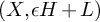 $(X,\epsilon H+L)$
,
 $$\begin{align*}M_{\Delta}^{\mathrm{NA}}(\mathcal{X},\mathcal{M})\ge \delta_1H_{\Delta}^{\mathrm{NA}}(\mathcal{X},\mathcal{M}) +\delta_2 (\mathcal{J}^{\epsilon H+L})^{\mathrm{NA}}(\mathcal{X},\mathcal{M}). \end{align*}$$
Proof. Decompose
 $M_{\Delta }^{\mathrm {NA}}(\mathcal {X},\mathcal {M})=H_{\Delta }^{\mathrm {NA}}(\mathcal {X},\mathcal {M})+(\mathcal {J}^{K_X+\Delta })^{\mathrm {NA}}(\mathcal {X},\mathcal {M})$
. By assumption, there exist positive constants
 $\epsilon ^{\prime }_0$
and
 $\delta $
such that
 $$ \begin{align*}H_{\Delta}^{\mathrm{NA}}(\mathcal{X},\mathcal{M})\ge-(\mathcal{J}^{K_X+\Delta})^{\mathrm{NA}}(\mathcal{X},\mathcal{M})+\delta (\mathcal{J}^{\epsilon H+L})^{\mathrm{NA}}(\mathcal{X},\mathcal{M})\end{align*} $$
for any
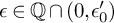 $\epsilon \in \mathbb {Q}\cap (0, \epsilon ^{\prime }_0)$
and semiample test configuration
 $(\mathcal {X},\mathcal {M})$
for
 $(X,\epsilon H+f^{*}L)$
. Thus, for any
 $0<\delta _1<1$
,
 $$ \begin{align} (1-\delta_1)H_{\Delta}^{\mathrm{NA}}(\mathcal{X},\mathcal{M})&\ge-(\mathcal{J}^{K_X+\Delta})^{\mathrm{NA}}(\mathcal{X},\mathcal{M})\\ &\quad +\delta(1-\delta_1) (\mathcal{J}^{\epsilon H+L})^{\mathrm{NA}}(\mathcal{X},\mathcal{M})+\delta_1(\mathcal{J}^{K_X+\Delta})^{\mathrm{NA}}(\mathcal{X},\mathcal{M}).\nonumber \end{align} $$
On the other hand, recall that there exists a
 $\mathbb {Q}$
-line bundle T on C such that
 ${K_X+\Delta }\sim _{\mathbb {Q}}f^{*}T$
. By Lemma 4.5, there exist
 $0<\epsilon _0<\epsilon _0'$
and
 $G>0$
such that for any
 $\epsilon \in \mathbb {Q}\cap (0, \epsilon _0)$
,
 $$\begin{align*}G(I^{\mathrm{NA}}(\mathcal{X},\mathcal{M})-J^{\mathrm{NA}}(\mathcal{X},\mathcal{M}))+(\mathcal{J}^{K_X+\Delta})^{\mathrm{NA}}(\mathcal{X},\mathcal{M})\ge0. \end{align*}$$
Therefore, there exist positive constants
 $\delta _1^{\prime }$
and
 $\delta _2$
such that for any
 $0<\epsilon <\epsilon _0$
and
 $0<\delta _1<\delta _1^{\prime }$
,
 $$ \begin{align} \delta(1-\delta_1) (\mathcal{J}^{\epsilon H+L})^{\mathrm{NA}}(\mathcal{X},\mathcal{M})+\delta_1(\mathcal{J}^{K_X+\Delta})^{\mathrm{NA}}(\mathcal{X},\mathcal{M})\ge \delta_2(\mathcal{J}^{\epsilon H+L})^{\mathrm{NA}}(\mathcal{X},\mathcal{M}). \end{align} $$
Fix
 $0<\delta _1<\min \{\delta _1^{\prime },1\}$
. Then we have
 $$ \begin{align*} M_{\Delta}^{\mathrm{NA}}(\mathcal{X},\mathcal{M})&=(1-\delta_1)H_{\Delta}^{\mathrm{NA}}(\mathcal{X},\mathcal{M})+(\mathcal{J}^{K_X+\Delta})^{\mathrm{NA}}(\mathcal{X},\mathcal{M})+\delta_1H_{\Delta}^{\mathrm{NA}}(\mathcal{X},\mathcal{M})\\ &\ge\delta(1-\delta_1) (\mathcal{J}^{\epsilon H+L})^{\mathrm{NA}}(\mathcal{X},\mathcal{M})+\delta_1(\mathcal{J}^{K_X+\Delta})^{\mathrm{NA}}(\mathcal{X},\mathcal{M})+\delta_1H_{\Delta}^{\mathrm{NA}}(\mathcal{X},\mathcal{M})\\ &\ge\delta_1H_{\Delta}^{\mathrm{NA}}(\mathcal{X},\mathcal{M}) +\delta_2 (\mathcal{J}^{\epsilon H+L})^{\mathrm{NA}}(\mathcal{X},\mathcal{M}) \end{align*} $$
Theorem 4.7. Let
 $f\colon (X,\Delta ,H)\to (C,L)$
be a polarized klt-trivial fibration, M (resp. B) be the moduli (resp. discriminant) divisor on C. Suppose that C is an Ambro model,
 $(X,\Delta ,H)$
is uniformly adiabatically K-stable over
 $(C,L)$
and
 $L=-(K_C+M+B)$
is ample.
Then
 $(C,B,M,L)$
is log-twisted K-stable.
Proof. Since
 $(X,\Delta ,H)$
is uniformly adiabatically K-stable over
 $(C,L)$
, there exist positive constants
 $\epsilon _0>0$
,
 $\delta _1>0$
and
 $\delta _2>0$
such that
 $$ \begin{align} M_{\Delta}^{\mathrm{NA}}(\mathcal{X},\mathcal{M})\ge \delta_1H_{\Delta}^{\mathrm{NA}}(\mathcal{X},\mathcal{M}) +\delta_2 (\mathcal{J}^{\epsilon H+L})^{\mathrm{NA}}(\mathcal{X},\mathcal{M}) \end{align} $$
for any rational number
 $0<\epsilon <\epsilon _0$
and normal semiample test configuration
 $(\mathcal {X},\mathcal {M})$
for
 $(X,\epsilon H+L)$
by Lemma 4.6. Fix an arbitrary
 $\mathbb {Q}$
-Cartier
 $\mathbb {Q}$
-divisor D on C. Replacing
 $\epsilon _0$
with a smaller constant if necessary, we have by Lemma 4.5 that
 $$ \begin{align} (\mathcal{J}^{\epsilon H+L})^{\mathrm{NA}}(\mathcal{X},\mathcal{M})+(\mathcal{J}^{(\frac{a}{\delta_2}f^{*}D)})^{\mathrm{NA}}(\mathcal{X},\mathcal{M})>0 \end{align} $$
for sufficiently small
 $a>0$
and
 $\epsilon \in \mathbb {Q}\cap (0,\epsilon _0)$
. Thus, we conclude that there exists a positive constant
 $a_1>0$
such that for any
 $0<a<a_1$
,
 $0<\epsilon <\epsilon _0$
and normal semiample test configuration
 $(\mathcal {X},\mathcal {M})$
for
 $(X,\epsilon H+L)$
,
 $(X,\Delta +\frac {a}{\delta _1}f^{*}D)$
is klt and equation (13) holds. Note that if
 $(X,\Delta +\frac {a}{\delta _1}f^{*}D)$
is klt, then
 $$ \begin{align} H_{(\Delta+\frac{a}{\delta_1}f^{*}D)}^{\mathrm{NA}}(\mathcal{X},\mathcal{M})>0 \end{align} $$
by Theorem 2.16. We may assume that there exists a canonical morphism
 $\rho \colon \mathcal {X}\to X_{\mathbb {P}^1}$
. Put n as the dimension of X. Then, we see that
 $$ \begin{align*} & M_{\Delta+af^{*}D}^{\mathrm{NA}}(\mathcal{X},\mathcal{M})-M_{\Delta}^{\mathrm{NA}}(\mathcal{X},\mathcal{M})\\ &\quad =\frac{a}{(\epsilon H+L)^n}\left((\mathcal{D}-\rho^{*}(f^{*}D)_{\mathbb{P}^1})\cdot\mathcal{M}^n-\frac{nf^{*}D\cdot(\epsilon H+L )^{n-1}}{(n+1)(\epsilon H+L )^{n}}\mathcal{M}^{n+1}\right)\\ &\quad =\delta_1\left(H_{(\Delta+\frac{a}{\delta_1}f^{*}D)}^{\mathrm{NA}}(\mathcal{X},\mathcal{M})-H_{\Delta}^{\mathrm{NA}}(\mathcal{X},\mathcal{M})\right)+(\mathcal{J}^{af^{*}D})^{\mathrm{NA}}(\mathcal{X},\mathcal{M}), \end{align*} $$
where
 $\mathcal {D}$
is the strict transform of
 $(f^{*}D)_{\mathbb {P}^1}$
on
 $\mathcal {X}$
. Combining the above equation with equations (12), (13) and (14), we obtain that
 $$ \begin{align*} M_{\Delta+af^{*}D}^{\mathrm{NA}}(\mathcal{X},\mathcal{M})&=\delta_1(H_{(\Delta+\frac{a}{\delta_1}f^{*}D)}^{\mathrm{NA}}(\mathcal{X},\mathcal{M})-H_{\Delta}^{\mathrm{NA}}(\mathcal{X},\mathcal{M})) \\ &\quad +(\mathcal{J}^{af^{*}D})^{\mathrm{NA}}(\mathcal{X},\mathcal{M})+M_{\Delta}^{\mathrm{NA}}(\mathcal{X},\mathcal{M})\\ &\ge \delta_1H_{(\Delta+\frac{a}{\delta_1}f^{*}D)}^{\mathrm{NA}}(\mathcal{X},\mathcal{M})+\delta_2((\mathcal{J}^{\epsilon H+L})^{\mathrm{NA}}(\mathcal{X},\mathcal{M})\\ & \quad +(\mathcal{J}^{(\frac{a}{\delta_2}f^{*}D)})^{\mathrm{NA}}(\mathcal{X},\mathcal{M}))>0 \end{align*} $$
for any
 $a\in \mathbb {Q}\cap (0,a_1)$
,
 $\epsilon \in \mathbb {Q}\cap (0,\epsilon _0)$
and normal semiample test configuration
 $(\mathcal {X},\mathcal {M})$
for
 $(X,\epsilon H+L)$
. By [Reference Boucksom, Hisamoto and Jonsson13, Proposition 7.15], we note that
 $$ \begin{align*}\mathrm{DF}_{\Delta+af^{*}D}(\mathcal{X},\mathcal{M})\ge M_{\Delta+af^{*}D}^{\mathrm{NA}}(\mathcal{X},\mathcal{M})>0.\end{align*} $$
By Theorem 4.1,
 $(C,B,M,L)$
is at least log-twisted K-semistable. Note that
 $(C,B)$
is klt by Theorem 2.23. Thus, it suffices to show that there exists no nontrivial normal semiample test configuration for
 $(C,L)$
whose log-twisted Donaldson–Futaki invariant is zero. To show this, assume the contrary. Note that M is semiample by Lemma 2.30. By Theorem A.10, we may further assume that there exist an effective
 $\mathbb {Q}$
-Cartier
 $\mathbb {Q}$
-divisor
 $D\sim _{\mathbb {Q}}L$
on C and a positive constant
 $a_0>0$
such that
 $(C,B+aD,M,L)$
is K-unstable for any
 $a\in \mathbb {Q}\cap (0,a_0)$
. By Theorem 4.1, there exist a constant
 $0<\epsilon _{a}<\epsilon _0$
for any
 $a\in \mathbb {Q}\cap (0,a_0)$
such that for any
 $\epsilon \in \mathbb {Q}\cap (0,\epsilon _{a})$
, there exists a normal semiample test configuration
 $(\mathcal {X},\mathcal {M})$
for
 $(X,\epsilon H+L)$
such that
 $\mathrm {DF}_{\Delta +af^{*}D}(\mathcal {X},\mathcal {M})<0$
. However, by what we have shown in the first paragraph,
 $\mathrm {DF}_{\Delta +af^{*}D}(\mathcal {X},\mathcal {M})>0$
for any
 $a\in \mathbb {Q}\cap (0,\min \{a_0,a_1\})$
,
 $\epsilon \in \mathbb {Q}\cap (0,\epsilon _a)$
and normal semiample test configuration
 $(\mathcal {X},\mathcal {M})$
for
 $(X,\epsilon H+L)$
. This is a contradiction. Thus,
 $(C,B,M,L)$
is K-stable and we complete the proof.
4.2 Convergence of the
$\delta $
-invariant

In this subsection, we calculate
 $\lim _{\epsilon \to 0}\delta _{(X,\Delta )}(\epsilon H+L)$
when
 $f:(X,\Delta ,H)\to (C,L)$
is a polarized algebraic fiber space and C is a curve. We make use of this to obtain a sufficiency condition of adiabatic K-stability of klt-trivial fibrations over curves .
First, we bound the multiplicity of
 $D_{\mathrm {vert}}$
, which is the vertical part of
 $D\in |\epsilon H+L|_{\mathbb {Q}}$
.
Lemma 4.8. Let
 $f\colon X\to C$
be a contraction to a proper smooth curve C. Suppose that
 $(X,f^{-1}(p)_{\mathrm {red}})$
is a projective log smooth pair for any
 $p\in C$
. Let H be a nef
 $\mathbb {Q}$
-line bundle on X and L be an ample
 $\mathbb {Q}$
-line bundle on C. Then there exists a positive constant
 $M>0$
such that for any rational number
 $\epsilon>0$
,
 $D_\epsilon \in |\epsilon H+L|_{\mathbb {Q}}$
and closed point P of X, (cf. Example 2.2)
 $$ \begin{align*}\mathrm{ord}_P(D_{\epsilon,\mathrm{hor}})\le M\epsilon.\end{align*} $$
Proof. It suffices to show that there exists a positive constant
 $M>0$
satisfying the following:
-
• For any irreducible component G of
$f^{-1}(f(P))$
that contains P, there exists a curve
$\gamma \subset f^{-1}(f(P))$
passing through P but not contained in
$D_{\epsilon ,\mathrm {hor}}$
. Furthermore,
$\gamma \cdot H\le M$
.


Indeed, Lemma 4.8 follows from this since
 $$ \begin{align*}\mathrm{ord}_P(D_{\epsilon,\mathrm{hor}})\le\gamma\cdot D_{\epsilon,\mathrm{hor}}=\gamma\cdot(\epsilon H+L)=\epsilon(\gamma\cdot H)\le\epsilon M.\end{align*} $$
Next, we show the existence of such M and
 $\gamma $
as we stated above. Fix an ample line bundle A on X. Let
 $\mathrm {dim}\,X=n$
and
 $\mu :\tilde {X}\to X$
be the blow up at P with exceptional divisor E. By Seshadri’s theorem [Reference Lazarsfeld56, Theorem 1.4.14], there exists a positive integer
 $m^{\prime }_1$
such that
 $\mu ^{*}(mA)-E$
are ample for any
 $m\ge m^{\prime }_1$
. On the other hand, there exists
 $m_1^{\prime \prime }\in \mathbb {Z}_{>0}$
such that
 $(mA-K_X-G)$
is also ample for any
 $m\ge m_1^{\prime \prime }$
and for any vertical prime divisor G on X. Indeed, since there are only finitely many numerical classes of such G, it suffices to check the existence of
 $m^{\prime \prime }_1$
for finitely many G (cf. [Reference Lazarsfeld56, Corollary 1.2.24]). By setting
 $m_1:=(n-1)m_1^{\prime }+m_1^{\prime \prime }$
, we obtain that
 $\mu ^{*}(m_1A-K_X-G)-(n-1)E$
is ample for any vertical prime divisor G and
 $P\in X$
. Choose a vertical prime divisor G such that
 $P\in G$
, and set
 $\tilde {G}=\mu ^{-1}_{*}G$
. Then
 $$ \begin{align*}m_1\mu^{*}A|_{\tilde{G}}-K_{\tilde{G}}-E|_{\tilde{G}}=(\mu^{*}(m_1A-K_X-G)-(n-1)E)|_{\tilde{G}}\end{align*} $$
is ample. Therefore, by [Reference Kollár51, Theorem 1.1], there exists a positive integer
 $m_2$
depending only on n such that
 $m_2(m_1\mu ^{*}A-E)|_{\tilde {G}}$
is ample and generated by global sections. Then there exist general divisors
 $D_1,\cdots ,D_{n-2}\in |m_2(m_1\mu ^{*}A-E)|_{\tilde {G}}|$
such that
 $\gamma '=\bigcap _{i=1}^{n-2}D_i\subset \tilde {G}$
is a smooth curve intersecting with E properly by Bertini’s theorem and is not contained in
 $\mu ^{*}(D_{\epsilon ,\mathrm {hor}})$
. Note that
 $$ \begin{align*} \gamma'\cdot \mu^{*}D_{\epsilon,\mathrm{hor}}&=m_1^{n-2}m_2^{n-2}A^{n-2}\cdot G\cdot H\le m_1^{n-2}m_2^{n-2}\frac{\mathrm{ord}_G(f^{-1}f(G))}{\mathrm{deg}\,L}(A^{n-2}\cdot L\cdot H). \end{align*} $$
We note that
 $T:=\max _G(\mathrm {ord}_G(f^{-1}f(G)))$
is a positive integer, where G runs over all vertical prime divisors. By setting
 $\gamma :=\mu _{*}\gamma '$
and
 $M:=m_1^{n-2}m_2^{n-2}\frac {T}{\mathrm {deg}\,L}(A^{n-2}\cdot L\cdot H)$
, we see the condition holds as we claimed in the first paragraph. We complete the proof.
Furthermore, we prepare the following useful lemma, which follows from the same argument of [Reference Boucksom, Hisamoto and Jonsson13, Proof of Theorem 9.14, Step. 2].
Lemma 4.9. Let X be a projective smooth variety. For any rational number
 $0<\epsilon <1$
, let
 $\Delta $
be a
 $\mathbb {Q}$
-divisor such that
 $(X,\Delta )$
is log smooth and
 $\epsilon $
-sublc. If D is an effective
 $\mathbb {Q}$
-divisor such that
 $\mathrm {ord}_P(D)\le \epsilon $
for any closed point
 $P\in X$
, then
 $(X,\Delta +D)$
is sublc.
Proof. By assumption, we see that
 $(1-\epsilon )\Delta _{\mathrm {red}}\ge \Delta $
. We see by [Reference Kollár and Mori55, Corollary 2.31] that
 $(X,\Delta _{\mathrm {red}})$
is sublc, that is,
 $$\begin{align*}A_{X}(E)\ge \mathrm{ord}_{E}(\Delta_{\mathrm{red}})\ge \frac{1}{1-\epsilon}\mathrm{ord}_E(\Delta) \end{align*}$$
for any prime divisor E over X. Since
 $\mathrm {ord}_P(D)\le \epsilon $
for any closed point
 $P\in X$
,
 $$ \begin{align*}\epsilon A_X(E)\ge\mathrm{ord}_{E}(D)\end{align*} $$
by [Reference Kollár52, Lemma 8.10] for any prime divisor E over X. Thus,
 $$\begin{align*}A_{(X,\Delta+D)}(E)=(1-\epsilon)\left(A_{X}(E)-\frac{1}{1-\epsilon}\mathrm{ord}_E(\Delta)\right)+\epsilon A_X(E)-\mathrm{ord}_E(D)\ge0, \end{align*}$$
which means that
 $(X,\Delta +D)$
is sublc.
Definition 4.10. Let
 $f\colon (X,\Delta )\to C$
be an algebraic fiber space subpair over a smooth curve C. Suppose that
 $(X,\Delta )$
is sublc. Set
 $B=\sum _{p\in C}(1-\mathrm {lct}_{(X,\Delta )}(f^{*}p))p$
as a
 $\mathbb {Q}$
-divisor on C and call this the discriminant divisor with respect to f.
In this situation, we note that
 $\alpha _{(C,B)}(L)=\frac {1}{\mathrm {deg}\,L}\min _{p\in C}\mathrm {lct}_{(X,\Delta )}(f^{-1}(p))$
. With this in mind, we prove the following result on the ‘convergence of
 $\alpha $
-invariant’.
Theorem 4.11. Let
 $f\colon (X,\Delta ,H)\to (C,L)$
be a polarized algebraic fiber space pair over a smooth curve C. Suppose that
 $(X,\Delta )$
is klt. Then,
 $$\begin{align*}\lim_{\epsilon\to 0}\alpha_{(X,\Delta)}(L+\epsilon H)=\alpha_{(C,B)}(L), \end{align*}$$
where B is the discriminant divisor defined as Definition 4.10.
Proof. We may assume that
 $\mathrm {deg}\,L=1$
. It is easy to see that
 $$ \begin{align*}\limsup_{\epsilon\to0}\alpha_{(X,\Delta)}(L+\epsilon H)\le\alpha_{(C,B)}(L)\end{align*} $$
by
 $\alpha _{(C,B)}(L)=\frac {1}{\mathrm {deg}\,L}\min _{p\in C}\mathrm {lct}_{(X,\Delta )}(f^{-1}(p))$
. Thus, it suffices to show that
 $$ \begin{align} \liminf_{\epsilon\to 0}\alpha_{(X,\Delta)}(L+\epsilon H)\ge\alpha_{(C,B)}(L). \end{align} $$
In other words, we have only to show that for any sufficiently small
 $\delta>0$
, there exists
 $\epsilon _0>0$
such that for any
 $\epsilon \in \mathbb {Q}\cap (0, \epsilon _0)$
and
 $D_\epsilon \in |L+\epsilon H|_{\mathbb {Q}}$
,
 $(X,\Delta +(\alpha _{(C,B)}(L)-\delta ) D_\epsilon )$
is lc. Take a log resolution
 $g:X'\to X$
of
 $(X,\Delta )$
, and let
 $f'=f\circ g$
. We may further assume that the reduced structure of any fiber of
 $f'$
is snc. Let
 $\Delta '$
be a
 $\mathbb {Q}$
-divisor on
 $X'$
such that
 $g_{*}\Delta '=\Delta $
and
 $$\begin{align*}K_{X'}+\Delta'=g^{*}(K_X+\Delta). \end{align*}$$
Fix a very ample divisor A on
 $X'$
, and set
 $D_\epsilon ':=g^{*}D_\epsilon $
. Then, we decompose
 $D^{\prime }_\epsilon =D^{\prime }_{\epsilon ,\mathrm {vert}}+D^{\prime }_{\epsilon ,\mathrm {hor}}$
(see the first paragraph of §2).
In two paragraphs, we estimate the multiplicities of
 $D^{\prime }_{\epsilon ,\text {vert}}$
. Put n as the dimension of X. Let
 $$ \begin{align} D^{\prime}_{\epsilon,\mathrm{vert}}=\sum_{i=1}^r a_iF_i+\Theta, \end{align} $$
where each
 $F_i$
is a fiber of
 $f'$
,
 $a_i\ge 0$
and
 $\Theta $
is an effective
 $\mathbb {Q}$
-divisor whose support contains no fiber of
 $f'$
. In this paragraph, we deal with
 $\Theta $
’s coefficients. We first note that there exist only finitely many singular fibers of
 $f'$
. Let
 $\{f^{\prime -1}(c_s)\}_{s=1}^l$
be the set of all singular fibers, and take one of them
 $f^{\prime -1}(c_s)$
. Let
 $f^{\prime -1}(c_ s)=\sum _{j=0}^k n_jC_j$
be the irreducible decomposition and
 $\sum b_jC_j$
be the restriction of
 $\Theta $
to the neighborhood of
 $f^{\prime -1}(c_s)$
. Here, one of
 $b_j$
is zero and by renumbering j, we may assume that
 $b_0=0$
. Let
 $\mathrm {Span}_{\mathbb {R}}\langle C_j \rangle _{j=1}^k$
be an
 $\mathbb {R}$
-vector space generated by
 $\{C_j\}_{j=1}^k$
, and set a bilinear pairing
 $\langle \cdot ,\cdot \rangle $
defined by
 $\langle E_1 ,E_2\rangle :=A^{n-2}\cdot E_1\cdot E_2$
. By applying the Zariski lemma (cf. [Reference Li and Xu61, Lemma 1]),
 $(\mathrm {Span}_{\mathbb {R}}\langle C_j \rangle _{j=1}^k,\sqrt {-\langle \cdot ,\cdot \rangle })$
is a finite-dimensional normed space and hence the norm
 $\sqrt {-\langle \cdot ,\cdot \rangle }$
is equivalent to the supremum norm. Therefore, there exists a constant
 $\beta>0$
such that
 $$ \begin{align} -\left\langle\sum_{j=1}^kd_jC_j,\sum_{j=1}^k d_jC_j\right\rangle\ge \beta (\max\{ d_j\})^2 \end{align} $$
for any
 $(d_j)_{j=1}^k\in \mathbb {R}^{k}$
. Since
 $D^{\prime }_\epsilon $
is nef,
 $$ \begin{align} \sum_{j=1}^k b_jC_j\cdot \left(\sum_{j=1}^k b_jC_j +D^{\prime}_{\epsilon,\mathrm{hor}}\right)\cdot A^{n-2}=\sum_{j=1}^k b_jC_j\cdot g^{*}(\epsilon H+L)\cdot A^{n-2}\ge0. \end{align} $$
Note that if we set
 $m=\min _jn_j>0$
then
 $\frac {\max \{ b_j\}}{m}f^{\prime -1}(c_s)-\sum _{j=1}^k b_jC_j$
is effective. Thus, we obtain
 $$ \begin{align*} \frac{\max\{ b_j\}}{m}\epsilon g^{*}H\cdot g^{*}L\cdot A^{n-2} & =\frac{\max\{ b_j\}}{m}g^{*}f^{-1}(c_s)\cdot g^{*}D_\epsilon\cdot A^{n-2} \\ &=\frac{\max\{ b_j\}}{m}f^{\prime -1}(c_s)\cdot D^{\prime}_{\epsilon,\mathrm{hor}}\cdot A^{n-2}\\ &\ge \left(\sum_{j=1}^k b_jC_j\cdot D^{\prime}_{\epsilon,\mathrm{hor}}\right)\cdot A^{n-2} \\ &\ge-\left\langle\sum b_jC_j,\sum b_jC_j\right\rangle\ge\beta (\max\{ b_j\})^2. \end{align*} $$
Here, we apply equations (17) and (18) in the second line of the above inequality. Therefore,
 $$ \begin{align*}\max\{ b_j\}\le \frac{\epsilon}{m\beta}g^{*}H\cdot f^{\prime *}L\cdot A^{n-2}.\end{align*} $$
The constants
 $\beta $
and m depend only on finitely many choices of irreducible components of
 $f^{\prime -1}(c_s)$
. Hence, there exists a constant
 $M'>0$
such that
 $M'\epsilon \sum _{s=1}^lf^{\prime -1}(c_s)-\Theta $
is effective for any
 $D_{\epsilon }$
.
Next, we bound the coefficients
 $a_i$
in
 $D^{\prime }_{\epsilon ,\mathrm {vert}}=\sum _{i=1}^r a_iF_i+\Theta $
in equation (16). We have that
 $$\begin{align*}\left(\sum_{i=1}^r a_iF_i\right)\cdot A^{n-1}\le A^{n-1}\cdot g^{*}(\epsilon H+L) \end{align*}$$
and hence
 $\sum _{i=1}^ra_i\le 1+\epsilon (\frac {A^{n-1}\cdot g^{*}H}{A^{n-1}\cdot f^{\prime *}L})$
. By the fact that there are only finitely many singular fibers of
 $f'$
, set
 $T:=\max _{c,Q}\mathrm {ord}_Q{f^{\prime -1}(c)}>0$
where
 $c\in C$
runs over all closed points and Q runs over all irreducible components of
 $f^{\prime -1}(c)$
. Then we have that
 $$\begin{align*}\sum_{i=1}^r a_iF_i=\sum_{i=1}^r a^{\prime}_iF_i+B', \end{align*}$$
where
 $a^{\prime }_i>0$
such that
 $\sum _{i=1}^r a^{\prime }_i\le 1$
and
 $B'$
is an effective snc
 $\mathbb {Q}$
-divisor such that
 $\mathrm {ord}_P(B')\le M"\epsilon $
for any closed point
 $P\in X'$
, where
 $M"=nT(\frac {A^{n-1}\cdot g^{*}H}{A^{n-1}\cdot f^{\prime *}L})$
. We note that in particular, it holds that
 $0<a^{\prime }_i\le 1$
.
Thus, we have by Lemma 4.8 and by the above arguments that there exists a positive constant
 $M>0$
such that for any sufficiently small rational number
 $\epsilon>0$
and
 $D_{\epsilon }\in |\epsilon H+L|_{\mathbb {Q}}$
,
 $$\begin{align*}g^{*} D_{\epsilon}= \sum_{i=1}^r d_iF_i+\Xi, \end{align*}$$
where
 $0<d_i\le 1$
,
 $F_i$
is a fiber of
 $f'$
and
 $\Xi $
is a
 $\mathbb {Q}$
-divisor such that
 $\mathrm {ord}_P(\Xi )\le M\epsilon $
for any closed point
 $P\in X'$
. By the definition of
 $\alpha _{(C,B)}(L)$
and the property of
 $X'$
,
 $(X',\Delta '+(\alpha _{(C,B)}(L)-\delta )\sum _{i=1}^r d_iF_i)$
is log smooth and
 $\delta $
-sublc if we choose
 $\delta $
small enough. Thus, if
 $0<\epsilon <\epsilon _0:=\min \{1,\frac {\delta }{M(\alpha _{(C,B)}(L)-\delta )}\}$
, then we have that
 $(\alpha _{(C,B)}(L)-\delta )\mathrm {ord}_P(\Xi )\le \delta $
for any closed point
 $P\in X'$
. By Lemma 4.9,
 $(X',\Delta '+(\alpha _{(C,B)}(L)-\delta )g^{*} D_{\epsilon })$
is sublc. This means that for any
 $\epsilon \in (0,\epsilon _0)\cap \mathbb {Q}$
and
 $D_\epsilon \in |L+\epsilon H|_{\mathbb {Q}}$
,
 $(X,\Delta +(\alpha _{(C,B)}(L)-\delta ) D_\epsilon )$
is lc. Hence, we have equation (15) and complete the proof.
By applying Theorem 4.11, we obtain the following theorem for the
 $\delta $
-invariant.
Theorem 4.12. Let
 $f\colon (X,\Delta ,H)\to (C,L)$
be a polarized algebraic fiber space pair. Suppose that
 $(X,\Delta )$
is a klt pair, C is a smooth curve and B is the discriminant divisor. Then
 $$\begin{align*}\lim_{\epsilon\to 0}\delta_{(X,\Delta)}(\epsilon H+L)=\delta_{(C,B)}(L). \end{align*}$$
Proof. By Example 2.17,
 $\delta _{(C,B)}(L)=2\alpha _{(C,B)}(L)$
and it is enough to show that
 $$\begin{align*}\lim_{\epsilon\to 0}\delta_{(X,\Delta)}(\epsilon H+L)=2\alpha_{(C,B)}(L) \end{align*}$$
instead. We may assume that
 $L=f^{*}c$
for some general point
 $c\in C$
since the
 $\delta _{(X,\Delta )}(\epsilon H+ L)$
depends only on the numerical equivalence class of L. First, we see that
 $$ \begin{align} \limsup_{\epsilon\to0}\delta_{(X,\Delta)}(\epsilon H+L)\le2\alpha_{(C,B)}(L). \end{align} $$
Indeed, recall that
 $\alpha _{(C,B)}(L)=\mathrm {lct}_{(X,\Delta )}(F)$
for some fiber
 $F=f^{-1}(p)$
. For any
 $\delta>0$
, pick a prime divisor E over X such that
 $A_{(X,\Delta +(\alpha _{(C,B)}(L)+\delta )F)}(E)<0$
. We see by definition that
 $$\begin{align*}S_{\epsilon H+L}(E)\ge\frac{\mathrm{ord}_E(F)}{(\epsilon H+L)^n}\int^{\infty}_0\mathrm{vol}(\epsilon H+L-xF)dx. \end{align*}$$
It follows that
 $$\begin{align*}\int^{\infty}_0\mathrm{vol}(\epsilon H+L-xF)dx=\int^{\infty}_0\mathrm{vol}(\epsilon H+(1-x)L)dx \end{align*}$$
from the fact that the volume depends only on the numerical class (cf. [Reference Lazarsfeld56, Theorem 1.4.40]). On the other hand, we have
 $$ \begin{align*} \mathrm{vol}(\epsilon H+(1-x)L)=n(1-x)\epsilon^{n-1}H^{n-1}\cdot L+\epsilon^n H^n \end{align*} $$
for any
 $x\in \mathbb {Q}\cap (0,1)$
. Take
 $\tau \in \mathbb {Q}_{>0}$
such that
 $H-\tau L$
is not pseudoeffective. Then
 $$ \begin{align*} \frac{1}{2}\epsilon^{n-1}(H^{n-1}\cdot L)+\epsilon^nH^n&=\int^1_{0}\mathrm{vol}(\epsilon H+(1-x)L)dx\le\int^\infty_{0}\mathrm{vol}(\epsilon H+(1-x)L)dx\\ &=\int^{1+\epsilon\tau}_{0}\mathrm{vol}(\epsilon H+(1-x)L)dx \\ &\le\frac{1}{2}\epsilon^{n-1}(H^{n-1}\cdot L)+(\epsilon^n+\epsilon^{n+1}\tau)H^n \end{align*} $$
and hence we have that
 $$ \begin{align} \lim_{\epsilon\to0}\frac{\int^{\infty}_0\mathrm{vol}(\epsilon H+L-xF)dx}{(\epsilon H+L)^n}=\lim_{\epsilon\to0}\frac{\int^{\infty}_0\mathrm{vol}(\epsilon H+(1-x)L)dx}{(\epsilon H+L)^n}=\frac{1}{2}. \end{align} $$
Thus, we have
 $$\begin{align*}A_{(X,\Delta)}(E)<2(\alpha_{(C,B)}(L)+\delta)S_{\epsilon H+L}(E) \end{align*}$$
for any sufficiently small rational number
 $\epsilon>0$
. This means that
 $$\begin{align*}\limsup_{\epsilon\to0}\delta_{(X,\Delta)}(\epsilon H+L)\le2(\alpha_{(C,B)}(L)+\delta) \end{align*}$$
for any
 $\delta>0$
and that equation (19) holds.
From now on, we show
 $$ \begin{align} \liminf_{\epsilon\to0}\delta_{(X,\Delta)}(\epsilon H+L)\ge2\alpha_{(X,\Delta)}(L). \end{align} $$
First, we show the following claim.
Claim. For any sufficiently small
 $\epsilon \in \mathbb {Q}_{>0}$
, let
 $$\begin{align*}C_{\epsilon}:=\frac{\int^{\infty}_0\mathrm{vol}(\epsilon H+(1-x)L)dx}{(\epsilon H+L)^n}. \end{align*}$$
Then for any prime divisor E over X, we obtain that
 $$\begin{align*}S_{\epsilon H+L}(\mathrm{ord}_E)\le T_{\epsilon H+(1-C_\epsilon)L}(\mathrm{ord}_E). \end{align*}$$
Proof of claim.
Take a irreducible and normal fiber F of f that does not contain the generic point of the center of E. For any
 $m\in \mathbb {Z}_{>0}$
such that
 $m\epsilon H+mL$
is a Cartier divisor, we take a basis
 $\{s_i\}$
of
 $H^0(X,m\epsilon H+mL)$
compatible with E and F by Lemma 2.15. Let D be the m-basis type divisor of
 $\epsilon H+L$
defined by
 $\{s_i\}$
. Then we have by Lemma 2.15 that
 $$\begin{align*}\mathrm{ord}_F(D)=S^m_{\epsilon H+L}(\mathrm{ord}_F). \end{align*}$$
This means that
 $D-S^m_{\epsilon H+L}(\mathrm {ord}_F)F$
is effective and
 $$\begin{align*}S^{m}_{\epsilon H+L}(\mathrm{ord}_E)=\mathrm{ord}_E(D)=\mathrm{ord}_E(D-S^m_{\epsilon H+L}(\mathrm{ord}_F)F). \end{align*}$$
We note that
 $\lim _{m\to \infty }S^m_{\epsilon H+L}(\mathrm {ord}_F)=S_{\epsilon H+L}(\mathrm {ord}_F)=C_{\epsilon }$
. By (20), we have
 $\lim _{\epsilon \to 0}C_{\epsilon }=\frac {1}{2}$
. Thus, we may assume that
 $C_\epsilon <1$
and
 $S^m_{\epsilon H+L}(\mathrm {ord}_F)<1$
by replacing m with a larger integer and
 $\epsilon $
with a smaller positive rational number. Then, we obtain that
 $$\begin{align*}S^{m}_{\epsilon H+L}(\mathrm{ord}_E)\le T_{\epsilon H+L-S^m_{\epsilon H+L}(\mathrm{ord}_F)F}(\mathrm{ord}_E). \end{align*}$$
It is not hard to see that
 $$\begin{align*}T_{\epsilon H+L-S^m_{\epsilon H+L}(\mathrm{ord}_F)F}(\mathrm{ord}_E)=T_{\epsilon H+(1-S^m_{\epsilon H+L}(\mathrm{ord}_F))L}(\mathrm{ord}_E)\end{align*}$$
by
 $L\equiv F$
. If
 $C_{\epsilon }\ge S^m_{\epsilon H+L}(\mathrm {ord}_F)$
, we obtain that
 $$ \begin{align*} T_{\epsilon H+(1-C_\epsilon)L}(\mathrm{ord}_E)&=\frac{1-C_\epsilon}{1-S^m_{\epsilon H+L}(\mathrm{ord}_F)}T_{\frac{\epsilon(1-S^m_{\epsilon H+L}(\mathrm{ord}_F))}{1-C_\epsilon} H+(1-S^m_{\epsilon H+L}(\mathrm{ord}_F))L}(\mathrm{ord}_E)\\ &\ge \frac{1-C_\epsilon}{1-S^m_{\epsilon H+L}(\mathrm{ord}_F)}T_{\epsilon H+(1-S^m_{\epsilon H+L}(\mathrm{ord}_F))L}(\mathrm{ord}_E). \end{align*} $$
Otherwise, we have
 $T_{\epsilon H+(1-C_\epsilon )L}(\mathrm {ord}_E)\ge T_{\epsilon H+(1-S^m_{\epsilon H+L}(\mathrm {ord}_F))L}(\mathrm {ord}_E)$
. Thus, we obtain that
 $$ \begin{align*} S_{\epsilon H+L}(\mathrm{ord}_E)&=\lim_{m\to\infty}S^m_{\epsilon H+L}(\mathrm{ord}_E)\le \lim_{m\to\infty}\min\left\{1,\frac{1-C_\epsilon}{1-S^m_{\epsilon H+L}(\mathrm{ord}_F)}\right\}T_{\epsilon H+(1-C_\epsilon)L}(\mathrm{ord}_E)\\ &=T_{\epsilon H+(1-C_\epsilon)L}(\mathrm{ord}_E). \end{align*} $$
We complete the proof of claim.
Note that
 $T_{\epsilon H+(1-C_\epsilon )L}(\mathrm {ord}_E)=(1-C_{\epsilon })T_{\frac {\epsilon }{1-C_\epsilon }H+L}(\mathrm {ord}_E)$
. Recall that
 $\lim _{\epsilon \to 0}C_{\epsilon }=\frac {1}{2}$
. By Claim and Theorem 4.11, we obtain that
 $$ \begin{align*} \liminf_{\epsilon\to 0}\delta_{(X,\Delta)}(\epsilon H+L) &=\liminf_{\epsilon\to0}\inf_{E}\frac{A_{(X,\Delta)}(E)}{S_{\epsilon H+L}(\mathrm{ord}_E)} \ge \liminf_{\epsilon\to0}(1-C_{\epsilon})^{-1}\inf_{E}\frac{A_{(X,\Delta)}(E)}{T_{\frac{\epsilon}{1-C_\epsilon}H+L}(\mathrm{ord}_E)} \\ &=\liminf_{\epsilon\to0}(1-C_{\epsilon})^{-1}\alpha_{(X,\Delta)}\left(\frac{\epsilon}{1-C_\epsilon}H+L\right)=2\alpha_{(C,B)}(L), \end{align*} $$
where E runs over all prime divisors over X. This is nothing but equation (21). Then equations (19) and (21) complete the proof.
Remark 4.13. There is a fact that the alpha invariant is continuous on the Kähler cone [Reference Dervan20, Theorem 3.5]. For the delta invariant, a similar result known by Zhang (cf. [Reference Zhang84]). Due to Theorems 4.11 and 4.12, we can extend these invariants continuously to the fiber class.
Now, we are ready to show Theorem 1.1. First, we prepare the following lemma on J-stability.
Lemma 4.14. Let
 $f:(X,H)\to (C,L)$
be a polarized algebraic fiber space. Suppose that C is a smooth curve and H is ample. Then for any sufficiently small rational number
 $\epsilon>0$
and semiample test configuration
 $(\mathcal {X},\mathcal {M})$
for
 $(X,\epsilon H+L)$
,
 $$\begin{align*}(\mathcal{J}^{-f^{*}L})^{\mathrm{NA}}(\mathcal{X},\mathcal{M})> -(I^{\mathrm{NA}}(\mathcal{X},\mathcal{M})-J^{\mathrm{NA}}(\mathcal{X},\mathcal{M})). \end{align*}$$
Proof. It suffices to show that
 $(X,\epsilon H+L)$
is uniformly J
 $^{H}$
-stable since
 $-L+(\epsilon H+L)= \epsilon H$
. By the ampleness of
 $$\begin{align*}n\frac{H\cdot (\epsilon H+L)^{n-1}}{(\epsilon H+L)^n}(\epsilon H+L)-(n-1)H=\frac{\epsilon^2(H^n)H+n((n-1)H^{n-1}\cdot L+\epsilon H^n)L}{n\epsilon H^{n-1}\cdot L+\epsilon^2 H^n} \end{align*}$$
and by Remark 3.4,
 $(X,\epsilon H+L)$
is uniformly J
 $^{H}$
-stable.
The following gives a sufficient condition for uniform adiabatic K-stability.
Theorem 4.15. Let
 $f:(X,\Delta ,H)\to (\mathbb {P}^1,\mathcal {O}(1))$
be a polarized klt-trivial fibration, let M be the moduli divisor and let B be the discriminant divisor. Suppose that
 $-(K_{\mathbb {P}^1}+M+B)$
is ample. If
 $(\mathbb {P}^1,B,M,\mathcal {O}(1))$
is uniformly K-stable, then
 $(X,\Delta ,H)$
is uniformly adiabatically K-stable over
 $(\mathbb {P}^1,\mathcal {O}(1))$
. Moreover, if
 $\Delta =0$
, X is smooth and
 $(\mathbb {P}^1,B,M,\mathcal {O}(1))$
is uniformly adiabatically K-stable, then
 $(X,H)$
has cscK metrics adiabatically.
Proof. Let
 $\mathrm {deg}\, (B+M)=s\ge 0$
, and then we have that
 $$\begin{align*}\delta_{(C,B)}(\mathcal{O}(1))=(2-s)\delta_{(C,B)}(-(K_C+M+B))>2-s \end{align*}$$
by Corollary A.17. Therefore, there exist positive constants
 $\epsilon _0$
and
 $\delta $
such that
 $$\begin{align*}\delta_{(X,\Delta)}(\epsilon H+\mathcal{O}(1))\ge2-s+\delta \end{align*}$$
for any
 $\epsilon \in (0,\epsilon _0)\cap \mathbb {Q}$
by Theorem 4.12. On the other hand,
 $$\begin{align*}K_X+\Delta\sim_{\mathbb{Q}}f^{*}(K_{\mathbb{P}^1}+M+B)\sim_{\mathbb{Q}} -(2-s)f^{*}\mathcal{O}(1). \end{align*}$$
Therefore,
 $$\begin{align*}(\mathcal{J}^{K_X+\Delta})^{\mathrm{NA}}(\mathcal{X},\mathcal{M})\ge -(2-s)(I^{\mathrm{NA}}(\mathcal{X},\mathcal{M})-J^{\mathrm{NA}}(\mathcal{X},\mathcal{M})) \end{align*}$$
for any
 $\epsilon \in (0,\epsilon _0)\cap \mathbb {Q}$
and semiample test configuration
 $(\mathcal {X},\mathcal {M})$
for
 $(X,\epsilon H+\mathcal {O}(1))$
by Lemma 4.14. Furthermore, we have by Theorem A.6 that
 $$ \begin{align*} M_\Delta^{\mathrm{NA}}(\mathcal{X},\mathcal{M})&=H^{\mathrm{NA}}_\Delta(\mathcal{X},\mathcal{M})+(\mathcal{J}^{K_X+\Delta})^{\mathrm{NA}}(\mathcal{X},\mathcal{M})\\ &\ge\delta(I^{\mathrm{NA}}(\mathcal{X},\mathcal{M})-J^{\mathrm{NA}}(\mathcal{X},\mathcal{M})). \end{align*} $$
This means that
 $(X,\Delta ,H)$
is uniformly adiabatically K-stable over
 $(C,L)$
. We complete the proof of the first assertion.
On the other hand, we can show that the K-energy is coercive by [Reference Zhang85, Proposition 3.5] and [Reference Chen15, Theorem 1.1] as the proof of the first assetion. Thus, the second assertion follows from [Reference Chen and Cheng17, Theorem 4.1].


4.3 Applications to rational elliptic surfaces
We apply Theorems 1.1 and 1.2 to rational elliptic surfaces (cf. Definition 2.31). For this, we first classify K-stable log-twisted Fano curves
 $(\mathbb {P}^1,B,M,L)$
associated with rational elliptic surfaces.
Proposition 4.16. Let
 $f:X\to \mathbb {P}^1$
be a rational elliptic surface of index
 $m(X)$
,
 $B=\sum _{Q\in \mathbb {P}^1}s_QQ$
be the discriminant divisor and M be the moduli divisor (cf. Definition 2.33).
Then
 $(\mathbb {P}^1,B,M,\mathcal {O}(1))$
is uniformly K-stable (resp, K-semistable, K-unstable) if and only if
 $\max _Qs_Q< \frac {2m(X)-1}{2m(X)}$
(resp.,
 $\max _Qs_Q\le \frac {2m(X)-1}{2m(X)}$
,
 $\max _Qs_Q> \frac {2m(X)-1}{2m(X)}$
).
Proof. It immediately follows from Corollary A.17.
We obtain the following by the Kodaira canonical bundle formula and by Lemma 2.32.
Corollary 4.17. Let
 $f:X\to \mathbb {P}^1$
be a rational elliptic surface and
 $\tilde {X}$
the minimal resolution of X. Then the log twisted pair
 $(\mathbb {P}^1,B,M,\mathcal {O}(1))$
induced by f is K-unstable if and only if one of the following holds.
-
•
$m(X)=1$
and
$\tilde {X}$
admits one of
$II^{*}$
,
$III^{*}$
or
$IV^{*}$
-type fibers, -
•
$m(X)=2$
and
$\tilde {X}$
admits at least one
$II^{*}$
-type fiber.


On the other hand,
 $(\mathbb {P}^1,B,M,\mathcal {O}(1))$
is K-stable if and only if one of the following holds.
-
•
$m(X)=1$
and
$\tilde {X}$
has at most reduced fibers, -
•
$m(X)=2$
and
$\tilde {X}$
has no
$II^{*}$
or
$III^{*}$
-type fiber, -
•
$m(X)=3$
and
$\tilde {X}$
has no
$II^{*}$
-type fiber, -
•
$m(X)\ge 4$
.


Proof. This immediately follows from Proposition 4.16.
Therefore, we obtain the following by Theorems 1.1, 1.2 and Corollary 4.17.
Corollary 4.18. Let
 $f\colon X\to \mathbb {P}^1$
be a rational elliptic surface with an ample
 $\mathbb {Q}$
-Cartier
 $\mathbb {Q}$
-divisor H on X and
 $\tilde {X}$
the minimal resolution of X. Then the following hold.
-
• If
$m(X)=1$
and
$\tilde {X}$
admits one of
$II^{*}$
,
$III^{*}$
or
$IV^{*}$
-type fibers, then
$(X,H)$
is adiabatically K-unstable over
$(\mathbb {P}^1,\mathcal {O}(1))$
. -
• If
$m(X)=2$
and
$\tilde {X}$
admits at least one
$II^{*}$
-type fiber, then
$(X,H)$
is adiabatically K-unstable over
$(\mathbb {P}^1,\mathcal {O}(1))$
. -
• If
$m(X)=1$
, then
$\tilde {X}$
has at most reduced fibers if and only if
$(X,H)$
is uniformly adiabatically K-stable. If X is further smooth,
$(X,H)$
has cscK metrics adiabatically. -
• If
$m(X)=2$
, then
$\tilde {X}$
has no
$II^{*}$
or
$III^{*}$
-type fiber if and only if
$(X,H)$
is uniformly adiabatically K-stable. If X is further smooth,
$(X,H)$
has cscK metrics adiabatically. -
• If
$m(X)=3$
, then
$\tilde {X}$
has no
$II^{*}$
-type fiber if and only if
$(X,H)$
is uniformly adiabatically K-stable. If X is further smooth,
$(X,H)$
has cscK metrics adiabatically. -
• If
$m(X)\ge 4$
, then
$(X,H)$
is uniformly adiabatically K-stable. If X is further smooth,
$(X,H)$
has cscK metrics adiabatically.


Remark 4.19. It is well known that there exists a smooth rational elliptic surface
 $f\colon X\to \mathbb {P}^1$
with a
 $II^{*}$
-type fiber of
 $m(X)=1$
. Let B (resp. M) be the discriminant (resp. moduli) divisor on
 $\mathbb {P}^1$
. Note that
 $\mathrm {deg}(B+M)=1$
. By Corollary 4.18 below, we have that
 $f\colon (X,H)\to (\mathbb {P}^1,\mathcal {O}(1))$
is adiabatically K-unstable. However, the twisted pair
 $(\mathbb {P}^1,0,B+M,\mathcal {O}(1))$
is uniformly K-stable. Indeed,
 $(\mathbb {P}^1,0,T,\mathcal {O}(1))$
is uniformly K-stable for any
 $\mathbb {Q}$
-line bundle of
 $\mathrm {deg}\,T>0$
by Corollary A.17. Hence, it is better to consider log-twisted K-stability of the base scheme to detect adiabatic K-stability of an arbitrary klt-trivial fibration at least when the base is a curve (cf. Theorem 4.1, [Reference Dervan and Ross22, Corollary 4.3]).
Finally, we note the following partial result on Miranda’s conjecture 1.2 (a).
Corollary 4.20. Let
 $f\colon (W,H)\to (\mathbb {P}^1,\mathcal {O}_{\mathbb {P}^1}(1))$
be a polarized rational Weierstrass fibration (Definition 2.31) whose fibers are reduced and irreducible. Then,
 $(W,\epsilon H+f^{*}\mathcal {O}_{\mathbb {P}^1}(1))$
is asymptotically Chow-stable for any sufficiently small
 $\epsilon>0$
. (For the precise definition of asymptotic Chow-stability, see [Reference Ross and Thomas75, §3] for example.)
Proof. First, we note that W is smooth and hence W has a cscK metric in
 $\mathrm {c}_1(\epsilon H+f^{*}\mathcal {O}_{\mathbb {P}^1}(1))$
by Corollary 4.18. On the other hand, it is easy to see that the automorphism group of
 $(W,\epsilon H+ f^{*}\mathcal {O}_{\mathbb {P}^1}(1))$
is discrete. Indeed, by (the proof of) Corollary 4.18 or [Reference Hattori47, Theorem 3.21], we see that we can apply [Reference Hattori47, Corollary 3.25]. Thus, the assertion immediately follows from [Reference Donaldson25, Corollary 4].
A Auxiliary results on log-twisted Fano pairs
In this appendix, we will prove some results to apply in §4. The main results are Theorems A.6 and A.10.
A.1 Ding stability of log-twisted Fano pairs and
$\delta $
-invariant

In this subsection, we show that the log-twisted
 $\beta $
-invariant classifies Ding-stable log-twisted Fano pairs
 $(X,B,T,L)$
as [Reference Fujita37]. First, we introduce the log-twisted Ding invariant of a test configuration as follows.
Definition A.1. Let
 $(X,B)$
be an n-dimensional subklt pair such that
 $L:=-(K_X+B)$
is ample and
 $(\mathcal {X},\mathcal {L})$
be a semiample test configuration for
 $(X,L)$
. We set the log Ding invariant as
 $$\begin{align*}\mathrm{Ding}_{B}(\mathcal{X},\mathcal{L})=-\frac{\mathcal{L}^{n+1}}{(n+1)L^n}-1+\mathrm{lct}_{(\mathcal{X},\mathcal{B}+D)}(\mathcal{X}_0), \end{align*}$$
where
 $\mathcal {B}$
is the strict transform of
 $B_{\mathbb {P}^1}$
on
 $\mathcal {X}$
and D is a
 $\mathbb {Q}$
-divisor on
 $\mathcal {X}$
defined by
 $$ \begin{align*} \mathrm{Supp}\, D&\subset\mathcal{X}_0,\quad\mathrm{and}\\ D&\sim_{\mathbb{Q}} -(K_{\mathcal{X}/\mathbb{P}^1}+\mathcal{B})-\mathcal{L}. \end{align*} $$
Note that D is uniquely determined. Thus, we simply denote that
 $D=-(K_{\mathcal {X}/\mathbb {P}^1}+\mathcal {B})-\mathcal {L}$
.
We set the log
 $\beta $
-invariant of a prime divisor F over X with respect to
 $(X,B)$
as
 $$\begin{align*}\beta_{(X,B)}(F)=A_{(X,B)}(F)\mathrm{vol}(L)-\int^{T_L(F)}_0\mathrm{vol}(L-xF)dx. \end{align*}$$
Definition A.2. Let
 $(X,B,T,L=-K_X-B-T)$
be an n-dimensional log-twisted Fano pair such that
 $(\mathcal {X},\mathcal {L})$
be a normal semiample test configuration for
 $(X,L)$
. Let also
 $\rho :\mathcal {X}\dashrightarrow X_{\mathbb {P}^1}$
be the canonical birational map, i.e.,
 $\rho $
is the identity over
 $\mathbb {P}^1\setminus \{0\}$
. Take a general
 $\mathbb {Q}$
-divisor
 $T_1\sim _{\mathbb {Q}}T$
. We may assume that
 $(X,B+T_1)$
is subklt. Then the log-twisted Ding invariant is defined as
 $$\begin{align*}\mathrm{Ding}_{(B,T)}(\mathcal{X},\mathcal{L})=-\frac{\mathcal{L}^{n+1}}{(n+1)L^n}-1+\mathrm{lct}_{(\mathcal{X},\mathcal{B}+D+\rho_{*}^{-1}T_{1,\mathbb{P}^1})}(\mathcal{X}_0), \end{align*}$$
where
 $\mathcal {B}$
is the strict transform of
 $B_{\mathbb {P}^1}$
on
 $\mathcal {X}$
and D is a
 $\mathbb {Q}$
-divisor on
 $\mathcal {X}$
defined by
 $$ \begin{align*} \mathrm{Supp}\, D&\subset\mathcal{X}_0,\quad\mathrm{and}\\ D&\sim_{\mathbb{Q}} -(K_{\mathcal{X}/\mathbb{P}^1}+\mathcal{B}+\rho_{*}^{-1}T_{1,\mathbb{P}^1})-\mathcal{L}. \end{align*} $$
Note that D is uniquely determined and independent from the choice of general
 $T_1$
. Indeed, we see that for another sufficiently general
 $\mathbb {Q}$
-divisor
 $T_2\sim _{\mathbb {Q}}T$
,
 $\rho _{*}^{-1}T_{1,\mathbb {P}^1}\sim \rho _{*}^{-1}T_{2,\mathbb {P}^1}$
as [Reference Blum, Liu and Xu12, Lemma 2.12]. Thus, we simply denote that
 $D=-(K_{\mathcal {X}/\mathbb {P}^1}+\mathcal {B}+\rho _{*}^{-1}T_{1,\mathbb {P}^1})-\mathcal {L}$
. On the other hand, let F be a prime divisor over X. Then the log-twisted
 $\beta $
-invariant of F with respect to
 $(X,B,T)$
is defined as
 $$\begin{align*}\beta_{(X,B,T)}(F)=A_{(X,B)}(F)\mathrm{vol}(L)-\int^{T_L(F)}_0\mathrm{vol}(L-xF)dx=\mathrm{vol}(L)(A_{(X,B)}(F)-S_L(F)). \end{align*}$$
We also set
 $$\begin{align*}j_{L}(F)=T_L(F)\mathrm{vol}(L)-\int^{T_L(F)}_0\mathrm{vol}(L-xF)dx. \end{align*}$$
The following lemma shows that the invariants of Definition A.2 are independent of the choice of a general divisor.
Lemma A.3. Let
 $(X,B,T,L=-K_X-B-T)$
be a log-twisted Fano pair and
 $(\mathcal {X},\mathcal {L})$
a normal semiample test configuration. Then,
 $\mathrm {Ding}_{B+T_1}(\mathcal {X},\mathcal {L})$
is independent of the choice of a general
 $\mathbb {Q}$
-divisor
 $T_1\sim _{\mathbb {Q}}T$
. Moreover, for any prime divisor F over X and general
 $\mathbb {Q}$
-divisor
 $T_1\sim _{\mathbb {Q}}T$
,
 $$ \begin{align*} \beta_{(X,B,T)}(F)=\beta_{(X,B+T_1)}(F). \end{align*} $$
Proof. We first deal with the first assertion. It is easy to see as [Reference Fujita37, Proposition 2.5 (2)] that if
 $g:\mathcal {Z}\to \mathcal {X}$
is a canonical morphism of test configurations for X and
 $\mathcal {Z}$
dominates
 $X_{\mathbb {P}^1}$
and
 $T_3\sim _{\mathbb {Q}}T$
satisfies that
 $(X,B+T_3)$
is subklt, then
 $$ \begin{align*}\mathrm{Ding}_{B+T_3}(\mathcal{X},\mathcal{L})=\mathrm{Ding}_{B+T_3}(\mathcal{Z},g^{*}\mathcal{L}).\end{align*} $$
Fix such
 $\mathcal {Z}$
. Take
 $T_1\sim _{\mathbb {Q}}T$
general enough such that
 $\rho _{\mathcal {Z}}^{*}T_{1,\mathbb {P}^1}$
contains no component of
 $\mathcal {Z}_0$
, where
 $\rho _{\mathcal {Z}}:\mathcal {Z}\to X_{\mathbb {P}^1}$
is the canonical morphism. This means that
 $\rho _{\mathcal {Z}}^{*}T_{1,\mathbb {P}^1}=(\rho _{\mathcal {Z}})^{-1}_{*}T_{1,\mathbb {P}^1}$
. Let
 $\mathcal {B}_{\mathcal {Z}}$
be the strict transform of
 $B\times \mathbb {P}^1$
and
 $D_{\mathcal {Z}}$
be the
 $\mathbb {Q}$
-divisor on
 $\mathcal {Z}$
defined by
 $$\begin{align*}D_{\mathcal{Z}}=-(K_{\mathcal{Z}/\mathbb{P}^1}+\mathcal{B}_{\mathcal{Z}}+\rho_{\mathcal{Z}}^{*}T_{1,\mathbb{P}^1})-g^{*}\mathcal{L}. \end{align*}$$
Let
 $D=-(K_{\mathcal {X}/\mathbb {P}^1}+\mathcal {B}+\rho _{*}^{-1}T_{1,\mathbb {P}^1})-\mathcal {L}$
. Then we see that
 $K_{\mathcal {Z}}+\mathcal {B}_{\mathcal {Z}}+D_{\mathcal {Z}}+\rho _{\mathcal {Z}}^{*}T_{1,\mathbb {P}^1}=g^{*}(K_{\mathcal {X}}+\mathcal {B}+D+\rho _{*}^{-1}T_{1,\mathbb {P}^1})$
. Thus,
 $$\begin{align*}\mathrm{lct}_{(\mathcal{X},\mathcal{B}+D+\rho_{*}^{-1}T_{1,\mathbb{P}^1})}(\mathcal{X}_0)=\mathrm{lct}_{(\mathcal{Z},\mathcal{B}_{\mathcal{Z}}+D_{\mathcal{Z}}+\rho_{\mathcal{Z}}^{*}T_{1,\mathbb{P}^1})}(\mathcal{Z}_0). \end{align*}$$
Here, we see that the right hand side is independent of the choice of general
 $T_1$
. Indeed, take a log resolution
 $\sigma :\mathcal {Y}\to \mathcal {Z}$
of
 $(\mathcal {Z},\mathcal {B}_{\mathcal {Z}}+D_{\mathcal {Z}})$
. Let
 $\rho _{\mathcal {Y}}=\rho _{\mathcal {Z}}\circ \sigma $
and
 $\mathcal {B}_Y$
be the
 $\mathbb {Q}$
-divisor such that
 $$\begin{align*}K_{\mathcal{Y}}+\mathcal{B}_Y=\sigma^{*}(K_{\mathcal{Z}}+\mathcal{B}+\mathcal{D}_{\mathcal{Z}}). \end{align*}$$
Thus we see by the Bertini theorem that
 $$\begin{align*}\mathrm{lct}_{(\mathcal{X},\mathcal{B}+D+\rho^{-1}_{*}T_{1,\mathbb{P}^1})}(\mathcal{X}_0)=\mathrm{lct}_{(\mathcal{Z},\mathcal{B}_{\mathcal{Z}}+D_{\mathcal{Z}}+\rho_{\mathcal{Z}}^{*}T_{1,\mathbb{P}^1})}(\mathcal{Z}_0)=\mathrm{lct}_{(\mathcal{Y},\mathcal{B}_Y+\rho_{\mathcal{Y}}^{*}T_{1,\mathbb{P}^1})}(\mathcal{Y}_0) \end{align*}$$
is independent from general
 $T_1$
such that
 $(\rho _{\mathcal {Y}})^{*}T_{1,\mathbb {P}^1}+\mathcal {Y}_0+\mathcal {B}_Y$
is an snc divisor, and
 $(\rho _{\mathcal {Y}})^{*}T_{1,\mathbb {P}^1}$
and
 $\mathcal {Y}_0+\mathcal {B}_Y$
have no common component.
For the second assertion, we have only to choose
 $T_1$
so that the support of
 $T_1$
does not contain the center of F.
Definition A.4. Let
 $(X,B,T,L=-(K_X+B+T))$
be a log-twisted Fano pair. Then, we say that
 $(X,B,T,L)$
is Ding-semistable if
 $\mathrm {Ding}_{(B,T)}(\mathcal {X},\mathcal {L})\ge 0$
for any normal semiample test configuration
 $(\mathcal {X},\mathcal {L})$
. We also say that
 $(X,B,T,L)$
is uniformly Ding-stable if there exists
 $\epsilon>0$
such that
 $\mathrm {Ding}_{(B,T)}(\mathcal {X},\mathcal {L})\ge \epsilon (\mathcal {J}^{L})^{\mathrm {NA}}(\mathcal {X},\mathcal {L})$
for any normal semiample test configuration
 $(\mathcal {X},\mathcal {L})$
.
Next, we check that [Reference Fujita37, Proposition 2.5] also holds for the log-twisted Ding invariant.
Proposition A.5. Let
 $(X,B,T,L=-(K_X+B+T))$
be a log-twisted Fano pair. Then the following hold.
-
(1) Let
$(\mathcal {Y},\mathcal {L}_{\mathcal {Y}})$
and
$(\mathcal {X},\mathcal {L})$
be normal semiample test configurations for
$(X,L)$
. Suppose that there exists a canonical birational morphism
$\pi \colon \mathcal {Y}\to \mathcal {X}$
such that
$\mathcal {L}_{\mathcal {Y}}=\pi ^{*}\mathcal {L}$
(cf. Definition 2.8). Then,
$$ \begin{align*} \mathrm{Ding}_{(B,T)}(\mathcal{Y},\mathcal{L}_{\mathcal{Y}})=\mathrm{Ding}_{(B,T)}(\mathcal{X},\mathcal{L}). \end{align*} $$
-
(2) Let
$(\mathcal {X},\mathcal {L})$
be a normal semiample test configuration for
$(X,L)$
and
$(\mathcal {X}^{(d)},\mathcal {L}^{(d)})$
be the normalized base change of
$(\mathcal {X},\mathcal {L})$
via the d-th power map of
$\mathbb {P}^1$
for any
$d\in \mathbb {Z}_{>0}$
(cf. Notation 2.11). Then,
$$\begin{align*}\mathrm{Ding}_{(B,T)}(\mathcal{X}^{(d)},\mathcal{L}^{(d)})=d\,\mathrm{Ding}_{(B,T)}(\mathcal{X},\mathcal{L}). \end{align*}$$
-
(3) Let
$(\mathcal {X},\mathcal {L})$
be a normal semiample test configuration for
$(X,L)$
. Then,
$\mathrm {Ding}_{(B,T)} (\mathcal {X},\mathcal {L})\le \mathrm {DF}_{(B,T)}(\mathcal {X},\mathcal {L})$
and equality holds if and only if
$(\mathcal {X},\rho ^{-1}_{*}T_{1,\mathbb {P}^1}+\mathcal {B}+\mathcal {X}_0)$
is sublc where
$\mathcal {B}$
is the strict transform of
$B\times \mathbb {P}^1$
,
$\rho :\mathcal {X}\dashrightarrow X_{\mathbb {P}^1}$
is the canonical birational map, and
$\mathcal {L}\sim _{\mathbb {P}^1,\mathbb {Q}}-(K_{\mathcal {X}}+\rho ^{-1}_{*}T_{1,\mathbb {P}^1}+\mathcal {B})$
for general
$T_1\sim _{\mathbb {Q}}T$
.


Proof. It is easy to check that the proofs of [Reference Fujita37, Proposition 2.5 (3)] and [Reference Fujita36, Theorem 3.2] also work for subpairs (cf. [Reference Boucksom, Hisamoto and Jonsson13, §7.8]). Thus the assertions follow from Lemma A.3.
We see that the (uniform) Ding-(semi)stability implies the (uniform) K-(semi)stability of log-twisted Fano pairs by Proposition A.5. The main purpose in this subsection is to show the following theorem.
Theorem A.6. Let
 $(X,\Delta ,L)$
be a polarized klt pair and
 $T=-(K_X+\Delta +L)$
. Then
 $$\begin{align*}\delta_{(X,\Delta)}(L)\ge1 \end{align*}$$
if and only if the log twisted Fano pair
 $(X,\Delta ,T,L)$
is Ding-semistable. Moreover,
 $$\begin{align*}H_{\Delta}^{\mathrm{NA}}(\mathcal{X},\mathcal{L})\ge\delta_{(X,\Delta)}(L)(I^{\mathrm{NA}}(\mathcal{X},\mathcal{L})-J^{\mathrm{NA}}(\mathcal{X},\mathcal{L})) \end{align*}$$
for any semiample test configuration
 $(\mathcal {X},\mathcal {L})$
for
 $(X,L)$
.
To show this, we first deduce that (uniform) Ding-stability implies (uniform) positivity of
 $\beta $
-invariant.
Theorem A.7 (cf., [Reference Fujita37, Theorem 6.12]).
Let
 $(X,B,T,L=-K_X-B-T)$
be an n-dimensional log-twisted Fano pair and
 $\delta \in [0,1)$
. If
 $\mathrm {Ding}_{(B,T)}(\mathcal {X},\mathcal {L})\ge \delta \,J^{\mathrm {NA}}(\mathcal {X},\mathcal {L})$
for any normal semiample test configuration
 $(\mathcal {X},\mathcal {L})$
, then for any prime divisor F over X,
 $\beta _{(X,B,T)}(F)\ge \delta \,j_{(X,B,T)}(F)$
.
In particular, if
 $(X,B,T,L)$
is Ding-semistable, then
 $\delta _{(X,B)}(L)\ge 1$
.
Proof. This theorem essentially follows from [Reference Fujita37, Theorem 6.12]. As in the proof of [Reference Fujita37, Theorem 4.1], take a log resolution
 $\sigma :Y\to X$
such that F is a smooth divisor on Y and
 $r_0\in \mathbb {Z}_{>0}$
such that
 $r_0(K_X+B+T)$
is
 $\mathbb {Z}$
-Cartier. The argument of the proof of [loc.cit, 4.1] shows the following. Let
 $I_{(k,x)}$
be the image of
 $$ \begin{align*}H^0(Y,-kr_0\sigma^{*}(K_X+B+T)-\lceil xF\rceil)\otimes\mathcal{O}_X(kr_0\sigma^{*}(K_X+B+T))\to\mathcal{O}_X\end{align*} $$
for any
 $k\in \mathbb {Z}_{>0}$
and
 $\mathscr {I}_r:=\sum _{j=0}^{r(e_+-e_-)} I_{(r,re_+-j)}t^j$
for sufficiently large
 $r\ge r_0$
. Here, we take
 $e_-\in \mathbb {Z}_{<0}$
and
 $e_+\in \mathbb {Z}$
such that
 $e_+>rT_L(F)$
. We set
 $\rho _r\colon \mathcal {X}_r\to X_{\mathbb {P}^1}$
as the blow up along
 $\mathscr {I}_r$
,
 $\mathcal {L}_r:=\rho _r^{*}L_{\mathbb {P}^1}-\rho _r^{-1}\mathscr {I}_r^{\frac {1}{rr_0}}$
as a semiample
 $\mathbb {Q}$
-line bundle and
 $$\begin{align*}d_{r,\delta}:=1+E^{\mathrm{NA}}(\mathcal{X}_r,\mathcal{L}_r)+\delta J^{\mathrm{NA}}(\mathcal{X}_r,\mathcal{L}_r). \end{align*}$$
Then, we have that the pair
 $$ \begin{align*} \left(X\times\mathbb{P}^1,\mathscr{I}_r^{\frac{1}{rr_0}}\cdot\mathcal{O}(B_{\mathbb{P}^1}+T_{r,\mathbb{P}^1})\cdot(t^{d_{r,\delta}})\right) \end{align*} $$
is sublc (cf. [Reference Fujita36, Definition 2.4]), where
 $T_{r}\sim _{\mathbb {Q}}T$
is general. Thanks to [Reference Fujita37, Claim 3],
 $$ \begin{align} d_{\infty,\delta}:=\lim_{r\to\infty}d_{r,\delta}=1-\frac{e_+}{r_0}+\delta T_L(F)+\frac{1-\delta}{L^n}\int^{T_L(F)}_{0}\mathrm{vol}(L-xF)dx. \end{align} $$
On the other hand, the pair
 $$\begin{align*}\!\left(\! Y\times\mathbb{P}^1,\mathcal{O}_{Y\times\mathbb{P}^1}(-\sum_{i=0}^k(1-A_{(X,B)}(F_i))(F_i\times\mathbb{P}^1)+\sigma^{-1}_{*}B_{\mathbb{P}^1}+\sigma^{*}T_{r,\mathbb{P}^1})\cdot ( \sigma^{-1}\mathscr{I}_r)^{\frac{1}{rr_0}}\cdot (t)^{d_{r,\delta}} \!\right) \end{align*}$$
is sublc, where
 $F_0=F$
and
 $\{F_i\}$
is the set of
 $\sigma $
-exceptional prime divisors. Here, by abuse of notations, we denote
 $\sigma \times \mathrm {id}_{\mathbb {P}^1}$
by
 $\sigma $
. We can choose
 $T_r$
so general that
 $A_{(X,B)}(F_i)=A_{(X,B+T_r)}(F_i)$
for any i,
 $\sigma $
is also a log resolution of
 $(X,B+T_r)$
and
 $\sigma ^{-1}_{*}T_r=\sigma ^{*}T_r$
. On the other hand, we have
 $$\begin{align*}\mathscr{I}_r\cdot \mathcal{O}_{Y\times\mathbb{P}^1}\subset (\mathcal{O}_{Y\times\mathbb{P}^1}(-F)+t)^{re_+}. \end{align*}$$
Let
 $\mathcal {D}:=-\sum _{i=0}^k(1-A_{(X,B)}(F_i))(F_i\times \mathbb {P}^1)+\sigma ^{-1}_{*}B_{\mathbb {P}^1}$
. Therefore, the pair
 $$\begin{align*}\left(Y\times\mathbb{P}^1, ( \mathcal{O}_{Y\times\mathbb{P}^1}(-F)+t)^{\frac{e_+}{r_0}}\cdot\mathcal{O}_{Y\times\mathbb{P}^1}(\mathcal{D}+\sigma^{*}T_{r,\mathbb{P}^1})\cdot (t)^{d_{r,\delta}}\right) \end{align*}$$
is sublc. By [Reference Kollár and Mori55, Corollary 2.33], we can choose
 $T'\sim _{\mathbb {Q}}T$
so general that for any
 $r\in \mathbb {Z}_{>0}$
 $$\begin{align*}\left(Y\times\mathbb{P}^1, ( \mathcal{O}_{Y\times\mathbb{P}^1}(-F)+t)^{\frac{e_+}{r_0}}\cdot\mathcal{O}_{Y\times\mathbb{P}^1}(\mathcal{D}+\sigma^{*}T^{\prime}_{\mathbb{P}^1})\cdot (t)^{d_{r,\delta}}\right) \end{align*}$$
is also sublc,
 $\sigma $
is also a log resolution of
 $(X,B+T')$
,
 $\sigma ^{*}T^{\prime }_{\mathbb {P}^1}=\sigma ^{-1}_{*}T^{\prime }_{\mathbb {P}^1}$
and
 $A_{(X,B+T')}(F_i)=A_{(X,B)}(F_i)$
. Hence,
 $$ \begin{align} \left(Y\times\mathbb{P}^1, ( \mathcal{O}_{Y\times\mathbb{P}^1}(-F)+t)^{\frac{e_+}{r_0}}\cdot\mathcal{O}_{Y\times\mathbb{P}^1}(\mathcal{D}+\sigma^{*}T^{\prime}_{\mathbb{P}^1})\cdot (t)^{d_{\infty,\delta}}\right) \end{align} $$
is also sublc. Let
 $E_F$
be the exceptional divisor of the blow up
 $\mathcal {Y}\to Y_{\mathbb {P}^1}$
along
 $F\times \{0\}$
. Similarly to the proof of [Reference Fujita37, Theorem 4.1], we have that
 $A_{(X,B+T')}(F)-\frac {e_+}{r_0}-d_{\infty ,\delta }+1\ge 0$
by calculating the log discrepancy of the pair (23) with respect to
 $E_F$
. Then the assertion follows from equation (22).
To prove the converse, recall the following explicit formula of the log Ding-invariant by [Reference Boucksom, Hisamoto and Jonsson13].
Proposition A.8 [Reference Boucksom, Hisamoto and Jonsson13, Proposition 7.29].
Let
 $(X,B,L)$
be a polarized klt pair and T be a
 $\mathbb {Q}$
-line bundle on X such that
 $T=-(K_X+B+L)$
. Let
 $(\mathcal {X},\mathcal {L})$
be a semiample test configuration for
 $(X,L)$
dominating
 $X_{\mathbb {P}^1} $
such that
 $(\mathcal {X},\mathcal {B}+\rho ^{*}T_{1,\mathbb {P}^1}+\mathcal {X}_{0,\mathrm {red}})$
is sublc for general
 $T_1\sim _{\mathbb {Q}}T$
, where
 $\rho :\mathcal {X}\to X_{\mathbb {P}^1}$
is the canonical morphism and
 $\mathcal {B}=\rho ^{-1}_{*}B_{\mathbb {P}^1}$
. Let
 $\{E_i\}_{i=1}^r$
be the set of irreducible components of
 $\mathcal {X}_0$
and G be a
 $\mathbb {Q}$
-divisor defined by
 $\mathrm {Supp}\, G\subset \mathcal {X}_0$
and
 $G\sim _{\mathbb {Q}}\mathcal {L}-L_{\mathbb {P}^1}$
. Then
 $$\begin{align*}\mathrm{Ding}_{(B,T)}(\mathcal{X},\mathcal{L})=\mathrm{Ding}_{B+T_1}(\mathcal{X},\mathcal{L})=\min_{E_i}(A_{(X,B)}(v_{E_i})+b_{E_i}^{-1}\mathrm{ord}_{E_i}(G)-E^{\mathrm{NA}}(\mathcal{X},\mathcal{L}). \end{align*}$$
Proof. The first equality follows from Lemma A.3. Let
 $D=-\mathcal {L}-K_{\mathcal {X}/\mathbb {P}^1}-\mathcal {B}-\rho ^{*}T_{1,\mathbb {P}^1}$
and
 $D^{\mathrm {log}}=D-\mathcal {X}_{0,\mathrm {red}}+\mathcal {X}_0$
. We see by [Reference Boucksom, Hisamoto and Jonsson13, Proposition 7.29] that
 $$ \begin{align*} \mathrm{lct}_{(\mathcal{X},\mathcal{B}+\rho^{*}T_{1,\mathbb{P}^1}+\mathcal{X}_{0,\mathrm{red}}+D^{\mathrm{log}})}(\mathcal{X}_0)=\min_{E_i}(A_{(X,B+T_1)}(v_{E_i})+b_{E_i}^{-1}\mathrm{ord}_{E_i}(G)) \end{align*} $$
for any
 $T_1\sim _{\mathbb {Q}}T$
such that
 $(X,B+T_1)$
is subklt and
 $(\mathcal {X},\mathcal {B}+\rho ^{*}T_{1,\mathbb {P}^1}+\mathcal {X}_{0,\mathrm {red}})$
is sublc. Thus, we obtain the assertion if we further choose
 $T_1$
so general that
 $\rho ^{-1}_{*}T_{1,\mathbb {P}^1}=\rho ^{*}T_{1,\mathbb {P}^1}$
and
 $A_{(X,B+T_1)}(v_{E_i})=A_{(X,B)}(v_{E_i})$
for any
 ${E_i}$
.
To show Theorem A.6, we remark that the following holds.
Proposition A.9 [Reference Li and Xu61, Proposition 2].
Let
 $(X,B)$
be a projective klt pair and
 $\mathcal {X}$
be a normal test configuration for X. Then there exist
 $d\in \mathbb {Z}_{>0}$
and a normal test configuration
 $\mathcal {Y}$
for X such that
-
(1) There exists a canonical morphism
$h\colon \mathcal {Y}\to \mathcal {X}^{(d)}$
, where
$\mathcal {X}^{(d)}$
as Notation 2.11, -
(2)
$(\mathcal {Y},\mathcal {B}_{\mathcal {Y}}+\mathcal {Y}_0)$
is lc, where
$\mathcal {B}_{\mathcal {Y}}$
is the strict transform of
$B\times \mathbb {P}^1$
, -
(3)
$K_{\mathcal {Y}}+\mathcal {B}_{\mathcal {Y}}+\mathcal {Y}_0$
is h-ample.


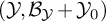


We call such
 $\mathcal {Y}$
the lc modification of
 $(\mathcal {X}^{(d)},\mathcal {B}^{(d)})$
. The proof of this proposition is similar to [Reference Li and Xu61, Proposition 2] and is left to the reader. Then, we apply these propositions to prove Theorem A.6.
Proof of Theorem A.6.
The second assertion follows from the first assertion and Proposition A.5. Indeed, we have that for any normal semiample test configuration
 $(\mathcal {X},\mathcal {L})$
for
 $(X,L)$
,
 $$ \begin{align*} M^{\mathrm{NA}}_{(\Delta,T)}(\mathcal{X},\mathcal{L})&=H^{\mathrm{NA}}_{\Delta}(\mathcal{X},\mathcal{L})-(I^{\mathrm{NA}}(\mathcal{X},\mathcal{L})-J^{\mathrm{NA}}(\mathcal{X},\mathcal{L})),\quad\text{and}\\ \mathrm{Ding}_{(\Delta,T)}(\mathcal{X},\mathcal{L})&\le M^{\mathrm{NA}}_{(\Delta,T)}(\mathcal{X},\mathcal{L}) \end{align*} $$
by Proposition A.5 (3). If the first assertion holds, then we obtain that
 $\delta _{(X,\Delta )}(L)\ge 1$
implies
 $$\begin{align*}H^{\mathrm{NA}}_{\Delta}(\mathcal{X},\mathcal{L})\ge I^{\mathrm{NA}}(\mathcal{X},\mathcal{L})-J^{\mathrm{NA}}(\mathcal{X},\mathcal{L}). \end{align*}$$
Put
 $n=\mathrm {dim}\,X$
, and we note that for any
 $r\in \mathbb {Q}_{>0}$
,
 $$ \begin{align*} \delta_{(X,\Delta)}(rL)&=r^{-1}\delta_{(X,\Delta)}(L)\\ H_{\Delta}^{\mathrm{NA}}(\mathcal{X},r\mathcal{L})&=r^nH_{\Delta}^{\mathrm{NA}}(\mathcal{X},\mathcal{L})\\ I^{\mathrm{NA}}(\mathcal{X},r\mathcal{L})-J^{\mathrm{NA}}(\mathcal{X},r\mathcal{L})&=r^{n+1}(I^{\mathrm{NA}}(\mathcal{X},\mathcal{L})-J^{\mathrm{NA}}(\mathcal{X},\mathcal{L})). \end{align*} $$
Thus, for any
 $\epsilon>0$
such that
 $\delta _{(X,\Delta )}(L)-\epsilon \in \mathbb {Q}_{>0}$
, we obtain that
 $$ \begin{align*} H^{\mathrm{NA}}_{\Delta}(\mathcal{X},\mathcal{L})&=(\delta_{(X,\Delta)}(L)-\epsilon)^{n+1}H^{\mathrm{NA}}_{\Delta}(\mathcal{X},(\delta_{(X,\Delta)}(L)-\epsilon)\mathcal{L})\\ &\ge(\delta_{(X,\Delta)}(L)-\epsilon)^{n+1}(I^{\mathrm{NA}}(\mathcal{X},(\delta_{(X,\Delta)}(L)-\epsilon)\mathcal{L})-J^{\mathrm{NA}}(\mathcal{X},(\delta_{(X,\Delta)}(L)-\epsilon)\mathcal{L}))\\ &\ge(\delta_{(X,\Delta)}(L)-\epsilon)(I^{\mathrm{NA}}(\mathcal{X},\mathcal{L})-J^{\mathrm{NA}}(\mathcal{X},\mathcal{L})). \end{align*} $$
Hence, we obtain that
 $H^{\mathrm {NA}}_{\Delta }(\mathcal {X},\mathcal {L})\ge \delta _{(X,\Delta )}(L)(I^{\mathrm {NA}}(\mathcal {X},\mathcal {L})-J^{\mathrm {NA}}(\mathcal {X},\mathcal {L}))$
.
Next, we deal with the first assertion. It suffices to show the opposite direction to Theorem A.7. By Proposition A.5 (1), we may assume that
 $\mathcal {X}$
dominates
 $X_{\mathbb {P}^1}$
. Furthermore, by Proposition A.5 (2) and Proposition A.9, we may assume that
 $(\mathcal {X},\Delta _{\mathcal {X}}+\mathcal {X}_{0,\mathrm {red}})$
is lc where
 $\Delta _{\mathcal {X}}$
is the strict transform of
 $\Delta \times \mathbb {P}^1$
. Hence, we may also assume that
 $(\mathcal {X},\Delta _{\mathcal {X}}+\rho ^{*}T_{1,\mathbb {P}^1}+\mathcal {X}_{0,\mathrm {red}})$
is sublc where
 $T_1\sim _{\mathbb {Q}}T$
is general. Let G be a
 $\mathbb {Q}$
-divisor defined by
 $G\sim _{\mathbb {Q}}\mathcal {L}-\rho ^{*}L_{\mathbb {P}^1}$
and
 $\mathrm {Supp}\,G\subset \mathcal {X}_0$
. Then, we see that
 $$ \begin{align} \mathrm{Ding}_{(\Delta,T)}(\mathcal{X},\mathcal{L})=\mathrm{Ding}_{(\Delta+T_1)}(\mathcal{X},\mathcal{L})=\min_E(A_{(X,\Delta)}(v_E)+b_E^{-1}\mathrm{ord}_E(G))-E^{\mathrm{NA}}(\mathcal{X},\mathcal{L}) \end{align} $$
by Proposition A.8, where E runs over all irreducible components of
 $\mathcal {X}_0$
. Take
 $r\in \mathbb {Z}_{>0}$
, we may assume that
 $r\mathcal {L}$
is a line bundle. Then, we set
 $$\begin{align*}F^{\lambda}H^0(X,mrL):=\{s\in H^0(X,mrL)\,|\,t^{-\lambda}\bar{s}\in H^0(\mathcal{X},mr\mathcal{L})\} \end{align*}$$
for
 $\lambda \in \mathbb {Z}$
and
 $m\in \mathbb {Z}_{\ge 0}$
, where
 $\bar {s}\in H^0(X_{\mathbb {P}^1},mrL_{\mathbb {P}^1})$
is a
 $\mathbb {G}_m$
-equivariant section corresponding to s. We have that
 $$ \begin{align*}F^{\lambda}H^0(X,mL)=\bigcap_E\{s\in H^0(X,mL)|v_E(s)+m b_E^{-1}\mathrm{ord}_E(G)\ge \lambda \}\end{align*} $$
for sufficiently divisible m and all
 $\lambda \in \mathbb {Z}$
by [Reference Boucksom, Hisamoto and Jonsson13, Lemma 5.17]. Set for any
 $\lambda \in \mathbb {R}$
 $$ \begin{align*}R^{(\lambda)}=\bigoplus_{m\in\mathbb{Z}_{\ge0}}F^{\lceil mr\lambda\rceil}H^0(X,mrL).\end{align*} $$
It is well known that
 $R^{(\lambda )}$
is a graded algebra. On the other hand, set
 $\lambda _{(\max )}=\max _Eb_E^{-1}\mathrm {ord}_E(G)$
and
 $\lambda _{(\mathrm {min})}=\min _Eb_E^{-1}\mathrm {ord}_E(G)$
, where E runs over all irreducible components of
 $\mathcal {X}_0$
.
Next, assume that
 $\delta _{(X,\Delta )}(L)\ge 1$
. To see
 $\mathrm {Ding}_{(\Delta ,T)}(\mathcal {X},\mathcal {L})\ge 0$
, it suffices to show
 $$ \begin{align} A_{(X,\Delta)}(v_E)+b_E^{-1}\mathrm{ord}_E(G)-E^{\mathrm{NA}}(\mathcal{X},\mathcal{L})\ge0 \end{align} $$
for any irreducible component E of
 $\mathcal {X}_0$
by equation (24). Note that
 $$\begin{align*}E^{\mathrm{NA}}(\mathcal{X},\mathcal{L})= -(L^n)^{-1}\int_{\mathbb{R}}\lambda\frac{d}{d\lambda}\mathrm{vol}(R^{(\lambda)})d\lambda \end{align*}$$
by [Reference Boucksom, Hisamoto and Jonsson13, Th. 5.3, Prop. 5.9 and Lem. 7.3]. We note that the support of the distribution
 $\frac {d}{d\lambda }\mathrm {vol}(R^{(\lambda )})$
coincides with
 $[\lambda _{(\min )},\lambda _{(\max )}]$
by [Reference Boucksom, Hisamoto and Jonsson13, Theorem 5.16]. Since
 $\delta _{(X,\Delta )}(L)\ge 1$
, we obtain that
 $A_{(X,\Delta )}(v_E)\ge S_L(v_E)$
and
 $$ \begin{align*} &A_{(X,\Delta)}(v_E)+b_E^{-1}\mathrm{ord}_E(G)-E^{\mathrm{NA}}(\mathcal{X},\mathcal{L}) \\ &\ge S_L(v_E)+b_E^{-1}\mathrm{ord}_E(G)+(L^n)^{-1}\int_{\mathbb{R}}\lambda\frac{d}{d\lambda}\mathrm{vol}(R^{(\lambda)})d\lambda\\ &\ge\int_{x\ge0}(L^n)^{-1}\mathrm{vol}(L-xv_E)dx+b_E^{-1}\mathrm{ord}_E(G)-\lambda_{(\mathrm{min})}-\int_{\lambda\ge\lambda_{(\mathrm{min})}}(L^n)^{-1}\mathrm{vol}(R^{(\lambda)})d\lambda\\ &\ge \int_{x\ge0}(L^n)^{-1}\mathrm{vol}(L-xv_E)dx-\int_{\lambda\ge b_E^{-1}\mathrm{ord}_E(G)}(L^n)^{-1}\mathrm{vol}(R^{(\lambda)})d\lambda\\ &= \int_{x\ge0}(L^n)^{-1}\mathrm{vol}(L-xv_E)dx-\int_{x\ge0}(L^n)^{-1}\mathrm{vol}(R^{(x+ b_E^{-1}\mathrm{ord}_E(G))})dx \end{align*} $$
for any irreducible component E of
 $\mathcal {X}_0$
by
 $(L^n)^{-1}\mathrm {vol}(R^{(\lambda )})\le 1$
. For sufficiently divisible m and all
 $x\in \mathbb {Z}$
, we have
 $$ \begin{align*}& F^{(x+ mb_E^{-1}\mathrm{ord}_E(G))}H^0(X,mL)\\ &\quad =\bigcap_F\{s\in H^0(X,mL)|v_F(s)+m b_F^{-1}\mathrm{ord}_F(G)\ge x+m b_E^{-1}\mathrm{ord}_E(G) \}\\ &\quad \subset \{s\in H^0(X,mL)|v_E(s)\ge x \}, \end{align*} $$
where F runs over all irreducible components of
 $\mathcal {X}_0$
. Thus, we have
 $$\begin{align*}\int_{x\ge0}(L^n)^{-1}\mathrm{vol}(L-xv_E)dx-\int_{x\ge0}(L^n)^{-1}\mathrm{vol}(R^{(x+ b_E^{-1}\mathrm{ord}_E(G))})dx\ge0. \end{align*}$$
Therefore, we obtain equation (25) and that
 $(X,\Delta ,T,L)$
is log-twisted Ding-semistable. We are done.
A.2 Log-twisted K-semistable Fano pair and destabilizing boundary
Finally, we prove that Ding-stability and K-stability coincide for log-twisted Fano pairs when T is semiample. The following is the main result in this subsection.
Theorem A.10. Let
 $(X,B,T,L=-K_X-B-T)$
be a K-semistable but not K-stable log-twisted Fano pair such that T is semiample. Then there exists a
 $\mathbb {Q}$
-Cartier
 $\mathbb {Q}$
-divisor
 $D\in |L|_{\mathbb {Q}}$
such that
 $(X,B+\epsilon D,T,(1-\epsilon ) L)$
is a K-unstable log-twisted Fano pair for any sufficiently small rational number
 $0<\epsilon <1$
.
We note that the logarithmic case of Theorem A.10 had been shown in [Reference Blum, Liu and Xu11, Proposition 3.3]. To show Theorem A.10, we first generalize the results of [Reference Li and Xu61], [Reference Fujita37] and [Reference Blum, Liu and Xu12, Theorem 3.12].
Theorem A.11 (cf. [Reference Li and Xu61, Theorem 2], [Reference Fujita37, Theorem 6.7]).
Let
 $(X,B,T,L=-K_X-B-T)$
be a log-twisted Fano pair such that
 $(X,B)$
is klt, T is semiample and
 $(\mathcal {X},\mathcal {L})$
be a normal ample test configuration. Then there exist
 $d\in \mathbb {Z}_{>0}$
and an ample test configuration
 $(\mathcal {X}^{\mathrm {lc}},\mathcal {L}^{\mathrm {lc}})$
dominating
 $(\mathcal {X}^{(d)},\mathcal {L}^{(d)})$
via
 $\pi $
that is the normalization of the base change of the d-th power map of
 $\mathbb {P}^1$
such that:
-
(1)
$(\mathcal {X}^{\mathrm {lc}},\mathcal {B}^{\mathrm {lc}}+(\rho ^{\mathrm {lc}})_{*}^{-1}T_{1,\mathbb {P}^1}+\mathcal {X}^{\mathrm {lc}}_0)$
is lc for any general effective divisor
$T_1\sim _{\mathbb {Q}}T$
, where
$\mathcal {B}^{\mathrm {lc}}$
is the strict transform of
$B_{\mathbb {P}^1}$
and
$\rho ^{\mathrm {lc}}\colon \mathcal {X}^{\mathrm {lc}}\dashrightarrow X_{\mathbb {P}^1}$
is the canonical birational map. -
(2)
$\mathrm {DF}_{(B,T)}(\mathcal {X}^{\mathrm {lc}},\mathcal {L}^{\mathrm {lc}})\le d\, \mathrm {DF}_{(B,T)}(\mathcal {X},\mathcal {L})$
and for any
$$\begin{align*}\mathrm{Ding}_{(B,T)}(\mathcal{X}^{\mathrm{lc}},\mathcal{L}^{\mathrm{lc}})-\delta\, J^{\mathrm{NA}}(\mathcal{X}^{\mathrm{lc}},\mathcal{L}^{\mathrm{lc}})\le d\, (\mathrm{Ding}_{(B,T)}(\mathcal{X},\mathcal{L})-\delta\, J^{\mathrm{NA}}(\mathcal{X},\mathcal{L})), \end{align*}$$
$\delta \in [0,1)$
.


Proof. By the semistable reduction theorem [Reference Kempf, Knudsen, Mumford and Saint-Donat50], we see that there exist a log smooth pair
 $(\mathcal {Y},\mathrm {Ex}(g)+g^{-1}_{*}(\mathcal {B}^{(d)})+\mathcal {Y}_0)$
and a birational morphism
 $g:\mathcal {Y}\to \mathcal {X}^{(d)}$
such that the central fiber
 $\mathcal {Y}_0$
is reduced (cf., [Reference Kollár and Mori55, Theorem 7.17]) for some
 $d\in \mathbb {Z}_{>0}$
. We may assume that
 $(\mathcal {Y},\mathrm {Ex}(g)+g^{-1}_{*}(\mathcal {B}^{(d)})+\mathcal {Y}_0)$
admits a
 $\mathbb {G}_m$
-action such that g is
 $\mathbb {G}_m$
-equivariant and there exists a morphism
 $\rho _{\mathcal {Y}}:\mathcal {Y}\to X_{\mathbb {P}^1}$
such that g and
 $\rho _{\mathcal {Y}}$
coincide over
 $\mathbb {P}^1\setminus \{0\}$
. Then take a general effective divisor
 $T_1\sim _{\mathbb {Q}}T$
such that
 $(\mathcal {Y},g_{*}^{-1}(\mathcal {B}^{(d)}+\mathcal {X}^{(d)}_0)+\rho _{\mathcal {Y}}^{*}T_{1,\mathbb {P}^1}+E)$
is log smooth and dlt,
 $(\rho _{\mathcal {Y}})^{-1}_{*}T_{1,\mathbb {P}^1}=\rho _{\mathcal {Y}}^{*}T_{1,\mathbb {P}^1}$
and
 $$ \begin{align*} d\, \mathrm{DF}_{(B,T)}(\mathcal{X},\mathcal{L})=\mathrm{DF}_{(B,T)}(\mathcal{X}^{(d)},\mathcal{L}^{(d)})&=\mathrm{DF}_{B+T_1}(\mathcal{X}^{(d)},\mathcal{L}^{(d)})=d\,\mathrm{DF}_{B+T_1}(\mathcal{X},\mathcal{L})\\ d\, \mathrm{Ding}_{(B,T)}(\mathcal{X},\mathcal{L})=\mathrm{Ding}_{(B,T)}(\mathcal{X}^{(d)},\mathcal{L}^{(d)})&=\mathrm{Ding}_{B+T_1}(\mathcal{X}^{(d)},\mathcal{L}^{(d)})=d\,\mathrm{Ding}_{B+T_1}(\mathcal{X},\mathcal{L}). \end{align*} $$
We take the lc modification
 $h:\mathcal {X}^{\mathrm {lc}}\to (\mathcal {X}^{(d)},\mathcal {B}^{(d)}+(\rho ^{(d)})^{-1}_{*}T_{1,\mathbb {P}^1}+\mathcal {X}^{(d)}_0)$
by Proposition A.9, where
 $\rho ^{(d)}\colon \mathcal {X}^{(d)}\dashrightarrow X_{\mathbb {P}^1}$
is the canonical birational map. Let
 $\pi :\mathcal {Y}\dashrightarrow \mathcal {X}^{\mathrm {lc}}$
be the canonical birational contraction and F be the summation of h-exceptional prime divisors such that
 $$\begin{align*}-F\sim_{\mathcal{X}^{(d)},\mathbb{Q}}K_{\mathcal{X}^{\mathrm{lc}}}+\pi_{*}(g_{*}^{-1}(\mathcal{B}^{(d)}+\mathcal{X}^{(d)}_0)+\rho_{\mathcal{Y}}^{*}T_{1,\mathbb{P}^1}+E). \end{align*}$$
Let
 $\mathcal {B}^{\mathrm {lc}}=\pi _{*}(g_{*}^{-1}\mathcal {B}^{(d)}+E)$
and
 $\mathcal {L}^{\mathrm {lc}}$
=
 $h^{*}\mathcal {L}^{(d)}-\epsilon F$
for sufficiently small
 $\epsilon>0$
. Then, it follows from the proof of [Reference Fujita37, Theorem 6.7] that
 $$ \begin{align*} \mathrm{DF}_{B+T_1}(\mathcal{X}^{\mathrm{lc}},\mathcal{L}^{\mathrm{lc}})&\le \mathrm{DF}_{B+T_1}(\mathcal{X}^{(d)},\mathcal{L}^{(d)})\quad\text{and}\\ \mathrm{Ding}_{B+T_1}(\mathcal{X}^{\mathrm{lc}},\mathcal{L}^{\mathrm{lc}})-\delta\, J^{\mathrm{NA}}(\mathcal{X}^{\mathrm{lc}},\mathcal{L}^{\mathrm{lc}})&\le \mathrm{Ding}_{B+T_1}(\mathcal{X}^{(d)},\mathcal{L}^{(d)})-\delta\, J^{\mathrm{NA}}(\mathcal{X}^{(d)},\mathcal{L}^{(d)}) \end{align*} $$
for any
 $\delta \in [0,1)$
.
Fix a general effective
 $\mathbb {Q}$
-divisor
 $T_1\sim _{\mathbb {Q}}T$
, and let
 $\mathcal {X}^{\mathrm {lc}}$
be a test configuration constructed in the previous paragraph for
 $T_1$
. Here, we assert that the construction of
 $\mathcal {X}^{\mathrm {lc}}$
is independent of the choice of general
 $T_1$
. Indeed, let
 $T_2\sim _{\mathbb {Q}}T_1$
be a general effective
 $\mathbb {Q}$
-divisor such that
 $(\mathcal {Y},g_{*}^{-1}(\mathcal {B}^{(d)}+\mathcal {X}^{(d)}_0)+\rho _{\mathcal {Y}}^{*}T_{2,\mathbb {P}^1}+E)$
is log smooth and dlt and
 $(\rho _{\mathcal {Y}})^{-1}_{*}T_{2,\mathbb {P}^1}=\rho _{\mathcal {Y}}^{*}T_{2,\mathbb {P}^1}$
. We note that
 $\mathcal {X}^{\mathrm {lc}}$
is the lc model of
 $(\mathcal {Y},g_{*}^{-1}(\mathcal {B}^{(d)}+\mathcal {X}^{(d)}_0)+\rho _{\mathcal {Y}}^{*}T_{1,\mathbb {P}^1}+E)$
by [Reference Odaka and Xu73, Lemma 2.1] and the construction. By [Reference Birkar, Cascini, Hacon and McKernan9, Lemma 3.6.9], the lc models of
 $(\mathcal {Y},g_{*}^{-1}(\mathcal {B}^{(d)}+\mathcal {X}^{(d)}_0)+\rho _{\mathcal {Y}}^{*}T_{i,\mathbb {P}^1}+E)$
over
 $\mathcal {X}^{(d)}$
are the same for
 $i=1,2$
. Thus,
 $\mathcal {X}^{\mathrm {lc}}$
is independent of the choice of general
 $T_1$
and by choosing
 $T_1$
general enough, we have that
 $$ \begin{align*} \mathrm{Ding}_{(B,T)}(\mathcal{X}^{\mathrm{lc}},\mathcal{L}^{\mathrm{lc}})&=\mathrm{Ding}_{B+T_1}(\mathcal{X}^{\mathrm{lc}},\mathcal{L}^{\mathrm{lc}}) \\ \mathrm{DF}_{(B,T)}(\mathcal{X}^{\mathrm{lc}},\mathcal{L}^{\mathrm{lc}})&=\mathrm{DF}_{B+T_1}(\mathcal{X}^{\mathrm{lc}},\mathcal{L}^{\mathrm{lc}}). \end{align*} $$
Hence, the assertion follows.
Theorem A.12 (cf., [Reference Li and Xu61, Theorem 3], [Reference Fujita37, Theorem 6.8]).
Let
 $(X,B,T,L=-K_X-B-T)$
be a log-twisted Fano pair such that T is semiample, and
 $(\mathcal {X},\mathcal {L})$
be a normal ample test configuration such that
 $(\mathcal {X},\mathcal {B}+\rho ^{-1}_{*}T_{0,\mathbb {P}^1}+\mathcal {X}_0)$
is lc, where
 $\rho \colon \mathcal {X}\dashrightarrow X_{\mathbb {P}^1}$
is canonical,
 $\mathcal {B}=\rho ^{-1}_{*}B_{\mathbb {P}^1}$
and
 $T_0\sim _{\mathbb {Q}}T$
is a general effective
 $\mathbb {Q}$
-divisor.
Then there exists a normal and ample test configuration
 $(\mathcal {X}^{\mathrm {ac}},\mathcal {L}^{\mathrm {ac}})$
for
 $(X,L)$
such that
 $(\mathcal {X}^{\mathrm {ac}},\mathcal {B}^{\mathrm {ac}}+(\rho ^{\mathrm {ac}})^{-1}_{*}T_{1,\mathbb {P}^1}+\mathcal {X}^{\mathrm {ac}}_0)$
is lc,
 $-(K_{\mathcal {X}^{\mathrm {ac}}}+\mathcal {B}^{\mathrm {ac}}+(\rho ^{\mathrm {ac}})^{-1}_{*}T_{1,\mathbb {P}^1})\sim _{\mathbb {P}^1,\mathbb {Q}}\mathcal {L}^{\mathrm {ac}}$
,
 $\mathrm {DF}_{(B,T)}(\mathcal {X}^{\mathrm {ac}},\mathcal {L}^{\mathrm {ac}})\le \mathrm {DF}_{(B,T)}(\mathcal {X},\mathcal {L})$
and
 $$\begin{align*}\mathrm{Ding}_{(B,T)}(\mathcal{X}^{\mathrm{ac}},\mathcal{L}^{\mathrm{ac}})-\delta\, J^{\mathrm{NA}}(\mathcal{X}^{\mathrm{ac}},\mathcal{L}^{\mathrm{ac}})\le \mathrm{Ding}_{(B,T)}(\mathcal{X},\mathcal{L})-\delta\, J^{\mathrm{NA}}(\mathcal{X},\mathcal{L}), \end{align*}$$
for any
 $\delta \in [0,1)$
and any general effective
 $\mathbb {Q}$
-divisor
 $T_1\sim _{\mathbb {Q}}T$
, where
 $\rho ^{\mathrm {ac}}\colon \mathcal {X}^{\mathrm {ac}}\dashrightarrow X_{\mathbb {P}^1}$
is canonical and
 $\mathcal {B}^{\mathrm {ac}}:=(\rho ^{\mathrm {ac}})^{-1}_{*}B_{\mathbb {P}^1}$
.
Proof. Fix a general effective
 $\mathbb {Q}$
-divisor
 $T_1\sim _{\mathbb {Q}}T$
such that
 $(\mathcal {X},\mathcal {B}+\rho _{*}^{-1}T_{1,\mathbb {P}^1}+\mathcal {X}_0)$
is lc. Hence,
 $(\mathcal {X},\mathcal {B}+\rho _{*}^{-1}T_{1,\mathbb {P}^1})$
is klt. Here, we apply [Reference Birkar, Cascini, Hacon and McKernan9, Corollary 1.4.3] to obtain a
 $\mathbb {G}_m$
-equivariant small
 $\mathbb {Q}$
-factorial modification
 $\sigma :(\mathcal {X}^0,\mathcal {B}^0+(\rho ^0)_{*}^{-1}T_{1,\mathbb {P}^1})\to (\mathcal {X},\mathcal {B}+\rho _{*}^{-1}T_{1,\mathbb {P}^1})$
. Here, we set
 $\rho ^0:=\rho \circ \sigma $
and
 $\mathcal {B}^0:=\sigma ^{-1}_{*}\mathcal {B}$
. Let
 $\mathcal {L}^0=\sigma ^{*}\mathcal {L}$
and for sufficiently large
 $l>1$
, set
 $\mathcal {H}^0$
as a sufficiently general effective
 $\mathbb {Q}$
-divisor such that
 $$\begin{align*}\mathcal{H}^0\sim_{\mathbb{Q}}\mathcal{L}^0-\frac{1}{l+1}(\mathcal{L}^0+K_{\mathcal{X}^0}+\mathcal{B}^0+(\rho^0)_{*}^{-1}T_{1,\mathbb{P}^1}). \end{align*}$$
Then, we run a
 $K_{\mathcal {X}^0}+\mathcal {B}^0+(\rho ^0)_{*}^{-1}T_{1,\mathbb {P}^1}+\mathcal {H}^0$
-MMP over
 $\mathbb {P}^1$
with scaling of
 $\mathcal {H}^0$
as in the proof of [Reference Fujita37, Theorem 3.2] and obtain a certain good minimal model
 $(\mathcal {X}^k,\mathcal {B}^k+(\rho ^k)_{*}^{-1}T_{1,\mathbb {P}^1}+\mathcal {H}^k)$
, where
 $\rho ^k\colon \mathcal {X}^k\dashrightarrow X_{\mathbb {P}^1}$
is canonical and
 $\mathcal {B}^k$
is the strict transform of
 $\mathcal {B}^0$
. By [Reference Li and Xu61, Lemma 2], we also have that
 $-(K_{\mathcal {X}^k}+\mathcal {B}^k+(\rho ^k)_{*}^{-1}T_{1,\mathbb {P}^1})$
is semiample over
 $\mathbb {P}^1$
and set
 $\mathcal {X}^{\mathrm {ac}}:=\mathbf {Proj}_C(\oplus _{l\ge 0}\pi ^k_{*}(\mathcal {O}_{\mathcal {X}^k}(-lr_k(K_{\mathcal {X}^k}+\mathcal {B}^k+(\rho ^k)_{*}^{-1}T_{1,\mathbb {P}^1})))$
, where
 $r_k\in \mathbb {Z}_{>0}$
satisfies that
 $r_k(K_{\mathcal {X}^k}+\mathcal {B}^k+(\rho ^k)_{*}^{-1}T_{1,\mathbb {P}^1})$
is Cartier and
 $\pi ^k\colon \mathcal {X}^k\to \mathbb {P}^1$
is the canonical morphism. Let
 $\rho ^{\mathrm {ac}}\colon \mathcal {X}^{\mathrm {ac}}\dashrightarrow X_{\mathbb {P}^1}$
be the canonical birational map and
 $\mathcal {B}^{\mathrm {ac}}$
is the strict transform of
 $\mathcal {B}^k$
. Then the proof of [Reference Fujita37, Theorem 6.8] shows that if we set
 $\mathcal {L}^{\mathrm {ac}}:=-(K_{\mathcal {X}^{\mathrm {ac}}}+\mathcal {B}^{\mathrm {ac}}+(\rho ^{\mathrm {ac}})^{-1}_{*}T_{1,\mathbb {P}^1})$
, then
 $(\mathcal {X}^{\mathrm {ac}},\mathcal {B}^{\mathrm {ac}}+(\rho ^{\mathrm {ac}})^{-1}_{*}T_{1,\mathbb {P}^1}+\mathcal {X}^{\mathrm {ac}}_0)$
is lc,
 $\mathrm {DF}_{B+T_1}(\mathcal {X}^{\mathrm {ac}},\mathcal {L}^{\mathrm {ac}})\le \mathrm {DF}_{B+T_1}(\mathcal {X},\mathcal {L})$
and
 $$\begin{align*}\mathrm{Ding}_{B+T_1}(\mathcal{X}^{\mathrm{ac}},\mathcal{L}^{\mathrm{ac}})-\delta\, J^{\mathrm{NA}}(\mathcal{X}^{\mathrm{ac}},\mathcal{L}^{\mathrm{ac}})\le \mathrm{Ding}_{B+T_1}(\mathcal{X},\mathcal{L})-\delta\, J^{\mathrm{NA}}(\mathcal{X},\mathcal{L}) \end{align*}$$
for any
 $\delta \in [0,1)$
.
Next, take a sufficiently general effective
 $\mathbb {Q}$
-divisor
 $T_2\sim _{\mathbb {Q}}T$
such that
 $$ \begin{align} \mathrm{Ding}_{(B,T)}(\mathcal{X}^{\mathrm{ac}},\mathcal{L}^{\mathrm{ac}})&=\mathrm{Ding}_{B+T_2}(\mathcal{X}^{\mathrm{ac}},\mathcal{L}^{\mathrm{ac}}) ,\quad\mathrm{DF}_{(B,T)}(\mathcal{X}^{\mathrm{ac}},\mathcal{L}^{\mathrm{ac}})=\mathrm{DF}_{B+T_2}(\mathcal{X}^{\mathrm{ac}},\mathcal{L}^{\mathrm{ac}})\\ \mathrm{Ding}_{(B,T)}(\mathcal{X},\mathcal{L})&=\mathrm{Ding}_{B+T_2}(\mathcal{X},\mathcal{L}),\quad\mathrm{DF}_{(B,T)}(\mathcal{X},\mathcal{L})=\mathrm{DF}_{B+T_2}(\mathcal{X},\mathcal{L}).\nonumber \end{align} $$
Then, we assert that the properties of
 $\mathcal {X}^{\mathrm {ac}}$
, which we stated in the last paragraph, are also satisfied for
 $T_2$
. First, we check that the
 $K_{\mathcal {X}^0}+\mathcal {B}^0+(\rho ^0)_{*}^{-1}T_{1,\mathbb {P}^1}+\mathcal {H}^0$
-MMP over
 $\mathbb {P}^1$
is also a
 $K_{\mathcal {X}^0}+\mathcal {B}^0+(\rho ^0)_{*}^{-1}T_{2,\mathbb {P}^1}+\mathcal {H}^0$
-MMP. Indeed, for any sufficiently general effective
 $\mathbb {Q}$
-divisor
 $T_2\sim _{\mathbb {Q}}T$
, we see that
 $(\rho ^0)_{*}^{-1}T_{2,\mathbb {P}^1}\sim _{\mathbb {Q}}(\rho ^0)_{*}^{-1}T_{1,\mathbb {P}^1}$
as [Reference Blum, Liu and Xu12, Lemma 2.12]. Thus, we may assume that
 $K_{\mathcal {X}^0}+\mathcal {B}^0+(\rho ^0)_{*}^{-1}T_{i,\mathbb {P}^1}+\mathcal {H}^0$
-minimal model programs over
 $\mathbb {P}^1$
with scaling of
 $\mathcal {H}^0$
are the same for
 $i=1,2$
. Furthermore, we see that
 $$\begin{align*}K_{\mathcal{X}^k}+\mathcal{B}^k+(\rho^k)_{*}^{-1}T_{1,\mathbb{P}^1}\sim_{\mathbb{Q}}K_{\mathcal{X}^k}+\mathcal{B}^k+(\rho^k)_{*}^{-1}T_{2,\mathbb{P}^1}. \end{align*}$$
This means that
 $\mathcal {X}^{\mathrm {ac}}$
constructed in the previous paragraph for
 $T_1$
can be also constructed in the same way for
 $T_2$
. Hence,
 $(\mathcal {X}^{\mathrm {ac}},\mathcal {B}^{\mathrm {ac}}+(\rho ^{\mathrm {ac}})^{-1}_{*}T_{2,\mathbb {P}^1}+\mathcal {X}^{\mathrm {ac}}_0)$
is lc,
 $-(K_{\mathcal {X}^{\mathrm {ac}}}+\mathcal {B}^{\mathrm {ac}}+(\rho ^{\mathrm {ac}})^{-1}_{*}T_{2,\mathbb {P}^1})\sim _{\mathbb {P}^1,\mathbb {Q}}\mathcal {L}^{\mathrm {ac}}$
,
 $\mathrm {DF}_{B+T_2}(\mathcal {X}^{\mathrm {ac}},\mathcal {L}^{\mathrm {ac}})\le \mathrm {DF}_{B+T_2}(\mathcal {X},\mathcal {L})$
and
 $$\begin{align*}\mathrm{Ding}_{B+T_2}(\mathcal{X}^{\mathrm{ac}},\mathcal{L}^{\mathrm{ac}})-\delta\, J^{\mathrm{NA}}(\mathcal{X}^{\mathrm{ac}},\mathcal{L}^{\mathrm{ac}})\le \mathrm{Ding}_{B+T_2}(\mathcal{X},\mathcal{L})-\delta\, J^{\mathrm{NA}}(\mathcal{X},\mathcal{L}), \end{align*}$$
for any
 $\delta \in [0,1)$
. Combining these properties with equation (26), we complete the proof.
Theorem A.13 (cf. [Reference Li and Xu61, Theorem 4], [Reference Fujita37, Theorem 6.9]).
Let
 $(X,B,T,L=-K_X-B-T)$
be a log-twisted Fano pair such that T is semiample and
 $(\mathcal {X},\mathcal {L})$
be a normal ample test configuration such that
 $(\mathcal {X},\mathcal {B}+\rho ^{-1}_{*}T_{0,\mathbb {P}^1}+\mathcal {X}_0)$
is lc and
 $-(K_{\mathcal {X}}+\mathcal {B}+\rho ^{-1}_{*}T_{0,\mathbb {P}^1})\sim _{\mathbb {Q},\mathbb {P}^1}\mathcal {L}$
for any general effective
 $\mathbb {Q}$
-divisor
 $T_0\sim _{\mathbb {Q}}T$
, where
 $\rho \colon \mathcal {X}\dashrightarrow X_{\mathbb {P}^1}$
is the canonical birational map and
 $\mathcal {B}=\rho ^{-1}_{*}B_{\mathbb {P}^1}$
.
Then there exist
 $d\in \mathbb {Z}_{>0}$
and a log-twisted special test configuration
 $(\mathcal {X}^{\mathrm {s}},\mathcal {L}^{\mathrm {s}}=-(K_{\mathcal {X}^{\mathrm {s}}}+\mathcal {B}^{\mathrm {s}}+(\rho ^{\mathrm {s}})^{-1}_{*}T_{1,\mathbb {P}^1}))$
for
 $(X,B,T,L)$
such that
 $$\begin{align*}\mathrm{Ding}_{(B,T)}(\mathcal{X}^{\mathrm{s}},\mathcal{L}^{\mathrm{s}})-\delta\, J^{\mathrm{NA}}(\mathcal{X}^{\mathrm{s}},\mathcal{L}^{\mathrm{s}})\le d\, (\mathrm{Ding}_{(B,T)}(\mathcal{X},\mathcal{L})-\delta\, J^{\mathrm{NA}}(\mathcal{X},\mathcal{L})) \end{align*}$$
for any
 $\delta \in [0,1)$
and general effective
 $\mathbb {Q}$
-divisor
 $T_1\sim _{\mathbb {Q}}T$
, where
 $\rho ^{\mathrm {s}}\colon \mathcal {X}^{\mathrm {s}}\dashrightarrow X_{\mathbb {P}^1}$
is the canonical birational map and
 $\mathcal {B}^{\mathrm {s}}=(\rho ^{\mathrm {s}})^{-1}_{*}B_{\mathbb {P}^1}$
.
Proof. Note that
 $$ \begin{align*} \mathrm{Ding}_{(B,T)}(\mathcal{X}^{\mathrm{s}},\mathcal{L}^{\mathrm{s}})&= \mathrm{DF}_{(B,T)}(\mathcal{X}^{\mathrm{s}},\mathcal{L}^{\mathrm{s}}),\quad\text{and}\\ \mathrm{DF}_{(B,T)}(\mathcal{X},\mathcal{L})&=\mathrm{Ding}_{(B,T)}(\mathcal{X},\mathcal{L}) \end{align*} $$
hold now due to Proposition A.5 (3). Thus, it suffices to consider the Donaldson–Futaki invariant instead of the Ding invariant. Recall the proof of [Reference Fujita37, Theorems 6.9 and 6.10]. We first take a
 $\mathbb {G}_m$
-invariant semistable reduction
 $\mathcal {Y}$
of
 $(\mathcal {X},\mathcal {B}+\mathcal {X}_0)$
. More precisely, there exist
 $d\in \mathbb {Z}_{>0}$
and a
 $\mathbb {G}_m$
-equivariant birational morphism
 $g:\mathcal {Y}\to \mathcal {X}^{(d)}$
such that
 $\mathcal {Y}$
is smooth,
 $\mathcal {Y}_0+\mathrm {Ex}(g)+g^{-1}_{*}\mathcal {B}^{(d)}$
is snc and
 $\mathcal {Y}_0$
is reduced. We may assume that there exists a
 $\mathbb {G}_m$
-equivariant birational morphism
 $\rho _{\mathcal {Y}}:\mathcal {Y}\to X_{\mathbb {P}^1}$
such that
 $\rho _{\mathcal {Y}}$
coincides with g over
 $\mathbb {P}^1\setminus \{0\}$
. Fix a general effective divisor
 $T_1\sim _{\mathbb {Q}}T$
such that
 $$\begin{align*}\mathrm{DF}_{B+T_1}(\mathcal{X},\mathcal{L})=\mathrm{DF}_{(B,T)}(\mathcal{X},\mathcal{L}), \end{align*}$$
 $\mathcal {Y}_0+\mathrm {Ex}(g)+g^{-1}_{*}\mathcal {B}^{(d)}+\rho _{\mathcal {Y}}^{*}T_{1,\mathbb {P}^1}$
is also snc and the support of
 $\rho _{\mathcal {Y}}^{*}T_{1,\mathbb {P}^1}$
contains no component of
 $\mathcal {Y}_0$
. Then, we can take a special test configuration
 $(\mathcal {X}^{\mathrm {s}},\mathcal {L}^{\mathrm {s}})$
for the log Fano pair
 $(X,B+T_1)$
as [Reference Fujita37, Theorem 6.10] by running some MMP of
 $\mathcal {Y}$
. In particular, the birational map
 $\mathcal {Y}\dashrightarrow \mathcal {X}^{\mathrm {s}}$
is a birational contraction. This means that
 $T_1$
does not contain the center of
 $v_{\mathcal {X}^{\mathrm {s}}_0}$
, and we can conclude that
 $$\begin{align*}\mathrm{DF}_{(B,T)}(\mathcal{X}^{\mathrm{s}},\mathcal{L}^{\mathrm{s}})=\mathrm{DF}_{B+T_1}(\mathcal{X}^{\mathrm{s}},\mathcal{L}^{\mathrm{s}}) \end{align*}$$
by Lemma 2.22. On the other hand, it follows from the proof of [Reference Fujita37, Theorem 6.9] that
 $$\begin{align*}\mathrm{DF}_{B+T_1}(\mathcal{X}^{\mathrm{s}},\mathcal{L}^{\mathrm{s}})-\delta\, J^{\mathrm{NA}}(\mathcal{X}^{\mathrm{s}},\mathcal{L}^{\mathrm{s}})\le d\, (\mathrm{DF}_{B+T_1}(\mathcal{X},\mathcal{L})-\delta\, J^{\mathrm{NA}}(\mathcal{X},\mathcal{L})). \end{align*}$$
Thus, the assertion holds.
Corollary A.14 (cf., [Reference Li and Xu61, Corollary 1], [Reference Fujita37, Corollary 6.11]).
Let
 $(X,B,T,L=-K_X-B-T)$
be a log-twisted Fano pair such that T is semiample. Fix
 $\delta \in [0,1)$
. Then, it holds that
 $\mathrm {Ding}_{(B,T)}(\mathcal {X},\mathcal {L})\ge \delta \,J^{\mathrm {NA}}(\mathcal {X},\mathcal {L})$
for any semiample test configuration if and only if the inequality holds for any log-twisted special test configuration for
 $(X,B,T,L)$
.
Furthermore,
 $(X,B,T,L)$
is log-twisted (uniformly) K-(semi)stable if and only if
 $(X,B,T,L)$
is log-twisted (uniformly) Ding-(semi)stable.
On the other hand, we obtain the following.
Theorem A.15 (cf., [Reference Fujita37, Theorem 6.13]).
Let
 $(X,B,T,L=-K_X-B-T)$
be a log-twisted Fano pair such that T is semiample, and let
 $(\mathcal {X},\mathcal {L}:=-(K_{\mathcal {X}}+\mathcal {B}+\rho ^{-1}_{*}T_{1,\mathbb {P}^1}))$
be a normal ample test configuration for
 $(X,L)$
with
 $\mathcal {X}_0$
irreducible and reduced, where
 $T_{1}\in |T|_{\mathbb {Q}}$
is general and
 $\rho \colon \mathcal {X}\dashrightarrow X_{\mathbb {P}^1}$
is the canonical birational map. Then the divisorial valuation
 $v_{\mathcal {X}_0}$
on X satisfies that
 $$ \begin{align*} \mathrm{DF}_{(B,T)}(\mathcal{X},\mathcal{L})&=\frac{\beta_{(X,B,T)}(v_{\mathcal{X}_0})}{\mathrm{vol}(L)},\\ J^{\mathrm{NA}}(\mathcal{X},\mathcal{L})&=\frac{j_{L}(v_{\mathcal{X}_0})}{\mathrm{vol}(L)}. \end{align*} $$
Proof. For general effective
 $\mathbb {Q}$
-divisor
 $T_1\sim _{\mathbb {Q}}T$
, we have
 $$ \begin{align*} \beta_{(X,B,T)}(v_{\mathcal{X}_0})&=\beta_{(X,B)}(v_{\mathcal{X}_0}),\\ \mathrm{DF}_{(B,T)}(\mathcal{X},\mathcal{L})&=\mathrm{DF}_{(B+T_1)}(\mathcal{X},\mathcal{L}). \end{align*} $$
Therefore, this theorem immediately follows from [Reference Fujita37, Theorem 6.13].
Thus, we obtain the following.
Theorem A.16 (cf., [Reference Fujita37, Theorem 6.5]).
Let
 $\delta \in [0,1)$
and
 $(X,B,T,L=-K_X-B-T)$
be a log-twisted Fano pair such that T is semiample. Then the following are equivalent,
-
(i)
$\mathrm {DF}_{(B,T)}(\mathcal {X},\mathcal {L})\ge \delta J^{\mathrm {NA}}(\mathcal {X},\mathcal {L})$
for any normal semiample test configuration
$(\mathcal {X},\mathcal {L})$
for
$(X,L)$
, -
(ii)
$\beta _{(X,B,T)}(F)\ge \delta j_{L}(F)$
for any prime divisor over X,


Corollary A.17 (cf., [Reference Li58, Theorem 3]).
Let
 $(\mathbb {P}^1,\Delta ,T)$
be a log-twisted Fano pair with
 $\Delta =\sum _{i=1}^m a_ip_i$
and a semiample
 $\mathbb {Q}$
-line bundle T, where
 $a_i>0$
,
 $m\ge 0$
and
 $p_i$
are distinct closed points of
 $\mathbb {P}^1$
. Then, the log-twisted Fano pair
 $(\mathbb {P}^1,\Delta ,T,-K_{\mathbb {P}^1}-\Delta -T)$
is uniformly K-stable (resp., K-semistable) if and only if
 $$\begin{align*}\max_{1\le i\le m}\{a_i\}<\frac{\mathrm{deg}(\Delta+T)}{2}\, \left(\mathrm{resp}. \, \max\{a_i\}\le\frac{\mathrm{deg}(\Delta+T)}{2}\right). \end{align*}$$
Proof. This immediately follows from Theorem A.16 as [Reference Fujita37, Example 6.6].
Now, we are ready to prove Theorem A.10.
Proof of Theorem A.10.
By assumption, Corollary A.14, Theorem A.15 and Theorem A.16, there exists a prime divisor F over X such that
 $\beta _{(X,B,T)}(F)=0$
. Here, we set
 $$\begin{align*}\alpha_F:=\inf_{D\in|L|_{\mathbb{Q}}}\frac{A_{(X,B)}(F)}{\mathrm{ord}_F(D)}\ge0. \end{align*}$$
For any rational positive number
 $0<\tau <T_L(F)$
, we can take
 $k\in \mathbb {Z}_{>0}$
such that
 $H^0(X,kL-k\tau F)\ne 0$
. Then there exists an effective
 $\mathbb {Q}$
-Cartier
 $\mathbb {Q}$
-divisor
 $D\sim _{\mathbb {Q}}L$
such that
 $\mathrm {ord}_F(D)\ge \tau $
and hence we obtain
 $$\begin{align*}\frac{A_{(X,B)}(F)}{\tau}\ge \alpha_F. \end{align*}$$
Therefore, we obtain
 $$ \begin{align} \alpha_FT_{L}(F)\le A_{(X,B)}(F). \end{align} $$
Next, we have by
 $\beta _{(X,B,T)}(F)=0$
that
 $$\begin{align*}A_{(X,B)}(F)\mathrm{vol}(L)=\int^{T_{L}(F)}_0\mathrm{vol}(L-xF)dx. \end{align*}$$
By equation (27), this means that
 $$\begin{align*}\int^{T_{L}(F)}_0(\alpha_F\mathrm{vol}(L)-\mathrm{vol}(L-xF))dx\le0 \end{align*}$$
and hence
 $\alpha _F<1$
. Thus, there exists a
 $\mathbb {Q}$
-Cartier
 $\mathbb {Q}$
-divisor
 $D\in |L|_{\mathbb {Q}}$
such that
 $A_{(X,B)}(F)<{\mathrm {ord}_F(D)}$
. Let
 $$\begin{align*}\beta_+:=A_{(X,B)}(F)\mathrm{vol}(L)=\int^{T_{L}(F)}_0\mathrm{vol}(L-xF)dx>0. \end{align*}$$
Then it holds that
 $$ \begin{align*} & \beta_{(X,B+\epsilon D,T)}(F) =A_{(X,B+\epsilon D)}(F)\mathrm{vol}((1-\epsilon)L)-\int^{(1-\epsilon)T_{L}(F)}_0\mathrm{vol}((1-\epsilon)L-xF)dx\\ &\quad =(1-\epsilon)^n(A_{(X,B)}(F)-\epsilon\,\mathrm{ord}_F(D))\mathrm{vol}(L)-(1-\epsilon)^{n+1}\int^{T_{L}(F)}_0\mathrm{vol}(L-xF)dx\\ &\quad =\beta_+\epsilon(1-\epsilon)^n\left(1-\frac{\mathrm{ord}_F(D)}{A_{(X,B)}(F)}\right)<0 \end{align*} $$
for sufficiently small
 $\epsilon>0$
. Thus, the assertion follows from Theorem A.16.
Acknowledgements
The author is grateful to his research advisor Professor Yuji Odaka for a lot of suggestive advices and productive discussions. The author would like to thank Odaka and Doctor Keita Goto for careful reading his draft. He is grateful to Doctor Aline Zanardini for pointing out typos in an earlier version. The author is also grateful to Professor Yoshinori Hashimoto for giving him a lecture on the paper [Reference Zhang85]. The author would like to thank Professor Kenta Hashizume and Doctor Eiji Inoue for fruitful discussions and helpful advice. He is also grateful to anonymous referee for suggestions. This work is a part of his master thesis and partially supported by JSPS KAKENHI 22J20059 (Grant-in-Aid for JSPS Fellows DC1).
Data availability statement
Data openly available in a puplic repository, with a permanent identifier (such as a DOI).



