Trends in Party recruitment provide a useful window on the Chinese Communist Party's (CCP) strategy for political survival. Although it does not have to compete with other parties to remain in power, the CCP must still generate popular support. Rather than solicit support through elections, it uses the recruitment of new members to build its base of popular support. More importantly, the changes in the composition of Party members – and the characteristics of new Party members, in particular – reflect changes in the CCP's strategy for building popular support. As the work of the Party changed from mobilizing mass campaigns in the Maoist period to promoting economic modernization in the post-Mao period, it sought new types of members with different skill sets. Whereas it used to concentrate on the “three revolutionary classes” (workers, farmers and soldiers), it now focuses on urban elites: highly educated young people in urban areas, the “new social stratum” of young entrepreneurs and professionals. This transformation of the composition of its membership and its support base is an indicator of its adaptability.Footnote 1
In recent years, research has concentrated on the CCP's organization,Footnote 2 cadres,Footnote 3 propaganda systemFootnote 4 and elites,Footnote 5 but relatively less attention has been paid to its membership as a whole. Research on Party membership certainly exists, but is generally out of date, being based on data from the 1980s and 1990s.Footnote 6 This not only leaves out an important dimension of the Party, but also of the political dynamics of the regime as a whole. As Andrew Walder noted, the CCP needs active cooperation and participation from the rank and file – the vast majority of its members – and not just from those who hold positions in the Party and government bureaucracies.Footnote 7 Understanding who the Party recruits and how it mobilizes their loyalty illuminates its priorities and its relations with key members of society.
The changing composition of the CCP is not just a matter of elite priorities; it also reflects the incentives for new members to join. Throughout the post-1949 period, the incentives for joining the CCP and the CCP's strategy for recruiting new members changed considerably. In short, the composition of the Party is shaped by both the interests of the Party organization in attracting talent and support and the interests of its potential new members.
The conventional wisdom is that people join the Party, especially in recent years, primarily to enhance their career prospects rather than for political or ideological reasons. In contrast, the CCP seeks support: support from the people it relies on for the success of its economic reform agenda and support for the political system as a whole. As this article will show, both of these truths are only partially correct. First of all, new recruits to the CCP in recent years are much more likely to acknowledge that they have career interests in mind. At the same time, they are also more likely to exhibit qualities of good citizenship: they are more likely to vote, do volunteer work, and donate money, goods, and even blood. However, these actions, rather than being spontaneous acts of participation, are largely mobilized by the Party to demonstrate loyalty. Second, although CCP members are more likely to support and trust the central party-state, they are not more likely to support their local party-state institutions than non-members. More surprisingly, levels of support and trust decline with levels of prosperity. This runs counter to the accepted wisdom that the CCP's popular support is based first and foremost on economic growth. Each of these challenges to the conventional wisdom on Chinese politics will be examined below.
This article uses data from a nationwide probability sample of urban areas in China to analyse the broad trends in Party recruitment and Party membership. The survey was implemented in autumn 2010 and encompassed a total of 3,874 respondents, including both long-term residents and recent migrants (see appendix for details). The survey focused on urban areas for several reasons. First, urban and rural areas in China are substantially different in many fundamental ways and are, therefore, normally treated as separate populations in survey research. For analytical purposes, this limits the number of observations from either area. Second, surveys are logistically less complicated in urban areas, creating greater efficiency in the time and cost of the survey, and allowing for a larger sample. Third, China is gradually urbanizing, with the population and economic activity increasingly shifting to cities. Finally, and most importantly for this project, the CCP is concentrated in the cities: relative to rural areas, a greater proportion of urban residents are CCP members, and most of the Party's recruitment of new members occurs in cities. The CCP's work now concentrates on urban areas and accordingly any analysis of Party membership warrants a similar focus.
The Evolution of the CCP's Recruitment Strategy
Throughout the history of the CCP, a key focus of the Party's work has been Party building – recruiting new members and creating organizations to manage, monitor and mobilize their activities. During the Maoist era, recruitment was targeted at “reds” and “experts” at different times: during Mao-inspired mass campaigns, the Party recruited large numbers of new members who demonstrated their support for the campaigns' goals and Mao in particular, but during periods of recovery after the campaigns ended, many of these new activists were weeded out of the Party in favour of more professional and technically trained people.Footnote 8 In the post-Mao period, the Party shifted its work from class struggle and related political goals to the almost exclusive focus on economic development, and changed its recruitment strategy to reflect this new goal. Beginning in the 1980s, it adopted the “four transformations” policy for recruiting new members as well as appointing people to official positions: it sought people who were revolutionary, young, intellectual, and professional (geminghua 革命化, nianqinghua 年轻化, zhishihua 知识化, zhuanyehua 专业化). In practice, the importance of being revolutionary was downplayed in favour of the other three transformations.
The focus of the Party's attention is increasingly on urban areas: that is where the more modern sectors of the economy are located and where the population is growing the fastest. As a result, the traditional base of the Party – workers and farmers – has shrunk within the Party, both as a proportion of Party members and in raw numbers. In 1994, almost two-thirds of Party members made their living in agriculture or industry, but by 2011 farmers and workers made up only 38.6 per cent of Party members.Footnote 9 Even though migrant workers from the countryside are increasingly common in the cities, they are not well represented within the Party. In 2008, only 2.5 per cent of migrant workers were Party members nationwide, which is less than half the ratio of Party members in the population as a whole.Footnote 10 Instead, the CCP has turned to the newly emerging urban elite of educated and professional youth for new recruits.
The CCP encountered difficulty recruiting young talent in the 1990s.Footnote 11 This was a period of tremendous economic, social and demographic flux, as tens of millions of people changed jobs each year owing to SOE reform, the expansion of the private sector and internal migration. Under these conditions, the advantages of Party membership were not readily apparent. In addition, the state's brutal response to the 1989 demonstrations in Tiananmen Square and dozens of other cities disillusioned the participants in these peaceful protests and left many feeling embittered towards the CCP. However, this situation had changed by the early 2000s when growing numbers of young college students sought membership in the Party.
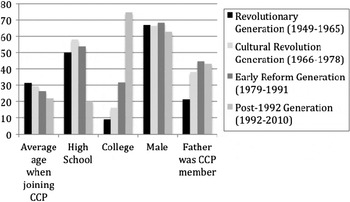
Over time, the operationalization of the CCP's strategy for recruiting new members has become apparent: it prefers young, well-educated, urban men. In annual reports of Party membership and new recruits, typically two-thirds or more of new members are under the age of 35 and have high school or college education, and most are men. A more detailed picture is presented in Figure 1, which uses data from the 2010 survey. First of all, it shows that the average age at which people joined the Party fell in the post-Mao period. During the 1980s and 1990s, owing to the advancing years of those already in the Party, the average age of CCP members was steadily increasing. The emphasis on recruiting those under 35 was designed to slow down the greying of the ranks.
Changing Characteristics of CCP Members, by Cohort*

For the post-Mao generations, high school education increased for the population as a whole. However, the number of CCP members with just a high school education dropped sharply as a university education became a more important criterion for admission to the Party. Numbers of undergraduate and graduate students grew rapidly after 1992, and as the CCP focused its recruitment efforts at the pool of college students, there were more college students and recent graduates to choose from. Those with only a high school degree are less valued as potential recruits.
Not only is a college degree more common among younger cohorts of Party members, but college campuses have become the main venue for recruitment efforts.Footnote 12 Among those who joined the CCP in 2010, 40.2 per cent were college students. This was the largest single group of new members, far surpassing farmers (19.6 per cent) and workers (6.4 per cent).Footnote 13 At elite universities like Tsinghua University, 28 per cent of all undergraduates, 43 per cent of graduating seniors, and up to 55 per cent of graduate students were CCP members in 2010.Footnote 14 At less prestigious universities, the numbers are lower, further reflecting the CCP's strategy for targeting elites. Just as it prefers to recruit new officials for its Party and government bureaucracies from the more prestigious universities, it looks to the same places to recruit members.
According to a former Party secretary of a university in Liaoning, universities are given a cap – not a target, but a cap – on how many students they can admit. Footnote 15 Typically, officials are rewarded for exceeding targets, but in this case the CCP wants to limit the numbers who are recruited into the Party to prevent the Party from growing too rapidly. The cap is therefore necessary to prevent universities from admitting too many students into the Party.
The CCP shifted its recruitment strategy to focus on college students for a variety of reasons. First, it needed a stronger presence on campus to avoid another popular protest movement, as happened in both 1986 and 1989. The CCP made little effort to recruit college students in the early post-Mao era: less than 1 per cent of college students were Party members in 1990.Footnote 16 The proportion of Party members among college students is dramatically higher today. Second, it sought to co-opt urban elites early, when their careers were just beginning. Third, the retirement of large numbers of officials and managers who had been trained in the 1950s and 1960s created many vacancies that could not be filled by the “lost generation” of the Cultural Revolution, who had not had the opportunity to attend college and therefore lacked the expertise the CCP desired.Footnote 17 At the same time, there was a push to get the middle-aged members to boost their academic credentials in order to be eligible for many cadre posts. Many of these degrees were of dubious merit, however. Recruiting from college campuses helped to ensure that members had the skills and capabilities their degrees imply.Footnote 18
This change in recruitment strategy also entailed a change in how the CCP screens applicants for political loyalty. In the past, the CCP recruited people in their late 20s and 30s, by which point the Party organization had opportunities to evaluate not only their socio-economic background but also their work performance. Whereas a college degree was previously a key criterion for membership, now it is college students, not graduates, who are targeted for recruitment. They must be judged on their potential for loyalty, rather than their demonstrated loyalty. Those in charge of recruitment can still use some of the traditional indicators of loyalty (for example, father's Party membership, and participation in the Communist Youth League), but have little information on whether student recruits will be loyal Party members in the workplace. As part of the application process, college students have to attend a year of Party classes in addition to their regular curriculum. These classes include lectures on Party ideology, discipline, and a “correct world view.” In these classes, recruiters are supposed to determine the true motivations of those who want to join the Party, weeding out those who are primarily interested in advancing their careers or economic prospects. As will be shown below, however, self-interest has become an increasingly prominent motive for joining the Party.
Finally, although most CCP members are men, the proportion of women in the CCP has been growing steadily in recent years. According to CCP reports, between 2007 and 2010, women accounted for 35–38 per cent of new members; as a result, the share of women among all CCP members increased from 17.8 per cent in 2002 to 23.3 per cent in 2011. This change is less obvious in the 2010 survey, which sampled only from urban areas. As the CCP's recruitment strategy shifted from rural to urban areas (and from agriculture and industry to professional and service sectors), the proportion of women in the Party increased on the whole. The change in emphasis was less pronounced in the larger urban areas, where a much higher percentage of Party members were women throughout the post-1949 era.
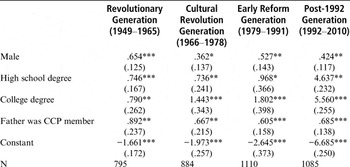
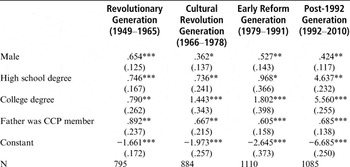
Table 1 highlights the relative importance of these criteria when the others are held constant. In large part, they reinforce the analysis above. The advantage of being male in terms of Party membership fluctuates, but generally declines over time. Even when age and gender are held constant, those with a college degree are much more likely to be Party members than those with middle school education or below, and that advantage grows over time.
Determinants of CCP Membership
Notes:
Probit regression coefficients with standard errors in parentheses. *p < .05; **p < .01; **p < .001.
Although not officially acknowledged in CCP reports, parental pedigree is another significant determinant of Party membership. The importance of having a father who is a Party member declined in the early post-Mao period,Footnote 19 but increased again for the youngest cohort. The renewed importance of the father's Party membership is likely owing to the falling age when joining the CCP: when Party recruiters seek to determine the loyalty of potential new members, a father's Party membership may be the most tangible – if not necessarily reliable – indicator.
Party Membership Incentives
In the nationwide urban survey used in this article, 15.7 per cent of respondents reported they were CCP members. This is much higher than the approximate 6 per cent of the total population who belong to the CCP for two reasons: first, the survey includes only those over 18 years old, so the percentage refers to the adult population, not the total population; and second, Party membership is more common in the cities than in the countryside. Why did these people join the Party?
According to the conventional wisdom, supported by interviews with people who have recently joined or applied to join the Party, the main incentive is pragmatic: people join in order to improve their career prospects. This presents a dilemma for Party recruiters: how do they make sure that the new recruits will be loyal Party members and are not simply motivated by professional advancement? Party officials in charge of recruitment on college campuses acknowledge this is a big problem for them, which they attempt to address by raising the bar for admission into the Party. In addition to their regular classes, students who apply to join the Party also have to take special Party classes, as noted above, pass exams on morality and Party history, and do volunteer work. This is designed to weed out people with primarily material interests, but few are deterred. According to the Party secretary of a university in Xi'an, approximately 80 per cent of the students at his university applied to join the CCP.Footnote 20 Nevertheless, the CCP is highly selective in who it lets into the Party: for every person who joins the Party, many others have their applications turned down. In 2011, 21.6 million people applied to join, but only 3.16 million (14.6 per cent) had their applications accepted, giving applicants about a one-in-seven chance of being admitted into the CCP.Footnote 21
The perception that Party membership boosts a person's job prospects is not illusory. There is a glass ceiling in many career paths for people who are not Party members. The CCP controls the top positions in most sectors – state bureaucracy, education, state-owned enterprises, banking, etc. – and people with ambitious career goals see the benefits of Party membership. Even for people who are just starting out, Party membership is appealing because many employers reportedly see Party membership as an indication that an individual has already passed a screening process and therefore will be a more dependable employee. In a survey of private entrepreneurs, 62 per cent said they would prefer to hire Party members, all else being equal.Footnote 22 Job competition is intense among college graduates, creating a high unemployment rate for those just graduating. As a result, Party membership becomes another important credential that increases job prospects.
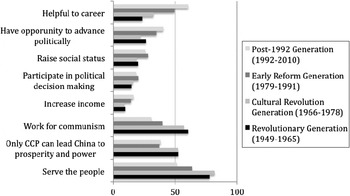
The motivations for joining the CCP have changed markedly over time. In the 2010 survey, respondents were asked to identify the three most important reasons for joining the CCP.Footnote 23 By dividing the Party members into separate cohorts, the differences in their motivations become apparent. Figure 2 shows that the youngest cohorts – those that came of age during the post-Mao reform era – are much more likely to report self-interest (such as helping their careers, advancing politically, and raising social status) as a motive and much less likely to report political and ideological motives (such as serving the people, working for communism, and faith in the CCP) than the older cohorts. The different motivations of these four political generations could hardly be more apparent. But it is important to note that, even among the youngest cohort, the majority cite “to serve the people” as one of the reasons they join the Party. They are less likely to give this reason than those in older cohorts, but most still contend that their motives are not totally self-serving.
Motivations for Joining CCP

How well do these motivations match the results? If the conventional wisdom is correct, then Party members should be more likely to hold high-paying and prestigious jobs, and Party membership should have an effect independent of the other characteristics of membership itself, such as gender and education. Party members are predominantly male, are more likely to have a high school and even college education, and are more likely to live in urban areas, all attributes that are also beneficial to obtaining good jobs. Party membership should be positively associated with good jobs even when those other factors are controlled for; if not, the conventional wisdom may hold only a grain of truth. On the other hand, if people join the Party for idealistic reasons, we should see evidence of their idealism. Do they exhibit higher standards of citizenship? Do they serve the people in some demonstrable way? If not, then we may suspect that their alleged motivations are self-serving.
A final question is whether the CCP gets what it expects from its members. Part of its strategy for recruiting new members is to build support among key sectors of society. It targets the best-educated young people in the more advanced sectors of society as its new base of support. Do they in fact have more support for the Party and government than do non-members? These three questions – do Party members have better jobs, do they serve the people, and do they hold higher levels of political support? – will be examined in the sections below.
Rewards of Party Membership
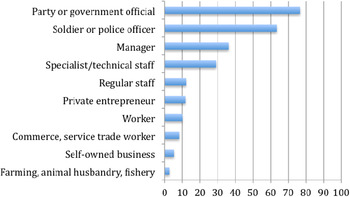
Party membership is a marker of political loyalty for recruitment into elite positions.Footnote 24 The CCP wants any position of authority to be held by people it trusts and over whom it has some degree of scrutiny and control. This is especially true for Party and government posts, but also true for universities, hospitals, SOEs and even non-state enterprises and organizations. For people who aspire to these jobs, Party membership is a necessary if not sufficient credential. As a result, Party membership is more concentrated in some professions than others. Party members tend to be under-represented among jobs at the low end of the social hierarchy, such as agriculture and blue-collar jobs, and more concentrated in the jobs involving higher skills and/or political authority. As seen in Figure 3, Party membership is highest among those who work for the state (Party, government and security), less so for entry-level white collar and service sector jobs, and lowest in agriculture, industrial labour and small-scale enterprises.
Proportions of Party Membership in Different OccupationsFootnote 44

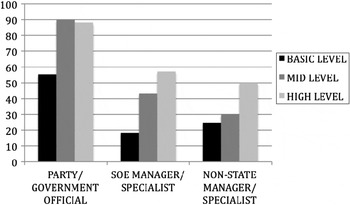
Previous research has found multiple career paths and diverse ways of achieving high paying and prestigious jobs in the party-state bureaucracy, state-owned enterprises and the non-state sector.Footnote 25 In order to assess the importance of Party membership for gaining access to the top jobs, I will concentrate on these three paths. As shown in Figure 4, Party members are more concentrated in high and medium level jobs than in basic level jobs, more in political than economic jobs, and more in SOEs than in non-state firms. However, these top jobs also require other credentials and attributes. In the post-Mao period, the CCP has put an emphasis on not just loyalty, but also on expertise when appointing people to administrative, management and technical jobs.Footnote 26 Higher education is also an important asset in the non-state sector.
CCP Members in Select Occupations

Since Party membership is also highly correlated with the other factors that are required for top jobs, how important is Party membership when other traits are also held constant? In an earlier study, Dickson and Rublee found that Party membership was not a statistically significant determinant of prestigious jobs when other factors were held constant; instead, education was the key.Footnote 27 That study was based on a survey from 1988, which was relatively early in the post-Mao era. Much has changed in the meantime, so we should not assume that the results are still valid. By 2010, the composition of the Party and the requirements for advancement were fundamentally different from the situation at the time of the 1988 survey.
The 2010 data show the value of Party membership in obtaining top jobs (see Table 2). Among those in the Party/government bureaucracy, Party membership is the key determinant, even when education, age and gender are controlled for. Its coefficient is positive, large and highly significant. Education is also a significant factor, but less important than Party membership. For top jobs in SOEs, education is the primary credential, although Party membership is also significant. In the non-state sector, Party membership is positive but falls just short of statistical significance (p = .06). Another distinctive feature of top jobs in the non-state sector is the negative coefficient for age, indicating that those posts are primarily held by young people, in contrast to Party/government and SOE posts, where seniority is more important. (NB. in all three career paths, a test for a curvilinear relationship was negative, so only Age and not Age 2 is reported.) This finding is consistent with broader trends in the job market: most jobs are being created in the non-state sector, so those recently entering the job market would be more likely to find jobs there. One surprising finding, given China's male-dominant occupational hierarchy, is that the coefficient for Male is not statistically significant in any of the three career paths, indicating that gender is less substantively important than the other achievement-oriented credentials. Given these findings, it is no surprise that so many college students join the Party. The career benefits are quite obvious.
Determinants of Access to Top Jobs in China

Note:
Probit regression coefficients with standard errors. *p < .05; **p < .01; ***p < .001.
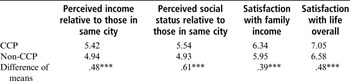
In addition to career benefits, Party members receive other advantages. CCP members have higher incomes relative to those in their communities, believe they hold a higher social status, and are more satisfied with their incomes and lives overall (see Table 3).Footnote 28 For each of these questions, respondents were asked to compare their incomes and social status relative to others in their own communities, using a 0–10 scale (0 = lowest, 10 = highest). They used the same 10-point scale to indicate their level of satisfaction with their incomes and life overall. For those who joined the Party for the material benefits, these data suggest they received them in tangible and intangible ways.Footnote 29
Perceptions of Economic and Social Well-Being (Average Scores on 0–10 Scale)

Note:
***p(t) < .0001.
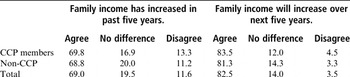
However, on a different set of questions about changes in income, CCP members were no different from non-members (Table 4). Almost 70 per cent of both groups reported that their incomes had risen over the past five years, and over 80 per cent expected their incomes to rise over the next five years. The absolute level of income may be higher for CCP members, but the vast majority of all respondents reported that their incomes had improved in recent years and an even larger majority expected their incomes to rise in the coming years (the difference between CCP members and non-members is small and not statistically significant). This also reflects the CCP's strategy for survival: Party members may benefit from access to the most prestigious and high-paying jobs, as well as the social status that goes with them, but even non-Party members believe their financial situation is improving and will continue to improve. The benefits of economic growth in China are distributed widely, albeit unevenly.
Changes in Income, Past and Future (%)

Mobilizing Loyalty
When recruiting new members, the CCP screens the applicants' political loyalty. Once in the Party, expectations of loyalty continue. The CCP mobilizes its members to participate in political and civic activities to demonstrate their loyalty and to serve as exemplars for the general population.
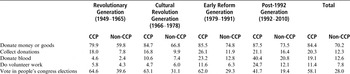
CCP members are more likely than non-members to engage in political and civic activities such as voting and volunteering their time, goods and services (see Table 5). There are also important generational differences: the youngest cohort was the most likely to report undertaking these activities. But, even among this youngest cohort, CCP members were more likely to have participated than non-members. In fact, for every type of behaviour and within each cohort (with the single exception of volunteer work among the Cultural Revolution generation), Party members were more likely to have participated. Of course, this is not just a tribute to the public spirit of Party members. The Party organization actively mobilizes its members to behave in these ways. For example, after the Wenchuan 汶川 earthquake in 2008, the CCP mobilized Party members to donate almost 10 billion yuan for rebuilding and other relief work.Footnote 30 Party members are also expected to take on other kinds of burdens. According to the Party secretary of the university in Xian mentioned above, about 60 per cent of the graduates of his university went to work on the western frontier after graduation, and most of them were Party members.Footnote 31 In these and other situations, the Party organization makes sure its members lead by example.
Civic Behaviour among CCP Members and Non-members, by Cohort (%)

Another prominent form of behaviour is voting. Urban elections in China are primarily limited to local people's congress elections, which have not drawn as much attention as village and township elections. Local people's congress elections are not as meaningful as executive elections at the village level, and turnouts are not as high: in the nationwide sample used here, only 18.6 per cent of respondents reported voting in the most recent people's congress election, and only another 14.1 per cent reported voting in a previous people's congress election. Put differently, over two-thirds of urban residents reported that they had never voted in a people's congress election. However, Party members were more than twice as likely to have voted in these elections (58.1 per cent compared to only 28 per cent for non-members; see bottom row of Table 5).Footnote 32 In contrast to the other forms of behaviour described above, the youngest cohort was less likely to vote than the older cohorts. But the importance of Party membership remains the same: within each cohort, Party members were about twice as likely to vote as non-members. The explanation is largely the same also: the Party organization mobilizes its members to get out and vote, and as these figures show, does so effectively.
Like many forms of political participation, voting and voluntarism in China are influenced by a variety of factors and require multivariate analysis to assess fully. In addition to Party membership, other personal characteristics – education, age and gender – typically influence political behaviour. In addition, we should also consider several other possible explanatory variables. First, material interests may influence an individual's likelihood of participating. Higher levels of personal income may make voluntarism more likely because people have more income to share. Income and the local level of prosperity may influence voting behaviour, either to bring about change for those who are lagging behind or to maintain the status quo for those who have prospered from it. To test these hypotheses, I have included two indicators of material interests: the respondents' family incomes relative to others in their communities (Level of Income) and the per capita GDP of the cities in which the respondents live.
Finally, democratic beliefs may influence voting behaviour. Respondents were asked, “Generally speaking, are you satisfied with the way democracy is practised in China?” and gave their answers on a four-point scale, ranging from “very unsatisfied” to “very satisfied” (see Table 6). Most outside observers would not assess the level of democracy in China to be high, so those who are satisfied with the current level of democracy should not be mistaken for democrats.Footnote 33 Voting is normally considered a pro-democratic form of behaviour, but in the Chinese context, voting in these kinds of elections may have a different meaning.Footnote 34 Previous research has found that most people in China do not know who their people's congress delegate is, and do not see these elections as politically significant.Footnote 35 If voting in China is seen as a sign of support for the status quo, then we would expect those who are satisfied with the level of democracy to be more likely to vote. Satisfaction with democracy is not conceptually relevant to voluntaristic activities, and is not included in their analysis.
Satisfaction with Democracy in China

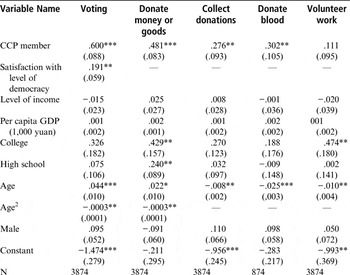
As Table 7 demonstrates, CCP membership remains the most powerful influence over voting in urban people's congress elections, even when other variables are controlled for. Its coefficient is large and highly significant. Among the other explanatory variables, only satisfaction with democracy is statistically significant: the more satisfied respondents were with the way democracy is practised in China today, the more likely they were to vote. Conversely, those who were dissatisfied with democracy in China were less likely to vote. This reinforces the viewpoint that voting in urban elections in China should not be seen as reflecting democratic sentiments. Indicators of material interests – level of income and per capita GDP – are not significant predictors of voting, nor are level of education or gender. Age has a curvilinear relationship with voting: the probability of voting increases with age, then declines among the oldest in the population. When looking only at CCP members, none of the usual predictors of voting – political beliefs, income, education, gender – help explain which Party members do and do not vote. From this contrast, it is clear that Party membership, and not any other individual characteristic, is the primary driver of voting behaviour. Mobilized loyalty makes CCP members vote.
Determinants of Voting and Voluntarism in Urban China

Notes:
Probit regression coefficients with standard errors in parentheses. *p < .05; **p < .01; ***p < .001.
Party membership is also the strongest predictor of most forms of voluntarism. It is the most important influence on whether people collect or give donations of money, goods, or blood. The only form of voluntarism where Party membership is not significant is doing volunteer work; in fact, it is not statistically significant even when only post-Mao cohorts are considered, even though CCP members in these cohorts were twice as likely to volunteer. This may be owing to the importance of a college education, which is a statistically significant predictor of volunteering. Many college graduates – CCP members and non-members alike – volunteer to work in remote places in hopes of better jobs later.
The only other variable that has a consistently significant impact is age: its relationship with donating money and goods is curvilinear, and negative with collecting donations, donating blood and doing volunteer work, indicating that these activities are more likely among young people.
In short, most forms of political and civic behaviour in China are influenced by the CCP's mobilization of its members. Voting and collecting and giving donations are examples of mobilized loyalty, designed to symbolize the support for the Party's leadership and the political status quo. But do CCP members actually support the leadership and status quo more than the population at large?
Does Party Membership Produce Political Support?
The CCP mobilizes the loyalty of its members, but is that loyalty genuine? Put differently, in the absence of mobilized loyalty, are Party members more likely than others to support the political status quo?
The question of popular support for the regime has been of interest in recent years. As expectations of political change have gone unfulfilled, scholars have looked for explanations of regime continuity in China. One explanation concerns the coercive tools and repressive tactics common to most authoritarian regimes.Footnote 36 The CCP has, to date, eliminated all organized challenges to its monopoly on political power. While it has liberalized the economic and social realms, the political sphere remains firmly under its control.
The survival of the CCP as China's ruling party is not based on fear alone, however. Numerous studies have found a remarkably high level of popular support for the incumbent regime, based largely on improving standards of living, greater economic opportunity and the nationalist sentiments that have accompanied the accomplishments of the gaige kaifang 改革开放 (opening and reform) policies.Footnote 37 This high level of support is all the more remarkable because of the well-publicized governance failures – corruption, pollution, inequality, denial of most civil liberties, etc. – that have also accompanied the reforms.Footnote 38 The solution to this puzzle is in large part based on a corollary observation about political support in China: most Chinese distinguish between levels of the political system, blaming problems on local levels and crediting higher levels with good intentions and positive results.Footnote 39
The 2010 survey data allow us to evaluate variations in the level of political support for different levels of the state and the determinants of that support. In particular, for the purposes of this article, the data allow us to see whether the CCP's recruitment strategy has generated new sources of support among the groups it now targets. If that is so, Party members should have a significantly higher level of support for the state when other potential explanations are included and other factors are controlled for.
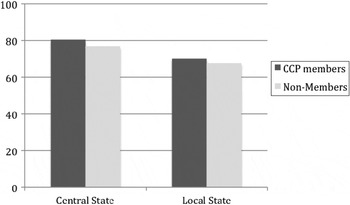
The hypothesis that CCP members should support the state more than non-members does not require much justification. The CCP properly expects its members to be loyal supporters, and the advantages of Party membership should generate a discernible measure of support. To measure political support, I use the respondents' levels of support and trust, respectively, with the central and city-level state institutions: CCP, government, people's congresses, courts, and procuratorate. Respondents were shown a card with an 11-point scale, ranging from 0 for “no support (or trust)” to 10 for “high support (or trust).” The responses to these questions were combined into indices of popular support for the centre and local states. Each index is comprised of ten questions (five regarding support of the five institutions, and five regarding trust in those institutions), and ranges from 0–100. Consistent with previous research, respondents had sharply different levels of support and trust for different levels of government, with higher levels for the centre than for the local level (see Figure 5).
Support and Trust for Central and Local State Institutions (0–100 scale)

As was the case for voting and voluntarism, Party membership is not the only determinant of support for different levels of state institutions, so a multivariate analysis will highlight the relative importance of different factors. In this analysis, I use the same set of variables used above. In addition to Party membership, this includes satisfaction with democracy, level of income, per capita GDP, education, age and gender. Three additional variables are added: retrospective income gains (whether a person's income has increased over the past five years; see Table 4), and GDP growth (2005–2009) are included to show change over time, and both are generally assumed to increase the level of support; per capita GDP 2 is included to determine if GDP per capita has a linear or a non-linear relationship with political support.
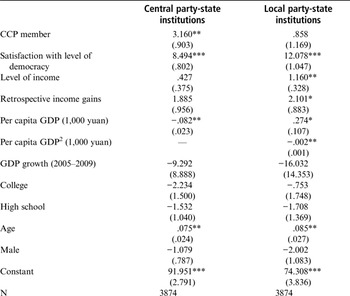
The results of this analysis of political support in China are shown in Table 8, and reveal several surprises. First, Party membership does indeed raise the level of support for central state institutions, but has a negligible (and not statistically significant) effect on support for local state institutions. The finding of support for the centre is not surprising: the CCP should expect that its members have higher support than the population at large, and tries to recruit people who will be loyal Party members. But the absence of significantly higher support for the local state is contrary to the CCP's efforts at building support through recruitment of new members and appointments to top jobs. Given the many advantages that Party members enjoy, this is a remarkable finding. It indicates that even political insiders – the ones who should be the main defenders of the status quo – have no more support for the local party-states than the population at large. Because most political protests in China are aimed at the local state, this could have consequences in future episodes of political mobilization. The participation of Party members as protest leaders (as in Wukan 乌坎 in 2011–12, for example) could prove to be additionally destabilizing, because it would signal defection from the party-state.Footnote 40 As a result, in episodes of large-scale local protests, we should find the CCP warning its members not to join the protests.
Determinants of Popular Support for Different Levels of Government

Notes:
OLS regression coefficients with standard errors in parentheses. *p < .05; **p < .01; ***p < .001.
Satisfaction with the level of democracy in China today is positively correlated with support for both the central and local states. It is worth repeating the caveat above, however: definitions of democracy vary widely in China, and are often quite different from scholarly notions of the concept. Satisfaction with the level of democracy need not mean respondents believe the level of democracy in China is on a par with Western democracies, but that they define democracy in terms of personal freedom, economic opportunity, or leaders who govern in the public's interest. CCP leaders frequently speak on the topic of democracy and give their own interpretations of it, and in particular how Chinese democracy is different from Western democracy. Regardless of the definition, the positive correlation between satisfaction with democracy in China and support for state institutions is straightforward: those who are more satisfied are more supportive.
The measures of aggregate and individual prosperity have contrary results for central and local state institutions. First, per capita GDP is negatively related to support for central state institutions (the test for a curvilinear relationship was not statistically significant, and is omitted here to simplify the presentation). In other words, the more economically developed a city is, all else being equal, the less respondents in that city support the central state institutions. This goes against the CCP's stated goals, and also against the conventional wisdom that the CCP's legitimacy is based on producing economic growth. Moreover, neither level of income nor retrospective income gains are statistically significant (the latter falls just short of statistical significance, p = .055). The expectation has been that both individual and aggregate levels of prosperity would generate support for the CCP. The results presented here do not support that expectation.
For local state institutions, individual indicators of prosperity have the expected outcomes: the higher their income level and the more their incomes are increasing, the more they support the status quo. This is, of course, the wager the CCP leaders are making – more prosperity in exchange for more support and continued Party rule. However, per capita GDP has a curvilinear relationship with political support: the level of support for local state institutions initially increases at higher levels of per capita GDP, but then declines at the highest levels (the test for a linear relationship was not statistically significant and is omitted here to simplify the presentation). This is most definitely not part of the wager CCP leaders are making. Growth in per capita GDP is not correlated with popular support for either central or local state institutions. As levels of per capita GDP rise, popular support for central state institutions falls in a linear fashion and support for local state institutions tapers off and then falls.
The cause of these contrary findings will require further investigation. It may be that those in less developed areas are more appreciative of the development that has occurred in recent decades, although not necessarily in the most recent years, because they started from a lower level. It may also be that those in more developed areas are less satisfied with the externalities of growth – pollution, congestion, corruption, and so on – and are therefore less supportive of the status quo. Similarly, the most prosperous cities in the survey also tend to have the largest populations, and large cities have more governance challenges. In these cities, if respondents were less satisfied with the quality of public goods (such as health care, education and transportation), they may in turn have less support and trust in the state. Finally, it may reflect a trend consistent with modernization theory: as economic development continues, people become less willing to accept the political and economic constraints of the status quo.
Among the demographic variables (education, age and gender), only age has a statistically significant impact on political support: all else being equal, the older the respondents, the more support they have for both central and local states (a test for a curvilinear relationship between age and support was negative).
The key question of this section was whether Party membership produces increased political support when other factors are controlled for. The results were mixed: Party membership does produce significantly higher levels of support for the central state, but not for the local state. This suggests that Party members, like the population at large, make clear distinctions between levels of the state and evaluate them quite differently. Party members, as representatives and beneficiaries of the status quo, should be more supportive of it, but that is only partially true. This bifurcation in support of the central and local states could have consequences in future episodes of political activism if Party members join with others in their communities. In addition, the contrary effects of individual and aggregate prosperity also call for a nuanced interpretation of the sources of political support in China. Economic growth in and of itself may not be the legitimizing force that most observers, including Party leaders, normally assume.
Conclusion
The data presented in this article reveal three key findings relevant to the future of the CCP. First, they indicate that many people are motivated by career incentives to join the Party. For those who aspire to positions in the Party/government bureaucracy or SOEs, Party membership is quite often a necessary, if not sufficient, condition. For those in the non-state sector, Party membership is neither necessary nor sufficient. In the more dynamic sectors of the economy, youth and college education are the primary attributes for obtaining top jobs. Second, the data also indicate that CCP members are more likely to donate time, money, and even blood, for various causes, and also are more likely to vote in local people's congress elections. These behaviours are signs of mobilized loyalty: the CCP mobilizes its members to participate in these activities to demonstrate their loyalty to the regime and to serve as examples to the rest of the population. Third, Party members are not necessarily more likely to support and trust their state institutions: while they do have significantly higher levels of support for the centre than does the population at large, Party membership does not produce increased support for the local state. Although Party membership provides a variety of benefits, it does not translate into support for all levels of the state. Just as Party membership does not guarantee political support, neither does economic development: all else being equal, support for central and local party-state institutions is lower in the most developed cities. Both of these findings call into question the Party's recruitment and development policies. Political support is not guaranteed through Party membership, and is eroded by higher levels of development.
These findings raise several possibilities for the future. First, Party members may not be loyal supporters of the status quo during protests against the local party-state. Defections from the state are one indicator of regime instability. While it is wise not to overstate this possibility, it is necessary to be aware of it. Second, the CCP is likely to continue its scrutiny of applicants, seeking both professional skills as well as political loyalty. If it fails to screen out those who only desire membership for the material benefits but do not exhibit even mobilized loyalty and do not support and trust the state, the CCP is likely to face a further weakening of its internal cohesion and external reputation. Third, the relationship between individual and aggregate prosperity and popular support for the continuation of CCP rule in China is not as straightforward as Party leaders and outside observers assume. The CCP has succeeded in its strategy to recruit new members and promote economic development; however, the results presented here indicate that these alone are not sufficient to generate the political support that is also needed to sustain Communist Party rule in China.
Appendix
The data presented in this paper come from a survey implemented in China during the autumn and early winter of 2010. The survey was a nationwide probability sample of urban areas, including the provincial-level municipalities (Beijing, Tianjin, Shanghai and Chongqing), prefecture-level cities and major cities. From this pool of over 280 cities, a sample of 50 cities was selected using the probability proportionate to size (PPS) method, meaning that cities with large populations had a higher probability of being selected than smaller cities. Equivalent numbers of cities were selected from each of three strata (high, medium and low levels of per capita GDP). Within each city, a district was selected as the primary sampling unit (PSU) using the PPS method, based on the number of housing units in each district. Each PSU was divided into 30′′ × 30′′ squares using GPS technology, and from this grid three squares were selected as secondary sampling units using the PPS method, with the number of households as the measure of size.Footnote 41 Within each secondary sampling unit, three sub-squares (roughly 90 metres square) were selected as tertiary sampling units with a simplified random sampling method. Among all the occupied residential units within the selected sub-squares, 60 equidistant residential units were selected. Finally, on the basis of a Kish grid, individuals within each selected residential unit who had lived there for at least six months and were between the ages of 18–80 were chosen as respondents and were interviewed face-to-face.
The actual implementation of the survey was conducted by the Research Center for Contemporary China of Peking University (RCCC), under the supervision of Shen Mingming 沈明明, Yang Ming 杨明, Yan Jie 严洁 and Chai Jingjing 柴晶晶. All the interviewers for this project were enrolled college students in the targeted provinces and cities. RCCC supervisors trained the interviewers and monitored their work daily. The survey included a total of 3,874 respondents.
In order to address the problem of missing data caused by non-responses to individual questions, multiple imputation is used. The benefit of multiple imputation is that it allows us to avoid both the problems of omitted variables and selection bias from listwise deletion because all observations are retained. The potential downside is that estimating missing data reduces standard errors, and thus may exaggerate the strength of relationships between variables.Footnote 42 However, the benefits generally outweigh the costs, and the analysis presented in this article uses data derived from ten rounds of imputation using the program, “Amelia II: A Program for Missing Data,” developed by Gary King and his colleagues.Footnote 43 The multiple regression analysis incorporates estimates from all ten rounds of imputation, and uses the “mim” software module running within Stata. In all multivariate models, survey weights are included to correct for design effects.